



Abstract
The International Monetary Fund estimates that the Indian economy contributes over 8% to the global gross domestic product (GDP), making India the fifth largest economy in the world. However, the formal and informal sectors do not contribute equally to the national GDP, with over 80% of this total originating from the informal sector. Street vending, among other informal activities in India, is a vital contributor to the informal economy. Many scholars argue that despite the critical influence of physical urban patterns on the practicability and viability of informal activities, urban planners are not providing adequate urban planning policies. Bangalore, the third largest Indian city by population, is the subject of the present case study. Although this city hosts a wide variety of cultures, economies, and lifestyles, 74% of its population can be categorized as working in the informal sector. The goals of this research study are (a) to explore spatial planning in relation to the urban informal sector in Central Bangalore, (b) to identify the physical urban challenges experienced by the city’s street vendors, and (c) to examine the implications of these challenges for the city’s master plan. Through interviews, surveys, and site analysis (mapping), This study elucidates (a) the challenges experienced by the area’s stakeholders (i.e., vendors and buyers), (b) the limited planning of the spatial urban form by urban planners with regard to the accommodation of informal economic activities, and accordingly, (c) the need to implement spatial planning policies and design regulations appropriate to Bangalore’s high-density marketplace.
Keywords
Introduction
As a developing country, India has an economy that is best considered by distinguishing agricultural and nonagricultural primary sectors. Over the past two decades, the latter’s contribution to the nation’s economy and productivity has increased steadily, making it the dominant contributor and, as a result, attracting the attention of national economists. This attention has in turn shed light on the increasing share of the “informal” or “unorganized” sector of the nonagricultural component of the economy.
The descriptor “informality,” in the context of urban planning, was introduced in the early 1970s by W. Arthur Lewis to refer to unplanned business establishments. He argues that informal economies play a critical role in regulating social and environmental aspects of the built environment. Globally, the informal economy has persisted since the industrial revolution and it remains a vital economic sector, providing affordable goods and employment to a large proportion of the population, especially in developing countries. Although the informal economy has often been thought of as consisting merely of residual or temporary activities, it is a substantial contributor even to major world economies (Hein, 2019; Sheng et al., 2018). UN-Habitat defines the informal economy as all units, activities, and workers not categorized under any judiciary regulation, the output of which does not contribute to a nation’s regularized economy. The term “informality” is in constant flux in the urban planning context, but the term “informal economy” generally refers to economies being generated “passively” rather than through the direct workings of new or existing regulations (Gelder, 2013; Harris, 2018; Portes et al., 1989). Researchers stress that the term has been largely misunderstood and that the urban character of informal urban public spaces has rarely been systematically evaluated (Harris, 2018).
As a result, informal urban public spaces operate outside the purview of state regulations, often without formal control in terms of planning, design, and regulation. Such spaces can be defined as larger areas comprising informal or spontaneous housing, economic, and/or social spaces to which occupants have no legal claim. The UN-Habitat report published in 2006 predicted that the growth in users of informal spaces would reach 1.4 billion by 2020. According to the United Nations, more than a billion people around the world already utilize informal spaces in their daily routines, a number growing by an additional million people per week (Burdett et al., 2018; Deatrick, 2020; Informal City Dialogues Reader, 2013).
The literature review below explores the uses of urban spaces by people engaged in the informal sector, as well as the shortcomings of current planning principles in reflecting or addressing these uses. The presence of informal urban public spaces in developing countries contributes to a wide diversity in the public realm linked to the social, economic, and physical fabric of a city. Although the benefits of the informal economy are generally known, as yet little or no legislation or spatial norms have been put into practice to ensure the rights of employees working in the informal sector. Appropriate zoning of vending and non-vending spaces is a rare phenomenon in the cities of developing countries. Furthermore, even those areas which have been zoned for vending are usually insufficient to accommodate new and existing vendors. The frequent result is that informal-sector employees occupy public spaces illegally and that small enterprises start their businesses at non-registered locations. This not only affects the social safety of employees at an individual level but also creates disorder and an unsustainable functioning of a city’s economy.
As noted earlier, India is currently the world’s fifth largest gross domestic product (GDP) contributor, with over 80% of the country’s economy coming from its informal sector. Bangalore, one of the three or four largest metropolitan regions in India (Mohanty, 2019), contributes 10% of this total, and as one of the major economic centers in India, serves as an ideal target for the present study. The 450-year-old city has been an important trading hub since its inception, and the old trading fort has developed into the present city’s central marketplace, buzzing with vendors selling their goods and services throughout its streets, which collectively form an informal urban public space.
This research project explores the evolution and sustenance of the informal marketplace in Central Bangalore and seeks ways to reorient the city’s urban planning principles so that they suitably incorporate such informal urban public spaces. A framework is developed incorporating policy and regulations aimed at enhancing the spatial urban form of street vendors’ physical environment so that their socioeconomic security and safety are ensured. The study addresses the following questions: (a) What strategies can be incorporated in Bangalore’s core area to ensure an adequate spatial urban form and a healthy physical working environment for street vendors? (b) What policy changes can promote socioeconomic security and safety for street vendors?
Literature Review
Urban Informality in Indian Cities
Urban informality forms a ubiquitous scene in major cities of urban India. A large proportion of India’s 8% contribution to world GDP originates in the informal sector; unemployment acts as a key enabler for the growth of informal economies in India and in developing and underdeveloped countries more generally. The dependence of the formal sector on informal activities, coupled with the inability of the formal sector to meet the employment needs of a diverse group of citizens in India, acts as a catalyst for the growth of the informal economy. As a result, a great number of poor people turn for their livelihoods to the informal economy (Jha, 2018).
In his 1973 study of “informal urban income opportunities in Ghana [West Africa],” Keith Hart discusses how the broad range of industrial activities in a developing country contributes to substantial variations in wages. This variance in wages, which encourages the development of an informal economy, must be acknowledged in each city’s planning strategy (Hart, 1973). Urban planning in India lacks planning strategies addressing informal activities, still following the narrative of a “Third World mega-city” without due consideration of the various economies—both formal and informal—thriving in the country. In her seminal work regarding planning in India and (lack of) recognition of the informal economy, Roy (2009) states that planning in India proceeds through systems of deregulation and exceptionalism catalyzed by social movements and insurgence, making the informal sector an “idiom” of the planning process. Thus, the privatization of planning and the strategies used by Indian cities to “future-proof” by rational planning norms only serve to indicate that India cannot plan its cities efficiently unless they give priority to urban informality in their planning processes (Roy, 2009). Negligence and indifference by planners toward non-critical government regulations applicable to the informal components of society are prominent in India. Local (state- or city-level) policies and reforms have a greater impact on informality, due to the relative immediacy of such intervention compared to those originating at higher administrative levels (Saran & Sharan, 2019).
Policies and reforms in India support—but also restrict—the right to engage in informal activities. For example, in the Indian constitution, Article 19 (1) (g) confers upon every citizen the right to practice a profession which can positively contribute to the nation’s economy. However, Indian Penal Code 1860, Section 283, fails to provide support for street vending activities. These loopholes lead to confusion in enforcing policy, which can further lead to unauthorized activities (Patel, 2019).
Whether a given urban space in India will tend to host informal activities is determined by a number of factors that can be social, economic, or environmental in nature, depending on context, the urban fabric, and users themselves. An example of this can be seen in the start-up of a small-scale enterprise on unlicensed land that is not visibly managed or owned by anyone and which appears suitable for public use, such as a street, public garden, or other community space. This lack of clear designation may well result in illegal encroachment onto a public throughway and/or hindrance of other community amenities (Glaeser & Henderson, 2017). Another major factor that facilitates informal settlement and employment is the absence of ownership titles. Apparently unowned spaces such as those below elevated expressways, unused land near railway tracks, and areas close to polluted canals are frequently taken over informally in the absence of clearly marked and regulated property titles (Roy, 2011).
In recent decades, India’s primary economy (i.e., the agricultural and governmental industries) is gradually being supplanted by secondary and tertiary industries (public enterprises, and informal or service-based enterprises, respectively), as defined by the Indian convention. Moreover, due to government support, small-scale industries, most of which do not have a static location, are incentivized and thereby develop faster. This creates pockets of informal spaces wherever such industries happen to be located. In addition to these factors, social-temporal factors, such as easy accessibility, visibility, presence of natural resources, and reliance on indigenous resources, play a strategic role in determining the locations of informal spaces (Miller et al., 2018).
In summary, the fact that spatial arrangements tend not to be clearly defined in Indian legislation compels informal vendors to occupy any available land they deem suitable for public use. Bangalore, one of the fastest-growing metropolitan areas in the world, has undergone a drastic transformation over the last decade. The pressure to organize informal economies in core, densely packed market areas has risen along with the increase in demand for cheaper products. The present study focuses on street-level planning for the informal sector in Bangalore’s Krishna Rajendra (“K. R.”) Market, which is primarily engaged in the vending of fresh produce. Despite this focus, the challenges faced by K. R. Market vendors are comparable to those encountered by most any vendor in densely populated markets in other Indian cities as well. The approach followed in this study is systematic, proceeding in the following stages: (a) understanding the current spatial arrangement of street vendors around K. R. Market; (b) analyzing the social challenges faced by these vendors, determined in part through the use of interviews and surveys; and (c) proposing tactics for a spatial arrangement of vendors which would both benefit their businesses and help the authorities better regulate the area’s streets.
Street Vending as Urban Informality in Bangalore
Bangalore, the capital and largest city of the state of Karnataka, is located in southern India as shown in Figure 1. From 1971 to 1991, the city’s population grew from 1.66 to 4.1 million and grew still further by 2011 to 8.5 million. As illustrated in Figure 2, this rapid population growth was accompanied by considerable expansion of the city’s built-up area as well; the area covered by the city increased from 200 km2 in 1971 to 1900 km2 by 2011 (Surie & Sami, 2017). The north and east sides of the city have barriers to expansion which include stone mines and large industrial manufacturing facilities. The western and southern boundaries of Bangalore used to have considerable areas of forest and agricultural land, which were largely eliminated due to British infrastructural development. The resulting growth pattern has been one of urban sprawl.
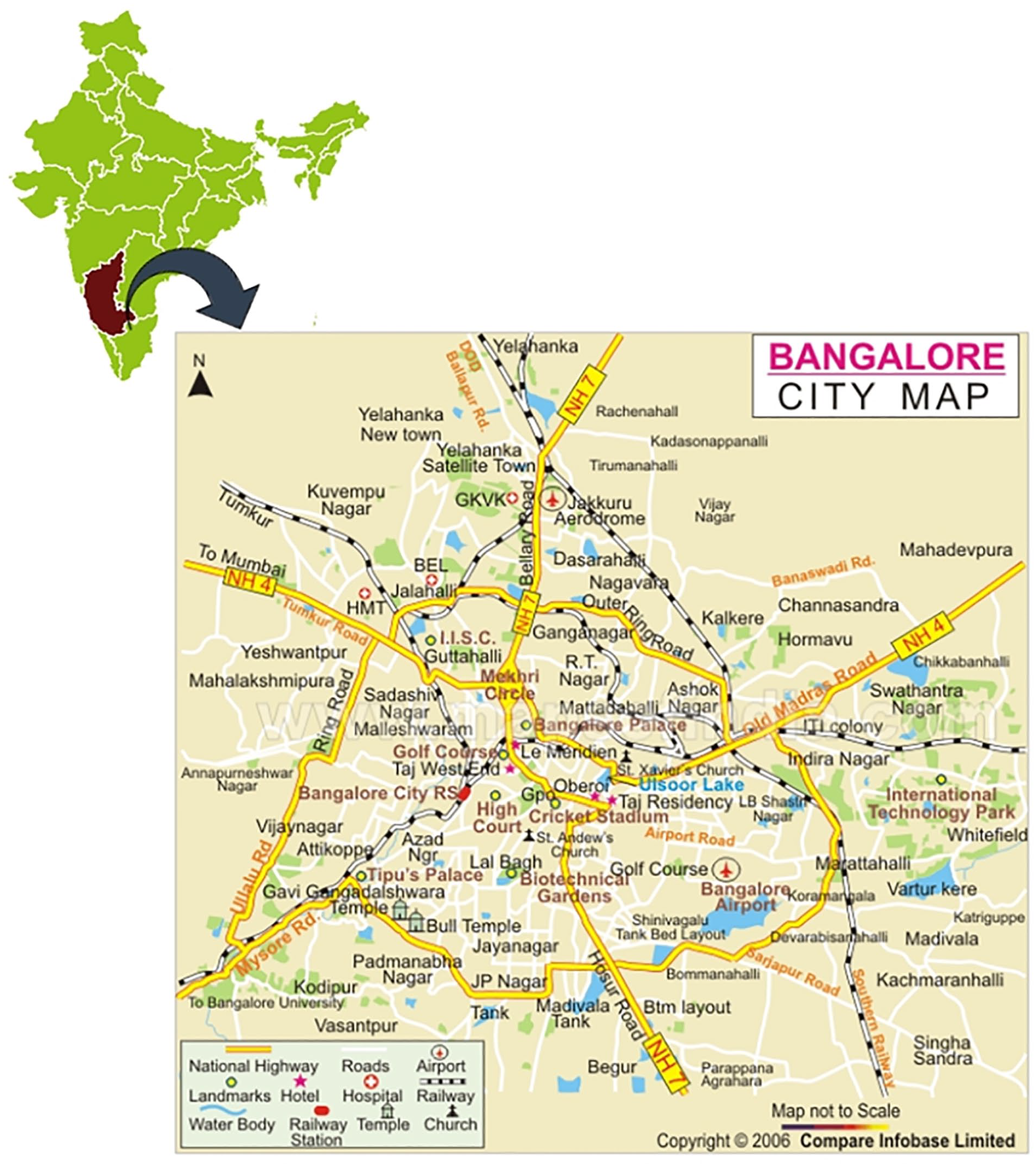
Map of Bangalore.

Expansion of Bangalore’s built-up area from 1990 to 2015.
As of the 2010s, Bangalore was the first city in Karnataka state to reach a population exceeding 1 million, so that the urbanization pattern of Karnataka is primarily concentrated in Bangalore’s large metropolitan area. The city’s rapid population growth has had three primary drivers, which have remained relatively stable over the years, as shown in Figure 3. These primary constants, as shown for the years from 1981 to 2001 in the figure, are natural increase, in-migration, and jurisdictional change (Sudhira & Nagendra, 2013).

Population growth by migration, jurisdictional change, and natural growth in Bangalore from 1981 to 2001.
As shown in Figure 4, the physical footprint of Bangalore has expanded along with its population growth, effectively tripling over the decade from 2001 to 2011. However, the accompanying economic growth has not been distributed equally throughout the population, as tends to be the case in many developing countries. Even in comparison to other urban areas of the Indian subcontinent, a large proportion of Bangalore’s population suffers from extreme poverty. In spite of the fact that Bangalore has been hailed as a “city of millionaires” due to its tech moguls, the per-capita income (PCI) in the city was only $690 as of 2004 (Ranganath, 2019; Rao, 2020). A large proportion of the city’s population belongs to the middle and lower-middle income groups, but about 43% of the population still lives in multidimensional poverty and often lack access to even basic needs (Mahendra et al., 2010).
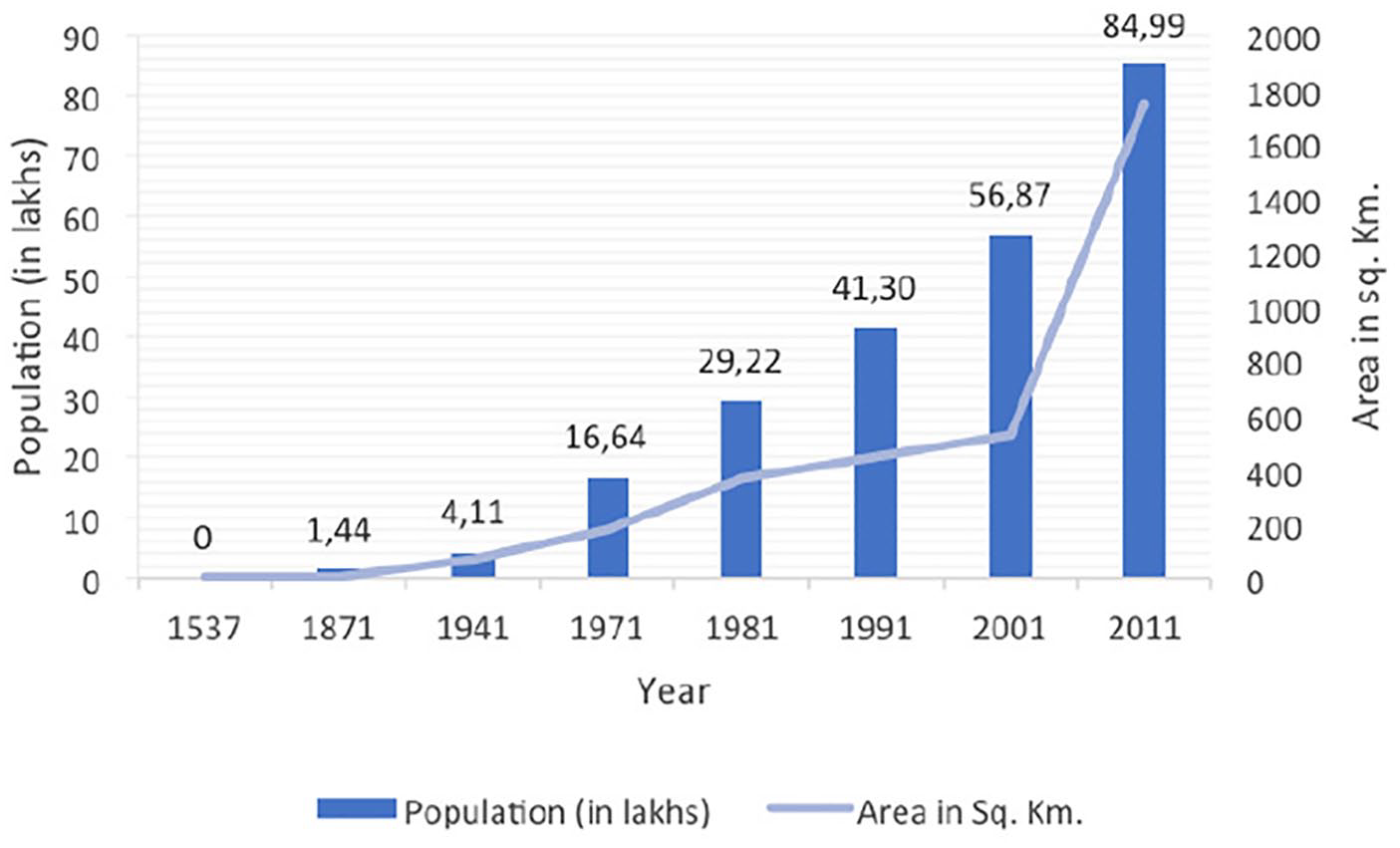
Population growth of Bangalore from 1537 to 2011.
Many of these developments can be traced to events in the city’s history. Bangalore first underwent large-scale industrialization during the British era, when several corporations were set up to support England in the wake of the Second World War. The British invested mainly in the industrial and defense sectors. Later, from the 1950s to the 1980s, substantial growth in public-sector investments was seen, and the 1990s saw rapid growth in the private sector, especially in IT and related services (Manish, 2013). Wipro, Infosys, Microsoft, and IBM were attracted to the city as they developed their investments at both the local and international levels. At the same time, engineers and professionals from various institutions around Bangalore contributed their support to the industry.
This shift in economic dominance from the public sector to the private sector resulted in a change in the urban texture of the city. The primary industry, mainly composed of agricultural and state-owned industries, and the secondary industry, comprising the public sector, declined in relative terms by the 1990s. At the same time, growth in the tertiary industry, of which the informal economy is a major part, gradually became more dominant in its share of contribution to the state GDP. This shift can be considered more “intense” than “radical,” from a developing country point of view (Marshall & Rossman, 2010; Wilson, 1996). The primary sector’s contribution to India’s GDP in 1980 was 40%, declining to 23% by 2004. Bangalore was a major player in this economic shift.
Clearly, this meant a move away from Bangalore’s agricultural industry toward the tertiary industry, whose contribution to Bangalore’s GDP was about 48% in 1980–1981, increasing to 70% by 2010–2011, as shown in Figure 5 (Surie & Sami, 2017). Thus, it can be argued that due to changing economic trends in Bangalore, the tertiary economy, of which informal activities (e.g., street vendors) are a vital part, must be taken into consideration by city planners. A well-planned, context-specific spatial arrangement for street vendors should be seen as an essential component of the master plan development process.
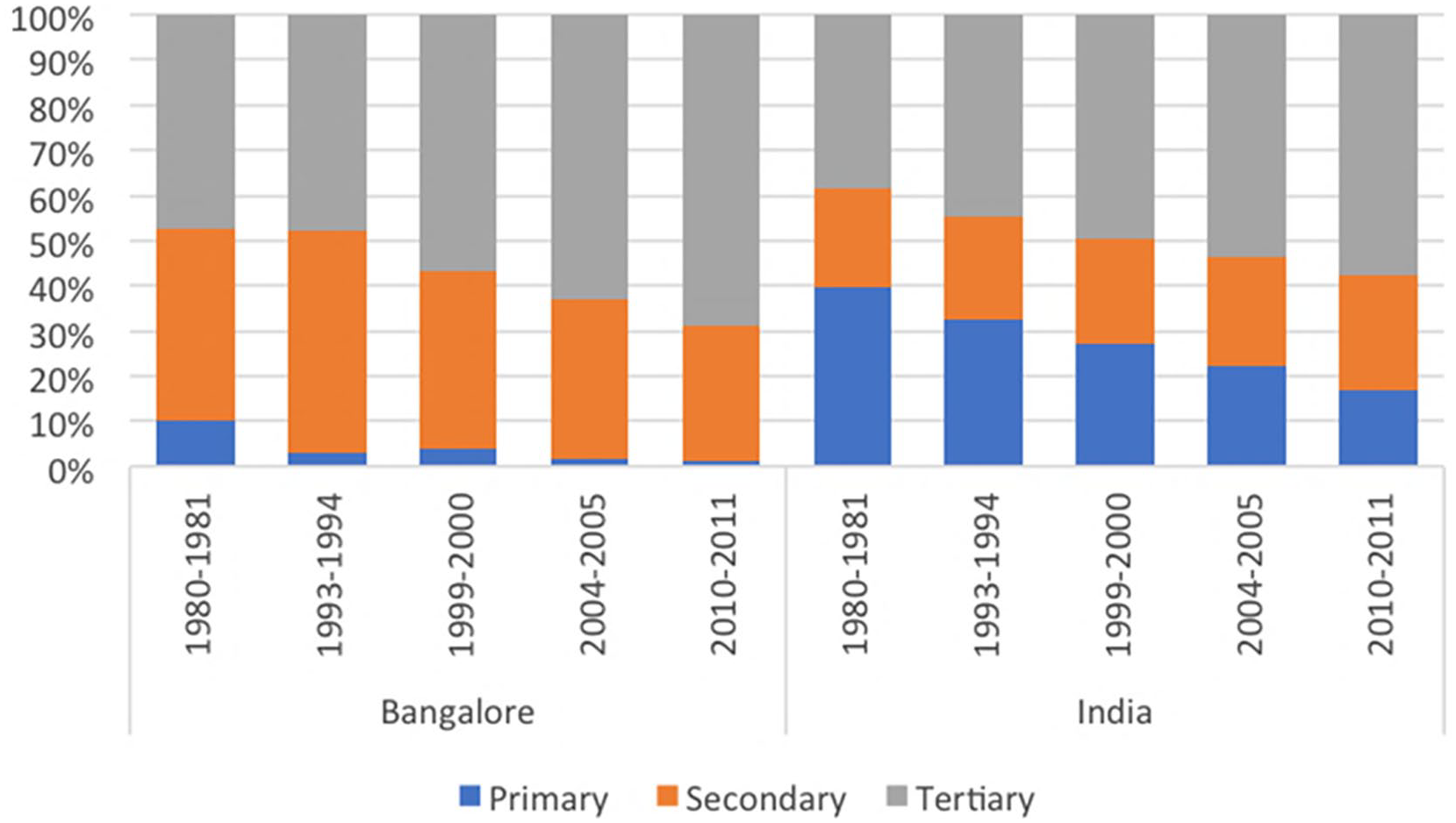
Contribution to gross domestic product in India and Bangalore, broken down by sector.
Research Design
The research design of the present study is shown in Figure 6 and is divided into four sections: (a) Literature Review, which provides a framework for understanding urban informality and the significance of street vending in Bangalore as a part of that city’s urban informality; (b) Methodology, which elucidates the contents and reasoning behind the study approach, including the approach used to collect data; (c) Site Description, which involves an exploration of the site’s settings and their impacts on site users; and (d) Design Proposal, a strategic framework based on a spatial proposal/plan, aimed at determining and addressing challenges at the microlevel.
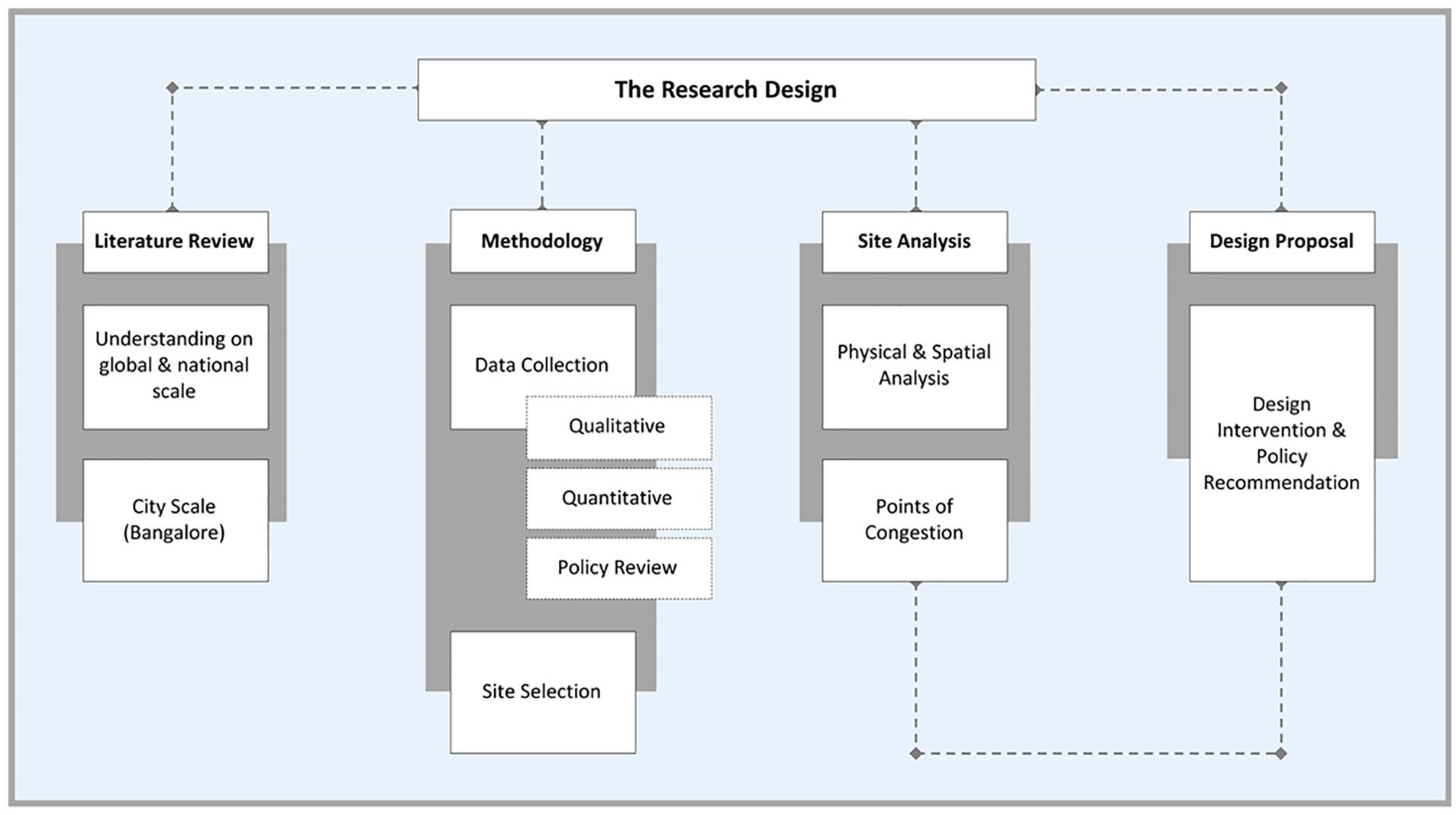
The research design adopted in the present study.
Findings
The results consist of four main sections: (a) an exploration of street vending as an economic urban informality in Bangalore and its relevance to K. R. Market; (b) an investigation of the types of informality prevalent in the core of Bangalore; (c) an identification of challenges faced by the area’s stakeholders (i.e., vendors, buyers, and supervisors) due to the lack of clear policies regulating the spatial urban form of the informal sector; and (d) a proposed framework based on policy and regulations seeking to enhance the spatial urban form of street vendors’ physical work environment and to provide them with adequate social and economic security.
Street Vending as an Economic Urban Informality in Bangalore
In 2017, the World Resources Institute (WRI) developed a map for Bangalore city, which categorizes its geographic regions into four types: centers, corridors, wedges, and peripheries (Pai & Dhindaw, 2017), as shown in Figure 7. Centers are defined in terms of economic agglomeration, usually incorporating traditional markets. Informal economies dominate these markets, which are typically characterized by street vending. These vendors travel to the city from neighboring villages and agricultural areas to trade their products, and return to their villages once their products are sold out. One such center is known as the Pete area, in which K. R. Market is an important hub for informal activities. A key challenge for users is the increase in demand for goods sold in informal markets due to the ever-increasing population. This growth in demand in turn leads to an increase in the number of street vendors, who do not have access to adequate facilities or infrastructure. This leads to bustling and chaotic streets which overflow onto main thoroughfares, leading to disturbances in the local traffic flow and creating additional congestion.

Economic centers, corridors, wedges, and peripheries in Bangalore.
The foregoing discussion has detailed how Bangalore’s informal economy has grown along with its large formal economy. Street vendors throughout Bangalore, who sell a wide array of items ranging from flowers to prepared food to toys for children, play a significant role in contributing to this informal economy. Street vendors not only define the character of streets in every city of India, but are also reflective of the culture and specialties of each city. Although each vendor is different in the specifics of how he or she sells goods (e.g., selling out of a basket or a cart, using space on a road or a pedestrian thoroughfare), all face many of the same challenges.
Bangalore Mahanagar Palike (BMP) announced hawking zones and licenses in 1999, yet research suggests that no accompanying legislation was passed. Neither vendors nor officials were aware of the zones which were meant for hawking or informed about related regulations (Naveen & Hampole, 2004). When interviewed by Hampole, vendors consistently reported being harassed by officials and asked for bribes. The replacement of the BMP by the Bruhat Bengaluru Mahanagara Palike (BBMP) took place in 2007, and new drafts for hawking licenses and hawking zones were announced, but again, it was soon realized that no plan for executing these new policies had been thought through. The result is that vendors continue to vend illegally wherever they find space, creating disturbances for pedestrians and along adjacent roads.
Financial liabilities like those alluded to above constitute a major challenge when operating in the informal economy. In addition to bribes demanded by municipal authorities, these liabilities include paying for essential services such as water, electricity, storage, public toilets, and waste disposal (Roever, 2014). According to statistics provided by the government of India, there are an estimated 10 million street vendors operating on the Indian subcontinent, of whom 30,000 work out of Bangalore. The relatively permanent vendors are located mostly in the city center, while the vendors operating in the outskirts are mostly mobile, meaning that they sell goods out of a basket carried on their heads or on bicycles. A recent study concluded that Bangalore vendors do not consider their activities to be temporary; in fact, most do not have any formal job and have been vending for more than 5 years (Gurtoo & Williams, 2009).
The focus location of the present research study, Krishna Rajendra Market, is commonly known as K. R. Market and is located in the core area of Bangalore. This city center area is known as “Pete” or “market center” in the local language of Kannada. The Pete area is one of the economic centers recognized by WRI India in its mapping project, mentioned earlier and illustrated in Figure 7. It is one of the oldest marketplaces, not only in Bangalore but in the whole nation, and is densely packed with commercial subareas. According to the local history, the 16th-century chieftain Kempegowda II invited in traders from surrounding cities and villages to encourage trade in the Pete area. K. R. Market had been the site of a battlefield and later, when British took over the local fort and city, it was turned into a public space (Government of Karnataka, 2016). For a long time, this public space acted as a buffer between the city and the local fort. However, in 1921, this public area was made into an official market space named after the then-king, Krishna Rajendra Wodeyar of Mysore. After that, a dedicated platform was created for vendors to sell their products. The platform was named Siddikatte, meaning “public platform” in the local language. Vendors came from Andhra Pradesh, North Karnataka, South Karnataka, Kolar, and other places to sell their wares, which included clothes, utensils, household items, and fruits and vegetables. In 1997, construction of a new three-story building was intended to lead to an improved environment supporting excellent retail and wholesale markets, with 21 shell roofs ambitiously designed to allow every stall to be lit by sunlight. Unfortunately, the design failed on many levels, as discussed below. Figure 8 illustrates the high proportion of commercial activity, marked in blue, taking place in the Pete area. The green circle highlights the area around K. R. Market, which can clearly been seen in the figure as part of a region of intense commercial activity. Street vending is the prominent commercial activity in this part of the city, especially in the spaces adjacent to K. R. Market. Photographs of the activities occurring in and around the market area are presented in Figures 9 through 12.

Existing map showing land use in Pete area.

Active hawkers on a weekday, as photographed from the opposite side of the western facade of K. R. Market.

Active hawkers on a weekday, as photographed from the K. R. Market building looking toward Sethu Rao Road.

Active hawkers on a weekday, as photographed from the flyover (north) side of Mysore Road, looking toward the K. R. Market building.

Active hawkers on a weekday, as photographed from the K. R. Market building, looking toward Coconut Market, the old market building.
Challenges and Points of Congestion for Street Vendors
In Indian markets, shop spillover and hawking on streets are common phenomena, and the Pete area of Bangalore is no exception to this. This study focuses on the street vendors in and around the K. R. Market building, shown in Figure 13 as the streets colored light green in the lower central part of the image. In the figure, some streets are marked with specific colors to show the type of informal activity typical for that particular location. For example, the light green color for the streets around K. R. Market indicates that the vending of fresh produce is typical there, while the yellow color marking streets in Chickpet indicates the vending of secondhand books. Even though the K. R. Market building was initially built with the goal of serving all types of vendors, this plan was unsuccessful because vendors’ business suffered once they were relocated within the building. As a result, vendors moved back out onto the adjacent streets, creating spillover and chaos that led to traffic congestion around all the major nodes of the area. These include the K. R. Market bus stop, the “green market” node below the Mysore Road flyover. Items sold in the Pete area include fresh produce, books, street food, mobile phones, and other electronic items. Vendors, some using carts and others using bicycles, often do not have a permanent location. Some set up shop in the same location every day; others operate in multiple locations that vary by the day of the week.
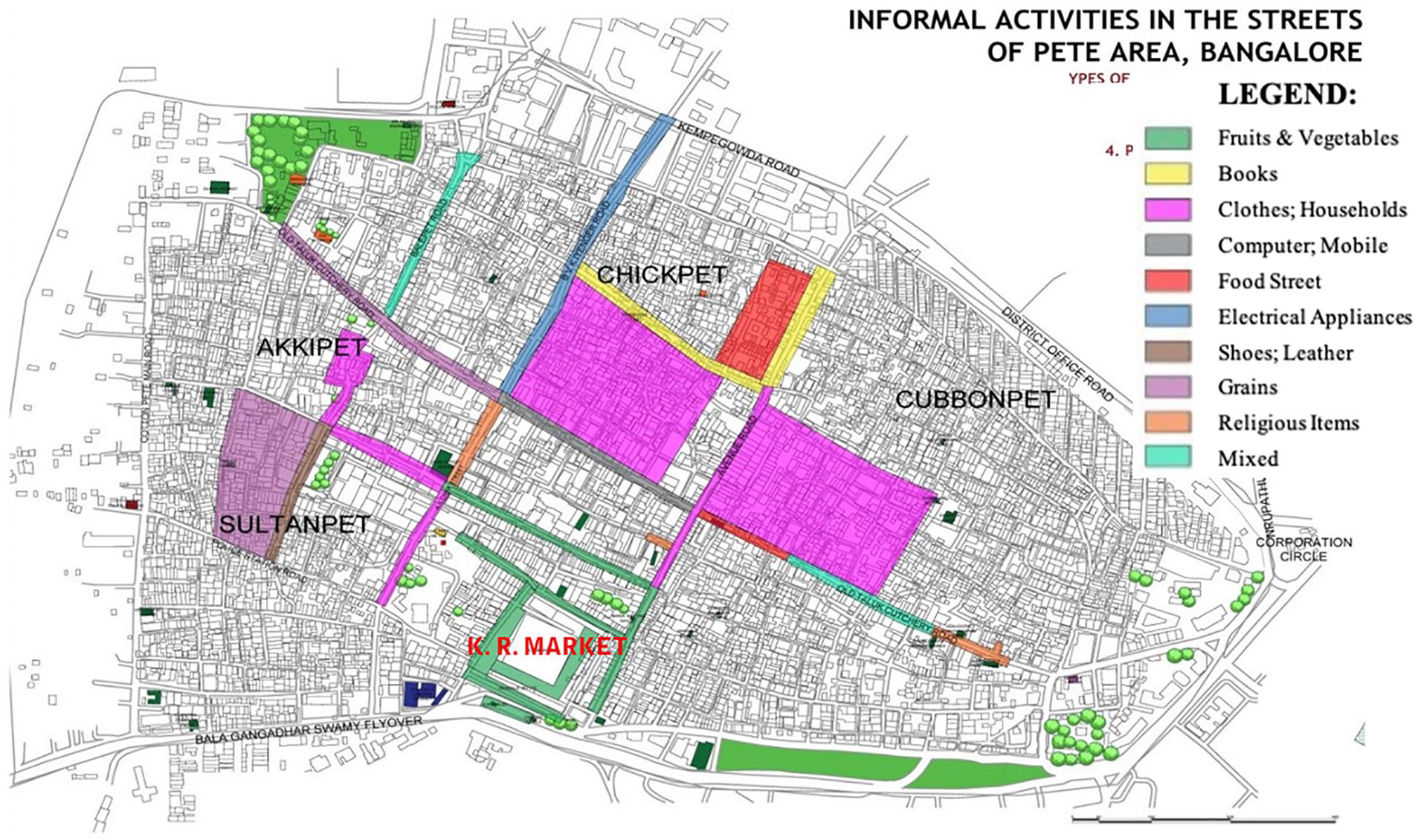
Types of informal activities in the Pete area.
The site in and around K. R. Market is notable because of the significance and extent of hawking activities occurring there on a daily basis. The amount of activity in and around the K. R. Market building is greater than that of other streets in the Pete area. Hawkers selling fresh fruits and vegetables in the peripheral streets of K. R. Market serve almost 40% of the total fresh produce needs of the whole of Bangalore (Government of Karnataka, 2016). This area is particularly suitable as a study focus because at this site, measures have been taken in the past which at least in principle were aimed at addressing vendors’ needs. The Smart City Bangalore recommendations developed by the municipality also address K. R. Market and the surrounding informal activities as a priority issue for redevelopment. The delineated area, illustrated in Figure 14, includes Sethu Rao Road on the west side (where fruit vendors are most prominent), the vehicular access street on the north side (hosting coconut vendors and loading/unloading activities of the flower market), the street on the east side (hosting vegetable vendors), and the street to the south which also hosts the main entrance to the market building (as well as additional vegetable vendors). The street under the Mysore Road flyover, which is also an extension of SJP Roads, is dedicated to vendors selling green leafy vegetables and thus is commonly known as the “green market.”
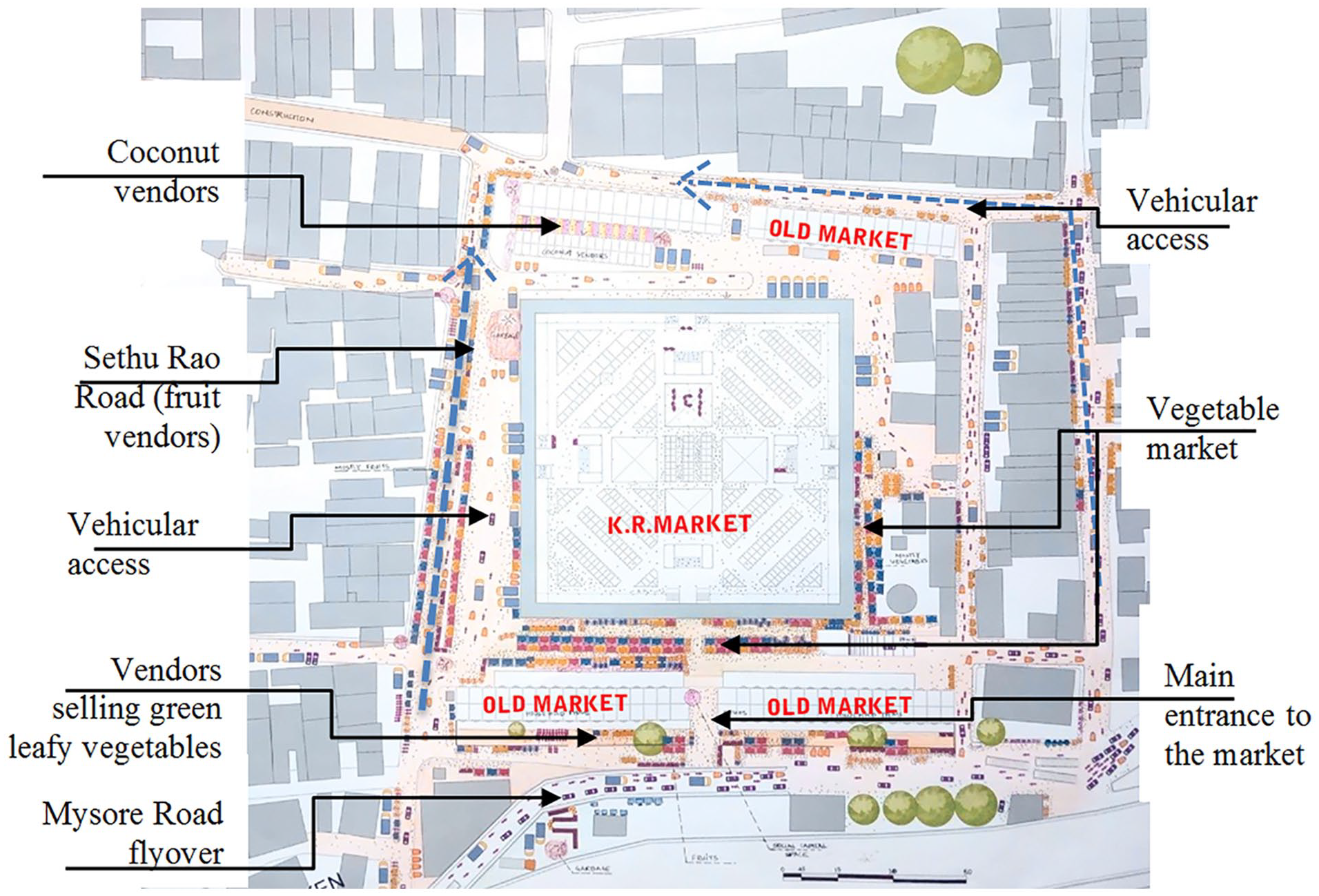
Base map showing the current conditions at and around K. R. Market on a typical day.
Proposal: Spatial Arrangement Criteria and Policy Recommendations
This research study now turns to two key challenges related to spatial arrangement: (a) visibility for all vendors and (b) ownership or licensing allowing them to conduct their business on the streets. Related to this second issue is the general lack of basic facilities like sanitation, accommodation, and food for vendors. Until these issues are resolved, chaos and inadequate safety will remain a problem for both sellers and consumers. To make forward progress along these lines, policy changes are required, so that vendors’ social and economic security are ensured. The policy proposed here calls for spatial planning norms that acknowledge and accommodate these needs, keeping the following points in mind (see also Figure 15 for an illustration of how the site should look once these recommendations are implemented):
It should be acknowledged that visibility is one of the most important factors in the business of street vendors. This policy recommends that the K. R. Market building’s ground floor be completely reworked to create much greater porosity, allowing all vendors there to enjoy sufficient visibility. This may involve substantial construction work, including the removal of some shop walls. One result will be that vendors can display their products on temporary platforms, which will be licensed by the authorities.
Municipal authorities should provide sufficient and clearly designated spaces zoned for vending, directly in the layout plans of the market area. The same kind of clear arrangement should be proposed for the streets as well, clearly separating vehicular and pedestrian paths. The proposal also recommends that Sethu Rao Road be used for vehicular access only, meaning that no vending activities will take place there. At the same time, the rest of the streets in the periphery of K. R. Market should be dedicated solely to vending. This design solution will also prevent traffic congestion during early morning hours caused by trucks being loaded and unloaded.
Mobile vendors should be permitted on all pedestrian streets except for those to be categorized as “no vending zones.”
With zoning of street vending incorporated into planning regulations, the authorities should include basic facilities and infrastructure within the K. R. Market building’s spatial arrangement. More specifically, this proposal recommends that the column structure of the building remain as it is, supporting the upper two floors, and that those floors be converted into hostel/housing facilities with proper sanitation. This would ensure a clean environment on the streets and provide vendors with greater social, physical, and business security.
The old market building—a series of shops on the north and south sides of the study site—should be reworked to create much greater porosity. Carried out properly, this would provide a large space for users, adequate for the 3,000 current vendors in addition to being able to accommodate a significant number of new vendors.
The K. R. Market bus stop node should be strategically redesigned to permit direct access (and visibility) to vendors in the building as well as to those on the street. The street to the east and the northern access road should be redesigned and re-designated for vehicular access only, which will help relieve congestion on the Mysore Ring Road during the early morning hours.
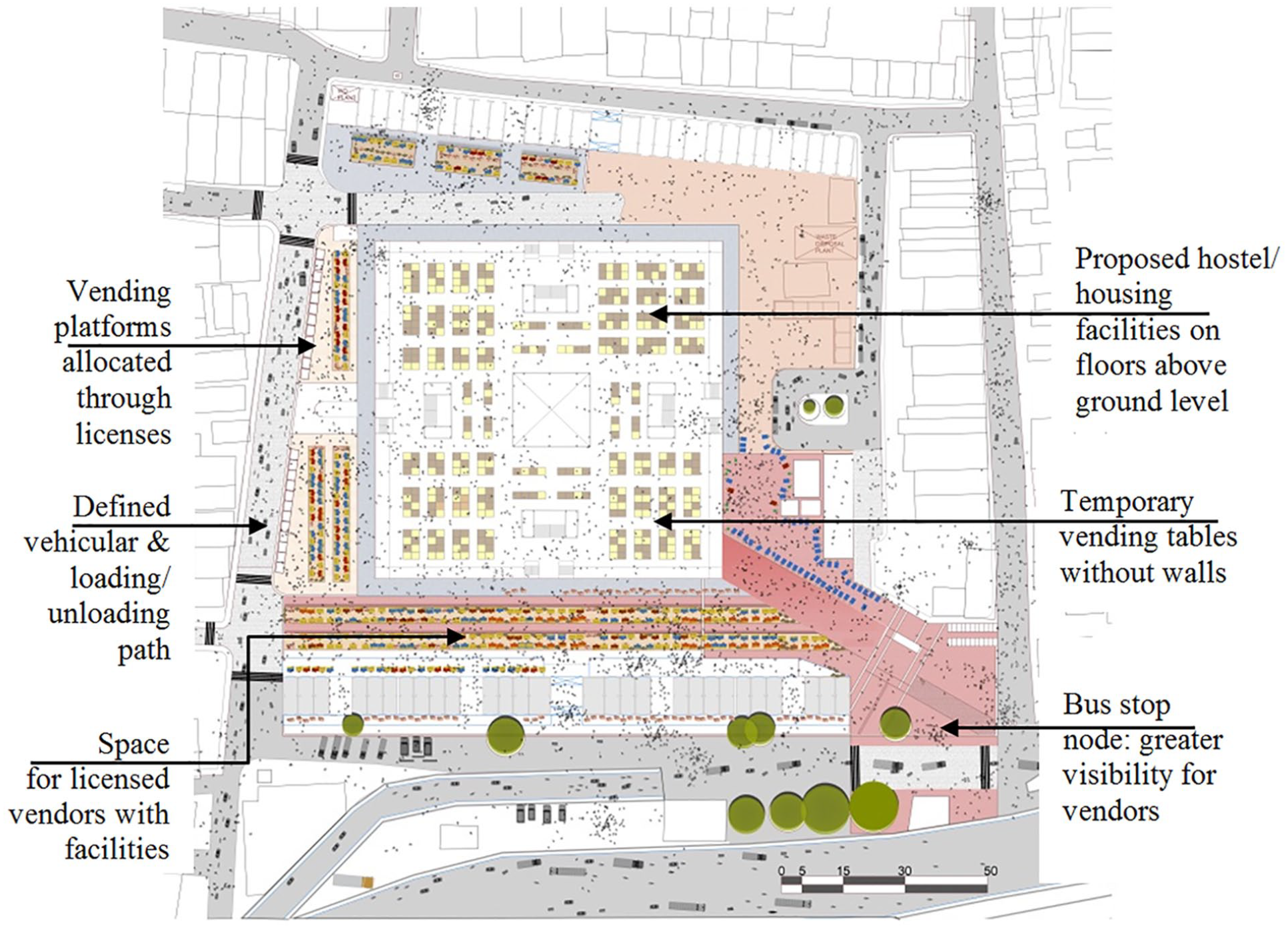
Proposed vending arrangements.
The present analysis has revealed a number of challenges currently faced by K. R. Market and the surrounding streets. In this light, the following recommendations for change at the policy level are proposed:
Designation of specific locations as vending zones or no-vending zones should not be left only to the municipal authorities; instead, such decisions must incorporate a participatory process that includes key stakeholders.
Licensing processes should take into account the situations of all vendors, keeping in mind the limitations they often face when required to provide documents from authorities in Bangalore as well as from those in various neighboring villages. Currently, there are about 3,000 vendors occupying the streets. The office or authorities empowered to provide licenses should be given enough resources to efficiently accommodate existing as well as new vendors.
Designation of specific zones such as loading/unloading areas should be complemented by close monitoring of such areas to ensure users understand and comply with these policies. Vendors should be given full support and guidance in order that they understand such regulations.
Solid waste facilities should be installed, taking into account the proximity of vendors, thus encouraging a participatory approach. In addition, littering on the streets should be a punishable offense.
Timing restrictions on loading/unloading processes and other vending-related activities should correspond primarily to the needs of street vendors, while also aiming to ensure that public spaces are not too congested.
Discussion and Conclusion
This research study included a review of the literature pertinent to the role of the informal sector and its significance in developing nations like India. Large-scale attempts to convert informal businesses into formal ones are unlikely to be viable, as this would change the very character which permits them to survive. At the same time, people involved in the informal sector should be accorded more recognition socially and be provided with better economic security. This can be accomplished, at least in part, by licensing informal activities and by giving such vendors the right to locate their businesses within designated areas. With this notion as a starting point, the present study has documented the oldest settlement in the southern India city of Bangalore. This has included a thorough investigation and documentation of a variety of informal activities taking place on the streets of a high-density market area, specifically the area in and around K. R. Market, which is dominated by street vendors selling fresh produce. The findings have helped to define a framework based on policy and regulations aimed at enhancing the spatial urban form of street vendors’ physical work environment and at providing them with adequate social, physical, and economic security.
At present, little or no regulation along these lines has been put into practice, even though the Street Vending Act calls for city planning laws to be cognizant of the needs of street vendors. The same is true for state and national planning laws. If appropriately implemented, street vending has the potential to contribute greatly to a city’s economy and should therefore be given spatial recognition in the development plans of the city. This can be carried out by means of “Tactical Urbanism” applied at a smaller scale. A significant percentage of land should be zoned for vending around transportation terminals, hospitals, government offices, business centers, and similar places in which vendors can benefit from greater visibility. The massive struggle in cities to balance needs relating to vending, pedestrian and vehicular mobility, and hygiene will be alleviated once the status of vending rises to that of a regulated activity.
With respect specifically to the situation of street vendors at K. R. Market and its environs, this study recommends strategies for spatial arrangement on-site, such that (a) vendors’ visibility is enhanced, thus boosting their business, and (b) basic infrastructure and facilities for vendors are made available. These strategies would provide these vendors with economic stability in the long term. The licensing of vendors should be a priority item, and policy reform more generally needs to be considered. If these recommendations are implemented well, this chaotic market space can be transformed into a prime example of a successful informal market area, enhancing vendors’ security and social status.
Contribution to Knowledge
While there have been several market regeneration projects in India which were planned to accommodate vending as a primary activity, only a few of these have been successful. The key insight in that must be remembered when planning around informal activities is that there is no single solution to the dynamic challenges related to vendors in Indian cities. “One size fit all” does not apply to the informal sector.
The findings of the present research study provide an opportunity to rethink approaches to the informal economy which is so prominent in India, taking street vending as this sector’s most common representative. The proposal does not recommend a complete regeneration of the delineated site, instead proposing a framework for intervention at a microscale; this is aimed at (a) providing social and economic security to vendors and (b) following a planning process which recognizes the needs of all stakeholders.
Critically, implementation of the revealed strategies requires the adoption of a multifaceted approach, in which planners, vendors, municipal supervisors, economists, and social scientists merge their efforts while recognizing the need for a spatial form for this critical sector, enhancing the quality of life of those involved.
Implications for Practice and Advancement of Research
The government of Karnataka is obliged to provide improved infrastructure and facilities to street vendors. Redesigning and re-regulating the K. R. Market is one of the primary goals of the Smart City Bangalore project. However, urban planners and designers must develop and implement a strategic approach to defining the spatial urban form which will enable vendors to continue their business safely and thus contribute to the nation’s economy. Forced removal or relocation of vendors and/or stripping them of their rights can only lead to more havoc and continued illegal activities. Therefore, interventions must not compromise the legal rights or socioeconomic security of individual vendors.
Finally, the present study can be expanded further, by exploring other components of the informal economy, both in Bangalore and at other locations in India. The insights thus obtained can help provide a comprehensive understanding of “what does or doesn’t work” for the informal sector in India.
Footnotes
Acknowledgements
The authors would like to thank BBMP and its officials for providing maps and discussions of the reality “on the ground” as experienced by authorities in Bangalore. Furthermore, the authors are thankful to all of the vendors at the K. R. Market who positively contributed to the study, by providing valuable data through interviews and surveys. In addition, the authors would like to acknowledge the research-oriented vision of Qatar University as an academic institute supporting sustainable development in the State of Qatar. This paper was subject to a double-blind peer review process. The article processing charge (APC) was provided by the Qatar National Library (QNL). Finally, the authors thank the anonymous reviewers for their valuable comments, which contributed to a substantial improvement of this paper.
Declaration of Conflicting Interests
The author(s) declared no potential conflicts of interest with respect to the research, authorship, and/or publication of this article.
Funding
The author(s) received no financial support for the research and/or authorship of this article.
