




Abstract
Employees working across all domains of professions are exposed to workplace violence (WPV). Few researchers have investigated the effects of WPV on employee engagement (EE) and the impact of the work environment and organizational culture on their relationship. The aim of this research is to describe the effect of WPV on EE and clarify the relationship between WPV, work environment, organizational culture, and EE. A cross-sectional study was performed on the data, collected from 178 alumni of a university, currently employed in caring, customer care, managerial, and technology professions in Pakistan. Structural equation modeling (SEM), confirmatory factor analysis (CFA), analysis of variance (ANOVA), and Tukey post hoc tests were employed for data analysis. The results showed that 88.7% of respondents had experienced WPV during the last 12 months. Significant differences existed in the work-related harassment and physical violence reported by occupational groupings. WPV had a significant direct negative effect on EE (β = −.556**), work environment (β = −.440) and organizational culture (β = −.758**). Furthermore, the work environment (β = −.123**) and organizational culture (β = −.157**) have a significant negative effect on EE, and both mediated the relationship between WPV and EE. The results show that employees working in caring and customer care are exposed to considerable risk of WPV. The findings underscore that a supportive work environment and positive organizational culture play a mediating role between WPV and EE among employees.
Introduction
Workplace violence (WPV) has been a critical problem for organizations across the globe (Johnson et al., 2018; Spector et al., 2014; Stutzenberger & Fisher, 2014). Researchers have reported WPV as one of the significant reasons for employee dissatisfaction and reduction in employee performance (Chao et al., 2015). Managing the devastating impact of WPV on employee well-being, coworker relationship, and organization’s overall effectiveness has been a challenge for organizations. Moreover, failure in doing so causes insecurity in employees, which leads to employee’s disengagement at work. Employee engagement (EE) is “the amount of discretionary effort exhibited by employees in their jobs” (Frank et al., 2004, p. 16). It is described based on the nature of the relationship between an organization and its employees (Groenewold et al., 2018; N. Li, Zhang, et al., 2019).
According to Kahn (1990), personal engagement means that employees strive to link themselves with their work roles, that is, to engage or harness oneself physically, cognitively, and emotionally with their role performance. Furthermore, he argued that workers operating in a psychologically meaningful and physiologically safe environment are more engaged and psychologically available, hence establishing a relationship between the physiological and psychological effects of WPV and level of EE. In applying the construct of WPV to the EE domain, we propose that a supportive work environment and organizational culture reduce violence at the workplace and enhance the level of EE.
Supportive work environment provides transparent and open communication, work–life balance, training and development, recognition for hard work and strong team spirit to its employees. However, an essential aspect of the work environment is the amount of care and support employees perceive to be provided by their organization as well as by their supervisor (May et al., 2004). Supportive management creates an environment of trust and safety, which encourages employees to prove their work potential without the fear of failure, hence enhancing EE toward the job.
Organization culture refers to the beliefs and principles followed in an organization. The culture followed by the organization has a profound impact on the employees and their relationship among themselves. Edgar Schein described organization culture at three levels: artifacts (offices, décor, furnishings, dress, etc.), espoused values (company slogans, mission statements), and basic underlying assumptions (which are unseen and not consciously identified in everyday interactions between organizational members; Schein, 2010).
WPV researchers have given little consideration to the relationship between the multiple contexts within which violence and its consequences are linked with the level of job engagement and organizational engagement. Similarly, even though studies of EE acknowledge multiple aspects of cognitive (May et al., 2004; Rothbard, 2001), emotional (Men & Yue, 2019), and behavioral (Jurek & Besta, 2019) components that are associated with individual role performance and work environment (Olugbade & Karatepe, 2019), these accounts overlook the violence component. However, research linking WPV with EE remains limited, and moreover, the theoretical perspectives need to be explored yet.
WPV is a chronic concern for organizations, which is known to have long-term effects on employee’s psychological health (Rasool et al., 2020). Jung and Yoon (2019) argued that EE enhances employee commitment, job performance, and organizational performance. The literature presents that behaviors classified as supportive and encouraging provide a foundation to build a productive organizational culture. This study focuses on the aspects of WPV that exist in general and specifically focus on how work environment and organizational culture can lead to enhance EE. Furthermore, a majority of WPV literature contributes to studies conducted in the health care industry (Y.-L. Li et al., 2020; Murray et al., 2020). This study aims to evaluate and compare the prevalence of WPV against professionals working in occupational groupings, including health care.
In this article, we intend to address the gap in both WPV and EE research: (a) Conceptually, explore and analyze the adverse impact of WPV on EE; (b) measure the differences existing in WPV based on occupational groupings; (c) propose a work environment and organizational culture as key mediators that can significantly enhance the probability of identifying their positive impact on EE.
Based on this discussion, the research questions proposed for this research are as follows:
WPV and EE
Numerous researchers have reported aggression, violence, and hostility as a true anomaly in the occupational environment (Park et al., 2015; Roldán et al., 2013; Spector et al., 2014). Today’s fast-paced growth, hyperstressful environment, personal problems, and lack of compassion for others are the reasons for frequent occurrences of rage, aggression, and violence at the workplace. The workplace environment is plagued with stress, discriminatory interpersonal interaction, and mistreatment that ultimately, when reach the boiling point, cause severe damage to employee morale and ethics (Wressell et al., 2018). Furthermore, these adverse emotional behaviors damage the aspects of organizational well-being, resulting in exhaustion, inefficacy, and disengagement of employees.
WPV
Violence is widely misinterpreted as physical assault, causing injury or physical damage (Wressell et al., 2018). WPV is a problem at a considerable broader domain. Any act (physical or verbal) in which a person is abused, threatened, assaulted, or intimidated at his or her workplace by another person, comes under the domain of violence at the workplace (Kamchuchat et al., 2008). WPV is also known as occupational violence, which refers to violence, in the form of verbal (abuse such as shouting at or showing disrespect) or physical abuse or threat (hitting, beating, biting, throwing things, strangling, pushing, kicking, dragging), which can lead to health and safety risk of an employee and sexual harassment (attempt or force to sexual favor, to threaten or blackmail into having sex, offering money, gifts, or privileges in exchange for sexual favors; Arnetz et al., 2018; Fute et al., 2015)
Employees are exposed to violence while performing their duties, which has an adverse effect on their performance, mainly due to stressful conditions that lead to doing mistakes, high absenteeism, reduction in job satisfaction, and, in extreme cases, quitting job (Fute et al., 2015; Wressell et al., 2018). Moreover, a review of the literature has provided evidence showing cause of WPV is stress, and the primary source of stress is mistreatment, harassment, or assault of an employee by his or her coworkers or customers, mainly resulting from gender disparities (Kulkarni et al., 2018). Sexual violence comes under the category of sexual harassment, which is underreported, and the targets are usually women. Employees on temporary contracts are highly exposed to such forms of violence as compared with full-time workers. Furthermore, discriminatory harassment based on gender, ethnicity, race, and even disabilities has received less attention in the literature (Lippel, 2018).
EE
EE has been broadly explained as the physical, cognitive, and emotional connection between the employee and the organization (Bedarkar & Pandita, 2014). Furthermore, it is described as the degree of alignment of employee’s personal goals with the vision of the organization in which they are employed (Andrew & Sofian, 2012; Bakker & Albrecht, 2018). The concept of an engaged employee is related to his or her emotional connection with the organization, which determines the extent to which he or she is personally involved in meeting the organization’s objectives and its success. To work that extra mile (effort) for the success of the business, an employee needs to own it as his or her personal success (Schaufeli & Bakker, 2004).
An engaged employee has a progressive attitude toward the organization, its reputation and values. Organizations strive to inculcate an environment that encourages high engagement level for employees, where they are fully absorbed by their work and enthusiastic about outperforming others (Kaliannan & Adjovu, 2015; Saks, 2006). Moreover, to engage employees, organizations must have well-defined roles, and these must be communicated to them. Defining employee roles requires the linking of the organization’s mission with each employee’s daily activities. It would also help employees to avoid burnout and disengagement, which results in positive emotions and ethical behavior at the workplace.
Numerous researches conducted in the 90s provide ample evidence of the relationship between EE, customer loyalty, and profitability (Bedarkar & Pandita, 2014; Kaliannan & Adjovu, 2015). According to Bakker and Albrecht (2018), the key characteristics of engaged employees are self-motivated and self-guided, creative and entrepreneurial, proactive with well-defined roles, and who contribute to organizational development as well as invest in personal development, active team membership, and emotional stability.
Saks (2006) categorized EE into two types: “Job Engagement” is the degree of employee’s commitment and dedication toward his or her job role and “Organizational Engagement” is the degree of employee commitment and loyalty toward their organization. The literature supports that the impact of WPV on individual’s involvement, job satisfaction, as well as enthusiasm for work is negative, which adversely affects EE and organizational engagement (Arnetz et al., 2018). Therefore, it can be inculcated that WPV is a significant construct of EE. Thus, it can be hypothesized as follows:
Occupational Differences in WPV
Based on the occupational perspective, the occupational grouping is relevant to the job performed by the employees. These occupational groups are formed based on the emotional control required while interacting with the public. According to Brotheridge and Grandey (2002), labor is classified into types of occupational groupings:
Caring professions (health care, teaching, social work): Workers employed in this category report significantly higher level of customer interaction, and display sympathy and concern.
Customer service professions (retail associates, salespeople, hairstylist) usually require to display positive and friendly emotions with customers.
Managerial professions (bankers, company executives) display authority and dominance in the workplace.
Technology professions (IT jobs, designer, freelancer) usually have the least interaction with other people and perform duty in isolation.
It has been commonly assumed that there is something unique about “caring” and “customer service” professions that make their occupants more likely to experience highest level of verbal or physical assaults in the workplace and are vulnerable to violence at workplace done by customers, patients, students, their relatives, and colleagues (Ahmad et al., 2015; Arnetz et al., 2018; Fute et al., 2015; Wressell et al., 2018). Whereas, managerial and technology professions are relatively less exposed to violence from outside organizations. Cases of violence are reported by low-level staff (frontline managers) against senior executives for the misuse of their authority. Therefore, based on this proposition, it can be hypothesized that there is a difference in the extent to which WPV happens in different occupational groups.
Work Environment and Organizational Culture
According to Kaliannan and Adjovu (2015), work environment and organizational culture are effective EE strategies that positively affect organizational success. The work environment is symbolically considered as employees’ second home because it encompasses a dominant position in employees’ work–life balance. Their study also indicates that organizations’ prevailing culture determines the type of labor force attracted toward the company and their turnover rate.
Work Environment as a Mediator of WPV
Organizations strive to harness the physical, emotional, and cognitive well-being of employees, so that employees perform their work roles with commitment and efficiency (Kahn, 1990). Due to the presence of WPV and the disturbance caused by it in work ethics, the level of emotional and intellectual commitment of employees toward the organization reduces. Furthermore, a supportive environment is characterized by openness and justice, allowing employees to experiment with new ideas without the fear of consequences. When employees are provided with a healthy work environment, they feel motivated and committed toward their job, feel good about going to work, and this positivity prevails along the day (Rhoades & Eisenberger, 2002). Furthermore, supportive supervisor relations were found to be positively related to psychological and physiological safety (May et al., 2004), which we propose to be a healthy sign toward preventing WPV.
Studies have reported numerous consequences of WPV that have a tremendous impact on the lives of employees as well as on their productivity and customer care quality (Ahmad et al., 2015; N. Li, Zhang, et al., 2019). Most of the consequences directly affect the physical and psychological health of an employee, however, it is correlated with work dissatisfaction; decreased performance, productivity, and efficiency; and increased employee turnover. WPV causes an interruption in the functioning of an effective work environment (Johnson et al., 2018). Therefore, based on the proposition, the next hypothesis to test understudy is proposed as follows:
Moreover, the supportive work environment is a key indicator of organizational support for professional employees (Allen & Shanock, 2013). Employees yearn for a better work environment, which creates a conducive setting under the support provided by leadership for employee retention (Johnson et al., 2018). To foster a talented workforce and sustain viable growth and performance, it is significant for organizations to maintain a learning and working climate. Researchers have found a positive association between supportive work environment and employee outcomes such as job satisfaction, commitment, and EE (Kundu & Lata, 2017).
Kaliannan and Adjovu (2015) referred to the work environment as the “second home of employees” because it serves as a hub for every worker. Authors have termed work environment as an “umbrella” for the employees as well as customers, which provides a “consistent culture of quality, safety and value.” Furthermore, the work environment defines employee–supervisor relationship a significantly important indicator of EE. Supportive employee–supervisor relationship yields cohesive bonding under which employees experience satisfaction and functional stability (Evans, 1970). We therefore predict the following:
Laschinger and Grau (2012) found that supportive supervisor and coworker relationships are essential indicators of job satisfaction, work stress, turnover intentions, and burnout of employees. Furthermore, in their research, they found that WPV (bullying) and incivility have adverse outcomes such as enhanced emotional exhaustion and reduced organizational commitment. Studies show that work–life fit and violence are interlinked with each other (Laschinger & Grau, 2012; Smith et al., 2010).
Similarly, research had proved that employees feel toxicity among peer or coworker relationship, due to the poor work environment (Sprigg et al., 2018). When the work environment is not supportive, employees face occupational stress, which leads to negative consequences such as low work engagement, absenteeism, and work destruction (Rasool et al., 2020). WPV is the result of conflict among employees, which lessens work performance. Supportive work environment helps employees engage in the positive exchange of behaviors, hence reducing violence at the workplace and improving work environment (Reio & Sanders-Reio, 2011). Based on this outset, this study predicted that there could be the mediating effect of supportive work environment on the relationship between WPV and EE, and the proposed hypothesis is as follows:
Organizational Culture as a Mediator of WPV
Organizational culture is one of the significant indicators of employee turnover than job satisfaction (Sheridan, 1992). Moreover, a strong organizational culture is developed by identifying and strategically incorporating employees’ organizational needs within the cultural norms (Kundu & Lata, 2017). Literature states that engaged employees are the strategic asset of an organization, who need to be retained through organizational engagement. It emphasizes performance-based rewards and provides them with the opportunity to develop, grow, and perform at their full potential. According to Parent and Lovelace (2018), positive organization culture reduces aggressive behavior, violence, and mood swings in employees, hence helping organizations to attract and retain high-quality, valuable employees.
The incidence of violence at the workplace is seldom formally reported, and that is because of the phenomenon called “normalization” of the workplace. It creates a professional viewpoint that WPV is a part of the job, which needs to be tolerated and dealt with expert advisability. Furthermore, employees do not report because there is no culture to report such incidents, and doing so may even make the position of the employee more vulnerable and untenable (Beattie et al., 2018; Wressell et al., 2018). Majority of the violence cases are not reported due to lack of administrative support, cultural barrier, lack of evidence (as in case of verbal abuse), and most importantly, the risk of losing the job. Furthermore, reporting such incidence is considered to have an adverse effect on customer service; therefore, no significant preventive actions are practiced in organizations. Hence, it can be stated that WPV negatively affects the relationship between employees and organization and deteriorates organizations’ culture. Thus, the following can be hypothesized:
Review of literature shows that organizational culture along with effective leadership, is a prerequisite for organizational performance (Ogbonna & Harris, 2000). Zhang and Zheng (2009) stated in their research that culture influences attitude. Today, organizations need to develop an inclusive and supportive workplace culture, to enhance the interplay between reporting of an incident and the organization’s response to report. It has become imperative that when a healthy employee–supervisor relationship is infused into the culture of the organization, it leads to employee well-being and psychological health. Furthermore, Jill et al. (2003) stated that organizational culture has a significant impact on an organization, and its employees’ behavior and motivation, which ultimately affects its financial performance.
Furthermore, employees who receive organizational support from leadership and coemployees reciprocate with a higher level of EE. Adequate training and development of skills, social and physical security at workplace, and provision of resources would be repaid in terms of positive behavior, attitude, and higher engagement in the job role and organizational role by employees (Albrecht et al., 2015). Therefore, it can be concluded that fostering a culture of friendship and personal relationships at the workplace must be a significant part of a strategic human resources (HR) management component in an organization.
Jill et al. (2003, p. 5) stated that “an organization that is people-oriented, values and respects its people and treats them fairly and with tolerance, will engender reciprocal responses of commitment, satisfaction and propensity to remain with the organization.” Furthermore, such reciprocity leads to organizationally desired behaviors in employees, such as work engagement and loyalty. Hence, an organizational culture that emphasizes justice will engender positive responses within employees, encourage a friendly environment, and reduce violence at the workplace.
Building a personal relationship with employees will help inculcate emotional bonds, which is the key to creating an engaged workforce. Organizations need to facilitate employees so that employees can establish social interaction based on equality, avoiding biases, respect each other (Sheridan, 1992), and other reasons for violence at the workplace. Indeed, it can be proposed that effective organizational culture sets guidelines and follows procedure designed to provide justice and equity to its employees, hence preventing violence at the workplace and enhancing EE (Pilch & Turska, 2015).
Based on the discussion and the evidence provided by literature, a framework is proposed (Figure 1) depicting the hypothesized relationships among variables.

Hypothetical model.
Method
The standard research methodology was adopted for the data collection and estimation of research findings. To test the proposed hypotheses, a quantitative method was used to obtain the data. A survey questionnaire was developed, and selective sampling technique was used to select respondents employed in occupational groupings mentioned earlier. Descriptive statistics and structural equation modeling (SEM) were used to estimate the relationships.
Research Design
A cross-sectional study is conducted, using a questionnaire for the data collection on WPV, work environment, organizational culture, and EE.
Sample
The respondents were graduates of COMSATS University Islamabad, contacted through the alumni center. The inclusion criteria were as follows: (a) had work experience of more than 3 years in any sector and (b) provide consent to participate. The exclusion criteria were as follows: (a) had never been employed in any organization, (b) are currently unemployed, (c) is on leave (sick, maternity, or annual) or studying (local or abroad) during the research investigation.
A sample of 280 full-time Pakistani employees who were potentially eligible were contacted for this study. Of 280, 225 volunteered to participate in the survey, which was conducted in their respective workplace. Thirty-six respondents stated that they were currently unemployed or on leave, thus their responses were excluded from analyses. Eleven surveys were discarded due to missing data; therefore, the final sample was of 178 respondents. The effective response rate was 63.6%.
Measures
Sociodemographic Characteristics of the Respondents
This section includes demographic and professional information of respondents such as age, gender, marital status, educational status, years of work experience, and training received to dealing with violence.
WPV
Workplace Violence Scale (WVS) was adapted and modified from the research conducted by Alyaemni and Alhudaithi (2016) in Riyadh, Saudi Arabia, and Workplace Harassment Questionnaire comprises 21 items (α = .93) by Lee et al. (2016) for Korean finance and service workers.
Frequency of WPV
This was measured using seven items regarding the frequency of violence, type of violence, time and source of violence, place, and reaction to violence.
Consequences of violent incidents
This section contains nine items, eight closed questions and one open-ended question. These questions addressed the consequences of violent incidents, reasons for not reporting, cause of violence, and satisfaction with incident handling.
WPV
This was assessed using nine items. The questionnaire included a 5-point Likert-type scale with measures ranging from 1 (never) to 5 (almost every day). The item included for “work-related harassment” was “I was humiliated or yelled at in front of others”; for “Defamation of character,” it was “I was insulted with demeaning expressions regarding my appearance or behavioral characteristics”; and for “Physical violence,” it was “I experience physical violence or threats (including threats imposed by throwing things).” In this study, Cronbach’s alpha was .739, average variance extracted (AVE) was .65, and composite reliability (CR) was .93, and the factor loadings of the nine items were higher than 0.73, indicating a greater level of both convergent validity and internal reliability for the scale.
EE
Employee Engagement Scale (EES) was adapted from the study conducted by Saks (2006) on antecedents and consequences of EE based on social exchange theory. Job Engagement Scale comprises six items (α = .82) and Organization Engagement Scale comprises five items (α = .90). EES used for this study was modified and adopted eight items, which are based on a 5-point Likert-type scale ranging from (1) strongly disagree to (5) strongly agree. There are four items each for job engagement “I really ‘throw’ myself into my job” and organization engagement “Being a member of this organization make me come ‘alive.’” In this study, the Cronbach’s alpha was .829, AVE was .57, and CR was .91, and the factor loadings of the eight items were higher than 0.68, indicating a greater level of both convergent validity and internal reliability for the scale.
Work Environment and Organizational Culture
Work Environment Scale (WES) was adopted (Saks, 2006) and modified from the eight-item scale (α = .89) of perceived organizational support (POS). WES comprises of seven items that are based on a 5-point Likert-type scale ranging from (1) strongly disagree to (5) strongly agree. Sample items are “My organization shows concern for me” and “Help is available from my organization when I have a problem.” In this study, the Cronbach’s alpha for WES was .946, AVE was .73, and CR was .95, and the factor loadings of the seven items were higher than 0.77.
Organizational Culture Scale (OCS) was measured by the eight-item scales (α = .75) of organizational citizenship behavior directed to the individual (OCBI) and organizational citizenship behavior directed to the organization (OCBO; Saks, 2006). OCS also comprises of seven items, which are based on a 5-point Likert-type scale ranging from (1) strongly disagree to (5) strongly agree. Sample items are “Give up time to help others who have work or non-work problems” and “Take action to protect the organization from potential problems.” In this study, the Cronbach’s alpha for OCS was .839, AVE was .52, and CR was .88, and the factor loadings of the seven items were higher than 0.53, indicating a greater level of both convergent validity and internal reliability for both the scales.
Data Collection Procedure
The purpose of the research and the assurance of confidentially were communicated to the selected respondents. After receiving the written consent of participation from respondents, the questionnaire (along with instructions) was emailed to them. The instructions comprised explanation and clarification to ensure consistency and remove the difficulty in the interpretation of terms. All the questionnaires were filled out independently by volunteered respondents working in their respective organization and collected via Google Forms.
Statistical Analysis
The responses were collected and checked for completeness (missing values). The data from MS Excel was exported to SPSS version 25.0 for data analysis. The demographic characteristics of the respondents, frequency and consequences of WPV, EE, work environment, and organizational culture were presented using descriptive statistics.Confirmatory factor analysis (CFA) in analysis of moment (AMOS) was used to check model fit, validity, and reliability. Correlation analysis was used for explaining the strength and direction of the relationship between major study variables. WPV among different occupational groups was tested using one-way analysis of variance (ANOVA) and Tukey post hoc comparison. SEM with AMOS 26.0 was used to test the hypotheses.
Results
Demographic Characteristics of Respondents
Respondents’ demographic characteristics are presented in Table 1. The majority of respondents were male (59%). The average age was 31.2 ± 5.6 years and the mean years of work experience in their respective occupation were 6.5 years. All respondents held a master’s degree (93.2%) and above.
Demographic Characteristics of Respondents (n = 178).

Frequency and Consequences of WPV
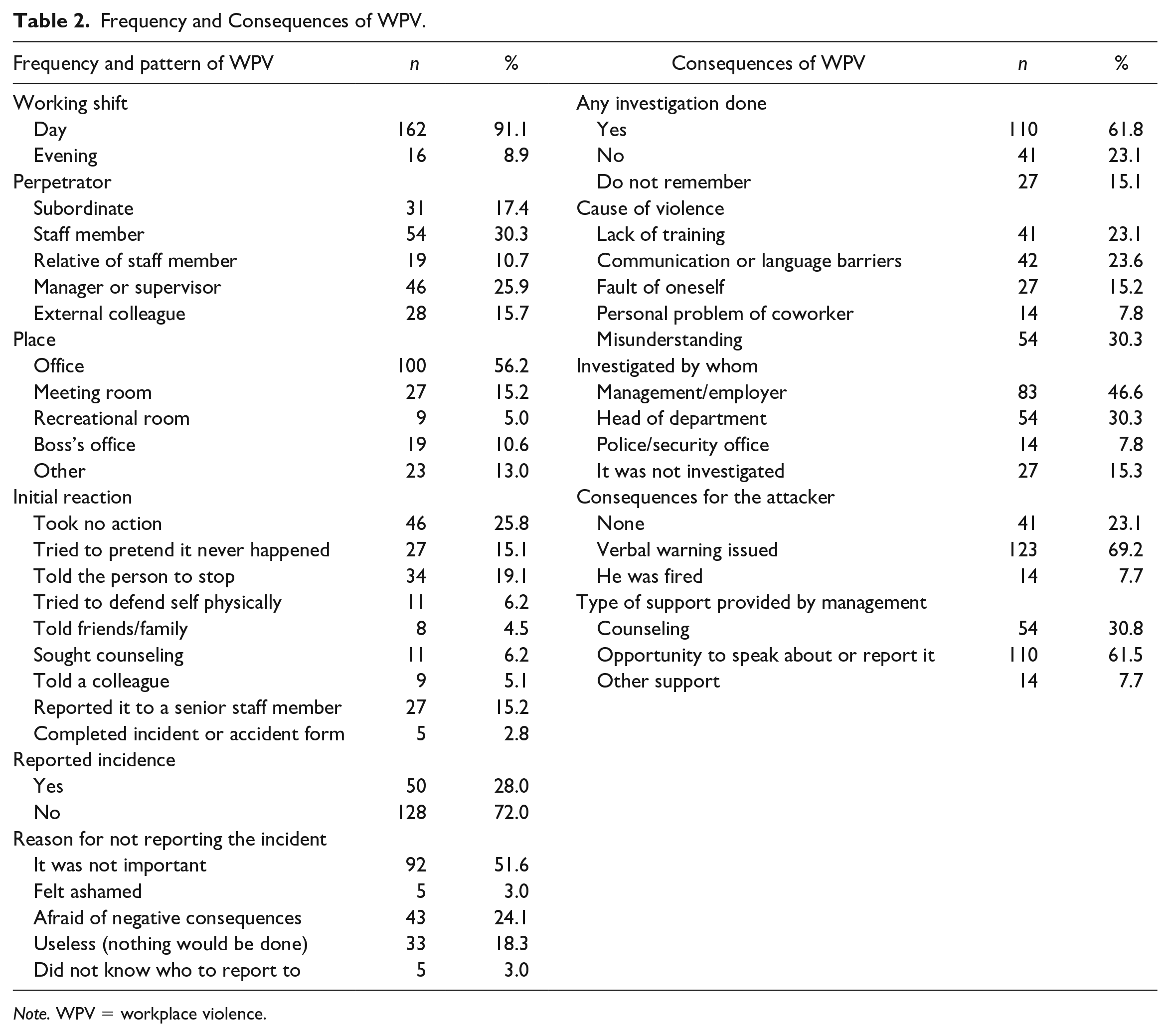
Among 178 respondents, the incident of violence was reported to occur during the day shift (91.1%); moreover, the perpetrator of violence identified was a staff member in 54 cases (30.3%) and manager/supervisor in 46 cases (29.9%). Incidents of violence were reported to occur in office (56.2%). Forty-six respondents (25.8%) took no action against it, 34 (19.1%) told the person to stop, and 27 (15.2%) reported it to a senior staff member. Majority (128 cases) respondents did not report the incident, and the reasons mentioned for not reporting were “it was not important” (51.6%) and “afraid of negative consequences” (24.1%). Detailed results are presented in Table 2.
Frequency and Consequences of WPV.
Note. WPV = workplace violence.
In all, 61.8% of respondents stated that the case was investigated, although 23.1% of cases were never investigated, or status is unknown (15.1%). The most common cause was a misunderstanding (30.3%) and communication/language barrier (23.6%). In most of the cases, the management/employee (46.6%) and head of department (30.3%) were responsible for investigating the incident. A majority (69.2%) of the respondents believe that verbal warning was issued, and 23.1% stated that nothing happened to their abusers. Majority of respondents (61.5%) stated that after the violent incident, they had the opportunity to speak about or report it, and 30.8% received counseling services from the management. Overall, the respondents ranked moderate satisfaction (38.5%), very satisfied (30.6%), and satisfied (15.4) with the ways the management handled the incident, whereas 15.4% ranked dissatisfaction.
CFA
Three additional models were tested along with the four-factor model (baseline model) for comparison (Table 3). The four-factor model (Model A) was compared with the three-factor model (Model B), two-factor model (Model C), and one-factor model (Model D). Model B combined work environment and organizational culture based on the concept that both constructs represent “positive and supportive environment.” Model C combined EE along with work environment and organizational culture based on the concept that all the constructs represent the “employee engagement strategies.” Model D had all the items combined into a single “managing workplace violence” factor. The results of CFA show that the four-factor model (WPV, EE, work environment, and organizational culture) had a reasonably adequate fit to the data, χ2 = 491.7, goodness of fit index (GFI) = 0.912, standardized root mean square residual (SRMR) = 0.054, comparative fit index (CFI) = 0.957, root mean square error of approximation (RMSEA) = 0.044. The results of CFA show that the model fits well and satisfies the basic requirements.
Comparison of Measurement Models.

Note. N = 178. GFI = goodness of fit index; SRMR = standardized root mean square residual; CFI = comparative fit index; RMSEA = root mean square error of approximation.
p < .001.
Descriptive Statistics and Correlations of Major Study Variables
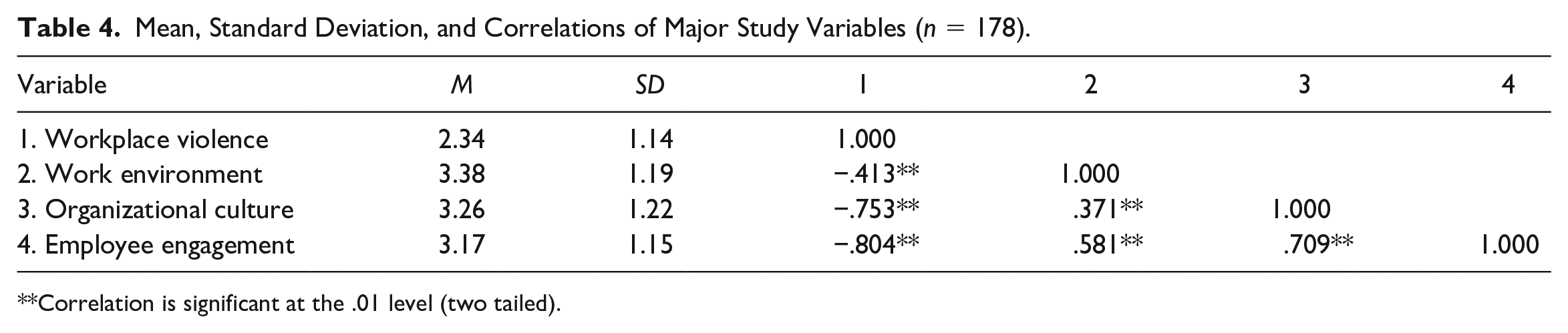
The mean, standard deviation, and correlations of major study variables among respondents are presented in Table 4. All the variables are significantly correlated with each other. WPV shows negative correlation with work environment (r = −.413, p < .001), organizational culture (r = −.753, p < .001), and EE (r = −.804, p < .001), hence proving negative association between them. Furthermore, work environment (r = .581, p < .001) and organizational culture (r = .709, p < .001) show positive relationship with EE. Moreover, work environment and organizational culture (r = .371, p < .001) show a positive correlation with each other.
Mean, Standard Deviation, and Correlations of Major Study Variables (n = 178).
Correlation is significant at the .01 level (two tailed).
WPV Among Different Occupational Groups
The results show that out of the 178 respondents, 158 (88.7%) had experienced WPV during the last 12 months. The occurrence of verbal attack, physical violence, and sexual harassment was 87.9%, 25.5%, and 4.9%, respectively. The results show that the verbal attack was the most common type of violence happening in the workplace in every occupational group. Based on the categories of occupational groups, Table 5 shows the frequency of violence experienced in the last 12 months: zero = none, low frequency = once, moderate frequency = 2 to 3 times, and high frequency = >3 times.
Prevalence of Workplace Violence in Occupational Groups (n = 178).

The bold values shows the highest percentage of frequency of violence experience.
Test of Hypothesis: ANOVA and Tukey Test
Hypothesis 2 was tested using one-way ANOVA and Tukey post hoc comparison. The results are presented in Table 6.
One-Way ANOVA and Tukey Post Hoc Comparison (n = 178).

Note. Cells with matching superscripts have significantly different (p < .05) mean value. ANOVA = analysis of variance.
Consistent with previous WPV studies (Courtney, 2019), the current study shows that the highest mean value (3.329) was for the caring profession, which differs significantly from customer service, but not from the other occupations. The mean levels for customer service (2.533) was comparatively higher than the other two occupations. Furthermore, the mean level of defamation of character was significantly highest (1.938) for the caring profession and at a significantly lowest level (1.467) for customer service than managerial and technology professions. The third WPV dimension, presenting physical violence, represents the highest mean (4.542) for caring profession workers, significantly higher than managerial employees. The results are graphically depicted in Figure 2, which shows that technology profession workers experience the least kind of violence at the workplace, whereas managerial professions are exposed to a moderate level of defamation of character as violence at the workplace. Overall, the data partially support the hypothesis (Hypothesis 2) that employees in “caring and customer service professions” experience more WPV than do employees in other occupational groups.

Workplace violence among different occupational groups.
Test of the Hypothesized Model
The result showed good model fit (Figure 3; χ2 < 1.762, p = .184, df = 1, GFI = 0.995, adjusted goodness of fit index [AGFI] = 0.951, incremental fit index [IFI] = 0.998, RMSEA = 0.066, normed fit index [NFI] = 0.996, root mean square residual [RMR] = 0.028).

Final model (work environment and organizational culture play mediating role between workplace violence and employee engagement).
Effect Estimates
Based on the final model, the SEM analyses confirmed all the proposed hypotheses. WPV had a significant negative direct effect on EE (β = −.556, p < .001) and the model explained 73.6% of the variances of EE. Hence, Hypothesis 1 was accepted.
WPV had a significant negative direct effect on work environment (β = −.440, p < .001). Whereas, work environment positively (weak) predicted EE (β = .279, p < .001). Moreover, the standardized indirect effect (i.e., mediated by work environment) of WPV on EE showed a weak negative effect (β = −.123, p < .001) and the model explained 17.1% of the variances. Based on these results, Hypotheses 3, 4, and 5 were also accepted.
Moreover, WPV had a significant and strong negative direct effect on organizational culture (β = −.758, p < .001). Whereas, organizational culture positively predicted EE (β = .207, p < .05). Moreover, the standardized indirect effect (i.e., mediated by organizational culture) of WPV on EE showed a weak negative effect (β = −.157, p < .05) and the model explained 56.7% of the variances. Based on these results, Hypotheses 6, 7, and 8 were also accepted. Effect estimates of the hypothesized model (standardized coefficients) are summarized in Table 7.
The Results of Hypotheses Test.

Note. WPV = workplace violence; EE = employee engagement; WE = work environment; OC = organizational culture.
p < .05. **p < .01 (two tailed).
Discussion
This article contributes by linking a supportive work environment and positive organizational culture to WPV and EE. To date, no model exists linking these four indicators.
WPV in “Caring” and “Customer Care” Professions
“Human service” workers are reported to experience a significantly higher level of WPV throughout the globe (Gerberich et al., 2004; Hamdan, 2015; Kamchuchat et al., 2008; Lin & Liu, 2005; Mohamed, 2002; Pinar & Ucmak, 2011; Rose, 1997). The current research shows that more than 16% of employees working in caring professions had confronted no less than one incident of verbal or physical violence, whereas 18% reported an incident of sexual harassment at the workplace in the previous year. Similarly, employees working in customer care professions had reported at least one incident of verbal (14%), physical violence (more than 6%), whereas less than 3% reported the incident of sexual harassment at the workplace in the last year.
The research analysis provides support that WPV negatively influences the level of EE in an organizational context (Johnson et al., 2018), specifically employees working in caring and customer service professions. As suggested earlier, employees caring for others (doctors, nurses, teachers, customer service providers, etc.) are frequently exposed to direct contact with people, crowded surroundings, stressful environment, service delays due to workload, and limited communication (N. Li, Zhang, et al., 2019). These factors result in a reduction in the level of engagement constructs such as job satisfaction, employee motivation and commitment, proactive behaviors, and organizational citizenship behavior; thus, a sense of disengagement sets in the employees.
Overall, there were no significant occupational differences (managerial and technological professions) in the “work-related harassment” and “defamation of character,” suggesting that these occupations are less prone to violence and uncivilized behavior comparatively, but the aspect of violence at the workplace still cannot be totally eliminated.
Work Environment and Organizational Culture Played a Mediating Role Between WPV and EE
The findings of this research reveal that the negative influence of WPV on EE can be reduced through the improved work environment and organizational culture. The study (Table 6) provides ample evidence to support the fact that healthy work environment and organizational culture can reduce the violence level and enhance EE, which is consistent with the findings of previous researchers (Kundu & Lata, 2017; H. Li, Sajjad, et al., 2019; Parent & Lovelace, 2018). The supportive role of healthy and friendly work environment has an enormous impact on employees’ behavior in context to employees working in caring professions.
Notably, organizations’ culture can create and develop a relationship of trust and honor among employees, which discourages any act of violence at the workplace (Johnson et al., 2018). The significant mediating effect of organizational culture between WPV and EE intends that positive culture can reduce the aggression and violence at the workplace by providing a safe working environment, with constant monitoring of rules and regulations, justice among employees, and protection of employee’s rights. Employees develop trust in their leader/supervisor when they observe that their leader is fair, caring, helpful, and fulfills their promise, which consequently improves EE.
Although there is a higher frequency of WPV in “caring” and “customer care” professions, if the management wants to alleviate the negative impact of WPV on EE, it can take measures to improve the work environment. Therefore, it can be concluded that positive characteristics of the work environment and organizational culture boost employee trust and confidence in the organization substantially, which leads to the engaged workforce (Li, Zhang, et al., 2019).
This study contributes to the existing WPV literature by introducing a new construct that helps to combine the research work in the domains of EE, work environment, and organizational culture. Most important, this study showed a comparative analysis between different occupational groupings based on frequency and type of WPV. Finally, this study analyzes the mediating role of the work environment and organizational culture between WPV and EE.
Implications for Management
The findings of this study support the hypotheses and describe the significance of work environment and organizational culture for enhancing EE and creating a healthy workplace without violence, supporting Johnson et al.’s (2018) and Reio and Sanders-Reio’s (2011) theoretical works that WPV is significantly linked to organizational outcomes. The implications of this study exist in the area of HR management. HR management must pay attention to provide a secure work environment and focus in the areas where employees feel unprotected due to physical, verbal, or sexual violence.
This research offers a few implications for HR management in organizations. First, management should develop a friendly work environment that discourages violence and develop an environment of trust and respect among employees. The findings imply that employees are influenced by the support provided by the management (including care for their well-being, as well as concern for their opinion), which subsequently has a positive impact on EE level (Kundu & Lata, 2017). Hence, organizations must provide a dynamic and supportive work environment to retain and motivate talented employees.
Second, these results also support the view that organizational culture needs to be supportive and healthy. Effective employee training should be provided to employees to improve their behavior at the workplace (Graham et al., 2004). Provision of a secure, encouraging, and helpful working environment where employees are not scared to interact with each other, and in case of a problem, feel free to seek help from the management. Management that ensures an effective working environment, where employees can express their suggestions, share excellent experiences, identify mistakes, share knowledge, and discuss work-based problems with their leaders, is likely to exhibit a higher level of EE (Li, Sajjad, et al., 2019).
Third, in the presence of WPV, EE cannot exist in an organization. Therefore, organizations need to develop strategies to promote sustainable organizational culture and environment. The management must ensure that preventive actions will be taken to control and illuminate the potential chances of violence. Whereas, in case of occurrence of violence, management must encourage it to be reported, and strict action must be taken. To protect against violence and prevent violence, workgroups should be monitored regularly. An effective communication channel must be developed so that actions of violence are not hidden from the management.
Finally, a primary practical implication of this study is the need to develop legislation on employee protection at the state level. Majority of Western countries have legislations or regulations that ensure appropriate action against culprits and take preventive measures to avoid occupational violence. Practice and policies (violence prevention policy, follow-up procedure, reporting of an incident, action taken) need to be administered at the organizational level (Friis et al., 2019).
Limitations
Some limitations to be addressed are as follows: first, the homogeneity of the data (i.e., collected among graduates of single university). The selective sampling limits the generalization of results due to potential selection bias. Second, the generalizability of findings and conclusions is limited to employees working in all the occupational groups due to the small sample size, which might cause biased results. Last, the number of EE strategies addressed in the study are limited and do not provide a complete picture. The need is to expand the conceptual model and incorporate more strategies for comprehensive understanding.
Future Directions
Future researchers can use variables such as age, gender, ownership, and experience of employees for empirical relationship analysis in this model. The model is open to test for more moderating and mediating variables in the future. Similarly, a comparative study can be conducted to test the conceptual framework in the South Asian, African, and European contexts. Furthermore, the sample size can be increased for the generalization of results to the overall population.
Conclusion
This article aimed to describe the relationship between these variables: WPV, work environment, organizational culture, and EE, as well as to investigate WPV based on occupational groups. This research proves that WPV negatively affects the level of EE. An employee who feels insecure at the workplace feels unsatisfied, and this causes stress and reduction in productivity level. Professions in which employees are exposed to more human interactions are more prone to report the occurrence of WPV. Therefore, there is a need for constant vigilance for such behaviors, and unbiased justice must be provided.
At some point in time, everyone experiences violence in their workplace. Nevertheless, if they are provided support, opportunity to share, justice, and right conditions, every employee can strive through this phase of adversity and look upon it as a growth experience. This research suggests that the provision of a successful work environment is well within the control of the organization’s management. Management must inculcate positive cultural norms and values in the organization to create the right atmosphere for their employees (free of violence) to engage in their job. A secure and healthy work environment has a direct impact on employees’ motivation to work, commitment toward the employing organization, and turnover intention.
It can be concluded that a satisfied employee trusts the employing organization, which results in improved performance. Employees’ positive behavior creates harmony in the environment, their performance level increases, and due to the positive attitude, the relationship between employee, his colleagues at all hierarchical levels, and management also strengthens. Furthermore, when an employee’s behavior is positive, it reduces the prevalence of violence at the workplace, improving overall performance and effectiveness of the organization.
Footnotes
Acknowledgements
The authors thank all the respondents for participating in this research.
Declaration of Conflicting Interests
The author(s) declared no potential conflicts of interest with respect to the research, authorship, and/or publication of this article.
Funding
The author(s) received no financial support for the research, authorship, and/or publication of this article.
Ethical Statement
This material has not been published in whole or in part elsewhere; the article is not currently being considered for publication in another journal; all authors have been personally and actively involved in substantive work leading to the article, and will hold themselves jointly and individually responsible for its content.
Informed Consent
Informed consent was obtained from all individual participants included in the study.
