




Abstract
Universities, across the globe, are identified as complex and critical engines for sustainable development. Nigerian universities have recorded success stories and breakthroughs, but they have their teething problems of retention and challenges which tend to impede their position on the world education league table. Retention of employees in the work environment has attracted a lot of attention from scholars in different fields of study to curb the trend of turnover intentions, human capital flight and redundancy of academia in Nigeria. Hence, this paper investigates the impact of workplace environments on the retention of the academic staff of public universities, Southern-Nigeria. The study adopted a cross-sectional and descriptive approach to elicit information from 384 academic staff that were randomly and purposively selected. The use of a modified questionnaire (quantitative) was adopted. The quantitative data were analysed using Structural Equation Modelling (SEM_PLS) to obtain results. The findings indicated that the issue of inadequate and decay of infrastructural facilities had been a concern to the sampled universities. Many lecturers, including professors, shared offices that are dilapidated, poorly ventilated and furnished. The results indicated an increasing pauperization, varying promotion criteria, erratic power supply, over-congested classrooms and a growing disparity in the ratio between teaching staff and students. Due to its consequences, strategies for curbing this menace in state universities, such as the creation of enabling environment, adequate funding of tertiary education, effective administration and motivation of staff of the sampled institutions, among others were proffered.
Introduction
Universities, across the globe, are identified as the most complex and critical engines for teaching, research, community impact, and economic development. This complexity necessitates a degree of proficiency, scholarship, and proven erudition from university academic staff. The achievement of this becomes imperative because universities, by their distinctive nature, are required to be a fountain of competency, governance, and partnership. Central to the achievement of the objectives are the teaching staff (lecturers) whose responsibilities are fundamental to ensuring continued existence, sustenance, and success of the university system. The quantity and quality of the required academic staff make the difference in any university education system. (Oziengbe & Obhiosa, 2014; Saka & Salami, 2014)
In Nigeria, the increasing number of these universities, coupled with the insufficient number of qualified academic staff, has become worrisome, especially in public universities. Nigeria’s university education has been faced with a high degree of apprehension and recurrent crises of different kinds which have ultimately resulted in the incessant strike embarked by the Academic Staff Union of Universities (ASUU). There are crises of internal governance and vulnerability, favouritism, unsatisfactory work situations such as poor condition of services (Gberevbie, 2008; Ibidunni et al., 2016), severe administrative and organisational structure (Osibanjo et al., 2014); under-funding (Ajayi & Ekundayo, 2010) and inadequate learning and teaching facilities (Abdulsalam & Mawoli, 2012; NUC, 2010); poor relationship with supervisors and colleagues (Asmui et al., 2012); crises of employment relationship (Adeniji & Osibanjo, 2012; Ojeifo, 2014) and continuity (Oredein & Alao, 2010); brain drain, rising absenteeism, and attrition (Gberevbie, 2008; Salau et al., 2018).
Of all the crises, unsatisfactory working conditions (Salau et al., 2018; Obateru, 2013), under-funding (Okebukonla, 2008), rising absenteeism and brain-drain (Ige, 2014; Okoro et al., 2014) have been recognised as most critical and worrisome (Adeyemi & Ekundayo, 2010; NUC, 2015; Nwagwu, 2015). By implication, the high rate at which university academic staff in Nigeria embark on industrial action and eventually resign from their jobs has become a source of concern for university management and government since 1980. Some other conflicts between university staff, management and government from 1980 to 2019 showing the number of times ASUU went on strike are shown in Table 1.
ASUU Strikes (Between 1980 and 2019).

Note. ASUU = Academic Staff Union of Universities.
It need not to be overemphasized that funding is paramount in the educational institution. No educational system can develop beyond the level of its funding. In an educational institution, the fund is required for the payment of remunerations, and other benefits to staff, purchasing of needed facilities, construction and repair of building and administration of the institution daily (Igbinoba et al., 2019; Salau, 2017; Statisense, 2019) indicated that. UNESCO declared that “for effective funding of education, 26% of the Gross Domestic Product (GDP) of each country in the world must be allocated to education” (Kpolovie & Obilor, 2013; Oyetakin et al., 2012; UNESCO, 2010). The case of Nigeria over the years, however, portends a noncompliance with this standard. Allocation to the education sector has been meager when compared to the annual budget, and this invariably affects employment relationship and continuity as presented in Table 2.
FG Budgetary Allocation to Education in Nigeria as % (2000–2020).
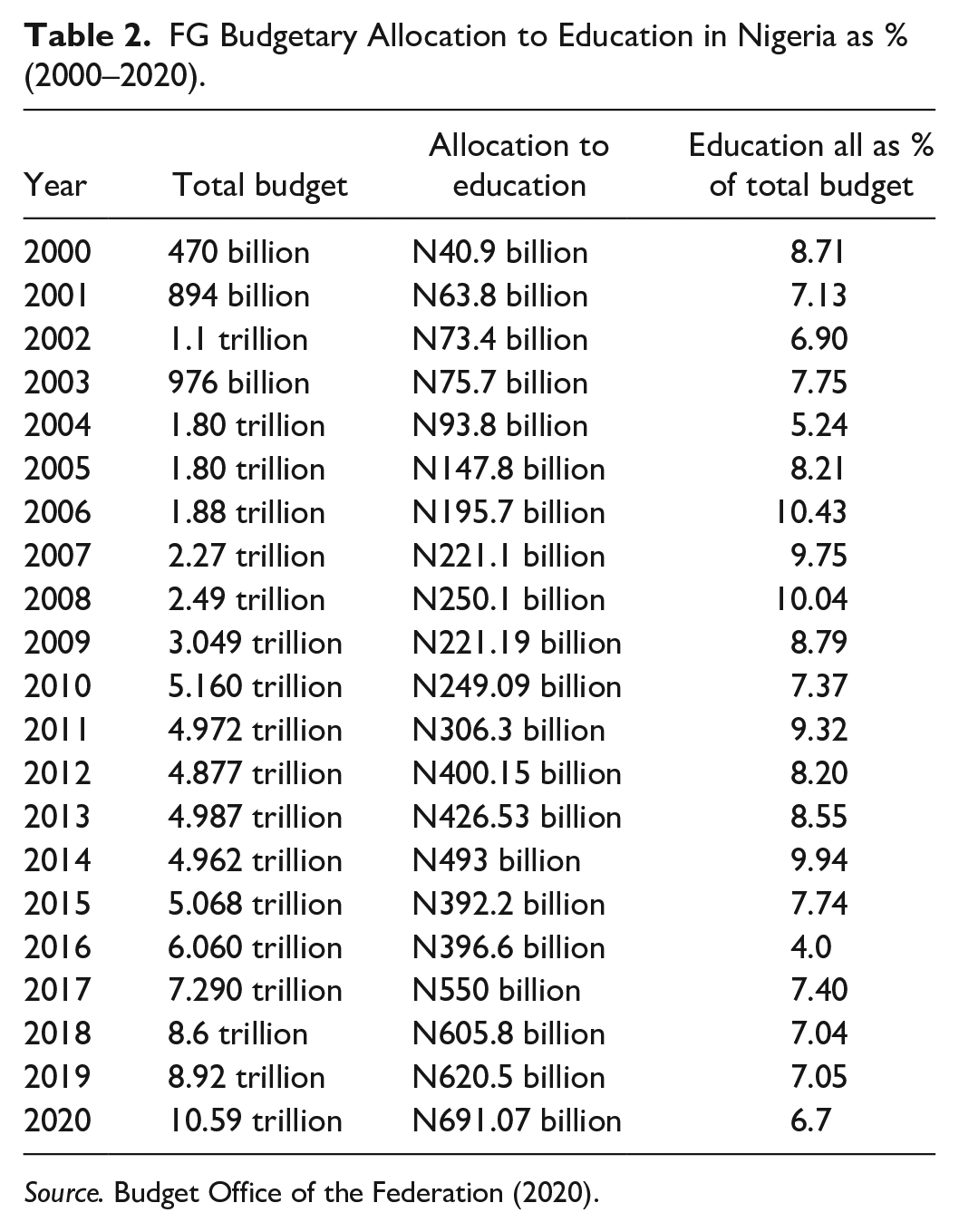
Nigerians have criticized the government for proposing an allocation lower than 26% of national budget “recommended” by the United Nations Educational, Scientific and Cultural Organization (UNESCO) to the education sector. A sum of 691.07 billion constituting 6.7% has been allocated to Nigeria’s Federal Ministry of Education in the 2020 national budget (Budget Office of the Federation, 2020 Abiodun-Oyebanji, 2011). Extant literature has shown that if this declining trend in percentage continues, envision 2030 sustainable development goals (SDGs), especially SDG Goal 4: Quality Education, may be challenging to achieve. Research has shown that lecturers leave Africa every year with Nigeria accounting for the bulk of the number.
Inadequate funding has been identified as the primary reason for the rot and challenges in the education sector, especially tertiary education, which has led to frequent strikes by teaching and nonteaching staff since the early 1990s. Indeed, the Federal Government’s allocation to education in the last 10 years has been miserly. Out of a budget of N55.19 trillion, only N3.90 trillion or 7.07% was allocated to the sector. Within the sphere of academics, available evidence indicates that academic staff resign from their jobs typically as a result of the inadequate reward system and poor working conditions such as infrastructural neglect and deterring conditions of service (Ologunde et al., 2013). This sentiment is validated on the Webometrics, Times Higher Education (THE), and ranking tables. It was observed that Nigerian state universities have not featured in the first 3,500 universities in the world (Webometrics, July 2019).
Report from the THE for 2018 also indicated that none of Nigeria’s universities was listed in the first 1,000 universities in the world. Most, if not all, of Nigerian universities primarily the state-owned would not be able to feature and compete with the rest of the world on the ranking tables if measured on these parameters above, especially on those parameters that focus on research outlook in world journals, student to faculty ratio (Adekitan & Salau, 2018), academic reputation, Alumni winning a Nobel laureate, knowledge transfer, patents, industry income, citations, international outlook, and so on. Central to National University Commission (NUC) annual university rankings, no state university appeared in the first 10 universities in Nigeria (NUC, 2019). Okebukola (2008) noted that the primary reason why Nigerian universities are poorly ranked is attributed to the level of research impact, openness, publications, citations, and alumni employment. In view of the problem statement, the following null hypotheses were formulated to guide this study:
Theoretical Justification
This implies that equity is not just concerned about input – outcome ratio, but also a comparison of an employee’s input-output ratio with the input-output ratio of referent others. By this comparison, if employees perceive that their input impact their outcome vis a vis the input-outcome of referent others, a state of perceived equality is said to exist (Fapohunda, 2012; Fatile & Adejuwon, 2011). If the reverse is the case, that is, employees input do not match outcomes, in addition to input-output of referent others, then there is a state of perceived inequality. When this exists in a social exchange, the employees are possibly going to be unhappy and dissatisfied. Input here refers to the magnitude and values of an employee’s effort and contributions in his or her work such as competence, skills, effort, time, tolerance, trust in colleagues & superiors, commitment and discretionary effort among others. The output of outcomes refers to favourable or unfavourable results that an employee perceives as resulting from the employment relationship such as pay & benefits, recognition for performance, responsibilities, sense of achievement, job security, reputation and esteem among others.
Expectancy theory was propounded by Victor Vroom in 1964. This theory looks at the employee’s expectations from the work they do. The expectancy theory consists of three vital components which are expectancy, instrumentality, and valence. Employees have different needs, wants, and goals and are motivated based on the expectations they have that their effort will lead to performance and performance will be compensated (Vroom, 1964). According to Vroom (1964), organizations should ensure that the reward tied to a particular performance is attractive and of high value. Full knowledge of what individual employees want should be ascertained as needs and wants varies. Employees should be treated as assets rather than being employed to achieve organizational goals. Employee’s expectations should be met as these expectations help to determine the number of efforts they will put into the organization. The efforts put in will determine their performance level and in turn affect their reward. As effort, performance, and reward are interrelated, organizations should ensure that these three components are appropriately attended to and taken into cognizance.
Method
Nigeria is the most visited country in West Africa with a landmass of 923,768 km and the fifth most visited country in Africa as a whole. Nigeria is a member of the West African Economic Community (ECOWAS) and later joined other African nations in 1963 to form the Organization of African Unity (newly renamed the African Union in 2002). Nigeria is situated in south-west coastal Africa and shares its borders in southeast Central Africa with the Republic of Niger, the Atlantic Ocean, the Republic of Cameroon, and Benin. This artificial boundary between Nigeria and other countries stretches over thousands of kilometers affecting several millions of people in a variety of ways. Notwithstanding, their separation by colonial powers, border communities still maintain a high degree of sociocultural and economic linkages through a large volume of cross-border trades. Nigeria became independent in 1960, and it is the most populated in Africa, with over 140 million inhabitants and over 370 diverse ethnic groups. Following the effort to employ a lingua franca over two decades ago, no language is used nationally. Nigeria has a diverse climate, with a northeasterly area of mountains, southeasterly rainforest, and northwest desert, as presented in Figure 1.

Southern Nigeria Map.
Southern Nigeria was established in 1900. In 1906, Lagos Colony was moved to South Nigeria. In 1914, South Nigeria joined with northern Nigeria to create Nigeria’s colony. The southern Provinces were split into the eastern and western regions in 1939, which were absorbed into the Nigerian Federation on October 1, 1960. Nigeria’s southern part is further broken down into three sub-regions, namely South-East (SE), South-South, and South-West (SW).
Nigeria’s south-south region comprises six states (Akwa-Ibom, Bayelsa, Cross River, Delta, Rivers, and Edo). Because of its oil reserves and the enormous wealth of oil, the region is significant not just for Nigeria but for the whole world. As oil exploration began more than five decades ago, the area has been the nation’s breadwinner. The region also contributes many primary commodities with significant prospects for investment in tourism and agriculture.
South-eastern region of Nigeria was formed during the Nigerian Civil War, and it comprises Abia State (God’s Own Country), Anambra Country (Light of the Nation), Ebonyi State (Salt of the Nation), Enugu State (Coal City Territory), and Imo State (Eastern Heartland-Hope Land).
Nigeria’s south-west area offers a wide variety of sights and experiences; from Lagos beaches to the Osun State natural springs, and from Ibadan’s historic city to the Ogun State mountain caves. There are six states in South-West, Nigeria. The states are Ekiti, Lagos, Ogun, Ondo, and Oyo.
The population data used in this study include all the state universities operating in southern Nigeria. This study was all-inclusive, and all the state universities in southern Nigeria were given an equal chance of participating in this study. The geopolitical location of the universities covered in this study is presented in Table 3.
Public (State) Universities in Southern Nigeria.

Represents the oldest universities in each region.
The target respondents were made up of all the members of the academic staff ranging from the professors, associate professors, senior lecturers, lecturers 1, lecturers 2, assistant lecturers, and graduate assistants of all the State Universities in southern Nigeria. Defining the study population and geographic area poses several challenges for this study. Although studies have identified various ways in determining the study population, which include performance, age, geographic mapping, and so on, this study, therefore, adopted the years (age) of the establishment. This study focused on two oldest state universities in each of the southern geopolitical zone, Nigeria. These state universities were Ekiti State University, Olabisi Onabanjo University (OOU), Rivers State University (RSU), Ambrose Alli University, Enugu State University of Science & Technology, and Ebonyi State University.
The use of questionnaire was adopted to gather the necessary data for the study and questions were selected based on their previous good reliabilities in Nigeria and other countries. All specific variables or parameters were measured using items adapted from the works of Abdulkareem and Oyeniran (2011) and Anyim (2012). These items were subsequently used to generate, test, and process the current dataset. All the items were measured using a 5-point Likert-type scale ranging from strongly disagreed (1) to strongly agreed (5). The structured questionnaire was adopted mainly to enhance uniformity of response bearing in mind that the degree of variations in behavior is likely to be high when dealing with such complex constructs like the dynamism of work environment and its consequential effects on retention.
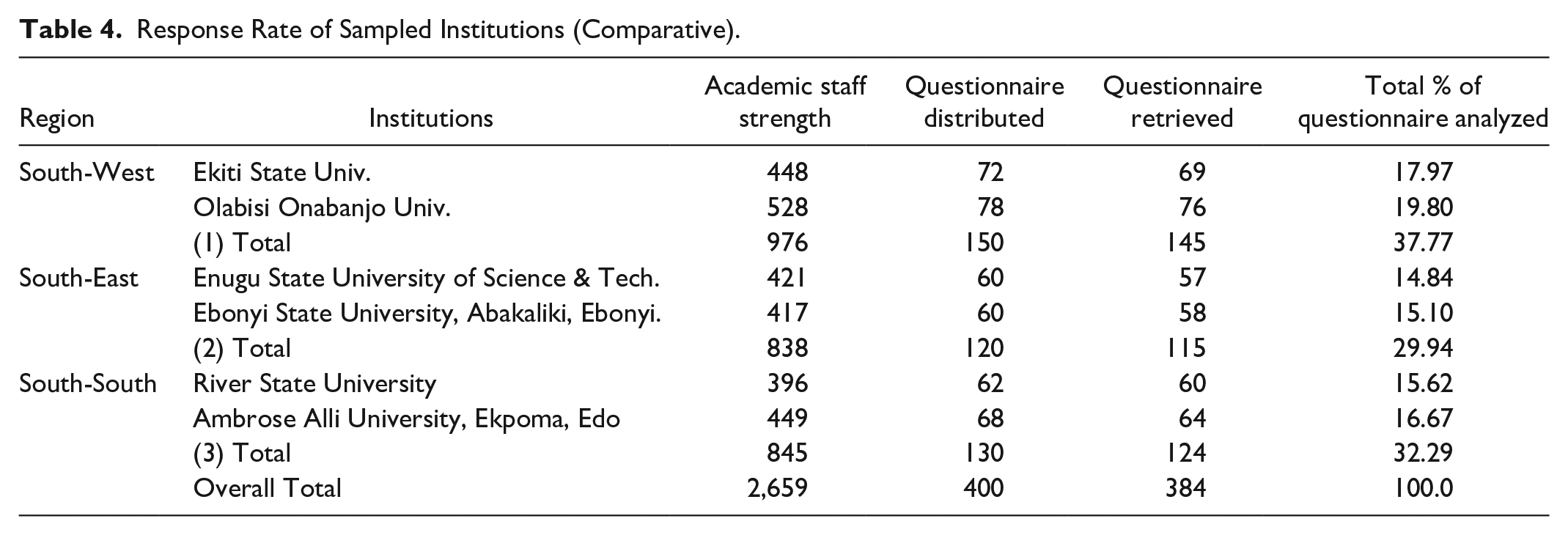
A sample size of 347 was arrived at and was subsequently increased by 15% to 400% as recommended by Israel (2013). The distribution of the sample size to the selected universities was done using a proportionate ratio or proportional affixation criterion (PAC). Therefore, a total of 400 copies of questionnaire were randomly administered with the support of three research assistant to the academic staff of selected universities in southern Nigeria, and this completely took 3 months for the whole data collection process. Three hundred eighty-four copies of the questionnaire were retrieved, which amounted to a 96% response rate (see Table 4). Three hundred eighty-four copies of the retrieved copies of the questionnaire were found usable. Sixteen copies of the questionnaire representing 4% were unusable because they were badly completed. This response rate is considered reasonably high and was found usable and statistically valid for this study.
Response Rate of Sampled Institutions (Comparative).
Code Availability
The data collected were assembled and checked for proper recording, coding, and analysis. The data were carefully sorted and organized with no inconsistencies in various measures. Data were coded and presented using descriptive statistics method, which includes cross-tabulation frequency tables, means, and standard deviation were used to present demographic characteristics of the respondents. In contrast, inferential statistics method of analysis was employed for the tests of hypotheses. The data collected were collated and coded with IBM Statistical Package for Social Sciences (SPSS) version 22 software, Excel, and a variance-based structural equation modeling (PLS_SEM). The smart PLS (partial least squares) is used for casual molding approach, that is, evaluation of the measurement model and the structural model (Usakli & Kucukergin, 2018). Survey data is provided and shared as distinct data files (Data Citation 1). All variables-item were expressed in the questionnaire and attached at the end of the document.
Data Records
The reliability and validity of the main items in the questionnaire were assured. The test–retest reliability index was adopted while construct validity through confirmatory factor analysis (CFA) was employed, and suggestions for changes were incorporated. This assisted in ensuring that the internal consistency of the instrument was appropriate. The normality and linearity were carried out, and 16 out of 400 copies of the questionnaire were removed due to variations from the regression line. The percentage of missing data was far less than 5% and were excluded using Listwise Deletion Method as suggested by Israel (2013). For exploratory business research analysis and studies where little to nothing is known about the theoretical parameter data relationship and where predictive accuracy is desired, PLS is a suitable option for analysis. The impact of the indicators with loading greater than 0.5 but less than 0.7 on the average variance extracted (AVE) and composite reliability (CR) were studied. If there is no effect on the AVE and CR when the indicator is deleted, then the indicator is retained but if the AVE and CR increased then the indicator is permanently deleted from the model (Tarka, 2018). After the modification of the final measurement model for all the constructs, AVE (with a threshold of 0.5) and CR (with a threshold of 0.7) were conducted as presented in Figures 2 and 3, respectively.

The average variance extracted (AVE) values for the latent variables.

The composite reliability of the implemented model.
This suggests that the instrument was confirmed reliable. Eventually, for the outer model, the strength of each indicator was adjudged, and the acceptable limit of 0.6 and an ideal value of 0.7 were applied as suggested by Hair et al. (2017) and Bagozzi & Youjae (1988). Using 5,000 subsamples, the significance of the model was determined using the bootstrapping algorithm. The path coefficient (loadings), the significance, and the t-value of each path of the indicators are reported in Tables 4 and 5, respectively.
Technical Validation
For the analysis, 384 copies of the questionnaire, which amounted to 96%, were retrieved from the academic staff of selected universities in southern Nigeria. Below are the tables showing the frequency distribution of variables and responses to administered questions. Table 4 and Figure 4 indicated the respondents by type of institutions.
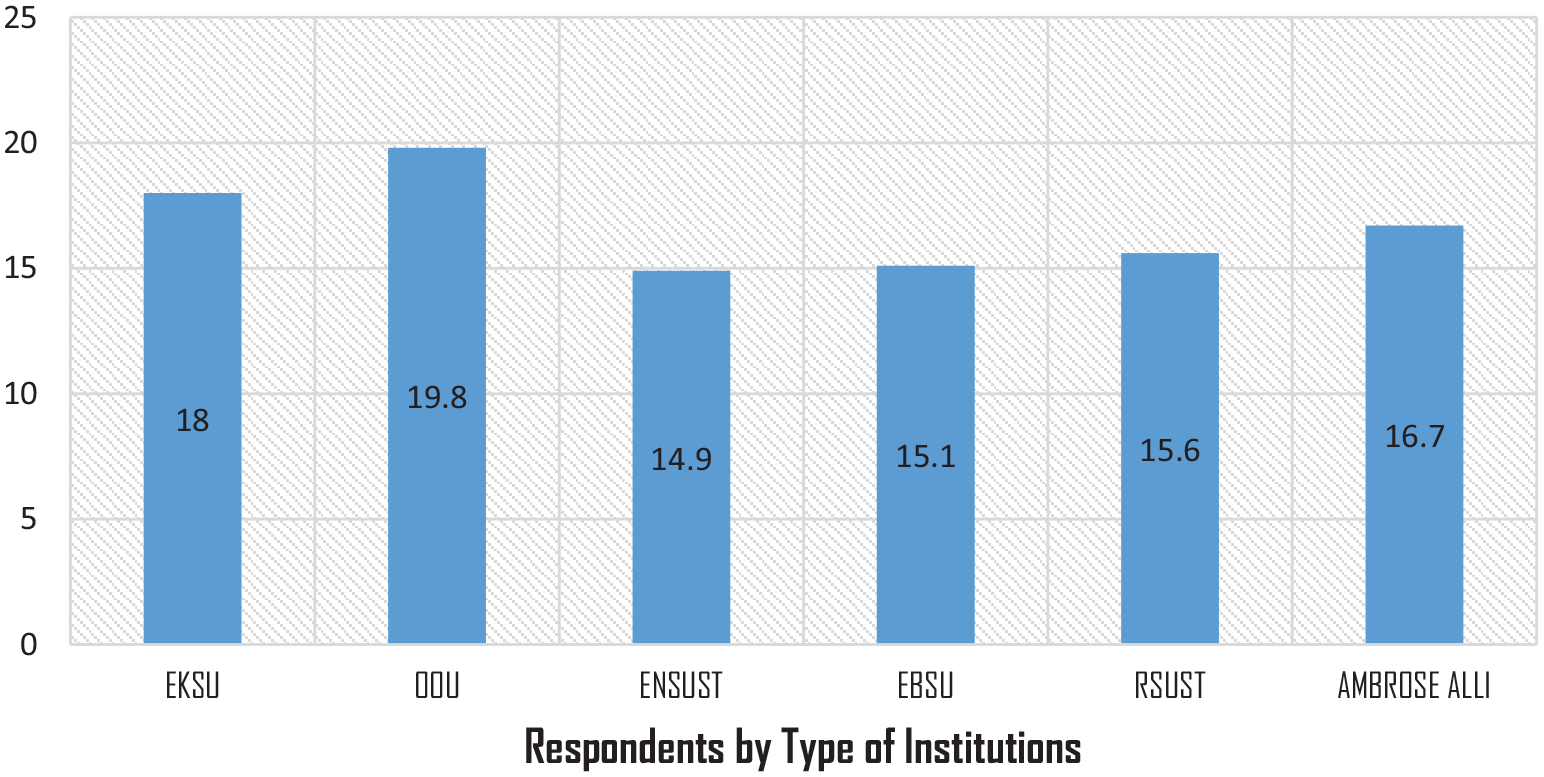
Respondents by type of institutions (comparative).
Table 4 and Figure 4 showed that 145 or 37.77% of the population were from South-West (Ekiti State University [17.97%] and OOU [19.80%], respectively); 115 or 29.94% of the population were from South-East (Enugu State University of Science & Technology [14.84%] and Ebonyi State University [15.10%], respectively); 124 or 32.29% of the population were from South-South (RSU with 15.62% and Ambrose Alli University, Ekpoma with 16.67%). Table 5 described the biographical characteristics of the respondents. Important variables considered were gender, current rank/status, work experience, and current university as presented in Table 5.
Biographical Characteristics of Respondents.

Correlation of Variables for the Sampled Universities in Southern Nigeria
In determining the strength of the relationship, Cohen (1988) suggests the following guidelines and the analysis is presented in Table 6:
R = .010 to .29 indicates weak relationship or r = −.10 to −.29: weak negative relationship;
R = .30 to .49 indicates medium relationship or r = −.30 to −.49: medium negative relationship;
R = .50 to 1.0 indicates strong relationship or r = −.50 to −1.0: strong negative relationship.
Correlation Analysis of the Variables.

Correlation is significant at the .01 level (two-tailed).
Hence, the use of structural equation model was adopted to confirm the level of variability and fitness of the model to explain the relationship between the dimensions of the work environment and retention outcomes. In this study, the impact of workplace environment on retention outcomes was analyzed using partial least squares (PLS) approach to structural equation modeling (SEM) (Fornell & Larcker, 1981). The following input parameters (organizational climate, reward system, physical factors, psychological factors, and job contents) were considered and with each progression in the analysis parameters having covariance issues were dropped in compliance with standard SEM analysis procedure. The final model developed is shown in Figures 5 and 6, respectively.

The structural equation model (regression weight).

The structural equation model (loading and p-values).
The structural modeling indicates that when Physical_work goes up by 1, retention goes up by 0.381 (38.1%). When Psycho_work goes up by 1, retention goes up by 0.215 (21.5%). When Job_contents/characteristics goes up by 1, retention goes up by 0.282 (28.2%). When Reward_systems goes up by 1, retention goes up by 0.118 (11.8%). Finally, when Organiznal_clim goes up by 1, retention outcome goes up by 0.257 (25.7%). This implies that the regression weight in the prediction of staff commitment is significantly different from zero at the 0.001 level (two-tailed). The key statistics of the indicator parameters can also be found in Table 7.
Key Statistics of the Indicator Parameters.

As shown in Table 7, all the indicators are significant at p < .05, the outer loadings range from 0.627 to 0.931, while the t-values varied from 6.749 to 40.894 thereby satisfying the 1.96 minimum t-value requirement for the indicators. The significance of each depot’s contribution to the global business performance is presented as a tested hypothesis in Table 8. For the one-tailed t-test at 5% significance level, all the hypotheses have t-values that are greater than 1.96 at p < .05, which confirms their significance and substantial impact on the institutional performance. The R2 of the overall model is .896 as shown in Table 8, which implies that 89.6% of the variation in the overall retention outcomes of academic staff is explained by the workplace environment indicators.
Direct Relationships for Hypothesis Testing and Model Fit.

Significant at p < .05.
The tables show the degree of association between workplace environments and retention among academic staff of southern Nigeria. This relationship is strengthened with path coefficients histogram as presented in Figures 7 to 11.

Path coefficient histogram between job characteristics and retention outcomes.

Path coefficient histogram between organizational climate and retention outcomes.

Path coefficient histogram between physical factors and retention outcomes.

Path coefficient histogram between psychological factors and retention outcomes.

Path coefficient histogram between the reward system and retention outcomes.
To support the path coefficient histogram, discriminant validity was also checked using Fornell and Larcker criterion. Evidence for discriminant validity is indicated by the correlations among variables, as indicated in Table 9.
Discriminant Validity Check Using Fornell—Larcker Criterion.

As revealed by the results, the discriminant validity shows the correlation matrix among the variables understudy. Hence, management must pay adequate attention to those indicators with a close relationship and essential operational parameters that affect the overall retention outcomes of academic staff. Apart from the anticipated effect, management must make sure that closely related work environment issues affecting retention and adequate control measures must be deployed.
The collinearity of the inner model was assessed to determine the path coefficients among the variables. The result of the collinearity is presented in Table 10. The variance inflation factor values ranged from 1.054 to 2.473, and these values are less than five indicating that there is no strong indication of multicollinearity (Fornell & Larcker, 1981; Hair et al., 2017). The results of the discriminant validity check, which establishes the Fornell–Larcker Criterion, are presented in Tables 9 and 10, respectively. The AVE of the independent variables was assessed to determine the convergent validity, and as shown in Figure 2, all the AVE for the study variables are all above the 0.5 thresholds (Fornell & Larcker, 1981; Usakli & Kucukergin, 2018). The internal consistency of the model was evaluated using the CR, and as shown in Figure 3, the CR values are all above the 0.7 threshold value.
Collinearity Statistics—VIF.

Note. VIF < 5—Acceptable (no strong indication of multi-collinearity). VIF = variance inflation factor; SRMR = standardised root mean residual < 0.08; NFI = normed fit index > 0.9.
Discussion
The finding of this study shows that work environments contribute 89.6% to the retention of the academic staff of state universities in southern Nigeria. The current finding indicates that the work environment has a positive and significant effect on the retention of academic staff. This support the findings of Ng’ethe et al. (2012) and Saka and Salami (2014) who indicated that favourable and conducive work environments were necessary for human resource development practices, which positively affect the employee performance. This study also indicated that physical work milieu (i.e., desks, chairs, shelf, office arrangement, lighting, ventilation) and job characteristics (i.e., task identity, task significance, skill variety, autonomy, feedback) were the most significant predictors of retention among academic staff of selected universities. Extant literature has revealed that typically, these variables are positively related to job performance, job satisfaction and employee engagement (Khalid et al., 2012; Quartey, 2012). Hence, H1 and H2 are accepted. Some of the studies have been carried out in accordance with the hypothesis mentioned earlier. Gul et al. (2012) examined the effect of the physical work environment in the Pakistani private banking sector. They found that the physical work environment has a moderate impact on employee performance. In another aspect, a study was carried out by Kenya commercial banks to look at the role of job contents on the productivity of employees (Wanyama & Mutsotso, 2010). The results show a good correlation between job contents and employees’ productivity (β < .48, p < .05). By implication, this implies that the only secret to achieving outstanding performance in Nigerian institutions has been substantial investment in the physical work environment and clarity of job characteristics.
Based on the impact of organizational climate on the retention of the academic staff of selected universities, the finding from this study shows positive β value .257, which tells that the organizational climate contributes 25.7%. This shows that the relationship is not only positive but also has a significant effect on the retention of academic staff. So, H3 is accepted. Some other studies are conducted related to the above-discussed H3, such as Adeniji (2011) has already worked on organizational climate and performance in the public universities, Nigeria. They have found positive β value of .231, which means the independent variable has a 23.1% contribution to employee performance.
The result of this study shows that when academic staff are attracted to extrinsic and intrinsic motivating factors, it helps them to stick with the organization and never think of leaving. The satisfaction of every employee helps to reduce the turnover level in the organization, and this will help to build the corporate image of the institutions. The findings corroborate with existing works. The study conducted by Abdulla et al. (2010), Bozeman and Gaughan (2011), and Ibrahim et al. (2013) argued in support of the findings that external reward, which is salary, serves as a major factor that motivates an employee, compared to incentives. This contention was agreed by Adeniji et al. (2018) where they expressed that salary should be considered a top priority in order to satisfy the employees effectively. From the research conducted by Daneshfard and Ekvaniyan (2012), they uncovered that improving the welfare system of an organization is the best way to minimize the number of employees that leave the organization. When the welfare system of an organization is poor, the employee feels less motivated and therefore tries to leave the organization for a better life. No one wants to stay in a less motivating environment.
Conclusion
It can be concluded that manpower in the right quantity and quality are sine-qua-non to a nation’s development. Unfortunately, the dearth of manpower characterized public institutions in Nigeria, which is worsened by the problem of staff retention. The issue of retention outcomes was examined, with a focus on factors influencing it, such as poor conditions of service, poor infrastructural facilities, and limited research funding, among others. An exodus of lecturers from state universities in Nigeria constitutes a loss of resources invested in their training. The cost of replacing the academic staff is also high and serves as a burden to government as well as a threat to the limited finance flow to the education sector. At present, it is disturbing that Nigeria’s universities are rated low in the world ranking. One of the conditions for ranking universities is the quantity and quality of academic staff in stock. Due to its consequences, strategies for curbing this menace in state universities, such as the creation of enabling environment, adequate funding of tertiary education, noninterference of government in institution’s affairs, effective administration, and motivation of staff of tertiary institutions, among others were also discussed. It is hopeful that if the strategies are adopted and implemented by government and institutions’ administrators, the menace will become a thing of the past. At the same time, the state of public universities will improve from the status quo in Nigeria.
The study found that many lecturers, including professors, shared offices that are dilapidated, out of ventilation, and poorly furnished. Lecture theaters were overcrowded and classrooms, laboratories, and workshops were shared by many programs across different faculties. The respondents also explained the deplorable state of most classrooms—the fundamental teaching infrastructure of any learning institution. It was identified that fewer than one in the six sampled universities had videoconferencing facilities, less than 20% made use of interactive boards, “and even the ones that are deployed are found in less than 10% of lecture rooms and theatres.” Fewer than half of the universities used public address systems in lecture halls.
Presently, there are many professors in many universities in Nigeria while there are those already due for the professorial position. Those with PhD and other lower qualifications might thus not have the chance to grab any opportunity where these senior staff exist. As the junior staff wish to rise to the positions, many often leave for other tertiary institutions where they have better opportunity/chances. What can be noticed is the rate in which lecturers are leaving the state-controlled institutions to be private and federal universities in Nigeria because of better opportunities to rise to top positions in such institutions. The perennial problem of having enough academics to teach an ever-growing student population was closely examined. This was expected because almost all the sampled institutions have endured lecturer shortages. There is also a growing disparity in the ratio between teaching staff and students.
The issue of research funding leaves much to be desired. Although most of the respondents were not happy with the compensation packages and promotional opportunities in the sampled universities, it was indicated that promotion opportunities are given based on favoritism and godfatherism. This is one of the factors that affect their retention outcomes. Many pieces of research had been abandoned due to inadequate funds which often demoralizes lecturers and forced them to leave for foreign countries where the opportunity for such abound. In an ideal situation, the staff of the tertiary institution who are qualified for promotion supposes to be promoted and when due. Surprisingly, the findings indicate the situations where the staff of sampled institutions will not be promoted due to one reason or the other, particularly when he or she has an axe to grind with management. These often lead to staff leaving their institutions for another where their regular promotion can be guaranteed.
This study revealed that reward significantly contributes to academic staff retention. Surprisingly, our statistical analysis revealed that the reward system is the least significant predictor of retention among academic staff. This implies that the management of the selected institutions needs to develop an equitable and competitive salary administration that will consequently reduce the incessant level of turnover intentions, undue extortions, and low productivity. This result supports exiting research. The use of reward has become indispensable in stimulating performance. Armstrong (2009) and Hafiza et al. (2011) contended that reward which is interchangeably used with compensation system often play an indispensable role in encouraging staff physically, emotional and psychological. Hashim and Mahmood (2011) and Ogunbameru (2012) concluded that adequate reward system often leads to greater commitment.
It is important for sampled institutions to deliberately entrench fairness in the outcome allocation system and also work out ways of improving and sustaining good manager-associate relationship as it promotes commitment to academic staff. A good horizontal relationship must be encouraged as it promotes friendliness and mutual respect within a diverse and multicultural workforce as well as group cohesion; this leads to commitment at the end. The research has shown that work environments significantly contribute to retention outcomes of academic staff in Nigerian State Universities. However, it was indicated that job contents, rewards, and organizational climate are the significant predictors of staff retention outcomes. It is evident from this study that the provision of enabling work environment will eventually lead to staff satisfaction, loyalty, productivity, commitment, and involvement in the educational sector.
Recommendations and Policy Implications
Our study offered valuable context of ideas, facts, and figures that can be adopted by researchers, practitioners, government, NUC, and other stakeholders in management education to explore the dynamics and resultant effects of work environments on retention outcomes. The study offers an inclusive understanding into organizational factors that impact on retention outcomes of academic staff using state universities in southern Nigeria.
Based on the findings of the study, the following recommendations were proffered:
Institutions should endeavor to invest more in creating a physical work environment. The problem of erratic power supply should be looked into with a stimulating spatial arrangement. Attention must also be given to the provision of basic infrastructures such as buildings, classrooms, laboratories, workshops, administrative blocks, and furniture.
On the promotional system, the study recommends that management of University education should consistently show more significant concern for academic career advancement programs as observed by the junior staff. Management of the universities should wholly avoid the use of mediocrity and favoritism for promotion and career advancement. The institutions can adopt an objective performance appraisal as a basis for granting merit, increasing pay of employee as well as promoting employee with the view of increasing their level of productivity.
The management team of the organization should strive to introduce a satisfactory motivational package that will stimulate commitment and performance of academic staff. The government should allocate sufficient fund to education, at least to meet up to 26% recommended by UNESCO. Management should make sure that compensation packages for university lecturers are equitable, impartial, and competitive. The management should continually organize workshops or seminars with work-related facilities to update their staff skills, knowledge, abilities, and competencies.
Finally, the Ministry of Labour, Employment and Productivity should device various alternatives to resolve pressing issues between the unions (ASUU) in the universities and governments to prevent recurring labor unrest. The management team should endeavor to adopt participative governance to promote peaceful coexistence and industrial harmony.
The major policy implications for the state universities were identified as follows:
Institutional policies tailored toward ensuring proper reward systems could bring about higher satisfaction and productivity of the tertiary institutions, mainly because the provision of adequate reward systems serve as stimulating factor and predictor for staff commitment, satisfaction, and productivity.
Policies on infrastructural should be targeted at enhancing favorable physical work settings which facilitate the commitment of competent staff. However, if it is not taken into consideration, it could lead to job dissatisfaction and low productivity.
Limitations and Future Research
The sample from which the population was drawn comprised 19 public (state) universities in southern Nigeria (NUC, September 2015). Because this population study was restricted to southern Nigeria, it can be suggested that other public (state Universities) institutions in Northern Nigeria and so on can further be studied. Studies can also be conducted using the federal universities within southern or northern Nigeria. Future research can explore the relationship between work environments and retention outcomes using private and federal universities in Nigeria. This will also help to compare the perceptions of the university lecturers in the two categories of schools.
This study employed quantitative methods for data collection. Further studies could employ the use of in-depth interviews as qualitative data collection process to enrich the data collection process. For further studies, the authors suggested that future researchers should consider virtual workspace along with physical workspace and psychological as this variable has a sociotechnological role that disrupts higher education. Finally, the quantitative aspect of this research adopted survey method of data collection other studies could consider carrying a study involving a longitudinal data collection process to provide a reliable confirmation of the relationships identified in this study.
Research Data
Data__Work_Environments_Manuscript_ID_SO-18-1953 for The Impact of Workplace Environments on Retention Outcomes of Public Universities in Southern Nigeria
Data__Work_Environments_Manuscript_ID_SO-18-1953 for The Impact of Workplace Environments on Retention Outcomes of Public Universities in Southern Nigeria by Odunayo Salau, Rowland Worlu, Adewale Osibanjo, Anthonia Adeniji, Hezekiah Falola, Maxwell Olokundun, Stephen Ibidunni, Tolulope Atolagbe, Joy Dirisu and Opeyemi Ogueyungbo in SAGE Open
Footnotes
Acknowledgements
On behalf of other researchers, we sincerely want to express our profound gratitude to the management of Covenant University for sponsorship and assistance in creating original work.
Declaration of Conflicting Interests
The author(s) declared no potential conflicts of interest with respect to the research, authorship, and/or publication of this article.
Funding
The author(s) received no financial support for the research, authorship, and/or publication of this article.

References
Supplementary Material
Please find the following supplemental material available below.
For Open Access articles published under a Creative Commons License, all supplemental material carries the same license as the article it is associated with.
For non-Open Access articles published, all supplemental material carries a non-exclusive license, and permission requests for re-use of supplemental material or any part of supplemental material shall be sent directly to the copyright owner as specified in the copyright notice associated with the article.
