



Abstract
The Meanings of Adolescent Masculinity Scale (MAMS) and the Adolescent Masculinity Ideology in Relationships Scale (AMIRS) were designed by American researchers to assess masculinity in adolescent boys. Given that masculinities differ cross-culturally, though, these scales may not be viable for use with non-American populations. In the current study, 221 Irish adolescents completed the MAMS and the AMIRS. Using confirmatory factor analyses (CFAs), the MAMS’s and the AMIRS’s factor structures were tested. Results indicated poor goodness-of-fit in both cases. Attempts to improve the models were unsuccessful. Accordingly, neither the MAMS nor the AMIRS appear to be structurally valid within an Irish context. We recommend that researchers consider cultural variations when designing, validating, and utilizing indicators of masculinity.
Masculinities are not static. Not only do masculinities differ cross-culturally, but conceptions of manhood also differ generationally, over time, intra-culturally, and between individuals (Harris, 1995; Kahn et al., 2011; Kimmel & Mahalik, 2004; Pompper, 2010; Tager & Good, 2005). While conceptions of masculinity can differ, it has been argued that “there is always a single hegemonic masculinity within a given culture or community” (Lee, 2004, p. 14), where hegemonic masculinity refers to the commonly held set of masculine prescriptions, to which individuals in a given cultural context tend to abide, and which support patriarchal systems (Connell, 1995). Moreover, each culture has its own unique version of hegemonic masculinity, which differs slightly from versions promulgated in other similar cultures. Brandes (2007), for example, elucidates how hegemonic masculinity differs between East and West Germany. West German hegemonic masculinity is described as being typical of a more individualistic masculinity, which emphasizes competition, status, and dominance over women. In contrast, East German hegemonic masculinity is situated in the everyday working classes and does not prioritize the aforementioned values to the same extent. Thus, as hegemonic masculinities may differ cross-culturally, it is important to use measures of masculinity that reflect the current social milieu of a given region and population of interest. Accordingly, the purpose of the current study is to assess, within the Republic of Ireland, the structural validity of two American-based measures of adolescent masculinity (specifically, the Meanings of Adolescent Masculinity Scale [MAMS; Oransky & Fisher, 2009] and the Adolescent Masculinity Ideology in Relationships Scale [AMIRS; Chu et al., 2005]). It is also important to note that Ireland has experienced a series of comparatively recent societal changes that have served to shift gender relations and, as such, challenge notions of hegemonic masculinity within the country (Ní Laoire, 2005). These departures, which may be indicative of larger cultural changes within Western societies, in turn, have implications for how participants answer these particular scales.
We will begin by describing adolescent masculinity and the ways it is measured, with emphasis placed on the MAMS and the AMIRS. We also will elucidate the ways in which Irish adolescent masculinity differs from its American counterpart.
Measurement of Adolescent Masculinity
Due to generational differences in how men and boys conceptualize manhood, specific scales are needed to examine adolescent masculinity (Pompper, 2010). Two such scales are the MAMS and the AMIRS. These measures constitute two of the few instruments designed to measure masculinity in youth (Thompson & Bennett, 2015) and, as such, are particularly relevant to the current study. Moreover, these scales were created within an American context and, to date, there are no published studies detailing the scales’ reliability and structural validity in other English-speaking countries. (While one study did assess the MAMS’s structural validity within a Brazilian context and found it to be inadequate in its original form, that study is unavailable in English; see Guerra et al., 2014.) Furthermore, while ostensibly culture-fair or culture-free measures for intelligence and other similar constructs exist (Zurcher, 1998), it has been demonstrated that attitudinal measures (e.g., beliefs about masculinity) do not possess etic validity and, as such, cannot be culturally unbiased (Roster et al., 2006). To this extent, it is important to test attitudinal measures in different cultural contexts.
Meanings of Adolescent Masculinity Scale (MAMS)
Consisting of 27 items measured from one (strongly disagree) to four (strongly agree), the MAMS (Oransky & Fisher, 2009) is divided into four factors, or categories of questions: constant effort (seven items; e.g., “Acting manly should be the most important goal for guys”); emotional restriction (seven items; e.g., “Guys should not talk about their worries with each other”); heterosexism (eight items; e.g., “A good way to seem manly is to avoid acting gay”); and social teasing (five items; e.g., “In order to fit in, guys must be able to tease other guys”). In concert, these items measure conformity to masculine norms in boys with higher scores denoting stronger conformity.
Adolescent Masculinity Ideology in Relationships Scale (AMIRS)
This 12-item measure consists of one factor and is designed to evaluate adolescent boys’ perceptions and experiences of masculinity with emphasis placed on boys’ peer relationships (e.g., “In a good dating relationship, the guy gets his way most of the time”). The AMIRS (Chu et al., 2005) uses a response format ranging from one (disagree a lot) to four (agree a lot) with higher scores denoting greater adherence to hegemonic masculine standards within relationships. To date, no study has examined the reliability and structural validity of the AMIRS in a non-American context.
Since their introduction into the literature, the MAMS and the AMIRS have been used to describe conceptualizations of adolescent masculinity. While the MAMS and the AMIRS have been utilized primarily within secondary school and sporting contexts (e.g., Leaper et al., 2018; Liang et al., 2019; Steinfeldt et al., 2012), the AMIRS also has seen use with undergraduate populations (e.g., Giaccardi et al., 2016). Both scales were included in Thompson and Bennett’s (2015) review of masculinity-related measures and are among the only scales designed specifically for the purpose of assessing masculinity in adolescents.
Irish Adolescent Masculinity
In comparison to other nations, Ireland ranks high in masculinity scores (Hofstede, 2001; McSweeney et al., 2016), and is thought, more specifically, to possess an agrarian, or rural, sense of manhood (Ní Laoire, 2005). Perceptions of Ireland as being a country of “rough and primitive, uncivilized and uncivilizable” men date back to the American antebellum period (Mooney, 2015, p. 96). Currently, however, Ireland is in a unique position because of economic and institutional changes occurring within the country (Ferguson, 2001). These changes include the diminishing power of the Catholic Church, less policing of women’s reproductive autonomy, greater freedoms afforded to sexual and gender minority persons, significant immigration to and emigration from Ireland, and the country’s transitioning from a period of economic prosperity to one of recession and recovery (Holohan & Tracy, 2014; Ó Beaglaoich et al., 2016). These social, political, and economic transitions have given Irish men an opportunity to (re)construct and (re)conceptualize their own sense of maleness (Johnston & Morrison, 2007). Indeed, some scholars have asserted that there is a crisis of masculinity, which may be particularly salient within an Irish context (Gosine, 2007). As such, Ireland offers a prime opportunity for the study of masculinities.
To date, few attempts have been made to theorize an Irish version of manhood (Ferguson, 2001; Johnston & Morrison, 2007; Popoviciu et al., 2006); this is particularly true for Irish adolescents. (For an overview of Irish masculinities circa World War II, see Hatfield, 2019. For an overview of conceptualizations of manhood held by Northern Irish adolescents, see Harland, 2000. 1 ) One notable exception to the absence of scholarship noted earlier is the qualitative study conducted by Ó Beaglaoich, Morrison et al. (2015). When asked to define their expectations for masculine behavior, the participants (N = 54 Irish boys aged 12 to 18) asserted that Irish boyhood masculinity is contingent on (a) not caring about what other people think; (b) being physically and mentally strong; (c) being heterosexual; (d) being an all-around competent individual (e.g., athletically and sexually); and (e) putting time into one’s physical appearance and, in particular, one’s muscularity.
These criteria are not too dissimilar from conceptions of boyhood masculinity identified in other highly masculine Western nations. For example, Schrock and Schwalbe (2009) describe how, in general, one of the components of masculinity that boys learn is to display attraction for girls (i.e., to be heterosexual); this is consistent with beliefs in heterosexual prowess as identified by (Ó Beaglaoich, Morrison et al., 2015). According to Schrock and Schwalbe, boys must also be in control of their feelings and emotions (see also Kågesten et al., 2016); again, this is similar to the idea of being mentally strong as presented by Ó Beaglaoich, Morrison et al. (2015). Furthermore, the need to be physically tough is common to both Irish adolescent boys and those from other nations (Kågesten et al., 2016; Ó Beaglaoich, Morrison et al., 2015). We note, however, that the criteria identified by Ó Beaglaoich, Morrison et al. (2015) differ slightly from conceptions of manhood delineated in other highly masculine Western nations. For instance, Schrock and Schwalbe comment on the reliance that boys place on the props (i.e., items) they use and on the importance of breaking rules. In comparison, Ó Beaglaoich, Morrison et al. (2015) do not discuss either of these factors. In addition, McSweeney et al. (2016) found that, using Hofstede’s (2001) Masculinity-Femininity Index, Irish men valued masculinity more highly than did men from other Western nations including the United States and Great Britain. Thus, while certainly subtle, there are important points of departure between Irish boys and adolescents from other Western nations vis-à-vis their conceptualizations of masculinity.
These differences are underscored by findings obtained in a previous attempt to test the dimensionality of an adolescent-specific gender-based scale—the Gender Role Conflict Scale for Adolescents (GRSC-A; Blazina et al., 2005)—with an Irish sample. Stated simply, the authors were unable to replicate the factor structure identified using American adolescents (Ó Beaglaoich, Conway et al., 2015). Two potential reasons for the GRSC-A’s lack of structural validity could be the scale’s reliance on American gendered values or the fact that the scale was already several years old when it was tested by Ó Beaglaoich, Conway et al. (2015).
Purpose
The purpose of this study is to determine whether two scales of adolescent masculinity (i.e., the MAMS and the AMIRS), developed and tested within an American context, possess factorial integrity when distributed to a group of adolescent boys residing in the Republic of Ireland. These scales are of particular importance given that few measures assess masculinity with adolescent populations (see Thompson & Bennett, 2015). It is also critical to gauge the viability of scales for use outside of the context that they were originally designed for use with. To date, the factor structure of either of these scales, using an English-speaking sample outside of the United States, has not been tested. While Ó Beaglaoich, Conway et al. (2015) did evaluate the scale score reliabilities of the MAMS and the AMIRS among Irish adolescents and found them to be satisfactory, the authors also claimed that the factor structures of these scales warranted scrutiny.
Method
Participants
Two hundred twenty-one adolescent boys (Mage = 15.05, SDage = 1.68; minimum age = 13; maximum age = 19) living in and attending secondary school in the Republic of Ireland, who predominantly identified as Irish (n = 203; 91.86%), participated in this study; all of the remaining participants were from other predominantly White European nations (e.g., Great Britain). In addition, of those participants who responded to a question about their sexual orientation, most identified as being “exclusively” heterosexual (n = 200; 90.50%), while a small subset identified as being “exclusively” gay (n = 4; 1.8%) or as being somewhere on a spectrum between “exclusively” heterosexual and “exclusively” gay (n = 13; 5.9%).
Measures
MAMS
Details about the MAMS are given in the introduction. The omega coefficient, which assesses reliability, was .92. (For a discussion of why coefficient omega is preferable to Cronbach’s alpha, see Dunn et al., 2014.) The averaged scale score was above the scale midpoint (M = 2.66; SD = .48).
AMIRS
Details about this measure are given in the introduction. The omega coefficient was .78. The averaged scale score was also above the scale midpoint (M = 2.42; SD = .26).
Procedure
After first obtaining approval to conduct this study from the authors’ university (i.e., the National University of Ireland Galway), adolescent boys living in Ireland were recruited through a roster provided by their secondary schools, which indicated their sex. Students were allowed to participate in the study contingent upon receiving permission from their parent/guardian. Participants completed the various measures and demographic information. While this study was part of a larger survey, the other items are not relevant to the objectives of the current study. Upon finishing the survey, participants were given a debriefing form, which explained the purpose of the study in greater detail.
Results
Confirmatory Factor Analysis—MAMS
A confirmatory factor analysis (CFA) was conducted in R (Beaujean, 2013) to test the MAMS’s four-factor model. Goodness-of-fit was assessed using various criteria including the χ2/df ratio (ideally <2), comparative fit index (CFI; >.95), Tucker–Lewis index (TLI; >.95), standardized root mean square residual (SRMR; <.05), and root mean square error of approximation (RMSEA; <.05; Byrne, 2006; Hu & Bentler, 1995).
Results from the CFA revealed poor fit for the four-factor model (see Figure 1 for a diagrammatic representation of the CFA for the MAMS): χ2/df ratio = 1.94, CFI = .841, TLI = .824, SRMR = .074, and the RMSEA = .073. The standardized factor loadings ranged between .422 and .815. Modification indices were computed and revealed that no single item uniquely contributed to the model’s lack of fit; hence, no alterations were made to the MAMS. Our inability to achieve acceptable model fit, even with the possible removal of scale items and correlated error terms, suggests that problems with the MAMS are likely conceptual.
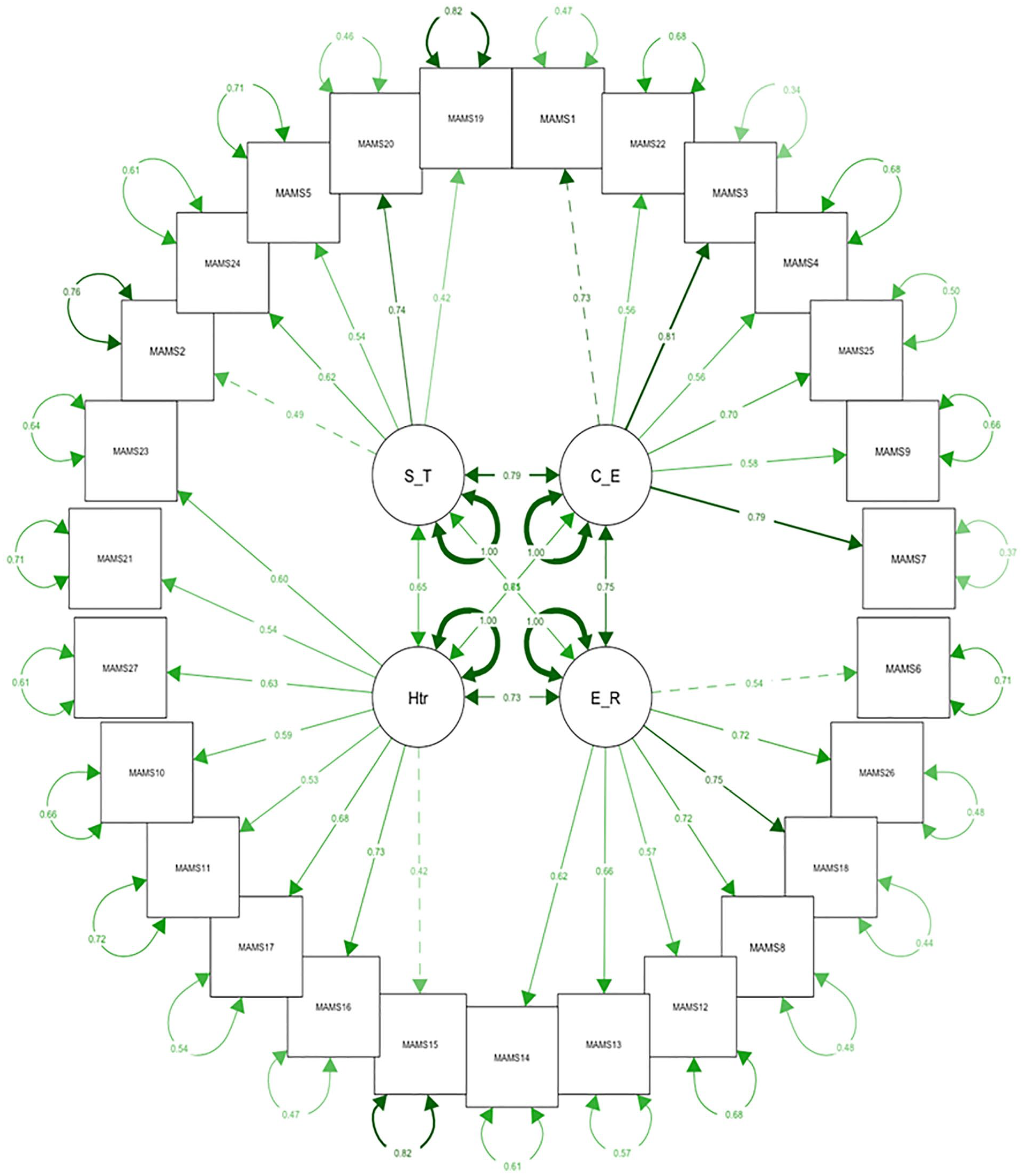
A diagrammatic representation of the CFA conducted on the MAMS.
In addition to the CFA, an exploratory factor analysis (EFA) was conducted. Based on parallel analysis and a scree plot, we retained five factors (see Humphreys & Montanelli, 1975, for a discussion of why parallel analysis is the best indicator of factor structure in an EFA). As such, an EFA with five forced factors and oblimin (oblique) rotation was utilized. (Oblique rotation was used because the factors were expected to correlate to some degree; it is also important to note that oblique rotation permits, but does not require, factors to intercorrelate—see Fabrigar et al., 1999.) Overall, the factor loadings proved problematic (see Table 1 for a summary of the loadings). While none of the items failed to load onto at least one factor (Matsunaga, 2010, recommends that a cutoff of at least .40 be used for factor loadings), nine items cross-loaded onto multiple factors (i.e., Items 9, 10, 13, 14, 20, 22, 23, 26, and 27). Items were determined to cross load if they loaded onto multiple factors and the highest loading was within .2 of the next highest loading (see Lu et al., 2017). Thus, given the available evidence, it appears that the MAMS does not fit a five-factor model in its current form.
A Summary of the Factor Loadings for the Five-Factor EFA Conducted on the MAMS.

Note. Factor loadings > .30 are presented. Any value that is bolded is the best exemplar of the item in question. Items were not considered to have loaded if they did not possess a factor loading of at least .40 (see Matsunaga, 2010); in such cases, no loadings were bolded. Where multiple loadings of greater than .40 are present, and the values do not differ by .20+, all relevant loadings are in bold.
Confirmatory Factor Analysis—AMIRS
A CFA also was used to test the AMIRS’s one-factor model (see Figure 2 for a diagrammatic representation of the CFA for the AMIRS). Again, all fit statistics were suboptimal: χ2/df ratio = 2.45, CFI = .766, TLI = .714, SRMR = .073, and the RMSEA = .084. Standardized factor loadings ranged between .337 and .539. Similar to the MAMS, modification indices did not indicate that removing scale items or allowing error terms to correlate would result in substantial improvements to fit.

A diagrammatic representation of the CFA conducted on the AMIRS.
An EFA also was used to test whether an alternative factor structure was appropriate. While the scree plot seemed to imply a one-factor model, parallel analysis suggested that a four-factor structure might better capture the data. Given the small pool of items and the fact that one of the real eigenvalues was barely greater than the simulated eigenvalue, we opted to test two-factor and three-factor models instead. Accordingly, two-factor and three-factor models were forced and oblimin (oblique) rotation was used. (Again, we employed oblique rotation because we expected the factors to correlate to some degree.) The factor loadings indicated that the three-factor structure was problematic (see Table 2 for a summary of the factor loadings for the three-factor model). Specifically, two of the items did not load onto any factor (Items 9 and 12) and two of the items cross-loaded onto multiple factors (Items 7 and 10). In addition, only one item uniquely loaded onto the third factor (see Tabachnick & Fidell, 2001, for a discussion of how factors containing fewer than three items are underrepresented). The two-factor model was similarly problematic with one item not loading (Item 12; see Table 3 for a summary of the factor loadings for the two-factor model). As such, alternative two-factor and three-factor structures do not seem plausible given the scale’s current form.
A Summary of the Factor Loadings for the Three-Factor EFA Conducted on the AMIRS.

Note. Factor loadings > .30 are presented. Any value that is bolded is the best exemplar of the item in question. Items were not considered to have loaded if they did not possess a factor loading of at least .40 (see Matsunaga, 2010); in such cases, no loadings were bolded. Where multiple loadings of greater than .40 are present, and the values do not differ by .20+, all relevant loadings are in bold.
A Summary of the Factor Loadings for the Two-Factor EFA Conducted on the AMIRS.

Note. Factor loadings > .30 are presented. Any value that is bolded is the best exemplar of the item in question. Items were not considered to have loaded if they did not possess a factor loading of at least .40 (see Matsunaga, 2010); in such cases, no loadings were bolded. Where multiple loadings of greater than .40 are present, and the values do not differ by .20+, all relevant loadings are in bold.
Discussion
The purpose of this study was to assess the structural validity of two scales of boyhood masculinity, the MAMS and the AMIRS, within an Irish context. As the content of these scales may reflect American notions of maleness, it is important to determine whether the MAMS and the AMIRS evidence factorial integrity when administered to other populations. CFAs revealed that neither the four-factor model of the MAMS nor the one-factor model of the AMIRS met established criteria for goodness-of-fit. Furthermore, attempting to use modification indices to improve the models was unsuccessful. Finally, EFAs did not suggest that alternative factor structures were viable for either the MAMS or the AMIRS.
How might one account for our inability to replicate the factor structures of the MAMS and the AMIRS? First, seeing as the measures were designed for an American adolescent population (Chu et al., 2005; Oransky & Fisher, 2009), and Irish masculinity possesses some unique features (Ó Beaglaoich, Morrison et al., 2015; cf. Kågesten et al., 2016; Schrock & Schwalbe, 2009), it is possible that these scales do not account for the masculine values of the population in question. Indeed, as suggested by the lack of model fit in all cases, it would appear that, while likely similar, there are (potentially) significant departures between conceptions of Irish and American adolescent masculinities. For example, Item 12 of the AMIRS (i.e., “I think it’s important for a guy to talk about his feelings, even if people might laugh at him”) did not load onto either the three- or two-factor EFA for the AMIRS, which suggests that this item may not be indicative of contemporary boyhood conceptualizations of Irish masculinity. Taken together, one possible explanation for the MAMS’s and the AMIRS’s failure to load concerns the recent changes within Ireland (see Ferguson, 2001; Gosine, 2007; Holohan & Tracy, 2014; Johnston & Morrison, 2007; Ó Beaglaoich et al., 2016), which may have produced a cultural context in which hegemonic masculinity is valued less than it used to be. And second, it is possible that the scales are out of date and, thus, possess limited relevance to contemporary youth and their understandings of masculinity. Indeed, masculinity scholars tend to support the notion that masculinities possess the ability to change over time in accordance with dynamic societal expectations and norms (see Anderson, 2009; Connell, 2005). Moreover, masculinity scholars claim that society is currently undergoing a transition, which alters how people perceive gender and masculinities alike (see Anderson, 2009). It is also conceivable that the aforementioned possibilities (i.e., Irish masculinity is unique, masculinities change over time) operate in tandem.
Overall, this study suggests that masculinities are contextual and culturally dependent. It is important to keep in mind, however, that masculinities are also similar across contexts in that they are defined continuously by hegemonies; that is, masculinities are tied to the establishment and maintenance of a patriarchal society regardless of locale. For example, Tan et al. (2013) contend that there is now a global, or universal, understanding of hegemonic masculinity among men. In order to better inform research, scholars should, accordingly, attempt to remain aware of the similarities and differences between conceptualizations of masculinities in different contexts.
Limitations and Future Directions
This study possesses several limitations that warrant mention. First, due to the modest size of our sample, we could not partition the sample into two subsamples. Doing so would have allowed us to conduct an EFA with Subsample 1 followed by a CFA with Subsample 2. This analytic sequence (potentially) would have permitted refinement of the factor models for the MAMS and the AMIRS. Second, while we identified that the MAMS and the AMIRS are not optimal for use with Irish boys, we do not really know why this is the case. One possible explanation deals with the subtle differences between American and Irish adolescent masculinities. However, more focused inquiry is needed on the constituent elements of Irish masculinity and the ways in which Irish boys’ sense of themselves as boys, deviates from, and converges with the masculine self-understandings of their American counterparts (e.g., Ferguson, 2001; Johnston & Morrison, 2007; Popoviciu et al., 2006).
Conclusion
This study indicates that, in their present form, neither the MAMS nor the AMIRS is optimal for use in a contemporary Irish context. More generally, this research illustrates that measures of masculinity developed in one cultural context are not necessarily applicable in other contexts. Researchers need to create and psychometrically test scales of adolescent masculinity that resonate with Irish samples of adolescent boys. It is only by doing so that scholars will obtain a thorough understanding of how this population conceives masculinity.
Footnotes
Declaration of Conflicting Interests
The author(s) declared no potential conflicts of interest with respect to the research, authorship, and/or publication of this article.
Funding
The author(s) received no financial support for the research, authorship, and/or publication of this article.
Ethics Statement
Ethics for this project was provided by the National University of Ireland-Galway. There is no committee approval number for this project.
