




Abstract
The Drive for Muscularity Attitudes Questionnaire (DMAQ) was developed to measure men’s desire to attain an idealized muscular body. To date, the cross-cultural suitability of this measure has received limited attention. The current study addressed this omission by testing the psychometric properties of the DMAQ using an online sample of Irish men (N = 327). Confirmatory factor analysis revealed that a unidimensional model adequately matched observed data (i.e., fit indices suggested acceptable model fit). Analyses also showed that the DMAQ yielded reliable and construct valid scores, suggesting that the scale holds promise as an indicant of the drive for muscularity among Irish men. Strengths and limitations associated with this study are discussed, such as advantages and disadvantages of Internet research. Directions for future research are given, including the need for more psychometric work.
Men driven to achieve an idealized muscular physique may be at risk, psychologically and physically (Cafri et al., 2005; Morrison, Morrison, & McCann, 2006). For example, men who want valorized musculatures may be more likely to use steroids (Parent & Moradi, 2011), engage in disordered eating (Brennan, Craig, & Thompson, 2012), report symptoms of bulimia (Pritchard, 2014), and experience self-stigma about seeking psychological help (Shepherd & Rickard, 2012). To identify those at risk, researchers and practitioners are interested in examining the drive for muscularity, which may be defined as men’s desire to attain a muscular physique characterized by a narrow waist and muscular upper body (Tod, Morrison, & Edwards, 2012a).
One measure of this construct, whose psychometric properties possess empirical support, is Morrison, Morrison, Hopkins, and Rowan’s (2004) eight-item Drive for Muscularity Attitudes Questionnaire (DMAQ). Other measures of this drive include the Drive for Muscularity Scale (DMS; McCreary & Sasse, 2000) and the Swansea Muscularity Attitudes Questionnaire (SMAQ; Edwards & Launder, 2000). However, there is no gold-standard measure of the drive for muscularity, with each possessing psychometric limitations (Edwards, Molnar, Tod, & Morrison, 2012). For example, in relation to the DMS (McCreary & Sasse, 2000), an exhaustive pool of items was not generated, its factor structure is uncertain, and evidence for its discriminant validity is mixed (Edwards et al., 2012).
To develop and assess the DMAQ, Morrison et al. (2004) conducted three studies with Canadian male undergraduate students. In the first study, 41 items were generated based on a literature review and an inspection of attitudinal items on the DMS (McCreary & Sasse, 2000) and the SMAQ (Edwards & Launder, 2000). All items were examined for content homogeneity, and 14 items were negatively worded to avoid acquiescence bias. Response options ranged from strongly disagree to strongly agree, with higher scores denoting a stronger drive for muscularity. Principal components analysis (PCA) and reliability analysis resulted in the retention of eight items that loaded onto one factor. A Cronbach’s alpha of .84 suggested that scores on the DMAQ were internally consistent, and support for its construct validity was furnished (e.g., scores on the DMAQ were positively associated with the discrepancy between participants’ current and ideal muscularity).
In the second study, additional support was garnered for the unidimensionality, reliability, and construct validity of the DMAQ. With regard to the latter, scores on the DMAQ correlated positively with Canadian participants’ weightlifting, consumption of protein and supplements, and contemplation of steroid use. The DMAQ was confirmatory factor analyzed in the third study, with results suggesting that the data adequately matched a unidimensional factor structure. Further support for the DMAQ’s construct validity also emerged. Scores on the DMAQ were negatively associated with appearance self-esteem, and sportsmen scored higher on the DMAQ than their non-athletic peers.
Morrison and Harriman (2005) further explored the psychometric properties of the DMAQ among Canadian male undergraduate students. A principal-axis factor analysis supported the unidimensional factor structure, and a Cronbach’s alpha of .82 suggested that scores were internally consistent. In support of its discriminant validity, a statistically non-significant correlation between scores on the DMAQ and a measure of social desirability bias emerged. Finally, scores on the DMAQ were negatively associated with a measure of muscle satisfaction, attesting to the scale’s convergent validity.
Tod et al. (2012a) examined the validity and test–retest reliability of the DMAQ and other drive for muscularity questionnaires (e.g., the DMS) among samples of British male undergraduate students. Scores on the DMAQ correlated positively with other measures of the drive for muscularity, providing evidence of its concurrent validity. The DMAQ’s weaker association with a measure of the desire to be thin also supported its discriminant validity. Cronbach’s alpha coefficients (e.g., α = .81) and intraclass correlations (e.g., ICC = .78) suggested that the DMAQ yielded scores that were internally consistent and stable over time, respectively.
An inspection of Cronbach’s alpha values for the DMAQ in other studies offers additional support for the measure’s reliability: Canadian male undergraduate students (α = .75, Kyrejto, Mosewich, Kowalski, Mack, & Crocker, 2008; α = .80, Morrison & Morrison, 2006), Irish male undergraduate students (α = .82, McDonagh, Morrison, & McGuire, 2008), British male undergraduate students (α = .83, Tod, Morrison, & Edwards, 2012b), and an international Internet sample of gay men (α = .76, Morrison, Morrison, & Bradley, 2007).
Additional psychometric testing of the DMAQ using different samples has been recommended (McCreary, 2007; Tod et al., 2012a). However, to date, the psychometric properties of the DMAQ among Irish men have not been evaluated. This is problematic because cultural influences may affect how Irish men interpret and respond to the DMAQ’s items, as it was not developed with or for Irish men. Thus, its cultural validity may be questioned (Solano-Flores, 2011). A recent study showed that the Gender Role Conflict Scale–Adolescent Version (Blazina, Pisecco, & O’Neil, 2005), which was developed within a North American context, possessed poor psychometric properties when completed by a sample of Irish males (Ó Beaglaoich, Conway, & Morrison, in press). This underlines the importance of investigating the psychometric properties of questionnaires developed in other cultures before administering them to Irish people.
The changing nature of Irish culture suggests that the study of Irish men’s drive for muscularity and, in particular, the psychometric properties of the DMAQ seem timely. Increasing numbers of Irish men are presenting to health services with eating disorders, which is believed to be due to Ireland’s growing gym industry and increasing pressures on Irish men to possess idealized musculatures (Boyd, 2014). Previous research on Irish men’s body image similarly suggested the growing importance of physical appearance to Irish men (McDonagh et al., 2008; Ryan & Morrison, 2009; Ryan & Morrison, 2013). To illustrate, McDonagh et al. found that 35% of their sample of 136 Irish men agreed or strongly agreed that “If a partner were to see me nude I would be concerned about the overall muscularity of my body,” and Ryan and Morrison (2013) found that 65% of the 545 Irish men in their sample at least sometimes thought that it was important to have well-defined abdominal muscles.
The current study psychometrically evaluated the DMAQ’s dimensionality, internal consistency, convergent validity, and discriminant validity when completed by Irish men. To investigate the DMAQ’s construct validity, the authors predicted the following:
These hypotheses were based on previous research that found a positive association between men’s drive for muscularity and their self-reported weightlifting and protein/supplement consumption (Morrison et al., 2004), a negative association between appearance self-esteem and scores on the DMAQ (Morrison et al., 2004), and a statistically non-significant correlation between scores on the DMAQ and a measure of social desirability bias (Morrison & Harriman, 2005).
Method
Participants
Participants were 327 Irish men aged 18 to 55 years (M = 22.19, SD = 4.95).1,2 Most categorized themselves as heterosexual (80.1%), with others self-identifying as gay (12.5%) or bisexual (5.2%). While many men were undergraduate students (52.3%), others were employed (26.3%), postgraduate students (11.0%), or secondary school students (8.6%).
Measures
To guard against acquiescence and response-set behaviors, the direction of items’ response options was switched periodically (e.g., strongly disagree → strongly agree for some items and strongly agree → strongly disagree for other items—see Barnette, 2000).
Demographic questions
Participants were asked to indicate their (a) gender, (b) age, (c) nationality, (d) sexual orientation, and (e) employment status.
DMAQ
The DMAQ (Morrison et al., 2004) is an eight-item scale that measures the drive for muscularity. Higher scores indicate a stronger drive for muscularity (total scores can range from 8 to 40). A 5-point Likert-type response format (i.e., strongly disagree, disagree, neither disagree nor agree, agree, and strongly agree) was employed. A sample item is “Muscularity is important to me.” Details about the DMAQ’s psychometric properties are provided in the Introduction.
Muscularity Behaviors (MB) subscale of the DMS
The MB (McCreary & Sasse, 2000) is a seven-item subscale that measures behaviors associated with the drive for muscularity. Higher scores indicate stronger behavioral investment in muscularity (total scores can range from 7 to 35). A 5-point response format (i.e., never, rarely, sometimes, often, always) was employed. A sample item is “I lift weights to build up muscle.” Exploratory factor analysis supported a two-factor structure for the DMS when completed by men (McCreary, Sasse, Saucier, & Dorsch, 2004), with results also indicating good internal consistency (e.g., α = .81). Evidence in support of the DMS’s construct validity has been furnished (McCreary, 2007). For example, with regard to convergent validity, Tylka, Bergeron, and Schwartz (2005) found that, as predicted, scores on the MB were positively correlated with preoccupation and dissatisfaction with muscularity (r = .20).
Rosenberg Self-Esteem Scale (RSE)
The RSE (Rosenberg, 1965) is a widely used, 10-item trait measure of global self-esteem. Higher scores indicate greater self-esteem (total scores can range from 10 to 50) and a 5-point Likert-type response format (i.e., strongly disagree, disagree, neither disagree nor agree, agree, strongly agree) was employed. A sample item is “On the whole, I am satisfied with myself.” Robins, Hendin, and Trzesniewski (2001) detailed multiple strands of evidence supporting the scale’s construct validity, and evidence has supported its internal consistency (e.g., α = .88, Bergeron & Tylka, 2007; α = .88, Karazsia & Crowther, 2008).
Social Desirability Scale (SDS-17)
As Stöber (2001) recommends the omission of 1 item, 16 items of the SDS-17 were used. This questionnaire assesses the tendency to answer scale items in a manner that garners social approval (e.g., “I sometimes litter”). Research by Stöber (2001) and Blake, Valdiserri, Neuendorf, and Nemeth (2006) indicates that the SDS-17 possesses adequate psychometric properties (e.g., α = .80, and scores on the SDS-17 correlate positively with other measures of social desirability bias). A 5-point Likert-type response format was used: strongly disagree, disagree, neither disagree nor agree, agree, and strongly agree, with higher scores reflecting greater social desirability bias (possible range = 16-80).
Procedure
Ethical approval was obtained from the institutional review board affiliated with a university in Western Ireland. Men aged at least 18 years were invited by the authors to complete an online body image questionnaire through convenience and snowball sampling methods. For example, men known to the authors and men with public homepage profiles on a social networking site were invited to participate and forward research invitations to others. Demographic questions appeared on the first page of the questionnaire, followed by interspersed scale items. Participants were informed that, if they desired, they could enter a competition to win a €100 gift voucher. As contact details and questionnaire data were submitted separately, participant anonymity was ensured. An online debriefing report was available to all participants.
Statistical Analyses
A missing values analysis was conducted in accordance with best practice guidelines (Jeličić, Phelps, & Lerner, 2009; Schlomer, Bauman, & Card, 2010). Almost 98% of variables had missing values, 73.35% of cases had missing values, and 20.40% of values were missing. There was a pattern of missing data, with incomplete data increasing as a function of questionnaire length (i.e., there were less missing values near the start of the questionnaire). Missing values were not missing completely at random, χ2(26,281) = 26699.37, p < .05, and the data set was non-monotone. Therefore, as recommended by researchers (Jeličić et al., 2009; Schlomer et al., 2010), multiple imputation was used. The fully conditional specification imputation method was used with five imputations, the maximum number of parameters in the imputation model was 100, and constraints were imposed on the age variable (i.e., in accordance with original data that included non-Irish men, the minimum age was 18 and the maximum age was 70).
A confirmatory factor analysis (CFA) was conducted using IBM SPSS AMOS 19 with each multiply imputed data set and, then, the output was pooled. Each multiply imputed data set was multivariate non-normal (pooled Mardia’s coefficient = 26.24). Although bootstrapping may possess advantages over maximum likelihood estimation (Byrne, 2001), the latter was used throughout, given negligible differences in results between both approaches in the current study (data not shown). In each multiply imputed data set, cases exceeding the critical value for Mahalanobis distance (i.e., 26.12 for eight dependent variables) were deleted. For CFA, Hoyle (2000) recommends using fit statistics that possess different computational logic. Thus, absolute fit was assessed using the standardized root mean square residual (SRMR) and the root mean square error of approximation (RMSEA), and comparative fit was examined using Bentler’s comparative fit index (CFI). Suggested guidelines for these indices are as follows: SRMR ≤ .08 (Hu & Bentler, 1999), RMSEA ≤ .06 (Hu & Bentler, 1999), and CFI ≥ .95 (Hu & Bentler, 1999). Modification indices (MIs) also were inspected to assess the extent to which the hypothesized model was appropriately described (Byrne, 2001). Pearson’s r correlations were used to test Hypotheses 1 to 3.
Results
Descriptive and reliability statistics on the measures are given in Table 1. 3
Descriptive and Reliability Statistics.

Note. DMAQ = Drive for Muscularity Attitudes Questionnaire (Morrison, Morrison, Hopkins, & Rowan, 2004); MB = Muscularity Behaviors subscale of Drive for Muscularity Scale (McCreary & Sasse, 2000); RSE = Rosenberg Self-Esteem Scale (Rosenberg, 1965); SDS-17 = Social Desirability Scale (Stöber, 2001).
Reliability Analysis
Cronbach’s alpha coefficients and 95% confidence intervals (CIs) for the DMAQ suggest that the measure yielded reliable scores (Table 1). The mean inter-item correlation was .28 (range = .12-.46).
Confirmatory Factor Analysis
Fit indices for a unidimensional DMAQ were as follows: χ2(20) = 44.93, p < .01; SRMR = .04, RMSEA = .06 (90% CI [0.04, 0.09]), and CFI = .95. Standardized coefficients ranged from .40 to .65 (Table 2), and MIs were negligible. Thus, a unidimensional model provided adequate fit to the data, and items appeared representative of the latent construct and varied in content.
Standardized Coefficients for Drive for Muscularity Attitudes Questionnaire Items.
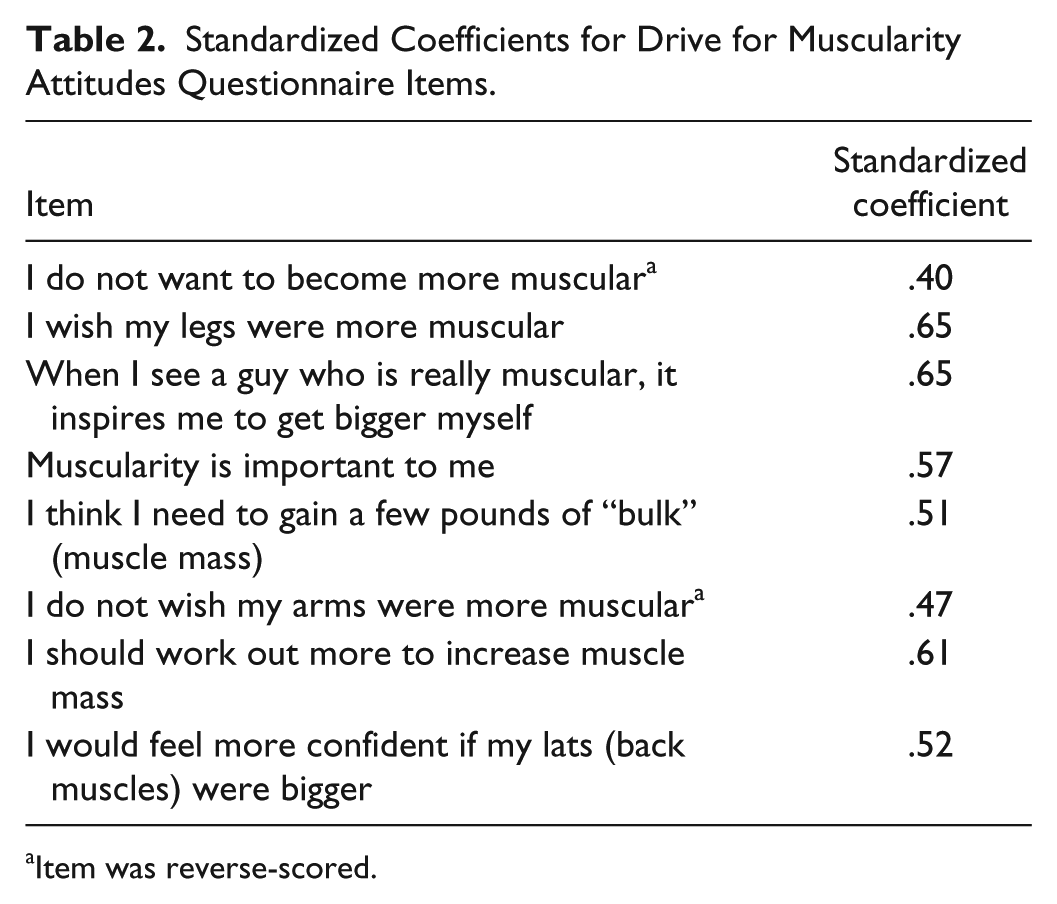
Item was reverse-scored.
Construct Validity
Results supported each hypothesis. In accordance with Hypothesis 1, drive for muscularity attitudes were positively associated with muscle building behaviors: r(325) = .40, p < .001. As predicted by Hypothesis 2, there was a negative (albeit small) correlation between drive for muscularity attitudes and global self-esteem: r(325) = −.20, p < .05. Finally, Hypothesis 3 was supported by a statistically non-significant correlation between drive for muscularity attitudes and socially desirable responding: r(325) = −.04, p = ns.
Discussion
The goal of the current study was to psychometrically evaluate the DMAQ among an Internet sample of Irish men, a group that has received limited scrutiny vis-à-vis the topic of body image. Results suggested that the DMAQ is psychometrically sound when completed by members of this population. The lower bound estimate for Cronbach’s alpha (.71) suggested that the DMAQ yielded reliable scores, and findings supported previous Canadian research on the measure’s factor structure (Morrison & Harriman, 2005; Morrison et al., 2004). The CFA indicated that the scale’s unidimensional model adequately matched the observed data, with favorable fit indices emerging (e.g., CFI = .95).
In support of the DMAQ’s convergent validity, Irish men’s drive for muscularity attitudes correlated positively with their behavioral investment in gaining more muscle mass. On average, the men reported moderate drive for muscularity attitudes and little behavioral investment in building muscle mass, suggesting that some of the men did not act on their desires to get bigger muscles. Irish men’s relatively weak behavioral investment in their muscularity supports previous research with Canadian men, which showed that participants engaged in few muscle building activities despite wishing they were more muscular (McCreary et al., 2004).
However, the MB subscale of the DMS (McCreary & Sasse, 2000) might underestimate participants’ behavioral investment in their muscles, as some of its items (e.g., “I think that my weight-training schedule interferes with other aspects of my life”) may measure symptoms of muscle dysmorphia (Edwards et al., 2012). Muscle dysmorphia is a condition characterized by a person’s pathological preoccupation with the belief that his or her body is insufficiently lean and muscular and consequent clinically significant distress or impairment in social, occupational, and/or other vital areas of functioning (Olivardia, 2001). Given the positive correlation between scores on the DMAQ and the MB (McCreary & Sasse, 2000), future research may wish to investigate the relationship between Irish men’s drive for muscularity attitudes and their muscle dysmorphia symptomatology by using the DMAQ and a measure of the latter construct, such as the Muscle Appearance Satisfaction Scale (Mayville, Williamson, White, Netemeyer, & Drab, 2002).
An anticipated negative correlation emerged between scores on the DMAQ and global self-esteem (which was generally high in the current sample), providing additional support for the DMAQ’s convergent validity. However, the small size of this association may warrant empirical attention. Previous research has found comparably small correlations between the drive for muscularity and self-esteem (Bergeron & Tylka, 2007; Morrison et al., 2004; Smolak & Stein, 2006). Future research may investigate the relationship between the drive for muscularity and self-esteem among men who have different body types. Men’s muscle mass may be a moderator, augmenting the negative relationship between the drive for muscularity and self-esteem among non-muscular men, while reducing this association for those with larger muscles.
Finally, evidence was furnished attesting to the discriminant validity of the DMAQ. Congruent with findings reported by Morrison et al. (2004), no relationship between socially desirable responding and scores on the DMAQ emerged. Thus, in this sample, it is unlikely that men’s responses to the DMAQ were unduly influenced by a desire to receive social approval.
The current investigation advanced past psychometric work on the DMAQ (Morrison & Harriman, 2005; Morrison et al., 2004; Tod et al., 2012a) by evaluating its dimensionality, reliability, and validity in a different cultural group (namely, Irish men). The demographic profile of the current sample of participants is an advantage as men from the community (e.g., employed men) were included. Previous work on the DMAQ has been restricted to university students (Morrison & Harriman, 2005; Morrison et al., 2004; Tod et al., 2012a). Also, the use of an Internet survey possesses advantages. For example, Internet surveys grant participants more anonymity (Eysenbach & Wyatt, 2002), which is associated with lower levels of socially desirable responding (Joinson, 1999).
The online nature of this study, however, also may constitute a disadvantage. Given self-selection biases (Eysenbach & Wyatt, 2002), the generalizability of the current findings is unclear. Indeed, the current sample of Irish men is not representative of the wider population. Future psychometric work on the DMAQ may benefit by employing representative samples of men from different cultural contexts. Furthermore, there were many missing data in this study, a common limitation of Internet research, which can negatively affect the validity of findings (Blankers, Koeter, & Schippers, 2010). However, the authors used multiple imputation, a statistical approach recommended for protecting the validity of results from data sets affected by missing data (Blankers et al., 2010).
In conclusion, the current research supports the psychometric soundness of the DMAQ among Irish men. Research on Irish men’s drive for muscularity is warranted, given growing body image pressures on Irish men, who increasingly have eating disorders (Boyd, 2014). As the pursuit of a muscular appearance may put Irish men at risk, both physically and psychologically (Cafri et al., 2005; Morrison et al., 2006), researchers may wish to study their drive for muscularity. The current findings suggest that Morrison et al.’s (2004) DMAQ may be used in an Irish context. However, more psychometric research is recommended, as this study was the first to psychometrically analyze the DMAQ among Irish men.
Footnotes
Declaration of Conflicting Interests
The author(s) declared no potential conflicts of interest with respect to the research, authorship, and/or publication of this article.
Funding
The author(s) disclosed receipt of the financial support for the research and/or authorship of this article: Travis Ryan’s work on this article was supported by the Lady Gregory Doctoral Research Fellowship Scheme of the College of Arts, Social Sciences, & Celtic Studies, National University of Ireland, Galway. Todd Morrison received no financial support for the research and/or authorship of this article.