




Abstract
This study aims to analyze the influence of the discourse of international organizations on university social responsibility (USR), from international organizations, in the policy and management frameworks of the State University System in Colombia. Then, we reviewed institutional documents of global and regional organizations, as well as educational policy documents from higher education institutions. Using Atlas Ti. 23 software, our findings indicate that universities adopt the models proposed by international organizations with different approaches. The policy and management frameworks, aligned with François Vallaeys’“impact” perspective, emphasize the importance of tangible results. Seven of the universities studied articulate a well-defined USR policy, with most integrating it into extension and outreach processes. We conclude that USR should be related to education, initiative integration, management, research, organizational culture, and management indicators. We recommend further studies on how USR policies are integrated in higher education institutions.
Introduction
University Social Responsibility (USR) as a field of research has received considerable attention over the last decade (Duque & Cervantes-Cervantes, 2019; Rosales Cevallos, 2023), particularly in disciplines such as administrative sciences, economic and university management (Salcedo-Muñoz et al., 2023). Additionally, there is a growing interest in exploring the role of international organizations in promoting this concept and their strategic influence on university activities (Cabanzo, 2022; Gaete Quezada, 2023).
USR is a theoretical framework that redefines university policy and management, transcending traditional models of outreach and engagement. In the social sphere, it incorporates perspectives that go beyond the conventional academic and administrative impacts. Moreover, in the educational field, USR emphasizes the consideration of organizational, cognitive, and social aspects (Ali et al., 2021; Barrera-Rodríguez et al., 2023; Hinojosa Salazar et al., 2022; Vallaeys, 2021a; Vallaeys et al., 2009; see Figure 1).

Four types of university impact.
Social responsibility implementation models address topics such as evaluations and management indicators (Santana Murcia, 2022), as well as corporate and managerial aspects (Gaete Quezada & Álvarez Rodríguez, 2019; Vallaeys, 2021b), with the aim of enhancing their social impact (García & Alvarado, 2012). Likewise, aspects related to the improving relations with internal and external stakeholders are highlighted to strengthen stakeholders’ engagement and provide advantages through institutional implementation (Barrera-Rodríguez et al., 2023; Hinojosa Salazar et al., 2022; Larrán Jorge & Andrades Peña, 2017; Valdés-Montecinos & Ganga-Contreras, 2021).
In this context, International Organizations (IOs) have played a crucial role in promoting and implementing the social responsibility of universities in educational policies (Gaete, 2016). This involvement often takes place through the signing of agreements or the support for projects (Blanca-Virgen et al., 2023). Additionally, IOs contribute by generating research and constructing discourses around university practices based on their policies and management approaches (Cabanzo, 2022).
In Latin America and Colombia, USR receives significant attention in both the public and private sectors. Networks include the Union of Latin American Universities with Social Responsibility (URSULA), which more than 1,600 members and 185 educational institutions (44 of them Colombian) in 15 countries. At the local level, the Observatory of University Social Responsibility (ORSU), affiliated to the Colombian Association of Universities (ASCUN) includes 30 higher education institutions.
As a contribution to the field of study, a critical examination of the impact of international organizations on university policies with a specific focus on university social responsibility is pertinent (Amaral & Neave, 2014). The aim is to characterize global discourses that subsequently influence public university policies at regional and local levels. In recent years, there have been significant advances in the analysis from a discursive perspective. For example, Fairclough and Ghio (2008) has contributed through critical discourse analysis, Fischer (2003) has examined it from the perspective of deliberative practices, and Van Dijk (2005) has analyzed discourse as social interaction and a form of political and ideological structuring.
In general terms, a relationship exists between policies and priorities identified by various international organizations. A notable example is the 1998 World Conference on Higher Education, with focused on the overarching theme “Higher Education in the 21st Century: Vision and Action,” initiating a discourse on university roles. In this context, three essential areas of dialog and debate were postulated: university autonomy and accountability; autonomy and stakeholders; and academic freedom, including its ethical implications and civic responsibilities (Neave, 1998).
Thus, a relationship can be identified between international organizations- both as instruments and actors that shape world politics (Tursi, 2017), university social responsibility, and the global education system.
This study raises the following questions: What is the role of international organizations in the implementation of USR in universities? How has USR been incorporated in state institutions in Colombia? The aim of this study is to analyze the influence the USR discourse of international organizations on the policy and management framework of the state university system in Colombia.
Method
A qualitative study was conducted to identify “a complex set of arguments, vision and logics of thought” (Galeano, 2012, p. 21). The objective is to identify perspectives in a way that is consistent with the phenomena being studied. The methodological strategy involved a documentary analysis from the perspective of interpretation and understanding of discourses (Flick, 2013). A discursive analysis was conducted on the documents from the selected organizations and institutions. Considering the typification of the documents, the analysis reached both descriptive and critical levels, which are commonly applied in disciplines such as political science for the analysis of public and educational policies. The ATLAS.ti-23 software package was used to manage data, allowing for coding, grouping, and relating the identified concepts (Freeman, 2016; Friese, 2019).
Two groups of primary sources serve as references: (a) documents from international organizations at the global (n = 35), regional (n = 12), regional network (n = 8) and local (n = 9) levels; (b) institutional educational policy documents from the 32 universities that make up the State University System (SUE) in Colombia. The defined corpus of educational public policy documents includes institutional educational projects (PEI), institutional development plans (PDI), management reports (IG), self-evaluations (AE), and/or accreditations (AC; n = 137). It also includes university social responsibility policies for those universities that explicitly have them (PUSR; n = 7).
Criteria for Selection of Primary Documents
First, we applied the inclusion criteria. In accordance with the research objectives, a phase was conducted to observe the relevance of the documents (Duque & Cervantes-Cervantes, 2019; Ramírez & García, 2018).
The information was collected as follows: first, documents from international organizations were collected from their respective institutional repositories. Second, data from international and national networks were obtained from their official websites and repositories. Third, educational policy documents were sourced from the normative repositories of 32 universities of the State University System (SUE). All documents were freely accessible and published on the institutions’ websites. Only documents from official institutional repositories were considered.
One of the inclusion criteria was that the documents must be publicly available on official institutional websites to avoid potential confidentiality concerns.
Data Collection Methods
A selection of documents was made to examine the discursive characteristics around University Social Responsibility (USR), education policy, higher education institutions and international organizations (IO). The primary descriptors used in the analysis included: “university social responsibility,”“social responsibility in the university,”“responsibility of higher education institutions” and “social responsibility and university management.”
Results
For the review of institutional documents (hermeneutic units) from different organizations at the global, regional, and local levels, including higher education institutions within the University System, thirty-seven (37) codes were identified through inductive analysis. These were organized into seven (7) groups of codes, culminating in the design of a co-occurrence table highlighting the most representative codes.
The codes were weighted according to their frequency in citations from the institutional documents. Codes such as “extension” (f = 4,567), “social responsibility” (f = 3,059), “indicators” (f = 2,157), “internationalization” (f = 1,625) and “sustainability” (f = 1586), are the most recurrent in the coding. Notably, some codes, though less frequent, reflect cutting-edge topics within the academic literature on universities’ scope of action, such as: “accountability” (f = 2), “organizational impacts” (f = 25) and “labor impacts” (f = 7). These criteria align directly with the frameworks proposed by Vallaeys (2021a, 2021b) and Organización de las Naciones Unidas para la Cultura y la Educación [UNESCO] (2008)
In addition, the presence of codes related to elements of the university’s mission stands out: for example, “governance” and “governability” with (f = 585) and (f = 192). Codes representing axiological dimensions also appear, such as: “values” (f = 115), “ethics” (f = 127) and “citizenship” (f = 534). This is related to Organización de las Naciones Unidas para la Cultura y la Educación [UNESCO]’s (2008), emphasis on the role of higher education institutions as builders of society, considering their ethical and formative impacts.
The document review and coding process resulted in the construction of seven (7) groups of codes (GRC) across the USR framework. These groups are: “organization” (GRC-1), “modeling” (GRC-2), “axiology” (GRC-3), “conceptualization” (GRC-4), “knowledge” (GRC-5), “impacts” (GRC-6), and “stakeholders” (GRC-7). In some cases, codes overlap between different groups, reflecting the recurrence of concepts (see Figure 2).

Network of university social responsibility (USR) groups and codes (frequencies).
The code group “organization” (GRC-1) focuses on autonomy, from the perspective of higher education institutions’ management. It is highlighted as a key element, with emphasis on university extension, educational administration, and quality as a guiding management principle.
From the group representing the topic of “modeling” (GRC-2), the proposal of models to incorporate USR and internationalization, related to areas such as research, knowledge transfer, and the commitment to generate evaluation indicators in higher education institutions stands out. The conceptual approach incorporates social outreach, supported by business and corporate social responsibility, addressing global challenges such as the Sustainable Development Goals (SDGs).
In the “axiological” component (GRC-3), attention is given to the contribution of values such as citizenship and ethics, particularly within two major areas of influence: sustainability and the social projection of institutions. Adherence to these values is presented within a framework of legitimacy supported by the exercise of social responsibility, emphasizing specific visions of sustainability as vectors of quality.
The group of codes representing “conceptualization” (GRC-4) explores social responsibility as a central axis for connecting with other social sectors (corporations, companies, for-profit and non-profit organizations). It examines how social responsibility shapes university management within a sustainability framework, emphasizing the dialog, intersections, and misunderstandings between different perspectives on social responsibility, including state, social, and corporate approaches.
The “knowledge” category (GRC-5) focuses on the knowledge society and how its production, particularly through research, defines responsibilities for transfer. It emphasizes the importance of prioritizing education for work.
Likewise, the “impacts” group (GRC-6), addresses various impacts at educational, cognitive, social, organizational, environmental and labor levels. Accountability is considered a fundamental element in influencing public educational policies.
Finally, the “stakeholders” category (GRC-7), emerges from a dialog with university governance, reflecting on citizenship engagement with stakeholders. Academic training of various levels strengthens the relationship between higher education institutions and their environment.
Co-Occurrences of Two Code Sets
Two groups of codes are contrasted: the first relates to the foundations and philosophical principles on which University Social Responsibility is based. The second group refers to the possible characteristics of the impact scenarios (see Table 1). A high co-occurrence coefficient (>0.1) is observed in three types of relationship: (a) social projection and extension (0.22), reflecting coincidence with higher education institutions that see this conjunction as a important niche for USR management; and social projection vs. internationalization (0.5), (Blanca-Virgen et al., 2023; Universidad del Magdalena, 2021; Universidad Distrital Francisco Jos de Caldas [UDFJDC], 2022; Universidad Tecnológica del Chocó Diego Luis Córdoba, 2021), (b) ethics vs. management (0.12), which coincides with the views of Vallaeys (2021b) and Gaete Quezada and Álvarez Rodríguez (2019) on the importance of maintaining a close relationship between ethical and philosophical considerations in institutions to enhance academic and administrative management, and c) governance vs. stakeholders (0.14), highlighting the need to maintain a positive relationship between institutions and their external environment, as part of the effort to improve administrative scenarios through enhanced communication dynamics (Campoverde et al., 2023; Valdés-Montecinos & Ganga-Contreras, 2021).
Co-occurrence of Two Sets of Codes (Count and Coefficient).

Note. Gr = Code rootedness. That is, the number of citations that have been coded by that code.
Top heading: Au = Autonomy; Ciu = citizenship; Et = ethics; Gob = governability; Gza = governance; Leg = legitimacy; Pro = projection; RS = social responsibility; USR = university social responsibility; Sus = sustainability; Val = value. Left column: Cal = quality; Ext = extent; Ger = management; Ges = management; ImAm = environmental impacts; ImCog = cognitive impacts; ImEd = educational impacts; ImLab = labor impacts; ImOrg = organizational impacts; ImSoc = social impacts; Ind = indicators; Int = internationalization; Inv = research; PI = stakeholders; PE = educational policies; PP = public policies; SC = knowledge society; Sos = sustainability; Tra = transfer; External number = headcount, internal number coeficient.
In a second group, there are relationships at an intermediate level, which include ethics - research (0.07), USR - management and values - quality (0.06), and values - research (0.05). In this context, Severino-González et al. (2022) emphasize the importance of integrating ethical values and principles in university management, underlining their role in the training process (see Table 1).
On the other hand, the low co-occurrence coefficients in the group addressing philosophical principles, impacts, public policies, and educational policies are notable, with values in many cases close to or equal to zero (0.0). Similarly, the codes related to autonomy and legitimacy show a low level of correlation with those connected to impact and university management.
University Social Responsibility (USR) in Higher Education Institutions (HEI)
A review of the institutional policy documents from the 32 universities within the State University System (SUE), shows that 18.75% include the USR in their Institutional Educational Project and Institutional Development Plan. Additionally, 21.88% include it in their management reports, and 25% in the accreditation reports and/or qualified registration before the Ministry of National Education (MEN) and the National Accreditation Council (CNA). In particular, 25% of the universities (8 out of 32) have specific documents dedicated to the USR (see Figure 3).
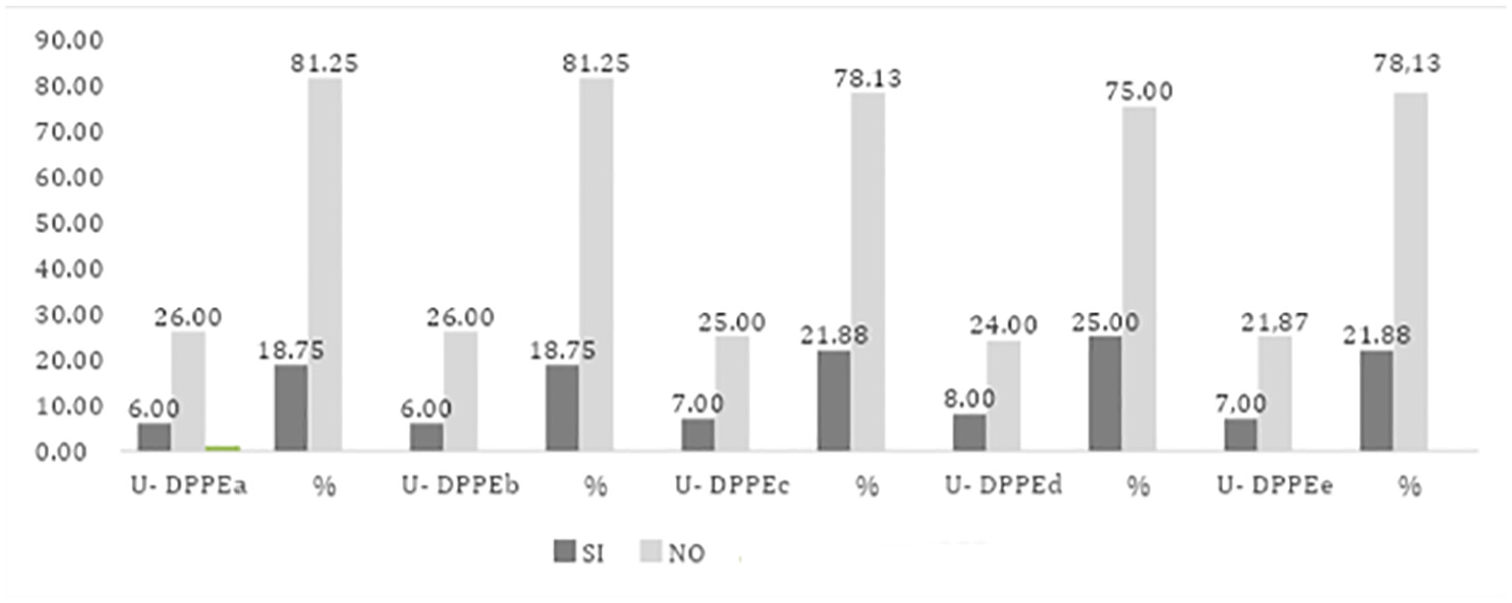
Incorporation of university social responsibility in institutional educational policy documents. Percentages (%; n = 32 universities of the SUE).
Extension” is presented in a two ways: first, as the foundation of University Social Responsibility (USR), and second, as a framework for educational and administrative management, where its management model is positioned. It is important to note that the seven Colombian universities that present a specific USR policy, through freely accessible documents published on their websites, place this work within social projection scenarios, mainly related to university extension.
The seven universities are: Universidad Colegio Mayor de Cundinamarca (UCMC), Universidad de Antioquia (UDEA), Universidad de Cundinamarca (UDEC), Universidad de Magdalena (UDEM), Universidad Distrital Francisco José de Caldas (UDFJDC), Universidad Tecnológica de Pereira (UTP) and Universidad Tecnológica del Chocó Diego Luis Córdoba (UTDCH).
Regarding educational management and administration, it should be noted that the USR is at the forefront of the entities responsible for outreach and social projection. In general, USR policy is understood as the point of interaction with society. For example, the Universidad Colegio Mayor de Cundinamarca (UCMC), considers USR as a collective attitude, positioned as a service to society through social projection and extension, using human potential (Universidad Colegio Mayor de Cundinamarca [UCMC], 2019). The University of Antioquia (UdeA) presents USR as a scenario of ethical self-reflection based on the recognition of others (Universidad de Antioquia [UdeA], 2019). Similarly, the University of Cundinamarca (UdeC), sees it as an awareness of management oriented to organizational, environmental, educational and cognitive impacts, with a special focus on internal and external stakeholders at social, economic and environmental levels, all centered on sustainable development (Universidad de Cundinamarca [UdeC], 2021).
The Universidad del Magdalena (UniMagdalena) adopts the principles of the Socially Responsible University to manage internal and external impacts. This approach supports the mission pillars of teaching, research and extension, all integrated in the administrative work (Universidad del Magdalena, 2021). At the Universidad Distrital Francisco José de Caldas (UDFJDC), the emphasis is on realizing the social contract, focusing on impact management as a core part of its mission and broader social impact (UDFJDC, 2022).
The Universidad Tecnológica de Pereira (UTP; 2019) offers a vision centered on “human, social and intercultural development” (p. 4) within a participatory, ethical and critical framework. The institution focuses on sustainable development, taking into account the welfare policies of its stakeholders (Universidad Tecnológica de Pereira [UTP], 2019). On the other hand, the Universidad Tecnológica del Chocó Diego Luis Córdoba (UTDCH) emphasizes a policy of continuous improvement, guided by ethical and quality management principles. This approach is supported by pillars such as civic education, dissemination of knowledge, participation and the search for equitable and sustainable development.
Discussion
The objective of the study is to analyze the impact of the discourse of University Social Responsibility (USR) from international organizations on the policy and management proposals of the State University System in Colombia. In this context, the different practices of universities within their management models are emphasized, where the regularization of organizations and the standardization of their practices across different administrative and academic areas become important.
Accordingly, the management dimensions of USR are highlighted by the need to promote models of implementation and adaptation, creating frameworks that strengthen quality assurance, accountability processes, and initiatives such as internationalization, among others (Blanca-Virgen et al., 2023; Gaete Quezada, 2023; Rosales Cevallos, 2023; Severino-González et al., 2022; Vallaeys, 2021a, 2021b).
Therefore, it becomes important, a materialization in university policies leading the identification of the forms of power that have been put into operation through practices (Van Dijk, 2005) and discourses emanating institutionally by international organizations (Cabanzo, 2022) that contribute to the debate on the role of organizations (Amaral & Neave, 2014), with a perspective of public policies from the nature of the arguments and the implementation of instruments (Fischer, 2003).
Hence, the USR gains value in the university, from the relationship between knowledge and power at global, regional and local levels, the preponderance given to management scenarios linked to quality policies, values related to institutional philosophy such as university autonomy which is one of the most important achievements of educational institutions in their struggles throughout the 19th and 20th century (Bernasconi, 2014; Sousa, 2007).
At the global level, the United Nations Educational and Cultural Organization (UNESCO), the World Bank (WB), the Organization for Economic Cooperation and Development (OECD), the Global Compact (GC) and the International Organization for Standardization (ISO) provide frameworks that, at the level of concepts and notions of higher education, materialize discourses on the relationship between the transformation of the State’s work and the corresponding public policies.
In this perspective, the United Nations Educational and Cultural Organization (UNESCO) postulates relevant topics for university institutions and knowledge communities such as relevance, management, and international cooperation. The programs promoted set a new horizon around the Sustainable Development Goals (SDGs, Agenda 2030), adding principles such as quality, equity, inclusion, and freedom of expression. Similarly, they are framed in the protection of the environment, with topics related to science and technology (Barrera-Rodríguez et al., 2023; George et al., 2023; Organización de las Naciones Unidas para la Cultura y la Educación [UNESCO], 2008, 2019).
Indeed, the World Bank (WB) finances initiatives to support developing countries through research and policy analysis, technical assistance, and financing, to strengthen institutions and improve the quality of their programs, within a framework of sustainability. Its indicators aim to improve enrollment rates in high-quality institutions, participation in research, teaching, and internationalization projects, as well as institutional accreditation of universities (Campaña Latinoamericana por el Derecho a la Educación [CLADE], 2020; World Bank [WB], 2017).
Likewise, the Organization for Economic Cooperation and Development [OECD], in the context of the USR, assists in the implementation of reforms aimed at optimizing learning needs and capacities by improving educators’ practices (Larrán Jorge & Andrades Peña, 2017). Thus, its actions are aimed at promoting policies to protect human rights, based on an open and transparent economy with an imprint of economic welfare and quality of life, based on adequate social and environmental standards (Organización para la Cooperación y el Desarrollo Económico [OCDE], 2018, 2019).
The International Standard Organization (ISO), the Global Compact (GP), and the Global Reporting Initiative (GRI) provide the USR with a technical vision of regulation and control in evaluation, through a system of principles, postulates, and indicators. Consequently, they are guidelines through which the social responsibility of higher education institutions is evaluated at a global level, and policies are promoted from discourses linked to sustainable development.
Specifically, the development of standardization regulations (Organización Internacional de Normalización [ISO], 2010, 2014) has guidelines and indicators for governance and ethical strategies articulated to stakeholders for the preparation of evaluation reports with their respective indicators (Global Compact [GP], 2018; Iniciativa Mundial de Presentación de Informes [GRI], 2016).
At the regional level, on the one hand, the Inter-American Development Bank (IDB) presents the USR system from a perspective of impacts (organizational, educational, cognitive and social) in the framework of a new university management policy based on commitment, participatory self-diagnosis, compliance and accountability (Ali et al., 2021; George et al., 2023; Hinojosa Salazar et al., 2022; Vallaeys et al., 2009). For these reasons, it is important to consider the projects financed for education by the IDB are framed in the discourse of ethics and social capital, with principles such as gender equality and diversity, environmental sustainability, climate change, regional economic integration, productivity, innovation, and financing (Campaña Latinoamericana por el Derecho a la Educación [CLADE], 2021).
Likewise, the Economic Commission for Latin America and the Caribbean (ECLAC) promotes a regional perspective for regional integration and cooperation, through advice to governments and training, planning, and implementation of projects, which according to George et al. (2023) becomes important because investment of resources is required. In terms of USR, it urges to review the ISO standards, and the parameters generated by the GP and the GRI, as a contribution to international economic relations (Alonso, 2006).
From a regional perspective, the Observatory of University Social Responsibility for Latin America and the Caribbean (ORSALC), the Association of Universities Entrusted to the Society of Jesus in Latin America (AUSJAL) and the Union of University Social Responsibility for Latin America (URSULA) generate spaces for dialog and adaptation to the proposals that arise in international scenarios. These are especially active in the dynamics of training, collaboration, good practices, and articulation between the State and higher education institutions. They also have a great capacity to establish networks throughout the continent, with a good level of acceptance by governments and public and private sector companies. Their main objective is to influence educational public policies at the local and regional level and in the construction of evaluation indicators (Asociación de Universidades Confiadas a la Compañía de Jesús [AUSJAL], 2014; Observatorio Regional de Responsabilidad Social para América Latina y el Caribe [ORSALC], 2018; Vallaeys, 2021a, 2021b).
At the local level, there is the University Social Responsibility Observatory, which is part of the Colombian Association of Universities (ASCUN), whose objective is to contribute to educational public policies, through the implementation of actions related to training and research programs with a sustainable development perspective, as part of its social function (Observatorio de Responsabilidad Social Universitaria [ORSU], 2021).
The universities affiliated to the State University System (SUE) incorporate university social responsibility from the perspectives of social projection and extension, mainly following the management model of François Vallaeys and articulating the educational policy corresponding to the mission axes and the quality guidelines issued by the Ministry of National Education and the National Accreditation Council.
The integration of university social responsibility (USR) models is evident in policy and management frameworks that align with international agenda themes. This alignment spans across organizations at various levels and reflects the evolving discourses within public education. Concepts such as “extension,”“social projection,”“sustainability,”“internationalization,”“autonomy,” and “indicators” are central to the development of university educational policies (see Figure 4).
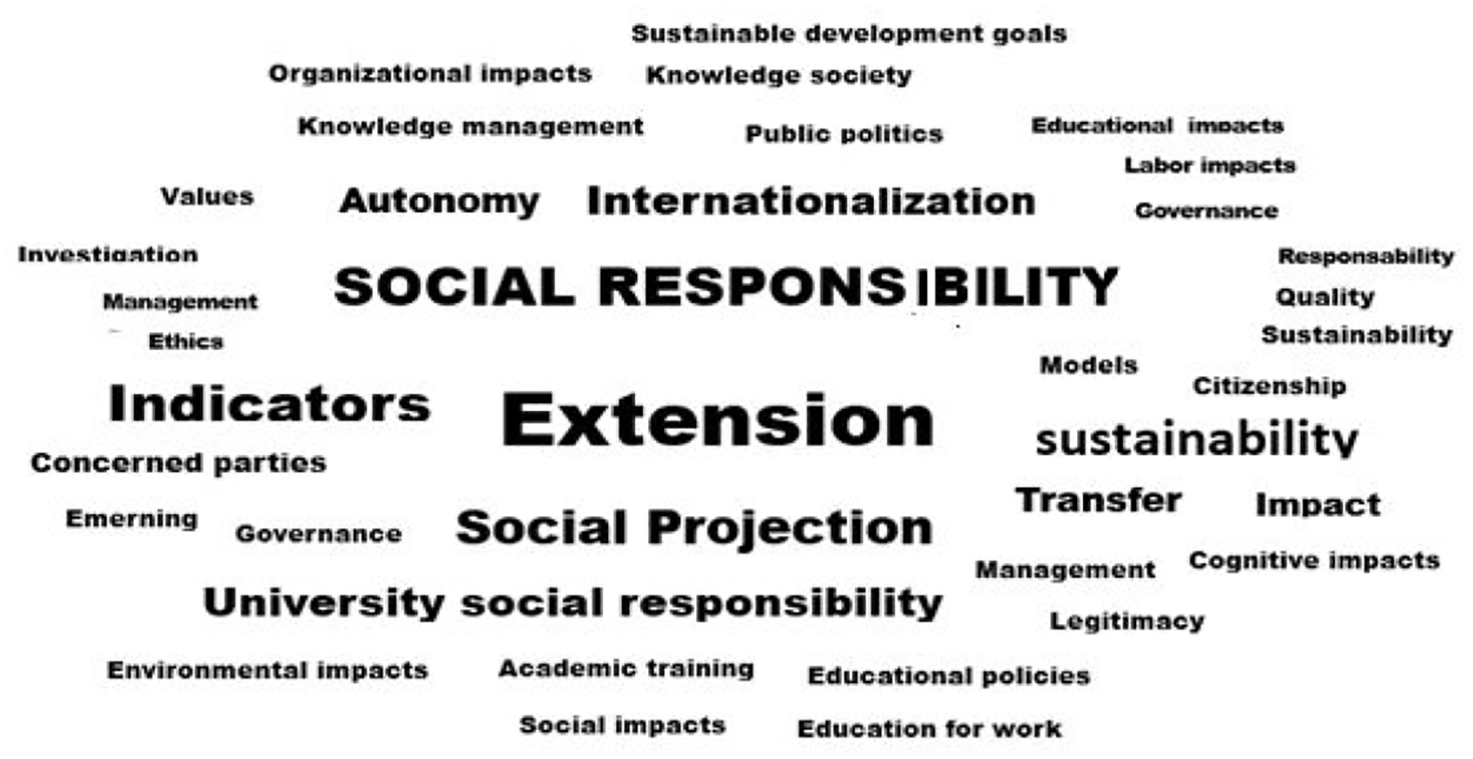
USR code cloud (n = 37).
Conclusions
University Social Responsibility (USR) encompasses a set of interrelated elements that manifest themselves through discourses, networks, and academic statements. The incorporation of discourses on management, quality and sustainability, among others, justifies the implementation of policies by university institutions that are aligned with organizational efficiency (e.g., indicators, management, knowledge transfer).
At the same time, the influential role of international organizations in shaping this construction, as well as the specific concepts and discourses that constitute them, is highlighted. These organizations contribute to how these proposals have been adopted by Colombian higher education institutions in research and innovation projects, stakeholder relations, corporate policies, and organizational culture.
The results show that while USR has been incorporated into state institutions in Colombia, it is important to note that it has not yet been officially integrated into higher education policies at the legislative level, nor into sectoral or development plans. However, the theoretical development of USR has progressed significantly. Public universities reference it in some public educational policy documents, and in certain cases, there is evidence of institutional policies specifically addressing USR.
Finally, for future studies, we propose utilizing data from all universities in Colombia. Likewise, longitudinal case studies should be conducted to characterize the daily management practices of universities at the management, academic, and research levels, in order to determine how USR policies affect daily activities.
Footnotes
Acknowledgements
We thank Doctorate studies in Policy and Modeling Public Management for the assistance in writing the proposal for this project.

Ethics Statement
It is not applicable for this study.
Funding
The author(s) received no financial support for the research, authorship, and/or publication of this article.
Declaration of Conflicting Interests
The author(s) declared no potential conflicts of interest with respect to the research, authorship, and/or publication of this article.
Data Availability Statement
Data sharing not applicable to this article as no datasets were generated or analyzed during the current study.