




Abstract
Perceptions and institutional frameworks can be barriers or facilitators to the development of female entrepreneurship policies. Institutions rely on factual data on the gender gap to evaluate their policies. However, the literature shows that the research and institutions should also analyze the impact of social beliefs on the success of these policies and initiatives. This study focuses on the impact of these perceptions in promoting female entrepreneurship. Data were collected from 287 responses to a questionnaire from Spanish women and men and were analyzed using multivariate regression analysis. The results show that the perception of lack of equality increases the gender gap even if there are specific and effective policies in a society that attempt to eliminate the gender gap in terms of the role of women in the home or positions of power. The main result is that these perceptions ultimately affect women’s entrepreneurial intentions. The results have policy implications for companies and public institutions willing to change the gender narrative about entrepreneurship and design policies and initiatives that help women overcome cultural barriers and effectively promote female entrepreneurship.
Introduction
In the last years, several scholarly works and international institutions have been monitoring gender inequalities and have published several indexes and studies. Among these initiatives, for example, are the United Nations Development Program (UNDP), Gender-Related Development Index (GDI) and Gender Empowerment Measure (GEM), the World Economic Forum’s Global Gender Gap Index, Social Watch’s Gender Equality Index, or The Economist Intelligence Unit’s Women’s Economic Opportunity Index (Dilli et al., 2019). These works have focused on setting the standards for systematic and systemic measurement of social and environmental conditions determining the gender gap.
However, as most of these initiatives follow an economic approach, information related to women’s progress tends to focus on income and wage gaps and, to a much lesser extent, on social perceptions on the access to participation in other areas of civic, political, and economic life. Therefore, there is insufficient information about women’s perceptions to strengthen their capacities, to improve their contributions to society, or to assess the efficiency of policies implemented to increase their development (Ilie et al., 2018). The study of perceptions, beyond the macrovariables, can help to understand the barriers to female entrepreneurship; for example, several works have shown that the perception of gender discrimination is associated with multiple negative aspects, such as poorer work attitudes, behaviors and psychological health, and work outcomes (Triana et al., 2019).
In this context, this research aims to complement and extend previous works and research on individuals’ perception of government policies, initiatives, and strategies to minimize the gap in the participation of women in relevant areas of society, in particular, female entrepreneurship. Especially during the early stages of entrepreneurship, support and encouragement are needed, given that any perceived barriers can have many negative implications (Ilie-Cardoza, 2018; Jabeen & Faisal, 2018). To this end, the study is framed within the social comparison (Festinger, 1954) and institutional theories (North, 1991) to analyze individuals’ perception of the feelings they have for their opportunities in entrepreneurship. The main premise is that before facing gender inequalities, individuals should be aware of discrimination (Crosby et al., 1989; Derks et al., 2015; Postmes et al., 2019; Schmitt & Branscombe, 2002).
According to these theories, perceptions about aspects of institutional reality can facilitate or hinder other spheres of the economy, such as interest in entrepreneurship. Social comparison provides the benchmark for individuals to evaluate their own opinions and abilities (Ngo et al., 2003; Perkins & Cross, 2014) and perceive socially accepted practices which reward people differently depending on the social group to which they belong (Ngo et al., 2003). Institutional theory provides a framework where the gender gap might exist despite the efforts from governments and other social players (Jütting et al., 2008). The set of perceptions and the development of the institutional framework can be a barrier or a facilitator to the development of female entrepreneurship policies and programs (Koo et al., 2019).
According to the latest Global Gender Report (World Economic Forum, 2019), the most significant gaps between women and men are found in political empowerment and economic participation and opportunity, at 73% and 41%, respectively. In the vast majority of countries, the total entrepreneurial activity (TEA) rate is lower for women than for men (Vinet & Zhedanov, 2011). These overwhelming data show that politics, civil society, and business do not benefit enough from women’s contributions despite institutional efforts. Beyond the facts or government initiatives, one of the barriers to the development of female entrepreneurship can be social beliefs based on perceptions. Specifically, there are perceptions of governments’ efforts, access to educational grants, family roles, and women’s participation in politics.
In this context, first, regulation and taxation are observed as a framework for promoting entrepreneurship (Vossenberg, 2013), while the lack of policies is usually analyzed as a common barrier for female entrepreneurship (Jamali, 2009). Second, awareness of gender discrimination is considered the first step in education and training to minimize the potential negative effects of the gender gap (Sipe et al., 2016). Third, the perception of the role of women in the family can also explain female entrepreneurship given that family responsibilities determine the possibilities of becoming an entrepreneur (Brush et al., 2009; Jennings & Mcdougald, 2007) and according to Williams (2004), caring for children has a negative effect on entrepreneurial success. Finally, women’s participation in politics is one of the most critical concerns to reduce gender inequality (Dilli et al., 2019). Based on these variables, this research asks whether the public’s perceptions of these aspects of economic and social life, beyond the facts and policies developed by institutions, can condition women’s entrepreneurial perceptions.
The article intends to contribute in several ways: (a) by shedding extra light on the perception of the effectiveness of policies intended to reduce the gender gap in female entrepreneurship and (b) by analyzing the perceptual barriers for female entrepreneurship. As a consequence, the study also expects to offer useful insights for private and public policymaking. The research focuses on the early stages of the professional career (after graduation) and contrasts these perceptions with official data and initiatives from institutions.
Results show that perceptions of discrimination toward female entrepreneurship are more harmful when societies have negative views of women’s access to education, politics, or the role they are expected to play in the family. These data are particularly striking when considering that the country has specific policies and initiatives to favor women’s entrepreneurship, access to education, politics, and recognizes forms of family other than those composed of a father or mother. Therefore, the study shows that beyond analyzing the factual data of the gender gap, research and policies should increase the communication and dissemination of initiatives to change the opinions of its citizens and encourage female entrepreneurship. Surprisingly, the results show that knowledge of pro-equality policies does not determine positive perceptions toward the possibilities of female entrepreneurship.
The article is organized as follows. The next section shows the main scholarly contributions to theory and introduces the hypotheses. Section “Research Methods” explains the sample, methodology, and research design. The discussion of the results, implications, limitations, and future research are provided in the last sections.
Literature Review
Gender discrimination is the unequal distribution of opportunities, resources, and rewards according to gender (Charles et al., 1996), and it is usually based on the perception and/or belief that there is a lack of equality because of gender rather than other personal characteristics (Ngo et al., 2003). Also, as a consequence of depriving women of fundamental freedoms (Miletzki & Broten, 2017), several studies argue that gender discrimination affects social development outcomes, causing poor governance and lower economic growth (Knowles, 2002; Swamy et al., 2001). Previous studies (i.e., Branisa et al., 2013; Miletzki & Broten, 2017) have shown that these inequalities are related to gender roles rooted in institutions. Other research has worked on this issue from the point of view of social comparison theory (Ngo et al., 2003). Therefore, this study is framed within institutional theory and social comparison theory.
Vossenberg (2013) have used institutional theory to justify the impact of the social, economic, and political systems within which entrepreneurs operate. According to this theory, institutions are embedded within societies and produce normative expectations that determine right or wrong behavior (Scott, 2014). Therefore, institutions govern behaviors and interactions (North, 1991) and promote social norms and beliefs (Jütting et al., 2008) because they comprise a “set of fundamental political, social and legal ground rules that establishes the basis for production, exchange, and distribution” (Davis & North, 1971, p. 6). In sum, institutional theory holds that institutions incorporate common beliefs to keep legitimacy and stability in society (DiMaggio & Powell, 1991; Meyer & Rowan, 1977). In this context, legitimacy theory states that people act within a value system that works as a contract between the different actors of society (Cormier et al., 2005). For women entrepreneurs, the perception of social legitimacy provides security and better results in the entrepreneurial self-efficacy necessary for venture growth (Ilie-Cardoza & Cardoza, 2021; Kawai & Kazumi, 2021).
Regarding the entrepreneurial gender gap in the context of institutional theory, there are three levels: the regulatory system (legal and policy environment of entrepreneurs), the normative system (stereotypes of males and females, family framework, gendered expectations, beliefs systems, cultural factors), and the cognitive system (education, training, and technology). These levels promote social thought and action (Baughn et al., 2006), which provide legitimacy and facilitate [or not] entrepreneurship. Gender beliefs are often analyzed as part of the female entrepreneurship gap as women do not usually identify themselves with entrepreneurship and do not consider this possibility (Minniti & Naudé, 2010).
Social comparison theory also sheds light on the explanation of the formal institutions’ normative system (stereotypes, gendered expectations, beliefs systems, cultural factors). According to social comparison theory, individuals turn to their cultural references to evaluate themselves and their status (Shah, 1998). In this context, group composition is likely to promote processes of comparison by shaping the value that individuals attach to groups (Wharton, 1992). People receive information that allows them to know what to expect from the institutional framework, what are the conditions, and, especially, what are the relations between what is demanded and what is achieved (Major, 1994). Therefore, women and men may perceive a discriminatory or non-discriminatory situation based on the comparisons they make within their own social group and on the development level of the institutions where their socialization process takes place (Ngo et al., 2003). In sum, the understanding of how individuals interpret, perceive, and value inequality between the two genders can reinforce the gender gap and determine the development of formal institutions (Ngo, 2001). This is why individuals’ cognitive processes, together with the institutional framework of societies, need to be taken into consideration in addition to real data and government initiatives.
Consequently, focusing on perceptions of equality and not just factual discrimination is needed because perceptions influence attitudes and behaviors within a given environment (Sanchez & Brock, 1996) and can cause moral problems (Shah, 1998). They may also help to promote ethical climate and socially responsible behaviors (Demirtas & Akdogan, 2015; De Roeck & Farooq, 2018). Besides, increasing awareness of the reality of gender discrimination is a necessary first step for designing effective policies and initiatives aimed at reducing the gap and dealing with discrimination problems (Sipe et al., 2016).
Hypothesis Development
A group or individual must first recognize that discrimination exists to take actions to protect themselves when faced with discriminations and to reduce inequality (Crosby et al., 1989; Derks et al., 2015; Postmes et al., 2019; Schmitt & Branscombe, 2002). This is because a direct relationship with other people implies the creation of social perceptions (Ibarra & Andrews, 1993), where individuals may perceive gender discrimination within socially accepted practices that often reward people differently depending on the social group to which they belong (Ngo et al., 2003).
Early career discrimination has negative impacts on women’s confidence, career satisfaction (Carr et al., 2000), long sickness absence among women (Pietiläinen et al., 2020) and, thus, their intention to be entrepreneurs. In this context, literature shows that the more aware people are about the possibilities of suffering discrimination, the more likely they are to confront the consequences of discrimination that can affect them at an individual level in terms of loss of opportunities and lack of self-esteem (Sipe et al., 2016). To understand the effects of perceptions on various aspects developed by formal institutions, a series of variables will be analyzed linked to institutional support for female entrepreneurship, education based on equality, the role of women in the family and society, and the perception on the possibilities to access politics and civil society.
Regarding the government’s supports, previous research shows that regulation, legal barriers, and taxation are observed as a framework for promoting entrepreneurship (Vossenberg, 2013), while the lack of policies, laws, and services are usually analyzed as common barriers for female entrepreneurship (Jamali, 2009). Aidis et al. (2007) show that formal institutions can create and provide opportunities for entrepreneurship, while normative beliefs and attitudes can strongly inhibit opportunities for female entrepreneurship because institutions define behaviors and interactions (North, 1991) and promote beliefs (Jütting et al., 2008). Thus, it seems appropriate to argue that when institutional efforts exist and global beliefs and perceptions are aware of that effort, the perception of discrimination will be less in promoting women’s entrepreneurship. These considerations lead to the following hypothesis:
The awareness of gender discrimination is considered the first step in education and training to minimize the potential negative effects of employment discrimination (Sipe et al., 2016). While some studies explain that higher education is negatively associated with the decision of being an entrepreneur (Bernat et al., 2017), other researchers point out that higher education provides better job offers and also allows individuals to identify entrepreneurial opportunities as well as having better managerial skills (Simoes et al., 2016). For example, Blanchflower (2004) found that educational level increases entrepreneurial activity in the United States while decreasing interest in Europe. Sims and Chinta (2019) showed that motivation for entrepreneurship is need-driven rather than opportunity-driven among women with fewer resources. Nevertheless, on the contrary, this kind of perception has its roots in cultures and socialization processes that can lead to subjective interpretations according to the entrepreneurs’ gender (Morales-Inga & Morales-Tristán, 2020).
Although there are no conclusive studies on the impact of educational level, it seems reasonable to argue that social beliefs regarding discrimination in access to education can lead to a negative perception of discrimination in the development of women’s entrepreneurial projects. Therefore, previous studies provide empirical research to verify the following hypothesis:
The perception of women’s role in the family can also determine female entrepreneurship intentions. Family responsibilities (commonly assigned to women in most cultures) can explain the possibilities of being an entrepreneur (Brush et al., 2009; Jennings & Mcdougald, 2007). Although entrepreneurship can provide flexibility for women, Williams (2004) found that spending time in caring for children negatively affects entrepreneurial success. Furthermore, running the business at home may also undermine the legitimacy of the business in customers (Marlow, 2002). Therefore, when a society fosters a perception of women strongly linked to family care and does not support behavior outside that pattern (e.g., deciding to be single), it may create a social perception that induces women not to contemplate the role of entrepreneur.
The role of the woman as a family caregiver can also affect social networks, which are another critical factor in entrepreneurship. There is a significant correlation between knowledge of another self-employer and personal involvement in starting a business (Minniti, 2010). Several studies (Brush, 1992; Greve & Salaff, 2003; Justo & DeTienne, 2008) underline that women in developing and developed countries rely more on husbands, partners, and extended families (Brush et al., 2009; Jennings & Mcdougald, 2007) which, in many rural settings, are often the only or a significant social network for females (Minniti & Naudé, 2010).
In a study conducted in Eastern Europe, Aidis et al. (2007) found evidence that access to finance is more difficult for female entrepreneurs, partially because women have fewer contacts. Other studies have shown that nascent female entrepreneurs tend to have a greater openness and cooperation than men (Zisser et al., 2019). In consequence, under these circumstances, Aidis et al. (2007) suggested that women should engage husbands or other male family members in introducing them to more robust social networks.
Such studies show that those societies that attribute a role to women that is exclusively linked to the family can undermine their entrepreneurial attitude. For that reason, the perception of discrimination toward other family options, such as being single, can help explain perceptions of female entrepreneurship. In this context, it seems appropriate to propose the following hypothesis:
Women’s participation in parliaments is one of the most critical concerns to reduce gender inequality (Dilli et al., 2019). Previous studies explain that women’s contributions to civic life are relevant as, under certain circumstances, a higher representation of women in political environments leads to lower levels of corruption (Dollar et al., 2001; Esarey & Schwindt-Bayer, 2018). In addition, countries with higher levels of corruption and a greater presence of clientelism usually promote more discrimination against women (Benstead, 2016; Swamy et al., 2001). In this sense, it seems appropriate to maintain that those societies that consider that their women have difficulty accessing politics will establish a perceptual link with the difficulties of being a female entrepreneur.
These relationships are in line with the premise of this study; despite the formal efforts to reduce the gender gap, society is conditioned by its perceptions of inequalities in valuing the possibilities for female entrepreneurship. These relationships are then conceptualized and formulated for empirical testing.

Model.
Research Methods
The sample was developed with data collected from a survey that was applied to 287 recent graduates (up to 3 years after graduation) in Spain from a nonprobability convenience sample The survey was aimed at gathering personal and professional information and data on recent graduates’ perceptions of the topics under study using Likert-type scales and other ordinal variables. The definitions for the variables are available in Table 1, and they are based on the Women’s Social Progress framework (Ilie et al., 2018). Participants operate within similar personal, familiar, and organizational idiosyncratic characteristics, thus the responses are operative and, as a consequence, they share a similar contextual view of their perceptions.
Definition of Variables.

The analysis of data was carried out in two stages. The first stage was based on multivariate regression analyses using the Likert-type scale on the level of agreement or disagreement regarding the following statement: “Women do not have the same opportunities as men to open a business or start a business” as a dependent variable and the survey’s answers as independent variables. The second stage was carried out using a stepwise multiple regression with the objective of obtaining the highest statistically significant correlation with the independent variable (the relative importance of these variables was not known beforehand). The intention of this second stage analysis was to complement the results of the first stage to see which of the variables has the highest impact on recent graduates in the sample and as a consequence rank them according to the respondents’ perceptions. The dependent and independent variables were the same as in the multivariate regression.
The model can be seen as follows:

where entrepreneur.p46i is the perception of equal opportunity to open a business or establish a company (Likert-type scale: strongly agree–strongly disagree). The independent variable law.p6i is a dummy variable that indicates whether or not the person knows of laws in the country that favor female entrepreneurship; edu.p1i analyzes the valuation of i on whether there are equal opportunities for men and women to access government grants for access to education; pol.p3i measures (strongly agree–strongly disagree) if men and women have equal opportunities to develop a political career. pol.p6i analyzes the frequency with which sexist comments about women politicians have been heard. Finally, single.p7i analyzes (strongly agree–strongly disagree) whether single women in the country are not treated like any other member of society. Table 2 presents the descriptive statistics.
Descriptive Statistics.
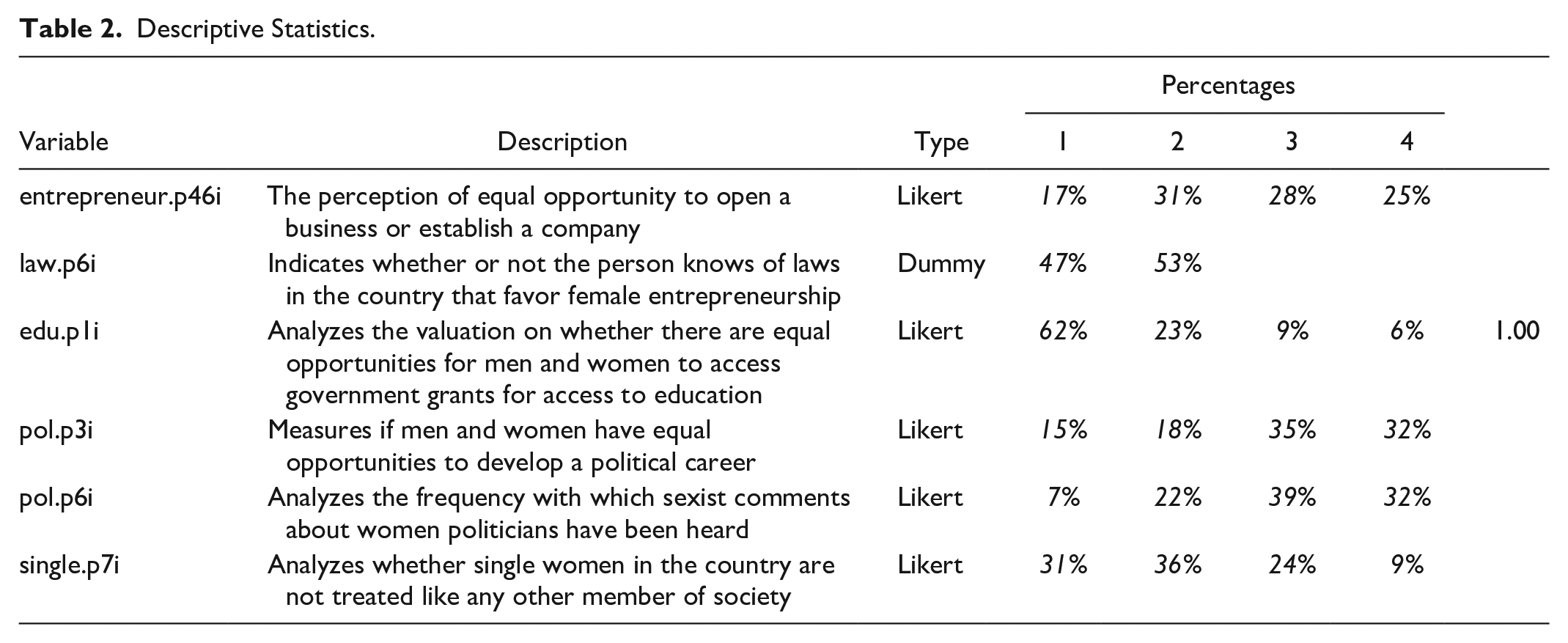
To contextualize the data obtained on the perceptions of the sample, the study analyzes the primary data of Spain according to the National Institute of Statistics (INE). The National Institute of Statistics is a legally independent administrative autonomous institution assigned to the Spanish Ministry of Economic Affairs and Digital Transformation, via the Secretary of State for the Economy and Business Support.
The analysis of the tetrachoric correlation matrix in Table 3 (for categorical variables) shows that the dependent variable is relatively highly correlated with almost all the variables, except law.p6. In addition, the correlation is negative in all cases, showing that the relationship between the variables and the dependent variable is inverse, as will be explained in the “Results” section.
Tetrachoric Correlation Matrix.

Robustness Checks
A first check was for specification (omission or inclusion of irrelevant variables, and the selection of an incorrect functional form). This first check was intended to test the robustness of the model, to avoid losses in the accuracy of the relevant coefficients’ estimates, and to avoid a biased coefficient by estimating a linear function when the relationship between variables was nonlinear. Second, measures were followed to avoid measurement errors, such as back translations and pilot testing of the questionnaire, along with data being collected in similar contexts. Third, t-statistics were adjusted by a heteroscedasticity correction in the regressions to test whether error terms depended on factors included in the analysis. Fourth, autocorrelation was analyzed by calculating the Durbin-Watson coefficient, and multicollinearity was checked through an assessment of the correlation coefficients between the variables in the model and the calculation of the variance inflation factor (VIF).
Results
The hypotheses state that: (H1) knowing the existence of laws that promote female entrepreneurship reduces the perception of discrimination against this type of entrepreneurship, (H2) the increase in the perception of discrimination in the awarding of grants for women’s access to education increases the perception of discrimination toward female entrepreneurship, (H3) the perception of discrimination toward single women increases the feeling of discrimination toward female entrepreneurship, and (H4) the perception of discrimination toward female politicians increases the feeling of discrimination toward female entrepreneurship.
The results allow acceptance of the null hypothesis in H1. The remaining results of the model allow us to reject the null hypothesis because all the coefficients have the expected results according to the hypotheses posed and are statistically significant (p < .05) (see Table 4).
Results From Regressions.

Note. Signif. codes: 0 “***” 0.001 “**” 0.01 “*” 0.05 “.” 0.1 “ ” 1. Residual standard error: 0.9094 on 279 degrees of freedom. Multiple R2: .2472, adjusted R2: .2283. F-statistic: 13.09 on 7 and 279 DF, p-value: 1.435e−14.
Therefore, the results show that those respondents who disagree with women having the same opportunities as men to obtain scholarships to study (edu.p1) observe or perceive the possibilities for female entrepreneurship more negatively. In this regard, it is essential to note that the Spanish state contemplates public policies to avoid discrimination in university access, and most universities offer special scholarships to promote equality. According to INE data in 2018, the percentage of women graduating from Spanish higher education institutions is around 53.3% and that of men is 46.7%. This is in line with data from the European Union, where the percentage of women graduating from higher education is higher than that of men, except in Germany and Greece.
Similarly, those who frequently perceive sexist comments about women politicians (pol.p6) consider that there are higher barriers to female entrepreneurship. This observation can be supported by the question pol.p3 (p < .1) which analyzes the perceptions of individuals about whether men and women have equal opportunities to access political positions and shows that those with negative views on those possibilities also value the possibilities of female entrepreneurship negatively. This information on perceptions of difficulties in accessing political leadership positions contrasts with official data provided by the INE where the percentage of women in executive positions of the main political parties stands at 38.0%. In 2018, the highest percentage of female presence corresponds to members of the Government, with a percentage of 61.1%. Moreover, in Spain, negative comments in both social networks and in public about women politicians are legally prosecuted depending on the extent of the offense.
The results also show that the perception of discrimination against single women, who are not in the care of the family (single.p7), makes perceptions of the difficulties of female entrepreneurship more considerable. According to INE, the percentage of women aged 18 and over who spend at least several days a week caring for or raising children, cooking or doing household tasks, and caring for relatives, neighbors, or friends with disabilities is higher in all cases than the percentage of men of the same age. Although women’s role has been more linked to these activities, no law encourages them to engage in these types of work. Spanish legislation recognizes forms of family other than that composed of a father and mother (single parent, same-gender marriage). There are also laws for effective equality between men and women, on gender violence, on work-life balance, and so on.
It is interesting to note that the dummy variable that asks whether laws favoring female entrepreneurship are known (law.p6) is not significant, showing that it is indifferent to whether this type of initiative is known to influence perceptions about the existence or lack of discrimination in female entrepreneurship. In this sense, the law for the effective equality of women and men expressly recognizes programs to improve women’s employability, the establishment of an equality label or stamp for companies, and so on. Besides, public institutions, such as the Spanish Chambers of Commerce, have specific programs to support female entrepreneurship.
Discussion
Previous works have indicated that there is not enough information about women’s perceptions to strengthen their contributions to society (Ilie et al., 2018). In addition, research shows that societies should be aware of discrimination before facing inequalities (Crosby et al., 1989; Derks et al., 2015; Postmes et al., 2019; Schmitt & Branscombe, 2002). Under the social comparison and institutional theories, the findings of this study show that beyond analyzing the macrovariables of the gender gap, research and institutions should analyze the impact of social beliefs on the success of policies and initiatives. The results pose that perceptions can create perceptual barriers in the possibility of becoming a female entrepreneur even though institutions want to mitigate the gender gap.
First, perceptions and the institutional framework can be barriers or facilitators to the development of female entrepreneurship policies given that literature on social comparison states that there is a social benchmark for evaluating opinions and abilities (Ngo et al., 2003; Perkins & Cross, 2014) as well as socially accepted practices (Ngo et al., 2003). The institutional theory also provides a framework where the gender gap might exist despite the efforts from governments and other social players (Jütting et al., 2008). The results support these theories by showing that, despite institutional efforts, social beliefs can influence female entrepreneurship.
Second, literature has shown that access to education has a moderating role in the development of entrepreneurial attitudes (Blanchflower, 2004; Simoes et al., 2016). Thus, the institutions try to ensure that there is no gender bias in access to studies. However, despite the efforts of the institutions, results suggest that if social beliefs maintain that there is a gender gap in access to education, this affects the negative perception of the difficulty of being an entrepreneur. This result reinforces the postulates of social comparison theory in the context of female entrepreneurship because the perception of inequality between the two genders can strengthen the gender gap and determine the development of institutions (Ngo, 2001).
Third, the gender gap in women’s entrepreneurship has revealed that household tasks, usually linked to women, have a direct impact on women’s entrepreneurial possibilities (Brush et al., 2009; Jennings & Mcdougald, 2007). Similarly, women in politics are a major concern to reduce the gender gap (Dilli et al., 2019). However, even if institutions attempt to eradicate this type of role linked to women or encourage their political aspirations, the study shows that when perceptions are not changed, the beliefs about the difficulties of entrepreneurship are growing. In this sense, the results reinforce previous studies highlighting that gender beliefs are part of the female entrepreneurship gap (Minniti & Naudé, 2010).
Finally, probably one of the most interesting results of this study is that although institutional theory holds that regulation and taxation are a framework for promoting entrepreneurship (Vossenberg, 2013) while their absence are barriers for female entrepreneurship (Jamali, 2009), perceptions are capable of ignoring these institutional efforts and of being driven by social beliefs when assessing the real barriers to entrepreneurship. Even though institutional theory incorporates common beliefs to maintain legitimacy and stability in society (DiMaggio & Powell, 1991; Meyer & Rowan, 1977), the results reveal the need to be able to communicate efforts and also to focus on communicating values associated with enhancing equality.
Conclusion
The main conclusion of the study is that governments and institutions should continue to create policies that reduce the gender gap, working at the same time on the public narrative that can change perceptions related to the entrepreneurs’ gender. Perceptions create psychological barriers in women’s entrepreneurial intentions. Even when a government’s actions reduce the real gap, the perceptions persist for a longer period.
Consequently, one of the conclusions of the article is that, even when there are concrete policies to reduce the gender gap, if perceptions do not change, women’s interest in entrepreneurship will not increase. Likewise, the study has observed that the generalized perception of women’s difficulties in accessing higher education affects their perceived difficulties in entrepreneurship. Similarly, perceptions of a women’s role in household care or their difficulties in accessing positions of political relevance increase the perceived barriers to entrepreneurship that women can face. Despite the legal context that supports gender equality, the generalized perceptions of the population in relation to women entrepreneurs have not changed significantly.
Consequently, institutions must combine the regulatory change and their frameworks with communication strategies oriented to improving the perceptions of women entrepreneurs. Thus, women’s interest in entrepreneurship will increase while their perception of the degree of difficulty in starting their business will decrease.
All these results lead to two managerial implications. On one hand, institutions must continue to develop policies and initiatives to promote women’s entrepreneurship. Although the results have shown that efforts are being made, the overall perception is clearly against such initiatives facilitating female entrepreneurship. On the other hand, it is essential that institutions adequately communicate the efforts made to achieve an impact on the population. By spreading positive perceptions, it is possible to promote social beliefs perceiving no barriers to women’s entrepreneurship. This condition is fundamental because, as has been shown, if these dynamics are not broken, the mere fact of having a belief can be a previous barrier to entrepreneurial intentions.
One of the limitations that the study is focused on analyzing is the perceptions of the people who answered the survey, so they are influenced by personal experiences related to the field of study. Further research can contrast perceptions with data recollected through qualitative research, such as in-depth interviews or multiple case studies.
