




Abstract
The aim of this article is to examine whether the cross-country and gender variations of entrepreneurship can be explained within the institutional framework. The study addresses normative forces to which entrepreneurs are expected to adapt within European welfare states. The normative forces are focused on norm-based factors of governmental quality and value-based factors of governmental generosity, which are both hypothesized to be associated with entrepreneurship at the level of society and furthermore from the gender perspective. To verify our hypotheses, the research was conducted among 28 European countries in the years 2012 to 2018. We adopted the macro-level of analysis and undertook panel data analysis (PDA). We estimated the econometric models with entrepreneurship rates as dependent variables and those with norm-based and value-based factors as independent variables. The results confirm that norm-based factors are associated with entrepreneurship and there are significant differences in the responses of female and male entrepreneurial activities to the quality of government. However, we did not find supporting evidence for the statistically significant impact of governmental generosity on entrepreneurship. The novelty of our research is in implementing institutional theory into the discussion on entrepreneurship from the welfare state perspective, by introducing the concept of norm-based and value-based factors which reflect the quality and generosity of the government. We also distinguish between the impact of governmental quality and generosity on entrepreneurship from the gender perspective to contribute to the discussion on the gender gap in entrepreneurship.
Keywords
Introduction
Entrepreneurship is considered as one of the drivers of economic development (Hopp & Martin, 2017), a tool for achieving a more sustainable economy (Dhahri et al., 2021). It is a widely understood phenomenon, which is related, on the one hand, to different theories explaining it as innovation, risk creation, or market opportunities exploitation (Ferreira et al., 2017). On the other hand, entrepreneurship can be broadly understood as a feature of persons or companies that is characterized by entrepreneurial orientation with such dimensions as innovativeness, risk-taking, and proactiveness (Covin & Wales, 2012; Covin et al., 2006; Ferreras-Méndez et al., 2021; Gauthier et al., 2021; Wiklund & Shepherd, 2003). Entrepreneurship can also be narrowly understood as the creation of a new company which is reflecting upon the start-up process or the running of one’s own business (Guerrero et al., 2021; Szerb et al., 2019; Zapkau et al., 2017). Being such a multidimensional construct, entrepreneurship can mean different issues and be operationalized by a variety of measures (Gumbau-Albert, 2017). In the present study we accept the narrow understanding of entrepreneurship, which is related to establishing and running one’s own business (Bradley, 2016; Pardo & Ruiz-Tagle, 2017). We treat entrepreneurship as a form of occupational choice that individuals enter into because they would prefer to act as entrepreneurs instead of being employees (Bradley, 2016; Kihlstrom & Laffont, 1979; Pardo & Ruiz-Tagle, 2017).
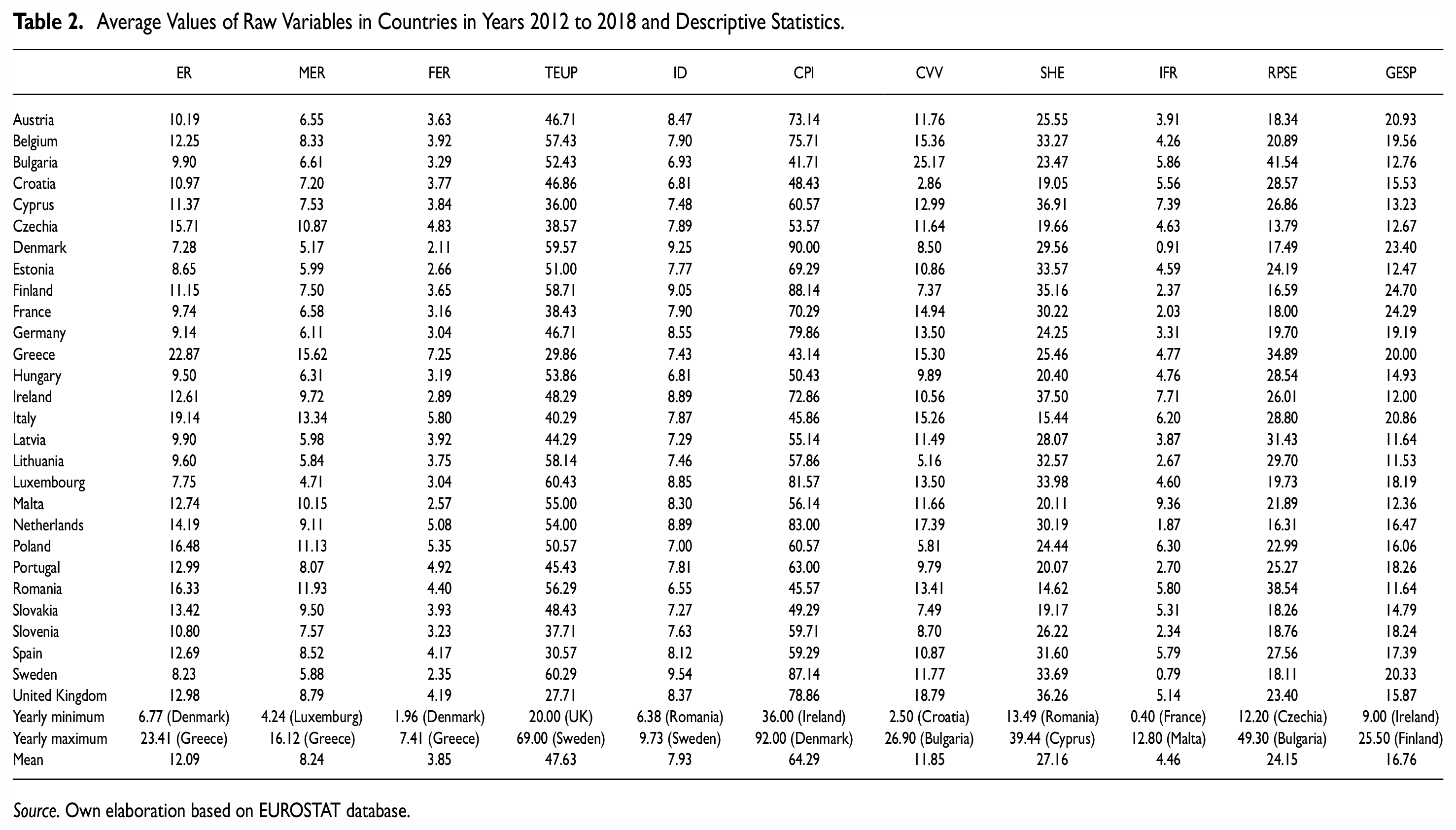
The level of entrepreneurship differs strongly across countries and there is no consensus regarding the factors determining those differences. Analyzing 28 European countries in years 2012 to 2018 (see details in Table 2), it can be noted that entrepreneurs were about 12% of the active population; however, the levels of entrepreneurship differ from about 7.2% on average in Denmark to about 22.9% on average in Greece. Moreover, there is also a significant gender gap between female and male entrepreneurs as women are generally 50% less likely to enter into entrepreneurship than men (Carter et al., 2015; Ester & Román, 2017). Among the 28 European countries analyzed in years 2012 to 2018, on average men constituted about 70% of entrepreneurs (Table 2).
Despite the ongoing debate, the factors driving people to enter entrepreneurship are still unclear (Yang et al., 2017; Zapkau et al., 2017) and of various types (Dileo & García Pereiro, 2019; Nikolaev et al., 2018). Personal characteristics (Caliendo et al., 2009; Reissová et al., 2020), access to resources (Reynolds, 2011; Seghers et al., 2012; Yang et al., 2017), enovironment, including entrepreneurial ecosystem (Song, 2019; Spigel & Harrison, 2018) are groups of the most commonly analyzed factors. Some of these factors are recognized as positive motivators, impacting opportunity-driven entrepreneurship, while others are negative, pushing to necessity-driven entrepreneurship (Angulo-Guerrero et al., 2017; Nikolaev et al., 2018; Reissová et al., 2020).
In the study, we adopt the macro-level perspective and approach entrepreneurship by reflecting on the determinants of entrepreneurial activity at the country-level (Saunoris & Sajny, 2017). More precisely we look for institutional determinants affecting the share of entrepreneurs in active populations within countries. From this perspective, we utilize institutional theory in explaining country differences in entrepreneurship (DiMaggio, 1988), as institutions are determinants of entrepreneurship operating at the societal level (Boudreaux & Nikolaev, 2019). The rationale for our attitude is the observation, that although entrepreneurs are independent agents (Markowska et al., 2019) they do, however, interact with their institutional environment in the entrepreneurial process (Su et al., 2019), and they need to adapt into the societal environment in which they are acting, as the institutional environment affects the entrepreneurial activity (Saunoris & Sajny, 2017).
According to institutional theory, the state’s legitimacy in shaping entrepreneurial activity is seated on prevailing norms and values, to which entrepreneurial activity is adapted (Scott, 1995). In this sense, both norm-based factors reflecting the quality of governance and value-based factors connected with welfare generosity are state-level institutional predictors of entrepreneurship. The quality of governance is a feature of a well-organized society (Thai & Turkina, 2014), which is related to the rule of law, political stability, the absence of violence, and accountability, and which in turn strengthens the environment of entrepreneurship (Raza et al., 2019). At the state level, values are associated with social responsibility which is organized by welfare states in different ways (Esping-Andersen, 1990; Schwartz, 2012; Scruggs & Ramalho Tafoya, 2022). Typically, governmental social responsibilities, such as social benefits, for example, are seen to be undermining entrepreneurial activity (Bosma et al., 2018). Welfare generosity creates disincentives for entrepreneurial activity. Furthermore, we also aim to determine whether there are some gender differences in reacting to the institutional environment. While institutions are the same for all individuals, they can be perceived differently by males and females, and in that way they can affect the gender gap in entrepreneurship.
The structure of the paper is as follows. The theoretical part of the paper starts with a discussion on the importance of institutions in shaping entrepreneurial activity. Concepts of norm-based factors of governmental quality and value-based factors of governmental generosity are introduced and explored in order to hypothesize on their impact on entrepreneurship, in relation to both general and gender perspectives. After the theoretical discussion, the hypotheses and the research method are explained. Then, the results of the research and the discussion are presented, followed by a section on the conclusion of this study.
Institutional Entrepreneurship
The sociological theorist, Parsons (1956) saw organizations as components of a larger social system and later, this view created a basis for institutional research on organizations. Meyer and Rowan (1977) corroborated what Parsons had already noted concerning the need for organizations to find a suitable relationship with the larger society (David et al., 2019). Based on the classic sociological approach, DiMaggio (1988) became a key person in creating the research strategy which later became known as “institutional entrepreneurship.” Entrepreneurs are independent agents acting under uncertainty and a subjective perception of risk (Markowska et al., 2019); however, they need to adapt to the societal environment within which they are acting, and from this perspective, the institutional environment affects the entrepreneurial activity (Saunoris & Sajny, 2017). Entrepreneurship is discussed in the context of institutional theory within several approaches (Scott, 1995), but mostly by distinguishing formal and informal institutions (Omri, 2020), or regulative, normative and cognitive pillars (Estrin & Mickiewicz, 2011). The relationships between entrepreneurship and institutions are also recognized at different levels of interactions, that is, at the macro, meso and micro levels (Zhai et al., 2019).
Scott (1995) formulated three institutional forces, called pillars, which affect entrepreneurial activity (Meyer & Rowan, 1977). First, the regulative pillar is based on a rational actor model and assumes that it is in the interest of entrepreneurs that they follow the rules, which the state and governmental institutions have created. Second, there is a force that is known as the normative force or pillar as Scott names it, which pushes actors to adopt the policies and practices of the broader society. Normative systems are typically composed of values and norms which people conform to. Third, there is a force that is known as the imitative pressure (pillar), resulting from reliance on the observed behavior of other organizations. However, the imitative pressure is not only a one-way process which people follow, but rather it is a collective process within which they also take part interactively.
In the present study, we focus on the normative pressure which affects entrepreneurial activity in a society (Scott, 1995). The rationale for our approach is the observation that, although entrepreneurs are independent agents (Markowska et al., 2019), they do need to adapt into the societal environment in which they are acting, as the institutional environment affects the entrepreneurial activity (Saunoris & Sajny, 2017). From this perspective, we are interested in societal norms and values which entrepreneurs are adapted to. The study of norms is focused on the quality of governance which is largely accepted as a key factor of entrepreneurial activity (Raza et al., 2019). Companies benefit from high-quality governance, which reduces societal uncertainty and contributes to the productivity of companies (Chowdhury & Audretsch, 2014; Dorożyński et al., 2020). On the other hand, values can be seen as factors of the welfare state’s generosity, which also affect entrepreneurial environment and activity (Bruton et al., 2010) by determining the relative costs of entrepreneurial activity (Saunoris & Sajny, 2017), and impacting the relative advantage of entrepreneurship over paid employment.
Norms as Factors of the Quality of Governance
A function of norms is to create predictability within a society, which is found to be a key feature of successful societies. Norms create predictability in the society, which also helps companies to operate efficiently. Successful societies have clear norms that create the basis for a well-organized society which supports economic growth (Shchegolev & Hayat, 2018; Temple, 1999). In this sense, democracy is a feature of a well-organized society, which supports the quality of governance (Thai & Turkina, 2014), and which in turn is a basis for successful entrepreneurship activity (Raza et al., 2019). The significance of democracy is based on a notion that individuals in democratic political environments have more equal chances of competing, compared to those in autocratic political environments.
However, violating societal norms undermines the quality of governance. For instance, Mohammadi Khyareh (2017) found that corruption reduces the efficiency and productivity in economics, impacting a negative relation between institutional quality and productive entrepreneurship while corruption control positively affects entrepreneurship (Dempster & Isaacs, 2017). Also, Lecuna et al. (2020) stated that the better controlled corruption is, the more effective entrepreneurial activity becomes. However, in circumstances of post-conflict economies, acting “off-the-books” to avoid taxation is perceived as the main form of corruption, while entrepreneurs generally treat it as the norm (N. Williams & Vorley, 2017). Further, Dheer (2017) argues that, specifically, corruption impedes the development of infrastructure (Mo, 2001), decreases tax revenue (Marjit et al., 2017), and discourages inward foreign direct investment in nations (Brada et al., 2019). From a perspective of norms, corruption and crime are clear signs of a malfunctioning society (Estrin et al., 2013).
According to Seligson and Carrión (2002), there is a clear association between the support of democratic principles and trust in political institutions. In this sense, the transparency of societies and public trust in societal institutions are also associated (Bjørnskov & Méon, 2013). The modern and complicated societies need to be accepted by their citizens, so that citizens’ trust in governmental institutions is a key factor for successful societies (Van der Meer, 2017). Studies demonstrate that institutions which are based on institutional trust support also national economic growth and socio-economic development (Özcan & Bjørnskov, 2011). Muldoon et al. (2018) found that trust within an entrepreneurial environment in general has a positive impact on productivity, while distrust has a destructive effect on the economy and it can also be potentially illegal. However, Goel and Karri (2006) remind us that entrepreneurs should not over-trust in the society, which may also be a risk for entrepreneural activity (Bernoster et al., 2018).
In sum, the quality of governance is a key factor for successful entrepreneurial activity (Nair & Njolomole, 2020). Kaufmann and Kraay (2007) argue that the quality of governance is a kind of “ease of doing business” indicator, which is related to the rule of law, political stability, the absence of violence, and accountability. In the present study, we are exploring whether the norm-based factors such as democracy, trust in institutions, corruption, and crime are associated with entrepreneurial activity across European countries. We assume that with the higher accountability of institutions, the share of entrepreneurs in the economy should increase as the quality of governance reduces the transaction costs and the risk of failure, making entrepreneurial benefits greater and more predictable. As a consequence, the quality of governance should be associated with the level of entrepreneurship.
Values as Factors of Governmental Welfare Generosity
At the state level, values are associated with social responsibility which is organized by welfare states in different ways (Esping-Andersen, 1990). In some cases, the responsibility lies with the state, while in others the responsibility is believed to belong to the sphere of individuals (Schwartz, 2012). Some countries have invested in statutory-based benefits and services while in other countries it is the citizens’ task to arrange their own social security. However, there is no welfare state where the entire social responsibility belongs to the state itself, and there is no state where social responsibility is based solely on the personal responsibility of individuals themselves.
Welfare generosity is a multifaceted phenomenon (Scruggs & Ramalho Tafoya, 2022). Social insurance protects citizens against various social risks such as aging, illness, disability, and unemployment. Thus, the greater the governmental welfare generosity, the larger the size of the inactive population in a country which, on the other hand, raises the expenditures of social protection (Esping-Andersen, 1990). From the perspective of entrepreneurial activity, governmental welfare generosity has been found to have both negative and positive effects. Hessels et al. (2008) note that social security negatively affects a country’s supply of entrepreneurship. Generous social security benefits for employees increases the opportunity costs of entrepreneurship, making paid employment a more attractive form of occupation. The growth in size of the public sector can reduce entrepreneurship through attracting people to apply for public positions, instead of running their own businesses. The public sector growth also impacts the financial transfers among societal groups and entrepreneurs who, by paying taxes, could perceive such growth as a factor promoting tax increases that would consequently reduce their profits. However, social security in general may have a positive effect on entrepreneurial activity by creating a safety net in case of business failure (Hessels et al., 2008). Such a precaution for potential failure would alleviate the level of uncertainty that can be coupled with entrepreneurship, which should also attract people to owning a business.
A state’s investment in education can be seen as a value that seeks to produce equality within a society. However, there is variation between countries regarding how much a particular country will have invested in a universal school system, from day care to higher education. Uhlaner and Thurik (2007) show that a higher level of education in a country is accompanied by a lower self-employment rate. This is explained by the fact that education is a path that leads away from lower socio-economic positions. Individuals with more education have a chance to achieve more social status when employed by others. Further, education may also be seen as a necessary norm to be achieved in order to enter the labor market, whereby a specific education type is required for a particular occupation or profession. But, the higher the level of education, the more regulated is the labor market. In this sense, it is obvious that a lower education level is associated with self-employment. The more recent body of literature has focused attention on the association of higher education and innovations by arguing that higher education is a key to economic growth (Bouhajeb et al., 2018). However, Hanushek (2016) notes, for example, that innovations cannot be achieved solely by automatically adding schooling years in a society.
In sum, social responsibility is a value which can be channeled in different ways, but at the macro level, it is typically approached by studying the degree of the state’s statutory-based social responsibility, and it is noteworthy that there is a big variation in welfare generosity among the welfare states. In the big picture, governmental social responsibilities are seen to be undermining entrepreneurial activity (Bosma et al., 2018). Welfare generosity creates disincentives for entrepreneurial activity on an individual level, and as the state sector grows, a bureaucratic apparatus replaces areas of market logic. In the present study, we assume that statutory-based social security has a negative impact on entrepreneurial activity.
Gender Factor in Institutional Entrepreneurship
Societies are more gender equal in general because females’ participation has been increasing in the workforce (Alsos et al., 2016), but the gender gap is still found in entrepreneurship, which means that men are still more likely to have the intention to start a firm than women (Delmar & Davidsson, 2000). In the body of literature on institutional entrepreneurship, the gender issue is typically approached as the division of formal (i.e., government) and informal (i.e., gender) institutions and how they affect entrepreneurship (Stiglitz, 2000). More precisely, formal institutions are focused on rules and regulations, which are written down to guide the economic and legal processes of a society. Informal institutions include unwritten codes such as traditions and values (Estrin & Mickiewicz, 2011; C. C. Williams & Shahid, 2016; Wu & Li, 2020). The gender gap is typically explained from the perspective of informal institutions (van Ewijk & Belghiti-Mahut, 2019) which is based on cultural issues such as masculinity and individualism (Gimenez-Jimenez et al., 2020; J. Williams & Patterson, 2019), leading to lower participation of women than men in entrepreneurship (Dheer et al., 2019).
From the perspective of institutional theory, it could be assumed that the norms which create good governance promote equality, and thus indirectly support women’s, as well as men’s, entrepreneurship. For instance, Baughn et al. (2006) found that the rate of female entrepreneurship is more associated with the general level of entrepreneurship in a society. However, value-based social responsibility, which is channeled through a state’s welfare generosity, could be expected to support women’s independence in a society and, indirectly, also female entrepreneurship. However, Estrin and Mickiewicz (2011) found that the size of the state sector has a significant and negative impact on female entrepreneurship. In this sense, welfare generosity may support women to stay at home, with respect to taking care of family members, instead of entering into the labor market. From this perspective, women have no incentive to gain additional income and, on the other hand, a larger state is also associated with higher taxes, which is viewed as a disincentive.
However, it has been noted that studies on institutional entrepreneurship have not reached the true nature of female entrepreneurship (Welter et al., 2014). For this reason, scholars have focused their attention on informal institutions, which are found to be more significant in explaining female entrepreneurship than the formal institutions (Gimenez-Jimenez et al., 2020; Noguera et al., 2015). In this sense, for instance, female domestic responsibilities are seen as a key determinant of the gender gap in entrepreneurship (Pérez-Pérez & Avilés-Hernández, 2016). Also, it is seen that a high fertility rate negatively affects female entrepreneurship (Dutta & Mallick, 2018). Further, Khyareh (2018) found that female entrepreneurship benefits from female networks but, on the other hand, stereotypes regarding gender (Naguib & Jamali, 2015; van Ewijk & Belghiti-Mahut, 2019), such as masculinity, individualism, and indulgence (Anambane & Adom, 2018; Gimenez-Jimenez et al., 2020) reduce the chances for female entrepreneurship. Finally, the gender gap in entrepreneurship can be seen as a result of gender inequality in the wider society, which may cause even actual discrimination against women (Estrin & Mickiewicz, 2011; Berger & Kuckertz, 2016).
In sum, the society affects all entrepreneurial activity, but there does seem to be a difference regarding its effect on female and male entrepreneurs. As the institutional theory is the framework often used to explain the gender gap in entrepreneurship, mostly in the context of culture as informal institution, we intended to expand this direction of research and check whether the quality of governance and welfare generosity also explains the gender differences in entrepreneurship. In the present study, we explore in more detail which institutional factors are associated with female and male entrepreneurial activity across European countries.
Research Task, Hypotheses, and Methods
Institutional theory assumes that society, and the state as its formal shape, has a significant impact on entrepreneurial activity. The state’s legitimacy lies on prevailing norms and values, which are the basis of quality of governance and welfare generosity. The aforementioned “ease of doing business indicator” (Kaufmann & Kraay, 2007) is related to societal norms such as democracy and institutional trust, but also related to the level of corruption and crime in a society. Social responsibility can be shared in different ways between the state, the market, and civil society. The concept of welfare generosity refers to the solution, whereby a state has the main responsibility in welfare issues. However, welfare generosity is seen to create disincentives for entrepreneurial activity on an individual level. In this sense, social expenditures, inactive people, and poverty are seen as value-based indicators which are inversely related to entrepreneurial activity.
According to institutional theory, we hypothesize that:
H1: Norm-based factors are associated with entrepreneurial activity across European countries.
H2: Value-based factors are associated with entrepreneurial activity across European countries.
The society affects all entrepreneurial activity but there seems to be differences regarding its wider-society effect on female and male entrepreneurs. In the present study, we explore whether institutional norm-based and value-based factors are associated in different ways with respect to female and male entrepreneurial activity across European countries.
H3: There are differences in the effect of institutional norm-based factors on entrepreneurial activity between female and male entrepreneurs.
H4: There are differences in the effect of institutional value-based factors on entrepreneurial activity between female and male entrepreneurs.
Although the relationship of entrepreneurs and societal institutions could also be seen as interactive in its nature (Tolbert et al., 2011), in the present study, it is assumed that societal institutions (norms and values) have an effect on entrepreneurial activity. Being aware of possible interactions, we focus on the one-way relationship of institutions affecting entrepreneurship. The association of societal institutions and entrepreneurs are approached at the country level, although individual-level phenomena could also be studied. Therefore, the study material is based on aggregated data and official statistics by country. Further, the data are selected so that they fit into the country-level analysis, for instance, regarding the fact that institutional trust is focused on macro-level phenomena, compared to micro-level personal trust and meso-level collective trust (Welter, 2012).
To verify the hypotheses, the empirical research was conducted to estimate the econometric models with entrepreneurship rates as dependent variables and with norm-based and value-based factors as independent variables. The first research step was related to the selection and statistical description of variables representing the entrepreneurship of the whole society and of genders as well as norm- and value-based factors.
European countries with research years as members of the European Union were selected for this research because they represent relatively similar levels of institutional environment and cultural background. The panel data analysis (PDA) was undertaken based on the annual data from the European Statistical Office EUROSTAT database for the years 2012 to 2018 for 28 countries, which means that the panel data set was collected with 196 observations of each variable (observations for 7 years multiplied by 28 countries). The following countries are included in the panel data based on availability: Austria, Belgium, Bulgaria, Croatia, Cyprus, Czechia, Denmark, Estonia, Finland, France, Germany, Greece, Hungary, Ireland, Italy, Latvia, Lithuania, Luxembourg, Malta, The Netherlands, Poland, Portugal, Romania, Slovakia, Slovenia, Spain, Sweden, and the United Kingdom.
Dependent variables reflect the level of entrepreneurship in the whole society and with regard to gender. Three dependent variables are accepted: the share of the total number of self-employed in the active population (entrepreneurship rate), the share of self-employed females in the active population (female entrepreneurship rate) and the share of self-employed males in the active population (male entrepreneurship rate). To explore these rates, EUROSTAT data based on the EU Labor Force Survey (EU-LFS) were used. Within these surveys, participants are interviewed and asked, among other issues, about their labor status (employment, unemployment and outside the labor force). Among employed people, the groups of employees and self-employed are distinguished, assuming that self-employment is understood as entrepreneurship. It means that data on entrepreneurship relates to self-declarations about the real labor status, regardless of the formal or informal manner of running one’s own business. In the context of self-declaration of labor status as a means of entrepreneurship rate calculation, we tacitly assumed that entrepreneurship rates accepted in our study represent all entrepreneurs, both formal and informal. A group of self-employed people consists of both these who are employers and who are own-account workers, for example, freelancers. Methodological details on these data are presented on the webpage of Eurostat (https://ec.europa.eu/eurostat/cache/metadata/en/lfsa_esms.htm, access: 13/07/2022).
The independent variables reflect norms and values, the division between which is not always clear; thus, it depends on the context and the research design (Hansson, 2001). In our research design, values are linked with welfare generosity while norms are linked with good governance (cf. Esping-Andersen, 1990; Schwartz, 2012; Scruggs & Ramalho Tafoya, 2022). With respect to generosity, we expect egalitarianism to be a key value orientation that shapes how citizens assess welfare generosity. From this perspective, variables such as social protection expenditures, risk of poverty and social exclusion, and inactivity because of family responsibility are seen as key factors associated with welfare generosity. A function of norms is to create predictability within a society, which is found to be a key feature of economic growth (Shchegolev & Hayat, 2018; Temple, 1999). From this perspective, strong democratic governance is characterized by the norms of transparency and accountability in both the public and private sectors (Raza et al., 2019), which strengthen the environment of entrepreneurship. In this sense, variables such as institutional trust, corruption, and crimes are seen to be related to norms. Also, education is approached as a norm because it is a formal criteria for accessing the labor market.
In sum, norms are operationalized by the Democracy Index (Economist Intelligence Unit), institutional trust in the European Parliament, perception of corruption, and experience of crime, violence, and vandalism, but also the level of education. The measured values in this research are: the risk of poverty and social exclusion, public expenditures on social protection, and the level of inactivity because of family and caring responsibility. Details on definitions and abbreviations of all variables are presented in Table 1.
List of Variables and Their Abbreviations.

Source. Own elaboration based on EUROSTAT database.
Although the European Union countries represent a relatively similar level of institutional environment and cultural background, significant differences in both the level of entrepreneurship and level of norms and values could be observed (see Table 2). On average, in 2012 to 2018 about 12% of the active population were entrepreneurs, of which around 70% were males. However, the lowest level of entrepreneurship rate was in Denmark (7.28% on average; 6.77% in 2018) while the highest level was in Greece (22.87% on average; 23.41% in 2012). The Democracy Index is on average at the level of 8.00 points, with such countries as Denmark, Finland, and Sweden with the highest level of democracy (over 9.00 points) and such countries as Bulgaria, Croatia, Hungary, and Romania with the lowest level (less than 7.00 points). According to the data, around 47% of people have trust in the European Parliament as an institution, with citizens of Luxemburg and Sweden representing the highest level of trust, and citizens of the United Kingdom, Spain, and Greece representing the lowest level of trust. Regarding the Corruption Perception Index (CPI, Transparency International), the counties perceived as the cleanest are Denmark, Finland, Luxemburg, The Netherlands, and Sweden (with CPI indexes over 80 on average) while the highest perception of corruption is perceived to be in Bulgaria, Croatia, Greece and Italy (with CPI indexes less than 50 on average). Croatia and Poland are countries with the lowest share of people who experience crime, violence, and vandalism, while Bulgaria and the United Kingdom are countries with the highest share.
Average Values of Raw Variables in Countries in Years 2012 to 2018 and Descriptive Statistics.
Source. Own elaboration based on EUROSTAT database.
Further, in the share of people who experienced a risk of poverty and social exclusion, this varies among European countries. In countries such as Bulgaria, Greece, and Romania with more than 34% are facing the risk of poverty, while in Czech Republic, Finland, or The Netherlands less than 17% are facing the risk of poverty. The share of governmental spending on social protection in GDP is on average equal to 16.7%, however, in some countries it is lower than 12% (Latvia, Lithuania, Romania) while in others it is higher than 20% (Austria, Denmark, Finland, France, Greece). Next, very important differences can be observed regarding the share of inactive people because of their family and caring responsibilities. There are countries such as Denmark or Sweden with less than 1% of the population being inactive for this reason, but at the same time there are such countries such as Cyprus, Ireland, or Malta with over 7% of inactive persons. With an average of about 30%, less than 20% of citizens attained a higher education in such countries as Croatia, Czech Republic, Italy, Romania, and Slovakia and more than 35% in such countries as Cyprus, Ireland, and the United Kingdom.
After initial selection of dependent and independent variables, all of the raw data were converted into a natural logarithm to linearize the relationships among them and to use the log-log model in further research steps since economic theory assumes models with constant elasticity.
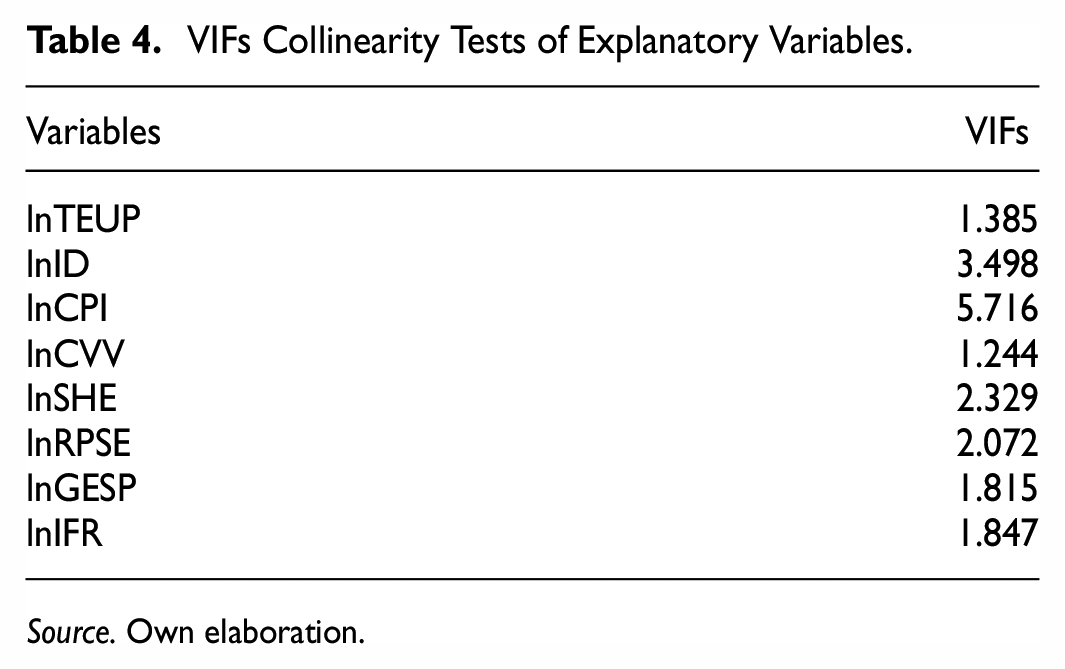
From a logical perspective, norm-based and value-based factors might be related to each other as they reflect the common understanding of society. However, from the econometric perspective, measures which are closely related to each other should not be taken together into estimations of models because of their collinearity, which would bias the results. To solve this problem, both the correlation and variance inflation factors (VIFs) among the variables were calculated. The correlation matrix (see Table 3) shows that correlations among explanatory variables are generally relatively low, thus making them possible to be implemented in the regression function.
Correlation Matrix Representing the Relationships Among Variables.

Source. Own elaboration.
To be certain regarding excluding collinearity, the analyses of the variance inflation factors (VIFs) were undertaken (see Table 4). All of the variables reported VIF values significantly below 10, meaning that VIF values do not indicate any problem with collinearity and all explanatory variables can be included in the estimation of regression functions.
VIFs Collinearity Tests of Explanatory Variables.
Source. Own elaboration.
After selection of dependent and independent variables, conversing them into natural logarithms and excluding collinearity, the general research model based on panel data is specified in the following manner:

where:
lnER it —dependent variable describing sequentially entrepreneurship rate (lnER) in t period and in i country (reg. 1), female entrepreneurship rate (lnFER) in t period and in i country (reg. 2) and male entrepreneurship rate (lnMER) in t period and in i country (reg. 3), converted into natural logarithms,
lnNBF it —independent variables describing norm-based factors in t period and in i country (lnTEUP, lnID, lnCPI, lnCVV, lnSHE), converted into natural logarithms,
lnVBF it —independent variables describing value-based factors in t period and in i country (lnIFR, lnRPSE, lnGESP), converted into natural logarithms,
β0, β1, β2—vectors,
ν it —total random error consisting of a purely random part ε it and individual effect ui which refers to the specific i unit of the panel (ν it = ε it + ui).
With the use of panel regression models according to the general Equation 1, three sets of regression functions were aimed at estimating separately for total entrepreneurship rate (regression function reg. 1), female entrepreneurship rate (regression function reg. 2), and male entrepreneurship rate (regression function reg. 3) as dependent variables. In all three sets of regression functions, the same independent variables are implemented. As the estimation is based on panel data, the Breusch-Pagan and Hausman tests were conducted to determine the method of panel regression (Table 5). The statistics of the Breusch-Pagan test indicate whether the ordinary least squares method or the panel regression method should be used. As all statistics have a low p-value (<.05), this refers to the correctness of implementation of the panel regression method instead of using ordinary least squares (OLS) analysis. The Hausman test permitted an estimate of the nature of the observed effect between fixed and random effects in the panel data. A low p-value (<.05) of the Hausman test in all three regressions suggests the use of the panel model with the fixed effects as the best estimation method.
Breusch-Pagan and Hausman Test Results.

Source. Own elaboration.
Results
Based on the results of the Breusch-Pagan and the Hausman tests, in all cases with regression functions, the panel regression with fixed effects was applied as the estimation method (Table 6). The discussion of the results is based on both the statistical significance and the values of regression function parameters which represent the impact of the independent variables on the dependent variables.
Models of Panel Regressions With Fixed Effects.

Source. Own elaboration.
Note. In bold type—significant parameters of regression function; standard errors in parentheses.
p < .05. *p < .1.
The first model is a regression function (Reg. 1) that estimates the impact of norm-based and value-based factors on entrepreneurship rate in the total population. The second model is a regression function (Reg. 2) that estimates the impact of norm-based and value-based factors on female entrepreneurship rate, and the third model is a regression function (Reg. 3) that estimates the impact of norm-based and value-based factors on male entrepreneurship. All three models are well fitted, with R2 being over 94% for each. Among the norm-based variables, trust in the European Parliament and the Democracy Index are the only explanatory variables which are statistically significant in all three models. The entrepreneurship rate of the total population, as well as female and male entrepreneurship rates, react negatively to the trust in the European Parliament, and the increase (decrease) of level of trust will affect the decrease (increase) in entrepreneurship. However, the absolute values of all function parameters suggest that the reaction of women’s entry to entrepreneurship is stronger than the reaction of men’s entry to entrepreneurship, showing that females are more sensitive regarding institutional trust. The Democracy Index is the second explanatory variable which affects all three rates of entrepreneurship, and its impact is positive. A higher level of democracy influences the higher level of entrepreneurship with stronger impact on female rather than on male entrepreneurship.
The next three norm-based explanatory variables affect female entrepreneurship or total and male entrepreneurship. The measure of experience of crime, violence and vandalism is statistically significant in explaining the entrepreneurship among women but is not significant for male or total entrepreneurship. The negative value of the regression parameter shows that the higher the share of people who face the crime, violence and vandalism in their local areas, the lower the share of females who undertake an entrepreneurial activity. The Corruption Perception Index (CPI) and share of people with higher education are explanatory variables for total entrepreneurship and for male entrepreneurship. The CPI affects both kinds of entrepreneurship in a positive manner, meaning that the more “clean” society (i.e., less corrupted) impacts the higher level of entrepreneurship, in general, and among men specifically. The share of people with higher education negatively affects both total entrepreneurship rate and male entrepreneurship rate, which means that the increase of people with higher education will decrease the total share of entrepreneurs and of male entrepreneurs.
All of these results give support to the acceptance of hypothesis H1, assuming that norm-based factors are associated with entrepreneurial activity across European countries, and hypothesis H3, assuming the existence of differences in the effect of institutional norm-based factors on entrepreneurial activity between female and male entrepreneurs. All norm-based factors affect entrepreneurship, however, their impact is different regarding the gender of entrepreneurs. In the cases where there are two variables, that is, institutional trust in the European Parliament and the Democracy Index, the gender difference is only with respect to the scale of reaction that is measured by the absolute value of the regression parameters. In the cases regarding the other three variables, solely entrepreneurs of one gender are impacted by them, females are affected by the experience of crime, violence and vandalism, and males are impacted by the perception of corruption and higher education.
Analyzing the model results regarding value-based factors, all three of them in all three models are statistically insignificant. The impact of inactivity because of family duties, the risk of poverty and social exclusion, and governmental expenditures on social protection are not significant in explaining the general, female or male entrepreneurship rates, as we theorized that the p-values of all parameters are p > .05. These estimations mean that hypotheses H2 and H4 were rejected, in that we did not find support for the hypotheses on the impact of value-based factors on entrepreneurial activity across European countries (i.e., H2) nor on the existence of gender differences in response to these factors (i.e., H4).
Discussion
We have been approaching entrepreneurial activity from the perspective of institutional theory, which assumes that entrepreneurs are a part of the broader societal systems. In this sense, entrepreneurs need to find a suitable relationship with the larger society (Meyer & Rowan, 1977). In the present study, entrepreneurial activity is approached at the country-level by asking how the norms and values of a society have an effect on entrepreneurial activity.
Societal norms are related to the quality of governance, which indicates a well-functioning environment for entrepreneurial activity, as per the aforementioned “ease of doing business indicator” (Kaufmann & Kraay, 2007). Based on the present study, it can be confirmed that a well-functioning democracy is associated with entrepreneurial activity. In this sense, the result is consistent with the notion of Raza et al. (2019), that democracy strengthens the environment of entrepreneurship. Further, it was found that democracy has a stronger impact on female rather than on male entrepreneurship. In this sense, supporting a well-functioning society also promotes female entrepreneurship. On the other hand, we did find that corruption and crime predict lower levels of entrepreneurial activity and indicate a malfunctioning society (Estrin et al., 2013). Similarly, Mohammadi Khyareh (2017) also found that corruption undermines efficiency and productivity in economies, and Lecuna et al. (2020) note that, the better controlled corruption is in the society, the more effective the entrepreneurial activity is. However, the present study reveals an interesting gender-based distinction between the effects of corruption and social safety (crime, violence, and vandalism). Corruption is associated with male entrepreneurship, however, social safety (crime, violence, and vandalism) is associated with female entrepreneurship. In both cases, these two factors have negative but gender-dependent effects on entrepreneurship. This result will need further and more detailed examination in future studies.
Typically, institutional trust is thought to be associated with the quality of governance, hence it could be expected to have a positive effect on the economic environment (Özcan & Bjørnskov, 2011). However, in the present study, institutional trust has a negative relationship with entrepreneurship. Institutional trust was focused on the European Union, which might be different from trust in national-level institutions. Thus, institutional trust in the European Union might be related to the attitudes toward supranational governance rather than to local-level governance. Also from this perspective, it is somewhat controversial that the European Union, which aims to support the European Single Market (ESM), is negatively associated with entrepreneurial activity and even more so regarding females compared to males. Further, trust in the European Union might be related to a kind of regulative basis within a country (Nielsen, 2016), which hinders entrepreneurial activity. It is possible that the more the EU is supported, the more positive an attitudinal environment for regulation in a country will be, which in turn is associated with less entrepreneurial activity in a country (Bailey & Thomas, 2017). However, this explanation is based on indirect interpretation, and we have no clear empirical evidence for supporting it. Further, as Goel and Karri (2006) underline, over-trust in the society presents a risk for entrepreneurship. Trust in the European Union is a risk for entrepreneurial activity if its institutions behave in an unexpected way, that is different from the perspective(s) of entrepreneurs.
In the present study, education has been approached from a normative perspective. Labor markets in modern societies require a special and highly skilled labor force. In this sense, education is a norm that controls citizens’ access to the labor market. According to several studies, the level of education is associated with entrepreneurship (Westhead & Solesvik, 2016), but with conflicting results. Some researchers prove its positive impact (Brás & Soukiazis, 2019), while others prove the negative, which is typically explained by the fact that individuals with more education have a chance to achieve more social status when they are employed by others, rather than by being a self-employed entrepreneur (Capelleras et al., 2019; Uhlaner & Thurik, 2007). In our study, this hypothesis was confirmed only in the group of male entrepreneurs, but education was not associated with female entrepreneurship. Men are generally less educated than women, hence entrepreneurship for men is a potential option to achieve a better life. In the past, education was reserved for men, however, the increase of female participation in education resulted in the shift leading to a reversed gender gap in tertiary education in most OECD countries (Caner et al., 2016; De Hauw et al., 2017; Delaruelle et al., 2018). In the case of women, role education is not as significant in the decisions to enter entrepreneurship, because women generally have a higher degree of educated than men. According to the “tertiary education attainment” indicator, women are educated to a higher degree than men in all European Union Member States (Eurostat, retrieved 9.9.2021). However, the situation is biased regarding the education fields, as there are still some which are difficult for women to enter, leading to female underrepresentation (e.g., STEM), or where women are pushed to enter, while there is overrepresentation of women (e.g., education or health care) (Sattari & Sandefur, 2019; Wu & Li, 2020; Zippel & Ferree, 2019). When comparing the field structure of women’s education and industries with the most entrepreneurial density (measured by number of private companies), we could see that education and industries with overrepresentation of women are mostly dominated by public institutions (e.g., education, health care).
According to previous studies, it can be assumed that societal values such as governmental welfare generosity are negatively associated with entrepreneurial activity (Bosma et al., 2018). In the present study, direct social security indicators, as a share of people who experience poverty and social exclusion, and also government expenditures on social protection, are statistically insignificant, unlike in many other studies. For instance, Robson (2010) found evidence of a negative relationship between the level of unemployment benefits and the rate of self-employment in an economy. When unemployment benefit schemes are relatively generous, this may reflect a lower urgency for the unemployed to engage in an entrepreneurial activity. Hessels et al. (2008) note that social security negatively affects a country’s supply of entrepreneurship, and generous social security benefits for employees increase the opportunity costs of entrepreneurship. On the other hand, social security in general may have a positive effect on entrepreneurial activity, by creating the aforementioned safety net in the case of business failure (Hessels et al., 2008).
In the present study, we found that governmental welfare generosity was not associated with entrepreneurship in general, and also this association did not exist in the case of female entrepreneurial activity. This is interesting, because many scholars have argued that social responsibility, which is channeled through a state’s welfare generosity, has a negative effect on female entrepreneurial activity. For instance, Estrin and Mickiewicz (2011) found that the size of the state sector has a significant and negative impact on female entrepreneurship because welfare generosity supports women to stay at home, for the purpose of taking care of family members instead of entering into the labor market. However, the present study found no evidence for the argument that welfare generosity indirectly supports female entrepreneurship, unlike the results of study by Gimenez-Jimenez et al. (2020), where evidence was found that investment in welfare generosity may support female entrepreneurship in countries with low social expenditures.
Conclusions
Entrepreneurs, as with any actors in the society, are influenced by factors which originate from outside their organizations. Institutions, as elements of an entrepreneurial environment, could enable or constrain entrepreneurship at the level of the society in its entirety as well as male and female entrepreneurship. The novelty of our research is in implementing institutional theory in the discussion on entrepreneurship from the welfare state perspective, and introducing the concept of norm- and value-based factors, which reflect the quality of governance and welfare generosity.
The state’s legitimacy lies in the prevailing norms and values (Scott, 1995), which entrepreneurial activity has adapted to. According to the present study, entrepreneurial activity seems to be more of a norm- rather than value-based phenomena in the current welfare states. Further, it is noteworthy that social norms which affect entrepreneurship have a different response in female and male entrepreneurship. The malfunctioning of society is detrimental for both female and male entrepreneurship, but corruption is linked to male entrepreneurship, and social safety (crime, violence, and vandalism) is associated with female entrepreneurship. Democracy is a central factor for both, but it is stronger for female entrepreneurship.
Theoretical and Practical Implications
The results of study lead to some theoretical implications both for theory of entrepreneurship and for institutional theory. As a welfare state related norm-based concept the quality of governance should be implemented into the theory explaining the entrepreneurial process. However, the importance of norm-based welfare state is not gender-neutral, as females are more sensitive on societal norms than males. In this sense, the theory of entrepreneurship rooted in institutions should reflect gender aspects.
Based on the present study, as practical implication, it can be recommended that societies strive to develop the quality of governance, which in turn would support business activities. Further, it would be essential for the legislators to pay attention to the different gender responses to the norms. In general, policy programs in support of entrepreneurship have paid more attention to corruption than to social safety, but the focus of social norms should also be on norms which support social safety (crime, violence, and vandalism). Well-functioning society can reduce the gender gap in entrepreneurship.
Limitations of This Research
The results of this study have some limitations regarding the study design. Entrepreneurship is a multidimensional concept, which can be operationalized by a variety of measures (Gumbau-Albert, 2017). In the present paper, we accepted the narrow understanding of entrepreneurship, related to establishing and running one’s own business. On the other hand, we approached entrepreneurial activity at the country level by emphasizing environmental factors. In this sense, we should not simplify the connection between the country level factors and individual level decision making on entrepreneurship. Furthermore, as country level factors, social norms and values are intertwined, making it difficult to distinguish one from the other. Finally, a limitation is related to the European context which has been explored in this research, which means that the problem of developed or developing countries has been omitted.
Further Investigations
Our results have also helped us in finding some areas that are suitable for further investigations. First, we considered entrepreneurship to be an occupational choice regardless of the formal manner of running one’s own business. However, the generosity and the quality of governance could also impact people’s decisions to undertake their entrepreneurial activity, in either the formal or shadow economy, which means that the reactions to norm-based and value-based institutions in formal and informal entrepreneurship is worthy of investigation. Second, the problem of how norm-based and value-based institutions affect entrepreneurship could also be considered from the perspective of developed and developing countries, as they represent different levels of generosity and the quality of governance, which can provide new insights into the problem.
Footnotes
Declaration of Conflicting Interests
The author(s) declared no potential conflicts of interest with respect to the research, authorship, and/or publication of this article.
Funding
The author(s) received no financial support for the research, authorship, and/or publication of this article.
