




Abstract
The digital divide is an important issue that has been addressed in the world for several decades. However, little attention has been paid to the special population that emerged in cities of developing countries: rural migrant workers. Previous studies have shown that family background is a potential determinant of digital inequality among schoolchildren. The study aims to explore whether the disadvantaged conditions of rural migrant workers have an impact on their children (i.e., migrant students). A questionnaire survey and multivariate analysis of variance (MANOVA) were conducted to examine the digital divide in information and communication technology (ICT) access, ICT usage, and ICT skill between urban and migrant students. We draw upon 1,230 fifth and eighth grade students from six urban public schools in China. Results indicate that all the indicators of the digital divide are statistically non-significant between the two groups, and the predictor of parental education level is invalid to an extent. Additional analyses suggest that providing equal opportunities like Chinese government for disadvantaged migrant students to enroll in urban public schools would reduce the digital divide between migrant students and urban students.
Introduction
The digital divide is a human rights issue (Sanders & Scanlon, 2021). Particularly, the COVID-19 pandemic has led to a lots of effects on people’s study, work, and social life which need to offer immediate solutions to bridge the digital divide among diverse populations (Anita & Cristin, 2020; Van Jaarsveld, 2020). The digital divide refers to the gap between people who have access to the new information and communication technology (ICT) and people who have not (Ghobadi & Ghobadi, 2015). This kind of digital divide was named the “first-level of digital divide” or “access gap” (Van Deursen & Van Dijk, 2015). However, with the widespread popularity of ICT, the access gap is diminishing (Tirado-Morueta et al., 2017), and the divergent uses of ICT have resulted in a new digital inequality. Consequently, researchers have developed a new digital divide, that is, “second-level of digital divide” or “usage gap” (Van Deursen & Van Dijk, 2013). Researchers argue that the new digital divide could not be mitigated by providing the access conditions (Büchi et al., 2016; Van Deursen & Van Dijk, 2013).
Currently, the studies on the digital divide were diverse while generally conducted in the developed countries. Although some studies were done in developing countries, they are primarily concerned with the digital divide among groups of people living in divergent regions (e.g., rural-urban) (Bornman, 2016; James, 2014; Li & Ranieri, 2013; Rahaman & Rahaman, 2020; Sampath Kumar & Shiva Kumara, 2018; Vong et al., 2017; Zhang et al., 2020). The studies on the digital divide among people living in the same places with different backgrounds are still not enough.
In developing countries, millions of rural residents, known as “migrant workers,” flock to big cities to make a living every year. In China, the world’s largest developing country, the number of migrant workers has reached nearly 300 million (National Bureau of Statistics, 2020). Since their children are left unattended in the countryside, many migrant workers will take their children to live together in big cities. Because of the strict household registration (hukou) system, low-wage migrant workers in big cities in China generally do not have urban household registration (hukou), which in turn loses most of the public welfare. For a long time, the lack of urban household registration (hukou) meant that their children were not eligible for admission to urban public schools in K-12. Since 2000, the Chinese government has introduced policies to support children of migrant workers to go to public schools in cities other than the location of their hukou. In this study, we named children of migrant workers as migrant students who come from rural areas but study in urban public schools with urban students. The main difference between migrant students and urban students is their household registration (hukou). The parents of migrant students are generally low-educated, engaged in low-income jobs, and do not have real estate in the city, so neither migrant workers nor their children can obtain urban hukou (National Bureau of Statistics, 2020). The situation for urban students is usually the opposite. Although there are possibly a fraction of parents of migrant students with rural household registration have the same income/wealth statuses as those with urban household registration. However, because of the strict household registration (hukou) system, these rural migrant workers with high salary are not yet easy to buy a house and send their children to high-quality school in the city. In other words, the household registration (hukou) becomes a key indicator to characterize family background. Therefore, we divided research samples into two groups, urban students and migrant students, with household registration (hukou). Previous studies have shown that family background (e.g., home ICT access, parental education level, socio-economic status) is a potential determinant of digital inequality among schoolchildren (Bornman, 2016; Hohlfeld et al., 2017; Xiao, 2020; Zhong, 2011). Do the disadvantaged conditions of migrant workers lead to a digital divide between their children (i.e., migrant students) and urban students? Despite substantial studies that have explored the digital divide between rural and urban residents, or between males and females (e.g., Masanet et al., 2021; Mumporeze & Prieler, 2017; Sampath Kumar & Shiva Kumara, 2018), little attention has been paid to this specific vulnerable groups. Both migrant students and urban students live in China’s big cities and study in urban public schools, but from the perspective of social stratification, migrant students are vulnerable groups in cities. In this vein, China is a particularly interesting case to study the digital divide between urban and migrant students in developing countries.
In view of this, we seek to conduct a questionnaire survey to identify whether there exists a digital divide between urban and migrant students in China, which is also an important issue to study the social inclusion/exclusion of the special group of migrant students (Lee et al., 2015; Livingstone & Helsper, 2007; Sanders & Scanlon, 2021). It is hopeful that this study will bring more attention to both migrant workers and their children who migrate from rural areas to big cities in developing countries. More importantly, this study can shed light on whether the Chinese government’s efforts to promote educational equity are effective for migrant students. This is of great reference value to other developing countries with a large number of migrant workers. Governments in developing countries should do more to ensure that children of migrant workers have equal access to education and are not marginalized by cities because of their parents’ socioeconomic status.
Literature Review and Hypotheses
As aforementioned, digital inequality may embody two levels, one is the first-level of digital divide, and the other is the new digital divide or second-level of digital divide. The first-level of digital divide commonly refers to the gap in ICT access. The second-level of digital divide is a term with multiple dimensions mainly including ICT usage and ICT skill (Hohlfeld et al., 2017; Van Deursen & Van Dijk, 2013).
Research on the Digital Divide in ICT Access
Although research interest has moved from the physical access of ICT to the usage and skill of ICT, substantial studies suggested that physical access is still a limitation for the disadvantaged groups in underdeveloped areas to benefit from ICT. For example, Hilbert (2016) believed that the gap in ICT access was a removable target that is impossible to be solved once for all. Similarly, Yang et al. (2013) reported that there existed a significant gap in digital access between rural school students and urban school students in China. A recent study indicated that even in developed countries like the United States, many people still struggled to maintain physical access to ICT (Gonzales, 2016).
Therefore, our first research purpose is to explore the digital divide in ICT access between urban and migrant students. According to the model of DiMaggio and Hargittai (2001), the physical access to ICT is measured by diverse technical apparatus, such as high-speed computers and internet access connections (Li & Ranieri, 2013). The following research question is thus developed:
Given that the economic status of urban families is generally better than that of migrant families, the corresponding hypothesis is advanced:
Research on the New Digital Divide in ICT Usage
A body of research has argued that the ICT usage is mainly manifested in the following three kinds of indicators. First, to evaluate students’ different levels in ICT usage, an important issue is the frequency of use (Hohlfeld et al., 2017; Richtel, 2012; Zhao et al., 2010). For example, the results of PISA 2003 showed that more frequent use does not necessarily bring better results in all countries and revealed that students with moderate ICT usage had the best results (OECD, 2010, p. 130).
The second indicator is the variation of use. For students, their ICT usage generally includesleisure use and study use (i.e., educational use) (Richtel, 2012; Zhao et al., 2010). Leisure use refers to online activities for relaxing and entertainment, such as playing video games, surfing the internet with non-study purposes. Study use aims at improving study via the diverse learning activities, including searching for learning materials online, taking online courses and online discussion about course-related information (CNNIC, 2019; Nachmias et al., 2000). “More use implies more experience in ICT,” which in turn will improve students’ ICT skills (Zhao et al., 2010).
Finally, the autonomy of use is also an important indicator of ICT usage (Li & Ranieri, 2013; Liao et al., 2016; Park, 2018; Richtel, 2012). It reflects how much control people exercise over their ICT usage. For instance, where does the user have access to ICT? How much freedom does the user have in access the ICT? What kinds of use are permitted?
Based on these indicators, our second research purpose was to explore the digital divide in ICT usage between urban and migrant students. In this study, we integrated the frequency and the variation of ICT use into two new dimensions (i.e., frequency of leisure use and frequency of study use), considering that (a) the variation of use was usually measured in the form of frequency in existing studies (Tien & Fu, 2008; Zhao et al., 2010), and (b) the frequency of leisure use and study use has represented the frequency of ICT use by students. In addition, we also considered the autonomy of use in our questionnaire survey. The second research question is thus proposed:
Given that the education level of urban families is generally better than that of migrant families, the following set of hypotheses are developed:
Research on the New Digital Divide in ICT Skill
ICT skill refers to the competencies to exploit ICT potential (DiMaggio & Hargittai, 2001). Previous studies have found that government investments in ICT infrastructure (e.g., computers and broadband) and creation of opportunities for vulnerable students to develop their ICT skills would reduce their skill gap (Gamoran, 2001; Ma et al., 2018; Perez-Amaral et al., 2021). Is there a digital divide in ICT skills between migrant and urban students studying in the same public schools? In this regard, digital self-efficacy is usually used to represent the ICT skill in many studies as the ICT skill per se is difficult to measure (Zhao et al., 2010). According to Social Cognitive Theory, the concept of self-efficacy means “the belief that one has the capability to perform a task” (Bandura, 1977). Bandura (1977) argued that self-efficacy may be considered as a predictor of actual behaviors. Grounded in the term of self-efficacy (Bandura, 1977), digital self-efficacy presents the perception that people have ICT skills to execute the course of actions (Hsu & Chiu, 2004). Studies have shown that students’ digital self-efficacy has a positive correlation with their ICT exploratory behavior (Hsu & Chiu, 2004; Zhao et al., 2010).
Therefore, our third research purpose is to explore the digital divide in ICT skill between urban and migrant students. The following research question is thus established:
Hypothesis 3 is stated as follows:
In conclusion, Figure 1 presents the research framework based on previous digital divide research.
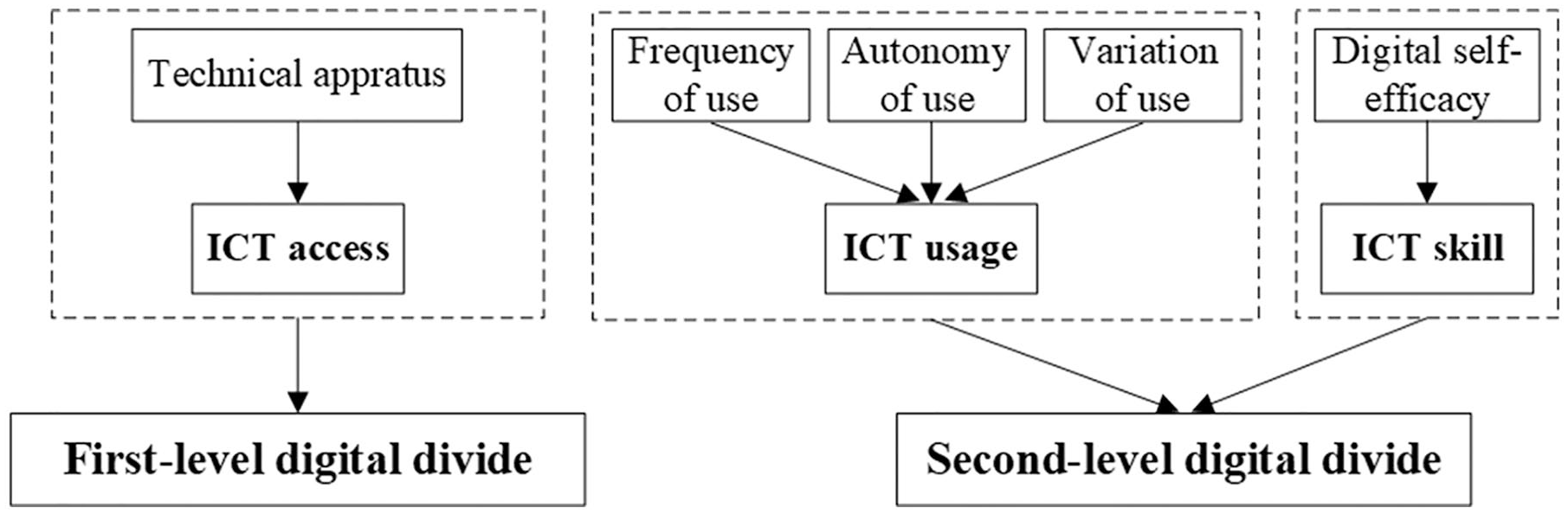
Research framework.
Method
Participants
In developing countries like China, migrant workers are mainly concentrated in big cities. There are three major city clusters in China: the Pearl River Delta in South China, the Beijing-Tianjin-Hebei in North China, and the Yangtze River Delta in East China. We selected one city from each of the three city clusters respectively, namely Shenzhen (South China), Beijing (North China) and Nanjing (East China). These three cities are important urban hubs in their respective regions. Considering the political and economic status of these cities, their attractiveness to migrant workers is overwhelming. By 2019, the permanent population of Shenzhen and Beijing has exceeded 10 million, while that of Nanjing has reached 8 million (National Bureau of Statistics, 2020). The data collected from these three cities can largely reflect the common characteristics of migrant students in developing countries.
There are two criteria for selecting schools in this study. The one is the urban public school that recruits both urban students and migrant students; The other is that the proportion of migrant students is no less than 30%. To draw a fair comparison between urban and migrant students, migrant students who attend private migrant schools were excluded in this study. To balance the sample size of both urban and migrant students, the proportion of migrant students in each selected urban public school is required to be no less than 30%. With the help of local education departments, one primary school and one secondary school were selected from the three target cities respectively. That is to say, a total of six urban public schools were selected for this study. All six schools that meet our requirements are located on the rural-urban fringe of the city. All the fifth and eighth grade students of the six selected schools participated in our questionnaire survey. There are two reasons for choosing these two grades to participate in this study. First, compared with sixth grade and ninth grade, they do not need to face the academic pressure of graduation. Chinese students will encounter much pressure to enter a high-quality junior high school when they finish primary school at the sixth grade. Similarly, Chinese students will encounter great pressure to enter a high-quality high school when they finish junior high school at the ninth grade. Second, their understanding ability is stronger than other lower grades, so they can accurately grasp the questionnaire items.
Before conducting the formal survey, we invited teachers from each selected school to explain to all participants the key concepts involved in the questionnaire, such as their household registration (hukou). In particular, many young students would not be willing to tell the truth about PCs and mobile phone usage. They would rather hide about ICT usage of leisure for a questionnaire from their teachers. To control such biases, we suggested the teachers to tell students that this survey is anonymous, and they are participating an important scientific research in which the real answer is a helpful contribution. This questionnaire requires students to recall their frequency of using ICT. In general, students use ICT more frequently on weekends or holidays than on working days. To avoid the interference of students’ ICT use on weekends or holidays when answering the questionnaire, this study will avoid issuing the questionnaire on Monday. We sent all the paper questionnaires to each selected school by post, and then the teachers of each school chose one day from Tuesday to Friday to distribute the questionnaires to all the participants. As a result, we handed out 1,329 questionnaires in total in October 2016 and received 1,230 valid questionnaires (the valid response rate is 92.55%).
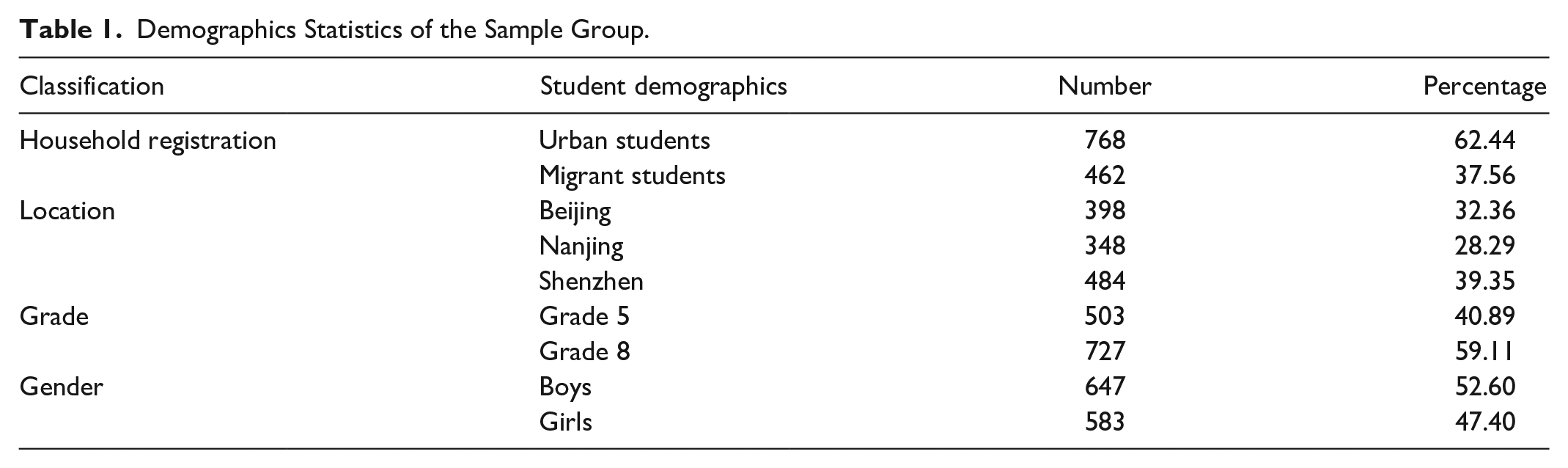
As shown in Table 1, among the 1,230 participants, 62.44% of the students have household registration in the city. Up to 37.56% of the students are from rural areas but live in the city without urban household registration. The numbers of sample groups from Beijing, Nanjing and Shenzhen were 398 (32.36%), 348 (28.29%), and 484 (39.35%), respectively. In all, 503 students (40.89%) are from the fifth grade and 727 students (59.11%) are from the eighth grade. In terms of gender composition, the number of male students is 647 (52.60%) and the number of female students is 583 (47.40%).
Demographics Statistics of the Sample Group.
Instrument
Based on previous studies, a close-ended questionnaire with three parts in Chinese was developed.
The first part includes six socio-demographic items relating to the respondents’ gender, household registration, parental education level, and academic performance in Chinese, Mathematics, and English. This study divides the parental education level into five levels: elementary school, junior high school, high school, university, and postgraduate. The parental education level in the data collection of this study refers to the highest education level of the father or mother.
The second part is about the participants’ digital divide which includes three subscales. The first subscale with 4 items aims to explore students’ differences in ICT access. The second and the third subscales target the new digital divide, which assesses students’ differences in ICT usage and ICT skill respectively. For the ICT usage subscale, it includes three dimensions: (a) frequency of leisure use with six items (CNNIC, 2019; Nachmias et al., 2000), (b) frequency of study use with three items (CNNIC, 2019; Nachmias et al., 2000), and (c) autonomy of use with two items (Martins & Kellermanns, 2004). For the ICT skill subscale, we used self-reported questions to measure students’ digital self-efficacy with 8 items (Hsu & Chiu, 2004).
The third part of this questionnaire is designed to investigate the parenting style. This subscale consists of two dimensions: reaction (two items) and requirement (five items), which was adapted from Macobby (1983). According to parenting mediation theory, parents will make attempt to utilize different strategies to mitigate the negative effects of ICT on their children (Clark, 2011; Livingstone & Helsper, 2008; Nikken & Jansz, 2006). The use of various strategies varies according to the parenting style. Investigating the parenting style enables us to better understand the potential digital divide between the two groups.
After a round of rigorous item-total statistics, we excluded nine items from the initial questionnaire. The deleted items came from the subscale ICT access and parenting style. Exploratory factor analysis (EFA) was then administrated to analyze the rest subscales. Results showed that all factors distinctly described the variance, except the factor loading of item FLU4 was unacceptable (coefficient<.5) and excluded. The parenting style subscale was also analyzed and validated via EFA. The Results from EFA are delineated in Supplemental Appendices 1 and 2.
After the EFA, the internal consistency coefficient (Cronbach’s α) of the revised questionnaire is .86 as a whole, 0.70 for the ICT access subscale, 0.78 for the ICT usage subscale, 0.87 for the ICT skill subscale, and 0.62 for the parenting style subscale. The final questionnaire is presented in Table 2 and the detailed items are shown in Supplemental Appendix 3.
The Instrument for Data Collection.

Note. CR = construct reliability; ICT = information and communication technology.
Results
To examine the abovementioned research hypotheses, we conducted a multivariate analysis of variance (MANOVA) with three dimensions of ICT access, ICT usage, and ICT skill as dependent variables and the household registration as a between-subjects factor, and the homogeneity of variance is true according to the result of Levene Test for each dependent variable. Table 3 presents the statistical results.
Differences in ICT Usage, ICT Skill, and ICT Access Between Urban and Migrant Students.

Note. ICT = information and communication technology; SS = sum of squares; MS = mean square.
The error variance in each variable is homogeneous via Levene test (p > .05).
p < .05. **p < .01. ***p < .001.
The Digital Divide in ICT Access Between Urban Students and Migrant Students
As shown in Table 3, there is a significant difference in ICT access between the two groups in terms of the p-value. However, household registration only accounts for about 1.6% of the variance of students’ ICT access. Thus, H1 is not supported because of the small effect size for a large sample size (Bakeman, 2005; Cohen, 1988, pp. 25–26, 477–478; Richardson, 2011). That is to say, the digital divide in ICT access is not statistically significant in this study.
The New Digital Divide in ICT Usage Between Urban Students and Migrant Students
In terms of the frequency of leisure use, the p-value demonstrates that there is a significant difference between urban and migrant students (see Table 3). However, the partial eta-squared index (η2) shows that household registration only accounts for 0.5% of the variance of students’ frequency of leisure use, thus we have to reject H2A deliberately according to the aforementioned guideline of small effect size.
Concerning the frequency of study use, no significant difference is found in the p-value between urban and migrant students. Therefore, H2B is not supported. Regarding the autonomy of use, the p-value does not show a significant difference between urban and migrant students. H2C hence is rejected too. Based on the above analysis, the new digital divide in ICT usage is not statistically significant between urban and migrant students in China.
The New Digital Divide in ICT Skill Between Urban Students and Migrant Students
As shown in Table 3, the p-value of digital self-efficacy between the two groups reaches a significant level. However, the household registration only accounts for 0.6% of the variance of students’ ICT skill, therefore, H3 is rejected with discretion according to the aforementioned guideline of small effect size. In line with the above results, we conclude that the new digital divide in ICT skill is not statistically significant between urban and migrant students in China.
Discussion
Major Findings
Overall, existing studies have confirmed that the digital divide in ICT access between urban and rural areas is closing, whereas the new digital divide in ICT usage and ICT skill widely persists (OECD, 2010, pp. 167–168; Richtel, 2012). The result of this study supports the conventional wisdom that the digital divide in ICT access has narrowed significantly. However, with regard to the new digital divide in ICT usage and ICT skill, the findings reported in this study are different from previous studies.
Studies (Liao et al., 2016; OECD, 2010, p. 149; Tirado-Morueta et al., 2017; Xiao, 2020; Yang et al., 2013; Zhao et al., 2010) have found that parental education level is a potential predictor of the digital inequality. For instance, a parent with university degree may take advantage of the internet (Tirado-Morueta et al., 2017). Parental education level can even predict how frequently children use new information technology (Ahn, 2011). Therefore, we also measured the educational level of both urban parents and migrant parents (see Table 4), which indicates that urban parents have a significantly higher level of education than migrant parents (t = 11.113, p < .001, d > .5). This significant difference should have resulted in a digital divide between urban and migrant students according to previous studies. To verify it, we conducted a two-way ANOVA with three dimensions of ICT usage, ICT skill, and ICT access as dependent variables and household registration and parental education level as between-subjects factors. Surprisingly, both main effects and interaction in all three subscales are not statistically significant because of the small effect (see Table 5). The predictor of parental education level is invalid again.
Differences in Parental Education Level Between Urban and Migrant Students.

p < .001.
Results of the Two-Way ANOVA.

Note. ANOVA = analysis of variance; ICT = information and communication technology.
The error variance in each variable is homogeneous via Levene test (p > .05).
p < .05. **p < .01. ***p < .001.
In conclusion, both the first-level of digital divide and the second-level of digital divide are statistically non-significant between urban and migrant students, and the predictor of parental education level is invalid to an extent too.
Further Analysis on the Results
To some extent, the results obtained in this study are different from previous studies on the digital divide. Compared with urban students, migrant students are at a disadvantage in terms of family income, parental education level and socioeconomic status, but this study shows that there is no digital divide between these two groups. We need to explain these results based on China’s national conditions.
The first reason is the good policy to resolve educational equality. Because of various favorable policies formulated by Chinese government, the migrant workers’ children may integrate into urban life, rather than being excluded. This kind of social inclusion can reduce social stratification to a certain extent (Sanders & Scanlon, 2021). The existing studies demonstrated that when compared to students in urban public schools, rural students in rural schools and migrant students in private migrant schools fell far behind in terms of ICT usage (Li & Ranieri, 2013; Yang et al., 2013). However, Yang et al. (2013) predicted that the digital divide may be narrowed if the children of migrant workers were able to be enrolled in urban public schools. Ma et al. (2018) supported this view by indicating that the digital divide among schoolchildren is partly “due to the unequal distribution of educational resources among schools.” Our study found that migration to urban public schools appears to be associated with the increase of ICT access at school, thus leading to better usage of ICT. In recent years, many urban public schools have begun to enroll migrant students with the encouragement of the Chinese government. The two groups (urban and migrant students) in this study both attend urban public schools, receive the same education, and share the same educational resources. This is an important reason why the predictors of the digital divide are invalid between urban students and those migrant students who used to attend poor-quality private schools or rural schools.
The second possible reason is that the new digital era creates a new generation. No matter urban students or migrant students, they are digital natives which have grown up with ICT as an indispensable part of their daily life, thus their use of ICT differentiates them from previous generations. As the new generation of adolescent are socialized through different digital technologies, they are labeled as the true original residents of the digital world, be more proficient in using new technologies than their parents (i.e., digital immigrants) (Gómez, 2018; Prensky, 2001). For this reason, although compared with urban students, migrant students may be at a disadvantage in terms of family backgrounds (e.g., parental education level, family income), there is no digital divide between them.
Another important reason might be a parenting style. In the third part of the questionnaire, we examined the parenting style of urban parents and migrant parents. An independent sample T-test was conducted to analyze the differences in parenting style between the two groups. The results show that there are no significant differences in both the reaction subscale (t = -3.049, p < .01, d < .2) and the requirement subscale (t = 11.113, p > .05, d < .2) between urban parents and migrant parents (see Table 6). Despite migrant parents are less educated than urban parents, the two groups have very similar parenting style toward their children. But actually, both urban and migrant parents generally have similar expectations for their children grounded in Chinese traditional culture that hoping their offspring achieve academic excellence to build a bright future. In addition, their children are at the same urban public school, thus the school’s requirements for every parent is consistent, which has an important influence on their parenting style. It is not surprising that there is no significant difference in parenting style between urban parents and migrant parents, which in turn eliminates the digital divide between urban and migrant students.
Differences in the Family Background Between Urban and Migrant Students.

p < .01.
Finally, we adopt the rigorous guideline of effect size in this study. In a large-scale survey, the p-value is generally not reliable. In other words, obtaining statistical significance can be seen as just a matter of sample size. Therefore, the increasing researchers are conscious to conduct statistics of effect size as a routine of empirical study (Bakeman, 2005). For the T-test, Cohen defined a d of .2 as small effect size, .5 as medium, and .8 as large; for ANOVA, Cohen defined a η2 of .02 as small, .13 as medium, and .26 as large (Bakeman, 2005; Cohen, 1988 pp. 25–26, 477–478). These guidelines of effect size are also frequently adopted in educational research (e.g., Furio et al., 2013; Richardson, 2011; Salloum et al., 2019). In this study, we can derive different statistical results according to p-value and effect size respectively. We chose the effect size as a key guideline, while previous studies on the digital divide adopted the p-value. It is another important reason why the results of this study are inconsistent with previous studies.
Conclusion
The aim of this paper is to explore the digital divide in ICT access and the new digital divide in ICT usage and ICT skill between urban and migrant students in developing countries. Drawing on data collected among 1,230 students from six urban public schools in China, we found that both the first-level of digital divide (RQ1) and the second-level of digital divide (RQ2 and RQ3) are statistically non-significant between urban and migrant students.
Four reasons may explain this result: (a) The good policy made by Chinese government to resolve educational equality, (b) the new digital era creates a new generation, (c) migrant parents have the same parenting style as urban parents, and (d) a rigorous guideline of effect size was adopted in this study.
Implications and Limitations
The issue of digital divide is one of the most important challenges in developing countries like China. The trend of rural to urban migration is to be continued in developing countries for a long time, consequently, unprepared adult may be lost in the labor market when they arrive in the city. More importantly, since access to information and knowledge is an important indicator to measure social capital, the exclusion from ICT may lead to social and cultural exclusions (Broadbent & Papadopoulos, 2013). ICT may provide opportunities of both accessing information and increasing social inclusion for those disadvantaged people (Duplaga, 2017). Promisingly in this study, although family backgrounds (e.g., parental education level, family income) have long been considered as a key factor in the digital divide, we found that the negative influences of this factor can be weakened by other efforts, such as educational equality. That is to say, ensuring educational equality can partially bridge the digital divide between urban and migrant students in developing countries, and Chinese government have set a good example. For rural students in rural schools and migrant students in urban private schools, one promising way to improve their use of ICT is to guarantee the equal distribution of educational resources. Future research can start from this point to narrow down the digital divide between rural students and urban students.
This work also has some limitations. First, we constructed our digital divide questionnaire with the indicators of ICT usage, ICT skill, and ICT access. There are more subtle and interesting avenues to explore the indicators of the digital divide, such as other environmental factors that influence ICT usage, not considered in this study. Furthermore, self-reported questions were adopted to reveal students’ digital self-efficacy in this study, which have potentially biased estimates about ICT skill. Finally, we divided samples into two groups, urban students and migrant students, with household registration (hukou). Although the household registration (hukou) is a key indicator for family background, but more in-depth analysis and statistics (e.g., multigroup-SEM) on rural migrant workers’ income and migrant students’ disadvantaged conditions should be addressed in future research.
Supplemental Material
sj-pdf-1-sgo-10.1177_21582440211016387 – Supplemental material for Is There a Digital Divide Between Urban Students and Migrant Students in China?
Supplemental material, sj-pdf-1-sgo-10.1177_21582440211016387 for Is There a Digital Divide Between Urban Students and Migrant Students in China? by Baizhang Zhong, Fenghui Zhu and Liying Xia in SAGE Open
Footnotes
Declaration of Conflicting Interests
The author(s) declared no potential conflicts of interest with respect to the research, authorship, and/or publication of this article.
Funding
The author(s) received no financial support for the research, authorship, and/or publication of this article.

Supplemental Material
Supplemental material for this article is available online.
References
Supplementary Material
Please find the following supplemental material available below.
For Open Access articles published under a Creative Commons License, all supplemental material carries the same license as the article it is associated with.
For non-Open Access articles published, all supplemental material carries a non-exclusive license, and permission requests for re-use of supplemental material or any part of supplemental material shall be sent directly to the copyright owner as specified in the copyright notice associated with the article.
