




Abstract
This article examines whether social inequality exists in European adolescents’ school-related Internet use regarding consuming (browsing) and productive (uploading/sharing) activities. These school-related activities are contrasted with adolescents’ Internet activities for entertainment purposes. Data from the Programme for International Student Assessment (PISA) 2012 is used for the empirical analyses. Results of partial proportional odds models show that students with higher educated parents and more books at home tend to use the Internet more often for school-related tasks than their less privileged counterparts. This pattern is similar for school-related browsing and sharing Internet activities. In contrast to these findings on school-related Internet activities, a negative association between parental education and books at home is found with adolescents’ frequency of using the Internet for entertainment purposes. The implications of digital inequalities for educational inequalities are discussed.
Introduction
In the digital age, information and communication technologies (ICT) play an integral part in individuals’ lives and are considered essential for social participation in society (Fraillon, Ainley, Schulz, Friedman, & Gebhardt, 2014, p. III). However, not all individuals are equally prepared for effective ICT use. The “digital divide” literature has identified several inequalities regarding ICT usage patterns and skills (Attewell, 2001; DiMaggio & Hargittai, 2001). Inequalities in ICT usage are also common among adolescents and young people, who are often described as “digital natives” (Bennett, Maton, & Kervin, 2008). Various studies show that adolescents from higher social backgrounds use the Internet more frequently for informational purposes than adolescents from lower social backgrounds, while the opposite tendency is sometimes observed regarding entertainment activities (Notten, Peter, Kraaykamp, & Valkenburg, 2009; Yates, Kirby, & Lockley, 2015). However, Internet use for “informational purposes” is a very broad category covering very heterogeneous activities (e.g., reading news, consulting a railway guide for the best train connection, watching a video on how to build a birdhouse). An especially relevant area of Internet usage for adolescents may be ICT use for educational purposes—not only in school, but also on their home computer systems. The possibility of using the Internet for schoolwork may constitute an advantage for students’ educational careers (Robinson, Wiborg, & Schulz, 2018; Shen, 2018). However, research on the social selectivity of students’ educational use of ICT shows inconsistent findings (Cranmer, 2006; Eamon, 2004; Gümüş, 2013; Vekiri, 2010).
In this article, we analyze whether social inequality exists in European adolescents’ school-related Internet use using data from the Programme for International Student Assessment (PISA) 2012. The aim of this work is, therefore, descriptive. However, it is a relevant question for social inequality research because the reproduction of social inequality is strongly driven by educational attainment (Blau & Duncan, 1967; Breen, 2004)—and students who use ICT for school-related purposes may be advantaged in their educational careers (Paino & Renzulli, 2013). We draw on Bourdieu’s (1977) theory of cultural and social reproduction as our theoretical framework and apply it to the digital domain (Ignatow & Robinson, 2017). With this theoretical framework, it can be expected that students from higher social backgrounds are more likely to use ICT for schoolwork. Thus, educational ICT use might contribute to strengthening educational inequalities. We also contrast students’ use of ICT for educational purposes with their ICT use for entertainment purposes to show that students from higher social backgrounds do not generally have a higher intensity of ICT use, but do so specifically in the educational domain. Moreover, it may be expected that inequality in educational ICT use is especially pronounced regarding more “active” or productive use of the Internet. We derive this expectation from the notion that more active or “engaged” use of the Internet requires more resources and skills (Selwyn, 2004), which are unequally distributed across different social strata (Fraillon et al., 2014). We, therefore, distinguish between productive (content creation and sharing) and consumptive (browsing) Internet activities—to our knowledge, no previous study has made such a distinction regarding educational ICT use. Thus, our study can contribute to the literature on digital inequalities and, more broadly, to the literature on the reproduction of social inequality.
Literature Review on Adolescents’ ICT Use
Inequality in Adolescents’ ICT Usage
The study of different usage patterns by sociodemographic characteristics has increased as opportunities for Internet access have risen, thus, research in this field started around the millennium (Attewell, 2001; DiMaggio & Hargittai, 2001; DiMaggio, Hargittai, Celeste, & Shafer, 2004). Most studies in this field have differentiated between informational versus entertaining Internet usage and examined the social stratification of usage patterns. These studies found that adolescents from families with higher social backgrounds tend to use the Internet for informational purposes more often than adolescents from lower socioeconomic backgrounds (Micheli, 2015; Notten et al., 2009; Peter & Valkenburg, 2006), while those with fewer socioeconomic resources use ICT more often for entertainment (Peter & Valkenburg, 2006) and playing games (Koivusilta, Lintonen, & Rimpelä, 2007; Notten et al., 2009). These findings are consistent with research conducted on adults’ online activities (Bonfadelli, 2002; Van Deursen, van Dijk, & ten Klooster, 2015; Zillien & Hargittai, 2009). Bonfadelli (2002) notes, “More educated people use the Internet more actively and their use is more information oriented, whereas the less educated seem to be interested particularly in the entertainment functions of the Internet” (p. 65).
Other studies which use clustering methods have identified different usage types among children and young people (Eynon & Malmberg, 2012; Livingstone & Helsper, 2007; Van den Beemt, Akkerman, & Simons, 2010). They were able to distinguish specific online user types, as exemplified by van den Beemt et al.: “traditionalists” who mainly engage with the Internet through browsing, “gamers,” “networkers,” and “producers” who use the web for a wide range of activities and upload content. It has been demonstrated that middle class children participated in more online activities than their peers from working class backgrounds (Livingstone & Helsper, 2008).
Research focusing on content production and sharing activities revealed that the link between parental resources and these activities is not that clear. College students with higher educated parents were described as more likely to be producers of content (Hargittai & Walejko, 2008). In contrast, Correa (2010) found no relation between parental educational levels and content creating. Other studies showed that the type of content produced should be considered: There is no association between individuals’ educational level and the creation of entertainment content or social network site usage (Blank, 2013; Micheli, 2015). In contrast, political content is more often created by highly educated people (Blank, 2013) and students with better educated parents are more likely to produce skilled content (their own website, blog, post created content, online forum, tweets on twitter) than their peers with less educated parents (Micheli, 2015).
To sum up, previous research has clearly demonstrated socially stratified ICT usage patterns among adolescents and young people. Adolescents from higher social backgrounds use the Internet more often for informational purposes and are more likely to produce “skilled content.” However, ICT usage for “informational purposes” is a very broad category, which encompasses very heterogeneous activities (e.g., reading news, obtaining practical information). Therefore, we shall now look more specifically at adolescents’ educational ICT use.
Inequality in Adolescents’ Educational ICT Usage
A growing body of research examines ICT usage at school and digital learning opportunities (Bulman & Fairlie, 2016; Falck, Mang, & Woessmann, 2018; Fraillon et al., 2014; Patterson & Patterson, 2017). In school, students use ICT most frequently in “information technology or computer studies,” followed by the natural sciences and human sciences (Fraillon et al., 2014, p. 151). In addition, students’ ICT educational usage outside school is receiving increasing attention (Ben-David & Kolikant, 2012; Furlong & Davies, 2012). Research on the social selectivity of using ICT for educational purposes outside school shows inconsistent results. Some studies found differences by social background regarding computer use for educational computer activities (Steffens, 2014; Vekiri, 2010), whereas others did not (Cranmer, 2006; Eamon, 2004; Gümüş, 2013). Gümüş (2013) analyzed the Turkish sample of the PISA 2009 study and found no significant link between family wealth, parental education, or cultural possessions with students’ ICT use for school-related activities at home. Eamon (2004) reported that children from poor and non-poor families did not differ in their home computer use for academic purposes in a U.S. sample of children aged 10 to 14 years. A qualitative study by Cranmer (2006) on use of the Internet for homework found no differences between family types within a sample of 11- to 15-year-old children from 17 families in the United Kingdom.
On the contrary, Vekiri (2010) showed that educational computer activities are carried out more often by students from better-off families in Greece. Higher percentages of children from better-off households are reported for the activities drill and practice, writing, and Internet search. Steffens (2014) showed that adolescents’ (from Germany, Finland, and the Netherlands) Internet use at home for school functions increases as socioeconomic status rises, but does not control for other variables. In addition, better-off parents are more likely to regard ICT as an educational tool (Linebarger & Chernin, 2003), which could result in different ICT mediation practices (Clark, 2011).
To conclude, the findings on the social selectivity of educational ICT are not consistent. As demonstrated, some studies have found a relationship between social origin and educational ICT activities, whereas other researchers reported that adolescents do not differ in their educational ICT use by social background. These studies are carried out on relatively small samples and focus on single regions or countries only. In addition, previous studies that examined online content production and sharing of young people focused mainly on college students (Correa, 2010; Hargittai & Walejko, 2008). Thus far, educational sharing practices have not been analyzed from a social stratification perspective.
Theoretical Framework: Bourdieu’s Theory of Cultural and Social Reproduction
We draw on Bourdieu’s (1977, 1986) theory of cultural and social reproduction as the theoretical framework for this study. The transmission of cultural capital from parents to children is a core element of this theory. Cultural capital in the “embodied state” (Bourdieu, 1986, p. 243) includes cultural skills and knowledge as well as tastes and attitudes. According to Bourdieu (1977), this kind of cultural capital is demanded and rewarded in the educational system and “can only be produced by family upbringing” (p. 494). Here, the “easy accumulation of every kind of useful cultural capital (. . . ) starts at the outset, without delay, without wasted time, only for the offspring of families endowed with strong cultural capital” (Bourdieu, 1986, p. 246). Thus, children’s cultural skills and knowledge, their interests, tastes, and attitudes are shaped by their parents’ cultural capital.
Various scholars have applied Bourdieu’s theory to the digital world (Kvasny, 2006; Paino & Renzulli, 2013; Zillien & Hargittai, 2009). For example, Van Deursen and colleagues (2015, p. 260) argue that cultural capital is necessary “to cope with the diverse amount of available content” using the Internet. It can be expected that parents’ cultural capital affects the way how their children use the Internet. Depending on their parental cultural capital, children will develop specific skills, interests, and attitudes regarding ICT, which will also show up in differentiated ICT usage patterns in adolescence.
Aim of This Study and Hypotheses
Drawing on Bourdieu’s theoretical framework and in line with previous empirical studies, we expect differential patterns of Internet usage in adolescence by parental cultural capital. In contrast to most previous studies on this topic, we will not address the broad category of “informational” ICT use but focus more specifically on “educational” ICT use and contrast it to “entertainment-related” use. The aim of this study is, first and foremost, therefore, analysis of the association between parental cultural capital and students’ Internet usage for school-related versus entertainment-related purposes. Concretely, we will test the following hypotheses:
In addition, we will also distinguish between more “active” or productive use of the Internet (uploading/sharing) and more consumptive use (browsing). It may be expected that inequalities are more pronounced regarding activities that require more active participation from the students (Selwyn, 2004). Thus, we distinguish four types of Internet activities (Figure 1): school-related browsing activities, school-related sharing activities, entertainment-related browsing activities, and entertainment-related uploading activities.

Categorization of school and entertainment-related online activities.
The second aim of this study is to analyze whether the association between parental cultural capital and students’ Internet usage for school-related purposes differs between browsing and sharing/uploading activities. Concretely, we will test the following hypothesis:
Data and Methods
We use data from the PISA study conducted in 2012. Directed by the Organisation for Economic Co-operation and Development (OECD), PISA measures the competencies of 15-year-old students in reading, mathematics, and science every 3 years, starting from 2000. Along with the assessment of reading, mathematics and science skills and the regular student survey, some countries participated in an additional survey, which recorded ICT possession and usage. In Europe, the following 25 countries asked their students to complete the ICT questionnaire: Austria, Belgium, Croatia, the Czech Republic, Denmark, Estonia, Finland, Germany, Greece, Hungary, Iceland, Ireland, Italy, Latvia, Liechtenstein, the Netherlands, Norway, Poland, Portugal, Serbia, the Slovak Republic, Slovenia, Spain, Sweden, and Switzerland.
Measurements
The dependent variables are measured by the self-reported time spent on browsing and sharing/uploading Internet activities with school-related and entertainment purposes (Figure 1). The students were asked how often they used a computer outside school for different activities. They could choose between doing the activity never or hardly ever, once or twice a month, once or twice a week, almost every day, or every day. We selected the following items to represent the different categories from Figure 1: “browsing the Internet for fun (such as watching videos, e.g., <YouTube™>),” “uploading your own created content for sharing (e.g., music, poetry, videos, computer programs),” “browsing the Internet for schoolwork (e.g., for preparing an essay or presentation)” and “sharing school related materials with other students” (OECD, 2011).
To measure parental cultural capital, the number of books at the student’s home and the highest educational qualification of the parents are used. The number of books in the parental home is measured using three categories: (0) 0 to 25 books, (1) 26 to 200 books, and (2) more than 200 books. Parental education is measured according to the International Standard Classification of Education (ISCED). In our analysis, we distinguish three categories: (0) up to lower secondary education (ISCED ≤ 2), (1) upper secondary education and postsecondary nontertiary education (ISCED 3 or 4), and (2) tertiary education (ISCED 5 or 6).
Previous research has shown that Internet activity can be influenced by diverse factors. We, therefore, include various control variables: migration background (1: the student or at least one parent was born outside the test country, 0: the student and both parents are born in the test country), gender (1: female, 0: male), ICT possession (number of ICT devices available for students’ use at home, e.g., a desktop computer, laptop or tablet), Internet experience (1: student was 9 years old or younger at first access to the Internet, 0: student was 10 years old or older), ICT usage in school (index of nine specific activities at school, see OECD, 2014), reading literacy (results of students’ reading test score). In all models, we also control for country dummy variables.
We removed from the data set all students who indicated that they do not have an Internet connection at home or never used the Internet (3.10%) because we are interested in students who are able to use the Internet autonomously. Moreover, we removed respondents with a missing value for one of the model variables (8.05%). However, we tested the robustness of our results using multiple imputations with chained equations (with 10 imputed data sets) and exclusion of observations with initial missing values on the dependent variables from the imputed data sets (Von Hippel, 2007)—our main results remained unchanged. We shall, therefore, only report the results from non imputed data. This analysis sample includes 154,539 respondents in 7,064 schools in 25 countries. Table 1 shows the distribution of the dependent variables. Further descriptive statistics concerning the sample can be found in the Appendix (Tables A1-A3).
Distribution of the Dependent Variables.

Source. Programme for International Student Assessment 2012.
Note. Figures in percent, n = 154,539.
Browsing activities are carried out more frequently than activities, which involve uploading or sharing materials. Nearly half of the respondents (over 48%) use the Internet every day to browse for fun, whereas less than 6% use the Internet daily to browse for school purposes.
Analytical Plan
The respondents are nested in countries and schools, and we take this structure into account using country fixed effects and clustering of the school variable. Standard errors are, therefore, adjusted for 7,064 school clusters. Due to the ordinal nature of our dependent variables, we estimate partial proportional odds models with the Stata add-on gologit2 (Williams, 2006). 1 Models, which are fitted with this method, do not violate the parallel line assumption of the ordinal logistic regression model. The coefficients can vary across the different categories of the dependent variable, but do not necessarily do so. We use the autofit option to test for coefficients for which the parallel line assumption cannot be held. A partial proportional odds model with more than two categories “becomes equivalent to a series of binary logistic regressions where categories of the dependent variables are combined” (Williams, 2006, p. 59). In our case, we first contrast never/hardly ever with monthly or more often. In the second step, the categories never and once or twice a month are contrasted with the remaining categories weekly or more often. Then, never, monthly, once or twice a week are compared with almost every day and daily. Finally, we contrast the categories never, monthly, weekly, and almost every day with the category every day. We use such an elaborated method so that we do not need to shed information and take the structure of the data into account. An alternative method would have been to reduce the models to a single contrast, for example, “at least weekly” versus “monthly, hardly ever or never.” We have refrained from this because this contrast is included in our models, and additionally all the other possible contrasts can also be considered. For binary independent variables, a positive coefficient states that the probability of a respondent being in a higher category for the outcome variable than for the current one rises, a negative coefficient reveals that a respondent is more likely to be “in the current or a lower category” (Williams, 2006, p. 63). To report the coefficients of interest, we use the Stata add-on coefplot (Jann, 2014). Some “typical cases” are shown by calculating predicted probabilities. To handle the plausible values for reading literacy, the models are fitted with the Stata add-on PV (Macdonald, 2014).
Results
We ran a partial proportional odds model for each dependent variable. The coefficients of parental education and number of books at home are plotted for school-related activities (Figure 2) and for entertainment activities (Figure 3). The control variables are included in all models. The full tables are shown in the Appendix (Tables A4 and A5).
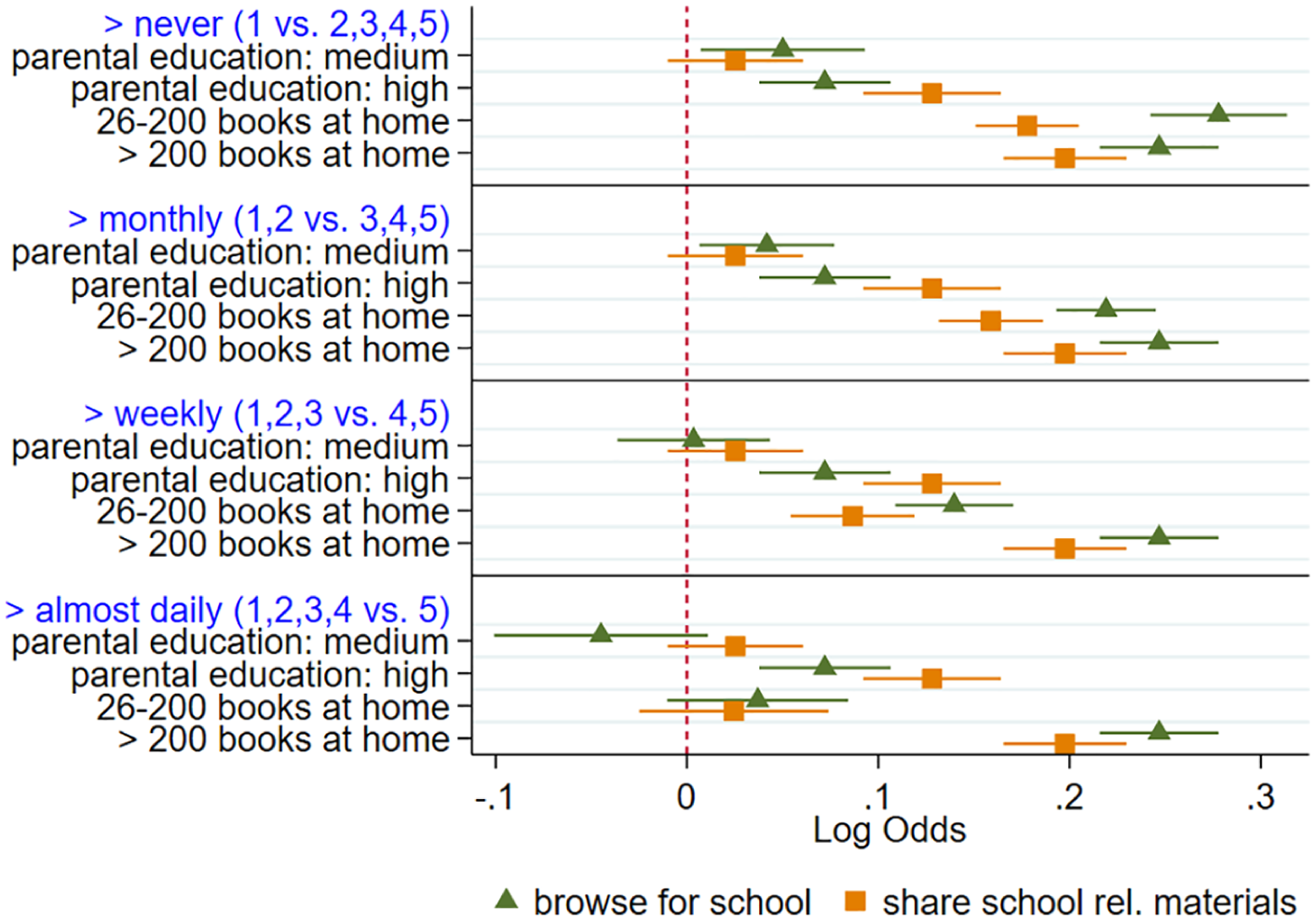
The association between parental cultural capital and school-related Internet use.

The association between parental cultural capital and entertainment related Internet use.
Results for the dependent variables browse for school and share school related materials tend to be very similar (Figure 2). In the first comparison between the categories never or hardly ever versus monthly or more often, coefficients for cultural capital are positive. The positive effects indicate that respondents from higher cultural capital backgrounds tend to appear in a higher category than never or hardly ever with a higher probability than respondents with less parental cultural capital. Similar effects can be found in the other contrasting panels. However, the effects of a medium level of parental education are mostly not significant. For most of the contrasts, the largest effects are found for “more than 200 books”: Students from families with many books at home are much more likely to browse for school and to share school-related materials than students from families with only a few books (the reference category). Overall, the results point to a pronounced association between parental cultural capital and the frequency of school-related Internet activities—this is true for browsing as well as sharing activities.
The opposite effects can be found for activities, which focus on entertainment (Figure 3). The significant effects of cultural capital are mostly negative for the activity browse for fun. The negative coefficient of possessing many books (more than 200 books) in the first contrasting panel never or hardly ever compared with monthly or more often indicates that respondents with many books are more likely to fall into the category never than those with only few books (0-25 books, reference category). Likewise, respondents with middle or high book possession and whose parents have a medium or high educational level are more likely to use the Internet less frequently than daily for browsing for fun than respondents from lower cultural capital backgrounds. The coefficients for parental educational level do not vary between the contrasting panels; the parallel line assumption is held. The effect sizes of the parental education and book possession variables for upload content activities are mostly smaller than for browse for fun. The coefficients for parental education also do not vary in the model for upload content activities, but the differences between respondents with highly educated parents and those whose parents have a low level of education are never significant.
We can conclude that cultural capital background does seem to influence what 15-year-old students do online. Thus, Hypotheses 1 and 2 are supported by our results. However, due to the high number of respondents in the data set, coefficients become easily significant, even when differences are not that great. We, therefore, want to demonstrate the effect sizes by plotting the predicted probabilities for some “typical cases” (Figure 4).

Predicted probabilities for different Internet activities carried out at least weekly by varying levels of cultural capital.
The predicted probabilities for browsing for fun do not vary strongly by level of parental cultural capital (Figure 4, left graph). All students have a very high probability of about 90% for browsing for fun at least weekly. A small difference of 2.2 percentage points between students from high versus low cultural capital backgrounds can be found.
For browsing for school, results show the opposite pattern. Students with high parental cultural capital do indeed have a higher probability of at least weekly browsing for school purposes than students with low cultural capital. The difference amounts to 7.9 percentage points.
Regarding uploading one’s own created content (entertainment), we do not find large differences by cultural capital. The difference between students from high versus low cultural capital backgrounds amounts to 2.9 percentage points.
A difference of 7.6 percentage points between the probabilities for students with low and high cultural capital can be found for sharing school related materials with other students (Figure 4, right graph). Students with higher cultural capital tend to use the Internet more often to share school-related materials.
In addition, further analysis revealed that the effect of cultural capital for browsing for school is not mitigated when ICT is used at school (Table A6). However, a moderation effect can be observed regarding the sharing of school-related material: Stronger ICT usage at school can reduce the effect of parental cultural capital on students’ school-related sharing activities.
To sum up, we find that cultural capital has a stronger effect on school-related ICT activities than it does on entertainment usage. Students from higher cultural capital backgrounds tend to use the Internet more often for school activities than students from lower cultural capital backgrounds. Therefore, Hypothesis 1 can be held. However, this effect of parental cultural capital on students’ Internet use for school is rather moderate in comparison with the influence of cultural capital in other domains. For example, the probability of being in at least the third quintile of the reading performance distribution differs by 53 percentage points between students from high versus low cultural capital backgrounds. Although students with low cultural capital are prone to use the Internet more often to browse and share entertainment content than their peers with high cultural capital, this difference is only very small. Finally, the differences between students from high versus low cultural capital backgrounds tend to be very similar (about eight percentage points) regarding browsing for school and sharing school-related materials. Hypothesis 3, therefore, is not supported. The relation between parental cultural capital and school-related Internet activities does not seem to be stronger for sharing activities compared to browsing activities.
Discussion
Summary
Our secondary analysis of the PISA 2012 data showed that differences by family background can be found for educational Internet usage; this is true for browsing and sharing activities. Previous research conducted on educational Internet usage was mostly unable to identify such a relationship (Eamon, 2004; Gümüş, 2013). However, the spread of ICT was smaller in the early 2000s and adolescents from less privileged families were prone to have a lower rate of Internet connection in their homes (Eamon, 2004). For Europe, high penetration of home Internet access can be observed in the PISA 2012 data, so our results indicated that cultural capital background matters for the educational use of the Internet outside school once access is provided.
Our results reveal that consuming activities are more common among adolescents than uploading and sharing activities. This is in line with previous research conducted on how young students use social media (Lu, Hao, & Jing, 2016). Using the Internet for educational sharing practices is an understudied area of research. The findings of this study revealed that differences exist by parental cultural capital level. In contrast, no crucial effect for parents’ cultural capital could be identified for uploading entertainment content. The variable used for measuring this activity was based on the question of how often respondents used the Internet for “uploading your own created content for sharing (e.g., music, poetry, videos, computer programs).” The findings, therefore, not only refer to sharing, but also include the production of entertainment content. In a former study on U.S. college students, differences could be found for creating content, but not for sharing practices (Hargittai & Walejko, 2008). In a more recent study, Lu and colleagues analyzed consumption and sharing practices in and outside school for a sample of Hong Kong students. They found no significant effect for parental education on content sharing and creating, but did not differentiate between educational and other sharing activities. The findings of our study are more in line with Blank’s outcome, which showed that political content creation is related to elite status for a sample of British Internet users, but that other uploading activities are not (Blank, 2013). Thus, not all kinds of content creation and sharing practices come along with higher social status or cultural capital background. In the PISA data, a sharing divide among European students could only be identified for school-related materials and not for entertainment content.
The presented results confirm a digital divide regarding the educational use of the Internet outside school. This is in line with the theoretical expectations derived from Bourdieu’s theory of cultural and social reproduction. However, the effect sizes seem rather moderate. In addition, we also want to stress that socially stratified educational Internet use is only one way (out of many other ways) in which parental cultural capital is transmitted to children and unequal educational opportunities are created.
Limitations
The most serious limitation of the data used in this study concerns the measurement of the dependent variables via students’ self-reporting. Such self-reporting may be biased by memory errors and may also be prone to social desirability effects. Also, the Internet activities considered in the analysis are rather broad. The PISA questionnaire is restricted regarding Internet use for school purposes. For this reason, we only analyzed two indicators for each concept of interest (school/entertainment). Better models could be fitted with tracked instead of self-reported data. However, such measurements are not available in the PISA data. As we have no data about the question of whether and how teachers include ICT in homework tasks, we could not control for those effects. Another limitation is that we were unable to control for school track effects, because the respective variable in the international PISA data set seems not valid for all countries (e.g., all respondents in Iceland were categorized as ISCED level 2). Thus, we control for reading literacy to control for students’ level of school achievement.
Implications and Future Research
Previous findings on Internet usage focused mainly on information-orientated online activities. Results indicate that there are different usage patterns depending on demographic and socioeconomic factors. If the assumption is applied that some activities confer greater advantages for users, those with higher socioeconomic status tend to benefit more from their media usage (Van Deursen et al., 2015; Zillien & Hargittai, 2009). This assumption can also be applied to school-related Internet activities out-of-school. If frequent use of the Internet for scholastic purposes is associated with educational success, the results of this study demonstrate that students from families with high cultural capital tend to benefit more from their Internet usage in terms of later life outcomes. School-related Internet usage might, therefore, contribute to the reproduction of social inequality. However, a longitudinal study in Switzerland by Camerini, Schulz, and Jeannet (2018) revealed that more frequent informational and educational use of the Internet is not always related to better school outcomes. Nevertheless, other studies were able to identify a positive relation between educational ICT usage and academic performance (Robinson et al., 2018). Thus, more long-term studies are necessary to investigate whether use of the Internet for school-related activities is connected with higher educational achievement and further success.
Different usage patterns according to users’ background characteristics indicate that there is a usage gap like that described by Van Deursen and van Dijk (2014). Not only is usage for informational purposes generally structured by users’ backgrounds, but we demonstrate that school-related Internet usage is also connected with cultural capital background. This is in contrast to previous research (Eamon, 2004; Gümüş, 2013) and, therefore, needs attention in further studies. The use of tracked data in such studies is desirable.
Footnotes
Appendix
Moderation Analysis: Predicted Probabilities for School-Related Internet Activities Carried Out At Least Weekly by Varying Levels of Cultural Capital and ICT Usage at School.

| Cultural capital | Browse for school |
Share school related material |
||
|---|---|---|---|---|
| ICT usage at school |
ICT usage at school |
|||
| Low | High | Low | High | |
| Low | 0.378 | 0.628 | 0.210 | 0.492 |
| Middle | 0.440 | 0.672 | 0.262 | 0.514 |
| High | 0.442 | 0.692 | 0.290 | 0.543 |
Source. Programme for International Student Assessment 2012.
Note. Predicted probabilities from models with an interaction term (cultural capital × ICT usage at school). ICT = information and communication technologies.
Declaration of Conflicting Interests
The author(s) declared no potential conflicts of interest with respect to the research, authorship, and/or publication of this article.
Funding
The author(s) received no financial support for the research, authorship, and/or publication of this article.
