




Abstract
This study examines the underpinning core values which educators ought to have, and students must acquire at schools adequately according to preservice teachers’ perception. The research was designed according to the quantitative model, and three open-ended questions questionnaire was used for data collection. The research group involved 263 preservice teachers. The data were analyzed using descriptive statistics. Findings, first, revealed 17 values that teachers ought to have, 21 values that school principals ought to have, and 20 values that students ought to acquire. The revealed values were also categorized as follows: moral values, professional values, and cultural values. Examining the ideas of preservice teachers has importance because they carry the existing values and in return affect the value formation of the society in the future.
Introduction
Values are the criteria by which individuals judge ideas, objects, people, situations, and actions as good, worthwhile, desirable, wrong, worthless, or undesirable (Shaver & Strong, 1976). Without shared values, it is unfeasible to find the basis for establishing common values and standards of behavior in society. In this context, throughout history, various societies had produced various common values to sustain their existence and keep the nation in solidarity.
One of the most influential agents of society to sustain its values is schools. For centuries, authorities have considered education as a useful tool to embed and perceive behaviors and values within new generations. According to Ünal (2005, 2013), education is a process the state regulates through the curriculum to maintain its controlling system in a society. Accordingly, authorities with different understandings struggle to convey their understanding to the next generation; such power struggle can be observed within the hidden curricular activities. For example, pictures and quotations of historical heroes on school walls are related to national values. Schools create a moral habitat where society passes its values and beliefs to students. Thus, the students learn what they can or cannot do (Ozoliņš, 2010). In this context, schools have played an important role in transmitting the common values of society to future generations throughout history.
Due to modernization, economic and technological developments have created a competitive environment among countries in the global world over time. In this process, as Ünal (2002, 2006, 2011, 2016) mentioned, the values supporting social unity and cooperation have changed mostly by values such as entrepreneurship, competitiveness, and individualism today.
Besides, these values have been considered as core values in education, particularly in developing countries, like Turkey. In this context, governments have focused on the creation or development of individualistic values, which are going to help individuals to survive in a competitive environment, at schools. In other words, they have given priority to educare or training. On the contrary, as Ünal (2002, 2006, 2011, 2016) indicated, they have neglected the transition of values that contribute to peace and serenity in the country such as friendship, respect, and cooperation. In other words, they have ignored educare or education for years.
Educare means “to bring up,” “to bear,” “to guide,” and “to direct” the learner. It is associated with a particular trade or profession and indicates training or providing the learner with a particular skill which, in general terms, is physical skills. According to such education, the contents of the curriculum will be determined mostly by the economic or social needs of a country. As a result, the prime motivation for teachers will be teaching the knowledge of a particular job or skills in areas where there is the most significant work opportunity. On the contrary, educare means “to draw out,” “to lead out,” “to raise up,” “to bring up,” or “rear a child.” The definition implies thriving the students’ ability to develop ideas and skills, which allows them to explore themselves and the world. On that account, the primary motivation of teachers and learners will be teaching and/or learning knowledge, not because of any pragmatic reason (Adeyemi & Adeyinka, 2003; Billington, 2003; Gunga & Ricketts, 2008). Consequently, the education system has been producing new generations, which can adapt themselves to the technological developments well but do not know how to contribute to social peace, democracy, and prosperity in such countries for years.
Today, there are many standardized exams for grades, which result in ignorance of transferring the values to the generations at schools in many countries. For example, in Turkey, there are the placement exam for senior high school, the exam for college placement (SAT), and the public personnel selection exam for individuals to be assigned to public institutions. Answering multiple-choice questions is enough to pass these exams. Thus, educators and parents have been compelling the students to succeed in such exams, but they have been disregarding the value transition to them over years. Similarly, for years teachers have been assigning to schools according to the score they obtain at the public personnel selection exams. Therefore, for years people seem to fail to achieve the essential educational goals of the country’s education system, such as being a democratic citizen.
Preservice teachers are future educators (Castañeda-Peña et al., 2019; Stachowski & Mahan, 1998). They are supposed to have a crucial role to play in laying the foundations of society in the future, because they will teach their students at schools according to their beliefs and values.
Scholars (e.g., Gutterman, 2010; Rokeach, 2008; Schwartz, 2012; Tuulik et al., 2016) argue that values can change in congruence with the changes in society and can reflect social changes in societies as well. In this regard, preservice teachers are both the reflection of the present society and the shapers of the new generation, as they represent an up-to-date cultural value of a specific region.
As scholars (Brady, 2011; Lashley & Barron, 2006; Shein & Chiou, 2011) emphasized, teachers are founts of values. They bring various professional and personal values to the classroom and students see them as role models. Thus, they have a huge opportunity for transferring their values to the students particularly through the hidden curriculum in schools. Hence, teaching is a sacred job, and teachers have always been of great significance for societies (Ayers, 1995). In light of these, teachers are architects of society. Ataturk (1924) emphasized this role saying “the new generation is a masterpiece of teachers.” Thus, they need to internalize universal values to generate respectful generations to a peaceful society. In this context, answering the question of “what values educators have?” is one of the essential prerequisites for the researchers in Turkey and the rest of the world because of the similar issues they face.
This research aims to discover the preservice teachers’ essential values of education. In this context, the main question of the research is what are the main values in education according to preservice teachers? The following questions have been answered throughout the study. According to the preservice teachers:
What are the main values teachers should have?
What are the main values school principals should have?
What are the core values that should be transferred to the students at schools?
Theoretical Framework
Values and Preservice Teachers
Values are individuals’ embedded abstract motivations. They guide individuals to understand, justify, and explain norms, attitudes, and actions (Feather, 1995; Rokeach, 1973; Schwartz, 1992). According to Schwartz (2011), values are the standards for individuals to determine whether people, events, or actions are good or bad, and as originated within the human being’s meaning. Besides, Rokeach (2008) considers human values as the consequence of psychological needs and societal demands, personal experience, being created by institutions within the community, or the culture.
Scholars have examined values in different ways and established models to understand their system. For instance, values are classified by Rokeach (1973) as instrumental and terminal; by Hofstede (1989) as professional, organizational, and national levels; by Posner and Schmidt (1992) as individual and organizational levels; by Schwartz (2005) as individual and cultural; and by Titov et al. (2013) as real and propagated. Several scholars (e.g., Durkheim and Weber as cited in Gutterman, 2010; Schwartz, 2012; Tuulik et al., 2016) have emphasized the importance of values in society to explain personal and social changes.
Preservice teachers have a multidimensional reflection on society. They represent the present cultural values of society and will shape the new generation in the future when they start to teach. In terms of representing the current cultural values of society, they bring their beliefs and values along with them when they come to the teacher training program. In addition, their professional values and beliefs which they have acquired since childhood are strengthened or changed throughout preservice education (Lortie, 2002; Zeichner & Gore, 1990). According to Richardson (2003), changes in teachers’ beliefs are crucial during preservice education. Thus, as Voinea and Palaşan (2014) emphasized, preservice teachers begin to construct their professional values, especially during preservice education.
Preservice teacher education also allows teacher candidates to get authentic learning experiences as active learners (Rule, 2006). In light of the above, understanding preservice teachers’ social and cultural values may provide some insight into their future behaviors as teachers in schools. Similarly, Opdenakker and Damme (2006) suggest further research to examine the links between teachers’ beliefs and theories to understand classroom practices at schools.
Schwartz Cultural Values Theory
According to Schwartz (2011), cultural values shape and justify beliefs, actions, and goals of individuals and groups within a society. His theory proposes six cultural values and three bipolar dimensions of a culture to represent alternative resolutions for three societal problems (Figure 1).
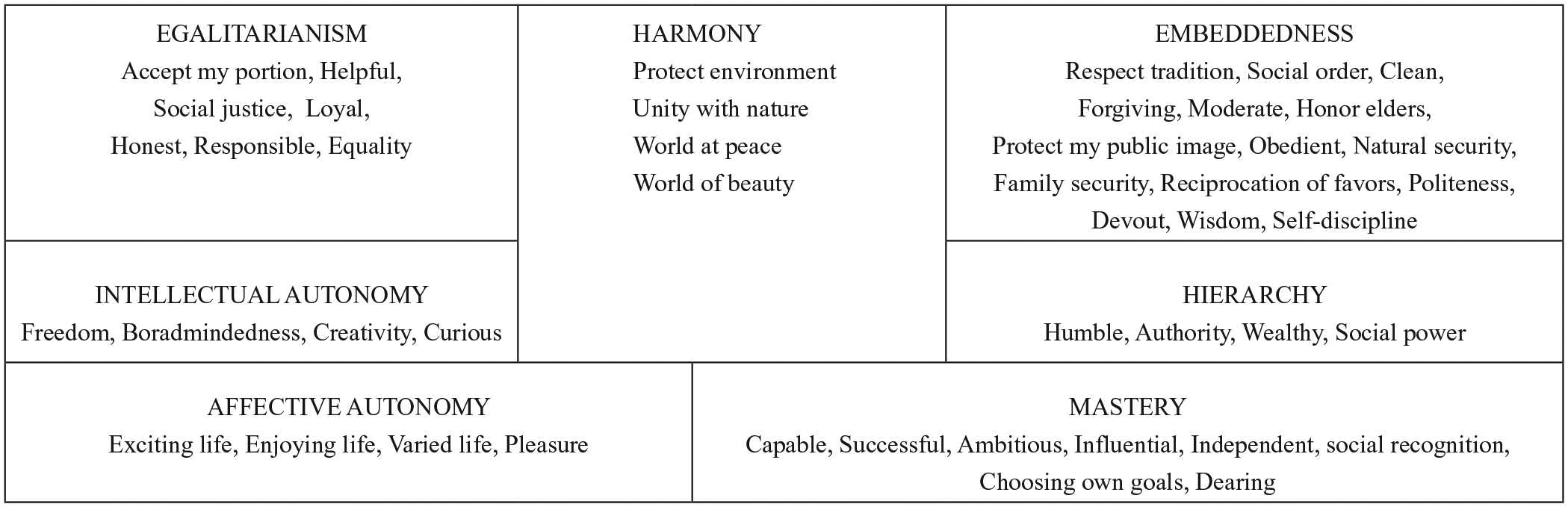
Cultural dimensions: Prototypical structure (Schwartz, 2006).
As shown in Figure 1, the first set of values is the Autonomy-Embeddedness/conservatism. This dimension determines the nature of the relation between the group and its members. Embeddedness emerges when individuals are embedded in a collectivity within a community. Intellectual autonomy refers to pursuit one’s own ideas and intellectual directions; hence, broad-mindedness, curiosity, and creativity are among the core values in such cultures. Affective autonomy encourages people to pursue positive experiences for themselves. In contrast, cultural embeddedness confronts self-serving behavior that might disrupt others (Gutterman, 2010; Schwartz, 2006, 2011).
The second set of values is the Hierarchy-Egalitarianism. These values are associated with the problem of conducting responsible activities by members of the group that will support the social fabric of the society. In hierarchical cultures, social power, authority, humility, and wealth are some of the core values. On the contrary, in egalitarian societies, individuals are seen as morally equal and do share fundamental interests as human beings (Gutterman, 2010; Schwartz, 2006, 2011).
The final set of values is Mastery-Harmony. Mastery cultures encourage active self-assertion emphasizing the desirability of functional and pragmatic problem-solving. Harmony cultures discourage efforts to achieve change and encourage relations and avoiding conflict. Individuals try to understand and appreciate rather than to change, or to exploit society in harmony cultures (Gutterman, 2010; Schwartz, 2006, 2011, 2017).
Values in Education
There are different perspectives on education and values. For instance, according to John Dewey (1902), the school is an essential part of the real world; thus, students learn not only in classrooms but also all around the school. In a social system, students ought to practice their roles as a part of the society and bear responsibilities of their actions (Lovat, 2009) in schools. Besides, they are expected to make decisions related to values in this social context, which would motivate them to learn something in schools (Billington, 2003). Similarly, Stromquist (2007) considers schools as critical cultural settings. In this context, students are influenced by not only educators but also school environment.
Values are in the core of education with both the philosophical grounds and the practical activities at schools. For instance, students come across pictures or mottos, suggesting explicit and implicit messages on the school walls. Besides, they mostly imitate their teachers because they consider them role models, particularly during the elementary education grade. Thus, teachers influence students’ values development, as well as their cognitive and psychological development. In light of these, they are considered as one of the most critical determinants establishing the future of society.
In general, teaching a set of values is needed for a democratic community to create desired habits and virtues of citizenship. Thus, education values should establish a society based on tolerance, respect, justice, freedom, and human dignity, which in return is going to create socially committed citizens (Morales-Vives et al., 2013).
Brahma Kumaris’s Living Values Education Project attracted the attention of the world in the mid-1990s. The project is enrolled at the Living Values Education Program, which has been supported by UNESCO as part of the global movement toward a culture of peace. The Living Values Education Program has been implemented at 8,000 sites in 83 countries as a global character education program since 1996 (Association for Living Values Education International [ALIVE], 2015).
The program aims to create generations who know how to live together through caring for each other and sharing 12 universal values which are stated as peace, respect, cooperation, freedom, happiness, honesty, humility, love, responsibility, simplicity, tolerance, and unity (ALIVE, 2015; World Spiritual Organization, 2015). For many years, Kumaris might have noticed that “teaching” has been more prominent than “educating” at schools, especially in developing countries. Therefore, he might have tried to strengthen the educating duty of the teachers emphasizing the values that support peace and serenity in a society.
Arweck and Nesbitt (2004) indicated that the program considered teachers as role models for the students concerning these values. In this context, it offered activities and practical methodologies to teachers that allow children to explore and develop critical values.
Values Education in Turkey
In Turkey, peace and democracy have been the main educational values since the foundation of the Republic in 1923. These values are based on the motto by Atatürk “peace at home, peace in the world” and were declared in the Educational Basic Law. Accordingly, transferring these values to future generations has been the primary goal of schools in the country.
However, along with the winds of change in politics, goals priority in education has started to change since 2001 in the country. Many teachers and school principals had already been transferring religious values through the hidden curriculum in schools contrary to fundamental values, which were stated in the law, for many years. After 2001, they started to do this value transfer without hiding it. Thus, the transfer of anti-democratic values by educators started without waiting for the law to change before 2012. Furthermore, the Prime Minister announced his goal about education in 2012 as “I want youth to be claimant to religion, language, brain, knowledge, chastity, house, grudge, heart” (OdaTv, 2012). At present, although the current education law remains unchanged, the goal of education has actually been changed to raise a new generation that meets the definition that the Prime Minister often emphasizes in his speeches.
The Living Values Education Program was launched in 2012, the name of values education at schools, and has been implemented in different horizons in Turkey since then. The selected values by the authorities were added in the curriculum, and teachers were asked to teach these values within different activities as part of the instruction. Thereby the selected values turned into class subjects. As a result, for so many years, teachers have been transferring mostly values of religious unity and solidarity to students instead of the real 12 universal values of the project.
Value education should include terms such as moral education, civic education, and citizenship education (Taylor, 1994). However, religious indoctrination tends to inculcate values through adult impositions and denies logic-critical judgment (Cam, 2014).
Method
Research Approach
This study focused on the essential values of education preservice teachers believed. Hence, the study aimed to reach the participants’ beliefs about the essential values of education without any social desirability bias (Bhattacherjee, 2012). Corbetta (2003) argues that the only way we can explore motivation, attitudes, beliefs, feelings, perceptions, and expectations is through asking open-ended questions. Besides, Hutchinson (2004) states that collecting data through the questionnaire is the simplest way in the survey model. Thus, this research has been designed as per the quantitative survey model.
Participants
According to Tigelaar and Tartwijk (2010), the evaluation of preservice teachers can be used for selection, diagnosis, licensure, and accountability purposes. This evaluation is used as a selection method to determine whether individuals are qualified enough to be admitted into teacher education programs or not. Besides, it can be used to diagnose and influence the performance and professional growth of preservice teachers while they are involved in teacher education programs or should receive their initial teaching license. Eventually, the results of the evaluation of preservice teachers can be used to monitor the effectiveness of teacher education programs and to account for the outcomes of these programs. In light of these, this study attempts to explore the essential values of education according to preservice teachers who are going to be teachers in the future.
Teachers have been educated under the higher education institutions in Turkey since 1973. Preservice teachers have both subject and teaching courses together in 4-year faculties of education. They attend theoretical courses such as introduction to educational science, educational psychology, curriculum planning and teaching, methods of teaching, measurement and evaluation, and classroom management. Besides, they are obliged to conduct teaching practice internships during either the third or fourth year of the program. Such internships are carried out at schools under the supervision of teachers of these schools. In addition, senior students or graduates of different faculties have been admitted to the teacher education programs offered by the education faculties. These programs generally last two semesters and include theoretical pedagogy courses and teaching practices. Those who want to become teachers are admitted to faculties of education according to their scores at university admission exam. Similarly, senior students and graduates are admitted to the teacher preparation programs according to their university Grading in Education (GPA) or graduation scores. Graduates are appointed as teachers according to the exam score they obtain as a result of the public personnel selection exam.
The data were collected from 263 preservice teachers (senior students) who were willing to participate in the research from a remarkable university in Turkey in 2018. In total, 215 (82%) were females and 48 (18%) were males. The participants were aged between 22 and 38 years old. All participants had a graduate degree. Their majors were math, health, literature, English language, and music. The field study of 54 participants (21%) was arts, 49 participants (19%) was philosophy and history, 48 participants (18%) was mathematics, 39 participants (14%) was health, 38 participants (14%) was English language and music, and 35 participants was literature.
Instrument
In this study, the participants’ beliefs about education values were questioned; therefore, there was a possibility of social desirability bias (Bhattacherjee, 2012) during the interviews. Grimm (2010) emphasizes that social desirability bias may occur while collecting data through personal interviews precisely because of the presence of another individual. Thus, the data were collected through the questionnaire to overcome such social bias. As mentioned above, Corbetta (2003) suggested open-ended questions to explore beliefs. Besides, McArthur (2014) emphasizes the contribution of open-ended questions for research by helping the researcher to understand the meaning of others without limitation. Thus, the questionnaire with open-ended questions was used in this study to take advantage of the freedom of participants’ expression. In this method, the questions were expected to lead participants to brainstorm. In this context, the three open-ended questions questionnaire was used to determine the participants’ tacit values in this study.
According to Morse et al. (2002), methodological coherence is one of the substantiating strategies that assure both reliability and validity of the data. It aims to ensure the congruence between the research questions and the components of the method. So the participants were asked to write down five essential values instead of choosing them from a list, provided that the participants shall answer the questions according to their belief. The three questions are as follows: according to you (a) What are the five most important values teachers ought to have? (b) What are the five most important values school administrators ought to have? and (c) What are the five most important values students ought to acquire at schools?
Morse et al. (2002) argue that new ideas are born out of data which has been derived from another reconfirmed new data, which must be verified by the collected data. This process is known as theoretical thinking, which is a verifying strategy that ensures both the reliability and validity of the collected data.
Procedure
The data were collected by the researcher from the participants after the lecture times at the mentioned university. First, preservice teachers were informed about the research. Then, those who volunteered to participate in the study were asked to stay in the classroom and answer the questions at the end of the lesson. As a result, 265 preservice teachers participated in the study voluntarily.
Participants received the questionnaire and were asked to write the first five values that came to their minds for each question in 30 min. As mentioned above, this method aimed to reach the subconscious values of the participants and accordingly eliminate the social desirability mistake that would occur because of the existence of another person in the classroom. The participants concluded the questionnaire about 25 min. Only two participants failed to answer the questions accurately, and thence they were excluded from the study during the data analysis. Consequently, 263 questionnaires were analyzed in the study.
The data were analyzed using Microsoft Office Excel 2007 package program. Kuznetsova (2018) proposes the analysis of open-ended questions as follows: (a) Looking through the text; (b) Identifying repeating themes; (c) Tagging them with a “code” to make them searchable and countable; (d) Evolving the codes, merging them, and breaking them down; and (e) Ending up with a bunch of themes and an idea of their frequency.
In light of these, the answers were scanned and inspected using the Excel package program. First, repeated answers were detected and highlighted with different colors. There was no further need to examine answers consist of single words but only for collecting the same and/or similar words together. Afterward, they were categorized under a specific title to make them searchable and countable for later use. For instance, the answers of the participants such as non-discrimination, equal treatment, being open to change, and neutral objects were titled (categorized) as equality, then, the titles were integrated.
Categorizing the answers and giving them titles has been implemented by three researchers separately. Afterward, all of the answers category titles were compared and concluded by the researcher. The final category titles were examined by a different researcher. The validity of the researchers’ analyses was tested by calculating the rate of consensus according to the “Reliability=Consensus/(Consensus + Disagreement)” formula as proposed by Miles and Huberman (1994). The formula revealed a consensus of 99%, indicating that the analysis was deemed to be reliable for the purposes of the intended research, and the remaining 1% was excluded from the study. Consequently, the results have been presented as per frequency and percentage. The categorizing titles of the values are listed in the Supplemental Appendix.
Results
The Main Five Values That Teachers Ought to Have According to Preservice Teachers
According to the results, the participants indicated that teachers ought to have 17 values: virtue, sympathy, equality, affection, respect, humanism, tolerance, modernism, patriotism, democracy, unity, friendship, devotion, discipline, responsibility, freedom, and diligence. The list of values according to the participants’ in order of importance is shown in Table 1.
The List of Values for Teachers According to the Participants’ in Order of Importance. a

As the participants emphasized the same values with different expressions, and they listed five values, the total results of each value are different from the total number of participants.
As shown in Table 1, the most stated five values by the participants were being virtue (f = 212, 81%), sympathy (f = 122, 46%), equality (f = 108, 41%), affection (f = 94, 36%), and respect (f = 62, 24%). However, the least stated five values were diligence (f = 7, 3%), freedom (f = 8, 3%), responsibility (f = 9, 3%), discipline (f = 10, 4%), and devotion (f = 16, 6%). The overall importance order of the values is presented in Figure 2.

Values that teachers ought to have according to preservice teachers.
The results in Figure 2 align with the Kumaris’s universal values except for simplicity and humility. According to the results, humanism matched with peace, friendship matched with the value of the happiness, virtue matched with the value of the honesty, and affection matched with the value of love. Furthermore, the results comply with the structure of the cultural dimensions of Schwartz (2006) as shown in Figure 4.
As shown in Table 1 and Figures 2 and 3, the most important values are associated with egalitarianism orientation. On the contrary, the hierarchy orientation has no values. Democracy is associated with harmony, while unity, patriotism, and discipline are associated with embeddedness. Openness to change and freedom are associated with Intellectual Autonomy.

Cultural dimensions of values that teachers should have according to Schwartz’s prototypical structure.
The Main Five Values That School Principals Should Have According to Preservice Teachers
According to the results, the participants indicated that school principals should have 21 values. These values are listed as virtue, equality, justice, sympathy, discipline, respectfulness, humanism, modernism, democracy, responsibility, tolerance, affection, conformity, diligence, honor, cooperation, patriotism, entrepreneurship, freedom, devotion, and friendship. The list of the values (in order of importance) is shown in Table 2.
The List of Values for School Principals According to the Participants’ in Order of Importance. a

As the participants emphasized the same values with different expressions, and they listed five values, the total results of each value are different from the total number of participants.
As shown in Table 2, virtue, equality, justice, sympathy, and discipline are the most stated five values by the participants. The least stated five values by the participants are friendship, devotion, freedom, entrepreneurship, and patriotism (Figure 4).
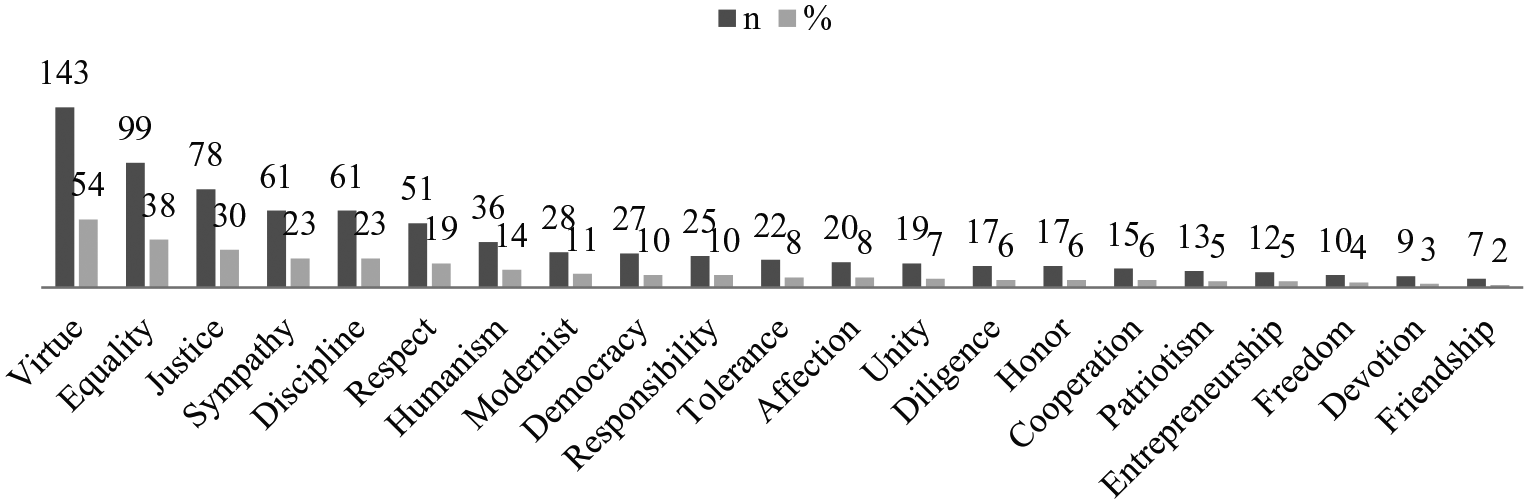
Values that school principals ought to have according to preservice teachers.
As shown in Figure 4, the most important values for school principals are in accordance with the Kumaris’s universal values except for happiness, humility, and simplicity. In addition, the results are in line with the structure of the cultural dimensions of Schwartz (2006), as shown in Figure 5.

The cultural dimensions of values that school principals should have according to Schwartz’s Prototypical structure.
As Table 2 and Figures 4 and 5 demonstrate, the most important values expressed by the participants are mostly associated with the egalitarianism orientation.
The Main Five Values That Students Should Acquire at Schools According to Preservice Teachers
According to the results, the participants indicated that students should acquire 20 values at schools. These values are listed as virtue, respectfulness, affection, conformity, sympathy, patriotism, humanism, equality, justice, tolerance, responsibility, democracy, modernism, devotion, diligence, freedom, discipline, entrepreneurship, friendship, and cooperation (Table 3).
List of Values That Participants Think Students Should Acquire, in Order of Importance. a

As the participants emphasized the same values with different expressions, and they listed five values, the total results of each value are different from the total number of participants.
As shown in Table 3, the most revealed five values by the participants are virtue, respect, affection and conformity, and sympathy. On the contrary, the least stated values are cooperation, friendship, entrepreneurship, discipline, freedom, and diligence (Figure 6).
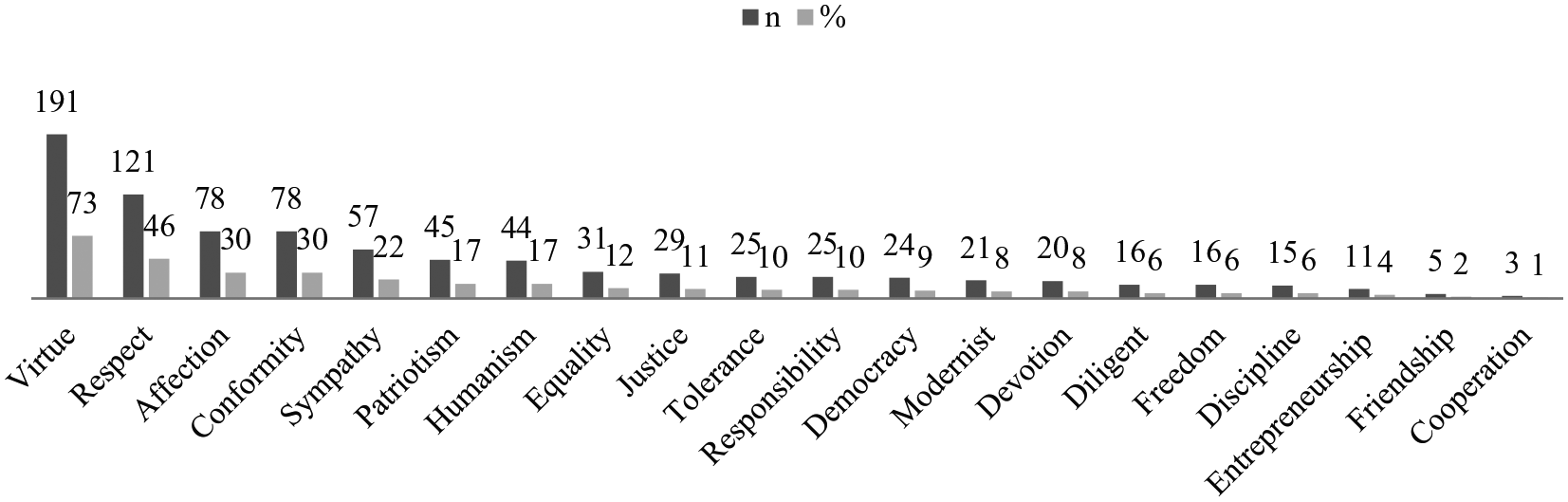
Values that students ought to acquire according to preservice teachers.
As shown in Figure 6, the values for students are in line with the Kumaris’s universal values except for humility, simplicity, and unity.
As shown in Table 3 and Figures 6 and 7, the most important values that students should acquire at schools is egalitarianism.

Cultural dimensions of values that educators should transfer to the students.
Discussion
This study aimed to investigate preservice teachers’ beliefs about essential education values. Thus, they, as future teachers, were asked to list their beliefs about the essential values that teachers and school principals have to and the students ought to acquire at school.
The Main Values for Teachers According to Preservice Teachers
The results revealed that according to the participants, teachers should have 17 basic values. According to Schwartz’s typology, these values are associated with egalitarian orientation. According to Schwartz (2006), egalitarian individuals see others as morally equal and cooperate voluntarily in building productive relations. In addition, teachers who have egalitarian values show more concern and importance toward students’ welfare; even more, they are committed to cooperating with their colleagues.
Having high egalitarianism-oriented values seems like these teachers and their future students will construct a community where equality, social justice, democracy, cooperation, responsibility, help, and honesty are the core values. Besides, the results showed that the participants themselves might also have high egalitarian-oriented values. This result means that they would teach in line with these values in the future. In light of these, as the preservice teachers are also future educators, it is supposed that the new generation also will be affected by the value of egalitarianism. Therefore, the new generation would be committed to cooperate, concern for the welfare of others, and act voluntarily for the sake of society. As a result, productive relations will be established in society, which will result in a flourishing and peaceful future for the people and the community itself. In this context, preservice teachers’ belief that teachers should have these values is promising for a peaceful world in the future.
In addition to egalitarianism, the participants stated openness to change and freedom which are included in Schwartz’s Intellectual Autonomy orientation. According to Schwartz (2006, 2007), teachers who have the orientation of egalitarian and intellectual autonomy can make independent decisions and take responsibility of their actions at schools. In addition, autonomy and egalitarianism promote and legitimize the granting of civil rights and political influence upon individual citizens. Therefore, cultural egalitarianism and autonomy relate positively to the level of democracy in countries. In this context, preservice teachers’ belief that teachers should have these values is promising for a democratic society in the future.
Naturally, no hierarchy-oriented value has been expressed by the participants in the questionnaire. On the contrary, the participants stated that teachers should have unity, patriotism, and discipline which are involved in the embeddedness dimension. There are 15 values included in the embeddedness orientation of Schwartz’s typology. Therefore, according to the results, the participants believe that teachers should have a low embeddedness orientation. Besides, this result means that the participants themselves might also have low embeddedness-oriented values. Schwartz (2006, 2009) argues that the embeddedness orientation is higher within the Islamic-oriented countries. However, the results show the opposite, although the participants were all Muslim.
Moreover, the core values stated by the participants for teachers are also compatible with the 12 universal values of Kumaris. This result means that they would also teach in line with these values in the future. Teachers do carry not only teaching but also value ingraining—in other words educating—responsibility in society. Passing consciously or unconsciously their individual and cultural values to their students, teachers are the main actors of the transferring predetermined values to the next generation in society. Hence, teachers have an essential role in transferring value to students in schools. In this context, the values of teachers are vital because it is going to be reflected on their students. Therefore, teachers ought to essentially have predetermined values, yet these values should be universal as to accomplish laying the foundations for a peaceful future. In light of these, preservice teachers would support UNESCO’s attempt to spread 12 universal values in the country in the future. Furthermore, the 17 values were categorized as moral values, professional values, and cultural values, as shown in Figure 8.

Cultural, professional and moral values that teachers should have.
As shown in Figure 8, the essential cultural values for teachers are democracy, freedom, patriotism, and unity. In addition, the essential professional values teachers should have are discipline, friendship, diligence, responsibility, devotion, and openness to change. Eventually, the essential moral values teachers should have are virtue, sympathy, equality, affection, respect, humanism, and tolerance.
The Main Values of School Principals According to Preservice Teachers
The results showed that, according to the participants, school principals should have 21 basic values. Similar to the results above, the participants revealed egalitarianism-oriented values for school principals too. The results indicated a low level of hierarch orientation for school principals. According to the results, the participants seemed to believe in similar values for both teachers and school principals; thus, the same comments can be concluded here for school principals as well. Moreover, the results are consistent with Kumaris’s 12 universal values. Hence, similarly, the same comments of teachers can be concluded here for school principals as well.
Furthermore, values that school principals should have were categorized as cultural, professional, and moral, as shown in Figure 9.

Cultural, professional and moral values that school principals should have.
As shown in Figure 9, the essential cultural values that school principals, like teachers, should have are democracy, freedom, patriotism, and unity. These results are similar to the results for teachers; thus, the same comments can be concluded for school principals as well.
In addition, essential professional values that school principals should have are discipline, cooperation, friendship, devotion, diligence, responsibility, openness to change, and entrepreneurship. School principals deal with teachers more than students while they administer schools. They might be supposed to have more administrative values than teachers, as they were considered as decision-makers in schools. Hence, the participants might have thought that principals should have more administrative values than teachers, as they are seen more as decision-makers in schools. Besides, the participants might have thought about such a relationship between them and school principals while answering because they will become teachers in the future.
Finally, Figure 9 demonstrates that essential moral values school principals should have are virtue, honor, justice, sympathy, equality, affection, respect, humanism, and tolerance. This result means that the participants believe that school principals need to have more moral values than teachers. Honor and justice are the two moral values that the participants stated that school principals need to have but did not express for teachers. They might have thought that principals need to manage teachers, students, and schools according to the principles of justice and equality.
The Main Values That Students Ought to Acquire at Schools According to Preservice Teachers
According to the participants, students ought to acquire 20 core values in schools. Interestingly, the results showed that the participants believe that students ought to acquire the essential values that school principals should have in schools, except for honor. Similarly, the results show that the participants expect students, in other words, the new generation, to acquire high-level egalitarian-oriented and low-level hierarchy-oriented values in schools. Besides, the core values stated by the participants for students are also compatible with the values of Kumaris. Finally, the 20 values were categorized as cultural, professional, and moral values, as shown in Figure 10.
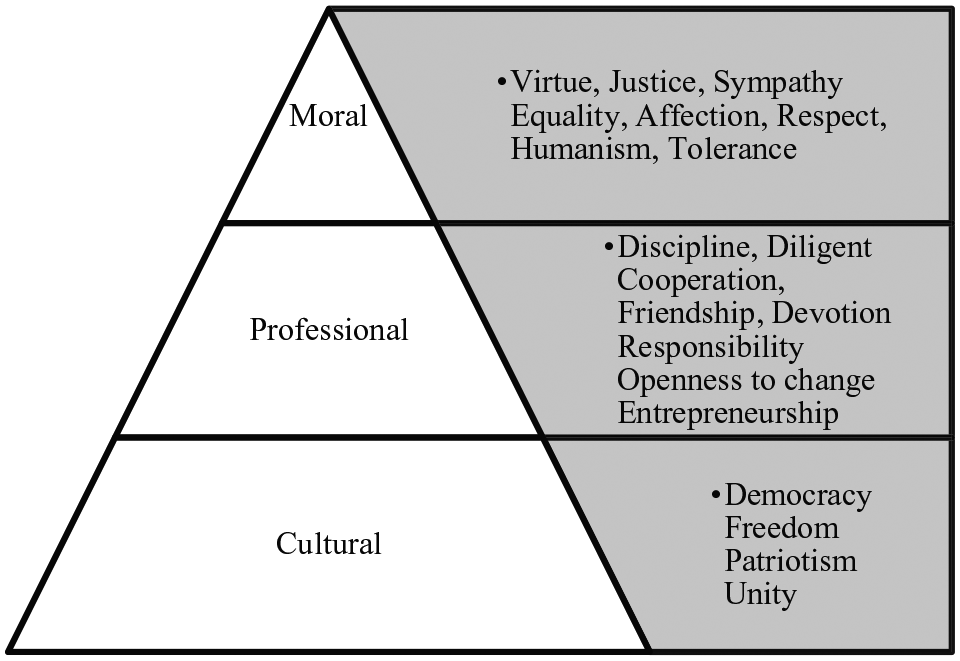
Cultural, professional and moral values which students should be transferred at schools.
As illustrated in Figure 10, according to the participants, students ought to acquire four cultural, eight professional, and nine moral essential values in schools. According to the results, the participants seem to believe that students, teachers, and school principals should have the same cultural values.
Figure 10 demonstrates that, according to the participants, students ought to acquire core professional values similar to those of principals. Similarly, they ought to acquire core professional values parallel to those of teachers except for cooperation and entrepreneurship. Besides, they ought to acquire core moral values similar to those of teachers except for justice. Finally, they ought to acquire core moral values parallel to those of school principals except for honor. This consistency in results is natural in a sense. Students spend most of their time with their teachers in school and learn how to be just, democratic, and non-discriminating, alongside the academic skills, through observing their teachers. Therefore, students are affected by the values that their teachers consciously or unconsciously reflect, while creating or developing their own values. Hence, in a sense, teachers have—more or less—positive or negative impacts on their students. Therefore, educated people are considered to be affected by at least one teacher—positively or negatively—throughout their lives. In light of these arguments, the responsibility of teachers in creating and developing value in society is more crucial than anyone else.
In addition to teachers, as mentioned before, principals also affect students’ values while administering educational activities and managing the school. In this context, teachers and principals are, in a sense, the architecture of the future community. Consequently, it is natural to expect the values expected to be passed on to generations to be consistent with educators.
Conclusion
This study tried to demonstrate the essential values of education from the point of preservice teachers. Therefore, the reflection of the results is bidirectional. First of all, the findings appear as a reflection of the existing values in the society. Second, this study also reveals the values under which teachers will practice their profession in the future.
People do use values to characterize individuals, societies, and cultures. Hence, schools are the most efficient institutions to teach human values to the next generations in the community. Among the functions of education are to ensure that students have universal values such as being democratic, egalitarian, and collaborative. Students spend most of their lives in schools that allow schools to transfer predetermined values to the next generation.
Teachers have both teaching and educating tasks at schools. They bring their professional and personal values to the school while performing these tasks; therefore, they affect students’ value development. Hence, they need to be aware of the responsibility of transferring such values to future generations. Preservice teacher education has a critical role in the value development of preservice teachers. As mentioned before, preservice teachers change or improve their values during their preservice training. Hence, teacher education programs affect the next generation indirectly. In this sense, it is suggested that preservice teacher education programs should be reviewed and developed to train teachers with universal values. Besides, teachers need to be aware of their values and the possibility of these values affecting students. They ought to educate their students with this sense of responsibility. Therefore, the results are supposed to be useful for policymakers and authorities in taking measures about teacher education in their countries.
Moreover, teachers and principals are expected to have mutual or compatible values to realize educational goals. Teachers’ and school principals’ values that do not contradict one another will reflect implicitly or explicitly upon the students at schools. Therefore, cooperation between school administrators and teachers is also as important as cooperation between teachers, parents, and students for effective education. Thus, the consistency of the values of educators becomes critical in value transfer in schools as well. In light of these, policymakers and other relevant stakeholders can use these findings to diagnose and reform value education processes in schools. Besides, these findings can be used in the licensing and selection of teachers and school principals. Furthermore, determining which values are essential to the students by the preservice teachers would help academics, policymakers, and other relevant stakeholders to predict the characteristics of the next generation and society in the future.
One of the limitations of examining values is that values shall not be generalized because they vary between a person and another, culture and another, society and another, even a country and another, thus scrutinizing values will be different according to the aforegoing mentioned aspects. As this study has been conducted in Turkey, the results herein revealed certain values of a specific society, thus the results of this study cannot be generalized. Similar researches can be done in other countries to further perceiving its future generations. The underlying reasons for the values teachers and principals can be reached by further studies. Similarly, further researches can investigate gender or field differences regarding these values. At this point, the results of this research may also guide them in interpreting their findings accordingly. In light of these, the results of this research would enlighten and even guide the researchers conducting further studies.
Supplemental Material
sj-pdf-1-sgo-10.1177_21582440211014485 – Supplemental material for Core Values in Education From the Perspective of Future Educators
Supplemental material, sj-pdf-1-sgo-10.1177_21582440211014485 for Core Values in Education From the Perspective of Future Educators by Asiye Toker Gökçe in SAGE Open
Footnotes
Declaration of Conflicting Interests
The author(s) declared no potential conflicts of interest with respect to the research, authorship, and/or publication of this article.
Funding
The author(s) received no financial support for the research and/or authorship of this article.

Supplemental Material
Supplemental material for this article is available online.
References
Supplementary Material
Please find the following supplemental material available below.
For Open Access articles published under a Creative Commons License, all supplemental material carries the same license as the article it is associated with.
For non-Open Access articles published, all supplemental material carries a non-exclusive license, and permission requests for re-use of supplemental material or any part of supplemental material shall be sent directly to the copyright owner as specified in the copyright notice associated with the article.
