




Abstract
Learning how to effectively respond to ethical dilemma can affect nurses’ physical and mental health, which is not conducive to developing a nursing career. Nursing students’ ethical behavior warrants attention as professionals about to begin clinical work. We aim to understand the current situation and influencing factors of Chinese nursing students’ ethical behavior. A cross-sectional descriptive study was conducted. Descriptive statistics and multiple linear regression were used to analyze the data. Full-time nursing students were recruited from an undergraduate medical university in Jinan through convenient sampling from November to December 2021. Research ethics approval (No. 2022-0018) was obtained from the Ethics Committee of Affiliated Hospital of Shandong University of Traditional Chinese Medicine. Informed consent was also received from participants. The EBT scores of the nursing students were 95.14 ± 11.37, which was not high compared with the total score. Gender, year level, and professional values had a significant impact on participants’ ethical behavior. A positive correlation was found between nursing professional values and ethical behavior. A gap still exists between the moral development and maturity of undergraduate nursing students. To further cultivate their ethical behavior and improve their confidence and ability to respond to ethical dilemmas, more innovative methods must be employed in teaching ethics courses, and continuity in the ethics education system must be maintained. For male and third- and fourth-year nursing students who showed lower ethical behavior scores, nursing educators can develop their ethical behaviors by helping them establish positive professional values.
Plain Language Summary
Ethical behavior refers to the actions taken by individuals when they encounter ethical dilemmas, which can either benefit or harm others and society. The occurrence of clinical ethical dilemmas is unavoidable, which often causes pressure to nurses and threatens the physical and mental health of nurses. Nursing students are valuable assets to the nursing profession, and their demonstration of positive ethical behavior can significantly boost their confidence and competence in resolving ethical dilemmas, which is conducive to the development of nursing work and career. This study aimed to investigate the current situation and influencing factors of nursing students’ ethical behavior in China. A total of 921 nursing students from a medical college in Shandong Province were surveyed using the Chinese version of the Ethical Behavior Test (EBT) and Revised Nursing Professional Values Scale (NPVS-R). The results of this study showed that ethical behavior of Chinese nursing students was relatively immature. Female nursing students, first- and second-year nursing students and nursing students who agree with the nursing professional view have more mature ethical behavior and they can deal with ethical dilemmas more effectively. We should focus on those students who have difficulties in adopting positive ethical behavior to solve ethical dilemmas and find powerful measures to improve the current situation of ethical behavior. This study is limited by a single sample source and limited exploration variables. Future research should expand the sample sources at more universities, explore other influencing factors, and take intervention measures to improve the moral behavior of nursing students.
Introduction
Nursing students’ professional values are embodied in their nursing practice and can guide their decision-making and behavior. Kaya and Boz (2019) reported that nurses could develop ethical reasoning and behaviors based on positive professional values. Q. Chen et al. (2021). found that positive professional values could promote their implementation of ethical decision-making. Undergraduate nursing students with positive professional values had a strong sense of active thinking and learning, exhibited proactive ethical behavior when faced with ethical dilemmas, and were more willing to spend time and energy to overcome various obstacles in implementing ethical actions (Aydın et al., 2022; İlaslan et al., 2021).
Ethical behavior is in line with social-ethical norms under the control of ethical cognition. It is the external expression of individual ethical literacy (Treviño et al., 2014). Nurses’ behaviors in ethical dilemmas often make them feel pressured, affect their physical and mental health, and increase their risk for potential diseases (Ando & Kawano, 2018). Insufficient knowledge of nurses on how to behave ethically may lead to feelings of guilt, helplessness, and self-doubt, resulting in headaches, endocrine disorders, and depression (Lamiani et al., 2017; McCarthy & Gastmans, 2015; Wiegand & Funk, 2012).
Nursing students are the reserve talents in the nursing profession. Because their ethical behavior is divorced from clinical practice, it is less affected by the complex working environment. Demographic factors influence nursing students’ perceived pressures and challenges in ethical practice. N. Jamshidi et al. (2016) showed that female nursing students experience more ethical challenges than male nursing students. A survey in the United States showed that nursing students with lower education levels felt more pressure in ethical practice (Powell et al., 2018). In a study on undergraduate nursing students, the level of ethical dilemmas among senior nursing students was significantly lower than that of junior nursing students (Bordignon et al., 2019).
A literature review showed that ethics education plays a crucial role in fostering ethical behaviors among nurses and nursing students, enabling them to effectively recognize and address ethical issues (Andersson et al., 2022). However, not all ethical education methods played a positive role in cultivating ethical behavior. Ethical education that involved higher participation and more interaction and promoted discussion and reflection among nursing students had a better effect on cultivating ethical behavior and is more popular with nursing students. Mulhearn et al. (2017) showed that the implementation of case-based teaching in ethics courses can enhance the ethical behaviors development of nursing students. This approach was more effective than traditional teaching methods. H. Jamshidi et al. (2021) pointed out that compared with traditional teaching methods, problem-based ethics learning was more effective in cultivating ethical behavior and moral development. Based on previous studies, to improve the ethical behavior of nursing students in China, it is necessary to identify the related influencing factors. Therefore, this study investigated the status ethical behavior of nursing students in China and its related influencing factors, which can provide directions for further improvement strategies.
Background
In recent years, nursing ethics has gradually attracted the attention of nursing educators as a required course in nursing professional norms, ethics, and codes of conduct. In China, it has also developed rapidly in recent years, although it is still in its initial stage of development (Luo et al., 2019). Sherer et al. (2017) found that medical ethics education in China primarily relied on theoretical lectures and written exams as the primary assessment method. Nevertheless, the curriculum design lacked the integration of clinical practice, which resulted in decreased student involvement in the learning process. A qualitative research interview found that most nursing students believe that ethical dilemmas in actual nursing practice are difficult to deal with because they are far from those taught in ethical theory (C. X. Zhang et al., 2018).
Nursing students’ ethical behavior can trouble them with negative emotions and affect their clinical study and professional development (Bickhoff et al., 2017; Monrouxe et al., 2015). In addition, nurses’ confusion about ethical behavior reduces professional satisfaction and enhances their turnover intention (Austin et al., 2017). Therefore, nursing educators must cultivate nursing students’ ethical behavior and investigate its influencing factors to enhance their confidence and ability to solve ethical dilemmas and enable them to quickly adapt to clinical work. However, most studies regarding ethical behavior focus on nurses and there is a paucity of studies involving nursing students. Thus, this study attempts to investigate the status and influencing factors of nursing students’ ethical behavior in order to support nursing students to implement ethical behavior to provide help in the future.
Research Aims
This study aimed to understand the current situation and related influencing factors of the ethical behavior of undergraduate nursing students. It explored relevant educational strategies to improve nursing students’ ethl behavior and provided a basis for nursing educators to formulate targeted intervention measures.
Methods
Participants
This study follows a cross-sectional design. Participants were recruited from an undergraduate medical school in China through convenient sampling from November to December 2021. Participants were screened strictly according to the study stage’s inclusion and exclusion criteria. The inclusion criteria were the following: (1) must be a full-time undergraduate nursing student (in school or in clinical practice), (2) must have provided informed consent to participate in the study. Undergraduate nursing students who were absent from school for various reasons during the survey period were excluded.
Data Collection
For first- to third-year undergraduate nursing students, questionnaires were directly distributed and collected in the classroom. For fourth-year students in clinical internships, the link to the online questionnaire was sent to them through a WeChat group. The questionnaire takes about 30 min to complete. Participants were informed of the study objectives, significance, and precautions by trained researchers. The researchers were not serving as teachers for nursing students to avoid bias in their selection. Participants were also told that there were no correct or incorrect answers to the questionnaire and that their choices would not affect their course grades. Informed consent was given to participants and consent was obtained before them completed the questionnaire independently, and their choices were kept confidential.
Ethical Consideration
This study was approved by the Ethics Committee of Affiliated Hospital of Shandong University of Traditional Chinese Medicine (No. 2022-0018). In the study, the researchers obtained informed consent from the participants. The participants volunteered to participate in this study and could withdraw from the survey at any time. The study was an anonymous online survey, and the participants were promised that all information about themselves will be managed confidentially and used only for this study.
Measurements
The general demographic questionnaire is a self-designed questionnaire, which includes information such as gender, year level, internship experience, how to enter the nursing major, professional preference, and the participant’s enrollment in a nursing ethics course.
The Ethical Behavior Test (EBT) was compiled by Professor De Casterlé et al. (1997) of the University of Leuven in Belgium in 1997. It is a tool used to assess the current situation of the ethical behavior of nursing students. It is an expedient questionnaire containing five ethical dilemmas with 105 items. For each dilemma, participants must choose between two decision options (A or B). Each decision option contains 21 items, which can be divided into three dimensions: ethical reasoning (5 items), ethical practice (5 items), and ethical self-efficacy (11 items). The five items on ethical reasoning represent different stages of Kohlberg’s theory of moral development (five stages of moral development from immature to mature). Participants need to rank the five items according to their importance and assign 6, 5, 3, 1, and 0 points from the most important to the least important. The sum of the scores of the two items representing the more mature stage of moral development is the score of ethical reasoning, which ranges from 5 to 55 points with higher scores indicating the participants’ more mature moral development stages.
Ethical practice describes five kinds of situational pressures that may be encountered in its implementation. Participants need to evaluate the possibility of taking action under these situational pressures, divided into four categories: very much less, quite a bit less, somewhat less, and not less. The grades are assigned 0, 1, 3, and 4 points. The higher the score on ethical practice, the more proactive the participants are in the ethical dilemma.
Ethical self-efficacy evaluates the participants’ self-efficacy in the face of ethical dilemmas. They were given 1 to 6 points, respectively, from completely disagree to completely agree. The higher the score, the higher the participants’ self-efficacy in ethical dilemmas.
The total score of the EBT ranges from 6 to 141 points. The higher the total score, the more mature the participant is in terms of nursing ethical behavior, and the better his/her ability to deal with ethical dilemmas effectively.
We developed the Chinese version of the EBT, which was authorized by Professor Bernadette, by translation, back-translation, author review, cross-cultural adaptation, and pre-investigation. The Cronbach’s α of the EBT was 0.931. The test-retest reliability was 0.962. The content validity index was 0.93 (J. W. Zhang, 2022).
The original Nursing Professional Values Scale (NPVS) was based on the interpretation of the code of ethics for nurses by the American Nursing Association (https://www.nursingworld.org/ana/) in 1985. It included 11 items, 1 to 6 items were about nurses’ responsibility toward patients, and 7 to 11 items were about their commitment to the nursing profession and public health. Weis and Schank (2006) revised the original version of the NPVS to develop the NPVS-R. Chinese scholar T. Y. Chen (2007) translated and culturally adapted the NPVS-R to develop its Chinese version and applied it to nurses. There are 26 items in the NPVS-R, which are grouped into four dimensions: care provision (10 items), activism (eight items), responsibility, freedom, and safety (five items), and trust (three items). The NPVS-R use a 5-point Likert scale with scores ranging from 1 (“not important”) to 5 (“most important”). All 26 items are scored positively. The total score ranges from 26 to 130 points. The higher the total score, the more the respondent agrees with the nursing professional view. The Cronbach’s α of the Chinese version of the NPVS-R was between 0.663 and 0.796. The Cronbach’s α of the Chinese version of the NPVS-R in this study was 0.844. The data obtained in this study were kept strictly confidential.
Data Analysis
Data were processed using the SPSS 21.0 and SAS 9.4 software programs. And the influence of demographic data on the moral behavior of nursing students was collected using the T-test and Analysis of Variance (ANOVA). Before that, the statistical tests were conducted, and the Shapiro-Wilk test was used to confirm the normal distribution, which was confirmed by the results (p > .05). Multiple stepwise linear regression analysis was carried out with participants’ demographic variables, and the total professional values score was taken as the independent variable. The total ethical behavior score was taken as the dependent variable to identify the factors influencing the ethical behavior of undergraduate nursing students. Statistical significance was set at p < .05.
Results
Participants’ Characteristics
A total of 1,029 nursing students filled out the questionnaires in this study. After excluding 108 invalid or incomplete questionnaires, 921 completed questionnaires were obtained, with an efficiency rate of 89.5%.
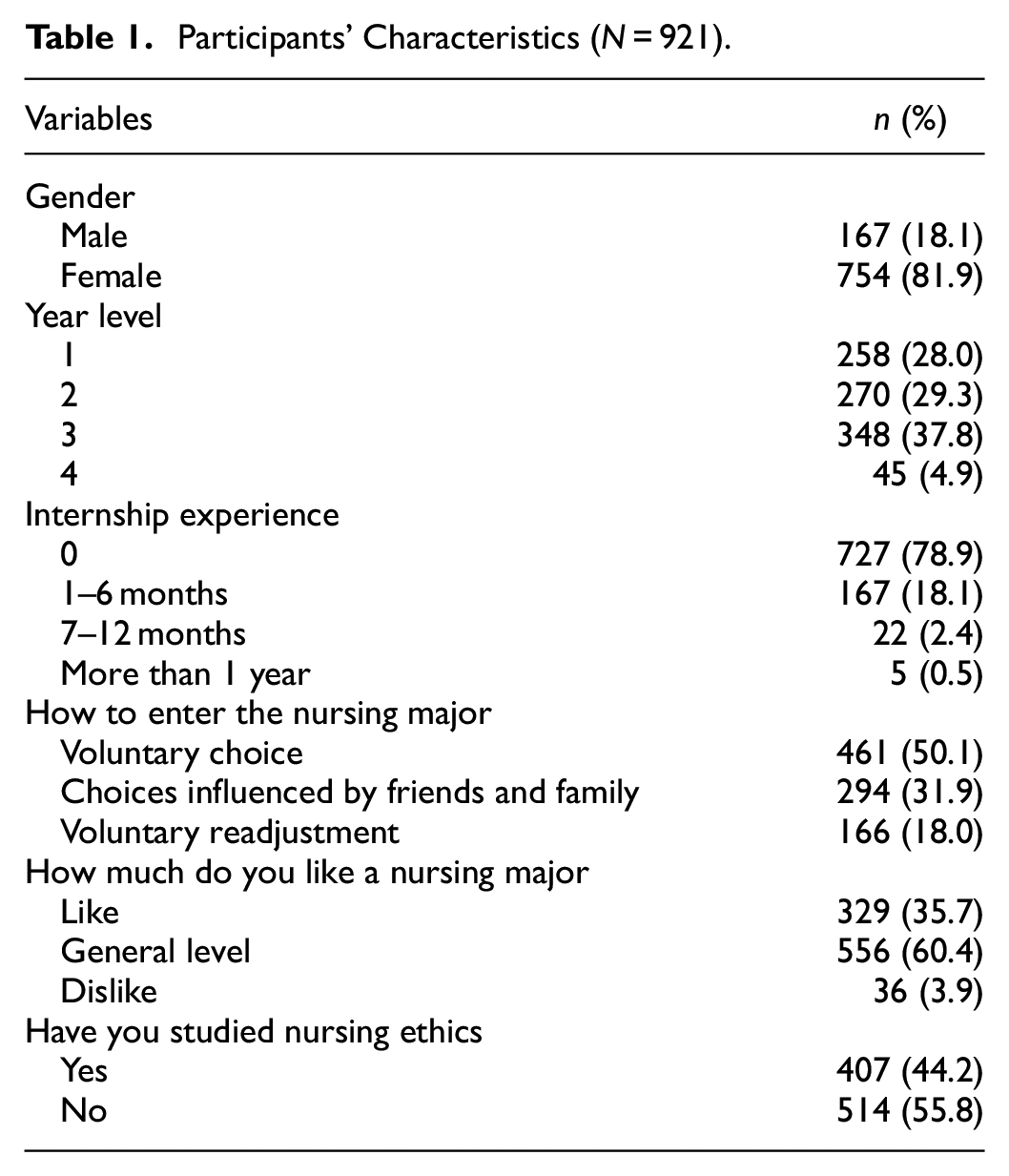
Table 1 summarizes the detailed demographic data of the participants. There were 167 male nursing students and 754 female nursing students in this study. Third-year nursing students made up 37.8% of the sample, followed by the second- and first-year students at 29.3% and 28.0%, respectively, then fourth-year students at 4.9%. Due to fourth-year nursing students were in the clinical practice stage, data was collected through an online questionnaire rather than in a classroom setting. This may explain the lower recovery rate of fourth-year nursing students data, as compared to data collected in a classroom setting. Most nursing students (78.9%) had no internship experience or school position (65.9%). Half (50.1%) of the sample voluntarily chose nursing majors when they were enrolled. More than one-third of the nursing students (35.7%) liked nursing. Less than half (44.2%) of nursing students had studied nursing ethics.
Participants’ Characteristics (N = 921).
Ethical Behaviour of Nursing Students
Nursing students’ scored 95.14 ± 11.37 in the EBT. The average scores for each sub-dimension of EBT are shown in Table 2. The influence of demographic data on the ethical behavior of nursing students is shown in Table 3. There were statistically significant differences in the ethical behavior of nursing students across both genders, and different year level, degrees of professional preference, and whether they had taken a nursing ethics course (p < .05) (Table 3).
Mean Scores of Ethical Behavior Test and Each Dimension.

The Influence of Demographic Data on the Ethical Behavior of Nursing Students.

Independent sample t-test. ** One-Sample ANOVA.
Professional Values of Nursing Students
The item mean score of the NPVS-R was 3.65 ± 0.86. The item mean scores of each sub-dimension of NPVS-R are shown in Table 4. Among them, the trust dimension showed the highest average score (3.71 ± 0.91), followed by the caring dimension (3.68 ± 0.87), then the responsibility, freedom, and security dimension (3.65 ± 0.87). The mean score of the activism dimension item was the lowest (3.60 ± 0.85).
Mean Scores of Nursing Professional Values Scale and Each Dimension.

The variable correlation matrix between nursing students’ professional values and ethical behavior is shown in Table 5. There was a significant moderate and positive correlation between nursing students’ professional values and ethical behavior (r = .422, p < .01), indicating that the higher nursing students scored on professional values, the higher their ethical behavior score. The caring dimension (r = .423, p < .01), activism dimension (r = .403, p < .01), responsibility, freedom, and security dimension (r = .416, p < .01) and trust dimension (r = .425, p < .01) were significantly positively correlated with nursing students’ ethical behavior.
Correlation Between Nursing Professional Values and Ethical Behavior.

Note. r = correlation coefficients; p = level of significance.
p < .01 level.
Factors Influencing Ethical Behaviour of Nursing Students
The results showed that the ethical behavior of nursing students was influenced by gender, year level, and nursing professional values (Table 6). These variables explained 19.60% of nursing students’ ethical behavior differences. Compared with male nursing students, female nursing students showed more maturity in terms of ethical behavior (β = .118, p < .001). Compared with senior nursing students, junior nursing students scored higher on the EBT and could better deal with ethical dilemmas and issues better (β = −.073, p < .05). The higher the professional values score of nursing students, the more mature their ethical behavior was, and the stronger their ability to effectively deal with ethical dilemmas (β = .408, p < .001).
Multiple Linear Stepwise Regression Analysis Predicting Nursing Students’ Ethical Behavior.

Discussion
The EBT scores of the nursing students in this study were 95.14 ± 11.37, which was not high compared with the total EBT score. This result is consistent with M. Zhang et al. (2010)’s study, which indicated that the ethical behavior of nursing students is relatively immature. Nursing students need to be further guided on ethical behavior and their ability to effectively solve ethical dilemmas needs to be enhanced.
The scores for ethical reasoning (35.11 ± 6.08) and ethical practice (13.21 ± 3.56) were relatively low compared with those in the study by De Casterlé et al. (2008), which may be related to the methods of ethical education. Ethical reasoning refers to the cognitive process in which individuals make ethically reasonable choices in ethical dilemmas. At present, foreign nursing ethics education introduces ethical dilemmas into the classroom, which nursing students are encouraged to analyze. It also promotes the improvement of nursing students’ ethical reasoning ability (Honkavuo, 2021; Khatiban et al., 2019). Nursing ethics education in China primarily focuses on textbook-based theoretical knowledge. It does not pay enough attention to the ethical reasoning ability of undergraduate nursing students in ethical dilemmas (Sherer et al., 2017).
Comparing the ethical practice scores of the five ethical dilemmas with the ethical reasoning scores, it was found that the dilemmas with higher ethical reasoning scores for nursing students had lower ethical practice scores. This suggests that there is still a gap between the ethical action and ethical reasoning of undergraduate nursing students. That is, when nursing students reason about ethical issues based on a more mature stage of moral development in the ethical dilemma, they do not act entirely based on ethical reasoning in nursing practice. This result is consistent with the findings of Da et al. (2015). It is speculated that this may be related to the lack of implementation of ethical actions among undergraduate nursing students. The ethical education of Chinese nursing students mostly remains at the level of ethical cognition, and nursing students lack specific guidance and practice on how to implement ethical actions based on correct ethical cognition.
The ethical self-efficacy score of the participants was 46.82 ± 7.23 points. Compared with Iacobucci et al. (2013)’s study, the ethical self-efficacy scores of undergraduate nursing students in China are relatively low, indicating that their confidence and belief in their ability to deal with ethical dilemmas need to be improved. This result may be related to the lack of a positive ethical atmosphere among undergraduate nursing students. Nursing educators must create a positive ethical atmosphere to enhance students’ self-confidence in their ethical reasoning and practice, and improve their overall ethical self-efficacy level.
The professional values score of the participants was 94.92 ± 22.28, which was relatively low compared with that in Lin et al. (2016)’s study, whose sample included senior nursing students. After 1 to 2 years of professional learning, senior nursing students understood the nursing profession, which played a positive role in establishing positive professional values. This study showed a positive correlation between the professional values and ethical behaviors of nursing students, indicating that the more positive the professional values of the students, the more effectively they could deal with ethical dilemmas. Professional values play a guiding role in behavior. Nursing students with high scores for nursing professional values had a positive understanding of the nursing profession. They were optimistic about ethical difficulties and obstacles encountered in dealing with ethical dilemmas. Under the guidance of positive professional values, they exhibited more proactive ethical behaviors, and could resolve ethical dilemmas more effectively.
The multiple linear regression analysis showed that gender, year level, and professional values had significant effects on the ethical behavior of nursing students (p < .05). The ethical behavior score of female nursing students (95.77 ± 11.36) was significantly higher than that of male nursing students (92.34 ± 11.01). The study of Borhani et al. (2021a) showed that female nursing students were more sensitive to ethical dilemmas and more aware of ethical dilemmas. This ethical sensitivity developed their ethical reasoning ability, leading to a moral development stage that was more mature than that of males.
In this study, the EBT scores of first- and second-year nursing students were significantly higher than those in their third and fourth year, which may be related to school’s ethics curriculum. Most undergraduate nursing students learned nursing ethics primarily through school courses. In our study, the nursing ethics courses were mostly offered as electives. Most nursing students chose to take nursing ethics courses in their first or second year. Most first- or second-year undergraduate nursing students in our study were either still studying or will be finishing their nursing ethics course soon. They gained a relatively good knowledge of nursing ethics and learned how to develop and exercise nursing ethics skills in the classroom. Therefore, first- and second-year nursing students were more confident in implementing ethical reasoning and practice when faced with ethical difficulties. However, for third- and fourth-year students, the nursing ethics course is completed relatively early. According to Ebbinghaus’s forgetting curve theory, when students complete nursing ethics courses early, their knowledge reserve of nursing ethics is relatively poor. Third- and fourth-year nursing students had different degrees of forgetting their abilities and skills in dealing with ethical dilemmas. Their confidence level was relatively low when resolving ethical dilemmas, which was not conducive to ethical behavior. This phenomenon suggested that the short-term ethics course study did not have a lasting effect on the ethical behavior of undergraduate nursing students. In the future, nursing educators should continuously cultivate the ethical behavior of undergraduate nursing students through a variety of educational methods that can help them deal with ethical dilemmas more effectively.
The professional values of nursing students were also one of the factors that influenced the ethical behavior of nursing students. Under the guidance of appropriate professional values, nursing students had a strong awareness of active thinking and learning when faced with ethical dilemmas. They were more willing to devote time and energy to overcoming various obstacles related to the dilemma, and also showed more proactive ethical behavior.
Recommendations
This study investigated the ethical behavior of 921 undergraduate nursing students and explored the factors that influence their ethical behavior. The sample size is extensive and covers both genders and different year levels. The following recommendations can be drawn from the data analysis:
Nursing educators should pay more attention to the ethical behavior of male and senior nursing students in future ethics education. To promote the development of their morality and help them more effectively deal with ethical dilemmas, they should be encouraged to communicate and discuss such ethical dilemmas. Andersson et al. (2022) showed the group discussions were favored and recognized by nursing students in the ethical education. In group discussions, nursing students discuss ethical dilemmas, express their views clearly and exchange opinions. Students’ participation and interaction enable them to reflect on their own practice and encourages them to make changes in their practice.
Nursing educators should build bridge between ethical theory and clinical practice and reduce the disconnection between ethical theory and practice. Honkavuo (2021) found ethics simulation trained future nurses to better understand ethical dilemmas within clinical nursing. In the simulation exercises, the students encouraged each other to develop and grow professionally. Simulation supports the theoretical foundation provided by the nursing education and prepares nursing students for mastering clinical, practical, and challenging situations. In addition, innovative ethical education methods also play an important role in promoting ethical behavior. Khatiban et al. (2019) and F. Zhang et al. (2019) claimed, compared with the lecture-based learning method, the use of the problem-based learning method in ethics education enhances moral development among nursing students. Kucukkelepce et al. (2021) showed nursing students who received ethics education with in-class case analysis (ICCA) and standardized patient (SP) practice increased their awareness of ethical problems and their multi-dimensional and critical thinking skills. Furthermore, through ICCA and SP, students increased moral sensitivity and the opportunity for observing and evaluating themselves. Such methods can be applied to better address students’ concerns when resolving ethical dilemmas and encourage their involvement in the ethical reasoning process. Teachers can guide nursing students to implement ethical practices. They can provide advice and a basis for innovating and diversifying the modes of ethical education suitable for Chinese nursing students.
Colleges and universities should pay more attention to the current situation of ethical behavior and maintain continuity in its cultivation among nursing students. They can partner with hospitals to create solutions to different ethical problems and address the educational needs of nursing students in various stages, such as school study, clinical internships, and clinical work, to form a systematic ethical education system. Nurses with advanced ethics education tend to be more confident in their ethical judgments and are more likely to utilize ethics resources and take ethical actions (Borhani et al., 2021b). Osingada et al. (2015) showed a structured Continuous Nurses’ Ethics Education program could improve ethics knowledge, skills, and competences among nurses. There is a need to increase in-service nursing ethics education in order to prepare the nurses to cope with current and future challenges to ensure quality nursing care delivery within the various resource-constrained settings.
Nursing educators should also prioritize developing the professional values of nursing students, which have a positive effect on cultivating ethical behavior. They can guide nursing students through career planning to help them gain a better understanding of the nursing profession (Antoniou et al., 2022). Moreover, they can stimulate students’ professional enthusiasm and enhance their professional identity to enable them to establish a positive professional attitude and clear career goals (Baghbani et al., 2022).
Conclusion
It is crucial to continuously evaluate and cultivate nursing students’ ethical behaviors as mature ethical behaviors can help them more effectively respond to ethical dilemmas. The ethical behaviors of nursing students differs depending on gender, year level, and professional values. Under the educational background of China, the ethical behaviors of male and senior nursing students, and those with negative nursing professional values need to be given more attention in future nursing education. Nursing educators should improve the ethics education system and develop students’ professional values to enable to resolve ethical dilemmas in clinical practice.
Limitations
This study has the following limitations. Firstly, this study only included nursing students in one medical university. Second, the study results may be biased due to the convenience sampling method. Finally, this study only analyzed three variables that may affect the ethical behavior of nursing students. Future studies should consider other variables. Therefore, in addition to the demographic data and professional values of this study, future research needs to analyze the influencing factors of ethical behavior of undergraduate nursing students.
Footnotes
Acknowledgements

Declaration of Conflicting Interests
The author(s) declared no potential conflicts of interest with respect to the research, authorship, and/or publication of this article.
Funding
The author(s) disclosed receipt of the following financial support for the research, authorship, and/or publication of this article: This research was supported by the Shandong Province Social Science Planning Research Preject[22CSZJ35]; the Shandong Humanities and Social Sciences Foundation [2022-XXDY-20]; and Key Program on Education and Teaching of Shandong University of Traditional Chinese Medicine [XJJG2021012].
Data Availability Statement
Data sharing not applicable to this article as no datasets were generated or analyzed during the current study.