




Abstract
Technical and vocational education and training (TVET) plays a pivotal role in equipping young individuals with technical skills and competencies, enhancing their employability. TVET is distinct for its student-centered and industry-oriented features, often involving enterprises in on-site training. In this study, we conceptualized TVET as a service through the lens of service-dominant (S-D) logic, offering a comprehensive exploration of its attributes and values. Our work rigorously validates the fundamental premises of S-D logic within the context of TVET, making the first systematic examination of TVET from a service science perspective. This innovative conceptualization allows us to view TVET as a dynamic process of value co-creation, with students and enterprises as active co-creators. They collaborate and contribute, fostering profound engagement among TVET practitioners, to mitigate TVET challenges through co-creation.
Plain Language Summary
This study aims to examine Technical and Vocational Education and Training (TVET) from a service perspective using service-dominant (S-D) logic. It takes a systematic approach to understand TVET as a value co-creation process involving students and enterprises. The study concludes that TVET can indeed be conceptualized as a service, with students and enterprises actively engaged in value co-creation. This novel perspective fosters collaboration among TVET practitioners, mitigating challenges in the field. The findings suggest that TVET can benefit from adopting a service-oriented approach, emphasizing collaboration between students, enterprises, and educational institutions. This approach has the potential to enhance the quality and relevance of TVET programs.
Keywords
Inspired by the buzzword, technology as a service, in information technology, education as a service (EaaS) has come to be accepted, and received scholarly attention in education communities. This concept emerged with the marketization, digitalization, and internationalization of education. Research (Ng & Forbes, 2009) has argued that the learning experience became a service when higher education in the UK was opened and marketized to international students. In EaaS, students behave like customers and express their expectations from the education (Woodall et al., 2014). In 2010, the IT giant, Intel, launched “The Education Cloud” project to provide educational services through cloud computing techniques (Fogel, 2010). Although whether students should be perceived as customers (Elsharnouby, 2015) is debatable, studies show that marketing policies played an important role in the success of education in the UK and the US (Stachowski, 2011). Marketization has become unavoidable in educational transformation and innovation (Provini, 2019).
Perceiving EaaS has given rise to a new field of research from the perspective of service science. Service science examines service theories and approaches to create service value. Studying education from the perspective of service science is a landmark in the new development phase of the marketization of education, in which students are considered not just as knowledge recipients but also as co-creators (Cai et al., 2018; Chalcraft et al., 2015; Duers, 2017). Based on the hypothesis that students are co-creators in education, one of the research motives in this direction involves designing and deploying high-quality educational services to students using theories and approaches that have proven successful in business marketing (Maglio et al., 2019; Maglio & Spohrer, 2008). Among these theories, service-dominant (S-D) logic (R. F. Lusch & Vargo, 2006; Vargo & Lusch, 2008) is an emerging and rapidly evolving theory characterized by the co-creation model of service values. It provides a theoretical foundation and practical guidance for maximizing educational values by encouraging students to engage in educational activities as learners as well as contributors (Elsharnouby, 2015; Ng & Forbes, 2009). Various education fields, such as higher education, older adult education (OAE), and nurse education, have been studied from this perspective (Cai et al., 2018; Duers, 2017; Fagerstrøm & Ghinea, 2013; Gummesson et al., 2012).
Similarly, studies on technical and vocational education and training (TVET) from the perspective of service science are emerging. For instance, pioneering research in this direction by Mewaldt (2014) proposed an integrative management model for marketizing and internationalizing TVET services. Ritzen et al. (2015) presented a hybrid vocational curriculum development approach by collaborating with the labor market, in which students acted as co-designers in developing curricula. Rahayu (2018) measured vocational education quality in terms of customer satisfaction by considering students as internal customers. These studies show the possibility and feasibility of studying TVET in service science, and reveal a novel and promising direction to achieve innovation and transformation in vocational education. This would be helpful to cope with contemporary challenges in TVET, such as students’ lack of motivation to learn, reluctance of enterprises and companies to participate in co-creation, and a lagged response from colleges to adapt to market demands (Lewis, 2000).
In this study, we argue that TVET is essentially a value co-creation system that satisfies the five fundamental premises which axiomatize the value co-creation theory in S-D logic (Vargo & Lusch, 2016). This novel perception breaks the traditional teaching-learning relationship between colleges and students in TVET and redefines more complex collaborative relations between colleges, students, and enterprises. These three parties collaborate with each other. Students are the pivots connecting colleges and enterprises. They embody and transmit the values of in-school teaching and in-company training by working skillfully and efficiently to produce and deliver high-quality services through close collaboration between colleges and enterprises. Consequently, the TVET values are maximized for all three parties. To this end, we conceptualized and generalized a theoretical model to formally capture the value co-creation theory in TVET through the lens of S-D logic in service science. The model consists of a structural definition of stakeholder relations and a procedural workflow of stakeholder behavior. The model perceives both students and enterprises as co-creators of educational value, in addition to TVET colleges, which are considered the main TVET contributors in the literature.
The implications of studying TVET as a value co-creation process are multifold. First, it depicts new collaborative relationships between colleges, students, and enterprises that would inspire advanced innovations and transformations in TVET by producing and delivering high-quality education services to students in an engineerable manner. Second, the existing challenges in TVET can be mitigated once the creativity and initiatives of students and enterprises are triggered through new relationships. Third, this perception enriches the study of value co-creation, which demonstrates the significance of the interdisciplinary study of education and service sciences.
Literature Review
Over the past decade, education has evolved drastically, particularly in three contexts: marketization, internationalization, and digitalization. Both educational contents and forms have been redefined, and just as how technology-as-a-service emerged, so did EaaS (Ng & Forbes, 2009; Pavlov & Hoy, 2019). Several subsequent studies have examined education through the lens of service science, giving rise to new theories and methodologies for transforming and innovating the forms and contents of education for personality, affordability, and rapid scalability, which are the main features of temporary commercial services.
Service science focuses on service systems, and features service value co-creation and maximization (Vargo et al., 2008). A service is “the act of helping others and the process of doing something for another person or entity that is beneficial” (R. Lusch & Wu, 2012). S-D logic examines the exchange of services provided and consumed by organizations, markets, and societies. It advocates value-in-use and value co-creation. Service values are created only when used, and are interactively co-created by providers and customers. All service stakeholders, their relationships, and their activities comprise a service system.
Studies have attempted to perceive universities and other institutions as service systems. For instance, Ng and Forbes (2009) proposed an EaaS framework to explore what it means for the market to be orientated toward universities, and to identify the relationship between marketing and good education. Spohrer et al. (2012) analyzed 10 reasons why service science matters for universities, and concluded that “universities and their home cities are complex and adaptive service systems, while service science is helpful to universities to overcome discipline silos and to contribute to good industry-university relations and interactions.” Similarly, Tay (2014) proposed a theoretical framework for modeling an EaaS system from the inner and outer dimensions to describe the interaction and competencies, and for creating win-win value propositions for stakeholders, including students, education practitioners, the government, and industry. Pavlov and Hoy (2019) proposed a conceptual framework called the Service Science Canvas to guide the practices of US universitization and university practices as service systems. Shafaqat et al. (2020) conducted a qualitative study on conceptualizing higher education institutions as a service system and revealed a mechanism for integrating resources to produce value for the mutual benefit of diverse stakeholders. Cai et al. (2018) proposed a new perception of interpreting universities as service systems in the special OAE sector.
In an educational context, students are knowledge recipients, a straightforward premise that enables the perception of them as customers under EaaS. Customers in service systems are the main stakeholders, as service receivers and value co-creators. Many theoretical and empirical studies have shown that students are customers and value co-creators in various education sectors (Maguad, 2007; Mark, 2013; Pitman, 2000). However, because education has more complex attributes than ordinary goods, whether students are perceived as customers remains debatable. Nevertheless, instead of simply denying that students are customers, a more rational and scientific approach would be to explore how to respond to the issue. Guilbault (2016) reframed the debate to clarify whether students are customers from the market and customer orientation perspectives; they believed that the current view of service and relationship marketing provides the best approach to this question by identifying the customer and co-producer roles of post-secondary students in learning. Similarly, Chalcraft et al. (2015) believed that the relationship between students and colleges should be redefined under the globalization and marketization of education, and that the concept of students as customers deserves further study to respond to the increasing expectations of students’ rights and offerings.
Efforts have been made to study other special education sectors from a service science perspective. For instance, Cai and Kosaka (2019) revealed that learners in OAE make equivalent contributions to developing curricula as lecturers do; based on this observation, they perceived learners as value co-creators in education (Cai et al., 2018). Beckman and Khare (2018) applied S-D logic to online business education and demonstrated a link between service systems and online business education. Such studies (e.g., Mewaldt, 2014; Rahayu, 2018; Ritzen et al., 2015) demonstrate the benefits of studying TVET as a service to develop and provide high-quality educational services. Nevertheless, existing studies are sporadic, and it is worth systematically investigating the theoretical and practical integration of these special education sectors and services.
TVET Models and Values
Unlike regular school education, TVET is highly flexible in terms of content and form. TVET models vary under government policies, culture, and economic levels, although their objectives are essentially the same: to develop professional competence for the exercise of specific occupations (Corson, 1985). In this section, we provide an overview of the four mainstream TVET models widely adopted by many countries: the dual system in German-speaking countries, the sandwich model in Denmark, the apprenticeship model in Australia, and the career and technical education (CTE) model in the US. Then, we discuss TVET values in terms of beneficiaries, such as individuals, enterprises, and societies, and analyze their inter-dependencies and consistency, which are the basis of co-creating and maximizing these values with the collaborative efforts of all stakeholders.
Four Typical TVET Models
The dual system originated in Germany and became well-known and widely adopted in German-speaking countries. It is essentially a training system that fully utilizes the advantages of both in-company training and on-campus teaching to assist young people transition smoothly from school to work (Furstenau et al., 2014). Under this system, students spend approximately three-quarters of their time in companies and one-quarter of their time in vocational colleges, playing dual roles as both students and employees. In schools, students are taught general as well as job-specific knowledge, whereas in companies, they are trained under the supervision of full-time employees. Companies and schools collaborate in strictly regulated procedures to develop training programs and curricula to improve students’ competence.
Denmark’s sandwich model is another typical model with alternating periods of school or college education and practical training in companies. One-third of students’ time is spent in colleges to acquire theoretical knowledge, and the remaining two-thirds on enterprises, where they receive practical training (Cuddy et al., 2005), from one or more firms as approved by the Danish Trade Committee. The key objective of the model is to provide wide-ranging education that covers both vocational skills and broad knowledge for students’ personal development.
Apprenticeships are another widely adopted TVET model. Australia is a representative country with a long history of a nationally adopted apprenticeship model, dating back to 1788. In contemporary Australia, apprenticeship refers to regulated and employment-based occupational training, which leads to a recognized qualification (Knight, 2012). The apprenticeship model features on-the-job training and full-time paid employment. Initially, training was provided entirely by employers. Since 1998, school-based apprenticeships allow students to start part-time apprenticeships while studying in secondary school (Smith & Wilson, 2004); students begin in-company training in the last 2 years of schooling to obtain vocational qualifications while studying.
The last TVET model is the CTE, a prevalent vocational education model in the US, ranging from secondary to adult education levels (Levesque et al., 2008). CTE is a result-driven system covering comprehensive programs of study in the National Career Clusters framework. Employers participate in designing and providing dynamic programs, including internships for students, externships for teachers, and apprenticeships (Gordon & Schultz, 2020). CTE programs encourage employers to improve work-based learning. Students pursue vocational careers after work-based learning.
These four representative models have been broadly adopted by other countries. Some variants of the models have also been developed with the necessary customization and localization by different countries to cater to relevant policies, laws, cultures, and economic situations (Grollmann, 2018). Complementary to academic education, they are essential in secondary education to provide young people and adults with opportunities to improve their competencies and employability.
TVET Values
TVET values have been well studied, and are also called benefits (Hoeckel, 2008; Russo et al., 2013) or returns (Fredland & Little, 1980; Lee & Coelli, 2010). Although there is no standard for evaluating the value of TVET systems owing to their variety across countries, some conclusive assessments are widely accepted by both academia and market, according to several comprehensive surveys (Hoeckel, 2008; Russo et al., 2013).
Value for Individuals
A distinguishing feature of TVET is that it teaches student-specific skills that have immediate value in increasing employability in the workplace (Carnegie, 2001; Lavrijsen & Nicaise, 2017). Employability refers to individual skills that are technical and specific to an occupation. This paves a smooth pathway to employment for teenagers who fail to continue their regular education, and reduces uncertainties and failures during the transition from school to work (Korpi et al., 2003).
In the long run, well-trained young students gain the capability of lifelong learning to receive further training and upgrade their skills, even after starting their careers (Hoeckel, 2008). This makes them flexible in increasing employment requirements owing to the progress of technology, globalization, and other factors. It also increases mobility for better payment and career development. Studies have demonstrated a strong association between health and vocational education. Indeed, Groot and Maassen van Den Brink (2007) found that those who received TVET were generally healthier than those who left schools early, and that the health effect was comparable to that of general education.
Value for Enterprises
Enterprises are also primary beneficiaries of TVET, considering the productive performance of trainees, reduced cost of recruiting skilled workers from the external labor market, and low labor turnover rates (Hoeckel, 2008; Russo et al., 2013). Crook et al. (2011) comprehensively analyzed the connection between human resources and enterprise performance using data from 66 US studies. The results showed that training is closely related to productivity performance, customer satisfaction, and product innovation. After examining the contexts in Austria, Denmark, Norway, and Sweden, the European Center for the Development of Vocational Training (Cedefop) also identified a positive link between TVET, productivity, and innovation (Lettmayr & Riihimaki, 2011).
From a long-term perspective, enterprises’ engagement in vocational education helps establish a stable supply of skilled employees from labor markets; they are sources of quality products and services, innovations, and competitiveness. Moreover, employees with pre-employment training experience are more committed to the company and have steeper company values. They usually stay with the company longer and become the backbone cadres as supervisors and managers, reducing labor turnover. Studies across diverse countries, including the US, Switzerland, and Japan, have demonstrated this link (Russo et al., 2013).
Value for Vocational Colleges
Owing to the educational nature of TVET, its value for vocational colleges is not for colleges themselves but for the society at large. Studies have shown that TVET has long-term impacts on social and economic transformation and development. Krueger and Kumar (2004) found that TVET helped technological innovation, which consequently contributed to economic growth. TVET programs are regarded as the most effective instruments for addressing globalization and digitalization demands in manufacturing and digital industries (Mouzakitis, 2010). Research by Cedefop showed the dual role of TVET in contributing to economic excellence and social inclusion (Russo et al., 2013). From a societal perspective, TVET reduces the unemployment rate, crime, and delinquency. Audu et al. (2013) considered TVET a veritable tool for educating young, unemployed people for reemployment and reducing poverty in Nigeria. Researchers in Russia found that TVET reduced the risk of youth unemployment (Blinova et al., 2015). Other studies similarly revealed that TVET participants had fewer new crime reconvictions (Bouffard et al., 2000; Jha & Polidano, 2016).
In the long run, TVET can provide other social benefits, such as integration, equity, and cohesion. Many European countries, including Finland, Germany, Norway, and the UK, have reported that TVET positively affected groups integration and reduced the risk of social exclusion (Russo et al., 2013) by providing an alternative for those who did not pursue advanced general education (Preston & Green, 2008).
The Value Triangle
The TVET value for individuals, enterprises, and colleges is neither isolated nor contradictory. Instead, they are closely related and interdependent, constituting a solid triangle, as shown in Figure 1.

The value triangle of TVET.
First, we describe the clockwise (inner dashed circle) direction of an individual node. Well-trained workers contribute to enterprises by producing high-quality products and services, thereby improving productivity and achieving technological innovation, from which enterprises can grow and profit. Growth and profits drive enterprises to create more employment opportunities and invest more money and effort in education. Suitable employment and support from enterprises help colleges increase their capacity and provide high-quality education using the latest technology and knowledge, thereby increasing student competency and employability. In this sense, TVET’s value for the three parties is clockwise-interdependent.
The interdependency of the value for individuals, enterprises, and colleges also exists in a counterclockwise direction (outer solid circle in Figure 1). During learning, student engagement can contribute to colleges by developing high-quality curricula, creating new knowledge, and improving the overall quality of education. Vocational colleges offer to enterprises, skilled and competent young workers, and stable yet dedicated channels for labor recruitment and hiring. Enterprises provide qualified employees with high wages, skill training, and promotion opportunities. Consequently, stable positions and incomes help individuals establish themselves, their families, and even societies.
The value triangle indicates that the TVET values of different beneficiaries are interdependent and consistent. Specifically, one beneficiary’s values depend on and contribute to the values of the others. Such dependency is the basis for individuals, colleges, and enterprises to collaborate and maximize these values. In the long term, societal value is created by increasing social wealth, reducing crime, and improving social integrity. A society with low crime rates and a large market can provide a sustainable environment for enterprises to set up factories, start new businesses, and promote technological innovation and evolution.
The Value Co-Creation Theory in S-D Logic
Value co-creation is the central theory in S-D logic. It advocates that multiple parties co-create service values by integrating resources and producing reciprocal services across multiple ecosystems that overlap and are governed by institutional arrangements (Vargo & Lusch, 2016). The procedure of value co-creation is well structured and defined, and comprises the following five iterative components (Figure 2).
1. Service exchange: the behavior of exchanging services among different parties.
2. Actors: the people who are involved in value co-creation.
3. Resource integration: the integration of both operant and operand resources to produce services.
4. Institutions and institutional arrangements: rules, norms, meanings, symbols, practices, and similar aids in collaboration and interdependent assemblages.
5. Service ecosystem: an assemblage of subsystems that are relatively self-contained and self-adaptive.

The narrative and process of S-D logic (Vargo & Lusch, 2016).
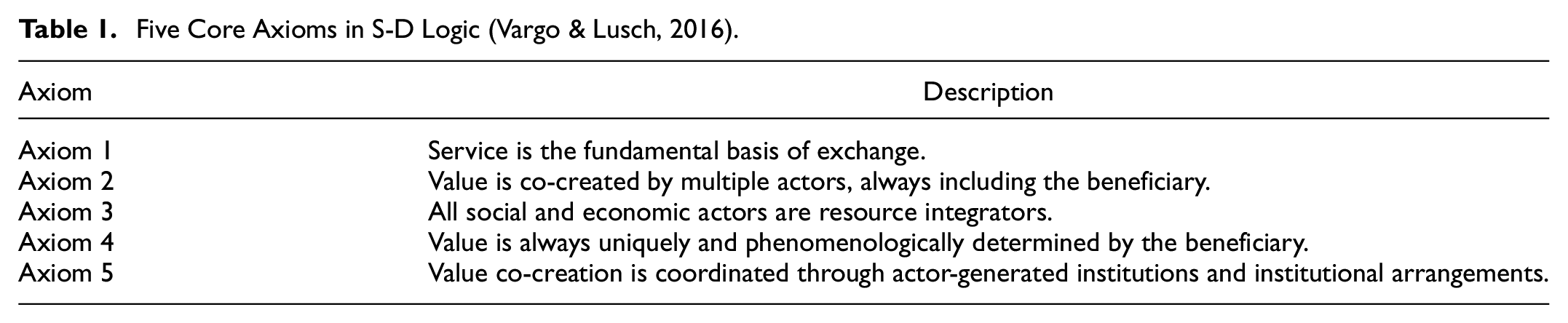
Actors integrate resources to produce services and exchange them through institutional arrangements (Vargo & Lusch, 2016). The features of the five components are axiomatized into five fundamental premises, as shown in Table 1 (Vargo & Lusch, 2016). Axiom 1 states that a service is the object and fundamental basis of exchange in service systems. All services have value and are exchangeable. All actors co-create value, including the beneficiaries involved in service exchanges. Axiom 2 identifies the actors who are not limited to the customer dyads but also include those who integrate resources and exchange services. Service beneficiaries are creators who collaborate with other actors (Vargo & Lusch, 2016). All social and economic actors in a service system are resource integrators, who integrate both operant and operand resources to produce services, as formalized by Axiom 3. Operant resources are intellectual resources, such as specialized knowledge and skills that act on other resources. Operand resources are natural resources that require human action or operations performed on them (Madhavaram & Hunt, 2008). Axiom 3 indicates that a network structure in a service system can be multivalent with various actors, rather than a singular or dyadic phenomenon. Among all actors, customers are the beneficiaries of the exchanged services; they are unique parties that determine the value of the services upon exchange. Axiom 4 emphasizes the central position of beneficiaries in the service systems. The last axiom formulates an articulated architecture for service systems. Specifically, a service system is a meta self-governed and self-adjusting ecosystem consisting of various institutions that seamlessly interact with and affect each other in service production under institutional arrangements.
Five Core Axioms in S-D Logic (Vargo & Lusch, 2016).
TVET as a Service System
This section introduces our conceptualization of TVET as a service system in terms of its static and dynamic aspects. We then validate this conceptualization by showing that TVET satisfies the five axioms of the value co-creation theory in S-D logic.
The Narrative of TVET Models
In the TVET service system, education and training are the main activities that involve students, colleges, and enterprises in transmitting knowledge, skills, and spirit. Values are co-created through collaboration among the three parties. Figure 3 shows the narratives of the four TVET models. The main actors in the narrative include students, colleges, and enterprises, who are the essential stakeholders in TVET. Education would be impossible without any one of the parties. Governments are also crucial in TVET for policy-making and financial provision, but are non-essential actors in the narrative because they are neither service providers nor direct service beneficiaries.

The narrative of TVET.
Students are central to TVET as beneficiaries of education. TVET is student-centered as it is individually tailored and focuses on students’ needs (Guthrie, Harris et al., 2009). Training that qualifies students in career development and lifelong learning (Kanwar et al., 2019) is regarded as a significant strategy for human resource development (Agrawal, 2009). Teaching and training are mainly based on prior knowledge aimed at developing problem-solving and higher-order thinking capabilities. Students pursue individual needs for personal fulfillment and for preparation in life by undertaking educational programs to learn domain-specific techniques and skills, which makes them competent in some positions in the corresponding domains (Guthrie, 2009). Rojewski (2009) believed that students are active knowledge pursuers and constructors. Student quality has always been the central criterion for evaluating the success of education; their motivation, requirements, satisfaction, and career development are factors that must be considered in all educational activities, such as student enrollment, curriculum-making, skill training, and competency assessment.
Vocational schools and colleges are independent places where qualified people start, accomplish professional tasks, and cooperate to shape the business world and society with social and ecological responsibilities (Rauner & Maclean, 2008). It connects the general educational system to the human resources market (Messmann & Mulder, 2011), and is both the executor and propeller of TVET’s deployment and development. The primary activities of TVET schools include student recruitment, in-class teaching, curriculum-creation, and quality assessments. TVET schools must be labor market-oriented to understand the market’s requirements, adjust the curriculum accordingly, and determine the criteria for student recruitment and graduation.
The involvement of enterprises in TVET is another feature that differentiates it from other education sectors. In contemporary TVET frameworks, the role of enterprises is critical because of progress and advancement in high-tech entrepreneurship and professional requirements for employees. Enterprises can provide training and mentoring through such avenues as apprenticeships, internships, and second-class teaching, among others. In all TVET models, enterprise involvement is an indispensable component that helps unskilled workers quickly adapt to the work demands after graduation. For instance, the dual model in German-speaking countries relies heavily on collaboration with enterprises at various levels. Many other countries have also adopted this mechanism (Remington, 2018). On-site training in companies plays a dominant role in the dual system’s heart, core, and backbone. In developing countries, such as Vietnam and China, a work-process-based curriculum is advocated to solve the skill mismatch dilemma in TVET by encouraging vocational colleges to cooperate closely with enterprises (Li & Pilz, 2019; Vo, 2018). In Australia, enterprises can become registered training organizations. They can issue qualifications and certificates to their workers and work as partners in the Technical and Further Education System or other registered training organizations (Smith, 2009).
Rationale
In this section, we validate the conceptualization of TVET as a service system by demonstrating that the five fundamental premises (axioms) of service systems hold for TVET.
Claim 1: Education in TVET is Fundamental for Exchanging Services Among Students, Colleges, and Enterprises
EaaS includes foundations and theories. In particular, compared with education in other formal sectors, education in TVET is more closely related to services because it is student-centered and objective-driven. In TVET, education is exchangeable among colleges, enterprises, and students, with schools and enterprises being providers and students being clients. In TVET models, education is deployed as in-class teaching in schools and on-site training and mentoring in companies. Teaching and training are gradually integrating because of advances in information and communication technologies (ICTs), and blended learning is becoming mainstream in the form of massive open online courses (Latchem et al., 2017). All these educational activities are student-centered, focusing on their requirements and needs, and are objective-driven by developing transferable skills.
The exchange of education in TVET is valuable from two perspectives. First, TVET has both monetary and intangible values. As secondary education, TVET is a paid service in which students usually pay tuition fees; however, in many countries, it is provided as public welfare, and tuition is waived or decreased to make it affordable for those from low-income families (Palmer, 2015). The tuition fees of private TVET institutions can be much higher than those of public ones (Preddey, 2009). Compared with monetary values, TVET’s other intangible values are more important to students, companies, schools, and even societies, as discussed in the previous section. Second, education is exchanged among students, colleges, and companies to benefit all stakeholders by helping them achieve their values. Colleges and companies provide teaching and training services to students to improve their skills and competencies. In turn, they benefit from developing and employing skilled workers to create social wealth through goods and services.
Therefore, education in TVET conforms to the two characteristics of service: value and exchangeability. Thus, we conclude that it is a kind of service defined in S-D logic. Moreover, it serves as the fundamental basis for exchanges between colleges, enterprises, and students in TVET.
Claim 2: TVET Value is Co-created by Students, Colleges, and Enterprises
We showed that students, colleges, and enterprises are all co-creators of TVET values, which is the principal observation supporting the conceptualization of TVET as a service system. According to Ramaswamy and Ozcan (2018), co-creation is an enactment of creation through interactions. It is a function of either the direct or indirect interactions between providers and consumers (Gronroos & Voima, 2013). From this perspective, co-creation of service values are created through interactions between consumers and producers, and that consumers also contribute to creating service values. Undoubtedly, TVET institutions are value co-creators in teaching and training students.
Students and enterprises also value co-creators in TVET. First, students act as consumers, while colleges and enterprises deliver knowledge and skills to them through teaching and training, respectively. On the one hand, students are recipients when they learn knowledge to improve their competencies and skills. On the other hand, they also contribute by creating new knowledge and products when learning and acquiring skills. The way students contribute to education as co-creators in other variants such as higher education (Harbisher, 2017; Navarro-García et al., 2015; Tsourela et al., 2015) and OAE (Cai et al., 2018; Cai & Kosaka, 2019), has been extensively studied. Compared with these educational variants, the feature of learning by doing in TVET endows students with roles other than those of learners. For instance, in the collaborative master-apprentice relationship in a dual system, students work as apprentices with skilled employers. Students contribute new knowledge while learning. They can also be co-producers of curricula, co-authors of textbooks, and creators of online teaching resources (Reneland-Forsman, 2016). All these roles are necessary to guarantee high-quality education and increase its value. In this sense, students become creators in the process of receiving education and training.
Second, students carry TVET values that are not created until they utilize their learned knowledge and skills in their work. In S-D logic (Vargo & Lusch, 2008), this phenomenon is conceptualized as the notion of value-in-use, an essential feature of perceiving consumers as value co-creators. This emphasizes the fact that the value of services and goods is not created until they are consumed. From this perspective, education in TVET is also characterized by its value-in-use; this is because education in TVET is student-centered and labor-market-oriented. The value of knowledge and skills that students learn from education is created at the workplace. These values are fundamental to the other derivative values of colleges, enterprises, and societies. For instance, enterprises would be motivated to invest in and collaborate more closely with colleges to develop higher-quality education services after benefiting from the values that students create in the workplace.
In view of value co-creation for TVET, another feature makes the value co-creation in TVET different from those in other service systems on the market: enterprises are consumers of institutions and students are the products. Enterprises engage in education through financial and intellectual investments, mainly to train and recruit employees from colleges. As TVET is market-oriented, it is essential for colleges to understand enterprises’ requirements to determine their curricula and quality assessment criteria. For instance, Ritzen et al. (2015) proposed an approach to designing a hybrid curriculum through collaboration between vocational education and the labor market to foster the development and implementation of the curriculum, and reflect on the new environment. Thus, enterprise engagement is essential in all four typical TVET models. From this perspective, enterprises are both customers and value co-creators, in relation to colleges, which are providers.
In summary, students and enterprises are the customers and value co-creators of TVET. Compared with traditional dyadic provider-consumer service systems, TVET service systems are multivalent, with each of the three actors being in a dyadic provider-consumer relationship. Each actor plays multiple roles as a service recipient and creator in such multivalence.
Claim 3: Colleges, Enterprises, and Students Are Resource Integrators in TVET
All three TVET actors are resource integrators. We identified educational resources in TVET and explained how they are integrated into education. In service systems, the resources are divided into operant and operands. In TVET, educational resources also conform to either category. Table 2 lists the 10 most essential educational resources for TVET as well as their integrators and categories. Government resources for TVET include policies and money, which are fundamental to its deployment. Governments play the role of a policymaker in defining educational objectives and as a resource provider of political and financial support (Atchoarena, 2009; Atchoarena & Grootings, 2009).
Principle Resources in TVET.
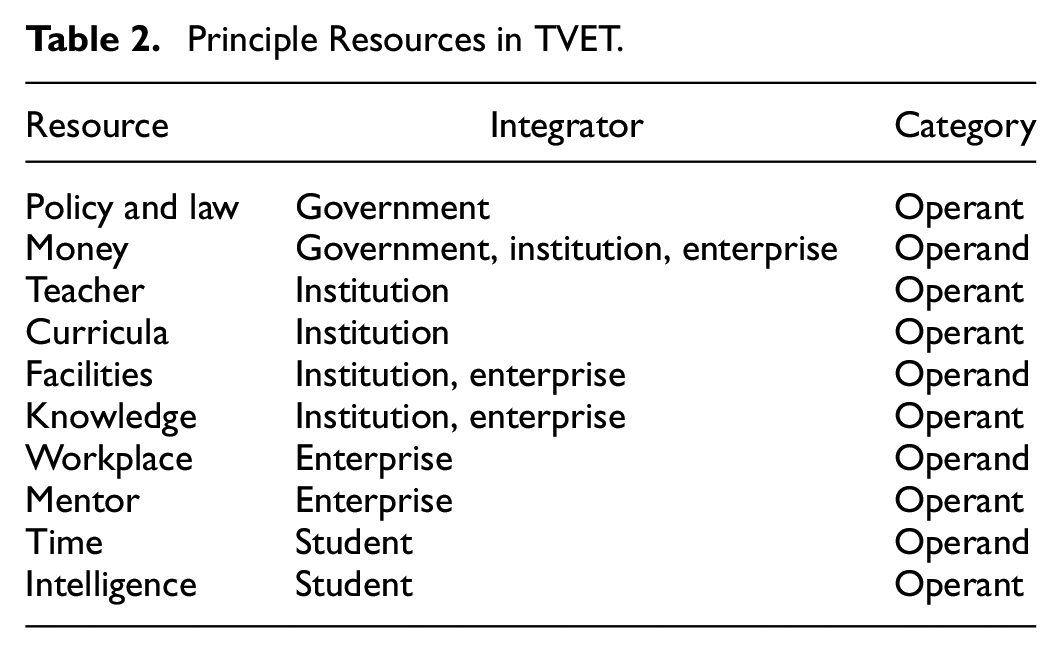
The money used for TVET also comes from colleges, enterprises, and TVET executors. These are integrated with student payments, social donations, and profits from selling services. As the dominant player in TVET, colleges integrate primary teaching resources, such as teachers, curricula, teaching facilities, and knowledge. Enterprises provide facilities, knowledge (skills), workplaces, and mentors for in-company training. They collaborate by integrating essential educational resources into a public-private-partnership (Oviawe, 2018). The resources integrated by institutions and enterprises are complementary; thus, their values are maximized during competence and skill acquisition (Bolli & Renold, 2017).
Students contribute their time and intellectual, emotional, and spiritual intelligence to becoming skilled and competent. Intelligence in teaching and training is a determining resource for guaranteeing educational quality and success (Sitepu et al., 2020). Studies also show that the correlation between personality and achievement for TVET students is significant (Rabaei, 2014).
Claim 4: Students and Enterprises Determine TVET Values Uniquely and Phenomenologically as Service Beneficiaries
In Claim 2, we argued that students and enterprises are customers in the dyadic relations between any two of the three stakeholders. Customers are called service beneficiaries in S-D logic (Vargo et al., 2008). Here, we justify that students and enterprises determine the value of TVET uniquely and phenomenologically as service beneficiaries, whereas the societal values of TVET are derivatives of these values.
First, students carry the TVET values and demonstrate them when they utilize the knowledge and skills learned in college and companies in production activities. As Leigh (2008) states, well-educated individuals may possess traits that help them outperform others in the labor market. Under the theory of value-in-use, the value of such an improvement will not be created until the knowledge and skills acquired are utilized. Once created, these values are reflected in high wages, promotions, and new careers for individuals (Hoeckel, 2008).
Second, enterprises play a dual role in determining TVET value. On the one hand, they provide employment opportunities for students to utilize their knowledge and skills in production activities. Colleges expect all students to be employed upon graduation. They must rely on enterprises, which are the main sources that can provide graduated students with opportunities to work and create value. On the other hand, enterprises are evaluators of TVET values. They only employ competent and skilled students and evaluate the capabilities and competencies of the employed students according to their production performance (Awang et al., 2011). More opportunities are provided to qualified employees, whereas unqualified employees may become unemployed.
Third, we show that the derivative societal values of TVET are reflected in the values created by individuals and enterprises. Skilled workers and productive enterprises add wealth to societies. In the short term, expenses are saved for social benefits caused by unemployment. In the long term, tax income increases from higher earnings with increased employment and productivity (Hoeckel, 2008). Studies also show plausible causal evidence of the effect of TVET on the reduction of crime rate (Jha & Polidano, 2016). All of these public values are derived from those created by individuals and enterprises.
Claim 5: Value Co-creation in TVET is Coordinated Through Institutions and Institutional Arrangements
An important feature of the value co-creation theory is that co-creation is coordinated through the institutions and institutional arrangements generated by actors. This feature was formulated as the last among the five axioms (Vargo & Lusch, 2016). Institutions refer to humanly devised rules, norms, and beliefs that regulate social behaviors and actions under constraints, and make them predictable. In the higher order, interrelated institutions constitute institutional arrangements. They establish the basis for coordinating educational activities, such as teaching, learning, training, evaluation, and employment, to accomplish the objective of education. We demonstrate that the multivalence of TVET makes institutions and institutional arrangements for coordinating educational activities in TVET more necessary, meaningful, and complex than in dyadic service systems.
First, educational activities in TVET are conducted under various articulated institutions, from formal codified laws to informal conventions. For instance, contracts with schools are established when students enroll in TVET schools. Students must attend classes, complete assignments, and take examinations to obtain their degrees and professional certificates. Schools are also responsible for developing curricula, teaching students, and providing employment training. Similarly, enterprise training is systematically achieved under specific regulations. Students and enterprises have rights and obligations for reciprocal interactions. Additionally, coordinating collaboration between schools and enterprises under specific coordination mechanisms that vary across countries and cultures is essential. Contracts, protocols, and regulations are established as the basis and guidelines for collaborators to restrict their behaviors, protect their rights, and reduce potential risks (Brockmann et al., 2008). For instance, Germany, a country well-reputed for linking enterprises and schools, has established a successful apprenticeship mechanism that integrates the resources of schools and enterprises, and motivates both stakeholders to interact under legal regulation. Furthermore, training, testing, and certification are standardized across all industries nationwide (Furstenau et al., 2014).
Second, TVET institutions are assembled interdependently in a higher order as institutional arrangements. One feature of TVET is that each of the three actors is the basis of coordination for the other two actors. For instance, students are the basis on which schools and enterprises coordinate; they are carriers of education and training values, bringing these values from colleges to enterprises, where they apply their knowledge and skills to production (Kuijpers et al., 2011; Wheelahan & Moodie, 2011). From the perspective of schools and students, enterprises are the destinations of all educational activities where knowledge and skills are transformed into tangible and intangible products. Enterprise participation significantly affects the forms and contents of on-campus teaching and learning (Wolf, 2017). Similarly, from the perspective of enterprises and students, schools establish connections between students who seek employment opportunities and enterprises that seek skilled employees. The inter-dependencies cause the regulations, rules, and agreements between any two actors to overlap and intersect. They are complementary, consistent, and confluent in functionality and objectives. The assemblage of interdependent institutions constitutes the institutional arrangements that provide all TVET practitioners with practical guidelines and perspectives on engaging in educational activities.
Based on the above arguments, we demonstrated the validation of the five fundamental premises of S-D logic in TVET, by which we consequently conclude that TVET is essentially a service system, where values are co-created by all the stakeholders in the system.
Conclusions and Implications
In this study, we proposed conceptualizing TVET as a value co-creation service system from a service science perspective and justified this conceptualization by validating the five fundamental premises of S-D logic in TVET models. To the best of our knowledge, this study is the first to perceive TVET as a service system through the lens of S-D logic, and to claim that TVET is essentially a value co-creation process, where the role of students and colleges as collaborators and contributors is emphasized.
This conceptualization has theoretical and practical implications. For example, innovating collaborations between involved stakeholders and maximizing educational values based on the value co-creation theory. Theoretically, this demonstrates the rationality of perceiving TVET as a service and validates the fundamental premises for perception. Practically, it provides instructional guidelines for investigating solutions to the dilemmas faced by TVETs in many countries, such as low standing in the education system, students’ lack of motivation to choose TVET, and enterprises’ reluctance to participate. This situation is mitigated when stakeholder values are maximized.
Implication I: Redefining Partnership Between Students and Enterprises in TVET
Education has never been a standalone activity, and this is particularly true for TVET. The perception of TVET as a value co-creation process helps explain the collaborative essence of education and advocates closer collaboration with students and enterprises (Tanggaard, 2005). Although existing TVET models consider the importance of students and enterprises participating in education, the new perspective redefines the new partnership as co-creators with them being equal contributors, as much as schools. Identifying new partnerships could motivate students and enterprises to participate in educational activities.
First, students would become more active participants in education. As co-creators, students would realize that they are not only passive learners and trainees but also contributors and innovators who create value while learning and practicing. The value-creation cycle between when knowledge is learned and utilized in practice is shortened, which could motivate students to reinforce their abstract knowledge and make them practically skilled. Meanwhile, if schools and enterprises admit the partnership of students, they would treat them as collaborators, respecting them and admiring their strengths. Adult respect helps young students become professionals and enthusiastic about their occupations, which is the core competency in employability-oriented education (Bhattarai, 2019).
Second, as co-creators, enterprises are motivated to contribute more to education. Currently, enterprise contributions to TVET are limited in some countries, mainly because experts and workers are reluctant to provide guidance and participate in the training process for fear of being displaced by those they assist (Ananiadou, 2013). This fear arises because workers and mentors consider students as potential competitors after becoming skilled. When they work with students as collaborators within a value co-creation framework, their group can achieve better performance in terms of productivity and innovation. The workers and experts could also improve themselves while training the students, as advocated by Confucius’s proverb: “Jiao Xue Xiang Zhang” (teaching and learning are mutually beneficial). These benefits would motivate enterprises to become more involved in education through the dual roles of educators and employers.
Implication II: Maximizing TVET Value Through Co-Creation
Perceiving TVET as a process of value co-creation can help maximize TVET value for students, enterprises, and schools. The main objective of value co-creation is to maximize the value for all actors participating in the co-creation process. Through co-creation, all stakeholders can achieve the values they pursue through education.
First, students would become more competent and their employability would be enhanced if they were motivated to learn. This collaborative relationship would make them feel respected when both schools and enterprises understand their requirements through collaboration. In addition to being knowledge recipients, students would improve themselves by being contributors, workers, and innovators in education (N. F. Hassan & Sanusi, 2015).
Second, enterprises’ investments in training and mentoring students in the workplace would be paid off by enrolling high-quality and loyal young workers. Enterprises would train students in professional skills and knowledge based on their requirements and career development plans. During training, enterprises can evaluate performance and capabilities, and enroll employees with high evaluation records after graduation. In addition to competency, enterprises can transmit their culture and values to develop loyalty (S. Hassan et al., 2019). Young employees conceived by the company’s culture are likely to be more creative and positive in their work and have longer careers in the company.
Third, school values are reflected in the maximization of the societal values of education. Students’ competency and employability reflect the values of TVET for schools. Having students and enterprises as educational collaborators can significantly improve students’ competency and employability in terms of skills, innovation, leadership, and collaborative spirit. In addition, many by-products of the value co-creation process, such as curricula, textbooks, and training courses developed in collaboration, are also of intellectual value for schools to increase the availability of TVET, lower learning costs, and improve learning quality (Remington, 2018).
Implication III: Innovating Educational Models via Three-Party Cooperation
Another implication of perceiving TVET as a value co-creation process is that it innovates educational models by applying and adapting existing value co-creation models to TVET, conforming to the narrative of value co-creation as shown in Figure 2. For instance, the “DART” model advocates a four-component co-creation process consisting of dialog (D), access (A), risk assessment (R), and transparency (T), which encourages more active and intensive customer engagement as collaborators and contributors to value creation (Mukhtar et al., 2012). This model sheds light on motivating students and enterprises to better engage in educational activities. Another potential direction is to investigate knowledge creation in TVET under the value co-creation theory (Goyal et al., 2020), where new knowledge in TVET carries the value of education in terms of students’ creativity and intellectual properties.
The perception of TVET as a process of value co-creation would also be helpful for ICT-powered innovations in TVET by transforming education into online services in the form of courses or games. The value co-creation theory has successfully guided ICT innovations (Rai et al., 2010). ICT-enabled services are becoming the primary innovative services for value co-creation and are available and accessible to potential customers (Breidbach & Maglio, 2016). ICT has reshaped the forms and contents of TVET and the relationships between students, schools, and enterprises (Kotsik et al., 2009; Yasak & Alias, 2015). For example, massive open online courses-based innovations are increasing in TVET (Kassim & Puteh, 2018; Mazin et al., 2020; Yusoff et al., 2017), which blend the boundaries between the three parties, making their collaborations interactive and seamless. Such online TVET education requires theories to study the relationships and efforts of schools, students, and companies in the system, which can be analogous to the value co-creation theory for online services, such as shopping and gaming.
Footnotes
Acknowledgements
None.
Declaration of Conflicting Interests
The author(s) declared no potential conflicts of interest with respect to the research, authorship, and/or publication of this article.
Funding
The author(s) disclosed receipt of the following financial support for the research, authorship, and/or publication of this article: This study was sponsored by the National Social Science Fund of China (Education) project (Grant No. BJA210094).
Ethics Statement
Not applicable.

Data Availability Statement
Data sharing not applicable to this article as no datasets were generated or analyzed during the current study.