




Abstract
Educational leadership theory is a dynamic and multifaceted subject that emerged from enterprise leadership perspectives, but it necessitates alignment with the practical aspects of educational management. To comprehensively grasp the evolution and present research status of this theory, content analysis is employed in this study to systematically analyze and quantify pertinent information. The key findings are as follows: Firstly, empirical research serves as the predominant research method in studying educational leadership theory. Within this field, qualitative and quantitative research methods are employed simultaneously. Moreover, case studies play a crucial role in advancing the development of issues and the construction of theories. Additionally, the distributed leadership theory has gained significant prominence within the realm of educational leadership. Current research methods employed in this theory are still in a stage of maturity, relying primarily on qualitative research to uncover underlying patterns among social phenomena through examination of specific cases. Finally, the primary focus of educational leadership theory lies in studying school managers and teachers. In light of the influence stemming from distributed leadership theory, teacher leadership has garnered increasing attention from scholars and has emerged as a burgeoning area of interest. This study contributes to the field by presenting a comprehensive framework for cognitive educational leadership theory through an extensive content analysis, thereby offering valuable insights into its overall developmental trajectory. These findings provide a macro-level perspective on educational leadership theory, particularly beneficial for subsequent researchers, especially those new to the field, seeking to grasp the broader landscape of this discipline.
Keywords
Introduction
The development of educational management originated from the field of enterprise management, which emphasizes efficiency, balance, and coordination as its core principles. These elements have been central to empirical paradigms. However, the emergence of critical theories in education challenges the absolute authority of “positivism.” The process of social diversification and encounters with different cultures necessitates adaptation in education (Hallinger, 2018). Consequently, scholars have undertaken fresh reflections on educational management, particularly with the widespread dissemination of the notion of “value relevance” in education. This broadens the previously narrow focus on “management,” which primarily emphasized teaching quality and efficiency (Hallinger & Chen, 2015). As a result, in the post-1990s era, the concept of leadership has emerged as a distinct and separate notion from management, leading to the formation of a new trend. This has opened up new frontiers in the field of educational management (Connolly et al., 2019), generating fresh knowledge and disciplinary paradigms through the continuous intersection and mutual exchange of postmodern diversification trends. These novel insights and paradigms bridge the gap between the new concept of “leadership” and the traditional notion of “management,” thereby enhancing the disciplinary framework of educational management.
As a discipline inherently relies on diverse theoretical frameworks, the educational leadership theory serves as a paradigm for addressing specific issues related to educational leadership. Hence, it provides valuable guidance for educational practices. The core essence of educational leadership delineates its role in managing and governing educational organizations and instructional activities (Clarke & O’Donoghue, 2017). Consequently, this necessitates a dynamic evolution of concepts pertaining to management and leadership to offer guidance for specific managerial challenges, as advocated by the contingency leadership theory. Notably, in the current educational landscape, schools confront increasingly intricate environments marked by educational transformations propelled by technologies like cloud computing, big data, the Internet of Things, and mobility, resulting in constant fluctuations in the educational backgrounds of students, teachers, and administrators (Öznacar et al., 2020). Consequently, previously effective criteria and norms no longer adequately address these challenges, prompting the emergence of novel approaches to educational leadership that embrace proactive adaptation. In this era of personalized education, leaders are tasked with comprehending the pervasive prevalence of diversity, plurality, and individuality, and skillfully analyzing the guiding significance of different educational leadership theories.
Educational leadership has emerged as a focal point within the field of educational management, intricately linked to the narrow conception of management, primarily due to the entrenchment of managerialism in educational practices (Bell, 1991; Bush, 2008). Initially rooted in the business and industrial sectors, educational management prioritized efficiency and procedural concerns, which contradicted the values espoused in the realm of education. As the discipline of educational management has matured, there has been a growing demand for the restoration of educational values, prompting “educational leadership” to shoulder the responsibility of addressing fundamental issues pertaining to educational values and purposes. Nevertheless, the current state of educational leadership exhibits fragmented responses to these fundamental educational inquiries, lacking a cohesive and systematic integration. For instance, the precise role of educational leadership theory in guiding the transition from a value-neutral to a value-relevant conception of education remains unclear. Consequently, this paper aims to delineate the developmental trajectory of educational leadership theory, analyze, and synthesize the prevailing trends and primary paradigms evident in its research, and elucidate the evolution and transformations within educational leadership theory. Employing thorough content analysis, this study constructs a comprehensive framework for cognitive educational leadership theory, offering valuable insights into its overarching developmental trajectory. It presents a panoramic perspective of educational leadership theory, particularly beneficial for subsequent researchers, especially those entering this field for the first time. This study primarily addresses the following inquiries:
(1) What are the characteristic theoretical frameworks in contemporary educational leadership theory?
(2) What are the commonly employed research methods in the study of educational leadership theory?
(3) What are the distributional characteristics of the research subjects in educational leadership theory?
Literature Review
To comprehend the developmental trends of educational leadership theory, it is essential to first explore its origins and evolutionary process. The concept of leadership was initially only one aspect of management. Bush pointed out that some countries adopted a narrower definition of “management” in education reform. Therefore, “management” prevailed (Bush, 2004). In the background, the term “leadership” gradually separated from management. Since then, it has become a relatively independent concept to answer the question of “educational value” in academic circles.
However, at present, the academic community has not yet formed a unified and clear consensus on the term “educational leadership.” By sorting out the concept of “educational leadership” in the education management literature, it is found that there are more than 60 definitions. Hence, they are derived based on different conceptual connotations. A variety of complicated educational leadership theories have emerged. Among the many definitions of leadership, the definition proposed by management scientist Koontz et al. (1986), the art or process of influencing people willingly and enthusiastically to achieve group goals, has a broader audience.
According to the development of the term “leadership,” the theory of educational leadership can be divided into two schools. One is the traditional leadership theory shrouded in the “positivism” trend of thought, deeply influenced by rationalism, primarily born in the early and mid-19th century, and famous in the 1960s and 1970s. It was declining in the 1970s, and the new trend of thought of “multi-dimensionality” in educational management has made significant progress during this period. In turning the positivist paradigm into the multi-paradigm, this new trend of thought provides fertile soil for the innovative development of educational leadership theory. In the context of the importance of educational value, a series of new educational leadership theories emerged in the early 1980s, including moral leadership, transformational leadership, and distributed leadership, which vigorously promoted the diversity of educational leadership theories. What needs to be pointed out here is that although new educational leadership theories have received much attention recently, the traditional leadership theories with leadership behaviors and styles as the main foothold still have research value (Shapira-Lishchinsky & Raftar-Ozery, 2018; Urick & Bowers, 2014). Hence, it still plays an irreplaceable role in educational management practice.
The transformation of educational leadership theory reflects the evolution and succession of the fundamental research paradigms and core methodologies within the field of educational management. To gain a better understanding of this transformation, it is crucial to have a clear understanding of the development of educational management during this transitional period (Zupic & Cater, 2015). The development of positivism in educational management excluded many factors that should not have been dismissed in social science research and introduced overly idealized assumptions, such as the assumption of complete rationality in human nature. The methodological emphasis of positivism restricted the perspective of human cognition of the objective world, leading to a stagnation in the field’s development. According to the book The Structure of Scientific Revolutions, a scientific revolution is urgently needed to drive the paradigm shift in the field of educational management. Greenfield was at the forefront of breaking free from the narrow paradigm of positivist rationalism by emphasizing cognitive pluralism and introducing the phenomenological paradigm, which marked the beginning of the transformation of the paradigm in educational management (Greenfield & Ribbins, 1993). Against this backdrop, educational leadership theory has also undergone transformation and iteration in line with the development of diverse paradigms in educational management.
The development of traditional educational leadership theory, referring to theories prior to the 1970s, can be delineated into three distinct periods, as outlined by Bryman (1992). Preceding the late 1940s, the prevailing focus was on trait-oriented leadership theory, emphasizing a reverence for the innate aspects of leadership. From the 1950s to the late 1960s, leadership theories exhibited a discernible pattern orientation, concentrating on the correlation between leadership effectiveness and leader behavior. Moreover, the research on trait and pattern orientation within leadership theory shared a common foundation rooted in behavioral science theory, leading some scholars to integrate these two types into a cohesive system of educational leadership theories. Additionally, leadership theory is a contingency theory, positing that, apart from leader characteristics, behavior, and style, the context in which leadership occurs significantly influences leadership effectiveness.
In the late 1970s, educational leadership theory took on a new and pluralistic orientation. As mentioned above, this new orientation is closely related to the change in education management (the essence of change is the development and evolution of society). Overall, with the shift in research paradigm, the way, role, and power of education leaders have also changed. During this period, the term leadership began to break away from the narrow meaning of management itself, and gradually included diversified elements such as leadership and value influence. At this time, multiple dimensions, flexible management, and corporate power have become new characteristics of educational leadership theory. Especially when contingency theory is less practical in the face of complex situations, new approaches begin to seek individuality and commonality in leadership. Personality forms a universal paradigm in a specific condition, trying to explain complex real-life educational problems, typically such as moral leadership theory. As an original educational leadership theory, it is in the environment of loose organizational structure and close cultural connection. Therefore, it can play a role higher than expected (Sergiovanni, 1987).
Entering the 21st century, educational leadership has garnered broader and more extensive attention within academia. Hallinger and Chen (2015) assert that the concept of “educational leadership” has assumed a central position in educational management. Simultaneously, an increasing number of countries, particularly developed ones, have recognized the value of leadership in school development and educational reform (Bush, 2012a). This trend is also evident within the academic community. In 2004, the journal Educational Management and Administration underwent a name change to Educational Management Administration and Leadership, thereby reflecting the distinctive status of educational leadership within the field of educational management.
It is important to emphasize that the evolution of educational leadership theory is not isolated but profoundly influenced by the societal developments it exists within. Particularly, the tumultuous transformations observed across various facets of society in the past half-century have disrupted numerous fundamental concepts, leading to the deconstruction and elimination of certain original paradigms. Scholars such as Habermas (1990) have introduced the notion of a postmodern society, distinct from the modern society that prioritized standardization, objectivity, and the singular rationality of science. In contrast, the postmodern society places greater emphasis on the value and diversity of knowledge and science. These changes signify a shift in the underlying logic of educational management, where the emphasis on educational value has undermined the dominance of logical positivism and shattered the absolute belief in positivism within educational leadership. Furthermore, the focus on educational value highlights that the purpose of educational organizations is to pursue equality and justice in education. Leadership is no longer solely about the rational exercise of power, but also encompasses qualities such as personality, openness, and innovation that embody educational value. In academic governance, being “value-related” has become the essence of all educational theories and paradigms, including educational leadership theory. In its multidimensional development, educational leadership theory reflects a shared spiritual essence rooted in educational value.
Theories and paradigms serve as foundational pillars for the advancement of academic disciplines. In the context of educational leadership, a concise overview of the various theories sheds light on the overall landscape. The history of educational leadership theories dates back to their inception, gradually evolving into a diverse and extensive body of knowledge often referred to as the “educational leadership theory jungle.” Over time, substantial theoretical outcomes have emerged from this body of research. This study provides a brief categorization and summarizes five influential types of educational leadership theories that have played a significant role in the development of educational leadership. The findings of this sorting process are presented in Table 1.
The Leading Theoretical Schools of Educational Leadership Since Modern Times.

Research Design
Research Method: Content Analysis
Content analysis is a research method used to analyze textual materials in depth (Guthrie et al., 2004). It facilitates a comprehensive understanding of a research topic. In contrast to review methods like bibliometrics and meta-analysis, content analysis stands out for its capacity to delve into the pertinent literature encompassed within the analysis. By engaging in a thorough examination of original texts, researchers can acquire the qualitative information they desire. Considering the aim of this study is to explore the concrete and profound research topic of educational leadership theory, content analysis is highly suitable. It follows a systematic execution process that can be summarized into seven steps: setting objectives, selecting samples, organizing materials, choosing analytical elements, establishing analysis categories, coding and statistics, and data interpretation. As a scientific research method, content analysis embodies objectivity, systematicity, quantifiability, and non-invasiveness. It allows for the handling of unstructured data in literature (Duriau et al., 2007; Short & Palmer, 2008). While some scholars criticize content analysis for over-reliance on simplistic quantification of textual information, which can lead to significant loss of information, authoritative scholars in the field have underscored the unique scientific utility of such quantification (Krippendorff, 2018). Its rigorous process design overcomes the subjectivity and uncertainty present in other research methods, thereby enabling precise and in-depth exploration of textual information (Gaur & Kumar, 2018). In this study, we present the developmental trends in the research field through statistical quantification of data, and we interpret the quantitative information through thorough qualitative analysis of the texts, aiming to minimize potential information loss as highlighted by some scholars.
Research Materials: Literature Search and Screening
This article aims to comprehensively and systematically review research conducted in the field of educational leadership. After careful consideration of factors such as article quality, authority, and publication volume, we have chosen to compare and analyze articles on “educational leadership” published in the journal Educational Management Administration & Leadership (EMAL). The retrieval strategy employed was SO = Educational Management Administration & Leadership. The rationale behind this selection is twofold. Firstly, EMAL is a renowned journal in the field of educational leadership and management (EDLM) and stands as the sole mainstream research journal indexed in the WoS Core Collection. It has published numerous original studies and review articles on educational leadership (Hallinger & Kovačević, 2022). Secondly, within the WoS “EDUCATION & EDUCATIONAL RESEARCH” category, EMAL’s Journal Citation Indicator (JCI) achieved a Q1 ranking for the year 2021, indicating the quality and impact of the research disseminated through this journal.
The study period selected for this research spans from 2010 to 2021, encompassing a total duration of 12 years. The main reason for this timeframe selection is rooted in EMAL being indexed in SSCI in 2009. A comprehensive search on the Web of Science yielded a total of 698 articles, specifically focusing on articles and reviews, within the designated time frame.
Based on the already identified core research topic of “educational leadership theory,” and following the criteria proposed by Guthrie et al. (2004), five authors collectively deliberated and established the criteria for literature selection. These criteria encompass two aspects: the first aspect is content criteria, which requires that the subject matter of the included literature must be closely related to “educational leadership theory.” This demands that the included literature should directly discuss, analyze, and apply theories of educational leadership, including their formation, development, and specific applications. Therefore, literature that only mentions “educational leadership theory” in the introduction as background should be excluded. Based on this criterion, 590 publications were excluded; the second aspect is quality criteria, which requires that the literature included for analysis must be peer-reviewed through a double-blind process, and must meet general standards of a paper: including having a clear structure, a specific research question, systematic research thoughts and methods, and concrete research methods. Thus, literature types such as Book Reviews that are not peer-reviewed and publications that do not meet the basic requirements of a regular paper should also be excluded. Under this standard, 27 publications were excluded for not conforming to document type standards, and 32 publications were excluded for not meeting the basic requirements of a regular paper. In the process of implementing screening based on the above criteria, for disputed literature, the five authors collectively deliberated or sought the judgment of professionals in the field of educational management. After about a week of screening, a total of 49 relevant publications were ultimately selected for analysis (the screening flowchart is shown in Figure 1), accounting for approximately 7.02% of the total publications of the journal from 2010 to 2021.

Literature screening flowchart.
Research Category: The Construction of the Category Table
To construct a category table that is as scientific and reasonable as possible, this study combines the precautions for category design in the content analysis method proposed by Guthrie et al. (2004). Firstly, the categories (variables) to be studied in the topic are pre-determined by combing relevant literature. Moreover, operations such as merging and splitting the selected categories are performed. Finally, detailed and mutually exclusive categories are obtained, and the coding guidelines are established. After several rounds of revision and adjustment, the final category includes three first-level categories: research methods, research objects, and research theories. In addition, the number of authors of the literature, the year of literature publication, and the population of the research object are also counted. It should be noted that under the first-level category of research methods, mixed research is listed separately as a second-level category, a classification form currently supported by many scholars. Because diverse research has been regarded as a different independent methodology for quantitative and qualitative research (Creswell et al., 2006; Johnson & Onwuegbuzie, 2004). The specific situation of the category table is shown in Tables 2 and 3 below.
Research Categories: Research Methods.

Research Categories: Research Objects and Research Theories.

Note. For the definition and classification of leadership theory, please refer to Section “Analysis of Research Methods on Issues Related to Educational Leadership Theory.”
Categories play a fundamental role in coding and conducting content analysis (Guthrie et al., 2004). This study incorporates Guthrie’s considerations on category design in content analysis to establish a scientifically rigorous and logical category table, which serves as a coding form for literature analysis. The following steps are implemented to establish the analysis categories and define associated rules. Initially, relevant literature is reviewed to identify the desired categories (variables) to be studied in the topic. Subsequently, operations such as merging and splitting categories are performed on the selected ones. Finally, comprehensive and mutually exclusive categories are derived, and coding guidelines are formulated. Through multiple rounds of revisions and adjustments, the final set of categories consists of three primary categories: research methods, research subjects, and research theories. Additionally, demographic information, including the number of authors, publication year, and research subjects, is collected. Primary categories represent relatively broad concepts that are generally independent and mutually exclusive, while secondary categories have a hierarchical relationship with the primary categories and serve as specific analytical units within them (Guthrie et al., 2004). Detailed information about the category table for this study can be found in Tables 2 and 3. It is noteworthy that the inclusion of “mixed methods” as a separate secondary category under the primary category of research methods is widely accepted among scholars. This recognition stems from the acknowledgment of mixed methods research as an independent methodological approach that differs from both quantitative and qualitative research (Creswell et al., 2006; Johnson & Onwuegbuzie, 2004).
Tables 2 and 3 present the three primary categories of research methods, research subjects, and research theories, along with their respective secondary categories. They also provide explanations of disciplinary concepts and terms within these categories. These explanations serve as coding criteria during the implementation of content analysis, ensuring the accuracy of coding as an important guarantee.
Analysis of Reliability and Validity
After the design of the category table, an analysis of its reliability and validity is necessary. In this study, relevant research (Creswell et al., 2006; Guthrie et al., 2004) was consulted during the development of the category table. Discussions were also held with experts in the field of educational leadership theory, ensuring the validity of the category table. The reliability of the category table was evaluated through inter-rater reliability, as suggested by Hayes and Krippendorff (2007) and Gaur and Kumar (2018). Two researchers independently conducted coding and statistical analysis, generating two separate Excel files of coded data. The consistency between the two coders was assessed using the commonly used inter-rater reliability measure in educational statistics and measurement. The analysis revealed that out of the 49 articles coded in the primary category of research methods, 46 articles had completely identical coding results (i.e., M = 46, with a total of N = 49 articles coded by both researchers). The average mutual agreement and reliability were calculated using the appropriate formulas:


Based on the above formula, the K value for the research methods category was calculated to be 93.88%, with a reliability coefficient (R) of 0.968. Similarly, for the research subject category (M = 45), the K value obtained through the same method was 91.84%, with an R of 0.957. As for the research theories category (M = 49), the K value was 100%, resulting in an R of 1. These calculations demonstrate that the reliability of the three primary categories exceeds 0.9, indicating strong reliability in both the category design and coding outcomes (Yu et al., 2024).
Results and Discussion
After completing the coding and statistical procedures, the data was interpreted and analyzed, comprising three main components: an analysis of the research methods employed in studying the topic, an analysis of the underlying connotations of different educational leadership theories, and an analysis of the research subjects related to the topic.
Analysis of Research Methods on Issues Related to Educational Leadership Theory
Research methods serve as the overarching frameworks that guide a study. Out of the 49 works of literature obtained and screened, a substantial number of them, specifically 42 articles, can be categorized as empirical research, constituting over 85% of the total. Furthermore, there were nine speculative/theoretical studies and three action studies. Among these, five papers employed a combination of two different research methods. Notably, two of them utilize both qualitative and action research methods (Kangas et al., 2016; Salo et al., 2015), while three literature works employed both quantitative and qualitative research methods (Amels et al., 2021; Litz & Scott, 2017; Muijs et al., 2013). The detailed distribution of research methods is presented in Table 4.
Distribution of Research Methods in the Related Research on Educational Leadership Theory.

Note. Articles that employ multiple research methods will be counted in different secondary categories. For example, an article that utilizes both quantitative and qualitative research will be counted in the categories of quantitative research, qualitative research, and mixed methods research.
From the Table 4, it can be observed that empirical research paradigm is the most commonly used in educational leadership theoretical studies, followed by speculative and theoretical explorations. Action research paradigm is noticeably less prevalent than the previous two, with only a few publications employing a cross-research paradigm. A closer examination of empirical research reveals a relatively balanced distribution between quantitative and qualitative approaches.
After a thorough review of the literature, it is evident that quantitative research methods were predominantly utilized in the field of educational leadership theory. Notably, the structural equation model (SEM) was employed in five studies, while meta-analysis was employed in one study (Tian et al., 2016). Additionally, traditional regression analysis, exploratory factor analysis, confirmatory factor analysis, and significance testing were employed in various studies. Two studies, conducted by Liu et al. (2018) and Liu et al. (2021), utilized data from the Teaching and Learning International Survey (TALIS) for structural equation modeling. Conversely, qualitative research in this domain exhibited a wide range of research methods, such as interviews, discourse analysis, grounded theory, fieldwork, literature analysis, and case study methods. It was worth noting that some studies adopted established paradigms in social science research, including the naturalistic inquiry approach (Ho et al., 2016). However, it was perplexing that there was limited application of ethnographic research methods, which have matured in recent years in the context of educational leadership theory.
Furthermore, it was important to emphasize the significance of case studies as a well-established qualitative research method within the realm of educational leadership theory. Case studies primarily focused on analyzing the effectiveness of leadership within specific environments, taking into account various contextual factors such as the social and school environment. Leadership contingency theory highlighted the influence of these contextual factors on leadership, and case studies were particularly adept at capturing these environmental dynamics. Despite some scholars suggesting that case analysis lacked generalizability and might not provide satisfactory answers to broad questions like those addressed in large-scale surveys (Yin, 2009), Briggs et al. (2007) argued that case research could offer precise insights within a specific scope. For instance, case studies could accurately examine the impact of leadership by explaining phenomena like high employment rates in schools facing unfavorable external conditions, such as high societal unemployment rates. In other words, case studies provided personalized insights and detailed information that statistical inference alone cannot capture.
After thoroughly analyzing the research methods used in educational leadership theory, it was evident that a wide range of methodologies from the humanities and social sciences have been extensively employed across different dimensions of this well-established subject. These diverse research methods have made significant contributions to advancing research in this field. For example, case studies have enriched our theoretical understanding by providing detailed insights and enhancing the explanatory capacity of abstract theories regarding specific behaviors and phenomena (Miller, 2020). In contrast, phenomenological research has alleviated the subjectivity inherent in qualitative research methods such as observation (Dagli & Öznacar, 2016). Furthermore, quantitative research, based on questionnaire surveys and firmly grounded in established theories, has effectively elucidated the behavioral intentions that influence teacher attrition (Thomas et al., 2020). Concurrently, theoretical research in this domain continued to evolve, with the integration of diverse methodologies offering probabilistic and causal explanations for specific phenomena and behaviors related to educational leadership, thereby advancing our comprehension of the fundamental nature of educational leadership (Bush, 2008).
Analysis of the Development Status of Educational Leadership Theory
An analysis of the development of content analysis uncovered the growth patterns within the field during the study period. Research theories served as established frameworks or models that emerge following significant advancement within a discipline or research area. This study primarily concentrated on five research theories within the realm of educational leadership, as presented in Table 3. Table 5 provides a summary of the publication count and temporal distribution of diverse research theories. The analysis of publication count reveals that distributed leadership has been the most prolific theory over the past decade, with a remarkable total of 33 articles, indicating a persistent upward trend in publication volume. Transformational leadership-related studies ranked second, comprising a total of eight articles, but their distribution appears more dispersed. Leadership behavior, on the other hand, exhibited the lowest number of publications. Although it continues to attract some research attention, scholars have relatively neglected this theory in recent times.
Number of Publications and Distribution Years of Different Educational Leadership Theories.

Note. When a paper (a study) contains multiple types of research theory, it will be counted under different secondary categories.
The leadership behavior theory appeared and flourished very early and was deeply influenced by traditional management theory. It originated in the field of industry and commerce, so it ignored many characteristics that education should focus on, such as educational value. At the same time, the leadership behavior theory regards leadership behavior and effect as a simple binary relationship too one-sidedly, ignoring the role of the educational situation. Therefore, when the idea of leadership behavior flourished, the view of leadership contingency came into being (Hallinger, 2020).
The theory of leadership behavior emerged in its early stages and underwent substantial development, primarily influenced by traditional management theory. Originating from the field of industry and commerce, it failed to address several crucial aspects that education should emphasize, including educational value. Moreover, the theory of leadership behavior oversimplified the relationship between leadership behavior and its effects, presenting it as a binary association and disregarding the impact of the educational context. As a result, with the growing prominence of the concept of leadership behavior, the notion of leadership contingency emerged as a response to rectify these limitations (Hallinger, 2020).
The contingency theory of leadership suggested that the effectiveness of leadership depended not only on the personal traits of the leader but also on their behavior, style, and the situational context. However, the data presented in Table 5 indicates that the contingency theory of leadership was no longer a prominent framework in the field of educational leadership theory. While this theory aimed to address the limitations of previous research by considering situational factors, it predominantly focuses on contextual variables while overlooking the significance of organizational culture and structure in educational leadership. Moreover, the theory’s broad conceptualization of the situational context presents challenges in its practical application within specific educational settings.
The concept of transformational leadership could be traced back to the work of Downton (1973). However, it gained significant attention from scholars following Burns’ (1978) comparison of transactional leadership and transformational leadership. Transformational leadership emerged as a prominent leadership theory and received extensive scholarly focus. Transactional leadership, on the other hand, could be broadly understood as a leader’s exchange of material or non-material resources, such as salary and recognition, for the labor and services of subordinates. This transactional approach to leadership was heavily influenced by classical management theory and reflects a corporate management perspective. In contrast, transformational leadership aims to establish shared goals, group norms, and organizational culture to inspire and guide subordinates toward achieving positive outcomes. It emphasized creating a cohesive organizational framework with consistent values and objectives. As asserted by Bass (1997), transformational leadership was a theory applicable to most organizations and quickly became the dominant educational management theory in the 1990s.
Moral leadership theory and transformational leadership are inextricably linked. From a particular perspective, moral leadership theory was a further development of transformational leadership theory in educational leadership. Its proponent, Sergiovanni (1992) believed that schools with loose organizational structures and close cultural connections should implement transformational leadership and need to pay special attention to moral factors. Based on this, Sergiovanni (1992) proposed a complete set of theories. At the same time, the theory also derived many new concepts and terms, such as moral leadership, enthusiastic leadership, and poetic leadership, which greatly enriched the connotation of the leadership theory.
In comparison to the aforementioned theories, the distributed leadership theory had a relatively shorter history of development. It was introduced by scholars who recognized in practical settings that “the role and responsibilities of a leader are not fixed but can be shared among organizational members.” This theory has gained considerable attention, as reflected in Table 5. However, there was still no widely accepted definition of distributed leadership among scholars. Some tended to adopt the core concept proposed by Harris (2008, 2013), which stated that leadership is not confined to a single individual but rather a collective responsibility that could be assumed by all members of the organization. Furthermore, the nature of leadership was not fixed but fluid and emergent (Harris, 2008, 2013). Since its formal proposal in 1995, distributed leadership has been evolving for over two decades, with numerous scholars enriching its conceptualization and informing various practices. Empirical analyses have demonstrated that distributed leadership could positively impact students’ academic achievements, thus highlighting its significant and influential role (Marks & Printy, 2003), further reinforcing the value and essence of distributed leadership.
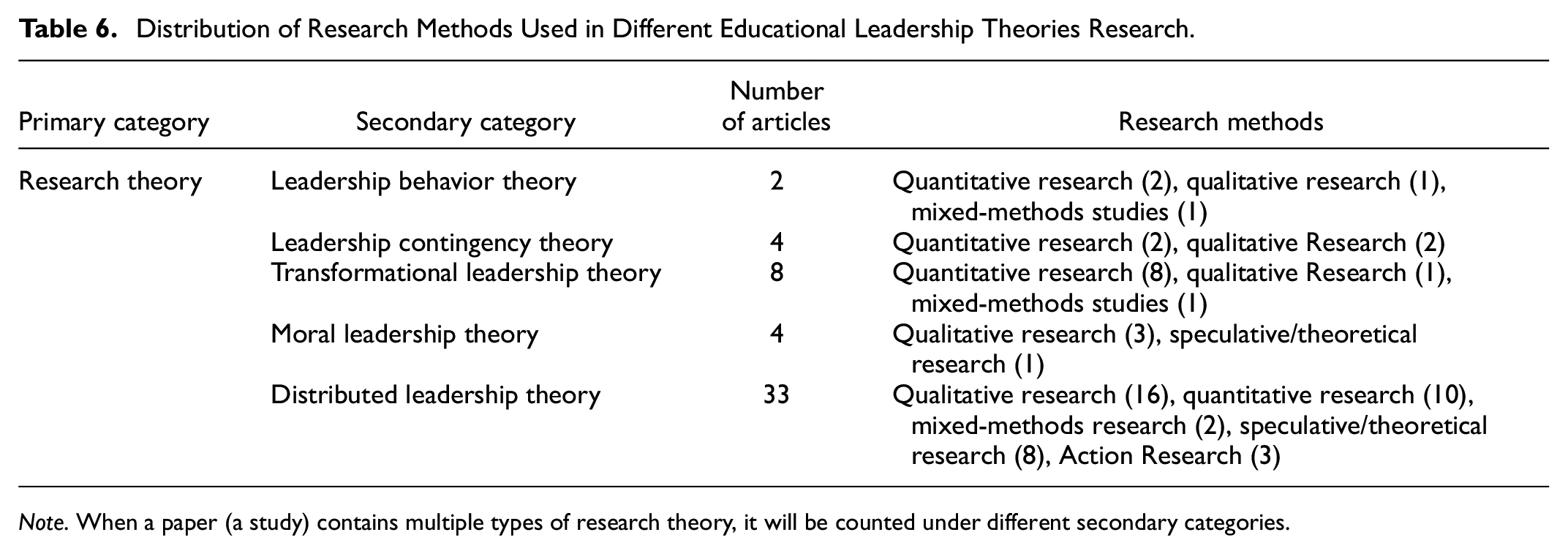
Through a comprehensive analysis of the research methodologies, employed in various educational leadership theories, we could gain insights into the fundamental frameworks that underpin the advancement of alternative approaches. Accordingly, these methodologies are systematically presented in Table 6.
Distribution of Research Methods Used in Different Educational Leadership Theories Research.
Note. When a paper (a study) contains multiple types of research theory, it will be counted under different secondary categories.
The findings presented in Table 6 reveal that a majority of theories incorporate both quantitative and qualitative analyses in their research applications. Particularly noteworthy was the prevalence of qualitative research within the distributed leadership theory, along with a significant presence of speculative and theoretical investigations. This indicated that the approach was still in a phase of robust development, requiring further expansion and empirical substantiation through objective evidence. Conversely, the transformational leadership theory has reached a mature stage, with a focus on applied studies that utilize the theory to explain observed phenomena and data. Furthermore, it was worth noting that the moral leadership theory stood out as the sole theory that does not extensively employ quantitative research methods. This distinction primarily stemmed from the ethical nature of its key elements, which predominantly involved subjective aspects such as value orientation and organizational culture, making them challenging to quantify using specific measures. Consequently, data collection, mining, coding, and analysis often relied on qualitative methods such as interviews.
Analysis of Research Targets in Educational Leadership
Research in educational leadership necessitates specific research targets, which typically included school leaders, school administrators, and teachers (Leithwood et al., 2010). However, as educational leadership theory has developed and evolved, the scope of research targets has expanded. Distributed leadership, for instance, posits that any member within an organization can assume a leadership role, leading to the emergence of concepts such as teaching leadership and teacher leadership. Consequently, an increasing number of studies have shifted their focus towards teacher groups (Aliakbari & Sadeghi, 2014; Marshall et al., 2012; Öznacar & Debes, 2019).
Guided by the principles of distributed leadership theory, several studies have proposed more comprehensive classifications of research targets. For instance, Larsson and Löwstedt (2020) delineated five distinct categories for research targets: principals, teacher team leaders, subject leaders, lead teachers, and common teachers. However, due to practical constraints in research design, it was impractical to encompass all categories. Instead, it is imperative to establish a classification system that offers a lucid representation of research targets within the realm of educational leadership theory. This entailed categorizing all school leaders and administrators as school managers, treating teachers as a discrete category, and acknowledging additional research targets that do not align with the aforementioned classifications (e.g., students engaged in educational management practices or decision-makers in government education departments) as “other research targets.” Moreover, studies exclusively focused on theoretical analysis without specific research targets should be classified as a separate category termed “unclear research targets.” The resulting classification framework is illustrated in Table 7, which presents the corresponding literature counts for each category of research targets.
Distribution of Research Targets in Educational Leadership Theory Studies.

Note. When a paper (a study) has multiple types of research objects, it will be counted under different secondary categories.
The analysis of Table 7 highlighted a significant focus on school administrators and teachers as research subjects, with 27 and 25 publications respectively. Notably, a considerable number of studies investigate both groups concurrently. A comprehensive examination of the literature reveals a predominant use of qualitative research methods, particularly interviews, in studies centered on school administrators, such as principals (Walker & Hallinger, 2015). In contrast, research on teachers tended to employ quantitative approaches. This preference could be attributed to the disparity in sample sizes between the two groups, making large-scale quantitative research challenging for the relatively smaller population of school administrators. Additionally, there were qualitative studies that encompassed entire universities as research objects (Egginton, 2010), as well as investigations focusing on parents (Brown et al., 2019) and students (Keddie, 2016). The diversification of research subjects indicated the evolving landscape of educational leadership, reflecting an increasing recognition of the human elements and values embedded within the education system.
Conclusions
This study utilized content analysis to examine the evolution of educational leadership theory over the past decade. Through the coding and analysis of quantitative data, the following research findings were obtained:
(1) The distributed leadership theory has garnered considerable attention within the academic community. However, the current research methods employed in this theory suggest that it remains in a state of ongoing development. It heavily relies on qualitative research approaches to discern patterns and phenomena within specific cases (RQ1).
(2) Empirical research serves as the predominant approach in the study of educational leadership theory. Both qualitative and quantitative research methods are employed to explore this subject, with case studies playing a crucial role in advancing the field’s development and informing theoretical investigations (RQ2).
(3) The central focus of educational leadership theory revolves around school administrators and teachers. Influenced by the advancements in distributed leadership theory, teacher leadership (also known as instructional leadership) has gained increasing scholarly attention and emerged as a prominent area of investigation within this research field (RQ3).
Implications, Limitations, and Future Work
Implications
The systematic review of educational leadership theory comprehensively explores the current state of development and evolving trends in international educational leadership issues, shedding light on the academic understanding and cognition of educational values. Without a doubt, educational leadership theory undergoes constant evolution, with each new theory addressing the limitations of its predecessors and bridging gaps left by prior frameworks. The discipline’s progress is achieved through this iterative process of renewal and iteration. By adopting a macroscopic perspective, this study provides a clearer comprehension of the deconstruction and reconstruction of educational leadership theories and associated concepts throughout their developmental journey—an indispensable pathway toward the scientific advancement of the discipline. Deconstruction entails a meticulous examination of existing achievements in educational leadership research, utilizing paradigmatic analysis to identify shortcomings and flaws. Conversely, reconstruction involves constructing the discipline based on the principles of disciplinary scientific development, thereby bestowing legitimacy upon the discourse of educational leadership.
Another noteworthy contribution of this study lies in the reassessment of the rational and affective dimensions within education. As elucidated in the literature review section, the issue of educational values has been a central concern propelling the theoretical development of educational leadership for the past half-century. This concern extends not only to educational leadership theory but also to the broader field of educational management, which has long grappled with the call for a resurgence of values. However, despite the persistent appeal for a value-oriented approach, the pursuit of “efficiency” remains deeply ingrained in current educational practices. Many managerial designs still prioritize organizational structures aimed at efficiency gains and compartmentalize individual work to task completion, thereby fragmenting the essential essence of education. It can be argued that educational management in numerous regions of the world remains constrained by classical organizational theories, with “retro” management forms like scientific management, administrative management, and bureaucratic structures impeding the transformation of educational management toward understanding, freedom, dialogue, fairness, and value creation. Nevertheless, it is precisely due to these circumstances that research in educational leadership and educational management continues to hold significance. This study reexamines educational values and reaffirms that educational management is a discipline imbued with values, one that scrutinizes value systems (Habermas, 1990). Its purpose is to remind scholars and education practitioners that research in educational management necessitates the consideration of values, and the work of educational management is intrinsically linked to the values of learners.
Limitations and Future Work
Due to time constraints, this study is subject to certain objective limitations. Firstly, the literature review was confined to the journal Educational Management Administration & Leadership (EMAL). While Hallinger and Kovačević (2022) have recognized EMAL as the sole mainstream research journal on educational leadership and management (EDLM) indexed in the WoS Core Collection, thereby rendering it highly representative, it may still lack comprehensiveness in depicting the current state of development in the field of educational management. Moreover, the categorization of the five major categories in educational management exhibits some minor omissions, as it may not encompass all the theories that arise during the developmental process of educational leadership theory. Certain relatively niche theories may not fit neatly into these five categories. Finally, there is scope for further enhancement in the design of the category table, such as incorporating educational stages (e.g., early childhood education, K-12 education, higher education, vocational education) as a primary category to analyze the application of theories across different educational stages. These aforementioned limitations will be addressed and rectified in future research endeavors to augment the scientific rigor and persuasiveness of this study.
Footnotes
Acknowledgements
The authors would like to express their sincere gratitude to the reviewers and editor for their valuable suggestions, to Zhejiang University of Technology and Universiti Sains Malaysia for providing opportunities for learning and researching.
Declaration of Conflicting Interests
The author(s) declared no potential conflicts of interest with respect to the research, authorship, and/or publication of this article.
Funding
The author(s) disclosed receipt of the following financial support for the research, authorship, and/or publication of this article: This research was supported by the National University Student Innovation and Entrepreneurship Training National Project of China (No. 202210337027, 202210337003), the University Student Innovation and Entrepreneurship Training National Project of Zhejiang University of Technology (No. 2022044), the 2024 Guangdong Education Science Planning Project (Special Project of Higher Education, Grant Number: 2024GXJK449), 2024 Regular Project of the “14th Five-Year Plan” for the Development of Philosophy and Social Sciences in Guangzhou (Grant Number: 2024GZQN85), 2024 Higher Education Research Project under the “14th Five-Year Plan” by the Guangdong Society of Higher Education (Grant Number: 24GQN27), the 2023 Zhejiang Education Science Planning Project(Grant Number: 2023SCG274), and 2023 A Project Supported by Scientific Research Fund of Zhejiang Provincial Education Department (Grant Number: SKY-ZX-20230164).

Data Availability Statement
The original contributions presented in the study are included in the article/supplementary material, further inquiries can be directed to the corresponding author.