




Abstract
Teachers often code-switch in the EFL classroom, but the question of whether or not they are aware of their code-switching has not been satisfactorily answered. This article presents the study on teachers’ understandings and beliefs about their code-switching practices in EFL classrooms as well as effective language teaching and learning. The participants of this study came from four junior high schools in Padang, West Sumatra, Indonesia: five teachers with their respective classes. This research used the conversation analysis and stimulated recall interviews to analyze the data which came from the video recording of classroom observations and the audio recording of stimulated recall interviews with teachers. The results revealed the pedagogical functions and affective functions of teacher’s code-switching. The data also showed that the use of stimulated recall interviews helped teachers to be consciously aware of their code-switching as well as of their other pedagogical practices in the language classroom. Therefore, stimulated recall interviews can be a useful tool for teacher self-reflection that they were not aware of their code switch. This awareness could be incorporated into language teacher professional development and in-service teacher professional learning.
Keywords
Introduction
The idea that teachers talk too much has perhaps acted as a barrier in evaluating teacher speech as language input. Nevertheless, the crucial points are not the quantity of their talk, but the way teachers talked, the language they used, and whether their talk aids their students’ language development. According to Turnbull and Arnett (2002, p. 211), there is a near consensus that teachers should aim to make maximum use of the TL. It is supported by LeLoup et al. (2013), who mention that teachers should use the target language as much as possible in the foreign language classrooms.
Polio and Duff (1994), Littlewood and Yu (2011), and Rondon-Pari (2014) acknowledge the claim that high use of the target language in the EFL classroom correlates significantly with the high students’ language output. However, Yamamoto-Wilson (1997) admits that careful use of L1 can assist students in learning a foreign language. Cook (2001) not only suggests that the usage of L1 should be minimized but also argues that the target language should mostly be used in the classroom as a tool of communication. He states that the systematic use of L1 in the second language classroom is for specific pedagogical purposes (Cook, 2001). However, to what extent should it be minimized is still an open question while Stephen (2006) states that the way L1 is used determines whether it is detrimental or helpful.
Literature Review
Studies, such as Lo (2015) and Raschka et al. (2009), have shown that switching between different languages is a common language behavior occurring in any regular interaction between speakers who share knowledge of the same languages. The behavior in alternating between different languages is known as code-switching. According to Wei (2005), people require competence in all languages involved to code-switch. In line with Wei (2005), Moghadam et al. (2012, p. 2219) define code-switching as shifting from one language to another in a conversation. It is a usual normal practice among people globally for various reasons and usually an unconscious activity. For those explications, this study defines code-switching as the alternation between two languages in the same discourse, and it is a common phenomenon in the present-day bilingual classroom.
Studies by Simasiku et al. (2015), de Sanchez (2018), Hamamra and Qararia (2018), and Bhatti et al. (2018) have scrutinized the advantages of code-switching in language classroom practices. Bhatti et al., for example, found that code-switching from English (L2) to the first language (L1) was a useful strategy in English as a second language class to help interaction between teachers and students and among students in the classroom succeed. According to Bhatti et al. (2018), all teachers and students in their study code-switched from L2 (English) to L1 (Urdu), although the primary language used in the classroom was English. Similarly, Simasiku et al. (2015) found that code-switching in the classroom helped students learn a second language more successfully. It is because learners were more active in the classroom if they were allowed to use their first language, notably when they experienced problems in speaking English in classroom interaction.
Another series of studies on code-switching by Alhourani (2018), Riaz (2019), Abdulhady and Al-Darraji (2019), Promnath and Tyjasanant (2016), and Gonzales (2016) focused on the possible reasons for code-switching in the classroom. Alhourani (2018), for example, found that Arabic students code-switched from English to Arabic for four different purposes: to cite other people’s ideas, to boast, to turn to another issue in a conversation, and to voice their perception. A study by Zainuddin (2016) also found that Indonesian students used English when having a conversation in Indonesian in four different conditions: (a) when they did not know the exact equivalence in Indonesian, (b) to show off, (c) to adapt to the situation, and (d) to help them communicate fluently without experiencing communication break-downs. These four possible reasons for code-switching by Indonesian students can be categorized into two factors: intrinsic and extrinsic factors (Zainuddin, 2016). Another reason for code-switching in the classroom was suggested by Rosa (2016) where limited vocabulary was the main cause of students’ code-switching in English as foreign language classes. This is probably because of the pressure to speak in a conversation in which students do not want to lose face in speaking. Therefore, they use their first language to overcome communication problems.
More studies on code-switching aimed at finding the perception or attitudes of teachers and/or students code-switching practices in the classrooms. A study by Ibrahim et al. (2013) found that teachers perceived code-switching in the classroom as positive; it was used for educational purposes. A similar finding was found by Rivera and Mazak (2017) in which students in their study had neutral to positive perceptions of code-switching. Therefore, they often code-switched in the classroom. Also, Songxaba et al. (2017) found that teachers in their study believed that code-switching was the best way to help students understand the lectures given by their professors. However, according to Songxaba et al., code-switching should be permitted at lower level classes but avoided at high-level classes.
The Rationale for the Study
In the present study, the language learning context becomes more complicated when the teacher shared the same language/s with the students, that is, mother tongue (Bahasa Minang) and the national language (Bahasa Indonesia). In such contexts, an essential issue is whether or not the students have sufficient opportunity to hear and use the target language (English) as the teachers are not always aware when and why they switch-code in classroom interaction (Inbar-Lourie, 2010; Polio & Duff, 1994; Yıldız & Yeşilyurt, 2017). In the context of the current study, students only had 80 min of English instruction per week that is constituted the only exposure the students have to the target language as an input. Nevertheless, even though the curriculum document encourages teachers to use the target language, English Curriculum at any level in Indonesia does not give clear guidelines on how much target language should be used in the teaching and learning processes in the classroom. This happens since the national curriculum only sets general objectives, then followed by developing and interpreting the curriculum at the level of each province (Suyanto, 2003).
Caukill (2015) and Wardaugh (2010) mention that teachers code-switch for both pedagogical and social purposes, but the question of whether teachers fully understand the processes of decision-making in code-switching has not been satisfactorily answered. This study tries to disclose the pedagogical practices of the teacher in performing code-switching in the EFL classroom at junior high schools in Padang, Indonesia. To guide this study, the following research questions were addressed:
Method
Research Design
Conversation analysis (CA) and stimulated recall interview (SRI) were used in this research to help the researcher to explore and describe the teachers’ language use, the teachers’ code-switching in the classrooms, and the understanding of the functions and the reasons of teachers’ code-switching as well as their perspective on their code-switching. It will be easier to look at the SRI that has not been widely used in EFL research contexts, especially in Indonesian EFL contexts (e.g., Cahyani et al., 2018). It is the reason why we chose a SRI to see whether the teacher perception and any mismatches with the classroom observation (e.g., Bensen & Çavuşoǧlu, 2013).
The SRIs with teachers were done after the completion of the entire set of classroom recordings to gain the “teachers” perspectives on their classroom practice (Gass & Mackey, 2000; Meade & McMeniman, 1992). Five teachers were chosen as the participants in conducting a SRI in Bahasa Indonesia to facilitate more in-depth expression. It is free for both the researcher and the teacher to stop the recording any time to provide comments on it. In conducting the SRI, the researcher selected two lessons video recording classroom interaction for each teacher which has the greatest amount of teacher–students verbal interaction. They represent a rich sample of teacher talk, in particular, the teachers’ code-switching.
In viewing the video recording, the researcher used a private room, as well as the interview data with the teacher. The interview was audio-recorded with their permission. By conducting SRIs, the teachers were assisted in recalling what they did and said in the lessons by watching the video-recording and asked some general open-ended questions to help them providing recall comments without leading them. The data were transcribed for analysis and translated into English to answer the research question: What are the perceptions of teachers in this context as to the relationship between code-switching and the effective teaching of English?
The Context
Indonesia has implemented the newest curriculum (Curriculum 2013) in running the teaching and learning process. In the 2013 curriculum, English as a subject in Indonesia’s primary school was taken away from the curriculum. Therefore, the students start learning English as a subject in grade seven in junior high school in Indonesia (Depdiknas, 2013). School terms run for a total of 34 weeks a year; hence they potentially have 68 sessions with 80 min in a session of English Language instruction. In this sense, the 2013 curriculum implementation only provides 272 hr of chance for junior high school graduates to be exposed to English in a classroom since they are no longer learning English in primary school. It is important to highlight this because English as a foreign language is new to junior high school students. Consequently, the issues of what language to be used by the teacher in the classroom interaction is crucial to consider.
Participants
The participants of this research came from four junior high schools, which were chosen randomly. There were five teachers referred to as Teacher A, Teacher B, and Teacher C, Teacher D, and Teacher E and their respective classes in four junior schools in Padang, West Sumatera, Indonesia. Each class consists of 25 to 30 students aged 13 to 15 years. The participating classes selected for classroom recordings were the ones in which the teacher participants taught English as a foreign language for two sessions or 160 min per week.
Data Collection
The data were collected from early January till the end of February during the second semester of the academic year. The researcher conducted the school visits every week for each school, with the total number of visits were varied between five teacher participants. As generally found in Indonesia, each class learned English as a foreign language for 160 minutes per week in junior high school. Twenty lessons were observed, and approximately 25 hr and 20 min of video were recorded from the five teachers. In conducting the classroom observation, the teachers and students were naturally encouraged to follow the normal teaching and learning process. As Erickson (2006) mentions, the video cameras were not moved while recording. It has been claimed that a fixed position of the cameras helps to minimize the influence of the observer’s perspective concerning what is and is not worth focusing on from moment to moment. There were two cameras set at a wide enough angle used in collecting the data since the purpose of the camera was to catch the two different points of view that were teacher-focused and students-focused.
The data for this research was the transcription of video lesson recordings, field notes, and SRI audio recordings. Transcription was used since the emic perspective of CA using transcription makes it possible to capture the “complex, fluid and dynamic” (Seedhouse, 2004, p. 60) nature of language classroom interaction. Seedhouse (2004, p. 43) also states that it is to develop an emic perspective on how the participants display to each other their understanding of the context. The analysis of this study follows Ten Have (2007, pp. 102–109) and Seedhouse’s (2004) analytic strategies practice of analyzing various interactional patterns to analyze the data which appeared relevant to the study; then, investigating individual CA phenomena.
Data Analysis
The researcher and an assistant have expertise in the relevant languages: Bahasa Minang (BM) as the mother tongue, Bahasa Indonesia (BI) as the national language, and target language or English (TL). In analyzing the data, they transcribed the video recordings and audio recordings following the transcription format adapted from Atkinson and Heritage (1984). In transcribing the video-recorded classroom interaction to facilitate the consistency of the transcription, the researcher applied rules as follows:
Every lesson is transcribed as a single unit;
All utterances were written out in full. When two words are contracted and uttered as one as in “we’re” and “I’ll” these are counted as two words;
However, contractions of the verb and the negative such as “don’t” are counted as one word (Hubbard, 1998, p. 248).
The CA started by coding the lesson transcripts, then coding the classroom observation transcripts to determine teachers’ code-switching functions. Examples of code-witching were identified from the lesson transcripts. Therefore, the occurrence of Bahasa Minangkabau (BM), Bahasa Indonesia (BI), and Target Language (TL) used in each class was calculated and compared. For this purpose, the teacher talks in the classroom; the researcher extracted the verbal interactions from the lesson transcriptions. Then, the audio recording of the SRI was transcribed. It is to determine the reasons for teachers’ code-switching by using AS-unit and following a thematic approach to uncover overarching themes that emerged from the individual participant teacher data as well as those emerging from comparisons of the five teacher participants’ performances. This analysis process revealed the teachers’ target language practices as input, the functions, and the teachers’ awareness of code-switching.
Result
The Amount of Teachers’ Language Use
The result of this study disclosed that teacher talk often involved at least two languages in the classroom that was Bahasa Indonesia (BI) and English (TL) and a few uses of the local language, Bahasa Minang (BM). Three languages were available in the participants’ repertoire, though only two of them (Bahasa Indonesia and English) were activated, with minimal exceptions. It can be concluded that the reason for Bahasa Minang was less evident because Bahasa Indonesia is the official language of the school and the unifying language of the country, and English as the target language. Therefore, code-switching occurred almost exclusively between Bahasa Indonesia (BI) and English (TL). The word count from the transcriptions of classroom interaction recordings showing the number of words of Bahasa Minang (BM), Bahasa Indonesia, and English for teachers’ language use is shown below.
As can be seen in Figure 1 above, teachers in this study did code-switching in teaching English although they mainly used English in the classroom. The analysis discloses that Teacher A switched code less than the other teachers. Like the other teachers in the present study, Teacher A did the most code-switching in the while activity. It showed that she maintained the TL for her students by using other strategies to help the students understand her TL. The analysis reveals that Teacher E did the most code-switching among the five teacher participants. Having a lack of English proficiency could be the principal reason for her to do many code-switching.
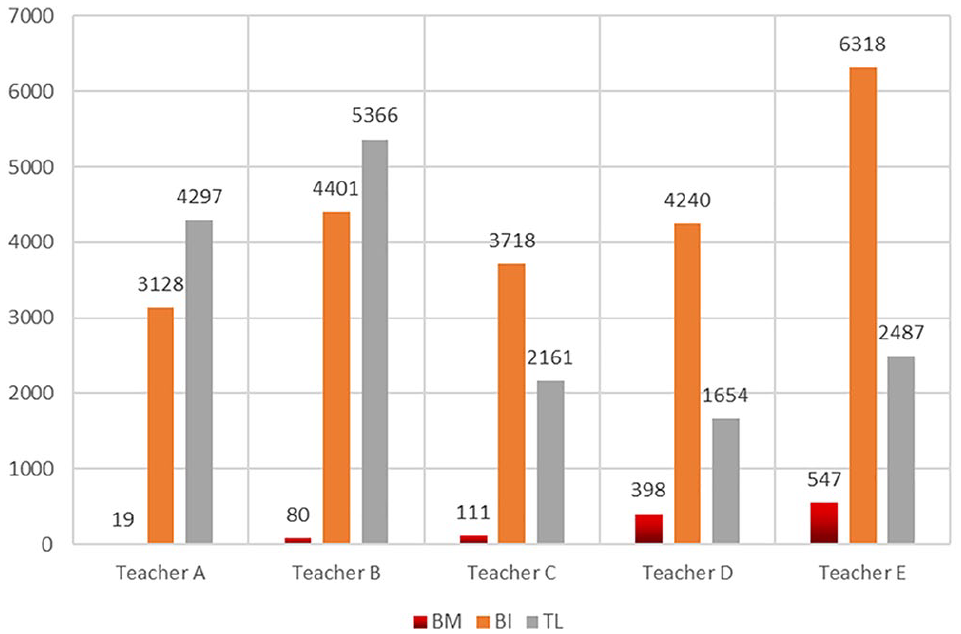
The amount of teachers’ language use counted in words.
The five teacher participants in this study had different foci of language components and language activities in the classroom lesson observation. Teacher A’s main focus was on listening skills by introducing new vocabulary with a particular emphasis. Teacher B focused particularly on explaining grammatical items by frequently providing her students with the practice of target language structures through controlled speaking activities to practice them in context. In line with Teacher B, Teacher E focused her lessons on grammar, but she was the teacher that used Bahasa Indonesia the most compared to the other four teachers in the classroom interaction with the students. Below is the description of teachers’ code-switching practices in this study.
Code-Switching Practices in the Observed EFL Classrooms
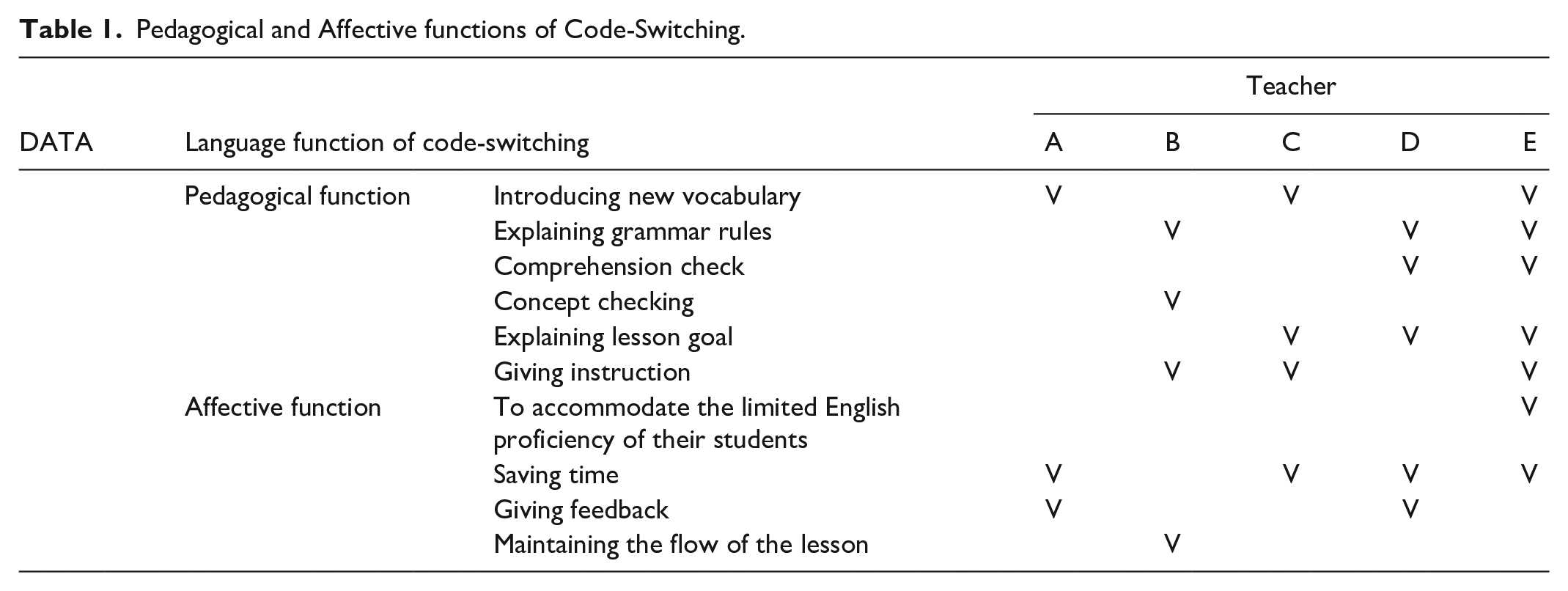
All teachers’ utterances containing Bahasa Indonesia were identified and categorized into two main categories that are pedagogical and affective functions. According to Canagarajah (1995, p. 179), the pedagogical function means that code-switching can help in the effective communication of the lesson content and language skill, which have been specified in the curriculum. Sert (2005, p. 3) defines that affective function refers to code-switching functions that serve for expression of emotions while Bensen and Çavuşoǧlu (2013, p. 72) state that code-switching serves as expressions of emotions to build solidarity and good rapport with the students. Table 1 shows the pedagogical and affective functions of code-switching as analyzed using the CA of the classroom observation transcripts.
Pedagogical and Affective functions of Code-Switching.
Discussion
Teachers’ Perceptions of Their Underlying Reasons for Code-Switching
Table 2 presents the key motivations for code-switching, as stated by the three teachers during the SRIs.
Teachers’ Reason for Code-Switching.

This study found that not all the observed data were consistent with the teachers’ perceptions as expressed in SRIs with the teachers. The main functions of code-switching, as expressed by the teachers were pedagogical reasons and affective reasons. Pedagogical reasons were used to teach grammar, to explain new vocabulary (translation), to check students’ comprehension, to emphasize certain points in the lesson, and to explain the lesson goal. Affective reasons were used to accommodate their students’ limited English proficiency, saving time, reprimanding or scolding, and maintaining the flow of the lesson. Macaro (2001) and Tang (2002) state that using L1 is less time-consuming than using the target language exclusively, and it is in line with the four teachers that claimed that they applied code-switching to save time. They argued that the use of code-switching was due to the limited EFL classroom time, and it affected the practice time available so that incorporating L1 in EFL classrooms was essential because it was more efficient and time-saving. Atkinson (1987) and Tudor (1987) in Kelilo (2012) also state that “translation or L1 use is often determined as productive, time-saving technique.” Teacher A in her comments mentioned the reason why she used Bahasa Indonesia. She mentioned that: Sometimes it took time to explain something in English, and I had to use Bahasa Indonesia in order to save time. (A 24-02)
It is also found that code-switching was used for maintaining the lesson flow. Teacher E used “paham anak mam” as the utterance in checking her students’ understanding regarding her explanation for a pedagogical choice. However, the lesson transcript analysis showed that students answered her with “yes,” which might not an honest answer. The utterance “paham anak mam” was used for the affective reason of helping the teacher to be confident. The data gained from the interview revealed that Bahasa Indonesia was used to construct a comfortable learning environment that makes the students enjoy learning English. In the case of Teacher E, Bahasa Indonesia was used to put students at ease and maintain relationships with the students.
Teacher D reported that she used Bahasa Indonesia to motivate her students to participate in class interaction. The use of Bahasa Indonesia might facilitate the learners’ understanding, but they had less exposure to TL, especially in the context of EFL learning where the opportunities to listen and to use the TL are limited (Musumeci, 1996). Therefore, the overuse of L1 will not help the students to achieve their goal of learning a foreign language. Moreover, the teachers stated that there were no clear guidelines for the quantity of using L1 in the classroom; the curriculum recommendation is simply to expose the students to the target language. The debatable issue about whether L1/L2 can be useful in the classroom or not is irrelevant if the teachers are unable to select the appropriate occasions to use it. Consequently, a teacher’s ability to control her or his use of language is considered to be as important as her or his ability to select appropriate methodologies (Walsh, 2002).
After watching their respective teaching video recordings, each teacher participant commented on their use of L1 in their teaching. The following comments from a SRI are examples of teachers’ reflection indicating that watching the video was a significant stimulus in enabling the teachers to view their teaching objectively. As Rosaen et al. (2008) mentioned, their reaction after watching the video recordings showed that it was a powerful medium in revealing aspects of their teaching, which they had not previously considered.
Teachers may be aware of some of the factors that may have influenced their language choices in general as analyzed by using the data from the lesson transcripts and the SRI transcripts. However, the teachers commented themselves that they were not aware of other factors until they watched the video of their teaching. This experience of watching their lessons appeared to provide a professional learning experience around code-switching in the classroom and lead to the findings that may have implications for language teacher education. As the previous explanation, at the end of the SRI, the teacher participants in this study gained more awareness of when and how much they engaged in code-switching. The result of this study implicates that they appeared to gain knowledge of how to fine-tune their use of code-switching in the classroom. Generally, it was found that teachers consciously switched to Bahasa Indonesia were to explain some points of grammar and explain a new difficult word and the typical occasions when they did code-switching unconsciously appeared to give significant pause for thought.
Teacher’s Beliefs About Language Choices in the Classroom
The teachers in this research agreed that the students need to be exposed to the target language significantly. However, Teacher A did not propose specific percentages when the five teachers participants were asked to give their opinion on the ideal proportions of English and Bahasa Indonesia to be used in classroom discourse. Teacher C, Teacher D, and Teacher E proposed specific percentages, which are 70% English and 30% Bahasa Indonesia, and however, it did not match her practice in classroom interaction that showed most of their observed utterances were in Bahasa Indonesia.
Teacher A
Teacher A did not mention specific percentages when she was asked about the ideal proportions of English and Bahasa Indonesia used in the teaching and learning process, but she acknowledged that more English should be used in the classroom. The result shows that she used the most English in the classroom of the five teachers (57.72%).
Teacher B
Teacher B mentioned that the target language’s ideal proportion percentages and mother tongue or second language is 50:50. She explained her beliefs by expressing to the researcher in the interview that it was challenging to teach grammar in the target language to young learners. These remarks are not compatible with what her observation data revealed. She revealed that her purpose in switching the target language to Bahasa Indonesia was to explain the important points related to grammar and vocabulary because she thought that grammar was a difficult part of teaching a language. Teacher B recognized that it is important to have further consideration about the way she taught in regard to language choice.
Teacher C
Teacher C mentioned in the interview, he used 75% of English in her classroom interactions. However, the observation transcript analysis data revealed that he used only 36.07% of the target language during her classroom interaction. It may be concluded that Teacher C was not aware of his code-switching.
Teacher D
Similar to Teacher C, Teacher D claimed that she used around 70% of English. She believed that an English teacher should use 70% of the target language and 30% of the mother tongue. Her belief was contradicted by what she had done in her classroom interaction. She used 27.6% of English and 67.38% of Bahasa Indonesia.
Teacher E
Teacher C was surprised to see how much Bahasa Indonesia she used in the classroom. She explained that she did not realize that she used that much Bahasa Indonesia in her interaction with her students. She admitted that teachers should be educated on the use of the target language in the classroom because she felt that there was a lack of knowledge among teachers in Indonesia regarding this.
Teacher Self-Reflection
Self-reflection provides information about one’s condition at the moment in a particular context (Richard & Lockhart, 1994). This self-reflection is important as it may reflect the individual’s self-conception at that current moment and connects to the facts in the real world. Richard and Lockhart (1994, p. 29) state that what teachers do reflects what they know and believe and that teacher knowledge and “teacher thinking” provide underlying framework or schema that guide teacher’s classroom actions. So, teacher self-reflection is crucial as it can be used as part of her or his professional development.
In this study, the five teachers felt surprised at their code-switching practice when watching the recordings and acknowledged gains in awareness through the SRI. The finding of this research suggests that this technique is a powerful tool in language teacher education or ongoing teacher professional learning. For example, Teacher B sometimes used Bahasa Indonesia for giving classroom or task instructions, but she realized that she should have used English in certain parts after watching the recording of her teaching. Her previous ideas of the “need” to use Bahasa Indonesia had been modified, which is an interesting dimension to the SRIs. The SRI can be used as a tool in reflective teaching where it is a valuable teaching approach in which teachers, as participants of the research, collect information about their classes and pay close attention to their behavior and teaching strategies (Ferdowsi & Afghari, 2015).
During the interview sessions, the case of teachers’ poor English proficiency was identified as one of the reasons hindering teachers from using the target language seems to be problematic because logically, an English teacher should be someone proficient in the target language. However, this problem was apparent in the context of this study. This matter can eventually be well anticipated in advance if teacher education programs also contain strong elements of enhanced TL learning, with perhaps refresher language courses offered during pre-service or even in-service contexts, via opportunities to spend time in English-speaking countries.
In most cases, self-reflexivity in teaching refers to teachers learning to subject their own beliefs of teaching and take more responsibility for their actions in the classroom (Korthagen, 1993). Reflexivity is viewed as a process of becoming aware of one’s context and gaining control over this awareness. According to Nagata (2004), . . . self-reflection is after the fact; self-reflexivity is in the moment and feeling is likely to have more immediacy so it may be easier to grasp its role. To be reflective is to sit and think about what took place after it is completed; one’s role in it, others’ reactions, and one’s responses to them. (p. 142)
Teachers need to be reflective as it is a useful source of professional development and reflexive support critical introspections. Nagata (2004) states that reflexivity can nourish reflections as introspection leads to heightened awareness and self and profession improvement.
In this research, the teacher participants believed that they realized the aspects of their teaching that they were never aware of before when they were watching their lesson on video. It helped them see their teaching strengths and identify areas of language use they wished to improve later on. By having the opportunity to watch and analyze their teaching video, they may have greater motivation experience, and engagement in the activity, further enriching the reflective process. It is supported by Kong et al. (2009) that the use of video cases to study classroom interaction in the teacher education program and teacher professional development might lead to improved teaching practices and, in turn, has the potential to improve students’ achievement.
The teacher participants evolved the self-reflexivity evident through SRIs. In other words, the SRI caused teacher participants to engage in self-dialogue and self-assessment, which according to Tsui (2007) and Varghese et al. (2005), is an ideal approach. In contrast, Park’s (2014, p. 173) study calls “for a shift from employing reflective practices in teacher education program to reflexivity,” which emphasizes both the researcher and the participant’s mutuality. Park (2014) continues that: As researchers, we often focused on the research participants and fail to reflect upon ourselves and the extent of our influence upon the research context. Although theories of L2 learning have emphasised the importance of interaction, most L2 researchers do not seem to consider themselves as active agents within their research context. (p. 175)
Specifically, in Padang, West Sumatra, Indonesia, there are teacher working groups known as MGMP [Musyawarah Guru Mata Pelajaran]. They are teachers’ professional development programs. The purpose of MGMP is to facilitate teachers to improve the knowledge quality, insight, and professional skills, especially for secondary schools (junior high schools and senior high schools) teachers, which in turn can improve their teaching quality (Syofiarni, 2006). Alwiyasin (2016) explains that the purpose of MGMP is to increase teachers’ competence at the level of junior and senior high school, which leads to the improvement of education quality. In this association, the school’s teachers from the same region organized a monthly meeting to discuss all issues related to their teaching.
One of the teachers in Marwan’s (2014) study reported that this teacher gathering is not effective due to the lack of better training activities. “Observing someone’s teaching was a useful activity” (Marwan, 2014, p. 229); however, there was no reliable classroom observation practice. Besides, the activities in KKG are not effective because teachers in the meeting speak in Bahasa Indonesia (Marwan, 2014). It would be worth doing if teachers in this monthly meeting speak in English to enhance their English speaking proficiency. In this case, SRIs involving self-reflexivity might help these teachers. Teachers can record their teaching process in the classroom and bring the video recording to the MGMP meeting to have a self-reflection with their instructors and peers’ help. The teachers need to perform self-reflexivity by allowing teachers and student participants to engage in reflective practice.
Conclusion
The results of this study by using CA revealed the learning environment in terms of teachers’ code-switching. This research found that pedagogical and affective functions were identified in code-switching and associated these observed functions to teachers’ perception toward code-switching through SRIs. The pedagogical functions were performed to teach grammar, explain new vocabulary (translation), checking comprehension, explaining lesson goals, giving instruction, and concept checking were demonstrated to analyze video recording classroom observation transcripts. The affective functions of teachers’ code-switching were found effective in helping the teacher to overcome their students’ limited English proficiency, to give feedback, to maintain the flow of the lesson, and to save time.
The experience of watching their performance in teaching language was found as a powerful agent of change to provide a professional learning experience in the classroom that revealed the aspects of code-switching that they had not previously considered. SRIs helped teachers to gain insight into their use of language, particularly their code-switching. It is necessary for teachers to know and be cautious about when and why they code-switch to avoid the overuse of L1.
As we believe, we have established that it is important to know why teachers code-switch, a raised awareness of code-switching practice, and the role of the L1. We recommend that English teachers should be cautious not to overuse their L1. Furthermore, managing code-switching in the EFL classroom, especially in the beginning EFL classroom or junior high school level, could be incorporated into language teacher education as a component of classroom interactional competence.
Footnotes
Acknowledgements
The authors wish to thank Universitas Negeri Padang for the financial support for this study.
Declaration of Conflicting Interests
The author(s) declared no potential conflicts of interest with respect to the research, authorship, and/or publication of this article.
Funding
The author(s) received no financial support for the research and/or authorship of this article.
