




Abstract
Translation of scientific texts has been regarded as having the least freedom and variety in rendition; however, inconsistencies occur when translators work with two language systems that differ in reference to time, such as between Chinese and English. Tense is one of the core components of English grammar, but such information is not apparent in Chinese because the Chinese language tends to express time with lexical items in context instead of adding morphological changes to the verbs. The present study collected Chinese-English translated texts from graduate students on topics in the popular science domain. Analyses were conducted by comparing the tense information in the source text and the tense rendered in the target text on a sentence-by-sentence basis. The results showed that while the source text in Chinese stayed in the present tense, the students tended to switch from the present tense to the future or past tense during translation. In particular, the Chinese word “hui” has a habitual meaning that usually describes facts instead of presenting a future tense in scientific texts, but the students tended to interpret it as a future tense word, thus producing inappropriate tense shifts during translation. The pedagogical implication of such findings on inconsistent tenses between the source and target texts suggests that in the teaching of translation, analysis of the tense structure of the Chinese text and the consistency of tense information rendered in English should be emphasized.
Keywords
Introduction
A translator is supposed to faithfully translate the message in the source text into the target text, including messages or entailments that are not explicitly stated in the text (Shastri, 2011). However, in a practical situation such as in a translation classroom where students are required to translate from Chinese into English, students who are native Chinese speakers often produce English texts that are prone to be inconsistent or even wrong in terms of tense (L.-H. Tsai, 2020; P.-S. Tsai, 2021).
Tense, as trivial as it may appear, carries important messages that may distort the original meaning of the source text if it is not properly rendered into the target language (P.-S. Tsai, 2021). As presented in previous research that compared English translations of Chinese texts between native and non-native English-speaking professionals (Chen & Dong, 2016), the reason that makes the rendition unnatural to the readers of English came from the inconsistencies in the tense and aspect. Furthermore, interviews with Chinese students with an advanced English proficiency level equivalent to C1 in the standard of the Common European Framework of Reference (CEFR; above 6.5 in IELTS; EF Education First, 2022) also showed that students considered the differences in the tense marking systems between Chinese and English challenging for them during translation (Li & Zhao, 2021).
Literature Review
Tense and Aspect Problems in Translation
Previous studies have shown that the grammatical structure in the first language would influence the translation of a second language (e.g., Jabbari & Salimi, 2015; Ma et al., 2019; Newbery-Payton & Mochizuki, 2020). In other words, the similarity between the first and the second language in terms of syntactic structure such as the tense marking system could have influenced the performance of a translator.
Support for the notion of first language influence came from the comparison between Cantonese, a Chinese dialect, and English. According to a study of middle school English learners in Hong Kong (Hong, 2008), in a Cantonese-English translation task, the students tended to reproduce the sentence either in the present perfect or the past perfect form in English when the source text in Cantonese was in the simple past tense. For source texts composed of the same verb phrase but in the present tense (without the past tense marker), the students tended to render the text in the simple present form, which was consistent with the tense in the source text. It seemed that the concept of tense in English was challenging for Cantonese speakers to reproduce the message in the correct tense.
The choice of tense is a problem that can be observed in students with a lower command of English. Ma et al. (2019) separated native Chinese undergraduate and graduate students studying in New York into a high and a low English proficiency group. They found that the tense problem was prevalent in the low English proficiency group but not in the high English proficiency group. In another study of undergraduate English majors in China (Li & Zhao, 2021), interviews showed that for Chinese students learning English as a second language, the majority of inappropriate tense usage was resulted from the students’ misunderstanding of English tense or lack of knowledge of the tense usage between languages. Similarly, Yossatorn et al. (2022) studied a group of students whose native language was Thai to translate sentences from Thai into English. The students were at the B1 level (i.e., intermediate English level), and they found that tense inconsistency between the source and target languages was ranked the second most frequent problem in students’ translation.
The mastery of aspect was even more challenging than tense. A corpus study examining published Chinese texts translated from English showed that aspect markers such as the perfective aspect marker “-le” (-ed) and the imperfective aspect marker “-zhe” (-ing) were less frequently used in translated texts than in texts composed by native Chinese writers (non-translated texts; Xiao & Hu, 2015), indicating that cross-linguistic transfer of aspectual message was difficult between English and Chinese. In another study using a Chinese-English translation task, vocational high school students had difficulty translating the perfect aspect from Chinese into English, and they either chose the simple past or simple present tense in rendition (L.-H. Tsai, 2020). These findings echoed the proposal of the unique item hypothesis that some particular items in a language would be under-represented when they were translated into instead of composed by speakers of that language (Mauranen & Kujamäki, 2004).
Tense and Aspect Systems between Chinese and English
A major difference between the Chinese and the English expressions of time is that the English language uses tense markers, such as “-ed,” to mark time, and every verb is expressed in a certain tense. Therefore, a speaker can easily identify the time of the sentence if a sentence is taken out and isolated from a paragraph. On the contrary, in Chinese, tense is expressed through context instead of a single morphological marker affixed to the verb (Lin, 2006). If a sentence is isolated from a context, the time that it expresses is ambiguous unless a specific time phrase is provided in the sentence.
The aspect marker “-le” is typically translated as a perfective marker indicating that an action has been completed (Zhu, 2019). The translation of this aspect marker has been under discussion for decades because the interpretation of its temporal meaning and grammatical function varies depending on the context (e.g., Lin, 2006; Ma, 2006; W.-T. D. Tsai, 2015; Zhu, 2019). In most cases, “-le” in the middle of a sentence is usually suffixed to a verb, which is similar to an English “-ed” as past tense or past participle. Therefore, the translation of “-le” in (1b), (2b), and (3a) is a perfective aspect, and the lexical meaning changes with the main verb that the suffix “-le” is attached to.
Different from English, a verb in a sentence in Chinese can be expressed with a certain type of aspect marker. For example, (1a) sounds like that the sentence is unfinished and vague, but adding an aspect marker such as (1b) and (1c) provides a clear reference to the tense and aspect. With an aspect marker, the sentences in (1b) and (1c) also sound more natural than a sentence without an aspect marker such as the one in (1a). Abbreviations used in gloss are provided in Transcription Conventions at the end of the paper.

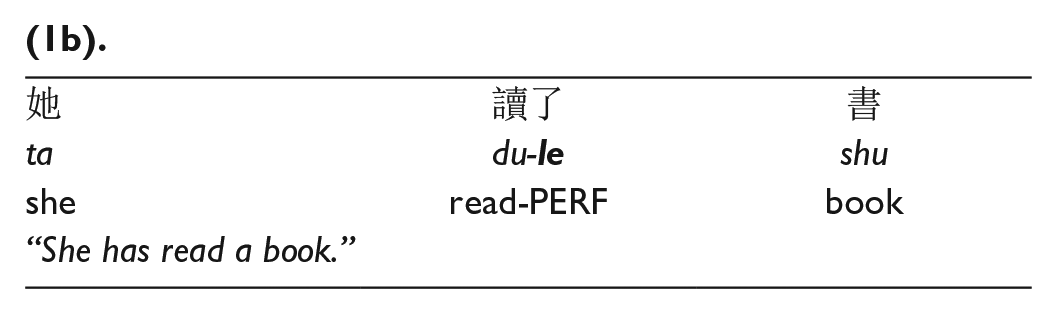

The Chinese language uses aspect markers such as “-le” or “-guo” that are appended to verbs to express the speaker’s perspective on time. For example, Sentences (2a) and (2b) both express events that happened in the past. The syntactic structures in the two sentences are identical, but the meanings, especially the perspectives of the speaker, are different.

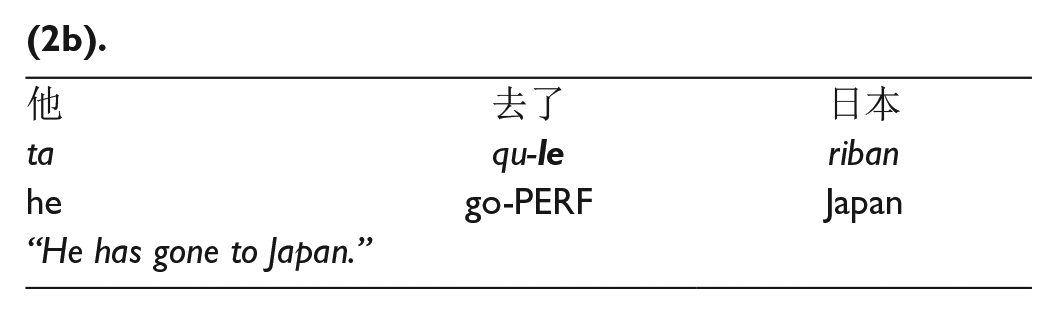
In (2a), the aspect marker “-guo” emphasizes the experience of the agent, while in (2b), the marker “-le” states the fact of an event in the past. In other words, “-guo” is an experiential aspect marker, while -le is an actual aspect marker. When“-le” is not used to make a contrast with “-guo,” the perfective meaning of “-le” is weakened. Thus, the perfective aspect marker “-le” can sometimes be treated as a past tense marker because the fact of something happening in the past is the emphasis when this marker is used. Whether “-le” is interpreted as a past tense marker or a perfective aspect marker depends on the context. This flexibility is one of the reasons that Chinese is regarded as a language without tense (Lin, 2006).
The inconsistencies between the Chinese and the English tense marking systems have created challenges for machine translation for decades. Previous studies have attempted to generate tense rules for Chinese-English translation based on parallel corpus data (e.g., Liu et al., 2011; Xiao & Hu, 2015; Xiao & McEnery, 2005). Among the studies, Liu et al. (2011) proposed an automatic tense prediction system based on statistical learning rules. However, the progress being made so far is still restricted to four simple tense markings, including the present, past, future, and infinitive. More detailed aspect differences such as the ones described between “-le” and “-guo” in (2a) and (2b) were not included.
Error Analysis
Errors are seen as records that help researchers look into the mental process that the participants have experienced during the task (Putri, 2019; L.-H. Tsai, 2020). Analyses of the errors help researchers identify the types of common problems that the participants make, and also provide evidence for researchers to evaluate and verify the validity of different theoretical hypotheses. For example, it was found that Chinese learners of English made more errors by translating the Chinese word hui from a habitual usage into a future tense will or would, whereas the Japanese speakers did not show such a tendency (Newbery-Payton & Mochizuki, 2020). On the other hand, the Japanese learners of English made more errors in relative clauses, mimicking an L1-like usage.
Similarly, more errors were observed in a translation task between languages that were different in grammatical structures of tense and aspect than those between languages that were similar in terms of how tense and aspect were expressed (Jabbari & Salimi, 2015). In the study, Persian and English, as compared with the pair of Turkmen and English, were different in terms of how simple present and present progressive tenses were structured. The participants produced a more correct translation of sentences from Turkmen into English in terms of tense usage in a translation task than the participants who translated from Persian into English, which were of different tense and aspect structures.
Chen and Dong (2016) investigated the use of tense among professional Chinese-English editors in translating Chinese press editorials into English. The translators were separated into native English-speaking professional translators, native Chinese-speaking professional translators, and native Chinese-speaking novice translators. The native English-speaking translators used their native language; therefore, their choices could be viewed as a reference in comparison with other native Chinese-speaking translators. The target texts in English were coded into five tense-aspect combinations: simple past, past perfect, simple present, present progressive, and present perfect. The results showed that the native English-speaking translators chose less simple past tense, and the native Chinese-speaking professional translators used less present progressive tense. Experienced translators (both native English-speaking and Chinese-speaking professionals) used less present perfect and more simple present tense than novice translators. The native English-speaking professional translators used simple past tense more frequently than the native Chinese-speaking professional translators, who also used simple past tense more frequently than novice translators. Their research results revealed a difference in the choice of tense among translators of different language proficiencies, especially in the choice of simple past tense.
Research Questions
While previous studies compared the frequencies of tense and aspect usages across languages and their translations (e.g., Chen & Dong, 2016), they did not look into the consistencies of the tense and aspect between the source and the target texts. For example, it was unclear whether the native English-speaking translators rendered the translation with more simple past tense because the source text in Chinese was written with more simple past tense or because the translators interpreted the source text as in the past (but the source was not written in the past tense). In other words, how the translator interpreted each sentence was not reported in the previous studies.
In addition, each of the previous studies on Chinese-English translation was collected from students of a certain English proficiency level, such as preliminary or lower level (Hong, 2008; L.-H. Tsai, 2020; Wang & Wu, 2009), upper-intermediate, or even higher levels (Chen & Dong, 2016; Dong, 2014; Dong & Lan, 2008; Li & Zhao, 2021; Newbery-Payton & Mochizuki, 2020; P.-S. Tsai, 2016, 2021). Few studies have looked into the translation produced by students of different English proficiency levels at the same time (except Chen & Dong, 2016).
Therefore, the goals of the present study were to map the consistencies of tense and aspect (1) between the source and the target text and (2) between participants of different English proficiency levels (between B2 upper intermediate and C1 advanced). The research questions were:
The research results were expected to shed light on translation teaching in guiding students to analyze and pay attention to the equivalence of tense and aspect between languages.
Method
Participants
The data were collected from two groups of participants: 24 graduate students from the program of translation and interpretation (19 females, 8 males), whose English proficiency was equivalent to advanced (C1) level in the CEFR, and 8 graduate students from the program of English with upper intermediate (B2) English proficiency (6 females, 2 males). The students in the translation group had intensive translation training for at least 6 months before participating in the study. The age ranges in both groups were between 22 and 53 years old. Their native language was Mandarin Chinese, and English was their second language.
Materials
Forty-two Chinese-English translation samples were collected as homework assignments from the graduate students. Each student contributed one to two translation samples to the research pool. The names and school numbers of the participants were removed from the analyses. The procedure of data collection was approved by the Research Ethics Committee, National Changhua University of Education (NCUE REC 109-008).
The Chinese source texts were news, market report, and science report collected from the official websites of National Applied Research Laboratories, the journal of Scientific American Traditional Chinese Edition, and National America Intellectual Property. These samples centered on three topics. One was a brief introduction to the principle behind the operation of a microwave oven; one was an innovation conference report on a pair of newly innovated eye-tracking glasses, and the other was an introduction to a new smartphone that applied eye-tracking technology. Each source text (as presented in Supplemental Appendix 1) contained 403 to 748 characters (approximately 240–443 words) in Chinese. These samples yielded a total of 1,077 Chinese sentences. The difficulty of these Chinese texts was about the level of fifth graders in elementary school according to the analyses provided by Chinese Readability Index Explorer (CRIE, version 3.0; Sung et al., 2016). The English translation of these texts was prepared by the researcher of the study.
Analysis Procedure
The students’ translation was handed in printed form, which was scanned and converted into digital texts, and then pasted into a spreadsheet line by line in Microsoft Excel. Next, the tenses and aspects for each sentence were identified and labeled separately for the source and the target text, as shown in Supplemental Appendix 2.
Data Analysis
Descriptive statistics such as frequency and percentage were calculated with Microsoft Excel. Inferential statistics such as chi-square tests of the tense and aspect used between the source and the target texts were calculated with IBM SPSS Statistics (Version 20).
Results
Representative examples of the categorization of tense and aspect of the main verb of the sentence in the source text (Chinese) are listed in (3a) through (3e). Details of all data are presented in Supplemental Appendix 2.


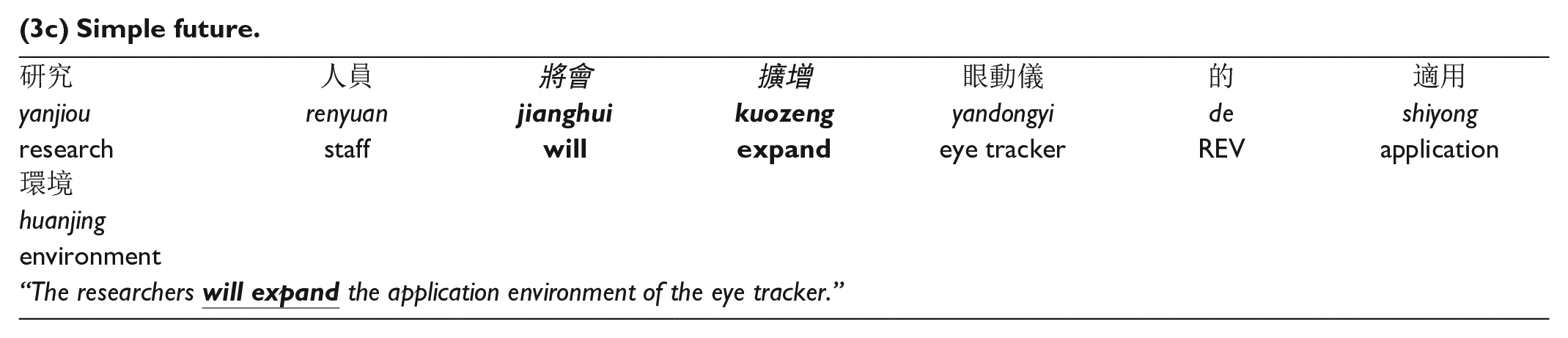


Example (3a) is in the simple past tense because it uses the past particle “-le” (-ed) immediately after the verb. Example (3b) is in the simple present tense because it states the fact, and there are no time-related adverbs or aspect markers in the sentence. Example (3c) is in the simple future tense because it uses the adverb “jianghui” (will) in the sentence. The sentence in (3d) shows an example of present perfect because the temporal adverb “xianjin” (nowadays) and the adverb “yi” (already) are used in the sentence. Because in Chinese, there is no aspect or tense markers for the present perfect expression, the adverbs of time are the clues that provide such temporal information. Example (3e) is future progressive because the adverb “jianghui” (will) has set up the time frame into the future tense, and the serial verb construction of “chixu” (continue) and “gaijin” (improve) demonstrates that the event is in progress. Thus, the sentence in (3e) is in a future tense in combination with a progressive aspect.
The examples from (3a) through (3e) showed that in the source text, the tense and aspect were relatively simple, probably because the source text was on scientific topics that emphasized facts, reasons, and new information. However, when the participants rendered these texts into English, their translation contained a wide usage of tense and aspect. Examples of different types of tense and aspect identified in the target text are presented in (4a) through (4g). The names of the participants were coded and presented in parentheses at the end of each rendition. The letter T stands for graduate students from the translation and interpreting program, and the letter E represents graduate students in the English program.
In the year of 2010, Apple
When the wave
Even while microwave ovens
While wearable electronic device
There
Researchers
This newly developed cameraless eye tracker has two functions:
The bold font and underlines in (4a) through (4g) highlight the main verbs of the sentences, in which the suffixes of the past tense “-ed” in (4a) and the third person singular present tense “-es” in (4b) indicate the tense being used in the rendition. The combination of the auxiliary verb “have” and the past participle of the be verb “been” in (4c), the progressive form “-ing” in (4d), and the future modal verb “will” in (4e) provide clear clues for the tense and aspect rendered into English. A sentence such as (4f) that uses a combination of a future modal verb “will” and a gerund “-ing” is identified as a future progressive tense. The last type in (4g) represents the few instances where the text is rendered into an imperative form.
The data in the present study showed that both groups of participants were generally accurate and consistent in reproducing the tense and aspect in the translation. The mismatches of tense and aspect between the source and target texts only accounted for 23.81% for the English majors (the upper intermediate English users) and 18.93% for the translation and interpreting majors (the advanced English users) respectively (as presented in Table 1). The results of the quantitative analysis are summarized in Table 1.
Comparison of the Tense and Aspect in the Source and Target Texts Between Participant Groups.

Note. POS = part of speech.
As shown in Table 1, the majority of the tense and aspect were matched between the source and target texts for both groups of participants. Such observation was further confirmed with a chi-square test that tested the relationship between the two groups of participants and the three major types of translation output (match, mismatch, and part of speech change). This analysis was adopted because its calculation was based on expected frequencies, which had considered the proportions and differences in the frequencies between groups and across translation types. The results indicated no difference between the two groups of participants, χ2(df = 2, N = 1,077) = 3.62, p = .163. Because the results of the chi-square test showed no overall differences in terms of the choices of tense output between the two groups of participants, analyses in the following sections did not further differentiate output between the two participant groups.
Tense and Aspect Matches
The study found that the top three most frequently used tenses in the source text were tenses of simple present, simple past, and present perfect (as shown in Table 2).
Frequency of the Matches and Mismatches of Tense and Aspect Between the Source and Target Texts.

The majority of the sentences in the source text were written in the simple present tense (954 instances, 89%), and the majority of the sentences translated into English were also rendered into the present tense (674 instances, 63%). The second most frequent tense used in the source text was in the simple past tense (64 instances, 6%), and half of these sentences were rendered into the past tense (30 instances, 3%); the other half of the sentences were translated into the simple present tense (16 instances, 1%), present perfect tense (9 instances, 1%), and other tense and aspect types. The next frequent category was the present perfect tense (26 instances), followed by simple future tense (22 instances), which was also often yielded into the simple future tense. Such matches are shown in examples (5a) through (5f), which are extracted from the data collected by the present study.

There

The new eye- tracker

If the sparks ignite fire, the sealed microwave ovens
Some might argue that the verb used in the source text (5a) “tuichu” (to launch) was different from the verb “are” rendered in the target text (5b), but because the focus of the present study was on the tense and aspect usage, and because in general, the rendition retained the core meaning of the target text, the present study counted the translation pair of (5a) and (5b) as a consistent tense and aspect match between the source and the target texts.
Similarly, the verb used in the source text in (5c) “jingguo” (to go through) was not translated into the target text, but the second verb in the sentence “ceshi” (to test) was used as the main and only verb in the rendition in (5d). This was acceptable because the first verb “jingguo” (to go through) in the source text did not carry as much information as the second verb “ceshi” (to test). Therefore, it was acceptable that the translator weakened the meaning of the first verb and chose the second verb as the main verb in the rendition. In terms of tense and aspect, the examples in (5c) and (5d) were counted as a consistent match between tense and aspect in the source and target texts. The first clause in (5e) was in the present tense, and the second clause was in the future tense because the adverb “will” was used. Similarly, the translation in (5f) also followed the word order and the sentential structure in the source message, producing a present tense clause followed by a future tense clause. Therefore, (5e) and (5f) were also considered matched examples.
Tense and Aspect Mismatches
The inconsistencies of tense marking between the source and the target texts provided data for the analyses of students’ translation process. The source text in Chinese can be categorized into five types of tense and aspect combinations, whereas the target texts yielded in English can be classified into nine categories, comprising simple past, simple present, present perfect, present progressive, simple future, future progressive, and other types of tense expression. The “other” type of translated sentences can be further divided into three types, including non-verb expression, imperative form, and miss-translation.
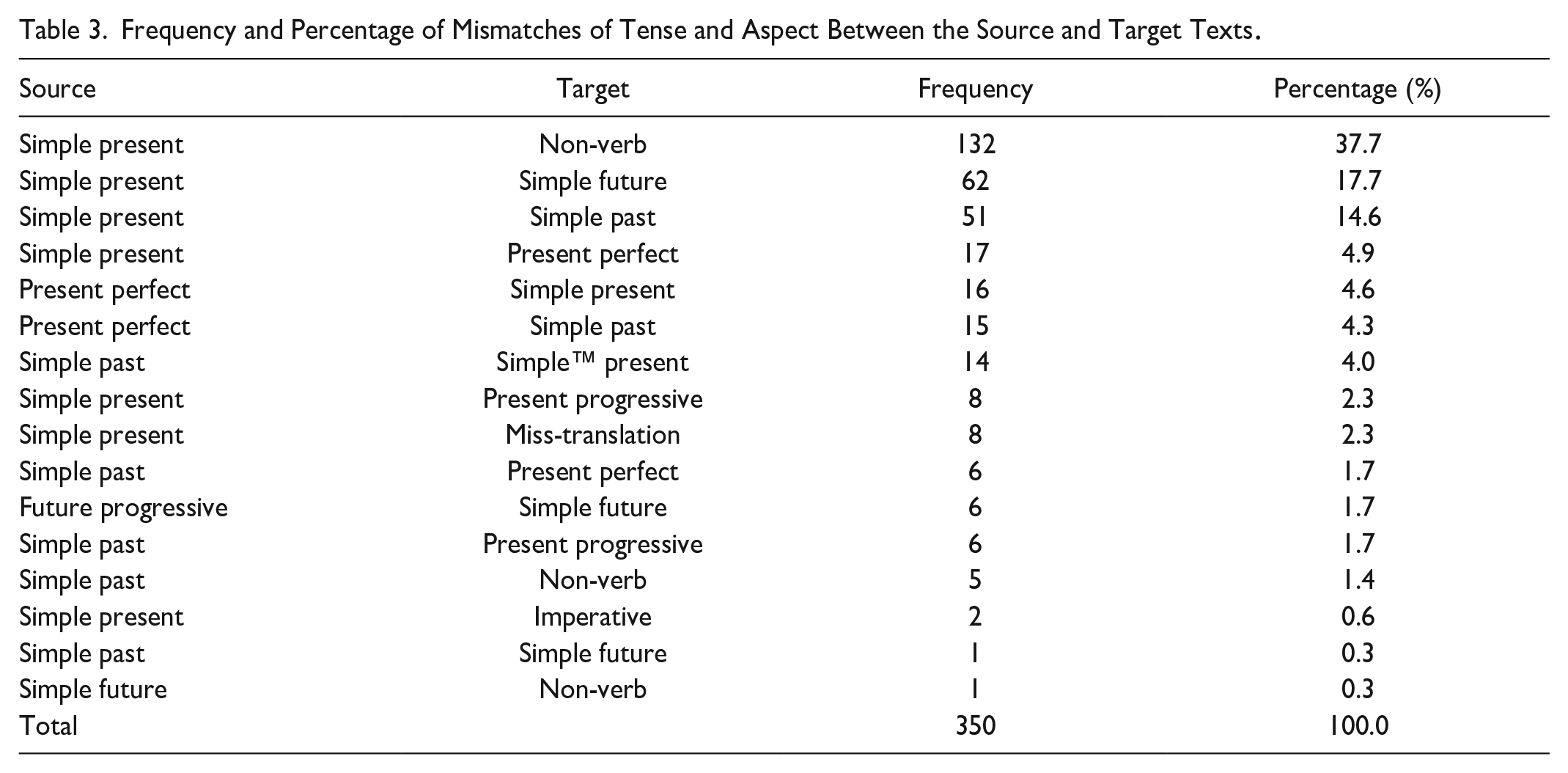
The data in Table 1 were reorganized and presented in ™, which focuses on the mismatches between the source and target texts. The table highlights that most frequently, some of the verbs in the sentences were translated into “non-verbs” as the examples presented in (6a) and (6b).

The energy of the eye tracker comes from solar panels
The sentence in (6a) had several verb phrases, including “laizi yu” (to come from), “guazai” (to mount), “yikao” (to rely on), “ke” (can), and “yunzuo” (to operate/work), and a comma, instead of a period, was used in the source text. As a translation strategy, the student did not translate every verb into a verb. The student separated the two clauses by using a period, and following the English grammatical rule that requires only one main verb in each clause, he transformed some of the verbs, such as “guazai” (to mount) and “yikao” (to rely on), into prepositions (non-verbs). Many possible translation strategies could be adopted to render the sentence in (6a). Some students, such as the example in (6b), divided the long sentence into two clauses. Some other students combined the meanings in the subordinate clauses and rendered them into a single sentence. Among all cases, change of word class was the most prevalent translation strategy observed from our data.
The frequency count in the present study was conducted on a clause basis. In other words, the example in (6a) was counted twice. The first counting happened before the comma, and the second counting was after the comma. Therefore, in the pair between (6a) and (6b), the first tense-and-aspect count was a consistent match because before the comma in the source text, the main verb “laizi yu” (to come from) was in the present tense, and the verb phrase “to come from” was also rendered into the present tense in (6b). The second count of the tense and aspect between the source and the target text was a mismatch because the main verb phrase in the second clause “ke yunzuo” (can work) was not rendered into the present tense. The other verbs in the source text were transformed into other word classes, and these changes were classified as the type of “non-verbs.”
The second largest group of mismatches (62 instances) between the source and the target texts was the translation of the present tense in the source text into the future tense in the target text, such as the examples in (7a) through (7d).

The Smart Scroll

The microwaves can penetrate glass/ceramics, and plastic without being absorbed, while food contains water or fat
In (7a), the tense in the source text was identified as the present tense because the main verb in the clause “shi” (to be) did not have tense markers attached to it. In the second clause, the verb “peihe” (to coordinate) was also not used together with any other tense markers. The third main verb was “caozuo” (to operate), which again was in the present tense. In the translation, the student restructured the source text and changed the subject in the second clause from “the Smart Scroll” to “the angle.” In the rendition, the first main verb phrase was “will navigate,” which was identified as using the future tense because of the use of the modal verb “will.” The translated text would have worked well even if the tense remained to be present. There was also no hint or no necessity for the first clause to be in the future tense and then switch quickly to the present tense in the next clause. Therefore, the student’s translation in (7b) was not regarded as an ideal translation in terms of her use of tense and aspect. The student’s translation was also not grammatical in English, but because the focus of the study is on tense translation, the present paper only discusses the use of tense and aspect.
In (7c), the text was in the present tense throughout the sentence. However, in (7d), the student translated the second clause into the future tense. A potential explanation for such an error is that the student tended to translate the modal verb “hui” in the source text into “will” in English. The problem is, that “hui” has multiple meanings. The Chinese word “hui” can be used to show a strong certainty that something is expected to happen or to affirm the ability to be able to do something. Although the English word “will” is usually the default translation of the Chinese word “hui,” the interpretation of this word in scientific writing usually does not denote the future meaning. Rather, it is usually used to pose a condition and to refer to a general fact or consequence. In this sense, the tense of the clause using “hui” is the present tense, not the future tense. This case of translating the habitual meaning of “hui” into “will” was also reported in a previous study on undergraduate students majoring in English in Shanghai (Newbery-Payton & Mochizuki, 2020), suggesting that for native Chinese speakers learning English as a second language, the habitual use of the adverb “hui” in Chinese is often overlooked.
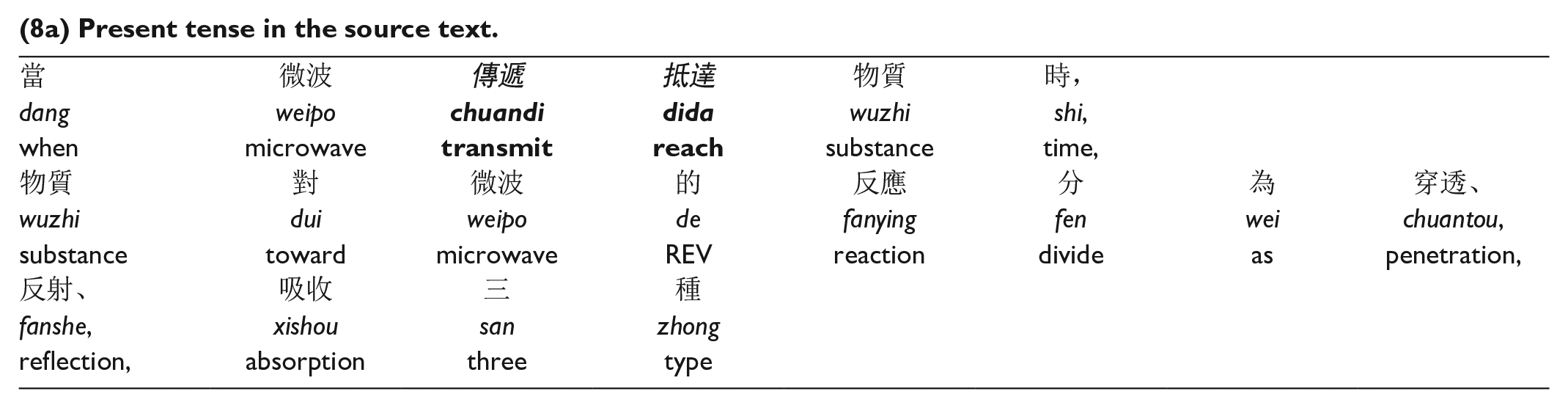
The third largest group of errors (51 instances) that the participants made was translating texts in the present tense into the past tense, such as the example presented in (8a) and (8b).
As microwaves
The student’s rendition in (8b) was inconsistent in terms of tense between the first and the second clauses. The first clause in the rendition was in the past tense, and the second clause was in the present tense. The source text in (8a) did not show hints of tense or aspect change, and the interpretation of the tense was dependent on the context. The source itself was also written in two clauses, and the student’s translation in (8b) followed the grammatical structure of the source text. Therefore, the abrupt change of tense could be made by a careless mistake. However, such an error of inconsistent tense usage within a sentence similar to the one presented in (8b) occurred relatively frequently and ranked number three in the types of errors the students made. This showed that contextual tense messages in Chinese increased the chances for students to make grammatical errors in tense consistency when they translated from Chinese into English.
Because the majority of the data in the source was in the present tense (as shown in Table 1), Table 3 was computed by pooling data of the present tense in the source text together in order to present a holistic picture of the errors that the students tended to make during translation. The type of present tense into non-verb translation was excluded from Table 4 because the change of word class was believed to be made based on strategy rather than mistakes.
Frequency and Percentage of Mismatches of Tense and Aspect Between the Source and Target Texts.
Error Types in Translating Source Text in the Simple Present Tense.

As shown in Table 4, the abrupt jumps between time references, especially between the present and future tense and between the present and past tense, accounted for 76% of the mismatch errors. Such a noticeable pattern suggested that this tendency was not random. A chi-square test was adopted to verify such observation, and the results showed that there were more cases of translating simple present tense into other tenses (past tense, future tense) than translating into another aspect, χ2(df = 2, N = 148) = 7.47, p < .05. There was no further difference between the use of past and that of future tense, χ2(df = 1, N = 113) = 1.07, p = .301. This finding echoed previous studies that students had a higher mastery of English tense than aspect (L.-H. Tsai, 2020). Therefore, when the students failed to reproduce the tense in the source text, they tended to err on tense than aspect.
Discussion and Conclusions
Our results showed no statistical difference in terms of tense selection between students of upper intermediate (B2) and those of advanced English levels (C1) even though they seldom made obvious and simple mistakes such as wrong words or mistranslation. In addition, among the top three tense and aspect inconsistencies, the most frequently observed phenomenon of translating verbs from the present tense into a non-verb was made based on a translation strategy. The second and the third types together showed the tendencies of students to translate messages from the present tense into either the future or the past tense. This suggested that the students could have randomly jumped between tenses when they were translating from Chinese into English. Different from those in English, morphosyntactic markers on the verb were often not found in the Chinese language. Therefore, readers of Chinese relied on lexical items such as the words “last year” or “already” to conceptualize the time reference in the passage. If the sentence lacked explicit lexical items that could suggest the time of the event, the readers needed to refer to the previous sentence or the context to decide the time (Lin, 2006). Because of the relatively broad temporal scope in Chinese as compared with the immediate temporal markings in English, the students might not be sensitive enough to pick up the temporal information in the text.
What could be inferred from the findings in the present study was, that when teaching students to translate between languages that used distinct temporal reference systems, explicit instructions on the temporal information in the text might help students produce more accurate descriptions of the events during translation because usually, students were not aware of the cross-linguistic difference. As suggested by a previous study of Chinese-English translation in graduate students (P.-S. Tsai, 2021), more errors were made in the consistency of the tense and aspect rendered in English. Also, similar to the findings in Newbery-Payton and Mochizuki (2020), Chinese students tended to overgeneralize the use of “hui” (will) and ignored the habitual meaning of this word. Therefore, they often produced a future tense during translation, which was supposed to be translated into the present tense to express habituality. The errors resulted from the students’ failure to recognize the cross-linguistic difference between the English “will” and the Chinese “hui” could have been avoided by raising the awareness of the cross-linguistic comparison of temporal expressions between English and Chinese.
The translation problems regarding temporality were not easily observed when the participants were asked to produce output in a monolingual environment such as what they had performed in English proficiency tests. The participants in the present study had profound vocabulary and grammatical knowledge that were good enough to allow them to possess English certificates higher than the B2 level. Their translation also showed relatively few beginner-level grammatical mistakes such as third-person noun-verb agreements or errors presenting a lack of vocabulary reported in the previous literature that tested students with preliminary or low English proficiency (e.g., Hong, 2008; L.-H. Tsai, 2020). Such data highlighted the importance of the delivery of temporal information for translation trainees with high-level second-language proficiency. Our data demonstrated that even though the participants were generally good at English, their awareness of the tense marking systems across Chinese and English was relatively not sensitive enough. Similarly, in the previous literature, Li and Zhao (2021) observed that participants with high English proficiency of C1 level still made errors in translating the tense from Chinese into English. Newbery-Payton and Mochizuki (2020) also found among Chinese participants of or above intermediate English level (B1–C1) problems in reproducing the tense message. These findings supported the notion that knowledge in one language does not necessarily transfer to the other language. To be able to faithfully convey the information from the source to the target language, a cross-linguistic awareness needs to be brought out for attention.
Recent studies on the implementation of translanguaging strategy as a translation pedagogy supported the notion that comparisons of the similarities and differences between languages can facilitate the teaching of translation for graduate students with an advanced level of English (C1 of CEFR) at a translation program (Laviosa, 2019). Laviosa has demonstrated that a reanalysis of the source text in the first language was necessary for students to better understand the meaning to be transferred to the second language, suggesting that developing students’ sensitivity to linguistic and cultural styles between languages is important in improving translation into a second language. A similar finding was also reported in Chinese students using English as an additional language (Heugh et al., 2017). Heugh et al. (2017) in an Australian university found a positive correlation between translation scores and first language proficiency. In other words, the Chinese students with better metalinguistic knowledge of translation were also better in Chinese proficiency. Therefore, Heugh et al. also argued that the focus in teaching should be shifted from English only to the promotion of proficiency in both the home language and the second language. Because the participants in our study seemed to overlook the tense information carried in the source text, the incorporation of reanalysis of the source text might have helped improve the accuracy of translation in terms of temporal information.
Teaching methods from the teacher can be exemplified in the following. Some studies about translation practice or teaching of translation have proposed to have translation trainees fill out a form or list out key information such as the topic of the source text, the type of target reader, the genre or style of the source text, and the purpose of translation before the translation process takes place (e.g., Liao et al., 2013; P.-S. Tsai, 2016; Ye, 2013). Following this logic, teachers can ask students to analyze and list the temporal information in the source language. Teachers can also encourage students to construct a mental map about the arrangement of tense information before they start the translation.
In the present study, the English translation was collected from graduate students whose second language was English. Compared with previous studies that contrasted the use of tense and aspect between native English translators and non-native English translators (Dong, 2014; Chen & Dong, 2016), the present study only examined English translation from English as a second language users, but the comparison was made between students with advanced (C1) level of English proficiency and those with upper intermediate (B2) level of English. In other words, both groups in the present study were using an interlanguage. Therfore, the comparison between groups was on a relatively equal basis, and the emphasis of the comparison was on the relation between the source and the target texts instead of between different participant groups.
In summary, the data in the present study have indicated that tense inconsistency was the major problem in the English rendition by students whose native language were Chinese. Therefore, explicit instructions from teachers about temporality across languages and reanalysis of the temporal information in the source text would be helpful for Chinese students to improve their translation.
Supplemental Material
sj-docx-1-sgo-10.1177_21582440231158263 – Supplemental material for An Error Analysis on Tense and Aspect Shifts in Students’ Chinese-English Translation
Supplemental material, sj-docx-1-sgo-10.1177_21582440231158263 for An Error Analysis on Tense and Aspect Shifts in Students’ Chinese-English Translation by Pei-Shu Tsai in SAGE Open
Supplemental Material
sj-xlsx-2-sgo-10.1177_21582440231158263 – Supplemental material for An Error Analysis on Tense and Aspect Shifts in Students’ Chinese-English Translation
Supplemental material, sj-xlsx-2-sgo-10.1177_21582440231158263 for An Error Analysis on Tense and Aspect Shifts in Students’ Chinese-English Translation by Pei-Shu Tsai in SAGE Open
Footnotes
Acknowledgements
This study was supported by the National Science and Technology Council, Taiwan (MOST 108-2410-H-018-004, MOST 110-2410-H-018-010).
Transcription Conventions
Abbreviations used in gloss
BE Be verb
CL Classifier
NEG Negation word
PAST Past tense marker
PERF Perfective aspect marker
PROG Progressive aspect marker
REV Relativizer
Declaration of Conflicting Interests
The author declared no potential conflicts of interest with respect to the research, authorship, and/or publication of this article.
Funding
The author disclosed receipt of the following financial support for the research, authorship, and/or publication of this article: This study was supported by the National Science and Technology Council, Taiwan (MOST 108-2410-H-018-004, MOST 110-2410-H-018-010).
Ethics Approval
The study has been approved by the Research Ethics Committee, National Changhua University of Education (NCUE REC 109-008).

Supplemental Material
Supplemental material for this article is available online.
References
Supplementary Material
Please find the following supplemental material available below.
For Open Access articles published under a Creative Commons License, all supplemental material carries the same license as the article it is associated with.
For non-Open Access articles published, all supplemental material carries a non-exclusive license, and permission requests for re-use of supplemental material or any part of supplemental material shall be sent directly to the copyright owner as specified in the copyright notice associated with the article.
