




Abstract
Newspaper editorials constitute a part of media discourse, which is an extremely important field of research in intercultural rhetoric analysis and EFL (English as a foreign language)/ESL (English as a second language) studies. Specifically, certain features of editorial headlines and also their important role in monitoring and directing readers’ attention have made the interface between the linguistic analysis of newspaper editorial headlines and teaching of EFL as a relevant issue in language teaching. Through conducting a contrastive textual analysis of selected headlines, culled from the editorials of the English newspaper, The New York Times, and those of Persian newspaper, Tehran Times, the present study aimed at exploring the kind of textual and rhetorical strategies the two newspapers used for propagating their preferred ideologies. The results of the study indicated that headlines in the two papers presented a subjective attitude of the writers (newspapers) toward the topic. However, based on the analysis of the data, it became clear that there were certain differences between the two sets of headlines in terms of Presupposition, and certain Rhetorical devices.
Introduction
Newspaper editorials, as a subgenre of the newspaper genre (Bell, 1991), are of importance in news discourse. Headlines in editorials, as an opening section to their relevant main text, have been ascribed different functions. Discussing the news schema, van Dijk (1988) has referred to headlines and leads as categories forming “the summary” of the news reports. Bell (1991) and Nir (1993) have made a distinction between headlines functioning as the abstract of the main event of the story and headlines as promoting one of the details of the story. Although in most cases headlines do bear such functions in news reports, some newspapers headlines present their readers with fairly complex riddles which neither summarize nor present the detail of the news reports (Lindemann, 1990).
Transcending the above-mentioned distinctions in headlines, Iarovici and Amel argued, The implicit convention between author and reader regarding the intention of correlating a text to another text as a headline, and regarding the formal marking of this quality by a privileged position, concerns the double function of the headline: a semantic function, regarding the referential text, and a pragmatic function, regarding the reader (the receiver) to whom the text is addressed. The two functions are simultaneous, the semantic function being included in and justified by the pragmatic function. (cited in Dor, 2003, p. 698)
In other words, newspaper headlines not only have the function of indicating the topic and summarizing the main content of the news text, but they also try to help the reader grasp the meaning of the text.
In an attempt to address the question of the communicative function of headlines, Dor (2003) has further transcended the different functions of the headlines and defined them as “relevance optimizers” that “are designed to optimize the relevance of their stories for the readers” (p. 696), For him, As relevance-optimizers and relevance-based selection-devices, headlines function as negotiators between stories and readers. As we have seen, producing the appropriate headline for a story is a complex task exactly because the headline is neither a semantic summary of the story nor a pragmatic attracting-device for the reader, but a communicative device whose function is to produce the optimal level of affinity between the content of the story and the reader’s context of interpretation, in order to render the story optimally relevant for the reader. (Dor, 2003, p. 720)
However, for Ifantidou (2009), newspaper headlines have only one function that is “attention-getting rather than information-providing device since headlines do not accurately represent the articles they introduce. In other words, newspaper headlines are persuasive rather than informative” (p. 97).
The issue of determining the role of the headlines would be much more complicated if one considers the kind of newspaper texts in which the headlines appear. All newspaper texts, for instance service information, opinion, and news (Bell, 1991), would both semantically and pragmatically require certain types of headlines based on the text and the receiver (reader).
Thus, some studies focused on analyzing the newspaper headlines. In an effort to equip the EFL (English as a foreign language) students with the linguistic strategies deployed by headline writers, White (2011), for instance, examined the prosodic, syntactic, and semantic patterns used in crafting Spanish and English headlines.
In a comparative study, Shie (2010) focused on lexical feature variations between Time Supplement (TS) headlines and The New York Times (NYT) headlines. The study found that “colloquialisms, idioms, slang expressions, technical terms, and non-English words were found in far more NYT headlines. These lexical features variations decrease the informality of TS headlines but increase their accessibility to general TS readers” (p. 79).
However, most of the studies on the headlines focused on either service information texts such as advertisement or new texts such as daily news reports. In other words, the role and function of the headlines in opinion texts have rarely been explicated in the literature.
Newspaper editorials as a kind of opinion texts (van Dijk, 1995) are different from the other types of news discourse, in that they are supposed to present evaluations and comments about the news events already reported in the newspapers.
Thus, due to the unique features of headlines such as encapsulating the content of the editorials, arousing the readers’ curiosity (Reah, 2002), and also their important role in monitoring readers’ attention, perception, and reading process (van Dijk, 1988), the present study attempted to conduct a systematic contrastive textual analysis of English and Persian editorial headlines to investigate the kind of rhetorical strategies the two newspapers use for propagating their preferred ideologies. It is also hoped that such knowledge would assist language teachers to effectively use newspapers as a teaching device in their EFL/ESL (English as a second language) classrooms.
Method
Data Collection and Analysis
The present study used a purposeful sampling for the purpose of data collection, and there are two main reasons for doing so. First, we aimed at focusing on only headlines of editorials of criticism. Second, as some editorials in Tehran Times (TT) had not been written by Iranians, there was a need to identify and exclude them from the corpus.
Thus, by adopting a nonrandom purposeful sampling, the present study selected 40 editorial headlines (20 culled from the electronic version of the Iranian English newspaper, TT, and 20 editorial headlines culled from the electronic version of the English daily newspaper, the NYT out of a large pool of editorials published daily over a specific span of time [April to September, 2008]). The two newspapers are among the top broadsheets in terms of readership as stated by the official websites of the papers. Also, the textual analysis has been carried out using presuppositions, and emerging rhetorical strategies.
Classification of the Editorials
For selecting the editorial headlines to be included in the corpus, we used the classification proposed by Hall (2001). Based on the proposed classification, it is possible to sort the newspaper editorials into editorials of Criticism, Attack, Defense, Endorsement, Praise, Appeal, and Entertainment. Editorials of criticism are defined here as editorials that aimed at criticizing policies and decisions that are considered as controversial by the newspaper staff. Since editorials of criticism are very similar to the editorials of attack, which are supposed to be much more forceful and “call for changes to be made immediately” (Hall, p. 159), the two kinds of editorials in the corpus have been referred to as editorials of criticism. The main reason for selecting the editorials of criticism lies in the fact that this type of editorials usually has a hidden social and philosophical commitment to the ideology of the publisher and to the interest of the readership (Rafael, 1995). This commitment, thus, makes them more argumentative and persuasive than the other types.
Categories of Textual Analysis
Textual analysis of the selected editorials has been carried out in terms of rhetorical devices used in the headlines. Definitely, the types of these devices were not decided in advance as “the qualitative categories . . . are not predetermined but are derived inductively from the data analyzed” (Dornyei, 2008, p. 245). Thus, the rhetorical devices discussed throughout the paper have emerged during the data analysis.
In addition to these emerging rhetorical devices, the headlines have been analyzed in terms of another linguistic device namely presupposition. Taking the newspaper headlines as a kind of persuasive writing, these devices are of special importance in that they enhance the effect of persuasion.
Presupposition “is any proposition whose truth is accepted by the speaker . . . but not asserted by the utterance” (van Dijk, 1995, p. 273). Linguistically, they are marked by using certain grammatical structures and lexical items. Presuppositions “allow speakers and writers to make claims without actually asserting them, and, moreover, take specific beliefs for granted although they might not be” (van Dijk, 1995, p. 273). They in fact provide the writers with a kind of a “linguistic device that can be used at word/phrase level to manipulate readers” (Huckin, 2002, p. 161).
Discussing the persuasive nature of presupposition, Sbisà (1999) argues, Presupposition, so intended, is clearly suitable for transmitting a kind of contents which may be called ideological: assumptions, not necessarily conscious but liable to be brought to consciousness, about how our human world is and how it should be. For various reasons, such assumptions are often difficult to be certain about, even though they are not in general unverifiable. Since assertion and argumentation commit the speaker to giving evidence or reasons for what is asserted or argued for, it may be difficult, or uncomfortable, to assert or discuss this kind of assumptions explicitly. (p. 507)
Thus, considering the manipulative nature of presupposition and the rhetorical devices, the selected headlines have been analyzed in terms of presupposition and the emerging rhetorical devices namely parallelism, alliteration, consonance, metonymy, pun, testimonial, quotation out of context, allusion, neologism, antithesis, and irony.
Textual Analysis of Headlines
Classification of Headlines
Headlines can be structurally classified as either verbal or nonverbal. Verbal headlines are those that contain a verbal clause. According to Quirk, Greenbaum, Leech, and Svatvik (1985), there are three main types of verbal clauses, namely, “finite clause,” “nonfinite clause,” and “verbless clause” (Quirk et al., 1985, p. 992). The verb in a finite clause is finite, that is, it carries tense, that is, Bush claimed Victory. On the other hand, a verb in a nonfinite clause is infinite, that is, it does not carry tense and it takes either a to-infinitive, a bare infinitive, an -ed form, or an -ing form, for example, Failing the World’s Poor. A verbless clause does not contain a verb at all, but it “is capable of being analyzed into clause elements” (Quirk et al., 1985, p. 992). That is, a form of copula can be inserted in the clause, for example, Lebanon at the Edge. In the present study, however, the verbless clauses have been classified as nonverbal headlines.
Nonverbal headlines are those that contain a noun or a nominal phrase. Owing to the importance of modification of nouns in headlines that “add ‘descriptive’ information to the head, often restricting the reference of the head” (Quirk et al., 1985, p. 65), they can be classified as nonmodified, premodified, postmodified, pre- and postmodified nouns. Table 1 illustrates the classification of the headlines in the selected editorials of the NYT.
Classification of the New York Times Headlines.

As Table 1 suggests, 75% of the headlines in the NYT were of the nonverbal kind while only 25% of them were of the verbal type. On the other hand, most of the nonverbal headlines were modified.
The verbal/nonverbal dichotomy can also be applied for structural classification of the headlines in the selected editorials of criticism in TT newspaper. Based on this dichotomy, Table 2 represents the types of the headlines in selected TT editorials.
Classification of Tehran Times Headlines.

As the Table indicates, 60% of the headlines in the selected editorials of TT are of verbal type while 40% of them are nonverbal. Meanwhile, most of the nonverbal headlines are either pre-modified or post-modified.
The analysis of the headlines in the selected editorials of the two newspapers revealed certain differences between the two sets of headlines. In terms of verbal/nonverbal distinction, the proportion of verbal headlines in the NYT (25%) was significantly lower than that in TT (60%). It might indicate that TT writers inclined to form the headlines in full sentences, while those in NYT preferred short and punchy phrases.
Moreover, in terms of the length of the headlines, verbal and nonverbal headlines in the NYT were written using short phrases whereas the TT headlines were in the form of comparatively long phrases and sentences. Calculated in terms of the average number of words per headlines, the figures obtained were 3.7 and 5.4 words for the NYT and the TT, respectively. In other words, based on this textual analysis, the NYT headlines were found to be short and punchy while those of TT were found to be mostly composed of full sentences which made them less striking and less persuasive than the headlines in the NYT. The following headlines exemplify the point:
TT headlines:
Is the Caucasus becoming more Balkanized than the Balkans?
NAM is the international community
Israel snubs Hamas ceasefire proposal
NYT headlines:
Remember Iran
Running out of time
Not safe enough
As reported in the findings of the Khodabandeh (2007a), this (using full sentences in the headlines) indicated that unlike the headlines in the NYT, Persian headlines were not different from those of ordinary, non-headline language.
These findings did not confirm the findings of the study conducted by Khodabandeh (2007b) who claimed, as a result of her study, that the proportion of verbal headlines were considerably higher in English headlines (94.82%) than in the Persian ones (24.27%). However, as there was no indication of the specific newspaper sub-genre in her study, it could be at least concluded that headlines in different newspaper sub-genres might be structurally realized through different textual strategies.
Presupposition in Headlines
Presupposition in NYT headlines
A textual analysis of the headlines in the selected editorials revealed that the editorial writers used this linguistic device.
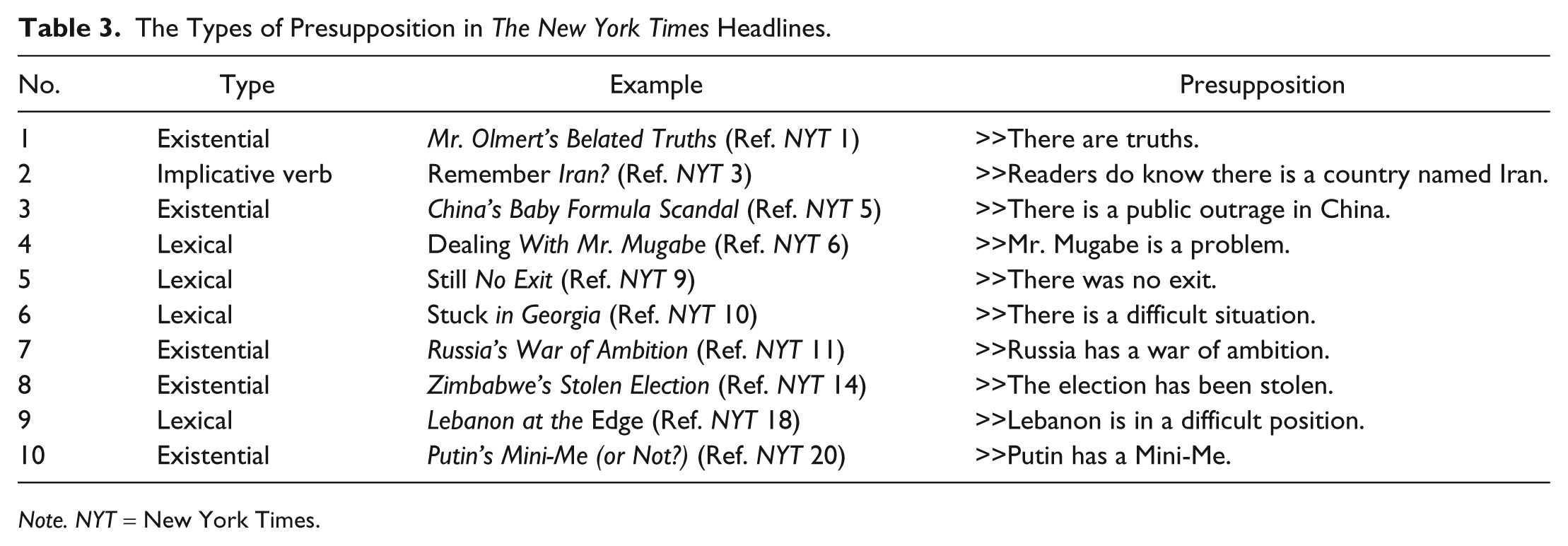
The kinds of presupposition used in the NYT headlines included existential and lexical presupposition. Table 3 enumerates the kinds of presuppositions used in the NYT headlines.
The Types of Presupposition in The New York Times Headlines.
Note. NYT = New York Times.
As Table 3 indicates existential presupposition is the common presupposition used in the NYT headlines. Through this kind of presupposition, the writers presupposed a negative attribute for Others and positive ones for Us. Attributions such as stolen election, belated truth and war of ambition are examples of the point. Lexical presupposition was the other kind of presupposition used in the headlines. Through certain lexical items or loaded words—words that have strong positive or negative connotations beyond their ordinary definition, the writers tried to presuppose their intended propositions. The lexical items such as dealing, still in Headlines 4 and 5, for example, presuppose respectively that there is a problem and there was no exit.
Presupposition in TT headlines
The analysis of the headlines revealed the frequent use of presupposition as a textual strategy for persuasion purposes. The following table tabulates kinds of presupposition used in the headlines of the NYT.
As Table 4 suggests, the presuppositions have been established through existential, and implicative verb. The word “mimicking,” for example, in the first headline suggested “imitation” and the possessive construction “’s” presupposes the existence of “ulterior motives of Rice.” The fourth and fifth headlines presupposed the existence of Israel’s “pipe dreams” and “war crimes.”
The Types of Presupposition in Tehran Times Headlines.

The analysis of the selected headlines in terms of presupposition revealed some similarities and differences between the headlines of the two papers. In general, the writers in the two papers presupposed particular propositions through certain types of presuppositions, namely, existential and lexical. The papers preferred existential presupposition triggered by possessive construction such as Rice’s ulterior motives and Israel’s war crimes. Implicative verbs were found to be the least used presupposition types in the two sets of the headlines. The commonality of using just these particular types of presupposition in the headlines of the two newspapers might suggest that writers opted for common types of presupposition in spite of their different linguistic backgrounds. Moreover, limited use of the implicative verbs and the other types of the presupposition types such as “factive,” “nonfactive,” and “structural presuppositions” (Yule, 1996, pp. 27-29) might reveal a specific characteristic of the newspaper genre specific to the editorial headlines.
The TT headlines compared with those of the NYT contained more existential presuppositions. The NYT headlines, on the other hand, contained more lexical presuppositions.
Rhetorical Devices
Parallelism
Moreover, to add balance and rhyming and also further clarity to the headlines, editorial writers in the NYT in some cases opted for Parallelism, using the same pattern of words and structures. The following excerpts are examples of the case:
Georgia, NATO and Mr. Medvedev (Ref. NYT 19)
Good Intentions, Vague Promises (Ref. NYT 12)
Parallelism in the first headline has been achieved through using the same class of the words, nouns. Noun phrases, on the other hand, have been used in the second headline for parallelism. Only one case of parallelism was identified in the TT headline presented as below:
Turkey’s “deep state” runs into shallow water (Ref. TT 7)
As evident in the headline, through using deep state and shallow water, the writer has established parallelism. In other words, the same linguistic structure, a noun modified by an adjective has been used in the headline. Although limited in number, the writers in the NYT and TT have used this rhetorical device to enhance the persuasive force of the headlines through repetition.
Alliteration, testimonial, and irony
Alliteration
There is a tendency to exploit alliteration in editorial headlines. This is a literary device chosen for the sake of generating a phonic pattern that might add further difficulty for EFL learners (White, 2011). In the following headline the editorial writer preferred this device to give balance and rhyming to the headlines.
Only one case of consonance was identified in the TT headlines as presented below:
Is more inflatio
Through using these two devices, alliteration and consonance, the writers in the two papers have tried to create mood and music in the headlines to further enhance their persuasive effect.
Testimonial
Testimonial, using the words of a famous or influential person, was found to be one of the devices used in only one of the NYT headlines for persuading the editorial readers. The following headline exemplifies the point.
What the F.B.I. Agents Saw (Ref. NYT 17)
The main argument of the editorial headlined by the above-mentioned phrase was to inform the American people, through descriptive scenes, of what was happening in the interrogation centers in American military prisons. To influence the readers, the editorial used the phrase “the F.B. I. agents” to further endorse its own description. This literary device was not used in the TT headlines.
Irony, stating the opposite of an intended meaning to mock a person, situation, was found to be one of the rhetorical devices used in the following TT headline.
The only upholder of human rights in the Mideast! (Ref. TT 20)
The main argument of the editorial entitled by the above-mentioned headline was to criticize Western counties for naming Israel as the only democratic country in the Middle East. To express his disapproval of the Western countries’ view, the editorial writer used a sarcastic headline. Even an exclamation mark (!) has been used in the headline to help the readers grasp the sarcasm and irony. This rhetorical device has not been used in the selected headlines of NYT.
Metonymy
Another instance of figurative language used in the headlines of the selected editorials was Metonymy. It is a figure of speech in which one word or phrase is substituted for another with which it is closely associated. The use of this rhetoric device can be identified in the following headlines of NYT.
China’s Baby Formula Scandal (Ref. NYT 5)
Russia’s War of Ambition (Ref. NYT 11)
Lebanon at the Edge (Ref. NYT 18)
China’s List of Olympic Don’ts (Ref. NYT 16)
The metonymic use of the countries in the NYT headlines can be presents as below:
CHINA→ Institution (A company)
RUSSIA→ Institution (Government)
LEBANON→ Status (Political)
CHINA→ Institution (Olympic committee).
In the above-mentioned nonverbal headlines, it is clear that editorial writers intended to refer to a company in China, Leaders in Russia, Political situation of Lebanon and Chinese government, respectively. However, in an effort to impose their own attitude, the editorial writers used metonymy to generalize the issue, that is, scandal, war, to be at edge, and Olympic don’ts to the respective countries.
Also, referring to some certain news events, in some cases the editorial writers in TT used metonymy as a rhetoric device. This device has been used in the following headlines.
Iran is not North Korea (Ref. TT 8)
U.S. hypocritically using ICC to pressure Sudan (Ref. TT 4)
U.S. meddling in formation of Lebanese cabinet (Ref. TT 5)
Israel’s hit-and-run war crimes (Ref. TT 18)
U.S colonialism in Iraq (Ref. TT 9)
Israel’s pipe dreams (Ref. TT 11)
Israel snubs Hamas ceasefire proposal (Ref. TT 14)
US dissension plot unfolds in Iraq (Ref. TT 16)
The main argument in the editorial titled “Iran is not North Korea” was to compare the Iranian nuclear program with that of North Korea. So, to refer to these programs, the editorial writer preferred to use the name of the countries. Similarly, the main arguments titled by the second and third headlines was to criticize the American authorities for using judges in International Criminal Court (ICC) to put pressure on Omar Hassan al-bashir, the Sudanese president, and the American administration for meddling in Lebanon’s affairs. Also, the main argument in the fourth headline is to blame Israeli’s army and military authorities for starting assaults against Gaza Strip.
This metonymic use of the countries name in the TT headlines can be stated as follows:
IRAN→ Nuclear program
NORTH KOREA→ Nuclear program
US→ Institution (Government)
SUDAN→ Institution (Government)
US→ Institution (Government)
ISRAEL→ Institution (Army)
US→ Institution (Government)
ISRAEL→ Institution (government)
ISRAEL → Institution (government)
US→ Institution (Government)
ISRAEL → Institution (Army)
Through using metonymy, the editorial writers in the two newspapers tended to keep and background the main news actors and events such as the U.S. authorities, Omar al-bashir, Israeli army officers, and nuclear program in the semantic field. In other words, writers used the metonymic concept of names of countries to refer to either responsible institutions or the status (social, economical, political) of the countries. Analysis of the data revealed that writers in TT used this type of metonymic reference (COUNTRY FOR INSTITUTION AND STATUS) in the headlines much more frequently than those in NYT. Considering the fact that “metonymy is not merely a reference device” but “it also serves the function of providing understanding” (Lakoff & Johnson, 1980, 34), the frequent use of this type of reference might be attributed to Iran’s long-lasting problems with the governments of the two countries namely the US and Israel. Names of these two countries have been thematized so that it can influence the readers understanding making them perceive every single event as something caused by the whole country and not by the single institution within the country.
In general, analysis of headlines in terms of this rhetoric device, metonymy, indicated the importance of the device in newspaper genre in general and headlines in particular.
Pun
Pun was found to be among of the rhetorical devices used in just one of the NYT headlines presented as below:
Putin’s Mini-Me (or Not?) (Ref. NYT 20)
To elaborate on the above-mentioned headline, it is necessary to mention that the editorial writer’s main argument in the respective editorial was to represent Russian president, Medvedev, as a puppet played by Valadimir Putin, the present Prime minister of Russia. To do so, the writer has used the word “Me” as a pun in the headline as the word “Me” suggests two distinct meanings. That is “Me” as referring to Putin and the second as referring to Medvedev. Note that the word Medvedev starts with “Me.” This rhetoric device, however, was not found in the selected headlines of TT.
Quotation out of context
Quoting out of context, removing the most important quotes from the context, editorial, was another device for persuasion identified in the NYT headlines. This persuasion device was realized in the following nonverbal headline.
Running Out of Time (Ref. NYT 4)
The headline reflects the growing concern about the failure of the American forces in Afghanistan. It is, in fact, a quoted phrase from the chairman of the Joint Chiefs of Staff, Adm. Mike Mullen, which summarizes the main point of the editorial. Examples of this rhetorical device were not identified in the TT headlines.
Rhetorical question
Rhetorical question was used a persuasive device in the NYT headlines as presented below:
Remember Iran? (Ref. NYT 3)
Putin’s Mini- Me (or Not?) (Ref. NYT 20)
The questions were asked for emphasis and provocation purposes. For example, the first yes–no question has nothing to do with whether we remember Iran or not. The question, however, was intended to emphasize the necessity of remembering Iran otherwise negative consequences would be faced. Similarly, the literary effect of the second rhetorical question is to put in doubt the authority of Russia’s president leading the readers to proceed with the reading of the main editorial text with a certain mentality posed by the headline via a rhetorical question.
Editorial writers in the TT also used this rhetorical device in the selected headlines. The following two questions represent the point.
Is more inflation on the horizon? (Ref. TT 2)
Is the Caucasus becoming more Balkanized than the Balkans? (Ref. TT 12)
The above rhetorical questions used for effect, emphasis, or provocation purposes as considering the ever-increasing inflation rate throughout the country and the serious political unrest in the Balkan Peninsula, the answer to the following question is obvious enough.
Editorial writers in the NYT and TT headlines used this literary device with the same frequency. This might indicate the importance of rhetorical questions in newspaper headlines in the two papers.
Allusion
The editorial writers in TT used allusion, indirect reference to a person, place, or event, as a persuasive device in the following headlines.
Is the Caucasus becoming more Balkanized than the Balkans? (Ref. TT 2)
U.S. colonialism in Iraq (Ref. TT 9)
Israel’s pipe dreams (Ref. TT 11)
The word Balkans in the first headline was supposed to remind the editorial readers of the different wars occurring in some southeastern European countries in the Balkan Peninsula during 1990s. In the same way, the word colonialism in the second headline was supposed to remind the readers of a policy based on exercising power over a dependent area and people for exploitation of their natural resources and creation of new markets for the colonizer which was practiced by some European countries during 1500 to 1900. The allusion in the third headline can be elaborated by referring to Ahmad Chalabi, an Iraqi politician, who promised to reopen an old British-built pipeline from Kirkuk in Northern Iraq to Israeli port Haifa. As a reaction to this promise, the then Israeli Minister of Infrastructure said that the pipeline would be a dream. Moreover, the phrase, pipe dream, has an additional connotative meaning suggesting a fantastic hope that usually comes from smoking a pipe of opium and thus regarded as an unreal aspiration.
The use of allusion in the above-mentioned headlines was significant, in that it could please the readers by reminding them of pertinent events and concepts such as Colonialism, Balkans, and Pipe dreams with which they were familiar, allowing them to be persuaded. This rhetorical device, however, was not identified in the selected headlines of NYT.
Neologism
The use of neologism, “a recently created (or coined) word or an existing word or phrase that has been assigned a new meaning” (Richardson, 2007, p. 69) was identified in the editorial headlines of TT. The following headlines exemplify the point:
Is the Caucasus becoming more Balkanized than the Balkans? (Ref. TT 2)
The Iranophobia plan (Ref. TT 17)
As evident in the above-mentioned headlines, the editorial writers created neologisms through the addition of the suffix “ize” and blending two existing words. The use of neologism not only reflects the editorial writer’s skill in the creative use of language, but also helps him make an association between two concepts. Excerpt 2 might serve as an example of this point. By blending the two words Iran and Phobia, the editorial writer has tried to associate “fearing Iran” with an “illness” that should be treated. Editorial writers in NYT did not use this device in the selected headlines.
Antithesis
To make the headlines more provocative, some editorial writers in TT used antithesis which can be defined as close juxtaposition and intentional contrast of two terms or ideas in the headlines. Antithesis establishes a clear, contrasting relationship between two ideas by joining them together or juxtaposing them, often in parallel structure. This rhetoric device can be noticed in the following editorial headlines:
The G8 ate while we went hungry (Ref. TT 6)
Turkey’s “deep state” runs into shallow water (Ref. TT 7)
The use of antithesis was also of significance in the editorials in that it made relatively fine distinctions which might be otherwise overlooked by casual editorial readers. This device was not identified in the selected headlines of NYT.
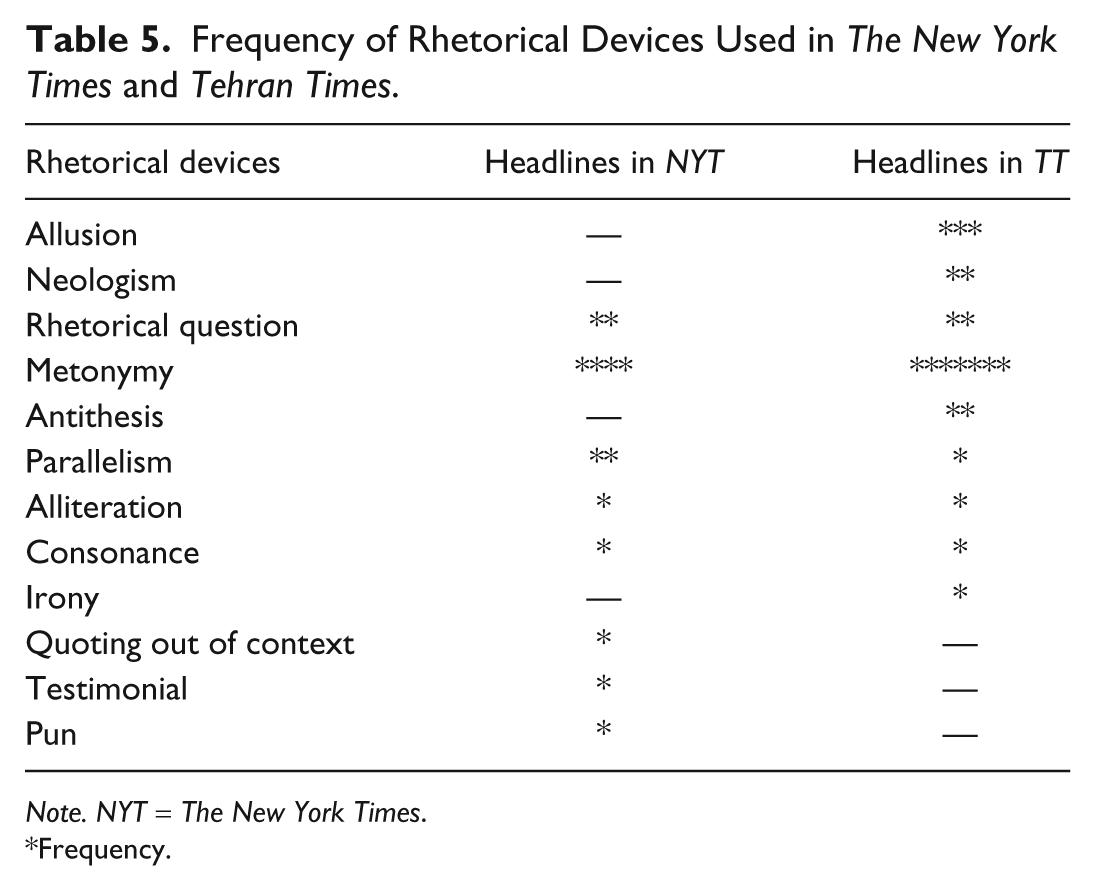
Thus, as the above-mentioned description suggested, editorial headlines not only informed the readers of the topic but also reflected the editorial writers’ subjective point of view. The analysis of the headlines revealed that editorial writers, in an effort to persuade their readers, try to use different textual strategies. Table 5 represents the types of the rhetorical devices used in the selected headlines of the two papers.
Frequency of Rhetorical Devices Used in The New York Times and Tehran Times.
Note. NYT = The New York Times.
Frequency.
As Table 5 suggests, Metonymy, Metaphor, Rhetorical questions, and Parallelism are the favored devices used in the headlines of NYT. Editorial writers in TT, however, favored Metonymy, Allusion, Neologism, Antithesis, and Rhetorical questions, while the less frequent devices include Testimonials, Puns, Assonance, Alliteration, Consonance, and Quoting out of context.
Findings and Discussion
The results of the present study revealed certain qualitative and quantitative similarities and differences between the English and Persian editorial headlines. In terms of verbal/nonverbal distinction, the study revealed that editorial writers in TT preferred to write the headlines mostly in a form of full sentences. However, those of NYT inclined to write the headlines in punchy and short phrases.
In general, the analysis of the headlines in the two papers revealed that the newspaper headlines not only introduced the topic of the editorials but also presented the subjective attitude of the writers (newspapers) toward the topic aiming at influencing and shaping the readers’ understanding of the editorial text.
This subjective presentation of the news events and the news actors were carried out by using certain textual and persuasive strategies. The analysis revealed that the two papers to some extent were identical in using existential presupposition, lexical presupposition for persuasion purposes. Similarly, rhetorical questions and metonymy were found to be used in the two papers equally. NYT and TT metonymically used the names of the countries, for example, to refer to the institutions or political/social statuses of the countries.
The two newspapers, however, were found to be rather different in terms of using other rhetorical devices. The editorial writers in TT did use literary devices such as allusion, neologism, and irony which made the headlines look persuasive. The writers in NYT, instead, preferred another set of devices such as pun, testimonial, and quoting out-of-context. Using different sets of rhetorical devices in the two newspapers might be attributed to the particular culture the writers in the newspapers belong to. However, the analysis revealed that the two papers to some extent were identical in using metaphors.
The analysis in general revealed that the editorial writers in both newspapers aimed at not only informing the readers of the topic of the editorial, but also expressing the preferred ideology of the papers which was accomplished through using certain persuasive and rhetorical devices.
Pedagogical Implications
A large number of English language newspapers are currently accessible to language practitioners through the widespread use of the World Wide Web. They are considered as the most up-to-date inexpensive text-book available to students bridging the gap between general academic subjects and the real world.
Owing to their unique characteristics in presenting authentic and real material, expressing prevalent cultural issues and their flexibility in teaching language, newspapers can be used as instructional material in language classes.
In fact, based on the present research findings such as Edfeldt (1990), Nunan (1999), Tomlinson (2002), Hadley (2003), Belge and Slowik (1988), and Rafael (1995), language educators can introduce newspapers into their classrooms making them as an integral part of their classes.
Yet, using the newspaper and its sub-genres as an input in EFL classes without initial focusing on their generic distinctive features such as, communicative purpose, schematic structures, and the syntactic patterns may be counterproductive. To Bhatia (1993), Genre specificity, thus, within the pages of newspaper is so significant that any attempt to use newspaper language without being aware of it can become misleading. In other words, if the learner is not made sensitive to genre distinctions, then the very strength of newspaper language can become its weakness. (p. 161)
As headlines in editorials are usually worded in a way to pack the greatest amount of meaning into the smallest space possible, EFL students usually suffer frustration on failing to cope with them (White, 2011). Furthermore, as illustrated earlier, the headline perplexity is increased through using different literary devices. Pedagogically, these literary devices can be singled out and analyzed in such a way “to enable the student to crack the code and turn a liability into asset, a stumbling block into a stepping stone.” (White, 2011, p. 95)
Thus, acknowledging the importance of the editorial headlines in monitoring attention, perception, and the reading processes (van Dijk, 1988), the present study aimed at shedding light on some of the genre-specific characteristics of headlines. These characteristics would help the EFL/ESL teachers to guide their students toward a more critical analysis of the media discourse in general and editorial headlines in particular. This kind of analysis will also expose the students to a deeper awareness of how headlines are used to manipulate the readers’ understanding of the news events. Practically, teachers as well as students can focus on the textual analysis of headlines by trying to identify presuppositions and rhetorical devices some of which are tabulated in Tables 3, 4, and 5 of the present study. It is only through this awareness that language practitioners would be able to use media discourse as a teaching device in their classrooms.
Conclusion
Referring to the ever-increasing accessibility of newspapers as a media discourse to the language practitioners and also considering the semantic and pragmatic functions of the newspaper headlines in shaping the public opinion, the textual analysis of the editorial headlines in the selected editorials of NYT and TT was carried out. Specifically, the aim of the study was to investigate how the editorial writers in the two newspapers tried to encapsulate the content of the editorials and hence direct the attention and perception of their readers toward their intended meaning through the headlines.
The findings of the study revealed that the headlines in the two sets of data besides introducing the main topic of the editorials, presented the subjective attitudes of the writers through using certain rhetorical and textual strategies. However, the study indicated some differences between the headlines of the two papers.
Owing to the argumentative nature of editorials of criticism, the present study focused on the headlines of this newspaper sub-genre. The other promising area of further research might focus on the textual analysis of other newspaper sub-genres such as editorials of praise, endorsement and entertainment. Studies of this type would reveal the other discourse conventions of the newspaper genre.
It is hoped that equipping the EFL teachers and students with knowledge on the discourse conventions used in the headlines of the editorials would enhance using of this media discourse, newspaper, as a teaching device in the classrooms.
Footnotes
Declaration of Conflicting Interests
The author(s) declared no potential conflicts of interest with respect to the research, authorship, and/or publication of this article.
Funding
The author(s) received no financial support for the research and/or authorship of this article.
Author Biographies