



Abstract
Research has shown that the effectiveness of written corrective feedback (WCF) on writing performance depends on learners’ engagement with WCF and its associated motivational state. However, little research has examined the inner causal relationships between motivation, learner engagement with WCF, and writing performance. The current study fills the void in the existing literature by taking a structural equation modeling approach as the methodological framework. Two independent Chinese undergraduate samples partook in the pilot and formal phases of the study. The results showed that cultivation of an ideal self-image significantly promoted both intrinsic and extrinsic motivations and enhanced learners’ engagement with WCF, but ought-to self-image was found to have no such effects. Furthermore, both intrinsic motivation and learner engagement with WCF could directly influence writing scores, with the latter being more explanatory than the former. The implications of the research findings are provided and discussed.
Keywords
Introduction
For learners to effectively self-regulate their learning, they need to self-generatively, reflectively, and strategically engage in academic tasks (Zimmerman, 2000). Feedback has been used to help students close the gap between their actual and desired performance (Stone, 2014) by serving an essential role in continuously engaging students in challenging tasks (Cramp, 2011). That is, student engagement (referring to the extent of a student’s active involvement in a learning activity; see Christenson et al., 2012) is an indispensable condition for actual learning (Nayir, 2017), and feedback without engagement may become ineffective (Price et al., 2011). In the field of second language writing, a similar view is also held by researchers, and the general consensus is that for written corrective feedback (WCF) to be effective, students should respond to or engage with it (Ellis, 2010; Hyland & Hyland, 2006; Ma, 2020). To elaborate, learners’ engagement serves as a critical bridge between the provision of WCF and learning outcomes (Han & Hyland, 2015). Nevertheless, research on student engagement with feedback in L2 writing still remains largely under-explored (Zhang & Hyland, 2018), and, in particular, the way in which learner engagement with WCF may be influenced or regulated by their motivation has yet to be systematically examined. Hence, the aim of the current study is to fill the void in the literature to further gain insights into understanding the effects of individual differences on learner engagement with WCF.
Literature Review
Learner Engagement With Written Corrective Feedback
To consolidate the validity of the L2 Motivational Self System, Dörnyei (2019) elaborates on the variable of L2 Learning Experience and defines it as “the perceived quality of the learners’ engagement with various aspects of the language learning process” (p. 19). Clearly, engagement is a key facet of learner motivation. Learner engagement, which involves meaningful learner participation, also plays a prominent role in the process of second language writing development. Specifically, analyzing L2 learners’ revision process (i.e., how L2 learners engage with WCF) can provide information regarding the extent to which they develop “metacognitive skills to notice, evaluate, and consequently improve writing” (Koltovskaia, 2020, p. 1). With respect to the internal structure of learner engagement with WCF in language learning, in his componential framework investigating oral and WCF, Ellis (2010) explained how individual factors (e.g., motivation) interact with contextual factors (e.g., L2 setting) in mediating the relationship between the corrective feedback (CF) received and engaged with by learners. He theorized the construct from three perspectives: cognitive (i.e., how learners respond to the CF they receive cognitively, for example, noticing and understanding linguistic errors), behavioral (i.e., learners’ uptake and revisions evoked by CF), and affective (i.e., learners’ attitudinal responses to CF, including affective responses and attitudes). Svalberg (2009) added one more dimension to the three-component construct, that is, social engagement, which refers to being interactive and initiating engagement in the language learning process. Empirical studies have also been conducted to scrutinize how students engaged with WCF. For example, in examining L2 writers’ engagement with teacher feedback in the form of reformulations, Qi and Lapkin (2001) found that the quality of noticing as a cognitive process was an essential factor for improving students’ revisions. Ahern-Dodson and Reisinger (2017) pointed out that without sufficient cognitive engagement, students may focus more on surface-level changes than on changes in content and organization. Hyland (2003) claimed that the feedback on form was widely and highly valued by most of her case subjects. The strong belief in form-focused feedback helping them notice the errors and improve, although not immediately, the quality of their writing affected the strategies they used to attend to the feedback, such as either playing it safe to avoid errors or taking risks to assume complex forms and respond to challenges. Hyland and Hyland (2006) argued that to facilitate student engagement with WCF, teachers should enable students to interpret and make good use of their comments by structuring instructional activities. In examining L2 students’ engagement with WCF, Zheng and Yu (2018) found that imbalance among the three dimensions of engagement (i.e., affective, cognitive, and behavioral) may be created because of their (lower) English proficiency.
The effects of teacher WCF have been confirmed in a recent meta-analytic study (Kang & Han, 2015) and numerous prior primary studies (e.g., Ferris, 1999; Ferris et al., 2012); however, learners may not equally benefit from teacher WCF because individual difference factors such as aptitude, attitude, motivation, and anxiety also play a salient role in mediating learners’ writing achievement (Ferris et al., 2012; Goldstein, 2006; Havranek & Cesnik, 2001; Hyland, 2011; Sheen, 2007, 2011) In general, learners with a high aptitude, positive attitude, strong motivation, and low anxiety benefit more from WCF. Among the diverse individual difference factors, motivation has often been viewed as a key and decisive factor in determining learners’ language achievement (Dörnyei, 2010; Gardner, 2011), and its positive relationship with language proficiency is also well documented in the literature (e.g., Dörnyei, 2009; Masgoret & Gardner, 2003).
Notwithstanding the salient role of L2 motivation, the way in which motivation may affect learner engagement with WCF still remains to be empirically clarified. Similarly, because learner engagement conceptually connects WCF and learning outcomes (Han & Hyland, 2015), the degree to which learner engagement may influence writing performance is also largely unexplored in the literature (Ellis, 2010). Furthermore, whether the conceptual linkage among motivation, learner engagement with WCF, and writing performance can be empirically connected and tested deserves closer examination. This investigation will help both researchers and practitioners understand more clearly the mediating roles of both motivation and learner engagement with WCF in the process of L2 writing.
Motivation in L2 Learning
In this study, motivation is essentially reviewed and discussed based on two influential and widely researched motivational theories: self-determination theory and possible-self theory. Two empirical investigations have led us to focus on the two motivational theories. First, the two types of motivational theories have often been applied to examining the effects of motivation on engagement and learning achievement. Second, researchers have also provided empirical evidence for the possible causal links between the two types of motivational theories. Below, we review these two types of motivational theories and the two empirical investigations in detail.
Intrinsic/extrinsic motivation
According to self-determination theory (SDT; Deci & Ryan, 1985), motivation evolves along a continuum from a less self-determined level to a more autonomous state, and the most self-determined types of motivation result in the most adaptive outcomes. SDT outlines two general classes of motivation, intrinsic and extrinsic. Intrinsic motivation refers to the motivation to simply obtain mental pleasure or self-fulfillment from an activity. Vallerand and his colleagues (Noels et al., 2000; Vallerand, 1997) have proposed three types of intrinsic motivation: (a) that for knowledge, defined as participating in an activity for satisfaction and pleasure that one experiences while learning; (b) that toward accomplishments, conceptualized as attempting to surpass oneself or accomplishing something while engaging in an activity; and (c) that for stimulation, theorized as experiencing pleasant sensations associated primarily with one’s senses (e.g., aesthetic pleasure). By contrast, extrinsic motivation denotes the motivation to complete a task for the sake of something else beyond an interest in the activity itself (Deci & Ryan, 1985). In other words, extrinsically motivated behaviors pursue some instrumental end from outside and beyond the self such as receiving anticipated rewards or avoiding punishment. Extrinsic motivation can be divided into four subtypes: external regulation (involving the imposition of external contingencies such as teachers’ praise), introjected regulation (internalizing the reasons for actions, e.g., “I must be at school on time”), identified regulation (valuing the action, that is, its usefulness), and integrated regulation (involving integration of the regulation into one’s developing sense of self; Deci & Ryan, 1985; Ryan & Deci, 2000).
Research on intrinsic and extrinsic types of motivation in second language learning has been widely conducted. For example, in Noels et al.’s (2001) investigation, intrinsic motivation and identified regulation were found to be positively associated with language learning outcomes. Similarly, in Wang’s (2008) research, autonomous extrinsic motivation was positively associated with English achievement, but controlled extrinsic motivation was negatively correlated with the same factor. Research on the relationship between intrinsic/extrinsic motivation and L2 writing competence is still scarce; thus, more studies on this issue are needed. In terms of the relationship between motivation and engagement, researchers regard motivation as a prerequisite and a necessary element of learning engagement (Gedera et al., 2015; Saeed & Zyngier1, 2012), with more motivation leading to more productive engagement (Lichtinger & Kaplan, 2011) and higher engagement intensity (Wigfield et al., 2015). Specifically, both intrinsic and extrinsic motivation will boost engagement, albeit different types (Price et al., 2011). For example, Cho and Perry (2012) found that those who were intrinsically motivated were more engaged than those who were extrinsically motivated. In their research investigating how motivation influences student engagement, Saeed and Zyngier (2012) discovered that those with intrinsic motivation were engaged in class at an authentic engagement level while those with extrinsic motivation tended to develop ritual engagement in learning. By summarizing previous research findings, Duan et al. (2020) suggest that intrinsic motivation triggers more active engagement, which in turn facilitates more elaborating learning. Based on Comanaru and Noels’ (2009) research examining the motivation of 145 university-level learners of Chinese considering the self-determination theory, internally regulated motivation (i.e., identified regulation, integrated regulation, and intrinsic motivation) was positively related to learning engagement variables (i.e., motivational intensity and intention to continue), whereas externally regulated motivation (i.e., external and introjected regulation) did not correlate significantly with either variable. In summary, both intrinsic motivation and autonomous types of extrinsic motivation contribute to optimal engagement. With regard to WCF in L2 writing, motivation, among other factors, is an integral determinant of the extent to which students engage in the revising and editing processes (Ellis, 2010; Zhang & Hyland, 2018). If pedagogical activities, as Goldstein (2006) argues, do not motivate students intrinsically or extrinsically, students will not invest sufficient time or effort in revising their writing.
Possible L2 selves
As an extension of the self-concept theory, possible selves are conceptualized as the motivational component of the self-system, and as the cognitive manifestation of persistent goals, motives, fears, and threats. In other words, possible selves function as incentives for one’s future behavior and offer a context for evaluating and interpreting one’s current view of oneself (Markus & Nurius, 1986). Simply put, possible selves can serve as powerful motivators and behavioral catalysts in self-regulatory processes (MacIntyre et al., 2009). Based on the contemporary notions of self, a major paradigm shift in second/foreign language acquisition has occurred in the past decade to re-conceptualize and re-theorize L2 motivation (Dörnyei, 2009). Specifically, a theoretical movement has taken place from the dichotomy of being integrative/instrumental to the re-definition of L2 motivation as being a component of the learner’s self-system (Dörnyei, 2010).
Based on empirical research findings and theoretical foundations, Dörnyei (2009, 2010) developed the L2 Motivational Self System (L2MSS). This theoretical conceptualization is firmly grounded in the field of L2 motivation but relies on the theoretical ideas from psychology including possible selves (Markus & Nurius, 1986) and self-discrepancies (Higgins, 1987). L2MSS offers an illuminating insight into the process of second/foreign language learning by proposing three components: (a) ideal L2 self (i.e., what one would like to become while learning a second/foreign language, that is, reducing the discrepancies between the actual/current self and the self one desires to become [e.g., imagining oneself writing English e-mails fluently]); (b) ought-to L2 self (i.e., concerning the attributes one feels obliged to have to meet significant others’ expectations and to avoid becoming an undesired possible self [e.g., one feels obliged to master L2 writing in order not to disappoint significant others]); and (c) L2 learning experience (Dörnyei, 2009, 2010).
Studies utilizing L2MSS have been conducted in the EFL context. Papi and Abdollahzadeh’s (2012) research showed no difference in ideal L2 self between Iranian secondary school students with high motivation and those with low motivation, whereas students with low motivation had stronger ought-to self than did those with high motivation. Kim (2012) found that ideal L2 self and ought-to L2 self were significant predictors of Korean students’ English proficiency. Furthermore, Lai’s (2013) research reported that the Taiwanese participants in his study learned English not for ought-to L2 self or external pressure (e.g., “I study English because of exams”) but for ideal L2 self. Lai’s study also found that ideal L2 self was significantly and strongly correlated with intrinsic motivation but not with external regulation, whereas ought-to L2 self was significantly correlated with external regulation but bore little connection to ideal L2 self. Similarly, Maekawa and Yashima (2012) found that ideal L2 self and intrinsic motivation were closely related, whereas both ideal L2 self and ought-to L2 self could lead to more self-determined forms of extrinsic motivation. Kojima and Yashima’s (2017) regression study further showed that ideal L2 self could significantly predict both intrinsic motivation and identified regulation (a higher level of extrinsic motivation), but the predictive power over identified regulation (β = .63) was two times greater than that over intrinsic motivation (β = .30). However, Yashima’s (2009) study revealed different levels of relationships: the higher levels of extrinsic motivation (identified and integrated regulations) correlated slightly more strongly with ideal L2 self than intrinsic motivation did. In sum, the effects of possible L2 selves on intrinsic and extrinsic motivations clearly exist, but the magnitude is not definite. Furthermore, as a motivational tool, not only can possible selves boost motivation in different ways as discussed above, but, most importantly, they can also boost student engagement in learning. Oyserman et al.’s (2002) study found that with a structured intervention focusing on possible selves, students’ academic possible selves and engagement (e.g., more bonding to school and being concerned about doing well in school) were bolstered, which resulted in improved academic success. In order to achieve effective persistent engagement, students should develop balanced and plausible academically focused possible selves according to Oyserman’s (2008) observation. Chan (2014) also claimed that in the field of second language acquisition, possible L2 selves served as an indispensable drive for students to deeply engage with their learning. Little evidence has thus far been provided to show the impact of possible L2 selves on student engagement with WCF, an uncharted area of research we attempt to explore.
Research Questions
Based on the discussion above, the current work seeks to investigate the inner causal relationships between motivation (including possible L2 selves and intrinsic/extrinsic motivations), learner engagement with WCF, and writing performance. To this end, this study aims at proposing a structural equation model in light of the theoretical underpinnings and empirical evidence just reviewed.
The research questions of the study are listed below:
Can a causal model system including possible L2 writing selves, intrinsic/extrinsic motivation, learner engagement with WCF, and writing performance be empirically validated?
To what extent can the internal causal relationships among the considered variables be empirically determined?
To what extent can intrinsic/extrinsic motivation and learner engagement with WCF mediate the causal links between possible L2 writing selves and writing performance?
Method
Research Framework
The current study’s analytic framework in Figure 1 is a hypothesized structural equation model, pursuant to the above illustrations of theoretical arguments and previous research findings, for representing, estimating, and testing the the inner causl relationships between motivation (including possible L2 selves and intrinsic/extrinsic motivations), learner engagement with WCF, and writing performance.

The proposed model of the study.
Participants
A sample of 97 Chinese undergraduate English language majors participated in the pilot study. Participants for the formal study were a larger sample of 433 Chinese undergraduate students from four universities in northern Taiwan. The valid return rate was 82%. The ratio of males to females was approximately 3.44, and their average age was roughly 19.35 years old. The participants had studied English as a school subject for at least 6 years, beginning in Grade 7. In their third year of high school, while preparing for university entrance examinations, all participants had learned writing techniques such as how to brainstorm before writing or how to compose a paragraph. On average, the participants rated their own writing competence as “just ok” (M = 2.95, SD = 0.78) based on a self-report questionnaire, indicating that all participants had a certain level of knowledge regarding English paragraph writing. Regarding ethical considerations, all of the participants were informed of the purpose and process of the study and assured of the integrity and confidentiality of the data before signing the consent form.
Instruments
The questionnaires included (a) the Possible L2 Writing Selves Scale, (b) the Writing Motivation Scale, and (c) the learner engagement with WCF Scale (Appendix A). To elicit participants’ responses to the survey questions, a 6-point Likert-type scale (1 = strongly disagree; 2 = disagree; 3 = somewhat disagree; 4 = somewhat agree; 5 = agree; 6 = strongly agree) was employed. The translation and back-translation method was also used to ensure the linguistic equivalence and cultural appropriateness of the items. Complete instructions regarding how to fill in the questionnaire were given in the pilot and formal studies. Item analysis and exploratory factor analysis were performed on the data collected from the pilot study to select reliable and valid items for the formal study. The computer software Mplus 8.1 was employed to execute a series of confirmatory factor analysis (CFA) analyses and the full structural equation modeling analysis. Notably, we chose Mplus rather than other commercial alternatives such as AMOS, EQS, or LISREL specifically for the reason that Mplus is the only software that can implement significant indirect effects testing for the causal routes including more than two or three variables (e.g., a → b → c → d).
The Possible Writing Selves Scale
Adopted and adapted from Taguchi et al.’s (2009) comparative research, the Possible Writing Selves Scale (PWSS) is an 18-item scale that assesses students’ ideal and ought-to L2 writing selves in the learning process of L2 writing. Both item analysis and principal component analysis with direct oblimin rotation were conducted. Because of a low corrected item-total correlation (lower than .3) or low communalities (lower than .5), two items from the subscale of ideal L2 writing self and four items from the subscale of ought-to L2 writing self were removed. The results supported a two-factor solution accounting for 71% of the variance (KMO = .84; χ2 = 822.28; df = 66, p < .001). The two factors were interpreted as ideal L2 writing self (five items) and ought-to L2 writing self (five items), respectively. The Cronbach’s alpha coefficients were .95 for the whole scale, .94 for ideal L2 writing self, and .91 for ought-to L2 writing self.
The Writing Motivation Scale
The 10-item Writing Motivation Scale (WMS) was adopted and adapted from Noels et al. (2001). It comprised two types of motivation: intrinsic motivation (five items) and extrinsic motivation (five items). After performing item analysis and exploratory factor analysis, one item from the intrinsic motivation subscale and two from the extrinsic motivation subscale were removed due to their low communalities (< .5). The results supported a two-factor solution that accounted for 70% of the variance (KMO = .69; χ2 = 345.71; df = 21, p < .001). The first factor was termed intrinsic motivation (four items) and the second was termed extrinsic motivation (three items). The Cronbach’s alpha coefficients were .86 for the whole scale, .83 for the intrinsic motivation subscale, and .80 for the extrinsic motivation subscale.
Learner engagement with WCF
The pilot version of the scale was devised based on the theorizing of Ellis (2010) and Svalberg (2009). In total, five items—one behavior item, two social items, and two cognitive items—were designed to measure learners’ engagement with WCF. In this study, we did not design affective items to avoid overlap with the two motivational constructs operationalized in the study. The results from item analysis and factor analysis displayed one factor, explaining 80.37% of the variance (KMO = .82; χ2 = 455.93; df = 10, p < .001). With only one component extracted, the solution could not be further rotated. The Cronbach’s alpha coefficient was .93 for the whole scale.
The Writing Achievement Test
An English paragraph writing test was administered along with the questionnaires. The participants were asked to write an argumentative paragraph of no less than 220 words (Appendix B). Two experienced university lecturers were recruited as raters. To ensure a high level of agreement (i.e., accuracy and consistency) between the two raters, a scoring rubric was used, and the two raters met twice beforehand to discuss how to independently and impartially evaluate the participants’ test papers by utilizing a 6-point writing rubric designed by the Language Training & Testing Center (2018). The rubric consisted of a list of criteria such as content, organizational structure, expression (i.e., vocabulary and sentence structure), grammar, and mechanics skills (i.e., spelling, contractions, capitalization, and punctuation), with articulated gradations of quality for each criterion from full competence to non-ratable (i.e., 5 = full competence, 4 = fair competence, 3 = limited competence, 2 = little competence, 1 = incompetence, and 0 = non-ratable/no answer). For example, a score of 5 indicates that the student has mastered the skills of composing a well-developed paragraph with great content, a high degree of coherence, good word choice, a variety of sentence structures, and few errors in grammar or mechanics. When the two raters finished marking all 357 test papers, the lead author computed the inter-rater reliability, and the Cohen’s (1960) kappa coefficient was .92.
Results
Confirmatory Factor Analysis
Before validating the measurement models with CFA, the normality of the data at both univariate and multivariate levels was first checked. The results showed that all of the skewness and kurtosis values fell between −3 and +3, and most fell between −1 and +1. Data normality was further checked and confirmed by employing the normal P–P plot of the regression standardized residual as well as a scatter plot to visually examine the pattern of the residual plots. Sequentially, to identify multivariate outliers, cases with a significant (p < .05) Mahalanobis D2 index were identified as multivariate outliers and were thus removed (Tabachnick & Fidell, 2007). These results fulfilled the requirements of the following series of CFA modeling. CFA was utilized to further validate the measurement models of latent constructs included in the study. Mplus 8.1 was used to carry out all of the CFA procedures of the study.
First, the results of goodness for possible L2 writing selves indicated an excellent model fit to the data with CFI = .976 (> .90), TLI = .968 (> .90), RMSEA = .067 (< .08), and SRMR = .048 (< .08) (Hu & Bentler, 1999). Ideal L2 writing self was weakly yet still positively correlated with ought-to L2 writing self (r = .20, p < .001). The goodness of fit for intrinsic/extrinsic motivation was also excellent with CFI = .994 (> .90), TLI = .990 (> .90), RMSEA = .037 (< .08), and SRMR = .034 (< .08). All of the items’ factor loadings under each factor were larger than .52, revealing that the seven items were valid indicators for the two intrinsic/extrinsic motivation factors. Intrinsic motivation was positively associated with extrinsic motivation (r = .46, p < .001). Finally, the results of goodness of fit for learner engagement with WCF further showed that the one-factor model provided a very good fit to the data with CFI = .998 (> .90), TLI = .996 (> .90), RMSEA = .043 (< .08), and SRMR = .014 (< .08). All of the factor loadings were greater than .75. In sum, all three CFA implementations were successful, and the legitimacy of the following full structural equation modeling analysis was thus empirically established.
Structural Equation Modeling of Latent Variables
This section further reports the results in relation to the structural equation model analysis: descriptive analysis, the presentation of the full empirical structural equation model, and the illustration of causal relationships among latent variables.
Descriptive analysis
Table 1 shows the participants’ responses to the items of ideal L2 writing self, ought-to L2 writing self, intrinsic/extrinsic motivation, and learner engagement with WCF. Overall, the participants were more inclined to develop ideal L2 writing self (M = 4.69, SD = 0.82) than ought-to L2 writing self (M = 3.78, SD = 1.09). They were also more extrinsically (M = 4.93, SD = 0.76) than intrinsically (M = 4.31, SD = 0.86) motivated to learn English writing. Similarly, the participants were typically willing to self-regulate their processes of digesting, absorbing, and making good use of teacher WCF (M = 4.34, SD = 0.89). Regarding the participants’ writing competence (M = 3.64, SD = 0.62), their average ability to write was above threshold 3 (= limited competence) but slightly below threshold 4 (= fair competence).
Descriptive Analysis of the Instruments of the Study.

Note. All items were measured on a 6-point Likert-type scale. IDS = ideal L2 selves; OTS = ought-to L2 selves; InM = intrinsic motivation; ExM = extrinsic motivation; LEWCF = learner engagement with WCF; WS = writing scores; WCF = written corrective feedback.
Structural equation modeling was utilized to test the hypothesized relationships among the latent variables. The results of goodness of fit were acceptable with indices achieving a good level of model fit, χ2 = 506.00, p < .001; χ2 /df = 2.34 (< .3.0); CFI = .946 (> .90); TLI = .937 (> .90); SRMR = .068 (< .08); RMSEA = .061 (< .08; 90% CI = .054 to .068). Based on the evidence, the fit criteria of the structural equation model could be empirically fulfilled, suggesting that the outcome model is a reasonable representation of the structural relationships in the population as displayed in Figure 2 below.
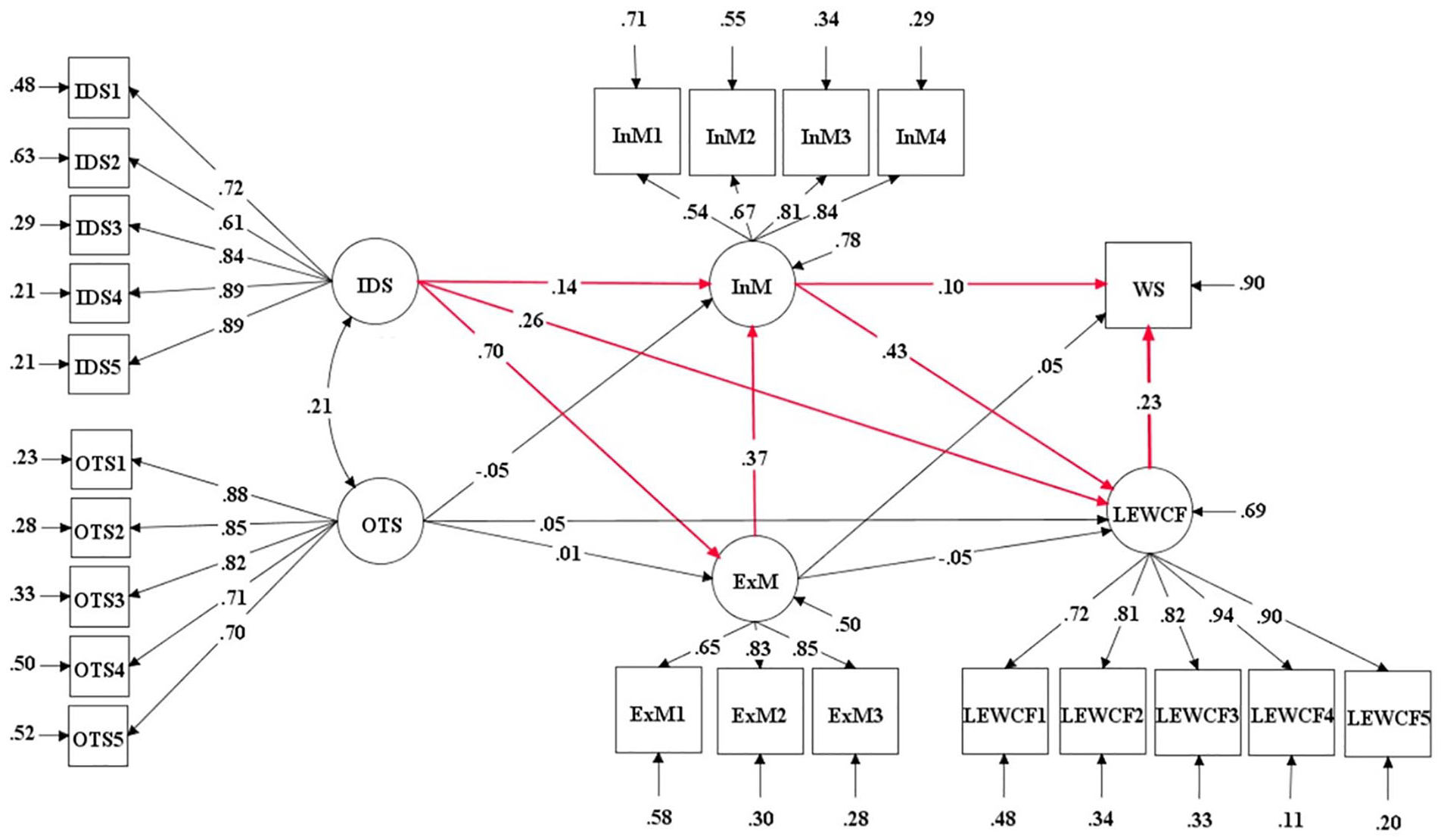
The empirical outcome of the proposed model of the study.
Effect size (ES) was calculated using Cohen’s (1992) proposed equation, f2 = R2/(1 – R2), to help the interpretation of the outcomes (.02 as small effect; .15 as medium effect; .35 as large effect). The ES estimates for latent endogenous variables in Table 2 revealed that this structural model accounted for 22% of the variance in intrinsic motivation (f2 = .28), 50% of the variance in extrinsic motivation (f2 = 1.00), 31% of the variance in learner engagement with WCF (f2 = .45), and 10% of the variance in writing competence (f2 = .11). All of the effect sizes fell between medium and large (range: 0.11–1.00), indicating that this structural model significantly and empirically explained the variances in intrinsic motivation, extrinsic motivation, learner engagement with WCF, and writing competence.
Effect Size Estimates for the Structural Model’s Latent Endogenous Variables.

Note. LEWCF = learner engagement with WCF; WS = writing scores; WCF = written corrective feedback.
As shown in Table 3, ideal L2 writing self was a strong and significant predictor of extrinsic motivation (β = .70, p < .001, R2 = .49, f2 = .96), but somewhat expectedly, it turned out to be a weak, though significant, predictor of intrinsic motivation (β = .14, p < .01, R2 = .02, f2 = .02). However, statistical significance was not observed for the direct effects of ought-to L2 writing self on intrinsic motivation (β = –.05, p > .05), on extrinsic motivation (β = .01, p > .05), or on learner engagement with WCF (β = –.05, p > .05). Regarding the causal link between intrinsic motivation and extrinsic motivation, the results further showed that intrinsic motivation could be directly predicted by extrinsic motivation (β = .37, p < .001, R2 = .14, f2 = .16).
Effect Sizes of Significant Direct and Indirect Paths among the Variables.

Note. IDS = ideal L2 selves; OTS = ought-to L2 selves; InM = intrinsic motivation; ExM = extrinsic motivation; LEWCF = learner engagement with WCF; WS = writing scores; WCF = written corrective feedback.
p < .01. ***p < .001.
With respect to learner engagement with WCF, both intrinsic motivation (β = .43, p < .001, R2 = .18, f2 = .25) and ideal L2 writing self (β = .26, p < .001, R2 = .07, f2 = .07) were found to be significant direct predictors, but extrinsic motivation was not (β = –.05, p > .05). Most importantly, writing scores could be directly predicted by intrinsic motivation (β = .10, p < .01, R2 = .01, f2 = 01) and learner engagement with WCF (β = .23, p < .001, R2 = .05, f2 = .05), but extrinsic motivation did not exert such an effect (β = .05, p > .05). A comparison of the R2 and f2 values showed that learner engagement with WCF could predict writing scores five times stronger than could intrinsic motivation.
As further reported in Table 3, ideal L2 writing self could indirectly and still significantly influence learner engagement with WCF via the mediation of intrinsic motivation (β = .14 × .43 = .06, p < .01, R2 = .004, f2 = .004) and the mediation of both extrinsic motivation and intrinsic motivation (β = .70 × .37 × .43 = .11, R2 = .01, f2 = .01). Notably, it was found that the mediating effects exerted by the longer route via both extrinsic motivation and intrinsic motivation were twice as strong as those of the shorter route via merely intrinsic motivation. This finding clearly showed that extrinsic motivation served as a pivotal mediator in the causal route from the ideal L2 writing self to intrinsic motivation (β = .70 × .37 = .26, p < .001, R2 = .07, f2 = .07), and that, in a similar vein, intrinsic motivation in turn further mediated the causal route from extrinsic motivation to learner engagement with WCF (β = .37 × .43 = .16, p < .001, R2 = .03, f2 = .03, small SE). More importantly, ideal L2 writing self was found to be able to indirectly influence writing scores via the mediation of learner engagement with WCF (β = .26 × .23 = .06, p < .001, R2 = .004, f2 = .004). This finding empirically explained the extent to which learner engagement with WCF mediated the causal relationship between ideal writing self and writing performance.
In addition, intrinsic motivation was further found to have an indirect effect on writing scores via the mediation of learner engagement with WCF (β = .45 × .23 = .10, R2 = .01, f2 = .01). On the other hand, although extrinsic motivation failed to directly predict writing scores via the mediation of learner engagement with WCF (β = –.05 × .23 = –.01, p > .05), it could still exert significant indirect effects on writing scores either via the mediation of both intrinsic motivation and learner engagement with WCF (β = .37 × .43 × .23 = .04, p < .05, R2 = .002, f2 = .002) or solely via intrinsic motivation (β = .37 × .10 = .04, p < .05, R2 = .002, f2 = .002).
Discussion
As indicated in Table 1, the participants were more likely to develop an ideal L2 writing self than an ought-to L2 writing self, which, to some extent, accords with Lai’s (2013) finding. That is, learners had a tendency to imagine themselves fluently and authentically utilizing English writing skills in different contexts. For instance, they would ideally like to be a person able to demonstrate fluent writing skills in school (e.g., finishing English assignments and presentations), on social networking sites (e.g., chatting with foreign friends by sending messages via Facebook), or in their future workplace (e.g., writing official documents or projects). However, one should note that the participants also possessed, although to a lesser extent, an ought-to L2 writing self in the process of learning English writing. Arguably, the research findings of the current study corroborate the statement of maintaining a harmonious balance, with dual focused goals of promotion and prevention, between expected and feared possible L2 writing selves (Oyserman, 2008). Previous research has suggested that learners with more balanced hoped-for and feared L2 writing selves may better know how to use strategies to both realize positive possible L2 writing selves and prevent negative possible L2 writing selves (Leondari & Gonida, 2008), as well as to devote more effort to attaining expected outcomes and avoiding negative ones (Oyserman & Markus, 1990). Therefore, a harmonious and balanced possible L2 writing self needs to be fostered within and outside of L2 writing courses.
In terms of the paths from possible L2 writing selves to intrinsic/extrinsic motivation, it can be seen that only ideal L2 writing self played an indispensable role in boosting learning motivation, as corroborated by other studies (e.g., Papi & Teimouri, 2012). The current study further shows that ideal L2 writing self can directly contribute to learners’ engagement with WCF (β = .26), a crucial empirical result that supports the finding of Oyserman et al.’s (2002) research and Chan’s (2014) argument. In addition, ideal L2 writing self is found to indirectly enhance the levels of learner engagement with WCF either via intrinsic motivation alone or via both extrinsic and intrinsic motivation. Specifically, as shown in Table 3, the indirect effects mediated by the synergies of both extrinsic and intrinsic motivation (β = .11) were nearly two times stronger than those mediated by solely intrinsic motivation (β = .06). These findings suggest that even though teachers should help learners develop a balanced L2 writing self during the learning process, it is advisable to put more emphasis on fostering their ideal L2 writing self rather than their ought-to L2 writing self. In addition, extrinsic motivation may play a salient triggering role by greatly expanding the effects of ideal L2 writing self upon intrinsic motivation and then, in turn, learner engagement with WCF. In other words, extrinsic motivation is no less important than intrinsic motivation as indicated in previous studies (Comanaru & Noels, 2009; Noels et al., 2001; Price et al., 2011).
Upon further investigation, it can be seen that the extrinsic motivation items are related to integrated regulation (e.g., ExM3: Because I have realized that to possess good writing skills in English has become a trend in the international workplace) and identified regulation (e.g., ExM1: Because I want to be that kind of person who can write in a second language), which are the two most autonomous forms of extrinsic motivation. This finding corresponds to Yashima’s (2009) argument that ideal L2 self correlates with the types of extrinsic motivation that are of a higher level of self-determination. Therefore, the finding derived from the present research may support Yashima’s contention that ideal L2 self can exert a marked effect on integrated and identified regulation, and this study confirms this causal link in the context of L2 writing.
Another related finding worth elaborating on is that ideal L2 writing self exerts much more explanatory power over extrinsic motivation (large ES) than over intrinsic motivation (small ES) as revealed in Table 3. In particular, the power of ideal L2 writing self in predicting extrinsic motivation (β = .70) is found to be five times stronger than that in predicting intrinsic motivation (β = .14). It is important to note that this research finding is in line with Kojima and Yashima’s (2017) study and further argues for the undeniable role of extrinsic motivation in effectively fostering L2 learners’ genuine interest in writing and their desire to actively engage in the process of self-correcting their writing after receiving teacher WCF. Two possibilities exist for explaining this phenomenon. First, the learning environment in Taiwan and other Asian countries is generally oriented toward nurturing students’ extrinsic motivation due to an examination-dominated culture (Watkins et al., 2002). As mentioned previously, teachers tend to use extrinsic rewards as a major method for motivating students to learn, and students are more familiar with the extrinsic type of motivation (Wolters, 1999). Extrinsic motivation may not be undesirable in that it may be ideal and beneficial for achieving short-term goals such as getting good grades or being able to demonstrate fluent writing skills in a future workplace (Froiland, 2012). In this way, students’ ideal image of themselves as good writers of English may naturally contribute more to the development of their extrinsic motivation. This point is made especially clear in the current work with the operationalization of integrated regulation and identified regulation as indicators of extrinsic motivation. Second, learning L2 writing is a tedious and time-consuming process. It may be too demanding for many language learners to immediately develop a keen interest in learning how to write well in English, especially when they are still struggling with learning how to write in a complicated writing system. In practice, it takes time for EFL learners to shift from being driven by external rewards (i.e., instrumental purposes from outside and beyond the self) to being energized by internal rewards (i.e., feelings of competence and self-determination from an activity), but this causal link from extrinsic to intrinsic motivation is substantiated in the current research. In sum, the foregoing arguments may explain why we found that ideal L2 writing self exerts a stronger effect on the participants’ extrinsic motivation than on their intrinsic motivation. However, more studies need to be conducted to further explore the causal relationships between possible L2 writing self and intrinsic/extrinsic motivation.
Furthermore, regarding the effects of intrinsic/extrinsic motivation on learner engagement with WCF, only intrinsic motivation can directly influence learner engagement with WCF. This suggests that intrinsic motivation (medium to large ES) plays a much more influential role than extrinsic motivation in encouraging and promoting learner engagement with WCF as previous research has shown (Cho & Perry, 2012; Saeed & Zyngier, 2012), with the variance of learner engagement with WCF explained by the former (.432 = .18) being nearly 18 times stronger than that explained by the latter (–.052 = 0). Importantly, intrinsic motivation can also serve as a stronger and significant indirect predictor of writing scores via learner engagement with WCF compared to extrinsic motivation. Hence, the findings of the current study restate the importance of helping EFL learners foster their intrinsic motivation to achieve long-term goals (Froiland, 2012) such as feeling the pleasure of mastering English writing methods and skills by effectively using teacher WCF on errors related to their writing’s content, organizational structure, grammar, vocabulary or collocation, and technical details such as punctuation.
In a similar vein, as indicated in Figure 2, the two viable direct routes to influence writing scores are determined by intrinsic motivation and learner engagement with WCF. This finding suggests that, as Hyland (2003) argues, acquiring L2 writing abilities can be a challenging and daunting task. Once learners can be intrinsically motivated, they are still required to actively engage themselves in reflecting upon teacher WCF and take actions toward editing or fixing writing errors in light of the WCF. Even though the predictive power of learner engagement with WCF for writing scores is not as pronounced as expected, its explanatory power over the writing scores should never be ignored by teachers. This is because the direct predictive power of learner engagement with WCF over writing scores is two times stronger than that of intrinsic motivation and also because learner engagement with WCF saliently mediates the causal route connecting intrinsic motivation and writing scores. Finally, one viable indirect path to influence writing scores is that from ideal writing self to writing scores through the mediation of learner engagement with WCF. This finding again underscores the vital bridging role of learner engagement with WCF between motivation and writing performance. It is clear that, contrary to what Truscott (1996) has argued, our research findings provide convincing evidence for the pivotal role of learner engagement with WCF in mediating the causal links among ideal L2 writing self, extrinsic motivation, intrinsic motivation, and writing achievement.
Conclusion
Learning to write in another language is a daunting task for most English language learners because of the complex interplay of various cognitive, linguistic, and psychological factors (Berdanier & Lenart, 2020). Thus, English language learners often find it challenging to improve their writing skills in comparison with their listening, speaking, and reading skills (Hyland, 2003). The current study examined the inner causal relationships between motivation (including possible L2 selves and intrinsic/extrinsic motivations), learner engagement with WCF, and writing performance. The research findings clearly suggest that one’s ideal L2 writing self plays a predominant role in promoting both intrinsic and extrinsic motivation. In addition, ideal L2 writing selves can contribute to learners’ engagement with WCF through direct and indirect routes via intrinsic and extrinsic motivation. In addition, extrinsic motivation was found to serve as an indispensable catalyst for augmenting the effects of the ideal L2 writing self on intrinsic motivation and learner engagement with WCF successively, yet intrinsic motivation outperforms extrinsic motivation in boosting learner engagement with WCF. Furthermore, learner engagement with WCF not only significantly mediates the causal links between intrinsic motivation and writing performance, but also serves as a more powerful predictor of writing performance than does intrinsic motivation in the whole model. However, some limitations in the current research should be acknowledged. Caution should be exercised when generalizing results beyond the scope of the present study because the findings obtained here may not be fully representative of the population as a whole, that is, the EFL learners in other countries. Other research methods should also be incorporated in future studies, such as interviewing participants, observing how they engage with other types of feedback (e.g., peer feedback, expressive feedback, and process-oriented feedback; see Yu et al., 2020), and analyzing their written texts to determine the degree of improvement in accuracy and fluency. Ultimately, the current research has essential and constructive implications for learning and teaching practices related to L2 writing. Instructors should help learners become self-motivated and effective self-regulated learners in the L2 writing process.
Footnotes
Appendix A
Appendix B
Declaration of Conflicting Interests
The author(s) declared no potential conflicts of interest with respect to the research, authorship, and/or publication of this article.
Funding
The author(s) received no financial support for the research, authorship, and/or publication of this article.
