




Abstract
The principal goal of this article is to study domestic artifacts in Masulih’s houses. This article points to the multidimensionality of domestic artifacts which can be categorized as being signifiers of research respondent’s beliefs and values, being part of the household’s social relations, and eliciting memories of the household. Research findings also highlight that some domestic artifacts have a life cycle and go through various phases in their life span. Qualitative research methods were used for data collection. Various extended field works were conducted in Masulih’s houses between 2008 and 2019. The principal techniques used for data collection were object interview, photo elicitation, and participant observation. The principal focus of interview sessions was on displayed objects and photographs in Masulih’s houses. During various interview sessions, respondents were asked to describe and narrate the stories of their domestic artifacts. Respondent narratives regarding their domestic artifacts highlight that the mentioned artifacts can be part of a complex web which mainly contains local inhabitants, houses, landscapes, memories, rituals, and values and beliefs. Furthermore, the study of domestic artifacts suggests that Masulih houses should not be considered solely as sites for the consumption of artifacts but places for the production of artifacts such as textiles. In this way, it can be said that local inhabitants are in constant connection with artifacts.
Introduction
This article is based on the ethnographic studies of material culture in Masulih’s houses. Following Rachel Hurdley (2006), the goal of this article is to study domestic artifacts and to record narratives provided by Masulih inhabitants. As Hurdley (2006) suggests, artifacts are not merely a collection of items to occupy space they can contain meanings which are constructed by their users (p. 717). These constructed meanings can take many forms and therefore are multidimensional (Tilley, 2001). The study of the artifacts within the Masulih houses demonstrates the multidimensionality of artifacts which can be categorized as the following items:
Artifacts providing in-depth insights regarding the beliefs and values of the households.
The cyclical usage of certain artifacts in domestic environment. These specific artifacts are displayed solely during the annual ritual of Ashura which is held in some houses.
Artifacts categorized under memory objects: These, according to Sabine Marschall (2019, p. 2), denote any personal belongings which elicit memories in one’s own autobiographical past. They also mean any objects in the domestic environment which represent memories of important events, places, and one’s social relations with friends and relatives. In this context, artifacts such as gifts from friends, family trip photos, pilgrimage photos, souvenirs, mementoes, and heirlooms and artifacts which elicit memories of certain professions can be considered as memory objects.
Artifacts like a slasher or a caplock musket (in Masulih’s houses) being locally made: The study of these specific artifacts inform us of Masulih’s artisans and their profession, local inhabitants as users of the artifacts, and Masulih surrounding landscape as the ground where they are utilized. It further provides information about production, consumption, and circulation of artifacts within Masulih’s cultural landscape. Most of the visited houses have workshops and the women are engaged in the process of weaving and selling textiles to the locals and tourists. In fact, Masulih houses should not be solely regarded as sites for the consumption of artifacts but as places of domestic workshops where the production of artifacts, and by extension material culture, takes place.
Home and Material Culture: Theoretical Framework
Home is a central domain in material culture studies. It cannot be considered solely as a private space which is isolated from the outside world nor as an exclusively public space (Woodward, 2001) but as a space in between private and public with strong ties and relations with the outside world (Haldrup, 2017). The meaning of private and public in a home swings according to the familial and social position of guests to the spatial organization of the home. In this way, home can be interpreted as an intermediate zone between private and public that permits the residence to live aspects of their lives publicly while preserving physical and emotional links within the privacy of their home (Woodward, 2001). Furthermore, it can be regarded as a crucial space around which the communication among artifacts and everyday life of the inhabitants is organized. Artifacts placed in the home can play an essential role for enacting relationships and strengthening bonds between home and outside world. As such, they can be an inseparable part of how one’s relationships are formed and mediated with other individuals, environment, culture, and community in which one lives (Haldrup, 2017; Woodward, 2020). Domestic artifacts can serve as entry points for narrating personal stories of the household and their relationships with others. In this context, domestic artifacts can function as links which can be retraced in any direction, to places and individuals (Riggins, 1994, p. 109). This understanding suggests a tripartite relationship among artifact, home, and the individual. These three interact in an ongoing construction of meanings and relations (Miller, 2001).
Home can be regarded as a personal space which facilitates relationships, experiences, meanings, and emotions for its inhabitants (Blunt & Varley, 2004, p. 3). The living room and guest room in a home can display the artifacts deliberately arranged (Allan & Crow, 1989; Hunt, 1989; Hurdley, 2006). For instance, an object produced in large quantity like a pot or a plate which is displayed in the living room in a house in Masulih can preserve significant cultural, emotional, and aesthetic meanings for the household. In this way, as Chevalier (1999, p. 94) reminds us, the pot or the plate turns into a meaningful décor. It can be said that these objects are incorporated into the household’s value system and function as an asset for understanding broader social and cultural issues (Douglas & Isherwood, 1996; Woodward, 2001). By displaying mass-produced objects in a domestic setting, the household occupants can move from being passive consumers of objects to active producers of meanings (Hurdley, 2006; Miller, 1988, 1995, 2001). A literature review on material culture studies in domestic environments suggests that there is a continuous interaction between households, displayed artifacts, and homes. The mentioned factors can play an important role in an active meaning-making process (Dittmar, 1992; Hurdley, 2006).
Within the context of British domestic culture, Hurdley (2006) studies artifacts displayed on mantelpieces and other areas. The principal goal of the research is to investigate the meanings and provenance of artifacts in relation to the research participants and focus on the construction of narratives about the displayed objects. Analysis of the research participants’ accounts suggests that individuals should not be regarded as passive consumers of objects but by narrating stories of their domestic artifacts they become active producers of meaning. In fact, the microstudy of the artifacts displayed at homes can shed light on the intersection of individual and self-identity.
This research follows the theory of objectification which is a way of overcoming the dualism that exists in modern empiricism regarding subject and object as separate and opposing entities such as humans and non-humans. Individuals define themselves through the process of crafting, utilizing, exchanging, living, and interacting with artifacts. The role of artifacts as material culture is fundamental in understanding an individual’s identity and the society at large. In fact, without artifacts, humans can hardly define or know themselves, as humans and their artifacts are dialectically intertwined. They are not fixed entities, rather they are in constant process of becoming. Values and ideas are created via the process in which the artifacts are crafted. Artifacts are powerful media through which ideas, values, and social relations are produced, altered, and legitimized. By interacting and living with the media of artifacts, various ways of identity construction come into being. The significance and meanings which artifacts hold for individuals are part of their identity. The relationship between individuals and artifacts is reciprocal. Cultural, social, and personal identity is manifested and embodied in individuals and objectified in artifacts. By studying artifacts, we can understand individuals because they are the medium through which we construct ourselves (Miller, 1987; Tilley, 2006; Woodward, 2020). Artifacts that surround us can be regarded as an inseparable part of how our relationship with other individuals, community, culture, society, and the environment is mediated. Artifacts, both handmade and mass-produced once produced, act through relations with other objects and individuals (Miller, 2010; Woodward, 2020). Artifacts in the field of material culture studies are not solely regarded as passive, rather an integral part of social and cultural relations. Artifacts act as key players in the formation of individual’s life (Woodward, 2020). In this context, humanity and materiality are intertwined and there is no fundamental detachment between them. The humanity is reflected in materials. As an example, a house is constructed by the collaboration of various artisans; the house as a cultural artifact reflects the artisan’s own identity and the way they observe the world. In fact, individuals understand who they are and what they are becoming by looking in a material mirror (Miller, 2005). This research is based on material-oriented ontology which positions artifacts as entangled and integral aspect of social relations. Individuals, artifacts, and social relations are co-constituted. In fact, artifacts play a crucial role in the materialization of individual self-definition and identity. In this vision, individuals do not stand peripheral to artifacts, but entangled with them (Woodward, 2020).
The concept of memory objects introduced earlier also demand further elaboration. As defined earlier, memory objects refer to any personal artifacts which elicit certain episodes in one’s own autobiographical past, one’s social relations with family members, friends and the community at large, certain places, and past events. They can be regarded as objects that can facilitate the process of remembrance. Memory objects such as small sentimental objects, souvenirs, and gifts can function as linking objects signifying certain people, home, places, and community. They can deliver a sense of identity continuity. Certain artifacts such as utilitarian objects used for everyday tasks can develop a sense of mnemonic over time, and in this way, they become memory objects (Marschall, 2019), and similar to other forms of material culture they have agency. They are able to produce effects on individuals. They can capture people and have the power to stimulate emotions such as anger, fear, lustfulness, happiness, or melancholy in individuals (Gell, 1998; Hoskins, 2006; Marschall, 2019). Various forms of material culture can be regarded as forms of instrumental action. They are formed to influence the actions and thoughts of individuals (Hoskins, 2006). Memory objects can act as emotional companions in someone’s life. They can invoke emotions, induce spiritual engagement, fuel imagination, and kindle one’s thought (Marschall, 2019). In Marschall’s (2019) research, the concept of memory objects is utilized in the context of intra-African migration, relocation, and displacement. In this research, the concept of memory objects is applied in relation to the displayed objects in Masulih’s living room. By describing their displayed objects, Masulih’s inhabitants elicit memories of home, past events, and certain episodes in their own autobiographical past.
Domestic artifacts are crucial for the formation of individual and family autobiographies. They can contain and preserve individual’s memories, experiences, identities, and biographies. When individuals describe their domestic objects, in fact they are constructing and materializing themselves (Csikszentmihalyi & Rochberg-Halton, 1981; Hurdley, 2006; Tilley, 2001; Woodward, 2001). One way to record the personal life histories of research participants is to ask them to describe their domestic artifacts. Describing domestic artifacts is a way of narrative construction in such a way that the research participants objectify and materializes themselves. In this context, personal memories and experiences are enshrined in domestic objects. The individual’s possessions can be regarded as a rich life history source (Hoskins, 1998; Tilley, 2001). Artifacts within the domestic environment are a rich source which can express and narrate individual lives. Following this notion, Daniel Miller (2008) visited the houses of residents of one street in contemporary London and conducted a series of interviews. Miller (2008) points out that domestic artifacts are capable of enhancing our insight regarding the household life. According to Miller (2008), it is the domestic artifacts within one’s home that depict the world within one’s private domain. It is vital to note that the meaning of objects should not be regarded as fixed. On the contrary, the object’s meanings are contingent and intrinsic by research participants. Also, the meaning of artifacts alters through time as the artifacts circulate, exchange, and pass through various social contexts (Hurdley, 2006; Tilley, 2001). It should be mentioned that the meaning of artifacts varies according to the stages reached by the artifacts in their overall life cycle. As an example, a hut might be constructed as a family dwelling, afterward it houses a widow, then it is utilized as a kitchen and finally it shelters the domestic animals before it is demolished or abandoned. In this regard, artifacts have different meanings according to specific stages in their life cycle (Tilley, 2001). By focusing on a local handmade object such as a bag, and tracing the entire life cycle of the artifact, meanings and relations which surround the artifact can be understood. A simple artifact such as a bag can hold significance beyond its utilitarian function for local inhabitants, such as supernatural protection, gift exchange, spirit divination, and decoration (Hoskins, 2006; Mackenzie, 1991).
This research also relates to the field of semiotics and visual semiotics. Semiotics is the study of texts such as artifacts, photographs, handmade and mass-produced objects, and buildings that can be taken as signs. Text can be defined as any semiotic object which contains symbolic or material boundaries and structural autonomy. It can be examined as a unit because all various parts have a function in relation to the whole text. Mentioned objects (texts) can be taken as signs as they can signify specific meanings for an individual or a community in a particular culture and society at a particular time (Aiello, 2020; Bal & Bryson, 1991). Semiotics is concerned about the way meanings are constructed. In this context, signs are used to communicate a specific idea, narrative, or a story. The primary aim of semiotics is to make visible the underlying and concealed meanings and cultural codes. Semiotics can assist us to thoroughly understand the world (Aiello, 2020). Roland Barthes can be considered as a key figure in the field of semiology; he demonstrates that photographs, objects, built environment, and popular icons of a particular culture can be read and interpreted as signs. For Barthes, signs and signification are bound with cultural and social fabric of a particular society at a particular time. Signs and signification (meanings) are context-based and vary across cultural contexts (Barthes, 1972, 1979).
Similar to semiotics, social semiotics focuses on the study of the internal structure of any text such as artifacts, photographs, objects, and built environment. It is concerned with how individuals construct, understand, justify, teach, and critique signs in a particular cultural, as well as historical and institutional contexts. Social semiotics regard signs, signification, and meaning-making as a process which is deeply embedded in current cultural norms of a particular society and it is formed by social structures (Aiello, 2020). From this perspective, photographs can be construed as symbolic, iconic, and indexical that are able to record particular events, places, and individuals. In addition, photographs can evoke abstract meanings associated with broader social norms and cultural values. In this context, they contain meanings (Aiello, 2020; Lomax & Fink, 2020).
This research follows the notion that any predetermined idea of what artifacts might stand for before commencing the ethnographic fieldwork should be avoided. The study of the artifacts should be based on the way artifacts are used, perceived, described, and conceptualized within a specific context, such as Masulih. Artifacts should not be regarded as universal; on the contrary, local inhabitants have various interpretations and understanding of artifacts within their specific culture. In fact, ethnographic fieldwork of material culture can be the starting point for deciphering artifacts within a specific context. In this way, artifacts are studied as they are (Henare et al., 2007).
In the study of the Ashura ritual in Masulih, the specific artifacts utilized within the ritual and the domestic environments where the ritual holds requires that home should not be considered only as a physical artifact but a cultural product, and the interior layout of the house is influenced by cultural values (Glassie, 2000; Rapoport, 1969, 1985). It can be said that religious beliefs constitute one of many cultural factors that mediate an individual’s relation to domestic environments (Mazumdar & Mazumdar, 1997). As a cultural factor, religious beliefs influence the interior layout of the house along with other factors (Hardie, 1985; Rapoport, 1969). In this context, home can be made sacred by the performance of ritual (Eliade, 1985, p. 108). Rituals conducted in domestic environments express the sacred nature of dwellings (Pavlides & Hesser, 1989). To summarize, this research attempts to study domestic artifacts through the lens of ethnographic studies of material culture and social semiotics which mainly lays emphasis on what individuals do with certain artifacts in a specific context and the ways in which these artifacts provide a ground for social relations. This research is concerned with the social and memorial dimension of artifacts that people obtain, utilize, and display in their everyday life.
This study will add to the existing research on material culture and domestic environment in the context of contemporary Iranian culture and society via investigating the artifacts in domestic environments in Masulih as a small-scale community and by examining the existing correlations between artifacts, individuals, surrounding landscapes, and the community at large.
Method
This research is based on qualitative research methods in understanding artifacts and material culture. To collect the data, various fieldworks were conducted between 2008 and 2019 in Masulih’s houses. Object interview, photo elicitation, and participant observation were the principal techniques for data collection during the fieldwork. The data produced in this research include audio recordings of the interviews, transcriptions, photographs of the artifacts, and field notes. All participants gave their verbal consent to participate in this research. Part of the data presented in this research is extracted from chapters 3, 4, and 5 of the author’s doctoral thesis (Daneshyar, 2014). For more detailed explanation of Masulih houses, domestic artifacts, and production and consumption of various artifacts in Masulih, see chapters 3, 4, and 5 of the thesis.
Object interview can integrate artifacts into the course of the interview. In this sense, the artifact becomes the central focus and the backbone of the interview. Through this method, the narratives that respondents produce concerning the artifacts are recorded. It is a form of narrative between participants, artifacts, and interviewers and the artifact plays a crucial role in generating the narrative. This can assist the researcher to gain better insights regarding the entanglement of individuals, artifacts, and the environment (Woodward, 2001, 2015, 2020).
The narratives as the principal outcome of this research could not be extracted by conventional interview techniques. For this reason, object interviews were conducted in Masulih houses to study artifacts in context. The artifacts were either displayed in houses or were selected by the participants. This research considers artifacts as text which was narrated by Masulih local inhabitants during the object interview sessions. The questions of Masulih’s inhabitants mainly addressed the following topics: (a) meaning and significance of artifacts, (b) the history of the artifact, and (c) the principal activities for which the artifact is used and the role which it played.
The principal focus of photo elicitation technique is mainly the description of photographs during the interview session. Photographs direct us into past events and lead to rich narratives, helping the researcher to reach beyond the photograph itself. They can function as reference and points of departure in an interview session and enable the respondents to narrate the story behind the photo and communicate other aspects of their lives. The photograph can point to a specific subject which is undetectable to the researcher but obvious and visible to the respondent, triggering unforeseen meanings. By using photo elicitation, a completely structured conversation can occur between the researcher and the interviewees. In summary, they can be seen as pathways into unfamiliar subjects and environments. By using object interview and photo elicitation techniques, it was possible to access dynamic insights which could not be reached and gathered by means of utilizing conventional interview techniques in the qualitative research methods employed here (Clark-IbaNez, 2004; Collier & Collier, 1986; Harper, 2002; Lapenta, 2011).
Part of the research objectives includes recording of the specific artifacts which are solely displayed during the ritual of Ashura. The ritual of Ashura that is annually held in Masulih’s houses involves local inhabitants and has religious significance with a long tradition in Shia Islam. Participant observation technique was employed for the ritual. It can be regarded as a process of data collection through involvement in the actual event, and the role of observer-as-participant is to observe and interact closely with the participants (Angrosino, 2007; Taylor et al., 2016). It is an effective method that facilitates data collection during the fieldwork (Angrosino, 2007). In addition, artifacts that were specifically displayed for the ritual were photographed, and object interviews with the participants were conducted.
Case Study: The Community of Masulih
The district of Masulih is located in the western part of Gilan province in Northern part of Iran (Bazin, 2012b; Figure 1). The province of Gilan is situated in the northwestern section of the Alborz Mountain range and the western part of the Caspian plateau (Bazin, 2012a). The township of Masulih is located in the upper valley of the Masulih Rudkhan at an altitude of 1,050 m. It is situated in the Talish Mountain range, which separates Gilan from neighboring Azerbaijan province (Bazin, 2012a, 2012b). Masulih itself is close to Masulih Dagh peak with an altitude of 3,050 m. The distance from Masulih to Rasht—the center of the province—is 60 km and to Fuman—another major city—is 32 km. The reports covering the series of excavations in Masulih district suggest that the origins of the community of Masulih is dated approximately between 10th and 14th century A.D. (Mughiyri, 1386/2008, p. 112). The population of Masulih is 554 individuals based on the 2016 census. Masulih can be considered as a touristic destination in Gilan province, because it is annually visited by around 800,000 visitors (Pur Ali, 2016). The entire community of Masulih is constructed on the slope of a mountain. The roofs are utilized as pedestrian paths due to the shortage of flat land. The pathways that course through the community of Masulih are significant, functioning as a kind of skeletal structure, linking homes, bazaar, tea houses, and sacred grounds (shrines and mosques) together. The mentioned characteristics attract local and foreign tourists (Daneshyar, 2017).

The historic community of Masulih.
On Domestic Artifacts in Masulih Houses
The first type of artifacts which were recorded in Masulih’s houses were displayed objects, the majority of which were religious artifacts. During a visit to the living rooms of Yad Allah Shahidi, Mohammad Asgarpoor, Ibrahim Hashimi Khah, and Murad Shab-ru, there were shown artifacts on the walls such as a carpet with the name of Allah, a poster with the name of Allah and the name of prophet Mohammad and his family, a carpet with the name of Fatimah, the daughter of prophet Mohammad, a carpet with a prayer to Fatimah and a poster with the name of Ali, the cousin and son-in-law of prophet Mohammad (Figure 2). Also, various carpets with verses from Quran were displayed in the living rooms (Daneshyar, 2014, pp. 285–286). During the object interview sessions, when asked about the displayed artifacts, the respondents mentioned that the prophet and his family are key figures in Islam and any devoted Muslim should follow their moral teachings. The prophet and his family have the power to protect and provide material and spiritual assistance for their devoted followers, and whoever is seeking redemption in the afterlife should follow them.

A framed textile with the name of Allah inscribed on it.
For respondents, the displayed artifacts act as a constant reminder of the prophet and his family. Religious meanings are not solely accessed through the intellect. Rather, they are crafted and presented through material forms such as artifacts. It is through the visible material world that the invisible realm become known and felt. Individuals learn and internalize the material discourse of a religion not only by reading sacred manuscripts or oral traditions but through the material culture of their religion (Khosronejad, 2012). Religious objects as powerful artifacts assist individuals to conceive the realm of the sacred and communicate with the divine (Frembgen, 2012; Gruber, 2016). The mentioned artifacts have agency and can evoke the individual’s senses of spirituality and emotion. From the senses of spirituality and emotion comes a feeling of healing comfort, engaging in more frequent contemplation and praying more devotedly with a wish to live a more fruitful life (McDannell, 1998). In this context, the study of artifacts can lead the researcher to discover the beliefs, values, and ideas of a specific community at a particular time (Prown & Haltman, 2000). As such, the artifacts are emblems that stand for individuals and their religiosity (Miller, 2010). The idea of religious beliefs becomes more apparent once one commences to study the carefully displayed artifacts within the living room of an individual and listens to the narratives of the artifact owner (Miller, 2006).
The second type of displayed artifacts is those which are solely used within the annual ritual of Ashura in Masulih. These types of artifacts have a cyclical use in Masulih’s houses. The annual ritual of Ashura is carried out during the first 10 nights of the Islamic month of Muharram (the first month of Islamic calendar) in Masulih and other cities and villages in Iran. Certain artifacts are displayed temporarily for 10 nights in the living rooms of the houses where the ritual is performed. The house of one interviewee, Mohammad Asgarpoor, was visited in December 2009 and August 2018 and August 2019 during a ritual to conduct object interviews, record the displayed artifacts, and observe the actual ritual. The living room of the house was divided into two sections for men and women. Every year, during the ritual, the living room functions as a place for local inhabitants—both men and women—to gather, sit, and mourn (Daneshyar, 2014, pp. 284–285). They mourn the martyrdom of Imam Huseyn, the grandson of Prophet Mohammad. During the ritual, people weep while listening to the recitation of the text and elegies which narrate Imam’s tragic death in the battle of Karbala. In Asgarpoor’s house, the artifacts which are used specifically for the ritual consist of the following items: a piece of black textile fabric hung around the room inscribed with poems describing the Ashura event, two black tapestries with the names of Huseyn inscribed on them, and a small pulpit located at the corner of the room for the clergy to address the audience (Figures 3 and 4). As Mohammad Asgarpoor mentioned during the object interview sessions, the artifacts narrate the story of Imam and his tragic death; in addition, it is the function of the displayed artifacts to transform the house into a temporary place for performing the ritual. For Mohammad Asgarpoor, the displayed artifacts provide a ground for performing the ritual which itself is a gateway to salvation and redemption in the afterlife. For him, the Imam has the power to intercede and to assist his believers on the day of resurrection, hence commemorating Ashura each year. During the ritual, the mourners request salvation and blessings for themselves and their deceased family members. Based on the concept of redemption and intercession in Shia tradition, performing the ritual of Ashura is perceived as a pathway for initiating contact with the spiritual world (Flaskerud, 2012). In Shia Islam, it is believed that holy figures play a significant role; they are signified as liminal beings that tie the realm of human with the divine. It is believed that they act as transmitters of divine blessings, as agents of intercession, and the intercessors on the Day of Resurrection. They have the power to protect, heal, and provide material and spiritual assistance (Gruber, 2016). In this context, religious artifacts also play roles. Human religiosity is intertwined with the material environment and to understand one particular religion, one should conceive the material culture which is associated with that particular religion. Religious artifacts such as inscribed carpets, textiles, tapestries, mourning banners, and photographs can be regarded as an expression of a particular religious tradition such as Shia. As mentioned before, such religious artifacts have agency. They can project meaningful effect unto the world. Religious artifacts focus on the supermundane which is beyond the realm of humans and projects the power of the supermundane unto the human world (Droogan, 2013). It can be said that certain artifacts might have significance for some individuals in a particular place and at a particular time (Miller, 1994). The study of displayed artifacts led the research efforts to the ritual of Ashura and shed light on some aspects of the respondent’s beliefs, values, and ideas.
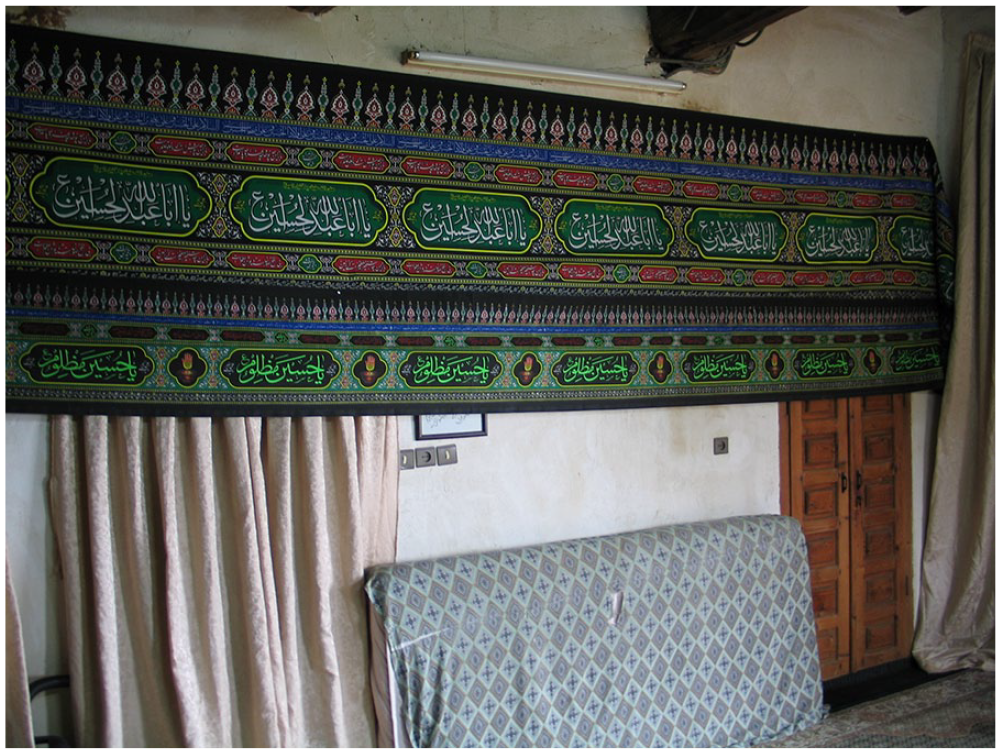
Asgarpoor’s living room during the ritual of Ashura.

A tapestry with the name of Huseyn inscribed on it.
Gifts from friends and relatives are the third type of artifacts which are displayed within the living room of the visited houses. As mentioned before, these types of artifacts are categorized as memory objects which play a key role in recalling certain individuals and families (Marschall, 2019). These objects are gifts which are presented by a friend or a relative during a certain event, ceremony, or occasion. As an example, in the living room of Fatimah Azargushasb, there are pots and plates which are displayed in various niches. These pots and plates are gifts presented to her after her return from pilgrimage to Mashhad and Damascus in Syria. After her return from each trip, the neighbors and relatives gathered in her living room and offered the displayed items to her (Daneshyar, 2014, pp. 273–278; Figure 5). The displayed pots and plates in Fatimah Azargushasb house form a special episode in her life—her pilgrimage to Mashhad and Damascus. The pots and plates as gifts are a reminder of her neighbors and relatives and in a wider sense it represents the values of friendship and care. In this way, a set of ordinary, mass-produced objects like plates and pots turned into memory objects and gained personal values (Marschall, 2019). As Fatimah Azargushasb mentioned during an object interview session, every time she cleans the artifacts, she remembers her friends and relatives (Daneshyar, 2014, pp. 273–278). By cleaning and dusting the plates and pots, it could be argued that Fatimah Azargushasb communicates with her cherished objects on a regular basis which activate the memories of her friends, neighbors, and family members (Cieraad, 2010, p. 97). From a phenomenological perspective, Fatimah touches the plates and pots and the plates and pots touches her; there is a reciprocal and dialectical relationship between subject and object at work here (Tilley, 2006). The practice of gift giving is a powerful way in which the identity of the individual is formed in relation to the other individuals. Individuals are objectified as members of the same community through the act of gift giving in a particular ceremony. Also, the objectification process which takes place through the act of gift giving shatters the distinction between object and subject worlds; through the process, objects and individuals are cojoined and united (Tilley, 2006). In this context, gifts as memory objects should be considered relational (Csikszentmihalyi & Rochberg-Halton, 1981, p. XI; Tilley, 2001, p. 258); they should not be considered solely as aesthetics objects for display in the living room, but also as part of the social relations of the household (Crang, 2010; Marschall, 2019). In fact, individuals and artifacts are part of the complex web of social relations (Glassie, 2000, p. 63).

The decorative pots in the living room of Fatimah Azargushasb.
Family trip photos to various cities and villages or pilgrimage photos to cities like Mashhad or Qum are considered under the banner of memory objects. As an example, in the living room of Mohammad Gulzar, there are displayed photos taken during the family pilgrimage to the shrine of Imam Riza in Mashhad and the shrine of Fatimah Masumeh in Qum. By pointing to the photo taken in Mashhad, Mohammad Gulzar mentioned that during their pilgrimage to Mashhad, they decided to have a photo at the shrine, although they did not have any camera with them. As a result, they decided to search in the bazaar for a photography studio. After a long search, they finally managed to find one. In the studio, they stood in front of a large painting of the shrine of Imam Riza to be photographed. For Mohammad Gulzar, the displayed photo is a memorabilia of the pilgrimage to Mashhad. Artifacts such as photographs can denote links with autobiographical past; in fact, memory is materialized through objects (Bliss, 2014; Marschall, 2019; Figure 6).

The displayed photos in Mohammad Gulzar’s living room.
The fourth type of displayed artifacts can be categorized as locally made ones. As mentioned previously, the study of these specific artifacts provides information about Masulih’s artisans, local inhabitants as the users, and Masulih’s surrounding landscape. By visiting the house of Ahad Allah Targhibi and discussing the caplock muskets and musketoons displayed in his living room, more in-depth insights were gained regarding the loss of musket-making profession in Masulih, the practice of hunting by local inhabitants, and Masulih’s surrounding landscape as hunting grounds. Ahad Allah Targhibi is the last gun-maker in Masulih. During the object interview session, while holding a caplock musketoon, he revealed his profession of making and selling musket and musketoon guns in his workshop in the bazaar of Masulih. He used to regularly visit the hunting grounds during the hunting season each year to hunt quail and boars. The peaks of the hunting seasons were in autumn and winter. During the hunting seasons, the Masulih inhabitants, who were hunters, used to regularly visit the hunting grounds and stay in a shepherd’s hut for 1 or 2 days. The boarders of the hunting grounds were limited to the lands above the Lalandiz grazing lands until the Qand Kalih peak. Targhibi’s guns were utilized in the above-mentioned hunting grounds (Daneshyar, 2014, pp. 417–423; Figures 7 and 8). Over-hunting was the cause of the discontinuation of the practice of hunting in Masulih and jeopardized Ahad Allah’s occupation as a gun-maker so he was forced to close his gun-workshop. For Ahad Allah Targhibi, the displayed muskets in his living room are reminders of his lost profession as a gun-maker, his hunting trips, and the hunting grounds around Masulih. Not only does the study of locally made artifacts provide insights into Masulih’s artisans, local inhabitants as the actual users, and the movement of certain artifacts in Masulih’s surrounding landscape, but it helps recognize these artifacts as memory objects. It can be said that an artifact might contain and preserve memories and embody personal experiences (Tilley, 2001). Also, artifacts can objectify particular places where they were made or particular landscapes where they were utilized. Certain artifacts such as caplock muskets and musketoons can refer to stories of particular events such as hunting excursions in particular landscape such as Masulih hunting grounds. In this way, individual’s biographies, identities, and their relation with certain places and landscapes are objectified in certain artifacts (Tilley, 2006).
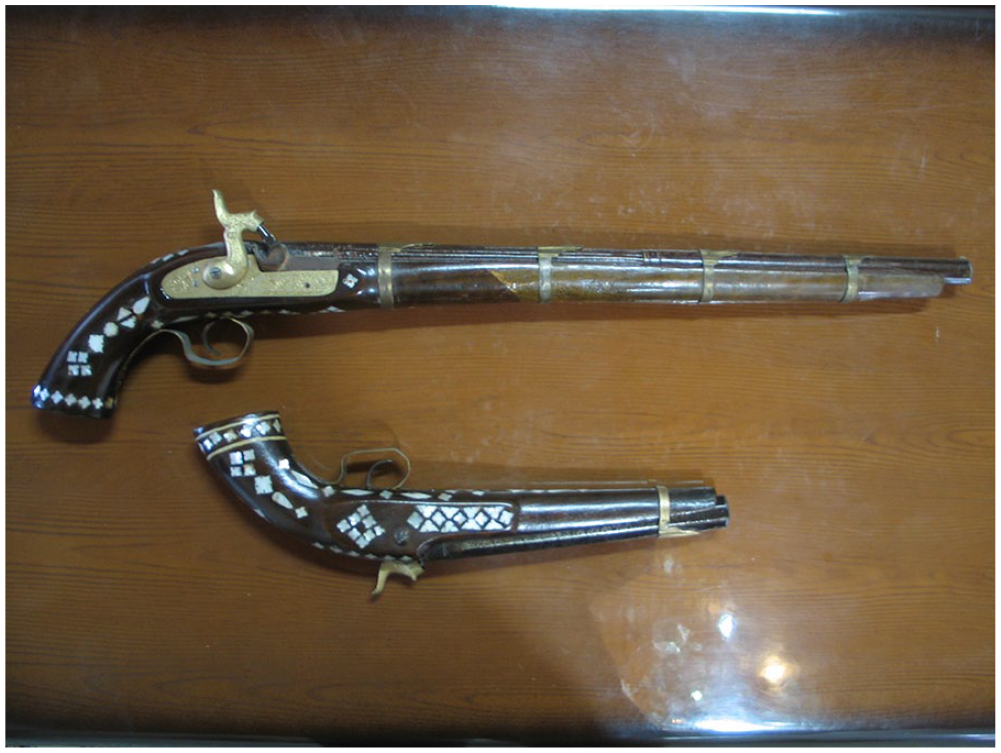
Two musket guns in Ahad Allah Targhibi’s living room.
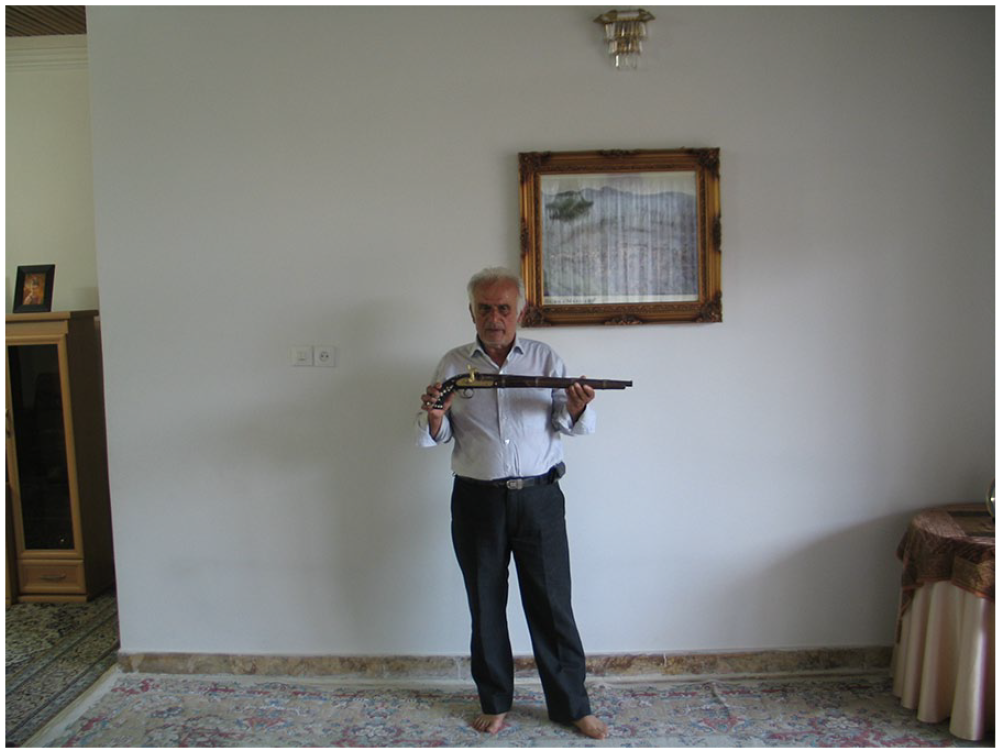
Ahad Allah Targhibi in his living room.
It was during the object interview session that Ahad Allah Targhibi showed his collection of hunting photographs. The photographs mirror his memory of hunting trips with his friends and remind him of various hunting excursions in Masulih vicinity. By pointing to various photographs, he related his memories of staying in the wooden huts during the cold autumn and winter nights, cutting logs, making fire, and attending to it during the cold nights. Therefore, in addition to caplock muskets and musketoons, the photographs should be considered as memory objects (Figure 9).

Ahad Allah Targhibi during a hunting trip with his friends.
By interviewing Mohammad Asgarpoor in his living room and conversing about the slasher displayed in his living room, an in-depth insight regarding the maker, user, and the landscape emerged where the actual artifact was used. As recalled, during an object interview session, his family were traditionally shepherds who used to graze flocks in the Lalandiz grazing lands in Masulih’s vicinity. Abdullah Asgarpoor—Mohammad’s father—used to graze flocks and sell butter, salted cheese, and meat to the merchants in Masulih bazaar. He would stay in Lalandiz grazing lands during the grazing seasons in spring and summer and tended the herd. Mohammad regularly visited his father and met his needs. While he was hiking toward the Lalandiz grazing lands, he cut the dense greenery paths and cleared the way by the slasher. They were also utilized on the grazing lands to cut logs for fire. Using an artifact such as a slasher needs constant care and Mohammad and his father regularly visited the blacksmith workshop of Jalil Ashjari to repair or sharpen their slasher, eventually making friends with Jalil Ashjari himself. In this way, the production and use of an artifact such as a slasher forges social relations (Crang, 2010; Marschall, 2019; Figure 10). Once again the study of locally made artifacts like a slasher provides insights into Masulih’s artisans, local users of the artifacts, and the usage of certain artifacts in Masulih’s landscape. Like individuals, artifacts might have biographies and undergo various stages in their life cycle (Tilley, 2001). Tracing the biography of an artifact like a slasher provides valuable perspectives into its production, usage, and maintenance in a specific context (Tilley, 2001). Also, it can be said that objectification process takes place by personification of individuals through artifacts. The personified artifacts might relate with family members, friends, and individual’s social relations and ties. In this context, the biography of a particular individual is linked with particular artifact. The artifact is the individual and the individual is the artifact. The consumption and circulation of personified artifacts associated with individuals and their life histories can become part of the construction of individual’s identity (Tilley, 2006).

Mohammad Asgarpoor with his slasher.
As mentioned before, Masulih’s houses are not places for solely displaying various artifacts but are sites of domestic workshops. Majority of the visited houses such as Fatimah Azargushasb, Khadiyjih Nasiyri, and Aziyz Hashimi Khah have workshops and the mentioned respondents engage in weaving textiles and selling it to the locals, shepherds, and tourists. Items such as patterned woolen socks, gloves, and dolls are made and sold to earn a living. In addition, skilled weavers are in constant connection with textiles as artifacts. An individual’s relationship to an artifact fundamentally alters when that person creates the craft. Through the act of production, the individual invests in the craft and its form. In this way, the individuals become part of the artifact and vice versa (Tilley, 2006). During the object interview sessions, all the respondents stated that they learned weaving through apprenticeship. As an example, Aziyz Hashimi Khah learned the basics of knitting and stitching under the supervision of Nargis Masumi. As Aziyz Hashimi Khah recalled, the daily task of weaving and selling textiles reminds her of Nargis Masumi who taught her how to weave. In this context, once again, it can be stated that artifacts such as textiles can be considered as memory objects (Figure 11).

A textile workshop.
Conclusion
The aim of this research is to highlight the complex roles that artifacts play in Masulih’s houses. These artifacts are multidimensional and their study indicates the various aspects that they represent. They can be categorized as signifying beliefs and values, having a life cycle, and being relational and memorial. The study of the domestic artifacts can be a gateway to gain valuable insights into certain individual’s belief system. Some artifacts are solely used during the Ashura commemoration period within some of the studied houses. Some of the studied artifacts have life cycles. These artifacts experience the two following phases in their life cycle: first they are locally made and serve their original intended function; then, they are converted into displayed objects. They are not originally built to be mementoes, but they are gradually converted into memory objects as they commence to elicit memories. Together with displayed photographs and other domestic artifacts, they can be regarded as containers of the household’s autobiographical past. Some of the studied artifacts are relational.
The study of these artifacts informs us of their makers, their user, and the landscape where they were utilized. The study of the artifacts in Masulih’s houses points to the issue that Masulih houses should not be regarded solely as sites for the consumption of artifacts but as places for the production of artifacts such as textiles. The familiar artifacts which surround an individual can be part of a complex web reflecting an individual’s social relation with other individuals, memories, values and beliefs, rituals, the house, and Masulih landscape. The main objective of the qualitative research on material culture is to render these familiar artifacts unfamiliar to invite focused attention on the significance and complexities of these artifacts in everyday life (Woodward, 2015). As this research highlights, by relating stories about their personal artifacts in their homes, respondents tell stories about themselves (Hurdley, 2006).
Footnotes
Declaration of Conflicting Interests
The author(s) declared no potential conflicts of interest with respect to the research, authorship, and/or publication of this article.
Funding
The author(s) received no financial support for the research, authorship, and/or publication of this article.
Ethics Statement
This research is approved by research ethics boards (McGill University). The research ethics board file number is  ; Tel: (514) 398-6831;