




Abstract
Digital technologies are increasingly being incorporated in the management and governance of urban forests to provide the information needed for sustainable and more livable cities. However, there is scarce information on the documented lessons from applying these digital technologies for urban forestry management in many developing countries. This study addressed this challenge using a literature review in the case of Nairobi, Kenya, and Kampala, Uganda. The results substantiate that urban forests are important city assets enhancing ecological stability and sustainable development. As such, the digital technologies of urban forest management practices are rapidly expanding in the two cities to enhance urban forestry and create new opportunities for sustainable development. Both cities have differentiated integration of digital technologies in the vegetative, community support, and resource management components of urban forest governance and management, with important information and lessons being generated for city authorities and policymakers. In general, the technology implementation level in Kampala city is higher than in Nairobi City. This differentiation could be attributed to differences in the socio-political contexts of the two cities, which present different enablers and barriers to technology application in urban forestry. Nevertheless, more location-specific practices and experiences with a focus on how to diversify opinions and actors in digital technologies should be pursued.
Keywords
Introduction
The dynamism in cities and emerging urban centers is encouraging new research on sustainability at the intersection of ecological conservation and digital technologies (Phillips & Atchison, 2020). This new research frontier is partly motivated by reports showing that many people will live in cities by the year 2050. With this realization, achieving local, regional, and global development aspirations, including sustainable development goals requires healthy and resilient cities. However, the growth of urbanization is also accompanied by environmental threats, changes, and stresses arising from mega-infrastructure development (Okai et al., 2018). Existing literature indicates that even though urbanization and the attendant infrastructure development contribute to the growth of the global domestic product, they also use approximately 70% of the global energy, which causes unprecedented catastrophic impacts on the climate system with rampant cases of pollution and biodiversity loss (Ali et al., 2020; Joshua et al., 2020; Mundoli et al., 2017; Okai et al., 2018; Russo & Cirella, 2018).
Sustainable urban forestry offers an innovative, integrative and nature-based solution planning and management approach focusing on tree elements that counter the negative environmental impacts of urbanization. Forests in urban areas have a central role in maintaining the cities’ ecological balance and sustainability through their provisioning, regulating, and supporting roles. Urban forests contribute to the carbon cycle, biodiversity conservation, and water quality improvement; hence, they have become critical in environmental change. As such, scientists, foresters, urban planners, policymakers, and communities alike have identified urban forests as important national assets to be conserved and managed—thus prompting the proliferation of initiatives and strategies that promote urban forestry. In the context of global action against climate change, biodiversity loss, and reducing pollution resulting from the growing human needs in urban areas, achieving the climate targets requires halting deforestation in all its forms in accordance with global leaders’ resolution during COP 26. This global commitment would require promoting practices of mass tree cover enhancements and regular monitoring that aim at addressing environmental changes.
Both developed and developed countries are fast infusing digital technologies in urban forestry as countries seek to expand their smart cities development practices and programs. It is hoped that the more digital technologies are embedded in urban forest management, the more strategic governments become as they improve actions toward more engaged, livable and sustainable cities. Urban forests are key ingredients for sustainable urban development because they contribute to the achievement of Sustainable Development Goal No. 11 on sustainable livable cities. Technology infusion in urban forests will enhance reporting on major international agreements and commitments such as the United Nations Convention on Biological Diversity (UNCBD), the United Nations Framework Convention for Climate Change (UNFCCC) and other agreements which require timely and accurate data and information. Many initiatives are also being undertaken in Africa and Asia to integrate urban forestry in sustainable urban development. For instance, in the Philippines the national policy exists and demands at least 30% of the total urban project land area for green spaces, including urban forests (Palijon, 2001). In the United Kingdom the existence of the National Urban Forestry Unit as an independent organization catalyzed the implementation of urban forestry expansion activities in Britain (Konijnendijk, 2003). In Hyderabad, Pakistan reviews show that in order to make their city competitive, urban forestry had to be included in the city’s sustainable development plans as a major objective (Zwingle, 2002).
However, in most countries, urban forest management and information gathering and sharing practices are still based on “traditional” cost and labor-intensive management practices. Moreover, the use of technologies in urban forest monitoring to show the contribution of these forests and trees to societal well-being and livelihoods remains under explored despite the immense time, cost and labor-saving opportunities. In addition, the documentation of the role and extent of deployment of digital technologies in urban forestry remains elusive in many developing countries, especially in the Africa continent.
Best practices from some developed countries show that many countries have initiated programs and deployed digital technologies that encourage urban residents to utilize green spaces, for example, the British Green Gym program (BTCV) and Forest therapy bases in Japan (Japanese Times). In addition, there are numerous research institutions currently exploring the nexus between digital technologies, urban forests, nature, and sustainable development, such as the United Nations Environment Development Programme. Nevertheless, sustainable urban forest management and governance requires a deeper understanding of the processes where various interested and affected stakeholders are involved (Lockwood et al., 2010). Sound urban forest management entails the interaction of humans with nature by utilizing the available organizations and institutional resources in order to achieve some common objectives (Steenberg et al., 2019). By exploring urban forest governance and management it is possible to discover ways of applying digital technologies in order to improve their sustainable management. As such, technologies for sustainable urban forestry appear to be thriving in many regions across the world. However, there is limited information on whether these technologies are improving the management and governance of these forests or not.
With this backdrop, this study seeks to explore the use of digital technologies in urban forestry in the case of Nairobi and Kampala cities in Africa and share lessons. Using case studies of two East Africa’s cities, the authors ask, in the wake of the existential environmental threats, what is the extent of integration of digital technologies in the various stages/components of urban forest management in East Africa? In order to address this research problem, in this pioneering study, the authors will first examine the social, economic and environmental matrices of urban forestry in two East African Cities (Nairobi and Kampala) to draw key observations. Later, the authors will apply the lessons learned from literature review to the findings from the two capital cities of East Africa and generate the policy implications of this study. Nairobi and Kampala have been chosen for this study because the two cities are among the top 10 cities in Africa with the highest penetration of digital technologies and devices (People Daily, 2019). Moreover, Nairobi and Kampala cities have been chosen for this study because they are rapidly growing capital cities in Africa in the socio-economic sense besides having a significant proportion of green spaces providing greenery which support ecosystems and human health (East African Community Website, 2019). Thus, it will be interesting to explore their governance and management of urban forests and draw lessons.
Sustainable Urban Forests and Digital Technologies
Clark et al. (1997) defined sustainable urban forests as trees and vegetation occurring in urban areas for provision of ecosystem services. As such, Clark et al. (1997) introduced a model for sustainability of urban forest management. Urban forest sustainability has three main components; the vegetative resource which includes the extent, type and distribution of tree resources in an urban forest; a community involvement framework that enhances cooperation in caring for trees on various properties; and the resource management approach for urban forests where the urban forest management philosophy is defined as programs are developed, requisite staff recruited and formulation of appropriate policies and urban forest management objectives. Clarks’ model demands that urban forests are governed in a proactive manner that integrates the three components.
Similarly, Dwyer et al. (2003) also appreciates the role of urban forests by emphasizing the role of society in management of the urban forests. As such, urban forest sustainability is defined as the process of maintaining a healthy ecological urban forest system which generates communial benefits in perpetuity. This disposition indicates that the type of urban forest in existence is largely dependent on ecological and social/community benefits to be derived. These framings are largely in agreement with the community framework envisaged by the Clark et al. (1997) model for urban forest management sustainability.
With the growing urbanization which appears to impact on urban forests, newer forest management approaches that involve the use of technologies are emerging. One of the growing approaches for sustainable urban forest management includes adoption of the concept of “smart urban forests.” This refers to a modern approach for promoting urban forest governance through the use of the internet of things and information communication technologies in managing the various aspects of urban forests (Tasoulas et al., 2013). Management activities may involve the use of technological applications such as citizen science apps, tree monitors, and 3D imagery. The “smart urban forest” concept has significant buy-ins into the sustainability model suggested by both Clark et al. (1997) and Dwyer et al. (2003).
Smart urban forestry entails using digital technologies to implement and monitor the three components of urban forest management; vegetative resource management of urban forests, fostering the cooperation of communities in caring for urban trees and tracking the progress of the resource management approaches in order to prevent adverse environmental change and as well as devise solutions for sustainable urban development (Mobilia et al., 2017; Mundoli et al., 2017; Yigitcanlar & Teriman, 2015).
The management practices where digital technologies may be applicable can range from trimming or pruning to the preparation of a full-fledged management plan (Dreistadt et al., 1990; Mundoli et al., 2017). It is important to understand that whichever the component, level of activity or practice, comprehensive information is needed on the situation of the urban forests as part of their wider conservation strategy. As such, important information such as the spatial distribution of tree resources may be urgently required (Givi et al., 2015). City authorities, planners, foresters and communities may use this information to Georeference trees for purposes of monitoring tree growth and health and plan silvicultural management regimes, set sound policies, and respond to dangerous tree reports (Tasoulas et al., 2013). Digital technologies have the capacity to provide this information in a timely manner if properly deployed and appreciated. Digital technologies of urban forests help cities to proficiently manage forestry projects, programs, and plans and lessen management costs since digital technologies together convey different data types for better planning. For instance, a city’s tree catalog may comprise the location of the tree, the tree species name, tree diameter at breast height (DBH), the tree crown width as well as the tree health status all collected at once (Tasoulas et al., 2013).
Moreover, urban forests governance is increasingly relying on the use of drones, machine learning, and robotics. The applications are usually connected to tree trunks or may be floating in the canopies of urban forests, while some could be embedded in the soil. These technological applications may also be situated in clouds and servers where data analysis is conducted.
Unmanned Aerial Vehicles (UAVs) may also be used for tree planting and monitoring of fires. Generally, UAVs are applicable in forest surveying, fertilizer application and spraying of pesticides, seeding, and detecting adverse forest events (Gabrys, 2020; Nitoslawski et al., 2019). Wireless sensors and Radio-Frequency Identification (RFID) microchips are also used to collect important urban forest information and to share them through web-based platforms (Alsamhi et al., 2019). As such, there is provision of big data sources needed for the effective management of urban forests.
With technological advancement, there are also networks for evaluating forest processes such as nutrient cycling and carbon sequestration. Lately, Light Detection and Ranging (LiDAR) combined with the use of machine learning are applied for assessing forest structure and automating or responding to adverse forest occurrences. Remote sensing applications are being applied to monitor deforestation whereas civic apps and platforms are gaining attention as search engines for worldwide reforestation programs. Urban forest tree species distribution modeling, which relies on these applications, is gaining popularity in predicting the incidence of certain tree species and populations and assessing their impact on other tree resources (invasive or endemic) in urban areas. Furthermore, the information provided by digital technologies in these respects can be used to design sustainable ecosystem restoration plans (Franklin & Lindenmayer, 2009). For instance, by using Volunteered Geographic Information (VGI) to identify and map naturally occurring urban tree species, the data collection becomes cheaper and more accurate (Franklin & Lindenmayer, 2009). The knowledge of the tree locations becomes important for various stakeholders who can monitor the distribution of protected trees in recently rehabilitated regions of the city (Bratkovich et al., 2011), and medicinal specialists can study and locate several tree species of interest (Biswas et al., 2021).
In the spirit of promoting engagement of city residents as “sensors” in sustainable urban forest management, other digital technologies such as the TREE APP, which is a product of public participatory geographic information systems, are now readily available. In addition, PPGIS, OpenStreetMap, Wikimapi, as well as Google Earth allow users to geotag pictures or places and also add textual data so as to create new information on the map, which is enhanced by their indigenous traditional knowledge (Goodchild, 2008). In sustainable cities with smart urban forests, digital technologies are usually integrated into broader urban design and planning.
Citizens have significant potential to be a source of vital georeferenced forest management information (US National Academies Website, 2020). Boyd and Foody (2014) also concur with this findings. However, studies also show that citizen-derived data have quality deficits and could be unreliable (Goodchild & Glennon, 2010).Thus, there is the need to conduct studies and devise ways of overcoming these challenges if digital technologies are to truly support urban forest management and hence the need for this study.
Several case studies show the possibilities of overcoming the aforementioned challenges and could provide key insights for other cities. The cities of Amsterdam in Holland and Chicago in the United States have developed various digital technologies for urban forest monitoring. The Green City Watch Initiative in Amsterdam uses artificial intelligence to continuously track urban green spaces. In Chicago, sensors and cloud-based analytics are used to monitor green spaces. Moreover, the Treescount Initiative in New York City used VGI for tree resource inventory and assessment (Nitoslawski et al., 2019). The case examples demonstrate the opportunities available in digital technologies which could be harnessed to monitor and assess other urban forest parameters in a cost-effective and time-efficient manner.
The i-Tree software suite from the US Forest Service uses desktops and web-based applications for individual tree inventory and assessment of urban forest canopy with the possibility of quantifying ecosystem services (Tan et al. 2021). Other technologies used for tree inventory include; OpenStreetMap, the Healthy Trees Healthy City (HTHC) web application developed by the Nature Conservancy, and the Seattle Department of Transportation (SDOP) application for inventory of urban forests.
From the above findings, it can be deduced that digital technologies are flourishing and producing new data and creating results that need to be explored. Nitoslawski et al. (2019) has attested to this need by acknowledging that the current literature that integrates urban green spaces, urban forests and smart city planning needs more exploration. Escobedo et al. (2019), Floridi (2018), Westera (2012), and Barns (2019) also recognize the scarcity of research that highlights human, technology, and environmental relationships. Hence, there is the need for studies that address digitized urban governance, including smart urban forestry (Barns, 2019; Datta & Odendaal, 2019; Floridi, 2018; McLean, 2020; Nunes & Nisi, 2018). Moreover, in the considered opinion of the authors, these findings illustrate the need for more location-specific studies on forest digitization processes in urban areas and hence, the need for this study.
However, there are also growing criticisms where smart urban forests are being considered as social-political technologies. Some digital technologies are prone to digital harm and categorization (Verma, 2022). Digital technologies are discouraged in some social settings in view of their largely Western neoliberal digital design and their seemingly neoliberal capitalist paradigm of design which appears to promote the commodification of nature. In addition, there is no single model of digital technologies that can work everywhere. Many cities are increasingly developing their tailor-made approaches for urban forest sustainability. Approaches include, bottom up initiatives by urban residents aimed at improving urban forest governance laws and strengthening partnerships between cities and states (Barns, 2019; Gabrys, 2020; Konijnendijk et al., 2018).
Digital Technologies and Forest Management in Kenya
Forests are important national assets providing immense ecosystem services to many Kenyans (Odwori, 2013). Following the constitutional changes of 2010, public forests are managed at National level by Kenya Forest Service (KFS) in a participatory manner with forest adjacent communities.
The forestry sector in Kenya has been evolving over the years, from management to training, research, and development. Efforts toward afforestation, reforestation, and restoration have also increased as various forest sector actors take lead in the activities. While these efforts are effective in ensuring sustainable forest management, the use of digital technology is quickly emerging. Digital technological development in the recent past has created new opportunities for the sector.
Various stakeholders are involved in development and management of digital technologies, for instance, the species site matching tool developed by Gatsby Africa helps tree growers select the most suitable tree species for their site. The tool uses soil, rainfall, altitude, soil types, soil depth, and species performance to assist tree growers and investors identify the appropriate tree species. There is also KEFRIAPP developed by Kenya Forestry Research Institute (KEFRI) which is available on Google play store. It provides site-species matching support thus assisting tree growers to identify the correct tree species to grow in a certain ecological zone. In addition, KEFRIApp provides information on the location of tree nurseries across the country and has tree planting documentation capabilities on a real-time basis. Kenya Forest Service (KFS) in collaboration with the National Centre for Earth Observation at the University of Leicester co-developed a rapid deforestation monitoring system. The system sends alerts every 5 days to help detect any changes in the forest resources such as changes in the forest cover. The system uses Copernicus Sentinel-2 images at 10 m spatial resolution allowing detection of even small-scale logging in the forests. Kenya Forest Service has also developed the Timbeter App as a digital timber measurement solution using artificial intelligence and machine learning technology for accurate log detection. The App aims at eradicating illegal logging and improving the monitoring and supply of timber using unique algorithms.
Urban forest management is guided by the provisions of the Constitution of Kenya (2010), Draft Forest Policy (2020), and the Forest Conservation and Management Act (2016). At the national level, forest management is coordinated by Kenya Forest Service. The most notable forest sector reforms in the Forest Conservation and Management Act (2016), is the requirement for all estate developers in urban areas to reserve 5% of their parcels of land for tree planting and the introduction of Participatory Forest Management (PFM), where different forest stakeholders are recognized in management decisions regarding all public forests.
Digital Technologies and Forest Management in Uganda
Forests and related vegetation cover about 4.9 million hectares in Uganda representing about 24% of the area of land. Up-to 70% of these forests are owned by private individuals while 30% are protected areas existing as forest reserves and national parks. In Uganda, these forests contribute about 8.7% to the country’s GDP. In addition, forests create nearly 1 million jobs. Wood fuels meet over 90% of the national energy needs. The responsibility to manage forests is scattered across various government entities resulting in overlaps in mandates and sometimes competition of interests. However, there is a lead Ministry responsible for forestry. The National Forest Authority is the semi-autonomous government agency responsible for the management of public/central forests. Forest management was initially decentralized with local governments being granted the authority to manage local forest reserves in the year 1993. However, forest management was recentralized in the year 1995 due to lack of technical capacity among most local forest management units. Urban forests are acknowledged to improve the quality of life in Kampala City. These forests are governed in accordance with the Uganda Forestry Policy of 2001. Unfortunately, the country loses its forest cover at an estimated rate of 2.4% per year. This loss is believed to be linked to infrastructure development, urbanization, agricultural extensification, charcoal production and the increasing demand for forest products.
Materials and Methods
Study Area
Nairobi, Kenya
The city is the capital city of Kenya and is located in the horn of Africa between latitude 1°17′11.0004″S and Longitude 36°49′2.0028″E. The city covers approximately 696 km2. The city has a population density of 6,317 persons (KNBS, 2019). Up-to 88% of the city residents use smartphones. Kenya which encompasses Nairobi City had a researcher density of 221 researchers in 2018 (World Bank Website, 2022). Nairobi as a portion of Kenya which is endowed with a wide range of forest ecosystems. Nairobi City has three gazetted forests that are rich in biodiversity and are managed by Kenya Forest Service. These forests include; Karura, Ngong Road Forest, and Nairobi Arboretum. According to a wall-to-wall high-resolution satellite imagery assessment conducted by Kenya Forest Service (2021), Nairobi city has 13.77% of tree cover and a forest cover of 13.74%. The city’s tree and forest cover per capita are 22.13 m2 and 22.09 m2 per person, respectively. Tree cover per capita is important in devising strategies for sharing ecosystem services, especially during this period of COVID-19. The greatest challenge facing the maintenance of adequate tree cover is the growing demand for land for real estate development (Nairobi County CIDP, 2018–2022).
Kampala, Uganda
Kampala city is located in Uganda between coordinates 0°20′51.3456″N and 32°34′57.0720″E. The city covers an estimated 189 km2. Kampala city has a population density of 794 with 15.8% smartphone users Kampala is located in a hilly place with its valleys filled with sluggish rivers/swamps (Uganda Bureau of Statistics Website, 2022). Uganda has a researcher density of 21 as of 2018 (World Bank Website, 2022).
To improve tree management in Kampala, the Kampala Capital City Authority (KCCA) implemented a tree inventory project in areas of Kololo, Nakasero, Makerere, and Mulago precincts (KCCA, 2018). Approximately 14% of Kampala had a total of 53,263 trees of over 200 species (KCCA, 2018). Out of the 200-tree species, 13 were identified as Nationally Threatened Species (Wildlife Conservation Society [WCS], 2016). Other initiatives launched by the Kampala Capital City Authority include the Kampala Trees and Palms Directory (KCCA, 2020), which informs the urban residents on the different tree names, their benefits, and how to manage them and increase the citizen reporting to the authority regarding tree management.
Kampala City was recently recognized among the Tree Cities of the World and the first African city to be recognized under Tree Cities of the World Programme for showing a willingness to be an urban forestry leader (KCCA, 2022). The key challenge is how to maintain the sustainable production and consumption of forest products in urban centers (Uganda Forestry Policy, 2001).
Data Collection and Analysis
This study seeks to establish the extent of integration of digital technologies in the management of urban forests in two East African capital cities. As such, an in-depth literature review was used to collect both secondary qualitative and quantitative datasets used in this study. Sources of information included internet search and review of key legislative and policy documents on urban forestry development in both cities.
The process of literature search entailed structuring the review; the actual review of secondary data; analysis and interpretation; outlining, and piecing up the review findings. These steps were also influenced by various standards and guidelines for the literature review, as suggested by Wong et al. (2013), Liberati et al. (2009), and Tranfield et al. (2003). The key documents consulted in this study are shown in Table 1.
Key Documents Consulted.

The research questions were used to guide the process of selecting key documents used in this study, including those highlighted in Table 1. In order to identify and locate these documents, the Google Scholar Search engine was used. Keywords, including smart cities, urban forestry, green infrastructure, urban trees, geographical information systems (GIS), remote sensing, internet of things, sustainability and ecosystem services were used to search literature on smart urban forest management. Also, in some cases, the keywords were used in combination in order to generate more specific and targeted search results. Additionally, Boolean operators such as “and,”“or,” and “not” were used to refine the results further.
The data collected were analyzed by customizing and using the analytical framework for assessing urban forests developed by Clark et al. (1997). According to Clark et al. (1997), there are three core components of a sustainable urban forest. The urban forest analytical framework is as outlined in Table 2. In order to document the status of urban forestry development and the integration of smart technologies that address the aspects of sustainability identified by Clark et al. (1997). The component of urban forestry identified in Table 2 will be described and analyzed for each capital city by narrating the similarities and differences.
Analytical Framework for Evaluating the Sustainable Urban Forests.
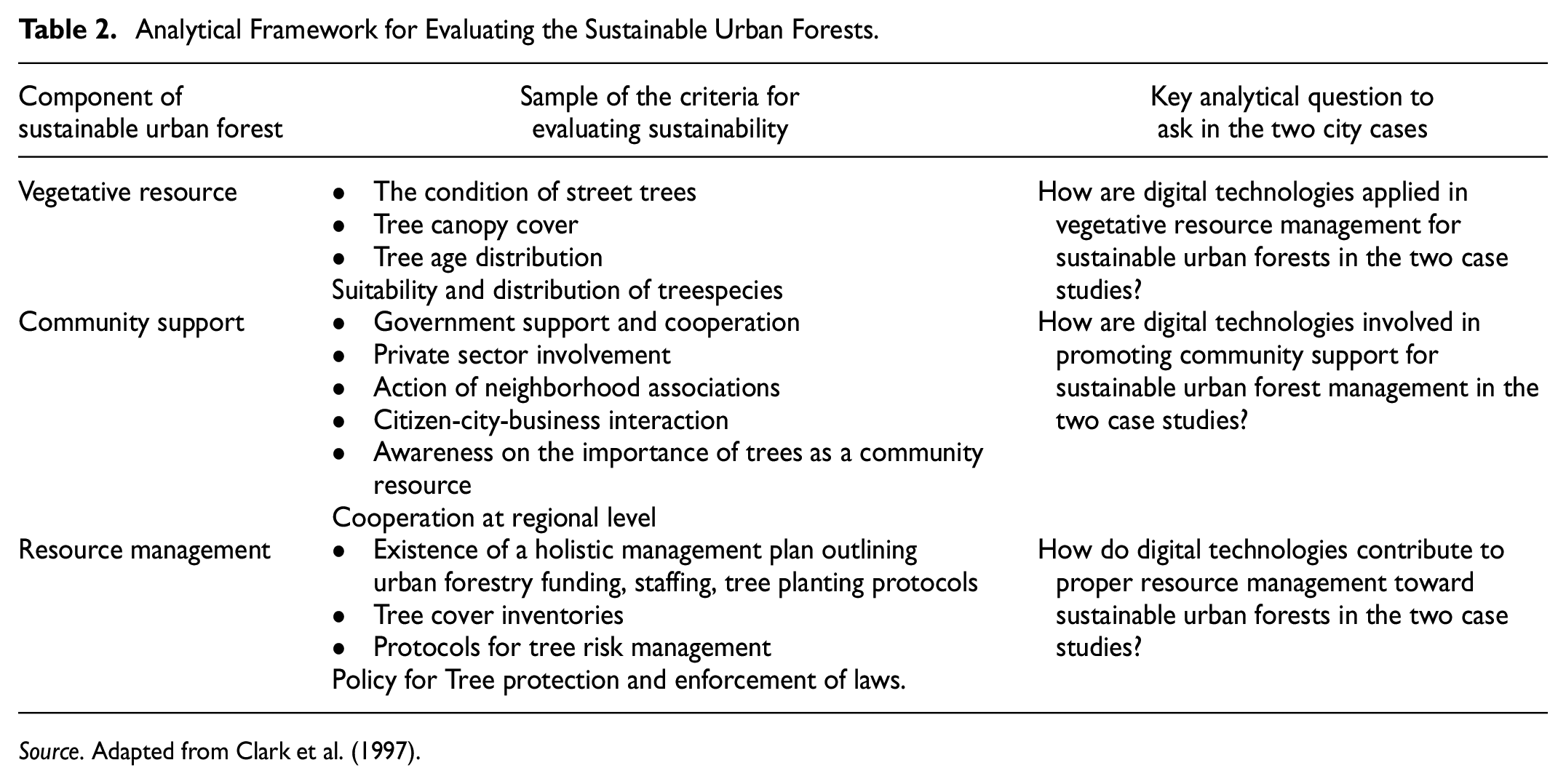
Source. Adapted from Clark et al. (1997).
Results
The results from literature review show that digital technologies are helping Nairobi and Kampala cities to address urban environmental change. From the contextual information reviewed, Nairobi has the largest city area (696 km2) with the highest population density (6,317 persons/km2). According to World Bank data, Kenya, where Nairobi is the capital, had the highest researcher density (in headcounts per million residents) as of 2018 with 221 researchers compared to Uganda which had 21. However, urbanization—especially mega-infrastructure development projects—and climate change are acknowledged as the greatest causes of environmental change in the two cities. Both cities have some greener policies and legislation for promoting the development of urban forestry. However, Kenya’s provisions that require all estate developers in urban areas to reserve 5% of their parcels of land for tree planting appear to be more robust and explicit. Moreover, in Nairobi, participatory approaches for forest management appear to be the existing framework for the participation of urban residents in the sustainable management of urban forests.
Kampala City appears to be the most advanced in the use of digital technologies of urban forest management compared to Nairobi. Results also show that the role of urban forests in promoting ecological integrity and socio-economic development is acknowledged across the two cities. In order to promote sustainability, vegetative resource assessments have been conducted in both cities where remote sensing technologies have been widely applied. The most common vegetative resource parameters assessed are tree cover, forest cover, and land-use land cover changes for Nairobi. Kampala city has had quite comprehensive assessments with technological applications cutting across vegetative resource assessments and community support components of urban forests highlighted by Clark et al.’s model of sustainability. Digital technologies in the area of resource management appears limited in Nairobi compared to Kampala. In Kampala, there is an Urban Forestry Management App which provides comprehensive data across all the three components of sustainable urban forestry (Table 2). The detailed description of results across the components of urban forestry is as highlighted below for each city starting with Nairobi then Kampala city.
Nairobi City, Kenya
Vegetative Resource Management Technologies
In Nairobi, the vegetative resource technologies are focused on managing the existing gazetted forests. Each of the three gazetted forests (Karura, Ngong Road Forest, and Nairobi Arboretum) are managed in accordance with the provisions of site-specific management plans, which outline all the forest management activities to be implemented. Even though the urban forests are important and rich in biodiversity, digital technologies for vegetative resource assessment are less documented. A few documented studies on vegetative resources exist. For instance, Oloo et al. (2020) used remote sensing technologies to examine tree loss in the Nairobi Metropolitan area. From the study, tree cover in urban areas was shrinking due to urbanization, energy demand, demand for forest products such as charcoal and other related anthropogenic activities. However, the study did not explore the loss at the tree species level. Other studies, for example, Boiyo (2019) and Ibrahim (2020), conducted a study on Ngong Road forest and found the existence of a strong negative correlation between the expansion of the city and tree resources.
Community Support Technologies
The city has rolled out various community support technologies. Each of the three gazetted forests (Karura, Ngong Road Forest, and Nairobi Arboretum) are managed by Kenya Forest Service in partnership with adjacent communities who have organized themselves into Community Forest Associations (CFAs). Among other roles, the CFAs are granted certain rights of using and accessing the forests. The CFAs have also formulated programs for forest conservation and act as a network for information dissemination on sustainable forest management. CFAs appear to be improving community support for urban forest management, as indicated by Simiyu (2004) in the case of Karura Forest. Moreover, even though there is scanty information on digital technologies for community support in urban forestry, Friends of Karura Forest CFA has started incorporating digital technologies in forest governance by operating a website (Friends of Karura Website, 2022).
In addition, Kenya Forest Service has developed a digital register for all CFAs in Kenya and an Online Voluntary Registration System for the private sector, government agencies, and individual citizens where a number of actors from Nairobi City have registered to participate in Urban forest management.
Resource Management Technologies
Some resource management technologies have been incorporated in city planning and development. Each of the three gazetted forests (Karura, Ngong Road Forest, and Nairobi Arboretum) are managed in accordance with the provisions of management plans. Among the recent resource management technological innovations being applied by Kenya forest Service to manage forest resources in the city include; the deployment of technologies to support surveillance and monitoring. These include; Aerial surveillance, Forest Alerts Tool, Unmanned Aerial Vehicle (drone), risk and fire mapping. Nevertheless, there is scanty information on digital technologies on the impacts it has on resource management in urban forestry.
Kampala City, Uganda
Vegetative Resource Management Technologies
In Kampala City, there is concurrence that the management and protection of urban trees requires a lot of foresight and vision, and so emphasis should not only be put on the promotion of tree planting but also other tree management practices like species site match, site preparation, soil improvement, enhancement planting, watering, pruning, tree health assessment and deployment of the relevant mitigation measures. As such, the city has developed several forest data collection and monitoring tools. Openforis is a Customized & built software based on field inventories as the main entry point for data collected. It has been touted as a fast, flexible way of setting up a user-friendly interface for surveys.
Community Support Technologies
In addition, the city has the “Kampala Tree Directory,” which provides a comprehensive, informative platform to guide the city community on the different tree species and provides important tree species information such as common name, ecology, uses, propagation, management, and feedback. The city has also developed the Kampala Urban Forestry Management App, a georeferenced platform for the tree data Map areas of interest for planning & management purposes. It enables the location of a given tree, quick assessment of the tree data vis-vi urban issues such as Land use, Flooding areas, Urban heat island effect. It enhances a more informed decision-making plan for short- and long-term solutions. The “Uganda’s Trees” app is one of the latest applications serving many purposes (Bhasin, 2019). It helps users tag, explore and learn about Uganda’s indigenous trees. The app describes 77 indigenous trees growing in Uganda as well as those in Kenya, Tanzania, and other African countries (Lemmens, 2019).
Kampala city has also developed the “online tree survey tools,” which is a tool that enables the community people to collect and send data (tree information) to the KCCA server. However, some studies show there is insufficient information about the trees in Kampala, which poses a challenge to the management of the urban forest. Some of these include; tree falls that damage property and take lives, illegal tree cutting, and lack of knowledge about trees by the public. There is scanty information on smartification digital technologies of resource management in the City of Kampala.
Resource Management Technologies
Kampala city has made some significant progress on implementing resource management technologies for sustainable urban forestry. In 2022, the city through the National Forest Authority (NFA) launched the use of mobile phones to be used in forest protection and law enforcement operations. The mobile phone were introduced as part of the initiatives to increase tree cover and efficient use of fuel wood and preventing detrimental environmental effects, such as climate change. The smart technology plus the Global Forest Watch Application and remote sensing approaches are used to give real-time updates on forest degradation. These technological applications have a direct impact on implementation of resource management technologies suggested in Clark’s model for sustainable urban forest management. However, in general, the key challenges facing the smartification of urban forests include; customization of smart infrastructure, a skills gaps, lack of early adoption, inadequate finances, application of a suitable governance model and inclusivity of all stakeholders (WCS Website, 2023).
Discussion
This paper seeks to determine the extent of incorporation of digital technologies in the management of urban forests in Nairobi and Kampala cities as a strategy for improving sustainability. This is an important question because existing literature shows that with the growing human needs and associated environmental threats and pandemics, the development of urban green structures and green spaces such as urban forests have become part of basic services. Urban forests provide essential environmental and socio-economic services which contribute to local livelihoods and economic development.
In this regard, some countries have initiated programs that promote sustainable urban forestry. Moreover, research programs seeking to establish the relationship between forests, nature, and sustainable livable cities are fast emerging within the framework of SDGs and a host of other international agreements and commitments such as UNFCCC, UNCBD among others. The resolutions of COP 26 where global leaders called for ending all forms of deforestation is clear testament of the need to address environmental changes at local, regional and global levels.
Sustainable urban forest management provides a framework for realizing these developmental aspirations in the case of urban areas. Whereas extensive studies have been conducted in the case of developed countries, a lot needs to be done for developing countries who are majorly still relying on “traditional” urban forest management practices.
Sustainable urban forestry requires comprehensive, accurate and timely information on the status and performance of urban forests as part of their wider conservation strategy. The approach requires information on the forest resource, organizations involved in its management, rules and processes. Whereas there are varied conceptualizations of sustainable urban forestry, to-date, the framework for urban forest sustainability provided by Clark et al. (1997) appears more comprehensive and has wider application across regions.
Incorporation of digital technologies in urban forests, which involves the use of technologies in various aspects of urban forests, is fast emerging as a feasible approach for providing timely, accurate and cost- effective information for the implementation of the sustainable urban forestry framework suggested by Clark et al. (1997).
Increasingly, results show that digital methods are being incorporated in urban forest plans, policies, and programs in order to validate, improve, and impact on aims and management activities. Also, in some developments, these methods are used to facilitate stakeholder participation toward cooperative aims among urban residents, educators, foresters, and policymakers. Therefore, combining the understanding of urban forest governance, management and digital technologies makes it possible to explore the ways of improving sustainable urban forestry and sustainable urban development.
Case results from Nairobi and Kampala cities also show that urban forests are important and provide many societal benefits. As such, digital technologies of urban forest management are fast emerging as an intervention for enhancing their sustainable management. These digital approaches have wider applications and could be harnessed to enhance the provision of timely information required for achieving the sustainability thresholds prescribed by Clark et al. (1997) in Table 2. The benefits of using these digital technologies in the case of Nairobi and Kampala cities are briefly discussed following the components of sustainable urban forest management.
Vegetative Resource Management Technologies
The key role played by urban forests in promoting sustainable and livable cities is widely acknowledged in Nairobi and Kampala cities. In Nairobi, the three gazetted forests which are rich in biodiversity, are important for various ecological benefits, including supporting the livelihood of many forest-adjacent communities (Friends of Karura Website, 2022; Simiyu, 2004).
In Kampala, urban and peri-urban forests are acknowledged for improving the quality of life through provisions of immense goods and services (Uganda Forestry Policy of 2001).However, overall, urban expansion, climate change, and limited urban forestry research appear to be the leading threats to the existence of well managed urban forests in Nairobi and Kampala (Draft Forest Policy, 2020; KFS, 2021; Nairobi County CIDP, 2018–2022; Uganda Forestry Policy, 2001). In response, the cities are formulating strategies, policies, and plans for promoting sustainable urban forests. The urban forest development policies appear to be more robust and explicit on integration of digital technologies, for instance, in Nairobi, where all estate developers in urban areas are required to reserve 5% of their parcels of land for tree planting and urban forests.
In general, the digital technologies of urban forests are being applied to provide critical information, including compliance with these policy provisions, besides generating important information about tree biology, characteristics, distribution, and other vegetative attributes needed for sustainable urban forestry.
In Kampala, there is wide recognition that the sustainable management of vegetative urban forest resources requires a lot of foresight and vision that includes both tree planting and tree management practices such as species-site matching and other silvicultural operations. The city has developed various smart applications for data collection and monitoring to actualize these visions. These digital innovations include; Open Foris for tree inventory, the Kampala Tree Directory, and the Kampala Urban Forestry Management App, which is a georeferenced platform for tree data maps. Out of digital technologies processes, it has been estimated that approximately 14% of Kampala had a total of 53,263 trees of over 200 species, out of which 13 were considered as Nationally Threatened Species (KCCA, 2018; WCS, 2016). These are highly laudable efforts and achievements that are in line with findings in reviewed global literature that seek to apply digital technologies in promoting urban resilience and sustainable smart cities programs (Gabrys, 2014, 2020). As such, the city of Kampala has received global recognition under the Tree Cities of the World program for showing a willingness to be an urban forestry leader (KCCA, 2022).
Moreover, the use of remote sensing in vegetative resource assessments is common in Nairobi and Kampala where tree cover, forest cover, and land-use land cover parameters changes have been assessed (Oloo et al., 2020). However, more comparative vegetative resource assessments using similar digital technologies are required as a way of promoting urban forestry in the two cities.
Community Support Technologies
Conceivably, the most important impact of using digital technologies in urban forestry is the possibility of affording, creating, and enhancing human-nature relationships (Barns, 2019; Gabrys, 2020). Stakeholder engagement is an integral component of many country’s urban forest management policies. Given this finding from reviewed literature, many smart urban forest policies, programs, and tree/forest plans not only seek to escalate stakeholder involvement and consciousness but also to aggressively seek out e-communication from citizens about their dispositions toward the management of urban forests. Therefore, the application of digital technologies in urban forestry increases knowledge and deepens relationships that increase abilities and opportunities for urban forestry programs by facilitating cooperation and partnerships. City authorities, International organizations, and civil societies have been active stakeholders in promoting digital technologies. Even though there is very little information on whether the application of digital technologies in urban forest governance has improved engagement and awareness among urban residents, Nairobi and Kampala have well-established platforms that could be leveraged to promote the digital technologies of community participation in urban forest management. In particular, Nairobi’s Community Forest Associations (CFAs) platform available in all the three urban forests of Nairobi provides a unique opportunity for digitizing the participation of urban residents in the management of urban forests. Under the platform which is enshrined in the Forest Conservation and Management Act (2016), the CFAs are granted certain access and use rights, etc. Moreover, the CFAs, which exist as corporate entities, formulate programs for forest conservation, networking, and information dissemination on sustainable forest management. Friends of Karura Forest CFA has already started incorporating digital technologies in its governance structure by operationalizing a website (Friends of Karura Website, 2022). Also, the government of Kenya—through the Kenya Forest Service (KFS)—has developed other digital technologies that appear to complement these CFA efforts. In particular, the KFS has developed a digital register for all CFAs in Kenya and has assembled an Online System Voluntary Registration of Tree Nurseries owned by the private sector, other government institutions, and individual citizens. Many citizens in Nairobi have registered to participate in tree nursery management as a way of promoting sustainable urban forest management. However, caution should be exercised when promoting community involvement in urban forest management. Many citizen-derived data are often diverse and are noted for their typically unknown quality and may be poorly described (Goodchild & Glennon, 2010). Reviewed literature has also shown that as much as collaborations are evident in several urban forest improvement projects, citizen participation in co-creation and design are important. This approach may help to counter against the antagonists of digital technologies in some social-political settings where some of these technologies are viewed as largely propagating Western neoliberal digital designs and neoliberal capitalist paradigm of design that promote and obfuscate the commodification of nature (Barns, 2019; Gabrys, 2020). Nevertheless, there is the need for more comparative evaluations of digital technologies for community support toward sustainable urban forestry in Nairobi and Kampala.
Resource Management Technologies
According to Clark et al. (1997), sustainable urban forestry is achieved in the component of resource management when there exists a comprehensive management plan that outlines the state of the urban forest resource, stakeholders involved, urban forest management policies, and availability of adequate resources to promote sustainable management. From the cases under study, it appears it is only Nairobi that has a robust plan for managing its urban forests. Each of the three gazetted forests (Karura, Ngong Road Forest, and Nairobi Arboretum) are managed in accordance with the provisions of management plans. Nevertheless, there is very little information on digital technologies and the impact it has on resource management in urban forestry.
In addition, there are no clear distinctions of digital technologies that separately address the criteria in Table 2. For instance, Kampala has somehow conducted comprehensive vegetative assessments with technological applications that cut across vegetative, community support, and resource management components. Digital technologies that exclusively cover resource management appear limited in both cities. Accordingly, this paper emphasizes the need for digital technologies targeting resource management processes which will help city authorities to monitor tree health and growth, schedule silvicultural management regimens, set sound policies, and respond to dangerous tree reports as discussed by Tasoulas et al. (2013). Digital technologies such as LiDAR have wide application in forestry, including assessment of forest structure, fires and detecting deforestation in real-time. Moreover, civic apps and platforms are contributing to reforestation initiatives and programs worldwide. It will be interesting for Nairobi and Kampala to consider applying some of these technologies to predict the impact of certain tree species and populations on, for instance, invasive or endemic tree species in urban areas. The information generated could be used to design sustainable urban ecosystem restoration plans, as reported by Franklin and Lindenmayer (2009).
Evidently, results show that there is differential adoption and implementation of digital technologies across the components of sustainable urban forest management in the two cities. Even though this study did not examine the causes of differential application of technologies, reviewed literature indicates there is no universal model for urban forest governance and that differences in technology application could be attributed to various enablers such as good governance where urban residents are involved in technology creation, public private partnerships and the growing body of scientific knowledge on technology applications in forestry (Barns, 2019; Gabrys, 2020; Konijnendijk et al., 2018). Barriers to technology adoption in the two cities may be attributed to criticisms pointed out in reviewed literature which indicate that digital technologies may be prone to digital harm and categorization (Verma, 2022).
Moreover, case results also indicate that the digital technologies of urban forests have the potential to provide opportunities for promoting competitiveness and regional integration of cities within the framework of the East African Community Treaty. For instance, the “Uganda’s Trees” app, which helps users to tag, explore, and learn about Uganda’s indigenous trees, also describes 77 indigenous trees growing in Uganda as well as those in Kenya, Tanzania, and other African countries (Bhasin, 2019; Lemmens, 2019). As such, there could be mutual cooperation arrangements for sharing these digital technologies among East African member states and cities as a way of improving efficiency in urban forest management. This development goal is in line with the current EAC’s development agenda of widening and deepening cooperation among the Partner States in various key spheres. Notably, reviewed literature has shown that currently, the process of regional integration is a top priority. However, lack of information and strategic, coordinated action amongst East African states continues to affect such integrative benefits. In order to unlock such cooperation, there is the need for escalating awareness on the importance of urban forests in East Africa by tapping high-level politicians and senior government officials to create political goodwill for urban forest development. Besides, there should be attempts to explore the option of pairing arrangements with foreign and local cities as a way of networking and information sharing which could be implemented through a smart urban forest management “twinning” program. Finally, this study calls for the need to conduct studies on the minimum required tree and forest cover per person in Nairobi and Kampala cities in view of the urban forest management challenges being experienced and the anticipated population growth.
Conclusion and Policy Recommendations
This study sought to address the scarcity of information on the extent of use of digital technologies in urban forestry using the case of Nairobi and Kampala cities. The results have shown that urban forests are important city assets, however; a lack of information and strategic, coordinated action that appreciates the use of digital technologies continues to affect the successful development of urban forests in many developing countries. Even though there is no single strategy that can provide uniform solutions for sustainable urban forestry development across regions and countries, the incorporation of digital technologies in urban forestry could improve the timely and cost-effectiveness of management and governance approaches. As such, the application of digital technologies in urban forestry is rapidly expanding.
In order to maximize the positive technology outcomes, consideration should be given to the thorough analysis of the development context of each city. In particular, the sustainable urban forestry analytical framework provides a practicable model for evaluating the context in the case of urban forests. Reviewed literature has established that residents’ support is the most critical aspect of urban forestry and that in order to secure community support of digital technologies, there should be a mechanism on how city inhabitants can participate in the creation and design of smart urban forests. Case results from Nairobi and Kampala have alluded to these findings. Moreover, Nairobi and Kampala are pursuing differentiated smart urban forest approaches in order to facilitate stakeholder engagement toward cooperative aims. Although there are several opportunities for enhancing urban forest management through citizen involvement, this study also cautions that some technologies could serve to reinforce alien ideologies and paradigms. As such, further research could draw on this study and document the practices and experiences of stakeholders in smart urban forests with a focus on how to diversify opinions when promoting governance in urban forest management. The main study limitation is that even though there are some indications that digital technologies of urban forests could be promoting regional integration, there was no cross-sectional dependence test to show a common spillover effect on the investigated cities.
Footnotes
Declaration of Conflicting Interests
The author(s) declared no potential conflicts of interest with respect to the research, authorship, and/or publication of this article.
Funding
The author(s) disclosed receipt of the following financial support for the research, authorship, and/or publication of this article: This work was supported by the Ministry of Education of the Republic of Korea and the National Research Foundation of Korea (NRF-2020S1A5C2A01092978).
Ethics Statement
Not applicable
