




Abstract
Despite the emphasis on effective supervisory feedback formulation on postgraduates’ academic writing, our understanding of effective feedback forms may not be comprehensive without mentoring students’ responses to feedback. Therefore, the current case study explores feedback formulation on research proposal writing and two postgraduates’ responses to feedback in a Malaysian university. Data were collected from written feedback, students’ commenting responses to feedback, their text revisions, and follow-up interviews. The feedback is formulated as directive, referential, and expressive, and it addresses issues related to content, organization, linguistic accuracy, and appropriateness in research proposal writing. The two postgraduates engaged in cognitive (e.g., confusion), metacognitive (e.g., reading feedback), and affective (e.g., appreciating feedback) responses to feedback. They integrated most of the feedback in revising their writing and made additional text revisions. Although this study is primarily qualitative in nature, simple descriptive quantitative measures were applied to the data to determine the prevalence of feedback forms, responding and revision patterns. The study provides useful suggestions for supervisory feedback practices.
Keywords
Introduction
Supervisory feedback is a key element in research supervision in higher education (Chur-Hansen & McLean, 2006). It helps undergraduates and postgraduates to know their current level and think of what they should do to progress in their research-relevant knowledge and academic writing (Basturkmen et al., 2014; Carter & Kumar, 2017; Kumar & Stracke, 2007; Xu, 2017; Xu & Hu, 2020). Written feedback is recognized as a tool for communication of issues and flaws in academic writing (Bitchener, 2018; K. Hyland & Hyland, 2006; Wang & Li, 2011; Wei & Cao, 2020; Yu & Lee, 2013). It is also known as on-script feedback (Basturkmen et al., 2014; Kumar & Stracke, 2007), which is often provided in the form of handwritten comments on students’ hard printed papers or through computer-based written comments using the commenting and track change functions of Microsoft Word (Basturkmen et al., 2014).
Supervisory feedback on postgraduates’ scholarly written texts is important for students’ development of research and academic writing skills (e.g., Carter & Kumar, 2017; de Kleijn et al., 2013; Wang & Li, 2011). These studies in addition to others (Basturkmen et al., 2014; Bitchener et al., 2010; Yu & Lee, 2013) have highlighted the potentials of effective feedback formulation for postgraduate supervisees’ research and academic writing skills. Yet, surprisingly, how supervisory feedback is formulated and provided to postgraduates remains “implicit and unexamined” (Pearson & Brew, 2002, p. 138) and has been given little attention so far (Bitchener, 2018; Li & Seale, 2007; Xu, 2017; Yu & Lee, 2013; Zheng et al., 2019). Recently, a few studies have explored this topic from feedback data by adopting analytical frameworks based on the sociocultural perspective (Vygotsky, 1980) and concluded that effective feedback formulation is important, yet complex (Bastola, 2020; Basturkmen et al., 2014; Morton et al., 2014; Xu, 2017). Central to the issue of feedback formulation is the question of what constitutes effective feedback. In this regard, Lee (2014) emphasizes three characteristics of effective feedback provision: intentionality (intended to assist learners to detect and solve issues in writing), reciprocity (triggering learners’ active roles and responses to it), and meaning (valuable for students in accomplishing the task). Besides, feedback formulation should consider students’ trust and students’ agency in learning (Bastola, 2020) as this may motivate or demotivate students to actively respond to feedback (Xu & Hu, 2020). However, in reality, it may turn out to be challenging and problematic for supervisors to know which feedback forms are effective for their students’ academic writing (Xu, 2017).
Relating to effective feedback formulation is the question of whether students will actively respond to feedback, understand it, and successfully use it in revising and improving their writing. In this regard, students may have difficulty understanding or interpreting some feedback messages and consequently may fail to act upon it in improving their written texts (Xu, 2017; Xu & Hu, 2020; Zheng et al., 2019). Therefore, the call for further research on undergraduates’ (e.g., Alvarez et al., 2012; Goldstein, 2004; Han & Hyland, 2015; F. Hyland, 2010; K. Hyland & Hyland, 2006; Jonsson, 2013; Zhang & Hyland, 2018) and postgraduates’ responses to feedback on writing (Xu, 2017; Xu & Hu, 2020; Zheng et al., 2019) is based on the argument that such responses do not only tell feedback providers about how students engage with feedback, but they can also provide evaluative information about the effectiveness of feedback provision. Despite these potentials, postgraduates may not be allowed to respond to respond to feedback and clarify their points because of time constraints and teacher-centered pedagogy in research supervision (Bastola, 2020). Also, how postgraduates respond to supervisory feedback has been almost under-explored (Carter & Kumar, 2017) as there are only three studies devoted to postgraduates’ responses to supervisory feedback (Xu, 2017; Xu & Hu, 2020; Zheng et al., 2019). Yet, the first two studies have restricted postgraduates’ responses to feedback to their mere text revisions. In this regard, although Zheng et al. (2019) provide evidence on six postgraduates’ engagement with supervisory feedback based on records of interviews, how students actually respond to feedback through commenting on feedback is lacking in this study. Therefore, based on the authors’ recommendations, supervisors should encourage postgraduates to actively comment on feedback. This seems consistent with the recent emphasis on the role of teacher dialogic feedback in promoting students’ negotiation and comprehension of the received feedback and creating a change in their roles from passive receivers to active respondents to feedback (Carless, 2020a, 2020b; Guasch et al., 2019).
The rationale for this study in addressing supervisory feedback formulation and students’ responses to it in the context of postgraduate academic writing is that feedback provision is an important feature of effective teaching practices in higher educational contexts (Basturkmen et al., 2014). Therefore, it needs to be explored through an analysis of feedback data given the complex nature of the process (Xu, 2017). However, feedback analysis alone may not provide comprehensive knowledge about the effectiveness of feedback formulation without mentoring students’ responses to feedback (Basturkmen et al., 2014). Therefore, responses to feedback help supervisors to better understand how students interpret their feedback (Xu, 2017) and whether they actively engage with it (Zheng et al., 2019). Although it is a small-scale case study, this study attempts to explore these issues deeply by looking at feedback formulation on research proposal writing of two postgraduates in a Malaysian university context and students’ responses to feedback from their comments on feedback, text revisions, and follow-up interviews. Specifically, the study attempts to answer the following research questions:
Literature Review
Theoretical Perspective
Vygotsky’s (1980) sociocultural theory, particularly its emphasis on the notion of human cognitive development as a result of mediated interactions with more capable others, is of relevance to the investigation of the current study. Mediated learning is defined as a collaborative process in which an individual accomplishes a task with the support of others that he or she may not be able to do so independently (Lantolf, 2013). Sociocultural research emphasizes written feedback as a mechanism by which teachers/instructors mediate students’ cognitive development, so feedback does not only assist learners to identify and fix issues and flaws in their writing, but it also creates contexts for teacher–learner interactions (K. Hyland & Hyland, 2006; Lee, 2014; Mirzaee & Hasrati, 2014; Morton et al., 2014; Xu, 2017). Based on this theory, effective feedback should be intentional (formulated with a deliberate effort to assist learners to detect and solve issues in their writing), reciprocal (learners showing interactive roles in the process), and meaningful (the value of feedback in accomplishing the task) (Lee, 2014). Although research on teacher feedback on undergraduates’ writing has been largely influenced by the sociocultural perspective, how this theory can inform our understanding of how learners respond to or engage with feedback has not been fully explored from this theory so far (Han & Hyland, 2015).
Formulation of Supervisory Feedback
In the contexts of supervisory feedback on postgraduates’ academic writing of research, research acknowledges the importance of effective feedback formulation in enhancing postgraduates’ research skills in general and academic writing in particular. Yet, how supervisors actually formulate feedback on postgraduates’ academic writing has not been adequately addressed in research. According to Bastola (2020), “it is surprising that there is little research on how feedback is framed and what functions it serves” (p. 2).
So far, four studies (Bastola, 2020; Basturkmen et al., 2014; Kumar & Stracke, 2007; Xu, 2017) have identified the various pragmatic functions of supervisory written feedback and clustered them into three main categories: referential (feedback that provides information, corrections, and reformulation), directive (feedback eliciting information such as seeking students’ clarification, justification, and confirmation, and telling and suggesting what to do and not to do), and expressive (registering a positive or negative response). However, the quantitative inquiry on feedback formulation suggests the varying prevailing pragmatic functions of feedback in these studies. For instance, according to Xu (2017), most of the feedback is formulated as referential, followed by expressive and then directive. This seems to be partially contradicted by the finding of a recent study (Bastola, 2020) that the majority of the feedback is given as expressive, followed by referential, and finally, directive. Bastola (2020) attributes this contradictory result to students’ language proficiency and supervisors’ time constraints. The divergent prevalence of pragmatic formulations of feedback in previous studies seems to reflect the divergent supervisor–supervisee relationships in research supervision (e.g., fewer imperatives as part of directive feedback suggest the facilitator roles of supervisors and the collaborative relationship with supervisees).
Other studies have identified different frameworks in analyzing supervisory feedback. For instance, Morton et al. (2014) analyzed supervisory written electronic (e-) feedback on a case master student’s academic writing of the literature review chapter and identified four main categories: comments, reformulations, deletions, and underlining. Moreover, the majority of supervisory written feedback is provided as reformulations, followed by deletions, written comments, and underlining. What is interesting about this study is the observed change in feedback formulation from more directness, such as reformulations and deletions to less directness, such as questioning over time. This change in feedback formulation over time, as interpreted from the sociocultural theory, suggests the need for reducing the supervisor’s explicit or direct scaffolding to students over time. In Yu and Lee’s (2013) study on supervisory feedback on research proposal writing of three Ph.D. students, feedback functions as directions and suggestions, positive and negative comments, and encouragement through such feedback somehow vary between the two supervisors. In other words, while supervisor A provided more feedback functioning as specific suggestions and concrete directions, supervisor B provided more feedback questioning serving as initiators of dialogue with supervisees. Yet, this study did not explain the possible factors contributing to the differences between the two supervisors in feedback formation and provision. In brief, the above studies conclude that despite the complex nature of feedback formation, analyzing feedback from a pragmatic perspective has a promising contribution to the pedagogy and research in research writing.
Studies on feedback formulation have also looked at the foci or content of feedback to identify the areas of academic writing addressed by supervisory feedback. In this regard, supervisory feedback addresses issues and flaws related to content and ideas, coherence, cohesion, organization, and language or linguistic accuracy (Basturkmen et al., 2014; Morton et al., 2014; Xu, 2017), appropriateness, and requirements (Basturkmen et al., 2014; Xu, 2017), as well as acceptability and others (e.g., format, size of the font) (Morton et al., 2014). The quantitative results of these studies reflect variations in the extent to which feedback addresses issues and flaws across the different areas of writing. In this regard, Xu (2017) reported that the majority of supervisory feedback addresses linguistic accuracy, followed by content, appropriateness, and organization. On the contrary, Basturkmen et al. (2014) reported that most of the feedback targets linguistic accuracy, appropriateness, and content, and the lowest number of feedback targets cohesion/coherence and requirements of academic writing. This result is interpreted from the nature of these different issues (e.g., supervisors can address linguistic accuracy and appropriateness through relatively short and less-effort consuming feedback as opposed to content-oriented feedback). This also contradicts the finding reported by Morton et al. (2014) as the majority of supervisory written feedback addresses content, followed by structure, language, and others.
From the above studies, only two studies have also cross-referenced the areas addressed by feedback to its different pragmatic functions to find out whether feedback formulation differs across the areas of writing. For example, Basturkmen et al. (2014) found that supervisors highly use directive feedback, such as single questions and suggestions, and a combination of both in addressing flaws relevant to content, coherence, and cohesion. However, they tend to address most of the linguistic accuracy and appropriateness-related issues through referential feedback. This finding is partially consistent with the finding of Xu’s (2017) study as the majority of issues pertinent to linguistic accuracy and appropriateness are addressed through referential feedback. Yet, it contradicts Xu’s (2017) finding on the extensive expressive feedback formulation in addressing content-related issues and directive feedback formulation in addressing the appropriateness of postgraduates’ written texts. These results confirm the evidence on the influence of the natures of issues and areas of academic writing on supervisors’ feedback formulation.
Students’ Responses to Feedback
Students’ response to feedback is defined as their engagement with feedback in revising their texts once receiving feedback (Han & Hyland, 2015; Zheng & Yu, 2018). Despite its potential for postgraduates in better understanding supervisory feedback and for supervisors to know about the effectiveness of feedback formulation for their students (Basturkmen et al., 2014; Carter & Kumar, 2017; Inouye & McAlpine, 2017; Wang & Li, 2011), a few studies have explored whether and how postgraduates respond to supervisory feedback. Inouye and McAlpine (2017), for instance, reported active but varied responses of two doctoral postgraduates to feedback. Although one of them actively evaluated supervisory feedback and used only some feedback in revising the text, the other postgraduate highly accepted and incorporated supervisory feedback in her academic writing. In Wang and Li’s (2011) study, six of the doctoral students were frustrated and uncertain about what to do with supervisory feedback. On the contrary, four of them were inspired and self-confident in responding to feedback. In other words, some of the international doctoral students coming from cultural backgrounds where critical feedback on their writing is discouraged may find it difficult to respond to critical feedback. The results of both studies indicate that responding to supervisory feedback varies among individual students and is influenced by several factors, including language proficiency, motivation, and cultural backgrounds.
Xu (2017) analyzed the text revisions made by her in responding to the supervisory feedback on her Ph.D. thesis. The researcher came up with four categories of text revisions: revisions directed by feedback, revisions inspired by feedback, additional revisions, and no revisions. Revisions directed by feedback were the most dominating category, followed by additional revisions, revisions inspired by feedback, and no revisions. Interpreting such responding behavior from the author’s own reflection on her experience as a receiver of feedback, Xu (2017) attributes the high rate of feedback-directed revisions to feedback to her lack of confidence and linguistic ability as well as her cultural background. On the contrary, the no-revision category is explained by from the feedback receiver’s inability to comprehend some feedback, and the additional revisions are indicative of her attempts in revising the thesis by herself. Similarly, Xu and Hu (2020) analyzed the responses of five Chinese doctoral students to supervisory feedback and identified four patterns: null/no revision, faithful revision, extended revision, and self-initiated revision. Most of the revisions made by the five postgraduates in responding to feedback are faithful text revisions. However, in Xu and Hu’s (2020) study, only students’ responses to language feedback (feedback focusing on linguistic or language accuracy in writing). In addition, all the above studies have limited students’ responses to feedback to the text revisions or changes made to written texts. In a recent study by Zheng et al. (2019) on six postgraduates, responding to feedback is not limited to students’ behavioral (e.g., text revisions), but it is inclusive of their cognitive (e.g., comprehension of feedback) and affective (e.g., reacting to feedback) responses to feedback. Yet, how students respond to feedback by commenting on it once received is lacking in this latter study.
Due to the limitations in the research investigation of postgraduates’ responses to feedback highlighted above, the literature of this study is extended to undergraduate research that provides deeper insights into how students respond to teacher written feedback. Like the abovementioned studies, undergraduate studies also provide evidence on text revisions made by students in responding to teacher feedback though some researchers refer to text revisions as students’ behavioral engagement with feedback (Zhang & Hyland, 2018; Zheng & Yu, 2018), while some other researchers refer to them as students’ uptake of teacher feedback (Ene & Upton, 2014). Regardless of these different concepts/terms, students’ integration of teacher feedback in revising their written texts differs depending on factors, such as feedback formulation and students’ language abilities and proficiencies in English as well as students’ willingness and motivation to follow teacher feedback (Hattie & Timperley, 2007). In addition, there are two studies which extend undergraduates’ engagement with teacher feedback by demonstrating that students respond to feedback cognitively (e.g., attempts to understand feedback, confusions, and misunderstanding) metacognitively (e.g., reading the feedback, reading their texts, and making modifications) and affectively (e.g., judgment of feedback, appreciation of feedback, and reaction to feedback) (Zhang & Hyland, 2018; Zheng & Yu, 2018). This result resembles result of the another study (Fernández-Toro & Furnborough, 2014) on 10 adult learners’ cognitive, metacognitive, and affective responses to teacher feedback on assignments. What is interesting about this latter study is these three categories of responses to feedback either elicit effective feedback dialogue or lead to ineffective dialogue. The authors argue that existence of feedback dialogue motivates students to enhance their writing, assists them to construct knowledge, and promotes their self-perception.
Although the above studies further our understanding of how students respond to feedback, the findings are based on analyses of student individual records of oral reports as a reflection on the feedback, text revisions, and follow-up interviews. Moreover, students’ effective engagement with feedback is sometimes challenged by students’ failure or inability to understand some feedback, confusion, and nature of issues in their writing (Zhang & Hyland, 2018; Zheng & Yu, 2018). Therefore, students should be allowed to comment on the feedback, ask questions, and interact over it (Zheng et al., 2019; Zheng & Yu, 2018). As students comment on the feedback, they can interact with the feedback provider and better comprehend it. Yet, how supervisory feedback can be formulated in a way to elicit students’ comments on it needs to be further explored.
The Study Methods
Study Design
This study used a qualitative case study, specifically an exploratory case study, which intends to provide a detailed interpretation of the phenomenon in context (McConlogue, 2015) and the particularities of a case (Hancock & Algozzine, 2017; Stake, 1995). Due to its potential in in-depth investigation of feedback practices and postgraduates’ responses to feedback, this research design has been used by several related studies (Xu, 2017; Zheng et al., 2019).
Study Setting and Participants
This study was conducted among two female postgraduates joining a master’s program in linguistics in a Malaysian public university during the academic year of 2018–2019. One of the students was a local Malaysian student, while the other was from Bangladesh. The two students were at the stage of research proposal writing. The two students were joining a research methodology course in which they had to write research proposals before starting their Master’s thesis writing later. Although eight Master’s students were joining the course, only two postgraduates were willing to take part in this study. So the study sample was self-selected, and therefore, it is not representative of the postgraduate population as a whole. The two case postgraduates were highly motivated to write and submit different drafts of their proposals based on the supervisory feedback. Being informed of the purpose of the study, the two postgraduates signed a consent on their voluntary participation (their participation in the feedback activities was not even graded) and protection of their confidentiality. The course instructor, one of the authors of this article, was a male who had taught undergraduate and postgraduate courses at the same university after being rewarded his Ph.D. in Applied Linguistics. He supervised and mentored the two postgraduates’ proposal writing through written feedback and also face-to-face discussions and meetings. However, the study is exclusive to the written feedback, postgraduates’ commenting on the feedback and text revisions, as well as a follow-up interview.
The Study Procedure
The two postgraduates were informed of the purpose of this research as part of a large project focusing on feedback practices and postgraduates’ responses to feedback while emphasizing the necessity to improve students’ research proposal writing. The students also signed a written consent form on their participation and informed that their confidentiality would be protected. By the time the data collection started in this study, the student had already written the first drafts of proposals (each draft consists of three chapters with a minimum number of 1,500–2,000 words). The two postgraduates were asked to email their first drafts to the course instructor to read them and provide commentary feedback on them using the commenting function of Microsoft Word.
The procedure of feedback provision and responding was carried at two-time rounds of 3 months (each round covers almost 1 month and half). The first round was initiated by providing written feedback on the two students’ first drafts (March 1–20, 2018) (Figure 1). Then, the two students read the written feedback, responded to it, or commenting on it using the reply function of Microsoft Word and revising their texts using the track change. This round ended by emailing the revised drafts (21 March–15 April 2018). The second round started by reading students’ revised drafts and their responses and giving feedback on their revisions. After that, students went through a similar process of reading, responding to feedback, and revising their texts. The second round ended by with students’ submission of the final drafts (May 6–31, 2018). Hence, during the period of study, the postgraduates made three drafts: draft 1, revised version, and final version.

The feedback procedure.
Based on the above procedure of feedback, first, the data were collected from three different sources: (a) written feedback, (b) students’ commenting on the feedback, and (c) their text revisions of research proposals. Then, a follow-up group interview was conducted with the students at the end of the study procedure (30 min). The purpose of the interview was to obtain further information on their responses to and integration of the feedback in revising their research proposals. The interview questions were developed based on students’ observed responses to feedback and the literature review (e.g., Zheng & Yu, 2018). These questions are intended to elicit further information, clarifications, and elaboration from both students as receivers of feedback on their responses to and use or integration of the feedback in revising their writing (Appendix A). The interview was voice recorded by one of the authors using mobile voice records and the transcription process was performed earlier to prepare it for a thematic analysis later.
Data Analysis
Before to our analysis, the data were organized in several Microsoft Word files. Then, the feedback written comments (550 comments) were read carefully and coded in terms of its pragmatic functions (e.g., suggestion and question) based on analytical frameworks of two previous studies (Basturkmen et al., 2014; Xu, 2017). According to Kumar and Stracke (2007), analyzing supervisory feedback from a pragmatic perspective is promising for it contributes to our understanding of effective feedback formulation and provision in postgraduate research writing. However, in this study, some comments carrying out two pragmatic functions were coded twice so there was an overall number of 561 pragmatic functions identified in the feedback data. Each comment was also coded in relation to its foci or the area of research proposal writing addressed by the feedback. As each feedback commentary addresses a single issue in particular area of academic writing, the feedback addressed an overall number of 550 issues and flaws in postgraduates’ proposal writing. Figure 2 provides a screen snapshot illustrating how each feedback commentary was coded.

Sample coding of supervisory feedback in Microsoft Word.
The feedback coding procedure ended by categorizing the feedback pragmatic functions into three main categories: directive, inferential, and expressive (Appendix B) and the feedback foci into content, organization, linguistic accuracy, and appropriateness (Appendix C).
Students’ responses to supervisory feedback consist of three data sources: commenting on the feedback, text revisions, and follow-up interviews. The first set of data consisting of 404 commenting responses was coded in relation to its pragmatic functions based on its intended meaning it conveys (e.g., confirmation, acceptance, and clarification) and in relation to its foci based on the above feedback codes (e.g., clear expression of ideas, relevance of ideas, the flow of ideas, and accurate grammar). This was followed by clustering the coded functions of these commenting responses into cognitive, metacognitive, and affective operations based on the concepts introduced by Zheng and Yu (2018) (see Tables 4–6 in the “Findings” section). In addition, the coded foci or areas addressed by these commenting responses were clustered into content, organization, linguistic accuracy, and appropriateness (see Table 4).
The second source of data consists of students’ text revisions which were traced using the highlights of Microsoft Word. These revisions were also coded and analyzed in relation to the revising actions/strategies, such as addition, substitution, removal/deletion, ordering, and consolidation, and in respect to the areas of writing they addressed: content, organization, linguistic accuracy, and appropriateness. Samples are provided in the “Findings” section.
The third source of data contains the follow-up interview transcripts. These transcripts were read carefully and then thematically and manually coded by both researchers. The thematic analysis was carried out based on the concepts of cognitive, metacognitive, and affective operations and also their views and strategies used in integrating feedback into their written texts. Moreover, in our thematic analysis, we tried to move back and forth among these three sources of data to be able to support categories emerging from data analyses of commenting responses and text revisions by excerpts extracted from the follow-up interview transcripts.
To avoid any biases and achieve high inter-rater reliability, an additional researcher, a lecturer of English, was requested to go through the data coded by the two researchers. The entire process of data analysis was iterative and the intercoder agreement reached was almost 77.51%. However, after several meetings and discussions, most of the disagreements were resolved and the percentage of agreement reached 81%.
Finally, the patterns of feedback formulations, student’s responses to feedback, including commenting on the feedback and text revisions, were counted using simple descriptive statistics: the numbers and percentages. Although the study is qualitative in nature, such simple counts of qualitatively identified patterns allowed us to better understand the extent to which each pattern emerges in the data and how linguistic formulation of feedback plays a role in triggering students’ integration of feedback in revising their proposal writing.
Findings
The findings are presented according to the three research questions.
RQ1: How Is Supervisory Written Feedback on the Two Case Postgraduates’ Academic Writing of Research Proposals Formulated?
To answer the first research question of this study, the feedback analysis revealed three main categories of pragmatic formulation of supervisory feedback: directive, referential, and expressive (Appendix B). The supervisor formulated his feedback in the form of directives intended to elicit information, seek clarifications and justifications from the postgraduates, suggest/advise, and also order them what to do or not to do in revising their proposals. So such comments give instruction and guidance to students and some of them, such as questioning offer the opportunities for students to negotiate and respond to feedback. On the contrary, referential comments provide information and even direct students to correct and fix the issues and errors in research proposal writing. The expressive feedback category serves as praise on students’ positive aspects of academic writing and criticism against the issues and flaws in their writing.
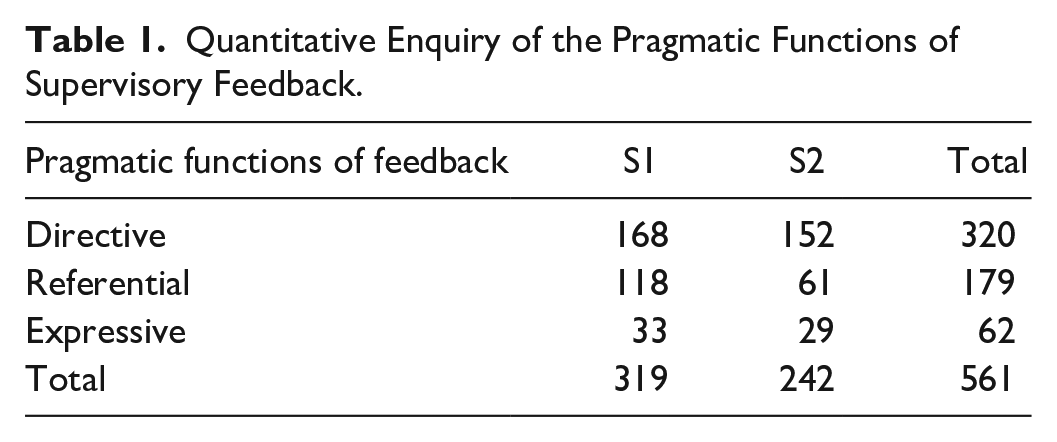
Table 1 presents the results on the frequency of these pragmatic categories of feedback. Although most of the feedback is formulated as directive, the lowest number of feedback is formulated as expressive.
Quantitative Enquiry of the Pragmatic Functions of Supervisory Feedback.
In relation to the four areas of writing addressed by supervisory feedback: linguistic accuracy, content, appropriateness, and organization (Appendix C), the quantitative results in Table 2 show that most of the feedback addresses issues relevant to linguistic accuracy, followed by content and appropriateness. However, the lowest number of feedback focuses on organization.
Quantitative Enquiry of the Foci of Supervisory Feedback.

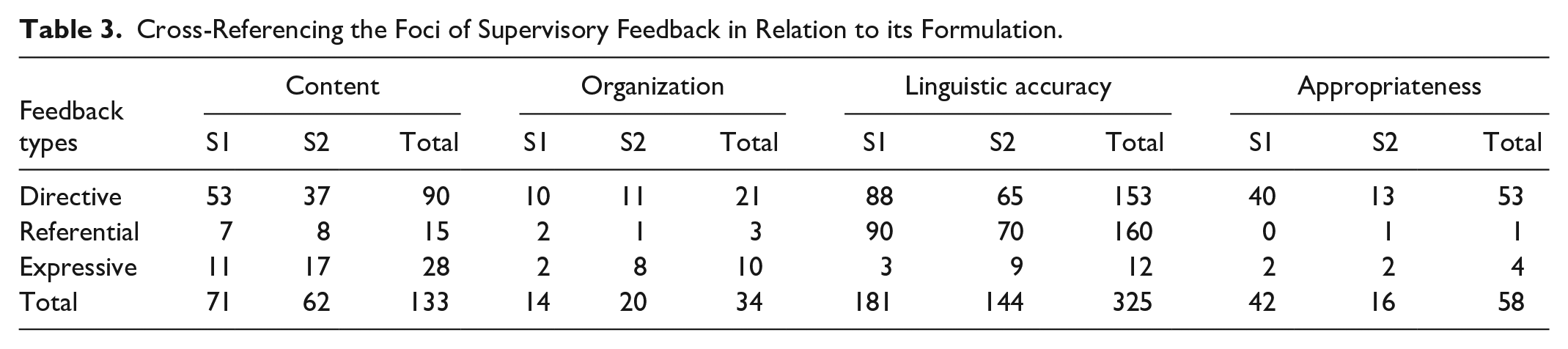
We also cross-referenced the various areas of writing addressed by the feedback in relation to the pragmatic functions (Table 3). The results illustrate that the supervisor’s linguistic formulation of feedback somehow varied according to the area of academic writing addressed by him. Specifically, directive comments seem to dominate the written feedback discourse when commenting on all aspects of academic writing except for the linguistic accuracy, which is highly addressed by referential feedback.
Cross-Referencing the Foci of Supervisory Feedback in Relation to its Formulation.
RQ2: How Do the Two Postgraduates Respond to the Supervisory Feedback on Their Academic Writing of Research Proposals?
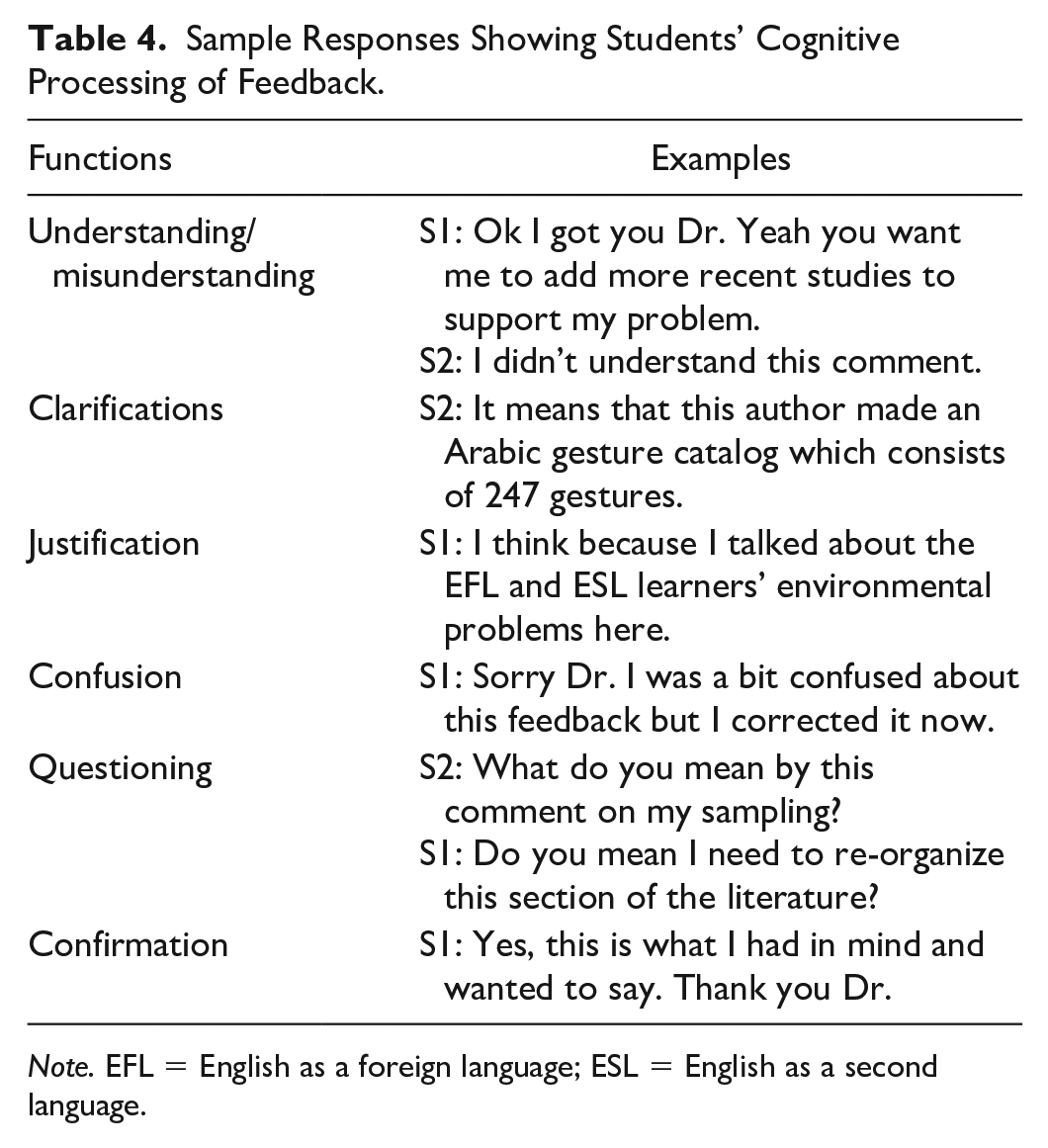
In answering the second research question, analysis of students’ commenting on the feedback illustrates the two postgraduates’ cognitive, metacognitive, and affective responses to feedback. The cognitive dimension is manifested in students’ comments functioning as negotiation of their understanding and misunderstanding of feedback on their academic writing (Table 4). Evidence of students’ cognitive engagement with feedback is found in their responses serving as clarifications of intended meanings or ideas, confirmation, questioning, confusions, and justifications.
Sample Responses Showing Students’ Cognitive Processing of Feedback.
Note. EFL = English as a foreign language; ESL = English as a second language.
Moreover, as opposed to single comment on the feedback that illustrates students’ understanding of the feedback message or intent (Example 1 in Figure 3), their exchanges of several comments show their failure to understand such feedback (Example 2 in Figure 3).

Single versus multiple commenting responses to feedback.
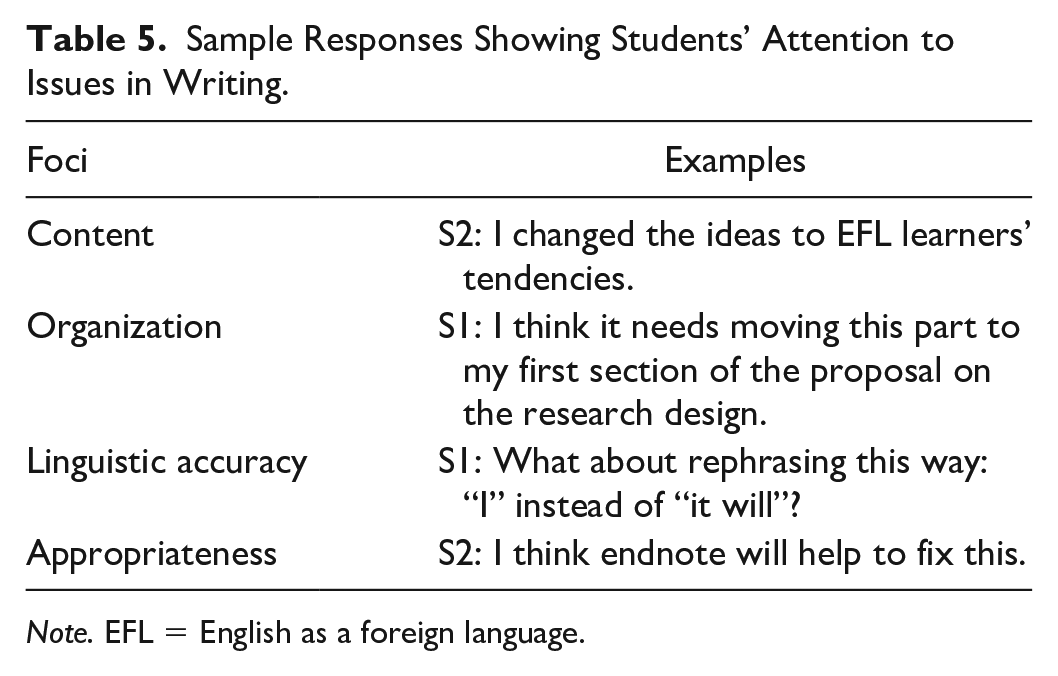
Analysis of the areas of students’ commenting responses shows their cognitive engagement with feedback, specifically attending to issues related to content, organization and coherence, linguistic accuracy in their academic writing, and appropriateness (Table 5).
Sample Responses Showing Students’ Attention to Issues in Writing.
Note. EFL = English as a foreign language.
The students’ responses to the interview questions support their cognitive engagement with feedback. They acknowledged the opportunities given to them to clearly express their intentions and clarify misunderstanding of feedback on their proposals:
I think replying to your feedback helped me to know that I didn’t get your point in this feedback.
As shown in Table 6, the postgraduates responded to feedback metacognitively. Their visible responses, such as provision of correct forms, informing the instructor of making a particular text revision, and commenting on their intention or to do and plan to refine their proposal writing in addition to reading, which is acknowledged by the postgraduates in the interview (S2: As a receiver, I read all comments and I was trying to get what you meant by your feedback and I wanted to know whether the reader understood my writing or not), are metacognitive strategies that regulate students’ cognitive engagement with feedback.
Sample Responses Showing Students’ Metacognitive and Affective Processing of Feedback.

Students’ affective responses to feedback include expression of intentions to make revisions, stating their agreements/ acceptance of suggestions and suggested edits, and admitting their errors in research proposal writing. Other comments showing their affective engagement with feedback are evaluation or judgment and appreciation of feedback. This positive affective evaluation is also supported by the two students in the interview:
The feedback was rather helpful and detailed.
I really appreciated the feedback because it helped me to improve my proposal.
However, both students did not talk about their negative reactions to the feedback. In other words, they seemed to have positive views of the critical feedback and satisfactory feelings upon receiving it from the supervisor:
I know that some feedback was critical but at the same time, I need really critical comments because they motivated me to read and keep writing.
After reviewing my writing, I felt satisfied that you pointed at the areas where I needed to work on.
The quantitative results on students’ cognitive, metacognitive, and affective responses to feedback in Table 4 illustrate that the learners engaged most highly in metacognitive, followed by cognitive and finally affective responses to feedback. These metacognitive responses seem to regulate students’ cognitive processing of the feedback. In relation to the areas of these responses, most of these responses focus on linguistic accuracy, followed by content, appropriateness, and then organization. Such result reflects students’ attention to the appropriate use of academic language in research proposal writing.
From the above results (Table 7), there are differences in the extent to which each individual student made efforts in processing the written feedback. Specifically, S1 more highly engaged in processing the feedback and paid more attention to issues related to linguistic accuracy, content, and appropriateness than S2 did. This result could be due to the differences in their language abilities as S2 relied more on her linguistic competence to understand the feedback without having to respond it through comments, while S1 appeared to be challenged by her inadequate understanding of some feedback. Another possible reason is the amount of feedback on their writing each student received from the supervisor. As S2 received more feedback, she had to more highly engage in responding to the feedback.
Quantitative Enquiry of the Postgraduates’ Commenting Response to Feedback.

RQ3: How and to What Extent Do the Two Postgraduates Integrate Supervisory Feedback Into Their Academic Writing of Research Proposals?
For the third research question, the postgraduates integrated most of the feedback in revising their research proposals and engaged in additional or self-made text revisions. As shown in Table 8, the two postgraduates engaged in several text revision operations that addressed issues and flaws pertinent to the content, organization, linguistic accuracy, and appropriateness. The quantitative results illustrate that most of the text revisions are corrections of linguistic issues (263), whereas the lowest number of revisions addresses flaws relevant to the organization (14). There are also minor differences in all aspects of text revisions between the two postgraduates except for appropriateness-related revisions as the difference appears higher.
Postgraduates’ Revisionary Responses to Supervisory Feedback Through Text Revisions.

The interview elaborates the above result on students’ integration of feedback in revising their proposals. When asked how they found the feedback and how it helped them to refine their proposal writing, the postgraduates admitted that it was helpful for them to know the issues in their writing though major revisions seemed challenging and time-consuming for them:
I found it helpful, but sometimes, it was difficult and took much time in revising big issues.
There are moments when I saw it challenging for me to make more revisions, add more, organize and re-phrase some ideas.
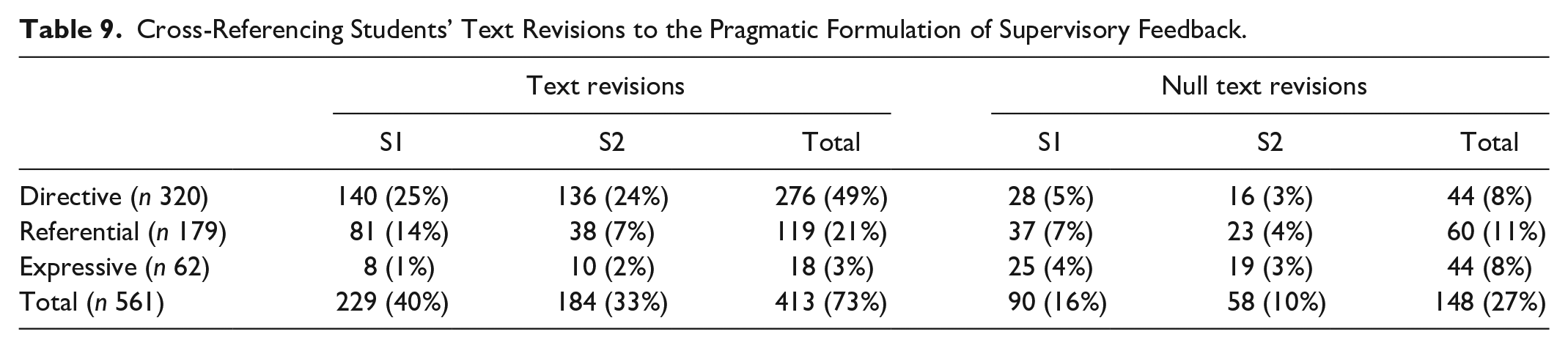
In addition, the text revisions were cross-referenced to the three patterns of pragmatic feedback formulations (Table 9). Results show that directive feedback triggers most of students’ text revisions, while the lowest number of the text revisions is attributed to expressive feedback. This could be due to the nature of expressive feedback (e.g., positive evaluations and praise) that neither points at issues in students’ writing nor requires text revisions from them.
Cross-Referencing Students’ Text Revisions to the Pragmatic Formulation of Supervisory Feedback.
The above result on students’ integration of the majority of feedback in refining their proposal writing is also supported by students’ voices in the follow-up interview:
Yes when I received feedback, I tried to amend my writing because feedback was give to me to improve so it is important for me to follow it.
For me, I can say yes, I did revisions and modifications based on your feedback.
Yet, the above result shows that S1 integrated a higher number of feedbacks in revising her writing than S2 did. This difference could be due to the different amounts of feedback received by each learner. In other words, as S2 received a higher number of feedbacks, she made a higher number of text revisions based on the feedback than S1 did.
The null text revisions, which mean that some feedback was ignored or was not addressed by the postgraduates, could be due to one or more than one of these possible factors: students’ unwillingness to follow it, their failure to understand it, or found it difficult to follow in making successful text revisions. This finding was also supported by S1 in the interview as she articulated this reason behind her null text revisions:
Sometimes I tried to ignore some comments because I know even if I read them, I still couldn’t fix them.
Other text revisions identified are additional revisions or self-made revisions. As shown in Table 10, most of these self-made text revisions address the linguistic accuracy in their proposals, while the least revisions address issues relevant to the organization.
Postgraduates’ Additional Text Revisions.

From the above results, there are differences between the two postgraduates in relation to self-made text revisions. This suggests the varying willingness to revise and enhance their research proposal writing beyond supervisory feedback as well as reliance on one’s linguistic competence to self-edit texts. S2 seemed to rely more on her linguistic competence than S1 to self-edit her writing. This is also found in the interview data as only S2 talked about her self-made text revisions despite the above evidence on both postgraduates’ self-made revisions:
Sometimes, also especially in the last draft, I made some revisions of some issues myself.
Discussion
This study aimed to explore supervisory feedback formulation on research proposal writing of two postgraduates in a Malaysian university and students’ responses to feedback. To address the first research question on how supervisory feedback is formulated, the findings show that feedback is formulated as directive, referential, and expressive, which supports the findings in previous studies (Bastola, 2020; Basturkmen et al., 2014; Kumar & Stracke, 2007; Xu, 2017). However, in this study, directives dominate the supervisory written feedback discourse, which contradicts the findings of previous research on referential (Basturkmen et al., 2014; Kumar & Stracke, 2007; Xu, 2017) and expressive feedback (Bastola, 2020) dominating feedback formulation. The extensive use of directive feedback in this study is owing to the supervisor’s overuse of questioning to engage students actively with the feedback. Another contradictory finding of this study is the lowest formulation of expressive feedback, which explains the divergent supervisor–supervisee relationships in the different contexts of these studies. Moreover, although students should be given positive evaluations and praises on their work, they should also be given critical feedback that points at their issues and weakness in academic writing.
Interpreting our findings from the view that feedback formulation is a way to know about supervisor–supervisee relationships (Mutch, 2003; Xu, 2017), the dominating formulation of directive feedback, especially as evidenced by suggestions and questions outnumbering imperatives, suggests the facilitating role taken up by the feedback provider and the collaborative relationship established by him with his students. This evidence is also supported by the lower number of referential feedback and the absence of certain referential feedback patterns (e.g., reformulation, adding, crossing out), which indicates that the supervisor’s direct and authoritative/expert intervention in students’ academic writing is almost lacking in this study. Despite the availability of corrections/edits as referential feedback, such corrections were provided in the form of on-script comments rather than direct corrections in the text. This means that the postgraduates were allowed to either accept or reject such suggested corrections/edits.
As feedback formulation includes the issues in writing addressed by supervisors through feedback, the feedback reported in this study addresses issues relevant to content, organization, linguistic accuracy, and appropriateness. This finding is consistent with Basturkmen et al. (2014) and Xu (2017) and partly supports the findings reported by Morton et al. (2014) in terms of content and linguistic accuracy. Based on the study findings, most of the feedback addresses linguistic accuracy in writing, which supports the finding reported by Xu (2017), while contradicts the findings of Basturkmen et al. (2014) that content and idea development are paid most attention through supervisory feedback. The finding of this study can be explained from the two postgraduates’ linguistic abilities as English as a foreign language (EFL) learners who are challenged by the accurate language use in academic writing as observed from their linguistic errors dominating their research proposal writing.
Cross-referencing of the foci of supervisory feedback to its pragmatic functions indicates that directive feedback highly or largely addresses content and idea development, organization, and appropriateness. On the contrary, when commenting on the linguistic accuracy in proposal writing, most of the feedback is formulated as referential. This finding is somehow in disagreement with what was reported by Xu (2017) as referential feedback is highly used when commenting on the content of postgraduates’ writing, but it is consistent with Basturkmen et al. (2014). One possible reason explaining the extensive formulation of directive feedback in addressing issues related to content and organization is that such issues seem more complex, which necessitates provision of directive feedback in the form of questions that urge students to clarify, justify, and evaluate their ideas and arguments. In contrast, linguistic issues and flaws are less complex, and therefore, referential feedback formulations, such as suggested edits and highlights, seem effective enough to draw students’ attention to language issues in academic writing.
In this study, to answer the second research question on how postgraduates respond to feedback, the findings revealed that the two students responded to supervisory feedback by commenting on it and revising their proposals. Interestingly, commenting on the feedback is the contribution of this study to previous research on supervisory feedback. Why is it important to encourage postgraduates to comment on the feedback? The answer is that due to students’ probable misunderstanding (Basturkmen et al., 2014) and misinterpretation of the intended messages/meanings of some feedback (Bitchener et al., 2010; Chanock, 2000), commenting on the feedback will enable them to seek clarifications, address issues in their writing, defend their ideas (Carter & Kumar, 2017) and also learn how to productively negotiate criticisms (Li & Seale, 2007). Furthermore, they will be able to value challenging feedback and recognize feedback provision as a collaborative and communicative process (Inouye & McAlpine, 2017; Yu & Lee, 2013).
Although there is evidence in earlier research that students tend to appreciate teacher and supervisor feedback, it may not always be received as supportive and students may misunderstand it. Therefore, it becomes necessary to explore their engagement with feedback. Like previous research on postgraduates’ (Xu, 2017; Xu & Hu, 2020; Zheng et al., 2019) and undergraduates’ (Zhang & Hyland, 2018; Zheng & Yu, 2018) engagement with teacher and supervisory feedback, the findings of this study demonstrate postgraduates’ engagement in cognitive, metacognitive, and affective operations to process feedback before they integrate feedback into writing. Moreover, this study contributes to these studies through its evidence on the role of students’ commenting on the feedback in responding to the feedback, interact, seek clarifications on some feedback and consequently, better understand its meaning. It should be noted that the formation of feedback as questioning plays a role in creating teacher–student interactions over the feedback. As reported by Fernández-Toro and Furnborough (2014), feedback formation influences whether and how students to respond to it. Interpreting this finding from the sociocultural theory (Vygotsky, 1980), effective feedback should be formulated with the intention not only to assist students to fix their issues in writing but also to create space for them to interact and negotiate the intended meanings (Lee, 2014). This also corporates the socio-constructivist research on teacher dialogic feedback that promotes interaction and negotiation of feedback (Carless, 2020a, 2020b; Guasch et al., 2019).
Another evidence on the potential of commenting on the feedback is the change in the roles of postgraduates from mere receivers of feedback to active respondents, which is observed in the threads of supervisor–student commenting exchanges. In light of the social constructivist view of feedback, such commenting exchanges suggest that effective feedback provision is a social and dialogic process of teacher–student negotiation and interaction that emphasizes students’ roles as active agents of feedback rather than mere receivers of it (Carless, 2020a, 2020b; Guasch et al., 2019). On the contrary, the absence of dialogue in feedback provision may hinder students’ development of autonomy, successful text revisions, and knowledge construction (Fernández-Toro & Furnborough, 2014).
In answering the third research question on how and to what extent the postgraduates integrate supervisory feedback in revising their proposal writing, this study illustrated most of the postgraduates’ text revisions are formulations and corrections of linguistic issues. This finding supports findings of other previous studies (Inouye & McAlpine, 2017; Xu, 2017; Xu & Hu, 2020) indicating that, in general, students appear responsive to feedback in revising their scholarly written texts though there were differences in the extent of their responsiveness to feedback. However, it should be noted that feedback formation affects how and to what extent students are responsive to feedback. One remarkable finding is directive feedback seems to trigger the highest rate of students’ text revisions. This could be due to the role of formulation of directive feedback, especially questions in triggering students’ text revisions.
There are differences between the two postgraduates in the extent to which they responded to the supervisory feedback through text revisions. Such differences could be attributed to the different amount of feedback each student received on her writing. Another possible reason, as shown by the two students’ null commenting text revisions, is their varying unwillingness to follow some of the feedback in revising their writing and or the difficulty in fixing content and organization issues. This has implications for enhancing students’ responses to feedback. Supervisory feedback focusing on content and organization should be clear or explicit. Students’ null or no text revisions might also be the result of students’ careful evaluation and consideration of feedback before using it in revising their texts (Xu, 2017; Xu & Hu, 2020). Finally, the varying self-made text revisions reflect the postgraduates’ varying willingness to self-edit their writing as well as varying reliance on their linguistic competence to self-edit their texts (Zhang & Hyland, 2018; Zheng & Yu, 2018).
Conclusion and Implications
The purpose of this study was to explore the linguistic formulation of supervisory feedback provided on two postgraduates’ academic writing of research proposals and postgraduates’ responses to feedback. The findings could be useful for efficient research supervisory practices. As effective feedback formulation is important for postgraduates’ academic writing, feedback should be carefully formulated formulated to actively and critically engage postgraduates in their academic writing. Supervisors should also consider how to promote students’ responses to feedback. Supervisors should encourage their supervisees to respond to feedback that they may disagree with or that seeks their clarifications, justification, and negotiations. Such supervisor–supervisee communication on academic writing is the key in establishing a peer-to-peer model of supervision that acknowledges supervisees’ construction of knowledge, autonomy, and agency in the process of research writing supervision (Yu & Lee, 2013). Such model also supports the argument underlying the shared responsibility of instructors and learners in feedback contexts (Nash & Winstone, 2017).
Despite the above-highlighted contribution of this study to previous research on supervisory feedback on academic writing, there are several limitations that should be addressed for future research. First, our result on feedback formulation is based on one supervisor’s feedback data and there might be a lack of in-depth data. Therefore, future research should use interviews with supervisors to provide interesting insights into supervisory feedback practices. Findings will enhance our understanding of what supervisors say about the feedback they provide. They may also give their views on their students’ responses to feedback. Finally, future research should also delve into the factors behind the differences in individual students’ response to feedback.
Footnotes
Appendix A
Appendix B
Coding the Pragmatic Functions of Supervisory Feedback.

| Category of pragmatic functions of supervisory feedback | Intention | Linguistic features | Examples |
|---|---|---|---|
| Directive | Eliciting information | Interrogative | Diplomats who? What are the initiatives implemented to reduce the difficulties? |
| Seeking justifications | Interrogative | Why teaching while you are focusing on learners? | |
| Seeking clarification | Interrogative | What do you mean by this? | |
| Seeking confirmation | Interrogative | L2? The first time you have used right? | |
| Suggesting what to do | Advisory Interrogative |
You should include other elements of the target culture of Arabs. Should not it look better if you say: working overseas? What if you change it by another word like opportunities? |
|
| Telling what to do/not to do | Imperative | List your objectives as (1) and (2) here. Don’t repeat the phrase in the same sentence. |
|
| Referential | Providing information Providing corrections |
Statement Indirect correction |
This paragraph gives a clear picture of the significance of the issue and also the gap in earlier research. “and will be recorded via an audio recorder and then transcripted” |
| Expressive | Praise Criticism |
Positive response Negative response |
Now your introduction is great. These sentences are not clear and not even relevant to the main idea in your review. |
Appendix C
Coding the Foci of Supervisory Feedback.

| Category of foci of supervisory feedback | Subcategories | Examples |
|---|---|---|
| Content | Clarity of expression | Can you read these sentences again? Do they clearly convey your intended ideas? |
| Elaboration | Who are the EFL learners here? Specify as you are talking about your study sample by adding more sentences about them. | |
| Consistency | In the 3rd objective above, you stated “courses” but in the question here methods so? Be consistent. | |
| Supporting arguments | And can you add a few studies on these problems in your study context to support your arguments here? | |
| Relevance of ideas | Should we need these sentences in this section of your literature review? | |
| Organization | Structure | Your introduction is great, but one suggestion: What if you re-ordered the paragraphs? You start your introduction by the 2nd paragraph. Then, you move smoothly to talk about the importance of learning a language of the host country for diplomats. |
| Cohesion | Which profession are you referring to here? Can you mention it? Or you mean that of diplomatists? | |
| Coherence | Use a contract linking device such as “On the other hand, etc to connect the sentences here.” | |
| Linguistic accuracy | Grammar | Check the verb since the subject is “a close relationship, so?” |
| Sentence structure | It looks like a hanging statement here not complete. So what if we delete “As” and replace it by “In other words, both . . . ?” | |
| Vocabulary choice | Why do not you replace this phrase by “finding speaking a daunting task?” | |
| Spelling and punctuations | Ok good but think you wanted to say “task” not dask ! Check here why As,? |
|
| Appropriateness | Academic and discipline conventions | Why no abbreviation between () following the full name here? Just the last name of the author not all. Check and correct it using APA. Got me? |
Note. EFL = English as a foreign language.
Declaration of Conflicting Interests
The author(s) declared no potential conflicts of interest with respect to the research, authorship, and/or publication of this article.
Funding
The author(s) received no financial support for the research, authorship, and/or publication of this article.
