




Abstract
The study aims to determine whether the government budget through education, health, and access to capital can alleviate poverty; whether the presence of waste can affect the poverty rate; and whether income inequality and gender equality can overcome the poverty rate in Aceh Province. This research aims to examine the significance of poverty alleviation in Aceh Province, utilizing three distinct approaches: economic, socio-cultural, and environmental. Its contribution is crucial as it aims to decrease the poverty rate and boost community. productivity by actively engaging local government policies, entrepreneurs, and communities. The study utilized panel data analysis and fixed effect model method to analyze data from 2016 to 2022 across 23 districts/cities in Aceh Province. The education budget, health budget, MSME loan disbursement, landfill, inequality, and gender development index have a simultaneous and partial impact on the poverty. The government needs to improve the quality of budgeting in the education and health sectors that are right on target. MSMEs, particularly young entrepreneurs, should have improved access to credit. The government must implement profitable waste management strategies, including lucrative recycling programs. Achieving the desired prosperity for the entire community necessitates establishing income and gender equality.
Plain language summary
This study analyzes how government spending, social and environmental factors can help reduce poverty in Aceh Province. The focus includes three main areas: economics (such as education budgets, health budgets, and the amount of credit for MSMEs), social and cultural aspects (such as gender equality and income inequality), and the environment (particularly the amount of waste). The researchers used data from 23 cities and districts in Aceh from 2016 to 2022, employing a panel data analysis method with a fixed-effects model to understand how these factors influence poverty. The study’s findings indicate that government spending on education and health, loans for small businesses (especially SMEs), waste volume, income inequality, and gender equality all contribute to reducing poverty. This study suggests that: 1. The government must ensure that education and health budgets are well-planned and targeted. 2. The government can create policies that make it easier for micro, small, and medium enterprises to access credit, but still under supervision and guidance through training. 3. Waste should be managed in a way that also generates income, such as through recycling programs. 4. Efforts to reduce income inequality and promote gender equality are crucial, requiring policies that are inclusive of all segments of society. In summary, reducing poverty levels in Aceh requires a combination of government policies that consider economic, social, and environmental factors, as well as strong community involvement and support for local businesses.
Introduction
The province of Aceh is undergoing economic recovery following decades of conflict and the tsunami disaster. The tsunami and conflict have had a considerable impact on the community, resulting in lost opportunities for employment, education, and health, as well as limited opportunities to work and establish businesses. In response, the government has implemented various programs to improve the welfare of Acehnese people. However, despite these efforts, Aceh Province remains the sixth-poorest province in Indonesia (Figure 1).

Indonesia’s top 10 poorest provinces in 2022.
The latest data on poverty in Aceh Province indicate an increase contrary to the Sustainable Development Goals Programme. Aceh Province has not yet achieved economic independence and remains heavily reliant on special autonomy funds from the central government, resulting in a lower level of welfare and poverty than other Indonesian provinces. Data on the development of the poor population decreased somewhat from 2018 to 2019 and increased again recently. The following graph illustrates this (Figure 2).
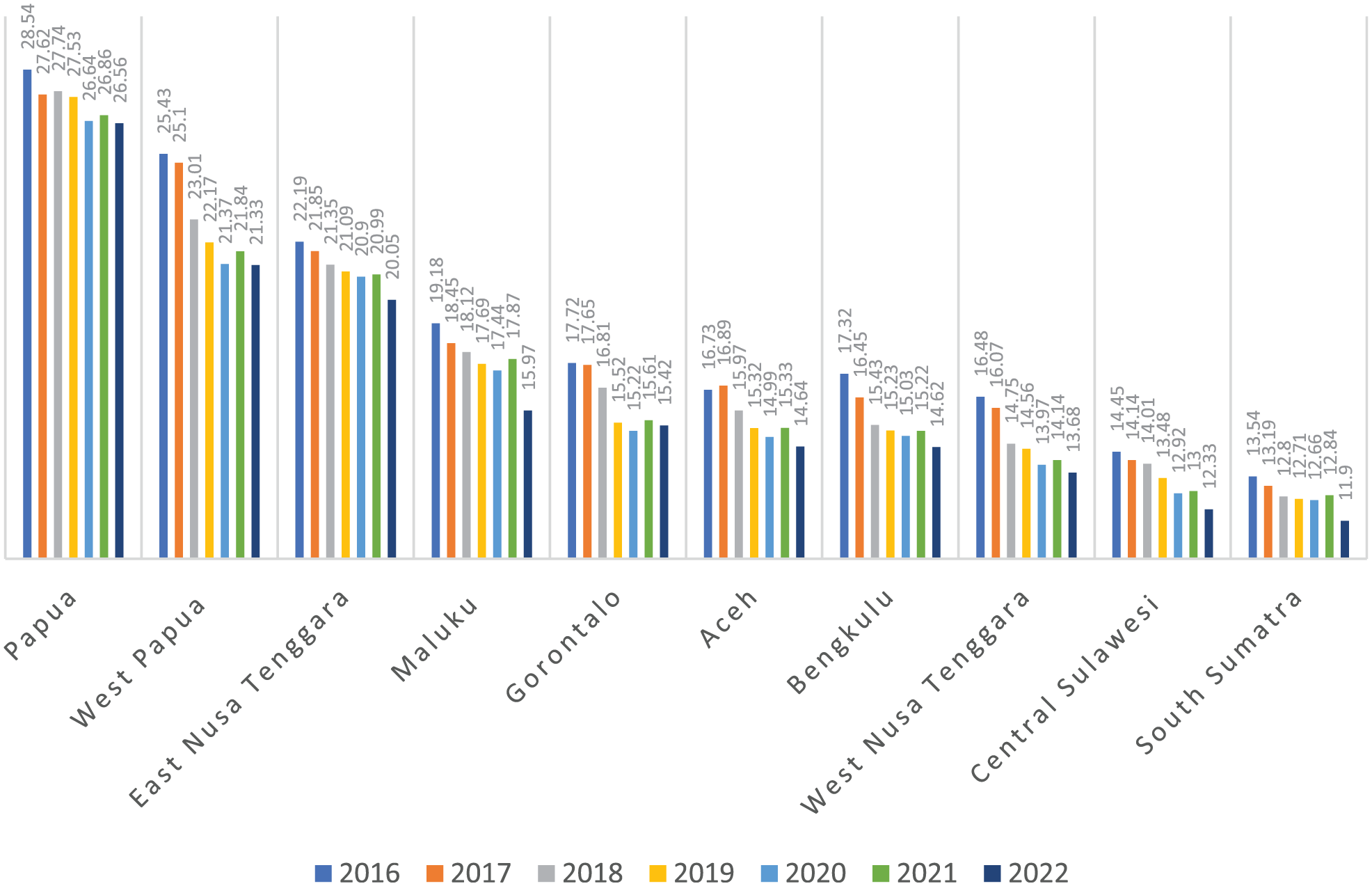
Percentage of poverty in the 10 poorest provinces in Indonesia 2016–2022.
The government’s target in SDG number 1, namely no poverty, has a few obstacles. This attracts the author to examine what causes poverty in Aceh Province to fluctuate. At the same time, the budget provided by the central government is huge and supported by vibrant natural resources. It is known that Aceh has the privilege of special autonomy funds, which will end in 2022, and will Aceh Province survive when special autonomy funds no longer exist? Aceh Province boasts abundant natural resources, particularly in the agricultural and mining sectors, thanks to the entry of numerous mining companies. Supposedly, the more companies that enter an area, the more they can support the economy’s circulation, providing goods and services and employment opportunities. However, the community has yet to perceive the potential benefits of these opportunities for its welfare.
Income is not the sole determining factor in the formation of poverty; numerous other factors also play a role in trapping a population in poverty. Sen posited that the capability to function is the factor that determines whether an individual is poor or not. Furthermore, it is erroneous to view economic growth as a goal in and of itself. Development should focus more on improving the quality of life lived and the freedoms enjoyed (Todaro & Smith, 2009). Moore and Sen (1982) elucidates the dynamic nature of poverty, differentiating it into two categories: chronic poverty, which is a long-term trap, and temporary poverty. Factors such as illness, economic crisis, or crop failure can precipitate a decline in any non-poor household’s income at any given time. Conversely, poor households can transition out of poverty due to securing more lucrative employment or benefiting from improvements in infrastructure (Dartanto & Nurkholis, 2013; Moeis et al., 2020). The alleviation of chronic poverty necessitates the investment of both human and physical capital, whereas the mitigation of temporary poverty hinges on establishing social safety nets or insurance programs (Hulme & Shepherd, 2003; Ravallion & Jalan, 1996).
The prevalence of poverty in developing areas is largely attributable to the high cost of energy consumption, including fuel, gas, and electricity, which is essential for meeting basic needs and conducting business activities. The burden of elevated energy prices is further borne by low-income households (Charlier & Legendre, 2021). Moreover, the misallocation of government resources at the community level has contributed to the prevalence of poverty. In response, the government has enacted fiscal decentralization through the enactment of Law No. 32 of 2004 and Law No. 23 of 2014 concerning regional autonomy. In contrast, Aceh Province has a specific autonomy law for regions with distinctive rights, namely the Special Autonomy Law No. 11 of 2006 concerning the Government of Aceh. The objective of this fiscal decentralization policy is to facilitate the development of local economies in each region in accordance with the aspirations of the communities therein, thereby ensuring that all communities benefit from the implementation of budgetary policies. Freinkman and Plekhanov (2014) argue that special autonomy supports human development, improves the quality of education, reduces unemployment, and promotes regional economic growth. The presence of a skilled workforce supports a reduction in poverty levels in a region. Previous research conducted in Aceh Province identified four categories of government funds: special allocation funds, general allocation funds, profit-sharing funds, and local revenue. The results show that only general allocation funds significantly reduce poverty and increase the Human Development Index (Abrar et al., 2020).
Poverty may be caused by factors that are not purely economic in nature. Azis (2020) suggests that poverty can be influenced by non-economic factors such as culture, institutions, decentralization, budget abuse, political cost transactions, and community participation. As stated by Stimson et al. (2018) development goals may include the alleviation of poverty, the reduction of crime, and the reduction of alienation. In order to achieve this, it is necessary to conceptualize sustainable development with several ecological or environmental, economic, and socio-cultural approaches. Acemoglu and Robinson (2012) argue that a country’s failure to promote citizen welfare is not due to geographical or cultural limitations, but instead, it is because of extractive economic and political institutions. These institutions prevent the establishment of inclusive economic institutions that protect assets and property for everyone, regardless of socioeconomic status. Inclusive economic institutions provide inclusive market opportunities, allowing individuals to have a wide choice of jobs that match their skills and engage in creative activities. Education and technology, the engines of prosperity, are also facilitated by inclusive institutions. Banerjee and Duflo (2019) identify five factors contributing to intractable poverty. The poor often struggle to express their concerns and carry excessive responsibilities without government support. Inaccessible markets and lack of access to essential services and resources also contribute to poverty. Actions by elites and a lack of hope and trust can discourage individuals from participating in efforts to improve their quality of life.
Davidai (2022) states that a person’s understanding of welfare and poverty is caused by two influences: individual influences, namely the ideology adopted and knowledge possessed, socio-economic position, and economic experience of failure and success. Social influences include macroeconomic policy, the culture that is promoted, belief in the structure of institutions, and consumption behavior. Some interesting indicators to study regarding the causes of poverty are the formation of human resource capabilities (health and education, inequality, and access to capital), socio-cultural factors such as gender equality, and environmental factors such as the amount of waste generated by the local community. This is based on research conducted by Wang and Huang (2021), who found that there was no research on the achievement of SDG number 1, “no poverty” in Indonesia using three pillars of study, namely the economic, environmental, and social parts. According to Pramono and Marsisno (2018), the percentage of poor people is influenced by various factors such as electricity, health, sanitation, and secondary school infrastructure, which have a negative impact. However, the development of primary schools has a positive effect. Yunus, Zainal, Jalil, and Khalsiah (2020) and Yunus, Zainal, Jalil, and Maya Aprita Sari (2020) found that Aceh farmers face challenges in accessing capital, post-harvest processing, marketing, and infrastructure, which negatively impact agricultural production. Social capital also impacts poverty rates, requiring government and social environment intervention. Nurlina et al. (2019) identified factors contributing to structural poverty among East Aceh District rice farmers, including higher social classes, structural injustice, limited asset access, development gaps, and lack of policies.
Furthermore, the classification of chronically poor and temporarily poor household groups has been carried out using three Spell approaches in Aceh Province, where temporary poverty dominates, and vice versa with the component approach and EDE chronic poverty (Purwono et al., 2021), regional conditions, geography, and socio-economic conditions that cause poverty influence both chronic and temporary poverty (Johnson & Mason, 2012). Radosavljevic et al. (2021) used indicators of basic needs, the long-term economic participation of farmers and farming communities, household input assets, nutrition, and social capital to determine the level of poverty traps. The results indicate that interactions between communities can help households escape poverty, while farmer behavior also plays a significant role. The government can effectively intervene by providing basic and economic needs, modifying farmer behavior, and financing the activities of the farmer’s social community. Policies to improve farmers’ livelihood capital by strengthening human resources, facilitating financial product innovation, and making good use of their social capital are important for supporting industrial development for the people with low incomes (Liu et al., 2021).
This research is motivated by examining poverty alleviation through a combination of multidimensional poverty and structural poverty theories. Poverty can be caused by multidimensional poverty factors such as economic, socio-cultural, and environmental factors of society. However, institutions also play a role in the presence or absence of people with low incomes. Institutions that are corrupt, exclusionary, and whose policies are not pro-low-income are likely to create new poor households. Based on the research motivation, which is based on the theory and empirical evidence described above, the research questions are:
Does the government’s policy of providing a public education budget reduce the poverty rate in the province of Aceh, Indonesia?
Does the government’s policy of providing a public health budget reduce the poverty rate in Aceh Province, Indonesia?
Does the government’s policy of providing business loans to MSMEs reduce poverty in Aceh Province, Indonesia?
Can a low level of income inequality reduce the poverty rate in Aceh Province, Indonesia?
Can a gender development index that reflects gender equality reduce poverty in Aceh Province, Indonesia?
Does the amount of waste produced by the community reduce the quality of life of the community and thereby increase the poverty rate in Aceh Province, Indonesia?
This study has four research objectives, including the following. First, to determine whether the government budget for education, health and the economy can affect the poverty rate. Second, to find out whether the amount of waste can damage environmental conditions and thus affect the level of community welfare. Third, to find out whether the impact of income inequality in society makes it difficult to overcome poverty. Fourth, to find out the influence of community culture on gender equality through women’s participation in conveying the aspirations and needs of women’s groups in providing solutions to poverty problems. This research has a novelty in how to analyze poverty comprehensively by including multidimensional factors of poverty, such as the role of institutions, regional economic conditions, community culture, and community environmental conditions. Research with these four aspects is still very minimal. It is known that poverty reduction, inclusive institutions, stable economic growth, gender equality, and climate change are sustainable development goals that need to be further promoted in order to achieve sustainable development goals.
The article’s organization is systematic, aiming to facilitate reader comprehension. The initial section, “Introduction,” is devoted to the discussion of the background, novelty, and objectives of the research. The second section, “Literature Review,” delineates the theoretical foundations that serve as the conceptual basis for this research. The third section, “Data and Methodology,” delineates the data and methodologies employed. The fourth section, “Research Results,” presents the statistical test results, while the fifth section, “Discussion,” analyzes and discusses the empirical findings. The sixth conclusion section summarizes the main findings and provides policy implications related to poverty alleviation in Aceh Province, Indonesia.
Literature Review
Poverty is a multidimensional concept that goes beyond just a lack of financial resources (Gorman, 2009; Sen, 1999). Chambers (1995) identifies five dimensions of poverty: poverty itself, powerlessness, vulnerability, dependency, and isolation. These dimensions encompass issues such as limited access to resources, poor health, low education levels, unequal treatment under the law, vulnerability to crime, and lack of control over one’s own life. Todaro and Smith (2009) state that policies focusing on poverty alleviation may not necessarily slow down economic growth. However, there are five reasons why poverty alleviation promotes economic expansion. First, it enables people with low incomes to obtain loans and invest in the local economy. Second, it encourages higher savings and investment from the wealthier population. Third, it improves the health, nutrition, and education of people with low incomes, resulting in increased productivity, and fourth, increasing income levels of the poor leads to higher demand for local products. Lastly, poverty alleviation serves as an incentive for greater participation in the development process, promoting overall economic growth. Gorman (2009) posits that poverty can be quantified through the measurement of income, assets, and socioeconomic metrics, which encompass data on health, nutrition, infant mortality, sanitation, and other aspects of human well-being. The poverty paradigm from an individual perspective can be described as Amartya Sen’s approach, which posits that the “capacity to function” is the determining factor in whether an individual is considered poor. Moreover, it is imperative not to consider economic growth as the primary objective. Instead, development should prioritize enhancing the quality of life and the freedoms enjoyed by individuals (Todaro & Smith, 2009). Consequently, in order to alleviate individual poverty, it is essential to ensure that every human being’s basic needs are met and that they have the freedom to enjoy a decent standard of living by studying the economic and social factors that affect them.
Institutions become obstacles for people to gain access to basic needs in social life. According to Acemoglu and Robinson (2012), weak or authoritarian political structures tend to cause structural poverty. Authoritarian political institutions often favor dominant interest groups or economic elites, which has a negative impact on the fair distribution of economic resources and opportunities. State institutions need inclusive economic policies to overcome poverty in society. Inclusive economic policies mean that all people have equal rights in gaining access to resources, especially in meeting their basic needs. Institutions must meet the needs of the community regardless of the interests of the rulers, but mainly for the benefit of people experiencing poverty. Local governments must provide alternative solutions for people experiencing poverty to fulfill their basic needs. The government’s concern for people with low incomes illustrates the condition of local institutions, and poor institutions are a disease in poor countries (Banerjee & Duflo, 2019).
Education plays a pivotal role in enabling a developing country to utilize modern technology and cultivate the capacity for sustainable growth and development. According to Todaro and Smith (2009), education can enhance the value of production in the economy. For the same income, a person can benefit from education because, by being able to read, communicate, argue, and make choices with better knowledge, they can be more calculated by others, and so on. As Gorman (2009) notes, government spending on goods and services represents approximately 20% of the total gross domestic product in each region. This spending encompasses transfers to social security, health care, unemployment insurance, welfare programs, and subsidies. Consequently, the government bears responsibility for enhancing the quality and capacity of the community’s human resources, given that the community has contributed to state or regional revenues through taxes. Those with higher levels of education and skills consistently earn higher incomes than those with lower levels of education and skills.
The concept of health within the context of structural functional theory, as postulated by Widianto (2013), suggests that the state of individual health can exert an influence on the prevailing social order, given the role of the social system in facilitating or impeding the functioning of the social order. In contrast, the conflict theory perspective regards health as a form of power for the individual. At the end of this theoretical spectrum, health is viewed as a representation of income accumulation, whereby the lack of cost allocation for health affects the level of individual health. Consequently, when an individual’s health quality is poor, it will affect their quality of life and productivity at work. The complexity of basic human needs is represented by factors that can affect growth, such as nutrition, and economic aspects are included through asset dynamics at the household level (Radosavljevic et al., 2021). Islamic financial institutions in the province of Aceh play a crucial role in providing poor households with access to capital for economic activities. These institutions believe that they have a responsibility to participate in the management of the country’s resources in line with the Islamic economic system. One of their main focuses is to strengthen and promote the growth of micro, small, and medium enterprises (MSMEs) as a means of poverty alleviation. In the context of development, individuals may face difficulties in accessing finance due to a lack of adequate collateral. At the same time, local communities may struggle to provide sufficient social services due to limited resources and unequal distribution of wealth. By providing financial support and services to these marginalized groups, Islamic financial institutions contribute to the economic empowerment and overall development of the region. Targeted poverty reduction strategies focus on economic, human capital, political, and socio-cultural aspects of poverty. They include promoting access to credit, education, vocational skills training, collective action, and negotiation capacity. Initiatives also aim to ensure equal representation of diverse gender groups in community decision-making processes (Etuk & Ayuk, 2021).
Poverty can result from income inequality within a society. Stiglitz (2013) states that income inequality within a community can negatively impact the welfare of the lower middle class. The limited financial resources available to individuals in the lower middle class often hinder their ability to pursue educational opportunities, manage healthcare costs, and establish entrepreneurial ventures. This situation exacerbates the challenges of poverty alleviation in regions characterized by significant income inequality. Rambotti and Breiger (2020) posit that higher income inequality is associated with lower life expectancy, especially in countries with high poverty rates. This finding indicates a potential positive correlation between income inequality and the poverty rate within a specific region. Institutional policies that are not inclusive have the potential to engender income inequality between high-income and low-income groups, which can lead to the perpetuation of poverty. Tarkiainen et al. (2025) posit that the social construct of poverty is regarded as a tragic experience that is attributed to external factors beyond individual control, including volatile labor markets and government policies. Research by Ji et al. (2024) indicates that regions exhibiting income equality may be more conducive to the implementation of alleviation programs in China. Furthermore, the prevalence of inequality has been demonstrated to exacerbate both poverty and inclusive growth (Amponsah et al., 2023).
Bourgois (2015), posits that a culture that engenders poverty is typified by a high prevalence of maternal loss, a lack of emotional expression, an underdeveloped mental structure, confusion regarding sexual identity, an inability to exercise self-control, a strong present-oriented mindset with limited capacity for delayed gratification and future planning, a sense of resignation, and fatalism. Additionally, male superiority and a high tolerance for various forms of psychological pathology are identified as contributing factors to poverty. Concurrently, as posited by Varenne and Scroggins (2015), the concept of culture as elucidated by Lewis suggests that the culture of poverty is not solely a matter of lack or disorganization. Rather, it represents the absence of something, namely, a design for living, a set of ready-made solutions to human problems, and a significant adaptive function. According to Johnson and Mason (2012), two sociological theories explain the causes of poverty. The first theory, individual pathology, suggests that poverty is the result of personal failings of those living in poverty. This perspective focuses on the individuals themselves and their inherent characteristics as the cause of their poverty. The second theory, structural barriers, argues that societal factors and policies create barriers that prevent individuals from escaping poverty. This approach emphasizes the role of the family and society in perpetuating poverty and sees poverty as the result of socially constructed belief systems. Policy responses to this theory aim to address these structural barriers rather than focusing on individual deficiencies. This perspective is known as cultural poverty thinking and suggests that changing social norms and beliefs is necessary to tackle poverty effectively.
Moreover, the interconnection between poverty and environmental degradation has been well-established. According to Chomitz et al. (2007), poverty can lead to environmental degradation through three poverty syndromes. The first syndrome occurs in areas with extensive forest cover, high poverty rates and low population density, making it difficult to implement traditional development strategies. This is a challenge for both poverty alleviation and forest conservation. The second syndrome occurs in communities living in or around forests, as they depend on forest resources for their livelihoods. However, competing interests often exploit these resources, negatively affecting the quality of life of those who depend on them. The third syndrome is barriers to the commercialization of forest products due to political, technological, or marketing constraints. These factors contribute to the link between poverty and environmental degradation. In rural areas with significant forest cover, low land prices prevent agricultural laborers from benefiting from working the land, leading to limited land use options. Low population density, coupled with isolation and lack of communication, means that forest dwellers have little influence on local and national affairs. Insecure land and forest tenure also leads to frequent conflicts over property rights between companies and forest dwellers.
Forest dwellers are unable to maintain environmental conditions due to their weakened condition, limited resources, limited rights, and difficulty expressing their aspirations, thus making them poorer and more alienated. Seabrook (2006) states that people with low incomes do not speak for themselves. The global community, including the domestic and poor, has pressed the mute button. People reach out pleadingly after disasters, homes destroyed by typhoons, civil strife, and environmental devastation, their faces grimacing with pain, their bellies distended with hunger. The destruction of forests, cultivated land, and coastal and riverine environments has largely destroyed the sustainable resource base. As a result, people have become poor in a certain sense, a poverty that occurs according to nature’s behavior. This factor is considered important in discussions on poverty, which are now under the auspices of global institutions.
This assertion is founded on the development of the theory of poverty and the multidimensional factors that influence it, as evidenced by previous research. Poverty, therefore, can be understood as the result of a multitude of interconnected factors. The multidimensional factors in this study include: First, the government institution factor, defined as a state institution, is obligated to allocate a budget to address the community’s needs. The government’s most significant financial plans pertain to the education budget, the health budget, and the budget for business credit allocated to MSMEs. Secondly, economic factors encompass income inequality within a region. A robust economy is characterized by the equitable distribution of income, with minimal poverty and inequality. Thirdly, the socio-cultural factor is the gender development index (GDI). GDI is a measure of the disparity in human development achievement between men and women. Inclusive socio-cultural conditions present opportunities for the equitable development of both women and men, fostering an environment conducive to self-actualization. The fourth factor is the environmental factor, which is measured by the amount of landfill. The improper management of waste can have deleterious effects on societal quality of life if it is not addressed satisfactorily. The impact of these factors on the health and quality of community productivity is well-documented, and their effect on the welfare of the community is significant. The amount of waste in an area is indicative of the quality of the people in that area. The four-dimensional factors that influence poverty can be translated into six variables used to measure the influence of multidimensional factors on poverty. The theoretical framework is illustrated in Figure 3 below:

Theoretical framework.
The hypothesis of this study, as postulated from the theoretical framework previously outlined, is as follows:
This study employs three interrelated approaches: economic, socio-cultural, and environmental, to examine the significance of poverty alleviation in Aceh Province. The investigation of the nexus between economic, socio-cultural, and environmental factors, with particular focus on Aceh Province, makes a significant contribution to the extant literature on poverty. Furthermore, this research offers valuable insights into strategies to enhance community productivity and reduce poverty levels through direct engagement with local government policies, entrepreneurs, and communities.
Data and Methodology
The study will employ a panel data approach, econometric modeling, and impact evaluation techniques to evaluate the influence of economic, socio-cultural, and environmental factors on poverty rates in Aceh Province. The study uses secondary data from several sources, including the Indonesian Ministry of Finance, Bank Indonesia, and the Aceh Central Bureau of Statistics. Panel data is employed as a combination of time series and cross-sectional data. The study utilizes annual data from the 2016 to 2022, focusing on 23 districts/cities in Aceh Province as the object of research. In this study, the dependent variable is the poverty rate. This is defined as the percentage of the population below the poverty line determined by government authorities. The independent variables are as follows:
The education budget, encompassing government expenditure on the education sector, is a yearly development expenditure for the education and culture sectors, reflected in the regional budget 2016 to 2022.
The health budget outlines government spending on healthcare, encompassing development expenditure for the sector in the 2016 to 2022 regional expenditure budget, expressed in rupiah per year.
Total financing is the amount of credit funds disbursed by commercial banks to MSMEs in 2016–2022, expressed in rupiah per year.
Total waste generation is the average amount of waste generated by the community in 23 districts or cities in Aceh Province, calculated in M3/day.
Inequality is the distribution of income within a region, measured by the Gini Index, which ranges from 0 to 1. A value closer to 0 indicates an even distribution, while a closer to 1 indicates an uneven distribution.
The Gender Development Index measures societal norms and customs influencing gender roles and responsibilities. A GPA below 100 indicates women’s development achievements are lower than men.
This study employs panel data regression analysis with model specifications aligned with those previously outlined (Baltagi, 2005; Gujarati & Porter, 2009; Hsiao, 2003). The following research model has been utilized to examine the influence of economic, socio-cultural, and environmental variables on the poverty rate in Aceh Province. The following research model was employed to examine the influence of economic, socio-cultural, and environmental variables on the poverty rate in Aceh Province. The regression equation of this study is as follows:
Model Specification:

The research data is transformed into several variables, namely the education budget variable, the health budget, the total amount of credit fund disbursement worth units of rupiah, and the average waste generation worth units of M3/day. This phenomenon’s rationale pertains to the nature of the dependent variable’s panel data, specifically the poverty rate. In instances where the percent unit is employed for the aforementioned dependent variable, concomitant independent variables such as the education budget, the health budget, the total amount of credit fund distribution, and the average waste generation are expressed in rupiah units; the research data may exhibit nonlinear characteristics. Consequently, the data must undergo a log10 transformation to ensure linearity between the dependent and independent variables. The independent variable data that is not transformed by logarithm 10 is the Gini ratio index, and the gender development index has the same data characteristics or is not significantly different from the dependent variable, which is expressed as a ratio. Therefore, it does not require transformation by the logarithm 10. Hsiao (2003) posits that in instances where the independent variable data Xit exerts a nonlinear influence on the dependent variable data Yit, no universally applicable transformation technique exists to eliminate incidental parameters. Investigating the nonlinear model’s specific structure is imperative to identify the appropriate transformation for eliminating incidental parameters. One approach to address this challenge is to implement a semi-logarithmic data transformation. In order to ensure a more linear data relationship between the dependent and independent variables, some independent variables are logarithmized. The resulting transformation equation is as follows:

Panel data research integrates time series and cross-sectional data in order to address the issue of omitted variables. The results of OLS regression must meet the BLUE criteria; therefore, GLS is used in its place. There are three main approaches to panel data analysis: general effects, fixed effects, and random effects. The suitability of a model can be assessed using statistical tests such as the Chow test, the Hausman test, and the Lagrange multiplier (LM), which also help to identify the best model (Gujarati & Porter, 2009).
Research Results
Selection of the Best Model and Classical Assumption Test
The objective of the normality test is to ascertain whether the residual value of the former model is consistent with a normal distribution. Normality testing is based on a histogram approach (Figure 4).
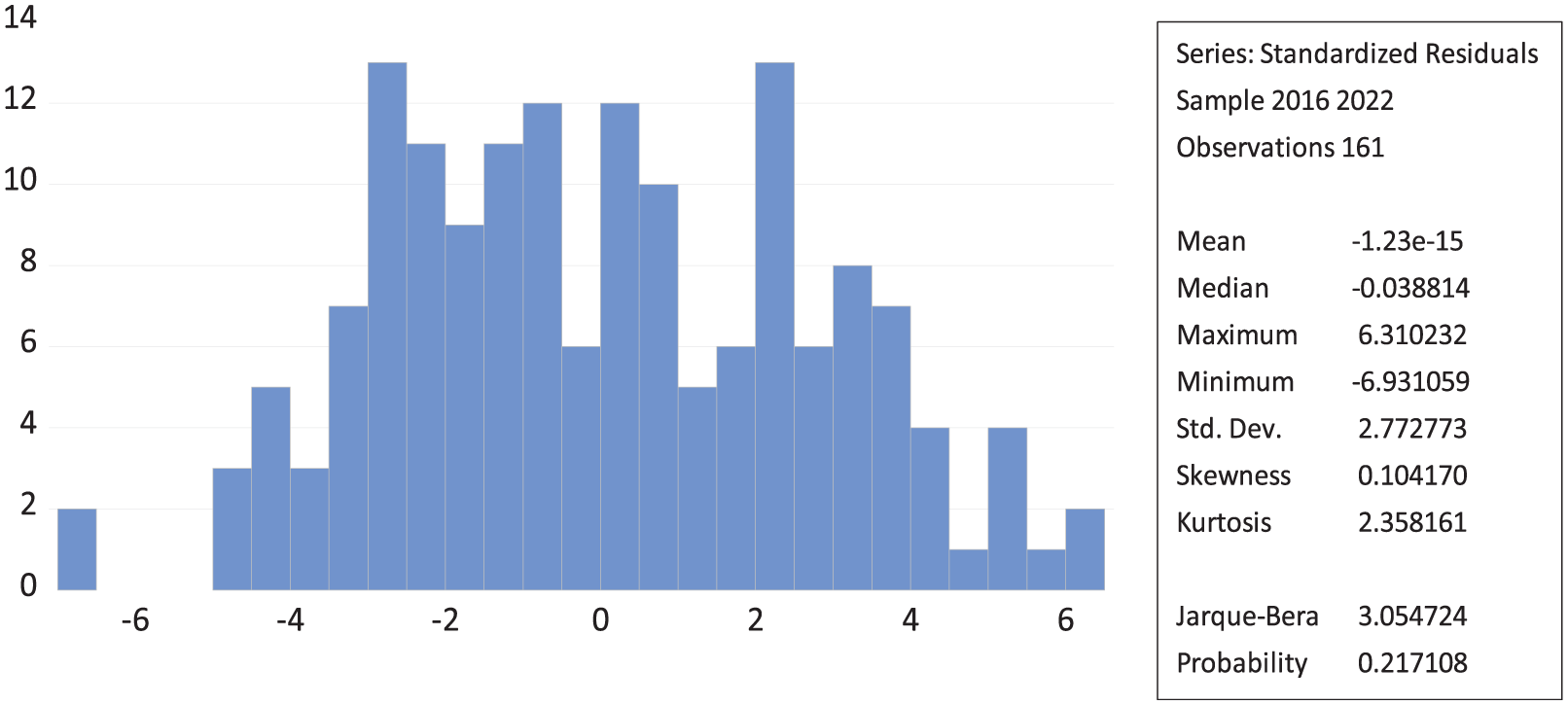
Normality test results.
The test results indicate a probability value of 0.217, which is higher than the 0.05 threshold, confirming the normal distribution of the data in this model. A multicollinearity test was conducted to examine the correlation value among the independent variables, the results of which are displayed in Table 1 below.
Multicollinearity Test Results.

Source. Data processing results (2024).
No single variable exhibits a correlation value exceeding 8, indicating that the model’s variables are free of multicollinearity. Heteroscedasticity commonly arises in cross-sectional data types due to the inherent characteristics of panel data regression. Consequently, there is a possibility of heteroscedasticity. Among the three panel data regression models, only CEM and FEM permit heteroscedasticity. This study employs the actual, fitted, residual graph comparison test (Figure 5).

Heteroscedasticity test results.
It can be concluded that there is no evidence of heteroscedasticity in the data used for the regression analysis, as the residual variance graph does not intersect or is equivalent to the actual and fitted graphs based on the heteroscedasticity results. There are three analytical techniques for panel data: common effects, fixed effects and random effects. The selection of the correct model among the three techniques above is subject to several tests, namely the F-test (Chow test), the Hausman test and The Lagrange Multiplier (LM) test. The following table shows the estimated results for the three methods:
The estimation results of the CEM, FEM, and REM methods are presented in Table 2. These results must undergo rigorous testing to ascertain the most suitable and optimal model. In this investigation, the Chow test is utilized to conduct a comparison of the CEM and the FEM. The Hausman test is a statistical procedure employed to choose between the REM and the FEM. A Lagrange multiplier (LM) test was employed to compare the CEM and REM models. The Chow test results are as follows:
Estimation Results with CEM, FEM and REM.

Source. Data processing results (2024).
Note.***significant at alpha = 0.01; **significant at alpha = 0.05; and *Significant at alpha = 0.10.
As demonstrated in Table 3, the F-test and chi-square values in the fixed-effects regression are statistically significant at the .05 level (P > F = .00). Consequently, the FEM model is superior to the CEM model. The Hausman test selects the most suitable model between the FEM and REM. The results of the Hausman test are as follows:
Chow Test Result.

Source. Data processing results (2024).
As illustrated in Table 4, the Hausman test results indicate that the fixed effects model is the most appropriate, with a chi-square value of 40.306 and a probability of .000, less than the alpha level of .05 or 5%. The fixed effects model is the most appropriate analysis technique for this panel data analysis, as confirmed by the Chow and Hausman test results. The Lagrange multiplier (LM) test is no longer a component of the analysis due to the Chow test and Hausman test findings, which indicate that the fixed effects model is the optimal model of the three. Consequently, the fixed effect model is employed to analyze this study.
Hausman Test Result.

Source. Data processing results (2024).
General Observations
In this study, the Fixed Effects Model has been identified as the optimal model for testing hypotheses. The results of the data analysis are presented in Table 5.
Fixed Effect Model Result.

Source. Data processing results (2024).
In order to ascertain the effect of independent variables on dependent variables, partial significance tests (t-tests) were utilized. These tests were conducted with confidence levels ranging from 90% to 95%. The analysis revealed that the budgets allocated for education, health, MSME credit, waste disposal, inequality, and gender development index exhibited varied probabilities. The education budget has been demonstrated to have a significant effect at a 90% confidence level, while the health budget, SME credit, and waste disposal sites have been shown to have a significant effect at a 95% confidence level. The impact of inequality is noteworthy, with a 90% confidence level, while the Gender Development Index exhibits a substantial effect at a 95% confidence level. These probability findings indicate that these factors exert a substantial influence on poverty levels. To ascertain the simultaneous or combined effect of independent variables on dependent variables at a 95% confidence level, a simultaneous significance test (F-test) was conducted. The regression test results indicate that the F statistical probability value of .000 is less than 5%, suggesting that all independent variables significantly and concurrently impact the poverty rate in Aceh. The coefficient of determination (Adj.R2) is .9748. Consequently, the independent variables can simultaneously account for 97.48% of the dependent variable. The residual 2.52% of the variance is attributable to other variables not incorporated within the model. According to the findings presented in Table 5, the regression equation can be expressed as follows:

The following interpretation of the results from the regression model is posited: Research indicates that education and health budgets, MSME credit distribution, waste accumulation, inequality, and GDI are factors contributing to variations in poverty levels. The constant value is 124.18%, indicating that other factors are assumed to remain constant. The coefficients for education budgets (−0.60) and health (−1.38) indicate a negative impact on poverty, while SME credit distribution (1.14) also has a negative effect. However, the accumulation of waste (0.14) and the Gini ratio index (4.06) have been shown to exert a positive influence, with a 0.1-point increase in the Gini ratio resulting in a 4.06% rise in poverty. Conversely, the Gender Development Index (GDI), which is calculated as the ratio of female to male secondary school enrollment, exhibited a negative correlation with the poverty rate, with a 1% increase in the GDI resulting in a 0.48% decrease in the poverty rate. It is assumed that other variables remain constant for each calculation.
As demonstrated in Table 5, which presents the regression results, the GINI Ratio Index variable is the independent variable that exerts the greatest influence on poverty in comparison to other variables. The coefficient value of the GINI Ratio index is 4.09, which indicates that a 0.1-point decrease in the GINI Ratio index in each region will result in a 4.09% decrease in the poverty rate in Aceh Province. Income inequality represents a significant impediment to the alleviation of poverty. Income inequality functions as a cyclical phenomenon for individuals of low economic means, rendering them susceptible to the perpetuation of extreme poverty. In the context of low-income levels, individuals encounter significant challenges in meeting the financial obligations associated with educational and healthcare expenses. This situation is further compounded by the limited availability of capital, which significantly restricts the capacity for entrepreneurship and business development. As posited by Goli et al. (2019), the alleviation of poverty is a formidable challenge, largely attributable to the prevalence of inadequate education and health outcomes, as well as the significant disparities in income that are evident among different geographical regions.
The constant value of the regression results is indicated by 124.18. The constant value exceeds the range of all the coefficient values associated with the independent variables. This finding underscores the pressing need for the government of Aceh Province to implement pro-poor government policies. Absent the proactive involvement of a government that is committed to addressing these disparities, it is inevitable that impoverished individuals will find themselves ensnared in a cycle of intergenerational poverty. One of the reasons why the constant number is greater than the coefficients of the other variables is because Aceh Province is an area that was once hit by a prolonged conflict from 1983 to 2005 and experienced a tsunami disaster in December 2004. The repercussions of the armed conflict and tsunami disaster resulted in significant damage and impairment to numerous facilities and infrastructure, rendering them inoperable. This phenomenon occurred in critical facilities and infrastructure, including hospitals, schools, markets, and other public institutions. The repercussions of the conflict are manifestly evident at the community level, as evidenced by the high rate of school failure, the scarcity of accessible healthcare facilities, and the considerable challenges encountered by individuals seeking to establish commercial enterprises due to the prevailing state of instability and insecurity (Heger & Neumayer, 2019).
Discussion
The regression estimation results presented above facilitate the analysis of the data, enabling the investigation of the following research questions:
a. The Role of Individual Capabilities Such as Human Capital Investment, Access to Health and Access to Capital in Poverty Alleviation.
The improvement of individual capabilities, which include human capital, the quality of health and the economic situation of each individual, strongly influences the quality of human life. The results of the estimation and the analysis of the data show that the education budget, which represents the element of human capital, has a negative but insignificant impact. Statistically, the impact of the education budget is not significant. There is a suspicion that the implementation of activities financed by the education budget has not met expectations, which calls for a thorough evaluation of these activities and programed. This will enable the education budget to contribute to SDG Goal 1 on poverty reduction in the future. The central government, as the organizer of education, continues to improve the education budget sector based on the phenomenon of the low contribution of the education sector to improving people’s welfare. This is regulated in the Law of the Republic of Indonesia No. 20 of 2003 on the National Education System, Article 49, which states: “At least 20% of the state and 20% of the regional revenue and expenditure for education shall be allocated to education, excluding the salary of teachers and the official cost of education.”
The Government of Aceh has enacted Qanun No. 11 on the Implementation of Education in Article 59, Points 1–3, which reads, (1) the funding of education in Aceh is a shared responsibility between the government, the Aceh Government, district and city governments, and the community. (2) The Government of Aceh and district/municipal governments shall allocate a budget of at least 20% of the Aceh budget (APBA) and district/municipal budget (APBK) to fulfill the needs of education in Aceh. (3) The allocation of the 20% budget for education funds, as mentioned in paragraph (2), is intended to enhance the quality of education, aligning with the Aceh education strategic plan and the district/city education strategic plan. This allocation is further reinforced by Article 60, point 2, which stipulates that “at least 30% of the Government of Aceh’s revenue from TDBH Oil and Gas, as mentioned in paragraph (1), is allocated to finance education in Aceh, particularly to enhance Aceh’s human resources.” The government also realizes that the Aceh Province education quality system is still low in several indicators. As released by the research team from the Ministry of Education and Culture by Sudarwati (2015) there are 5 missions that the government wants to achieve, namely: (1) availability of education services; (2) affordability of education services; (3) quality of education services; (4) equality in obtaining education services; and (5) certainty in obtaining education services. Bai et al. (2021) conducted research indicating the importance of investing in children’s education and skills training before they participate in the labor market. Investing more in education or skills training before entering the labor market increases the likelihood of children earning higher incomes than their parents and enjoying better social welfare benefits like pensions, health insurance, and promotion opportunities. Zhang et al. (2021) asserted that the education factor strongly influences the duration of poverty among impoverished individuals. Increased education increases the potential to escape the poverty zone more quickly in the future. Liu et al. (2021) state that the mechanism of human capital investment in children breaks the intergenerational transmission of poverty and promotes social mobility.
Health is the most important thing that every individual has for their life’s growth and development. If the quality of individual health is poor, it can lead to an unqualified society, characterized by a high number of stunted children, malnutrition, and a reduced ability to develop into a reliable workforce in the future. It is necessary for the government to meet the needs of its people in the health sector and prepare future generations with the full quality of public health. The results of the data analysis show that the health budget has the second-largest contribution to the poverty alleviation process in Aceh Province. The government should allocate more funds for health initiatives that directly benefit the community, particularly in rural areas. The implementation of programs and activities should not only benefit the community but also assist the impoverished in escaping their poverty. This study aligns with Pramono and Marsisno (2018) submission, asserting that facilitating easier and more affordable access to basic health services can decrease the proportion of impoverished individuals. Rahayu et al. (2019) stated that the distance of access to hospitals in the village has a negative effect on poverty. the further access to hospitals experienced by the community, the potential for them to become poor people because the costs incurred are expensive and they are reluctant to get health facilities at the hospital because it affects their income.
Business capital is one of the main elements required for people to start a business. Without business capital, individuals struggle to establish a business, leading them to remain unemployed. Entrepreneurship serves as a means to overcome unemployment, particularly in situations where job opportunities are difficult for labor to secure. This is the point at which some individuals become impoverished due to their inability to generate income in their daily lives. Therefore, providing business credit facilities to business actors is an alternative policy for overcoming poverty in the community. The data analysis results show that lending is a variable that is very helpful in overcoming poverty in Aceh Province. In this model, the credit distribution variable is the largest variable that contributes to overcoming poverty in Aceh Province. It is crucial that the government enhances its policies to facilitate the development of businesses for MSMEs, particularly through lending as a source of business capital. Etuk and Ayuk (2021) research indicates that poor households who participate in CADP see a rise in income compared to those who do not. Credible institutions, such as cooperatives and commercial banks, can enhance the requirement for business capital by offering training and business development to impoverished households that participate.
b. The Impact of Waste on The Environment Can Affect Poverty.
Damage to the natural environment significantly impacts the quality of life of the people living there. Improper management of waste deteriorates the environment, turning it into a pile of garbage that fosters the growth of diseases. This situation disproportionately affects people with low incomes, who are less resilient to disease due to their high medical costs. Waste piles also demonstrate the population’s consumerism and disregard for nature, as waste significantly impacts water quality, sanitation, and the prevalence of diseases. On the other hand, waste piles highlight the government’s and the community’s incapacity or lack of creativity in managing them, which could enhance the community’s quality of life. The results of the data analysis show conformity with the theory that landfills have a positive and significant relationship with poverty. This illustrates that environmental damage will trap people in poverty. The government must educate the public not to consume goods that produce waste because it will damage the environment and community life. The government should implement a waste management program to enhance the community’s value by recycling waste into alternative forms, thereby generating income for jobless individuals in the lower middle class. The waste management program is one of the poverty alleviation programs, as stated by Banowati (2014) The composting business, which processes waste into new functional materials, generates economic profits; additionally, it alleviates poverty among the workforce. This suggests they can achieve parity with factory workers who earn the minimum wage. Some of the co-benefits of this venture include the ability for workers to organize their work schedules, longer working hours, a reduction in pollution, a decrease in the volume of waste in TPS and TPA, and the acquisition of new functional materials that are both economically and ecologically sustainable. The government should continue conducting regular training and apprenticeships in waste processing, along with community empowerment and higher education elements. The government must focus on coordinating its implementation toward one integrated poverty reduction policy target: improving the welfare of people experiencing poverty so that they are not poor.
c. Income Inequality Affects the Poverty Rate.
Income inequality refers to the social disparity in society that is caused by the existence or unevenness of income earned by the community. In the context of elevated income inequality, the formation of social classes becomes a prevalent phenomenon, thereby facilitating the emergence of societal discord, largely attributable to constrained access to income resources among specific demographic groups. The findings of the data analysis demonstrate that inequality in Aceh Province exerts a positive influence. These findings align with the theoretical premise that income inequality is associated with higher levels of poverty. The government must implement policy interventions that are equitable for all communities. Such interventions may include information disclosure, facilitation of access to education, healthcare, the economy, and inclusive socio-culture. These measures are necessary to overcome poverty in Aceh Province.
Income inequality is one of the largest variables with a statistically significant impact on poverty reduction. This suggests that addressing income inequality is a solution to poverty. Income inequality in the community is caused by the fact that some people find it difficult to access jobs that are the source of their income. Data from BPS Aceh Province (2025) shows that the open unemployment rate in Aceh Province has only slightly decreased in the last 8 years. In 2016, the number of open unemployment was 7.57%, while in 2024, it was 5.75%. In the period from 2016 to 2024, the government was only able to reduce the unemployment rate by 1.82%. This is one of the reasons why people find it difficult to get a source of income, so they are trapped in poverty. Employment opportunities must be open and accessible to all members of society in order to reduce income inequality. The rise in income inequality can be attributed to the rise in unemployment within the community, particularly among the less educated (Berghammer & Adserà, 2022).
The influence of income inequality (GINI Index) on poverty alleviation is more significant than that of other variables, including education budget, health, access to credit for MSMEs, waste, and gender development index. This is due to the direct impact of income inequality on people’s welfare. The issue of income inequality has been demonstrated to have a multiplier effect, which is more acutely felt by the lower middle class. As posited by Ravallion (2001), elevated levels of income inequality have the potential to impede the prospects for pro-poor growth. In an economy characterized by persistently low inequality, the economically disadvantaged population is more likely to benefit from economic growth compared to an economy marked by high inequality. In essence, the extent of poverty reduction is significantly influenced by the rate of growth of average income distributed equitably. The impact of other variables, such as the education budget, health, or access to MSME credit, the amount of waste, and the gender development index on poverty alleviation, is a gradual process and indirect for the community.
The study conducted by Nurlina et al. (2019) identified the factors responsible for structural poverty among rice farmers in East Aceh District as follows: (1) The reliance of farmers on higher social strata; (2) Systemic unfairness and inherited economic disparities. Interviews conducted with numerous farm laborers and farmers in East Aceh District reveal that the majority of them have not received any form of government aid. Some individuals were unaware of the existence of government support. Several agricultural workers were invited to attend meetings in the village, but they were not included in the distribution of aid. Additionally, they are not enrolled to receive aid, despite the availability of information regarding the allocation of aid. They get several forms of support, such as Rice for the Poor, Direct Cash support, and Healthy Indonesia Cards. However, the distribution of these benefits is neither uniform nor consistent. (3) Limited possibilities to possess and manage productive assets, particularly land and finance. (4) Development Inequalities. Education facilities, sanitation, and infrastructure, such as public roadways and agricultural infrastructure, are necessary to adequately support agriculture. (5) Absence of policies that prioritize impoverished farmers. These five criteria delineate the circumstances of inequitable access within the population of the community, resulting in income disparity within the community, hence rendering poverty reduction rather arduous to surmount.
The findings of this study are consistent with the findings of research conducted by Yu et al. (2023), which indicates that there are significant disparities between impoverished and non-impoverished families with respect to food consumption, clothing consumption, education, and housing. The implementation of the Targeted Poverty Alleviation (TPA) policy has been associated with a substantial reduction in the socioeconomic disparity between impoverished and non-impoverished households. However, in terms of household consumption per capita, a disparity persists between poor and non-poor families. To further enhance the living standards of low-income households, it is necessary to sustain this intervention. The provision of equal opportunities to access natural resources has been demonstrated to reduce income inequality and contribute to poverty alleviation (Begazo Curie et al., 2021). Furthermore, the study by Begazo Curie et al. (2021) confirmed a negative and significant correlation between income inequality and poverty. This finding indicates that the implementation of income redistribution policies can facilitate poverty reduction not only on a national level but also at the local level. Luo et al. (2020) posited that the decline in income inequality in China is indicative of accelerated income growth among the lower income percentiles and the impact of newly introduced redistributive and pro-poor policies.
In light of the findings from prior studies, it can be posited that income inequality has the potential to impede the accessibility of poverty alleviation programs. The correlation between elevated levels of income inequality and considerable poverty is well-documented. Income inequality has been demonstrated to result in a considerable proportion of economic activity being controlled by a limited group of individuals, predominantly corporations or capital owners. This phenomenon has led to a limited number of employment opportunities that are primarily accessible to a small segment of the population that is of working age and currently unemployed. The challenge of acquiring a stable source of income often leaves individuals susceptible to the perpetuation of intergenerational poverty. The solution to this issue is twofold: first, the government must exercise control over the portion of economic activity through its policies, and second, it must do so in a manner that is both effective and efficient. Government policies must prioritize the well-being of low-income populations and promote economic equality within the community.
d. The Gender Development Index Indicator, Which Promotes Equality, Plays A Significant Role in Alleviating Poverty.
Poverty is particularly vulnerable for women because the majority of family heads are men. The population’s habit of making women the second choice in daily life has become a culture in the community. Men are the main choice in both work and social activities. When men are the decision-makers, there is very limited access for women to things such as employment, participation in social activities, expressing aspirations, fulfilling education, and other needs in daily life. Conditions will worsen if women become the head of the family due to several circumstances, such as the husband’s death, divorce, or limited income. This bad condition will occur if women are very limited in gaining access to decision-making for fulfilling their daily needs. Then it has the potential to trap people in poor households. Poverty will also be passed down to their children, thus creating intergenerational poverty. The results of the data analysis show that the gender development condition of Aceh Province is in accordance with the theory and statistically significant. The data shows that a high gender development index will reduce the poverty rate in Aceh Province. The government should ensure equitable access to many essential resources and opportunities for women, including but not limited to employment, education, socio-economic activities, and politics. In order to ensure that women’s needs are fulfilled, they will be empowered to cultivate more prosperous future generations. This research aligns with the study conducted by Yunus, Zainal, Jalil, and Maya Aprita Sari (2020), which discovered a strong and adverse correlation between social capital and poverty rates. Farmers with a greater amount of social capital experience a reduced poverty rate. The social capital components examined include the Community Social Capital Index, participation in farmer groups, religious organizations, and political parties, establishment of social capital networks, trust, and engagement in collective action.
Conclusion
The poverty rate in Aceh Province is significantly influenced by various factors such as education budget, health budget, MSME credit, landfill, inequality, and gender development index. Increased education budget, health budget, and MSME credit distribution can reduce poverty rates. equality through the Gini ratio index can reduce poverty rates if income is evenly distributed. Increased landfill can increase poverty rates due to increased costs of waste impacts. Equal gender participation can reduce poverty rates. A summary of the results of the hypothesis testing comparing poverty theory with empirical findings can be seen in Table 6.
Comparison Between Theory Poverty and Empirical Findings.
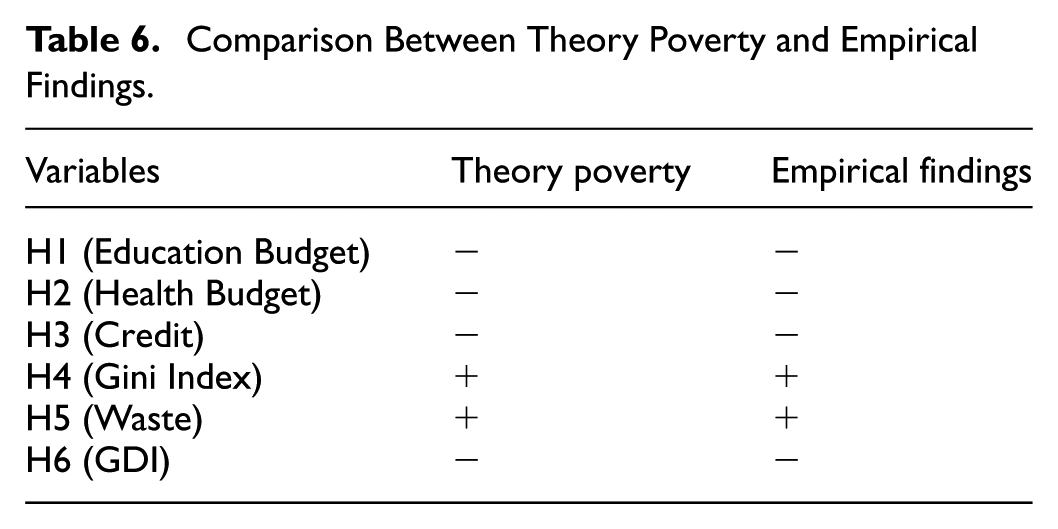
Based on Table 6, education budgets, health budgets, and credit budgets can reduce poverty levels. Thus, the government can increase education budgets, especially those focused on improving human resources, such as teacher and educator training, as well as paying attention to their welfare. The government can increase the health budget to provide health facilities in remote and isolated areas. Furthermore, the government needs to increase the credit budget for MSMEs. In addition to providing credit to MSMEs, the government must provide guidance and basic training for cooperative administrators and MSME actors, so as to produce local products and reduce dependence on neighboring provinces. The government also needs to optimize coordination among stakeholders to prevent overlap or failure in achieving poverty reduction targets. Priority programs, such as healthcare services and business capital, must be implemented to ensure residents remain healthy and to promote economic circulation.
This issue of income inequality should be of particular concern to all parties who have a mission to overcome poverty in each region. The government’s potential interventions include the establishment of poverty alleviation targets, with a focus on regions exhibiting pronounced income inequality. A subsequent step involves the collection of data concerning the number of low-income individuals and the implementation of intervention policies. These policies should include the provision of training and employment opportunities for the aforementioned low-income individuals. The policy must be executed sustainably. This necessitates the cooperation of community groups with the government program. This is an effort to mitigate the adverse consequences of moral hazard among low-income individuals who are the primary beneficiaries of government programs. Poverty is influenced by a multitude of factors, including economic, educational, health, cultural, and environmental aspects (Affandi et al., 2025; Chambers, 2007; Priatama et al., 2022). Communities can participate in overcoming poverty in their area by creating opportunities to generate income so that income inequality in the community can be reduced. Opportunities to generate income can be obtained by improving community education. Each household must be more concerned and more participatory toward the willingness to get education and training to get better welfare. When income is evenly distributed, poverty can be overcome. Some empirical evidence points out that education and training factors can increase income and reduce the chances of being poor (Berghammer & Adserà, 2022; Mulyaningsih et al., 2021).
This study uses a fixed effects panel data regression model to analyze the relationship between poverty levels and economic, socio-cultural, and environmental factors. Important assumptions in this model include the exogeneity of independent variables, the absence of high multicollinearity, and homoscedasticity in error variance. The selection of the appropriate model for interpreting the results was carried out using model specification tests such as Chow and Hausman, without performing the Lagrange multiplier test because the fixed effects model was selected as the most appropriate. The variables used are believed to reflect the relevant factors in the economic, socio-cultural, and environmental dimensions. However, it is imperative to acknowledge the limitations of this study. First, there is a risk of omitted variable bias because several other important factors, such as income distribution, unemployment rate, socio-cultural infrastructure, amount of carbon emissions, and condition of natural/forest damage due to mining or industrial activities, are not included. A potential opportunity for omitted variable bias exists in utilizing independent variables, which should extend beyond mere quantitative data, such as budgetary amounts allocated to education, health, and lending funds, to include quality data. This may include metrics such as the number of certified teachers, health workers, and active small and micro businesses. Secondly, potential endogeneity, mainly due to reverse causality between poverty and economic factors, can affect the interpretation of causality. Therefore, it is necessary to test the robustness of the model. Finally, the limited data coverage in terms of area-level characteristics and period may limit the generalizability of the results to a broader context.
Suggestions for future research include the identification and comprehension of the factors that influence poverty and the development of effective strategies for its mitigation. First, future researchers must re-explore the important factors that cause poverty rates to be difficult to reduce, especially in countries with large populations and large geographical areas, such as India, China, Indonesia, and other countries on both the Asian and African continents. Theories that study poverty in contemporary society continue to evolve. It is imperative to recognize that poverty cannot be measured by economic factors alone; however, other factors influence it, including institutional, cultural, religious, spatial, and multidimensional poverty (Acemoglu & Robinson, 2012; Azis, 2020; Chambers, 2007; Sen, 1999). Secondly, future researchers must augment the duration of the observation period with a longitudinal study, encompassing a more extensive timeframe. This should include an analysis of the impact of the ongoing COVID-19 pandemic on poverty levels. Thirdly, researchers must incorporate a robustness assessment of the model. Fourthly, future researchers should develop dynamic analysis models, such as the Generalized Method of Moments, spatial factors, or other methodologies.
Footnotes
Acknowledgements
Thank you to all those who have been very helpful in structuring this article properly, especially Indonesian Education Scholarship (BPI), Center for Higher Education Funding and Assessment (PPAPT Kemdiktisaintek), and Indonesian Endowment Fund for Education (LPDP), which have provided encouragement and support in terms of funding. This article will be helpful to all of us and generate constructive criticism and suggestions for future improvements.

Author Contributions
Affandi: conceptualization, investigation, resources, data curation, formal analysis, methodology, software, and writing—original draft. Yunastiti Purwaningsih: conceptualization, formal analysis, supervision, writing—review and editing, and validation. Lukman Hakim: data curation, methodology, methodology and software. Tri Mulyaningsih: supervision, writing—review and editing, methodology, and validation. Mulyanto: conceptualization, data curation and formal analysis. Mulyanto: conceptualization, supervision and data curation.
Funding
The authors disclosed receipt of the following financial support for the research, authorship, and/or publication of this article: This work was supported by Beasiswa Pendidikan Indonesia [Affandi-202101121637].
Declaration of Conflicting Interests
The authors declared no potential conflicts of interest with respect to the research, authorship, and/or publication of this article.
Data Availability Statement
Data sharing not applicable to this article as no datasets were generated or analyzed during the current study.