




Abstract
This study investigated how employees’ information technology (IT) competency is associated with employee agility via perceived task structure. Most scholar’s emphasis is on the impact of IT competency on individual work performance; however, it seems as if no attention has been given to explore the relationship between IT competency on employee’s agility through perceived task structure. This research offers and tests a new comprehensive model that links the individual’s IT competency with perceived task structure and employee agility. Data were gathered from 167 representatives who used various IT applications for daily work routines in the organization. Findings showed that IT competency is positively related to task interdependence and autonomy. Task autonomy also has significant effect on employee agility; however, task interdependence has shown insignificant effect on employee agility. Furthermore, work expertise positively moderates the relationship between IT competency and perceived task structure. Theoretical and managerial implications of study are also discussed in the last section.
Keywords
Introduction
In a rapidly dynamic marketplace, employees are required to be agile to respond to environmental changes and capitalize on emerging market opportunities (Alavi & Wahab, 2013; Cai et al., 2018; Pitafi & Ren, 2021). Agility is the capability of employees to react and adapt to unpredictable environment that is changing rapidly and appropriately, while trying to adjust to it (Alavi, 2016; Cai et al., 2018; Muduli, 2017; Pitafi, Liu, & Cai, 2018). Past studies have shown several advantages of employee’s agility, including organizational learning, product quality, and customer services and satisfaction (Alavi, 2016; Pitafi et al., 2019). These benefits brought by agility lead to an increasing interest in identifying its influencing factors. However, this stream of research is at the initial stage with merely conceptual inferences and anecdotal evidences to answer how to develop employee’s agility (Chuang, 2020; Sohrabi et al., 2014). Nevertheless, earlier studies on organizational agility also have constantly mentioned that individual agility is a crucial element of organizational agility. For example, Chonko and Jones (2005) argued that organizational agility is based on people who are working together in an organizational setting. In addition, Tallon and Pinsonneault (2011) reported that information technology (IT) use could improve individual capability, which promotes to organizational agility. Similarly, Breu et al. (2002) also proposed that flexibility and speed is the heart of employee agility. Previous studies have suggested the link between IT competency and agility (Goodhue & Thompson, 1995; Queiroz et al., 2018; Zhou et al., 2018). Specifically, IT competency creates digital options for employees that allow them to react and adopt environmental changes more appropriately (Ravichandran, 2018). For example, individuals can use enterprise social media (ESM) technology to respond to unexpected market changes, as ESM facilitates employees to learn new business procedures from colleagues through interaction (Lu & Pan, 2019). Therefore, it is necessary to understand the phenomena by which IT competency can be associated with employee’s agility within the organizational context.
In recent decades, rapid innovation of IT applications in the workplace has changed the procedures of work environment. Employees at all levels of the organization are even more distributed than before and perform several organizational tasks using digital technologies (Wong & Berntzen, 2019), specifically, tasks that have an important practical use in modern organizations (Howard & Rose, 2018). With IT competency, employees can process and elaborate several task-related information (Peng et al., 2015; Van der Vegt & Van de Vliert, 2016). For example, using IT tools such as ESM, employees can interact, communicate, and exchange task-related information frequently with their colleagues (Ding et al., 2019; Pitafi, Liu, & Cai, 2018). In addition, perceived task structure, individual needs higher support, assistance, expertise, coordination of their colleagues (Chin, 2018; Wu et al., 2020). With mutual understanding and better support, employees can respond to market dynamics and customer requests, and adopt market-related changes more appropriately (Bathaei et al., 2019; Sherehiy & Karwowski, 2014). Hackman and Oldham (1975) categorize perceived task structure as task autonomy and task interdependence. Specifically, perceived task structure, together with task autonomy and task interdependence (Fung-kam, 1998), is responsible for transmitting the impact of IT competency on employee’s agility. Task autonomy refers to the measure of opportunity and effort that an individual has done on allotted tasks (Chang et al., 2012). Task interdependence is a type of task in which frequent communication and coordination of employees are needed to finish the tasks at hand (Beverborg et al., 2017; Guzzo & Shea, 1992; Wu et al., 2020). Therefore, it is interesting to investigate the effect of perceived task structure as a mediator in the link between IT competency and employee’s agility.
However, IT competency is not a guarantee for an employee to perform the perceived task structure, exchange information, and resources with others (Choi, 2016; Islam, Pitafi, et al., 2021), as IT competency is also associated with the individuals’ work expertise (Kwahk & Park, 2018; Rasheed, Malik, et al., 2020). Thompson et al. (1994) proposed that work expertise is positively related with IT usage. This indicates that IT competency may be more efficiently modeled with individual work expertise. With relevant work expertise, individuals can better use the IT applications, including ESM and knowledge management software, and will provide accurate, timely, and useful business information (Lee et al., 2011; Leonardi, 2014; Rashid et al., 2020) that benefit perceived task structure. Past theoretical work has proposed that individual work expertise is essential in enhancing task autonomy and interdependence that needs freedom, control related to the task, and, conversely, timely, relevant information for communication (Anser et al., 2020; Augusto Felício et al., 2014; Salviano et al., 2012). Scholars argue that people who have expertise in work may offer valuable information and will present appropriate knowledge associated with their own experience (Choi, 2016). Therefore, we explore how work expertise acts as a moderator between IT competency and individual perceived task structure.
This study proposes a theoretical model that clarifies how IT competency impacts the employee’s agility through perceived task structure from an information processing perspective (Nadeem et al., 2020; Tushman & Nadler, 1978). Information processing perspective refers to collecting, interpreting, and organizing information in the perspective of strategic decisions (Islam, Islam, et al., 2021; Tushman & Nadler, 1978). The objective of present research is to scrutinize the association among IT competency, perceived task structure, and employee’s agility. This study extends our understanding in line with the previous studies on information system (IS) in several ways. First, present research study explores the fundamental part of IT competency by considering mediating variables (perceived task structure) to examine the role of IT competency in developing employee’s agility. Nevertheless, the research on developing employee’s agility is limited (Alavi et al., 2014; Pitafi, Khan, et al., 2020). According to authors’ knowledge, it is the first study which explores the role of employee IT competency in improving employee agility, as prior IS studies focused on organizational agility and firm-level IT capability (Liu et al., 2013; Tippins & Sohi, 2003). Second, the influence of individual IT competency on perceived task structure has been overlooked by research in this domain. Consideration of perceived task structure is important because IT tools such as ESM is designed to support interaction, knowledge sharing, and execution of several task-related assignments. We extend knowledge in this domain by shedding light on the influence of IT competency on perceived task structure. The current study advances research by identifying perceived task structure as a mediating mechanism by which perceived task structure influences employee’s agility. Third, this study advances knowledge on how employee’s agility can be improved by investigating the role of IT competency and perceived task structure by considering the role of work expertise as moderator in this relationship from information processing perspective. Therefore, we tend to theorize the role of perceived task structure in transmitting the influences of IT competency on employee’s agility.
This study is organized as follows. The “Theoretical Background and Literature Review” section consists of the theoretical background and comprehensive literature review and theoretical foundation of all the constructs. In the “Hypotheses Development” section, the authors provide the detailed literature for each hypothesis. The “Method” section consists of the method of data collection and detail of measurement items. The “Data Analysis and Results” section gives the results from the data analysis performed. The “Discussion, Limitations, and Implications” section consists of the discussion of results, implication, and limitation of the study. Finally, the “Conclusion” section describes the conclusion of the study.
Theoretical Background and Literature Review
Information Processing Model
According to Tushman and Nadler (1978), information processing model refers to collecting, explaining, and organizing information in the perspective of strategic decisions. In the previous studies, several scholars used information processing theory in IS studies. Existing study explores how IT competency successfully influences the human behavior and shapes the relationships between perceived task structure and the problems associated with rapidly reacting to unexpected changes. Specifically, IT competency provides quickness and accurate information in responding to unpredictable changes because it increases the employee’s understanding of sensing and reacting to dynamic market (Mathiassen & Pries-Heje, 2006).
From the information processing perspective, employee’s agility needs employees to make decisions based on numerous accessible information; as a result, it represents the flexibility to promptly sense and respond to market changes (Pitafi et al., 2019). Along these lines, IT is contributing to perceived task structure owing to its positive role in the process with reference to the task-related information. Given the nature of IT to promote communication and coordination together with information processing theory, scholars (Masa’deh, 2013; Pérez-Aróstegui et al., 2015; Queiroz et al., 2018) suggest that IT competency enhances the amount of task-related information that employees have and make use of it to adjust and redesign their perceived task structure.
IT Competency
Due to the increasing trend of commerce and growing competition in the 21st century, IT tools emerged quickly in today’s business, for example, ESM tools. IT has not only modified the normal approach of businesses but also broken the procedure of old work environment and built changes deep in time and space (Kucharska & Erickson, 2019; Paik et al., 2017). The efficient utilization of IT tools in the organization may be a vital issue which effectively enhances the task performance (Jafar et al., 2019; Wang Chen & Benitez-Amado, 2015). Understanding the necessities of businesses, companies, the scholars urged that the role of IT competency in generating sustainable competitive advantage should be further enhanced (Bassellier & Blaize Horner Reich, 2001; Ong & Ismail, 2008; Saunila, 2017). Based on these studies, IT competency refers to skills and knowledge of employees associated with IT tools together with ESM, software packages, programming, web meeting, and system analysis that support collaboration, interaction, and knowledge sharing, and increase employee performance (Mata et al., 1995; Sambamurthy & Zmud, 1997; Wang Chen & Benitez-Amado, 2015).
In recent past, researchers have inspected the determinants of IT competency in information sharing, collaboration, and agility performance (Choi, 2016; Lee, 2008; Peng et al., 2015; Pitafi, Kanwal, Akhtar, & Irfan, 2018; Pitafi, Kanwal, & Khan, 2020; Queiroz et al., 2018). Specifically, Choi (2016) examined the usage of IT applications in knowledge sharing activities, and proved that IT has a positive effect on information sharing. Peng et al. (2015) found that IT competency is positively related to employee knowledge sharing. Similarly, Queiroz et al. (2018) discovered the significant link between IT competency and individual agility performance. These studies generally highlighted the role of IT in enhancing employee performance. Therefore, investigating the role of IT competency in improving employee agility through perceived task structure is expressive in this study.
Employee’s Agility
Employee’s agility presents the competency of employees to behave promptly with unpredicted environmental changes in the organization more appropriately (Alavi, 2016; Cai et al., 2018). It is not only referred to respond unforeseen changes in a timely manner but also represents individuals’ competency to take gain of changes and convert them into opportunities for development of recent concepts and learning of emerging technologies (Bathaei et al., 2019; Chonko & Jones, 2005). Several advantages of employee’s agility have been evident from past studies, including product quality, customer service improvement, and learning (Alavi & Wahab, 2013; Panda et al., 2016; Sohrabi et al., 2014; Sumukadas & Sawhney, 2004). In reference to the dimensions of agility corresponding to the work of Sherehiy (2008), employee’s agility consists of three dimensions, namely, proactivity, adaptability, and resilience. The adaptive dimension comprises of adopting or updating oneself with change or learning new technologies; the resilience dimension describes employees positive attitudes for change, new ideas, and technology; and the proactive dimension consists of employees’ initiatives toward new ideas and activities that might be helpful in resolving change-related problems (Sherehiy, 2008).
Past literature mentions that employee’s agility can be improved in a flexible environment where individuals communicate, exchange information, and collaborate frequently (Pitafi, Liu, & Cai, 2018; Wei et al., 2020). Several studies considered task structure and frequent communication as a critical factor for promoting employee’s agility because information will only be exchanged among employees with mutual coordination. For example, researchers argue that having access to efficient and timely information and a “line of sight” are important for employees to respond quickly to suddenly changing environment (Sumukadas & Sawhney, 2004). Scholars have recently explored the employee agility from several perspectives (Alavi, 2016; Cai et al., 2018; Sherehiy & Karwowski, 2014). For example, Alavi (2016) highlighted the role of employee agility in manufacturing industries. Cai et al. (2018) suggested psychological conditions and ESM usage as an important element for developing agility. Sherehiy and Karwowski (2014) suggested autonomy, job demands, and collaboration as important strategies that promote individuals to be agile. This study focused on employee agility through perceived task structure.
Perceived Task Structure
In the workplace, individual tasks are affected by several task-related issues such as type of task, task characteristics, and task processes (Riasudeen et al., 2014; Sonnentag et al., 1994). Perceived task structure is defined as individual perception related to task in which tasks are organized and performed (Billing et al., 2013). Riasudeen et al. (2014) recommended that more empirical investigations are required on perceived task structure for IS studies. Specifically, perceived task structure is a series of sub-tasks, several procedures, and technologies, and knowledge is necessary to finish the task (Chandrasekaran et al., 2015). Deng et al. (2017) proposed that perceived task structure has positive effect on work performance in ESM environment. Task interdependence is the degree in which individual must work together to finish the task (Bishop & Scott, 2000; Pearce & Gregersen, 1991; Zheng & Bao, 2006). In a high level of interdependence, individuals are required to connect and cooperate with workmates to regulate their thoughts and actions, and to make decisions regarding work problems (Langfred & Moye, 2004; Sonnentag, 2017). Related research studies have cautioned that as task interdependence increases, the necessity for communication, collaboration, and cooperation also increases (Grabner et al., 2017; Kiggundu, 1983; Staples & Webster, 2008; Wageman & Baker, 1997).
Work Expertise
Work expertise is an individual’s amount of knowledge about the particular domain (Liu et al., 2016). According to MacCrimmon and Wagner (1987), work expertise is defined as the experience of the individual in a specific domain, ability of applying that experience, and competency of learning new knowledge in that domain. Prior studies have discovered that work expertise is interdependent and relevant abilities of an individual whose fundamental goal is to comprehend work-related issues and collaborate with partners for the solution of problems (Bassellier & Blaize Horner Reich, 2001; Marcus & Anderson, 2006; Nelson & Winter, 2009). Collectively with the higher work expertise, individuals will respond to task-related problems more appropriately and quickly (Butcher, 2007). Moreover, past research reports that experienced employees understand task-related problems more quickly in contrast to unskilled workers (Snell & Dean, 1992) and also make more effective and efficient decisions.
Hypotheses Development
IT Competency, Perceived Task Structure
In perceived task structure, each member must exchange resources with other members like information, experience, and skills (Brass, 1981; N. A. Khan et al., 2020), and thus lend itself to IT support (Gebauer et al., 2010). For example, in perceived task structure environment, IT competency enables employees to share, communicate, and exchange information from completely distant locations in several time zones (Rico & Cohen, 2005; Wang Chen & Benitez-Amado, 2015). Scholars view IT competency as strong variable in the literature of perceived task structure and knowledge sharing and argued that IT competency is directly associated with knowledge sharing activities (Choi, 2016; Gold et al., 2001; Rasheed, Jamad, et al., 2020). Theoretical work associated with IS steered that employee IT competency has a key role in facilitating the knowledge sharing process, collaboration in an organization (Peng et al., 2015; Younis et al., 2020), that successively enhances workers’ interdependence and autonomy (Kang et al., 2008), whereas IT competency may be essential for individuals, because with efficient IT competency, employees search, retrieve, analyze, and access useful information that should promote the autonomy and interdependence by facilitating quicker and better quality of decision making (Aral et al., 2012). Furthermore, with IT competency, individuals quickly share information, expertise, and resources with workmates (Stark et al., 2014).
Numerous scholars have examined the link between IT competency and knowledge sharing (Chang et al., 2012; Cropanzano & Folger, 1989; Langfred & Moye, 2004). For example, Wageman (1995) argued that tasks can be accomplished at different levels of autonomy and interdependence, which is mostly associated with their workmate’s knowledge and information. As expressed by Chung (1977), both interdependence and autonomy require work planning and working speed, expertise, and knowledge of other colleagues which is only convincible with individual IT competency (Boell, 2017; Wang Yen & Huang, 2011). Specifically, in a higher amount of interdependence, an individual needs to build a close relationship with colleagues to accomplish the task successfully (Wageman & Baker, 1997). In addition, with IT competency, employees access several important information from different resources using various internet applications (Aral et al., 2012), which successively promotes the autonomy (Belias et al., 2015). According to the information processing theory, the richer task-related information is provided by IT, the efficient utilization of that information, thus, team members have greater discretion in their task. Therefore, we theorize the following hypotheses:
The Moderating Role of Work Expertise
The function of IT competency in relation to perceived task structure may change according to work expertise. According to Hackman and Oldham (1976), the perceived task structure may depend on individual characteristics, such as individual work expertise. Work expertise reflects the sum of skills and knowledge owned by employees within a particular domain (Sonnentag, 1998). In the earlier years, an increasing body of literature had explored the connection between work expertise and resource sharing activities (Anderson, 1985; Hershey et al., 1990). The importance of individual work expertise is because of immense knowledge, their capacity to tackle complex issues, and working interdependently (Koubek & Salvendy, 1991). Franz and Larson (2002) argued that if an employee possesses work expertise, he or she might provide relevant information and suggest different ideas and indirectly support their colleagues in several task-related problems (Sonnentag, 1995), because previous experience is involved in similar situations (Lee et al., 2011). Furthermore, in task interdependence, an individual with higher level of work expertise contributes useful information using different IT tools (Liu et al., 2016). The important and relevant information provided by individual will decrease information asymmetry and increase knowledge sharing (Lee et al., 2011), and individuals are expected to have greater amount of communication if valuable and accurate knowledge is presented (Franz & Larson, 2002; Wallin et al., 2019), so it is expected that work expertise of individual would be beneficial for task interdependence. We claimed that individual who have work expertise will become fully involved in frequent interaction with colleagues and would be likely to provide assistance in task-related issues using different IT application with other colleagues more quickly (Animesh et al., 2011). Given that in task interdependence, employee is likely to obtain a vast amount of information through frequent communication from different colleagues in a given time. As volume of information from multiple sources increases, more diversity of information may occur, which may damage the efficiency of a decision-making process of individual. With relevant work expertise, individual can manage high volume of information more efficiently. Therefore, considering the work expertise as an important element, we outline the following hypothesis:
Chung (1977), in his research, suggested that task autonomy requires work planning, freedom, control, and working speed. Following his suggestions, we also argue that with relevant work expertise and knowledge, employee can better plan task-related events and respond fast to work-related issues using emerging technologies (Hodkinson, 2004; Närhi, 2002). Past studies have also shown that task autonomy is associated with individual work expertise (Gagné & Deci, 2005; Riasudeen et al., 2014). For example, a software engineer has work expertise in writing code for a specific type of application will be likely to ask for task autonomy as compared with an inexperienced individual who has just completed training and is starting to write code. An individual with work expertise is much more likely to suppose that he or she can effectively perform the task with autonomy (Langfred & Moye, 2004). Specifically, freedom of work may produce several interpretations, thus resulting in task performance, which may depend on individual work expertise. For example, individuals who have expertise in an autonomous task situation may perform the task efficiently as compared with the non-autonomous performer (Chang et al., 2012). Therefore, with related literature support, we suggest the following hypothesis:
Perceived Task Structure, Employee’s Agility
According to the literature, task interdependence can enhance employees’ knowledge, expertise, and information (Arnold & Tafkov, 2019; De Jong & Matthijs Bal, 2014). In a higher amount of task interdependence team, individuals are attached frequently with coworkers to share information and resources, and facilitate each other (De Jong & Matthijs Bal, 2014; Stark et al., 2014; Wei et al., 2020).
Numerous studies have proposed that task interdependence allows individuals to acquire a diversity of knowledge through the conversation, exchanging of several ideas with their coworkers, which in turn advances their competency to respond to sudden changes (Christensen-Salem et al., 2020; Gu et al., 2016; Sherehiy & Karwowski, 2014; Sumukadas & Sawhney, 2004). Alternatively, the increase in task interdependence possibly increases the work coordination, and the employees may lead to an increase in information processing demands (Kanwal et al., 2018; Saavedra et al., 1993). Such successful communication among individuals boosts the level of information sharing and decision making (Chang et al., 2012; Kanwal, Pitafi, Akhtar, & Irfan, 2019). Specifically, on one hand, if task interdependence is higher and one employee shows negative progress which might reduce the work performance of other participants (Wageman, 1995), the employee has to sense that their own involvement is extremely important for the achievement of the task. This successively should boom the inducement of the employees and lead to a better response with reference to unexpected market dynamics. Furthermore, when task interdependence is lower and employees have a low performance will most probably be compensated by other members, which also enhances the overall work performance (Wageman & Baker, 1997). Therefore, task interdependence permits individual to capture opportunities, and adjust and work independently, which consequently develops their agility. Therefore, we present the following hypothesis:
The research model of Bandura et al. (1999) suggested that individual will be inspired by task autonomy because it provides freedom, coordination, working speed, planning, and control in performing a task (Cao et al., 2020; Troyer et al., 2000). Scholars have reported that individuals who have discretion and full control in performing a task may likely provide more efficient solutions of the problem and better decide how to respond with the unpredictable market changes more appropriately (Frese & Zapf, 1994; Latif et al., 2021; Muduli, 2017).
Past studies show a positive link between task autonomy and work outcome (Fung & kam, 1998; Hackman & Oldham, 1975; Langfred & Moye, 2004; Zhang et al., 2017). Hence, it appears reasonable to expect that individuals who have more task autonomy would be having more freedom and control to make decisions regarding volatile market changes (Belias et al., 2015). In higher level of autonomy, employees have a higher level of freedom in decision making, such as to handle task-related uncertainties, capture market opportunity, and make strategic decisions. In addition, scholars also reported the direct and positive relationship between autonomy and knowledge sharing (Llopis & Foss, 2016). Also, increased control over the task will encourage the individual to learn and become knowledgeable in different task-related issues of an unstable environment, and they will expend time and energy improving their capabilities to react with changing conditions. In conclusion to the above argument, we present the following hypothesis:
Mediating Effect of Perceived Task Structure
Research on perceived task structure goes back a long way in different directions. Following the studies of Wageman (1995) and Stewart and Barrick (2000), we may also apply the same approach. First, the task interdependence relies on technological requirement. Second, in task interdependence, employees require cooperation and frequent communication. We suggest that IT competency has the potential to enhance task interdependence. Specifically, IT competency will enable employees to share information and connect with colleagues from different locations (Staples & Webster, 2008). These connections facilitate communication that can improve the interdependence by increasing individual affective commitments to one another. The link between task interdependence and employee agility is hypothesized as positive. Employees who have the coordination of their workmates associated with task normally accomplish better when reacting to market changes and become confident in handling unexpected environment in their workplace (Alavi, 2016). Therefore, we propose the role of task interdependence as follows:
Task autonomy also has been considered as an important and interesting topic of IS research (Langfred, 2005; Rico et al., 2007) and may strongly relate with the employees’ work performance (Langfred & Moye, 2004). We propose that IT competency may enhance autonomy by promoting working speed, planning, sequence, and control over the task. Specifically, IT competency allows everyone to control the task remotely. Several researchers have argued that freedom from external pressure enhances competency of employees because outside pressure and control tend to decrease concentration in the task itself (Chang et al., 2012; Zhang et al., 2017). The none availability of task-related autonomy may also reduce the individual’s struggle in handling task-related uncertainties. In addition, autonomy imposes important responsibility on the individual, to take decision pertaining to sudden changes (Chang et al., 2012). For example, in task autonomy, employees can work alone and control their own work speed, timing, and sequence of their task. Employees who have control and freedom about their capabilities normally react well when acting to unexpected environmental changes (Alavi, 2016). Hence, we hypothesized the mediating role of autonomy as follows:
Method
Data Collection
We composed a survey questionnaire that was developed using past studies. The survey of this study was conducted in China, as China is a developed country as far as economy and innovations are concerned (Cai et al., 2018; A. N. Khan et al., 2019), and expanding prevalence of IT tools such as ESM in the country is very evident. The scale was analyzed by using a 5-point Likert-type scale, ranging from 1 = “strongly disagree” to 5 = “strongly agree,” as it is widely used by previous scholars (Kanwal, Rasheed, et al., 2020; Latif et al., 2020). All samples of this research were employees of Chinese companies, so we also took help from three local Chinese professionals who are also well versed in English. All the scales of survey were initially converted from English to Chinese. English language items were transformed into the Chinese language by four specialists who are unknown to the original scale. The authors found no major distinction between both versions of the scale, such as original and translated scale; therefore, the Chinese version was used for this research. For data collection, authors visited several organizations to ensure themselves about IT usage and the working environment. In total, eight companies were approached from the service industries, financial industries, and manufacturing industries. All eight organizations had implemented the IT infrastructure, and employees have enough knowledge about IT tools. Authors, however, discovered that several IT applications—ESM, knowledge management systems, intranets, groupware, and bulletin board systems (BBS)—were adopted by these companies. We then contacted the managers of these organizations and described in detail our study goal. Managers of the organizations were helpful and cooperative. The cooperative attitude of managers helped increase the overall response rate for this study and the data came in much quicker with the cooperation of these managers. We used convenient sampling technique to collect data for this study, as convenient sampling is easiest and faster procedure of data collection. During the period of September 2017 to October 2017, the authors collected the data for pilot study. Initially the pilot study was performed on a sample of 50 respondents, and findings were discovered according to the standard. In the final study, we removed these 50 respondents.
We distributed 265 questionnaires among employees, during the period that extended from December 2017 to January 2018, and received 200 responses, in which 33 were found inadequate such as missing information or filled improperly. Finally, 167 proper entries were used for the final analysis, and the response rate was about 85.6%. Details of the sample are shown in Table 1. To determine the sample size, we followed the stratified sampling approach, which is significantly consistent with the method, as it has diversity and Cochran’s formula. The sample of the study has indicated the adequate level of representative as a whole, having reliability 90 and denotes the proper consistency of questions of all the constructs (Stringer et al., 2011).
Sample Information.

Measures
The research model of this study is based on several indicators and has been adapted from prior research studies that are well structured in their respective domain (Alavi et al., 2014; Chandrasekaran et al., 2015; Pitafi, Liu, & Cai, 2018). The proposed research model consisted of 12 variables together with some demographic variables. We used five control variables in the analysis, namely, Gender, Age, Education, Tenure, and Department. The control variables were coded as follows: male = 0, female = 1; age: 21 to 30 years old = 1, 31 to 40 years old = 2, 41 to 50 years old = 3; education: college or below = 1, undergraduate = 2, master’s degree or above = 3; department: administration = 1, development = 2, marketing = 3, production = 4; tenure: <1 year = 1, 1 to 2 years = 2, 2 to 3 years = 3, 3 to 4 years = 4, >5 years = 5. The variables that were used are IT competency, work expertise, task autonomy, task interdependence, and employee’s agility as dependent variables. We scored IT competency using five items which were developed by Bassellier and Blaize Horner Reich (2001). The measurement of work expertise was done using the Lee et al. (2011) scale that consisted of four items. The scale of task autonomy was constructed using four items that were developed by Chandrasekaran et al. (2015). The instrument of task interdependence was constructed using six items which were adopted from the scale of Sharma and Yetton (2003). Employee’s agility is a second-order construct that comprised of three first-order constructs, namely, proactivity, adaptability, and resilience; it was therefore constructed using the measurement by Alavi et al. (2014).
Data Analysis and Results
Common Method Variance
We analyzed the common method bias in our study using two different methods, as all data were gathered from a similar place at the same time (Kanwal, Pitafi, Rasheed, et al., 2019; MacKenzie & Podsakoff, 2012). First, we used the method which is proposed by Liang et al. (2007) to compute the common method variance. Accordingly, findings indicated that substantive factors have value of 68.7% of the variance and the method factors 1.3% of the variance, indicating no common method variance. Second, the results of Table 3 indicated that all the correlation values are less than .60 (Pavlou & El Sawy, 2006). Hence, both results confirm that common method variance is not a serious issue with these data.
Results of CFA.

Note. CA = Cronbach’s alpha; CR = composite reliability; AVE = average variance extracted; IT = information technology; CFA = confirmatory factor analysis.
Descriptive Statistics and Correlations.

Note. The diagonal elements are the square root of the AVE. IT = information technology; NA = not available; AVE = average variance extracted.
The diagonal elements are the square root of the AVE in bold.
Measurement Model
The model fit was investigated to evaluate the validity of the scale. The model fit was analyzed, as suggested by Hair et al. (2010), Hu and Bentler (1999), and Yadama and Pandey (1995). The findings show that χ2 = 1,048.08, df = 308, root mean square error of approximation (RMSEA) = 0.05, standardized root mean square residual (SRMR) = 0.06, normed fit index (NFI) = 0.77, incremental fit index (IFI) = 0.89, comparative fit index (CFI) = 0.92, and goodness-of-fit index (GFI) = 0.77 are acceptable if the sample size is greater than 150 (Yadama & Pandey, 1995).
Validity and Reliability
For data analysis, we used SPSS, Version 21.0, and we performed different tests, including validity and reliability, average shared variance (ASV), and maximum shared variance (MSV). The loadings of each item were >0.60 as guided by Fornell and Larcker (1981) and Kanwal, Pitafi, Malik, et al. (2020). We also computed the Cronbach’s alpha (CA), the composite reliability (CR) of constructs, and average variance extracted (AVE) to conform the convergent validity. Table 2 indicates that CA ranged from .82 to .94, which was >.70, as directed by Hinkin (1998), Kanwal et al. (2019a), and Sun et al. (2020). CR values ranged from .86 to .95 and were >.70, as directed by Nunnally (1978). The AVE ranged from 0.53 to 0.75 and was >0.50, as directed by Bagozzi and Yi (1988) and Kanwal et al. (2019b), and greater than the MSV. These results therefore attested that the research model has standard convergent validity.
For discriminant validity, we also used two procedures. First, Table 3 results confirmed that the square roots of the AVEs of all the construct are greater than intercorrelations between variables, which ensured the discriminant validity of the model (Kanwal, Pitafi, Ahmad, et al., 2020). Second, Table 4 results also indicated that HTMT (heterotrait–monotrait) values are less than the recommended value 0.85 or 0.90 (Henseler et al., 2015).
HTMT Analysis.

Note. HTMT = heterotrait–monotrait; IT = information technology.
Shaded areas indicates that all the values are less than 0.85.
Structural Model
In this study, we used employee agility as a second-order construct by using the average score of first-order dimensions. Table 3 indicated that the correlation of first-order construct is significant at p < .001, showing that these first-order dimensions represent the construct employee agility (Pitafi, Liu, & Cai, 2018). Table 5 results indicate the path analysis and moderation of work expertise results. These results indicate that the lowest value (.17) of the variance explained (R2) of each dependent variable is above the recommended value .10 (Ali, Wang, & Khan, 2019; Falk & Miller, 1992; Kanwal, Pitafi, Pitafi, et al., 2019). Hence, the proposed research model is acceptable. Figure 1 shows the path coefficients of all the relationships. All the control variables have insignificant effect on employee agility as shown in Figure 1. The results show that IT competency has a significant effect on task interdependence with β = .33, t = 5.43, p < .001, and task autonomy with β = .30, t = 4.02, p < .001; H1 and H2 are supported for this study. Similarly, task autonomy is positively related to employee agility with β = .14, t = 3.03, p < .005; H5 is validated by the current study. However, task interdependence shows insignificant effect on employee agility with β = .10, t = 1.87, p > .05; therefore, H6 is rejected.
Results of Path Analysis.

Note. IT = information technology.
Significance at the .05 level. **Significance at the .001 level.
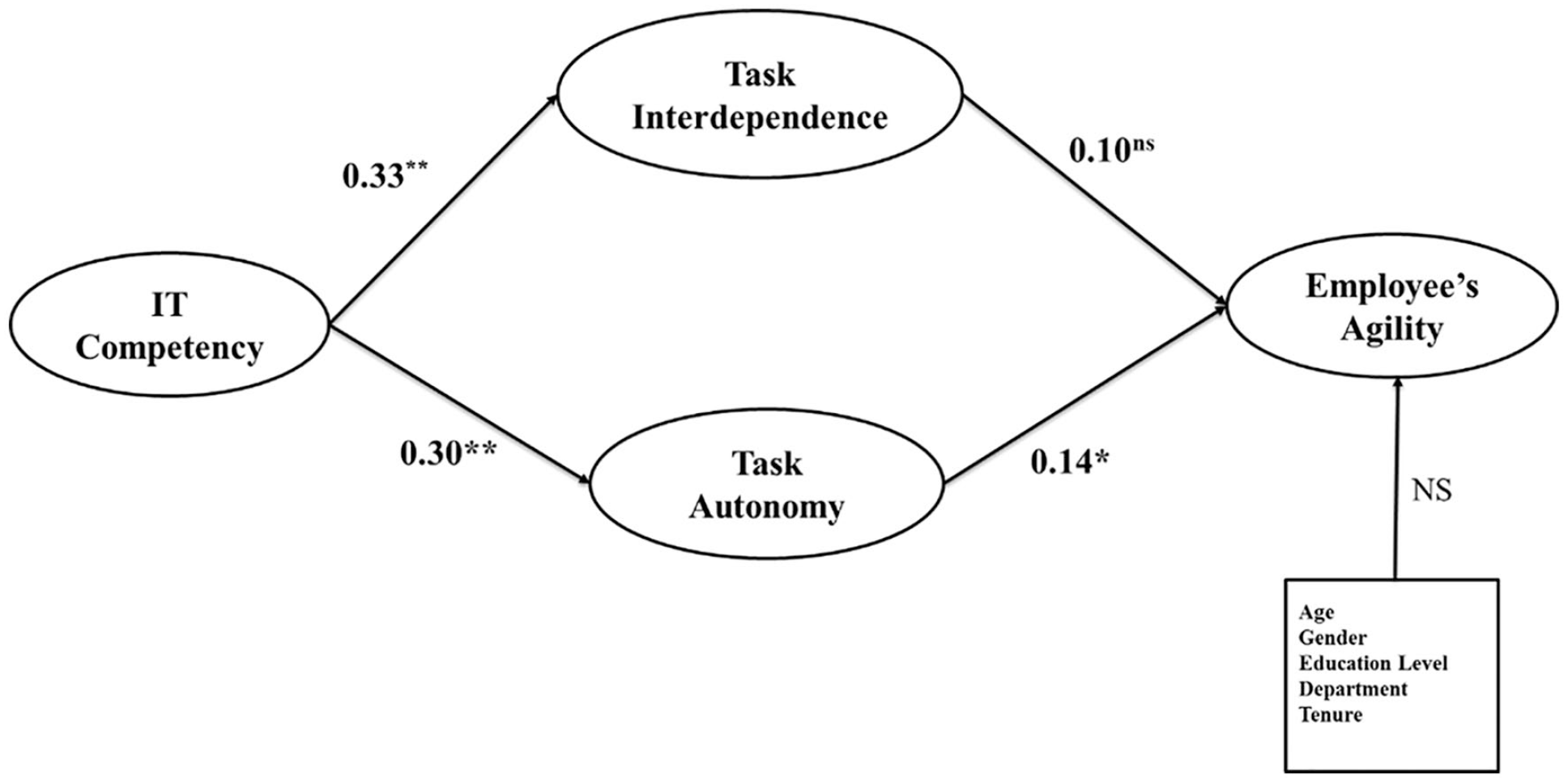
Results of structural equation model.
Furthermore, Table 5 indicates the results of moderating effect of work expertise. Results indicate that work expertise positively moderates the relationship between IT competency and task interdependence with β = .15, t = 2.03,p < .05, thereby supporting H3. Work expertise is also positively moderating the relationship between IT competency and task autonomy with β = .17, t = 1.98, p < .05; hence, H4 is also supported by the current data set.
We use graphical procedures to further investigate the moderating effects (Aiken et al., 1991). Figure 2 indicated the moderating effect of work expertise with the relationship between IT competency and task interdependence. Similarly, Figure 3 also indicated that work expertise also moderates the relationship between IT competency and task autonomy.

Work expertise as a moderator with the association between IT competency and task interdependence.

Moderating effect of work expertise on the relationship between IT competency and task autonomy.
Mediating Effect Test
To examine the mediating effect of the task interdependence and task autonomy, we adopt the “bootstrap sampling method (bootstrap sample size = 5,000)” proposed by MacKinnon et al. (2004). Table 6 results indicated that task interdependence does not mediate the link between IT competency and employee’s agility because confidence interval (CI) = [–0.030, 0.658] contains zero, which does not support H7. However, the task autonomy mediates the link between IT competency and employee’s agility because CI = [0.0038, 0.0916] does not include zero, which supports our H8.
Results of the Bootstrapping Method.

Note. IV = independent variable; MV = mediating variable; DV = dependent variable; CI = confidence interval; IT = information technology.
p < .05. **p < .001.
Discussion, Limitations, and Implications
Discussion
The objective of this research was to examine the impact of individual IT competency on employee agility through perceived task structure, including autonomy and interdependence. Findings confirm that IT competency positively affects the task interdependence and autonomy that is in line with previous studies, and IT competency is directly associated with knowledge sharing (Ali, Wang, & Khan, 2019; Kanwal, Pitafi, Akhtar, et al., 2019; Peng et al., 2015). The outcome demonstrates that the task autonomy has a positive effect on employee’s agility, providing an idea for the organizations to enhance employee agility by enhancing IT competency which was in accordance with our assumptions. We reasoned that if IT tools such as ESM were designed to support task-related assignments, then the nature of the task should play a key role in shaping its utility for employee’s agility (Kanwal et al., 2018; Pitafi et al., 2019). However, the effect of task interdependence shows the insignificant effect on employee’s agility, which is against our hypotheses. Besides, this we also investigated the mediating effect of both perceived task structure variables, namely, interdependence and autonomy. The findings suggest that autonomy mediates the link between IT competency and employee’s agility, whereas task interdependence shows insignificant mediating effect. Surprisingly, results of this study could not support the mediating effect of task interdependence. There are numerous conceivable explanations behind that H8 cannot be endorsed. Perhaps the relationship does not exist. However, from the model, though we have no proof of accepting them, in the meantime, we likewise have not enough reasoning to decline them either. Perhaps to grow the sample size estimate or to modify the questionnaire would present to us another outcome. Obviously, this issue should be researched in the future studies being conducted on this or related topic using the relationship as in H8.
In addition, our exploration considers the moderating effects of employees’ work expertise. The discoveries of our investigation demonstrated that work expertise positively moderated these relationships, which is also identified in past studies (Cao & Ali, 2018; Pitafi, Kanwal, Ali, et al., 2018; Snell & Dean, 1992). In task interdependence and task autonomy setting, employees require information sharing, coordination, and freedom over the task. As the requirement of task interdependence is that every employee relies on the resource, information of others (Wang Yen & Huang, 2011), in this type of environment, work expertise plays an important role as moderator in the relationship between IT competency and interdependence. As with work expertise, individual can use IT application and share relevant information with workmates. Similarly, in task autonomy, the individuals are required to work on planning, and have full control and freedom over the task. With relevant expertise, employees can plan task sequence and understand emerging technologies such as IT tools including ESM quickly as compared with unskilled workers (Snell & Dean, 1992).
Theoretical Implication
This investigation makes various noteworthy theoretical contributions to existing literature. First, this research tackles an imperative but neglected area of research—employee’s agility. Specifically, Alavi et al. (2014) and Pitafi, Rasheed, et al. (2020) stressed that more experimental research is required on agility of employee; this study is an attempt to address this research gap. In addition, prior studies related to organizational agility also observed the employee agility as an important component (Bala et al., 2019; Pitafi, Kanwal, Pitafi, et al., 2020; Tallon & Pinsonneault, 2011; Yusuf & Adeleye, 2002). When employees use IT application, they can proficiently manage different information, and they can acquire abundant knowledge, which is useful to quickly detect and respond to unexpected changes in the organizational context or marketplace.
Second, we also show that perceived task structure matters when it comes to the link between employee’s IT competency and employee’s agility. IT competency is used to support activities that individuals undertake when performing their assigned tasks (Karsten, 2003; Kiani et al., 2020; Pitafi, Kanwal, & Khan, 2020). Previous studies also recommended that perceived task characteristics are necessary for understanding the employee’s outcome impact of IS (Goodhue, 1995; Goodhue & Thompson, 1995; Kuegler et al., 2015). However, the major theoretical work is based on the direct impact of IT competency on employee performance. Whereas in this research study, we focused on the influence of IT competency on employee’s agility through task interdependence and task autonomy. Third, this research highlights employees’ IT competency and its advantages in the workplace. Previous scholars mostly focused on IT infrastructure, firm-level IT capability, and IT environment (Liu et al., 2013; Tippins & Sohi, 2003). However, IT competency is necessary to support the activities when an individual performs his or her assigned tasks (Kim Jooho et al., 2016).
Managerial Implication
From theorizing the case above, a number of implications can be directed to managers. First, study results suggested that the managers should maximize the work-related functions of IT, such as implementing some collaborative, knowledge management software where individuals can communicate, discuss, and share knowledge with colleagues. For example, managers can also motivate individuals to use IT tools such as ESM for collaboration and communication. ESM is a public platform where entire communications are visible (Leonardi, 2014; Nand et al., 2019), and managers can post the achievements of their coworkers on ESM platform.
Second, the results of this study provide suggestions to managers with new insights into the dynamics of management agility of their employees via IT competency and perceived task structure. Individual employee determines his or her agility, which should be strengthened through task structure. Results show clear evidence that IT competency is beneficial for perceived task structure. In addition, managers should adopt better procedures to recruit applicants who show high agility, as better recruitment practices may also indicate better career advancement opportunities (Ali, Wang, Khan, Pitafi, et al., 2019; Jager-van Vliet et al., 2018).
Third, to improve the employee agility, managers can implement the reward system in organizations on individual performance-based rather than fixed pay, and reward system will encourage individuals to respond and adopt new environmental changes more appropriately. In addition, managers should also create a flexible working environment, where individuals can share and exchange information with other individuals. Emerging technologies such as ESM should be deployed in the workplace, which connect workers, thereby improving their competency to cooperate and exchange information and also access information resources.
Finally, findings of the current research recommend that the managers should extend the IT competency of their coworkers by arranging proper IT training and steering to use IT application. The study results also suggest that managers should not solely consider assigning the resource for new technologies, like various IT tools (hardware, software), but also guide their coworkers about IT applications by arranging training, workshops, and seminars.
Limitations
Like other research studies, our research also has a few restrictions that we are highlighting for future directions. This research is prescribed by various factors that require to be taken into account generalizing the findings of this study as well as future studies in this line of research inquiry. First, our respondents are only from China. However, China is an ideal country for these types of studies as a result of Chinese corporations principally use various IT tools for business-related correspondence and likewise as for collaboration. The future research scholars can broaden this study utilizing a similar theoretical model in various countries and test the outcomes whether this structure is as relevant as the findings and context of our study. Second, the population of this study is comparatively small but an acceptable inquiry in this domain of research. The latest research studies explain that small samples can be further strengthened by follow-up studies, and small sample size can be used if it meets the statistical and research criterion (Latif et al., 2019; Wolf et al., 2013). In future studies, scholars can extend this study with larger sample size or multiple studies can accommodate the generalizability. One more sampling problem is that this study only focused on the jobs in which IT applications are utilized for collaboration and knowledge sharing. However, for a few work positions (housekeeper, restaurant waiter, and machine operators), individual IT competency is not necessary. Future studies can examine whether and how the IT competency changes across different types of tasks and occupations.
Furthermore, we explored the moderating effect of work expertise in the relationship between IT competency and task interdependence and task autonomy. Scholars can use different moderator(s), such as information sharing and type of job in this relationship.
In this research, we only tackled two task characteristics, task autonomy and task interdependence, as mediating variables that played a significant role in determining the individual use of IT. The future analysis in this area needs to contain consideration of task environment while observing the individual IT competency and employee agility. Furthermore, in this study, task interdependence shows insignificant mediating effect. Therefore, future research can examine additional intervening variables such as task environment to enhance our understanding of the improving employee agility.
In this study, our respondents are individual workers of various corporations. At present, organizations depend increasingly on more teamwork than ever before; therefore in future studies, the researcher can likewise expand a similar idea at the group level.
Conclusion
The goal of the present study was to investigate the role of individual IT competency in improving employee’s agility through perceived task structure. The empirical data validate most hypotheses including moderating role of work expertise, indicating that perceived task structure (e.g., autonomy, interdependence) is significant in transferring the value of IT competency to employee’s agility as well as work expertise being essential for this relationship, although, the link between IT competency and agility cannot be mediated by task interdependence. We claimed that individual IT competency is helpful when employees are performing task autonomy and interdependence. These task activities, in turn, are beneficial for improving the employee’s overall agility. Therefore, this research provides insights into the link between perceived task structure and employee agility.
Footnotes
Declaration of Conflicting Interests
The author(s) declared no potential conflicts of interest with respect to the research, authorship, and/or publication of this article.
Funding
The author(s) disclosed receipt of the following financial support for the research, authorship, and/or publication of this article: The work described in this paper was supported by the National Natural Science Foundation of China under grant numbers (NSFC: 71531008, 71521001, and 71490720) and the Fundamental Research Funds for the Central Universities (JZ2020HGQB0217).
