



Abstract
The study investigates the current state of information demands and the information-seeking behavior of Urdu literary students using digital technologies. Another purpose of the study was to determine the level of satisfaction with both the existing facilities and resources. A quantitative survey method of research is used to achieve the study’s objectives. Four major public universities of Lahore were the population. Containing the use of the convenience sample approach, data was obtained using a self-structured questionnaire with open-ended and closed-ended questions. Results show that Urdu literature students were not very familiar and comfortable with using research journals, research reports/theses, and reference works while finding information. There is a need to encourage students the use research journals, research reports/theses. The study focuses solely on Pakistani Urdu literature students. For generalizations, this survey should be reproduced on a larger scale. The findings of the research will contribute to knowledge about Urdu literature students’ information-seeking behavior at the university level in Pakistan, which may be beneficial to ultimately provide better services in the domain of Urdu literature. Universities and libraries need to provide more facilities and electronic resources for the Urdu language and literature students, keeping in mind their trends toward new technologies. University libraries should organize special training programs for literature students.
Keywords
Introduction
One of the most widely spoken languages in south Asian subcontinent is Urdu, and its dominance as a language of learning is increasing all over the world. Pakistan has adopted it as a national language. However, people in India also speak it. They have migrated from Pakistan to other countries like England, USA, Scandinavian, West Asian, and African countries (Sultana, 2015). Urdu carries an excellent charm for those who are not native Urdu speakers, and they want to learn about the history of the language, and there is substantial literature in Urdu.
Large-scale linguistic data has become possible as a result of technological advancements in the 21st century. Web researchers may now collect enormous online texts of all types and sources due to technological gadgets with better storage capacity at a low cost. At present, we are living in the deep and dark sea of information; we can call this century information flow century. There are sharp waves of information around us. We do not know which information wave of them to catch and which to let go. To capture and utilize the right wave at the right time, we need to learn mature information-seeking behavior in the right way.
Information needs and information-seeking behavior has become very important in the student’s life. Due to the overflow of information during the last two decades, rapid societal changes were noted worldwide. It affects every discipline of life. Many challenges occur due to these gadgets (Ansari & Zuber, 2010; Arshad & Ameen, 2021; Sultana, 2015). Information creates and expired very quickly, so the need for updating information is a continuous process. Everybody confronted change all through life. These progressions are essentially the initial step toward learning and figuring out how to face these tiny and massive changes. These minor changes have strongly impacted our behavior and consciously or unconsciously became a part of our information-seeking behavior. Disciplines of Study have been the most common factor for investigating information seeking and information behavior in general (Howlader & Islam, 2019; Wellings & Casselden, 2019).
Sultana (2015) examined the relationship between the Urdu faculty, research scholars, and P.G. students reading habits and utilization of library and internet resources for their work. Scholars read an average of 20 articles per month around the world, with considerable variances between disciplines and geographic areas (Arshad & Ameen, 2021). Previous literature showed notable differences in academic reading patterns by different subject branches. According to Tenopir et al. (2009), the reader’s subject discipline influences a variety of factors, including the reading skills, behaviors, and total hours invested for each reading.
This study aimed to look at the current state of Urdu literature students’ information demands and searching behavior, with an emphasis on university library services and resources in digital paradigms. Present research seeks to understand and explain probable intuition into participants’ information-seeking behavior. The findings of this study will contribute to knowledge domain Urdu literature students’ behavior while searching for desired information in Pakistan.
Research Objectives
The core aims of the study were:
To investigate the current scenario of information demands and searching behavior among Urdu literature scholars.
To measure the frequency with which scholars from the Urdu literature domain use university library services and resources.
To examine how satisfied these students are with the available resources and services of their libraries.
Scope of the Study
User-centered researches contribute to the understanding of the specific behavior pattern of users. While locating certain information, every user has their style or behavior. Studies related to information-seeking behavior can help the policy-makers, libraries, and stakeholders for future services and planning. With the help of the results of the previous researches can take the appropriate measures to match their users’ requirements. The current study attempts to determine what knowledge Urdu literature students demand and how their seeking behavior has changed in the digital paradigm. The research investigates the challenges faced by the Urdu literature students of Pakistan during this process. The Urdu language and literature study experts, on the other hand, ignore this domain. The frequency with which Urdu literature students accessed university library services and resources had to be determined. The findings are expected to serve as a foundation for future research in this sector and add to existing knowledge. The current situation of Urdu literature students’ required knowledge and searching behavior in digital paradigms will be depicted in this study.
Literature Review
Urdu language resources entered the digital age with the application of computers for Urdu in the 1980s. Due to technological advancements, there are various developments associated with Urdu resources. At present, there have been countless Urdu resources available through World Wide Web (Durrani, 2010). We need to create a holistic cultural environment and start more practical activities to promote the Urdu language instead of waiting in the age of globalization (Bashir & Khanum, 2021; Yaqoob, 2005).
Shaheen (2010) indicated that a new paradigm is emerging in Urdu, which will change the attitude of the information-seeking behavior of Urdu language and literature learners. She further explains that the quality of research and teaching will improve with the digitalization of Urdu. The current century is known as the information age. Information has become the most important factor in societal growth. No matter how well-versed one is in a topic or job, they need various information to thrive in this digital era (Bashir et al., 2015; Tahir et al., 2008).
In the 1990s alone, it is estimated that over ten thousand papers on information-seeking behavior were published (Case, 2002). Many researchers have looked into how library users obtain information based on their subject interests, occupations, information environments, and geographic location. For decades, information scientists have been interested in academics’ information demands and information-seeking behavior (Majid & Kassim, 2000). Many authors have noted that there are fewer studies on information-seeking behavior and the needs of social scientists than there are for natural scientists, and there are even fewer studies on the needs of humanists (Challener, 1999; Hopkins, 1989; Line, 1969).
Various individuals, associations, and institutions in Pakistan have conducted studies on the reading habits of different professional groups, which partially suggest their information demands. Anwar (2007) evaluated some research studies on people’s information-seeking behavior in Pakistan. He said that there had been fifteen unpublished research on the subject thus far. Shahzad (2007) conducted a study of Government College University, Lahore faculty members to identify their information-seeking behavior. He gathered information from all three faculties: science, technology, and social sciences and humanities. At the University of Punjab, Anjum (1978)investigated the information needs of humanities teachers (Tahir et al., 2015). According to Ahmad (2008a,b), computational text in Urdu is getting popular, although it is in its early stages compared to other disciplines and languages.
Furthermore, he indicated that software has also been developed for studying Urdu computational text, for example, automatic parsing. Asari (2008) believes that there are notable changes in teaching and learning methodologies and Urdu language due to technological advancements. He emphasizes a need to adopt modern technology quickly to strengthen those who learn information through the Urdu language. Akram (2012) indicated that modern technology, especially the development of computers and the internet, initially gave the impression that it would reduce the number of readers of language and literature. This will eliminate languages other than global communication and computer language. Cyberspace has opened up new possibilities for the development of language and literature. It is gratifying that our Urdu language has also been able to adapt to modern technology. Information is a significant source for the growth and development of every individual personality. It is an integral part of the survival of society (Ukachi, 2007).
Improving our information or knowledge societies depends on the quick provision of all types of information with spending as low as possible in terms of financial as human resources. During the last decades, the amount of production in the information field is rapidly growing. Information produces and gets outdated in a flash time in our so-called information society. It is crucial to reduce the uncertainty while searching for the required data to fulfill the information gap. Case (2002) believes that information needs occur once an individual gets himself in an information gap. At this specific time, they require some channels or paths to fulfill information needs to achieve specific goals. Siatri (1999) explains information needs as expressions correlated to the concept of information-seeking behavior. It is an umbrella term that covers many other aspects of information. This process starts when individuals find themselves in an information gap situation and successfully fulfill the knowledge gap with the help of correlated steps. These steps include searching, recognizing the required information, arranging this information, evaluating the available data by critical analysis, and the last step is the presentation or dissemination of this information. According to Chinnasamy (2017), information needs and information-seeking behavior about users’ detailed information. Information requirements vary, but they are frequently linked to a person’s professional activities (Demergazzi et al., 2020; Joel et al., 2019; Sycz-Opoń, 2019; Bashir et al., 2018).
E-learning will be the next generation of education. A wide range of applications defines the field of e-learning research. Learners benefit from information technology because it allows them to access instructional resources just-in-time, regardless of time or location (Bashir & Warraich, 2020). As a result of these causes, the internet and web resources have become more accessible. Scholars have grown accustomed to retrieving knowledge on the internet rather than from a traditional library. However, a substantial portion of the material on the internet is written in English. Although the information is available in other languages, the rise of data on the internet in different languages, particularly in Urdu, is continuing. Very few web resources available in the Urdu language, for example, The “Annual of Urdu Studies” is a free web-based publication containing full-text research of Urdu language and literature.
“Rekhta.org” is another free website dedicated to promoting and disseminating Urdu literature, particularly Urdu poetry, to a wider audience than those familiar with the script. U4U.Com” is the only legal site with hundreds of poets and authors, covering 500,000 plus pages of Urdu literature from the past to the present.
Digital Resources of Urdu in Pakistan
In Pakistan’s Urdu literature realm, digitization and digital libraries are new fields of academic inquiry. Pakistan, on the other hand, has adopted only a few digitization measures. Significant digital library projects, according to Rafiq and Ameen (2009), include the UN Digital Library (UNDL) in Islamabad, the Pakistan Research Repository (PRR), the Allama Iqbal Urdu Cyber Library, and the HEC-National Digital Library Program. The Allama Iqbal Urdu Cyber Library, an initiative of Pakistan’s Iqbal Academy, is the world’s first digital library of Urdu Books. Urdu books on Iqbal studies, Urdu classics, literature, poetry, and prose have been digitized and made available online by the library.
In 2006, Pakistan’s Higher Education Commission launched the PRR initiative, an aggregated repository for archiving research output from Pakistan’s academic and research institutions. The PRR digitizes and makes available online Pakistani PhD and MPhil theses and dissertations.
About 0.15 million manuscripts in Arabic, Persian, Urdu, Pashto, Sindhi, and Sanskrit languages have been discovered in Pakistan. Some are held in Pakistani libraries, while others are held in private collections. These texts’ bibliographies are also available. As a result, digitizing this material is both a necessity and an opportunity (Ahsan, 2009).
According to Wilson (2000), information-seeking behavior deliberate searches for information to fill gaps in knowledge. He added that during this searching process, there are chances that individuals might intermingle with numerous information sources available. Information-seeking behavior is defined as human behavior that involves searching for information to fill a gap. This conduct can be difficult to determine at times (El Maamiry, 2016). It is not a new phenomenon for people to seek information. The information world is increasingly complicated, and managing and filling the knowledge gap generated by the information stream has become difficult.
The 21st century is the beginning of a data or knowledge-based society where people have easy and free access to complete information. Information generation and expiration are so quick these days, so people need a consistent and fast update to meet the challenges created by the information society. Berget and MacFarlane (2020) believes that Users in various walks of life rely on information searching and access to meet their needs, from finding flights to discovering information needed to fulfill work duties. Kadir et al. (2018) explain that the rapid proliferation of information in the present era has significant implications for university students’ education and library usage. Weber et al. (2019)explains that Individual information-seeking behavior in higher education is a relatively novel field of research. In the realm of information seeking, the information source is a crucial component of the idea or process, and various obstacles affect university students’ information-seeking actions and use (Thindwa et al., 2019).
Durrani (2009) indicated that in the present century, Urdu teachers’ responsibility to familiarize themselves with these new technologies and teach a new electronic culture among literature students. He believes that this will enhance the capabilities of students of literature. A new digital paradigm is emerging in the world of Urdu at present. According to El-Maamiry (2020), the region’s distinctive traditional and nationalistic culture influenced pupils’ behavior while searching for required information.
Pakistan is a multicultural society that is a combination of different cultures, languages, and traditions. Lahore, one of the country’s big cities, is a blend of different cultures of the country. It is the city of Universities, private and public. People come all over from province and other provinces to get educated and earn degrees in different disciplines of life. Learning changes its nature rapidly as a result of the advancements in ICT. Now a day’s learning is not restricted to classrooms, especially for the students of Urdu literature. There is a remarkable change in students’ behavior while using information and searching for their required information. The purpose of this study was to look into university students’ information-seeking behavior and determine how Urdu literature students’ information-seeking behavior has changed over time.
Research Design and Methodology
This study aimed to look into how Urdu literature students sought information and to determine whether there were any differences in how students and scholars used information sources. According to Arshad and Ameen (2021), the survey approach entails a systematic collecting of data, whether by an interview, questionnaire, or observation method. Many researchers suggested that the quantitative approach is the best method to explore the study information competencies and seeking behavior (Howlader & Islam, 2019; Sultana, 2015; Tanacković et al., 2017; Wellings & Casselden, 2019 & Tahir et al., 2008) Hence, this study also employees quantitative survey method of research to collect data from four major public universities of Lahore city were the population of the study that is,
GC University, Lahore
LCWU, Lahore
Punjab University, Lahore
University of Education, Lahore.
A self-structured questionnaire, that is, “Survey of Urdu Literature Students Information Seeking,” based on the open and close-ended questions used to collect data. This survey questionnaire was prepared after a comprehensive literature search and discussions with subject experts. The research instrument, that is, questionnaire, consists of two parts. Part 1 is related to the students’ demographic information and Part 2 was related to information sharing behavior, background knowledge, preferred medium and sources for information, level of satisfaction regarding the quantity of library collection, Issues and problems, and influencing factors. To check the data collection tool, a pilot study will also be conducted. Data were collected from the convenience sampling method from Urdu literature students of Intermediate, BA Hons (4 Years), MA, M.Phil, and Ph.D. Appropriate sample size can produce accurate results. This study adopted the formula of Yamane (1967) to get the right sample size from the proposed population. At the time of research (2020), there were 600 enrolled students in selected four universities of Lahore. As per the formula mentioned above, 240 questionnaires were circulated amongst these four universities; the total sample population was divided into four equal portions of eighty from each university. Out of which, 185 returned. The collected data were analyzed through SPSS.
Results and Research Findings
Demographic Information
Data was collected through the questionnaires by implemented convenient sampling. Total 240 questionnaires were distributed among four selected universities of Lahore; 185 (77%) responses were received. Table 1 provides comprehensive details of the respondent’s gender, age group, and qualification.
Demographic Information.

Results indicate (Table 2) a high ratio of 21 to 25 (48.1%) and (28.1%) respondents age group was 16 to 20. It was noted that more than 56% of respondents were BA (Hons) programs, only 6% of respondents were Ph.D. scholars.
Frequency of Sources.

Note. BM = books or monographs; Ref = reference work; Jou = journals; RT = research report/thesis; Bib = bibliographic; IS = internet sources; dis. = discussion with colleagues; MC = attending meeting/conference; ID = informal discussion.
Visits of Libraries
One of the core objectives was to explore the visit ratio of Urdu literature students to Libraries. Results show high percentage (45%) of weekly visitors and (35%) daily visitors of libraries. It is pertinent to mention the meager ratio of 7%monthly visitors toward libraries. Figure 1 draws comprehensive feedback of students regarding library use.

Percentage of libraries visits.
Sources to Locate Desired Information
Results show a high ratio regarding daily use of Books and Monographs; 40.5% of Urdu literature students use BM daily to get their required information. Another popular source to locate information was Internet 36.8%, and students use this source daily to reach for needed information. The collected data shows that the Urdu literature students were not very familiar and comfortable with the use of Research journals, research reports/theses, reference works, and meetings and conferences while finding information. Results indicating an interesting finding that 10.8% of Urdu literature students never use bibliographical sources to get information.
Students were asked to indicate the frequency of sources which they use to get their desired information. Figure 2 shows the percentage of each source implied by the Urdu literature students to find information. Results indicated the high ratio of daily use of books 40.5% (Figure 2), and only 5.4% of Urdu literature students never use books to locate information.

Percentage of sources.
Opinions and Background Knowledge About Information Seeking Behavior
Respondents were asked to give their feedback on a scale of 1 to 5 on the provided statements. The purpose behind this research question was to explore the background knowledge of Urdu literature students about Information-seeking Behavior. Students were asked to indicate that whether they regularly read professional journals in their field. The result shows (Figure 3) that the ratio of students who were not read the journals of their specific area periodically is slightly higher than the students who read Journals. Results show that most of the students enjoy learning. Students give their feedback about study other than course books. A high ratio was recorded about this statement of “I always do more than minimum requirements in courses.” Table 3 present the frequency of feedback about these statements.

Percentage of comprehensive details of feedback.
Opinions and Background Knowledge about Information Seeking Behavior.

Note. A = I regularly read professional journals in my field. B = I genuinely enjoy learning. C = I always do more than minimum requirements in courses. D = I like to study. E = I know my personal learning style. F = I am actively involved in learning experiences. G = I never dislike when someone offers feedback that could improve my knowledge and skills.
Status of Information Collaboration
Information sharing is one of the main elements of information seeking. Students were asked that how frequently they share the collected information with others. Results show (figure 4) that 56% of students share collected data frequently with others, and 37 % share their knowledge occasionally. Results indicated a low ratio of (6%) students who never share their data with others.

Status of information collaboration.
Medium of Access for Published Materials
Students were asked to indicate the medium which they preferred for access to published materials. Results reveal (figure 5) a high ratio of 39% students chosen institutional libraries when they required published materials. The other sources for accessing print material were teacher’s and supervisor’s collections (24%). It was noted that a meager ratio (2%) of students use libraries other than their institution to get required published materials.
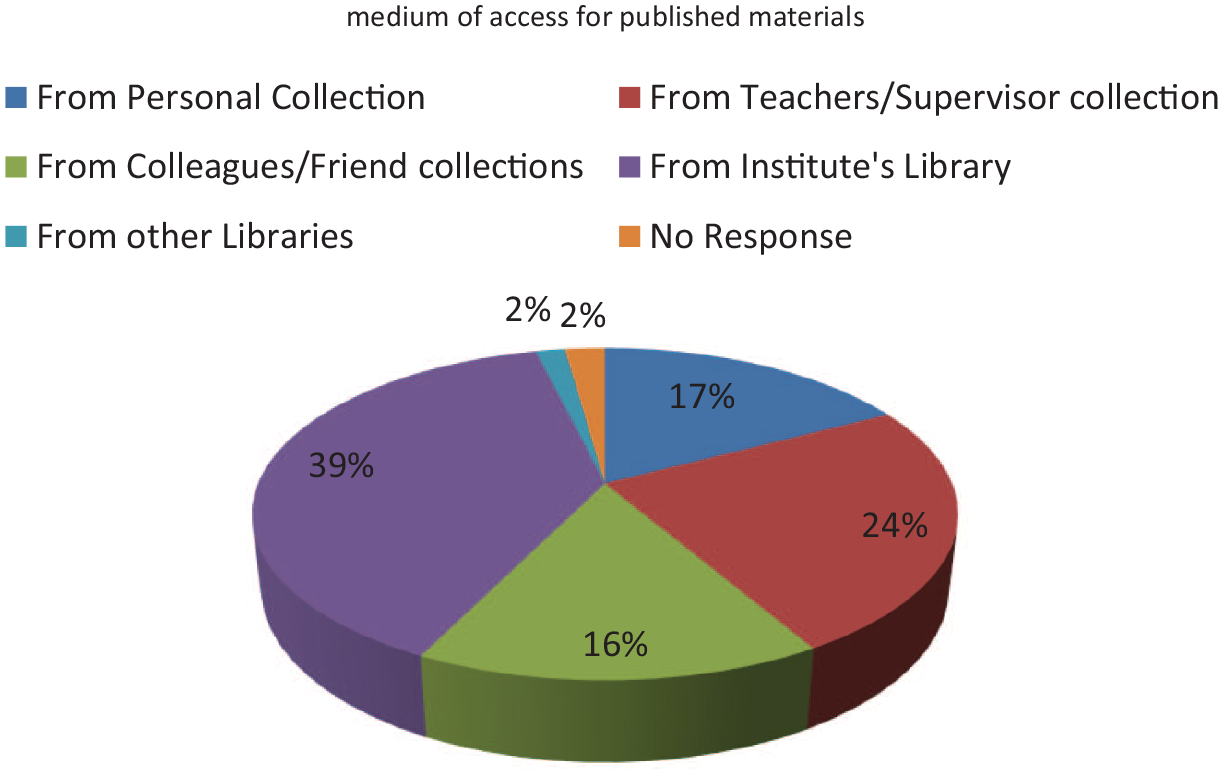
Medium of access for published materials.
Preferred Information Sources
Respondents were asked to indicate information sources they use to get related information for academic purposes. Results showed (figure 6) a high ratio of (46%) respondents who rely upon library books to get desired information. About 29% of students were in favor of lectures, notes and handouts. It was observed that only 13% of students used textbooks to get required information, only 2% of students used theses and research reports to get information for academic purposes.

Preferred information sources.
Status of Students Satisfaction Regarding Quantity of Library Collection
No doubt, libraries are significant sources of information. Students can get information from libraries only if institution libraries are adequately arranged and well-stocked. Students were asked to indicate how well-stocked their institutional library was in their subject area. Results show (figure 7) that a high ratio of 35% of students believed that their institutional library is well stocked in their relevant subject. At the same time, 23% of students think that the library is very adequately stocked. It is also observed that 13% of students have no idea about this statement. Results reveal that students were delighted with their institutional libraries regarding collection development in their subject areas.
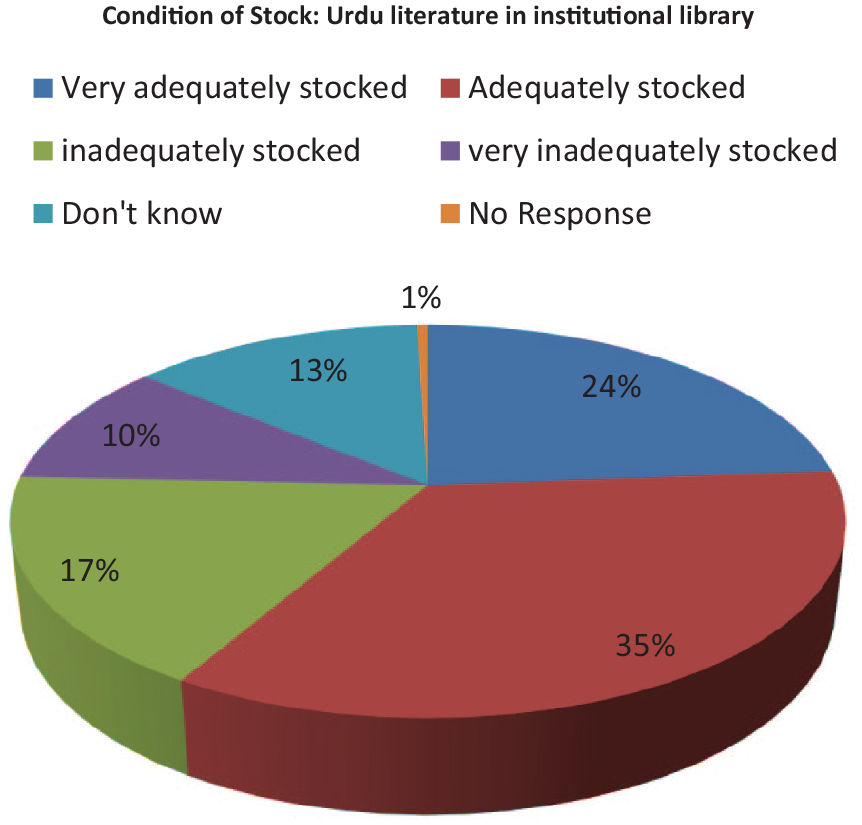
Percentage of condition of stock.
Preferred Sources During Information Seeking
Issues and problems during seeking information
Information locating is not an easy task. It is challenging to get the required information. Students faced many issues and problems during this process. The aim of this research was to map out the problems and issues faced by the Urdu literature students during information seeking. Results indicated that the primary point during information seeking was the non-availability of required material and shortage of time. About 14% of students indicated that lack of subject knowledge among library staff as the major problem while seeking required information. An equal ratio of students (14%) believes that lack of knowledge about library resources and services was the major problem. A low percentage (6%) of the students recorded who have not basic understanding of ICT which cause hurdles for them to get the desired information. Figure 9 described the significant problems while seeking information.

Percentage of seeking help.

Percentage of major problems in seeking information.
Factors influencing on the interpersonal skills and information seeking behavior
Students were asked about the influencing factors to improve interpersonal skills. A high ratio of results (figure 8) indicated that 45% of respondents firmly believed that group work and discussions were the significant factors that can help to improve their interpersonal skills. Figure 10 show that 25% of students favored lectures, notes, and handouts that can also enhance their interpersonal skills. It was observed that only 13.5% of students like textbooks for improving their skills. The lowest ratio of 2% of students uses theses and dissertations to get information.

Percentage of factors influencing on the improvement of interpersonal skills.
Mediums to learn language and linguistics
This research also explores the mediums used by the students while learning language and linguistics. Students indicated a high (47%) ratio of essays and writings as the preferred medium while learning vocabulary and linguistics. Figure 11 draws comprehensive feedback of students regarding the medium they were employed for learning language and linguistics.

Percentage of mediums to learn language and linguistics.
Results show that Books and monographs are significant sources while locating desired information. Urdu literature students were not very familiar and comfortable with using research journals, research reports/theses, reference works, bibliographical sources, and meetings and conferences while finding information. It was also found that Urdu literature students were not chronic in reading their specific field research journals. Information sharing is widespread among Urdu literature students. They frequently share their collected data/information. The institutional library is popular among students, high ratio of students gain access to required published sources.
On the other hand, a meager ratio (2%) of students recorded consulted libraries other than their institution while searching for information. Textbooks were not the preferred medium of information while conducting research projects/assignments by the Urdu literature students in Universities. Theses and dissertations were not popular sources to get relevant information. A high ratio of satisfied students is recorded regarding the quantity of library collection in their specific subject area. Significant problems while seeking information are the non-availability of needed information material and lack of time. Only 6% of students considered that lack of ICT knowledge and awareness regarding library services is the main problem while searching information. Essays and writings are potent mediums to learn language and linguistics.
Discussion and Conclusions
The information-seeking habits of specific fields inspired the design of information literacy programs and reference services. Many research studies have been undertaken to investigate the information-seeking patterns in various aspects of life. However, there have been few studies that look into the special demands and habits of literature students. Urdu literature and students have gotten little attention from researchers in Pakistan. As a result, their information-seeking habits are frequently thought to be similar to those of other topic domains. This study aims to determine the information demands of Urdu literature students in the digital era, as well as changes in their information-seeking behavior. The study looks at the information issues that Pakistani Urdu Literature students face. This is the first study to look into the information-seeking behavior of university students of Urdu literature. For literature students, a greater awareness of their research habits could aid in the development of appropriate information literacy and bibliographic teaching programs.
Modern technology, especially the development of computers and the internet, initially gave the impression that it would reduce the number of readers of language and literature. This will eliminate languages other than global communication and computer language. This did not happen; cyberspace has opened up new possibilities for developing language and literature. It is gratifying that our Urdu language has also been able to adapt to modern technologies. There are many digital libraries and many websites in Urdu on the internet (Akram, 2012). Results show that Urdu literature students were not very familiar and comfortable using research journals, research reports, theses, and reference works while finding information. There is a need to enhance their skills and encourage them to use technology and use research journals, research reports/theses. Special training programs for literature students should be organized to motivate and familiarized them with the technology and ICT skills. In Pakistan, Urdu literature students lack ICT skills and updated technology knowledge; with the help of training, their ICT skills can be improved.
It was pertinent to mention that female respondent were more concerned about using the library to get the desired information. At the same time, they were highly involved in informal discussions with colleagues and teachers at the college. While asking about the access to the published sources, female respondents were marked from teachers/supervisor collection and from the institute’s library compared to male respondents who believed in friend collections and internet sources. They were more dependents on the personal use of internet sources to get their desired information.
Conferences and seminars are significant sources to update current knowledge of the field. Results show that at present, Urdu literature students are reluctant to participate in these scholarly activities. BA (Hons) and MA students were not familiar with journals and research reports, and conferences. Only M. Phil and Ph.D. scholars were concerned about conferences, journals, and seminars.
It is suggested that faculty members and senior Urdu researchers encourage juniors to participate in these activities. It was also found that humanities libraries in universities are facing a shortage of budget at present. University administration should pay attention and provide sufficient funding for facilities and electronic resources related to Urdu language and literature.
Urdu literature researchers and students thought that there is a lack of current and updated resources in libraries. More attention is required to update textbooks according to the needs and requirements of students. The culture of resources sharing is not found during this study among literature-based libraries and institutions. There is a dire need to motivate students to use libraries other than their institutions. University libraries in Pakistan have vast collections of cultural, historical, and intellectual documents. They need to make them available online to make it easier for users to access them and get the most out of them.
Supplemental Material
sj-docx-1-sgo-10.1177_21582440211054484 – Supplemental material for Information Competencies and Information Seeking Behavior in Digital Paradigms: A Case of Urdu Literature
Supplemental material, sj-docx-1-sgo-10.1177_21582440211054484 for Information Competencies and Information Seeking Behavior in Digital Paradigms: A Case of Urdu Literature by Almas Khanum and Faiza Bashir in SAGE Open
Footnotes
Declaration of Conflicting Interests
The author(s) declared no potential conflicts of interest with respect to the research, authorship, and/or publication of this article.
Funding
The author(s) received no financial support for the research, authorship, and/or publication of this article.

Supplemental Material
Supplemental material for this article is available online. [Appendix A: Survey Questionnaire]
References

 ). [
). [Supplementary Material
Please find the following supplemental material available below.
For Open Access articles published under a Creative Commons License, all supplemental material carries the same license as the article it is associated with.
For non-Open Access articles published, all supplemental material carries a non-exclusive license, and permission requests for re-use of supplemental material or any part of supplemental material shall be sent directly to the copyright owner as specified in the copyright notice associated with the article.
