




Abstract
This descriptive study aims at developing a collective competence instrument for Information Technology (IT) teams. It was carried out in the city of Farroupilha (Brazil), with IT teams of a large footwear manufacturing company. To analyze data, descriptive statistics, factor analysis, and linear regression were used. The results indicate that four factors explain the collective competence in IT work teams: Proactivity, Communication, Cooperation, and Interpersonal Relationship. Proactivity was the factor with the highest intensity of association with the general perception of collective competence. This study aims, through its instrument for measuring collective competence, at contributing to the creation, development, and improvement of such competences.
Introduction
One issue that seems to be the center of the debate about competences is that, despite the concept’s apparent simplicity, its application is relatively complex (Ruas, 2005). There is no consensus regarding its definition and how it is developed in organizations which is demonstrated by the many approaches and authors dealing with the subject. According to Bonotto (2005), the theme is based basically on two approaches: organizational and individual. Although different, many authors emphasize the importance of the coordination between these competences as a competitive advantage factor (Dutra, 2007; Zarifian, 2001).
Some authors consider competence as a set of abilities that an individual has to do a job with a high level of performance. Others question whether competences should or should not include personality traits, values, and styles, pointing to some studies that distinguish soft competencies—that includes personality traits—and hard competencies—which merely indicate the skills required to do a specific job. Throughout the eighties and nineties, many authors challenged definitions of competence, associating them to people’s achievements, to how they prove themselves, to their output. The fact that an individual hold the necessary qualifications for a job does not guarantee that they will deliver what is required of them (Macke, Vallejos, Faccin, & Genari, 2012).
Studies on the collective context are fewer; their irregular reflections do not allow for more conclusive results about what collective competences are or how they occur in organizations. Only in the late nineties, management models began to consider the importance of collective practices: interaction, communication, training of multidisciplinary teams, team work, as well as the managers’ interest in create effective team synergy to achieve effective results. The implementation of groups—whether denominated teams, units, or projects—happens in response to an environment characterized by its complexity or as an alternative to work organization (Bonotto & Bitencourt, 2006).
To develop a competence is to put into practice what we know in a context characterized by labor relations, company culture, unexpected events, time and resources constraints, and so on (Le Boterf, 2003). Some authors discuss the issue of competence associated with the individuals’ performance in comfort zones and using their strengths.
Following this reasoning, Information Technology (IT) professionals need skills that go beyond specialized knowledge. It can be said that the IT specialist needs technical/methodological and business/social knowledge associated to a transdisciplinary knowledge. Such ability involves the development of specific skills related to online business (Internet) and also the foresight that technological changes could have an impact on the business environment (Kollmann, Häsel, & Breugst, 2009).
It is not possible to structure an efficient organization only with information strategy and IT resources; one must also bring together business strategy and human resources. To that end, organizations should join fundamental general skills with those intrinsic of IT specialists aiming at developing a distinctive strategic vision of IT and business (Morris, Meed, & Svensen, 1998).
There is a gap on the literature concern with the collective competence evaluation (Chou, Lin, Chang, & Chuang, 2013; Denrell, Arvidsson, & Zander, 2004; Stratman & Roth, 2002; Zibell, 2007). Considering the strategic importance of collective competence, great attention is needed to evaluation tools for the group performance.
This study aims at developing an instrument to measure collective competence for IT teams. The selected company has been on the footwear market for 42 years and is one of the world’s largest footwear producers. In 2011, it sold 150.1 million pairs produced entirely in Brazil. The Company has 132 employees in the IT Division of its five units; the general administration and much of the IT employees work at its headquarters in the city of Farroupilha (RS). Since 2007, the company has a customized management model based on competence as KSA—knowledge, skills, and attitudes. This concept will be detailed below.
The article is structured as follows: after a literature review and the presentation of the research context, the “Research Method” section explains the sample as well as methods for data collection and data analysis. The subsequent findings section provides a descriptive overview on the thematic area; in the meantime, it presents the survey instrument. The final section discusses the findings and concludes on the insights gained from this study.
Collective Competences: Concepts and Applications
The term competence in the late Middle Ages was primarily a legal jargon. It was considered a special faculty bestowed on someone or on an institution to judge and evaluate certain issues. Over the years, the concept has been used more generally to describe the individual able to perform a determined task (Bitencourt, 2004).
Doubtless, the concept of competence gets mixed up with that of qualifications. The context is that of formal employment, predominantly industrial, characterized, in general, by recurring tasks and a strong trade union; qualification focuses on the training of abilities directed to predictable processes. During the nineties, the restructuring of production meant that the concept of competence re-emerged in a new context that saw the acceleration of competition, the logic of the service sector, occasional and informal employment, low predictability of businesses and activities, and the crisis in trade unions (Ruas, 2005).
To work competences such as aptitude, Zarifian (2001) states that competence is a combination of knowledge, know-how, experience, and behaviors needed in a certain context; it can be used in a professional environment and it can be assessed. In such case, it is up to the company to identify, evaluate, validate, and promote such competences. The concept of competence was also associated to mobilization; that is, to display competence is to assume responsibilities in complex work situations, seeking to deal with the unexpected with dexterity (Le Boterf, 2003).
Durand (1998) considers competences as a set of interdependent KSA that are necessary to perform a particular task. These three dimensions are known as KSA—knowledge, skills, and attitude. Knowledge is the recollection of ideas or experiences recorded or stored in one’s mind (Bloom, Engelhart, Furst, Hill, & Krathwohl, 1979; Durand, 1998); whereas Ruas (2005) believes that knowledge is what an individual has to know to perform competently any given assignment. The most common definition of skill is that which the person can seek in their previous experiences, being information, facts, principles, or techniques appropriate to assess and solve a problem (Bloom et al., 1979).
The third dimension of the KSA—attitude—regards the social and emotional aspects related to the work. According to Durand (1998), attitude is a complex state of the human being for it affects their behavior toward people and situations, determining the choice of a particular action. The aim is to seek behaviors more consistent with a required situation. At this stage, the coming together of talk and action should be expected (Ruas, 2005).
One of the most important attitudes for competence development is the proactivity, which means that the competence is related to the capacity to take responsibilities toward complex work situations, acting proactively face unpredictable events (Zarifian, 2001).
Faced with the possibility to consider and interpret competence under different approaches, Dutra (2007) suggests the existence of two major theoretical perspectives. The first is represented by American authors McClelland (1973) and Boyatizis (1982). They understand competence as a set of essential skills and individual characteristics (such as KSA), which allow them to perform a job or deal with a given situation. The second is represented by French authors Le Boterf (2003) and Zarifian (2001). It associates competence with the person’s achievements in a given context, that is, what the individual produces or accomplishes at work. Sandberg (1996) proposes a different line of reasoning in which development must be based on organizational practices through the analysis of experiments and experiences. The first stage for the definition of competence is to understand the meaning of work.
Collective competences can be understood from two perspectives: functional and social. In the former, the focus is on the deployment of organizational competences in different sectors, levels and processes through a set of specific knowledge, skills, and activities. Among the authors who focus on this approach, we highlight Leonard-Barton (1992), Nordhaug and Gronhaug (1994), Puente-Palacios (2002), Ruas (2005), Siqueira (2002), and Freitas (2005) (Bonotto & Bitencourt, 2006).
The social perspective emphasizes the construction of a collective sense-making: the establishment of a common knowledge and the development of a team spirit of a set of individuals who are part of an organization. Authors working with this perspective are Weick (1993), Weick and Roberts (1993), Sandberg (2000), Frohm (2002), Hansson (2003), Le Boterf (2003), and Boreham (2004) (Bonotto & Bitencourt, 2006).
Weick (1993) suggests that the origin of collective competence is in the group’s sense-making process; that is, the group’s ability to give meaning to individual actions that are adjusted according to the information provided by the individuals so the group can be successful. Globalization poses a constant challenge to workers to assign meaning to new experiences and needs that are not as yet well understood. It compels them to engage in the sense-making process (Quinn, Harding, Burbach, & Matkin, 2009).
For this reason, it can be said that sense-making is not in the search for an accurate answer; its basic idea is that reality is an ongoing process resulting from the effort to sort out and understand, retrospectively, what happens (Weick, 1993).
Similarly, Quinn et al. (2009) suggest the seven distinct features of sense-making:
It is based on the identity theory: The creation of identity is a process sustained by the need of self-worth, self-efficacy, and self-consistency;
It is a retrospective process, that is, individuals are only aware of what they really believe in after saying this;
It comes from environments where action and cognition (set of abilities gained after acquiring knowledge) are combined. Interpretation explains how people deal with existing institutions, whereas sense-making describes how these are created;
Communication is inherently social. Sense-making is the common sense derived from the give-and-take process of the social environment;
Realistically, the process has neither beginning nor end; socially, the flow of information is in a constant process of creation and disappearance;
Due to the large amount of information in any social process, its goal is reasonable and it prevents the accuracy of the understanding. The information in any communication process is likely to be incomplete;
The creation of an acceptable shared meaning allows the continuity of the social process.
Organizations are breeding grounds for sense-making because they work with ambiguous information, as well as they have their own language and symbols, events, and unexpected interruptions on a complex network of interactions dynamically arranged in search of organizational sense (Borges & Gonçalo, 2009).
Considering the above, sense-making is a new way of associating action with the organizational context that emphasizes how people create meaning from experience and its cultural and discursive context (Borges & Gonçalo, 2009).
According to Le Boterf (2003), the existence of collective competences can be recognized through the following elements: to know how to develop shared representations, to know how to communicate, to know how to cooperate, and to know how to learn collectively.
To know how to develop shared representations means that the whole is in its parts: it is the case of a group of colleagues engaged in the management of a process or that cooperate in carrying out a project. There is a convergence of individual elements toward common elements that create a common “problem space.” This compatibility requires that each subject learn, sometimes, to change points of view or customary representative schemes. Shared representations take sometimes the form of “common cognitive maps” that are not averages or juxtapositions of individual maps. They represent thought processes, modes of reasoning, cause and effect relationships, classifications, or typologies to which members of a team or network refer. They are characteristic of a group and set up a specific way to handle a complex situation.
To know how to communicate is the development of a “common operational language.” It is based on a deformation of the natural language that becomes a “dialect” unique to the team and that only applies in relation to the practices to which it refers. It can be more economical than the natural language, allowing for “minced words,” “reading between the lines,” and avoiding comments and explanations to save time.
Collective competence exists when individual competences are made available, that is, it is necessary to know how to cooperate. Cooperation is essential to complementarity and versatility. The association between cooperation and mutual aid leads to discussions to find solutions to problems, and in this context, people help each other, listening to others’ points of view. Collective competence allows individuals to negotiate conflicts a posteriori rather than repress or stifle them. Consensus often results from agreements and negotiations. It is necessary to “know how to organize” points of view, representations, strategies, and criteria not only different but often conflicting and contradictory.
To know how to learn collectively happens when the team is able to take lessons, collectively, from experiences; it is to foretell what to do, to determine and describe immediate activities and anticipate their effects. The team should listen to information from their environment (internal or external) and anticipate upcoming changes. To face events in times of crisis is an important aspect of collective competence.
Influenced by Hansson (2003), Bonotto (2005) proposes a different approach to collective competence. According to Bonotto, the notion of collective competence is based on the cognitive and emotional connection of team members, considering aspects, such as cohesion, social harmony, solidarity, complicity, and the homogeneity of profiles. In this sense, the profile of group members must be taken into account when an appropriate collective action is needed, suggesting that individuals with interpersonal incompatibilities are not supposed to form part of the same team.
Therefore, the concept of competence of individuals is redefined into three categories: practical competence (implementation of tasks), interpersonal competence (social interaction), and mutual support (ability to relate to colleagues outside the workplace). Collective competences are formed by practical and interpersonal competences in technical and social dimensions, as shown in Figure 1 (Bonotto, 2005).

Hansson’s collective competences.
Time and space can hinder the construction of this collective sense: Time determines the experience or tacit knowledge for practical competence; space is the more significant dimension of interpersonal competence, for it is the site in which the group interacts. Interpersonal competence occurs as one-off moments, whereas practical competence evolves continuously in time (Bonotto, 2005).
The psychological perception of time has also influenced the social-structural empowerment, crucial for proactive behavior. The proactive behavior is “the perception of the working environment that triggers persons to affect their work roles actively, represent the organization’s interests and shape the work context” (Sprafke, Externbrink, & Wilkens, 2012, p.125). To acquire usable knowledge and competencies, groups are supposed to be proactive in shaping their own learning processes (Kriz, 2003). For this reason, it is increasingly important to evaluate and monitor the development of collective competences.
The development of a collective competence ensues from a process of socialization, which develops understanding of the work process and sharing of the knowledge generated among group members. This socialization process involves individual and collective learning, in which the shared knowledge becomes essential to the development and maintenance of collective competence (Sandberg, 2000).
Research Method
The nature of the research and its design are the planning and the structure of the investigation conceived to obtain answers to the survey questions (Kerlinger, 1980). The research investigates the world in which the human being lives and the being itself. The researcher relies on techniques such as observation, reflection, and analysis of past and present experiences to seek the solution for the problems encountered (Chizzotti, 1996).
It is a quantitative study whose data were collected through survey. According to McDaniel and Gates (2005), this type of research uses a questionnaire to collect data, opinions, and attitudes; it is the most commonly used primary data collecting method. Among the reasons for using this type of research, the authors highlight the possibility to form an idea of the causes of a certain action and how it will happen. In addition, survey studies allow the researcher to analyze demographics or lifestyle aspects, for example, by checking information on age, income, profession, position in the family group, and other factors that are considered relevant to the study.
The universe of study was employees working at the IT Division of a large shoe company with headquarters in Farroupilha (RS), which we will call Company A. The questionnaires were applied to the entire research population, that is, the 132 employees of the Company’s IT Division, organized into 10 work teams. The employees at its headquarters were given a printed version of the questionnaire. IT Division employees working at the Sobral, Crato, Fortaleza (Ceará), and Teixeira de Freitas (Bahia) units used Google Docs tool which allowed the researchers to send by email a link to the survey properly formatted.
Several data collection instruments were examined, but none was found to meet the needs of this study. The researchers felt the need to design a specific search tool based on the studies listed below (Figure 2).

References used in the survey.
The research instrument was divided into two blocks. The first comprises the respondent’s profile, in which participants informed gender, age, academic background, and length of service. The second block consists of 31 variables, using five-level Likert-type items, being 1 for strongly disagree and 5 for strongly agree.
A pre-test evidenced flaws, such as the complexity or redundancy of questions and writing deficiencies, in the questionnaire language. This was made twice: the first tested 31 respondents; and the second, 15. In addition, a favorable order of the questions was observed; data analysis and results obtained were tested so as to ensure they made sense (Roesch, 2005).
To analyze the results, the authors used the PASW (predictive analytics software), Version 18. The statistical methods used were descriptive analysis of respondents’ profile; factor analysis, which allowed the identification of factors; and regression analysis, which identified the degree of influence of the factors in the general perception of collective competence. To achieve a triangulation process (Yin, 2003) and to deepen the results from the survey, we ran a qualitative phase through semi-structured interviews with seven IT members. All the qualitative data we collected were scrutinized and analyzed according Bardin (2004). The results are presented and discussed below.
The Development of an Instrument for Measuring Collective Competences in IT Teams
IT Teams’ Profile
The analysis of the IT professional’s profile considered four variables: gender, age, level of education, and length of service. Regarding the gender, there was a prevalence of male workers (87%). Despite the low rates of female workforce in the Company A, there was a 100% growth in 2 years: from eight employees in 2009 to 16 in 2011. The research “Profile of Information Technology Professionals,” carried out in 2010, also demonstrated an increase in female participation in the Brazilian IT labor market: 12% in 2007 to 16.4% in 2010 (Iannini, 2010).
Regarding the age of the respondents, the prevalent age group was 21 to 30 years (46.97%) followed by the age group 31 to 40 years (28.79%). Similar data were found in the report “Profile of Information Technology Professionals,” which showed that the highest number of professionals in the area are concentrated in the age group 21 to 29 years, representing 63.3% of the professionals in the labor market (Iannini, 2010).
With regard to academic education, 49% of the respondents had a college degree and 31% were graduate (specialization or MBA). The scenario in the IT Division of Company A differs from the one presented by the research “Profile of Information Technology Professionals,” in which the number of professionals with a university degree was considered low (25%; Iannini, 2010).
Having analyzed their length of service, the researchers found that 45% had between 1 and 5 years of service. This is similar to the Iannini (2010) research data which revealed that the average length of service of professionals in the IT industry is up to 3 years.
Identification of Explanatory Variables of Collective Competences in IT Teams
An analysis of non-response (missing values) was initially performed. Non-responses did not compromise the results. Furthermore, there were no problems with divergent values or typing mistakes. Thus, the researchers ensured that the database was in good condition to proceed with the analysis. The factor analysis used the principal component analysis (PCA) method for the extraction of factors, with varimax rotation and pairwise comparison. The authors opted during factor analysis for the exclusion of some variables to ensure factorability data, to improve internal consistency, and to achieve better explanation through factors (explained variance).
The first round of factor analysis found seven factors. Variables “I try to put me in my teammate’s shoes in order to understand their attitudes” (V 19); “We have certain words or phrases we use to express our team’ moods” (V 11); “Our colleagues do not discuss their frustrations with the team” (V 5); “In our team we usually rotate the tasks among ourselves” (V 18); and “We usually do not have time to help other teams” (V 15) had very low factor loadings (less than 0.500). Therefore, these variables were excluded from the analysis.
A second factor analysis identified four factors. The variables “Everyone knows which tasks are better suited to the skills and interests of each team member” (V 17); “We often compare our team with other teams in order to assess our performance” (V 23); “My colleagues seek to understand how their work will contribute to the company’s goals” (V 24)” had low factor loading and were therefore discarded.
The variables “We strive to understand the attitudes and views of each other” (V 8); “In our team, we dedicate part of our working hours for the evaluation of our performance” (V 24); and “Some members are unkind to other members of the staff” (V 28) presented low internal reliability within the factors, and therefore were also excluded from the analysis. Analysis of the internal consistency of the factors was made through Cronbach’s alpha calculated for each factor (Malhotra, 2001).
An analysis of the excluded variables identified possible reasons for the low level of explanation of them in the final factor analysis. The authors observed that
“Frustrations are not discussed” (V 5): This variable was tested by the question “Members of our team do not discuss their frustrations with the team.” Being a negative question located at the beginning of the questionnaire, it may have created a negative impact that hampered its score;
“We strive to understand attitudes and views” (V 8): This variable was tested by the sentence “We strive to understand the attitudes and views of each other.” The use of such question presented problems because it gave rise to different interpretations of the words “attitudes” and “views”;
“The group has its own jargon” (V 11): Although the research instrument deals with collective competences, the question led to a distorted understanding of the term “certain words or expressions.” Those can be technical terms used by IT professionals or even inside jokes;
“We evaluate our performance as a team” (V 14): This variable was tested by the sentence “In our team, we dedicate part of the working hours for the evaluation of our performance.” As each IT team can have different ways to evaluate their own performance, this question received a low score. It was suggested that the teams needed a formal performance evaluation event;
“We do not have the time to help other teams” (V 15): This variable was tested by the question “We usually do not have time to help other teams.” IT teams usually consist of specialized professionals. Thus, the question was badly prepared and led to misunderstandings. Generally, the teams need to help each other so specific knowledge is brought together to achieve the company goals. However, the question can be understood as a lack of willingness to help other teams;
“We know how to adapt tasks” (V 17): This question did not suit the four factors to get a good score. Thus, the words used (skills and interests) may have a very broad sense, which led to misinterpretation;
“We rotate the activities” (V 18): This question did not fit in any factor and was the one to get a negative score. Undoubtedly, the question was not relevant to the context studied;
“I try to put myself in someone else’s place” (V 19): This variable was tested by the question “I try to put myself in the place of my teammates in order to understand their attitudes.” The low level of explanation of this variable can be attributed to the subjectivity of that affirmative which hinders its interpretation;
“We compare our team with other teams” (V 23): This variable was tested by the affirmative “We often compare our team with other teams in order to assess our performance.” The question was badly elaborated, as it needs to be validated by a formal performance evaluation;
“Colleagues seek to understand how their work helps the company” (V 24): This variable was assessed by the question “My colleagues seek to understand how their work will contribute to the company goals.” The variable score was divided in two factors; probably because the respondent needed to know the work and profile of colleagues, as well as which are the company objectives;
“Some members are unkind to other team members” (V 28): This question is also inverted (negative) and got a low score. The question was very straightforward and may have intimidated the respondents.
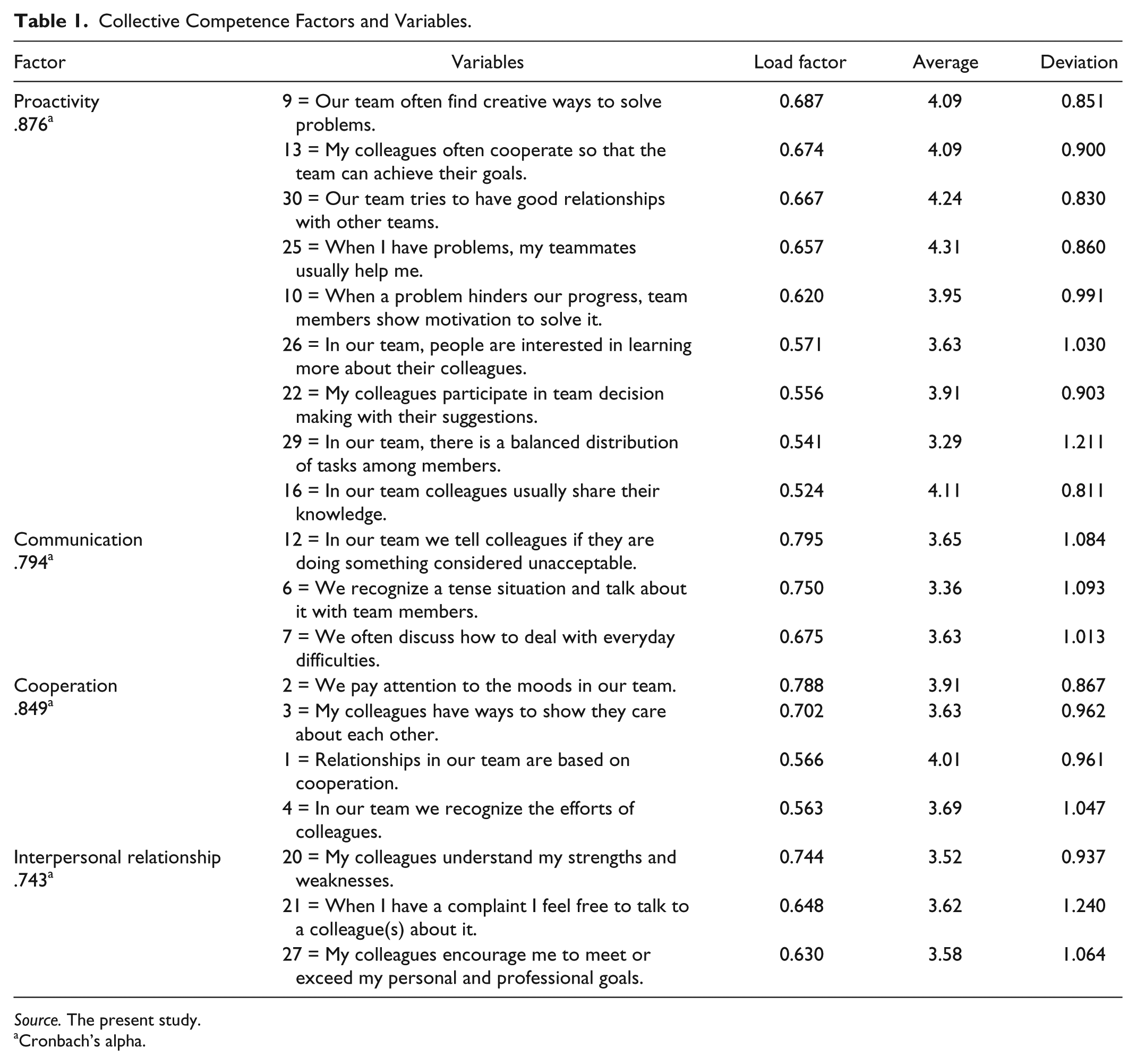
The result of the factor analysis was 19 variables divided into four factors, with a Kaiser–Meyer–Olkin (KMO) index of adequacy of 0.912 and a Bartlett’s sphericity test of 0.000, indicating the factorability of the data (Malhotra, 2001). The factors identified, as well as factor loadings, averages, and standard deviations of each variable are presented below (Table 1).
Collective Competence Factors and Variables.
Source. The present study.
Cronbach’s alpha.
The total variance explained by the four factors is 64.23%. This result is satisfactory, as the total variance percentage found is higher than the acceptable limit of 60% suggested by the literature (Hair, Anderson, Tatham, & Black, 2005).
The results of the correlation with the factor demonstrate that “the team finds creative ways to solve problems” and “co-workers cooperate so the team achieve their goals” are the two variables most associated with Proactivity. This may be related to the fact that in IT teams, specialized knowledge is distributed among its members. Consequently, the teams need to help each other up constantly, given the complexity and interconnectedness of the tasks carried out by different teams.
In the Communication factor, the variable “We inform colleagues when they do something unacceptable” stood out, as it showed greater weight (factor loadings) among the analyzed variables. This indicates that teams may not be able to negotiate conflicts when they occur, but refuse to repress or stifle them. Being able to communicate does not eliminate tensions and conflicts, but promotes the ability to handle them and consider their occurrence normal (Le Boterf, 2003).
In the Cooperation factor, the main variables were “We pay attention to the moods in the workplace” and “My colleagues care about each other.” They indicate that if team members feel comfortable in the group they will be happy to work together. Zarifian (2001) sustains that cooperation is a mutual understanding of the cohesion on the nature of issues to be addressed, of the knowledge to be developed, of the constructed identity, of the meaning given to actions, and of the convergence of such actions.
Finally, the Interpersonal Relationship factor highlights the variable “My colleagues understand my strengths and weaknesses.” Through multiple transactions, several contents are exchanged in the working groups. Thus, the members of these informal groups influence the attitudes, thoughts, as well as the way to reason, to interpret the reality, and to act.
The four factors obtained through factor analysis enabled the comparison of their results with those of other studies on Collective Competence. The factors identified are similar to the three elements presented by Le Boterf (2003). This author states that a collective competence can be recognized by the following elements: to know how to develop shared representations, to know how to communicate, and to know how to cooperate. They are very similar to the four fundamental constituents of the collective competence proposed by Retour and Krohmer (2011), namely, common reference, shared language, collective memory, and subjective commitment. Thus, considering the context limitations (IT professionals of a large shoe company), the empirical results of this study provide a practical tool for evaluating collective competences insofar as they corroborate theoretical studies of prominent authors.
The Influence of Factors in the General Assessment of Collective Competences
To analyze the influence of each factor on the general assessment of the collective competences of the IT team, the authors used the variable “Usually our team can make use of the competences of each member to achieve team goals” (V 31). This variable encompass all relevant aspects of collective competences, and through them, IT professionals perform their activities collaboratively and assertively (see Figure 3).

Model for regression analysis.
To perform such analysis the researchers used the linear regression technique, which enables the identification of the relative weight of each dimension in determining the general perception of respondents. For the linear regression analysis, variables were considered significant when p < .05 (probability of error of 5%). The authors used the stepwise model, which takes as input criterion of the variables in the model their significance level (Malhotra, 2001).
Therefore, the four factors identified (Proactivity, Communication, Cooperation, and Interpersonal Relationship) were treated as independent variables, and the variable “Usually our team can make use of the competences of each member to achieve team goals” was considered as a dependent variable (see Table 2).
Linear Regression.

Source. The present study.
Note. The beta is the relative weight of each variable and determines the order of their importance in the factor. The R2 value indicates the degree of explanation of the set of variables in relation to the dependent variable, which means that “proactivity” explains 45.4% of the general perception regarding collective competence; when the effects of multicollinearity were removed (R2 adjusted), proactivity explains 45.0% of the collective competence.
This result revealed that Proactivity is the most significant element in the development of an IT collective competence. Other factors were not included in the model due to their low level of significance. The standardized beta coefficient of .674 indicates that when the Proactivity increases by one unit, collective competence (dependent variable) increases .674 units.
In fact, IT teams are constantly working with technical information and normally use logic to solve their problems. Thus, motivation, initiative, and creativity are crucial elements to keep the teams together, so projects are more likely to be concluded successfully and on schedule.
The fact that other factors were not included in the model demonstrates that IT professionals tend to work individually and find it difficult to communicate. According to Iannini (2010), “the introvert stance of many IT professionals makes it difficult for them to speak in public and to control anxiety when talking to customers; it is very clear the objectivity with which they deal with facts” (p. 19). Therefore, their aptitude for Communication, Cooperation, and Interpersonal Relationship are reduced.
In qualitative phase, we seek to deepen the results from the survey by a triangulation process. Cooperation, systemic vision, and interpersonal relationships were cited as the main characteristics of the collective competence for IT teams. Compared with the factorial analysis we see that, except for the systemic view, cooperation and interpersonal relationships were also founded in the quantitative survey.
The new element, systemic view is described as the “ability to analyze all the impacts and what is the best choice for the company. At the same time, action to results predisposition enables qualified outputs, which will add value as quickly as possible to a very dynamic business” (Interviewed 4). This perception can be explained through the complexity of the collective competence concept, in other words, to the group’s ability to give meaning to individual actions and a socialization process, which involves individual and collective learning, to achieve qualified outputs.
In addition to these features, the analysis of the interviews allows us to identify the main respondents’ experiences when mobilizing a collective competence are strongly related to (a) opportunity to participate with other teams; (b) importance of sharing knowledge; (c) proactive team members development; (d) collaborative work and commitment among IT teams; (e) alignment with all business analysts, even outside of IT teams; (f) feedback framework after collaborative events; and (g) agility in understanding and solving IT issues. These findings are supported by the literature (Chou et al., 2013; Le Boterf, 2003; Zarifian, 2001; Zibell, 2007) through the emphasis on the main elements for a collective competence building.
Final Considerations
Several companies use management practices to plan, seize, develop, and evaluate, at different levels of the organization, the necessary competences to achieve their goals. This study presented a conceptual review of collective competences to establish a theoretical framework for the creation of an instrument for their evaluation.
To identify which collective competences stand out in IT teams of large companies, we developed a research instrument that focused on the characteristics of such teams, already dealt with in the literature. The creation of such instrument relied on the theoretical framework and in data obtained from the First Research on the Profile of Information Technology Professionals (Iannini, 2010). Other research instruments found in the literature review were used as background information for the creation of a specific research instrument for assessing the collective competence of IT teams in large companies.
The analysis of the collected data identified four explanatory factors—Proactivity, Communication, Cooperation, and Interpersonal Relationship—of the collective competence of the IT teams studied. Among these, the Proactive factor explains most of the perceptions of the teams about collective competence.
The identification of these four factors allowed their comparison with other studies. Le Boterf (2003) defends that the existence of collective competence depends on knowing how to develop shared representations, to communicate, and to cooperate. Three factors were identified in this study, namely, Proactivity, Communication, and Cooperation. Regarding the Interpersonal Relationship factor, Le Boterf (2003) considers it along with “to know how to communicate,” and unfolding it as a common social knowledge.
It is important to highlight Interpersonal Relationships in IT teams, because this element emerged as one of the explanatory factors. A work team is a group of people who understand their goals and are committed to achieve them as a group. Co-workers need to know each other strengths and weaknesses to be able to recognize facts, diagnose needs, and plan actions.
Even considering the context variables and the limited generalizability (due to the research subject), this instrument could be a starting point for studies on collective competences of other professional groups in small and medium businesses.
The factors identified in this study may change if the research instrument is applied in other contexts. For this reason, the authors carefully highlighted the variables that were excluded and the stages of the analysis. The result of the mediation of competences is directly related to how the IT team interact; in other words, with the individual competences of the team members and their work context.
To overcome the limits of the present article, we encourage additional research within other professional teams, as well as within different organizational contexts. Furthermore, valuable contributions could emerge from analyzing some elements appeared in the qualitative phase, especially the systemic view close related to the collective competence according to a social perspective. Structural equation modeling (SEM) could be used to test these new elements to find out complex relationships between them and the four factors founded and the collective competence as a dependent variable. Finally, this analysis could support the understanding of knowledge and relational barriers that affect groups in developing collective competences.
The main challenges for the studies in this field are the contextual dependence of the competence evaluation. Furthermore, the collective competence cannot be achieved by simply adding partial competences, without an overview of their mutual relations. The notion of collective competence rests on the idea that the interaction of individual competences is greater than their sum into the organizations, also contributing to the location of the emphasis on the possibility of combinations. The search for the complementarity of competences, the efficiency on events, and the learning process through which collective competence is developed can reveal a lack of promptness of groups to work collaboratively.
In sum, this work contributes theoretically and practically in many ways. First, the construction of an assessment instrument of collective competences for IT teams, according to the social approach. Second, the identification of four key factors for the development of collective skills—proactivity, communication, collaboration, and interpersonal relationship—can help both human resource (HR) policy makers and social science researchers. Finally, this study might serve as a basis for other studies, as it will provide an empirical contribution on the analysis and evaluation of key collective competences for IT teams.
Footnotes
Acknowledgements
The authors would like to express their gratitude to the support of the National Council for Scientific and Technological Development (CNPq) and the Coordination for the Improvement of Higher Education Personnel (Capes).
Declaration of Conflicting Interests
The author(s) declared no potential conflicts of interest with respect to the research, authorship, and/or publication of this article.
Funding
The author(s) disclosed receipt of the following financial support for the research, authorship, and/or publication of this article: The author(s) received financial support from their respective affiliations.