




Abstract
Despite the consensus on the paramount importance of translation technology competence, its exact definition and constructs remain vague and inconsistent. Moreover, translation educators’ dual identity both as a translator and an educator received insufficient attention. Therefore, drawing on the previous models of translation competence, we identified and defined the constructs of translator educators’ technology competence, and proposed a three-dimensional gear-driven model, placing the Metacognition dimension as the driving gear, the Knowledge dimension and the Application dimension as the driven gears, each of which was further subdivided into three sub-dimensions. Based on the model, a survey was conducted to investigate the effectiveness of the training programs in empowering translation educators with technology competence, and offer some insights for future pedagogical approaches to translation educator training. This study finds that translation educators need to possess competencies in three dimensions of Translation Technology Competence (TTC)—application, knowledge, and metacognition—in the age of technology and information. However, the training programs for translation educators in China primarily focus on the application dimension, neglecting the knowledge and metacognition dimensions, which results in insufficient teaching effectiveness. The survey indicates that while there is moderate satisfaction with the application dimension, there is a notable lack of emphasis on knowledge and metacognition, failing to adequately meet the market demand for translation professionals.
Keywords
Introduction
The global shift toward information and technology-driven economies had a huge impact on the translation industry. With the introduction of translation technologies, the profession of translation underwent dramatic change, which requires the development and use of a number of ICT (Information and Communications Technology) and online communication skills (Marczak, 2018). As a result, the technological advances raised a growing demand for integrating translation technology into translation teaching, considering technology competence (hereinafter referred to as TC) as a vital component within the framework of translator education (Bolaños-García-Escribano et al., 2021; European Master’s in Translation (EMT) Expert Group, 2017; Massey & Ehrensberger-Dow, 2017; Orozco & Hurtado Albir, 2002; Piotrowska & Tyupa, 2014; Pym, 2013; TAC, 2017). In such a new context, translators, professional or nonprofessional, are expected not only to be competent in translation knowledge in the traditional sense but also well-trained in translation technologies. Accordingly, translation education needs to adapt to the new requirements in an age of technology-and-information empowerment. Some innovative studies have been conducted on translation technology competence from both theoretical and pedagogical approaches (PACTE Group, 2003; Pinto & Sales, 2008; H. Wang & Li, 2019; Yue et al., 2019).
Yet another important issue is under-discussed: the educating of translation educators. Most empirical pedagogical research concentrated on student learner competence and its development, while the work tailored specifically to translator educators’ competences, needs, and development remains scarce. As Zhang and Nunes Vieira (2021) pointed out, research with a European focus on the implementation of computer-aided translation teaching still predominates, but practices in other regions, especially Asia, Africa, and South America, are examined and debated less often. With this in mind, we locate our study in China as a typical context to investigate its current state of translation educators’ technology competence development and the effectiveness of translation educator training programs.
The overall picture of Chinese translation educators’ technology competence development is not so optimistic, with a great many translation teachers under-trained either in translation technologies and other related information skills or pedagogy. It echoes the research findings of the 2018 EMT (the European Master’s in Translation), revealing that a relatively low proportion of universities required their teaching staff to attend mandatory professional development courses, and allocated a limited number of hours per year to continuing professional development (Massey et al., 2019). The case is similar in China. According to the latest survey by TAC (2022, p. 23), the number of universities with MTI (Master of Translation and Interpreting) programs amounted to 316 and those with BTI (Bachelor of Translation and Interpreting) programs to 301. However, many universities (44.2%) with MTI programs have not offered translation technology courses yet due to the lack of teachers of translation technology, of whom 36.16% have no prior experience of translation technology practices at all, and only 23.66% are proficient in translation technology (H. Wang et al., 2018). Therefore, the biggest challenge for translation technology education is the lack of teachers specializing in translation technology.
To be better qualified as translation teachers in the age of technology empowerment, these translation educators surely need to receive in-service education. Questions like how translation educators should be further educated and what technological competences need to be developed are still open for discussion. Therefore, our research located the study in the scope of Chinese translation educator training to identify and define the required technology competence within a broader conceptual map.
Translation Competence Models and Technology Competence Constructs
The radically changing scenario of the translation industry accompanied with the growing use of new information and communication technologies led to a great deal of research to identify and define the translation competence expected to be acquired by translator trainees and practitioners (EMT, 2009; Hurtado Albir, 2007; Kelly, 2005; Kiraly, 2000; PACTE Group, 2003; Pym, 2003). To map out the knowledge framework of translation technology and explore the technological competence system for translators are the significant issues to be researched and clarified by the scholarly community of translation studies (S. Wang & Qin, 2018).
Translation Competence Models and Subcategorization
Much effort to subdivide translation competence into sub-competences was made to define the basic features of the competence by proposing various multi-componential models. With more importance attached to the role of social-cultural, technological and metacognitive factors, “some more graphically presented translation competence models emerged, with clearer definitions of competence components and explanations on the relationship among different components” (Yang & Li, 2021). Some widely accepted models are presented below to clarify some important concepts and draw up the profile of translation competence research (Figure 1).

Different models of translation competence: (a) PACTE model, (b) EMT model 2009, (c) EMT model 2017, (d) translation task-based approach, and (e) TransComp’s TTC model.
We can find three major trends in formulating conceptual models of translation competence.
- Technology-oriented. All the above-listed models took the impacts of ICT technologies into account when identifying the defining features of translation competence, like “instrumental sub-competences” in PACTE’s model (2003) and Hurtado Albir’s model (2007), “technological,”“info-mining” or “technology” in EMT model (2009, 2017), and “Tools and research competence” in Göpferich (2009). Though it was not specified in his minimalist approach, Pym also agreed that “the profession requires such movements to and from intercultural and technical communities,”“such as the proficient users of traditional tools and new technologies for professional interlingual communication purposes” (Kiraly, 2000, p. 13, quoted in Pym, 2003, p. 491).
- Profession-oriented. Instead of being taken as a pure learning activity in the educational context, translation competence development should be a kind of “situated action” characterizing “the everyday world of the translator’s professional activities” (Kiraly, 2012, quoted in Yıldız, 2020, p. 1006). This trend can be identified in the “Knowledge about Translation sub-competence” of PACTE’s model (2003), “translation Service Provision” or “Service Provision” of the EMT model (2009, 2017), and “occupational” of Hurtado Albir’s Model (2007), echoed by Pym (2003) as quoted above.
- Metacognition-oriented. A major change taking place in the second period is the growing interest in the role of metacognition in the translation process. Alves and Gonçalves (2007) spoke highly of the role of meta-cognition since “expert translators will draw more heavily on metacognitive processing, thus making more conscious decisions and qualitatively increasing the management of the cognitive resources available in the process of translation” (2007, p. 48, quoted in Yang & Li, 2021, p. 117). This trend can also be spotted in each model above, corresponding with “Strategic” in PACTE’s model (2003) and Göpferichs’ model (2009), “Thematic” or “Translation” in the EMT model (2009, 2017); “Methodological and Strategic” in Hurtado Albir’s model (2007), and “a process of generation and selection, a problem-solving process” in Pym’s depiction (Pym, 2003, p. 489).
Constructs of Technology Competence
Despite the consensus on the paramount importance of TC, the academic circle has not agreed to a commonly accepted definition of Translation Technology Competence (hereinafter referred to as TTC), and its exact definition and constructs remain vague and inconsistent. By studying these translation competence models, we can find one widely shared defining feature of translation competence is the technology element, though there was an abundance of divergent definitions with different interpretations.
The most widely adopted concept relevant to TTC is “instrumental competence/sub-competence” (Alves & Gonçalves, 2007; Campbell, 1998; González & Wagenaar, 2003; Hurtado Albir, 2007; Kelly, 2002; PACTE Group, 2003; Pym, 2003), defined as “predominantly procedural knowledge related to the use of documentation resources and information and communication technologies applied to translation” (PACTE Group, 2003, p. 59); “analysis and synthesis, information management, organization and planning, decision-making, problem-solving, IT skills” (González & Wagenaar, 2003, p. 70); or “to handle documentary sources and an array of tools to solve translation problems” (Hurtado Albir, 2007, p. 177). In the EMT model (2009), “technological competence” seemed to be more closely linked to the technology application, but actually some components or micro-skills covered by this term overlapped those illustrated in “info-mining competence” and “thematic competence” in this model as they all stressed the importance of information processing, and strategies for dealing with data, documents and terminology. These concepts were later incorporated into “technology competence” in the EMT model (2007), indicating that it is a challenging job to distinguish the micro-skills and components intertwined in the translation process.
Upon closer examination, we can attribute the disagreement on defining TTC to the divergences on two levels: micro-level and macro-level. The micro-level disputes generally involve what sub-competences shall be categorized as the constructs of technology competence while the macro-level mainly deals with how to define and locate TTC within the framework of translator competence instead of translation competence. If we treat TTC merely as procedural knowledge or a set of technology-related skills to perform translation tasks, then it shall be defined within the framework of translation competence. However, if TTC is viewed as a competence entailing more than acquiring knowledge and ICT skills to complete translation tasks, it shall be discussed in a broader context, in which translators’ metacognitive strategies and their interaction with the intercultural and technical communities to meet the demands of profession and society shall all be considered for building a TTC model. Hence, putting TTC within the framework of translator competence may better fit in the rapidly changing scenario of translation education.
Hence, though studies on translation competence developed considerably, the issue concerning TC is under-researched. It is worth the effort urgently to clarify some confusion about TC and present a framework for it.
TTC Reference Framework for Translation Educators
Based on the discussions, we define and specify the constructs of TTC by locating the concept in a broader paradigm, fully aware of the importance of translators’ professional identity and their autonomy in knowledge acquisition, decision-making and problem-solving during the translation process.
MAK Model—A Three-Dimensional Conceptual Model for TTC
Drawing on the insights from PACTE’s model (2003), EMT model (2017) and Hurtado Albir’s model (2007), we proposed a three-dimensional conceptual model—MAK Model to address the important constructs of TTC, as shown in Figure 2.

MAK model.
We hold that the reference framework for TTC analysis shall include three major dimensions: Metacognition, Knowledge, and Application. It is a three-dimensional gear-driven model, placing Metacognition dimension as the driving gear, and Knowledge dimension and Application dimension as the driven gears.
The Metacognition dimension is considered as the driving gear, focusing on know why. This is in line with the standpoints of Alves and Gonçalves (2007), who regarded metacognition as a higher translation competence in making conscious decisions and managing the cognitive resources. The MAK model highlights the pivotal role of translators’ conscious metacognition in driving and orienting the technology-related activities in two other dimensions (such as knowledge acquisition & technology application) to fulfill translation tasks. It includes three sub-competences:
- Attitudinal sub-competence: comprising aspects such as motivation, perceptions, intellectual curiosity, critical spirit, self-esteem, confidence in the ability to use translation technologies;
- Strategic sub-competence: comprising aspects such as planning, regulating, decision-making, identifying, and solving translation problems by employing ICT tools, skills and strategies appropriately.
- Reflective sub-competence: comprising aspects such as monitoring, examining, evaluating, and reflecting the translation process involving translation technology application and implementation.
The Knowledge dimension is one of the driven gears, working under the driving force of Metacognition. This dimension concerns about know what: all the knowledge required about understanding, managing, and applying translation technologies for performing translation tasks. It includes three sub-competences:
- Declarative knowledge sub-competence: comprising aspects acquiring and understanding some concepts, theories, ideas, facts, and principles related to translation technologies.
- Procedural knowledge sub-competence: comprising aspects knowing how to use specific ICT tools, or the steps to execute a computer-assisted translation action correctly.
- Professional sub-competence: comprising aspects such as using technologies for professional interlingual communication purposes, knowing and following professional codes and requirements for translation technology application.
In some literature, procedural knowledge is defined as know how opposed to declarative knowledge as know what due to its dynamic and performative nature. However, our MAK model places it under Knowledge dimension as a sub-competence of know what against the Application dimension as know how based on the assumption that a thorough knowledge and proficient use of a CAT tool does not guarantee that the translator can implement translation technologies appropriately and effectively.
The Application dimension is the other driven gear, also impacted and regulated by the driving force of Metacognition. This dimension centers around operational competence—know how, the ability to apply and integrate ICT skills into translation practices appropriately. It includes three sub-competences:
- Instrumental sub-competence: comprising aspects of employing and applying ICTs and CAT skills to translation;
- Informational sub-competence: comprising aspects of information searching, archiving, organizing, processing, retrieving, and evaluating;
- Managerial sub-competence: comprising aspects of organizational and managing abilities and skills in solving translation-technology-related problems.
TTC Model for Translation Educators
As Yang and Li (2021) pointed out, “translation teaching would require a detailed description of what translation competence entails and that sub-components in such a model can serve as a content base in translation curriculum design (2021, p. 110).” When it comes to translation educator training, we agree with Yang and Li (2021) that the translation training of translation educators shall be based on a pedagogically motivated model. Then it is imperative to answer the question: What are the differences between a TTC model for a translator and that for a translation educator?
To this end, we would draw on some important notions in The UNECO ICT Competency Framework for Teachers (2018, hereinafter referred to ICT CFT), which provided a comprehensive set of competencies teachers need to integrate ICT into their professional practice to facilitate students’ achievement of curricular objectives as shown in Figure 3.

The UNESCO ICT Competency Framework for Teachers (2018, p. 10).
The ICT CFT identified 18 competencies organized according to the six aspects of teachers’ professional practice over three levels. The conviction is that teachers with competencies to use ICT in their professional practice will deliver quality education and ultimately be able to effectively facilitate students’ ICT competency development.
It is interesting to note that there is reasonable concordance between MAK model and ICT CFT model, both of which included competences pertaining to metacognition, knowledge and application into the framework, and recognized the importance of profession-related competences. In light of the ICT CFT model, we revised and developed MAK model into a dual-function framework, both as a conceptual framework, and a pedagogical framework for TC development and training of translation educators (see Figure 4).
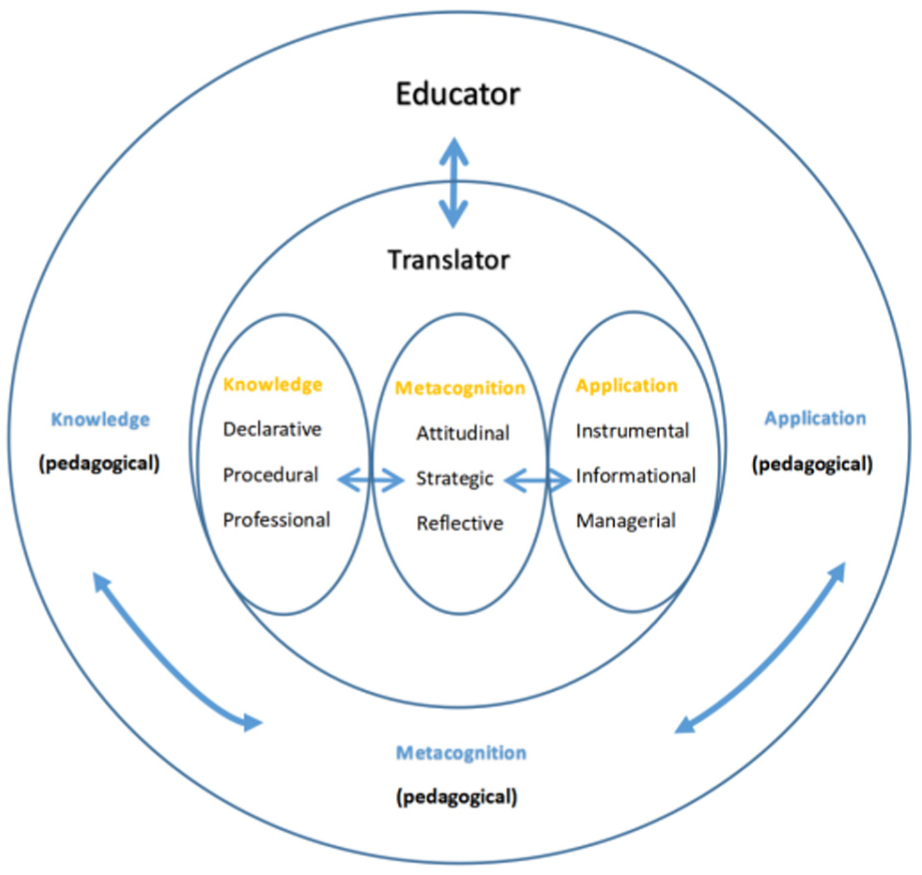
TTC model for translation educators.
The model was formulated with the belief that translation educators play a dual role—translator and educator. Translation educators specifically refer to those who teach translation-related courses (especially translation technology courses) in schools, institutions, colleges, and universities. So all the sub-competences expected to be acquired by a translator shall also be the ones for a translation educator, among which metacognition still takes the core position. However, a good translator would not necessarily be a good teacher since being a teacher raises more demand for competence development. As for translation educators, especially those teaching CAT courses, their TTC framework entails more pedagogical components, which can be identified in each major dimension:
- on Metacognition, comprising the aspects such as motivations, perceptions, self-esteem, and confidence in teaching translation by applying ICT tools and skills; monitoring, planning, organizing, decision-making and solving problems in CAT courses (both in and out of class) with appropriate pedagogical strategies; reflecting and evaluating the efficacy of both teaching and learning in CAT courses;
- on Knowledge, comprising the aspects such as concepts, theories, principles, facts and procedures of teaching translation courses supported by ICT;
- on Application, comprising the aspects such as knowing how to use various pedagogical measures or means (including some ICTs) to facilitate CAT teaching and learning.
In comparing the MAK model and TTC model, it is obvious that the two models are to a large extent very similar and identify a common body of dimensions and sub-dimensions. But they are shaped based on different underpinnings and serve different purposes. The former sheds some light on depicting the defining features of TTC and looks into the constituents on a fine-grained scale. Whereas the latter serves a dual function, both as a conceptual framework and a pedagogical framework, echoing the standpoint of underscoring the dual identity of translation educators.
Methodology
Research Questions
The paper addresses three main questions: (1) What kinds of TTC are expected to be acquired by translation educators in the age of technology-and-information empowerment? (2) What kinds of TTC have been covered in the training programs for translation educators in China? (3) How effectively do these programs empower the trainees with TTC?
Research Methods
This study adopted a mixed-method approach, combining corpus analysis and a questionnaire survey. The following sections describe the data collection and analysis procedures in detail.
Corpus Analysis
We collected data from two primary sources: the syllabuses, curricula, and relevant information about translation technology training (hereafter referred to as TTT) workshops and programs designed for translation educators. These materials were sourced from the official websites and social media platforms of key institutions responsible for conducting systematic TTT in China. The two institutions selected for this study are: The Translators Association of China (TAC), offering a series of systematic TTT programs since 2012, and The World Interpreter and Translator Training Association Translation Technology Education Society (WITTA TTES). WITTA TTES is an organization attached to the international interpreter and translator training association that also conducts systematic TTT programs. We collected syllabi, course modules, and other relevant program details from these sources to build a small corpus comprising 39 training programs (21 from TAC and 18 from WITTA TTES and other sources) conducted since 2012. This corpus was analyzed using the following tools and techniques.
(1) Word clouds: To visualize the most frequently occurring terms in the collected data, enabling us to identify key themes and concepts related to translation technology competence (TTC).
(2) Word frequency analysis: This method allowed us to quantify the occurrence of specific terms, such as technological tools and skills, to determine the emphasis placed on various competencies in the training programs.
(3) Topic modeling: We employed topic modeling to uncover latent themes and structures within the corpus, helping us understand whether the TTC covered in the programs aligns with the expected competencies for translation educators in the age of technological empowerment.
Questionnaire Survey
In addition to corpus analysis, we conducted an online questionnaire survey to gather insights directly from translation educators who had received TTT. The survey was designed to assess both the current state and the effectiveness of TTT programs in empowering the trainees with TTC. The questionnaire was distributed via www.wjx.cn, the most popular online survey platform in China, and targeted translation educators who had either undergone TTT in recent years or were actively teaching translation technology courses. The study poses minimal risk, while its findings are expected to benefit both the participants and the broader community of translation education. All data were collected anonymously, with no personal or sensitive information involved. At the beginning of the survey, participants were presented with an informed consent statement outlining the study’s objectives, methodology, data usage, and their rights. Only those who provided consent were allowed to proceed, ensuring informed and voluntary participation. All researchers adhered to the ethical principles of the Declaration of Helsinki. The study was approved by the Hubei University Humanities and Social Sciences Ethics Committee, Wuhan, China (Approval file number: HUBU-HSSEC-2025002). The questionnaire consisted of multiple sections:
(1) Demographics: Collecting information about the participants’ teaching experience, the institutions they are affiliated with, and the number of TTT programs they had attended.
(2) Perceived Effectiveness: Gauging participants’ views on how well the TTT programs equipped them with TTC, focusing on specific areas such as technical skills, pedagogical strategies, and familiarity with translation tools.
(3) Challenges and Suggestions: Open-ended questions allowing participants to highlight challenges they encountered during the TTT and to suggest improvements for future programs.
A total of 71 valid responses were collected from participants, and the data was analyzed using descriptive statistics to determine the overall trends, alongside qualitative analysis of the open-ended responses to capture more nuanced perspectives on the effectiveness of the TTT programs.
MTI Program Data Collection
Additionally, we gathered data on the translation technology courses offered to BTI (Bachelor of Translation and Interpreting) and MTI (Master of Translation and Interpreting) students at five Chinese universities. These institutions were selected because they are key universities in China, two specializing in foreign languages and three being comprehensive universities. The collected data included information about modules, schedule, credits, and other details that shed light on how translation technology education is integrated into MTI curricula. By employing this combination of methods, we aimed to assess the alignment between the competencies expected from translation educators in the era of technology and information empowerment and those offered in TTT programs in China. Additionally, the survey helped us evaluate the practical effectiveness of these programs in preparing translation educators to integrate technology into their teaching practices.
The Status Quo of TC Training of Translation Educators in China
TAC and WITTA TTES Training Programs
We have collected materials from 39 TTT workshops and programs (available upon request).
Our materials show that most of the workshops and training programs covered the Application dimension, which mainly involves the technological aspect, aiming to train the translation educators in their application of various technological tools. Among the 39 ones, only two of them did not cover that aspect. Both were annual conferences of WITTA TTES. The two focused more on theoretical discussions than practical application. Different from the Application dimension, which is about operational skills, the Knowledge dimension is about the theoretical knowledge of the technological tools, and that of the language industry. Among the 39 ones, 28 involved this component, accounting for 71.79%. The Metacognition dimension, which mainly involves the cognitive aspect, including attitudinal, strategic and reflective cognition of translation technologies, was not included in most of them. Among the 39 ones, only two were concerned with it, accounting for 5.23%. It is interesting to note that the two happened to be the ones without the Application component, that is, the two annual conferences of WITTA TTES. That is, except for the two conferences, the other 37 did not cover this component.
To further examine what components of TC were covered, we conducted a corpus analysis, including term frequency and LDA topic modeling. The following screenshot is a word cloud visualization of term frequency (Figure 5).

Word cloud of TTT programs.
In a word cloud graph, the bigger the word, the higher the frequency. As the graph shows, translation (翻译), translation technology (翻译技术), computer-aided translation (计算机辅助翻译), technology (技术), teaching (教学), localization (本地化), SDL Trados, and application (实践), are among the words with bigger size, meaning that they represent the focus of the workshops, and training programs. We made a list of the top 50 words (available upon request).
Among the top 50, the term translation (翻译) ranks first, with a frequency of 526, compared to technology (技术) with a frequency of 247. Since the workshop and training programs were about translation technology, it stands to reason that the two words rank first and second. Following them are localization (本地化), project management (项目管理), projects (项目) and teaching (教学), with the frequency higher than 100. As the workshops and training programs held between 2012 and 2016 were all about translation and localization projects, no wonder that localization, project management, and projects are among the top five terms. Many other words are related to the Application dimension, namely, the operational skills of technological tools for translation, for example, computer-aided (计算机辅助), application (实践), Trados, CAT, practice (实操), tools (工具), software (软件), search (搜索), corpus (语料库), and practical training (实训). As to the Knowledge and Metacognition dimensions, few words in the top 50 words are concerned with the two. Among those related to the two dimensions, the terms like analysis (分析) and theory (理论) rank among the top 25, and the words like service (服务), procedure (流程), and research (研究) rank among the top 50.
To examine what topics were covered, we did a further analysis using an LDA (Latent Dirichlet Allocation) topic modeling (results available upon request).
Our results show that five topics are detected. For each topic, the top 20 terms are presented. Many of the topic words are concerned with the Application dimension, for example, localization (本地化), demonstration (演练), software (软件), and computer-aided (计算机辅助) in topic 3, search engine (引擎), collaboration (协同), technology (技术), and management (管理) in topic 4, and most words in topic 5. Since there is a workshop on the application of translation technology to book translation held in 2021, no wonder that the words of topic 5 are mostly about the operational skills of technologies necessary for book translation, for example, documents (文档), hide (隐藏), controlling (控制), and splitting (拆分) are about how to split a whole book into chapters in a Word file. In topics 1 and 2, although some words are also related to the Application dimension, for example, post-editing (译后), memory (记忆) and collecting (收集), quite a few others are related to the Knowledge and Metacognition dimensions, for example, frameworks (框架), theoretical courses (理论课), trend (发展趋势), overview (概览), feedback (反馈), and empowerment (赋能). Yet, compared to those concerned with the Application dimension, the words concerned with the Knowledge and Metacognition dimensions are less salient, revealing that the two dimensions were paid less attention than was the Application dimension.
The above discussion shows that the Application dimension was the focus, attracting more attention than the Knowledge and Metacognition dimensions. This answered our second research question. That is, the Application dimension was mainly covered or highlighted, while the Knowledge and Metacognition dimensions were in general inconspicuous. Only very limited training programs touched upon the two, like the two annual conferences of WITTA TTES.
Survey of Technology Competence Training of Translation Educators
Subjects
Our survey targeted teachers involved in translation technology courses or research in Chinese universities. From the 249 universities offering MTI programs in China as identified by H. Wang et al. (2018, pp. 76–77), we first compiled a list of those that provide specific translation courses. Out of these, we employed a stratified sampling method to ensure balanced representation across various academic titles and experiences. We divided the universities into categories based on their geographic regions, academic rankings, and the extent of their technology offerings. This categorization helped us select participants who reflect a diverse range of perspectives within the field. We targeted a minimum of 62 valid responses to ensure our sample exceeded half the number of universities offering translation technology courses. Ultimately, we successfully obtained 71 valid responses, surpassing our initial goal. To mitigate potential biases, we employed both online surveys and direct outreach to maximize participation. We also considered factors such as the teachers’ years of experience and academic positions to capture a comprehensive view of educators’ insights regarding translation technology. This multi-faceted approach allowed us to achieve a representative sample, reflecting the general situation of Chinese translation educators’ engagement with translation technology training.
Results
Our questionnaire comprises of 26 items designed in accordance with our MAK model and the three research questions. The questions cover information pertaining to profiles of respondents, their training experiences of translation technologies, their knowledge, and use of translation technologies, their feedback on TTT, their understanding of TTC and other relevant topics.
As Table 1 shows, the survey shows good reliability and validity, with the Cronbach α test result higher than .7, KMO test result higher than .7, and Sig. of Bartlett’s test result .000, showing that the research scales are respectable (DeVellis, 2017, p. 136).
Reliability Test of the Survey.

Table 2 summarizes some basic information about the respondents.
Basic Information of the Respondents.

In terms of academic title, the majority of the respondents are lecturers (45.07%) or assistant professors (35.21%). Among all the respondents, more than half (53.52%) have not taught any translation technology courses, and an even greater percentage of them (64.79%) did not attend any translation technology courses when they were university students. Of those who have learned translation technology as a university student, most of them replied that they learned it in MA courses (29.58%), compared to 11.27% who learned it in BA courses. Such a fact reveals that translation technology courses are more probably offered in MA courses than in BA courses, and in some way, also indicates that the scarcity of translation technology teachers is common in many universities in China.
To find out our respondents’ experience of using translation technologies and their understanding of TTC, we asked three questions (available upon request).
According to the responses, for the question what translation technologies the respondents used, machine translation, corpus, term bank and desktop Computer Aided Translation (CAT) tools are the top 5 technologies that have ever been applied by the respondents; for the question what CAT tools and platforms the respondents know, SDL Trados, MemoQ, YiCAT and Deja Vu X are the top 4 known to more than half of our respondents, of which YiCAT is a Chinese online CAT tool and the other three are desktop CAT tools. The responses to the two questions reveal that, in general, the respondents do not have a good knowledge of translation technologies, which is probably one of the important reasons why many universities offering MTI programs have not yet provided translation technology courses (see H. Wang et al., 2018, p. 77). For the question what components the respondents think that translation technology competence comprise, among the top 5, four are related to corpus and terms, the other one is related to translation projects, and the bottom three are related to programing, database and text processing. The results show that our respondents are more concerned with the technologies more directly related to translation practice and easier to learn and use in practice, which are covered in the Application dimension.
Table 3 summarizes the results of the question on how often the respondents received TTT.
Respondents’ Training Experience of Translation Technology.

Nearly half of the respondents attended lecturers and seminars less than 3 times after becoming university teachers, compared to even a much higher percentage of them attending TTT in the past 3 years (81.69%). More than half of them (64.79%) received less than 3 times of TTT. Only a very small percentage of the respondents received TTT 10 times or more, with 1.41% in the past 3 years and 8.45% since they have become university teachers.
The survey shows that translation technology teachers in China generally received insufficient TTT. Given that more than half of the respondents are assistant professors, the majority of the respondents only attended TTT (lasting more than half a day) about every 3 years, which is far from enough in a technology-empowering era with rapid change, and development of technologies. With the development of technologies for language service, new requirements are needed to meet the needs of this industry; accordingly, in the talent training for language service, due attention must be paid to the significant changes in language service to meet the needs of the market. In the era of big data, the skills of applying translation technology have become fundamental expertise for practitioners in language service, thus adjustments must be made in the programs and curricula of talent training to meet the market needs (Xu, 2019, p. 163). To this end, universities, an essential role in talent training of language service, need to act actively in line with market demand and take the initiative to explore models of collaborative innovation to develop and improve the TC of teachers and students in universities. (H. Wang, 2017, p. 88).
To find out the effectiveness of the TTT, the respondents’ previous knowledge related to translation technology, their metacognition of TTT, and translation technology courses, we designed 20 questions with five scales, which were transformed into five dimensions of variables (results available upon request).
The results show that the mean scores of the five dimensions of variables are all less than 4. The highest mean score (3.98) among the five is that of Dimension two: Previous knowledge. The relatively high score of this dimension indicates that the respondents believe that they have a somewhat sound knowledge necessary for teaching and applying translation technologies. The dimension with the lowest mean score (3.04) is “Metacognition of TT course.” The low mean score reveals that the respondents did not quite support that translation technology should be offered as a compulsory course. The low score for this dimension can be attributed to people’s traditional views on the quality of machine translation. Before the emergence of Neural Machine Translation, machine translation tools very poor-quality translations. As a result, people attached little important to translation technology. The dimension “Needs of training” also receives a low mean score (3.18), indicating that the respondents did not think that it was important to receive TTT regularly. The dimension “Effectiveness of training” gains a mean score of 3.61, a bit higher than the previous two. Yet, it is still less than 4 which corresponds to “Agree.” This reveals that the respondents did not quite believe that they have improved their TC after attending the training. In other words, they did not agree that the training was quite effective. The dimension “Content of training” gets a mean score of 3.67, also smaller than 4. For this dimension, we went through our respondents’ answers to the related questions, and found out that a majority of the respondents replied “Somewhat agree” or “Don’t agree,” which correspond to “3” and “2” in the five scales, for the questions related to the Metacognition and Knowledge dimensions of our translation educators’ TTC model. That is, many of the respondents did not hold that TTT for translation educators should include the Metacognition and Knowledge dimensions, instead, most of them strongly agreed that the Application dimension should be the focus of the training, empowering them with the skills of using the technological tools necessary to complete translation tasks and projects.
In summary, the survey reveals that the translation technology educators in China are generally not competent enough to offer translation technology courses. They are generally under-trained in translation technologies and were not quite satisfied with the effectiveness of the TTT they attended. This answered the second research question: “How effectively do the training programs empower the trainees with TTC?”
Translation Technology Courses in MTI & BTI Programs
We examined the BTI and MTI programs of a few Chinese universities. Five universities were surveyed, including foreign language and non-foreign language universities. Table 4 summarizes their translation-technology-related courses.
Translation Technology Courses offered in the Five Universities.

Only three of the eleven courses are compulsory, accounting for about 27%. That is, translation technology courses have generally not been stressed.
Although translation technology courses have not been stressed in university curricula, many universities have offered programs of translation technology as optional courses. We surveyed the teaching plan for translation technology courses offered in four universities (available upon request).
Two of the four universities offer the course for 11 weeks, one offers it for 13 weeks, the other for 18 weeks. Given that universities in China generally offer courses for 16 to 18 weeks in a term, courses offered for fewer weeks are normally not core courses. That is, three of the four courses are not regarded as core courses in their universities.
We found that the use of CAT tools and corpus is the focus of the course, for example, the course offered at University B is mainly concerned with the use of CAT tools, so does that of University C. In the course offered by University D, which lasts for 18 weeks, CAT tools and corpus are both included, with a focus on CAT tools, since not only the teaching plan of the first 3 weeks involves CAT tools, but the six case studies later are also about the application of CAT tools in translation projects. In the course offered in University A, apart from the use of CAT tools and corpus, the knowledge related to TC is covered, for example, Week 1 on language service in the new era, Week 2 on Internet information service, and Week 4 on the use of digital reference books.
In general, from the technology courses offered in the four universities, the training of students’ TC mainly focuses on the application of CAT tools, related to the Application dimension of our three-dimensional pedagogical model of TC.
Numerous reasons can justify the insufficient emphasis on translation technology courses. Apart from the lack of attention to translation technology teaching from the deans and laboratory managerial personnel of MTI universities, and even the whole translation education field, the lack of experienced and qualified teachers is an important factor. As many scholars pointed out (Cui et al., 2017; H. Wang et al., 2018), the biggest challenge of translation technology teaching is a severe shortage of translation technology teachers. Besides, inadequate experience in translation technology application is another challenge.
According to the Chinese Assessment Standard of Translation Competence 2022, TTC mainly comprises the skills of four aspects: information retrieval, corpus management, computer-aided translation, and machine translation (China Foreign Languages Publishing Administration, 2022, p. 31). That is, for the translation technology courses offered in universities, not only the CAT tool skills and corpus use should be trained, information retrieval and machine translation should also be included.
Discussions
In our TTC model, we put forward that, as translation educators have a dual identity: translator and educator, they need to possess TTC required for not only translators but also educators. As translators, translation educators need to be endowed with TTC comprising Metacognition, Knowledge and Application dimensions, which encompass three sub-components each as elaborated in section two. To achieve this end, teachers need to possess six aspects of professional practice, of which “pedagogy” ranks third (UNESCO, 2018, p. 8). Likewise, translation teachers need to possess the competencies of using and teaching translation technologies to deliver quality education and guide the development of students’ TTC. Thus, given the two facets of identity, translation educators need to be trained in pedagogy additionally for the three dimensions of our TTC model, to enable them with the TTC required for translators, and empower them to train their students the TTC required to meet the market needs of language service. This answers our first research question. That is, translation educators are expected to possess competencies in not only the dimensions of application and knowledge but also the dimension of metacognition. This aligns with our hypothesis that educators require a comprehensive knowledge base to effectively teach translation technologies.
In answering the second research question, we found that most of the training programs only covered the Application dimension, placing little emphasis on or even ignoring the Knowledge and Metacognition dimensions. Although a few of the training programs in our dataset claimed to be a training program on translation technology teaching, the modules of the training program were in fact focused more on the Application dimension, with little emphasis on the Knowledge and Metacognition dimensions. And the pedagogical aspect scarcely received due attention. Judging from the three dimensions of our TTC model, the TTT programs in our dataset did not fit in with the requirements for developing translation educators’ TTCs.
For the third research question, we found a moderate level of satisfaction with the training. Among the three dimensions of TTC, the majority of the respondents were concerned with the Application dimension, mainly including CAT and corpus tools. As a result of the insufficient understanding of TTC, and even ignoring the Knowledge and Metacognition dimensions, translation technology teaching in universities has not been given due emphasis. While participants expressed moderate satisfaction with the Application dimension, their fragmented understanding and lack of systematic knowledge hindered their teaching effectiveness. This supports our theoretical framework’s core argument that translation educators must achieve a balance across all three TTC dimensions to meet market demands for language services.
With drastic changes in the environments for translation in the big data era, translation technology competence has been indispensable to translators, which leads to the incorporation of translation technology courses in the curriculum system of translation education (H. Wang et al., 2018). In line with the increase in MTI programs, more translation teachers are needed to offer translation technology courses. Yet, the majority of the respondents did not take translation technology courses in university. Thus, most of them lack systematic knowledge of translation technology and are not empowered with TTC required for their professional practice as translation educators. What they know about translation technology is fragmented knowledge self-taught or acquired through some training of a few days long, which may lead to their incompetence in their professional practice as a teacher of translation technology. To deal with the lack of translation educators for TT courses, TTT programs could be a good solution. As H. Wang and Li (2021) pointed out, more emphasis needs to be placed on the training of translation educators on translation technologies. It is not only essential that more TTT programs for translation educators should be provided, but also more emphasis should be placed on the Knowledge and Metacognition dimensions of TTC, rather than mainly focusing on the Application dimension. Therefore, we recommend that future training initiatives emphasize the cultivation of Knowledge and Metacognition dimensions, ensuring that translation educators are well-rounded in their competencies to enhance their educational effectiveness.
Final Remarks
We constructed a model of TTC, the MAK model, based on a systematic review of previous models related to TTC, which comprises three dimensions: Metacognition, Knowledge, and Application. We hold that the three dimensions should be covered in training programs on translation technology. Considering the dual identity of the translation educator both as a translator and educator, the curriculum design of TC training shall combine the professional perspective and pedagogical perspective. Our models are currently only conceptual frameworks, which are open for reviewing and discussion to make them operationalized for empirical studies and a guide for translation technology training. Based on our theoretical framework, future research could further develop the model and elaborate on its sub-components for each dimension, conducting empirical studies based on the refined framework. Our findings indicate that Metacognition and Knowledge are two dimensions that require enhancement in future TC training; thus, subsequent research could focus on developing these components and exploring strategies to improve them in training programs.
Nevertheless, our research has some limitations, particularly the relatively small number of survey respondents, which may not accurately reflect the current status of translation educators’ TTC in China. Future research could address this limitation by including a larger participant pool in the survey. Additionally, the long duration of the training programs presents challenges in directly assessing their effectiveness regarding participant outcomes. Future studies could benefit from incorporating participant surveys or follow-up assessments to gain a clear understanding of the impact that these programs have on learners. Such an approach would offer a more comprehensive view of how well the training addresses the needs of translation educators and supports their professional development.
Footnotes

Funding
The authors disclosed receipt of the following financial support for the research, authorship, and/or publication of this article: This work was supported by Hubei Provincial-Level Teaching Research Project for Institutions of Higher Learning (Grant No. 2022195).
Declaration of Conflicting Interests
The authors declared no potential conflicts of interest with respect to the research, authorship, and/or publication of this article.
Data Availability Statement
Data sharing not applicable to this article as no datasets were generated or analyzed during the current study.