




Abstract
Previous studies have revealed the influence of cultural values on volunteering; however, few have focused on the Confucian value of benevolence. This study examined the relationship between the Confucian value of benevolence and volunteering, as well as the mediating role of volunteer motives. A total of 473 Chinese college students completed questionnaires to assess the Confucian value of benevolence, including familism, unity, and harmony (UH), six functional motives to volunteer and volunteering. The results revealed a positive relationship between UH and volunteering and the mediating role of functional motives; however, there was no significant association between familism and volunteering. Furthermore, a multigroup analysis suggested that the mediation model was similar across genders among college students. Practical implications and limitations are also discussed.
Keywords
Introduction
Volunteerism refers to “freely chosen helping activities that extend over time and that are often performed through organizations and on behalf of receptive causes or individuals” (Snyder & Omoto, 2008, p. 1). The philanthropic activities of volunteers provide benefits not only to other people and society but also to volunteers themselves (Snyder & Omoto, 2008; Wilson, 2012). In particular, volunteering can meet volunteers’ needs, such as career enhancement, learning new skills, building social relationship, escaping from negative feelings, and improving self-esteem (Clary et al., 1998; Smith et al., 2010). Moreover, in the field of education, volunteering plays a vital role in cultivating students’ civic spirit and sense of social responsibility (Goldner & Golan, 2017; Lin, 2015; Rockenbach et al., 2014). Therefore, volunteering participation has gradually become a basic requirement for college students.
However, previous studies have found that students from different countries have varying participation rates in voluntary service (Kang et al., 2011). The initiation and maintenance of college students’ participation in volunteering have become an important issue. The factors that affect participation in volunteerism include not only social factors such as adhering to social regimes but also cultural values (Grönlund et al., 2011; Kang et al., 2011). To date, the majority of research on the relationship between values and volunteering has been conducted in the context of western cultures (Bekkers, 2005; Cohen, 2007; Grönlund, 2011; Kang et al., 2011; Wymer, 1997), but little attention has been paid to Confucian values. Through thousands of years of inheritance, Confucian values constitute the main body of Chinese values (Huang & Charter, 1996), and Confucianism is one of the dominating philosophical backgrounds for most East Asian cultures (Park & Chesla, 2007; Yun & Bell, 2014; Zhang et al., 2005). Zhuang (2010) proposed that the Confucian values of benevolence had a close relationship with the development of volunteering within China today. That is to say, the Confucian value of benevolence may be an important cultural basis for volunteering in China. Investigating the effect of the Confucian value of benevolence on volunteering may thus be more meaningful within the context of Chinese culture. Exploring the relationship between Confucian benevolence as a special cultural value and volunteering would be a beneficial supplement to prior literature on the relationship between values and volunteering and also help to provide guidance to promote the development of volunteering from the perspective of Confucian culture. This study aims to examine the relationship between the Confucian value of benevolence (i.e., familism, unity, and harmony [UH]) and volunteering among college students as well as to explore the role of motives for volunteering in such a relationship.
Literature Review
Values are desirable goals of a person and have a guiding effect on behavior (Rokeach, 1973; Schwartz, 1992, 2012). Schwartz (1992, 2012) developed his value theory and identified 10 basic value types across cultures—including benevolence and universalism. The goal of benevolence is to preserve and enhance the welfare of the in-group, while that of universalism is the welfare of all people. According to Schwartz’s (1992, 2012) value theory, benevolence and universalism are both regarded as self-transcendence values, and they are compatible with each other, which means that the pursuit of one value can also promote the realization of the other.
Previous studies on the relationship between self-transcendence values and helping behavior or helping attitude have seldom distinguished these two values (Briggs et al., 2010; Daniel et al., 2015; Park et al., 2017). For example, Daniel et al. (2015) studied the relationship between values and helping behavior for strangers and found that self-transcendence values (the average of benevolence and universalism) were positively related to helping behavior, without distinguishing between the possible different roles of universalism and benevolence. The only exception was the study carried out by Lönnqvist et al. (2013), in which they proposed that benevolence values did not play a decisive role in altruistic behavior toward strangers as universalism did. As far as volunteering, it is a helping behavior for strangers. It is necessary to distinguish the effects of these two values on volunteering and further verify their results in the context of Chinese culture. Although Schwartz’s value theory is universal across cultures, the values of Chinese people—especially Confucian benevolence—have their unique connotation, which is more suitable for discussion in the context of Chinese culture.
The Confucian value of benevolence and volunteering
Different from Schwartz’s benevolence, as the core of Confucian values (Hwang, 2001), Confucian benevolence (“ren”) refers to “love all men “ (the Analects of Confucius, Yan Yuan). Confucius said, “A youth, when at home, should be filial, and abroad, respectful to his elders. He should overflow in love to all, and cultivate the friendship of the good” (the Analects of Confucius, Xue Er). Confucian benevolence can be divided into two categories: loving family and loving others (Zhuang, 2010). Confucian benevolence emphasizes that filial piety is the first and the root of all benevolence. The emphasis on the centrality and importance of family in one’s heart is often called “familism,” which is a concept that also exists in other regions and cultures, such as among Hispanics and Latinos (Knight et al., 2010; Lugo Steidel & Contreras, 2003; Sabogal et al., 1987). Furthermore, Confucianism advocates that benevolence should be extended from loving one’s relatives to loving others, nature, and all things, to a state of unity of humans and nature (Hwang, 2001; Zhuang, 2010). Han (2013) proposed that harmony within the family, harmony among people, and the unity of the world are the concrete manifestations of Confucian benevolence. That is, in addition to familism value, Confucian benevolence emphasizes the unity of the world and harmonious relationships. In this study, we use UH to represent “loving others” in Confucian benevolence. Therefore, both familism and UH represent the core content of Confucian benevolence. In this study, we focused on these two aspects—familism and UH—to explore the Confucian value of benevolence.
Moreover, on one hand, Confucian benevolence emphasizes the differential order of love (Hwang, 2001), which means when one cannot consider both their family and other people simultaneously, family members would be given priority. In other words, familism and UH may conflict with each other. On the other hand, Confucian benevolence suggests that filial piety is the root of all benevolent behaviors. For example, Mencius regards love for the family as the foundation of the germination, cultivation, and expansion of benevolence (Gan, 2019). If somebody has strength, they should extend their kindness to other people in need and to the state (i.e., loving others) (Hwang, 2001; Zhuang, 2010). Therefore, the goals of familism and UH may also be congruent and may be compatible with each other. Given the different relationships between familism and UH, the relationships among familism, UH, and volunteering may be different.
Thus, it can be seen that Confucian benevolence contains the connotation of Schwartz’s benevolence and universalism, including love for close people and love for all people. The two dimensions of Confucian benevolence, familism, and UH, are similar to Schwartz’s benevolence and universalism; that is, both familism and benevolence point to close people, while UH and universalism point to the whole human being. However, the difference between them is that Schwartz emphasizes the compatible relationship between benevolence and universalism in his theory. In Confucian benevolence, familism and UH may be conflicting or compatible. In view of these differences and cultural adaptability, it is necessary to explore the relationship between Confucian benevolence and volunteering in the context of Chinese culture.
Volunteering helps those who desire assistance but not family members (Snyder & Omoto, 2008). According to Schwartz’s (1992, 2012) values theory (as desirable goals), values are the standards that people use to evaluate actions, events, and policies and have the functions of motivating behaviors that reflect corresponding goals. As mentioned above, as the goal of individuals with high UH is the welfare of all people, we expected that individuals with high UH would have a more positive attitude and higher intention and investment in volunteering. Previous research has suggested that the motivation for harmony enhancement is positively related to helping behavior (Leung et al., 2015). Lönnqvist et al. (2013) also found that universalism values positively predicted prosocial behavior toward strangers. In addition, some studies have addressed the relationship between Confucian values and organizational citizenship behavior (OCB) (Hunsaker, 2016; Wang & Zhang, 2012). Wang and Zhang (2012) found that Confucian values could predict the OCB of Chinese employees. In the case of South Korean employees, it was also found that the Confucian mind-set was positively correlated with OCB (Hunsaker, 2016). Although OCB does not completely equate with volunteering, they have similar characteristics, for example, they both emphasize discretion and deliberate helping behaviors without tangible rewards (Lavelle, 2010). The measure of Confucian values used in these two studies included tolerance, altruism, and maintaining good relations with others. In addition, solidarity was found to promote volunteer activities in sports (Kristiansen et al., 2015; Schlesinger & Nagel, 2018). These studies indicated that UH might be positively related to volunteering.
As the goal of individuals with high familism is the welfare of their family members, these individuals may not have a positive attitude toward volunteering, with low intention and less investment, especially when they could not take care of their family members and others simultaneously. Although the factors such as family beliefs in volunteerism, family support, and model functions of family members as volunteers could all contribute to the participation of individual volunteering (Law & Shek, 2009; Van Goethem et al., 2014), if a person only focuses on caring for their family, they may neglect to care for others (Fukuyama, 1995). Knight et al. (2015) investigated Mexican–American adolescents and found that the value of familism was negatively associated with altruistic behaviors. However, this study also found that familism can positively influence altruistic prosocial behavior through moral reasoning. This indicated that individuals with high familism might also be able to understand and sympathize with others more based on loving their families, and then participate in voluntary service more. In summary, individuals with high familism may participate in volunteering more or less, depending on certain conditions. Furthermore, previous research showed that the familism value had no association with altruistic prosocial behaviors in Mexican–American adolescents (Knight et al., 2018). Lönnqvist et al. (2013) found that benevolence described by Schwartz (1992, 2012) did not predict prosocial behavior toward strangers. It seems that familism, thus, does not necessarily contribute to volunteerism.
Therefore, although both familism and UH are important aspects of Confucian benevolence and care for the welfare of others, their goals are not exactly the same, which may lead to differences in their prediction of volunteering. That is, the relationships between the two manifestations of Confucian benevolence and volunteering may be different. We presumed that UH may have a positive association with volunteering, whereas familism may not necessarily contribute to volunteering.
Volunteer motives as a mediator
The underlying processes through which the Confucian value of benevolence promotes or hinders volunteering need to be explored. Previous studies have shown that volunteer motivation is an important variable affecting volunteering (Aydinli-Karakulak et al., 2016; Haivas et al., 2013). Currently, the research mainly focuses on two theoretical perspectives: the functional approach (Clary et al., 1998; Houle et al., 2005) and self-determination theory (Hardy et al., 2015; Millette & Gagné, 2008). Of these, the concept of functional motivation has been widely used (Chacón et al., 2017). In this study, we focus on the theory of functional motivation.
Building upon functional analysis theory, participating in volunteering could satisfy individuals’ one or more needs or motives. Clary et al. (1998) proposed that volunteering has many functions related to its initiation and maintenance. Subsequently, they developed the Volunteer Functions Inventory (VFI) and identified a set of six functions of volunteering—values (expressing values such as humanitarian concerns for others), understanding (acquiring new learning experiences or skills), social (strengthening social relationship), enhancement (acquiring psychological growth), career (increasing career-related experiences), and protective (escaping from one’s negative feelings)—which are also known as motives or reasons for volunteering. Moreover, Wu et al. (2009) revised the Chinese version and found that the six-factor model fitted the best. Although these motives could be seen as self-directed (specifically the five motives of understanding, social, enhancement, career, and protection) or altruism (the value motive), they are usually combined, rather than mutually exclusive, to motivate volunteering (Aydinli-Karakulak et al., 2016; Grönlund, 2014). Previous studies have shown that motives for volunteering are key factors for the initiation and continuation of volunteer behavior under the Chinese cultural background. For example, Lai et al. (2013) found that volunteers and potential volunteers had higher motivations than those of nonvolunteers in Beijing and Macao samples. In addition, a recent study that used Hong Kong’s volunteer samples found that all six motives positively predicted sustained volunteering through satisfaction (Aydinli-Karakulak et al., 2016).
Conceptually speaking, values are abstract goals and are cross-situational (Schwartz, 1992, 2012), whereas functional motivation is the reason for participating in volunteering, which is the specific goal based on the specific situation of volunteering. As abstract goals, values may affect corresponding behaviors through goals in specific situations. According to the behavioral reasoning theory developed by Westaby (2005), reasons serve as important linkages between values and intentions as well as behavior. Therefore, the functional motivations for volunteering may be the important mediating variables in the relationship between values and volunteering. However, there are few empirical studies on this issue. Lai et al. (2013) found a mediation effect of the social motive of VFI between national identity and volunteering. Briggs et al. (2010) found that benevolence value (including helpful and altruism) positively predicted attitudes toward helping others through value expression of VFI. Based on these arguments, we hypothesized that individuals with high UH are more concerned about the welfare of others, and they are more likely to understand the significance, functions, or reasons behind volunteering, thus having higher motivation for volunteering.
Conversely, individuals with high familism mainly focus on their family members and do not regard helping others as their primary priority. Consequently, they may not realize the significance or functions behind volunteering which leads to lower motivation. However, based on their concern for their families, some individuals with high familism may extend their love to others, realize the significance or functions of volunteering, and have high motivation for volunteering. That is, the individuals with high familism may have high or low VFI motives. Therefore, the correlation between familism and VFI motivations may be weak. As such, we hypothesized that UH would be positively related to VFI motives, and familism would not necessarily contribute to motives for volunteering.
Potential gender differences
According to social role theory (Eagly, 1987), family division of labor for women may create a social stereotype and expectation of women: women show more relatively communal qualities, such as sympathy, care, and helpfulness, than do men, which may be further internalized in women’s values. Empirical studies did find that female respondents valued universalism more than male ones did (Cuervo et al., 2016; Schwartz & Rubel, 2005). In addition, it was found that women scored significantly higher than men did on almost all VFI motivations (Fletcher & Major, 2004; Stukas et al., 2016). Similarly, female college students are more involved than male ones in volunteer service (Carlo et al., 2005). Yet, there have been few studies of gender differences in the relationships among these variables. To evaluate the universality of the hypothesized associations among familism, UH, VFI motives, and volunteering; however, we explored whether the above associations was moderated by gender and do not make any accurate hypothesis.
The Current Study
Based on the values theory of Schwartz (1992, 2012), the behavioral reasoning theory (Westaby, 2005), as well as previous literature (Aydinli-Karakulak et al., 2016; Eagly, 1987; Hunsaker, 2016; Knight et al., 2015, 2018; Kristiansen et al., 2015; Lai et al., 2013; Leung et al., 2015; Lönnqvist et al., 2013; Schlesinger & Nagel, 2018; Wang & Zhang, 2012), this study aimed to examine the associations and gender differences among Confucian benevolence, volunteer motives, and volunteering. We hypothesized that (H1) UH is positively related to volunteering, whereas familism does not necessarily contribute to volunteering; (H2) UH has an indirect effect on volunteering via VFI motives, whereas familism has not. As mentioned above, we did not make any accurate hypotheses about the gender differences in the hypothesized model.
Methods
Participants and Procedures
The participants comprised 473 first-year college students in Beijing. The average age of the participants was 18.79 years (SD = .98). Of the sample, 280 (59%) participants were male, 189 (40%) were female, and 4 (1%) did not report their gender. In addition, 85 (18%) majored in liberal arts, 127 (27%) were science students, 226 (48%) were engineering students, 30 (6%) identified as others, and 5 (1%) did not provide this information. The college students were asked to fill out paper-and-pencil questionnaires in a classroom. Before filling in, they were told that the survey was about volunteering, and they could participate voluntarily. They were asked to fill in the demographic variables (such as gender, age), followed by volunteering experience, VFI motivations, Confucian benevolence, and social desirability.
Measures
Volunteering
A 4-item scale for volunteering, developed by Carlo et al. (2005), was used. Students were asked whether have you ever volunteered (0 = no, 1 = yes), are currently volunteering (0 = no, 1 = yes), plan on volunteering during the next two months (0 = no, 1 = yes), and the likelihood that you would volunteer with a campus-based community service program if asked (0 = definitely no, 1 = probably no, 2 = may be, 3 = probably yes, and 4 = definitely yes).
The questionnaire was translated into Chinese following standard back-translation procedures. All four items were then transformed into standard scores, and the average value was used as an indicator of involvement in volunteering, with higher scores representing greater involvement in volunteering.
Volunteer motives
Volunteer motives were measured using the VFI (Clary et al., 1998), which had been revised in a study using a sample of Chinese participants (Wu et al., 2009). According to Wu et al. (2009), 27 items were rated on a 7-point Likert-type scale ranging from 1 (strongly disagree) to 7 (strongly agree). This scale included six subscales: values (5 items; e.g., “I feel compassion toward people in need”; α = .87), understanding (5 items; e.g., “I can learn more about the cause for which I am working”; α = .91), enhancement (4 items; e.g., “Volunteering makes me feel important”; α = .88), career (5 items; e.g., “Volunteering experience will look good on my resume”; α = .88), social (5 items; e.g., “My friends volunteer”; α = .87), and protective (3 items; e.g., “By volunteering, I feel less lonely”; α = .74). For each motive, the average score of all items in the corresponding dimension was applied, with higher scores representing stronger functional motives.
The Confucian value of benevolence
Confucian benevolence was measured by the Confucian Traditional Values Scale, which was originally developed by Yang and Cheng (1987) with Chinese participants in Taiwan and revised by Guo (2012) among college students in mainland China. There are four subscales in the version revised by Guo (2012), including UH, self-discipline and diligence, obedience to authority, and familism. We used the two subscales—familism and UH—as indicators of Confucian benevolence. Specifically, UH contained three items—“Spirit of unity,” “Being honest and trustworthy,” and “Harmony with others” (α = .84). Familism contained three items—“Mutual support with family,” “Filial piety,” and “Being faithful to family” (α = .80). Participants rated these values on a 4-point Likert-type scale (1 = strongly disagree to 4 = strongly agree). The subscale scores for UH and familism were calculated by averaging the three items separately, with higher scores representing higher UH and familism.
Control variables
Social desirability was measured as a control variable. The short form of the Marlowe–Crowne Social Desirability (William, 1981) was used, consisting of 13 items. Participants responded with “yes” or “no” on each item (e.g., “It is sometimes hard for me to go on with my work if I am not encouraged”). The average score of all items was applied, with higher scores representing stronger social desirability.
Data Analysis
Descriptive analyses and correlation coefficients for all variables were conducted using SPSS (Version 24.0). Moreover, structural equation modeling (SEM) was employed to examine the main hypotheses using Mplus software (Version 7.11). First, the measurement model was tested, and a direct model was established to test the direct effects of UH and familism on volunteering (H1). Subsequently, the mediation model was analyzed to test the hypothesized model (H2). Previous studies found that gender and social desirability can exert a degree of influence on volunteering (e.g., Aydinli et al., 2015; Carlo et al., 2005); therefore, they were controlled in SEM. Furthermore, bias-corrected bootstrap analysis (95% confidence intervals [CI]; 1,000 bootstrap samples) was used to verify the significance of the mediation model. Finally, we conducted multigroup analyses to test whether the mediation model was similar across gender. The measurement invariance and structural invariance were tested step by step. We used “Model Constraint” and “Model Test” commands to test the potential gender difference of indirect effects (Muthén & Muthén, 2012).
There were three latent factors (i.e., UH, familism, and VFI motives) in the measurement model. Among them, there were six dimensions within the VFI motives, which were packaged into six indicators. To assess the model fit, χ2 (chi-square goodness-of-fit test), comparative fit index (CFI), Tucker–Lewis Index (TLI), root mean square error of approximation (RMSEA), and standardized root mean square residual (SRMR) were reported. According to the CFI and TLI, cutoff value should not be less than .90, and values greater than .95 indicate a good fit. An RMSEA of between .08 and .10 indicates an acceptable fit, and one below .08 is needed for a good fit (MacCallum et al., 1996). An SRMR below .08 indicates an acceptable fit (Hu & Bentler, 1999).
Results
Descriptive Statistics and Correlations Among Main Variables
Table 1 presented the descriptive statistics of the main variables, which showed that the data did not severely violate the normality assumption and that all of the main variables were positively and significantly correlated with one another. Gender was significantly correlated with all variables, except for the protective motive (r = .03, p > .05) and volunteering (r = .07, p > .05). In addition, social desirability was significantly correlated with all variables, with the exception of the enhancement motive (r = .09, p > .05) and volunteering (r = .08, p > .05). Therefore, gender and social desirability were controlled in later analyses. Of note, the bivariate correlations of familism with volunteering and VFI motives were affected by the third variable (e.g., UH) and in turn, they were less credible. Furthermore, the results of partial correlations of familism with volunteering and VFI motives showed that familism was not significantly correlated with volunteering and VFI motives (r = −.05 to .06, p values > .05), except for the values motive (r = .14, p < .01) and understanding motive (r = .10, p < .05) after controlling for UH.
The Correlations, Means, Standard Deviations, Skewness, and Kurtosis for Observed Variables.

Note. Male = 1, female =2.
p < .05. **p < .01. ***p < .001.
Measurement and Direct-Effect Model
First, we verified the measurement model to confirm the validity of the measurement variable. The results showed that the overall fit of the measurement model was good (χ2 = 107.78, df = 46, χ2/df = 2.34, p < .001, CFI = .98, TLI = .97, RMSEA [90% CI] = .054 [.041, .068], SRMR = .036). In addition, the factor loads of the three latent variables in this study were between .61 to .93, and all indicators loaded on their respective factors significantly (p < .001), indicating that the three latent factors were well represented by their respective observational indicators. The direct model was then conducted and demonstrated acceptable model fit: χ2 = 330.03, df = 78, χ2/df = 4.23, CFI = .93, TLI = .91, RMSEA [90% CI] = .084 [.075, .094], p < .001, SRMR = .066. UH was found to be positively related to volunteering (β = .25, p < .05), but familism was unrelated to volunteering (β = −.03, p = .72). These results supported H1.
Indirect-Effect Model
We tested the indirect effect model, which showed an acceptable fit (χ2 = 318.59, df = 76, χ2/df = 4.19, CFI = .93, TLI = .91, RMSEA [90% CI] = .084 [.074, .093], p < .001, SRMR = .055). As shown in Figure 1, UH was positively related to VFI motives (β = .37, p < .001), but familism was unrelated to VFI motives (β = .05, p = .55). Moreover, VFI motives were predictive of volunteering (β = .19, p < .001). In addition, the paths from both UH (β = .14, p = .16) and familism (β = −.01, p = .92) to volunteering were not significant. Bootstrap (a bootstrap sample of 1,000 was specified) results further confirmed that VFI motives mediated the relationship between UH and volunteering (95 % CI = [.01, .13]) but not the relationship between familism and volunteering (95% CI = [−.03, .05]). These results showed that VFI motives fully mediated the relationship between UH and volunteering but not the relationship between familism and volunteering, which supported H2.

Standardized path coefficients of the mediation model.
Moderating Role of Gender
Multigroup analysis was conducted to explore whether the hypothesized model was equivalent for both male and female college students. Table 2 demonstrated the results of multigroup analysis comparing, and Figure 2 presented standardized coefficients of the measurement invariance model. As shown in Table 2, the mediation model was acceptable for male and female college students separately. Moreover, the measurement invariance test showed that the measurement model was identical across gender (Δχ2 = 16.63, Δdf = 9, p > .05). As shown in Figure 2, there was a difference between male and female college students in the path coefficient from UH to volunteering, which was significant for male college students (β = .27, p < .05) but not for females (β = −.05, p > .05). However, the test of structural invariance showed that there was no significant difference in all the coefficients (Δχ2 = .006–3.104, Δdf = 1, p > .05). Finally, we compared the indirect effects of the Confucian value of benevolence on volunteering. The Wald test showed that the indirect effect of UH on volunteering was not significantly different across genders (Wald χ2 = .890, df = 1, p = .346), which was also found to be the case for familism (Wald χ2 = .030, df = 1, p = .862). These results suggested that, in general, male and female college students showed similar relationships between the key variables.
Model Fit Indices for the Multigroup Comparison.

Note. CFI = comparative fit index; TLI = Tucker–Lewis Index; RMSEA = root mean square error of approximation; SRMR = standardized root mean square residual; UH = unity and harmony; VFI = volunteer functions inventory. Measurement invariance model restricted the factor loadings between two groups. The models “Structural invariance model” restricted the specific pathway presented in the left blank. ns = not significant (p > .05).
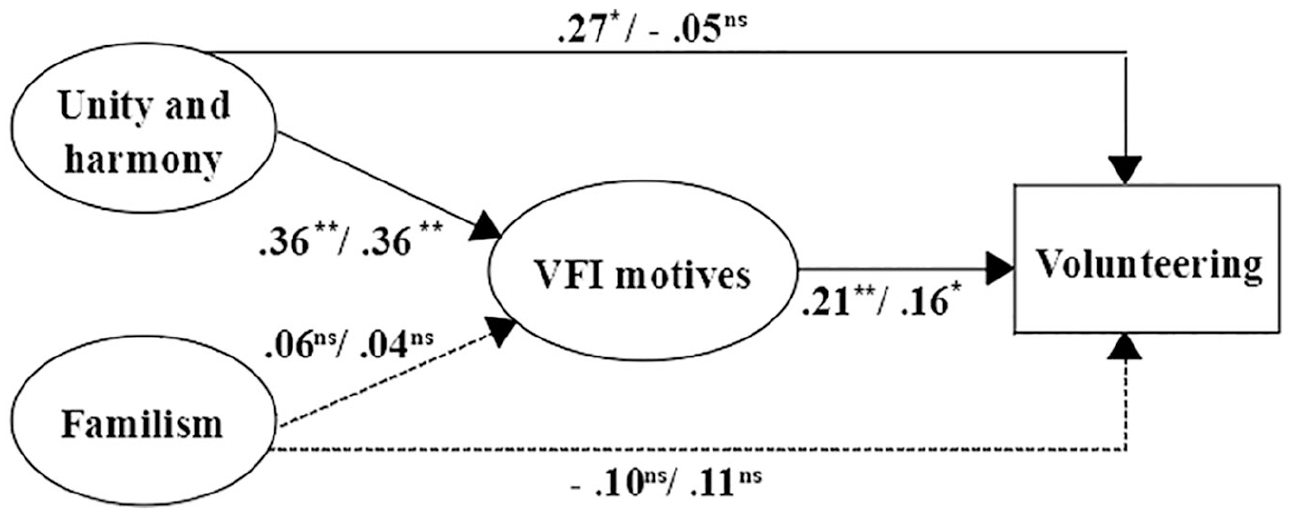
Standardized path coefficients of measurement invariance model (restricted factor loadings).
Discussion
This study examined the extent to which the Confucian value of benevolence was related to volunteering among Chinese college students, and whether these relationships were mediated by individuals’ VFI motives. The results demonstrated that UH positively predicted volunteering, and VFI motives mediated such a relationship. Conversely, familism had no direct or indirect association with volunteering through VFI motives. Furthermore, multigroup analysis suggested that the mediation model was similar across genders among college students.
Confucian Benevolence and Volunteering
UH was positively related with volunteering, while familism had no association with volunteering; thus, H1 was supported. Consistent with the previous results (Hunsaker, 2016; Kristiansen et al., 2015; Leung et al., 2015; Lönnqvist et al., 2013; Schlesinger & Nagel, 2018; Wang & Zhang, 2012), UH seems to exert a positive contribution to volunteering among college students. Individuals with high harmony value attach importance to other people’s expectations, feelings, and needs and try to meet the needs of others, which makes them willing to cooperate with others and act altruistically (Wang & Zhang, 2012). Therefore, UH can help individuals make a commitment to volunteer and invest more in volunteering.
Conversely, although correlation analysis suggested that familism was weakly and positively related to volunteering, the results of the partial correlation and the SEM indicated that familism had no association with volunteering. This result was consistent with that of previous research, which showed that the familism value had no association with altruistic prosocial behaviors in Mexican–American adolescents (Knight et al., 2018). In addition, the result was similar to the research of Lönnqvist et al. (2013), which showed that the value of benevolence focusing on the welfare of the in-group did not predict the prosocial behavior of strangers. However, this result was inconsistent with research indicating that the familism value was negatively associated with altruistic prosocial behaviors in Mexican–American early adolescents (Knight et al., 2015). The reason for this inconsistency may be that the research subjects in this study were college students who are less proximate to their families, compared to early adolescents. Therefore, whether age moderates the relationship between familism and volunteering requires further study. All these results indicated that familism does not necessarily contribute to volunteering and supports the recent view that familism is not necessarily an obstacle to civil society (Kim, 2010).
Overall, the above results indicated that there were differences between familism and UH in the predictive effects on volunteering. This supported the concept of differential order of love of Confucian benevolence (Hwang, 2001), and this may indicate that besides the compatible relationship, there may be a conflicting relationship between the two, which may be a useful supplement to Schwartz’s values theory. According to Schwartz’s (1992) values theory, familism, and UH belong to self-transcendence values and are compatible with each other; furthermore, it is necessary to distinguish them when exploring their relationships with volunteering.
The Mediating Role of VFI Motives
Consistent with H2, the results demonstrated the mediating effect of VFI motives between UH and volunteering among Chinese college students. This suggested that college students who valued UH were more likely to have higher VFI motives, which, in turn, promoted them to be engaged in volunteering. This result was in agreement with previous research, which found that national identity (e.g., concern for the country) was associated with the intention to volunteer through volunteer motivations (Lai et al., 2013). The results supported the behavioral reasoning theory (Westaby, 2005), which showed that reasons serve as important linkages between values and intentions as well as behavior. Hence, when individuals attach great importance to UH, they tend to have higher VFI motives, which then promote participation in volunteering activities.
In comparison, the mediating effect of VFI motives between familism and volunteering was not observed in this study. From the results of partial correlation, familism was only significantly related to value motive and understanding motive but not to other motives of VFI. Furthermore, the SEM results showed that familism had no association with VFI motives. The relationship between familism and motivation may be relatively complicated and affected by other factors. For example, Mencius thought that sympathy is the way individuals develop from loving family to loving others (Gan, 2019). According to the empathy altruism theory (Batson et al., 1988), empathy is an important factor promoting altruistic motivation. In addition, empirical studies have shown that depleted self-regulatory energy may reduce volunteering efforts and helping behavior of participants (DeWall et al., 2008; Xu et al., 2012). Therefore, whether individuals with high familism have strong empathy and have enough resources to cope with life events may affect their understanding of the function or significance behind the participation of volunteering and their participation in volunteering. The relationship between familism and motivation may depend on other factors, which requires further investigation.
Gender Differences in the Mediating Model
The multigroup SEM analysis revealed that the mediating model was largely invariant across gender. Overall, the results suggest that UH is related to volunteering through VFI motives, whereas familism is unrelated to volunteering in both male and female college students, and there is no significant difference across genders. Previous studies also did not find gender differences in the relationship between familism and altruism (Knight et al., 2015). Gender differences may not exist in variable relationship of this research; yet we could not completely rule out the other possibility that the gender differences in the model were weakened by some factors. Both male and female college students are still in college and have not got married and started their career; thus, there may be no obvious difference in their social division of labor. In particular, they receive more education on equality between men and women and experience similar social expectations than before, resulting in a decrease in gender stereotypes. As a result, the difference in UH between men and women may be weakened, and they show similar levels of volunteering. Indeed, our study did not find a significant correlation between gender and volunteer service, which was also found in a recent study on Chinese college students (Xie et al., 2020).
Contributions and Limitations
To our knowledge, this study is among the first to elucidate the associations among the Confucian value of benevolence, VFI motives, and volunteering. As such, it may contribute to the understanding of the underlying mechanism of the Confucian value of benevolence influencing college students’ volunteering. In terms of practical implications, the results of this study suggest that UH may be beneficial to improve the level of volunteering, particularly in China. Therefore, UH can be used as a cultural basis for the development of volunteering in China. As for the effect of familism on volunteering, our results suggest that familism had no association with volunteering; however, according to Confucian ideology, filial piety is the starting point, rather than the end point. Hence, one should continue to act with benevolence on a more far-reaching scale on the basis of caring for their families. Indeed, empirical research has demonstrated that familism is positively related to prosocial moral reasoning, and in turn, linked familism to altruistic prosocial behavior in a Mexican American early adolescent sample (Knight et al., 2015). Moreover, Kim (2010) revisited Confucian familism and proposed that a Confucian model of civil society could be constructed on the basis of Confucian familism. The role of familism in volunteering thus requires further study.
This study had several limitations. First, inferences could not be made in the causal relationship between the variables of interest in our study due to the use of cross-sectional design. Future research should use a longitudinal or experimental approach to facilitate more causal evaluations. Moreover, based on the role of values in the initiation and maintenance of behavior, this study constructed and verified the relationship model between Confucian benevolence and volunteering. However, it is possible to identify with Confucian benevolence more after volunteering. For example, a prior study has shown that values are an important outcome variable for students to volunteer (Astin et al., 1999). Therefore, in the long run, the two may be mutually causal. That is, values may be an important driving factor for students to volunteer, and volunteering may also become an important way to cultivate the values of students, which requires systematic research.
Second, the two indicators of Confucian benevolence were constructed based on the existing literature, but there has been no empirical research. Whether these two indicators can represent Confucian benevolence remains to be explored. Moreover, this study only focused on the relationship between Confucian benevolence and volunteering but did not explore other aspects of Confucian values. In particular, as an important part of the Confucian cultural system, Confucian values have a very widespread and far-reaching impact on the behavior of Chinese people. Future research should comprehensively explore the relationship between Confucian values and volunteering, which may be more conducive to a comprehensive and in-depth understanding of the impact of Chinese traditional values on volunteering.
Third, this study took individual volunteer experience and future intention as indicators of volunteering and did not pay attention to different types of volunteering. Research showed that different types of volunteer behavior may have different relationships with values and motivations. For example, Lönnqvist et al. (2013) found that personal values predicted value-expressive but not value-ambivalent behaviors. In addition, Aydinli-Karakulak et al. (2016) found that self- and other-oriented motives have different predictive effects on in- and extra-role volunteer behavior. Therefore, further research could be carried out on the relationship among Confucian benevolence, motives, and different types of volunteering.
Finally, data collection was based on students’ self-reports. To reduce potential bias that can result from self-reported data, future research should use multiple methods of assessment. The sample in this study is limited to college students, which may limit the generalizability of the study results. As such, further studies could investigate other groups.
Conclusion
In summary, the study findings verified that UH may help to improve volunteering, and VFI motives play a mediating role in the relationship, while familism may neither directly nor indirectly predict volunteering. Furthermore, a multigroup analysis suggested that the mediation model was similar across genders among college students.
Footnotes
Declaration of Conflicting Interests
The author(s) declared no potential conflicts of interest with respect to the research, authorship, and/or publication of this article.
Funding
The author(s) disclosed receipt of the following financial support for the research, authorship, and/or publication of this article: This research was supported by Beijing Municipal Social Science Foundation (grant no. 20SRA002).
