




Abstract
This study expanded the research on service climate to the perspective of customers in the hospitality context and explicated the influence mechanism of service climate on customer citizenship behavior. Service climate traditionally perceived by employees has been well studied, but only limited studies focused on the customer perspective service climate. Based on the existing literature, customer perceived service climate in the hospitality industry was operationalized and its influence on customer citizenship behavior was proposed. After the measurement purification with exploratory factor analysis based on the pilot data using IBM SPSS 20, data collection was conducted in the hotels in Wuhan, China. A total of 432 valid questionnaires were collected and the data were analyzed for hypotheses testing, using Mplus 7.4. The research results indicate that each factor of customer service climate has a positive impact on customer citizenship behavior, with the strength of effects being different. Customer psychological empowerment plays a partial mediating role between some factors of service climate and customer citizenship behavior. The findings provide implications for service enterprises in terms of service climate design and customer citizenship behavior facilitation.
Keywords
Introduction
With the increasing important role customers play in service industries, managing customers as human resources to stimulate their citizenship behaviors becomes a means by which service organizations gain advantages over others. Customer citizenship behaviors describe customers’ voluntary behaviors that are not indispensable for the success of service processes but beneficial for the service providers (Chiu et al., 2015). These extra-role behaviors can effectively strengthen the relationship between customers and service providers, improve service quality, and ultimately support the growth of service enterprises (Van Tonder et al., 2018). Because of this, service managers gradually pay close attention to citizenship behaviors of customer who essentially act as partial employees (Choi & Lotz, 2018). How to stimulate customer citizenship behavior becomes a popular and important topic for the service industries.
Compared with the well-studied organizational citizenship behaviors of employees, the antecedents of customer citizenship behaviors were relatively less understood. To date, previous studies on the antecedents of customer citizenship behavior mainly focus on the customer-related factors such as customer participation in services, customer satisfaction, and commitment (Curth et al., 2014; Zhu et al., 2016). The service design and delivery processes, however, receive much less attention. According to social exchange theory, to encourage customers to engage in good deeds as citizenship behaviors, an organization should first make customers reap benefits and gain value from services (Zhao et al., 2017). Service climate is one of the important factors that provide customers benefits and value (Bowen & Schneider, 2014).
Traditionally, service climate refers to employees’ perceptions of services provided by organizations through reward and punishment policies, organizational practices, work procedures, and so on (Chang, 2016). The correlations between service climate and employee behavior have been examined by previous research. For example, Zhang et al. (2019) tested and found the relationships between ethical climate and nurses’ extra-role service behavior through regression analyses. The elements of service climate are strongly connected to guests’ experience in restaurants; and the service climate perceived by employees positively influences the creation of a guest-focused climate (Susskind et al., 2018). Similarly, the service environment offered by organizations to customers such as facilities and personnel could also be perceived by service recipients (Sharma et al., 2015). Organizational factors and boundary conditions impose influence on guest service processes and perceptions of a climate for service, as customers suggested higher level of service evaluation because of the climate driven by human resource practices and company leadership (Hong et al., 2013). From this perspective, there exists customer perceived service climate, which was also provided by service enterprises, but only for customers (Salanova et al., 2005). Similar to the service climate leading to employee satisfaction, engagement, and performance (Li & Huang, 2017), customer perspective service climate may also lead to positive service outcomes such as perceived quality and experiences (Jia & Reich, 2013). Due to the principle of reciprocity, customers feel obligated to return favors when they have benefited from a service organization, and thus are inclined to take positive actions that are beneficial to the organization (Xie et al., 2014). However, the mechanism behind this process has not been systematically examined, especially through the role of customer psychology, but it is worthy of this investigation.
The direct consequence of service climate created by firms is customers’ psychological reactions. With the deepening of experience economy, leisure service consumption is increasingly hedonic and customers confoundedly pursue enjoyable experiences (Prebensen & Rosengren, 2016). Their psychological states in the services become more and more important (Morrongiello et al., 2017). Customer psychological empowerment is one of these states describing customers’ feeling the power they have in the service processes (Buehler & Maas, 2018). Service climate involves many aspects of service that can make customers feel their rights, such as customer-oriented processes and resource support by service providers (Chang, 2016). Customer empowerment leads to a closer match of individual needs and firm offerings. In general, customers benefit from having more control (Fliess et al., 2014). Once customers feel that they have power over and enjoyment of the service processes, they will be more inclined to do good deeds such as citizenship behaviors to repay service firms (Morrongiello et al., 2017). As limited research has been done on the holonomic mechanism stimulated by service climate from the perspective of customers, especially for tourism and hospitality industry (Ryu & Jang, 2007), this study attempts to fill this gap by investigating customer service climate and its influence on customer citizenship behavior via psychological empowerment.
Specifically, three objectives of the present study were set: operationalize the customer perceived service climate in the context of hospitality industry; examine the influence of service climate on customer citizenship behavior; investigate the mediating effect of customer psychological empowerment in the influence mechanism. This endeavor could provide marginal contributions to service climate theories and practices, and service marketing in terms of customer relationship management.
Literature Review and Hypotheses
Service Climate and Customer Citizenship Behavior
Service climate traditionally describes employees’ general perceptions of organizational requirements, rewards, policies, and procedures supporting service work and behaviors (Mahon et al., 2019; Schneider et al., 2006). Susskind et al. (2018) measured climate for service as the combination of (a) known standards for service, (b) support functions for service, and (c) guest orientation among line-level service providers. In service-based organizations, employees and guests cocreate the service experience. This process consists of both tangible and intangible factors, including employees’ perceptions of a service climate bundle, and also guests’ positive perceptions of their service settings and environmental cues, which were incorporated into a guest service climate bundle (Susskind et al., 2018). In the broad sense, service climate can be created and perceived from both employee and customer perspectives (Jung et al., 2017), though the latter perspective was usually neglected and rarely studied. Borucki and Burke (1999) concluded four dimensions of customer perceived service climate as organizational service orientation, commodity-related support, employee service quality, and human resource support. Organizational service orientation prioritizes the interests of customers and can be reflected in the organizational policies and regulations that offer customers conveniences (Lytle & Timmerman, 2006). Commodity-related support refers to customers’ perceived support of commodity, with respect to types, quality, commodity updates, and so on. Employee service quality mainly describes customers’ perceptions of quality in terms of function and technology. Relevant support from personnel department reveals service firms’ support for employees in terms of service provision to customers, such as distributing employees reasonably and granting employees certain power to better meet customers’ needs. Service climate is an important factor for good customer service and may influence customers’ service evaluation (Susskind et al., 2018). Some research has implied that service climate meets customers’ derivative demands and affects various customer outcomes, which seems robust across a variety of external service contexts, such as restaurants and hotels (He et al., 2011). However, compared with employee perspective service climate, the empirical studies on customers’ perceived service climate are relatively lacking regardless of the fact that customers require more than functional goods and their needs extend to psychological and social concerns through the whole service process, and their influence is beyond service processes, through the activities like citizenship behaviors (Payne & Frow, 2005; Prebensen & Rosengren, 2016).
Customer citizenship behavior (CCB) is based on the concept of organizational citizenship behavior and has received increasing academic attention. CCBs consist of extra-role behaviors in which customers voluntarily engage in during or after the service delivery (Di et al., 2010), including helping other customers, providing valuable feedback, and giving advice for service enhancement (Bartikowski & Walsh, 2011). Customer citizenship behavior reflects the intention of customers to voluntarily provide suggestions for employees’ work or service processes, which improves the work performance and profitability of service enterprises (Bartikowski & Walsh, 2011). Existing empirical studies have supported the significance of CCBs to service value creation, customer loyalty, and firms’ long-term development (Anaza & Zhao, 2013; Auh et al., 2007). Thus, service firms are eager to stimulate citizenship behaviors of customers because of these positive results (Yi & Gong, 2013). CCBs as a type of voluntary and friendly behaviors are the consequences of customer satisfaction, commitment, and perceived customer support (Curth et al., 2014). In addition, CCBs will be enhanced when there is a match between customer identity and organizational identity, or when the interdependent relationships exist between service organization and customers (Ahearne et al., 2005). If the customers receive more attention and responses from service firms, such as responding to customers’ kind advice with timely measures, customers will be more active in services and voluntarily provide the enterprise with rationalization proposal (Mugambwa et al., 2016). In this way, the customer–enterprise relationship turns into a virtuous circle and service firms will finally benefit from their effort in service climate (Schneider et al., 2005).
From the standpoint of customers, there are basically two types of motivations driving customers to show extra-role citizenship behaviors as firms expect: self-interest motivation and altruistic motivation (Bove et al., 2009). Self-interest motivation is derived from the customer’s previous benefits or expectation of return, while altruistic motivation means that customers spontaneously intend to improve the services of the enterprise (Bove et al., 2009; Reimer & Benkenstein, 2016). For customers, quiet and comfortable environment enables customers to obtain high-quality and satisfactory services, which starts the virtuous circle. In addition, customers may also perform citizenship behaviors to improve the services they receive, and maximize the benefits they reap from service transactions (Choi & Lotz, 2018), such as giving feedback and suggestions. Organizational service orientation means prioritizing the interests of customers; this service orientation was viewed as an aspect of the broader climate of the organization, policies, practices, and procedures in an organization, delivering the concern of enterprises for services, which will have positive impacts on service experiences (Briggs et al., 2019). Commodity-related support lay the foundation a successful service value realization and inevitably influence customers’ evaluation of service experiences (Padhi & Aggarwal, 2011). Employees delivering services interact with customers frequently, and they expect to receive support from firms (Gong et al., 2019). Employee service quality directly affects the efficiency and effectiveness of services and is a key factor for customers’ perception of service climate during their service experiences (Dhar, 2015). Relevant support from personnel department reveals service firms’ support for employees in terms of service provision to customers; and reasonable human resource management has been found facilitating service delivery process, service performance, and the behaviors of customers (Gilal et al., 2019; Shen & Zhang, 2019). The social exchange theory suggests that human resource management naturally leads to employee service behaviors, which are the foundations for customers’ assessment of service climate (Chen et al., 2019). According to the principle of reciprocity, when customers receive the benefits from service enterprises, they will have a sense of responsibility to repay, and ultimately, give return to enterprises through certain behaviors (Kim & Choi, 2016). The theory of resource exchange suggest that people exchange various resources (love, status, etc.), and the more similar the resources of both sides, the more likely the exchange behavior will occur (Rosenbaum & Massiah, 2007). Because of this similarity effect, only when customers perceive the support and values provided by the service enterprises, will they perform the behaviors that benefit the enterprises (e.g., customer citizenship behavior). The service climate has been argued as provisions by service firms that make customers feel the support and obtain certain value. In other words, perceived high level of service climate may be a way to stimulate customer citizenship behavior.
Customer citizenship behaviors as helpful and constructive behaviors toward other customers or the service organization (Anaza, 2014) could be the consequences of service climate. If service organizations go further than offering just products customers need, by providing better atmosphere and environment, customers may volunteer to do more for the organization to safeguard its interests and image, because some customers regard service climate as extra benefits and they tend to repay with extra-role effort as citizenship behaviors (Lawler, 2001; Sierra & Quitty, 2005). Customers are regarded as part-time employees or transient employees of service enterprises (Chiu et al., 2015). In this way, the conclusion regarding the path from employee perspective service climate to organizational citizenship behavior may also be applicable to the customer perspective. Therefore, we propose that the service climate customer perceived may have a positive impact on their citizenship behaviors. As customer perspective service climate includes four dimensions and customer citizenship behavior involves three widely accepted factors which may vary with each other to some extent (Groth, 2005), it is more meaningful to formulate and test the following specific hypotheses.
Customer Psychological Empowerment
Customer psychological empowerment is a type of inherent psychological characteristics of customers in the process of service transactions, caused by perceptions of increasing control and autonomy; the core of this empowerment is the feel that they have control over their choices (Broniarczyk & Griffin, 2014; Hunter & Garnefeld, 2008). Because of the empowerment, customers may feel powerful in the relationship and confident about their ability, which affects their judgment (Morrongiello et al., 2017). Individuals generally have an inherent need for empowerment, such as the capacity to influence and control their environment and the strive for greater self-determination (Alshibly & Chiong, 2015). This empowerment can be understood from three aspects: the right to choose, know, and influence (Wright et al., 2006). Empowering customers psychologically usually exert positive impact on customer behavior and business, leading to the results such as customer satisfaction, favorable attitudes, purchase intention, customer loyalty, and the final financial performance (Berraies & Hamouda, 2017; Fuchs & Schreier, 2011).
The psychological empowerment of customers may arise in the service environment. Customer psychology is susceptible to the external environment and servicescape (Lin et al., 2015). Customers purchasing hospitality services expect to obtain satisfactory service experience and pleasure, and their psychological state and behaviors depend on the outcomes of the service conditions (Bowen & Schneider, 2014; Ryu & Jang, 2007). Service environment shapes the way customers perceive and act in service processes, and that customers react to the stimulus (Dedeoglu et al., 2018; Mobach, 2013). Research has suggested that customer experience and the subsequent recommendation behaviors are positively affected by hotel service environment, such as employees’ work effort in the service process and the interaction between employees and customers due to service delivery (Line & Hanks, 2019), which are forms of service climate.
Various factors of service climate may enhance customer psychological empowerment. Research indicates that customers in a climate with positive measures, support from enterprises, and fluent service procedure may feel high control of the service quality and outcomes (Jin et al., 2017; Schneider et al., 2006). In other words, high level of service climate can make customers feel empowered from their hearts, and let customers feel their decision-making power in the services (Usta & Häubl, 2011). This influence mechanism follows the stimuli-organism-response model. Service climate acts as stimuli to customers who purchased the services, leading to the psychology and behavior change of them (Poujol, 2009). In the enterprises with strong service climate, customer-oriented services enable the firms to meet customers’ needs and requirements; comfortable environment, high-quality service, diversified products, and customer’s accessibility to relevant information just show the importance firms attach to customers (Mendes-Filho et al., 2018). The constituent of service climate, from concern for customers to service personnel, empowers customers by increasing provisions for them to choose, promoting reliable purchase ways, and so on (Hajli & Sims, 2015; Schneider et al., 2006; Wright et al., 2006). Customers tend to have a sense of control and influence over their service experience due to the enterprise’s empowerment measures (Hunter & Garnefeld, 2008). Hence, because of the increasing service climate customer perceived, customer psychological empowerment arises.
This customer psychological empowerment may further play a role in stimulating customer citizenship behavior. Nowadays, customers no longer receive services unilaterally, but actively pursue a sense of control, a high degree of choice, and freedom in the service processes (Bradley & Sparks, 2002). When customers have a sense of control, self-efficacy, and self-determination in services, they take further steps to perform citizenship behaviors (Bester et al., 2015), as exchange favors for the benefits they receive from service firms (Tung et al., 2017). Service climate improves service experience of customers (Fuchs & Schreier, 2011). In this situation, if customers perceive having more power in decision-making and having the right to know and influence, they may consciously take actions beyond services (i.e., extra-role) to repay the service firm (Gregory et al., 2010), since they already have the power to control the services (Ramani & Kumar, 2008). Thus, following the stimuli-organism-response framework, we propose that customer psychological empowerment mediates the relationship between service climate and customer citizenship behavior. Considering the various factors of customer citizenship behaviors, we reach the following subhypotheses:
Based on the conceptual model with the guidance of social exchange theory (Figure 1), the hypotheses will be tested using structural equation modeling.
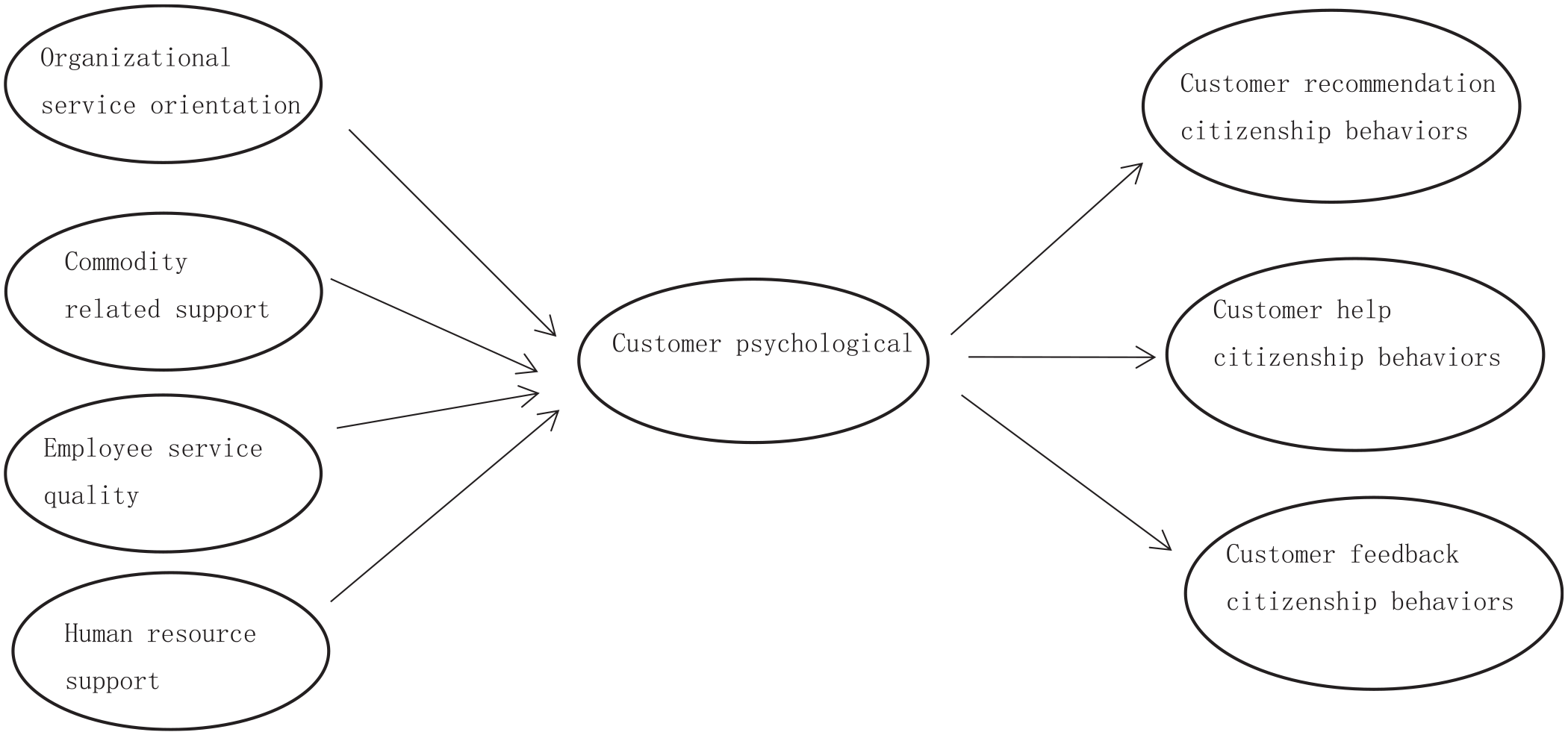
Overall structural model of the study.
Method
Based on Borucki and Burke’s (1999) four dimensions of customer perceived service climate, we reviewed the relevant literature on hotel service climate and obtained 26 items following the principle of scale development. Data collection was then conducted based on the context of hotels in Wuhan, China. A pilot study was carried out using the 26 items. Three research assistants were hired to survey customers in hotels through both paper questionnaires and online ones (via WeChat), the selection of which was up to participants. Questionnaires were collected in three hotels, including Dorsett Wuhan Hotel, Urban Convenient Hotel (Fuxing Road), and Home Inns (Nanjing Road), who possess ideal geographical location and large flow of passengers. Respondents were randomly approached near the hotels. They were informed the purpose of the survey and completed the questionnaires. We expected customers to cooperate with the survey seriously and those answering the questions carefully received red packets (in WeChat) after the researchers confirmed the questionnaire. Finally, 165 effective questionnaires were collected during 2 weeks. Exploratory factor analysis (EFA) was performed to analyze the pilot data. The results suggested that the value of Kaiser–Meyer–Olkin (KMO) exceeds 0.8 (0.942), and Bartlett’s test was significant at 0.000, indicating that the sampling was adequate for EFA. Items were removed one by one if the factor loading of an item was lower than 0.4 or the item loaded on two or more factors. Each time, the item with the lowest factor loading was deleted (then the cross-loading ones). EFA was conducted again after each item was removed. After the nine-round EFA, 18 items were derived, including four factors, which was consistent with the four dimensions we expected (see Table 1). The results showed that the cumulative explanatory variance of the four principal components was 61.307%, and the factor loadings of all the items were greater than 0.6. The α values of the factors exceeded the cutoff point 0.7, indicating acceptable reliability. Thus, the four factors, including employee service quality, commodity-related support, human resource support, and organizational service orientation, explain the customer perceived service climate well. The 18 variables were then placed in the questionnaire for the main survey.
Results of EFA on Service Climate.

Customer psychological empowerment was measured by the items adopted from Spreitzer (1995) and Hunter and Garnefeld (2008). Employee psychological empowerment has been examined by many researchers, such as Spreitzer (1995), which measured the construct from four aspects (meaning, competence, self-determination, impact), and has been widely used by scholars. Based on this, Hunter and Garnefeld (2008) developed four items to measure customer psychological empowerment, with high reliability and validity. Therefore, a total of seven items from the two studies were obtained to measure customer psychological empowerment. As the research context of the present study was different from the previous ones on customer psychological empowerment, semantics and expressions are adjusted to reflect the settings in the hospitality industry.
Customer citizenship behavior was evaluated using the measurement provided by Groth (2005). The scale measures the construct through three dimensions: recommendations (e.g., recommend the business to your family), helping customers (e.g., assist other customers in finding products), and providing feedback (e.g., fill out a customer satisfaction survey). The 12-item scale was widely used. The researchers made some minor adjustments of the items corresponding to the hospitality industry practice.
All the variables were assessed using a 7-point Likert-type scale, ranging from 1 (strongly disagree) to 7 (strongly agree). The items were translated into Chinese using back translation method. Then the questionnaire was created with the aforementioned items, together with demographic profile of the respondents including gender, age, income, and education background. The demographic variables were set as control variables in the research model.
The main survey was conducted using the questionnaire that has been designed. The main context of the study is the hospitality industry, where service excellence and climate were pursued by practitioners. Three research assistants helped the questionnaire distribution to the hotel customers. Like the pilot study, both paper questionnaires and online questionnaires (in the form of QR code) were adopted, subject to different participants. Similar hotels were selected from the three hotel groups mentioned in the pilot study. Before that, the research purpose was also explained to the hotel employees and they offered some help in the data collection process. Finally, a total of 456 questionnaires were collected and 24 invalid questionnaires with too many missing or obvious illusive answers were excluded. These 432 valid questionnaires were then analyzed using IBM SPSS 20 and Mplus 7.4.
Results
Profile of the Respondents
Among the 432 respondents, 53.01% (n = 229) were female and 46.99% were male. About 29.63% of the respondents were aged between 18 and 25 years, accounting for most among the age groups. The second largest age group (83, 19.21%) was between 26 and 35 years, followed by the participants aged between 36 and 45 (18.98%). About 29.17% of the respondents earned more than ¥6,000 a month. More than half of the respondents’ monthly income fell between ¥2000 and ¥6000 (51.62%). About 19.21% of the participants owned monthly income below ¥2,000. Meanwhile, 57.41% of the respondents had a high school degree or lower and the “graduate degree or higher” group account for the least among the participants (18.29%).
Measurement Model and Confirmatory Factor Analysis
The descriptive analysis was performed using IBM SPSS. The mean and standard deviation values of the variables were listed in Table 2. In addition, the normality of the variables was tested, and the results suggested that the data were approximately normally distributed, as the skewness and kurtosis values of the variables lied between -1.5 and 1.5. As all the measurements were assessed by customers, common method variance was estimated. Harman’s single-factor test was performed in IBM SPSS 20 and the factor analysis result suggests that the percentage of variance explained by common factor is 43.46%, less than 50%. The intraclass correlation coefficients of the constructs (>0.7) reveal high level of interrater reliability. Therefore, common method bias does not constitute a threat to the research.
Results of Descriptive Statistics and CFA.

The confirmatory factor analysis (CFA) was also conducted. The results of model goodness indices indicate that the measurement model fit the data well (χ2 = 1154.706, df = 601, p = .00, comparative fit index [CFI] = 0.927, Tucker–Lewis index [TLI] = 0.919, root mean square error of approximation [RMSEA] = 0.046). The reliability and validity of the constructs could be revealed by the CFA results shown in Table 2. The standardized factor loadings of the 18 variables of service climate are all greater than 0.6. The items of customer psychological empowerment and customer citizenship behavior with factor loadings ranging from 0.614 to 0.849 are significant (t values > 14.919). Meanwhile, the composite reliability of the constructs or factors were higher than 0.8, and the Cronbach α values of all the constructs exceeded 0.7 (Table 3), indicating high construct reliability. In Table 3, The average variance extraction (AVE) values of seven constructs are greater than 0.5, with customer psychological empowerment being slightly lower than 0.5. The results of convergent validity are generally acceptable. In addition, the correlation coefficients of any two constructs are less than the square root of AVE values of each variable, suggesting that the discriminant validity of the constructs is high. Therefore, the measurement model could be regarded as statistically adequate.
Correlations and Reliability Result.

Note. Square root of AVEs are on the diagonal; OSO = organizational service orientation; CRS = commodity-related support; ESQ = employee service quality; HRS = human resource support; CPE = customer psychological empowerment; RCB = customer recommendation citizenship behaviors; HCB = customer help citizenship behaviors; FCB = customer feedback citizenship behaviors.
The bold values along the diagonal are the square root values of AVE for each construct.
Alternative model testing was conducted, where the paths with the constructs were analyzed so that only the direct effects were estimated (no mediation). In the alternative model, the four dimensions of service climate directly influence customer psychological empowerment, which further influences customer citizenship behaviors, compared with the proposed model in Figure 1 that service climate also links to customer citizenship behaviors. The model fit indices were checked in both models and the fit of competing and theoretical plausible ones were compared. The results suggest that both the alternative model and the proposed model fit the data well (RMSEA < 0.08; CFI > 0.9; TLI > 0.9). Further analysis indicated that removing indirect effects calculation may decrease the model fit (Δχ2 = −66.8, Δdf = −12). Thus, the proposed model is better than the alternative one.
Hypothesis Testing
The direct influence and mediating effect were estimated in the structural equation modeling using Mplus. The coefficient estimates, standardized coefficients (β), t values, significance level, and model fit indices were shown in Table 4. The direct effect of service climate on customer citizenship behavior can be judged from the results of Model 1, and the indirect effects would be derived from Models 1 to 3. The fitness indices of the three models were generally ideal (χ2/df < 3; RMSEA < 0.08; CFI > 0.9; TLI > 0.9), except that CFI and TLI values of Model 1 were at the brink of the cutoff point 0.9 (CFI = 0.890; TLI = 0.889; RMSEA = 0.056). As indicated by the path coefficient results, the three factors of service climate have a positive and significant impact on customer recommendation citizenship behavior, so Hypothesis 1 was supported. Similarly, organizational service orientation and employee service quality positively influence customer help citizenship behavior, but the paths to customer help citizenship behavior from commodity-related support (β = 0.08, t = 1.302 < 1.96) and personnel department support (β = 0.078, t = 1.067) were not significant. Thus, H2a and H2c were supported, but H2b and H2d were not. Because of this, H5b and H5d (the meditation of customer psychological empowerment between these two dimensions and customer citizenship behavior) were not supported. Each dimension of service climate, except the human resource support dimension (β = 0.113, t = 1.547 < 1.96), had a significant positive effect on customer feedback citizenship behavior. Thus, H3a, H3b, and H3c were supported, but H3d was not, which also means that customer psychological empowerment does not mediate the relationship between human resource support and customer citizenship behavior (H6d).
Structural Model Results.

Note. RMSEA = root mean square error of approximation; CFI = comparative fit index; TLI = Tucker–Lewis index; OSO = organizational service orientation; CRS = commodity-related support; ESQ = employee service quality; HRS = human resource support; CPE = customer psychological empowerment; RCB = recommendation citizenship behaviors; HCB = help citizenship behaviors; FCB = feedback citizenship behaviors; Model 1 = direct effects; Model 2 = full mediation; Model 3 = partial mediation; Values in parentheses represent t values.
p < .05; **p<.01; ***p<.001.
In Model 2, the standardized path coefficients were significant, either from predictor constructs to “mediator,” or from “mediator” to the outcomes. The results show that organizational service orientation (β = 0.186, t = 2.707 > 1.96), commodity-related support (β = 0.126, t = 2.224), employee service quality (β = 0.160, t = 2.841), and human resource support (β = 0.345, t = 5.226) positively affect customer psychological empowerment. Meanwhile, customer psychological empowerment has a positive impact on customer recommendation citizenship behavior (β = 0.513, t = 11.809), help citizenship behavior (β = 0.415, t = 8.898), and feedback citizenship behavior (β = 0.528, t = 12.262).
Model 3 involving all the constructs in the research framework was estimated. The results indicate that two factors of service climate were not significantly associated with customer recommendation citizenship behavior, which are organizational service orientation (β = 0.131, t = 1.87 < 1.96) and human resource support (β = 0.129, t = 1.754). That means the addition of customer psychological empowerment significantly reduces the effect of organizational service orientation and human resource support on customer citizenship behavior. Considering the results of Models 1 and 2, customer psychological empowerment is a perfect mediator between the two relationships. Thus, H4a and H4d were supported. The other two dimensions of service climate, including commodity-related support (β = 0.127, t = 2.203) and employee service quality (β = 0.221, t = 3.872), positively associate with customer recommendation citizenship behavior, and the standardized coefficients of the two paths in Model 3 was lower than the corresponding ones in model 1. The change of these effects suggested that customer psychological empowerment partially mediates the relationship between employee service quality and customer recommendation citizenship behavior, but not the one between commodity-related support and recommendation citizenship behavior. Thus, H4c was supported, but H4b was not.
In Model 1, organizational service orientation and employee service quality have a significant effect on customers’ citizenship behaviors. After customer psychological empowerment was considered in the relationships (Model 3), the effect has decreased significantly. Thus, H5a and H5c were supported. Similarly, compared with the relationships in Model 1 (direct effects), the standardized coefficients of the influence of organizational service orientation, commodity-related support, and employee service quality on customer citizenship behavior in Model 3 (where customer psychological empowerment was added) were lower than the corresponding ones in Model 1. Further analysis supported the indirect effects of customer psychological empowerment. Therefore, customer psychological empowerment plays a mediating role in the relationships between these three factors of service climate and customer citizenship behavior. In other words, H6a, H6b, and H6c were supported.
Discussion and Conclusion
Theoretical Contributions
This study explores the relationship between customer perceived service climate and their citizenship behaviors, and the role of customer psychological empowerment in the relationships. The present study expanded the research on service climate to the perspective of customers in the hospitality context and explicated the influence mechanism of service climate on customer citizenship behavior. The research findings carry some theoretical and practical implications.
This research contributes to service climate, psychological empowerment, customer citizenship behavior, and relationship management literature in several important ways. First, this study broadens the perspective of research on service climate (to include customer standpoint) and contributes to the research on service offerings and management. In the context of the hospitality industry, the service climate customers perceived is conducive to better understanding the services firms can provide and the value customers may cocreate with employees. Previous research mainly examined the service climate from the employee perspective (e.g., Schneider et al., 2006). Limited studies proposed the customer perceived service climate (e.g., Jung et al., 2017), with the service or customer outcomes of which being basically uninvestigated. The present study measured the customer service climate in the hospitality settings and linked it with customer citizenship behavior, which broadens the scope of service climate, and contributes to the research on service offerings and management. The research indicated that customer service climate provided by service firms could be understood from four dimensions: organizational service orientation, commodity-related support, employee service quality, and human resource support. Employee service quality was measured by six items and explained the most variances of service climate. This reflects the close relationship between the customer and employee perspective service climate (Susskind et al., 2018). The scale was statistically confirmed as the construct reliability and validity were adequate according to the factor analysis and measurement model testing results.
Second, this research builds an integrative conceptual model that predicts the impact of service climate on customer citizenship behavior. The results of this article expanded the research on the antecedent factors of customer citizenship behavior. This study explored service climate as the effective stimulus to customer citizenship behavior and found that customer perceived various factors of service climate have different impacts on the dimensions of customer citizenship behavior. Customer perceived organizational service orientation is positively associated with customer recommendation, help, and feedback citizenship behaviors. Customer perceived employee service quality is also significantly correlated with the three dimensions of customer citizenship behavior. For the other two factors of service climate, the effects vary. Customer perceived commodity-related support positively affects customer recommendation and feedback citizenship behavior, but has no significant impact on customer help citizenship behavior. In addition, customer perceived human resource support significantly influences customer recommendation behavior, but not customer help and feedback citizenship behaviors. These findings enhance the understanding of customer citizenship behavior facilitation by adding the service climate, which contributes to the research on service design and customer relationship management.
Finally, this research examines the role of customer psychological empowerment, and this could offer a broader view on customer psychology from stimulus-organism-response (SOR) theory. The present study tested the mediating role of customer psychological empowerment in the effect of service climate on customer citizenship behavior. The results revealed the specific influence mechanism of customer perceived service climate on their citizenship behaviors and enhanced the understanding of the role of customer psychology in service climate outcomes. Customer psychological empowerment plays a mediating role in the relationship between organizational service orientation and the three factors of customer citizenship behavior. This means that if hotels created customer-oriented servicescape and provided high-quality offerings, customers will feel psychologically empowered, which further stimulate their citizenship behaviors together with the service climate. Meanwhile, customer psychological empowerment partially mediates the influence of employee service quality on customer recommendation, help, and feedback citizenship behaviors. Employees’ influence on customers’ psychology is closely related to the relationship between customers and employees. Employees play an important role in influencing the degree of customer’s perceived dominant power on service. Employee service quality includes not only outcome quality, such as their professional communication abilities and skills, but also their etiquette, empathy attitudes, flexibility and cordiality, skillfulness in interacting with customers, which make customers feel like “masters” (Grobelna & Marchiszewska, 2013). When employees give priority to customers’ needs and actively serve them, customers will feel that they are concerned and valued, and have a deeper sense of influence and control for services (Ziggers & Henseler, 2016). Thus, the present studied revealed the role of psychological empowerment in service climate and outcomes, contributing to the consumer psychology in services.
Compared with service orientation and employee service quality, the other two factors of service climate do not have the same impact mechanism on customer citizenship behaviors. There is a positive relationship between human resource support and customer citizenship behavior, but it does not motivate customer recommendation or feedback citizenship behavior by enhancing customer’s psychological empowerment. Also, commodity-related support can empower customers, influence their psychology, and make customers have a sense of control over the service process. For example, good accommodation environment satisfying the basic demand of hotel customers is a factor affecting their psychology experience, and this will motivate some positive feedback citizenship behavior at the individual level (Peng et al., 2015). However, commodity-related support does not motivate customer’s recommendation or help behavior through customer psychological empowerment. Thus, this research specifically examined the influence mechanism from the factors of service climate to the three dimensions of customer citizenship behaviors and found the differentiation of the paths, which provides marginal contributions to the research on service climate and its customer-related outcomes.
Practical Implications
The research findings could also provide managerial suggestions for service enterprises in terms of service climate design and customer citizenship behavior facilitation in the hospitality industry.
Managers in the hospitality industry can create positive service climate to stimulate customers’ citizenship behaviors. Four aspects can be considered when designing the service climate: organizational service orientation, commodity-related support, employee service quality, and human resource support. Organizational service orientation aims at improving service quality and bringing great service experience to customers, and is usually reflected in the enterprise policies and regulations (Jin et al., 2017). For example, hospitality firms make customers feel it is easy to find the places, or hotel restaurants quickly complete their orders from customers, so as to make customers perceive the importance enterprises attach to them, which ultimately may promote various types of customers’ citizenship behaviors. The importance of commodity-related support should also be recognized if firms expect customers to show more voluntary citizenship behaviors. The advantages of clean and hygienic environment, comfortable rooms, and reliable service facilities in the hotels can effectively promote customer recommendation and customer feedback citizenship behaviors. In addition, hospitality enterprises should pay special attention to customers’ perceptions of employee service quality, and take measures to improve them, such as fluent service processes and supportive system to improve the communications between customers and employees. Moreover, since human resource support has a significant and positive influence on customer recommendation and help citizenship behaviors, the supportive environment and systems for human resources should not be ignored. Human resource support encourages more people to deal with customers’ needs and problems without worries behind, and it is an objective resource or opportunity for customers. Reasonable allocation of hotel human resources to better meet customer demand is conducive to customer citizenship behaviors. Hospitality firms providing more resources and support to human resources will reduce the burnout of service providers as well as customers, and increase their service involvement (Salanova et al., 2005). These measures will finally trigger more citizenship behaviors of customers via customers’ perceptions and psychology.
Customers should also be psychologically empowered in the hospitality services so that they may perform more citizenship behaviors. Customer psychological empowerment positively affects their citizenship behaviors and plays an important part in the influence of service climate on customer outcomes. To enhance customer psychological empowerment, managers should well manage organizational service orientation and commodity-related support. Hotels should optimize the provision of service scenarios, rooms, facilities, and other aspects to empower customers for improving their psychological feelings (Peng et al., 2015). Besides products and facilities (e.g., bed), a whole package of customer-oriented support should be designed to satisfy the customers’ mixed requirements. For example, service firms should formulate relevant policies and regulations to benefit customers, so that customers feel that they are valued and enjoy the sense of control over services (i.e., psychological empowerment). Human service aspect should be highlighted in service provision. Good quality and caring employee service enable customers to increase their self-esteem in the service processes, be concerned, enhance their sense of dominance and control over the services, and the psychologically empowered customers may finally perform extra-role behaviors. In other words, if customers’ psychology and needs are more deeply understood and met, they are more likely to perform citizenship behaviors to benefit the firms.
Limitations of the Study and Future Research
There are several limitations in this study, which may also suggest some directions for the future research. First, customers’ perceptions of service climate may rely on the length they stay in the hospitality firms, but this factor has not been considered in the present study. Whether customers are first or repeat consumers for the hotels may also affect their commitments to the hotels and their intentions to show citizenship behaviors. Future research could examine the number of times a customer stays in a hotel when the customer perspective service climate is to be investigated. In addition, the sample of hotels in this study are not grouped, and hotel types can be further considered. For different types of hotels, such as luxurious hotels versus budget hotels, the design of the services (including service climate) and the way customers perform may be restricted by the existing resources and environment, and this is also worth exploring in future research. Furthermore, this study specified the impact of the four factors of service climate on citizenship behaviors of customers, but only one psychological factor was considered in the model (psychological empowerment). Although customer psychological empowerment has been found mediating the relationship between the two factors of service climate (organizational service orientation and employee service quality) and customer citizenship behavior, commodity-related support and human resource support do not affect most types of customer citizenship behaviors via psychological empowerment. There may be still other factors that have been ignored in the relationships, such as the positive and negative emotions customers responded to the service climate, and relationship quality between customers and employees. Future research can integrate these constructs in the model to more specifically investigate the influence mechanism of service climate. Finally, we did not explore the potential moderation of demographic variables of customers in the present study. For example, it is interesting to examine the role of gender and age to find out whether the effect of organizational service orientation on recommendation citizenship behavior varies/differs from each other between the male versus female and older versus young customer groups. Future research can continue to explore the contextual factors when examining the consequences of customer perspective service climate.
Footnotes
Declaration of Conflicting Interests
The author(s) declared no potential conflicts of interest with respect to the research, authorship, and/or publication of this article.
Funding
The author(s) disclosed receipt of the following financial support for the research, authorship, and/or publication of this article: This work was supported by the National Social Science Foundation of China (NSSFC) under Grant No. 19CGL031.
