




Abstract
The main aim of this study is to enhance and go beyond the conventional service profit chain model (SPC) by adding new intervening variables suggested in the relevant literature. Empirical data were obtained from 201 service companies from different service businesses using a survey approach; 603 questionnaires were collected from three perspectives: customers, front-line employees, and managers. A SmartPLS package was used to check data reliability and validity and to test hypotheses for paths using a Structural Equation Modelling (SEM) approach. The findings of this study revealed that internal service quality (ISQ) enhanced employee satisfaction and that employees’ attitudes induced higher external service value and customer responsiveness alongside organizational performance. In addition, most of the intervening factors and links within the new SPC framework suggested in this study were supported. This study contributes to the relevant literature by adding new mediating factors to the conventional model. Hence, this study extends the integrative mechanism for how a firm’s internal operational activities will be translated into customer perceptions and business performance in the Saudi context.
Keywords
Introduction
The roots and origins of the service profit chain (SPC) theory go back to Reichherld and Sasser’s (1990) work on understanding the impact of customer satisfaction and loyalty on business profitability. Based on the findings of the profit impact of the market share (PIMS) project started in the 1970s using business unit-level data from GE, researchers noticed that market share is not the only factor that relates to profitability. Hence, Reichherld and Sasser (1990) re-explored other new factors influencing profitability. Heskett et al. (1994, 1997) developed a theory called the SPC to depict relationships among several factors, including internal quality, employee satisfaction, customer satisfaction, market share, revenues, and profitability. This theory assumes that achieving profits and customer satisfaction depends on having good relationships with employees, which induces committed employees. Son et al. (2021) highlighted the value of the SPC model due to its ability to answer the interrelationships between key factors, including employees’ performance, customers’ perceptions, and business outcomes. Ahmed et al. (2022) stated that the SPC model has shown high value in a wide range of service sectors regarding business profitability. Hogreve et al. (2022) attributed the importance of the SPC to its ability to link the company’s internal environment (i.e., employee satisfaction, loyalty, and productivity) with its external environment (i.e., service quality, customer satisfaction, and Loyalty) to the business final performance.
Despite the popularity of this model, some researchers have questioned and criticized it. In other words, some shortages and limitations inherited and emerged in the model have been discussed in the literature. For instance, Hong et al. (2013) tested the SPC model using a meta-analysis approach and declared some limitations. Moreover, Hogreve et al. (2017) reviewed the SPC model using a meta-analysis technique and claimed that the model has suffered from limited applications and empirical tests of its entire components. They also criticized previous studies that addressed the SPC model for offering fragmented and vague support.
Adeinat and Kassim (2018) tried to retest the model of SPC to address gaps raised in the relevant literature in the Saudi setting. They highlighted two shortages in the relevant literature: namely, first, testing this complex model and interrelationships in only one industry and setting; second, more operational factors such as employees’ productivity and achievement require full integration in the model. Chicu et al. (2016) claimed that the SPC model was tested mainly in traditional industries attributed to high contact and face-to-face interactions; accordingly, they tested the original SPC model in the call center service setting.
Unfortunately, only a few empirical studies tested a close-to-complete view of the SPC model (e.g., Gelade & Young, 2005; Loveman, 1998; Pritchard & Silvestro, 2005; Silvestro & Cross, 2000) and used only a case study approach of individual companies. In addition, studies have shown several incomplete and modified versions of the SPC model by omitting and summarizing or even substituting specific factors within the SPC model (e.g., Adeinat & Kassim, 2018; Jiang et al., 2012; Yee et al., 2010, 2011; Zablah et al., 2012). Patel et al. (2020) tested the SPC model by breaking it down into two blocks: the internal SPC model (I-SPC) involves the internal activities and policies that make employees able to deliver results for customers, such as internal service quality, employee satisfaction, and retention, and the external SPC model (E-SPC) addresses the customers’ perception and assessment of services delivered, such as customer satisfaction, loyalty, and identification.
After reviewing key papers in the area of the SPC model, it became clear that the literature shows significant evidence for well-established relationships within the model. However, the preceding discussions showed some shortages in the literature and offered some recommendations for enhancing the model and its understanding. Thus, reviewing the previous studies has revealed that more enhancement of the SPC model is needed by adding new factors and variables that might help in understanding the SPC model. Hogreve et al. (2017) urged researchers to add some new mediating factors to the conventional SPC model, such as customer identification, organizational citizenship behavior, customer-oriented behavior, emotional contagion, and reciprocity, because these factors might help in enhancing the performance of service staff and employees. Hogreve et al. (2022), in their meta-analysis, found out that the original SPC model is poor, and researchers are invited to consider some other factors to explain the mechanism in this model and its linkages. “A better understanding of how different internal and external SPC mechanisms work together is important. Therefore, the literature requires more research on these mechanisms and the contingencies that shape their interplay” (Hogreve et al., 2022, p. 464).
Accordingly, this study aims to deeply understand the conventional service profit chain (SPC) model developed by Heskett et al. (1994) and enhance this basic and conventional model by adding some new intervening factors. To do so, this study is going to add some new mediating links and intervening factors, which have been mentioned by several authors in the relevant literature as potential mediating factors. Having done this will help to enhance the SPC conventional model and close some shortages within the basic model within the Saudi Service sector context. In this regard, Hogreve et al. (2022) urged future researchers to test this model in different cultures and in small service companies, which will enhance the understanding of the SPC mechanism. “A better understanding is needed of how cultural differences in SPC effects help service firms adapt their internal and external marketing investments to cultural settings in order to improve performance”Hogreve et al. (2022, p. 470). Accordingly, this paper added new paths and variables within the conventional SPC model to be tested beyond the straightforward and supported links within the SPC model in the Saudi service sector setting.
Theoretical Background (The SPC Model)
Based on that, Heskett et al. (1994, 1997) developed a theory called the Service Profit Chain (SPC) that depicts relationships between several factors, including internal quality, employee satisfaction, customer satisfaction, market share, revenues, and profitability, as shown in Figure 1. Accordingly, the SPC model became a vital managerial tool and central organizing framework used by managers and practitioners in the dynamic business environment.

The SPC model.
As shown in Figure 1, Silvestro and Cross (2000) stated that the SPC model stipulates the relationship between employee and customer satisfaction while considering satisfaction as a “satisfaction mirror” that indicates the success of business performance. In this regard, Mandal (2022) insisted on the importance of frontline employees due to their close interaction with customers, which allows them to create value for customers. Having said this, the skills and motivations of staff will shape the interactions with customers in the service setting.
Literature Review and Hypothesis Development
This section offers and displays the research framework in Figure 2 and develops several hypotheses that address links and paths within the new enhanced SPC framework.

The research framework.
The framework shown in Figure 2 offers an integrative mechanism for how a firm’s internal operational activities will be translated into customer perceptions and behavior, and how these will be translated into better business performance. More importantly, the enhanced SPC framework in Figure 2 shows the two perspectives of the SPC model, that is, I-SPC and E-SPC. In other words, Figure 2 shows the new mediating factors mentioned and suggested as discussed in the preceding discussion, including; employee reciprocity, organizational citizenship behavior, emotional contagion, customer reciprocity, customer company identification, and customer-oriented behavior.
It is worth noting that some sub-theories, including the social exchange theory (SET), the social identity theory (SIT), and the marketing relationship theory under the umbrella of the SPC theory, help in explaining the mechanisms of some links displayed and assumed in the research framework. In this regard, the social exchange theory (SET) justifies and explains the mechanism for variables under investigation mentioned in the research framework. In other words, the SET was developed as a tool for understanding connections in the workplace setting between different parties, such as employees, supervisors, peers, and customers (Cropanzano & Mitchell, 2005; Homans, 1958). Such theory introduced the concepts of reciprocity, trust, loyalty, and mutual commitments to explain the exchange process between individuals (Emerson, 1962; Flynn, 2005; Wayne et al., 1997). In this regard also, the social identity theory (SIT) explains why employees and customers are going to have an attachment to their organization and suppliers (Ashforth & Mael, 1989; Bhattacharya & Sen, 2003).
Based on the preceding discussions, the current paper is going to divide the hypotheses developments into two parts: direct and indirect links.
Directs Links
Internal Service Quality and Employee Retention
Several scholars stated that ISQ positively enhances and predicts employee satisfaction and retention (Adeinat & Kassim, 2018; Chicu et al., 2016; Jiang et al., 2012) and employee productivity (Batt & Colvin, 2011) indirectly through the impact of employee satisfaction. (Sharma et al., 2016; Voss et al., 2005).
Yee et al. (2011) claimed that, based on the SET, when employers establish a positive and long-term relationship with employees by offering promising and positive job conditions (i.e., ISQ), employees will consequently be loyal and will be retained at their organizations. In addition, ISQ positively enhances employee productivity by enhancing the ability of employees to do their jobs’ tasks and duties (Aryee et al., 2016; Liao et al., 2009). Messersmith et al. (2011) stated that having the right skills and knowledge for doing the job should be the first condition for doing the job correctly and effectively, regardless of the level of customer satisfaction among employees. They claimed that once employees are satisfied and loyal, they are going to invest the optimal efforts, time, and energy to achieve their organizations’ interests.
According to assumptions made on the SET and SIT, having a high level of ISQ reduces employee turnover by increasing the cost of leaving the organization and increasing the dependence of employees and commitment, along with obligation to the organization and a feeling of connection and attachment to a specific organization (Briggs et al., 2020; Jiang et al., 2012; Mitchell et al., 2001; Shaw et al., 2009). In this regard, Rawshdeh et al. (2023) found out that when companies invest in HRM and ISQ programs, more retention will be secured for their talented employees. Saleem et al. (2022) in their analysis of employee performance, concluded that employee performance and productivity form a key tool for securing competitiveness. Bhatti et al. (2022) also confirmed the influence of HR and ISQ practices on employee satisfaction and retention, which supports the internal part and perspective of the SPC model. The following hypothesis was developed:
H1: ISQ positively affects employee satisfaction.
Internal Service Quality and Employee Reciprocity
In terms of the link between ISQ and employee reciprocity, literature shows that when companies are offering a higher level of ISQ in terms of support and long-term relationship investment, employees are going to have a feeling of reciprocity toward their organization and they will be more obliged for their organization (Blau, 1964; Jiang et al., 2012; Shaw et al., 2009). As a result, the following hypothesis was developed:
H2: ISQ positively affects employee reciprocity.
Internal Service Quality and Organizational Citizenship Behavior
Previous studies indicate that ISQ is improving the quality of employee performance through enhancing empowerment and showing extra discretionary efforts beyond their key duties. In other words, ISQ defines job tasks and performance, which in turn will lead to more extra efforts by individuals, such as helping others and avoiding problems (Mittal et al., 2005; Podsakoff et al., 2009; Snape & Redman, 2010). Accordingly, the following hypothesis was developed:
H3: ISQ positively affects organizational citizenship behavior.
Employee Satisfaction and Employee Retention
Literature also discusses the link between employee satisfaction and retention and claims that satisfied employees positively influence employee retention (i.e., Adeinat & Kassim, 2018; Batt & Colvin, 2011; Chicu et al., 2016; Jiang et al., 2012; Loveman, 1998; Sharma et al., 2016; Voss et al., 2005). Accordingly, the following hypothesis was developed:
H4: Employee satisfaction positively affects employee retention.
Employee Retention, Productivity, Satisfaction, and External Service Value
ISQ plays a significant role in enhancing external service quality via several mediating factors, such as employee satisfaction, employee loyalty, and productivity (Adeinat & Kassim, 2018; Ehrhart et al., 2011; Hogreve et al., 2017; Sharma et al., 2016). Hence, a positive and better understanding of customers’ responses and attitudes will be gained (Heskett et al., 1994; Yee et al., 2011). Studies have shown that having a satisfied workforce will allow them to have the ability to deliver excellent levels of service quality (Heskett et al., 1994; Loveman, 1998; Schlesinger and Heskett, 1991; Silvestro & Cross, 2000; Voss et al., 2005). In addition, Yee et al. (2010) demonstrated that loyal employees can deliver better levels of external service value. Consequently, customer satisfaction will be achieved (Chicu et al., 2016).
In addition, employees’ productivity influences external service quality due to proper and efficient work performance by the employees (Adeinat & Kassim, 2018; Pritchard & Silvestro, 2005; Silvestro & Cross, 2000). In this regard also, Saad et al. (2022) supported the idea that employee commitment and engagement will enhance their performance. At this point, HRM and ISQ processes and practices will leverage marketing activities and efforts. In this regard, Ma et al. (2022) highlighted the importance of the social exchange theory in explaining the reciprocity that is going to take place between employees and customers. Accordingly, the following hypotheses were developed:
H5: Employee retention positively affects ESV.
H6: Employee productivity positively affects ESV.
H7: Employee satisfaction affects ESV positively.
External Service Value, Customer Satisfaction, Customer Loyalty, and Business Performance
Studies have explored the links between external service value, customer satisfaction, and customer loyalty. Positive ESV will be translated into customer satisfaction, thereby driving more customer relationships and loyalty (Adeinat & Kassim, 2018; E. Anderson et al., 1994; E. Anderson & Sullivan, 1993; Kassim & Abdullah, 2010). Thus, ESV is considered an antecedent of customer satisfaction and loyalty (Adeinat & Kassim, 2018; R. Anderson et al., 2004; Gelade & Young, 2005; Hult et al., 2017; Loveman, 1998; Pritchard & Silvestro, 2005; Silvestro & Cross, 2000; Theoharakis et al., 2009; Yee et al., 2011). Bagozzi (1992) announced that the link between external service quality and customer satisfaction is based on the attitude theory, which outlines how customers evaluate their experience and ability to achieve certain outcomes. Several studies have addressed this link (e.g., Yee et al., 2010, 2011). Hallowell (1996) supported the idea that satisfied customers are going to be engaged in activities that lead to loyalty, such as continuous relationships and having positive word of mouth and recommendations. Yi (1990) outlined the positive impact of customer satisfaction on customer loyalty. Such relationships are related to the relationship marketing theory as suggested by Berry and Parasuraman (1991), which addresses the relationships between companies and customers.
Moreover, previous studies have explored the links between customers’ responses and the bottom line of organizations. Loyal and satisfied customers represent key factors that determine the profitability of organizations since having them will be less price-sensitive and they will accept the offered services and products. Hence, reductions in marketing and operations costs and expenses will be secured (Hallowell & Schlesinger, 1999; Mittal & Kamakura, 2001; Yee et al., 2011). Loveman (1998) explored the impact of customer satisfaction loyalty on profitability by addressing the financial outcome of customers’ attitudes. Satisfied and loyal customers will increase purchase volumes, more repeat visits and purchases, decrease costs for serving customers, decrease expenses for acquiring customers, positive word of mouth, improve the reputation and image of the company, and increase customer referrals. More sales, revenues, and incomes will be generated. Better financial results and indicators will be gained. Previous studies have highlighted the positive links between customer satisfaction, customer loyalty, and financial performance due to the operational, marketing, and strategic benefits gained from customers’ attitudes (E. Anderson et al., 1994; Mittal & Kamakura, 2001; Nagar & Rajan, 2005; Verhoef, 2003). Studies have also discussed the impact of customer satisfaction on customer retention and loyalty (e.g., E. Anderson et al., 1994; Loveman, 1998; Zeithaml et al., 2020). Based on the preceding arguments, the following hypotheses were developed:
H8: ESV positively affects customer satisfaction.
H9: Customer satisfaction positively affects customer loyalty.
H10: Customer loyalty positively affects organizational performance.
Employee Satisfaction and Emotional Contagion
Literature indicates that having satisfied employees will create a state of emotional contagion by using the satisfaction mirror of the SPC model (Hennig-Thurau et al., 2006; Heskett et al., 1997). In other words, having satisfied employees will encourage customers to have positive feelings as well, since they mimic the emotions, employees have shown (Sutton, 1991). Barger and Grandey (2006) also supported the idea that employees’ smiles and feelings are going to influence the moods of customers. The following hypothesis was developed as follows:
H11: Employee satisfaction positively affects emotional contagion.
Employee Satisfaction and Customer Reciprocity
Based on the satisfaction mirror assumed in the SPC model (Heskett et al., 1997), customers are going to reciprocate employees’ performance using their cognitive evaluation process. As a result, positive attitudes and behaviors among customers will be achieved. The following hypothesis was developed as follows:
H12: Employee satisfaction positively affects customer reciprocity.
Employee Satisfaction and Employee Productivity
Literature shows contradictory results on the link between satisfaction and productivity. For instance, Riketta (2008) indicates that employee satisfaction influences employee productivity weakly. Harrison et al. (2006) reported a positive relationship. Messersmith et al. (2011) In this regard, also stated that the level of employee satisfaction is not going to have a significant impact on employees’ productivity once employees have the right level of skills and competencies. Accordingly, the present paper assumes that having satisfied employees will help enhance their productivity, as following:
H13: Employee satisfaction affects employee productivity.
Employee Reciprocity and Employee Retention
The SPC model assumes that once employees perceive and appreciate efforts made by their organizations, such as the ISQ, a reciprocal reaction will be gained. As a result, employees will show more commitment and loyalty to their organizations, which means more retention (Blau, 1964; Meyer & Natalie, 1991). The following hypothesis was developed:
H14: Employee reciprocity affects employee retention.
Organizational Citizenship Behavior and Employee Productivity
Since organizational citizenship behavior implies showing extra discretionary efforts by employees, more optimization of resource allocations and consumptions will be secured (Mossholder et al., 2011; Organ, 1988). Based on that, the following hypothesis has been developed:
H15: Organizational citizenship behavior affects employee productivity.
Employee Productivity and Customer-Oriented Behavior
The literature did not offer a specific mechanism for the impact of employee productivity on employees’ customer orientation; however, this paper assumes that having productive and highly efficient employees will make them able to deal with their customers professionally and with a high level of enthusiasm (Hennig-Thurau, 2004; Mei-Liang & Kuang-Jung, 2010). The following hypothesis was developed accordingly.
H16: Employee productivity positively affects customer-oriented behavior.
Emotional Contagion and Customer Satisfaction
As mentioned before, the SPC model introduced the satisfaction mirror (Heskett et al., 1997). As a result, the positive feelings of employees will be translated to customers via their emotional contagion mechanism (Hennig-Thurau et al., 2006).
H17: Emotional contagion positively affects customer satisfaction.
Customer Reciprocity Customer Satisfaction
Similar to the above hypothesis, the SPC model introduces the satisfaction mirror, which means that once customers reciprocate what providers are offering them, more customer satisfaction will be gained (Hennig-Thurau et al., 2006; Heskett et al., 1997). The following hypothesis was developed:
H18: Customer reciprocity positively affects customer satisfaction.
External Service Value and Customer–Company Identification
Literature shows based on the social identity theory (SIT) perspective that efforts made by companies to improve the service quality will be related to customer company identification since customers are going to increase their dependency and consider this offering as a unique value (Scheer et al., 2015). The following hypothesis was developed accordingly.
H19: External service value positively affects customer–company identification.
Customer Company Identification and Customer Loyalty
Former literature shows that customer company identification is going to affect customer loyalty and makes ties with a specific provider (Ahearne et al., 2005; Ashforth & Mael, 1989; Bhattacharya & Sen, 2003; Homburg et al., 2009; Mandl & Hogreve, 2020). The following hypothesis was developed:
H20: Customer company identification positively affects customer loyalty.
Customer-Oriented Behavior and Customer Loyalty
Literature shows that COB refers to dealing with customers personally and professionally by their names and showing professional knowledge and understanding of the products with high-level service and enthusiasm (Mei-Liang & Kuang-Jung, 2010). Hennig-Thurau (2004) highlights the importance of this concept as a factor in securing customer loyalty. Accordingly, this paper assumes the following hypothesis:
H21: Customer-oriented behavior positively affects customer loyalty.
The Mediated Indirect Links
Recall that this study aims to enhance the understanding of the SPC theory by adding new mediating factors that were suggested by previous studies. Accordingly, this study is trying to offer a new contribution to the SPC theory by testing the mediating role and links of the new factors and variables mentioned previously (i.e., reciprocity, organizational citizenship behavior, emotional contagion, customer-oriented behavior, and customer company identification) to properly understand the SPC theory. In this regard, Hogreve et al. (2017) claimed that the conventional literature on SPC did not measure the impact of ISQ on employees’ behavior and loyalty by using a rigorous perspective and links. They suggested testing the impact of ISQ on employees by understating and including the impact of some meditating factors and links, that is, beyond the traditional factors and perspective.
Having done this will help to widen the conventional SPC model scope using new factors to effectively explain the SPC theory. For instance, customer-company identification might meditate the influence of ESV on customer loyalty and customer satisfaction. Bhattacharya and Sen (2003) found that having a high level of ESV gives more opportunities for creating social ties with customers and allows customers to identify themselves with the company, thereby making them loyal customers beyond the impact of customer satisfaction (i.e., regardless of the customer satisfaction level achieved by those customers). In addition, this study added emotional contagion and reciprocity to know how such factors can help in developing customer satisfaction resulting from employee satisfaction. Hence, the following assumptions will address and answer the research gap identified in the relevant literature by including some intervening factors and testing the indirect-mediated links within the proposed research framework depicted in Figure 2, which go beyond the traditional links made by Heskett et al. (1994, 1997).
H22: ISQ affects employee retention via the mediating role of employee satisfaction.
H23: Employee satisfaction mediates the link between ISQ and employee productivity.
H24: Reciprocity behavior of employees mediates the effects of ISQ and employee retention.
H25: Organizational citizenship behavior mediates the effects of ISQ and employee productivity.
H26: Customer-oriented behavior mediates the effects of employee productivity on customer loyalty.
H27: Customer–company identification mediates the effects of ESV on customer loyalty.
H28: Emotional contagion mediates the effects of employee satisfaction on customer satisfaction.
H29: Customer reciprocity mediates the effects of employee satisfaction on customer satisfaction.
H30: ESV mediates the effects of employee satisfaction on customer satisfaction.
H31: Customer-oriented behavior mediates the effects of employee productivity on organizational performance.
H32: Customer loyalty mediates the effects of customer satisfaction on organizational performance.
Methodology
Research Instrument
This study adopted and adapted several existing and valid measures used in well-known previous studies (Table 1). A Five-point Likert-type scale ranging from 1 (Strongly Disagree) to 5 (Strongly Agree) was used to obtain responses from all respondents (i.e., customers, employees, and managers) (Table 1).
Measures of Constructs.

All items used in the research instrument were in English. Hence, all items were translated from English to Arabic. Then, the translated items were re-translated into English by bilingual experts to ensure the accuracy of their meaning. Thereafter, a stage of a pre-test for items was conducted by meeting some front-line employees, customers, and managers, such that the face validity requirements and the appropriateness of statements used in the research questionnaire were met.
Survey Procedures and Sample
This study was conducted in the service sector in Saudi Arabia due to the importance of the Saudi economy. Researchers collected data from three different sources and perspectives: front-line employees, customers, and managers of service companies. Regarding procedures for collecting the data, a random sampling technique was used for collecting data from front-line employees, customers (clients), and managers. Anonymity was assured for respondents to get accurate results. Respondents were given instructions on how to fill out the questionnaire. No conditions or criteria have been identified for selecting and accepting respondents to participate in the study. Service organizations were approached without any restriction on the size of company.
At the end of the survey conducted for 5 months by several MBA students, 603 out of 648 eligible questionnaires from the three different perspectives (i.e., front-line employees, customers, and managers) were obtained from 216 different service companies in the Saudi service market. However, 45 questionnaires from 15 service companies were omitted due to some errors and incomplete responses from one of the perspectives. Accordingly, 201 service companies from different businesses and industries were surveyed, resulting in 603 questionnaires. Table 2 shows the democratic profile of respondents who participated in the study.
Demographic Profile of Respondents.

From Table 2 it is clear that the majority of respondents were male (85%). Moreover, the majority of respondents were located in the mid-age group (i.e., 26–40 years old). Finally, the vast majority of respondents have a good education, that is, a bachelor’s degree. Having such a demographic profile of respondents (i.e., employees, customers, and managers) is consistent with the general profile of the population in Saudi Arabia.
Results
Measurement Model
A SmartPLS 3 package was used since such software will be able to test complex models like the framework that has been developed in this study. Moreover, using this software was needed to investigate the relationships between uni-dimensional variables (i.e., first-order constructs) and multidimensional constructs (i.e., second-order constructs) and test the links simultaneously between all variables (Hair et al., 2012).
The 76 items were employed in the measurement of first-order reflective constructs, and two items were employed in the measurement of a second-order construct (i.e., organizational performance), which contained two first-order reflective-constructs. In the evaluation of the measurement model of the research, the study employed confirmatory factor analysis (CFA). Because the model included reflective–reflective constructs, the two-stage approach was applied following Becker et al. (2012). Thus, in the first stage, the repeated indicator approach was applied, through which first-order scores were gathered for first-order constructs; in the second stage, the weighting of the first-order variables was used to calculate the second-order construct’s CR and AVE (Table 3).
The Results of Construct Validity and Reliability for First Order (1st Order).
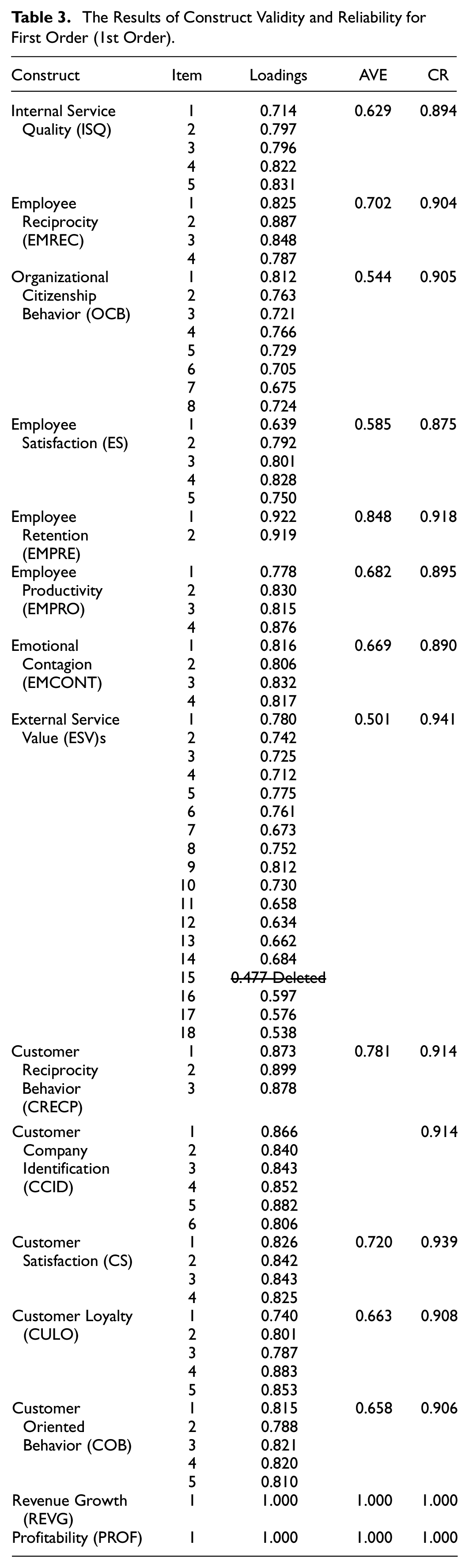
Table 3 displays the outcomes of the standardized factor loadings of the model items. Notably, the initial standardized factor loadings all exceeded 0.5 (the loadings range from 0.576 to 1.000), except for item number (15) for ESV, which was below 0.50; hence, this item was deleted. From Table 2, the AVE values for all the constructs ranged from 0.501 to 1.000. These values exceeded the cut-off value of 0.5, as proposed by Hair et al. (2019). Furthermore, the values of composite reliability for all the constructs ranged from 0.875 to 1.000, and these obtained values all surpassed the proposed value of 0.7 for all the constructs, as in Hair et al. (2019).
Table 4 displays the outcomes of the standardized factor loadings of model items. Notably, the initial standardized factor loadings exceeded 0.5 (the loadings range from 0.787 to 0.769). From Table 4, the AVE value for the construct was 0.728. This value exceeded the cut-off value of 0.5, as proposed by Hair et al. (2019). Furthermore, the value of composite reliability for the construct was 0.930, and this obtained value surpassed the proposed value of 0.7 for all the constructs as in Hair et al. (2019).
The Results of Construct Validity and Reliability for Second Order (2nd order).

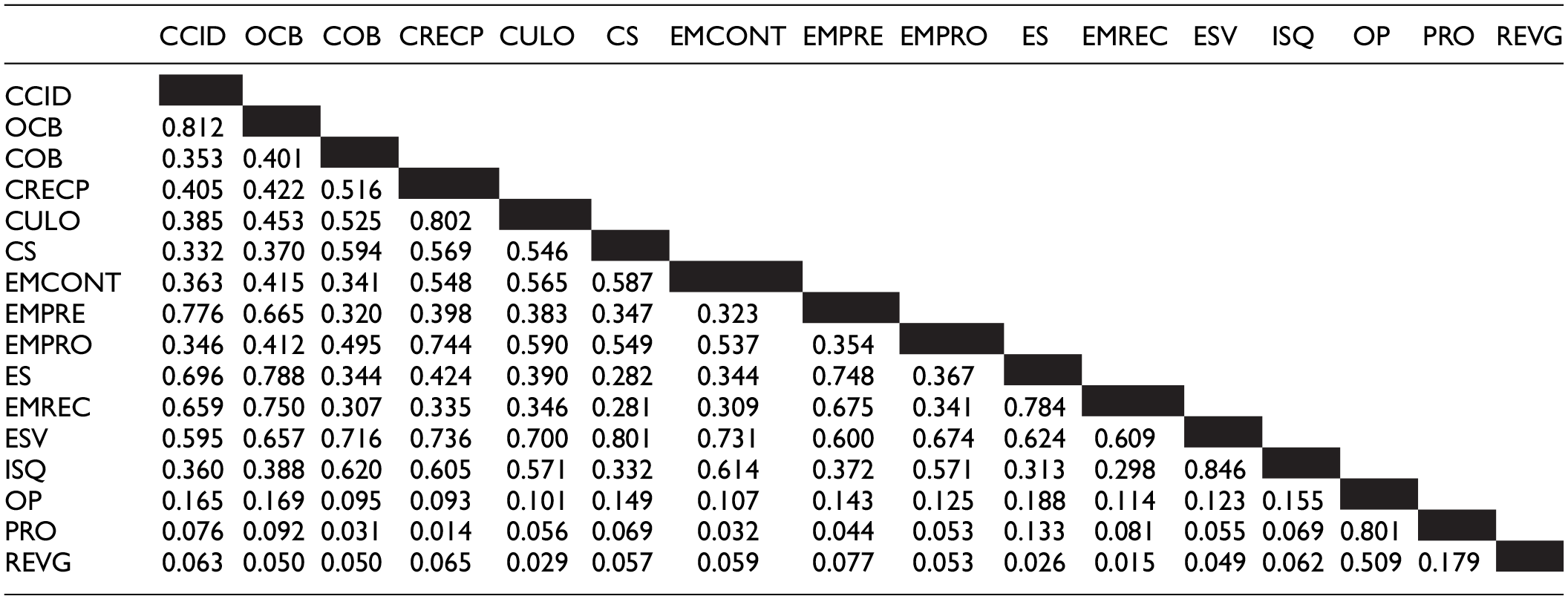
This study obtained HTMT for the model constructs (Henseler et al., 2015).
From Table 5, all the HTMT values of the constructs in the CFA model were below 0.90, ranging from 0.014 to 0.812. Therefore, it confirms that each latent construct measurement was discriminating against the other (Henseler et al., 2015). This study’s results revealed that the measurement scale to assess the constructs and their relative items in the overall CFA model was reliable and valid.
The Results of Discriminant Validity (Using HTMT).

Structural Model and Hypotheses Testing
Table 6 displays the results of hypothesis testing. The values of R2 for direct impacts were acceptable and ranged from moderate to high. Also, the table above shows that the VIF for inner model values were 2.331, 2.439, 3.721, 1.214, 1.635, 1.187, 2.131, 2.372, 1.392, 1.000, 2.410, 2.491, 1.958, 1.662, 1.764, 1.439, 2.222, 1.737, 2.993, 1.897, and 1.671, respectively, representing all the direct relationships below 5 (Hair et al., 2019). For predicting the dependent factors, Table 5 shows significant and acceptable results for all hypotheses (i.e., H1, H2, H3, H4, H5, H6, H7, H8, H9, H10, H11, H12, H13, H14, H15, H17, H19, H20, and H21), except H16 and H18 which were not supported because their p-values exceeded .05.
Results of Direct Links.

Note. Significance at the level 1%, 5%, and 10%.
Moreover, as you can see in the above table. The R2 values were in line with Chin’s (1998), recommendation where the values ranged between 0.33 and 0.67 which means acceptable results. In addition, Table 6 refers to the Q2 value for the dependent variable which was more than .0 to be consistent with Hair et al.’s (2019) recommendation, Finally, for the F2 values, Table 6 shows acceptable results since values ranged between 0.15 and 0.35.
From the Bootstrapping outcomes displayed in Table 7, and based on Hair et al. (2019) and Preacher and Hayes (2008), the mediation role of suggested factors was supported and exist. The results showed a statistically significant mediation role for all hypotheses measuring mediations (i.e., H22, H23, H24, H25, H26, H27, H28, H29, H30, H31, and H32). Moreover, Figure 3 below shows the structural model for the hypotheses tested in this study.
Results of Mediation Links.


The structural model.
Discussion and Implications
This study expanded the understanding of the SPC model by adding some new intervening factors beyond the original and traditional model developed by Heskett et al. (1994), including employee reciprocity, organizational citizenship behavior, emotional contagion, customer reciprocity, customer company identification, and customer-oriented behavior. As shown in the findings, this study supports the indirect influence of ISQ on business performance through several mediating factors related to the internal and external perspectives of the SPC theory (i.e., I-SPC and E-SPC). Although the previous studies showed similar findings, this study reveals a more integrated and enhanced overview and understanding of the mechanism of links within the SPC model. The findings of this study show that the I-SPC variables (i.e., ISQ, ES, EMPRE, EMPREC, EMPRO, and OCB) leveraged the role of E-SPC variables (i.e., customers’ perception of service quality, satisfaction, and loyalty) in improving business performance.
The findings also indicate that the majority of central and conventional direct links of SPC have been accepted and supported by showing positive and significant links between ISQ, employee satisfaction and retention, reciprocity, organizational citizenship behavior, external service value, customer satisfaction, and loyalty of customers, which is consistent with the previous key papers in this area of research (e.g., Adeinat & Kassim, 2018; Heskett et al., 1994, 1997; Hong et al., 2013; Jiang et al., 2012; Loveman, 1998; Pritchard & Silvestro, 2005; Silvestro & Cross, 2000; Yee et al., 2010, 2011; Zablah et al., 2012).
However, two hypotheses did not show significant links (i.e., H16 and H18). In other words, this study finds an insignificant link between EMPRO and COB, as assumed in H.16 Having such a result means that being a very productive employee will not lead to making employees focus on customers’ benefits, interests, and concerns as a priority, as claimed by Mei-Liang and Kuang-Jung (2010) and Hennig-Thurau (2004), which means a high level of customer-oriented behavior as assumed in this paper. Having such a result is logical since productivity refers to the input/output ratio rather than being so sensitive to customers’ needs and wants. In this regard, Bowen and Schneider (2014) found that sweet-hearting behavior by employees who are loyal to their organizations are going to strive to benefit their organizations first rather than their customers, as claimed and assumed in customer-oriented behavior. Accordingly, the finding of H16 is acceptable when concluding that productivity programs are aiming to benefit organizations first before benefiting customers.
In addition, this study finds an insignificant link between CRECP and CS assumed in H18, as shown in Table 6. It is worth noting that the satisfaction mirror introduced by Heskett et al. (1997) and Hennig-Thurau et al. (2006) depends mainly on the contributions, effects, and role of reciprocity and emotional contagion between employees and customers, as assumed in H11, H12, and H17. Having said this means that the link between customer reciprocity and customer satisfaction as suggested by Heskett et al. (1997) and Hennig-Thurau et al. (2006) includes the mechanism of influence happening between employees and customers rather than understanding the mechanism of influence within customers only as assumed and introduced before in the social exchange theory (SET).
As assumed in this study, the findings show that ISQ improved positively, directly and indirectly, several job attitudes, such as employee satisfaction, employee retention, organizational citizenship behavior, and employee productivity. Such findings are consistent with previous studies (e.g., Adeinat & Kassim, 2018; Batt & Colvin, 2011; Chicu et al., 2016; Jiang et al., 2012; Loveman, 1998; Sharma et al., 2016; Voss et al., 2005). This study finds that the higher the level of ISQ, the higher the level of ES, OCB, EMPRO, and EMPRE. Consistent with the social exchange theory and assumptions underlying reciprocity, this study finds that satisfied employees stay in their jobs and will extend such feelings to influence the behavior and attitudes of customers, as suggested and claimed by previous studies, once they have good HR practices and conditions (i.e., ISQ) offered in the ISQ programs (e.g., Flynn, 2005; Wayne et al., 1997).
As previous studies claimed (e.g., Adeinat & Kassim, 2018; Ehrhart et al., 2011; Hogreve et al., 2017; Loveman, 1998; Sharma et al., 2016; Silvestro & Cross, 2000 ; Voss et al., 2005; Yee et al., 2010, 2011), this study finds that ES and EMPRE influence ESV positively since having loyal, committed, and passionate staff will enhance service quality. In addition, this study finds that EMPRO influences ESV significantly and positively since having employees who do their tasks properly and efficiently will allow them to enhance ESV assessed by customers (e.g., Adeinat & Kassim, 2018; Pritchard & Silvestro, 2005; Silvestro & Cross, 2000). In addition, this study finds that ES helps in improving several employees’ and customers’ attitudes, such as EMPRE and EMPRO (e.g., Adeinat & Kassim, 2018; Loveman, 1998; Voss et al., 2005).
More importantly, this study supports what was identified in the literature that CS acts as a key and significant antecedent of customer behavior and attitudes, such as customer loyalty, which in turn leads to better business performance (e.g., Andreassen, 1994; Bagozzi, 1992). Hence, this study confirms the idea that satisfied customers are going to be engaged in activities that lead to loyalty, such as continuance relationships and having positive word of mouth and recommendation (E. Anderson et al., 1994; Hallowell, 1996; Loveman, 1998; Reichherld & Sasser, 1990; Yi, 1990).
This study also shows that having satisfied staff with positive feelings about their jobs’ characteristics will make customers with higher emotional contagion have similar positive emotions and expressions. More importantly, the findings show that EMCONT plays a significant mediating role between ES and CS, indicating that EMCONT helps to enhance positive feelings upon customers once employees are satisfied with their jobs according to the SE as suggested in the social exchange and social identity theories (e.g., Barger & Grandey, 2006; Hennig-Thurau et al., 2006; Heskett et al., 1997; Sutton, 1991).
Although this study did not support two direct links (i.e., EMPRO-COB and CRECP-CS), the findings of this study support the mediation role for all mediation factors (Table 5), that is, the indirect and mediated links including, H22, H23, H24, H25, H26, H27, H28, H29, H30, H31, and H32. This means that all mediating factors included reported positive and significant intervening roles. Accordingly, this study confirmed the previous and new assumptions and links within the SPC model by supporting the idea that employee attitudes (i.e., job satisfaction and retention) helped in improving ESV as mediators. In addition, this study confirmed the idea that customers’ attitudes (i.e., customer satisfaction and loyalty) mediate the impact of ESV on OP. However, this study added more understanding of the SPC model by adding more mediation factors, such as OCB, CCID, EREC, CRECP, and COB.
This study offered several interesting theoretical implications. This paper identified the research gap in the SPC literature by extending the conventional model of SPC theory. Moreover, this study contributed to the relevant literature by adding some new mediating factors never tested before empirically and simultaneously in one single framework, according to the knowledge of the researchers. Having done this might help in offering an interesting opportunity to expand the insights of the SPC theory. More importantly, this study used triadic perspectives for measuring the framework by having several resources and perspectives for collecting data and respondents: customers, employees, and managers. This paper also supported and validated the linkage between the two perspectives of the SPC model (i.e., I-SPC and E-SPC) by using a heterogeneity data set, that is, different service types within the service sector.
Moreover, the findings of this study indicated that the effect of ISQ on business performance goes beyond the traditional role and affects employee and customer satisfaction and loyalty. In other words, reciprocity, retention, emotional contagion, organizational citizenship behavior, and customer identification are some powerful factors in bridging the link between ISQ and business performance (i.e., I-SPC and E-SPC). More importantly, the findings of this study revealed that ISQ positively impacts employee productivity through the mediating impact of employee satisfaction and organizational citizenship behavior. Having said this, it implies that the ISQ is helping in improving efficiency and flexibility indirectly via the mechanisms of employees’ attitudes and feelings.
The findings of this study highlight and confirm the importance of several disciplines contributing to the SPC model (a multi-disciplinary topic) such as HRM (i.e., ISQ, employee satisfaction, employee satisfaction, and retention, organizational citizenship behavior, and reciprocity), marketing (i.e., ESV, customer satisfaction and loyalty, customer company identification, reciprocity, and contagion), operations management (i.e., productivity), strategic management (i.e., performance measurement system, intellectual assets, etc.) by integrating several theories, including SPC. SET and SIT.
This study also measured factors in the research framework by having multi-dimensional aspects of constructs under investigation. Moreover, this study tested the validity of this model in one of the most progressing economies in the World—Saudi Arabia. In addition, one of the other strengths of this study is that several service business types within the service sector were surveyed. Having done this might enhance the generalization ability of the findings obtained in this study. In addition, this study offers an easy tool to enhance the implementation of the SPC theory by showing key directions and factors that should be involved. Since the SPC model offers a road map for how to improve business profitability due to investment in internal factors, this study extended the original SPC model by including some new operational factors. Finally, this paper has proven, confirmed, and validated the link between the I-SPC and the E-SPC. Thus, this study investigated the dual perspectives of the SPC. In addition, this study has offered more support for several key theories, such as the social exchange theory and the social identity theory.
In terms of the practical implications, this study offered several recommendations and implications for practitioners. This study insists on the idea that managers should focus not only on the three key factors within the conventional SPC model (ISQ, ESV, and CS). Managers now need to give more attention to improving employee productivity programs, employee reciprocity, and organizational citizenship behaviors. In other words, the findings show that investing in reciprocity, emotional contagion, and OCB programs is imperative. In addition, the results of this study show that managers should focus on customer identification stimulation programs since such a factor accelerates and helps in securing better relationships with customers beyond the impact of CS. Managers, even in small service businesses, need to encourage and enhance the relational approach with customers, not only the transactional approach, in enhancing and securing customer loyalty. Hence, managers should not rely only on customer satisfaction programs to secure positive links within the SPC model. In contrast, CCID programs should be incorporated into the strategic direction of any service company. Hence, strong emotional bonds between customers, employees, and companies will be secured, which, in turn, will improve business performance significantly.
Managers should also focus on the job attitudes of service workers by offering training programs for how to enhance OCB, EMPRO, and COB since services have distinctive intangible features and characteristics. This will secure positive service quality, customer-company identification, and retention. In addition, the findings of this study highlight the need for service companies to improve their service and customer-oriented culture, even in small-sized service organizations. To be more specific, the front-line employees should be more people-oriented, warmer, and friendly. Having done this will significantly help in linking employees’ capabilities with customer satisfaction and identification. Briggs et al. (2020) encouraged managers to use the servant leadership style with employees to encourage and inspire them to be more service and customer-oriented.
Limitations and Future Research
This study has some limitations due to the complexity of the research framework. Namely, this study could not add some other factors that could enhance the understanding of the SPC’s mechanism more. Such factors could include employee engagement, as suggested by Cain et al. (2018). Therefore, future studies are encouraged to include such factors. This study encourages future researchers to replicate this study in a service setting. Future research can re-test this research framework in a large chain company at the branch unit level with a larger sample size. Longitudinal research, not only a cross-sectional approach, is encouraged to test the SPC model to properly understand the causality among factors under investigation.
Moreover, a leadership approach should be used in the future as an intervening factor within the SPC model. Since this study was conducted in one country and one city (i.e., Saudi Arabia, Riyadh), it is recommended to have a similar study in some other countries in the MENA region with similar cultural settings to assure higher generalizability of its findings. Future studies should distinguish between high and low-service-contact companies. Moreover, future studies should consider the size of the service organization as a moderating factor.
Conclusions
Using empirical data obtained from 201 service companies using a survey approach in Saudi Arabia from different perspectives: customers, front-line employees, and managers, this study validated the traditional view of the SPC theory by supporting the idea that ISQ leads to better business performance. In other words, the findings of this study confirmed the direct and indirect links between ISQ and business performance via well-known factors such as employee satisfaction and retention, external service value, and customer satisfaction and loyalty. More importantly, this study supports the assumed links for the new intervening variables that have been added to the research framework developed in this study (i.e., employee reciprocity, organizational citizenship behavior, emotional contagion, customer reciprocity, customer company identification, and customer-oriented behavior). However, this study did not support the direct link between employees’ productivity and customer-oriented behavior due to issues related to achieving the company’s interests rather than the customer’s interests. To conclude, this study shows that the new intervening factors show significant mediating roles among the key and traditional variables within the SPC model. Having said this, and based on the main aim of the study, the current paper offers a deeper understanding of the conventional (SPC) model developed. Accordingly, this study enhanced the basic conventional model by adding several mediating factors and links suggested in the literature. Firstly, this study confirmed the link between the internal service profit chain variables (I-SPC) and the external service profit chain variables (E-SPC) and outlined the mechanism of links between variables related to those two perspectives (i.e., I-SPC vs. E-SPC). To conclude, Table 8 shows and summarizes the findings of hypotheses developed in this study.
Summary of Hypotheses.

Table 8 shows two different mechanisms for linking variables. In other words, the previous Table shows direct links between several factors as reported in H1, H2, H3, H4, H 5, H6, H7, H8, H9, H10, H12, H13, H14, H15, H16, H17, H18, H19, H20, and H21. Moreover, Table 8 displays indirect and mediated links between several factors as indicated in H22, H23, H24, H25, H25, H26, H27, H28, H29, H30, H31, and H32. In addition, the previous Table shows that the developed hypotheses address two different perspectives of understanding the SPC model, that is, Internal Service Profit Chain (I-SPC) versus External Service Profit Chain (E-SPC). All hypothesized links have been supported and validated except for two links (i.e., H16 and H18), which indicate a valid, enhanced, and improved framework for understanding the SPC theory in comparison to the conventional model as discussed earlier.
Footnotes
Declaration of Conflicting Interests
The author(s) declared no potential conflicts of interest with respect to the research, authorship, and/or publication of this article.
Funding
The author(s) received no financial support for the research, authorship, and/or publication of this article.

Data Availability Statement
The datasets generated during and/or analyzed during the current study are not publicly available due to the fact that such data relates to details of employees and customers, as well as the performance of companies under investigation but are available from the corresponding author on reasonable request.