




Abstract
The increasing pace of globalization and competition for highly skilled professionals have accelerated the international mobility across national boundaries for knowledge exchange and economic reasons. The purpose of this study was to examine the current trend and determinants of migration intentions in China. For this purpose, we carried out a survey in China from 2021 respondents by using a probability sampling technique. For empirical estimation, we employed the logistic regression estimation technique to compute and evaluate the data. In the findings of this study, several push-and-pull factors have been identified for both inflow and outflow of skilled human capital in China. The findings of this study derived that high wages outside China and low wages within China are considered as the top reasons to leave China. In addition, more opportunities and a better lifestyle in the host countries are the key factors to push skilled human capital from China. The results also indicate that better education in the host countries has a positive correlation with migration intentions in China. Therefore, it can be argued that education, wages, more opportunities and better lifestyle are the significant push factors that determine why highly educated people emigrate from China.
Introduction
In the new global marketplace, skilled human capital is considered as one of the fundamental factors of sustainable economic growth and development. In fact, no country can achieve sustainable economic growth and development without substantial investment in skilled human capital development. Internationalization makes it easier for skilled human capital to migrate from one country/region to another region for the sake of knowledge exchange and socioeconomic benefits. Human capital flight (brain drain) is an international migration, which refers to the migration of skilled human capital who received advance training, education, and skills at home and move to the host country for the sake of socioeconomic benefits (Adina-Iulia & Blaga, 2015). Brain-drain migration cause the source country to lose their trained, well-educated, and skilled human capital who would be considered the natural leaders in terms of economic, social, and technological development. For many developing countries, achieving Sustainable Millennium Development Goals (SMDG) and particular national targets is threatened or hampered due to lack of skilled human capital such as doctors, engineers, academicians, nurses, and technicians who emigrate to more advanced countries (Bradley & Thébault, 2019; Hatton, 2014; Su et al., 2018).
Recently, worldwide, countries are struggling to train and attract skilled human capital to meet their human capital demand. In the modern world, skilled human capital is considered as a key driver for innovation and development (Fransen et al., 2017; Warner & Zhao, 2018). Recently, the number of international migrants has been increasing dramatically worldwide. The number of international migrants increased from 220 million in 2010 to 258 million in 2017 (Qin, 2015). Moreover, the International Organization for Migration (IOM) assessed that 244 million (equivalent to 3.4%) of the world’s population are living in countries other than their home countries (Segal, 2019).
As far as the Chinese economy is concerned, China is the second largest economy in the world, and ranked the world second largest foreign direct investment recipient after the United States (Zheng & Walsh, 2019). However, it has been noticed that the China’s economy is growing at its slowest pace since 2007 (Lin & Wang, 2019). But also, China faces demographic challenges. China has a rapidly aging population, both numerically and structurally. China is projected to have 280 million (one-fifth of the population) elderly by 2025 (Chen et al., 2016). While China’s fertility rate has fallen below the warning line, in 2019, the number of newborns dropped by 580,000 to 14.65 million (1.7 children per women), lower than 10.94 per 1,000 in 2018 and 12.43 per 1,000 in 2017, which was also the lowest recorded since 1952 (Chen et al., 2019; Xu et al., 2019). However, in the past few decades, China has increasingly become a source and a destination country for migrants from all over the world: since 2017, there were 10 million Chinese migrants living and working overseas (IOM). Since 1979, more than 500 million Chinese migrants have been migrated from rural to urban areas (Su et al., 2018). According to the Ministry of Education of the P.R. China, the outflow of Chinese students from China is nearly about 610,000 in 2018, up to 11.7% rise from last year (Zhou et al., 2018). Most of the Chinese students and parents preferred to study in western and more advanced countries such as Australia, the United Kingdom, France, the United States, Japan, and Italy. Table 1 illustrates the statistics of Chinese students in different regions/countries in 2016 (Cebolla-Boado et al., 2018).
Number of Chinese Students in the Major Destination in 2015.

Source. Fatoki (2014).
Today, in more internationalized world, China changed rapidly from isolation to open-door policy. With open-door policy, China encourages and begin to send many students abroad for advanced studies. After graduation, the world welcomes Chinese graduates to participate in the labor market. Chinese skilled human capital is heavily sought after because they can adapt themselves anywhere, and still among the cheapest human capital in the world. Chinese skilled human capital is steadily flowing out to fill the soaring demands abroad. Approaches to offset this phenomenon have to be carried out immediately. Based on the aforementioned facts and background, this study aims to add, review, and empirically investigate the phenomenon of brain drain and brain gain migration in the new era happened in China. Current, study is important in several aspects. Skilled human capital is generally acknowledged as the great contributor to sustainable economic growth for any country but more specifically it is significantly contributed to Chinese economic growth and development. However, the migration of highly skilled and professional labor has been a major concern for many developed and developing countries. That is why it is the need of the time to assess the more current trends and determinants of migrant intentions from China. This study would be beneficial for policymakers to design more productive and effective policies in the long term for China.
To meet our objective, the novel contribution of this study to the literature is the empirical estimation of the benefit that the migrant brings in the form of positive spillovers; skill-based externalities that extend to the entire labor force working around him. The respective costs and benefits vary by the skill of the migrant. Theoretically, this study offers an innovative analytical and methodological approach to assess the current trends and determinants of migrant intentions for socioeconomic reasons from China. The research makes a methodological contribution by employing different primary and secondary data collection techniques, in addressing issues related to brain-drain migration in China. This study applied the advanced regression techniques to analyze the trend and determinants of migration intention in China.
The rest of article is organized as follows. In the “Related Literature Review” section, we provide the overview of the literature. Following this, in the “Research Method” section, we discuss the methodology and data collection procedure. In section “Results and Discussion,” we discuss the analyses and results, and in the “Conclusions and Policy Recommendations” section of the article, we make some concluding remarks.
Related Literature Review
This concept of brain-drain migration was coined by the British Royal Society in the 1960s. It is defined differently by different authors, for example, by Beine et al. (2011): “brain-drain migration is the proportion of working individuals (age 25 and over) with at least tertiary education, born in a given country but living elsewhere.” Later, brain-drain migration was used to refer to the physical movement of highly skilled, trained, and educated people from one country to another in search of better opportunities, better lifestyle, employment with the consequent loss to the country of their knowledge, intellectual richness, and diverse innovative skills required for that country’s economic development (Bénassy & Brezis, 2013). Skilled human capital is an asset that can be used to support or acquire other assets. Brain-drain migration has a significant economic, social, and cultural impact on both source and recipient countries.
Hypothesis Development
Although the decision to migrate is a complex phenomenon that includes set of factors that push people to migrate from one country/region to another country/region. The set of push factors includes less opportunities, poor pay, unemployment, poor health and education, insecurity, poor working environments, and corruption (Boncea, 2015; Magris & Russo, 2009; Pi & Zhang, 2016), while the set of pull factors includes the factors that pull an individual to other country/region for better education and health, more employment oppertunties, life security, and easy immigration regulations (Dibeh et al., 2019; Pi & Zhang, 2018; Taylor et al., 2003). The push–pull factors are divided into different categories: (a) individual socioeconomic factors, (b) incentives and opportunities, (c) institutional factors, and (d) labor market factors.
Education and Brain-Drain Migration
The available evidence from previous studies finds out that education in both host and home country/region plays an important role in individuals’ decision-making. Prior studies emphasized that the poor education in home countries/regions increases the probabilities to move from home to host countries/regions for the possibilities of good pays, more opportunities, and decent living style (Ashraf et al., 2018; X. Wang et al., 2019), while better education in host country/region is the main pull factor to attract young talent to the host country/region (Pan, 2015). Mulitiple studies establised a direct and positive correlation between brain-drain migration, education, and transfer of technology (Shafqat & Xia, 2019; Waite & Smith, 2017). In fact, brain-drain migration becomes brain gain for home countries when the well-educated and skilled human capital are back to their home countries with international exposure and expertise (Brzozowski, 2008).
Wages and Brain-Drain Migration
The labor emigration literature devotes much more attention to workers’ poor pay. Wages are considered the key factor that can play a major role in emigration decision (Beine et al., 2001; Cebolla-Boado et al., 2018; Loubaki, 2012). In the econonomics literture, the poor pay in home countries and high pay in host countries are concidered the key aspects that can increase the chances of emigration from home to host countries (Z. Wang & Jing, 2018). Most of the countries are trying to attract well-educated professionals by offering them decent pay and better working facilties (Jiang et al., 2018; Mu & Yeung, 2018). Moreover, poor pay and high cost of living in developing countries encourge the workers to migrate from home to host countries (Azizi, 2018). One of the studies (Byra, 2013) found out that good pay, better working environment, and good career development are the microeconomic factors that directly affect the individual behavior to stay or leave the home country.
Social Security, Social Welfare, and Brain-Drain Migration
The social security and welfare aspects of brain drain have been relatively unexplored in the migration literature due to lack of migration dates. Although the relationship between emigration and lack of social security is not a new phenomenon, Baruch et al. (2007) provide a more extensive dataset for social security and welfare migration from selected countries in selective years. The finding of the study explored the positive and direct relationship between social security and welfare with migration. Also, migration is linked with both financial and non-financial benefits such as retirement allowance, health and education allowance, taxation benefits, and unemployment package (Beine et al., 2011). Furthermore, countries with high risk and violence, such as high crime rate, push the human capital from one region/country to another region/country for the sake of life safety (Dibeh et al., 2018; Liang, 2001; Zhao, 1999).
Family Bonds, Cultural Attachments, and Brain-Drain Migration
No doubt that international migration has both incentives and opportunities for host countries. Attraction in the receiving countries includes flexible immigration policies, higher salaries, and better research and working environment (Lu et al., 2018). The flexible immigration polices play crucial rules in migration decisions of individuals. One example is the H1-B visa policy introduced by the United States in 1990 as the U.S. Immigration and Nationality Act for non-immigrant to attract foreign skilled human capital to work in the United States (Segal, 2019). There are three different stages that play a key role when people are making migration decision: desire and intention to move, consideration to move, and expectation of movement behavior (Boncea, 2015; Steinberg, 2017). The intention to stay in or return to host countries is mostly influenced by attachment with family and friends in their home country. Moreover, the return intention is linked with their expectations of life in origin countries as compared with their expectation in the destination receiving countries (Beine et al., 2011; Fatoki, 2014; Korobkov & Zaionchkovskaia, 2012; McGill, 2013). The following hypotheses are proposed:
Research Method
Conceptual Framework
Different theories and theoretical models explain why and how international migration happens. The conceptual framework of our study is based on the random utility theory and related literature review (Ifanti et al., 2014; Iqbal et al., 2019; Wen et al., 2018). A number of studies focus on the determinants of migration, while a smaller part of the literature pay attention to the push–pull factors in regular migration. These push–pull factors play a key role in individuals’ decision-making during migration and those decisions are based on the random utility theory (Horowitz et al., 2014). Random utility theory posits that people generally choose what they prefer, and where they yield maximum utility. Random utility theory is based on the hypothesis that every individual is a rational decision-maker, maximizing utility relative to his or her choices (Iqbal et al., 2019). Here, Figure 1 explains the theoretical framework of this study.

Theoretical framework of the study.
Data Collection
Related methods for this study have been selected on an opportunistic basis. These surveys, interviews, and focus groups all support the research efficiently. A closed-ended questionnaire method was adopted for data collection. This new technology has eased the process of collecting responses, thus this study generated its own microdata base through Survey Monkey (https://www.surveymonkey.com/). Online surveys help to minimize the cost, time, and accessibility to the real-time and convenience respondents of the study (Zhou et al., 2018). Moreover, examining human behavior and belief system requires both quantitative and qualitative approaches to search, as the former method tends to understand the prevalence of a particular practice, behavior, and belief.
The participants of the survey were employed, students who were already graduated and looking for jobs, and students who were about to graduate. After eliminating the irrelevant information, the valid sample size was 2,021. Samples were collected from urban (Beijing, Shanghai, Shenzhen, Guangzhou, and Chengdu) and rural (Gansu, Anhui, Qinghai, Jilin, and Guizhou) areas in China based on the accessibility to respondents. In this study, we used a 5-point Likert-type scale for questionnaire measurment, beceause it is a useful method to collect primary data. Also, the Likert-type scale generates reflection on each factor and is considered significant to the overall agreement (Iqbal et al., 2020). In this article, we use three unique sets of variables that perfectly explain the migrant intentions to migrate: (a) a set of demographic variables (age, gender, etc.), (b) a set of explanatory variables (work experience, socioeconomic background, etc.), and (c) a set of perception-related variables (work environment, perception about wages, lifestyle, family ties, etc.).
Descriptive Statistics
In Table 2, we demonstrate the descriptive statistics of the study. In this survey, 52% of the participants are female, while the rest of the participants (48%) are male. Majority of the survey participants (48%) are single, and 43% of the participants are in relationship or married. We divided the participants into different age groups: 26% of the survey participants are in the age group of 33–37 years; 24% are in the age group of 28–32 years; and 20%, 16%, and 15% are in the age groups of 18–23, 24–27 and >37 years, respectively. We divided the participants into two groups based on their living area: urban and rural, where, 89% of the survey participants belong to urban areas, and the rest of the participants (11%) belong to rural areas. We also paid much attention to participants’ education: 58% of the participants are well educated holding a master’s degree, and 26% of the participants are PhD degree holders. To know the current employment status of the participants, we divided them into employed and unemployed groups, where 74% of the participants were employed and the rest of the participants (26%) were unemployed. To know the financial status of the participants, we divided them into different income groups: a huge portion (40%) of the participants are in the group of 10–20,000 RMB per month, while 18% of the participants are in the group of 20–25,000 RMB per month. It is important to know the discipline of the participants: discipline-wise response shows that 29% of the participants are from medical sciences, while 27% and 25% are from social sciences and engineering sciences, respectively. Regarding the profession of the participants, 30% of them are doctors, 25% are engineers, and 26% are teachers by profession.
Brain Drain Descriptive Position in China.

Correlation Matrix
In Table 3, we establish the correlation between future intentions to migrate and the determinants (push–pull factors) that play an important role in migrants’ intention to move abroad. The findings of the correlation matrix show that future intentions to migrate are negatively correlated with better lifestyle, better education, more opportunities, and lack of facilities in China. This result shows that the above push–pull determinants discourage migrants to migrate from China. Also, the correlation between future intentions to migrate and poor pay is statistically significant and positively correlated in China. The results indicate that the poor pay in China and decent pay in overseas encourage migrants to migrate from China. In short, in Table 3, there is no multicollinearity among the concerned variables. Moreover, there is positive correlation between decent pay in home country with better lifestyle, poor pays, and more opportunities; these results are validated by X. Wang et al. (2019). Finally, lack of basic facilities and poor pays are negatively correlated, and the results are validated by Walani (2015).
Results of Pearson’s Correlation Matrix (N = 2,077).

Note. BNDR = brain drain; HW = high wages; MOPL = more opportunities and better lifestyle; BED = better education; LSFO = lack of social security, basic facilities, and opportunities; LW = low wages.
Econometric Strategy
In this study, to analyze the correlation between the variables, a series of Pearson’s product correlation has been used. To examine the predictive power of all factors, we used logistic regression analysis to predict the future intentions to migrate from China. To analyze and compare other categories, we used the cross-tabulation method; to analyze the primary data, we used statistics and data (Stata).
Model Specification
In the proposed model, we take BNDR (brain-drain migration intention) as a regression variable with a discrete choice and binary outcome. If an individual plans to migrate, we assign a value of 1, and if there is no future intention to migrate, we assign a value of 0. Because of the limited number of (binary) dependent variables, we used logistic regression, linear probability, and simple regression models. The logistic regression model has the ability to solve the biasness problems that could possibly occur in simple regression and linear probability models. Logistic regressions are flexible with explanatory variables and give meaningful interpretation of the results (Shafqat & Xia, 2019). Hence, we used the logistic regression model in this study. This model is shown as follows:

where P(BNDRi = 1) is the probability that represents the individual who has absolute future intention to migrate, α is the intercept, Xi is the explanatory variable, and β is the coefficient vector. Let

Equation 2 represents the logistic distribution function along the natural logarithm base, that is, “e.” It also shows the probability of future migration intention, while Equation 3 represents the probability with no future migration intention:

Equation 4 illustrates the natural logarithm of probability ratio,

As we have supposed that α


where Yi is the log of odds, α is the intercept, Xi is the explanatory variable, β is the coefficient vector, and ε0 is the error term. Finally, the functional form of econometric models is as follows:
Push factor logistic regression:

Pull factor logistic regression:

Push-and-pull factor logistic regression:

In Equations 7 to 9,
Results and Discussion
Cross-Tabulation Analysis
In Table 4, we explored the migrant future intention across the demographic characteristics through cross-tabulation analysis. The results of the survey show that 52% of the participants show their positive interest to migrate from China, while the rest of the participants (48%) have no interest to migrate from China. People living in urban areas (49%) have more interest to migrate as compared with rural areas (41%). In addition, men (55%) have more interest to migrate from China as compared with women (42%). Participants who are married and have family (52%) have more migration interest as compared with single participants (48%). Regarding the age group, almost half of the participants (51%) have more future migration intention at 28–37 years of age.
Demographic Characteristic Brain-Drain Intention Patterns (N = 2,077).

Career development after graduation is the most important factor that affects the migrant future decision to move or stay in their home country/region. The current survey shows alarming results by education: 68% of the participants having a technical degree, 61% holding a PhD degree, and 50% holding a master’s degree show interest to migrate from China. The participants identified different factors that affect their future decision to migrate, such as pollution, lack of good education and health facilities, and lack of better opportunities. The study results were validated by the work of Heitor et al. (2014). Moreover, there are more interesting results related to the majority of the participants. Here, 53% of the participants holding engineering-related degrees and 51% holding medicine-related degrees have high intentions to migrate, whereas the participants holding degrees related to social sciences (44%) have less intentions to migrate as compared with other science-related degree holders. Moreover, the participants who are more professional are more likely to migrate. The survey results show that 55% of the participants related to medical profession and 53% related to engineering profession have more migration intentions as compared with other professions such as teachers (49%).
Push-and-Pull Factor Estimation Results
In Table 5, we estimated three different logistic models: push factor (Model 1), pull factor (Model 2), and push-pull factor (Model 3). For estimation, we applied the logistic technique due to the binary nature of the variables. The findings of this study show that decent pay in overseas and poor pay in China are considered as the main reasons for migrants to migrate from China. Decent pay in overseas and poor pay in China are statistically significant. These results are also validated by the work of Di Maria and Lazarova (2012). The coefficient of poor pay is higher than that of the decent pay, which shows that poor wages in home countries/region push migrants to countries/region with decent pay (Wen et al., 2014). Furthermore, the findings of the study show that more opportunities and better lifestyle in overseas are the determinants that motivate migrants to migrate from China to overseas. The findings also show that more opportunities and better lifestyle in overseas show significant but negative correlation with migrant future intention in China. Countries with less opportunities and poor lifestyle push migrants to more advanced countries for better future (Kandemir, 2012). The country of orgin that creates an environment to provide more jobs and business opportunities plus improve the living standard can play a vital role to stop migration and attract global talent (Welch & Zhen, 2008). Moreover, the lack of social securities and social welfare has a negative correlation with migrant future intention in China. It shows that the home country with lack of social securities and social welfare push migrants to a host country (Chen et al., 2016). The results also show that the better quality of education in overseas has a significant and positive correlation with the migrant future intention. Generally, Chinese parents strongly encourage their children to study overseas for bright future and international exposure to become a strong and independent human being (Okeke, 2013). To reduce this flow, the Chinese government has to improve and update its national education system.
Logistic Regression Model (Dependent Variable = BNDR) (N = 2,077).
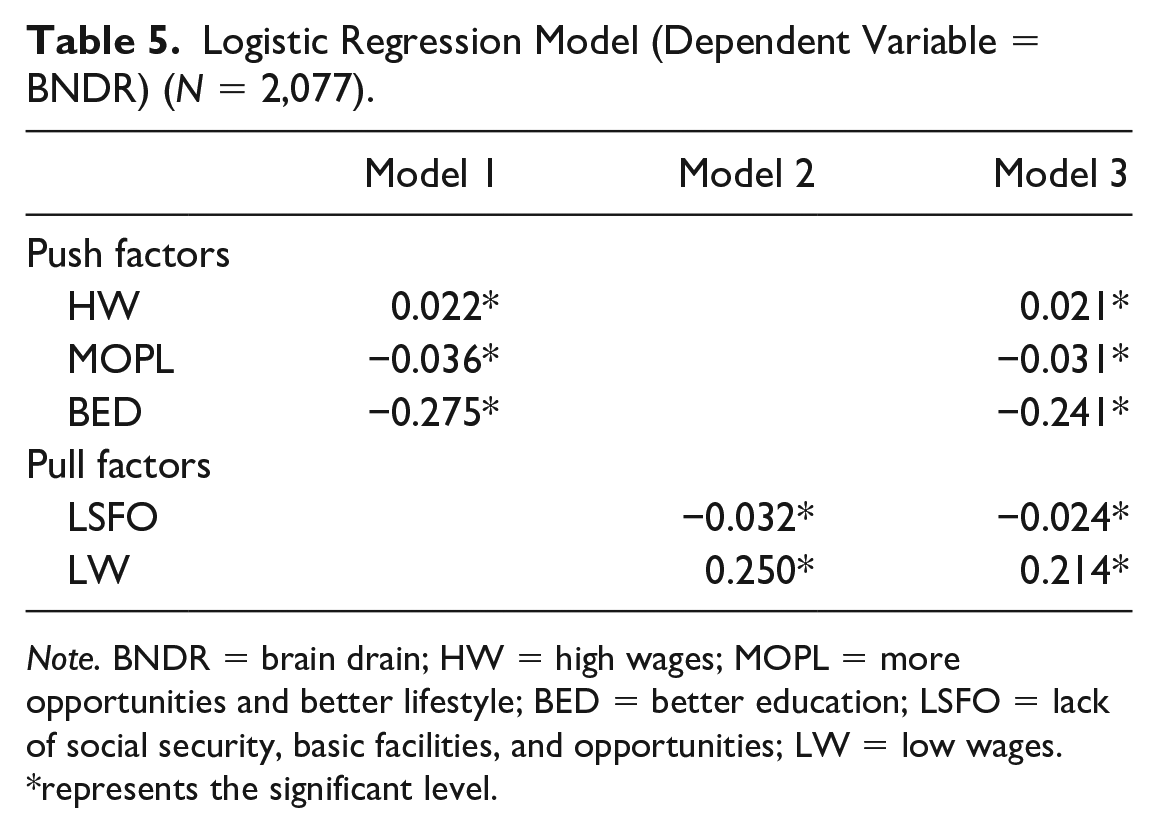
Note. BNDR = brain drain; HW = high wages; MOPL = more opportunities and better lifestyle; BED = better education; LSFO = lack of social security, basic facilities, and opportunities; LW = low wages.
represents the significant level.
Goodness-of-Fit and Variance Inflation Factor
In each model, logistic goodness-of-fit (GOF) is systematically applied at 1% level of significance (refer to Table 6). To find out the functional type and omit parameter problems, the relation test was applied (Hosmer et al., 1997). The prediction square (hats) is statistically insignificant, which showed that the relation test was passed by all of our models. In primary data processing, there is a possibility of multicollinearity. Estimated magnitudes are unreliable and standard errors have been highly exaggerated. To diagnose the degree of multicollinearity in the results, the variance inflation factor (VIF) and tolerance (I/VIF) provide complete sample. Logically, the data may need to be further examined if the values of VIF and tolerance exceeded 10 and 0.1, respectively. The mean VIF value is 1.01, push factor model value is 1.00, and pull factor model value is 1.03, so both factors are suitable (see Table 6).
Goodness of Fit (GOF) and Variance Inflation Factor (VIF).

Note. Hat and hatsq indicate the prediction and prediction square, respectively; TOL = tolerance level; HW = high wages; MOPL = more opportunities and better lifestyle; BED = better education; LSFO = lack of social security, basic facilities, and opportunities; LW = low wages.
1% level of significance.
Conclusions and Policy Recommendations
The purpose of this article was to examine the more recent trend and determinants of migrant future intentions in China. The number of factors has been identified in this article. Based on the empirical analysis, the findings of this study show that decent pay in overseas and poor pay in China are considered the top reasons for migrants to migrate from China. The decent pay in overseas and poor pay in China have a statistically significant positive correlation with migrant future intention. Furthermore, the findings of the study show that more opportunities and better lifestyle in overseas are the factors that push migrants from China to overseas. The results also show that more opportunities and better lifestyle in overseas have a negative correlation with migrant future intention in China. Moreover, the lack of social securities and social welfare has a negative correlation with migrant future intention in China. The results of the study also show that better education in overseas has a positive correlation with migrant future intention in China.
The population potential can be turned into economic advantages if the policymakers ensure to implement a labor-friendly policy. In this perspective, the government of P.R. China already applied a couple of policies such as Thousand Talents Program to attract skilled and professional workers. But still the Chinese law and enforcement agencies need to do more to formulate a strategy: (a) China needs to implement suitable macroeconomic policies to address the issues identified by the respondents of this survey; (b) China needs an active migration monitoring system that focuses and monitors migration movement; (c) the educational policies in China need to be revisited, and China needs to improve the basic structure of its education system and provide a good quality educational environment; and (d) to ensure fiscal and career incentives, China needs to revisit their labor policies, increase minimum wages, reduce taxation, and allow local businesses to compete with foreign businesses for talent hunting to offer them decent pays.
It must be noted that “intent to stay or leave” was used as a proxy for actual turnover (brain-drain migration). Hence, it is just a projective future indication for turnover, not actual turnover. The limitations of this study are other factors had not been examined and more research is needed to further validate the findings such as employing a non-stochastic sampling technique with limited data set which limits its generalizability. From the review of literature, this lack of information on brain-drain migration does not provide a solid base on which effective polices on brain-drain migration could be based to solve this problem. Systematic and comprehensive data need to be kept on the extent of the brain-drain migration by examining data in the home country and in major host countries. Comparative studies can be conducted in other Asian countries, such as India, Russia, Pakistan, and Bangladesh, to determine the differences in the context of developing countries.
Footnotes
Declaration of Conflicting Interests
The author(s) declared no potential conflicts of interest with respect to the research, authorship, and/or publication of this article.
Funding
The author(s) received no financial support for the research, authorship, and/or publication of this article.
