




Abstract
Physician emigration from developing and underdeveloped countries to developed countries is a growing problem that is taking place in current times and is an obstacle in achieving global health. Social circumstances, economic demands, as well as modern medical technologies and desire to pursue better career opportunities, are all driving factors for medical graduates’ emigration. This study investigates Turkish medical students’ intentions of pursuing residency training abroad and explores associated factors that play a significant role in instilling the tendency of moving overseas. A cross-sectional study was conducted at Ege University, Faculty of Medicine, İzmir, Turkey. Students’ future specialty intentions, preferred country for residency training, and the contributing factors in their decisions were questioned via an online survey questionnaire. Out of 617 students included in the study analysis, 183 (29.7%) expressed their desire for going abroad for residency training and Germany, United States of America, United Kingdom, and Canada were the top preferred destinations where 40 (25.3%) reported planning to stay permanently. Mother’s level of education and student’s training/ understanding of advanced levels of any foreign language were found significantly associated with the developed intention of going abroad for residency training. Qualitative analysis revealed better “living standards/conditions” was the most frequently uttered reason for studying abroad. It’s vital to know reasons out why medical school graduates want to go to another country. A better understanding of this issue will aid in developing actions to reduce the proclivity of medical graduates to relocate.
Introduction
Physician emigration from low and middle-income (LMIC) countries to high-income countries (HIC) is a growing obstacle to global health (Chen & Boufford, 2005). There is a severe scarcity of healthcare workers and other providers, including physicians, in developing and underdeveloped countries (Hallock et al., 2007). This situation has been a source of concern for a significant amount of time due to the fact that it exacerbates the existing discrepancy in the distribution of physicians across the globe (Adovor et al., 2021; Mejia, 1978). This large-scale movement has a number of economic consequences, including increasing mortality in LMICs due to a physician shortage (Saluja et al., 2020). To look at it another way, skilled labor migration from developing to developed countries can be thought of as a high-cost grant for developing countries (Tansel & Güngör, 2004).
The economic characteristics of the country of origin and the country of destination heavily influence physician emigration (Adovor et al., 2021). In addition to finances, better working conditions, academic opportunities, modern medical technologies, increased specialization of health professionals, and the protection of their children are also reported as important considerations for relocating abroad (Molina-Ruiz et al., 2022; World Health Organization, 2006).-. These dynamics, combined with an increasing demand for health workers in advanced economies with an aging population and persistent disparities in working and living conditions across countries, point to an increase in international migration of health workers in the coming decades (World Health Organization, 2006). For instance, 25% of physicians in the United States of America (USA) are international medical graduates, while the percentages are even higher in the United Kingdom (UK), Canada, and Australia. The majority of these graduates come from economically disadvantaged regions with high disease burdens, such as Africa; these nations simply cannot afford to lose their healthcare experts (Brock & Blake, 2017; Chen & Boufford, 2005). Physician emigration, on the other hand, represents a unique loss of resources for LMICs, since it involves both direct financial investment and the loss of lives that departing doctors could have saved if they had stayed in their home country (Saluja et al., 2020).
The ultimate goal of medical education is to produce knowledgeable, skilled, and up-to-date physicians to serve the society (Swanwick, 2013). This journey, which varies by country and lasts 6 to 12 years of training, requires physicians to complete extensive theoretical and practical training and pass numerous exams in order to become specialists (Nara et al., 2011). Under such conditions, it’s natural for physicians to have higher expectations than the general population, the majority of which revolve around a higher salary (Perera, 2021), increased recognition, and a better standard of living (Sheikh et al., 2012).
Many physicians emigrate worldwide for undergraduate medical education, residency training, and academic and professional possibilities (Leung et al., 2020; Tansel & Güngör, 2004; Uğur, 2022). This has been pointed out as the first step (Hallock et al., 2007) or influencing factor (Gouda et al., 2015) of permanently leaving the home country and different proportions of residents and students reported to migrate and/or permanent stay intentions in the preferred countries (Li & Sun, 2019; Petousis et al., 2019). While the “brain drain” of physicians from developing to developed nations is a source of worry, migration creates new views on international health systems and cultures, as well as cross-national cooperation in research, education, and policy. Thus, for example, students in Asia and Africa have many reasons to study abroad. These are clinical training in HICs (Heist & Torok, 2018), seek innovative educational opportunities, paying low tuition fees, and being able to receive international medical education in the English language (Astor et al., 2005).
The desire of medical students to receive specialty training abroad has the potential to turn into a long-term brain drain. The brain drain of physicians trained with the financial and labor resources of the country without providing health services to the society that creates these resources with their taxes means a serious waste of economic resources (Adovor et al., 2021). On the other hand, it complicates the widespread and effective provision of healthcare that society requires.
Earlier studies have reported several advantages of studying abroad such as promoting career development, accomplishment of expectations, experience cultural differences, foreign language, personal growth, widening professional networks, developing improving interpersonal communication skills, developing multicultural sensitivity etc. (Akl et al., 2008; Gouda et al., 2015; Grace Chien, 2020). A large number of medical graduates from LMIC choose to pursue residency abroad for a variety of reasons, including clinical training experiences in high-income countries, increased job opportunities, higher living standards, financial security, and a more favorable work environment and working conditions. Financial challenges, poor working circumstances, a severe workload, scarcity of training possibilities, and a lack of promotion opportunities, among other things, all influenced medical migration (Imran et al., 2011).
In the last decade, physician migration intention has been on an increasing trend, and it has almost doubled in 2022 compared to 2021 (Turkish Medical Association, 2022), with most of them planning to stay permanently in their destination country (Uğur, 2022). n In addition to economic factors, a more organized and systematic lifestyle appears and important consideration for students. The economic and political instability and uncertainty in Turkey in the last few years are also aggravating factors driving working people reluctance to return (Tansel & Güngör, 2004; Uğur, 2022). The results of a study conducted among Turkish physicians in the USA can be added to the reluctance to return. These are possibilities of special research, working environment, fears of not being able to find funding for their research, lack of personal development possibilities\facilities, not ensuring their career life and success (Yıldız, 2020).
To the best of our knowledge investigating the underlying reasons for medical students’ migration desire is scarce in the literature. This research investigates medical students’ intentions on studying abroad and migration for their residency training as well as to explore factors instilling intentions of it that includes socio-demographic attributes, medical study phase, level of foreign language and prior international experience.
Methods
Study Design and Participants
A cross-sectional study was conducted at Ege University, Faculty of Medicine (EUFM), a public institution in Turkey. After the ethical approval, data were collected between June and August 2020 from enrolled undergraduate medical students. All participants recruited across 6 years of the training (first 3 years is preclinical and latter three is clinical) with a convenience sampling method. Medical students were reached during their online medical training phase in the early COVID-19 pandemic period. The participation of students was completely voluntary and informed consent was obtained from all medical students.
Data Collection
An online survey questionnaire created in Turkish using Microsoft Forms was sent to all the participants via student WhatsApp communication groups (Supplemental Appendix 1). In the first part of the survey, demographic characteristics of the participants were questioned. In the second part of the questionnaire, students’ future specialty intentions, preferred country for residency training and the contributing factors in their decisions were asked. The questions in the second part of the survey were developed on the basis of literature reviews and informal discussions with medical students. The participants sent all their responses anonymously by entering the online survey form while it was open for a 45-day period. Two reminders were sent to the students at the beginning of second and fourth weeks after the initial introduction of the survey.
Analysis
The quantitative data were analyzed using descriptive statistics. One-Way ANOVA and chi-squared test of independence were used to evaluate the association between students’ intentions to go abroad for residency training and their characteristics. Multinomial logistic regression was performed to estimate the effect of factors being independently associated with students’ intentions to go abroad for residency training. To unpack how the adjustment affects the impact of a particular explanatory variable at the multivariable logistic regression analysis, only factors that emerged statistically significant (p < .05) at the univariable analysis were tested as independent variables. Results were presented with odds ratio (OR) and 95% confidence interval (CI). The statistical analysis was performed by using Microsoft Excel and IBM SPSS 21.0.
A manual thematic content analysis was carried out in a systematic manner. The data was coded and examined iteratively by all the researchers until saturation was reached. Analytic rigor was assured by consensus discussions among researchers and a search for contradictory or uncommon commentary. To strengthen the trustworthiness of the research findings, quotations from participant responses are included.
Results
Demographics
Among 2,534 invited, a total of 626 (24.7%) students responded to the study questionnaire and nine responses were excluded due to skipped questions and/or missing data. The demographic characteristics of the 617 (98.6%) participants included in the study analysis have been summarized in Table 1.
Demographic Characteristics and Comparisons.

Note. M = mean; SD = standard deviation.
Column percentage.
Row percentage.
Basic and Intermediate: From primary education until advanced level.
Advanced: From short-cycle tertiary education and beyond.
Statistical significance. p < .05.
Out of 617 respondents, 592 (95.9%) were Turkish and 25 (4.1%) were international students. The mean age of the respondents was 21.5 (±1.96). Gender distribution was 311 (50.4%) for females and 306 (49.6%) for males. 304 (49.3%) of the participants were in their pre-clinical years and 313 (50.7%) were in their clinical years of medical training. The majority (n = 473, 76.7%) of the respondents defined their economic status as middle-income level and more than a quarter of the respondents (n = 174, %28.2) reported relatives living abroad.
Migration Intentions and Preferred Destinations
Of the 617 students, 183 (29.7%) declared their migration intention to go abroad for residency training. Germany, USA, UK, and Canada were the top preferred destinations by the great majority (n = 152, 85.4%) (Graphic 1). Among those, 40 (25.3%) reported their plan to stay permanently in the preferred country where 25 (14.0%) stated to return to their homeland, Turkey and 108 (60.7%) were undecided whether to stay abroad or come back.

Students’ migration intention and preferred country distribution.
Related Factors
Table 1 shows the characteristics of the students with the intention of going abroad for residency training. There was no statistically significant difference between genders (female 28.6%, male 30.6%, p = .728) in their desire for going overseas for residency training. Significantly higher percentage of international students (68.0%, p < .001) declared their plan to go abroad for residency training compared to Turkish students. In terms of study phase, a significantly higher percentage of preclinical students (35.2%) intended to go abroad for residency training compared to clinical phase students (24.3%) (p < .01). Although the father’s education level was not significantly related (p = .530), the mother’s education level was found significantly related to students’ migration intentions (p < .001). Moreover, family economic status (p = .335) and relatives living abroad (p = .286) was not significantly related with student’s residency training intentions in overseas countries. However, having an advanced level of any foreign language (p < .001) and prior international experience (p < .005) were found significantly related to the decision to go abroad for residency training.
Decided Group
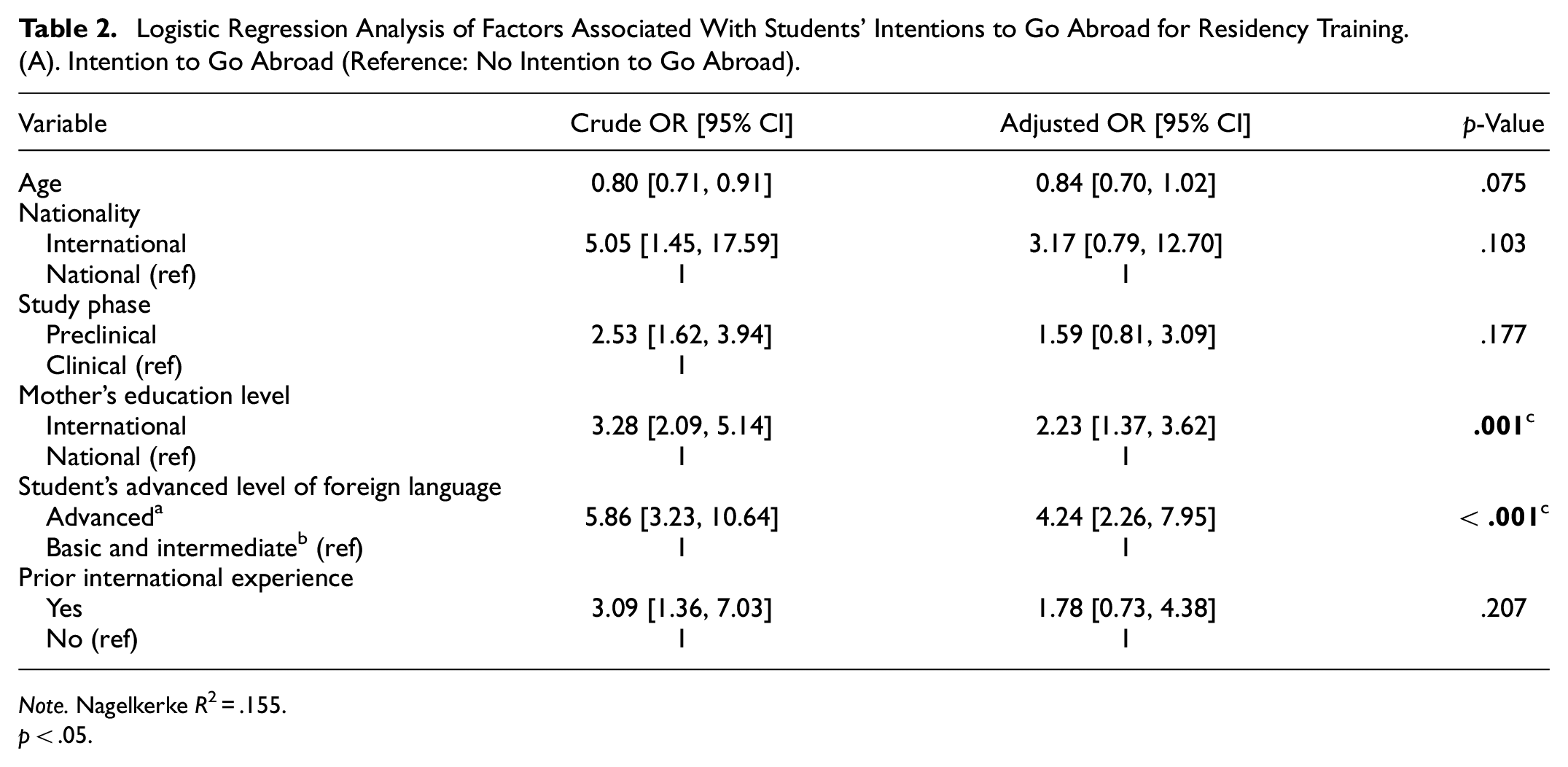
The student group that declared intention to go abroad was analyzed taking as reference the group that do not want to go abroad for residency training. In the multivariable regression, mother’s education level and student’s advanced level of any foreign language was found significantly associated with intention to go overseas for graduate training. The students whose mothers’ have advanced levels of education had a 2.23-fold (OR, 95% CI [1.37, 3.62]) higher probability than students with mothers who had other levels of education. Similarly, having an advanced level of skills for any foreign language was 4.24-fold (OR, 95% CI [2.26, 7.95]) increasing students’ intentions to go abroad for residency training (Table 2A).
Logistic Regression Analysis of Factors Associated With Students’ Intentions to Go Abroad for Residency Training.
(A). Intention to Go Abroad (Reference: No Intention to Go Abroad).
Note. Nagelkerke R2 = .155.
p < .05.
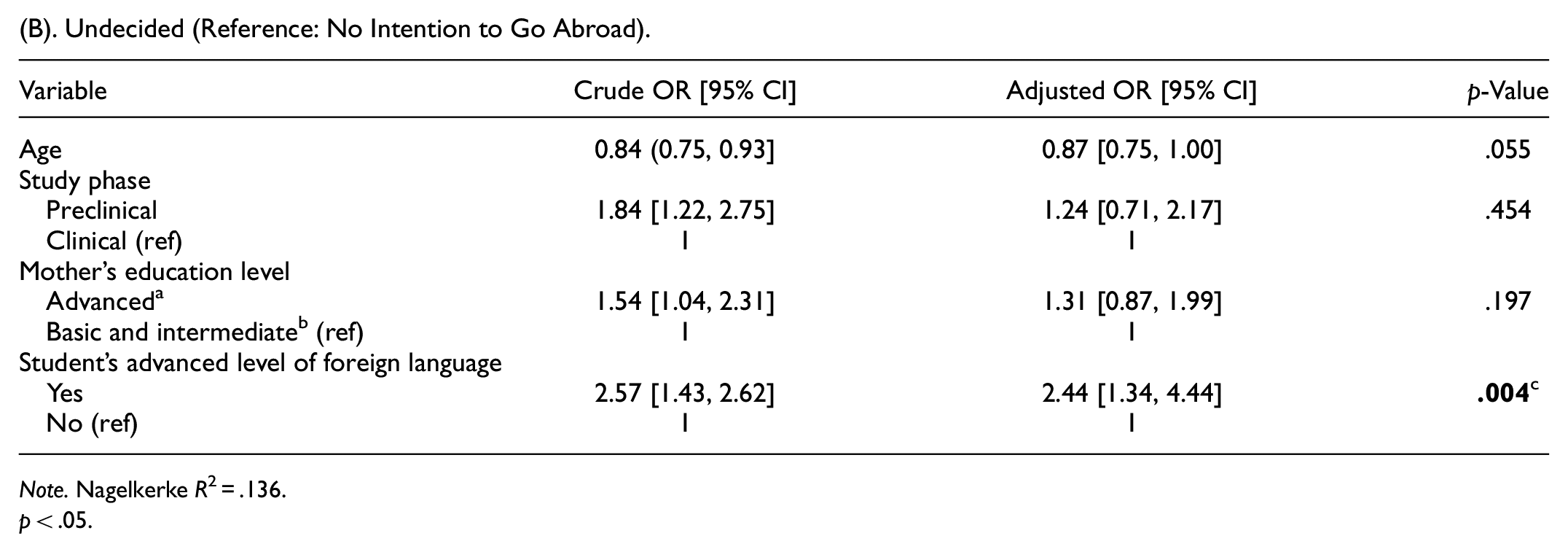
(B). Undecided (Reference: No Intention to Go Abroad).
Note. Nagelkerke R2 = .136.
p < .05.
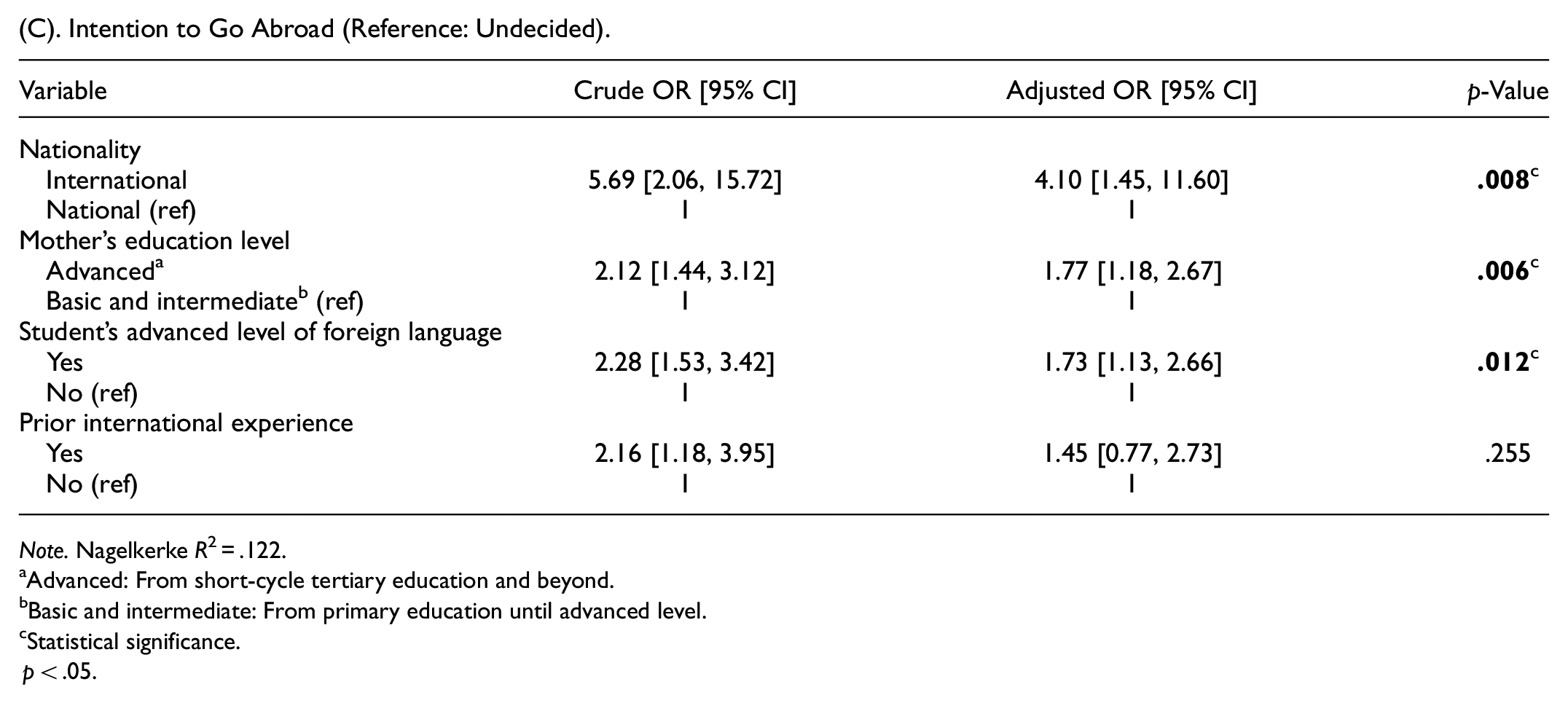
(C). Intention to Go Abroad (Reference: Undecided).
Note. Nagelkerke R2 = .122.
Advanced: From short-cycle tertiary education and beyond.
Basic and intermediate: From primary education until advanced level.
Statistical significance.
p < .05.
Undecided Group
The undecided student group intentions was analyzed taking as reference the group that do not want to go abroad for residency training. Multivariable analysis revealed that students with advanced levels of any foreign language were significantly associated with intention to go abroad for residency training. Having an advanced level of education in any foreign language was 2.44-fold (OR, 95% CI [1.34, 4.44]) increasing students’ intentions to go overseas for graduate training (Table 2B).
As seen in Table 2C, when the undecided group was taken as a reference group, study abroad intentions were increasing in the student groups with higher educated mothers (OR: 1.77, 95% CI [1.18, 2.67]) and advanced level of skills for any foreign language (OR: 1.73, 95% CI [1.13, 2.66]).
Qualitative Data
Out of 183 students declaring intentions to go abroad for residency training, 178 (97.3%) responded with 235 statements to the open-ended question investigating personal reasons for their decision. After the qualitative data analysis six themes were identified from these statements (Table 3). One of the most striking opinions from the students resembles a summary of all the identified themes: “Because I feel that my fundamental rights and freedom are restricted in Turkey. I won’t be able to receive the salary I deserve, my living standards will be lower than that of my colleagues abroad, and I am worried about my safety due to the recent increase in violence against doctors.” Students’ opinions reflecting the identified themes are exemplified in Table 3.
Student Opinions.

Discussion
In this study, we found that 29.7% of the respondent medical students expressed their intention to go to a foreign country for their residency training after graduation. Top preferred destinations were Germany, USA, UK, and Canada respectively and a quarter of students are planning to stay permanently in those countries. Mothers’ advanced level of education and students’ advanced level of any foreign language were found significantly associated with students’ intentions to go abroad for residency training. A wide variety of migration intention rates are published in the literature from different studies and countries. Although our findings reveal relatively low migration intention rate compared to the other studies from India (Rao et al., 2006), Pakistan (Imran et al., 2011) and Lebanon (Akl et al., 2008), South Africa (Dambisya, 2021), according to a latest report from Turkish Medical Association ((2022)), physician migration intention has been constantly increasing and reached a 20-fold in the last decade (Türk Tabipleri Birliği (TTB) 2018-2020 Çalışma Raporu | Turkish Medical Association (TMA) 20218-2020 Working Report, 2020). The results of the TMA’s report could be considered a predictor of increasing Turkish medical students’ immigration rates, and this rate could reach the level of other countries’ immigration rates.
Our study revealed the most desired target country of choice for residency training was Germany followed by the USA, UK, and Canada. Studies from Syria, Croatia, and Greece demonstrated that Germany was the most popular destination similar to our study (Bojanic et al., 2015; Labiris et al., 2014; Sawaf et al., 2018). As Germany is hosting the largest Turkish community around the world (Fassbender & Leyendecker, 2018), this might explain the preference of our study participants. In addition, this parallel result with other studies could be related to the geographic proximity of countries to Germany. Relatively easy residency requirements, and availability of job opportunities for medical doctors might also be facilitating factors of this tendency. Our findings are incongruent with earlier studies where USA is the most popular destination for studying (Deressa et al., 2012; Imran et al., 2011; Rao et al., 2006; Sheikh et al., 2012).
In our study there was no difference found in the intention to go overseas for graduate training by gender. Literature has different results in this manner; while a study from Pakistan was supporting our finding of no gender difference (Gouda et al., 2015), a study from India found intentions in favor of female students (Rao et al., 2006), and other studies from Ethiopia and Syria reported intentions in favor of male students (Deressa et al., 2012; Sawaf et al., 2018).
Study phase was investigated by various research groups from different countries and results were incompatible in terms of study phase and intent to go abroad. The study from Pakistan reported a statistically significant relation in favor of preclinical year students’ tendency to go abroad (Imran et al., 2011). Similarly, we found a significance in chi-square analysis in our study showing that preclinical students are more likely to go abroad for their further studies, this has lost its significance in multivariable analysis. In contrast, the study from Ethiopia revealed a non-significant positive tendency to go abroad in favor of clinical year students’ proportion (Deressa et al., 2012).
One of the preeminent results of our study was the significant association between mother’s education level and students’ tendency to go and study abroad. This finding is also remarkable as the literature was scarce of investigating the relation between these two variables in medical education context. In a study from Nigeria mother’s education level was not found associated with medical students’ migration intention (Oghenekaro, 2019). However, in one research investigating the brain drain in general argue that mothers with a higher level of education have greater control over household resources, and they devote to their children at a higher rate than males (Docquier et al., 2007).
In contrast to our result, the only study we found in the literature from Ethiopia indicated no difference between the education levels of parents and the migration intention of undergraduate medical students (Deressa et al., 2012). However, a study investigating Italy and France higher education students’ individual determinants of participation in foreign exchange programs reported that, students whose parents have a higher education degree are more likely to study abroad (Di Pietro & Page, 2008). We believe further investigation is needed to establish and understand the impact of mother’s education level on students’ study abroad intentions.
Another leading result of our study was the significant association between the student’s level of foreign language and the tendency to study abroad. Very few studies were found in the literature investigating the relation between language skills and study abroad intentions. A recent study from Russia reported that the majority of students believe that studying in English expands their professional career and almost half of the medical students are planning to live and work abroad after their graduation (Novikova et al., 2021). The study from Lebanon concluded that the preference of medical school and the destination country might be affected by earlier foreign language choice (Akl et al., 2008). We interpret the association between the level of foreign language and tendency to migrate as a two way and complex relation affecting each other in both ways. These results provide a new insight into the relationship between the level of a certain language and migration intention.
Based on the qualitative analysis in our study six themes were identified as motivational factors for studying abroad. These factors are consistent with the other studies in this field published from different corners of the world. From students’ perspective in different studies, the themes we determined in our study are the most frequently stated reasons in the literature as well: living standards/ conditions (Akl et al., 2008; Sheikh et al., 2012), economic conditions (Avgerinos et al., 2006; Gouda et al., 2015), working conditions and safety (Avgerinos et al., 2006; Gouda et al., 2015; Imran et al., 2011; Moss et al., 2004; Sheikh et al., 2012), scientific environment (Akl et al., 2008; Avgerinos et al., 2006), gaining experience (Bojanic et al., 2015), and educational environment/ standards of training (Gouda et al., 2015; Imran et al., 2011; Sawaf et al., 2018).
Despite the novelty and rigor of this research study, there were some limitations associated with it. Since, we collected the data from a single public university and the response rate was one-fourth of all invited students, therefore the results cannot be generalized to most public and private medical schools, as this type of thought development is generally governed by other factors too which we haven’t covered in detail here in this study as it is out of the scope of this study like city-type, family’s expenditure power, societal factors, and exposure of surroundings of foreign neighbors, all that play role in shaping thought process of any individual. There is no prior local research available to compare our findings. Only, scanty reports are available from other countries that too not matching with the economic, societal, and cultural status of Turkey; hence comparisons were not possible. Notwithstanding, the discovered contributing themes (factors) accountable for developing such intentions are overlapping with the factors reported in other studies from different countries, so a part of the results dealing with contributing themes can be generalized. But, considering the differences between countries’ cultures, political conditions, and economic status, the current findings from Turkey must be taken into account carefully and subjected to further analysis.
Conclusions
To the best our knowledge, this is the very first study in Turkey exploring the Turkish medical students’ desire of pursuing residency training abroad and delve into controlling factors that play significant roles in instilling this intention. Although, no data is available within Turkey to compare with the current study; but, the present outcomes could be useful for future research in this area. Determining why medical school graduates intend to migrate to any developed country is critical in establishing policies to curb this movement and prevent from developing such tendency or thought processes. Future multicenter-international in-depth research is warranted to elucidate this growing problem of poor and developing countries as it is going to impact severely to their healthcare system due to shortage of medical professionals in the future.
Supplemental Material
sj-docx-1-sgo-10.1177_21582440231195419 – Supplemental material for Increasing Trend of Studying Abroad for Residency Training Among Medical Students
Supplemental material, sj-docx-1-sgo-10.1177_21582440231195419 for Increasing Trend of Studying Abroad for Residency Training Among Medical Students by S. Ayhan Çalışkan, Umay Ruchan Tümer and Ozan Karaca in SAGE Open
Footnotes
Acknowledgements
The authors would like to thank Purevsuren Chimedregzen for igniting this research as well as her valuable contributions at the initial phase of the study, student representatives Gülce Ergün, İsmail Ali Derman, Beril Güçlü, Hakan Turan Kiriş, Mehmet Çelik, and Deniz Fırat Öztürk for their great support in data collection. We are also thankful to our participants in this study from EUFM for their time, commitment, and willingness. We would like to extend our deep and sincere gratitude to Shafiul Haque for his valuable feedback and revisions on the draft of this paper, Aslı Suner Karakülah for her guidance on initial statistical analysis and Seyfi Durmaz for his immense support on the statistical analysis of this article.
Declaration of Conflicting Interests
The author(s) declared no potential conflicts of interest with respect to the research, authorship, and/or publication of this article.
Funding
The author(s) received no financial support for the research, authorship, and/or publication of this article.
Ethical Approval and Consent to Participate
The data collection in the present study was conducted after the approval of Ege University Scientific Research, and Publication Ethics Boards dated 28 May 2020 Ref.606 We confirm that all methods used in this study were carried out in accordance with relevant guidelines and regulations. The participation of students was completely voluntary and informed consent was obtained from all participants or, if participants are under 18, from a parent and/or legal guardian.

Data Availability
The datasets used and/or analyzed during the current study are available from the corresponding author on reasonable request.
Supplemental Material
Supplemental material for this article is available online.
References
Supplementary Material
Please find the following supplemental material available below.
For Open Access articles published under a Creative Commons License, all supplemental material carries the same license as the article it is associated with.
For non-Open Access articles published, all supplemental material carries a non-exclusive license, and permission requests for re-use of supplemental material or any part of supplemental material shall be sent directly to the copyright owner as specified in the copyright notice associated with the article.
