




Abstract
This work explores the adoption and implementation of Sport Canada’s long-term athlete development (LTAD) model by coaches and tries to understand the barriers to and enablers of these processes. LTAD adoption was studied in 14 coaches (5 female, 9 male) in seven sports while implementation was assessed among 10 different coaches (2 female, 8 male) from nine sports. Semistructured interviews ascertained coaches’ perceptions of and experiences with the LTAD model in their coaching practice. Coaches adhered to the global vision and general principles of LTAD. However, several barriers to LTAD adoption and implementation were identified. A mismatch between the model’s long-term and the short-term visions of results in sport was perceived as deterrent to LTAD adoption and implementation. Coaches involved in early development sports mentioned a lack of compatibility of LTAD with the demands of their sport. Coaches also perceived complexity in LTAD athlete’s developmental stage determination and the identification of “windows of opportunity” or critical periods. These barriers should be addressed to complete diffusion of LTAD among Canadian coaches.
Introduction
The development of an athlete is likened to an art where coaches are involved in complex orchestration of planning, executing training, and competition (Nash, Sproule, & Horton, 2011). Many models have been developed to help countries, sport clubs, and coaches prepare athletes to reach their full potential. Bruner, Erickson, Wilson, and Côté (2010) suggested that athlete development models were created with the mind-set of “continuity and developmental change across athlete developmental stages.” Côté, Bruner, Erickson, Strachan, and Fraser-Thomas (2010) postulated that the key role of coaches at particular points in athletes’ development is to consider their global developmental pathway.
Long-Term Athlete Development (LTAD)
In Canada, Balyi and Way (1995) developed the LTAD model to help enhance performance by internationally competitive Canadian athletes in some sports and slow the declining rate of physical activity by Canadians (Ifedi, 2005). Since 2005, Sport Canada has promoted the LTAD model to address this decline and help in the development of elite athletes. Indeed, in its 2007 to 2012 Canadian Sport Policy, Sport Canada mentioned LTAD as “. . . one of the potentially most significant advances in Canadian sport since the adoption of Canadian Sport Policy in 2002 . . .” (Canadian Heritage, 2007, p. 3).
The backbone of LTAD is built on the physiological principles of growth, development, and skill acquisition (Bompa, 1995; Ford et al., 2011; Stafford, 2005). Other models of athlete development, such as Côté’s Developmental Model of Sport Participation, share similar principles, like avoidance of early specialization (Côté, Lidor, & Hackfort, 2009), but place strong emphasis on psychosocial maturation. For more information about the 10 factors of LTAD, the reader is invited to consult the Canadian Sport for Life website (http://canadiansportforlife.ca/learn-about-canadian-sport-life/ten-key-factors). LTAD includes seven stages of development: (a) Active Start (0-6 years old), (b) FUNdamental (6-9 years old), (c) Learn to Train (8-12 years old), (d) Train to Train (11-16 years old), (e) Train to Compete (15-23 years old), (f) Train to Win (18+ years old), and (g) Active for Life (athletes and participants 12+ years old; Canadian Sport Centres, 2006).
The LTAD model was introduced as generic and sport-specific versions to coaches through coaching education programs in various countries. In Canada, national sport organizations, sport clubs, and sport associations developed sport-specific LTAD models and resources to help already-certified and new coaches understand the concept. The National Coaching Certification Program (NCCP) is Canada’s largest contributor to coaches’ knowledge of the model (Banack, Bloom, & Falcao, 2012; Canadian Sport Centres, 2006). Canada’s LTAD model is touted as the pathway for coaches to develop athletes and increase participation in physical activity (Canadian Sport for Life, 2011).
Research on LTAD
Despite the intent of Sport Canada and sport organizations in other countries to use LTAD for athlete development, research on LTAD appears to be found mainly in nonrefereed reports (Balyi & Way, 1995) and some research on early versions of Balyi and Way’s LTAD model (Ford et al., 2011). However, peer-reviewed research on the LTAD model is scarce (Banack et al., 2012; Black & Holt, 2009; Ford et al., 2011; Frankish, Beaudoin, & Callary, 2012; Lang & Light, 2010).
Black and Holt (2009), who investigated the perceptions of coaches and parents on the implementation of a LTAD-based alpine ski program, found that the model helped coaches to update their knowledge, use consistent language, and plan training sessions. However, coaches did not have many other positive comments about the model, and parents had little knowledge of it. Banack et al. (2012) evaluated whether the Canadian NCCP entry-level course (Introduction to Community Coaching) was teaching cross-country coaches the basic principles of LTAD. All participants perceived that they were able to identify and integrate key components of the model into their coaching practices focused on young athletes having fun as opposed to worrying about competition results or talent development. This was consistent with LTAD recommendations for the 6-year-old and younger age group.
Frankish et al. (2012) investigated how coaches in three Canadian cross-country ski (xc-ski) clubs perceived attributes of the LTAD model in their decisions to adopt it according to Rogers’s (2003) theoretical framework. Their results identified two major trends. First, coaches readily adopted certain aspects of the model (i.e., late specialization with youth participating in multiple sports, lifelong involvement in sport, and following developmental stages set out in the LTAD model). Second, the characteristics of their club influenced coaches’ perceptions and thus their adoption of the model. LTAD was adapted in the United Kingdom from the same core model as Canadian LTAD.
Lang and Light (2010) found that swimming coaches in the United Kingdom had concerns about (a) the negative impact of overemphasis in the LTAD model on training volume at the expense of precise techniques, and (b) competition rules in their sport that appeared to contradict elements of their LTAD. Furthermore, Lang and Light noted that increasing specialization in swimming at a younger age was incompatible with the principles and developmental stage of the LTAD model.
Given the ambitious task of implementing LTAD in Canadian sport, there is a need to understand the challenge of LTAD’s adoption and implementation by coaches and how they perceive LTAD within their sport context. LTAD’s adoption and successful implementation depend on coaches involved in their specific coaching environments. Coaches are those who apply LTAD principles on the ground. According to Rogers’s (2003) theory, they are agents of change in relation to the proposed innovation that is LTAD. It is, therefore, important to understand how they perceive LTAD and what motivates them to adopt or reject it.
The purpose of this article was to explore how coaches adopted and implemented Sport Canada’s LTAD model and to understand the barriers and enablers they see in these processes. This research could link adoption/implementation of talent development in general, and the LTAD model in particular, from the perspective of sport coaches. LTAD has been adopted by various countries (e.g., the United Kingdom), and the present study has the potential to be generalized to other sport systems. However, we must warn readers that ours is not a study of LTAD efficacy.
Theoretical Framework
Rogers’s (2003) Diffusion of Innovations served as a theoretical framework. Originally designed to understand the diffusion of technological innovations, this theory became useful in helping to fathom the adoption of social innovations within a social context. A social innovation can be defined as a new idea (product, service, or model) developed to fulfill social needs and supported by the public sector, community groups, and volunteer organizations from any sector or field (Bacon, Faizullah, Mulgan, & Woodcraft, 2008). In some instances, it has been employed in health education and exercise program evaluation (Westhoff & Hopman-Rock, 2002), sport management (Newell & Swan, 1995), and sport equipment use (Schreier, Oberhauser, & Prügl, 2007) to explain and understand the process of innovation adoption in specific domains. This theory provides an effective framework for studying LTAD as a social change, as it can be considered a social innovation that affects the way sport is delivered. The individuals responsible for adopting and implementing LTAD are coaches, and social innovation is the LTAD model.
The diffusion of innovation process (Figure 1) depicts how individuals move from their initial knowledge of an innovation toward its adoption and implementation in their practice (Rogers, 2003). Prior to and during innovation adoption, individuals are persuaded to adopt its positive attributes when they are interested and actively seek information or details about it (Rogers, 2003). The five attributes that influence an individual to adopt or reject an innovation are (a) the relative advantage that it has over other innovations; (b) compatibility of the innovation with the individual’s own values, past experiences, or needs; (c) complexity of the innovation, meaning the degree to which it is perceived as easy or difficult to understand; (d) trialability of the innovation, meaning the ability of individuals to experiment with the innovation; and (e) observability of the innovation, meaning an individuals’ ability to observe the effects of the innovation.

Finding’s included in Rogers’s (2003) innovation-decision process.
Regarding the implementation stage, Rogers (2003) determined that it occurs “when an individual (or other decision-making unit) puts an innovation to use” (p. 179). Rogers explained that implementation involves behavior change related to the innovation. During the implementation stage, the innovation can be reinvented, meaning “the degree to which an innovation is changed or modified by a user in the process of its adoption and implementation” (Rogers, 2003, p. 180). Rogers noted that a great deal of reinvention occurred for many innovations, and sometimes only parts of it were adopted or implemented.
Method
Case Study
We took a case study approach. As discussed by Yin (2003), “the case study is used in many situations to contribute to our knowledge of individual, group, organizational, social, political, and related phenomena” (p. 1). Our case study is appropriate because its purpose is to gain deeper understanding of a complex phenomenon: how coaches adopt and implement Sport Canada’s LTAD model. We investigated this phenomenon in its real-life context, as experienced by coaches. Each coach provided valuable information individually and collectively, providing insight into the phenomenon studied.
Sampling and Recruiting of Participants
The University of Ottawa and Université du Québec à Trois-Rivières ethics boards approved the project. An information letter was sent by email to 40 national and provincial sport organizations to invite their coaches to fill out a short online questionnaire. The sport organizations either posted the letter on their website or included it in their newsletter. The questionnaire was designed to verify, on a Likert-type scale, how much coaches knew about LTAD, by asking, “How much do you know about Sport Canada’s LTAD model?” At the end of the questionnaire, an open-ended question invited coaches to take part in an individual interview and to give us their telephone number and email address if they agreed to participate further.
Study Participants
Two groups of coaches participated in the study: One group was composed of coaches who decided to adopt LTAD (partially or totally) and the other group was in the implementation stage (i.e., fourth stage of the decision process).
Adoption study
For studying adoption, 112 coaches from the province of Quebec (francophones and anglophones) responded to the survey and, of them, 52 (46%) agreed to participate in personal interviews. We engaged a selection strategy (purposeful sampling) to recruit participants who decided to adopt LTAD with different levels of knowledge, (a) being very familiar with it, (b) had limited knowledge of it, or (c) knew very little about it. A total of 31 coaches were contacted by email or telephone, and 14 (numbered from 1 to 14) agreed to participate in an individual interview.
Implementation study
Of the 86 English-speaking coaches from Canada who accepted to answer the questionnaire, 36 volunteered to participate in individual interviews (41.8%). Purposeful sampling (Creswell, 2013) was adopted as a strategy for participant selection for the interview based on three criteria in their questionnaire responses: (a) coaches were actively coaching, (b) those with certification from the NCCP, and (c) they were knowledgeable about the LTAD model. Twenty-four of the 36 coaches who volunteered for the interview qualified by meeting the abovementioned criteria. Ten coaches were randomly chosen and completed the interview component on implementation (numbered from 15 to 24). They were contacted by email or telephone, depending on the information they had given in the survey, and were invited to participate in the interview process.
Instruments
The qualitative part of the study took a narrative approach to develop an interview guide (Elliott, 2005). Conducted by telephone, the interviews lasted between 45 to 75 min, and were digitally recorded. The researchers developed an interview guide based on Rogers’s theoretical framework, including questions regarding whether and how the coaches had either adopted or implemented the LTAD model. The interview guide also included questions about their perceptions of the barriers they had encountered. During the interview, participants were encouraged to recount their experiences in learning about and implementing the LTAD model. Elliott (2005) explained that narrative interviews helped participants to organize a “sequence of events into a whole so that each event can be understood through its relation to that whole” (p. 3).
Adoption study
The interview guide included three sections: (a) coach history, in which questions were asked, such as, “Tell me about yourself as an athlete and as a coach,” “What is your background in sport?” and “How did you get started?” (b) LTAD model characteristics, as presented in Rogers’s theoretical framework, in which questions included, “What are the advantages or disadvantages of the LTAD model?” “How is the model compatible or incompatible with your values, past experiences as a coach, and the needs of your sport and athletes?” and (c) perceived barriers or enablers during LTAD adoption in which the question was, “Did you experience any barriers in adopting the LTAD model? If so, please explain.” Probing questions were asked to flesh out initial answers.
Implementation study
The interview guide for the implementation study was similar to the one used by the adoption study. Sections 1 and 2 were the same as for the adoption study. Section 3 was oriented with questions on implementation such as, “Did you experience any barriers in implementing the LTAD model? If so, please explain”—to gain insights into perceived barriers of LTAD adoption.
Data Analysis
Each interview was transcribed verbatim and uploaded into the QSR NVivo 9 Qualitative software program. As suggested by Yin (2003), interview content was analyzed. First, a deductive approach (Patton, 2002), focusing broadly on Rogers’s theoretical framework, transformed the transcribed interviews into “meaning units” with the following codes: (a) coaches’ attributes, including subcodes for their athletic experience, coaching certification, the sport(s) they coached in, their duties as coaches, the level of athletes they coached, and the years of experience they had as coaches; (b) Rogers’s innovation-decision process, including subcodes for the stages: knowledge, persuasion, decision, adoption, implementation, and confirmation (Figure 1); and (c) barriers to adoption and implementation of the LTAD model. The coded statements were reviewed independently by a second research team member. The researchers took an inductive approach to further examine the data coded under the implementation stage for undiscovered patterns. Finally, meaning units within the code “Barriers to LTAD model adoption or implementation” were subcoded to examine barriers that pertained directly to LTAD model implementation. These were divided according to two main patterns in LTAD model adoption or implementation, as described above.
Adoption study
Seven coded statements presenting differences were appraised, discussed, and reviewed independently by a second research team member. Agreement was reached by consensus, enabling validation of statement interpretation for each category (Yardley, 2008). A total of 194 statements were analyzed, 27 for relative advantage, 39 for compatibility, 25 for complexity, 20 for trialability, 13 for observability, 27 for communication channels, and, finally, 43 for barriers to adoption.
Implementation study
Owing to the large number of coded meaning units within Rogers’s innovation-decision process (119) and particularly within the subcode for the implementation stage (43 meaning units), it became apparent that the majority of coaches were in the process of implementing LTAD. To understand how coaches came to implement the model, meaning units within the persuasion stage code (33) were further examined, and all the data, in a second round of analysis, were further coded according to Rogers’s five attributes of innovation—relative advantage, compatibility, complexity, trialability, and observability—generating 113 additional meaning units.
Inductively, it became clear that there were two main patterns in LTAD model implementation: (a) coaches considered information on LTAD in specific stages according to the level of athletes they coached, and (b) they viewed the LTAD model as a global vision, philosophy, or planning tool for the development of athletes across stages.
Results
Adoption Study
Participants’ characteristics
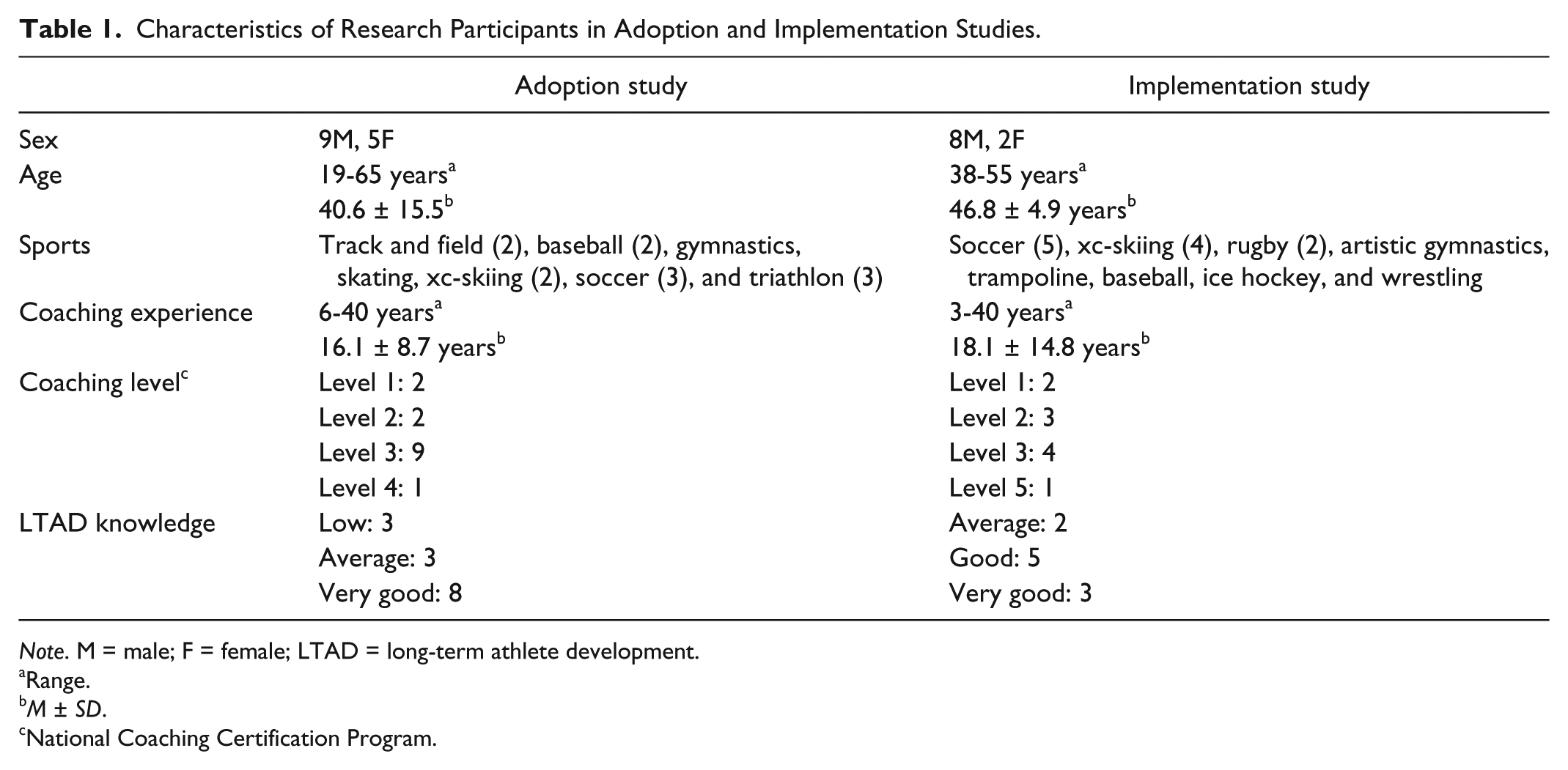
A total of 14 coaches (5 female, 9 male) from various regions of Quebec participated in the LTAD adoption study (Table 1). These coaches all participated as athletes in sport competitions at various levels in the past except for Coach 6. Most had experience as coaches in competitive environments, except for one who was involved only at the community level (Coach 5). Thus, all these coaches were engaged from development Stage 3 (Learning to Train) and subsequent stages. Coach 5 was involved at Stages 1 (Active start) and 2 (FUNdamentals).
Characteristics of Research Participants in Adoption and Implementation Studies.
Note. M = male; F = female; LTAD = long-term athlete development.
Range.
M ± SD.
National Coaching Certification Program.
Among coaches who participated in the LTAD adoption study, eight were very familiar with the model, three considered themselves as being moderately knowledgeable, and three others knew very little about LTAD. It should be noted that coaches who knew very little about LTAD were mainly involved in sports with early development, such as gymnastics and figure skating, but were in the process of adopting it (Table 1). The third coach in this situation was Coach 5, who worked in baseball at the community level. All coaches had heard about the model through their provincial and/or national federations.
Perceptions of Innovation’s Five Attributes
The majority of coaches had favorable perceptions of LTAD. As discussed by Rogers (2003), positive perception, in most cases, increased the likelihood of adoption of the proposed innovation (LTAD), while negative perception more likely led coaches to reject it. The following section presents interview results on the five key predictors of innovation adoption: relative advantage, compatibility, complexity, trialability, and observability.
Relative advantage
The relative advantage is the degree to which an innovation is perceived as being better than the idea it supersedes. The relative benefits of LTAD perceived by coaches were many and varied (27 statements). However, the positive central element that emerged from the perceptions of all coaches (except the two coaches in gymnastics and figure skating) was a long-term vision of athletes, the need to respect and follow their human development, and support the development of their full potential: In fact, long-term development brings more athletes to their full potential with a common provincial and national vision. (Coach 13)
These coaches also emphasized that the model provides a framework, a tool with which they could work and get the feeling of going in the right direction: I think it is important to have structure because it gives us good foundations. We have a model to follow and if we respect it, we know exactly what the goal is, what it is going to give us, technically, tactically, physically. (Coach 14)
Compatibility
Compatibility, for its part, is how LTAD can be consistent with the values, past experiences, and needs of coaches. All coaches acknowledged that several components of LTAD were compatible with their values and practice (39 statements). At first, 12 of the 14 coaches recognized that LTAD presented components of training they already applied: We used this concept since a long time. (Coach 1) These elements have always been part of my practice. (Coach 9)
Another coach refers to xc-skiing, a late development sport for which the sport’s governing body had already adopted the LTAD model at the time of the interview: Given that we are a “late development” sport, we indirectly followed this model without necessarily knowing it. Thus, the model came as a confirmation for me. (Coach 11)
In a second step, all coaches (except for the two in gymnastics and figure skating) saw that various LTAD components matched their values. They (a) practiced various sports and avoided early specialization, (b) developed basic skills and took pleasure in playing these sports, (c) respected the rhythm of natural growth in children and young athletes, and (d) had a healthy lifestyle and exercised over a lifetime.
Finally, some coaches stressed that LTAD was a new tool that met the needs of coaches who had little experience.
LTAD is a wonderful tool for new coaches coming in, those who are volunteers and do not have much training. Many told me: “Wow! Finally, we have the tools we can apply.” (Coach 11)
Complexity
Rogers (2003) referred to the notion of complexity by the degree of difficulty in understanding and deploying the proposed innovation (25 statements). If LTAD seems relatively easy to understand at first, to use and integrate it in coaching practice are perceived very differently, particularly in the early stages of development, as expressed by one coach: Yes, you can share in the vision, but they are significant changes not obvious in practice. The biggest change is much more with coaches involved with young athletes and yet it is those (coaches) who are the least equipped. (Coach 9)
In addition, some coaches emphasized that LTAD had not addressed their difficulty in planning their athletes’ training and had not helped to ascertain the development stage of young athletes: Planning: That’s the challenge. Anyone can understand LTAD, but they will say, “How can I do that?” It gets tricky when observing movement and estimating maturity, to establish what kind of activity can be suitable and to work with young people in different developmental stages. (Coach 9)
It is these remarks that drive most coaches to discuss the great need for additional training to ascertain the developmental stages of their athletes, without which it may be very difficult to integrate LTAD in practice.
Trialability
Trialability is an important feature in the decision to adopt or reject innovation because, here, it is possible to see if coaches are able to explore certain components of the proposed innovation (Rogers, 2003). Thus, if coaches could experience some components of the model and get satisfaction from it, they will be more likely to adopt it. The majority of coaches (8/10) had already experienced some parts of LTAD, which brought various adjustments to their practice at the time of the interview (20 statements). This was the case with one female soccer coach: I think that as a coach I did not respect the stages. I realize that it is important to make adaptations according to age group. Although I personally like to make my training sessions competitive, I believe that with 6-7-year-old kids, it may not necessarily be good to bring competition to training sessions. So, after reviewing the model, I adapted my training sessions. (Coach 14)
However, the reality of certain sports in a competitive system can create multiple barriers. This is the case with triathlon coaching but more specifically its swimming component: In swimming, it is not possible because the short-term results are extremely important when hiring coaches, ensuring the continuity of their career and providing feedback from club administrators or parents. The way this is actually done makes it very difficult to apply LTAD because of the expectation of short-term results. (Coach 7)
Observability
As defined by Rogers (2003), observability is the last feature to target if the results of innovation are visible to others in the community where it is released. In this respect, although the majority of coaches believed that the benefits of LTAD would be observed only in 10 or 15 years, they still expressed strong conviction of a positive impact: I see that young people have the desire to continue playing sports. When I say “playing sport,” I am sure that some young athletes at any given time will say that they have discovered another sport. In the long run, it will help our young people who want to pursue sports. (Coach 1)
Another coach spoke of benefits on the physical side that he saw in some athletes: When you take the time to do things differently, there are always long-term benefits in the end. For example, for agility in basketball, I see great improvements in athletes who are less coordinated, particularly due to growth spurts. (Coach 13)
Another outcome perceived by a xc-ski coach was performance upgrade in their discipline: I think that our sport has become better in the last five or six years. It will perhaps take another 10 years to see the benefits of this model. Their development is probably achieved by keeping them longer in the sport. (Coach 11)
Adoption Process by Coaches
Analyzing coaches’ perceptions of LTAD characteristics as an innovation theory can help to identifying enablers and barriers that influence coaches’ decisions to adopt or implement LTAD (Rogers, 2003). Table 2 provides a synthesis of coaches’ decision process described in the previous section.
Decision-Making Process for LTAD Adoption by Coaches.

Note. LTAD = long-term athlete development.
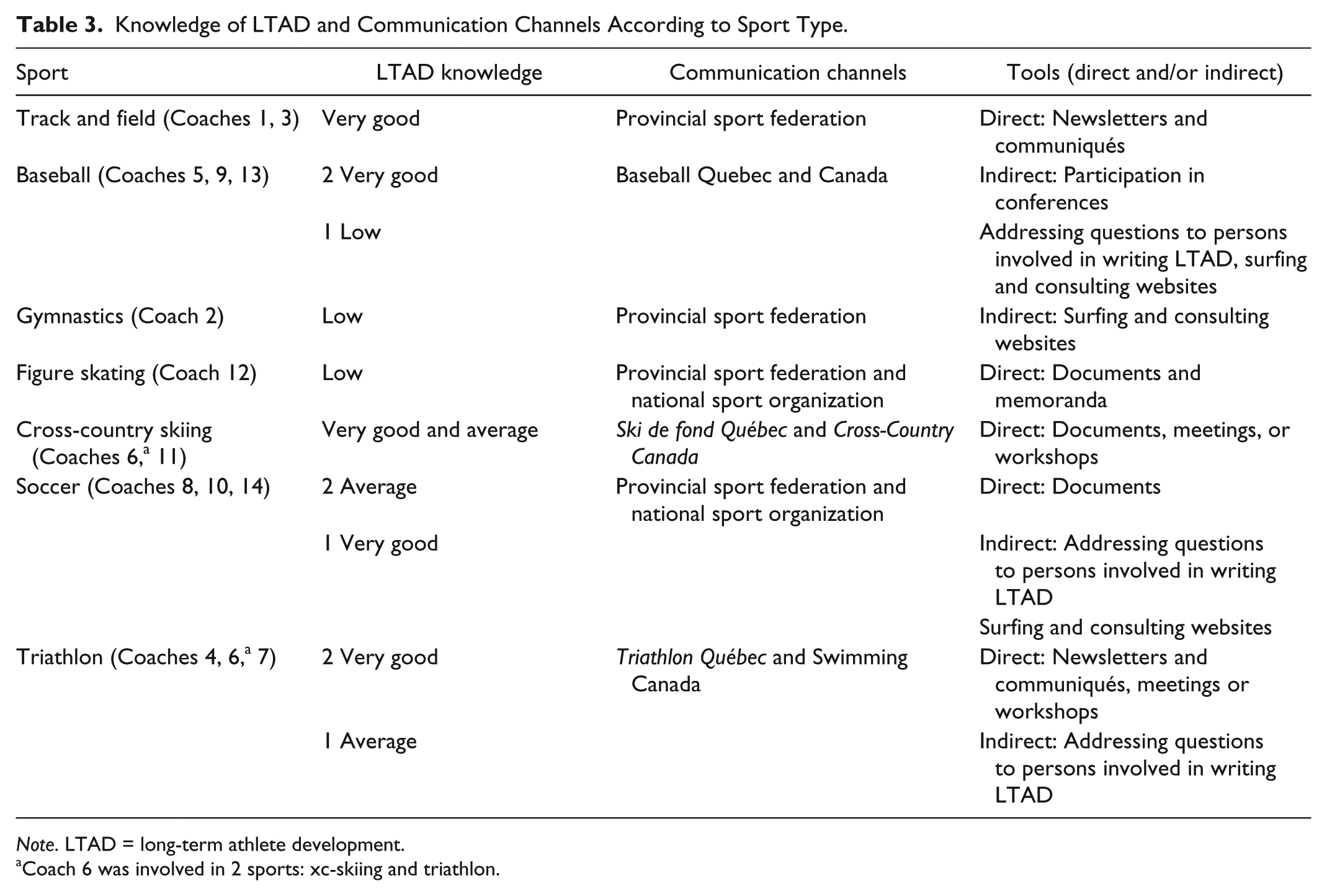
First, knowledge of the model and the role of coaches’ training are essential for a critical look at proposed innovations and their adoption (Table 2). Two coaches (in gymnastics and figure skating) knew very little about LTAD from the start and were at the beginning of adoption (Table 3). Thus, knowing LTAD’s benefits and compatibility could have persuaded them that it could be positive for them and their athletes.
Knowledge of LTAD and Communication Channels According to Sport Type.
Note. LTAD = long-term athlete development.
Coach 6 was involved in 2 sports: xc-skiing and triathlon.
Many factors influenced the adoption process in coaches (Table 2). Coaches in track and field (Coaches 1 and 3) and xc-ski (Coaches 6 and 11) seem to have adopted LTAD for the following reasons: (a) long-term vision for athletes already present in their sport, (b) validation of what they were doing right, and (c) the organizational structure of their sport. For the adoption process, being able to try some of LTAD’s components and living positive experiences have enabled the majority of coaches (two in track and field, two in xc-skiing, three in soccer, two in baseball, and one in basketball) to perceive positive impacts of the LTAD model.
Although they were in agreement with the principles and long-term approach with LTAD, in practice, many barriers hindered its full adoption. Also, two triathlon coaches (Coaches 4 and 7) encountered several barriers linked to the culture and organizational structure of their sport, which led us to believe that LTAD adoption was very difficult for them. Finally, LTAD’s perceived complexity inhibited its implementation in the daily practice of these coaches (Table 2). Therefore, barriers perceived by coaches may counterbalance their decisions and hinder the possibility of full LTAD implementation in their practice.
Implementation Study
Ten coaches (2 female, 8 male) were interviewed to gain an understanding of their decision and process to adopt or reject the LTAD model (Table 1). Four of the 10 coaches interviewed were coaching in more than one sport. Finally, 8 coaches noted that they knew the LTAD model either very well or quite well. Two of them said they were somewhat knowledgeable.
Persuasion
Coaches were persuaded (33 meaning units) to adopt the LTAD model according to attributes described in Rogers’s framework. All 10 coaches interviewed described how they were persuaded to take up the LTAD model because of its compatibility (37 meaning units) with their values, its relative advantage (28 meaning units) over other models, its trialability (13 meaning units), and its observability (14 meaning units).
Coaches involved in our study were persuaded to use the LTAD model because they all believed that it was compatible with their personal values. The following quotes show how coaches found the model to be compatible with their own coaching values and approach. Coach 7 stated that “The LTAD makes a lot of intuitive sense when you understand the rationale behind it,” while Coach 17 pointed out that “I became aware of LTAD early in my soccer coaching career. It resonated with me and made a lot of sense.” For these reasons, coaches said they were easily persuaded to implement the model.
The following quotes indicate how coaches found the LTAD model to be relatively advantageous (28 meaning units) compared with previous approaches in coaching: I think LTAD gives us some structure, especially at the lower levels. The pathway is now clearer for everybody. (Coach 24)
Coach 22 asserted how division of athletes’ development into defined stages helped them to speak a common language with other stakeholders: The best part for me starting out (with LTAD) was actually categorizing athletes, not just by age, but by “Learning to Train,” “Training to Compete,” and that kind of thing . . . Once everybody speaks the same language, then it’s easier to turn it around and make it work.
These advantages helped persuade coaches to implement the model. Coaches also noted that the model influenced club structure (14 meaning units). This, in turn, persuaded them to implement LTAD because they could see the layout of the model and how it fit with the level they were coaching: The ski club presented to parents’ meetings in the fall and aligned the programs with appropriate LTAD nomenclature . . . “Training to Train,” “Learning to Train,” etc. I think just designating groups by these names brings focus and has some impact . . . getting some people to think about LTAD. (Coach 15)
Finally, the coaches noted that they could try out the model (13 meaning units), which led to their LTAD adherence. Some of the persuasion needed to adopt a new innovation includes its trialability. As one coach explained, the coaches at his club were able to learn about LTAD, begin to understand, and then implement its principles.
It’s not like the club changed everything it did overnight and set up a system that was completely LTAD-based. Slowly, as people have come to know more about it, the way things have been done has changed a bit in accordance with that. (Coach 21)
One coach simply stated that LTAD was already being implemented by the other coaches in his club, and so when he started coaching, it was a natural inclusion into his approach.
LTAD was part of the training. I was first introduced to it through my ski club three years ago. When I started coaching, it (LTAD) was already in the club atmosphere. (Coach 18)
As the coaches were already persuaded to adopt the LTAD model, they started to implement it in various ways while coaching their athletes.
Implementation of the LTAD model by coaches
Two patterns appeared to dominate the coaches’ ways of implementing LTAD (43 meaning units). First, all 10 coaches interviewed seemed to acquire information from specific stages (including relevant principles) of the LTAD model, which, although allowing them to use the model in a way that aided their own coaching approaches, also led to a host of barriers that they perceived with its implementation (40 meaning units). Second, 7 of these 10 coaches understood the LTAD model as a global vision of how athletes should develop in sport and they implemented it as a planning tool. With this approach, there appeared to be fewer barriers to LTAD model implementation (15 meaning units). However, such an approach can only be taken when coaches have sufficient understanding of the whole model.
Implementation according to the development stages
All 10 coaches interviewed seemed more specifically interested in stages of development in the LTAD model that pertained to the level of athletes they coached, and they were also interested in specific principles in these stages.
One coach discussed how he learned from the model, specifically with athletes in the fundamental stage of development (6- to 8-year-old females, 6- to 9-year-old males), to play games with children and to develop their physical literacy, as the LTAD model endorses within this stage of development: Now I use the idea that LTAD makes it fun for kids, and finding what is fun gains their interest, and helps them learn fundamental skills and game intelligence. (Coach 17)
This coach determined that athletes became more engaged once he implemented his game approach according to the LTAD model in the FUNdamental stage (6-year-old and younger).
Another coach, of boys in the “Learn to Train” stage (8- to 11-year-old females, 9- to 12-year-old males) focused on LTAD’s trainability factor to understand when and how to train his athletes’ skills and physical abilities.
With our 10-year-old boys’ soccer team last year, we didn’t spend time specifically trying to develop their aerobic system because teaching them that is a waste of time. We spent time focusing on the things that they were more receptive to learn and focus on. You need to have a long-term mentality, and it’s a long-term program. Winning isn’t and shouldn’t be the focus in the short-term. (Coach 21)
A coach in the “Train to Train” stage explained how he used the factor of developmental age to determine when to begin strength training with his athletes based on their growth and maturation.
Our strength training begins at under 14 year old (U14), but it leans more towards resistance exercises, with weighted balls, coordination movements and simple plyometric exercises. With females, we’re able to incorporate resistance work earlier than with boys because of maturation, as the LTAD model explains. (Coach 16)
On the contrary, a gymnastics coach ascertained that the number of hours prescribed by the LTAD model as part of the 10-year rule factor was difficult to follow for her more competitive young athletes. She chose when to implement this factor and when not to do so.
Provincial gymnastics coaches were all in a bit of a panic with LTAD because we’re an early immersion sport. LTAD recommend eight weekly hours for the nine-year-olds, but we do 12 to 18 hours . . . So when parents ask if their child can train more hours, if he or she is able to handle more, I say “do it.” But if they’re unable to handle more training, I quote the LTAD and say, “According to this document, and all the work that’s gone into it, we support the fact that athletes should be involved in other things.” (Coach 23)
What is interesting is that this coach specifically picked up on one factor within the model and chose when to use it or not.
Barriers to Adoption and Implementation
Barriers to adoption
Barriers to adoption are presented along the decision process. In our study, four main barriers to adoption stood out with the majority of coaches: (a) lack of LTAD knowledge and training; (b) shortage of competent coaches, including parents; (c) inadequate sports culture and organizational structures; and (d) emphasis placed on results, that is to say, the performance of athletes or sports teams.
The majority of coaches underlined how lack of LTAD knowledge and training slowed adoption of the new model. A figure skating coach mentioned that not knowing enough about the model hindered its exploitation: For me, not knowing the model enough is a real barrier. I miss a lot of information, especially how to adapt it to my discipline . . . I think if I had all this information, I would apply LTAD. (Coach 12)
More than half of coaches underlined that preparing coaches was important as it could contribute to LTAD adoption and implementation.
We need to make coaching education mandatory for all coaches starting in that role and everything should commence from the beginning with the model. Do not forget that for children who start at 7-8 years, the parents who coach them usually know nothing about the sport—as they do it out of kindness . . . . (Coach 10)
Some coaches feel that a paradox exists in the current sports culture. The model represents a long-term approach to meet the growth and development of young athletes, whereas organizational sport structures encourage them to engage early in competition and often leads to their overspecialization.
I gave a presentation on the long-term development of athletes at the soccer federation and they laughed at me. They said: “We cannot do that!” I replied that there should not be elite-class competitive soccer before the age of 12 years for girls and 14 years for boys . . . and they told me that it would never change! (Coach 7)
Some coaches underscored that the emphasis on results, in terms of performance of young athletes or teams, is a big barrier to LTAD adoption and implementation. So how is it possible to reconcile an approach based on the long-term development of young athletes with the attraction of short-term results? This is how a triathlon coach explained the situation: Look at the structure of swimming here. Even if coaches are fairly high level and are aware of the need for youth development, the major issue is that recognition comes with performance, it becomes a vicious circle. What counts are our short-term results. (Coach 4)
Such situations inevitably lead coaches to run aground in insufficient financial resources, and they are dependent on the performance of their athletes. As explained by the same triathlon coach, People always focus on financial issues, searching for sponsors. This is only short-term and far removed from concerns about the quality of interventions in our youth and their long-term development . . . . (Coach 4)
In addition, as pointed out by this coach, such a sport culture often pushes coaches and athletes to look for shortcuts, recipes, or interventions to attain high-level but short-term performance: Basically, when we coach, it is normal to want to win a season, and it is very easy to focus on that rather than think about youth development. So we sometimes skip the teaching of certain skills to focus more on specific things that will help to win. (Coach 13)
Barriers to implementation
Coaches noted that there were specific barriers as a result of implementing LTAD. The barriers included lack of information on some stages of development in the LTAD model (11 meaning units), a lack of understanding of the other stages of development within the model (14 meaning units), and, perhaps most notably, coaches had trouble assessing the developmental stage of their athletes and following recommendations within the LTAD model (15 meaning units).
One coach noted that there were no technical and tactical drills that gave coaches the tools to implement the LTAD model’s recommendations. Acknowledging that LTAD is a model that addresses the many stages of athlete development, two coaches noted that they only really understood the LTAD model within the age category that they coached. Therefore, a barrier for them in implementing the LTAD model was that they did not understand the model fully. Coach 24 said, I’ve gone over it (LTAD). I’m not going to say I fully understand it. The youngest I’ve ever taught is 16- and 17-year-old athletes. I’ve never taught anybody under that. So for me to use the LTAD with younger stages would be a barrier to me.
Another coach explained that the determination of developmental age, measuring the growth and development of individual athletes to develop skills at proper times, is hard to implement in team sports where chronological age serves to place athletes on teams.
Sometimes stages are hard to differentiate—you tend to treat all 12-year-olds the same. I’m not sure how you don’t when it’s a team sport . . . you’ve got all kinds of 12-year-olds, some who are small and others who look like men—especially around puberty. (Coach 19)
Indeed, six coaches found it hard to implement LTAD model directions explicitly for certain stages of development. As Coach 15 explained, The whole concept around puberty in terms of athletes’ development and monitoring their growth, to look for peak height velocity and all those fancy terms . . . I don’t see 97% of coaches out there involved in measuring their athletes’ height differences on a monthly basis. I’m not sure many coaches out there have the time or motivation to do so.
The same coach determined that the LTAD model could be perceived as a barrier to athlete development if coaches fixated on specific recommendations. Instead, he suggested that LTAD was best considered as a guideline: Some people accept precise details of LTAD as gospel . . . if Johnny didn’t complete 359 hours of aerobic conditioning by the age of 13 years and 3 months, he’s out of luck, and he’s never going to make it as a skier. (Coach 15)
Implementation as a Global Vision for Athlete Development Over Time
Seven coaches considered the LTAD model to be a guide or a plan with a global vision for athlete development. These seven coaches noted that LTAD was a vision for coaching individuals across their life span. This was useful as it provided a framework for the coaches’ lesson plans: I used it (LTAD) as baseline, kind of like a course curriculum. I developed an outline and then wrote down my objectives. (Coach 20) Here’s the rough outline . . . there’s a certain skill set or physical ability that this age group player should have. (Coach 19)
Coaches also cited the LTAD model when explaining their plan to athletes and parents. It enabled them to have a tool with which to explain their coaching approach.
What I like to explain to the parents and athletes are the keys stages. Following the LTAD, I’m developing all core skills for movement and sport in younger children. At 12 to 14 years, we can introduce competition or preparation for events. (Coach 18)
More specifically, one coach talked about how explaining the LTAD model to parents helped them relax in regard to their child’s sport development.
I spend time speaking to parents about goals, expectations, and processes (according to LTAD), and I find them much more relaxed when they understand that kids develop at different rates . . . . (Coach 17)
Barriers to implementation as a global vision
Seven coaches discussed barriers that prevented them from fully implementing LTAD (15 meaning units). These included lack of support and evidence-based research of the LTAD model, its complexity, and the difficulty in ensuring that all individuals working with athletes (coaches, parents, and support staff) adhered to LTAD recommendations.
In general, coaches felt that there was no support to help them learn about the LTAD model. Some coaches noted that the coach education courses where they learned the LTAD model were too time-consuming and that they could not take the many courses required to fully understand the model. Others who had received their certification from the old NCCP system (Levels 1-5) noted that they were not required to recertify and so they never had the opportunity to learn the LTAD model. Still others noted that even after learning about the LTAD model, they were unsure whether it would really improve athlete development over the course of their entire athletic careers. As one coach said, If you take a group of nine-year-olds and you do lots of speed training with them, and you take another group of nine-year-olds and you don’t do any speed training, then when they are 19 years old, is one group significantly better off than the other group as a result of what they did? I don’t believe that sort of research has been done so . . . are we really sure that the LTAD is right? (Coach 15)
To this coach, the lack of evidence-based research regarding the model was a barrier because it led him to question whether or not to implement it.
Probably the greatest barrier to implementing LTAD as a global vision for developing athletes is its sheer complexity. One coach called the LTAD model “a bit daunting” (Coach 21). This coach noted that understanding how athletes develop over the course of their childhood and adolescence is a huge undertaking.
If you gave me a piece of paper and asked me to draw the graph, to get all windows (of trainability) in the right places, I couldn’t do it. I read those documents a bunch of times but I would still fail the exam, so to speak. (Coach 21)
Indeed, not only is complexity a barrier for coaches, but coaches must also properly describe the model to parents to get them on board. The coaches noted that parents play an important role in ensuring that coaches implement the LTAD model and that athletes are following their advice: The LTAD is a bit of an overhaul of information because your athletes don’t necessarily get the information directly. You would have to go through the parents. (Coach 20)
Coaches felt that it was difficult to properly implement the LTAD model without educating parents about the de-emphasis on winning and competition at younger ages. An ice hockey coach explained, Each year is an education process for parents, learning training to game ratios, rest and taking a long-term approach. I find that it’s always a challenge. (Coach 17)
A barrier to implementing the LTAD model as a global vision was getting everybody committed to the LTAD model. In other words, if everyone working with athletes throughout their development was not on board with the model, then athletes would not have the continuity needed to ensure success. One coach suggested that head coaches organize their coaching staff to understand and implement the LTAD model to ensure athletic success: If you leave LTAD implementation up to individuals, you’re going to get a fair bit of variability and that doesn’t lend itself well to the kids who might move from coach to coach and not get consistency. (Coach 21)
Taking a long-term global view of the LTAD model, coaches, parents, support staff, and athletes have to be aware of and understand it—to have the same vision for implementation.
Discussion
The purpose of this article was to explore how Canadian coaches adopted or implemented Sport Canada’s LTAD model and to understand the barriers they perceived in adopting and implementing it. Rogers’s (2003) theoretical framework served to understand the decision-making process of coaches and to analyze their perception of the model’s characteristics influencing their decision to adopt or reject this social innovation or the process of implementation once it was adopted.
The Five Attributes of Innovation and LTAD Adoption and Implementation
The five attributes of an innovation, as stated in Rogers’s (2003) theoretical model (relative advantage, compatibility, complexity, trialability, and observability), provide a conceptual framework for understanding what may have limited or helped LTAD adoption and implementation by coaches.
Knowledge of the model
Knowledge is the first determinant of innovation adoption. More than half of participants in the adoption part of the study reported very good knowledge of LTAD, and all coaches had already acquired some LTAD facts before it was introduced by Sport Canada. Communication channels for information on LTAD are available to coaches through sports (national or provincial) federations. Information is transmitted in several ways, but in most cases during coaching seminars. This could be due to the fact that coaches who responded to the invitation to participate in the study were experienced, and most of them had a relatively high level of training before LTAD’s arrival. Therefore, they did not attend recent coaching seminars for new certification (Table 3). However, coaches with lower level LTAD knowledge also had lower level coaching certification. Indeed, the three coaches who reported having little knowledge of LTAD were at Levels 1 (n = 2) or 2 (n = 1), and their experience as coaches was, respectively, 6, 11, and 12 years. However, they recognized that the model’s merits resided in the development of knowledge cohesiveness as a whole. Many coaches observed that sport in Canada was still driven by many parent volunteers who had little or no knowledge of their sport. It is one of the tenets of LTAD that better coaches of younger athletes would help to develop all the basic skills proposed in LTAD (Balyi, Way, & Higgs, 2013). Therefore, it is a challenge to better prepare coaches, even those involved with younger athletes.
Coaches at the level of implementing LTAD and who perceived that they had better knowledge of the LTAD model exploited it not only for information pertaining to their athletes’ stages of development but also as an overarching vision of athlete development, so that they deemed the model to be a guide for athlete development in general.
Coaches in early development sports may be less familiar with LTAD, as two of them, who knew very little about the model, were from this type of sport (gymnastics and figure skating). However, it remains to be confirmed in a larger study sample with objective measures of LTAD knowledge as the present study measured the perception of knowledge of LTAD. Gymnastics Canada and Skate Canada produced an LTAD guide for coaches and parents in 2008 and 2010, respectively. Our gymnastics coach (Coach 2), who lived in a remote area, testified about the challenges of having access to continued education in coaching. However, such was not the case with our figure skating coach (Coach 12). The model, in its original form (Balyi & Way, 1995), was much less compatible with the type of performance progression observed in early development sports, whereas in our days, the revised version of LTAD and the new structure of the NCCP, adding the community sport coach approach, offer more opportunities to integrate LTAD in most sports organizations. This subject warrants further investigation.
Relative advantages of LTAD
LTAD was the first athlete development model officially adopted in Canadian sport as part of a policy. Thus, LTAD itself does not replace an existing model. This may partially explain the positive perception of LTAD by coaches. The relative advantages perceived by coaches can be divided into two categories, those favoring athlete development and those associated with coaches’ duties. The majority of coaches emphasized the importance of designing training plans respecting the developmental stages of athletes as persons and not just performers. The benefits related to athletic performance have not been emphasized probably because there is currently no evidence showing that this model is more effective than others in producing better athletes and more of them. Coaches at the level of implementation also perceived relative advantages from LTAD. The main advantage was the “creation of a common language with other stakeholders,” particularly parents. For coaches, it is a tool to help their interaction with parents. Trialability and observability were also identified as positive features of LTAD but were much less often mentioned than compatibility and relative advantages (Table 2). Indeed, it is evident that to really study impacts of LTAD, a cohort of athletes would need to be longitudinally followed during their careers as only parts of the LTAD model are evidence based.
Depending on their duties, many coaches mentioned helpfulness of the model in guiding new coaches and facilitating communication with parents. This is consistent with the findings of Black and Holt (2009)—that the relative advantage of “speaking the same language” (vision and common tongue) has helped alpine ski coaches in Alberta, Canada. However, their work also indicated that a common language facilitated by LTAD was not associated with a total “buy in” of the model by coaches (Black & Holt, 2009).
Compatibility
At first glance, we see that LTAD is compatible with the values of the coaches interviewed. Others suggest that the model validated their own approach and that of some parents. Again, this point was cited by Black and Holt (2009). Many themes emerged that indicated positive influences on LTAD implementation (Figure 1). Coaches considered that LTAD was compatible with their values, which may not be surprising. As mentioned by Collins and Bailey (2013), is it because LTAD incorporates “. . . much face-valid and simple advice, guidance that is so fundamental and sound that it is almost irrefutable . . . ?” (p. 186) Or is it attributable to previous knowledge of some LTAD components (e.g., avoidance of early specialization and prevention of dropping-out) that were already presented in curricula of university physical education or kinesiology programs or other forums? However, a problem has been raised about LTAD compatibility with the organizational structure of sport that generally gratifies short-term success, rejecting athletes and coaches who do not achieve this kind of goal. It is a major digression in LTAD implementation that will have to be addressed to create compatibility between LTAD, the actors in the system, and the sport system itself. Moreover, several examples show that short-term success, defined mainly by wins and endorsed by the sport system, hamper the development of athletes and ultimately the ability to retain young people who would otherwise have reached their full potential later. One example is the phenomenon of “relative age effect” in which younger individuals in a category are less likely to progress to higher or competitive categories and are possibly more inclined to leave the sport (Musch & Grondin, 2001). Another example is the overspecialization of athletes, which is considered detrimental to the development of a repertoire of general motor skills (Fransen et al., 2012). In today’s sports culture, the emphasis on results brings a whole lot of profit, instant satisfaction for athletes and their parents, coach recognition, increased coaching salaries, sponsors, government grants, and so forth. The effect of these factors may be obvious at higher levels of competition. However, even in younger categories, they may exert negative influences and heighten the risk of early specialization and its consequences (Malina, 2010).
Complexity
While understanding LTAD principles, coaches emphasized difficulties in taking action, especially when it came to (a) determining athletes’ stages of development and (b) planning short- and long-term training according to stages. At the stage of implementation, two patterns emerged in LTAD implementation. First, some coaches took information from the model that pertained directly to the stage of development in which their athletes fit. These coaches found that barriers existed in implementing the LTAD model, including a dearth of information on particular stage, a lack of understanding stages different from their own athletes, and trouble identifying the developmental stage of their athletes, to follow LTAD model recommendations. Other criticisms particularly matched with this study included a lack of guidelines for LTAD implementation. Some coaches wanted specific technical and tactical drills or exercises that would help with implementation in their sport, while others found that the lack of specific guidelines allowed coaches to consider the model more as a guide without adhering too strictly to its recommendations. This reinforces the need for coaching education, citing concrete examples of these two identified difficulties to be overcome once LTAD principles are well understood. Continuing education on more practical aspects of training is warranted.
Trialability
For some coaches, it was clear that an approach, such as LTAD, with long-term outputs, makes its full implementation illusory at the moment. However, the majority of coaches interviewed were able to engage some LTAD principles. Although they experienced certain beneficial effects, they indicated that it was often difficult to explain their relevance to others. Gratification of short-term success, as expressed by a swimming coach, was a limiting factor of trialability. There is a perceived risk to try LTAD with athletes. By following the LTAD approach, not aiming at short-term success, and not knowing if success will come later, coaches as well as parents may fear that their athletes may never be successful. Therefore, each sport may suggest intermediate goals (competencies, skills, etc.) to coaches and athletes that may help them to follow progression based on developmental stages and not uniquely on results (medals, ranks, etc.).
Observability
Some coaches have already begun to perceive the positive effects of LTAD, including persistence not only in sport and physical activity among young people but also in the acquisition of motor skills. In the latter case, it is difficult to see what effect this will have on performance. However, a xc-ski coach has already begun to witness a new generation of athletes. It is noteworthy that Cross-Country Canada was one of the first sport federations to adopt LTAD.
The Role of Social Systems
Social innovations like LTAD are not only dependent on the attributes of the innovation. The surrounding social system with its values also influences that capacity of individuals to adopt and implement the social innovation. All interviewed coaches expressed their views on the sporting culture in Canada and how its organizational structure limited LTAD adoption and implementation, as proposed by Sport Canada. Triathlon coaches involved in swimming and those in soccer and baseball specifically mentioned how the competitive system in place worked against LTAD. Thus, the main barrier may be the persistence of a system that emphasizes results in competitions at stages where some other aspects of athletic development would be preferred. In addition, the outcomes of these competitions are short term, providing financial and other rewards or support for athletes, which go directly against the principles of LTAD and discourage its implementation in daily practice for these coaches. When coaches have to choose between training orientation (e.g., specialization) that will provide immediate results and another approach that may take time to produce results, sport system demands will pull coaching toward short-term goals. However, the majority of coaches surveyed adhere to LTAD principles but are in a paradoxical situation where they cannot afford to reduce short-term performance because they are immediately accountable. In fact, as suggested by Côté and Gilbert (2009), the notion of coaching success is questioned by LTAD. There is a need to better define what is successful-effective coaching, depending on athlete levels.
Coaching education also seems to be a factor identified by coaches as having an influence on whether or not LTAD will be adopted. Indeed, five coaches, perceiving their knowledge of LTAD as being less than optimal, had NCCP Level 1 or 2 certification. However, this observation should be confirmed in a larger sample. In coaching education on LTAD, it is clear that different communication channels are targeted: (a) NCCP training when coaches want to reach higher levels; (b) attending meetings, workshops, and seminars; (c) sending documentation; or (d) visiting websites (Table 3). These testimonials suggest that coaching education programs should not rely on a single communication channel. Finally, the clear need for coaching education is to target LTAD observability by coaches by giving concrete examples of implementation experienced by them during NCCP training seminars.
In terms of practical recommendations, sports funding should be consistent with the sport development model chosen in a given country. Specifically, in Canada, prioritizing long-term and integrated athletic development and not merely focusing on short-term results should be targeted to follow the plan proposed by LTAD. Each sport federation could develop a set of process goals that could help coaches follow the progress of their athletes.
Barriers faced by coaches may be addressed through reinvention. Many of the barriers faced by coaches created obstacles to overcome LTAD implementation but did not bring about its discontinuance. Therefore, an alternative implementation occurred where coaches implemented only selected stages of the model (i.e., reinvention). In parallel, they engaged in ongoing learning to develop better understanding of the model and to teach it to others (parents, athletes, assistant coaches).
Rogers (2003) noted that reinvention is a strong indicator of actual change. All 10 coaches interviewed declared having implemented LTAD with adaptations, according to the examples that they provided in interviews. For the coaches in this study, reinvention of the model within a specific stage of development gave coaches the opportunity to implement it despite insufficient information, support, or understanding, all while keeping the model less complex in their minds. In studies by Black and Holt (2009) and Frankish et al. (2012), some coaches similarly used the model for certain stages or factors only. However, Rogers noted that, in many cases, reinvention could be judged as good or bad. Indeed, partial implementation, or not viewing the model as a global vision of athlete development, could limit coaches from ensuring that all sports persons were working toward a common goal for their athletes and safeguarding consistency for athletes’ development no matter what stage they were in.
Rogers (2003) explained that “. . . some reasons for re-invention lie in the innovation itself, while others involve the individual or organisation adopting the new idea” (p. 186). Banack et al. (2012) discussed how the sport context (i.e., recreational) could have an impact on the way coaches perceive and adopt the LTAD model in their coaching practices. Frankish et al. (2012) also determined that coaches in clubs with different goals and structures perceived the model in different ways. For example, coaches from competitive clubs adopted the model more easily than coaches from clubs with a recreational “Learn to Ski” environment. In addition, Frankish et al. suggested that a coach’s role within the club could lead to a different path of adoption. Therefore, building from their research, it was found that coaches perceived the model and employed it in two main ways: (a) coaches’ perception and knowledge of the model, with barriers to implementation coming from LTAD itself; and (b) the organization’s inability to properly support the model.
Black and Holt (2009) found inconsistencies in the way that the LTAD model was implemented in one sport-specific situation and highlighted the difficulty in evaluating LTAD implementation. In fact, reinvention of the LTAD model to the specific needs of different sports is described in both Frankish’s et al. (2012) study on the late-specializing sport of xc-ski and Lang and Light’s (2010) study on the early-specializing sport of swimming.
While acknowledging that the LTAD model could provide a common vocabulary for coaches and emphasize the importance of teaching fundamental skills, Martindale, Collins, and Daubney (2005) raised concerns regarding its scientific merit in a study of the LTAD implementation in the United Kingdom. Similarly, a few coaches in our study expressed these concerns as potential barriers that created doubts about the model’s rigor. It may explain why some coaches reinvented LTAD according to their beliefs, prior knowledge, and barriers. In fact, reinvention may also be seen crudely as cherry-picking of concepts from LTAD that they already know. Indeed, of the few references on LTAD, the majority underlined that many key LTAD concepts (e.g., perils of early sport specialization) were already known to some practitioners (Dowling, 2014; Ford et al., 2011). However, other concepts, like “critical developmental phases,” remain non-evidence based (Ford et al., 2011).
Study Limitations
Interview duration enabled researchers to gain deeper understanding of coaches’ use of the LTAD model (a total of 287 meaning units analyzed). The views in this article were those of individual coaches. Rather, the focus was on exploring how coaches adopted and implemented the model that was presented to them by Sport Canada. Our study did not address the different sport contexts of coaches (community, competition, and instruction) that could influence LTAD model adoption and implementation. The observations of coaches in their work environment could have further strengthened the interview data.
Future Research Paths
Further research is warranted to develop a global understanding of how the model is adopted, implemented, and confirmed or abandoned over time. The results of our study and those of others have shown how different sports, sport organizational structure, training of coaches, and the role of parents are key factors influencing LTAD model adoption and implementation. Of course, adoption and implementation processes need to be assessed in other countries where LTAD is in place. Cultural differences in coaches dealing with LTAD or other models of performance/participation may exist and will have to be addressed (Collins et al., 2012).
Conclusion
According to Canadian Sport Policy, the LTAD model is actually the “paradigm” of Canadian sport (Canadian Heritage, 2007). So far, 54 Canadian sport governing bodies have adopted a LTAD framework (Canadian Sport for Life, 2011). Our research identified factors that influence coaches’ adoption and implementation of LTAD or some of its components. LTAD, compatible with most coaches’ values respecting human development stages, is potentially helpful for adoption and implementation. The creation of a common language with other stakeholders is also a point that favors LTAD adoption and implementation.
Barriers hindering LTAD implementation included (a) lack of organizational support regarding implementation of the model, (b) shortage of evidence-based research on the model, and (c) complexity of the model when viewed in its entirety, and the difficulty in getting all sports persons involved in implementing the LTAD model’s recommendations (Figure 1). A sport system gratifying short-term success is not compatible with the long-term approach of LTAD. Also, the compatibility of LTAD with sports demanding early performance development, such as gymnastics, is a challenge to stakeholders involved in these sports.
Those who implemented LTAD did not necessarily do it integrally. Many coaches undertook reinvention, or implemented only selected aspects of the model, and consider LTAD as a set of guidelines without adhering too strictly to them. This may be ascribed to the fact that parts of LTAD are evidence based, but the whole approach must be empirically verified by longitudinal studies.
The model’s perceived complexity also stands as an obstacle for some coaches, particularly with regard to comprehension of the transition between development stages, methods to estimate athletes’ stages, and identification of “windows of opportunity” or critical periods. Therefore, professional development regarding LTAD in its entirety (not just for those stages in which the coaches work), with emphasis on philosophical underpinnings of the model and including practical ways that coaches can teach others (parents, other coaches, athletes), must be offered to coaches.
Footnotes
Declaration of Conflicting Interests
The author(s) declared no potential conflicts of interest with respect to the research, authorship, and/or publication of this article.
Funding
The author(s) disclosed receipt of the following financial support for the research and/or authorship of this article: This work was supported by the Sport Canada Research Initiative and the Social Sciences and Humanities Research Council of Canada.