




Abstract
New graduate registered nurses (NGRNs) face a great challenge during the transition from school to clinical practice. We conducted a quasi-randomized controlled study to evaluate the effects of a new training mode for newly recruited NGRNs in a Chinese teaching hospital. A total of 150 NGRNs were recruited from a teaching hospital and assigned into two groups. The conventional training and a new training program were taken for the control group and the research group, respectively. At the end of the training, the two groups were evaluated and compared for theoretical knowledge and operation skills using a mutual-evaluation examination and the Chinese Registered Nurse Core Competency Scale. The scores of theoretical knowledge (88.4 vs. 81.7, p < .001) and operation skills (94.8 vs. 90.3, p < .001), and the total core competencies score (156.2 vs. 148.8, p < .05) in the research group were statistically significantly higher than those in the control group. Compared with the control group, the research group also had statistically significantly higher scores in education and consultation (2.47 vs. 2.40), clinical nursing (2.87 vs. 2.62), interpersonal relationship (2.56 vs. 2.43), and critical thinking and scientific research (2.78 vs. 2.61). The innovative pre-job training program for NGRNs conducted in Chinese clinical nursing skill training bases might significantly improve the training effects and is worthy of broader implementation.
Keywords
Introduction
New graduate registered nurses (NGRNs) are the nurses who have work experience less than 1 year after registration. Researches indicated that NGRNs had the lower capability to incorporate their knowledge, skills, and evidence-based practice into their work (Jackson, 2016). New nurses needed support and training to speed their transition from new graduates to qualified practitioners and improve their retention (Asber, 2019). Standardized training is important for NGRNs to complete this transition between school education and clinical nursing work.
In China, the number of nursing schools has increased considerably. The total number of registered nurses (RNs) is estimated to be 4.45 million by 2020. The conventional training for the NGRNs pays more attention to the cultivation of theory and skills. For school education, reform in the curriculum, the education and assessment methods, and the teachers’ training have been initiated. The nursing schools have constructed a comprehensive nursing curriculum, adopted new textbooks, increased the class hours of humanities and social sciences, and facilitated earlier nursing practice in hospitals for students. Despite the expanded scale of education, needs remain unmet as regards the effective improvement of the educational level of the nursing staff. The speed and quality of the development of graduate education for NGRNs are limited and unbalanced, and the overall quality is low. Furthermore, with the aging population and the changed disease spectrum, increased social demands for nursing services cause changes in the nurse–patient relationship. In turn, such changes present profound challenges for the training goals of NGRNs. Nursing specialization entails new requirements for the degree of specialization and lifelong learning abilities (H. Liu, 2017).
To evaluate the effects of a new training mode for NGRNs, we conducted a quasi-randomized controlled study of NGRN training and compared two training modes in the newly recruited NGRNs in a tertiary and teaching hospital in Lianyungang City, Jiangsu Province, China.
Method
Participants and Study Setting
The study was approved by the Ethical Committee of the First People’s Hospital of Lianyungang (Approval No. KY20171101001) and conducted between July and November 2018. Conducting of the study followed the Transparent Reporting of Evaluations with Nonrandomized Designs (TREND) statement (Stroup et al., 2017).
To detect a statistically significant difference of three points between the mean scores of the two groups, with a type I error of 0.05, power of 0.9, and a standard deviation (SD) of 5, 63 participants were needed for each group. Considering a 10% dropout rate, we recruited all the 150 NGRNs (seven males, 143 females) registered in the First People’s Hospital of Lianyungang in 2018. They were assigned to the research and control groups using their registration numbers. The students with even numbers were assigned to the research group, and the students with odd numbers were assigned to the control group. In the end, we got 75 NGRNs for each group. All the NGRNs participated in the pre-job training in July 2018 immediately after they were recruited by the hospital.
The main outcomes of interest in the study were theoretical knowledge, operation skills, and core competencies of the NGRNs.
Training Program
The training was implemented in the Clinical Nursing Skills Training Base (CNSTB) of the hospital. The required nursing knowledge and skills in the CNSTB were obtained and evaluated by the nursing department in the hospital. The goals of the CNSTB are (a) to facilitate the transition of new graduate nurses to professional RNs; (b) to prepare an entry-level staff nurse with confidence who can provide patients with quality and satisfactory care; and (c) to increase the commitment and retention of new graduate nurses within the organization (Brook et al., 2019).
Immediately after the NGRNs’ were recruited, they participated in a 4-week pre-job training in the CNSTB organized by the Department of Human Resources (DHR) and the Department of Nursing (DN) of the hospital. The training in the first week was the new staff training organized by the DHR. The training from the second to the fourth week, including theoretical knowledge and operational skills, was organized by the DN and 8 hr per day. The training forms included in-classroom teaching, case analysis, group discussion, operation demonstration, scenario simulation, and so on. All of the contents were designed to improve the effects of new nurse training. The enrollment, assignment, allocation, follow-up, and analysis of the participants are shown in Figure 1.

Flow diagram of enrollment, assignment, allocation, follow-up, and analysis of the participants.
The control group took the New Nurse Conventional Training (NNCT), which included both theoretical knowledge learning and operational skills training (Table 1). Theoretical knowledge training focused on quality vocation education, interpersonal communication, and occupational safety. At the same time, medical law and ethics training was also included to improve the NGRNs’ legal and ethical awareness. A standardized training manual, training courseware, and a manual of standard nursing operational skills were available for every NGRNs to let them have further self-learning.
The Training Program Developed for the NGRNs.
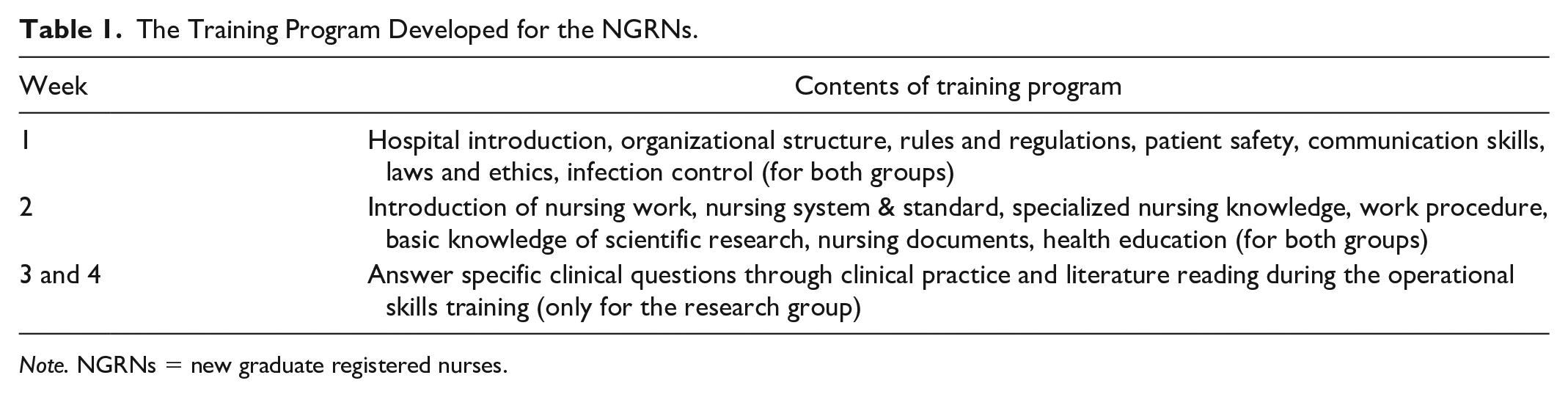
Note. NGRNs = new graduate registered nurses.
The training contents of the research group were based on the New Nurse Training Outline (Trial) and the Chinese Registered Nurse Core Competency Scale issued by the Chinese State Health and Family Planning Commission (M. Liu et al., 2009), and main training courses were designed according to the characteristics of NGRNs (Table 1).
In addition to the contents adopted in the control group, the NGRNs in the research group were also required to answer specific clinical questions through clinical practice and literature reading during the operational skills training stage in the third and fourth weeks. The clinical practice was carried out in the CNSTB every workday from 8:00 to 10:00 a.m. First, the NGRNs observed and exercised the operations that the clinical nursing teachers performed. Second, the nurses would try to answer some clinical questions according to their observation and exercise. After the clinical practice, they would spend 1 hr to have a group discussion and Q&A session about the theoretical and/or clinical issues that they encountered during practices. After 11:00 a.m., the research group and control group would have nursing practices together in the training center.
Data Collection Tools
At the end of the 4-week pre-job training, the NGRNs’ theoretical knowledge and operational skills were evaluated using a mutual-evaluation examination (including theoretical knowledge and operation skills two parts, and each part was scored between 1 and 100), and their core competence levels were assessed using the Chinese Registered Nurse Core Competency Scale (Chen & Lin, 2020). The scale includes 58 items of seven domains, that is, education and consultation, clinical nursing, leadership, interpersonal relationship, legal and ethical awareness, occupational development, and critical thinking and scientific research. Each item is scored using a 5-point Likert-type scale from the lowest competence (0 points) to the highest competence (4 points), with a higher score indicating a higher competence. The internal consistency (Cronbach’s α = .89) and criterion validity (r = .44) had been examined in previous studies (Pang & Zhou, 2015). The mutual-evaluation examination is the conventional examination adopted in the nursing schools; therefore, no validity and reliability analyses were conducted in our study.
Except for the mutual-evaluation examination and the scale, the NGRNs also took notes during the theoretical knowledge training, wrote reflection diary, and recorded the scores of the operational skills that were assessed in the CNSTB.
Statistical Analysis
The continuous data were summarized using mean and SD, and categorical data were summarized using percentage. Given the normal distribution of the data, the differences in the nursing theoretical knowledge and operational skill scores between the groups were tested using the Student’s t test. A two-sided p value of <.05 is considered statistically significant. All the analyses were conducted in the statistical software SPSS version 19.0 (IBM, Armonk, NY, USA).
Findings
The majority (95.3%) of the 150 recruited NGRNs are female (Table 2), and the average age of them is 21.1 ± 1.3 years.
Characteristics of the NGRNs.

Note. NGRNs = new graduate registered nurses.
The average scores of theoretical knowledge and operational skills in the research group were statistically significantly higher than those in the control group, which were 88.4 and 94.8, and 81.7 and 90.3 for the research group and control group, respectively (Table 3).
Theoretical Knowledge and Operational Skills Scores (M ± SD).

p < .001.
Regarding the specific core competencies’ scores, compared with the control group, the research group had statistically significantly higher average scores in education and consultation (2.47 vs. 2.40), clinical nursing (2.87 vs. 2.62), interpersonal relationship (2.56 vs. 2.43), and critical thinking and scientific research (2.78 vs. 2.61) (Table 4). However, there was no statistically significant difference found in leadership ability, legal and ethical awareness, and occupational development (Table 4). The total score of the core competencies of the research group was statistically significantly higher than that of the control group (156.2 vs. 148.8; Table 4).
Scores of Core Competencies.

p < .05. **p < .01. ***p < .001.
Discussion
The NGRNs face the great challenge during the transition from school to clinical practice. The transition from nursing student to practicing nurse can be very stressful for some new nurses. Different countries and regions have a different emphasis on training NGRNs. In the United States, new graduate nurse transition programs (NGNTPs) have been proposed to facilitate the transition of new graduate nurses into practice and develop clinical leadership skills. The NGNTPs vary significantly in quality and length. The NGNTPs may be limited to brief hospital orientations, followed by short clinical orientations, or be strengthened with supplemental experiences that take place over 6 or more months, for example, the Institute of Medicine recommends 1-year NGNTPs (Chappell & Richards, 2015). The National Council of State Boards of Nursing (NCSBN) has done extensive research on new graduate nurse transition, and in collaboration with more than 35 nursing organizations and stakeholders, NCSBN has developed an evidence-based standardized transition to practice (TTP) model. The model aims to promote public safety by supporting NGRNs during their critical entry period and progression into practice. The model is dependent on a well-developed preceptor–nurse relationship using preceptors trained for the role (Silvestre et al., 2017). NGRNs learn how to develop nursing thinking through clinical practices of caring for a variety of patients, help and assistance from colleagues, and discussion with peers (Asiem, 2020).
In Canada, a New Graduate Guarantee (NGG) program has been implemented, which aims to provide NGRNs with the support and consistent clinical practice necessary to facilitate their transition to professional practice. The NGG provides an extended orientation with a preceptor and a full-time employment opportunity for the NGRNs after orientation. The orientation and preceptor period involves pairing the NGRNs with an experienced RN for the NGRNs to learn the routine and responsibilities associated with their new role (Guay et al., 2016; Rush et al., 2019). In the United Kingdom, the Flying Start of the National Health Service (NHS) is adopted as a national development program for all newly qualified nurses (Chan et al., 2019). The main training contents of the NHS Flying Start are clinical ability, decision-making ability, teamwork, leadership and management ability, career development planning, and so on. NGRNs can choose different training courses according to their professional specialty and career development plan. They may adopt the model of combining training from both hospitals and universities (Innes, 2019).
In Japan, the Transition Program for Newly Graduated Nurses is widely used (Blay & Smith, 2020). The contents of this NGRN training contents include the clinical knowledge and skills required in a handbook of basic nursing procedures. Japan adopts collective education and on-the-spot education to train new nurses. The on-the-spot education is organized and implemented by various departments (Gordon et al., 2014). At the same time, NGRNs are encouraged to acquire confidence and strengthen professional identity through exchange experience (Calleja et al., 2019; Tuomikoski et al., 2020). Although many health care organizations have tried to provide transition programs to support NGRNs through this vulnerable period, the optimum length and structure of the programs are still under exploration (Missen et al., 2014). In general, the theoretical knowledge and clinical practice of the NGRNs are not closely connected, and there is still an unneglectable gap between clinical thinking and practical ability and the needs of daily clinical work.
In China, usually, hospitals undertake most of the nurse training tasks, whereas universities offer part of the courses with flexible schedules. The training forms for NGRNs are quite diverse, including setting up learning files, clinical practice, and/or web-based courses, and so on. Although the Newly-employed Nurse Training Program (Trial) formulated by the Chinese State Health and Family Planning Commission has paid high attention to the training and role adaptation of the new nurses, the standardized training for the NGRNs in China is still underdeveloped. To improve the quality of NGRN training, the pre-job training and clinical practice implemented in the CNSTB have been widely adopted in the tertiary and teaching hospitals where NGRNs are trained before they start clinical practices. To our knowledge, our study is the first quasi-randomized controlled study conducted in China that compared the traditional training mode and the innovative training program for NGRNs.
Although the NGRNs who received the innovative training presented better competencies compared with the control group, overall, the NGRNs in the study presented significantly lower core competencies scores compared with the experienced Chinese nurses investigated in other studies (with a mean score around 2.5 vs. 4.0; Li et al., 2015; Wei et al., 2019). In addition to the creative way that we applied to improve the outcomes of learning for the NGRNs, we also suggest integrating the continuing education program into clinical practices to strengthen the knowledge and skills of the nurses. An ongoing follow-up of the nurses has been conducted, and a questionnaire survey has been planned to evaluate and compare the nurses’ performance in their clinical practices after 3 years of the training program.
Practice Points
In China, NGRNs face the great challenge during the transition from school to clinical.
NGRNs need support and training to speed their transition from new graduates to qualified practitioners and improve their retention.
The innovative training program adopted in the study may significantly improve the NGRNs’ theoretical knowledge, operation skills, and core competencies.
Limitations
Because the NGRNs did not practice in the clinics, the clinical nursing teachers had no contact with these new nurses. Therefore, the NGRNs had to conduct mutual-evaluation on their theoretical knowledge and operational skills and were not evaluated by clinical nursing teachers or trainers. There might be bias in the scores. We plan to use longer follow-up after pre-job training in the future study. The NGRNs will be evaluated by the nursing teacher or other more objective methods when they enter clinical practices. The obtained data will be more reliable and objective. Furthermore, because of the tight schedule of the training, we could not take a pretest involving theoretical knowledge and operational skills of the NGRNs; therefore, few baseline information was available, and the results might be biased. However, with the aid of the quasi-randomized design, we assume the bias was minimized.
Conclusion
The newly established NGRN training program adopted by our research group has shown trilateral win–win results:
To nurses, their ability of evidence-based nursing is improved through reviewing a large number of literatures. Their ability of critically thinking is improved through clinical observation and exercises. Through identifying and solving clinical problems, NGRNs learn how to effectively deal with various problems that they might encounter in their future clinical works. Besides, improvement in the core competencies may ensure the NGRNs to adapt to nursing demands as soon as possible, and provide safe and quality care.
To hospitals, because the NGRNs who play an important role in clinical services can adapt to their daily job quickly, the innovative CNSTB-based training program may improve the cost-effectiveness of nursing care and result in socioeconomic benefits.
To patients, because the NGRNs who take the CNSTB-based training show better interpersonal relationships and can handle their work with critical thinking (Table 4), the patients may receive better and safer nursing services, feel more comfortable during the caring, and therefore have higher satisfaction.
The innovative CNSTB-based pre-job training program adopted in our study for NGRNs may significantly improve the training effect and is worthy of extensive implementation in the nursing educational settings similar to those in China.
Supplemental Material
sj-pdf-1-sgo-10.1177_2158244020988542 – Supplemental material for Effects of an Innovative Training Program for New Graduate Registered Nurses: A Comparison Study
Supplemental material, sj-pdf-1-sgo-10.1177_2158244020988542 for Effects of an Innovative Training Program for New Graduate Registered Nurses: A Comparison Study by Fengqin Xu, Liang Ma, Yinhe Wang, Jiang Yu, Dandan Li, Guohui Zhou, Yuzi Xu, Hailin Zhang and Yang Cao in SAGE Open
Footnotes
Author Contributions
F.X. and H.Z. contributed to conceptualization; Y.C. contributed to methodology; G.Z. contributed to software; Y.W. contributed to validation; G.Z. and Y.X. contributed to formal analysis; F.X., H.Z., J.Y., and D.L. contributed to investigation; F.X. contributed to funding acquisition; F.X. and H.Z. contributed to resources; F.X. and G.Z. contributed to data curation; F.X. and Y.C. contributed to writing—original draft preparation; Y.W., H.Z., J.Y., D.L., and L.M. contributed to writing—review and editing; H.Z. and Y.C. contributed to supervision; F.X. and H.Z. contributed to projection administration; and all authors have read and approved the manuscript.
Declaration of Conflicting Interests
The author(s) declared no potential conflicts of interest with respect to the research, authorship, and/or publication of this article.
Funding
The author(s) disclosed receipt of the following financial support for the research, authorship, and/or publication of this article: F.X., H.Z., J.Y., D.L., G.Z., and L.M. were supported by the 13th Five-Year Plan of Education Science of Jiangsu Province, China (20180105-C-b), and the Research and Development Fund of Kangda College of Nanjing Medical University, China (KD2019KYJJZD006). The funders had no role in study design, data collection and analysis, decision to publish, or preparation of the manuscript.
Ethical Approval and Consent to Participate
The study was approved by the Ethical Committee of the First People’s Hospital of Lianyungang, the First Affiliated Hospital of Kangda College of Nanjing Medical University, China (Approval No. KY20171101001). Written informed consent was obtained from all participants.
Consent for Publication
All data were obtained after written informed consent to answer and for data to be analyzed and published.

Availability of Data and Materials
The data used to support the findings of this study are available upon request from the corresponding author Hailin Zhang, who may be contacted by email at
Supplemental Material
Supplemental material for this article is available online.
References
Supplementary Material
Please find the following supplemental material available below.
For Open Access articles published under a Creative Commons License, all supplemental material carries the same license as the article it is associated with.
For non-Open Access articles published, all supplemental material carries a non-exclusive license, and permission requests for re-use of supplemental material or any part of supplemental material shall be sent directly to the copyright owner as specified in the copyright notice associated with the article.
