



Abstract
In recent years, there has been growing interest in core competencies and how to cultivate core competencies in secondary education. The teacher professional competency (TPC) plays an important role in this regard. However, TPCs tailored for English as a Foreign Language (EFL) teachers to develop students’ English core competencies (language ability, learning ability, cultural awareness and thinking capability) remains scarce. This study therefore aims to investigate EFL teachers’ perspectives and develop a TPC scale. A comprehensive literature review yielded a TPC model consisting of 14 factors. Then a pilot study employing Exploratory factor analysis (EFA) was conducted using a questionnaire (n = 175) across 15 schools, followed by a formal study with Confirmatory factor analysis (CFA) on data collected from 914 EFL teachers across 335 schools. The study developed and validated three second-order models and one-third-order factor model, resulting in a reliable and structurally stable three-layer TPC scale. This scale, built on rigorous empirical research, consists of three dimensions and 12 factors. Aligned with the goal of cultivating students’ English core competencies, it accurately and effectively captures the essential skills and qualities required of EFL teachers. Moreover, it provides robust theoretical and practical support for research and practice in teacher professional development, further enhancing its value as a reliable tool in this field.
Plain Language Summary
This study aimed to investigate EFL teachers’ perspectives and develop a TPC scale. A comprehensive literature review yielded a TPC model consisting of 14 factors. Then a pilot study employing Exploratory factor analysis (EFA) was conducted using a questionnaire (n=175) across 15 schools, followed by Confirmatory factor analysis (CFA) on data collected from 914 EFL teachers across 335 schools. The study developed and validated three second-order models and one third-order factor model, resulting in a reliable and structurally stable three-layer TPC scale. This scale, built on rigorous empirical research, consists of three dimensions and 12 factors.
Introduction
The development of national curriculum standards based on subject core competencies has emerged as an international norm (Arends, 2024; Dunagan, 2024; He et al., 2021; Shao et al., 2015). In China, this is clearly seen in the English Curriculum Standards for Compulsory Education (Ministry of Education of China, 2022a) and the English Curriculum Standards for Senior High Schools (Ministry of Education of China, 2020). These standards set clear objectives for enhancing students’ core competencies in English. In light of these standards, secondary school EFL teachers are encouraged to update and enhance their professional competencies. Recent scholarly debates have mainly focused on identifying the essential professional competencies for EFL teachers to effectively implement these standards (Lan & Lam, 2020). A review of literature indicates that despite various proposed TPC frameworks, there is a shortage of empirically validated studies on TPC types considered essential by EFL teachers themselves (El Deen, 2023; Lauermann & Ten Hagen, 2021).
Currently, AI technologies, such as automated assessment and intelligent tutoring systems, have significantly impacted teaching practices. They personalized learning and optimizing assessments (Akgun & Greenhow, 2022; Limo et al., 2023) by catering to the unique traits and needs of individual learners (Hwang et al., 2020; Jin, Sun et al., 2025), monitoring students’ progress (Wang & Zhao, 2020), and providing precise evaluations (Chaudhry & Kazim, 2022). As a result of the aforementioned functions of AI in education, teachers’ roles seem to have substantially evolved, transitioning from being primarily instructors to becoming facilitators and coaches (Bryant et al., 2020; Jin, Peng et al., 2025). Moreover, AI specifically influences key teacher competencies. For example, digital competence correlates with successful AI adoption (Behnamnia et al., 2024), and preservice teachers’ tech experience aids its development (Howard et al., 2021). Teachers’ positive AI attitudes boost cognitive, fundamental, and educational management competencies (Simut et al., 2024), while AI analytics (e.g., in virtual classrooms) refine management skills (Attwood et al., 2020). AI tools like GenAI enhance pedagogical skills, fostering higher-order thinking and aiding curriculum work (Gamlem et al., 2025; Ghamrawi et al., 2024; Lee & Bryan, 2025). AI training builds ethical awareness and elevates their teaching competencies (Metwally & Bin-Hady, 2025). In light of the above transformations and the impact on teacher competencies, identifying the specific professional competencies that EFL teachers should possess has become increasingly important. However, research on large-scale studies on the competencies of secondary school EFL teachers still remain limited (Seufert et al., 2021). Given the context of developing students’ English core competencies, the question arises: what professional competencies should secondary school EFL teachers possess to meet the goal of enhancing students’ English core competencies in an AI-integrated teaching environment? Prior studies have employed the Technological Pedagogical Content Knowledge (TPACK) framework to explore AI-related competency in teaching practice among teachers in the age of AI technologies (Yue et al., 2024). Yet, the TPACK framework alone does not encompass all required professional competencies. Additionally, limited attention has been given to the development of the TPACK framework for secondary school EFL teachers based on their perceived needs for these competencies (Alharbi, 2020). Hence, the primary objective of this empirical study is to develop a comprehensive and practical scale of TPCs for secondary school EFL teachers, focusing specifically on the development of the English language core competencies among secondary school students.
Literature Review
Classifications of Teacher Professional Competency
Teacher competencies are typically included in frameworks or standards, providing various goals for teacher professional development (Sancar et al., 2021). They guide teacher education, evaluate teacher performance (Qobilovna, 2023) or serve as measures to assess quality of teaching (Murkatik et al., 2020). A literature review reveals that TPCs are broadly classified into two categories: micro-level operational competencies and macro-level integrative competencies (Fernández-Batanero et al., 2022; Karsenti et al., 2020). Micro-level models focus on specific, actionable skills such as classroom management, technology integration, and language proficiency (Richards, 2010; Şen & Yildiz Durak, 2022). For instance, the TPACK model emphasizes the interplay between technological, pedagogical, and content knowledge, offering practical guidance for teachers (König et al., 2024). Zaragoza et al. (2021) emphasized the crucial role of social-emotional competencies and classroom management in teachers’ professional development. Uztosun (2018) identified essential micro-level competencies for primary school English teachers through expert consensus, including teaching management, understanding learner characteristics, and teaching planning and organization, providing concrete directions for English teachers’ competency development. K. Kim and Kwon (2023) proposed a total of 22 AI competencies for primary school teachers based on their TPACK framework. Macro-level competencies, on the other hand, start from a macroscopic perspective and focus on high-level comprehensive abilities. The macroscopic abilities such as comprehensive language use, teaching ability, and curriculum understanding mentioned by X. Wu (2021) provide a broader perspective for understanding teacher competencies. In their digital framework, Karsenti et al. (2020) outlined dimensions including ethical digital citizenship, technological skill development, and critical thinking cultivation. While current research has made progress in classifying TPCs, the hierarchical relationships between macro and micro competencies is not clear and require further validation through additional empirical studies. Moreover, various teacher competency assessment tools exist (Binkley et al., 2012; Knezek et al., 2019; Kocabas &Gokce Erbil, 2017; Mohamadi & Malekshahi, 2018). However, these tools typically validate competencies based on the level of importance or hierarchical rankings rather than teachers’ perceived needs (Yurinova et al., 2022) and rarely address the specific requirements of AI-enhanced teaching environments (Ng et al., 2023).
Perspectives on English Teachers’ Professional Competencies in Empirical Studies
Empirical research on English teachers’ professional competencies has revealed multi-dimensional perspectives, reflecting the complexity of language teaching contexts and evolving educational demands. Studies have identified foundational core teaching competencies rooted in subject expertise and pedagogical practice. Yim and Lim (2024) proposed five constructs of English subject-specific competency, including language proficiency, cultural teaching, grammar translation teaching, communication skills teaching, and student-centered teaching, with variations across school levels and teaching experience. Şen and Yildiz Durak (2022) operationalized professional field competencies into three dimensions (language skills support, assessment and evaluation, learning environment organization). Thah (2022) categorized information and communication technology competencies into technological operations, pedagogical application, professional skills, and ethical awareness, finding disparities between primary and secondary teachers in technological and ethical domains while AlSuwaihel (2024) highlighted the predictive role of augmented reality competencies and TPACK components (e.g., technological content knowledge) in teaching quality, underscoring technology-subject interplay. Beyond technical skills, socio-emotional and personal attributes matter, Ag-Ahmad et al. (2024) identified passion, social-emotional skills, and “going beyond teaching” as hallmarks of quality teachers. Ballová Mikušková et al. (2024) linked didactic competencies and student-centered practices to personality traits, motivation, and cognitive abilities and Nguyen (2025) noted pre-service teachers’ speaking anxiety, stemming from linguistic gaps and sociocultural pressures, impacts communicative efficacy.
Cultural and inclusive competencies are critical in diverse settings. Alrawashdeh and Kunt (2022) found refugee teachers face challenges in cultural competency and self-efficacy. Žero (2022) explored inclusive education competencies in Bosnia and Herzegovina, highlighting geopolitical and systemic barriers. Emerging research on sustainability and reflective practices connects language proficiency to sustainable development competencies. Chaikovska et al. (2024) observed correlations between English skills and sustainable development competencies like collaboration while Li (2025) noted Chinese pre-service teachers’ positive sustainability attitudes but limited behavioral implementation with Pinninti (2025) and Kansizoglu et al. (2024) emphasizing action research and formative assessment competencies for professional growth. Finally, context-specific demands shape competency priorities. S. Kim et al. (2024) identified English-speaking skills as a key challenge in South Korea’s English-Medium Instruction (EMI) settings. Reflianto et al. (2022) highlighted questioning strategies for reading instruction in flipped classrooms, collectively underscoring the need for context-adaptive frameworks. These empirical perspectives converge on a holistic model of English teachers’ competencies, integrating subject expertise, technology, socio-emotional skills, cultural sensitivity, and context responsiveness—laying groundwork for scale development.
Study Context
In China, both the English Curriculum Standards for Compulsory Education (Ministry of Education of China, 2022a) and the English Curriculum Standards for Senior High Schools (Ministry of Education of China, 2020) highlight the core competencies that English courses aim to cultivate in students. These competencies include language ability, cultural awareness, thinking capability, and learning ability (see Figure 1). Among them, language ability serves as the fundamental element of core competency, cultural awareness symbolizes its values, thinking capability represents the mental traits of core competency, and learning ability is the key element for the development of core competency. To promote the development of these English core competencies, it is recommended that teachers adopt an integrated teaching approach of “teaching-learning-assessment.” This approach focuses on leveraging information technology (IT) to deeply integrate IT with curriculum teaching, enrich curriculum resources, expand learning channels, and facilitate effective student learning. The Ministry of Education’s “Teacher Digital Literacy” (Minstry of Edcuation of China, 2022b) defines the digital literacy requirements for teachers, including knowledge of digital technology theory, data collection and analysis abilities, and data interpretation and application skills. Additionally, the Key Points for Enhancing National Digital Literacy and Skills for All in 2024, jointly issued by the Ministry of Education, Ministry of Human Resources and Social Security, and other departments (Central Cyberspace Affairs Commission, M. o. E., Ministry of Industry and Information Technology, Ministry of Human Resources and Social Security, 2024), emphasizes the importance of enhancing teachers’ digital literacy. Therefore, current teacher professional development should not be confined to traditional teaching methods and conventional assessment means, but rather teachers need to acquire new skills, ideas, and approaches, such as integrating modern educational technologies, adopting innovative teaching models, and using diverse assessment systems, to adapt to the development of students’ core competencies and the ever-changing educational environment.

The English language core competencies of secondary school students.
The Conceptual TPC Model for Secondary School EFL Teachers
This study seeks to expand on a growing body of knowledge on the professional competencies required for the development of students’ English core competencies in the Chinese context. We integrated the models of Standards for Secondary School Professional Competencies (Ministry of Education of China, 2012), Teachers’ Professional Competencies (Selvi, 2010) and Professional Competencies for English Teachers (Gong, 2011) as foundational bases. These models provide a foundational classification of TPCs, guiding the identification of essential TPCs for secondary school EFL teachers.
The first model integrates TPC indicators in six areas: teaching design competency, teaching implementation competency, class management and educational activity competency, testing and assessment competency, communication and cooperation competency, and reflection and development competency. These competencies are primarily oriented toward teaching practices across various disciplinary contexts. Drawing from this model, we identified six core teacher competencies: teaching design competency, teaching implementation competency, classroom communication and cooperation competency, classroom organization and management competency, teaching reflection competency, and assessment competency. Additionally, we introduced teaching innovation competency to emphasize innovation’s role in effective teaching (Chou et al., 2019). The second model involves nine main subgroups, including field competency, research competency, curriculum competency, lifelong learning competency, socio-cultural competency, emotional competency, communication competencies, information communication and technology competency, and environmental competencies. Utilizing this model, we delineated seven core competencies critical to effective teaching: teaching competency, educational research competency, curriculum resource development and utilization competency, lifelong learning competency, self-development competency, intercultural communicative competency, and information communication and technology competency. The third model includes linguistic knowledge, English proficiency, pedagogical knowledge and teaching methodology, language learning processes and strategies, learners, curriculum and class instruction, testing and assessment, language, thinking and culture, and teacher development. Identifying overlapping competencies across the initial two models, we incorporated linguistic knowledge, English proficiency, and the interplay of language, thinking, and culture into linguistic competency and English cognition competency.
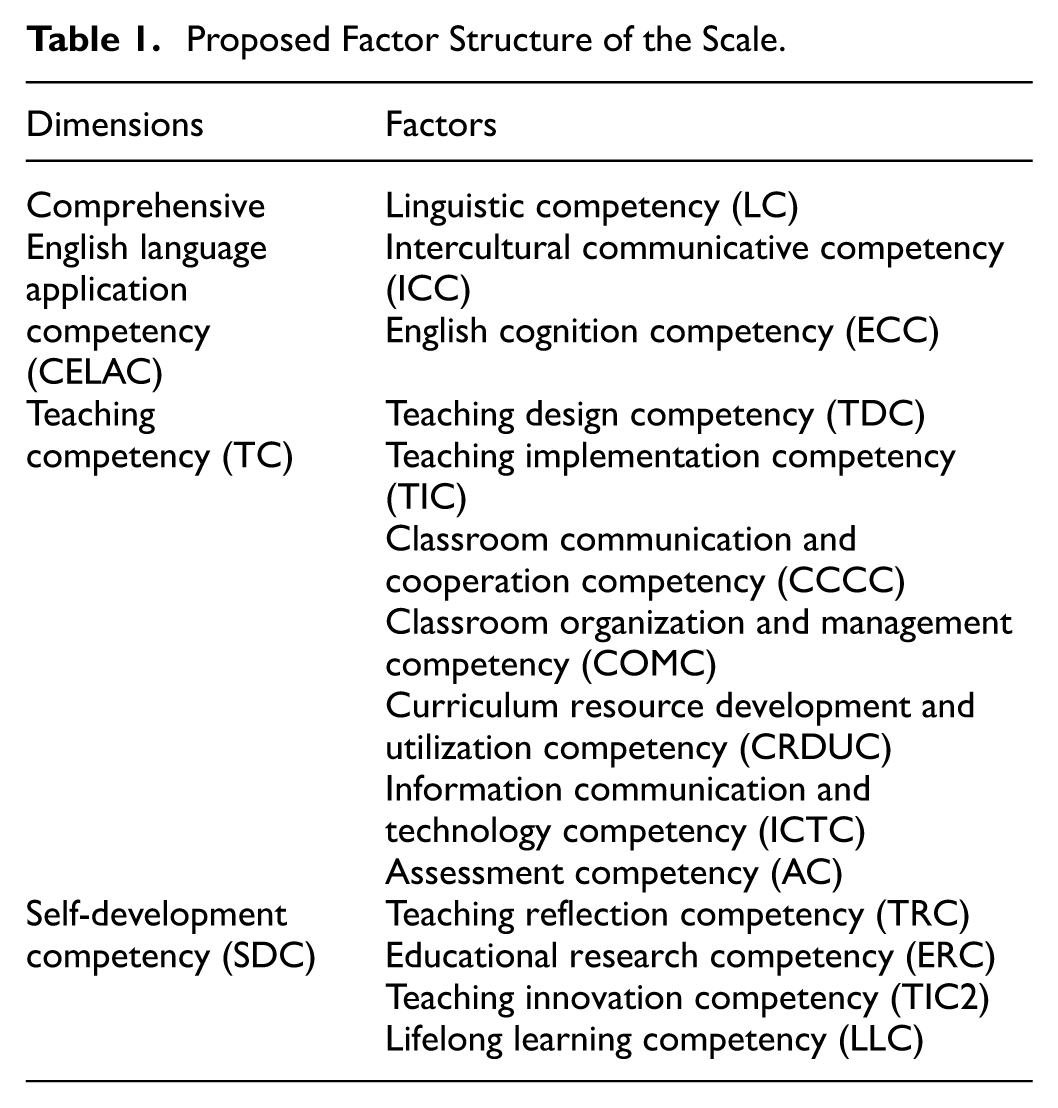
Language ability serves as the foundational core competency for English teachers. As Richards and Farrell (2005) noted, language ability extends beyond mere linguistic knowledge to encompass practical language application. It requires English teachers to possess robust linguistic knowledge, pragmatic competence, and intercultural communication skills, ensuring accurate and authentic English usage and effective knowledge transmission. Teaching ability is crucial to professional development. Moreover, the Pedagogical Content Knowledge (PCK) theory of Shulman (1987) emphasizes the complexity of teaching abilities. It encompasses not only classroom teaching skills but also instructional design, teaching strategies, learning assessment, and classroom management. Modern English language teaching demands that teachers flexibly employ diverse teaching methods and technological approaches based on students’ varied needs and learning characteristics. Self-development ability reflects the continuity and proactivity of teacher professional growth. Darling-Hammond (2006) emphasized that excellent teachers should possess the capacity for continuous learning and reflection. It includes professional reflection, self-assessment, continuous learning, and research capabilities, enabling teachers to continuously update their knowledge systems and adapt to rapid educational changes. Thus, in this study linguistic competency, intercultural communicative competency, and English cognition competency are combined into comprehensive English language application competency (CELAC). Teaching design competency, teaching implementation competency, classroom communication and cooperation competency, classroom organization and management competency, curriculum resource development and utilization competency, information communication and technology competency and assessment competency are integrated into teaching competency (TC). Teaching reflection competency, educational research competency, teaching innovation competency, and lifelong learning competency are constituted into self-development competency (SDC). Finally, we propose a three-layer TPC conceptual model consisting of three dimensions (CELAC, TC, and SDC) with 14 factors, serving as the theoretical foundation of the TPC scale for secondary school EFL teachers (see Table 1).
Proposed Factor Structure of the Scale.
Methodology
Data Collection and Participants
Data were collected through a survey questionnaire administered via Wenjuanxing platform to English teachers in secondary schools in China. This study adhered to established ethical guidelines and received appropriate institutional approval. Informed consent was obtained from all participants prior to their involvement. They were fully informed about the research purpose, and were assured that participation was entirely voluntary, with the option to withdraw at any time without consequence. To ensure confidentiality, no personally identifiable information was collected. The questionnaire content was deliberately designed to focus on professional competencies and teaching practices, excluding any sensitive or potentially distressing topics. The development and validation of a reliable and valid a scale provides a scientifically robust tool for assessing teacher professional development and informing school-level training policies, holding substantial theoretical and practical value. For the participants, the study offered an opportunity to reflect on their own professional competencies.
A total of 208 English teachers from 15 schools participated in the piloted survey. Samples were excluded if they demonstrated consistent response patterns across scale items, indicating potential disengagement, or if the completion time was less than 4 min, which was deemed insufficient for thoughtful responses. After data cleaning, the final piloted sample consisted of 175 valid responses (84% of the total 208 responses), with a total of 33 samples excluded.
The formal study involved a much larger and more comprehensive sample, with 1,053 English teachers from 335 schools completing the online survey. Following the same exclusion criteria as the pilot study (e.g., consistent response patterns and insufficient completion time), 139 responses were removed, resulting in a final formal sample of 914 valid responses (87% of the total 1,053). The majority of participants were female (749, 69%), while 165 teachers were male. Regarding the school levels, 606 teachers were from junior high schools and 308 teachers were from senior high schools; 384 teachers were from rural schools, while 530 were from urban schools. Furthermore, 596 teachers taught in general schools, and 318 teachers were from model schools. In terms of teaching experience, 56 teachers had 1 to 3 years of experience, 208 teachers had 4 to 10 years, 219 teachers had 11 to 15 years, and 431 teachers had over 16 years of teaching experience.
Data Instrument
The instrument employed in this study was developed on the basis of the conceptual model above and previous TPC classifications or models (Blömeke & Delaney, 2012; Freeman & Johnson, 1998; Noer, 2019; Richards, 2010), comprising three dimensions: CELAC (23 items), TC (64 items), and SDC (31 items). Informed by the mix of Iceberg Model theory (Spencer & Spencer, 1993) and Onion Model theory (Boyatzis, 2008), competencies are defined as a set of abilities or skills, interpreted by a list of observable behaviors needed for effective job performance. These behaviors are supported by a dynamic combination of knowledge, skills, attitudes and values, and motives and traits. In this study, TPC refers to teachers’ abilities or observable professional behaviors that enable them to solve teaching-related problems coherently, effectively and efficiently. The professional competencies of EFL teachers are uniquely associated with foreign language instruction, which fundamentally differentiates them from those required for teaching other subjects in Chinese. Building on the model of language ability, teaching ability and self-development ability (Freeman, 1989; Gong, 2011), this study expands our understanding of the components of the hierarchical relationships among professional competencies.
Table 2 shows the definitions of 14 constructs and respective sample items. EFL teachers rated these 118 items on a five-point Likert scale (1 = unneeded, 2 = somewhat unneeded, 3 = somewhat needed, 4 = needed, 5 = very needed), with higher scores indicating a greater need for teacher professional competencies.
The Definitions and Sample Items of Each Construct.

In the piloted study, normality was initially tested. All the 118 items were measured, having appropriate skewness (ranging from −1.459 to −0.184) and kurtosis (ranging from −0.786 to 2.191), smaller than the requisite maximum values of |2| and |4|, respectively, indicating that the data of all items were close to expected values under normality (Armitage et al., 2013). Additionally, KMO values and Bartlett’s sphere test Kaiser (1974) showed KMO = 0.893 and χ2 = 2,103.448 (df = 190, p = .000) of CELAC; KMO = 0.927 and χ2 = 8,479.695 (df = 1,081, p = .000) of TC; KMO = 0.918, χ2 = 5,099.511 (df = 435, p = .000) of SDC. These results indicated that the correlation matrix of the population has common factors and is suitable for EFA. Principal component analysis was employed to extract common factors. As professional competencies should not be related to each other in each construct, varimax rotation was used to analyze item loadings (Boyle et al., 2014). The number of factors was determined using the Kaiser criterion (eigenvalues > 1), and items with loadings below 0.50 were excluded (Hinkin, 1995).
In the EFA for CELAC, four factors emerged: English cognition competency (ECC), English skills (ES), intercultural communicative competency (ICC), and English knowledge and application competency (EKAC). These results diverge from the original hypothesis of three factors (LC, ICC, and ECC), with linguistic competency (LC) now divided into ES and EKAC. ECC remains unchanged. A total of 20 items were finalized. In the EFA for TC, five factors emerged: teaching implementation and management competency (TIMC), information and communication technology competency (ICTC), teaching design competency (TDC), test item construction competency (TICC), and comment competency (CC). This combines the original seven factors into five, with assessment competency (AC) split into TICC and CC. A total of 47 items were obtained finally. In the EFA for SDC, four factors were identified: teaching reflection competency (TRC), educational research competency (ERC), teaching innovation competency (TIC2), and lifelong learning competency (LLC), consistent with the original TPC model. A total of 30 items were collected. The internal consistency reliability of the three dimensions (CELAC, TC, and SDC) and the overall scale was assessed using Cronbach’s alpha coefficient (Peterson, 1994), yielding a value of .924, .975, and .959 for three dimensions and .985 for the total scale, respectively. These data indicate high internal consistency, stability, and reliability for both the individual dimensions and the entire questionnaire. Ultimately, the three dimensions encompass 13 factors with a total of 97 items, providing a thorough understanding of the formal scale’s content.
Data Analysis
We hypothesized that the TPC scale as a third-order factor model comprising three second-order factor models (CELAC, TC, and SDC). We constructed three second-order factor models to inform the development of a third-order factor model. To develop the TPC scale, Structural Equation Model (SEM) was used to explore the relationships among three dimensions. SEM is particularly suitable for validating established theoretical relationships with evaluating measurement and structural components of a conceptual framework (Anderson & Gerbing, 1988). The data analysis comprised two main stages: the measurement and structural model assessment. During the measurement assessment process, CFA was first conducted using data from 914 valid responses to ensure the construct validity of the formal scale, using the most common techniques for testing dimensionality: absolute fitting index (χ2/df ≤ 3.00), Goodness-of-Fit Index (GFI ≥ 0.90), Adjusted Goodness-of-Fit Index (AGFI ≥ 0.90), Root Mean Square Residual (RMR ≤ 0.08), Root Mean Square Error of Approximation (RMSEA ≤ 0.08), Comparative Fit Index (CFI ≥ 0.90), and Normed Fit Index (NFI ≥ 0.90; Hu & Bentler, 1999). We employed AMOS 24.0 and SPSS 25 software to assess the scale’s reliability and validity, including Average Variance Extracted (AVE > 0.50), and Composite Reliability (CR > 0.80; Hu & Bentler, 1999) along with internal consistency coefficients using Cronbach’s alpha (α > .70; Peterson, 1994). Discriminant validity was verified when the square root of the AVE for each latent variable exceeded its correlations with other latent variables (Fornell & Larcker, 1981). Accordingly, we also examined multicollinearity among the variables using variance inflation factor (VIF). During the structural model assessment process, we examined standardized coefficients among second-order factors before validating the third-order factor model.
Results
Measurement Model Assessment
After post-modification and removing three items during the CFA process, the CELAC dimension exhibited exceptional structural integrity through multiple fit indices (χ2/df = 2.261, RMSEA = 0.037, RMR = 0.018, GFI = 0.971, AGFI = 0.958, NFI = 0.976) with four factors emerging for CELAC: ECC, ES, ICC, and EKAC. Similarly, after the removal of 17 items and one factor (CC), the TC dimension achieved satisfactory fit indices (χ2/df = 2.523, RMSEA = 0.041, RMR = 0.018, GFI = 0.933, AGFI = 0.919, NFI = 0.962), validating the theoretical four-factor structure of TC: TIMC, ICTC, TDC, and TICC. After deleting three items, the SDC dimension modifications yielded favorable fit indices (χ2/df = 2.724, RMSEA = 0.043, RMR = 0.023, GFI = 0.936, AGFI = 0.920, NFI = 0.967), confirming the four-factor structure (TRC, ERC, TIC2, LLC). Finally, we developed a scale of 12 factors with 74 items for TPCs in secondary education.
The measurement model assessment shows all factors’ VIF values were within acceptable ranges, varying between 1.361 and 3.159, which is less than the recommended by (Hair et al., 2019), suggesting that there is no multicollinearity issue among the independent variables in the model. Most factors have high Cronbach’s Alpha values, such as .960 for TIMC and .966 for TRC, indicating strong internal consistency. Some factors like ES (0.751) and EKAC (0.672) have relatively lower Cronbach’s Alpha values, yet they are still within an acceptable range (Hulin, 2001). Overall, the measurements of these factors show certain reliability.
The data in the table shows that most factors have high composite reliability, some dimensions have good convergent validity (AVE > 0.5), and most factors have good discriminant validity (the square root of AVE is greater than the correlation coefficient between dimensions). Regarding the convergent validity, although the AVE values for ES (0.451) and EKAC (0.411) within the CELAC model were marginally below the commonly accepted threshold of 0.50, they still fell within an acceptable range (Bagozzi et al., 1981). The AVE values for TC were reasonable, with a minimum of 0.644, and SDC demonstrated strong convergent validity with a minimum AVE value of 0.634. ECC and ICC exhibited strong discriminant validity, with the square roots of their AVE exceeding correlations with other latent variables. Conversely, ES and EKAC demonstrated significant correlations, potentially undermining their discriminant validity. Despite EKAC’s weaker discriminant validity, the square roots of AVE for most latent variables generally met requirements, suggesting that the measured constructs are mostly independent, thus supporting the overall model validity (see Table 3).
Measurement Model Assessment.

Second-Order Factor Structural Model Assessment
When analyzing the data on 12 factors from measurement model assessment, we closely examined the relationships among latent variables. The correlation coefficients between every pair of latent variables within the three dimensions, namely comprehensive English language application competency (CELAC), teaching competency (TC), and self-development competency (SDC), exceed .5, in accordance with the benchmark set by Mueller (1999). For example, in the CELAC dimension, the correlation between ECC and ICC is as high as .826; in the TC dimension, the correlations between TIMC and ICTC are .747 and .756 respectively; and in the SDC dimension, the correlation between TRC and TIC2 stands at .807 (see Table 4). Such relatively high correlation coefficients strongly imply the presence of a higher-order common factor within each dimension. This underlying higher-order factor acts as a fundamental construct, influencing and integrating the individual latent variables within their respective dimensions, thus accounting for the observed interdependencies. Consequently, we formulated three second-order factor models corresponding to the three dimensions: CELAC, TC, and SDC. These models are meticulously crafted to more effectively capture the latent structural relationships and the impact of the higher-order factors on the individual latent variables.
Correlations Among Three Dimensions of 12 Factors.

After formulating the three second-order factor models (CELAC, TC, and SDC), we evaluated their fit to the data of the CELAC model, and all fit indices were favorable. The χ2/df was 2.417 (<3.00), RMSEA 0.022 (<0.08), RMR 0.039 (<0.08), and GFI, AGFI, NFI, RFI, IFI, TLI, and CFI all exceeded 0.90. The TC model also showed a good fit, with χ2/df = 2.522 (<3.00), RMSEA = 0.041 (<0.08), RMR = 0.019 (<0.08), and all other major indices above 0.90. The SDC model had satisfactory fit indices too, with χ2/df = 2.729 (<3.00), RMSEA = 0.044 (<0.08), RMR = 0.023 (<0.08), and all relevant indices > 0.90. These results for all three models confirm the initial hypothesis of higher-order factors due to high latent variable correlations, validating our study’s theoretical framework on professional competencies.
Figure 2 shows CELAC as a higher-order factor with substantial influence on first-order factors ECC, ES, ICC, and EKAC, with β values of .96, .51, .85, and .57, respectively. Notably, its strong impact on ECC and ICC highlights them as crucial components of CELAC, suggesting that changes in CELAC significantly affect these factors. Figure 3 illustrates TC’s similar explanatory power, impacting TIMC, TDC, ICTC, and TICC with β values of .92, .83, .80, and .75, respectively. TIMC is particularly influenced by TC, reinforcing TIMC, TDC, ICTC, and TICC as vital parts of TC. Figure 4 demonstrates SDC’s robust explanatory capability on TRC, ERC, TIC2, and LLC, with β values of .90, .78, .90, and .81, highlighting TRC and TIC2 as key elements within SDC.

The standardized coefficients and path of the second-order factor model of CELAC.

The standardized coefficients and path of the second-order factor model of TC.

The standardized coefficients and path of the second-order factor model of SDC.
Additionally, as presented in Table 5, the correlations between each factor and the total scale range from 0.901 to 0.962, all of which exceed 0.70. The correlations among the individual factors (CELAC, TC, and SDC) range from 0.762 to 0.851. These results indicate that while the dimensions of CELAC, TC, and SDC demonstrate a certain degree of independence, they also exhibit a high level of commonality. The relatively high correlations among the factors suggest that there is likely an underlying higher-order factor influencing these dimensions. The significant correlations at the 0.01 level (2-tailed) further strengthen the reliability of these relationships.
Correlations Among Three Dimensions of the Final TPC Scale.
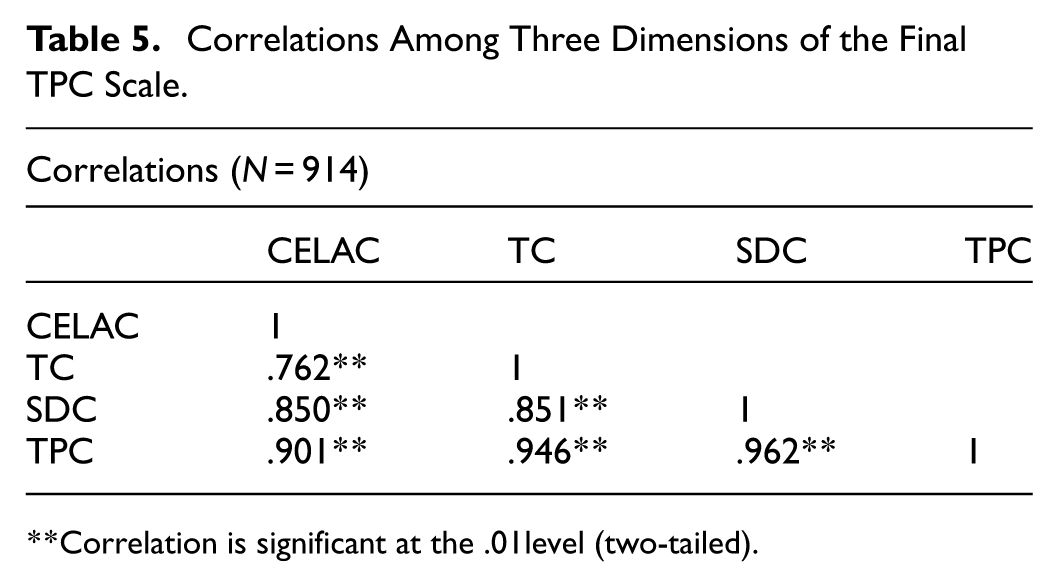
Correlation is significant at the .01level (two-tailed).
Third-Order Factor Structural Model Assessment
Figure 5 reveals TPC’s extraordinary explanatory power over three second-order factors CELAC, TC, and SDC, with high βvalues of 0.920, 0.98, and 0.99, respectively. The significant standardized regression coefficients indicate the stability and reliability of the third-order factor model, highlighting CELAC, TC, and SDC as crucial components of TPC. After multiple model-fitting adjustments, the fit indices for the TPC model are as follows: χ2/df = 2.347 (<3.00), RMSEA = 0.038 (<0.08), RMR = 0.033 (<0.08), GFI = 0.843 (>0.90), AGFI = 0.830 (>0.90), NFI = 0.910 (>0.90). Although GFI (0.843) and AGFI (0.830) are slightly below the 0.90 benchmark, most indices fall within the acceptable range, providing data—based support for the theoretical model. The composite reliability (CR) coefficients of the four latent variables CELAC, TC and SDC are all greater than 0.80. The average variance extracted (AVE) values for these latent variables are greater than 0.50, confirming their validity (M. Wu, 2010). This validates the good convergent validity of the latent variables, thereby confirming the intrinsic quality of the TPC model. The CR values of the three latent variables CELAC, TC, and SDC all exceed 0.80, and their AVE values are greater than 0.50 (M. Wu, 2010), which validates the good convergent validity of these latent variables and confirms the quality of the TPC model. Moreover, the Cronbach’s Alpha value of .932 for the TPC model further attests to its internal consistency.

The standardized coefficients and path of the third-order factor model of TPC.
Discussion and Conclusion
This study focuses on developing a professional competency scale for secondary school EFL teachers, covering three core dimensions: comprehensive English language application competency (CELAC), teaching competency (TC), and self-development competency (SDC; see Table 6). The results of this study align with the model of Freeman (1989) including language ability, teaching ability, and self-development ability and expand on it through empirical validation. The scale’s structure supports the complexity of teaching abilities (Shulman, 1987) and practical language application (Richards, 2010). This scale is reliable and structurally stable, effectively reflecting the professional competencies required for secondary school English teachers in the context of cultivating students’ English core competencies. We discuss this scale from three dimensions: conceptual organization, theoretical relationships, and measurement properties.
The Final Factors of the Scale.

First, regarding conceptual organization, the scale established in this study presents a clear three-dimensional hierarchical structure, providing a systematic conceptual framework for teacher competency assessment. By integrating the core principles of the Iceberg Model theory (Spencer & Spencer, 1993) and the Onion Model theory (Boyatzis, 2008), the study provides a new perspective for understanding the hierarchical structure of teachers’ professional competencies, revealing the dynamic combination of various elements such as knowledge systems, skill sets, attitude orientations, value systems, motivational drives, and personality traits behind these competencies. The scale is organized at the highest level into three core dimensions: CELAC, TC, and SDC. This organization breaks through the single-plane structure of traditional teacher competency models (Marzano, 2017; Stronge, 2018), instead adopting a multi-level architecture to reflect the complex associations between competency domains. The factors under each dimension have been rigorously empirically validated, streamlined from an initial 14 factors to a final 12 factors, achieving a balance between comprehensive content coverage and operational simplicity. This conceptual organization not only captures the multi-faceted composition of TPCs but also avoids the excessive complexity common in existing frameworks (Duong et al., 2025; Şen & Yildiz Durak, 2022), providing a more practical conceptual structure for teacher assessment and development. Notably, unlike earlier research suggesting that teachers’ technological capabilities should be an independent and important dimension (Karsenti et al., 2020), this study takes a different approach. This scale incorporates information communication and technology competency as an independent factor within the TC dimension, reflecting the special requirements for English teachers’ technology integration abilities in the digital age. This alignment with global trends is reinforced by Thah (2022), who categorized ICT competencies into technological operations, pedagogical application, and ethical awareness across international contexts, and AlSuwaihel (2024), whose work on augmented reality and TPACK components underscores technology-subject interplay as a universal priority, suggesting the scale’s technology-related factors can adapt to diverse digital education ecosystems beyond China.
Second, in terms of theoretical relationships, the theoretical relationships presented in this scale reflect the intrinsic connections and developmental logic of teacher professional competencies. The three second-order factors (CELAC, TC, SDC) and 12 first-order factors form a clear hierarchical structure that not only reveals how specific competencies constitute broader competency domains but also reflects the dynamic process of professional competency development. Unlike the TPACK model (S. Kim et al., 2021) which views technological competency as an independent domain, this scale demonstrates through empirical validation that information communication and technology competency (ICTC) exists both as an independent factor under the TC dimension and functionally interacts with other TC factors. Most notably, this scale extends the TPACK model (König et al., 2024) and elevates SDC to a core dimension parallel to CELAC and TC. This aligns with recent calls for adaptive teacher roles in AI-enhanced classrooms (Bryant et al., 2020). The high correlation between SDC and TC (r = .851) supports the assertion of Darling-Hammond (2006) that reflective practice underpins effective teaching. This innovation breaks free from the limitations of traditional frameworks that subordinate reflection and research abilities to teaching skills (Danielson, 2013), highlighting the key role of teacher autonomous development in professional growth. Additionally, the theoretical associations among 12 factors in the scale directly correspond to the needs of students’ English core competency development (Ministry of Education of China, 2020, 2022a) and resonate with international models. For instance, Yim and Lim (2024) identified language proficiency, cultural teaching, and student-centered teaching as universal constructs, while emphasized assessment and learning environment organization, all of which are encapsulated within the CELAC and TC dimensions, forming a theoretical bridge between teacher competencies and student development goals.
Third, concerning measurement properties, as a scale established through rigorous empirical research, this measurement tool demonstrates superior psychometric properties. Through CFA of data from a large sample of 914 EFL teachers from 335 schools, the three-level structural model of the scale (including three second-order factor models and one-third-order factor model) has been fully validated, indicating good structural validity. This empirically-based approach distinguishes itself from traditional framework development that primarily relies on theoretical reasoning or expert consensus, providing stronger evidential support for the structural validity of competency categorization. The measurement design of the scale considers both theoretical integrity and practical application needs in teacher assessment and development, avoiding both the oversimplification of some existing models and the excessive complexity of others (Newby, 2011). Simultaneously, the scale is specifically designed for secondary school English teachers, ensuring the professional relevance and applicability of measurement content, overcoming the limitations of generalized teacher competency standards (Ministry of Education of China, 2012). Notably, its focus on context-adaptive factors aligns with international findings. For example, Reflianto et al. (2022) highlighted questioning strategies as critical for flipped classrooms, while A. J. Kim et al. (2024) and S. Kim et al. (2024) identified English-speaking skills as a key challenge in South Korea’s English-Medium Instruction settings. This suggests the scale’s core dimensions (e.g., CELAC’s emphasis on communicative proficiency) can be supplemented with context-specific items to suit diverse educational environments. Measurement results indicate that this scale possesses stable psychometric properties, providing a reliable quantitative foundation for teacher competency assessment. In terms of practical application, this scale provides clear guidance for teacher training and professional development globally. For example, its inclusion of ICTC within TC responds to the finding of Thah (2022) that technological and ethical competencies are universal needs (despite regional disparities), suggesting training programs worldwide could adapt the scale to address local technology access gaps while retaining core information and communication technology integration metrics.
This study contributes to the literature in four primary ways, with distinct theoretical and practical implications. Theoretically, it enriches research on EFL teachers’ professional development by identifying necessary TPCs for enhancing students’ English core competencies, addressing gaps in existing literature, which lacks consensus on required TPCs and comprehensive scales, through an empirically validated scale clarifying how specific competencies support students’ core competency development. Additionally, applying the Iceberg Model Theory and Onion Model Theory deepens understanding of the layered professional skills and abilities essential for effective English language education. Practically, identifying these specific competencies can guide teacher training and development programs, enabling educators to better adapt to the evolving educational landscape. Moreover, the constructed TPC scale for secondary school EFL teachers clarifies teachers’ professional competencies in cultivating students’ English core competencies, providing an important reference for research and practice in teacher professional development.
As with all studies, this study has a few limitations. It primarily draws on a specific geographical region or an educational system, which may not fully capture the varied educational landscapes and teaching practices prevalent in other areas. This potentially limits the generalizability of the scale across different educational contexts, and institutional settings. Future studies should aim to validate and adapt the scale in diverse geographical settings. Such adaptations could include refining cultural teaching factors to address the insights of Alrawashdeh and Kunt (2022) on refugee teachers’ cultural competency challenges, or adjusting EMI-related items to align with the findings of S. Kim et al. (2024). These steps would enhance the scale’s global applicability and relevancy. In terms of research methods, a combination of classroom observation, in-depth interviews, teaching case analysis, and other methods can be used to gain a more comprehensive and in-depth understanding of teachers’ professional competencies. At the same time, with the increasing application of artificial intelligence in the education field, it is crucial to deeply explore the relationship between artificial intelligence and teachers’ professional development. For example, researching how to use artificial intelligence tools to achieve personalized teaching guidance and intelligent teaching evaluation can further improve the quality of English teaching. While the study has limitations, it points to directions for subsequent research, with the expectation that future work will refine the scale to better serve diverse educational needs and advance the English education industry.
Supplemental Material
sj-docx-1-sgo-10.1177_21582440251412777 – Supplemental material for Measuring Secondary School English Teachers’ Professional Competencies: Scale Development and Validation
Supplemental material, sj-docx-1-sgo-10.1177_21582440251412777 for Measuring Secondary School English Teachers’ Professional Competencies: Scale Development and Validation by Qihua Sun and Ping Qu in SAGE Open
Footnotes
Acknowledgements
We thank all the participants, teachers and experts who participated in this study.

Ethical Considerations
This study was approved by the High School Affiliated to Huaibei Normal University Research Ethics Committee at Huaibei Normal university (approval no. A2022002) on January 25, 2022.
Consent to Participate
The study was approved by the High School Affiliated to Huaibei Normal University Research Ethics Committee at Huaibei Normal university (Ethical Clearance Reference Number: A202202) on January 25, 2022. All participants provided written informed consent prior to participating.
Author Contributions
PQ has contributed to the research design; QS has conducted the data collection and analysis and drafted the paper; QS, and PQ have contributed to the critical revision. Two authors have given final approval of the final version to be published and agree to be accountable for all aspects of the work.
Funding
The authors disclosed receipt of the following financial support for the research, authorship, and/or publication of this article: This work was supported by the General Scientific Research Project of Zhejiang Provincial Education Department [Grant Number: Y202455880].
Declaration of Conflicting Interests
The authors declared no potential conflicts of interest with respect to the research, authorship, and/or publication of this article.
Data Availability Statement
The original contributions presented in the study are included in the article/Supplemental Material. Further inquiries can be directed to the first author.*
Supplemental Material
Supplemental material for this article is available online.
References
Supplementary Material
Please find the following supplemental material available below.
For Open Access articles published under a Creative Commons License, all supplemental material carries the same license as the article it is associated with.
For non-Open Access articles published, all supplemental material carries a non-exclusive license, and permission requests for re-use of supplemental material or any part of supplemental material shall be sent directly to the copyright owner as specified in the copyright notice associated with the article.
