



Abstract
Competency development is critical for college students to prepare for future careers after graduation. A scientific investigation of these students’ perceptions of competency can help develop effective ways to enhance their competencies. This study used Q methodology, which reveals subjectivity, to examine Korean college students’ perceptions of the core competencies they seek to improve and their corresponding reasons. The study participants included 49 students at a university in South Korea. The researchers explained the study’s purpose to the participants, obtained consent, and performed Q sorting. The study derived four types of students: Type 1 preferred improving personal competencies through professional development, Type 2 desired improving character development, Type 3 selected improving adaptability, and Type 4 favored improving cooperation. This study explored the perception types to determine how to enhance competencies for student success after graduation.
Introduction
An essential objective of college programs is to improve students’ competencies so they can function as independent members of society after graduation (Briggs et al., 2012). Thus, colleges must provide education based on core competencies to effectively achieve this objective. Scholars have used the core competency concept to explain competitive advantages and enhance corporate competitiveness (Porter, 1980). Core competencies are an assembly of the minimum knowledge, skills, and attitudes that enable effective performance in various situations (Dubois, 1993).
The Organisation for Economic Cooperation and Development (OECD) initiated discussions on the core competencies of the 21st century starting in 1997. In the following years, they carried out projects such as the OECD DeSeco (Defining and Selecting Key Competencies) for primary and secondary education and the OECD-AHELO (Assessment of Higher Education Learning Outcomes) for higher education (M. S. Kang & So, 2020). In addition, concerning core competencies at the graduate school level, the Accreditation Council for Graduate Medical Education (ACGME) accredited medical knowledge (problem-based learning), interpersonal communication, patient care, professionalism, practice-based learning and improvement, and system-based care (Joshi et al., 2021). In South Korea, the Ministry of Education, Science, and Technology and the Korea Research Institute for Vocational Education and Training established the Korea Collegiate Essential Skills Assessment (K-CESA) to evaluate the knowledge, skills, and attitude required for successful performance in most occupations, regardless of the specific position (M. S. Jin et al., 2011). Thus, college students’ core competencies are comprehensive abilities that commonly include knowledge, skills, and attitude and we can divide the competencies into cognitive and non-cognitive domains. The cognitive domains have high-order thinking abilities such as critical thinking, analytical and problem-solving, and communication abilities. In contrast, the non-cognitive domains include emotive aspects such as self-concept and attitudes and competencies such as interpersonal relations and self-management (Choi & Rhee, 2009).
J. J. Park et al. (2014) explored college students’ core competencies, noting that these are not limited to traditional intelligence, which focuses on staged cognitive abilities. They also include non-cognitive competencies, which involve using one’s resources effectively in specific situations. The Korea Collegiate Essential Skills Assessment (K-CESA), which diagnoses the common core competencies of South Korean college students, states that cognitive competencies include communication, processing and utilization of resources, information and technology, synthetic thinking faculty, and global competencies; the non-cognitive competencies include interpersonal and self-management competencies (M. S. Jin et al., 2011). Unlike traditional education, teaching based on core competencies enhances student employment competitiveness (Cellucci et al., 2018). Through this model, students form knowledge, skills, and attitude to function successfully in society and meet the demands of decision-makers and the labor market (Alkhodary et al., 2020).
Competency-based education (Pijl-Zieber et al., 2014) focuses on learner performance toward concrete learning goals. According to Mah and Ifenthaler (2017), a competency-based curriculum requires successful completion of time management, learning, self-monitoring, proficiency, and research. These competencies are closely related to employability or marketability standards for graduates (Rahmat et al., 2012 ). Currently, employers are looking for graduates with good employability skills and expect them to demonstrate their skills on the job (Gauthier, 2020). In addition, employability skills include critical personal qualities and values that enable employees to thrive in the workplace (Kovacs & Vamosi Zarandne, 2022). However, the actual employability standards of employers differ from those perceived by college students due to the apparent gap between the content students learn in school and the abilities necessary to work (Blokker et al., 2019; Grealish, 2006). The response to the mismatching, which appears in the difference between the competencies required by employers and the competencies learned by college students, creates a demand for college career guidance (Minwook et al., 2020). Therefore, colleges must identify the core competencies employers and society require to achieve workplace competitiveness and educate students on these core competencies to strengthen their competitiveness (M. S. Jin et al., 2010).
First, earlier studies on college students’ core competencies focused on measuring core competencies. For instance, H. Y. Kim et al. (2018) developed and validated a diagnostic tool to measure college students’ core competencies. Meanwhile, Song (2019) focused on a system for diagnosing and utilizing these core competencies, and Im (2019) created a self-awareness diagnostic tool for students at a specific university. Second, various studies assessed awareness of specific competencies. For example, S. J. Kim (2018) investigated the challenges college students face in collaboration, using a scale-based study to explore this competency and suggested improvements. J. A. Lee and Ahn (2019) analyzed the educational needs for developing entrepreneurship among college students, while S. Park (2019) studied how college students perceive creativity. A study by Mah and Ifenthaler (2018) identified German first-year students’ academic competencies and proposed providing appropriate programs. Third, other studies examined the differences in the perception of core competencies among subjects. Studies like that of Kang and Park (2018) revealed the differences in how human resources managers and college students perceive the competencies of new employees. Heo and Hwang (2020) conducted a comparative analysis of industry’s and university students’ perceptions of engineering convergence capabilities. S. J. Kim (2019) showed differences in collaboration ability levels depending on college students’ collaboration experiences. In addition, research with Iran and Israel investigated developing the core entrepreneurial competencies in an educational context (RezaeiZadeh et al., 2017). Lastly, studies showed effects on college students’ perceptions of their core competencies. M. S. Kim et al. (2019) revealed that college students’ participation in extracurricular programs affected their learning capabilities, with J. Lee et al. (2019) stating that extracurricular education courses affected students’ core competencies. J. Y. Park (2020) demonstrated the mediating effect of coaching capabilities in the relationship between college students’ core and creative convergence competencies.
Although these prior studies contributed practically and academically to improving college students’ core competencies by developing scales and programs, these studies primarily reflect the researcher’s perspectives. A significant limitation is their failure to explore the students’ subjectivity—considering the viewpoints of the college students who are directly affected. In a 2018 study, Maharaja conducted exploratory qualitative research on the intercultural competence of college students in the United States. Similarly, Telang et al. (2017) explored competency-based medical education from the perspectives of study participants. However, both studies primarily highlighted the subjective experiences of college students and failed to categorize these subjective characteristics systematically. Therefore, these limitations hinder providing practical, customized services to universities based on these studies.
Colleges strive to develop students’ competencies by investigating core competencies that fit the school’s classification characteristics. That is, they try to improve the competencies required of college students, reflecting what employers seek through curriculum, extracurricular activities, or college credit completion requirements (M. Lee, 2017; Min, 2020; Ryu & Kang, 2020). Moreover, colleges developed students’ core competency scales by surveying students’ perceptions. However, these surveys are limited since they forced students to choose from an existing list instead of allowing them to state what competencies they thought were necessary and why (Jeong, 2016; H. Y. Kim et al., 2018; Koh & Jung, 2017).
Understanding college students’ desired competencies can help schools develop competencies based on perception types and provide opportunities to examine and supplement these competencies. For instance, Glasser (1981) argues that the perception of reality is more important than reality per se in determining human behavior. Thus, students seek to improve the competencies they perceive to be the most important and often do not realize they are missing out on other necessary skills. Therefore, understanding students’ perceptions is critical in guiding and equipping them for life. In particular, investigating the core competencies perceived by first and second-year college students is crucial because it can provide opportunities to improve the competencies during the third and fourth years.
Consequently, this study used the Q methodology to examine subjective perceptions and investigate how college students perceive their competence. Q methodology has a characteristic that the researcher does not use categories or scales defined in advance. Instead, research participants directly express their opinions qualitatively, and this can minimize researcher bias or the problem of inducing socially desirable answers that can occur in traditional quantitative surveys (Watts & Stenner, 2005a). That is, Q methodology is a methodology that can derive significant study results by enabling participants to express their opinions freely, analyzing the opinions, and identifying the patterns; Q methodology combines the strengths of qualitative studies.
The study’s results of different perceptions contribute to core competency development according to the characteristics of each type, enabling individuals to create a sustainable career with good productivity, health, and happiness (Heslin et al., 2020). In addition, college life is the most critical time to develop such competencies, especially for first-year college students. It is important to explore and begin to develop their competencies early on for a more successful adjustment to college culture as well as the overall college experience (Tharp, 2017; Trautwein & Bosse, 2017). Hence, this study investigates entry-level university students’ preferred core competencies and their corresponding reasons to determine the areas they need to supplement.
Research Methodology
William Stephenson, a British physicist–psychologist, created the Q methodology in 1935. He was interested in uncovering subjectivity in situations involving attitudes, experiences, and perceptions (Brown, 1996). Q methodology focuses on exploring the study subjects’ subjectivity, emotions, and perceptions regarding the study topic, which is useful for systematically understanding individual experiences and perceptions (Jang, 2021). Q methodology systematically examines subjectivity in various fields, including the social sciences and humanities, and categorizes subjectivity according to perspectives on specific topics (Brown, 1993; Coogan & Herrington, 2011; Webler et al., 2009). It is a valuable tool for scientifically understanding the intra- and inter-individual differences, “discerning people’s perceptions of the world from the vantage point of self-reference” (McKeown & Thomas, 2013, p. 1).
Analysis in Q methodology differs from general quantitative R as it is factor analyses by individual rather than variable. However, it has the characteristics of quantitative studies in that it categorizes factors, while its qualitative characteristics include its ability to identify study participants’ deep thoughts. Thus, the Q methodology has the benefit of quantitative and qualitative studies (Chaaban et al., 2023; Karasu & Peker, 2019 ). However, while Q methodology uses statistics, Q studies do not provide statistical generalizations related to the number of populations with certain characteristics. Instead, Q studies provide practical generalizations regarding the types of people in the population (Ramlo, 2024).
Q methodology aims to find correlations between people on a particular topic, thus categorizing people’s perceptions (Kil et al., 2020). It allows for organizing small groups related to a specific topic and identifying and examining subjective perceptions. This study utilized the Q methodology to understand the perceptions related to college students’ desired competencies. The research process involved creating a Q-concourse, selecting a Q-set and P sample, and then collecting data through Q sorting to analyze and interpret the results, as shown in Figure 1.

Research process.
Q Concourse
A Q concourse represents a collection of ideas, comments, and conversations about a particular topic, expressed as statements or items (du Plessis, 2019; Stephenson, 1986). A Q concourse is a collection of opinions and perspectives commonly expressed within a certain culture and an assembly of statements used in Q methodology studies (H. K. Kim, 1992). Watts and Stenner (2005a) explain several characteristics of concourses, such as knowledge sharing, cultural heritage, and leading formation of new information, meaning that concourses form from the communication of individuals and dynamically and continuously evolve into new forms (Karasu & Peker, 2019). In this study, Q concourse becomes all items about the core competencies college students want to improve. We obtained a Q concourse through the following procedure.
First, we conducted a semi-structured survey of 180 first-year college students taking a required career course at a university, a 4-year private university in Seoul, South Korea. For this process, we prepared a semi-structured questionnaire using a Google form. Then, we installed the link in the notice of the liberal arts e-class “Career Design,” mandatory for lower-grade undergraduate students. The message stated the study’s purpose, and students responded to the semi-structured questionnaire through the Google form link. We received 57 completed questionnaires. After thoroughly reviewing these questionnaires, we obtained 147 items.
The questionnaire asked the students to list the core competencies they wanted to develop through college curriculum or extracurricular activities during college life. Most respondents were in their first year, but we also included students from other years who had not taken the course during their first year. We surveyed on the orientation day of the first semester in 2020. All questionnaire responses comprised the primary concourse.
Then, we supplemented the Q-concourse with a literature review sourced from Riss4u and Google Scholar (Korea), using “core competencies” and “college students” as keywords (P. G. Baek, 2013; Cho & Choi, 2019; Chung et al., 2019; K. S. Hwang et al., 2015; M. S. Jin et al., 2011; Nam et al., 2016; Y. S. Park et al., 2017; C. N. Park & Chung, 2017). Through this process, 87 items were obtained, creating a total of 234 items for the Q-concourse.
Q-Set
A Q-set is a widely representative sample of Q items extracted from the Q concourse. To obtain the Q-set, we repeatedly reviewed the Q concourse, excluding overlapping competencies and selecting the most diverse core competencies. More specifically, we reduced the 234 items from the Q-concourse to 120 representative items by modifying those with similar meanings into one. Then, we categorized these items into cognitive (62 items) and non-cognitive(58 items) categories. After a comprehensive review, we selected 33 representative items for the Q-set, ensuring diverse selection within each category. Figure 2 (in Section 2.4) shows the final core competency items in this study.

Q Items: The Perception of Desired Core Competencies.
P Sample
A P sample means the respondents who participate in Q sorting (H. K. Kim, 2008). Since Q methodology focuses on an in-depth analysis of a few cases rather than a superficial analysis of many cases (Amin, 2000), it does not require demographic representativeness when selecting the P sample; only those the researchers expect will provide a clear perception of the issue (van Exel & de Graaf, 2005). Thus, a P sample is a small group of theoretically relevant participants to the issue (Brown, 1980), ranging between 10 and 100 individuals (Paik & Kim, 1998). A small size is sufficient if the P sample is comparable (H. K. Kim, 2008). Watts and Stenner (2005b) stated that determining the number of P-samples depends on experience and that studies are possible with a very small number. Therefore, a P-sample can comprise a few participants showing a range of perspectives on the study topic. Since this study aimed to examine how lower-grade undergraduates perceive their competencies, we selected undergraduates from the mandatory “Career Design” class as our P sample. We chose participants, that is, the P samples, focusing on entry-level university students because their perceptions can be significant in identifying opportunities to develop and supplement their competencies early in the college curriculum and extracurricular activities.
We used purposive sampling to select the study’s P sample from university in Seoul during the first semester of 2020 from April 24 to May 22, targeting students in the “Career Design” class through an e-class notice to participate after class. Participants included 41 first-year students, seven sophomores, and one student who did not report a year. We conducted this study during the last week of the semester on June 11, 2020. We notified students of the voluntary nature of participation in this study and emphasized that participation would not affect grades as the course was a pass/fail (P/F) subject. In addition, the participants received a detailed document explaining the study’s aims and procedures through Webex, an online system for non-face-to-face classes. Upon agreeing to participate in the study, the participants printed, signed, and uploaded the written informed consent forms before we proceeded with data collection. This study complied with the Committee on Publication Ethics (COPE).
Q Items, Q Sorting, and Data Analysis
This study’s Q sorting participants received notification through Webex. We uploaded the Q-sort sheet to the e-class, and students printed the Q-sort sheet to participate. After completing Q sorting, students took a picture of the Q sort sheet on their mobile phones and uploaded it to the e-class.
Brown (1980) describes Q sorting as “a modified rank-ordering procedure in which stimuli (Q items, in the case of this study) are placed in an order that is significant from the standpoint of a person operating under specified conditions” (p. 195). First, we asked the participants to classify 33 Q items according to their level of agreement (see Figure 2). Then, they placed the items on a quasinormal distribution Q sort table (He et al., 2020). Next, we provided a sufficient explanation of the basic concepts of individual competencies, after which the participants set 33 Q items according to the degree to which they wanted to develop personal competencies. We distributed the following Q items (i.e., the Q-set) to the participants for sorting (Figure 2).
Next, we provided the following instructions to the P samples about the Q items:
Please cut out each Q item card on the first sheet.
Read each Q item card carefully and separate them into three piles (most agreeable, neutral, and most disagreeable).
Next, place the most disagreeable cards on the far left side and the most agreeable cards on the far right side of the Q sort table below.
Fill in the rest of the table, placing the cards in the corresponding areas based on the level of agreement.
After placing all the cards, change them as necessary.
Once complete, please stick the cards onto the table using the given glue stick.
We used a nine-point scale in Q sorting ranging from the most agreeable (+4) to the most disagreeable (−4; Figure 3).
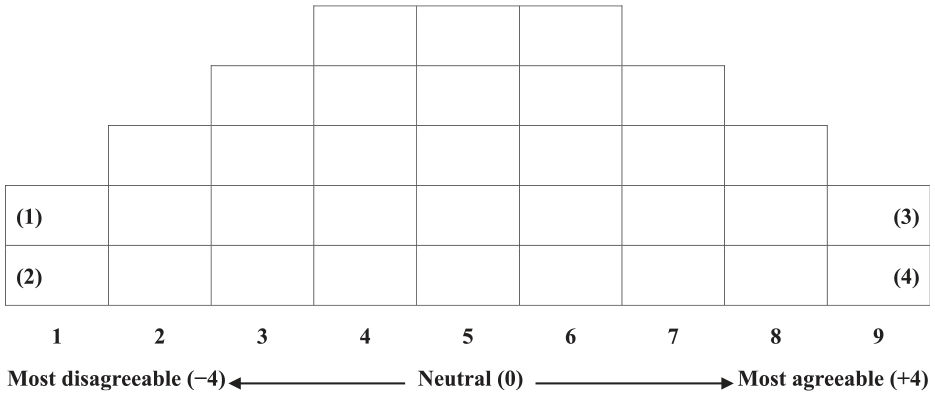
Q Sorting Grid.
After classification through Q sorting, we asked the respondents to write detailed responses for why they agreed and disagreed with the two items they ranked most agreeable and most disagreeable. Figure 4 illustrates the form for collecting responses.

Q Sorting Sheet including Reasons.
The researchers then analyzed the Q sorts using the QUANL program. Finding the number of each factor using the QUANL program requires input numbers ranging from 2 to 10 and selecting the result with the highest explanatory power (H. K. Kim & Oh, 2005). The QUANL program’s advantage is obtaining many results with simple data input (H. K. Kim, 2008). We also used Q principal component factor analysis to analyze and interpret the resulting numerical data (z-scores). We input and used the z-scores loaded to all the statements to explore the significance of these items. Principal component analysis extracts factors to maximize the factors’ explanatory variables. Therefore, the explanatory power of the factors is greater than the centroid analysis (H. K. Kim, 2008). This study used principal component analysis and a theoretical rotation. We also performed a varimax method that rotates as a criterion for maximizing variables concerning factor rotation. The results enable knowing the explanatory power, correlations between each factor, z-score of each item of each factor, the factor weight, and common items.
Principal component analysis usually extracts only factors with eigenvalues greater than 1.00. Z-scores are loaded to all the items to be used for analyzing the significance of these items. Moreover, the difference shows how significant a particular item is to a particular type compared to the other types. To interpret this study’s results, we focused on the items of z-scores and the differences with 1.000 or more and referred to the preception of P samples with high factor weights of each type. A P sample with a high factor weight can represent the characteristics of each factor (H. K. Kim, 2008). Moreover, we analyzed the P samples’ (participants) detailed written reasons for choosing the most agreeable items.
The researcher explained each concept before Q sorting so that the study participants would recognize the Q item concepts (i.e., the study participants understand the concepts of the words for the core competencies of the Q items). However, their reasons for developing those competencies may differ, revealing why they strongly agree with some items and individual subjective perceptions. Therefore, we formed and interpreted each type based on the factor analysis and contents described in the Q sort sheet. Then, we extracted the related types based on the factor statements, including the P samples’ most agreeable and most disagreeable statements.
Results
Analysis of Results
The study derived four types, as shown in Table 1. The eigenvalues for the individual types were 13.9008 (Type 1), 4.4127 (Type 2), 2.4729 (Type 3), and 2.1975 (Type 4), and the cumulative variance was 0.4691.
Eigenvalues and Explanatory Variances in the Classification of Four Types.

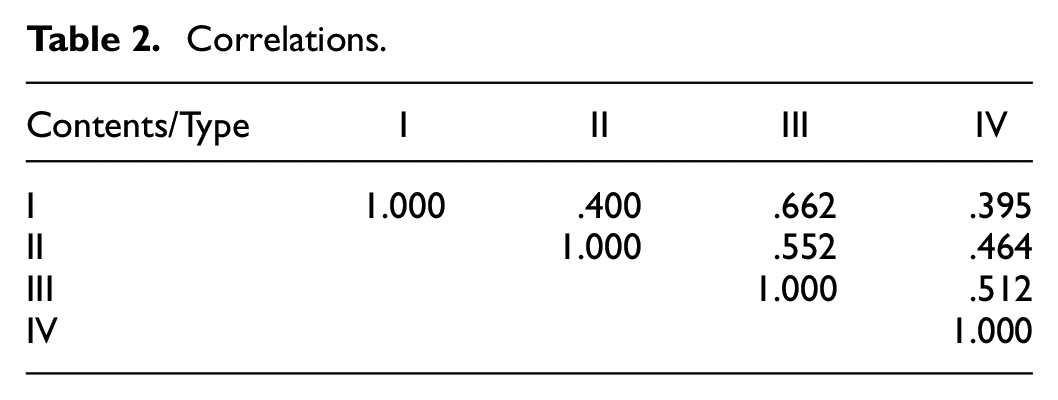
The correlations between individual types show the degrees of similarity between types (see Table 2). A high correlation coefficient in Q methodology does not necessarily mean no difference between the two factors. Thus, we can use it for interpretation through linkage and separation between theoretical concepts (H. K. Kim, 2008). The correlation between Types 1 and 2 was.400, Types 1 and 3 was .662, Types 1 and 4 was .395, Types 2 and 3 was .552, Types 2 and 4 was .464, and Types 3 and 4 was 0.512.
Correlations.
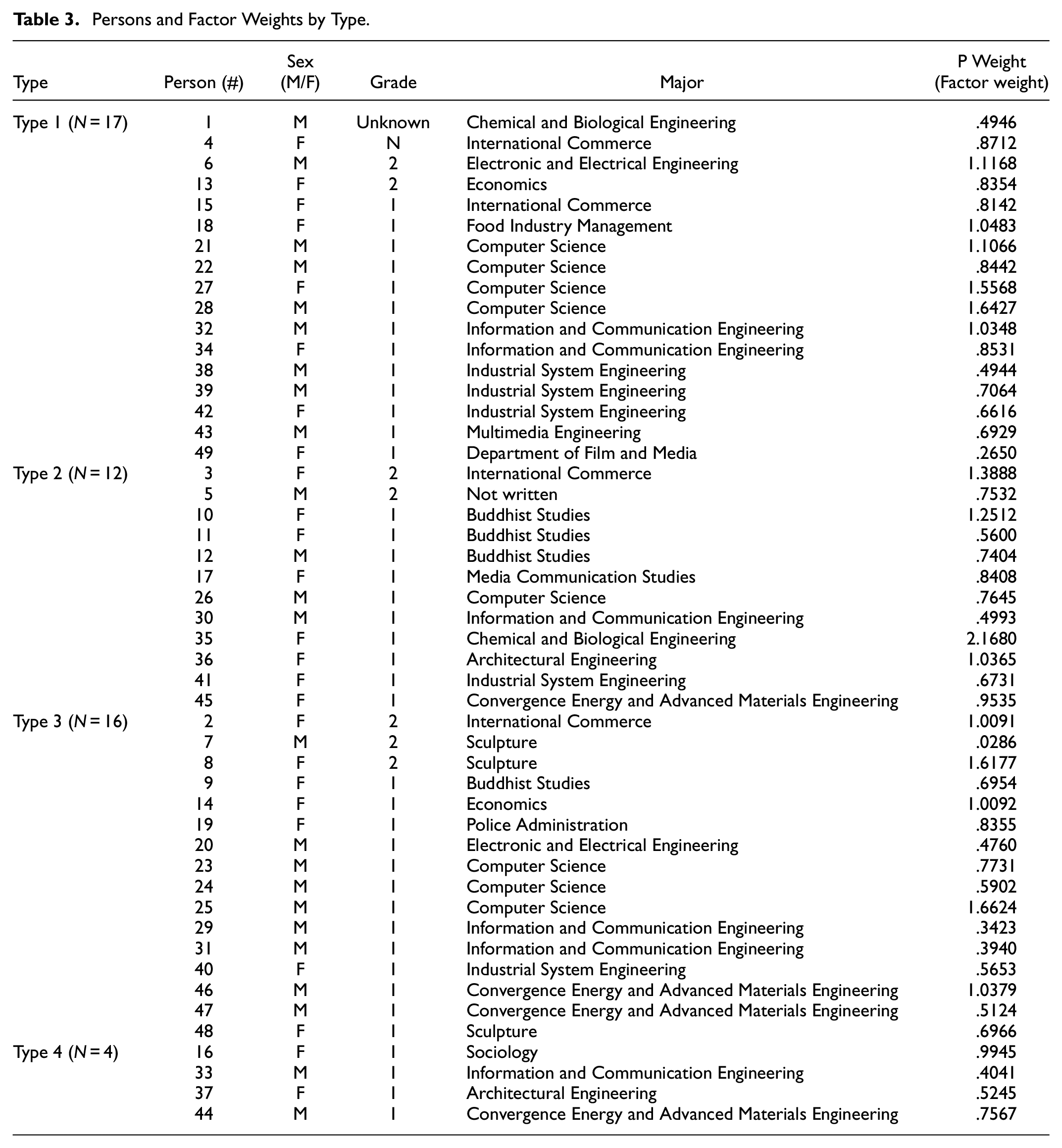
The individual types’ factor weights and demographic characteristics are in Table 3. The factor weight indicates the loading value. The participants included 30 students majoring in engineering, such as computer engineering and information and communication engineering, and accounted for 61.2% of all participants. In addition, there were 14 students majoring in humanities and social sciences (28.5%) and four majoring in arts and sports (8.1%). The remaining students did not indicate their department.
Persons and Factor Weights by Type.
Characteristics of Perception Types
We denoted each type’s characteristics based on the z-scores of each Q item and the specific items among the types. We found the items by looking at the differences between each type and the mean value of the other three types.
Type 1: Preference for Improving Professionalism
Type 1 included 17 students (male, n = 9; female, n = 8). Their majors were chemical and biological engineering (n = 1), international commerce (n = 2), electronic and electrical engineering (n = 1), economics (n = 1), food industry management (n = 1), computer science (n = 4), information and communication engineering (n = 2), industrial system engineering (n = 3), multimedia engineering (n = 1), and department of film and media (n = 1). Concerning grades, 13 were first graders, two were second graders, and two did not provide their grades.
The items with a z-score of 1 or higher with which Type 1 students agreed were Q20 (1.65) expertise, Q19 (1.40) problem-solving, Q5 (1.31) self-development, Q7 (1.27) execution, Q31 (1.26) challenge, Q16 (1.21) time management, and Q12 (1.09) momentum (Table 4). Items that particularly distinguish Type 1 from other types are Q20 (2.581) expertise, Q19 (1.318) problem-solving, and Q12 (1.182) momentum (Table 5). In addition, Appendix 1 shows the two most agreeable items selected by Type 1 respondents and their corresponding reasons.
The Items of Type 1 and Z-score (> +1.00).

The Items of Type 1 Different from the Other Types and Z-score (> +00).

Type 1 students are interested in solving problems encountered during college studies. They hope to improve their skills by taking exams or conducting projects. They also show interest in their studies, achieving good grades and developing personally. In addition, because they think enhancing their expertise will help them professionally, they improve their competencies through education in their major. For example, P28 (1.6427) showed the highest factor weight among Type 1 students. He said, “All activities, such as study, certificates, and volunteer work, are self-development” and “College students must understand this while meeting many challenges and failing and succeeding.” He considers self-development and challenges as the competency items to improve the most.
P28 also finds all experiences of challenges and failures, studies, certificates, and volunteer services essential for forming necessary competencies. In addition, P27 (1.5568) said, “The objective of entering college is to learn important knowledge and use it in the future, so expertise is important” and “You will experience many things, including projects and exams. At every such time, you need the competency to quickly find a solution.” With the second-highest factor weight, she views expertise and problem-solving as the competencies she wants to improve the most, indicating that she is more interested in enhancing her cognitive competencies to become a successful member of society.
Type 2: Preference for Improving Character Development
Type 2 included 12 students (male, n = 4; female, n = 4), and their majors were international commerce (n = 1), Buddhist studies (n = 3), media communication studies (n = 1), computer science (n = 1), information and communication engineering (n = 1), chemical and biological engineering (n = 1), architectural engineering (n = 1), industrial system engineering (n = 1), and convergence energy and advanced materials engineering (n = 1). The students included ten first-graders and two second-graders.
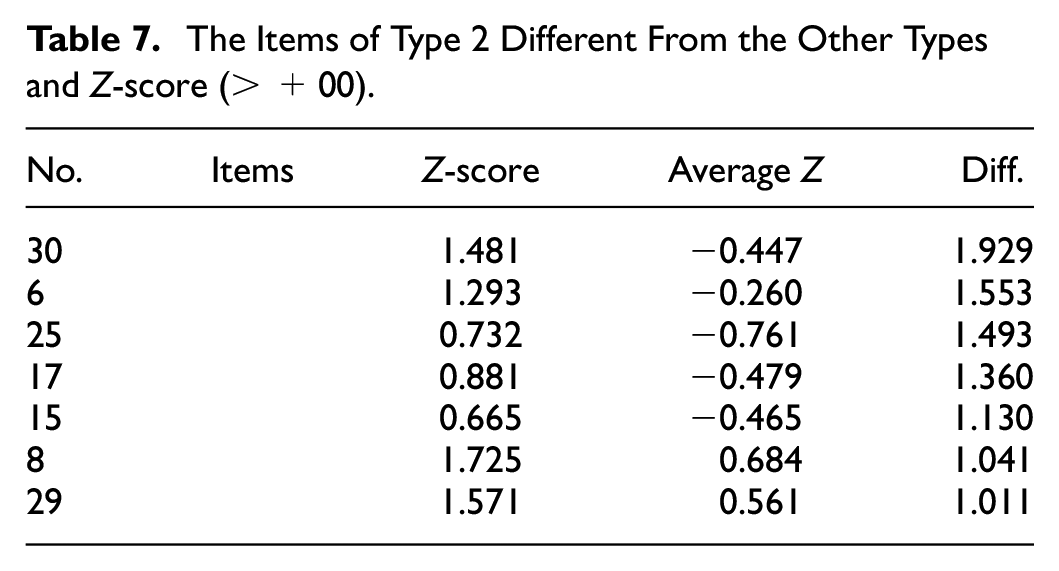
The items with an eigenvalue of 1 or higher with which Type 2 students agreed were Q8 (1.72) responsibility, Q29 (1.57) sincerity, Q30 (1.48) courtesy, Q6 (1.29) consideration, and Q5 (1.21) self-development (Table 6). Items that particularly distinguish Type 2 from other types are Q30 (1.929) courtesy, Q6 (1.553) consideration, Q25 (1.493) morality, Q17 (1.360) active listening, Q15 (1.130) empathy, Q8 (1.041) responsibility, and Q29 (1.011) sincerity (Table 7). In addition, Appendix 2 shows the two most agreeable items selected by Type 2 respondents and their corresponding reasons.
The Items of Type 2 and Z-score (> +1.00).

The Items of Type 2 Different From the Other Types and Z-score (> +00).
Type 2 students are more interested in character-building competencies related to mental attitudes than improving skills. They seem to think that mental attitudes are the foundation for enhancing competency. They recognize that the competencies they want to improve at college affect college life and their life after graduation and want to take responsibility for their actions. In addition, they acknowledge the necessity of sufficient thinking before acting and thus emphasize the introspection of their efforts.
Type 2 students continuously think about their role as college students and their desire to meet society’s standards of an “ideal student.” P35 (2.1680) said, “Consideration is an essential element both in college and in life in the future, so I think it is the most important competency” and “You can think more about your actions before making decisions only when you have a sense of responsibility for what you have done.” She showed the highest factor weighting among Type 2 students, recognizing consideration and responsibility as the competencies she most wants to improve at college. She emphasized meticulous behavior because of her firm belief in these character traits.
Type 3: Preference for Improving Adaptability
Type 3 included 16 students (male, n = 9; female, n = 7), and their majors were international commerce (n = 1), economics (n = 1), police administration (n = 1), electronic and electrical engineering (n = 1), computer science (n = 3), information and communication engineering (n = 2), industrial system engineering (n = 1), convergence energy and advanced materials engineering (n = 2), and sculpture (n = 1). The students were 13 first-graders and three second-graders.
The items with an eigenvalue of 1 or higher with which Type 3 students agreed were Q27 (1.83) resilience, Q4 (1.62) confidence, Q32 (1.35) goal management, Q16 (1.20) time management, Q8 (1.19) responsibility, and Q31 (1.13) challenge (Table 8). Items that particularly distinguish Type 3 from other types are Q26 (2.201) convergent understanding, Q23 (1.541) creative thinking, and Q27 (1.080) resilience (Table 9). In addition, Appendix 3 shows the two most agreeable items selected by Type 3 respondents and their corresponding reasons.
The Items of Type 3 and Z-score (> +1.00).

The Items of Type 3 Different from the Other Types and Z-score (> +00).

Type 3 students are intensely interested in continuously adapting to a changing society. They show a strong will to confidently adapt to the challenges in life and a sense of responsibility, including having an implementation plan. P25 (1.6624) said, “A challenging attitude is important to college students. To challenge, one must have confidence without fail” and “As a college student, I expect to see many situations where I undergo hardships and frustrations. I think that ego resilience is very important for me to forget about these things and challenge new goals.” With the highest factor weight among Type 3 students, he considered confidence and resilience to be what he wants to improve the most in college life. These characteristics demonstrate a will to face challenging new college life situations and overcome inevitable failures. In addition, Type 3 students consider creative thinking and convergent understanding as unique items that do not appear in other types. This finding reflects perceiving and preparing for potential changes in necessary competencies and accounting for society’s structural and developmental shifts.
Type 4: Preference for Improving Cooperation
Type 4 included four students (male, n = 2; female, n = 2) majoring in sociology (n = 1), information and communication engineering (n = 1), architectural engineering (n = 1), and convergence energy and advanced materials engineering (n = 1). All four students were first graders. The items with an eigenvalue of 1 or higher with which Type 4 students agreed were Q16 (2.15) time management, Q13 (1.35) curiosity, Q32 (1.31) goal management, Q31 (1.30) challenge, Q10 (1.06) cooperation, and Q22 (1.06) teamwork (Table 10). Items that particularly distinguish Type 4 from other types are Q13 (2.431) curiosity, Q2 (1.211) tolerance, Q16 (1.201) time management, and Q22 (1.146) teamwork (Table 11). In addition, Appendix 4 shows the two most agreeable items selected by Type 4 respondents and their corresponding reasons.
The Items of Type 4 and Z-score (> +1.00).

The Items of Type 4 Different From the Other Types and Z-score (> +00).

Unlike other types, Type 4 students focus solely on improving the competencies necessary for their college life. For example, P16 (0.9945) said, “Having a goal can prevent you from wasting time. Most students in high school only study for the entrance exam without doing self-exploration. It is important to know how to set another goal for yourself when your previous goal disappears.” With the highest factor weight among Type 4 students, P16 believes that goal-setting skills are critical in college for motivation and better time management. In contrast to other types, Type 4 perceives teamwork as a crucial competency. In addition, P44 (0.7567) said, “I think that teamwork is considered important in college, and therefore, cooperation with people is necessary.” He recognized the characteristics of the college per se as a small society and an organization where cooperation is essential.
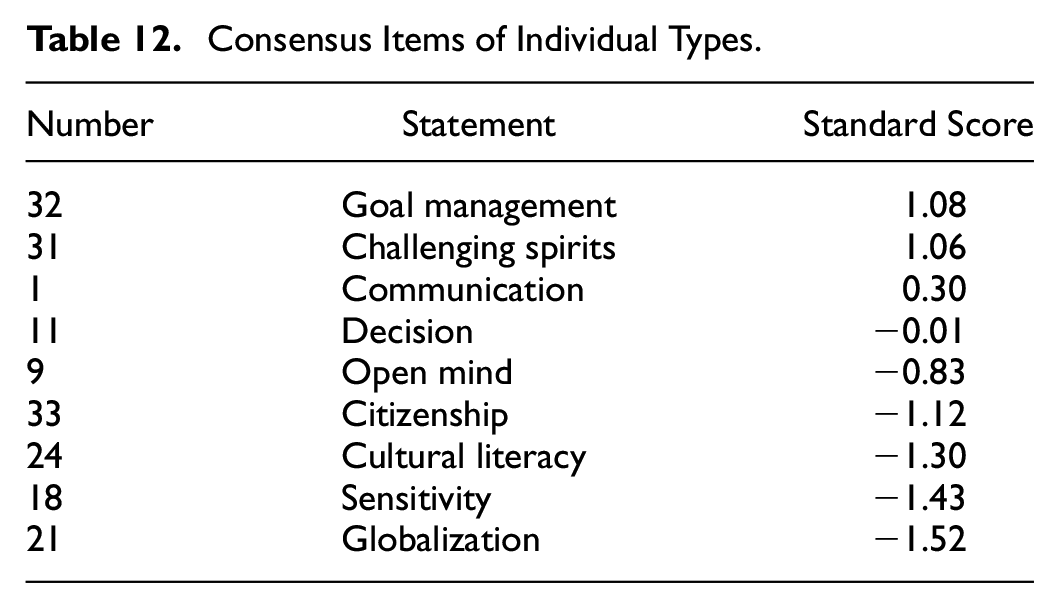
Consensus items represent items that obtained similar scores in all factors, with all differences in standard scores within 1.00. As shown in Table 12, this study’s consensus items were Q32 (1.08), Q31 (1.06), Q1 (0.30), Q11 (−0.01), Q9 (−0.83), Q33 (−1.12), Q24 (−1.30), Q18 (−1.43), and Q21 (−1.52).
Consensus Items of Individual Types.
Discussion
This study examined the competencies that students beginning college life hope to improve and why. Our research results determined four types of students: Type 1 prefers improving professionalism, Type 2 favors enhancing character, Type 3 desires perfecting adaptability, and Type 4 leans toward cultivating cooperation. The individual types exhibit complex characteristics in contrast to existing competency classifications with simple meanings. We found differences in the degree of cognition and an additional dimension that plays a role in determining competency preferences.
As shown in Figure 5, the degree of focus on social and personal competencies varied, leading to four unique types. This finding means that the concepts of existing individual competencies form complex actions to constitute a new area.

Core competency model.
Type 1 reflects many cognitive characteristics and strongly desires to improve personal competencies, while Type 2 emphasizes non-cognitive aspects and social competencies. Type 1 is cognitive and personal because it prefers improving professional competencies through self-development, while Type 2 is non-cognitive and social because it prioritizes social competencies. Type 1 seeks to promote professionalism and improve personal and cognitive competencies. They perceive patterns of meaningful knowledge and information in their field and are cognitive in seeking to solve problems quickly and without error (Oh, 2006). Type 2 seeks to improve character competencies and shows social characteristics emphasizing relationships with others based on relationship building, consideration, and respect. They show more relationships with non-cognitive activities, which differ from cognitive activities, such as acquiring simple knowledge and information (H. J. Kim, 2020).
On the other hand, Type 3 recognizes competencies related to personal attitudes as essential and reflects non-cognitive characteristics. Type 3 prefers career competency improvement through continuous adaptation and executive ability; thus, it is personal and non-cognitive. In contrast, Type 4’s features seek to improve cognitive and social competencies, indicating that college students have varying degrees of interest in these two dimensions. Type 4 is cognitive and social, as it prefers the improvement of competencies necessary for university community life. Type 3 seeks to promote adaptability competencies, regards nurturing individual abilities in a rapidly changing environment as important, and emphasizes non-cognitive factors that actively adapt to rapid changes in environments of diverse contexts (S. A. Kim, 2021). Type 4 seeks to improve cooperation competencies. Cooperation is a representative element of sociality, and the cognitive aspect called learning is important in improving such competencies (J. H. Park & Hong, 2018).
In addition, McClelland (1973) defined competencies as individual intrinsic characteristics that enable excellent job performance in a specific situation or job, which are the knowledge, skills, and attitude characteristics of outstanding performers. Thus, scholars emphasize a comprehensive meaning regarding competencies, including knowledge, skills, and abilities (Bowen & Bok, 1998; Holzer, 1996; Jones, 1996; Stern & Wagner, 1999). Knowledge is academic ability, such as communication, understanding of the major field, analytical skills, problem-solving, critical thinking, sentence constructing, information processing, technology utilization, continuous learning, and motivation. On the other hand, skills are professional occupational abilities and include cooperating with people from different cultural backgrounds, maintaining friendly relationships with people with different values and recognizing others, accepting changes, competitiveness, creativity, and leadership. Finally, attitudes are personal/social abilities. They include forming and maintaining friendships, taking a break and enjoying leisure, active interest and participation in community service activities, and religious values (A. Kim & Rhee, 2003). In this context, Type 1 in this study emphasized knowledge, Type 2 strongly reflected abilities, and Type 3 prominently showed technical characteristics. In addition, Type 4 demonstrated skills and abilities.
Type 1 is interested in improving professional competencies through self-development. This type’s 11 respondents were engineering students, indicating that those choosing engineering majors may desire to acquire expertise and apply it in their careers. Therefore, they are likely to choose jobs based on their majors. Furthermore, since accuracy and detailed work are considerable requirements in engineering due to the practical and specific characteristics of the relevant studies, they also want to acquire professional skills and apply them to their jobs. According to a study that analyzed the K-CESA of engineering students, accredited students exhibit higher “analyzing skills” in higher-order thinking competencies than non-accredited students. However, their flexibility level in global competency was significantly lower, demonstrating that colleges need to restructure their curriculum planning and management (Sinn et al., 2019).
Similarly, since Type 1 students focus on improving personal and cognitive competencies, schools should re-examine current curricula to supplement the lack of social and relational competencies. The reality is that teachers and learners lack an understanding of competency-based education, are negligent in preparation, and struggle with developing the necessary competencies (S. Baek, 2020). Thus, schools should expand the engineering college curricula contents and their operation method. P27 (1.5568) with a high factor weight viewed “expertise” and “problem-solving” as the competencies she wanted to improve the most, indicating that she is interested in improving cognitive knowledge competencies to become a successful member of society.
According to S. Hwang (2018), 21st-century engineering education aims to cultivate problem solvers who solve concrete problems in reality and develop talented persons who have creativity, innovation, leadership, communication skills, and engineering expertise in balance. This finding means checking whether the curricula operate adequately; thus, incorporating Type 1 students’ desired competencies is necessary. In addition, E. Lee and Kim (2016) viewed that non-cognitive domain competencies are generally difficult to acquire in regular courses, and S. Baek (2020) said that extracurricular educational activities affect human relational competencies. Therefore, to supplement competencies likely overlooked by students, especially to improve social relationships, schools should guide students to know the information on non-extracurricular activities and the importance of the activities so they can participate.
Type 2 students considered inner character and relationships important. This type included 12 students majoring in media communication, international commerce, Buddhist studies, and engineering. They sought to cultivate social competencies to engage in society and considered the necessary cognitive competencies for their jobs less important. However, while they recognized essential competencies in human relations, they could not identify the concrete competencies required for work. College students should prepare for employment when they graduate, along with their marketability (Rahmat et al., 2012). Therefore, to engage in vocational activities, schools must give them opportunities to improve their professional and job competencies, such as diverse short-term and long-term internships. Currently, colleges operate internship programs to support students in finding employment. Such programs are vital for Type 2 students to improve their practical competencies related to jobs (You & Song, 2017). Schools should publicize and facilitate program access so that students can accumulate valuable experiences.
Type 3 emphasized abilities to practically adapt to social changes and acquire execution skills to implement goals. The 16 students of this type are majoring in police administration, economics, sculpture, and engineering. However, they showed varying interest in social competencies when focusing on adaptability. According to Wheeler (2008), one’s social environment enhances competency development by creating learning goals, diverse relationships, and life experiences. Therefore, schools should provide this type of environment for Type 3 students. For instance, schools can enable students to set goals they want to achieve in college and life and have various new experiences in life while meeting different people through extracurricular activities outside their major.
Currently, colleges guide each curriculum’s competency types, but there is no consensus on the guidance. For example, schools’ arbitrary interpretations contribute to the design of liberal arts courses (McCowan, 2015). Furthermore, the composition of teacher qualifications lacks a theoretical background or transparent model for creating liberal arts courses for core competency development (H. J. Park, 2018). Therefore, schools should develop their curriculum or extracurricular activities based on competencies.
Type 4 recognized the importance of cognitive and social competencies in college life. Four college students of this type are majoring in sociology and engineering. Setting goals is critical for these students. Now that they have achieved their goal of getting accepted into college, making new goals and adjusting to the college community are their primary focuses (Strayhorn, 2018). For example, Parker et al. (2004) found that emotional and social competencies are paramount when transitioning from high school to college. Thus, Type 4 students recognize the importance of these emotional and social competencies during college. However, they seemed not to understand how to apply them after college.
According to Parker et al. (2004), emotional and social competencies are important during the transition from high school to college, which is also related to academic achievement. Type 4 appeared to recognize the importance of these emotional and social competencies. However, when examining Type 4′s stories, we found they were interested in college life per se but lacked awareness of how to use such competencies in social life after graduation. Therefore, these students need guidance to broaden their perspectives on the future practical application of their learned competencies, including discerning the connections of their lives with the community. According to M. Jeong (2019), college students have a new sense of challenge after learning to solve community problems. Therefore, participation in programs or volunteer activities linked to the local community will help them improve their competencies in a broader sense.
Among the consensus items, we found goal management (Q32) and challenge (Q31) the most significant across all four types. This finding reflects a consensus among college students that they should manage their goals and try new challenges. On the other hand, the study’s results showed patience (Q14), cultural literacy (Q24), citizenship (Q33), and sensitivity (Q18) to be the most significant in their disagreement. These items reflect college students’ social realities in which South Korean college students focus on grade management in high school for college entrance. They have concerns about finding a job when entering college and after graduating, and it is a societal concern and a concern for universities at the policy level.
In addition, we found that not all types commonly recognized that they want to improve in “globalization.” This finding is consistent with a study conducted by Hwang and Kwon (2019), indicating that the globalization competency was the lowest. When analyzing the demands for the education of core competencies in the liberal arts of industrial workers and the rankings of the demands, the core competencies of liberal arts with the highest need for education were foreign language skills in global competencies, character cultivation in liberal arts knowledge, and self-exploration and development (E. J. Kim & Seong, 2017). This finding means that South Korean college students’ perceptions of globalization competency are inconsistent with that of companies, indicating an area for improvement.
The results of this study can be said to have contributed to identifying comprehensive and in-depth core competency elements of college students which can utilized when constructing career curriculums and extracurricular activity programs that most universities have. Additionally, scaling such results through additional studies could help identify the core competencies pursued by college students and the core competencies requiring supplementation.
The government is presenting a non-major system for South Korean universities to respond flexibly to social changes and pursue innovations based on integrative thinking (Ha, 2024). This system is to improve complex and comprehensive competencies rather than certain majors. The results of this study offer a practical understanding and improvement of college students’ competencies by allowing for a comprehensive examination without oversimplification.
Implications
This study’s findings reveal the core competencies subjectively perceived by students, providing a foundation for choosing jobs based on self-awareness and better-demonstrated job competencies. Therefore, supported by the results of this study, we recommend the following.
First, the study findings suggest developing customized competencies by type. For example, since Type 1 strongly tends to grow into an expert through self-development, it is necessary to provide opportunities to acquire professional knowledge and skills independently. In addition, it is essential to design curricula or extracurricular activities that can improve relational competencies, which these students might miss. On the other hand, Type 2 prefers to strengthen social competencies through inner characteristics such as a sense of responsibility and sincerity. Therefore, they need opportunities to develop self-leadership along with their majors. Since Type 3 seeks to develop the competencies necessary for careers through practical experience rather than theoretical knowledge, the school should identify the links between curriculum and competencies by providing ample job experience or participation in similar programs. Lastly, Type 4 seeks to enhance competency through college community activities. Thus, the school should provide programs to cultivate cooperation and teamwork in the local community.
Second, social cognitive career theory indicates that individuals’ overall perceptions of environmental barriers and social support influence their career development (Lent et al., 2000). Thus, colleges can use these types to build student career programs and systems to enable employment. Furthermore, policymakers can use these types as basic data for necessary factors to develop scales that evaluate personal core competencies.
Third, to improve core competencies at college, it is necessary to break away from previous competency classifications like self, relational, and technical (M. Jin, 2020) and better understand the complex factors that affect students as they acquire these competencies. For example, Lawson et al.’s (2014) study of college accounting students suggested developing an integrated competency, including an educational framework based on competencies. They also suggested applying this framework to other fields. This finding means that college students need a long-term curricular and extracurricular activities framework to improve their desired competencies.
Fourth, according to the current study results, similar majors, such as engineering, appeared in the same type in some cases, and different majors appeared in the same type in others. According to Reimer et al. (2008), the qualitative employment levels among college graduates vary considerably depending on their majors. However, the findings of this study support only a part of the prior results. Therefore, colleges should simultaneously consider individuals’ characteristics and majors and operate job preparation differently according to majors while simultaneously operating job preparation tailored to individuals.
Fifth, although colleges diagnose core competencies based on their standards for college students’ job preparation, colleges must multilaterally understand the characteristics of individual college students. For example, colleges currently use standardized tests to evaluate competencies, but it is difficult to grasp the features of complex competencies through these tests. Schools apply paper-and-pencil tests to assess current competencies, and there are difficulties in identifying the characteristics of complex competencies through such methods (Ko, 2015). Therefore, colleges need to improve the technique of identifying competencies.
Sixth, the college community cannot fully develop students’ competencies (Yoo et al., 2015). Giles and Eyler (1994) found practical community service experiences improve citizenship. In addition, their finding indicates that theoretical education and societal experience help improve competency. Therefore, colleges should prepare development plans to enhance student competencies connected to the local community.
Limitations
The limitations of this study are as follows. First, we examined students’ perceptions in the early college years, especially in the first and second years. Although exploring the perceptions of the early years in college is important, the study did not examine the perceptions of third- and fourth-year students hoping to get a job. Thus, future research should investigate the perceptions of third- and fourth-year students to compare junior and higher-year students. Nevertheless, this study is meaningful because Korean university students can see the subjective perception of the competency they want to improve.
Second, when interpreting the findings of this study, we referred to the study participants’ reasons for improving core competencies. However, revealing richer content and more detailed information may have been possible by interviewing representative students with a high factor weight within each type. A more in-depth understanding of their competencies can help improve awareness of student reasons.
Third, concerning the participants’ majors in this study, there is a limitation that the number of engineering students was relatively large. However, since the Q methodology is not for generalization, the representativeness of the study participants is not critical. Still, future research should identify the characteristics of perceptions according to majors based on quantitative analysis through random sampling to determine whether there are differences in the perceptions of competencies according to majors.
Fourth, a limitation of this study is that its subjects were exclusively students at a 4-year university. Future studies should include diverse participants from 2-year colleges and national, private, regional, and urban universities. This approach will ensure the research encompasses college students from varied demographic backgrounds. Additionally, future studies should compare their findings with the results of this study.
Fifth, researchers should conduct additional quantitative studies to identify patterns, generalize results to broader populations, and help compare the differences between domestic and foreign college students’ perceptions of core competencies.
Finally, this study used the Q methodology to explore the subjective perceptions of college students’ competencies, making it difficult to generalize the findings in the same way as quantitative studies. Therefore, future research should focus on developing and validating a scale that can generalize these perceived core competencies. Subsequent studies using this validated scale should also investigate how perceptions vary according to demographic backgrounds.
Conclusion
In conclusion, this study identified various types of recognition of the core competencies that college students want to improve. The findings show a need to break away from the existing simple college education based on core competencies to provide education that will cultivate and supplement the core competencies pursued by college students. Job security and lifelong employment are no longer guaranteed (Hall & Heras, 2010). This reality means that students must quickly develop the competencies necessary for work.
In addition to student efforts, colleges should support students in improving these competencies. Although colleges are not vocational schools, they should play a role in helping college students improve their competencies to find and maintain careers after graduation. Schools need programs based on customized competencies to develop the individual competencies of college students (Mah & Ifenthaler, 2017). The findings of this study provide the foundation for developing customized competency-based programs necessary for college students
Footnotes
Appendix
Reasons for Choosing Competencies by Type 4 Participant.

| P/(weight) | Q item | Reason |
|---|---|---|
| P16/(0.9945) | Q32 Goal management | Having a goal can prevent you from wasting time. Most students in high school only study for the entrance exam without doing self-exploration. It is important to know how to set another goal for yourself when your previous goal disappears. |
| Q27 Resilience | There will be many unexpected hardships and failures in college, away from the small society of middle and high school. You can finish college life only when you have the strength to escape from frustration and depression. | |
| P33/(0.4041) | Q16 Time management | College students have too much work to do. It is necessary to manage time by efficiently allocating it to many things and now seems to be a good time to develop this ability. |
| Q13 Curiosity | Interest in or curiosity for study, as well as interest in or curiosity for other things, can enrich a person’s knowledge and emotions. Having much curiosity seems to be of great help to yourself and, at the same time, much help for self-development. | |
| P37/(0.5245) | Q16 Time management | College students have a lot of time, including time between classes, vacations, and weekends, and I think it is important to manage that time. |
| Q27 Resilience | You can get frustrated because you do poorly on an exam or fail an interview. It’s important to get rid of your frustrations and recover your positive self while building ego resilience. | |
| P44/(0.7567) | Q16 Time management | I can choose my lecture times, unlike in high school, where timetables are organized, and I have more free time than in high school. If I manage my time well, I can cover everything, even if all of the other competencies are a little insufficient. |
| Q22 teamwork | I think that teamwork is considered important in college, and therefore, cooperation with people is necessary. Developing teamwork seems to have been built up when I was a high school student and did team activities. It is a competency necessary for college students who cooperate on a team well and enter social life in earnest. |
Declaration of Conflicting Interests
The author(s) declared no potential conflicts of interest with respect to the research, authorship, and/or publication of this article.
Funding
The author(s) received no financial support for the research, authorship, and/or publication of this article.

Data Availability Statement
The datasets generated and/or analyzed during the current study are available from the corresponding author upon reasonable request.