




Abstract
This study investigated the effects of incremental service innovation on customer brand association and further explored the multilevel mediating and moderating variables underlying this link. Multilevel analyses of the data were conducted using 374 valid questionnaires from employee–customer paired samples in 68 hospitality companies in China. The research results showed that incremental service innovation (supervisor-reported) explained significant variance in customer brand association (customer-reported). The service sweethearting (employee-reported) fully mediated the relationship between incremental service innovation and brand association. Furthermore, sustainable human resource management (supervisor-reported) positively moderated the relationship between incremental service innovation and brand association. This study originally represents a unique contribution to combine the individual and organizational perspectives of service innovation and further confirms the multilevel-moderating effect of sustainable human resource management that enhances the relationship between service sweethearting and customer brand association. Managerial implications and future research suggestions are presented.
Keywords
Introduction
An assumption in the current service industry is that gaining a sustainable competitiveness requires delivering high-quality services, satisfying and retaining customers, and improving customer perception of the company (Colgate & Danaher, 2000; Suh et al., 2012). Service companies should pursue superior customer relationship strategies and positive customer brand association (Anderson & Narus, 1991), and managers should strive to provide “customer-driven” products or services to understand and satisfy customers’ needs (Skålen et al., 2015). One common approach to achieve this goal is investigating brand association, which is related to a product or service category and represents criteria used by customers to assess a product or service (Narumon & Gerard, 2010). Therefore, brand association is critical for customers to directly link and evaluate the products and services (Narumon & Gerard, 2010).
In alignment with the service innovation literature (Lin, 2016; Nijssen et al., 2006; Stock & Zacharias, 2013), past studies have demonstrated that, among the important antecedents of brand association, service innovation can facilitate the generation of customer brand association and value. World Economic Forum and Deloitte also jointly proposed a special discussion on future financial service innovation and circular economy, and advocated that disruptive innovation has reshaped the structured, provisioned, and consumed mode of financial services (McWaters, 2015). This issue has also attracted increased attention from major global companies participating in the World Economic Forum (Lewandowski, 2016). For example, a car sharing company claims that the product or service is available to customers for a specific period of time. A software company argued that their users can bring their own devices to get the access to services. In addition, a music online company shifts physical products, services, or processes to virtual (Lewandowski, 2016). Furthermore, PricewaterhouseCoopers believes that service innovation is a new or changed service concept. Customer interaction channels, service delivery systems, or technical concepts can bring one or more new service functions to the company, thereby changing the market. As a result, changing the service innovation model required new technology, human resource, and organizational capabilities to achieve (Probst & Bohn, 2013). Preissl (2000) has also proposed service innovation as a meaningful construct defined as the development of new service procedures and concepts. Because of services’ real-time production, the new service needs to modify the service delivery process at any time and to enhance frontline employees’ skills (Nijssen et al., 2006).
Furthermore, Sundbo (2001) argued that incremental service innovation refers to the concept that internal service organizations must coordinate, replicate the successful service model, adopt the service innovation model gradually, and internalize the administrative process. Because incremental service innovation emphasizes the gradual duplication and improvement of existing service modes, it can better link customer loyalty and enhance customer brand association. Recently, researchers confirmed the relationship between incremental service innovation and brand association (Lin, 2016; Stock & Zacharias, 2013). However, due to a lack of research, we do not know yet how incremental service innovation predicts customer brand association in considering contextual factors underlying this multilevel link, and scholars have further called for more research to clarify the inputs and the boundary conditions that enhance brand association (Lin, 2016; Stock & Zacharias, 2013). Gounaris (2006) and Karlsson and Skålén (2015) also argued that further research should clarify the relationship between incremental service innovation and customer value. Therefore, this study puts effort toward addressing this issue.
Empirically, in the service industry, in addition to conveying products, good service and the brand concept must rely on frontline employees’ communication (Dusek et al., 2014). Based on the strategic service innovation theory, the customer may strengthen the company’s brand connection because of innovative services. The employee’s sweethearting behavior is a special behavior in the service industry (Chi et al., 2015). Sweethearting behavior refers to the extra favors that frontline employees provide to customers, including unauthorized free or discounted goods and services (Brady et al., 2012). Theoretically, frontline employees authorized to conduct service innovation and sweethearting can improve customer service quality (Sundbo, 1996). Thus, collusive practices, such as employee service sweethearting, may mediate the relationship between service innovation and customer brand association (Brady et al., 2012; Connor, 1999). In addition, empirical studies have not clarified whether sweethearting has beneficial influences on enterprises or not. This study’s additional objective is to investigate the multilevel mediating role of employees’ service sweethearting.
Based on literature review, frontline employees’ training and development play critical roles in the service innovation and sustainability process (T. Y. Chang & Hsu, 2010; Pang et al., 2013). The focus of sustainable human resource management (SuHRM) would be developing a variety of outcomes, not just economic outcomes, which would include a range of social and ecological outcomes (Kramar, 2012). The definition of SuHRM is to emphasize on sustainable management of HRs, which contributes to the social and human outcomes of sustainable development in the long run, this is to a sustainable organization (Ehnert, 2011; Kramar, 2014). Empirical research also proves that employee-centered SuHRM encompasses more aspects than extant HRM, including trade unions and self-organized employees, and people-oriented training and caring (Richards, 2020). Consistent with the strategic service innovation theory and the resource-based view (RBV), recent meta-analyses have shown that using SuHRM for training frontline employees is positively associated with customers’ brand association (Fernandez et al., 2003; Roper & Davies, 2010). Clarifying the “black box” of such processes is important because it describes how and why the effect of SuHRM unfolds within the service industry (Dias-Angelo et al., 2014; Guchait, 2010; Pang et al., 2013). Practically, frontline employees play key roles to directly convey the brand value and high service quality to customers. Thus, the design of internal determinants, strategies, and SuHRM to train employees is crucial because employees’ attitudes, beliefs, values, and behavioral styles reflect the brand image and indirectly influence customer brand association (Narumon & Gerard, 2010; Rubalcaba et al., 2012). Ricard and Perrien (1999) also suggested that employees’ expertise and understanding of customers are important factors in successfully implementing a relational strategy. However, less concern is accorded to internal organizational determinants of the successful implementation of customer brand association (Colgate & Danaher, 2000; Liao & Chuang, 2007). In addition, researchers continue to call for more research to examine the processes through which SuHRM predicts customers’ brand association (Roper & Davies, 2010). Thus, how can a firm use organizational-level arrangements to facilitate this type of learning process among core employees and convert the learning outcomes into customer brand association (S. Chang et al., 2012)? Firms require SuHRM to develop human capital who need extensive skills (Wright & Snell, 1998). Recruiting and leveraging employees in service companies will generate meaningful ideas from the accumulation of knowledge. The talent pool can further spawn enterprise problem-solving skills and enhance organizational value and sustainability (Karlsson & Skålén, 2015; Zeithaml et al., 2009) if an organization has SuHRM to develop HR systems (Ordanini & Parasuraman, 2010; Wright & Snell, 1998).
This study integrates two core theories to build a comprehensive model. First, we apply the RBV to explain the specific processes and service innovation used by firms to alter their human resource base and represent sources of sustainable competitiveness. Core competencies determine the coordination and training among different employees (Eisenhardt & Martin, 2000) to enhance customer brand association. Second, using the strategic service innovation theory, Sundbo (1998, 2001) noted that service firms should adopt service innovative activities to increase customer brand association. We also adopt multilevel analysis to understand firms’ policy and employee and consumer behaviors and to reduce the weaknesses inherent in a single-level analysis. In conclusion, based on the RBV, the strategic service innovation theory, and a multilevel perspective, this research’s objective is to extend our understanding of the integrative relationships among these four variables in cross-levels.
Incremental Service Innovation and Customer Brand Association
The strategic service innovation theory considers innovation as originating from the employee’s service network as a progressive innovation stream, and a firm’s service innovation strategy often stems from the senior management team or the meeting of customer needs (Rubalcaba et al., 2012). Therefore, service innovation is a significantly improved service concept that has been put into practice. PricewaterhouseCoopers (PwC) believes that service innovation can be new solutions in customer interaction channels, new distribution systems, novel applications of technology in service processes, new forms of supply chain operations, and new ways of organizing and managing services (Probst & Bohn, 2013). Ramdas et al. also argue that organizations can consider service innovation in four areas: the structure of interactions, the service boundary, the allocation of service tasks, and the delivery location. They further propose a framework to identify and evaluate service innovation opportunities.
Sundbo (1998, 2001) further argued that incremental innovation must be coordinated, copied, and used, and it becomes an administrative process. Furthermore, firm’s service innovation strategy involves both top-down and bottom-up processes (Rubalcaba et al., 2012; Sundbo, 1996). In other words, employees and managers must explore new ideas, and the management team must simultaneously induce innovation with a balanced process by adopting a strategy to achieve this balance. Therefore, a firm’s incremental service innovation should be executed innovation with ongoing internal and market development assessments (Sundbo, 2001).
Narumon and Gerard (2010) noted that the service environment, the employees, and the self-service technology may potentially affect the customer experience because employees represent the brand. For instance, one practical suggestion is to determine the “employee deployment plan” in advance of a customer rollout of new service innovations. After consuming innovative products or services, customers will generate the attributes, benefits, and attitudes toward this particular brand, a so-called customer brand association (Keller, 1993). Empirical study also has proved that the incremental service innovation and development strategy of the hotel business will lead to an increase in corporate performance. Furthermore, incremental service innovation and service advantages will enhance brand performance and brand association (Pansuppawatt et al., 2014). In addition, innovation-related attributes are significantly related and enjoy a mutual extension with service brand association in the service industry (Ruyter & Wetzels, 2000). Based on these arguments, the following hypothesis is proposed:
Multilevel Mediating Effect: Employee Service Sweethearting
Skålen et al. (2015) noted that a firm’s service innovation strategy must create customer value, and customers will assess the service that they receive. Cadwallader et al. (2009) further argued that incremental service innovation emphasizes the autonomy of employees. Therefore, the implementation of incremental service innovation will enhance frontline employee service sweethearting and autonomy. Ultimately, service sweethearting refers to the autonomy of frontline employees to make decision to provide customers with additional benefits and services (Brady et al., 2012). In addition, Connor (1999) argued that incremental service innovation is related to customer-led strategies that focus on manifest needs. In this case, certain organizations prevent revisions to existing services. In other cases, employees want to enhance their services (Connor, 1999), which results in service sweethearting and collusion with customers with respect to customer expectations and a belief that the behavior is in the best interests of the company (Brady et al., 2012). Based on these findings, we propose the following:
Stock and Bednarek (2014) argued that product and service quality both influence the customers’ purchasing behavior, and companies must identify how to use their own resources to meet customers’ demands. For service businesses in particular, employees’ attitudes, behavior, and positive emotions shape organizational work ethics and the guidelines for customer satisfaction, trust, and reliability (Singh, 2000; Zablah et al., 2012). Brand associations are related to a product or service category and represent criteria used by customers to assess a product or service (Narumon & Gerard, 2010). Thus, Narumon and Gerard (2010) noted that brand associations are criteria used by customers to assess a product or service. In this case, service sweethearting, customers, and frontline employees have a close and interacting relationship (Price & Arnould, 1999), and frontline employees play an important role in the purchase process (Brady et al., 2012; Singh, 2000). In addition to enhancing the exchange of ideas, sweethearting has a direct and positive impact on the interaction between employee and customer. Customers provide desirable evaluations because, when individuals express gratitude, they return the favor to the benefactor, which can be of potential value to the firm (Brady et al., 2012; Emmons & McCullough, 2004). Based on the strategy service innovation theory, employee contact with customers caused by innovative behavior results in desirable outcomes for customers. The RBV approach notes that resources include products and service delivery to customers; in addition, when a company has such resources, they increase the value, rarity, and inimitableness of its core competencies. Based on these arguments, the following hypothesis is proposed:
Service marketing, service innovation, and the service delivery-related research imply that customers’ needs can stimulate new product and service development and provide valuable information (Stock & Bednarek, 2014). Cheng and Krumwiede (2012) argued that service innovation contributes to new service performance by creating new interests for existing customers and through the creation of new markets by incremental addition to existing service values or radical creation of brand new service value. The implementation of incremental service innovation will promote frontline employees to illustrate the new service model, to empower employees through more autonomy and to increase the service sweethearting behavior. Therefore, in the interaction process between employees and customers (Bitner et al., 1994), sweethearting behavior provides more information exchange opportunities and ultimately enhances customer brand association. Our study corresponds to the strategic service innovation theory (Rubalcaba et al., 2012) and argues that organizations, customers, and employees must interact during the buying and service processes. Furthermore, according to the RBV approach, Barney (1991) noted that, if a company has capabilities (such as service innovation) and resources (such as delivering products and services to its customers), its core competencies may be inimitable and valuable. Based on these arguments, the following hypothesis is proposed:
Multilevel Moderating Effect: Sustainable HRM
Kesting and Ulhøi (2010) and Pang et al. (2013) noted that innovative decisions are related to frontline employees’ knowledge, skills, and practices that create value. Service innovative strategy execution allows firms to identify a process blueprint and secure the best available technology. In addition, employee support is essential for the service innovation strategy to work (Cadwallader et al., 2009). The effect of the organization’s service innovation strategy is crucial, and service firms’ sustainable development projects that succeed if their HR practices are unique and superior to those of competitors. Thus, HR practices are central to the sustainable development of innovation success and strategic business planning. Cadwallader et al. (2009) note that firms must successfully implement innovations to remain sustainable competitiveness.
According to Kramar (2014), in addition to pursuing economic and external results (promoting social and environmental results), SuHRM also links and examines the interrelationships between HRM and practice (organizational results). In other words, the characteristics of SuHRM include the dynamic nature of HRM and its results, and the interconnectedness of the organization’s external, internal, and personal aspects. Thus, SuHRM considers not only organizational and economic outcomes but also social and ecological outcomes for a variety of stakeholders. Empirical research also proves that among 106 companies, the significant differences between the implementation of SuHRM and the free and coordinated market economy between Western European countries are revealed, indicating the need to address the impact of national institutional context on firm’s SuHRM (Diaz-Carrion et al., 2020). SuHRM also emphasizes the importance of time and space for the regeneration and recovery of individual resources (Ehnert, 2009). Thus, employee-centered SuHRM goes far beyond what is covered in existing HRM literature, and SuHRM covers more aspects including trade unions and self-organized employees (Richards, 2020).
Other scholars have suggested from different perspectives that one of the goals of SuHRM is to identify and reduce the negative externalities of HRM practices, or to reduce the harm of work that organizations impose on third parties or stakeholders (employees, their family members, and society). In current work environment, the health harm of work are inevitable, so it is important to measure and reduce the health harm of work through SuHRM practices. (Mariappanadar, 2016). Therefore, based on perspective of SuHRM, in order to corporate sustainability, employers need to make further investments while maintaining their human resources (Ehnert, 2009).
Organizations require SuHRM to develop rapidly adaptable HR systems, require a human capital pool with an array of skills, and promote behavioral flexibility among employees to enhance sustainable competitiveness (Wright & Snell, 1998). SuHRM helps firms acquire and develop diverse knowledge and skills, and these components may positively influence market responsiveness and firm innovativeness. Ostrom et al. (2010) further argued that SuHRM could help an employee initiative program create new customer value and enhance customer brand preference and association.
Furthermore, service firms adopting incremental service innovation will improve existing service products, change service processes, and enhance customer brand association (Pansuppawatt et al., 2014). Cheng and Krumwiede (2012) also argued that customer orientation could form the basis for incremental service innovation. According to the strategic service innovation theory (Rubalcaba et al., 2012), service innovation is a stream of incremental innovations initiated by the management team and frontline employees. Moreover, the ability, motivation, and opportunity (AMO) theory emphasizes that the improvement of employees’ capabilities, the driving of motivation, and the provision of opportunities will ultimately affect the organizational performance. Therefore, SuHRM and frontline employee training and development planning play critical roles in implementing service innovation and in enhancing the relationship between incremental service innovation and customer brand association. Based on RBV, SuHRM is idiosyncratic and interdependent, and companies can capitalize on their proprietary knowledge and transfer it creatively and effectively across the workforce. Based on these arguments, the following hypothesis is proposed. And the conceptual model is shown in Figure 1.

Research framework.
Method
Sample and Procedures
In China, the third industrial revolution has led to a substantial increase in the number of workers engaged in the service industry. According to the National Bureau of Statistics, data show that, in China, the service industry represented 52.2% of the total gross domestic product (GDP) in 2018 (National Bureau of Statistics of the People’s Republic of China). Whether from the strengthening and support of the Chinese government’s 13th Five-Year planning or the future business trend of service industry development, this study suitably investigates the issue of service innovation in China. To test our proposed model, we selected frontline employees in hospitality and tourism service companies as our research samples. Taiwanese and Chinese local companies have heavily invested in the Chinese market in recent years (Sacchetto & Andrijasevic, 2015), and the government of China has garnered foreign company investment in its service industries (Vlcek, 2014). Therefore, we investigated hospitality service innovation and sweethearting in Chinese emerging economies.
Furthermore, according to Horng et al. (2016) and Horng et al. (2018), the hospitality industry must fact the issues of sustainable development and service innovation. Therefore, this study investigates the unique sample group, employee–customer paired samples in hospitality and tourism companies in China, which leads to sample representativeness.
In the data collection, there were a total of 374 valid questionnaires completed by 374 frontline employees and 374 customers as paired samples in 68 hospitality and tourism companies. According to Hair et al. (2014), data range between 5 and 10 times the number of items used in the scale is appropriate. There are total 36 items of this study (including demographic items), so 10 times the number of items is about 360 samples. A total of 374 samples were collected in this study, and the sample size is sufficient.
Participating frontline employees completed “sustainable HRM,” “incremental service innovation,” and “service sweethearting” items, and customers completed “brand association” items. The attributes of the respondents are exhibited in Table 1. It was determined that 39.3% of employee respondents were male and 68.7% were female. In terms of customers, nearly half were male (51.6%) or female (48.4%). Most of the sample was 21 to 30 years old and single in terms of marital status. Regarding education level, most of the employees in the sampling were undergraduate or college, and most of the customers in the sampling were postgraduate or above.
Demographic of Samples.

Note. N = 374 employees and 374 customers in 68 firms.
The data collection procedure was as follows. First, this study needs to communicate with the hospitality industry, five-star hotels in China, and to confirm that these companies have implemented service innovation and improving service quality–related policies. In advance, the managers and frontline employees must complete different sections of questionnaires at different sampling time periods to collect cross-level (individual and organizational level) samples. The introductory message in questionnaire explained the purpose of the study, outlined that participants were required to complete surveys in 1 month, and assured participants that all responses would be confidential. SuHRM, service innovation, and service sweethearting were measured at Time 1 by frontline employees. At Time 2, customer brand association data were collected by customers. In addition, during the data collection process, this study attempted to reduce the potential for common method variance (CMV) by two means. First, to avoid social desirability (Podsakoff & Organ, 1986), our studies provided a self-addressed and stamped envelope for participants to enclose and mail their completed questionnaires. This study’s emphasis on confidentiality reduced respondents’ evaluation apprehension (Podsakoff et al., 2003). Second, this study collected data from multiple sources to reduce the influence of same-source bias (Podsakoff & Organ, 1986). Third, this study conducted a “time lag” method using two different sampling time periods.
Measures
First, we translated the original questionnaire into Chinese and asked three bilingual foreign language experts to translate the questionnaire back into Chinese from English (Brislin, 1980). Second, three organizational behavior scholars, service management scholars, and marketing scholars reviewed the translation for appropriateness. Participants rated items on a 5-point Likert-type scale ranging from 1 (strongly disagree) to 5 (strongly agree).
SuHRM (organizational level)
Through reviewing previous studies related to SuHRM, this study measured the construct by incorporating three dimensions. (a) Personal-oriented investment refers to the characteristic of sustainability enterprise that all employees have to be trained and developed for sustainable business issues (Skaggs & Youndt, 2004). (b) Personal-oriented leverage is the possible way to leverage talents’ ability and deploy them into the appropriate job positions for sustainability (Fernandez et al., 2003; Govindarajulu & Daily, 2004). (3) Personal-oriented involvement refers that companies have clear vision, learning climate, various communication channels, and sustainable business practices and encouraging sustinability involvement (Tang et al., 2018). This study used 5-point Likert-type scale (ranking from 1 to 5, strongly disagree to strongly agree). Six items were used to measure investment (α =.879), three items were used for measurement of leverage (α = .853), and six items were used to measure involvement (α = .868). This part of questionnaire was finished by employees.
Incremental service innovation (organizational level)
This scale was constructed using four items (α = .841) from the questionnaire developed by Avlonitis et al. (2001). The sample items were “The services were a revision of an existing service” to measure incremental service innovation. This study used 5-point Likert-type scale (ranking from 1 to 5, strongly disagree to strongly agree). A higher score indicated that the participant (frontline employee) perceived a greater degree of incremental service innovation in the work setting.
Employee service sweethearting (individual level)
To assess service sweethearting, we adopted four items (α = .785) from the questionnaire that Brady et al. (2012) developed. A sample item was “To the reasonable and acceptable extent, I will hook my customers up with free or discounted goods and services.” This study used 5-point Likert-type scale (ranking from 1 to 5, strongly disagree to strongly agree). A higher score indicated that the frontline employee showed a greater degree of service sweethearting in the work setting.
Customer brand association (individual level)
We adopted and modified nine items (α = .830) from the questionnaire developed by Keller (1993). Brand associations could be divided into three categories: attributes, benefits, and attitudes. A sample item was “In comparison with other brands, I think my favorite brand’s culture and value are unique” This study used 5-point Likert-type scale (ranking from 1 to 5, strongly disagree to strongly agree). A high score indicated that the participant (customer) showed a greater degree of brand association in the work setting.
Control variables
Practically, frontline employees are directly in contact with customers and are requested to provide high-quality service in the service industry. Thus, frontline employees may suffer several pressures caused by the service innovation and may lead to negative emotions (Malhotra et al., 2016). Thus, we collected and controlled employee negative emotions at work at the individual level to avoid the potential confounding effect on our findings and alternative explanations. We tested negative emotions with a 10-item negative emotion scale developed by Podsakoff et al. (2003). Respondents answered on a 5-point scale and displayed suitable reliability in this study (α = .865). In addition, we also controlled for employees’ gender and tenure, which may potentially relate to their service sweethearting behavior.
Regarding the organizational level of analysis, the firm size and revenue may affect the display strength of service innovation and human resource management. The larger the firm size and revenue is, the greater the capital it has, and possibly the more resources it can invest in adopting the strategy. Thus, we controlled for the firm size (number of employees) and revenue (in the last year) to ensure that different control variables would not influence the research results.
Data Analysis Strategy
The data were multilevel, with employees and customers nested in different organizations. Therefore, hierarchical linear modeling (HLM) was used to assess the hypothesized relationships. To assess the viability of aggregating individual-level data for incremental service innovation and SuHRM at the organizational level, we computed Rwg to assess the within-group agreement (James et al., 1984). The median Rwg values for incremental service innovation (.92) and SuHRM (.96) confirm high within-group agreement for these variables. Next, we computed intraclass correlation coefficients (ICC1) and reliability of the mean (ICC2) to examine within- and between-group variance and reliability in assessments. The ICC1 and ICC2 values for incremental service innovation were .315 and .862, respectively. The corresponding values for SuHRM were .592 and .826, respectively. The F ratio is the result of an analysis of variance (ANOVA)-based significance test of between-group differences and indicated the statistical significance of group membership. Thus, these indexes generally supported the appropriateness of aggregation (James et al., 1993).
Results
Normality Test
According to Bollen (1989), when the Mardia coefficient is less than p (p is the number of observed variables), the basic requirements of multivariate normality can be achieved. The observed variable of this study was 15, and the normalized Mardia coefficient is 9.85 (p < .05). Therefore, the data in this study fit the multivariate normality distribution.
Confirmatory Factor Analysis (CFA) and Discriminant Validity
Prior to testing the hypotheses, our studies examined the distinctiveness of our variables using CFA via Mplus 7.0 (Jöreskog et al., 2000) and the maximum likelihood method of estimation. We analyzed the factor structure to identify a structural relationship among the variables. Then, we formed composite variables and adopted those composites as factors’ single indicators (Anderson & Gerbing, 1988). This study examined the structure of the data to investigate the discriminant validity. Table 2 shows that the baseline model (four factors) indicated the data, χ²(644) = 630, p < .01, root mean square error of approximation (RMSEA) = .0229, non-normed fit index (NNFI) = .957, comparative fit index (CFI) = .972, standardized root mean square residual (SRMR) = .0705, and goodness of fit index (GFI) = .851. Thus, compared with the other model, the baseline model is the best fitting model.
Comparison of Measurement Models.

Note. Baseline model (four factors): SuHRM, incremental service innovation, service sweethearting, and brand association. Three-factor model: service sweethearting and brand association combine into one factor; two-factor model: incremental service innovation, employee service sweethearting, and brand association combine into one factor; one-factor model: all variables combine into one factor. RMSEA = root mean square error of approximation; NNFI = non-normed fit index; CFI = comparative fit index; SRMR = standardized root mean square residual; GFI = goodness of fit index.
The means, standard deviations, and correlations among the study variables are presented in Table 3. Table 3 shows that SuHRM was positively related to incremental service innovation (r = .538, p < .01), service sweethearting (r = .329, p < .01), and brand association (r = .154, p < .05). In addition, incremental service innovation was positively related to service sweethearting (r = .449, p < .01), and service sweethearting was positively related to brand association (r = .144, p < .05). Table 2 also shows the descriptive statistics and the internal consistency reliabilities for the study variables. All variables displayed good internal consistency (Cronbach’s α > .785).
Means, Standard Deviations, Intercorrelations, and Coefficient Alphas.
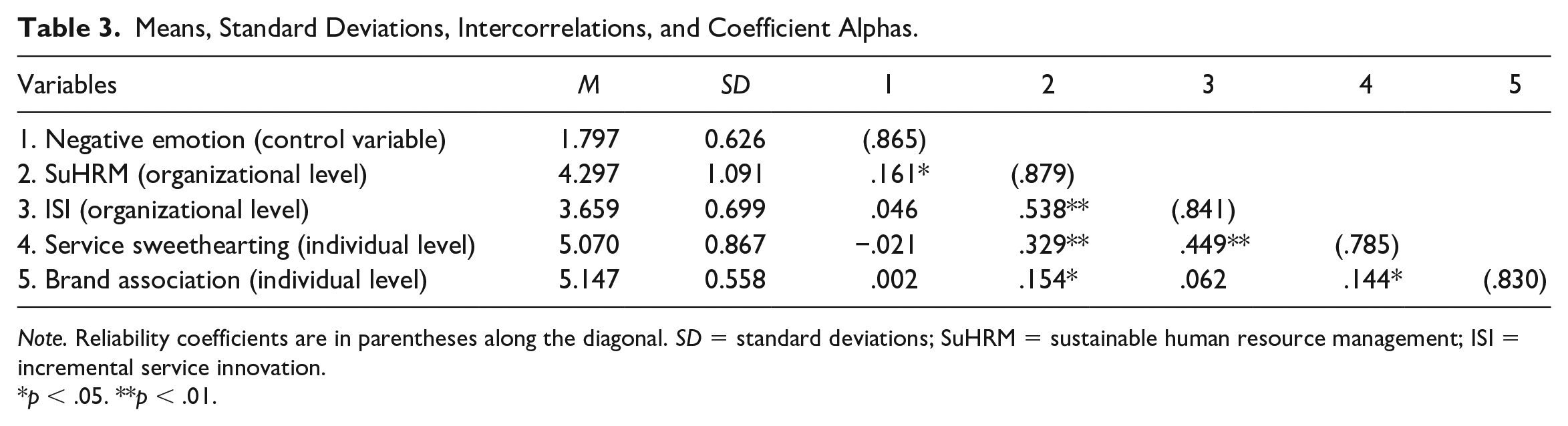
Note. Reliability coefficients are in parentheses along the diagonal. SD = standard deviations; SuHRM = sustainable human resource management; ISI = incremental service innovation.
p < .05. **p < .01.
Hypotheses Testing
Model variance for customer brand association and values of all coefficients derived from the hypotheses are presented in Table 4. The first step tested the direct effect of incremental service innovation on customer brand association. We estimated an intercepts-as-outcomes model, with incremental service innovation as the organizational-level predictor, and customer brand association as an individual-level outcome variable. The results indicated that incremental service innovation had a significant positive relationship to customer brand association, γ = .52, p<.01 (see Table 4 Model 1), thus supporting Hypothesis 1.
Estimations of Direct Effects and Indirect Effects.

Note. Individual-level N = 374; organizational-level N = 68. CBA = customer brand association; ESS = employee service sweethearting; ISI = incremental service innovation; SuHRM = sustainable human resource management.
p < .05. **p < .01.
The HLM analysis results for Model 2 (see Table 4) revealed that incremental service innovation had a positive influence on employee service sweethearting (γ = .38, p < .01); thus, Hypothesis 2 was also supported. The Model 3 results indicated that employee service sweethearting positively influenced customer brand association (γ = .31, p < .01), supporting Hypothesis 3. To test Hypotheses 4, we acted in accordance with Baron and Kenny’s (1986) recommended three conditions for confirming a mediating effect. The originally significant effects of incremental service innovation on customer brand association were also significant when we added the employee service sweethearting to the model, γ = .15, p < .05 (see Model 3). Furthermore, the results of the PRODCLIN Test (Pituch et al., 2005) indicated that the 95% confidence interval of the indirect effect was significant. These results met the conditions of a partial mediation model (Baron & Kenny, 1986). Therefore, Hypothesis 4 was supported.
In Hypothesis 5, we created the interaction term Service Innovation × SuHRM using the grand mean-centering approach, since both variables conceptualized are at the organizational level. We proposed that organizational-level SuHRM would moderate the relationship between incremental service innovation and customer brand association. In Table 3 Model 5, the interaction item of service innovation and SuHRM has a significant impact on customer brand association (γ = .29, p < .01). Thus, Hypothesis 5 is supported. As shown in Figure 2, the effect of service innovation and customer brand association was stronger when the level of SuHRM was high and vice versa. The meso-moderated model explained 51% (Adjusted R2 = .51) of the variance in the outcome variable.
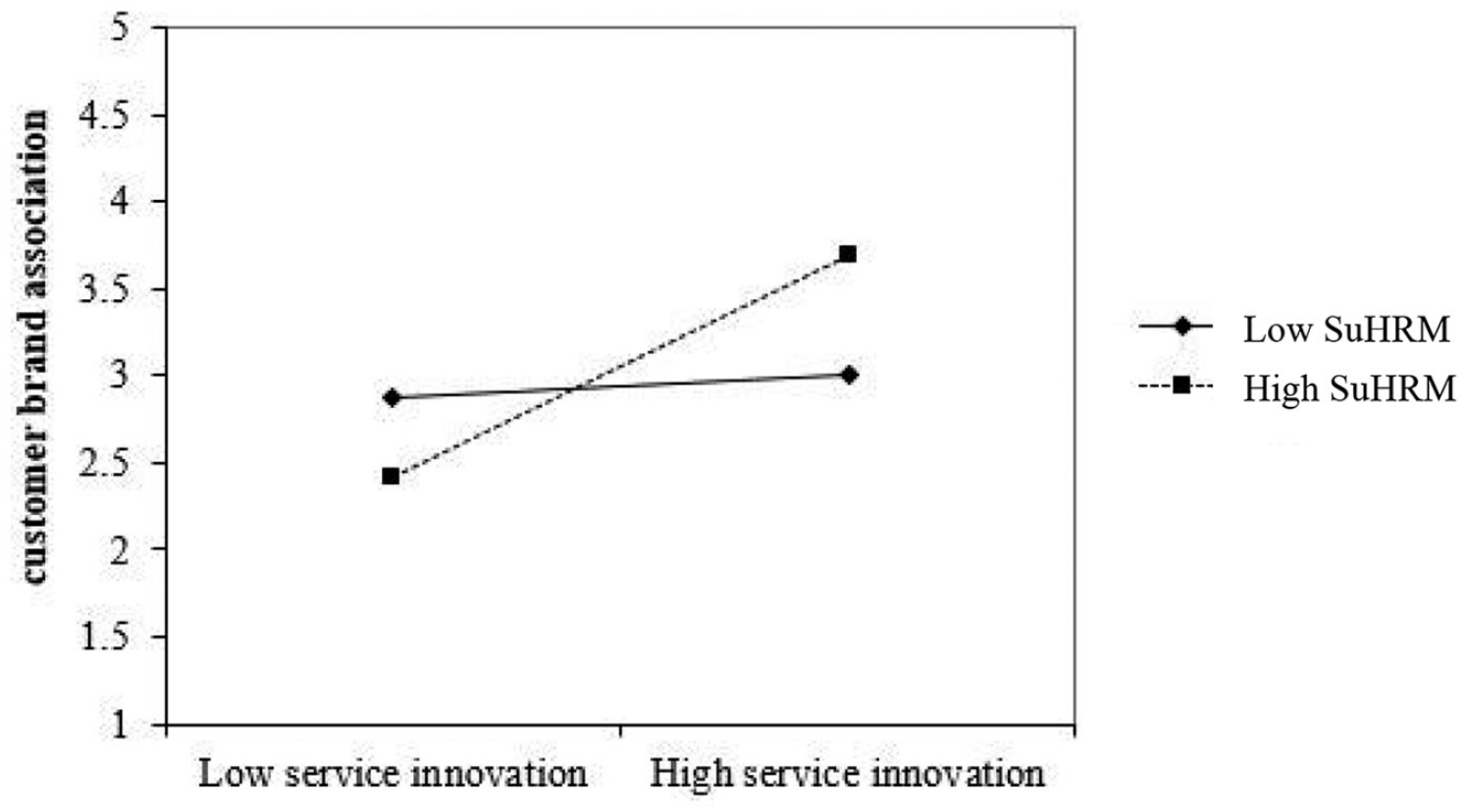
Moderating effect of SuHRM on the relationship between service innovation and customer brand association.
Conclusion
This study uniquely contributed to the existing service management, HRM, and marketing research. Based on the RBV and the strategic service innovation theory, this study investigated the cross-level mediating and moderating effect among incremental service innovation, SuHRM, service sweethearting, and customer brand association. First, incremental service innovation in a company creates employees who are dependent and familiar with past service models.
First, this study confirms that incremental service innovation has a positive effect on customer brand associations. For the hospitality industry, the service environment, frontline employees, and self-service technologies all impact the customer experience (Narumon & Gerard, 2010). Service innovation contributes to new service performance by creating new interests for existing customers, or creating new markets by increasing the value of existing services (Cheng & Krumwiede, 2012). This study argues that the hospitality industry needs to propose a new service model, which can directly allow companies into new markets. And after customers experience innovative products or services, they will generate associations with this particular brand, including attributes, benefits, and attitudes (Keller, 1993). Therefore, the innovation attributes of the service industry are significantly related to the customer brand association, and incremental service innovation and service advantages will enhance brand performance and customer brand association. The results of this study support empirical studies such as Pansuppawatt et al. (2014) and Ruyter and Wetzels (2000).
Second, for the hospitality industry, frontline employees represent the brand. Thus, an “employee deployment plan” should be determined before launching innovative services. The implementation of incremental service innovation will facilitate frontline employees to communicate with customers and demonstrate new service types. Thus, by empowering employees, employees will illustrate service sweethearting. Therefore, in the process of employee–customer interaction (Bitner et al., 1994), service sweethearting provides more opportunities for information exchange and ultimately enhances customer brand associations. If employees evolve gradually and progressively from the original/past service model, they are more likely to adapt to new service models. Thus, employees will be more inclined to engage in customer service sweethearting. In other words, when service companies implement an incremental service innovation strategy, frontline employees will cooperate with the company’s policy and adopt a new service model. When employees exhibit sweethearting behavior, customers will react positively to brand image and value. Conversely, if employees do not exhibit sweethearting behavior, the overall value of the brand will not improve. These results confirm those of Brady et al. (2012). Based on the partial mediating effects of the service sweethearting, service companies should consider frontline employees’ training, deployment, and integration such that they can develop their ideas and illustrate service sweethearting behavior autonomously. Incremental service innovation is based on the company’s existing service model for upgrading, modifying, and increasing effectiveness and reducing cost. Thus, when frontline employees exhibit sweethearting and high-quality service behavior, they directly enhance the customers’ overall evaluation of the company and brand association.
Third, the study results demonstrate that SuHRM has a significantly moderating effect on the relationship between service innovation and customer brand association. According to the strategic service innovation theory (Rubalcaba et al., 2012), service innovation is a series of innovations initiated by the management team and frontline employees. Therefore, SuHRM and frontline employee training and development programs play a vital role in implementing service innovation and enhancing the relationship between incremental service innovation and customer brand association. Companies conducting effective deployment and coordination of core workers will enhance incremental service innovation and customer brand association. Most service innovation, particularly in the existing service model, requires collaboration, adjustment, and interaction among employees to generate and discuss new ideas. The adoption of realistic and exploitative deployment to strengthen the capabilities and skills of core workers will enhance service innovation and finally positively influence customer brand association. Therefore, the implementation of employee-centered SuHRM must be invested, leveraged, and involved to enable employees to demonstrate the concept of sustainable business and innovative services (Cadwallader et al., 2009), and ultimately achieve the company’s sustainable development goals (Ehnert, 2009; Kramar, 2012, 2014; Richards, 2020).
In conclusion, based on the RBV and the strategic service innovation theory, this study confirmed that HR strategies and service innovation will influence frontline employees’ psychological transformation and service behavior and finally affect the consumer behavior. Therefore, this study provides critical implications for academic and practical domains.
Theoretical Implications
The RBV advocates that the leverage of valuable, rare, inimitable, nonsubstitutable factors, and human capital is the most appropriate method for a firm to create competitive advantage (Barney, 1991; Boxall & Steeneveld, 1999; Wright et al., 1994). The research results confirmed that RBV provides a sophisticated theoretical framework to explain the relationships among SuHRM, incremental service innovation, and brand association. The RBV approach also considers core competencies, such as the coordination of different employee skills and the integration of multiple technologies, to be important to the organization. Having the foresight and ability to respond quickly to global service innovation trends, hospitality companies need to reconfigure, deploy, and coordinate different resources and capabilities to achieve the desired end (Amit & Schoemaker, 1993; Grant, 1996; Suh et al., 2012). Resources include human and organizational assets that firms use to develop services for customers (Barney, 1991), and such skills are key to sustainable innovation. Therefore, building core competencies is significant and should be differentiated and integrated vertically. For example, managers should decide whether to manufacture or buy by beginning with the end product and looking upstream to supply chain efficiencies and downstream toward distribution and customers (Suh et al., 2012). An investigation incorporating organizational-level SuHRM strategies into service and marketing management that identifies how firms can leverage HR and pursue HR synergy is required and is critical for service and marketing management (Pang et al., 2013).
Second, from the perspective of corporate sustainability and SuHRM, it focuses on developing more results for organization, not just economic results (Kramar, 2012). These outcomes will include a range of social and ecological outcomes. For the service industry, the pursuit of corporate sustainability of must invest in human resources management. The employee-centered SuHRM emphasizes investment, leverage, and involvement of employees with sustainable awareness and innovative thinking. In addition, the results of SuHRM can be measured by assessing organizational, social, personal, and ecological outcomes (Kramar, 2014). This study confirms that the SuHRM policy has a positive moderating effect on the relationship between service innovation (organizational) and customer brand association (personal). Therefore, based on SuHRM, employers need to invest further while maintaining the competitiveness of human resources to finally achieve corporate sustainability (Ehnert, 2009).
Third, according to strategic service innovation theory, the one-way progression of service innovation includes a top-down and bottom-up development process (Rubalcaba et al., 2012). This study adopted strategic service innovation theory and applied it to the empirical analysis. We provide appropriate and complete explanations analyzing the service innovation process among different levels and sources. In other words, when service enterprises want to implement service innovation and transformation, it is necessary to integrate the incremental service innovation strategy, the frontline employees’ psychological transformation and innovative service behavior (service sweethearting), and finally enhance the consumer behavior (customer brand association).
In conclusion, this study has several academic contributions. First, the prior research in innovativeness and HRM focuses on the single level and collects data from single sources (e.g., S. Chang et al., 2012). This study further proposed a multilevel (two different levels) and multisource (two different sources) analysis to interpret this research topic from a more integrated perspective. Second, on the basis and recommendations of a previous study (e.g., Brady et al., 2012), this study attempts to investigate whether sweethearting behavior may have a positive effect (benefits) on customer brand association from a different perspective.
Practical Implications
In the service industry, companies should consider investing in the type of resources that enhance the quality of service and customer brand association (Fornell et al., 1996; Maruca, 2000). The critical point is how to develop the new product and service, the so-called incremental service innovation (Lake & Lunde, 2008), and how to improve the service quality of frontline employees through SuHRM and employee training (Heskett et al., 2008; Homburg & Stock, 2004). Regarding managerial implications, our research demonstrates several policies.
There are several approaches in implementing incremental service innovation in the hospitality industry. To cope with the highly competitive environment, the company must propose a new service type to attract more customers. And this innovative service type allows the company to enter a brand new market and gain a certain market share. In addition, innovative services should complement the competitiveness of existing product lines. Alternatively, this innovative service can be a modified update of an existing service type.
Furthermore, this study indicated that SuHRM can enhance incremental service innovation and customer brand association. Firms’ leaders (the management teams) are critical new service innovation policy decision makers. Applying vision, leaders should execute proactive and sensible talent (core employee) deployment. Adjustment policies should facilitate the efficient realignment and coordination of talent to meet the current challenges. SuHRM has three modules in practical applications. (a) First one is investment. Companies should hire employees with sustainable business ideas at higher salaries. And this company should strengthen its sustainability image so that it can attract more potential employees. The other is that the company should spend more money and time on training related to employees’ sustainable business philosophy, and also encourage employees to participate in relevant courses. (b) The second is about leverage, which is based on organizational strategy, companies should encourage employees to participate in the process of improving the company’s sustainable operations and service processes. And the company should strengthen employees’ skills related to sustainable management in the process of eco-initiative involvement, and praise employees who have made outstanding contributions to sustainable operation and service performance. (c) Regarding the involvement, employees should be satisfied with the relevant training arranged by the organization. And training programs should also be in line with the latest sustainable management and service trends in currently institutional environment. Therefore, sustainable business training should be a priority and important investment for the company.
Then, service sweethearting is a significant mediating mechanism between incremental service innovation and brand association. Leaders or department heads should consider whether the original service mechanism attracts customers or instills a positive impression to ensure a positive consumer behavior and customer association with the company and its product. Therefore, leaders and supervisors should empower and instruct employees to engage in service sweethearting to encourage positive customer evaluations. The marketing department should consider that service sweethearting improves company image and customer evaluations, which can support marketing communications. In practice, frontline employees in hospitality industry should be encouraged to contact the people (customers) they like and ask them to expenditure. And occasionally, employees can provide customers with free or discounted goods and services.
Furthermore, in the practical applications of the customer brand association, customers should have a particularly deep connection with the company’s (or brand) attribute, benefit, and attitude. In terms of attribute, when customers hear or read this company’s logo, they can strongly associate with this company. And let customers have a sense of the company’s history or tradition. Compared with other companies, customers can confirm the unique culture and value of this company. In terms of benefits, the company should make customers feel a strong sense of identification and peer-group acceptance. In terms of attitude, the company should make customers feel that this company is unique, trustworthy, and has a strong positive feeling.
Finally, for the students studying in hospitality and tourism university, this study provides an appropriate perspective to understand the current service innovation model in Chinese hospitality industry. The insight presented in this study is an important practical content for college courses and identifies the management-focused learning objectives which help students to work in the actual environment (Turner, 2008).
Limitations
This study has certain limitations. First, the cross-sectional design causes difficulty in determining the direction of causality. In future studies, scholars should attempt a longitudinal or experimental study. The second limitation is related to the variables examined, which were measured through self-reporting. This method may encourage CMV. We conducted CFA to detect the severity of CMV. If the one-factor model fits the data better than other models, the results may be contaminated by CMV. However, the CFA results showed that our proposed model had a better fit than the one-factor model. In addition, we collected the data at multiple time points, and employee negative emotions was controlled in the regression analyses, which are useful means to reduce CMV. Therefore, CMV should not adversely influence our findings. Additional testing across industries and contexts using other types of contextual and situational motivations will help to extend the framework. Another promising approach for future research is the study of different strategic HRM and frontline employees’ services (e.g., service sabotage) in other types of customer service interactions. Finally, the sampling of this study is based on the convenience sampling of hospitality and tourism companies in China, which conforms to the normal distribution and passes the test of validity. Therefore, the research results can generalize the populations and clearly describe the behavior of employees and customers in hospitality and tourism companies. However, it is limited to generalize other industries.
Recommendations for Future Research
Based on research limitations, this study proposes future research recommendations. First, the questionnaire used in this study may not reflect the completed psychological response of participants. Further research should consider the qualitative research methods and interviews to gather more deeply information about participants’ perspectives. Second, the ability to generalize the causal relationship is limited in cross-sectional data analysis. Therefore, longitudinal research or experimental methods should be used to investigate in future study. Third, this research topic and participants focus on the phenomenon of hospitality and tourism companies. Future research can investigate and collect different industries’ samples to enhance the generalizability. Finally, the sample of this research is still concentrated in the five-star hotels in Grand China, and there executives, employees, and customers are still mainly Chinese. Future research can conduct cross-cultural comparisons of samples from different countries.
Footnotes
Appendix: Questionnaire
Declaration of Conflicting Interests
The author(s) declared no potential conflicts of interest with respect to the research, authorship, and/or publication of this article.
Funding
The author(s) received no financial support for the research, authorship, and/or publication of this article.
