




Abstract
Computerization in management information systems has thickly segregated employment and unemployment which are being discussed due to technological implementation at operational and strategic levels. In this article, we have evaluated the criticism and internal corporate social responsibility (CSR) challenges caused due to the espousal of computer-based information systems (CBIS) by the companies. Based on existing measures, a comprehensive questionnaire was designed and distributed to 120 employees of the companies having the adoption plan of CBIS. The hypothesized model of CBIS implementation intention disclosure and human factor was tested with correlation and regression analysis of the data received from 108 employees (90% response rate). Results show a positive relationship between technological trends and motivation of computer literate employees. We have established our study in the context of human capital management which is a sociobehavioral notion for meeting the internal CSR. Theoretical implications of this study have been progressively discussed simultaneously with the limitations therein. Our research has practical implications for corporate managers, human resource managers, and management information systems managers in manufacturing industries.
Keywords
Introduction
Generally, Information Technology does smart work because the workflow becomes automated with efficiency to replace the manual rigorous graft. A computer-based information system (CBIS) enables the automatic management of workflow with the use of technology. Besides effective storage and efficient retrieval of data, CBISs have numerous benefits including qualitative information, presentation, new services, and customer intimacy (Laudon & Laudon, 2015). However, certain challenges which might be faced after the implementation of Information Technology are often neglected before the system adoption, ultimately raising question on internal corporate social responsibility (CSR).
Lidding the area of cost management, human roles are eliminated, and usually computer illiterate employees are trained for retention even unnecessarily sometimes. In such firms, these employees act as the parasites due to the absence of a good managerial plan; hence, the companies endure the opportunity cost by losing possible profits. In other cases, such employees are laid off on the face of downsizing or rightsizing, which puts a new question mark on internal CSR while creating unemployment and job security risks even for existing workers, lower level managers, or middle level managers.
Gap of the Previous Studies
To attain the convenience, quality, and economies of scale, use of information systems in businesses is inevitable in this modern age. Sometimes information technology, communication technology, and information systems are perceived as the same concepts. However, there is a considerable difference in each terminology, and understanding of each concept is necessary to discuss the relevant issues (Lee, Thomas, & Baskerville, 2015). Extant literature has widely explored the uses of information systems and information technology with their side effects including health and social issues (Gajic & Boolaky, 2015; Leach & Turner, 2015; Nasir, Al Mamun, & Breen, 2017; Yasmeen, Alam, Mushtaq, & Alam Bukhari, 2015). However, there is no comprehensive study in the social and anthropological sciences of employees, which explores the opinions and concerns of employees, guiding business managers about the job security of their staff with the implementation of CBIS in order to fulfill internal CSR.
The motivation of the employees and job insecurity are unexplored variables under the application of Malthusian theory. Up to what extent, the top level managers are concerned about the job security of their employees, pre- and post-implementation of CBIS? What impact their consideration has on the motivation of employees? With the understanding of these differences, it is important to visualize the effects of technology in ethical dimensions (Chuang & Huang, 2018). This article focuses on CBISs as an issue of human behavior.
Main Objective
The main objective of this micro CSR research is to empirically investigate the relationship between the disclosure of CBIS implementation intention and employees’ perception of job motivation and job insecurity. The study is also aimed to explore the moderating role of computer literacy in this relationship. This study is significant for various sectors of business as realizing the threat of unemployment of people upon implementation of CBIS, enterprises for good management need to evolve CSR strategic plans to handle and overcome the risk. Touching all connected concepts, our study focuses to determine the impact of CBIS implementation on the employee motivation at the workplace; hence, contributes to the existing literature on the role of technology in humanity and management strategies.
Problem Statement
Job selection is based on the main motivations: high pay and job security (Hsieh, 2015). Self-determination theory (SDT) implies that human beings are governed by external regulation and are less prone to altruistic values and act disparately in the connotation of job insecurity. It is a sad latitude that use of technology may cut the jobs in firm’s heterogeneity (Canova, Lopez-Salido, & Michelacci, 2007; Uysal, Yotov, & Zylkin, 2015); therefore, the impact of software implementation becomes important in human life. Linkage of internal CSR with external CSR has differential effects on perceptional and prosocial behaviors (Hur, Moon, & Choi, 2019). Because this raises question on internal CSR, there is the need of research to investigate how motivation and feeling of job insecurity will be influenced by the intentions of companies for technological shift.
Main internal (employees) and external (community) stakeholders of companies expect the expression of CSR for them (Hao, Farooq, & Zhang, 2018). Therefore, software and system implementation need to take the knot of business ethics. This is because CSR ultimately influence organizational commitment of employees (O. Farooq, Payaud, Merunka, & Valette-Florence, 2014). Although there are six phases of enterprise resource planning (ERP) software life cycle (Esteves & Pastor, 1999), the cycle restarts after the retirement phase (Laudon & Laudon, 2015). During the adoption decision phase of the ERP life cycle, the important issue of those employees who are loyal to the company but are computer averter has to be well-thought-out. It can be noted that sometimes due to automation, many human roles are inevitably performed by machines and robots. However, technology is not only taken advantageous, it is also associated with certain ethical challenges.
Simultaneous with a large number of uses and benefits, one major threat which has been overlooked by most small and medium enterprises is a prospective loss of loyal employees. Business ethics and CSR are needed not only for the environment, community, and external customers but also for the internal customers, that is, to take the social responsibility of employees’ needs (Hao et al., 2018). Ethical issues impact the knowledge, and it is imperative to address them (Guitton, 2015). The solution to these ethical issues is linked with motivation to resolve them. This article sheds light on this factor of human attention during the implementation of software and systems with technological advancements.
Scheme of Study (SOS)
After this introduction, our article presents the literature review on the information technology, information systems, and the adoption of CBIS. In the next portion, hypotheses are developed with the justification of previous related studies on the human factor, the motivation, and job insecurity contingent on the adoption of CBIS with the variance of computer literacy. Next section presents the methodology of the research which leads to the results of data analysis. In the last section, discussion on the hypotheses testing has been carried out with theoretical and practical implication and clear directions toward future research.
Literature Review
The terms “Information System” and “Information Technology” are interchangeably used because of the commonality of the word information in both. However, Information Technology is, in fact, a subset of Information System which consists of people, processes, machines and information technology itself (Laudon & Laudon, 2015). It is the integration of computers with telecommunication for effective and efficient storage, retrieval, and manipulation of data to form an organized package (Angell & Smithson, 1991). In the past decade, information system along with information technology was slightly criticized by certain groups which are at other extremes of technocentric thinking. These groups include unemployed employees sharing their feelings at social media. Markus and Robey (1988) have discussed different theories in their article to describe how and why information technology affects organizational life. Georgiou (2009) suggested two zones of information technology usage with an optimum point segregating employment and unemployment.
Among the different disadvantages of information technology highlighted at various forums of employment, the foremost is the elimination of jobs (Leonar, 2019). For instance, significant time is saved during the completion of routine tasks with the implementation of information technology in business operations. Information and communication technology may have an adverse quantitative impact on employment (UKEssays, 2013), which reflects that the implementation of information technology may lead to unemployment. A case illustrates that harnessing the synergy of ideas—mentoring, training, and refreshers are needed for the adoption of information and communication technology in a department (Oyelude & Oladele, 2014). Due to the reduction of paperwork and emergence of automation, businesses boon expediently, and the tasks which were performed by human beings manually are performed by computer systems such as answering of phone calls by systems replaced receptionists and telephone operators. Nevertheless, loyal employees may face difficulty in securing future employment. Similarly, the churn rate may also vary with the use of information technology and with the adoption of CBIS (Laudon & Laudon, 2015).
According to Kumar (2014), with the streamlining of business processes and procedures, outsourcing and downsizing due to job redundancies are the new challenges linked with the implementation of information technology causing unemployment of many more people of lower and middle level roles. If not unemployed, the employees lose the sense of job security which relates to their mental peace and motivation. If constant learning is not adopted, then the wish for job security is not rational. Implementation of technology and CBIS has its effects in Europe, Africa, and other continents of the world (UKEssays, 2013).
Nohria, Groysberg, and Lee (2008) defined motivation in terms of employee engagement, commitment, satisfaction, and intention to quit the job. Engagement is the energy, effort, and initiative brought to the job by employees. Commitment shows the extent to which employees involve in corporate citizenship. The degree to which employees feel that the company meets their expectations at work and satisfies the implicit and explicit contracts with them is known as satisfaction. Intention to quit is the big proxy for employee turnover because the turnover intention is negatively influenced by the motivation to quit the job. The factors causing the reduction of internal motivation also include lack of job rotation and promotion (Shoraj & Llaci, 2015).
Majority of people in developing countries satisfy the livelihood of their dependents through salaries obtained from the jobs. It is not simple to grow population and food supply thereupon without the optimal motivation toward job and workplace. In certain cases, the employee motivation can be jeopardized with the intention of management to implementation of CBIS. Hence, to design the framework for the connection of technological trends of firms with employee motivation, we need to use Malthusian theory which suggests that in the history of human, technological progress had no impact on income per capita in the long run but caused larger population growth. According to the theory, while technologically advanced economies over the era were characterized by higher population density, their level of income per capita was not different than those among technologically regressed society (Malthus, 2018). In addition to the economic factor of per capita income, there are motivation factors which are of likely interest for the employees who are inspired by the care of their managers about the worker’s career. Employee motivation in the context of a hierarchy of needs (De Vito, Brown, Banister, Cianci, & Mujtaba, 2018) is relevant to the managerial concerns by understanding unattended social wants of community and employees (Hao et al., 2018). Hence, we also need the support of self-determination theory (SDT) for development of motivation-system framework. According to SDT, motivation is of two types: (a) extrinsic and (b) intrinsic.
Development of Hypotheses
A system is a set of interrelated activities, whereas information system is defined as an integrated set of components for collection, storage, and analysis of data to provide the information and knowledge facilitation. Adoption of information technology and CBISs is associated with individual perceptions, leading to a tool of diffusion or reengineering of the system (Moore & Benbasat, 1991). The problem arises when systems are subjected for the adoption of technology without proper planning and determination of employee’s capabilities to use the computers, which is better defined in the context of computer self-efficacy (Compeau & Higgins, 1995). The computer self-efficacy also gives an indication of employee motivation and job security because the functioning of information systems is not dependent on computer technology. Job security is the feeling of safety that the job will not be lost, whereas employee motivation can be defined as the “psychological forces that determine the direction of a person’s behavior in an organization, a person’s level of effort and a person’s level of persistence” (Jones, George, & Hill, 2000).
In most small and medium businesses, firm development involves the stages of existence, survival, success, take off, and resource maturity (Lewis & Churchill, 1983). Each stage among these delineates needs of continuous improvement which certainly connects with business ethics as well. The final stage, especially with the emergence of Information Technology, is very important and crucial for existing employees of a firm. The factors involved in different decisions are mainly structured by the organization, level of system formality, strategic goals, managerial style, and, of course, the involvement of the owner in the business with task significance for employee satisfaction (Phiri, Bano, & Raouf, 2019; Rousseau, 1977). Moreover, bringing information technology at the workplace has an extent of the imposition of social control on the employees (Land, 2018); hence, implies internal CSR. Furthermore, the inertia to internationalization is an additional factor which can cause some resistance (Dow, Liesch, & Welch, 2018) in CBIS implementation, including the change toward automation. Thus, the call to the implementation of automated information systems may influence the motivation of employees. This leads us to the first hypothesis:
A very interesting point which Velasquez and Velazquez (2002) raised is regarding the need to eliminate the interest that creates a conflict of interests. Fair wages and job risks are the critical issues which are required to be addressed noticing them and should be focused for implementations which do not create a conflict of interests. On contrary, change management and molding of interests are the strategic management functions, intensifying currently on the development of mutual interests in respect of Information Technology. However, further training and strategies are not actively adopted for reduction of perceived employment insecurity (Lebert & Antal, 2016).
Barnet (1996) has found that most people in the world depend upon jobs for their livelihood. Hence the terms unemployed, underemployed, unemployable, and especially “subemployed” are used for those who sometimes work part time but want to work full time. Now, global job crisis is threatening not only to the economic growth but also to the capitalist system and subemployed people. Hence, the right competencies and abilities are necessary for the managers as well as for the staff to sustain the role of business and employment in the economy. Social capital combined with CSR and responsiveness is playing a vital role in creating innovative jobs (Pop, Dina, & Martin, 2011), and overall employee motivation is an influential factor for company’s performance (Nohria et al., 2008). As recent research shows that internet usage has a negative impact on job insecurity (Lissitsa & Chachashvilibolotin, 2016), it is expected that CBIS will also have a negative impact on job insecurity of computer literate employees.
A survey of different advantages and disadvantages was done regarding the usage of IT in children (Vodopivec & Samec, 2012) which refers to the need of exploration of advantages and disadvantages of information technology in different eras by different researchers. In this age, the need for ethics has been sensed. Regardless of the nature of the technology, ethics, and social responsibilities are of persistent importance. Hence, the issues of justice, society, and employment sustainability cannot be ruled out (Schultz, 2006). Accordingly, there is a need to understand the motivation level of employees in the CBIS implementation process.
The human factor is always to be taken into account in the utilization of information because the technology is not the sole evidence of a secure environment. Users may make mistakes due to ignorance, mischief, apathy, resistance, and negligence (Safa, Von Solms, & Furnell, 2016). These aspects also relate to the user’s level of computer literacy which is the important determinant in the study of CBIS implementation. Recent research has focused on human factor in the study of computer and information security (Parsons et al., 2017), hence a moderator of computer literacy variance can possibly influence the relationship of CBIS implementation intention and the employees’ perceptions about motivation and job security.
Two relationships of the intention of CBIS implementation and employee motivation, and intention of CBIS implementation and job insecurity cannot be properly explained without considering the other factors of CBIS. The most important determinant of CBIS is the computer literacy of the potential user. Technological knowledge, for instance, the knowledge in the fields of robotics science (Liu, Khan, Farooq, Hao, & Arshad, 2019) and computer science, gives confidence to the users at the workplace. Moreover, learning and knowledge sharing patterns contribute to the motivation of employees (Wang & Hou, 2015). Hence, our next hypothesis is on the role of computer literacy of employees:
Method
We adopted a correlational fix research design to collect and analyze the measures of variables for testing the research model as shown in Figure 1. Our research setting encompassed 20 urban cities of Asia which were in the approach of the researchers and found fit for conducting this research.

Research model.
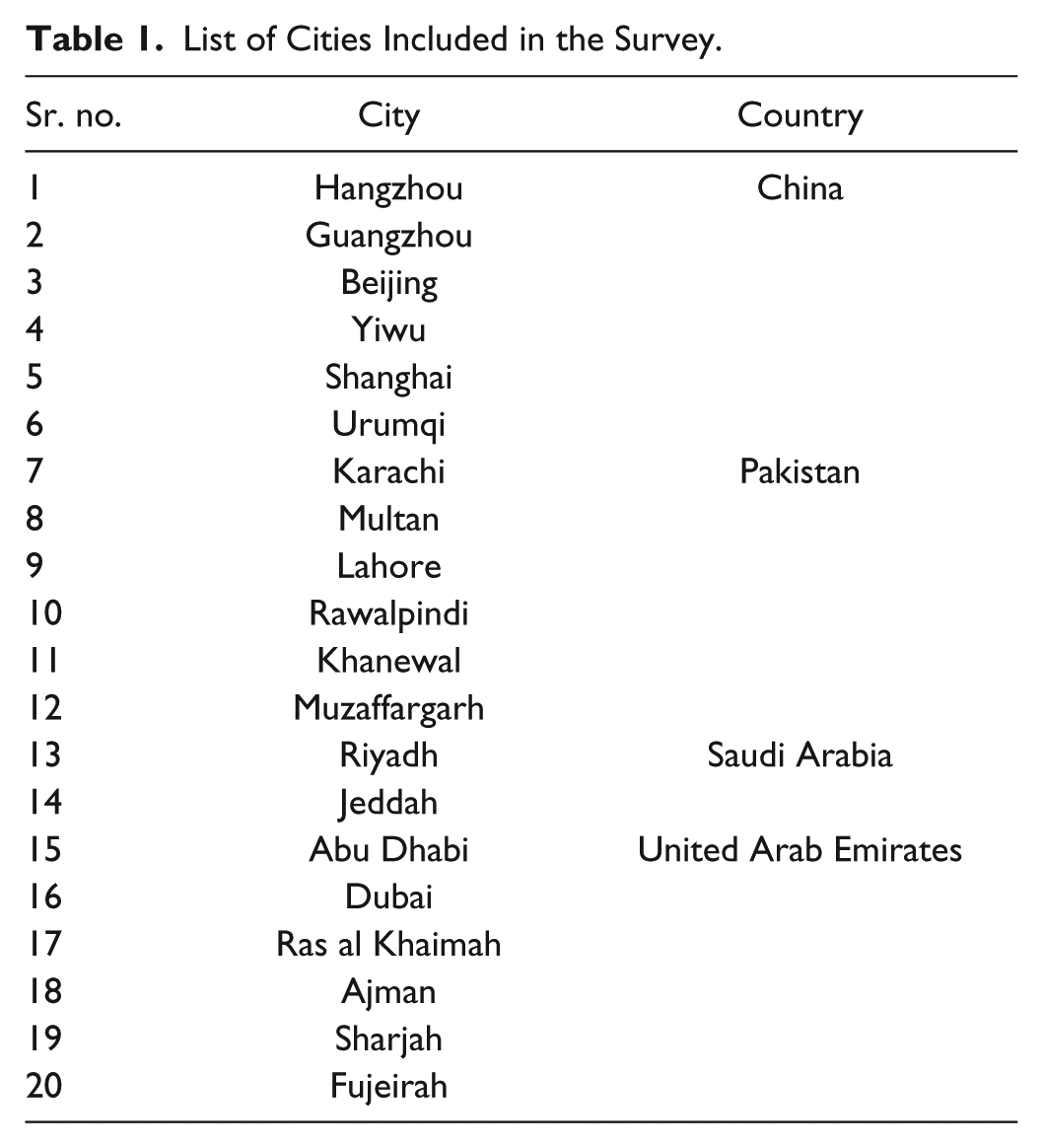
We conducted a survey of 120 employees from small and medium enterprises in the garments sector. We selected the respondents with convenient sampling technique; however, the selection was based on CBIS plans of industries, and researchers’ approach to the cities and the firms. Due to the convenient sampling technique, 120 employees could be included in the survey. Apparently, the sample is small, but it has representation from four different countries, which makes it significant for testing the hypotheses. The research was carried out in Hangzhou, China, and data were collected from the respondents of 20 cities of four countries of Asia. These respondents were available in Hangzhou and Yiwu for employment, business, or higher studies purposes. Country-wise list of the cities is shown in Table 1. The sample was approached through physical and online interaction. This multitime survey was completed in four country-wise phases during the years 2017 to 2018. Irrespective of the number of employees laid off after the technological shift, 60 computer literate respondents were selected from the firms which had adopted Information Technology, and another 60 computer illiterate employees were taken from the firms which were intending to adopt CBIS. This kind of selection in convenient sampling was not mandatory, however, it was done to have a balanced representation from both types of respondents. Computer literacy was measured through computer self-efficacy (Yusoff, Muhammad, Zahari, Pasah, & Robert, 2009). These multisource and mixed method techniques put a paddle on common method bias.
List of Cities Included in the Survey.
For establishing these facts, a comprehensive research instrument containing 5-point Likert-type scale with four sets of items was designed to collect the responses about technology adoption and future course of action regarding motivation and job insecurity with respect to CBIS implementation. Replies from 108 employees were realized on a Likert-type scale in which 51 were received from computer literate and 57 were computer illiterate respondents. Out of 120 sample size, 90% response rate (108 respondents) was realized, which is an encouraging rate. Sample and realized response rate is consistent with the latest study on monitoring and evaluation practices (Niyivuga, Otara, & Tuyishime, 2019).
Responses regarding the dependence of control of unemployment on proactive steps by firms were analyzed through SPSS. These proactive steps were measured in terms of firms’ strategies and departmental plans. State of measures used for the development of the instrument is given in Table 2 with the sources.
Scales and Measures.

Note. CBIS = computer-based information systems.
The Kruskal-Wallis K nonparametric sample test was used for interpretation of data and to find if the samples are from the same population. Taking employee motivation as the dependent variable with job insecurity, computer literacy is treated as the moderator in the relationship of disclosure of CBIS adoption decision and job insecurity and employee motivation. The correlation and regression analyses were performed to explore the relationship between these variables. We used PROCESS macro for examining the moderating role of computer literacy in the direct relationship of the independent variable with the two dependent variables.
Results and Findings
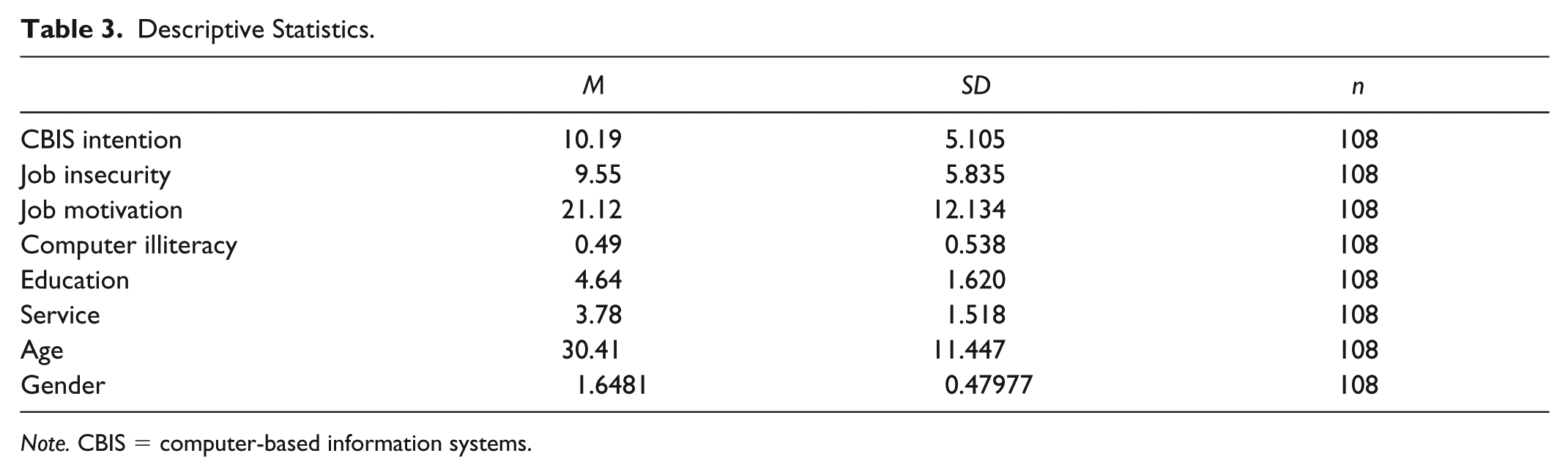
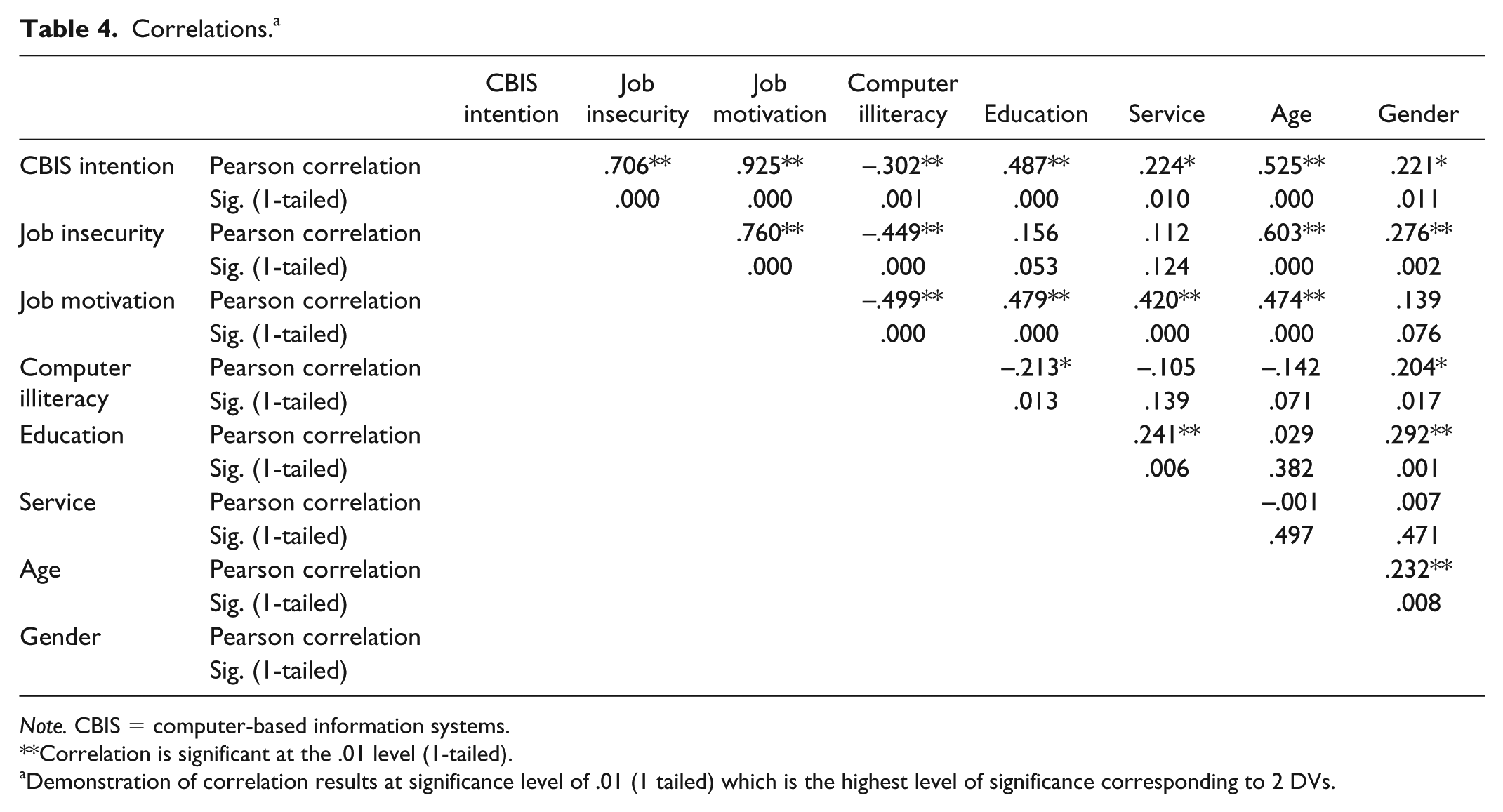
In our research, we distinguished the computer literate people from the computer illiterate people on the basis of their basic computer knowledge and computer self-efficacy. Ten items in the survey were aimed to differentiate and categorize employees. Having an overall reasonable response rate (90%), we segregated the respondents as male (M) female (F) in both levels of literacy. Table 3 below shows the descriptive statistics, and Table 4 shows correlation analysis. With a sample size of 108, we can see the mean and standard deviation for each variable.
Descriptive Statistics.
Note. CBIS = computer-based information systems.
Correlations. a
Note. CBIS = computer-based information systems.
Correlation is significant at the .01 level (1-tailed).
Demonstration of correlation results at significance level of .01 (1 tailed) which is the highest level of significance corresponding to 2 DVs.
Results show a significant relationship between a company’s interest in employees’ retention and employees’ interest in the job. The threat of job security and unemployment due to the technological shift in companies has been evidenced with a slightly high standard deviation (SD = 5.84).
As the use of CBISs reduces manual work, a certain category of employees showed the feeling of job insecurity, but this feeling varied with the variation of computer illiteracy. We noticed a high standard deviation in job motivation and a negative correlation between CBIS intention and computer illiteracy which shows that computer illiterate people tend to resist CBIS adoption.
The analysis shows a good Cronbach’s alpha for all variables to support the reliability of data. In the regression analysis with moderator’s effect (computer literacy—the inverse of computer illiteracy; Table 5), we have found R2 value = .594 for the impact of CBIS intention on job motivation with moderation of computer illiteracy, the coefficient of determination which gives us the ratio of explained variation to total variation in the analysis. If we convert the value of R2 to a percentage, we get the value 59% through which 59% of the variability of the employee motivation has been explained by the variation of the independent variable. Value F = 50.75 is statistically highly significant at .01 level, which indicates that the CBIS adoption intention is statistically significant to job insecurity with the moderation of computer literacy, giving the model a good fit. However, in case of job insecurity, the R2 is .944, which is a strong value. Although there is a negative correlation between computer illiteracy and job insecurity, it has a moderating effect on the relationship of CBIS intention and job insecurity. Model summary in Table 6 shows the analysis of the firm’s intention to adopt CBIS and employee motivation which supports H3a.
Model Summary Motivation.

Note. R2 = .5942; F = 50.7516; df1 = 3.000; df2 = 104.000. LL CI = lower limit confidence interval; UL CI = upper limit confidence interval.
Model Summary Job Insecurity.

Note. R2 = .9441; F = 585.6232; df1 = 3.000; df2 = 104.000. LL CI = lower limit confidence interval; UL CI = upper limit confidence interval.
Our analysis supports the model because the results of data collected from 51 computer literate employees reveal a significantly negative relationship of CBIS implementation with job insecurity, strongly supporting H2 and a positive but insignificant relationship with motivation. It does support H3a which means that in computer literate people, motivation is affected by CBIS implementation. Moreover, in the analysis of 57 responses of computer illiterate people both H2 and H3b are accepted because standardized regression coefficients for employee motivation and job insecurity are negative and positive, respectively. Figure 2 shows the regulating effects and interaction among variables due to computer literacy. The dotted line shows the effects of high computer literacy in the relationship between independent and dependent variables. However, the positive impact of CBIS intention on employee motivation.

The regulating effects of moderator computer literacy.
Discussion and Conclusion
With the implementation of technology, few manual posts lose their need against every new post of the computer user. With the literature review, it was hypothesized that a particular segment of employees of the companies planning to adopt CBISs either face unemployment or feel the insecurity of job. These are major computer illiterate or less proficient employees. To answer the research questions as do the companies intending technological shift ethically think for the career of employees to avoid unemployment after the said shift, and if the companies think so, how they control unemployment menace which is resulted from the adoption of information technology, we have empirical evidence from the analysis of primary data. Due to the reduction of manual work with the use of computers, a large number of employees expect the abolishment of jobs, but this perception varies with the variation of computer illiteracy because there is no significant deviation of its values from the mean value (SD = 0.538). These people have to learn about computer usage and find a computer job which is very much necessary and supportive. However, other people who find no alternatives fall unemployed for long.
The sign of values of LL CI and UL CI in Table 5 is same (positive), and the sign of LL CI and UL CI in Table 6 is negative. Same signs for LL CI and UL CI values for each analysis support our hypotheses. Hypotheses testing show that bringing information technology at the workplace has an extent of the imposition of social control on the employees which conforms to the study of Land (2018), that also indicates the inertia to CBIS implementation, including the change toward automation. Although the existing research explains that in certain dimensions Internet usage negatively impact job insecurity, our study contributes to this finding with the interpretation of human factor in CBIS implementation and its impact on job insecurity. According to Safa et al. (2016), human factor accounts in the utilization of information because the technology is not the sole evidence of a secure environment. The interaction term between the computer illiteracy and job insecurity in our data analysis shows that users may make the mistakes due to the low level of computer illiteracy which may cause job ineffectiveness leading to the threat to job insecurity.
In the current era, society and business settings demand earnings transparency from the firms (Zhang, Farooq, Zhang, Liu, & Hao, 2019), which becomes convenient with the implementation of technology. At the same time, job security is one of the concerns of employees who are already computer illiterate. Understaffing and overstaffing are not positive in context of internal CSR of any company. Companies also have their limitations to lay off the employees because investment in computer systems which ultimately gives more accuracy and larger productivity in less time and through fewer resources increases their expectations of more returns. Firm’s heterogeneity and trade sometimes induce layoffs (Uysal et al., 2015). Companies want to retain employees, the people who are skilled, the personnel who are trained, and the resources that are loyal to the company. The optimal solution is the optimum and effective utilization of resources.
Implications and Contributions
Theoretical implications
Our research attains a bewitching for economic and social understanding theories pertaining to the CBIS’s implementation due to the important findings of the relationship between CBIS adoption intention and employee motivation with respect to the level of computer literacy. Our research finds and connects the critical elements of technology development, employment sustainability, and anthropological contributions to advance the related knowledge of internal CSR.
With the cultural comprehension of CSR (Q. Farooq, Hao, & Liu, 2019), there is a research need of time to understand the internal social responsibility of firms during the implementation of CBIS in various cultures and environments. One facet of this understanding is to assess the motivation of employees whose companies plan to shift from the manual system to CBIS. Research in this dimension attains the optimal level of importance because the relationship of CBIS adoption and employee motivation is not addressed in the previous studies. Present research contributes in the literature of management information systems and human resource management by focusing on manufacturing firms because the production workers and skilled workers are used to the existing systems and processes of the industry, and an operational or strategic shift between system’s use and employees’ loyalty by the firm can influence their motivation level due to retention plans and unemployment threats. This article provides the room for interpretation of Malthusian theory and theories of motivation by explaining the impacts of implementation plans of technology and information systems with consideration of internal CSR. Our research supports content theories of motivation with the implication of technological reengineering and infrastructure plans to be associated with the safety needs of human in Maslow’s hierarchy of needs in the context of job security.
Practical implications
Implementation of CBIS and e-commerce is increasingly becoming common in particular industries (Q. Farooq, Fu, Hao, Jonathan, & Zhang, 2019). On the basis of need explained in the foregoing paragraphs, it was required to look for the companies which have adopted partial or complete Information Technology infrastructure and also those companies that are in a phase of adoption decision, are likely to address the business and human need. A person in certain communities usually provides financial support to many family members. As a view of the dependence of families on individuals, ethical spectrum enlarges when it comes to rightsize or downsizing. It was hypothesized that companies with good managerial practices consider these ethical aspects and make plans for controlling unemployment along with the implementation of CBISs when the need for more employees is decreased. With these findings, motivation can be interpreted with the impacts of technology and its implementation. Our research has managerial implications for human resource departments, corporate managers and management information systems managers to craft the strategies for CBIS implementation, change management plans, and training programs in accordance with the computer literacy and aptitude ratio in their firms.
As found, a large number of companies have adopted CBISs to improve efficiency and accuracy; those companies have managed the situation of their human resource as well. Few managers conscious of internal CSR, have proactively planned the business expansions and presented it to their directors, whereas others neglected it. The present research is in agreement with the previous study (Oyelude & Oladele, 2014), which focuses on the need for relevant training of their employees in particular companies and industries. Instead of going into complicated statistical and mathematical calculations, successful managers have converted threats into opportunities using entrepreneurial capabilities. Quite interestingly, making business expansions, opening of new subsidiaries, introducing new product line, or even entering into new industries with effective financial management and business plans are the solutions about which entrepreneurs and managers should think to reduce the threat of unemployment for their employees after the implementation of computer systems to enhance business efficiency as well as to attain competitive advantage.
Limitations and directions for future research
Despite several useful findings, this research has certain limitations. First, two dependent variables job insecurity and employee motivation are likely to be interrelated with each other. Although our study checked the impact of CBIS implementation scheduling on dependent variables, there is a need for further research on the mutual relationship of dependencies. Second, it is a perceptional study which has analyzed the data from the users. Perceptions vary with the level of education, age, experience, and maturity. Hence, future research may consider the control variables not only in the context of demographics but also the psychological influencing factors. Third, the sample size was small and convenient sampling technique was used. Although the representation of respondents from different areas covered the limitation of small size, future research may attempt the investigation using a large sample with stratified or quota sampling technique. Last, there is the possibility of common method bias due to data analysis because single-source data were collected for this study. Our directions for future include multisource research based on data collected from the employees and their supervisors. This means the data may be collected with particular measures through the items specified with different hierarchal levels.
Conclusion
Anthropological beliefs and technological solutions are two extremes that are found necessary in business progressions. A transparent bridge between these immoderations can provide better internal CSR results to the organizations. In this research, we have met the aim to examine the relationship between technological implementation intentions of companies and the motivation level of their employees. It has been found that computer literacy plays a moderating role in this relationship. Efforts are required for motivation and mental peace of employees of the companies that are doing businesses and planning to incorporate a massive computer and informational infrastructure. Such infrastructure brings several improvements in the business processes as one information system. The situation of demotivation due to illiteracy of computer knowledge and CBIS implementation may get more deteriorated when employees have closed-ended contracts with the company. Through the brief presentation of analyzed data, we answered the questions of interest of those employees and the managers (whether they are computer literate or not) who are working in companies, planning a shift to CBISs. This study recommends companies to control prospective unemployment being an ethical measure of the implementation of CBISs.
Footnotes
Acknowledgements
We are thankful to Prof. Dr. Hayat Muhammad Awan who is the real research mentor for generations and who morally encouraged us to conduct this research. We are grateful to all the supporters.
Author’s Note
Qamar Farooq is also affiliated with faculty of Management Sciences, Riphah International University, Islamabad, Pakistan and Management Science Faculty, Air University Multan Campus, Multan, Pakistan.
Declaration of Conflicting Interests
The author(s) declared no potential conflicts of interest with respect to the research, authorship, and/or publication of this article.
Funding
The author(s) disclosed receipt of the following financial support for the research, authorship, and/or publication of this article: This research was supported by the Science and Technology Project of Zhejiang Province (No. LGF18G010002), the Humanities and Social Sciences Foundation of the Ministry of Education (No. 17YJA630015), and the Key Projects of National Social Science Foundation of China (19AGL015).
