



Abstract
The escalating urgency for sustainable practices within organizations, particularly in the information technology (IT) sector, highlights the need for a comprehensive understanding of the factors that influence green behavior among employees. This study investigates the intricate interrelationships between environmental knowledge, individual green values, supervisory support and green behavior within IT organizations. Data was collected from 230 IT professionals based in Chennai, India, through an online survey and analyzed using partial least squares structural equation modeling (PLS-SEM). The results revealed significant positive relationship between environmental knowledge and green behavior, as well as between individual green values and green behavior, indicating that employees who possess greater environmental knowledge and stronger personal green values are more inclined to participate in ecological responsible practices in the workplace. Additionally, the study identified supervisory support as a critical moderator, enhancing the positive effects of both environmental knowledge and individual green values on green behavior. This finding emphasizes the importance of supportive leadership in building a sustainable culture within organizations. The study concludes that aligning organizational values with individual green values and providing strong supervisory support can effectively encourage employees to adopt eco-friendly practices. These insights contribute to the field of green human resource management and offer practical guidance for IT organizations to enhance their sustainability initiatives. Future research should explore the long-term effects of these factors and investigate how diverse organizational contexts influence green behavior.
Keywords
Introduction
The rapid pace of technological advancement over the past decade has significantly escalated e-waste generation in the IT sector. Shorter product lifespans and increasing consumer demand have exacerbated environmental challenges, including high energy consumption, e-waste, and carbon emissions from data centers, AI technology, and cloud computing (Nair, 2024). According to a report by the “United Nations Institute for Training and Research” (UNITAR, 2024), global e-waste reached an estimated 62 million metric tonnes in 2022, nearly doubling from 2010 levels. In India alone, the “Ministry of Environment, Forest, and Climate Change” reported that the country generated approximately 1.6 million metric tonnes of e-waste in 2021 to 2022, a staggering 163% increase since 2010 (2023a). Projections indicate that by 2030, India’s e-waste generation will surge to approximately 74.7 million metric tonnes (Ministry of Environment, Forest and Climate Change, 2023b). Despite the pressing need for robust waste management solutions, the recycling infrastructure remains inadequate, with a significant portion of e-waste managed by the informal sector, posing severe environmental and health risks due to improper disposal of toxic materials (Abalansa et al., 2021). Furthermore, the energy-intensive nature of AI-related processes necessitates sustainable innovation mechanisms aligned with responsible environmental practices (Alzoubi & Mishra, 2024). As frequent hardware upgrades continue to exacerbate global e-waste, proper disposal and recycling have become imperative (Nair, 2024). In this context, green information technology (GIT) practices, focusing on resource optimization, energy-efficient software, and renewable energy-based cloud solutions, have become essential (Xu et al., 2020). While IT employees may not always lead GIT policy-making, they can still significantly contribute to sustainability through daily practices like efficient coding and resource utilization.
Addressing these environmental issues requires IT companies to embrace environmentally friendly resource production and utilization. Human Resource Management (HRM) professionals are increasingly considering how green HRM practices can assist organizations in reaching their sustainability plans (Yong et al., 2020). As businesses recognize the long-term importance of sustainability initiatives and the need for new environmental management approaches (Lawler & Worley, 2012), implementing green methods is crucial for building a company's image and gaining a competitive edge (Paillé & Boiral, 2013; Tang et al., 2018). Companies must evaluate the environmental impact of their activities to achieve their long-term goals (Koberg & Longoni, 2019). Employees, as agents of a company's green policy, need encouragement and attitudinal shifts to support environmental initiatives (Ramus & Steger, 2000). Organizations are now leveraging green HRM to foster green behavior at the workplace (Renwick et al., 2013). There is increasing evidence for the adoption of green HRM practices to motivate employees to become committed toward sustainability both at work and outside of work (Ogiemwonyi et al., 2020; Ojo & Raman, 2019; Shoaib et al., 2022).
While there is increasing academic interest in the influence of green HR policies in environmental sustainability, recent studies indicate that further investigation is required into the variables that impact the environmentally conscious conduct of employees (Davis et al., 2020; Dumont et al., 2017). Studies in the literature suggest various factors that can promote green behavior in the workplace. Green behavior can be categorized into two factors: personal and organizational. Personal factors are related to the employee and environmental factors are related to organization. Factors like Individual green values, environmental knowledge, harmonious environmental passion, green commitment, pro-environmental attitude are reported in the literature as personal factors (Chrief & Farmanesh, 2022; Fawehinmi et al., 2020; Hameed et al., 2020; Khan et al., 2022; Langenbach et al., 2020). The organizational factor like green transformational leadership, green organizational culture, green training, a psychological green climate, supervisory support are studied in literature (Abdullah & Wider, 2022; Amrutha & Geetha, 2021; Ercantan & Eyupogla, 2022; Rizvi & Garg, 2021). Prior research (e.g. Ahmad et al., 2021; Kura, 2016) has demonstrated a positive correlation between leadership styles and employee behavior, specifically indicating that transformational and supportive leadership styles are linked to increased employee commitment, motivation, and job satisfaction. However, the direct relationship between supervisory support and environmentally friendly behavior has not been extensively investigated. Consequently, this study aims to deepen the understanding of green behavior among employees and examine the role of supervisory support in fostering environmental improvements within organizational settings.
In concrete terms, it focuses on three core objectives: (1) to explore the relationship between employee’s environmental knowledge and green behavior in the workplace, (2) to assess the influence of individual green values on green behavior, and (3) to examine the role of supervisor support as a moderator in the relationship of environmental knowledge and green behavior. Also to test the moderating influence of supervisor support in the relationship between individual green values and green behavior. We have used an integrated approach to explore the moderating role of supervisor support on employees’ environmental knowledge and green values in improving green behavior at the workplace. Our study contributes to the IT industry and green behavior literature by establishing the catalytic role of supervisor in influencing the entire mechanism of green behavior of employees at workplace.
The rest of the paper is divided into the following sections: Initially, we go deep into a detailed analysis of the literature on the theoretical background. This discussion is to be built on the research variables that would establish a connection between them. Next, we formulate hypotheses to describe the relationships among environmental knowledge, individual green values, supervisory support, and green behavior. Then we elaborate on the research methodology to evaluate the hypotheses. In the last section, we summarize the main findings and discuss their implications, stating the limitations of our study and avenues for further research.
Literature Review
Theoretical Background
The “Theory of Planned Behavior” (TPB) by Ajzen (1991) provides a well-suited theoretical framework to understand green behavior in an organizational setting. According to TPB, an individual’s behavior is influenced by three core factors: “attitudes toward behavior, subjective norms, and perceived behavioral control.” Within this framework, environmental knowledge fosters positive attitudes by improving their comprehension of the benefits and impact of eco-friendly practices, thus strengthening the intention to live green behavior in employees (Karmoker et al., 2021). Environmental knowledge serves as a basis for a favorable attitude toward sustainability, enabling them to be informed of how their actions matter toward reducing the environmental impact. Similarly, individual green values align with attitude toward the behavior. Highly value-oriented employees are likely to internalize green practices as personal and social norms that drive commitment to green behavior (Al-Ghazali & Afsar, 2021).
This framework is moderated by supervisory support that increases perceived behavioral control: it reflects an individual’s trust in one’s ability to perform the behavior. Active endorsement and facilitation by supervisors of green initiatives increase employees’ confidence in performing sustainable actions, thereby making it easier for them to act on knowledge and values (Amin et al., 2021). Additionally, supervisory support instills subjective norms because it communicates organizational commitment to sustainability, which is in accordance with employees’ personal values and enhances their intention to be involved with green behavior. Encouragement by the supervisor can also remove certain potential obstacles to green behavior. So employees feel capable of and supported with taking environmentally responsible actions (Yuan et al., 2024). The integration of the knowledge of the environment with green values and supervisory support through the lens of TPB highlights how organizations create a supportive culture that aligns individual attitudes, norms, and control beliefs in realizing stronger intentions and actual engagement in green behavior.
Environmental Knowledge
Environmental knowledge involves building awareness and comprehension of sustainability concerns by educating individuals with knowledge, insights and prospects to enhance their competence (West et al., 2020). Green awareness can influence individuals to adopt specific behaviors with regard to environmental impacts (Rayner & Morgan, 2018). Researchers (Burchett, 2015; Fawehinmi et al., 2020) stated that environmental understanding entails knowing how humans impact the ecosystem, the issues they create, and the numerous links across ecological systems. Such knowledge might include the abilities required to reduce harmful effects on the ecosystem. Despite multiple initiatives to promote sustainability, studies show that people’s understanding of environmental issues is rather low (Renwick et al., 2013). However, individuals with higher levels of education tend to place higher significance on environmental protection for both current and future generations. Therefore, increasing public awareness and knowledge is essential for driving effective sustainability initiatives (Shutaleva, 2023).
Individual Green Values
Green values are the outcome of sustainable development, which pertains primarily to the attitudes and actions of individuals (Dumont et al., 2017). Existing literature by Chou (2014); Sagiv and Schwartz, (2022) finds that specific green values possess a significant effect on individual attitudes and behaviors. It motivates individuals to pursue eco-friendly behaviors based on environmental values. Afsar and Badir (2016) found that individuals are encouraged to take ecologically friendly actions grounded in ecological principles. When employees recognize a significant congruence between their values, personalities, skills, and talents and those of the organization, it facilitates their ability to fulfill organizational expectations. Individuals that feel connected to the organization through values and identity are more inclined to commit to organizational goals. Then it is easier to build a relational psychological contract between employee and organization (Hameed et al., 2020). Hu and Jiang, (2018) point out that individuals with high moral identities are more likely to enhance environmental HRM practices and advocacy. Among them, moral individuals have greater influence and feel connected to organizational morality (environmental HRM).
Green Behavior
Green behavior encompasses a variety of individual actions aimed at reducing the negative impact of human activities on environmental quality and performance (Kim & Stepchenkova, 2020). Encouraging employees to encourage in green behaviors and address environmental issues is considered an effective approach to cultivate an ecologically conscious firm and enhance its sustainable productivity (Saeed et al., 2019). The following are examples of green workplace behaviors that organizations can employ to help the environment: reducing energy consumption, reusing and recycling materials, avoiding pollution and excessive carbon emissions, and encouraging others to implement more effective environmental management systems, either directly or indirectly (Norton et al., 2015). Such environmentally conscious behaviors may fall into two categories, as described by Dumont et al. (2017) and Ramus & Killmer, (2007): in-role green behavior and extra-role green behavior. Both types of behaviors are distinct from one another but share a common goal: to improve the organization’s environmental performance. Reduced paper consumption during printing and adequate recycling are examples of in-role green behavior that contribute to meeting performance evaluation criteria. “Extra-role green behavior” is when an employee does things that aren’t directly connected to their job and aren’t counted toward their performance review (Paillé & Boiral, 2013). Some individuals hold the belief that regular environmentally friendly behaviors should incorporate in-role and extra-role green conduct. Employees have varying degrees of control over exhibiting employee green behavior (EGB) at work, which is why Yuriev et al. (2020) noted that both in-role and extra-role green behaviors originate from different sources. Despite these contextual differences, both forms of environmentally conscious conduct are vital for integrating green approaches to organization with overall green objectives.
Environmental Knowledge and Green Behavior
Knowledge about the environment has the potential to encourage people to engage in particular behaviors or to abstain from them in particular ways. Afsar et al. (2016) found that environmental knowledge influences employee’s intents to participate in eco-friendly actions, and that psychological commitment necessitates a specific degree of environmental awareness and competence. Effective green knowledge management improves organizational members’ environmental knowledge infrastructure and transmission (Lin & Chen, 2017). Zhang et al. (2021) extends this idea by attributing pro-environmental activities to the intrinsic satisfaction that comes from achieving competency. Knowledge of the environment logically informs the alignment of personal interests and the intrinsic satisfaction gained from competence. Environmental training and development can enhance understanding of environmental issues (Rayner & Morgan, 2018; Zhang et al., 2021). It also results in an increase in efforts of employees to complete duties that enhance their company’s environmental performance (Safari et al., 2018). Research (e.g. Fawehinmi et al., 2020; Karmoker et al., 2021; Muafi, 2022) shows that environmental awareness and knowledge exchange have a positive, statistically significant impact on green behavior among employees in various organizations. Henceforth, by being aware of environmental issues and challenges, employees will act more responsibly toward the environment and the firm. On the basis of the theoretical background, the following relationship are proposed:
Individual Green Values and Green Behavior
People generally acknowledge individual green values as important determinants of pro-environmental attitudes and behaviors. An integrated assessment system conceptualizes them as desired end-states. These principles are essential for understanding attitudes toward the environment (Barbarossa et al., 2017). Many studies (e.g., Al-Ghazali & Afsar, 2021; Chou, 2014), have demonstrated that an individual’s environmental values significantly influence their level of engagement in ecologically responsible activities and also shape their behavior. Studies have demonstrated that a more robust affiliation between an employee and their organization, based on similar values and identity, increases the probability of their commitment to the firm’s objectives and mission (Hameed et al., 2020). When an organization fosters a compatible environment that aligns with its employees' views, integrates their green values, and promotes a strong sense of belonging, the employees are more inclined to exhibit environmentally cognizant conduct when acting on behalf of the organization. Given the circumstances, individual green values enhance the correlation between sustainability and human resource management (Gilal et al., 2019). Recent research (Islam, Hussain, et al., 2021; Zhu et al., 2021) has shown that when individuals' personal beliefs align with organization’s ideology, its lead to better employee outcomes. These outcomes include enhanced organizational identification, greater work significance, and improved workplace-related green attitudes and behaviors. On the basis of the theoretical background, the following relationship are proposed:
Moderating Role of Supervisory Support
A concept known as supervisory support for the environment was formulated by Ramus and Steger (2000). It consists of a specific collection of behavior patterns designed to inspire employees to participate in individual environmental initiatives. Ramus and Steger (2000) argue that workers are more inclined to actively support sustainable initiatives when they see their superiors consistently demonstrating supportive behaviors on a regular basis. Amin et al., (2021) emphasize that supervisors may substantially augment employees’ emotional commitment to environmental practices, thereby fostering involvement of employees in sustainable behaviors. This is further supported by Aslam et al. (2021) who found that supervisory support positively affects employee attitudes toward pro-environmental behavior. Similarly, Yuan et al. (2024) found that supervisory support can mitigate negative outcomes, such as emotional exhaustion, thereby promoting voluntary green workplace behavior.
Based on Zhang et al. (2021), there is a robust correlation between effective knowledge management practices and green employee behavior. In other words, employees are more inclined to adopt environmentally friendly practices when their supervisors actively participate in the dissemination and encouragement of knowledge. It is additionally corroborated by Li et al. (2019), who determined that the intention of individuals to embrace green behaviors is positively influenced by their environmental knowledge, as the encouragement provided by their supervisees is highly influential in this regard. Individual green values also form an important part of this process. Further, transparent organizational polices and facilitative supervisory practices facilitate the perceived value of green initiatives, thereby promoting the behavior of employees who adhere to their respective green values (Riva et al., 2022). The study reveals that when supervisors endorse and uphold green values, employees tend to adopt sustainable practices, thereby reinforcing the notion that supervisory support is crucial in fostering sustainability cultures.
The moderating role of supervisory support is not only to enhance the effect of environmental knowledge and values but also to mitigate possible barriers to green behavior. For instance, Zhang et al. (2022) contend that the perceived inconsistency in organizational-supervisory support contributes to the perception of corporate hypocrisy, which hinders employees from engaging in green behaviors. This suggests that supervisors should tailor their support to align with the organizational structure if they want to effectively promote environmental initiatives.
Based on the above discussion, we seek to understand that supervisory support serves as a moderator in the interaction between environmental knowledge, individual green values, and green behavior of the organization. Hence, the following relationships are proposed:
Methodology
Research Design
This study employs a cross-sectional empirical research design aimed at understanding the factors influencing green employee behavior among IT professionals. The research utilizes a quantitative approach, with statistical analysis conducted to test the hypothesized relationship between environmental knowledge, individual green values, supervisory support, and green behavior. A conceptual model (Figure 1) was developed, evaluated using partial least squares structural equation modeling (PLS-SEM), to examine these constructs at the organizational level.

Conceptual model.
Sampling Plan
The sample consisted of IT employees working in Chennai, India, selected based on convenience sampling. The target population included professionals in mid-sized to large IT firms to ensure a diverse range of perspectives related to green behavior in the workplace. IT companies were chosen due to their significant environmental impact, driven by high energy consumption for the data centers, AI, and cloud computing, along with substantial e-waste generation. Additionally, IT firms are often early adopters of sustainable practices and face increasing pressure to implement green HRM initiatives. This study focuses on the IT sector to explore how environmental knowledge, individual green values, and supervisory support influence green behavior in a high-impact industry. A total of 230 IT professionals participated in the study, providing responses during a specified data collection period from September to November 2023.
Data Collection (Participants)
Data were through an online survey administered via google forms, accessible to IT employees in Chennai. The questionnaire was carefully designed to include measurement scales for environmental knowledge, individual green values, supervisory support, and green behavior. The data were anonymized, and no personal information, such as contact numbers or email addresses, was collected. To ensure ethical compliance, informed consent was obtained from all participants before their involvement in the study. Participation was entirely voluntary, with individuals having the right to withdraw at any stage without any repercussions. Furthermore, no minors were recruited for the survey to uphold ethical guidelines and ensure the appropriateness of participant selection. These measures collectively prioritized the privacy, autonomy, and well-being of all participants involved.
Measures
The questionnaire was developed in English (see Appendix). All research variables were assessed using 5 point Likert scales, with a range of 1 (strongly disagree), 2 (disagree), 3 (neutral), 4 (agree), and 5 (strongly agree).
Environmental knowledge: The four-item measure developed by Gillani et al. (2018) was used to evaluate environmental knowledge. One sample item to measure environmental knowledge is as follows “In my organization, sharing knowledge and awareness about environmental issues and solutions with colleagues is a routine matter.” The measure’s Cronbach alpha value was .88.
Individual green value: Steg et al. (2005) employed a nine-item scale to assess individual green value. Three of the items were eliminated from the scale as a result of inadequate loading, leaving the remaining six with a calculated reliability of 0.84. In this study, individuals' green values were assessed using the same six-item measure. Additionally, exploratory and confirmatory factor analyses were performed on the variable (Hair Jr et al., 2017). Example of item to measure individual green values is “I feel guilty when I contribute to environmental degradation.” The Cronbach alpha was 0.84.
Supervisory support: The measurement of supervisory environmental support involved the utilization of an employee-friendly six-item measure based on claims made by Ramus (2001). Example of item to measure supervisory support is “My supervisor makes sure that employees have environmental competences needed to do their jobs.” The Cronbach alpha was 0.93.
Green Behavior: The six-item scale developed by Bissing-Olson et al. (2013) was utilized by Dumont et al. (2017) to assess green in-role and extra-role behavior. The scale comprised three items for each of these behaviors. It was reported that the reliability of extra-role and in-role green behaviors was 0.85 and 0.86, respectively. Some examples of in-role behavior are, “I adequately complete assigned duties in environment-friendly ways” and “I took the initiative to act in environment-friendly ways at work” (extra-role behavior). The Cronbach alpha was .89.
Data Analysis
The data analysis for this research was performed utilizing version 3 of Smart PLS, as described by Ringle et al. (2015). PLS and SEM is an esteemed analytical tool for its ability to simultaneously examine the constructs or measures and the underlying structural model (Hair Jr et al., 2017). PLS-SEM is highly suitable for confirmatory, survey-based analyses due to this particular attribute. Furthermore, even with smaller samples that deviate from the normal distribution, it exhibits increased resilience (Hair Jr et al., 2017). Also, it is well-suited for reflective models. In the preliminary phase, an assessment is conducted on a measurement framework to ascertain the constructs' validity and dependability. In second stage, the hypotheses are subsequently validated through an examination of the structural model (Hair et al., 2019).
Results
Demographic Characteristics of IT Employees
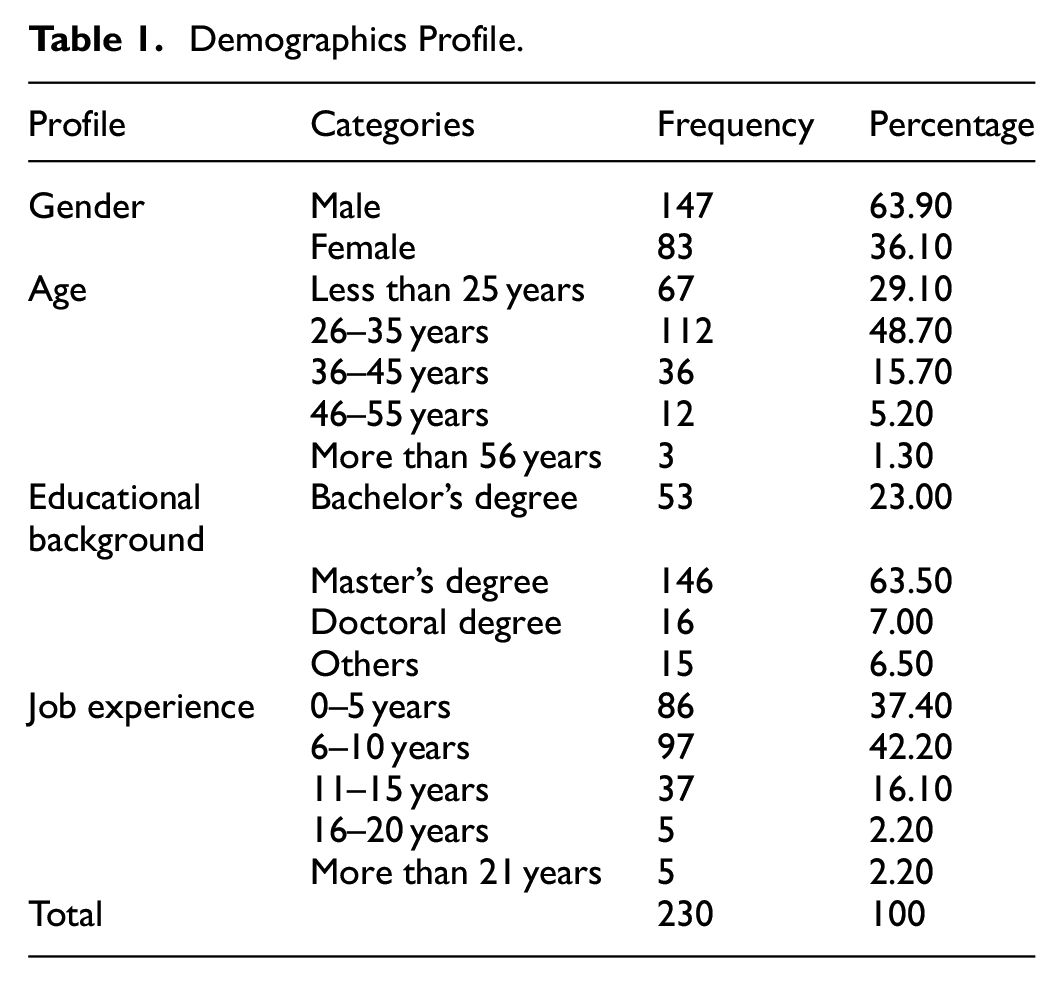
The demographic characteristics of the sample are presented in Table 1, outlining participant gender, age, educational background, and job experience. The sample included 63.9% male and 36.1% female respondents, with the majority (48.7%) aged between 26 and 35 years. Most respondents held a master’s degree (63.5%), 42.2% had between 6 and 10 years of experience in the IT industry.
Demographics Profile.
Measurement Model
In accordance with the recommendation of Anderson and Gerbing (1988), the built model underwent two phases of testing. Prior to proceeding, an assessment of the instruments’ validity and reliability was conducted on the measurement model, adhering to the criteria established by Hair et al. (2019). The structural model was subsequently executed in order to validate the hypothesis.
An evaluation was conducted on the loadings, average variance extracted (AVE), and composite reliability (CR) of the measurement model. The loading values, AVE, and CR must all be equal to or greater than 0.5 and 0.7, respectively. As shown in Table 2, the average variances and CRs were both greater than 0.5 and 0.7, respectively. Averaging 0.708, only one or two loadings deviated from this value, suggesting that the loadings were satisfactory (Hair et al., 2019).
Shows the Model for Measuring the Structures.

The discriminant validity was then evaluated in step 2 using the Fornell-Larcker criterion, which implies that the square root of a latent variable AVE must exceed its correlation with any other latent variable. Table 3 confirms that each construct is distinct and shares more variance with its own indicators than with other variables. HTMT criterion, as described by Henseler et al. (2015) and revised by Franke & Sarstedt, (2019). To satisfy the mode-lenient criterion, the HTMT values must be equal to or below 0.90 (mode-lenient criterion) or 0.85 (stricter criterion). As demonstrated in Table 4, every HTMT value fell below the more rigorous threshold at (≤0.85). Although one HTMT value exceeds the stricter 0.85 threshold, it remains below the more lenient criterion of 0.90, indicating an acceptable level of discriminant validity (Franke & Sarstedt, 2019). Moreover, Table 2, VIF values for environmental knowledge, and individual green values remain well below the recommended threshold of 5, further indicating that there is no multi-collinearity issue in this model (Hair Jr et al., 2017).
Fornell-Larcker Criterion.

Heterotrait-Monotrait Ratio.

Structural Model
To evaluate the hypotheses, an estimated PLS structural model is utilized. Ordinary Least Squares (PLS) regression analyses, whether simple or complex, are executed iteratively as part of the PLS estimation method (Chin, 1998). As a result, pathway coefficients can be represented as fixed regression coefficients in the structural equation. Hair Jr et al. (2017) explain that bootstrapping was utilized to determine the statistical significance of the path coefficient increase. This was necessary because PLS does not make any assumptions about the distribution of predictors. Before evaluating the connections between structures, it is necessary to analyze collinearity in order to prevent any potential distortion in the regression outcomes. This method, which is similar to evaluating formative assessment models, calculates VIF values by using the scores of the exogenous constructions’ latent variables (Hair Jr et al., 2017). A collinearity issue may arise when the Variance Inflation Factor (VIF) for the predictor variables exceeds 5. On the other hand, VIF levels between 3 and 5 can also cause collinearity (Becker et al., 2015). The results show that none of the study’s values are more than 5.
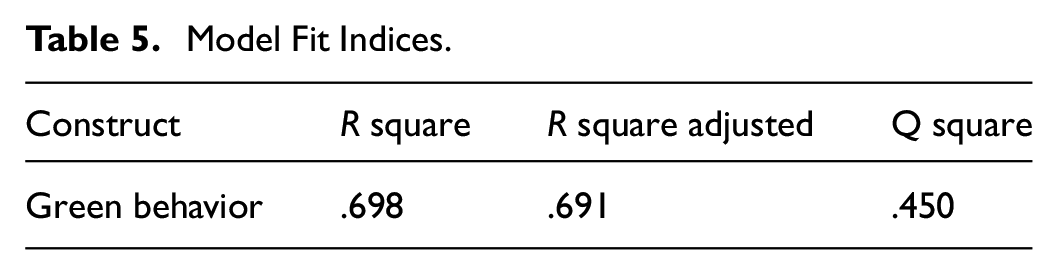
The model’s explanatory power is assessed using the R2, which quantifies the amount of variation accounted for in each endogenous construct (Shmueli & Koppius, 2011). The coefficient of determination (R2) in this study was 0.698. In addition, the ƒ2 effect size is utilized in order to evaluate the influence of removing a particular exogenous component from the model on the variation in the R2 value. Effect sizes below 0.02, as stated by Cohen, (2013), do not show any significant effect. Based on the data shown in Table 5, both of the independent variables have values greater than 0.02, while one of the dependent variables has a value greater than 0.15. Additionally, the Q2 value can be utilized to assess the precision of the PLS route model’s forecasts (Stone, 1974). The relevant component shows how dependent the variables are on one another. As an example of the impact of one variable on another, we have values of 0.02 for low thresholds, 0.15 for moderate thresholds, and 0.35 for high thresholds. In Table 5, we can see that the study has a high level of predictive relevance with a Q2 obtain of 0.450. Standardized root mean square residual (SRMR) was employed in the study to assess the model’s adequacy. the SRMR, which is calculated by square rooting the mean discrepancy between model-implied and observed correlations. According to (Hu & Bentler, 1998), the SRMR is a measure of fit that is absolute; a value of zero denotes perfect fit. And the CBSEM method's SRMR value should be less than 0.08 or 0.10. The study found that the SRMR value is 0.061, which is less than the cut-off of 0.08.
Model Fit Indices.
Hypothesis Testing
In this study, the research hypothesis was tested using the structural equation modeling technique. This was accomplished by determining whether or not the structural equation model was suitably fitted. First, the path coefficients are generated, and then, after that, the t-test statistics are applied in order to determine whether or not these coefficients are important. At the 95% confidence, the target’s route and path coefficient are statistically significant. This is illustrated by the test statistic's absolute t value exceeding 1.96, the critical value set at 0.05. In the event that the route coefficient is found to be lower than this threshold, it is regarded as not being significant. A direct or indirect connection may be determined by the sign of the route coefficient, the path coefficient measures two variables’ correlation. The summary of the data collected through the process of fitting the research model is presented in Table 6, which is visually represented in Figure 2. Consistent with the hypothesis testing process, routes are deemed significant when their absolute t value exceeds 1.96. In addition to Figure 2, we observed positive effects of environmental knowledge on green behavior (t value = 3.284 and p value = .001) and individual green values on green behavior (t value = 3.513 and p value = .000). The findings validate the initial two assumptions of the study, namely H1 and H2.
Path Coefficients.

Note. EK = Environmental Knowledge; IGV = Individual Green Values; SS = Supervisory Support; GB = Green Behavior.

Evaluation for the measurement model.
The interaction between environmental knowledge (EK), individual green values (IGV), and supervisory support (SS) was evaluated in Table 7 to determine the moderating influence of SS on EK-GB and IGV-GB. We observed a substantial impact of supervisory support on green behavior, as a p-value of .000 and a t-value of 7.290 indicate. Furthermore, the statistical analysis revealed that the interactional term (EK × SS) had a substantial effect (t value = 2.378 and p value = .018), indicating moderation. Similarly, the interactional term (IGV × SS) also had a substantial effect (t value = 2.029 and p value = .043), suggesting moderation. Upon further analysis of the slope, we examined the impact of higher and lower supervisory support (refer to Figures 3 & 4). Our findings indicate that persons with high supervisory support are more prone to developing green behavior when exposed to environmental knowledge and individual green values, hence supporting hypotheses H3 and H4.
Moderating Analysis.

Note. EK = Environmental Knowledge; IGV = Individual Green Values; SS = Supervisory Support; GB = Green Behavior.

An examination of the moderating effect of supervisory support (SS) with environmental knowledge (EK) and green behavior (GB).

An examination of the moderating effect of supervisory support (SS) with individual green values (IGV) and green behavior (GB).
Discussions
The empirical investigation holds significant relevance to existing literature on the issue. The study’s main hypotheses, H1 and H2, posit a positive relationship between environmental knowledge (EK) and individual green values (IGV) with green behavior (GB), and the statistics substantiate these ideas. The empirical findings show that environmental knowledge is positive for green behavior with a significant statistical value, yielding a t-value of 3.284 and a p-value of .001. Individual green values also positively affects green behavior, since it yielded a t-value of 3.513 and a p-value of .000. These research findings align with the previous research (Islam, Khan, et al., 2021; Zhu et al., 2021) indicating that individual values and environmental knowledge positively influence the promotion of environmentally friendly behaviors in organizations. Employees with strong green values tend to have favorable attitudes toward engaging in environmentally sustainable practices, perceiving these actions as beneficial and necessary for environmental protection. In contrast, employees with weaker green values may not recognize the importance of such behavior, resulting in less favorable attitudes. Additionally, employees with substantial environmental knowledge are more likely to appreciate the significance and advantages of green behaviors, while those lacking sufficient knowledge may remain indifferent or unaware of the environmental impact of their actions.
The investigation further confirmed the moderating influence of supervisory support (SS) on the connection between environmental knowledge and green behavior and the relationship between individual green values and green behavior. Hence, conforming to H3 and H4. The interactive terms, specifically EK × SS and IGV × SS, demonstrated significance with t values of 2.378 (p value = .018) and 2.029 (p value = .043), respectively. This reinforces the notion that supervisory support amplifies the beneficial impact of both environmental knowledge and individual green values on green behavior. The findings are consistent with previous research (Odai et al., 2021; Tabiu, 2019), who identified substantial backing from supervisors in promoting employees’ environmental behavior. For instance, Gilal et al. (2019) have posited that alignment between personal values and organizational values can notably improve employee engagement in environmentally friendly practices. This is consistent with the findings of the current study concerning the importance of social responsibility.
The slopes analysis further concludes that employees who get more encouragement and support from their supervisors or reporting officers regarding environment-friendly initiatives in their jobs will demonstrate more green behavior at the workplace. The literature supports the finding, indicating a strong correlation between supportive leadership and increased employee engagement in environmental initiatives (Abdullah & Wider, 2022; Odai et al., 2021). Indeed, the evidence suggests that the combination of supervisory support and individual green values amplifies the employees’ green behavior, consequently, an organization can harness supervisory support to foster a culture of environmental accountability (Hameed et al., 2020; Islam, Khan, et al., 2021).
Lack of resources or perceived difficulties in implementing green practices can hinder employees from engaging in green behaviors, despite having green values. Employees need to feel that they have the capability and resources to perform green behaviors. If employees perceive environmental knowledge as complex or hard to apply, it may reduce their perceived control and willingness to engage in green behaviors. Adequate support from supervisors will enhance their perceived control. Supervisors can promote and encourage green behavior by actively involving employees in environmental problem-solving and facilitating discussions on environmental issues. They should also ensure that employees possess the necessary environmental competencies to perform their job duties effectively. Supervisors play a crucial role in motivating employees to demonstrate green behavior. If employees have limited awareness of sustainable work practices, supervisors can enhance green behavior in the workplace through proper guidance and support. Supervisors play a crucial role in shaping social norms within the organization. Their support signals to employees that green behavior is valued and expected. Supervisors can enhance employees’ perceived control by providing the necessary resources, training, and support for implementing green behaviors. By addressing obstacles and providing clear guidance, supervisors can make it easier for employees to adopt green practices.
This study contributes to the expanding literature on interactions among environmental knowledge, individual green values, supervisory support, and green behavior in organizational settings. This reiterates theoretical frameworks regarding environmental behavior in the workplace and offers practical insights for IT organizations aiming to improve their sustainability initiatives. The study indicates that enhanced supervisory support, in conjunction with individual green values and environmental knowledge, can promote stronger green behavior among employees.
Theoretical Implication
The theoretical implications of this study are substantial, as it contributes to the field of organizational behavior by integrating the Theory of Planned Behavior (TPB) and enhancing our understanding of green behavior The inclusion of supervisory support, environmental knowledge, and individual green values within the TPB framework broadens the theoretical domain and evaluates in greater depth the factors affecting green behavior within organizational settings. The significance of leadership in shaping employees' participation in environmentally sustainable activities is highlighted by the identification of supervisory support as a critical moderator. Furthermore, the theoretical framework's comprehensiveness and practicality are enhanced by the research's incorporation of contextual elements, including organizational culture and various industry environments. In general, the theoretical contributions presented here enhance our comprehension of leadership dynamics and contextual elements to promote environmentally conscious conduct in the work environment. As a result, human resource management and environmental sustainability scholars and practitioners will gain invaluable insights.
Practical Implications
For IT companies, the research has major practical implications. The findings emphasize the significance of focused interventions designed to enhance employees’ environmental knowledge and foster their personal commitment to sustainability. Employees can benefit from a better grasp of environmental issues and their actions' consequences by participating in environmental knowledge training programs. Organizations can enable employees to make ecologically conscious decisions in their daily duties by offering knowledge on sustainable practices and their significance. Implementing training programs, awareness campaigns, and initiatives that align the values of the organization with the environmentally conscious goals of employees can effectively promote sustainable behavior. During recruitment, organizations can prioritize candidates who demonstrate strong green values aligned with the company’s sustainability goals. This alignment ensures that new hires are predisposed to support and engage in organizational green initiatives. Post-recruitment, organizations can further reinforce green values through continuous training and value-driven engagement activities. By cultivating a workforce that inherently values sustainability, IT organizations can strengthen the alignment between individual and organizational goals, fostering a culture where green behavior thrives. Moreover, the study highlights the importance of leadership dedication, as evidenced by the support provided by supervisors. Organizations should allocate resources toward cultivating ecologically conscious leadership practices, enabling supervisors to advocate for environmentally friendly initiatives, and equipping employees with the means to regularly communicate about the organization’s green efforts. This will foster a positive perception among employees regarding the ecologically conscious procedures of the organization and encourage their active participation in sustainable activities.
Limitations and Future Research Direction
The study offers valuable intuitions, yet it’s crucial to admit certain limitations that could impact the interpretation and practical implications of the findings. Firstly, the use of self-reported data may introduce response bias, while the cross-sectional design hinders the establishment of causal relations. Therefore, future longitudinal studies are imperative to address these shortcomings. Understanding the motivations behind individuals' increasing environmental consciousness at work requires a deeper exploration of their underlying reasons and driving forces. Paillé and Mejía-Morelos (2014) distinguished between direct and indirect environmentally conscious actions, highlighting the need for further investigation into the factors influencing individuals’ choices in engaging in these behaviors. Moreover, the study’s focus on a specific industry and demographic group may limit external validity.
Despite these constraints, the study paves the way for future research avenues. Conducting longitudinal studies would provide a deeper insight into the connections between environmental knowledge, personal green values, supervisory support, and green behavior over time. Expanding the scope of the study to encompass diverse demographic and industrial groups can enhance the generalizability of the results. By examining how these relationships vary based on organizational contexts and employee profiles, valuable insights can be gained to tailor environmentally responsible human resource management practices accordingly. Moreover, delving into the correlation between these variables and the influence of management philosophies and organizational culture on eco-friendly initiatives could provide a more holistic understanding of the determinants shaping workplace greening efforts. Additionally, exploring the impact of external factors such as cultural dimensions and national policies on environmentally friendly HRM practices could offer valuable insights for organizations operating in diverse sociocultural environments. Overall, future studies should aim to deepen our understanding of the complexities associated with green HRM and its implications for fostering ecologically friendly practices within organizations.
Conclusion
To conclude, this study offers empirical evidence that underscores the positive correlations between environmental knowledge, individual green values, and green behavior, while also affirming the moderating influence of supervisory support within these relationships. Effective supervisory support boosts employees’ perceived control over adopting and exhibiting green behaviors in the workplace. By providing essential resources, training, and clear guidance, supervisors enable the implementation of green practices and crucially shape organizational norms, signifying the importance and expectation of green behavior. Overall, the findings enrich the expanding literature on green HRM, its importance for organizational sustainability, and its role in preserving the environment. Future studies may explore mechanisms through which green HRM practices influences employee behavior, especially across different organizational settings and industries. The findings of the study can guide IT organizations to formulate context-specific strategies that promote the role of their employees in furthering environmental stewardship—a broader goal toward achieving sustainability.
Footnotes
Appendix

| Constructs | ||
|---|---|---|
| Environmental Knowledge | 1 | “In my organization, sharing knowledge and awareness about environmental issues and solutions with colleagues is a routine matter.” |
| 2 | “I have contributed knowledge to this organization.” | |
| 3 | “I have contributed knowledge to other members that resulted in the development of new insights.” | |
| 4 | “Environmental knowledge and experiences were exchanged on various occasions in different departments.” | |
| Individual Green Values | 1 | “I feel a personal obligation to do whatever I can to prevent environmental degradation.” |
| 2 | “I feel normally obliged to save the environment from degradation, regardless of what others do.” | |
| 3 | “I feel guilty when I contribute in environmental degradation.” | |
| 4 | “I feel normally obliged to protect the environment instead of degradation.” | |
| 5 | “People like me should do whatever they can to protect environment from degradation.” | |
| 6 | “I would prefer to buy eco-friendly appliances.” | |
| Supervisory Support | 1 | “My supervisor encourages environmental initiatives.” |
| 2 | “My supervisor encourages employees to attend environmental training.” | |
| 3 | “My supervisor makes sure that employees have environmental competences needed to do their jobs.” | |
| 4 | “My supervisor openly engages in discussions around environmental topics.” | |
| 5 | “My supervisor gives complete and accurate information regarding environmental issues.” | |
| 6 | “My supervisor involves employees in environmental problems solving.” | |
| Green Behavior | 1 | “I adequately complete assigned duties in environment-friendly ways.” |
| 2 | “I fulfill the responsibilities specified in my job descriptions in environment-friendly ways.” | |
| 3 | “I perform tasks that are expected of me in environmental-friendly ways.” | |
| 4 | “I took a chance to get actively involved in environmental protection at work.” | |
| 5 | “I took the initiative to act in environment-friendly ways at work.” | |
| 6 | “I did more for the environment at work than I was expected to.” |

Ethical Considerations
The data were anonymized, and no personal information, such as contact numbers or email addresses, was collected. To ensure ethical compliance, informed consent was obtained from all participants before their involvement in the study. Participation was entirely voluntary, with individuals having the right to withdraw at any stage without any repercussions. Furthermore, no minors were recruited for the survey to uphold ethical guidelines and ensure the appropriateness of participant selection. These measures collectively prioritized the privacy, autonomy, and well-being of all participants involved.
Funding
The author(s) received no financial support for the research, authorship, and/or publication of this article.
Declaration of Conflicting Interests
The author(s) declared no potential conflicts of interest with respect to the research, authorship, and/or publication of this article.
Data Availability Statement
The data that support the findings of this study are available on request from the corresponding author. The data are not publicly available due to privacy or ethical restrictions.