




Abstract
Although research on teleworking dates back about a decade, much remains unknown with regard to how teleworking impacts employees’ experience at work. Based on self-determination theory, this research seeks to understand the dynamics underlying the impact of teleworking on employees’ job satisfaction. The study was conducted in an organization with a formal teleworking program; 448 respondents (211 teleworkers and 237 office workers) completed an online questionnaire. The results of structural equation model analysis indicate that teleworking is a better way of meeting workers’ psychological needs for autonomy, competence, and relatedness. In addition, our results indicate that there is a moderating effect on the relationship between these three types of psychological needs and employees’ job satisfaction, supporting the idea that the satisfaction of psychological needs does not operate in the same way for teleworkers and office workers.
Since the beginning of the 21st century, organizations across the world have shared the challenge of adapting quickly to constantly evolving circumstances. For instance, the complex, competitive environment created by the knowledge-driven economy has forced business owners to rethink work organization and employment practices. In response to this pressure, many organizations have expanded their organizational boundaries, adopting a dispersed workforce strategy with the hope of accessing the best talents and reaching clients across the globe (Montgomery, 2016). Information and communication technologies (ICTs) played an important role in this transformation as they “have enabled organizations to rapidly form teams that are not restricted by geography, time, or organizational boundaries” (Avolio et al., 2001, p. 337).
One trend that reflects organizations’ growing need for fluidity is “teleworking.” The exact definition of this term has been debated for many years, as well as the threshold for employees to work away from the office often enough to be considered teleworkers. Nevertheless, there is a general agreement among researchers that telework is an alternative work arrangement in which employees perform some portion of their regular work at a site other than the main office, using ICTs to communicate with people inside and outside the organization (Gajendran & Harrison, 2007). This definition involves a substitution of place, which restricts teleworkers’ interactions with coworkers and superiors because of the greater spatial distance. It includes both part-time and full-time teleworkers. In terms of intensity, teleworkers are employees who spend at least half of their working hours outside the main office. According to some researchers, working remotely for 50% of the week (or 2.5 days) seems to be the psychological threshold that separates and creates different experiences for teleworkers versus office workers (Gajendran & Harrison, 2007; Konradt et al., 2003).
Although global statistics on telework are scarce, surveys show that it is an important phenomenon. For example, the results of a Reuters/Ipsos survey (11,383 workers in 24 countries) suggested that one in five workers around the globe teleworked frequently and nearly 10% worked from home every day (Gottfried, 2012). Global Workplace Analytics’ research estimated that 56% of the U.S. workforce holds a job that is compatible with at least part-time telework, and that 3.6% of employees worked from home half-time or more in 2018 (Global Workplace Analytics, 2017). The research also indicated that the number of people telecommuting in the United States increased 173% between 2005 and 2018. The number of teleworkers has undoubtedly skyrocketed as the coronavirus disease 2019 (COVID-19) pandemic forced employees across the world to work from home full-time. A poll conducted in July 2020 by the Angus Reid Group reported that approximately 59% of Canadian employees were working remotely (Canadian Workforce Study, 2020). When the dust settles, Global Workplace Analytics estimates that 25% to 30% of the U.S. workforce will work from home on a multiple-days-a-week basis by the end of 2021 (Global Workplace Analytics, 2020).
The academic literature also reflected this increase as many researchers sought to gain a better understanding of the dynamics and intricacies of teleworking. On the upside, studies suggest that organizations that adopt flexible work arrangements report better productivity, work climate, and access to talent pools, as well as reduced absenteeism, turnover, and costs (Bosua et al., 2012; Brunelle, 2013; Morgan, 2004; Shepherd & Martz, 2006). Employees also benefit from teleworking in several ways: greater well-being, work–life balance, performance, motivation, satisfaction, and autonomy, and less stress and work–family conflict (Allen et al., 2015; Dima et al., 2019; Gajendran & Harrison, 2007; Lautsch et al., 2009; Van den Broeck et al., 2010). On the downside, when telework hours are too long, working remotely can sometimes backfire and negatively impact employees’ productivity and stress levels (Kazekami, 2020). Yet the greatest challenge faced by teleworkers tends to be social isolation because “working at a location removed from regular face-to-face interactions with coworkers and supervisors alters the dynamics of work-related interpersonal processes” (Allen et al., 2015, p. 52). Unless there is a conscious effort to create opportunities for formal and informal interactions, teleworkers may feel excluded from the workplace community (Pyöriä, 2011). In fact, the survey conducted by Reuters/Ipsos revealed that 62% of respondents felt isolated when working remotely (Gottfried, 2012). Social isolation among teleworkers is not to be taken lightly as it can have a negative impact on stress, performance, satisfaction, communication, innovation, and work relationships (Allen et al., 2015; Bentley et al., 2016; Golden et al., 2008).
Although researchers have tried to determine whether telework is ultimately a “good” or “bad” thing, for more than a decade, findings are often contradictory and much remains unknown with regard to how it impacts employees’ experience (Boell et al., 2016). In fact, some researchers have labeled this “gray zone” as the “teleworking paradox of mutually incompatible consequences for employees” (Gajendran & Harrison, 2007). If teleworking enhances perceived autonomy and lowers work–family conflict, this would, in turn, have a positive impact on job attitudes, performance, and stress. Simultaneously, if teleworking damages relationships with colleagues and superiors, this would imply that the positive outcomes cited above come at the expense of social ties (Gajendran & Harrison, 2007). What is really happening? Through which mechanism can telework generate positive outcomes for employees?
This study aims to provide a partial explanation to these paradoxes by using self-determination theory (SDT) to better understand how teleworking impacts employee satisfaction. From this perspective, the first objective is to compare teleworkers and office workers in terms of the satisfaction of their basic psychological needs for autonomy, competence, and relatedness (a central tenet of SDT). The second objective is to evaluate whether psychological need satisfaction impacts teleworkers’ and office workers’ job satisfaction in the same way.
To that end, the rest of the article is organized as follows. First, we present the conceptual framework developed to support our research. The framework consists of a review of the literature on teleworking and job satisfaction, as well as a presentation of SDT on which our hypotheses rely. Second, we present the methodology used to test our hypotheses. Third, we share our results and analyses. Finally, we conclude with a discussion of our results and their implication.
Conceptual Framework
Teleworking and Job Satisfaction
In today’s knowledge-driven economy, organizations are turning toward an important internal resource to remain competitive: their employees. Because satisfied employees are thought to perform better and remain with the organization longer, job satisfaction has been included in several organizational studies since the beginning of the 20th century (Izvercian et al., 2016).
As an indicator of employees’ experience at work, job satisfaction is still very relevant today and is one of the most commonly reported outcomes of telework (Pinsonneault & Boisvert, 2001). Although popular management wisdom has suggested that job satisfaction is higher among teleworkers, the findings of early studies were not robust enough to support this claim (Bailey & Kurland, 2002; Morganson et al., 2010).
With the aim of resolving inconsistent findings, Golden and Veiga (2005) explored the impact of the intensity of telework on the satisfaction of professional-level employees. Their findings suggested a curvilinear relation between the intensity of telework and job satisfaction, with satisfaction appearing to plateau at higher levels of telework. Specifically, they found that telework was positively associated with job satisfaction for employees who teleworked for less than 15.1 hr a week, a threshold above which the positive association disappeared. The authors hypothesized that, for high-intensity teleworkers, “the negative impact of increased isolation and decreased social interaction on relationships with supervisors and coworkers is likely to negatively affect job satisfaction” (Golden & Veiga, 2005, p. 303).
Although early studies cast some doubt on the benefits of telework, the results of Gajendran and Harrison’s (2007) meta-analysis of 46 studies involving 12,883 employees as well as Bae and Kim’s research (Bae & Kim, 2016) later confirmed the positive association between telework and job satisfaction. In addition, Fonner and Roloff (2010) found evidence that this was the case for both low- and high-intensity teleworkers. When comparing a group of teleworkers with a group of office-based employees from different companies, they found that, “despite the challenges brought on by working remotely over 50% of the time, high-intensity teleworkers remain more satisfied than employees working in a collocated setting the majority of the time (p. 353).”
When investigating the mechanism whereby telework affects employees’ satisfaction, Gajendran and Harrison (2007) found that the impact was partially mediated by reduced work–family conflict and improved supervisor relationship quality, and fully mediated by autonomy. Similarly, Fonner and Roloff’s (2010) findings suggested that work–life conflict had the greatest impact on job satisfaction, and that teleworkers reported less frequent but not lower quality information exchanges with their superiors and coworkers. The concepts of social ties and autonomy are particularly interesting because their interaction was thought to create an antagonistic effect on teleworkers’ experience, hence the “teleworking paradox” presented earlier.
There is general agreement in the literature that social isolation—or weak social ties with colleagues and superiors—is a key challenge faced by teleworkers (Allen et al., 2015; Golden et al., 2008). Surprisingly, none of the studies presented above found evidence of negative outcomes in the relationship or social domain. These findings may in part be explained by the wide variety of measures used to capture social isolation (or lack thereof). For example, Gajendran and Harrison (2007) looked into relationship quality, Fonner and Roloff (2010) measured the quality of information exchanges, while Golden and Veiga (2008) were interested in professional isolation. As social isolation has been defined as an objective condition that involves a lack of satisfying relationship or access to social networks (Orhan et al., 2016), a measure that captures the degree of relatedness at work may be instrumental in resolving the debate around teleworking and social ties. Specifically, such a measure could help clarify whether social ties hinder or benefit teleworkers’ job satisfaction.
Autonomy has long been thought to be a benefit of telework. In fact, when working away from their superiors, teleworkers have more latitude in choosing how, when, and where to work (Shepherd & Martz, 2006). For example, some may have the flexibility to start their work day earlier (or later) or to work at their local coffee shop if they want to. According to Morganson et al. (2010), there is a sense of freedom and discretion that comes with being physically and psychologically removed from the office environment, away from face-to-face supervision. Yet the findings of a longitudinal study recently conducted by Sewell and Taskin (2015; Rook, 1984) suggested that the emancipatory potential may have been overstated: In contrast to the many optimistic predictions about the liberating possibilities of telework, our study illustrates that it did not lead to the emergence of a truly autonomous and self-determining worker (if, indeed, such a subject position was ever possible). Rather, we observed a reordering of control that constrained both professional and technical teleworkers, through the reshaping of norms that were normally associated with the traditional workplace—for example, visibility, presence, trust, and availability. (p. 1525)
In other words, the authors shed some light on a tension inherent in telework: Although employees may feel more autonomous when working remotely, using ICTs at home may place new constraints on how they behave in a setting that was previously beyond the reach of managerial control (Rook, 1984). This study reminds us that, although autonomy is thought to be one of the main benefits of telework, it cannot be taken for granted and may not always contribute to teleworkers’ satisfaction.
Overall, although several studies have attempted to demystify teleworkers’ experience, there is still a need for a solid theoretical model to explain how working remotely can enhance job satisfaction. The mediation models proposed by Gajendran and Harrison (Golden & Veiga, 2008) and Fonner and Roloff (2010) both contributed to a better understanding of teleworking outcomes. Combined, their models included nine different psychological mediators, which makes it difficult for practitioners to know which levers to use to ensure that teleworkers remain satisfied. To gain a clear insight into teleworkers’ psychological experiences and compare them with those of office workers, we believe in the value of using the most succinct model of universal basic psychological needs: SDT.
SDT, Need Satisfaction, and Teleworking
SDT is concerned with the type of motivation that energizes behaviors. Rather than viewing motivation as a dichotomy (i.e., extrinsic vs. intrinsic), the theory recognizes that external regulation such as organizational values and regulatory structures can be internalized—or taken in—by individuals so that it becomes internal regulation (Deci & Ryan, 2014). Thus, SDT proposes a controlled-to-autonomous continuum to encompass the full range of motivation: amotivation, external regulation, introjected regulation, identified regulation, integrated regulation, and true intrinsic motivation (Gagné & Deci, 2005). At one end of the spectrum, individuals can be controlled by external contingencies such as rewards, deadlines, or their superiors. External regulation involves employees being motivated to act solely by the presence of environmental incentives and consequences. At the other end of the spectrum, individuals can be autonomously motivated and experience volition as well as self-endorsement of their actions. Ultimately, the most autonomous type of motivation is where intrinsically motivated employees engage in work-related activities because they find them interesting and inherently satisfying (Hardré & Reeve, 2009).
Where individuals fall on that spectrum is greatly influenced by the degree to which their basic psychological needs for autonomy, competence, and relatedness are fulfilled. The first need is for autonomy or the experience of behavior as volitional and self-endorsed. According to SDT, the sense of volition stems from individuals fully endorsing their actions and the values expressed by them. In a work setting, employees are “most autonomous when they act in accord with their authentic interest or integrated values and desires” (Chirkov et al., 2003, p. 98). They feel free to express their opinions and be themselves at work, and they have the latitude to make choices that are right for them. According to Koestner and Losier (1996), the notion of choice is key to the concept of autonomy and sets it apart from the concept of independence, which is defined as “the circumstance of not relying on others for support, help, or supplies” (Chirkov et al., 2003, p. 98).
As explained above, autonomy has often been associated with telework. By working away from direct supervision, teleworkers have greater autonomy to organize, plan, and execute work-related activities (Standen et al., 1999). In other words, compared with office workers, they can more easily choose to execute their work in a way that is right for them. The flexibility regarding the location of their work, as well as the timing and execution of tasks, creates an environment conducive to the satisfaction of employees’ need for autonomy (Golden & Veiga, 2008; Perry et al., 2018). This leads us to formulate the following hypothesis:
The second need is for competence, which is defined by SDT researchers as “the feeling of being effective in producing desired outcomes and exercising one’s capacities” (Ng et al., 2012, p. 26). In other words, employees feel competent when they can do their job properly and when they feel they are able to accomplish the most difficult tasks. To our knowledge, the satisfaction of the need for competence has never been studied in the context of telework. Nevertheless, some aspects of telework programs may indirectly contribute to employees’ feelings of competence. First, the sheer fact of being granted the privilege of working remotely may make employees feel competent because telework programs often require specific competencies and sustained performance as eligibility conditions. Second, studies suggest that, when working from home, employees tend to be more productive, efficient, and organized (Morgan, 2004). The facts that teleworkers save travel time and generally experience fewer disruptions than office workers could explain their greater productivity (Bailey & Kurland, 2002; Morgan, 2004). In turn, being productive means that teleworkers can do their job properly and in a timely manner, which may enable them to tackle more difficult tasks. According to SDT, this would greatly contribute to satisfying the need for competence. Hence, because teleworking can optimize productivity and often requires employees to be competent and skillful, we make the following hypothesis:
The third and last need is for relatedness or the experience of a sense of belonging (Ng et al., 2012). An employee whose need for relatedness is fulfilled feels connected and supported at work, while having the feeling that they are contributing to something larger than themselves. Because teleworking comes with a reduction in face-to-face interaction and diminished social presence, interpersonal bonds with coworkers and supervisors may be weakened (Golden, 2006). The alteration of the interpersonal sphere is mainly driven by the use of ICTs; when interactions are mediated by technology, they become more formal and asynchronous (Brunelle, 2013). According to media richness theory, interactions through text messaging and emails are not as rich as face-to-face interactions because they restrict access to nonverbal cues (e.g., intonation, posture, and facial expression; Sharma et al., 1981). Hence, the context of remote work can make it harder for teleworkers to have efficient conversations with colleagues and superiors, while inhibiting the emergence of trust, a key pillar of healthy relationships (Jawadi, 2013; Wheatley, 2012). Because teleworking can impact the quality and nature of communication, as well as the development of work relationships, teleworkers may not relate to and connect with colleagues and superiors as much as office workers do. Thus, we posit the following hypothesis:
Finally, SDT posits that social conditions that promote the satisfaction of the three basic universal psychological needs facilitate autonomous types of motivation, which will in turn yield important work outcomes such as job satisfaction (Gagné & Deci, 2005). In other words, autonomously motivated employees who feel they are in the driver’s seat of their own lives, connected with their coworkers and leaders, and able to successfully and efficiently accomplish work-related tasks, fare better than those who feel controlled, obliged, and pressured to work. This claim has been empirically supported many times. Indeed, empirical research has consistently demonstrated the positive association between fulfillment of employees’ need for autonomy, competence, and relatedness and greater job satisfaction (Hofer & Busch, 2011; Loher et al., 1985).
However, the job status—that is, whether employees are teleworkers or office workers—has never been taken into consideration in these studies. As demonstrated in the literature review, whether work is remote or colocated impacts employees’ social environment. Because teleworkers often work remotely from their colleagues and superiors, they rely on the use of ICTs for the establishment of interpersonal relations. This has an effect on how these relations are developed and maintained, and may lead to teleworkers feeling more socially isolated (Brunelle, 2013). In addition, working away from immediate supervision affords teleworkers greater autonomy and control on how their work is performed. For these reasons, some authors go so far as to describe remote work as a new social paradigm (Standen et al., 1999). We can therefore predict that the relationship between the satisfaction of psychological needs and job satisfaction will be affected by employees’ job status. Thus, based on SDT, we believe that
Method
Sample and Procedures
This study was carried out at a large Canadian information technology (IT) consulting firm, which has an official teleworking program. This program was officially implemented 5 years prior to this study as a solution to the costs of limited office space. We chose this organization to conduct our study because the way the firm’s teleworking program is set up makes a clear distinction between teleworkers and office workers. Thus, we were able to divide participants into two groups: those who are identified as teleworkers and those who are identified as office workers.
With the authorization of the organization, an invitation was randomly emailed to 2,750 employees. The invitation provided information on the goal of the study—that is, to understand the differences between teleworkers and office workers—and a link leading to an online questionnaire. Of the people contacted, 455 employees completed the questionnaire and 448 of them completed it correctly (211 teleworkers and 237 office workers), for a final response rate of 16%.
The sample was 72% male and 28% female, an expected gender gap in a male-dominated industry. The mean age of participants was 50 years and the mean tenure in their position was 6.92 years.
The two groups did not differ significantly in terms of gender; the proportion of men was 70% for teleworkers and 74% for office workers, respectively. There was a significant difference between the groups for age, with the teleworkers (M = 52.1, SD = 9.7) being slightly older on average than the office workers (M = 48.62, SD = 11.66); t = 3.35, p = .001. There was also a difference in terms of seniority in their current position, with teleworkers (M = 203, SD = 73.06) having less seniority in their current position than office workers (M = 230, SD = 85.70); t = 2.86, p = .023.
Measures
Telework status
Given that the firm in which we conducted this study has a formal telework program that labels employees as either teleworkers or office workers, a single question asking “Are you considered a teleworker by the company?” and allowing Yes or No answers was used to measure telework status.
Job satisfaction
We used the Michigan Organizational Assessment Questionnaire–Job Satisfaction Subscale (MOAQ-JSS) developed by Cammann et al. (1983) to measure job satisfaction. Participants were asked to rate their agreement with three items (e.g., “All in all, I am satisfied with my job,” “In general, I like working here”) using a 7-point Likert-type scale (1 = strongly disagree, 7 = strongly agree). A meta-analytic examination of the MOAQ-JSS’s construct validity confirmed its good psychometric properties (Bowling & Hammond, 2008).
Need satisfaction
To measure participants’ satisfaction of their needs for autonomy, competence, and relatedness, we used the Work-Related Basic Need Satisfaction Scale (Van den Broeck et al., 2016). Participants were asked to use a 5-point Likert-type scale to rate their agreement with 18 items (1 = totally disagree, 5 = totally agree). Specifically, there were six items for autonomy (e.g., “I feel free to do my job the way I think it could best be done,” “At work, I often feel like I have to follow other people’s commands”), six for competence (e.g., “I really master my tasks at my job,” “I feel competent at my job”), and six for relatedness (e.g., “At work, I feel part of a group,” “I don’t really feel connected with other people at my job”). The reliability and validity of this scale have been demonstrated in recent studies (Taskin, 2006).
Control variables
We also collected data to assess the results as a function of the number of months of experience in the current position and the respondents’ age and gender.
Measurement Assessment
Before conducting statistical analyses to test our hypotheses, it was essential to ensure the quality of the measures and verify their reliability and validity (Hair et al., 1998). We therefore ran exploratory factor analyses, using principal component analysis to determine the psychometric properties of the items comprising the different scales. All items loaded as theoretically expected and the Cronbach’s alpha of the scales for all measures exceeded .8, supporting the reliability of the measures.
Convergent validity is increasingly assessed on the basis of a construct’s average variance extracted (AVE). The AVE represents the amount of variance a construct measure captures from its associated items relative to the amount that is due to measurement error. An AVE of at least 0.50 indicates sufficient convergent validity, demonstrating that the construct accounts for the majority of the variance in its items (Fornell & Larcker, 1981). As shown in Table 1, the models provided a satisfactory fit to the data, indicating the unidimensionality of the measures; all the estimates for the AVE were higher than 0.5, supporting the convergent validity of the measures (Anderson & Gerbing, 1988).
Convergent Validity.

Note. χ2 = 253,759; df = 155; χ2/df = 1,637; ΔBentler–Bonett = 0,938; CFI = 0.975; IFI = 0.975; GFI = 0.949; AGFI = 0.923; RMSEA = 0.038. AVE = average variance extracted; CFI = comparative fit index; IFI = incremental fit index; GFI = goodness-of-fit index; AGFI = adjusted goodness-of-fit index; RMSEA = root mean square error of approximation.
A construct’s discriminant validity is commonly regarded as adequate when the square root of the construct’s AVE is higher than the inter-construct correlations in the model (Chin, 1998). All AVE values were above 0.50 (see Table 1) and the square root of the AVE for each construct (0.735, 0.715, 0.772, and 0.837) was higher than the correlations between that construct and all other constructs in the model (see Table 2), demonstrating the discriminant validity of the measures.
Discriminant Validity.

Results
Test of Hypotheses 1, 2, and 3
Descriptive statistics and the correlation matrix are presented in Table 3. Following the method described by Byrne (2006), structural equation models were employed using EQS 6.1 software to test Hypotheses 1, 2, and 3. As Table 4 shows, the goodness-of-fit statistics are within the recommended range, indicating that the proposed model could be tested.
Means, Standard Deviations, and Correlations.
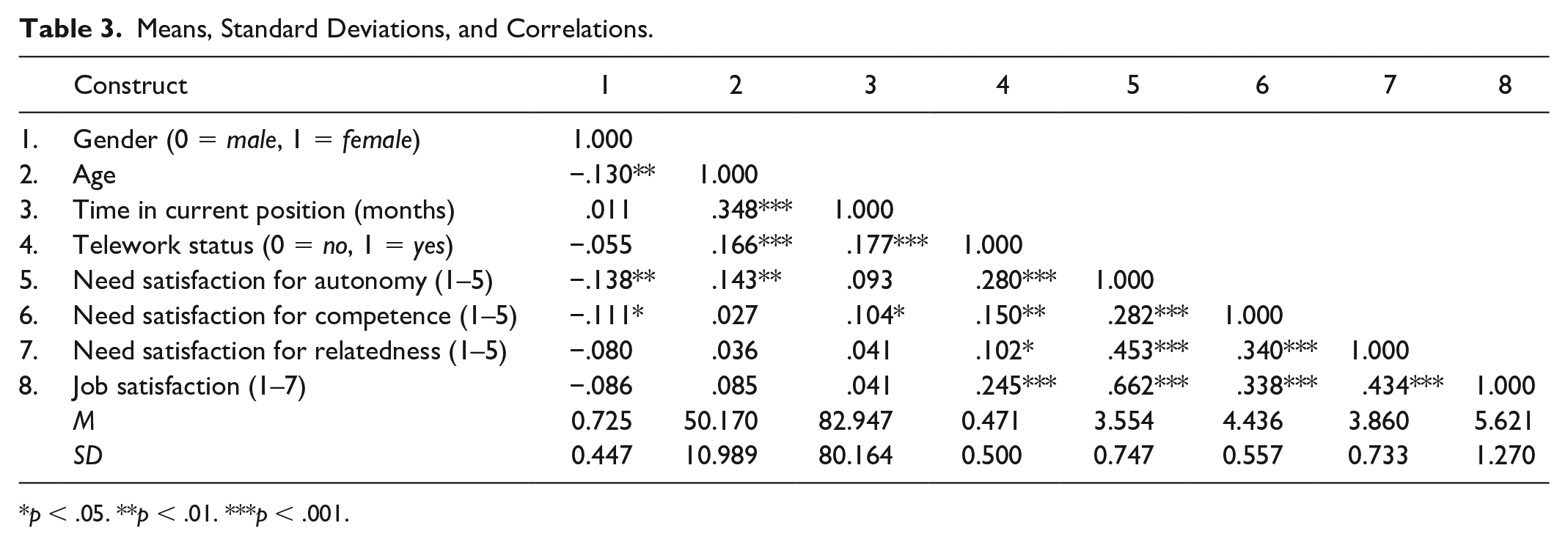
p < .05. **p < .01. ***p < .001.
Test of Hypotheses 1, 2, and 3.

Note. χ2 = 333,611; df = 174; χ2/df = 1.9173; ΔBentler–Bonett = 0.918; CFI = 0.958; IFI = 0.959; GFI = 0.936; AGFI = 0.907; RMSEA = 0.046. CFI = comparative fit index; IFI = incremental fit index; GFI = goodness-of-fit index; AGFI = adjusted goodness-of-fit index; RMSEA = root mean square error of approximation.
**p < .01. ***p < .001.
Although this was not posited as an hypothesis in this research, we first examined the impact of telework on job satisfaction. The result revealed that teleworkers had a higher level of job satisfaction than office workers. This result is consistent with the results of previous studies and met our expectations. We then continued our analyses and tested our hypotheses to improve our understanding of the underlying dynamics.
As Table 4 shows, the results of the statistical analyses indicate that telework is associated with greater satisfaction of the three basic psychological needs of workers. As we expected, teleworkers experience greater satisfaction of their needful autonomy (.234***) and competence (.121***) than office workers do. These results support Hypothesis 1 and Hypothesis 2. The results also suggest that telework better satisfies the need for relatedness (0.110***). This result is significant and it contradicts our hypothesis that there would be a negative correlation. Although more studies are required to gain a better understanding of this unexpected result, we do not believe it discredits SDT, but rather calls for a different interpretation of the often-reported association between telework and social isolation.
Considering that our results indicate that there is a significant relationship between the satisfaction of the psychological need for relatedness and whether or not workers are doing telework, we further investigated the context in which the study was done. Among other factors, we paid more attention to how the teleworkers in this company experience their status as teleworkers and how the organization supports them. In other words, we attempted to better understand their interpersonal relations, so we could then grasp why satisfaction of the need for relatedness was higher in teleworkers than in office workers.
By analyzing the organizational context in more depth, we found that the firm was very aware of the risks of social isolation for teleworkers. Therefore, optional practices were integrated into the telework program to promote social connectedness. Among other things, this organization’s telework program provides resources for teleworkers who wish to organize informal socialization opportunities. For example, sports activities are regularly organized with peers to allow teleworkers to physically meet other people (both teleworkers and office workers) and the costs incurred for these activities are reimbursed. In addition, the company makes use of technologies that enable teleworkers to feel constantly connected to their colleagues, without using these technologies as a mechanism to control employees. For example, an instant messaging system with the function of communicating quickly and easily is available and teleworkers use it regularly to meet their needs. This technology allows teleworkers to continuously keep in touch with members of their work team, even in the absence of physical proximity. This way, they can experience social connectedness while still benefiting from the positive effects of telework. Thus, based on our results, we are inclined to believe that the practices the organization has put in place to counteract the effects of isolation are effective and contribute to satisfying teleworkers’ need for relatedness. Because these practices allow teleworkers to obtain more personalized, flexible responses that meet their own needs in terms of frequency of interactions and intensity of social bonds than the office workers, we consider this result to be coherent with the theory. Consequently, although our results do not support Hypothesis 3, they do not oblige us to reject the theory itself.
Test of Hypothesis 4
Following Arnold (1982) and Qureshi and Compeau (2009), we tested Hypothesis 4 by examining two types of moderation: structural and coefficient difference. Structural moderation is present when a path is significant in one subgroup and not in the other. Coefficient difference moderation is when path coefficients in two subgroups are statistically different based on a pairwise t test. Table 5 summarizes the results of the moderation tests. As we can see, the t test indicated that the path coefficient from office workers and teleworkers for the relationship between satisfaction of the needs for autonomy, competence, and relatedness and job satisfaction are statistically different, supporting our hypothesis that there is a moderation effect (Hypothesis 4). Moreover, the path coefficient of satisfaction of the need for competence and job satisfaction is statistically significant for the office worker group but not for the teleworker group, whereas the path coefficient of satisfaction of the need for relatedness and job satisfaction is not statistically significant for the office worker group but is statistically significant for the teleworker group, indicating structural moderation and also supporting Hypothesis 4.
Test of Hypothesis 4.

Note. χ2 = 651,015; df = 418; χ2/df = 1.5575; ΔBentler–Bonett = 0.845; CFI = 0.936; IFI = 0.938; GFI = 0.889; AGFI=0.840; RMSEA = 0.037. CFI = comparative fit index; IFI = incremental fit index; GFI = goodness-of-fit index; AGFI = adjusted goodness-of-fit index; RMSEA = root mean square error of approximation.
Test of equality of coefficients between two groups.
p < .05. **p < .01. ***p < .001.
To illustrate these moderating effects, we used the procedure suggested by Sharma et al. (1981; Sewell & Taskin, 2015) and did a subgroup analysis. Graphs comparing the linear regressions for the two groups are presented in Figure 1. As we can see, and in accordance with the results obtained, there are substantial differences between the two groups as a function of telework, illustrating the moderation effect and supporting Hypothesis 4.

Moderating effect of teleworking.
Discussion and Conclusion
Teleworkers Are More Satisfied Than Office Workers
The purpose of this study was to investigate how teleworking impacts employees’ experiences at work. Based on SDT, we first assessed the difference between teleworkers and office workers in terms of the satisfaction of their basic psychological needs for autonomy, competence, and relatedness. Our results indicated that teleworkers experienced more satisfaction of each of these three psychological needs and were generally more satisfied with their jobs than office workers.
This conclusion provides evidence for organizations that wish to deploy effective strategies to attract and retain staff. Based on the results of this study, we can state that implementing a telework program is a good way of creating a climate that promotes greater worker satisfaction. This kind of program makes it easier to meet workers’ basic psychological needs and thus to give them arrangements that will promote greater job satisfaction.
In this regard, one of the most interesting (and unexpected) results of our study is the positive association between the need for relatedness and telework. Note that, as mentioned in our literature review, although it is generally accepted that social isolation is one of the greatest risks of telework, earlier studies were not conclusive on this topic (Allen et al., 2015; Golden et al., 2008). Although we must continue our research to validate our results, they may explain this gap in the literature. Based on SDT, we can see that, if organizations like the one in this study give teleworkers opportunities to adequately meet their psychological need for relatedness, it can in turn benefit job satisfaction. In other words, this result tends to support the idea that it is possible to set up management practices that will counteract the supposed harmful effects of telework. Thus, SDT provides a relevant, appropriate frame of reference for understanding this dynamic.
Teleworkers and Office Workers Are Satisfied in Different Ways
Perhaps the most valuable contribution of this study is the evidence that satisfaction of psychological needs does not contribute to teleworkers’ and office workers’ job satisfaction in the same way. We assessed the moderating effect of telework on the relationship between the satisfaction of workers’ psychological needs (i.e., autonomy, competence, and relatedness) and job satisfaction. Our results support the existence of such a moderating effect.
Specifically, our results indicate that satisfaction of the psychological need for autonomy has a positive impact on job satisfaction for both teleworkers and office workers. Nevertheless, the effect is significantly greater for office workers than for teleworkers, indicating that, regardless of how work is organized, it is appropriate to implement management practices that will foster workers’ feelings of autonomy. However, the contribution of these practices will be greater for office workers than for teleworkers.
Our results also indicate that satisfying workers’ need for competence had a significant positive effect only for office workers, whereas meeting the need for relatedness had a significant positive effect only for teleworkers. These results are particularly interesting because they tend to support the idea that teleworkers’ experience is truly different from that of colocated workers. Based on this finding, it would be most effective to focus on implementing management practices that aim to satisfy the need for competence in office workers and, conversely, the need for relatedness in teleworkers. These two different contexts demand different levers; organizations will need to take this into consideration when designing practices to support employees in the COVID and post-COVID eras as the hybrid working model (office work combined with telework) will most likely become the norm.
Limitations and Future Directions
This study was an introductory study and one of the first to leverage SDT in the context of telework. The results must be considered as such. Thus, certain limitations of this study must be taken into account.
First of all, the nature of the study means that the results cannot be generalized. In fact, our sample may not represent all teleworkers or all office workers. Recall that this study was conducted with a sample comprising employees from only one Canadian IT consulting firm. Replicating the study in different contexts by extending the geographic scope, seeking samples from many other organizations, and involving more work contexts will improve the external validity of our results. With this aim in mind, future research must be undertaken to explore these possibilities.
In addition, it is important to remember that the methodology used in this study may have generated certain biases that must be considered when interpreting the results. For example, the fact that we collected our data by means of a self-report online questionnaire may have introduced a certain bias. In short, it would be interesting to carry out a study using other data collection methods to verify the validity of these results.
Finally, we encourage future researchers to investigate in depth how teleworking impacts employees’ experience at work. Despite the limitations of our study, there is evidence that this research avenue is a promising one that will allow us to make new discoveries in our quest for knowledge concerning the impact of teleworking. Specifically, we believe that further studies should be conducted to better understand the mechanisms behind other work outcomes, such as performance, collaboration, and innovation. The last two are particularly interesting as they are often cited by organizations as reasons why they choose to bring employees back into the office. If we can gain a better understanding of the factors that contribute to collaboration and innovation in teleworking environments, then this information could be used by organizations to improve performance.
Footnotes
Declaration of Conflicting Interests
The author(s) declared no potential conflicts of interest with respect to the research, authorship, and/or publication of this article.
Funding
The author(s) received no financial support for the research, authorship, and/or publication of this article.
