




Abstract
Entrepreneurship benefits economic development and innovation, and provides competitive advantages. Thus, entrepreneurship issues have received widespread attention from both academia and governments. However, there is relatively scarce research on the issues or topics that concern most people when talking about entrepreneurship on social media platforms. This study explores global entrepreneurship issues on Twitter. It adopts a text-mining technique followed by a social network analysis to analyze global, real-time longitudinal, and qualitative data from Twitter using 138,089 tweets related to entrepreneurship from 28,592 Twitter users. We observe that the startup phase is the most critical issue when talking about entrepreneurship because most people are interested in acquiring information on how to start a new venture. We also find that busy entrepreneurs prefer obtaining tips to help them work smart. Finally, the four most discussed topics are starting a business, success tips, startup, and team building. The research period is not long enough and all samples in the study are from Twitter Although they are representative, future research can improve the academic and practical implications with extended data collection periods and cross-platforms.
Plain language summary
This study investigates how practitioners discussed entrepreneurship on Twitter. Text-mining is used to generate entrepreneurship topics in this work. The study employed a qualitative method. This study observes that the startup phase is the most critical issue when talking about entrepreneurship.
Introduction
Entrepreneurs can contribute to decreasing unemployment rate, creating wealth, and enhancing competitiveness, innovation, and economic development. Entrepreneurship issues have received widespread attention from both academia and governments (Baron, 1998). The existing literature on entrepreneurship focuses on examining entrepreneur’s personality traits (Antoncic et al., 2015; Hossain et al., 2021), exploring entrepreneurial cognitions (Grégoire et al., 2011), analyzing entrepreneurship action (García-Morales et al., 2020; Narayanan et al., 2021) and social media (Hsieh & Wu, 2019), and studying entrepreneurial processes (Alsos et al., 2016; Gartner & Carter, 2003; Keh et al., 2002).
Entrepreneurial behavior is mostly determined by entrepreneurial intention, which is positively associated with entrepreneurial knowledge (Majid et al., 2020). Entrepreneurship education stimulates the entrepreneurial intention and develops entrepreneurial knowledge of college students (Vincett & Farlow, 2008). Social media is also suggested to effectively trigger entrepreneurial intention among the young generation (Majid et al., 2020). It provides an interactive platform for people to create, share, and exchange information through online interaction (Ibrahim et al., 2017). Twitter, one of the most popular social media platforms, provides real-time data for users to express their opinions and ideas, thus serving as a well-suited source for opinion mining and sentiment popularity detection (Ibrahim et al., 2017; Saura et al., 2018). Due to its openness and connectivity, Twitter has been employed by entrepreneurs to obtain information and manage their business activities (Olanrewaju et al., 2020). The significance of social media in entrepreneurship has achieved considerable attention from academics. However, most studies either explore the adoption and utilization of social media by entrepreneurs or investigate the antecedents or outcomes of social media application on entrepreneurship (Majid et al., 2020; Olanrewaju et al., 2020). Relatively scarce research exists on the issues or topics that concern most people when talking about entrepreneurship on social media platforms.
Most researchers have employed either cross-sectional (Alsos et al., 2016; Antoncic et al., 2015; Koe Hwee Nga & Shamuganathan, 2010) or longitudinal methodologies (Clarysse & Moray, 2004) to investigate entrepreneurship. Additionally, their studies were region-specific (Lafuente et al., 2007) or country-specific (Clarysse & Moray, 2004). The unavailability of data and the sample size and source restrictions reduce research generalizability. For valuable insights into entrepreneurship, it is crucial to utilize global, real-time longitudinal and qualitative data to procure user-generated content and reveal issues of public concern and how they are discussed.
Despite intensive and prolific literature on entrepreneurship, most studies have concentrated on entrepreneur-related themes from an entrepreneur’s perspective. Few have aimed to uncover entrepreneurial issues that are of public concern. The following research questions exist: What are people talking about when they refer to entrepreneurship issues? What topics are people concerned about when they intend to start new ventures? By addressing these important questions, this study attempts to bridge the research gap and enrich the literature by adopting a public-based viewpoint. Gartner (1990) suggests that researchers need to outline themes that define the major issues faced by practitioners.
Why do individuals share and discuss entrepreneurship topics on social media? Self-determination theory (SDT) explains that individuals can be independently motivated or controlled (Adeel et al., 2023). When they are self-motivated, they engage in activities based on personal inclinations. Knowledge sharing is a voluntary and proactive behavior. Members with higher self-efficacy believe that their knowledge can enable them to solve problems or generate meaningful impact to benefit the community (Cai et al., 2024). Based on SDT, this study adopts a qualitative method followed by a social network analysis (SNA) to explore the entrepreneurship topics posted by practitioners on Twitter.
This study involves Twitter users to discuss entrepreneurship issues for various reasons. First, Twitter has been the most widely used social media platform among startups and investors in the past few years, where users have created a large, unprecedented amount of publicly available text (Gloor et al., 2020), which makes investigating new research questions possible, such as analysis and estimation of public opinion on social behavior and various topics (Gaikar et al., 2015). Second, compared with other social media, Twitter facilitates the expression of personality and ideas, the ability to reveal the thoughts and opinions of others, and has a stronger social, economic, and political connotation (Barrera Verdugo & Villarroel, 2021). Third, Twitter data are provided in longitudinal format. Most quantitative studies on entrepreneurship rely on cross-sectional data, which can potentially lead to recall bias and limit causal inference (Fisch & Block, 2021). Finally, combining Twitter data with big data analysis can provide new insights into research questions.
This study builds on previous entrepreneurship-related studies and makes three primary contributions. First, it employs a public-based perspective to explore the topics that are of interest to the public. By delving into such topics, academics, practitioners, and policymakers can seize the key points of successful entrepreneurship. Academics also can design better entrepreneurship education to increase students’ entrepreneurial knowledge and evoke their entrepreneurial intention. Practitioners can obtain information about new entrepreneurial ideas to develop more appropriate and successful business strategies to improve their firm performance. Second, the research employs global, real-time longitudinal, qualitative data from Twitter to analyze user-generated content, which enhances our comprehension of entrepreneurship. Third, the results can help policymakers propose action plans to cultivate or attract entrepreneurial talent. Consequently, academics, practitioners, and policymakers can understand the current state of global entrepreneurship and thus plan their future research directions. This study briefly reviews the literature on SDT and entrepreneurship. Then, it delineates the research methodology and presents the results of the content analysis. Finally, it concludes with a discussion of the findings.
Literature Review
Practitioner–Academic Divergence
Practitioner-academic divergence is not new. Practitioners often do not need academic research, as they develop their resources from practical experiences, often inapplicable to rigorous theoretical frameworks from academia (Massaro et al., 2021). Nevertheless, they follow real-life developments in technology, business models, and trends. Researchers rarely seek inspiration from practitioners for setting research questions or interpreting their results (Shepherd & Gruber, 2021). As a grand theory is formed based on high generality, it reflects thoughts generated through abstract thinking about ideas and relationships rather than from empirical research (Secinaro et al., 2022).
Scholars are criticized for conducting research that contributes little to practice without considering practitioners’ perspectives (Dal Mas, 2019). Academic research is now in an open information environment where international or industrial boundaries are increasingly blurred. However, academic research is often too limited to accommodate the development of business stakeholders, leading to ongoing criticism of academic research (Violante & Vezzetti, 2017). Part of this issue arises from the divergence between the abstraction and theoretical biases of academic research and the practical needs of the business world. By contrast, practitioners create new knowledge conducive to solving institutional problems but are not interested in disseminating this knowledge as it may jeopardize their competitive advantage.
Some contributors advocate for a deeper understanding of practitioners’ perspectives to bridge the gap. Studies have emphasized the importance of comparing scholar and practitioner viewpoints; the former aims for solid framework models, while the latter experiences practical solutions firsthand in real-life scenarios and can gage the tangible and intangible outcomes (Secinaro et al., 2022). Scholars interested in conducting research related to entrepreneurship would benefit from understanding the key differences among practitioner subgroups as a starting point (Carlson & Jennings, 2024). The sources from practitioners can help individuals find new results in the ever-growing research themes. The development of new tools, such as blogs and social media, has provided scholars with new sources to gather ideas, test, and develop new theories (Dal Mas, 2019).
Self-Determination Theory and Knowledge-Sharing Intentions
SDT explores the driving mechanisms of individual behavior from the perspective of motivation, focusing on the degree of autonomy and self-determination exhibited in human behavior (Vansteenkiste et al., 2010). Throughout individual development, one’s self-determination and decision are crucial. Deci and Ryan (2008) showed a positive correlation between autonomy, competence, and sense of belonging on social media and the willingness to share work. It can be attributed to the social environment facilitating the satisfaction of individuals’ needs for autonomy, competence, and a sense of belonging (Song et al., 2023). When individuals’ psychological needs are met, they are more likely to show proactive behavioral intentions (Coun et al., 2019). Psychological safety provides a safe atmosphere where practitioners can freely express ideas and viewpoints without worrying about resulting negative experiences. In pursuit of the value and goals of innovative activities, practitioners are more willing to share knowledge to bridge their knowledge gaps and seek creative problem-solving solutions. At this point, the pleasure and satisfaction derived from knowledge sharing can increase the willingness to share knowledge.
Activities Engaged in the Entrepreneurial Process
Gieure et al. (2020) indicated that entrepreneurs engage in various essential tasks in the entrepreneurial process, including generating ideas for new products/services, recognizing business opportunities related to the ideas, obtaining the resources needed to launch a new venture, making decisions, and formulating appropriate business strategies. The activities undertaken by entrepreneurs in the entrepreneurial process are associated with their cognition and behavior (Baron, 1998). Therefore, cognitive and behavioral variables as well as the entrepreneurial process are of interest to entrepreneurship researchers and are examined intensively in the literature.
Psychological characteristics are a central underpinning of entrepreneurship. However, what drives an individual to become an entrepreneur remains unclear. Numerous scholars have endeavored to explore the psychological determinants of entrepreneurial decisions. The results indicate that some personality traits, for example, extraversion, openness, consciousness, agreeableness, emotional stability, risk propensity, and neuroticism, are associated with entrepreneurship (Postigo et al., 2021). Specifically, extraversion does not affect the tendency of women to become social entrepreneurs, whereas conscientiousness and openness positively influence their social entrepreneurship start-up intention (Hossain et al., 2021).
Furthermore, some researchers investigated the relationship between cognitive process and entrepreneurship. Baron (1998) proposed several cognitive mechanisms (e.g., counterfactual thinking, affect infusion, attributional style, the planning fallacy, and self-justification) and delineated each mechanism’s impacts on an entrepreneur’s thinking. Narayanan et al. (2021) and Mitchell et al. (2007) illustrated the critical contributions of the entrepreneurial cognition research stream on the entrepreneurship literature development and on understanding entrepreneurship-related phenomena. Grégoire et al. (2011) employed a systematic approach to discover the conceptual foundations of entrepreneurship cognitive research and proposed concrete strategies and an agenda for future research.
Researchers also investigated the process of entrepreneurial venture creation. Keh et al. (2002) examined how entrepreneurs recognize and evaluate opportunity under risky situations. Their results indicated that the illusion of control and belief in the law of small numbers are related to how entrepreneurs evaluate opportunities. Clarysse and Moray (2004) and Gartner and Carter (2003) emphasized organization formation and evolution processes during the startup phase. Koumbarakis et al. (2021) utilized the regulatory focus theory to study the process of firm birth and firm abandonment. Moreover, Lindblom et al. (2020) explored the entrepreneurial exit process.
Twitter and Entrepreneurship
User-generated content is important for entrepreneurs to express themselves and communicate with others online (Saura et al., 2019; Smith et al., 2017). Social networks may help entrepreneurs obtain both tangible and intangible resources. Using a machine learning model based on 1.5 billion tweets from 5.25 million users to estimate the relationship between the Big Five personality traits and entrepreneurship, Obschonka et al. (2020) found that the Big Five personality traits are positively correlated with entrepreneurship rate. Naudin and Patel (2019) conducted an online ethnographic survey on the Twitter activities of six female entrepreneurs and argued that online platforms are an important space for self-employed cultural workers and femininity is intertwined with entrepreneurial spirit within this context. Meanwhile, Gloor et al. (2020) examined the impact of board member composition and board members’ social media presence on startup performance and discovered that startups whose board members are active on Twitter attract additional funding over the years despite not generating additional sales.
Using software such as Linguistic Inquiry and Word Count via digital footprints to gain insights into the personality of superstar entrepreneurs and managers, Obschonka et al. (2017) found that superstar managers are more entrepreneurial than superstar entrepreneurs in many personality traits. Similarly, Fisch and Block (2021) assessed how digital identities of entrepreneurs on Twitter change with entrepreneurial failure based on a sample of 760 entrepreneurs who experienced failure using a similar approach. According to their exploratory study’s results, the financial, social, and psychological consequences of failure are reflected in these entrepreneurs’ tweets, causing them to change their digital identities.
Topic Modeling in Entrepreneurship
Chandra et al. (2016) employed topic modeling to analyze the strategies used by 2,334 social entrepreneurs. They found that social entrepreneurs adopt 39 change-making strategies, which can be classified into individual empowerment, collective action, system reform, physical capital development, evidence-based practices, and prototype design. Utilizing topic modeling to explore the themes or topics in corporate social responsibility-related conversations within the Twittersphere, Kao and Luarn (2020) extracted four dimensions (social strategy, impact, business, and people) and six indicators (social, opportunity, change, enterprise, network and team) to establish a conceptual framework for the development of social enterprises. These topics are also visualized by SNA and word clouds. Moreover, Chae and Park (2018) adopted the approach of topic modeling, SNA, and word cloud to study corporate strategy and identified 30 topic groups included in the corporate strategy.
Williamson et al. (2021) applied latent Dirichlet allocation (LDA) to investigate the impact of gender on prosocial crowdfunding. The results showed that men’s campaigns were more advantageous than women’s and they were associated with faster funding. Employing a mixed-methods approach using topic modeling and thematic analysis, Hayduck and Newland (2020) revealed that male sport entrepreneurs tend to send more strong sport-related signals to investors to enhance credibility in their biographies and thereby receive more funds than their female counterparts. H. Yuan et al. (2016) explored the determinants of crowdfunding success by developing a domain-constraint latent Dirichlet allocation (DC-LDA) topic model to extract effective topical features from project texts. The results demonstrated that the topical features mined from project descriptions were useful in predicting fundraising success.
However, these studies rarely examine people’s views on entrepreneurship from a global perspective. Hence, this study aims to employ techniques such as text analysis to identify global entrepreneurship issues on Twitter and examine the key topics mentioned at the beginning of this study.
Methodology
Rapid developments in mobile network technologies now allow users to create and share ideas, views, and experiences at any time and place. Browsing through content on Facebook, Twitter, Weibo, or other forms of social media has become one of the focal points of users’ everyday lives. The importance of social media, and the attention it has garnered, has been widely studied by the scientific community, as its growth appears unstoppable (Lahuerta-Otero & Cordero-Gutiérrez, 2016). For example, van Zoonen et al. (2016) studied 433 employees from different organizations and analyzed the manner in which they used Twitter to discuss work-related matters. They found that the topics of discussion among these employees mainly centered on professions, organizations, and work behaviors. Lin et al. (2016) compared Weibo and Twitter users in their forwarding or sharing behaviors related to extreme weather events. They showed that most of the forwarded messages contained useful information, reflecting the uncertainty of extreme weather events.
Twitter is highly popular among Internet users. The service currently has approximately 192 million daily active users, with 80% living outside the United States (Twitter, 2021). The micro-blogging service provided by Twitter allows users to update their status with messages of up to 140 characters, also known as tweets. Twitter is a collection of interests, and users may select topics they are interested in and participate in discussions. Most users publicize their tweets, allowing researchers to obtain and store information with minimal difficulty and cost.
Data Collection
To collect data, this study applied to Twitter for API keys. It then used the BirdIQ tool developed by Data Pipeline for data collection. This tool provides researchers with comprehensive information, including tweets, date of tweet creation, number of retweets, and information on tweet authors. Figure 1 shows the process of acquiring, processing, and analyzing data from Twitter. First, the search term #entrepreneurship was used to collect tweets. Hashtags are used in social network posts to group individual posts. Using the # symbol in a tweet converts any word or phrase into a searchable link. This action helps organize post contents based on keywords and helps monitor discussion topics. To circumvent the effects of Twitter’s restriction on the number of crawl requests, this study excluded the retweets of each post to acquire a wider range of tweets. From February 8, 2017 to April 30, 2017, this study collected 154,494 tweets. Second, duplicated tweets were removed based on their posting times, reducing the number of tweets in the database to 138,089 entries. Third, in each tweet, a user often hashtags several words, such as #marketing, #entrepreneurship, and #entrepreneurs. To expand the scope of this study, each tweet was divided into text and hashtags for analysis. Finally, this study processed and transformed text and hashtags separately to remove numbers, links, stop words, and symbols to render the data analyzable.

Research process.
The data collection time might somewhat influence the results of a study, but it is not the most critical determinant of research validity or credibility. Despite the short data collection period, this study gathered 138,089 tweets about entrepreneurship from 28,592 Twitter users. It allowed us to obtain global, longitudinal, and qualitative data to acquire user-generated content and reveal the themes people are concerned about and how they discuss them. While research topics evolve and diversify over time, the essence of entrepreneurship remains the same. For example, Duan (2023) explored the thematic evolution of business models in the sharing economy business model after COVID-19. While research topics evolve and diversify over time, sharing economy, business model innovation, Airbnb, and business models remained the four main research topics throughout the study period.
Text Analysis
This study adopts Rstudio, HTML5, and NetDraw to analyze texts from tweets. LDA of Rstudio is used to perform text and cluster analyses. The topic modeling approaches include latent semantic analysis (LSA), probabilistic latent semantic analysis (pLSA) and LDA. LSA analyzes relationships between terms and the words in the terms as well as a set of documents and the terms in the documents. pLSA has additional probability consideration. However, pLSA could result in overfitting. Thus, implementing LDA based on pLSA with Bayer’s theorem is an applicable approach for topic modeling. LDA assumes that each document consists of several topical themes and thus, an article is a blend of many topics. LDA is a new generation of mixed-membership model. It breaks the limitations of classical mixture models, which assume that each document exhibits only one topic and common latent words and topics across documents can be detected. LDA allows words to belong to multiple topics in the specific context of their occurrence. This characteristic has a noted benefit in modern topic modeling procedures (Hayduck & Newland, 2020). Because LDA uses unsupervised machine learning for topic modeling, it could reduce researcher bias when identifying themes but still allow topic assignment of researchers (Dyer et al., 2017).
Word cloud intuitively use word’s size and color depth to present frequencies, facilitating the capture of core vocabulary of each topic (Obschonka et al., 2020). HTML5 can build a world cloud of the most frequently used words in the analysis. Constructing network visualization helps understand how different topics are related to each other, including hashtags and topic groups (Chae & Park, 2018). NetDraw is a software package for the analysis of social network data (C.-H. Yuan et al., 2019). Table 1 presents classification techniques used in this study. Descriptive statistics allow us to determine the relevance of entrepreneurship to people (Kao & Luarn, 2020). Hashtags are employed to index and classify contents. Hashtags can also be used for building community and discourse space for users to express their values and gain recognition from other users. Lastly, text analysis classifies users’ tweets and learns about changes in these classifications (Tiba et al., 2019).
Classification framework.

Among 138,089 tweets, the average number of retweets and tweets favorited by others are 0.722 and 1.479, respectively. These tweets were sent from 28,592 unique accounts. Of the nearly 30,000 users, 76.7% were identified from 172 countries, among which, 60 countries had 20 or more users. Top 20 countries are United States (36.0%) United Kingdom (8.3%), India (5.5%), Canada (5.4%), South Africa (2.2%), Australia (2.0%), France (1.1%), Nigeria (1.0%), Japan (1.0%), Germany (0.9%) Spain (0.8%), Netherlands (0.6%), United Arab Emirates (0.6%) Pakistan (0.5), Belgium (0.5%) Switzerland (0.5%), Kenya (0.5%), Ireland (0.5%), Singapore (0.4%), and Finland (0.4%). Each of these accounts sent 4.82 tweets related to entrepreneurship in the study period. The oldest account was created 11 years ago, and the average account age is 4.678 years (std. = 2.820). Male and female users comprise 16.28% and 9.10% of the recognizable usernames, respectively, whereas the remaining accounts are corporate or anonymous. Each account has an average of 4,957 followers. Table 2 shows the descriptive statistics of Twitter users.
Descriptive statistics for sample.

Result
Tweet Frequency
Figure 2 shows daily tweet activity during the study period. According to the results, the top 3 days for posts are February 21 (2,731 counts), April 25 (2,696 counts), and February 16 (2,593 counts). Mostly, summary counts per day are between 1,500 and 2,500. Seven days (2/21, 4/25, 2/16, 4/26, 4/20, 4/19, and 4/5) have >2,500 tweets. Tweet activity is highest on Wednesday or Thursday.

Daily tweets activity.
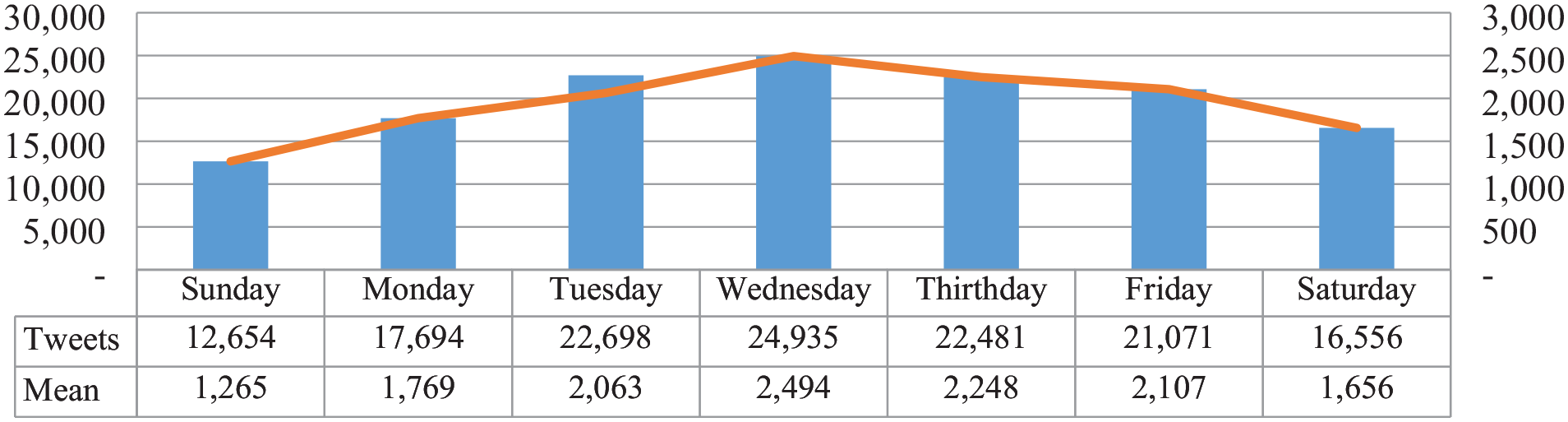
Figure 3 shows a visualization of tweet activity. The most weekly summary counts are Wednesday (average of 2,494 counts), Thursday (2,248 counts), and Friday (2,107 counts). Relatively few tweets are posted on weekends. The results indicate concern about the issues of entrepreneurship on working days, which is consistent with the findings presented in Figure 2.
Weekly tweets activity.
Hashtag Analysis
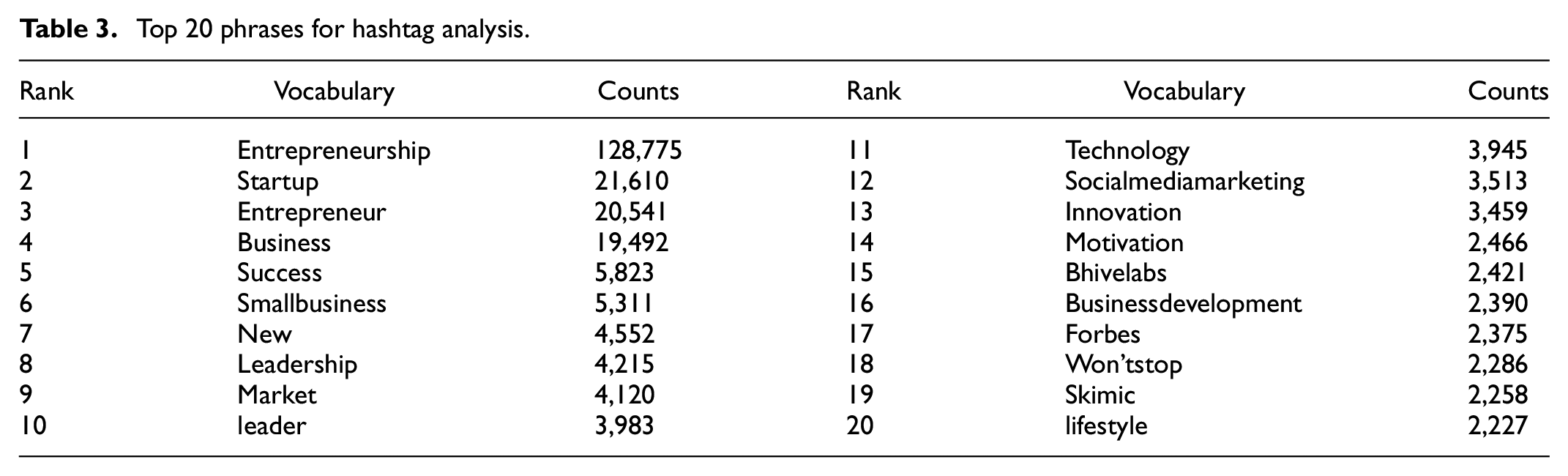
Table 3 shows the top 20 referred hashtags in tweets. Entrepreneurship is the most hashtagged phrase, followed by startup and entrepreneur. The results indicate that startup is the issue of greatest concern when discussing entrepreneurship. Gartner and Carter (2003) proposed that only successful entrepreneurs are reported, and scarce information is offered about why some entrepreneurs fail at the startup stage. Our findings suggest that most people are interested in acquiring information on starting a new venture rather than how to succeed at it. However, past studies or reports provided no clear processes and sufficient information (Bann, 2009).
Top 20 phrases for hashtag analysis.
After removing entrepreneurship, the other hashtag entities are further analyzed using word clouds. This study creates word clouds from the dialog of each user’s tweets to illustrate the results of entrepreneurship issues. This enables us to gather insight into word frequency trends and depict the changes in entrepreneurship hashtags over time. Figure 4 shows the interaction in February–March and April. The word clouds during February–March reveal that the five most frequently referred terms were “busy” (14,152 counts), “startup” (12,598 counts), “entrepreneur” (11,923 counts), “success” (4,008 counts), and “new” (2,814 counts). The word clouds in April reveal that the five most frequently mentioned terms were startup (8,908 counts), entrepreneur (5,318 counts), business (5,300 counts), lifestyle (2,096 counts), and “won’tstop” (2,056 counts). The two-word clouds reveal that entrepreneurship issues have changed over time.

Word cloud for hashtag analysis. (a) Hashtag in February–March. (b) Hashtag in April.
Figure 5 shows the SNA results. The figure represents networking relationship among hashtags. “Startup” and “entrepreneurship” are core keywords of entrepreneurship hashtags in SNA. Startup is frequently associated with the hashtag entities of “entrepreneur,”“business,”“success,”“won’tstop” and “socialmediamarket.”“Success,”“businessdevelop,”“wealth,”“lifestyle,”“soicalmediamarket,”“motivation,” and “news” are frequently networked with “entrepreneur.”“Business” is closely related to “social media,”“smallbusiness,” and “success.”

SNA for hashtags.
Text Analysis
Table 4 shows the top 20 vocabulary for text in tweets. Among them, “busy” is the most frequently referred vocabulary word, followed by “entrepreneur,”“success,” and “make.” The results indicate that “busy” is the issue of greatest concern when discussing entrepreneurship. For example, texts such as “Five ways busy entrepreneurs can keep passion alive,”“11 smart strategies to stay on task during a busy workday,” and “You can’t rush creativity. Are you too busy to be creative?” indicate that busy entrepreneurs would like to acquire some tips for working smart. Topics addressing “make,” mostly focus on “make money” and “make business.”
Top 20 vocabularies for text.

Figure 6 presents the interaction of text in February–March and April. The word cloud results provide more evidence for content that is systematic and more closely related to the relevant issue when examining entrepreneurship tweets. The word clouds during February–March reveal that the five most frequently referred terms were “busy” (8,017 counts), “entrepreneur” (5,195), “success” (3,880 counts), “make” (3,740 counts), and “startup” (3,384 counts). The word clouds in April reveal that the five most frequently mentioned terms were “busy” (3,128 counts), “perspective” (2,049 counts), “entrepreneur” (2,005 counts), “listen” (1,495 counts), and “start” (1,237 counts). The two-word clouds also show that entrepreneurship issues have changed over time.

Word cloud for text analysis. (a) Text in February–March. (b) Text in April.
To facilitate discussion of overarching trends, this study classifies 100 phrases into 20 topic groups with their most representative terms (Appendix Table 1). The title of each topic group is named by the recognition and judgment of the researchers of this study. This study demonstrates two to eight of the most representative words for each topic group and ranks them from most to least representative. Appendix Table 1 and Figure 7 show all the topic groups. The 20 groups are represented by topic, key phrase, and related tweets. The 100 phrases are displayed in a word cloud with different colors, wherein the font sizes and colors represent the topics’ relative prevalence and their appropriate groups. The positions of words are derived from the posterior by dimension reduction. Hence, the proximity of words within the cloud implies the similarity of topics within the clustering. As illustrated in Figure 7, words of the same color tend to stay together, implying that our analysis, which determined words’ locations, is consistent with our domain knowledge, which determined colors.

Word cloud for topic groups.
Jointly, the 20 topic groups portray the entrepreneurship scope. In accordance with the proposition of Baron (1998), the topics discussed the most on Twitter encompass the central tasks involved in the entrepreneurial process, such as generating ideas for new products or services (Creativity), recognizing business opportunities related to the ideas (Innovation and Opportunity creation), obtaining the resources needed for launching a new venture (Crowdfunding, Partner, and Launching), making decisions (Challenge and Stop to plan), and formulating appropriate business strategies (Marketing and Insight).
Among the 20 topic groups, the largest group is “Start business,” which includes key phrases addressing business, start, step, sell, online, and free. For instance, tweets such as “Steps in creating a successful fundraising business” and “8 steps to make things happen now in your business” might imply entrepreneurs’ focus on starting businesses. As interpreted by Kautonen (2008), entrepreneurs are motivated to start business by “pull” or “push” factors. The former refers to positive factors, such as independence, increased earning, and carrying out new ideas, while the latter refers to negative impulses, such as redundancy, a lack of career opportunity, and dissatisfaction with the current job. The second group is “Success Tips,” which consists of key phrases regarding entrepreneur, success, listen, tip, brand, grow, and person. Baron (1998) proposed that entrepreneurs differ from other people, which lead them to recognize opportunities, pursue them, and so on. In addition, such personal traits also differentiate successful entrepreneurs from unsuccessful ones.
The third group is “Startup,” which includes startup, company, founder, CEO, tech, million, invest, and fund. The phrases involved in this group coincide with the business startup behaviors proposed by Gartner and Carter (2003), which include thinking about starting business, investing money in business, developing model for product/service, asking financial institutions or people for funds, and so on. The fourth group is “Team building,” which includes way, build, team, leader, and employee. According to the entrepreneurial process proposed by Baron (1998), entrepreneurs have to acquire essential resources to launch a new venture. Human resource is one of them and thus requires entrepreneurs to possess social skills to effectively interact and communicate with others (e.g., venture capitalists, potential customers, prospective employee). The detailed of the 20 topic groups is displayed in Appendix Table 1 and graphically shown in Figure 7. According to Smilor (1997), an effective entrepreneur should possess the know-how skills (e.g., leading, communicating, listening, and negotiating) to manage change and team-building is an important way to procure know-how skills of the lead entrepreneur. Cardon et al. (2017) proposed that team entrepreneurial passion positively influences the quality of new venture team processes.
Besides the aforementioned topic groups, the other topics (i.e., Entrepreneurship education, Lesson learning, Big dream, Female entrepreneurship, Entrepreneurship daily, and Reason for quitting jobs) are also concerned and discussed by the public on Twitter (e.g., Hayduck and Newland, 2020; Obschonka et al., 2017). Some topics like “Entrepreneurship education” and “Female entrepreneurship” have received considerable attention from the academics and the practitioners (Vincett & Farlow, 2008). Nonetheless, “Entrepreneurship daily,”“Lesson learning,”“Big dream,” and “Reason for quitting jobs” are discussed by people but have attracted less attention in the past.
Discussion
This article focuses on one fundamental but overlooked question in entrepreneurship: what are people talking about when they refer to entrepreneurship? Previous studies on entrepreneurship either adopt a quantitative approach using cross-sectional data to confirm the validity of their research model or employ a qualitative approach by interviewing entrepreneurs to explore entrepreneurship-related issues. This study differentiates from those by using global, real-time longitudinal, qualitative data as well as data mining techniques to analyze tweets on Twitter to explore what issues the public is most concerned with and interested in and how these issues are discussed. The findings of this study contribute to the entrepreneurship literature by revealing what topics of people’s concern have been investigated in the past and what topics remain ignored by academia.
The results of this study are as follows. First, Twitter has the highest trend of posting tweet activity on working days. Second, the startup phase is the most critical issue for most people talking about entrepreneurship. Most people are more interested in acquiring information on how to start a new venture. Third, startups are frequently associated with hashtag entities of entrepreneur and business. Fourth, busy entrepreneurs would like tips to help them work smart. Finally, public opinion on entrepreneurship focuses on starting a business.
Implications for Academics
This study finds that most of the tweets were published on workdays, reaching a peak on Wednesdays, followed by Thursdays and Fridays. People were least active on Twitter on Sundays. Our results are consistent with the study of van Zoonen et al. (2016), which indicates that the Twitter activity of employees peaks on Wednesday and is least active on Sunday.
Employing data mining techniques for tracing the top 20 phrases hashtagged in tweets, the results demonstrate that entrepreneurship is the most referred phrase, followed by startup, and, finally, entrepreneur. Our findings illustrate that startup is the issue of greatest concern when people talk about entrepreneurship. Gartner and Carter (2003) found that a large proportion of nascent entrepreneurs spent time thinking about starting a business rather than defining market opportunity. Additionally, our results imply that most people are more interested in acquiring information on how to start a new venture rather than how to succeed at it. Korunka et al. (2003) argued that entrepreneurs in the startup process had limited and selective use of startup information. These findings are consistent with the results of previous entrepreneurship studies.
After removing entrepreneurship, this study utilizes word clouds to further analyze word frequency trends while also demonstrating the variance in entrepreneurship issues across time period. The findings show that “busy,”“startup,”“entrepreneur,”“success,” and “new” were the top five frequently referred terms during February and March. In April, the top five frequently mentioned terms were “startup,”“entrepreneur,”“business,”“lifestyle,” and “won’tstop.” From the results, this study can perceive the changes in the concerns and interests of people regarding entrepreneurship. Chae and Park (2018) also argued that topics of discussion change over time, which is consistent with this study’s results. However, people are still very much interested in issues of startups and entrepreneurship.
The results of the text analysis show that “busy” is the most frequently referred vocabulary in the top 20 tweets, followed by entrepreneur, success, and make. For example, “Five ways busy entrepreneurs can keep passion alive,”“11 smart strategies to stay on task during a busy workday,” and “You can’t rush creativity. Are you too busy to be creative?” Our findings indicate that “busy” is an issue of greatest concern when people talk about entrepreneurship. Kao and Luarn (2020) found that social enterprises mainly convey values using keywords such as “social, impact, business, community, and enterprise.” In contrast, this study focuses on broader entrepreneurship, thus leading to different research results. According to Chen et al. (2009), passionate entrepreneurs may show strong and positive emotions toward their projects, they cannot stop thinking and talking about their ideas, and are busy mobilizing resources to turn ideas into reality. Furthermore, entrepreneurs might be busy spotting market signals of opportunity and potential change.
The topics of entrepreneurship-related tweets are divided into 20 categories, which seemingly share the same view as existing studies. In the Twittersphere, entrepreneurship-related tweets can be classified into multiple dimensions (Chae & Park, 2018; Kao & Luarn, 2020). Of the top 20 topic groups portraying the entrepreneurship scope, the most important is “Start Business,” which embraces the following key business phrases: start, step, sell, online, freelancer. It is a common perception that entrepreneurship means starting a business. Shabbir and Di Gregorio (1996) proposed that freedom is a critical personal goal for the female entrepreneur. Majid et al. (2020) confirmed the impacts of social media features on the entrepreneurship intentions of college students. To start a business, entrepreneurs also need to obtain some crucial resources, such as education (Vincett & Farlow, 2008; C.-H. Yuan et al., 2023), and human and financial capital (Montgomery et al., 2005).
Practical Implications
Practitioners are on social media for various reasons and purposes crucial to their business activities. We have demonstrated when and how practitioners discuss entrepreneurship on Twitter. It allows us to draw some practical implications from our research for decision-makers at national and international levels. This study can help them understand the issues that practitioners are concerned about, to consequently design and implement tailored plans. In entrepreneurship education, introducing appropriate programs can help motivate young people to actively seek and utilize entrepreneurial opportunities. Supporting independent entrepreneurship and establishing youth entrepreneurship empowerment centers can provide young people with one-stop specialized services. Programs also include building resource matching platforms, organizing youth participation in various entrepreneurial activities, combining entrepreneurial activities with local features, and providing channels for matching projects with resource, technology, and market.
Talent competitiveness, a key element of competitiveness, innovation, and geopolitical soft power, will become increasingly important. The competition for international talent will also intensify. In international entrepreneurship, governments can gather international talents and outstanding entrepreneurs to explore essential issues, such as entrepreneurial environment, entrepreneurial opportunities, and international talent development, and further discover the positive effect of international talents on promoting the continuous improvement of innovation levels. The government can also provide international young entrepreneurial talents with appropriate services, such as optimizing local policies to attract international talents needed for local industrial development, strengthening the attractiveness of high-tech and emerging industries to relevant international students, and establishing cross-departmental cooperation mechanisms to ensure plan implementation.
The results of this study have important practical implications, revealing topics of concern to practitioners and their relationships. Therefore, based on text mining, entrepreneurs will be able to pre-formulate a risk-minimization framework to increase the chance of entrepreneurial success. Practitioners can also design entrepreneurship training courses and business counseling frameworks based on the results of this study. Business partners and development organizations are more important sources of support for firms in developing countries than those in developed countries when facing problems at different stages, such as start up (Kautonen & Welter, 2005).
Limitations and Future Research
This study is preliminarily exploratory research on entrepreneurship based on public perspective. Our study has several potential limitations. First, it employs only Twitter rather than other social media for data collection. Future research can utilize other social media, for example, Facebook and Instagram. Second, Twitter has a daily download limit of tweets, which restricts us from obtaining complete data. Future research can employ multiple social media platforms to ensure the findings’ generalizability and increase the external validity of the research. Fourth, the time period for data collection is only 2.5 months. Future research can prolong the data collection period to amplify sample sizes. Fifth, the data aging might limit the inferences of the study. Future research can compare research results of the post-pandemic era with this study to offer a more comprehensive discussion. Additionally, our study reveals one critical but neglected issue (i.e., startup); future research can be conducted to explore the important factors associated with this phase to satisfy the public’s curiosity and interest in this issue. COVID-19 also contributed to the development of some of the research topics, such as digital entrepreneurship, entrepreneurial tendencies, and open innovation. To enrich academic development, scholars can also examine the impact of COVID-19 on various topics.
Conclusion
Research on entrepreneurial practice is crucial for both practitioners and scholars. If entrepreneurship scholarship is to be valuable and relevant, we must strive not only to explain entrepreneurial behavior, but also provide practitioners with recommendations for appropriate action. Unfortunately, to date, entrepreneurship scholars have provided little managerial guidance on how to address the challenges posed by entrepreneurship. In addition, practitioners face many challenges as a result of escalating ideological and geopolitical tensions. The study findings help both academics and practitioners to have a better comprehension of what people talk about and are concerned with when talking about entrepreneurship. By utilizing a text-mining approach to analyze 138,089 tweets regarding entrepreneurship from 28,592 Twitter users, this study collected global, longitudinal, and qualitative data to obtain user-generated content and revealed what topics concern people and how they are discussed. Such information can help academics discover new research questions or design adequate entrepreneurship education programs to enhance students’ entrepreneurial knowledge and intention. Additionally, the information can provide practitioners with valuable insights into entrepreneurship to develop and implement appropriate strategies for their businesses.
Footnotes
Appendix
Topic groups for text.

| Topics | Keywords | Examples |
|---|---|---|
| Start business | business, start, step, sell, online, free | 1. How to start an online business from scratch, step by step #entrepreneurship 2. Are you planning to start your own business? Free information session on #entrepreneurship on 7 March |
| Success Tips | entrepreneur, success, listen, tip, brand, grow, person | 1. Kesbutters: Here are my seven tips for becoming a successful entrepreneur: … #entrepreneurship 2. Effective tips to have a successful business! Listen. #marketing #entrepreneurship #blog |
| Stop to plan | make, money, plan, time, take, stop | 1. Avoid unnecessary spending & plan for your money before and even after receiving it. #business #entrepreneurship 2. #Entrepreneurship how to make money with a podcast—for podcasting to pay off—have a plan to be different a. |
| Startup | startup, company, founder, CEO, tech, million, invest, fund | 1. The five most important qualities of startup tech company entrepreneurs #entrepreneurship 2. Ten tips to secure investment in your event tech company: good for any startup! #entrepreneurship |
| Entrepreneurship education | great, day, today, talk, student, read, check, book | 1. Great talk today by @davidjbell @Aru_BusinessSch—students already feeding back to me how it has re-energized the. 2. Thanks for the follow-back, @jessajoss! Great hearing you share your ideas about #entrepreneurship with @OCAD students the other day! |
| Partner | work, thing, people, good, love, find, job | 1. I always love presenting there. Staff is wonderful to work with. I always leave feeling more energized. #entrepreneurship 2. “Work on stuff you love with people you respect.”—Kim Polese, Silicon Valley entrepreneur #entrepreneurship #womenintech |
| Team building | way, build, team, leader, employee | 1. #Entrepreneurship why building relationships with your employees is better than just managing them 2. Building a team that cares is important in #entrepreneurship. Here are five ways to do that via @Forbes |
| Lesson learning | learn, lesson, import | 1. Ten important career lessons most people learn too late in life #entrepreneurship #leadership 2. #Entrepreneurship five important business lessons you can learn from billionaire Oprah Winfrey |
| Crowdfunding | market, strategy, video, social | 1. Fifty video marketing stats to help you create a winning social media strategy in 2017 2. Seven secrets for a successful video marketing strategy #entrepreneurship |
| Creativity | idea, top, follow, question | 1. #Entrepreneurship top tips for the perfect elevator pitch—the question is, how many elevator pitches should a… 2. The first questions to ask yourself when you have that bigidea |
| Big dream | life, live, year, big, dream, give, back | 1. Do you live your life as an aspiring entrepreneur should? #entrepreneurship #smallbiz 2. National #entrepreneurship week helps small businesses reach their big dreams |
| Innovation | entrepreneurship, innovation, key, growth, create, opportunity, join, discuss | 1. Innovation is the key to #entrepreneurship. You can’t remain stagnant. You need to keep evolving. 2. Innovation, ecosystem support key to startup growth, job creation. |
| Opportunity creation | create, opportunity, join, discuss | 1. Opportunities don’t happen. You create them. 2. Seven New Opportunities Virtual Reality May Create |
| Marketing | product, custom, manage, sale, secret, develop, app | 1. Donít build your product without knowing your customers first #entrepreneurship 2. The secret weapon to producing huge sales. #business #socialmedia #entrepreneurship |
| Insight | world, change, meet, future, share, strategy | 1. “Belief has the power to change your inner state and your outer world.”—John Paul warren #leadership #motivation #entrepreneurship #mindset |
| Female entrepreneurship | share, women, inspiration, story | 1. Great stories shared at “women founders: be the ceo of your own life” at the office #Luxembourg #entrepreneurship 2. How can we inspire more UK women for #technology and #entrepreneurship? |
| Entrepreneurship daily | latest, daily | 1. The latest entrepreneur leader daily 2. The latest the entrepreneurship daily |
| Launching | week, smallbusiness, launch, support, program | 1. Ten must-read books to “launch your small business idea” #entrepreneurship #small biz 2. National #entrepreneurship week helps small businesses reach their big dreams |
| Reason for quitting jobs | reason, power | 1. Six powerful reasons to quit your job and start a small business #business #job #entrepreneurship |
| Challenge | challenge, goal, focus | 1. Focus on the finish line of the goal standard challenge #entrepreneurship 2. Seek challenges for your business to keep yourself focused on the work and itís end goal. #entrepreneurship #businessdevelopment |
Note. The URL in tweets is removed.
Declaration of Conflicting Interests
The author(s) declared no potential conflicts of interest with respect to the research, authorship, and/or publication of this article.
Funding
The author(s) disclosed receipt of the following financial support for the research, authorship, and/or publication of this article: The authors thank the Guangdong Province Philosophy and Social Science Planning Project (No. GD18XJY01), Guangdong Province Education Science “13th Five-Year” Planning Project (No. 2020GXJK420), and Guangdong Province Undergraduate College Teaching Quality and Teaching Reform Project (No. SJY202306).
Ethics Statement
Not applicable.
