




Abstract
While many studies have shown that telework can improve job satisfaction and reduce work–family conflict, most have been conducted in the U.S. or Europe. Few studies have focused on South Korea and Japan, where organizational dedication is highly valued and gender discrimination is more severe than it is in European countries. Previous research indicates that introducing telework in organizational cultures that demand high commitment to the organization can increase domestic and caregiving workloads for female teleworkers, exacerbating work–family conflict. This study aimed to examine the impact of telework on job satisfaction and work–family conflict in Korea and Japan using survey data collected in September 2022 from married men and women aged 30 to 44. The findings reveal that telework improved job satisfaction and reduced working hours, indicating that teleworking employees in these countries are generally more satisfied with their jobs. However, telework amplified work–family conflict among teleworkers. The study found no significant moderating effect of gender on the relationship between telework and job satisfaction or work–family conflict, indicating that the effects of telework are consistent across genders in these countries. This study highlights the need for policymakers and organizations to implement supportive policies to alleviate the increased work–family conflict caused by introducing telework.
Plain language summary
This study explored how telework impacts job satisfaction and work–family conflict in South Korea and Japan, two countries where workplace commitment is highly valued and gender inequality remains prevalent. While telework is often associated with improved job satisfaction and reduced work–family conflict in Western countries, the effects in East Asian contexts may differ due to unique cultural factors. Using survey data from September 2022, the study focused on married men and women aged 30-44 in South Korea and Japan. The main question was whether telework positively affects job satisfaction and helps reduce work–family conflict in these societies. The results showed that teleworkers generally reported being more satisfied with their jobs and having reduced working hours. However, they also reported higher work–family conflict, suggesting that balancing work and home responsibilities became more challenging for those working remotely. Interestingly, gender did not significantly impact these outcomes, meaning that both men and women experienced similar impacts on job satisfaction and work–family conflict from teleworking. These findings suggest a need for supportive policies to help employees better manage work and family demands while teleworking, particularly in cultural settings where high organizational commitment and traditional gender roles are common. This research highlights the importance of adapting telework policies to fit the specific cultural and social dynamics of East Asian countries.
Introduction
With the spread of telework, many studies have examined how telework improves job satisfaction and work-life balance, reporting various practical effects (Allen et al., 2015; Beckel et al., 2023; Gajendran & Harrison, 2007; Nilles, 1975). Due to the positive influences of telework, many governments and private companies have long been attempting to introduce teleworking in their areas. For example, the Japanese government has been promoting telework by implementing various policies and offering large subsidies since the 1980s (Shin & Takenoshita, 2023).
However, the impact of teleworking on work-related well-being must be carefully examined. Although policymakers and managers expect telework to positively influence well-being, some studies indicate unclear relationships between the two (Bailey & Kurland, 2002; Delanoeije & Verbruggen, 2020). Teleworking can blur the boundaries between the workplace and home (H. G. Shaw et al., 2000), increase work exhaustion (Windeler et al., 2017), necessitate overtime work (Glass & Noonan, 2016), increase work–family stress (Hardill & Green, 2003), and lower job satisfaction (Cooper & Kurland, 2002).
Recent studies emphasize the telework environment’s role in enabling effective teleworking. Miglioretti et al. (2022) found that the effectiveness of teleworking varies according to the efficiency of the telework environment. High-quality teleworking profiles lead to high well-being, whereas low-quality profiles are directly associated with low well-being. These findings highlight the hazards of following a monolithic approach to teleworking. In other words, successful teleworking implementation may depend on the support provided by the institutional environment. If the social context requires on-site work regardless of telework implementation, an unfriendly teleworking environment lowers teleworkers’ well-being. Theoretically, the effects or consequences of technology use depend on social relationships. According to the social shaping of technology (SST) approach, the impact of technology should be interpreted within a specific social context (MacKenzie & Wajcman, 1999). Therefore, this study assumed that telework outcomes differ according to the working conditions of countries and their different institutional environments beyond the individual company level.
In particular, in countries like Korea and Japan, where workers are generally loyal to their companies at the expense of their families, the results are expected to differ from those in European countries with relatively well-developed working environments. However, most studies focus on cases from Europe, North America, Australia, and New Zealand, with few examining Korea and Japan. In particular, empirical research on the impact of telework on job satisfaction and work-life balance in Korea is lacking. Accordingly, this study examines whether telework improves job satisfaction and reduces work–family conflict in the labor markets of Korea and Japan, where dedication to the organization is common.
Furthermore, this study explored the differences between Korea and Japan, considering their different histories of introducing telework. Japan, already the world’s second-largest economy in the 1980s, has been implementing various telework policies through public–private cooperation since the late 1980s. In contrast, Korea, which was a developing country for a long time, did not implement telework policies until the 2000s, except for a few cases. Many policies in Korea were introduced urgently as a measure against the COVID-19 pandemic after 2020. As a result, while Japan has various telework support systems, Korea has very few. Therefore, this study compares the conditions in Korea and Japan to determine whether telework improves job satisfaction and reduces work–family conflict in each country.
Literature Review and Hypotheses Development
Job Satisfaction and Work–Family Conflict
Following the introduction of telework as a new working style, many empirical studies have elaborated on its positive effects in enhancing job satisfaction and reducing work–family conflict (Allen et al., 2015; Bloom et al., 2015; Felstead & Henseke, 2017; Fonner & Roloff, 2010; Gajendran & Harrison, 2007; Giménez-Nadal et al., 2020; Golden, 2006; Irawanto et al., 2021; Kazekami, 2020; Kelliher & Anderson, 2010; Ray & Pana-Cryan, 2021; Shin & Takenoshita, 2023; Suh & Lee, 2017; Wheatley, 2012, 2017; Wohlers & Hertel, 2017). Some studies used nationwide statistics, while others focused on individual companies. For example, Ray and Pana-Cryan (2021) used data from the 2002 to 2018 General Social Survey-Quality of Worklife (GSS-QWL) conducted by the National Opinion Research Center (NORC) in Germany, providing evidence that telework improves job satisfaction and work-life balance. At the company level, Bloom et al. (2015) conducted an experiment with Ctrip, a NASDAQ-listed Chinese firm, to examine the usefulness of telework. In this company-level experiment, the authors divided participants into a treatment group, comprising people who voluntarily performed telework, and a control group, comprising individuals who worked from the office. Results indicated a clear positive influence of telework on job satisfaction (Bloom et al., 2015). These trends were confirmed by a meta-analysis conducted by Gajendran and Harrison (2007), which showed that telework improves job satisfaction and alleviates work–family conflict. Similar results were reported by Beckel et al. (2023), who considered work interference with family and family interference with work and found that telework reduces work interference with family.
Additionally, examining the relationship between job satisfaction and work–family conflict can provide a more accurate understanding of the impact of telework on job satisfaction and work–family conflict. Many studies have examined the relationship between job satisfaction and work–family conflict. Cortese et al. (2010) and Talukder (2019) highlighted the negative effect of work–family conflict on job satisfaction. Zhang et al. (2015) also found that work–family facilitation could improve job satisfaction. Haar et al. (2014) examined the relationship between job satisfaction and work-life balance using multinational data collected in New Zealand, Spain, France, Italy, Malaysia, and China and found a positive association between work-life balance and job satisfaction regardless of cultural background. Finally, a meta-analysis by Allen et al. (2020) elaborated on the negative relationship between job satisfaction and work-life conflict. They reviewed 332 studies on the impact of cultural values on this relationship and found that, except for a few studies, research generally associates work-life conflict negatively with job satisfaction, regardless of cultural value. In this context, some studies measured the mediation effect of work-life balance and job satisfaction while examining the efficiency of telework. They described the sequential relationship among telework, job satisfaction, and work-life balance, and the mediation effect of work-life balance on teleworking efficiency and job satisfaction (Fonner & Roloff, 2010; Gajendran & Harrison, 2007; Golden, 2006; Kowalski et al., 2022; Sousa-Uva et al., 2021). Golden (2006) clarified the relationship among telework, work–family conflict, and job satisfaction. According to Golden’s (2006) findings, despite some curvilinearity, telework is negatively associated with work–family conflict, and in succession, work–family conflict is negatively related to job satisfaction. Furthermore, Golden (2006) argues that telework indirectly affects job satisfaction by generating work–family conflict using the Sobel test. A meta-analysis by Gajendran and Harrison (2007) showed that telework is directly and indirectly associated with job satisfaction, directly benefiting and indirectly affecting job satisfaction by reducing work–family conflict. Therefore, it is necessary to examine the mediating effect of work–family conflict on job satisfaction to sufficiently explain the influence of telework.
This study measured work–family conflict by dividing it into work-to-family conflict and family-to-work conflict. The concept of work–family conflict was originally proposed based on conflict theory to explain interrole conflict. In the early stages, when Kahn et al. (1964) introduced this concept, they did not differentiate between work-to-family conflict and family-to-work conflict. However, subsequent studies pointed out the need to consider directionality, emphasizing the distinction between the impact of work life on family life and the effect of family issues on work life (Allen et al., 2000; Greenhaus & Beutell, 1985).
Work-to-family conflict occurs when the work domain invades the family domain, while family-to-work conflict indicates the invasion of the work domain by the family domain (Allen et al., 2015; Allen & Finkelstein, 2014; Shimazu et al., 2013). Meta-analyses conducted by Byron (2005) and Michel et al. (2011) have shown that the effects of work-to-family conflict and family-to-work conflict differ from each other. Similarly, empirical evidence from studies such as Allen and Finkelstein (2014) and Erickson et al. (2010) supports the distinct effects of work-to-family conflict and family-to-work conflict. In particular, a study by Shimazu et al. (2013) focusing on dual-earner couples in Japan also demonstrated statistically significant differences in how work-to-family conflict and family-to-work conflict influence psychological distress and social undermining. Against this background, this study proposes the following hypotheses:
Hypothesis 1: Telework improves job satisfaction.
Hypothesis 2a: Telework reduces work-to-family conflict.
Hypothesis 2b: Telework reduces family-to-work conflict.
Hypothesis 3a: Work-to-family conflict mediates the effect of telework on job satisfaction.
Hypothesis 3b: Family-to-work conflict mediates the effect of telework on job satisfaction.
Problems of Blurring Boundaries and Deterioration of Job Satisfaction
Although telework reduces work–family conflict and improves job satisfaction, its negative aspects cannot be ignored. Theoretically, integration creates role-blurring problems (Ashforth et al., 2000; Olson-Buchanan & Boswell, 2006). In other words, maintaining sufficient physical distance between the workplace and home helps create boundaries (Ashforth et al., 2000). However, teleworkers work from their homes without commuting to or leaving the office. Therefore, they often experience the blurring of boundaries between their home and workplace. Leung and Zhang (2017) found that home-based information and communication technology (ICT) use creates a permeable boundary between work and life. In essence, commuting helps switch between work and life roles. Due to these reasons, many studies report the negative effect of telework on working hours (EU-OSHA, 2021; Felstead & Henseke, 2017; Galinsky et al., 2001; Hill et al., 2003; Lazauskaitė-Zabielskė et al., 2023; Messenger, 2019; Ojala et al., 2014; Quinlan & Bohle, 2008). For example, Galinsky et al. (2001) found that teleworkers tend to work longer hours than non-teleworkers. Felstead and Henseke (2017) found that despite improving job satisfaction, telework causes individuals to work beyond formal hours and within their homes.
Moreover, blurred work–family boundaries exacerbate gender- and caregiving-related issues. The presence of family members requiring teleworkers’ care often causes work–family conflict among teleworkers (Baines, 2002; Greer & Payne, 2014; Hill et al., 1996; Lu & Zhuang, 2023; Standen et al., 1999). Considering the gender inequality in caregiving labor (O. Sullivan, 2019), women tend to experience the lack of physical boundaries between home and office more acutely (Chung, 2020; Lott, 2020; Lu & Zhuang, 2023; Messenger, 2019; Qian & Fuller, 2020). For example, Wheatley (2017) argues that flexible work can provide benefits such as reduced working hours for men but can increase the burden of housework for women. Lu and Zhuang (2023) report a restricted positive influence of telework on job satisfaction: men experienced an increase in job satisfaction, whereas women tended to feel less satisfaction. Female teleworkers are burdened by both their office jobs and housework. To clarify this gender difference, the authors used role blurring and border theory. According to border theory, the boundary between work and family is closely related to work-life balance (Allen et al., 2014; Clark, 2000; Glavin & Schieman, 2012). Empirical studies report the blurring of work–family boundaries caused by telework (Duxbury et al., 1998; Kraut, 1989; C. Sullivan & Lewis, 2001; Yeo & Li, 2022). In addition to gender role differences prevalent in childcare, Campo et al. (2021) found that even when both parents were in the same household, children tended to communicate more frequently with their mothers than their fathers, and fathers spent relatively more time alone than mothers. Therefore, women with children easily experience role blurring between work and family and a low work-life balance (Araújo, 2008; Clark, 2000; Glavin & Schieman, 2012; Menzies & Newson, 2008; O’Laughlin & Bischoff, 2005; S. M. Shaw et al., 2003). Moreover, Allen and Finkelstein (2014) found that work–family conflict easily occurs when parents have children aged 5 years or younger. Based on these arguments, this study proposes the following hypotheses:
Hypothesis 4a: Telework is positively related to overtime work.
Hypothesis 4b: Telework is negatively related to job satisfaction through overtime work.
Hypothesis 5a: Female teleworkers experience worse job satisfaction than non-teleworkers or male teleworkers.
Hypothesis 5b: Female teleworkers experience higher work-life conflict than non-teleworkers or male teleworkers.
Hypothesis 6a: Teleworkers with children experience worse job satisfaction than non-teleworkers.
Hypothesis 6b: Teleworkers with children experience higher work-life conflict than non-teleworkers.
Social Contexts of Japan and Korea
According to the social shaping of technology, the consequences of technology are determined by social contexts, such as the institutional environment and cultural background (Howcroft & Taylor, 2023). Previous research suggests that the effects of teleworking vary by country. For example, Haar et al. (2014) found that the influence of work-life balance on job satisfaction differs by cultural context among countries. Peters et al. (2009) comparatively analyzed France and the Netherlands and found that differences in national culture caused variations in telework adoption between the two countries. Recently, comparative studies conducted by Eurofound and the International Labour Office (2017) highlighted the similarities and differences in teleworking practices among countries. The authors carefully examined cases from Europe, Japan, the United States, Argentina, Brazil, and India to clarify various teleworking outcomes. These case studies clearly indicate that policy responses to and outcomes of telework can vary across countries.
In this context, a comparative study of Korea and Japan can provide meaningful insights. Compared to other countries, Korea and Japan have well-developed ICT infrastructures, providing optimal environmental conditions to support telework. For example, in the E-Government Development Index published in 2022, Korea ranked third, and Japan ranked 14th (United Nations, 2022). However, the countries’ teleworking policy backgrounds show significant differences. In Japan, the government and domestic companies have been implementing various teleworking support policies since the 1980s. At the company level, the Nippon Telegraph and Telephone Corporation (NTT), a major telecommunications corporation, conducted social experiments on telework in the 1980s. In 1991, the Japan Telework Association was established as a nongovernmental organization. Moreover, after 1999, the Ministry of Land, Infrastructure, Transport, and Tourism (MLIT) started collecting telework implementation details using the “Population Survey on Teleworkers.”
In contrast, in 1993, Korea was still a developing country with a gross domestic product per capita of only $8,884 (World Bank, 2023). In May 2022, it was classified as a developed country by the United Nations Conference on Trade and Development. Hence, prior to the outbreak of the COVID-19 pandemic, telework policies were not stringently enforced, and telework did not receive extensive public attention in Korea. These differences in telework policy implementation significantly affected the telework adoption rate. Figure 1 reveals the different teleworking trends between the two countries. In Japan, according to the Population Survey on Teleworkers, the teleworking rates were 14.8% in 2019 and 26.1% in 2022. In contrast, in Korea, according to the Economically Active Population Survey, the teleworking rates were 0.5% in 2019 and 5.4% in 2021. Figure 2 shows the long-term trends of teleworking rates in Japan. This figure is the result of the “Communication Usage Trend Survey (Businesses)” conducted by the Ministry of Internal Affairs and Communications (MIC). The survey was conducted among businesses with 100 or more employees, excluding those that provide public services. According to the Communication Usage Trend Survey (Businesses), the telework rate was 0.8% in 1999, 20.1% in 2019, and 51.7% in 2022. Based on these social contexts, it can be inferred that Japan enjoys more positive effects of telework than Korea.
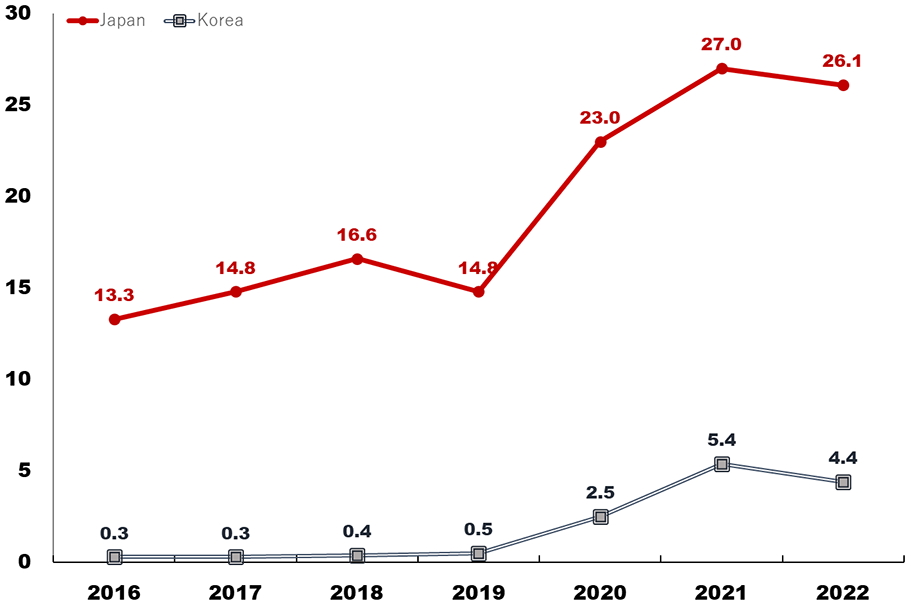
Teleworking trends in Japan and South Korea.

Teleworking trends in Japan.
Methods
Data Introduction
This study conducted a unique survey named “International Comparative Survey on Work and Life under COVID-19” from September 1 to 12, 2022. A standardized questionnaire was administered to a research panel pre-registered with an online research company in Japan and Korea. The subjects of this dataset were married men and women aged 30 to 44 years, with a designed sample size of 500 individuals per country. Respondents were randomly selected from a pre-registered survey panel provided by an online survey company, with sampling based on population proportions of gender and age in both Korea and Japan. Finally, a total of 392 participants from Japan and 458 participants from South Korea who were engaged in economic activities were included in the study.
Measurement
Job satisfaction was assessed using the following question: “How satisfied are you with your current job?” The responses were: satisfied (1), somewhat satisfied (2), neutral (3), somewhat dissatisfied (4), and dissatisfied (5). These responses were reversed for convenient interpretation. Work-to-family conflict was assessed using two questions: “How often has each of the following happened to you during the past three months? A. I have come home from work too tired to do the chores that need to be done. B. It has been difficult for me to fulfill my family responsibilities because of the amount of time I spent on my job.” Family-to-work conflict was assessed using two questions: “How often has each of the following happened to you during the past three months? A. I have arrived at work too tired to function well because of the household work I had done. B. I have found it difficult to concentrate at work because of my family responsibilities.” All the questions were answered on a 4-point scale with the following responses: several times a week (1), several times a month (2), once or twice (3), and never (4). The responses were reversed and added. The study used a dummy variable for telework (1 = with telework, 0 = without telework). Overtime work was another dummy variable, indicating whether a worker’s weekly working hours exceeded 40 hr. Labor laws in South Korea and Japan mandate a maximum of 40 hr of work per week, with workers’ consent required if this limit is exceeded (Geunlo Gijunbeob [Labor Standards Act], 1997; Rōdō Kijunhō [Labor Standards Act], 1947). Having children was indicated using a dummy variable equal to 1 if respondents had children under 6 years. Another dummy variable was gender (1 = male, 0 = female).
Other control variables were as follows: age was a continuous variable ranging from 30 to 44 years. Education (1 = university, 0 = non-university) and company size (1 = companies with at least 300 employees, 0 = companies with up to 299 employees) were dummy variables. Occupation was categorized into three dummy variables: manager/professional, white-collar worker (e.g., clerk and salesperson), and working class (e.g., factory worker and craftsman). Industry was another dummy variable, with a value of 1 if respondents worked in the professional services sector (accounting, information technology, law, consulting, finance, and research). Personal income was a log-transformed variable. Finally, employment status was categorized into three dummy variables: regular, non-regular, and self-employed.
Analytical Strategy
Job satisfaction, work-to-family conflict, and family-to-work conflict were analyzed using ordinary least squares models, while overtime work was analyzed using a logit model. To measure indirect effects, this study utilized the Stata command “mediate,” available in Stata 18. The mediate command calculates indirect effects based on the potential-outcomes framework, which allows for the use of different variables in each outcome. This method is more flexible than the Sobel test and bootstrap methods.
Results
Descriptive Statistics
Table 1 presents the descriptive statistics for Japan and South Korea. First, the teleworking participation rate was higher in Japan than in Korea and reasonably close to national data in both countries. Second, although job satisfaction was slightly higher in Korea, work-to-family conflict and the rate of overtime work were significantly higher in Korea than in Japan. These results indicate that workers in Korea experience more issues related to work-to-family conflict and family-to-work conflict than those in Japan.
Descriptive Statistics.

Table 2 presents the correlations among study variables in Japan and Korea. The correlations align with the assumptions made in the current study. In both countries, telework is positively associated with job satisfaction, job satisfaction is negatively related to work-to-family and family-to-work conflicts, and family-to-work conflict is positively related to having children under 6 years. However, there are some differences between the two countries. Overtime work demonstrates a negative correlation with teleworking and job satisfaction in Korea but not in Japan. In addition, while overtime work is positively related to both work-to-family and family-to-work conflicts in Korea, it is related to work-to-family conflict alone in Japan. These results suggest that teleworking can improve well-being, though the specifics differ between the two countries.
Correlations Among Key Variables for Japan and Korea.

Note. Correlations for the complete sample for Japan are indicated below the diagonal, and those for South Korea are provided above the diagonal.
p < .05. **p < .01. ***p < .001.
Assessment of the Consequences of Telework
This study first considered a direct/indirect effects model to examine Hypotheses 1 (job satisfaction), 2a/3a (work-to-family conflict), 2b/3b (family-to-work conflict), and 4a/4b (overtime work). Tables 3 and 4 depict the results for the Japanese and Korean cases, respectively. In Tables 3 and 4, telework is positively related to job satisfaction in Japan (b = 0.298, p < .05, Model 1-1) and Korea (b = 0.340, p < .01, Model 2-1). Therefore, Hypothesis 1 is verified: telework can improve workers’ job satisfaction. This finding is consistent with earlier studies that have consistently reported a positive relationship between telework and job satisfaction (e.g., Gajendran & Harrison, 2007).
Impact of Telework on Job Quality in Japan.

Note. Models 1-1, 1-2, and 1-3 are ordinary least squares models. Model 1-4 is a logit model. The standard error is provided within parentheses.
p < .05. **p < .01. ***p < .001.
Regression Results for South Korea.

Note. Models 2-1, 2-2, and 2-3 are ordinary least squares models, and Model 2-4 is a logit model. The standard error is indicated within parentheses.
p < .05. **p < .01. ***p < .001.
However, aside from the positive association between telework and job satisfaction, the findings differ from this study’s hypotheses. First, Hypotheses 2a and 2b were rejected. In Korea, telework has no statistical significance with respect to work-to-family and family-to-work conflicts. In Japan, telework is related to family-to-work conflict; however, the statistical effect was positive, contrary to Hypothesis 2a, which assumed a negative correlation. Thus, telework implementation can be considered a cause of family-to-work conflict in Japan. The negative impact of telework on work–family conflict aligns with the findings of some earlier studies (Bellmann & Hübler, 2021; Hill et al., 2003). Using panel data from Germany, Bellmann and Hubler (2020) found that teleworking has a neutral effect on job satisfaction and a negative effect on work-life balance. Moreover, Hill et al. (2003) indicated teleworking’s positive effect on job satisfaction and negative effect on work-life balance.
Moreover, Hypotheses 3a and 3b, which consider the indirect effect of telework through work-to-family and family-to-work conflicts, were rejected in both countries. Table 5 presents the indirect effects, showing the nonsignificant indirect effects of telework on job satisfaction through work-to-family and family-to-work conflicts. These findings indicate that telework does not influence work–family conflict in Korea but aggravates the conflict in Japan. Second, the impact of telework on overtime differs significantly from Hypothesis 4a. As discussed earlier, some studies highlight the problems of work-home spillover or working beyond formal hours as side effects of teleworking (Felstead & Henseke, 2017). However, the current study did not indicate any significant correlation between overtime work and telework in Japan. Instead, telework was found to reduce the possibility of overtime work in Korea (b = −1.022, p < .05, Model 2-4). In other words, blurring of boundaries is not a major concern, at least in relation to overtime work.
Indirect Effects of Telework on Job Satisfaction.

Note. CI = confidence interval; Coeff. = coefficient; SE = standard error.
p < .05. **p < .01. ***p < .001.
Influence of Gender and Having Children on Teleworking Effectiveness
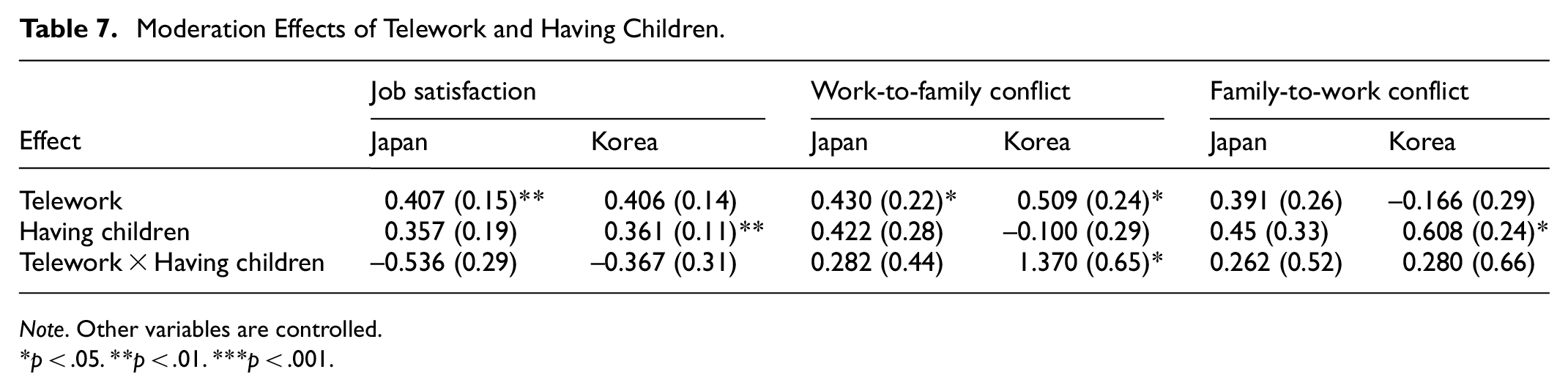
Tables 6 and 7 examine interaction effects to determine whether gender and having children influence teleworking effectiveness. The differences between teleworkers and commuters regarding the effects of gender and having children remain unclear. The results in Table 6 indicate that teleworking has no statistically significant moderating effect on gender in Japan and Korea. Therefore, Hypotheses 5a and 5b were rejected. Regarding having children, only teleworkers reported severe work-to-family conflict in Korea. Figure 3 depicts the results of the interaction effects between teleworking and having children on work-to-family conflict in Korea. For this conflict, there was no significant difference between teleworkers and commuters in the absence of children. However, when parents had children, the work-to-family conflict of commuters showed no significant change, whereas that of teleworkers increased rapidly. These results conform to the findings of earlier studies, which indicated that telework causes problems of boundary blurring (Felstead & Henseke, 2017).
Moderation Effects of Telework and Gender.

Note. Other variables are controlled.
p < .05. **p < .01. ***p < .001.
Moderation Effects of Telework and Having Children.
Note. Other variables are controlled.
p < .05. **p < .01. ***p < .001.

Moderation effects of having children on work–to–family conflict in Korea.
Discussion
This study commenced with the question of whether telework could improve workers’ work-related well-being even in societies such as Korea and Japan, where work often takes precedence over home life. Several previous studies have suggested that telework can improve job satisfaction and reduce work–family conflict. However, most of these studies have focused on cases in the Anglo-American region, and relatively little research has been conducted on East Asian countries. In Japan, there are some studies on the introduction of telework, but in Korea, more research on telework is still needed. Compared to European countries, Korea and Japan often require workers to be highly dedicated to their work and companies, with many workers planning their daily lives around their jobs. Therefore, confirming whether telework positively affects work-related well-being in Korea and Japan, where work culture and institutional environments differ significantly, has meaningful implications for understanding the nature of telework.
Interestingly, only Hypothesis 1, which predicts a positive relationship between telework and job satisfaction, and Hypothesis 6b, which predicts that having a child will exacerbate work–family conflict, are accepted; all other hypotheses are rejected. The findings show that in Korea and Japan, telework helps improve job satisfaction and reduce working hours but can amplify work–family conflict. Telework has a particularly negative effect on work–family conflict among Korean workers with children under the age of six. In addition, since Japan implemented telework policies approximately 40 years before Korea, this study expected the positive impact of telework to be more evident in Japan. However, the analysis results do not show notable differences between Korea and Japan.
This study has several academic contributions. First, it contributes to understanding the impact of social and cultural contexts on telework by examining its effect on work-related well-being in Korea and Japan. The effects of telework may vary depending on the organizational and national context (Chung & van der Lippe, 2020). If telework is primarily implemented in workplaces with a culture that requires high labor intensity, additional work, overtime, and weekend work, telework may actually amplify work–family conflict (van der Lippe & Lippenyi, 2020). The organizational and group-oriented work culture in Korea and Japan, characterized by tendencies such as overworking, karoshi (death from overwork), and business drinking parties, is different from the European work culture. Therefore, this study is unique in that it focuses on East Asian countries—Korea and Japan—whose labor market structures and work cultures differ from those of European countries.
Second, this study shows that telework can positively impact job satisfaction regardless of sociocultural background. Many studies on telework discuss its positive effect on job satisfaction, but some call for a cautious approach. There needs to be more discussion about whether telework is beneficial even in a social and cultural environment that prioritizes the organization over individual life. As confirmed by Lu and Zhuang (2023), only men who have the upper hand in the division of gender roles may enjoy the benefits of improved job satisfaction. However, this study found that telework improved job satisfaction in both Korea and Japan and reduced working hours in Korea. Additionally, the findings confirmed that telework improves job satisfaction regardless of gender.
Third, the limitations of telework were clarified by confirming that telework can expand work-family conflict, especially for those who have children. Since Nilles (1975) reported on the benefits of telework, many researchers and policymakers have argued that telework will contribute to improving work–family balance, especially for employees who must perform caregiving work. However, some studies have reported that telework can place more responsibility for housework and childcare on women (Chung, 2020; Lott, 2020), and this study found similar results that telework can burden workers with children with additional care work.
Fourth, the results confirmed that the history of telework introduction and the effects of telework are separate dimensions. By comparing South Korea and Japan, which have similar economic characteristics, industrial structures, social utilization of ICT, and labor cultures but different telework-related institutional environments, this study clarified the impact of differences in institutional conditions on teleworking effectiveness. Interestingly, although Japan has a longer history of teleworking than Korea, the positive impact of telework on working conditions is similar in both countries. In other words, a longer history of telework does not guarantee greater efficiency.
The policy implications of this study are as follows. So far, policies in Korea and Japan have focused on introducing and expanding telework. Since the adoption rate of telework was not high before the COVID-19 pandemic, it is natural to focus policy efforts on the introduction of telework. However, consideration of the impact of telework on workers after its introduction has been scant due to the belief that it would help improve job satisfaction and reduce work-family conflict. The analysis results of this study confirmed that telework contributes to improving job satisfaction but provided no evidence that it reduces work–family conflict. Instead, work–family conflict increases among teleworkers with children under 6 years of age. Therefore, at least in Korea and Japan, if telework is implemented without any policy support, the problems of blurred boundaries will likely arise within the home, increasing the burden of housework and childcare on teleworkers. Therefore, if telework is being introduced for work–family balance and women’s participation in the labor market, it is also necessary to introduce policies that can reduce the burden of housework and childcare on teleworkers.
Limitations and Future Research Scope
Although the present study reveals important findings, it has several limitations. First, this study analyzed married men and women in their 30s and 40s; therefore, it does not clarify the effects of telework on people over 40 years of age or single individuals. Second, due to limitations in survey design, the study could not directly measure boundary blurring and work-home spillover. Finally, due to data limitations, this study did not clearly explain why telework exacerbates work-to-family conflict in Japan. Considering the similarities in labor laws, work culture, and gender roles in the family between Japan and Korea, the problems of boundary blurring cannot sufficiently explain the findings. Therefore, future research should specifically examine the reasons for such differences between Korea and Japan using large-scale samples. Additionally, future research should extend beyond South Korea and Japan to include the United States and Europe.
Conclusion
This study examined the impact of telework on improving job satisfaction and reducing work–family conflict in Korea and Japan. Based on previous research, this study expected positive effects of telework and predicted that more positive effects would be confirmed in Japan, where the institutional environment was well established by implementing telework policies more than 30 years before Korea.
The analysis confirmed that telework improves job satisfaction in both countries and suppresses overtime work in Korea. However, no positive effects of telework could be found for other factors; instead, telework tended to aggravate work–family conflict among teleworkers. In summary, despite some differences, the influence of telework on job satisfaction and work-family conflict appears to be comparable in Korea and Japan. Furthermore, contrary to expectations, the effect of telework on work-related well-being was similar in Korea and Japan.
These results indicate that the introduction of telework does not guarantee an improvement in work-related well-being and that the effectiveness of telework depends on how the relevant labor market accepts and utilizes it. Rather than understanding telework as a tool to address all issues, it should be treated as part of the labor process that improves job satisfaction. Therefore, when telework is implemented in Korea and Japan to reduce work–family conflict, organizations should implement supplementary policies to alleviate the work–family conflict caused by telework, considering that telework can cause boundary issues and increase teleworkers’ burden of childcare and housework.
Footnotes

Funding
The author disclosed receipt of the following financial support for the research, authorship, and/or publication of this article: This study was supported by the Japan Society for the Promotion of Science, KAKENHI (Grant Numbers 18H00936, 20K20787, 22H00917, and 23K12625).
Declaration of Conflicting Interests
The author declared no potential conflicts of interest with respect to the research, authorship, and/or publication of this article.
Data Availability Statement
Data sharing not applicable to this article as no datasets were generated or analyzed during the current study.