




Abstract
The purpose of this study is to test an integrated entrepreneurial motivation and intention model based on self-determination theory (SDT) and the theory of planned behavior (TPB). Particularly, it aims at testing the direct and indirect effects of the basic psychological needs satisfaction of SDT, that is, autonomy, competence, and relatedness on entrepreneurial intention through the TPB attitudinal factors, that is, attitude toward entrepreneurship, subjective norms, and perceived behavioral control. A sample of 622 university students from two universities in Yemen has been used, and the integrated model was tested using structural equation modeling to check its validity and the hypothesized relationships. The study findings lend support to the theoretical integration of the model, where basic psychological needs satisfaction has a positive effect on attitude toward entrepreneurship, subjective norms, and perceived behavioral control, and in turn, they have positive effect on entrepreneurial intention. The findings suggest full mediation of attitude toward entrepreneurship and perceived behavioral control due to the insignificant direct path from need satisfaction on entrepreneurial intention, whereas no mediation effect was observed in the case of subjective norms.
Keywords
Introduction
Entrepreneurship has become of great interest to policy makers and other stakeholders, as it is generally linked to national wealth and well-being (Du & O’Connor, 2018). It is regarded as a panacea to some of the socioeconomic challenges such as unemployment (Thurik, 2003). Engagement in entrepreneurial activity results in more job creation, enhanced economic development, growth, and productivity (van Praag & Versloot, 2007). Respective stakeholders including policy makers, international organizations, researchers, and educators have consensus about these fruitful outcomes, and as a result, they devote considerable efforts on how to make entrepreneurship more recognized, valued, and desired. Given this significance, it is crucial to understand why some people would choose to be entrepreneurs while others do not (Wu, Su, & Lee, 2008). Early entrepreneurship research attempted to differentiate those who start new ventures from those who choose other career paths on the basis of their psychological characteristics or personality traits (Gatewood, Shaver, Powers, & Gartner, 2002). However, due to the inability of this stream of research to reliably differentiate entrepreneurs from others (Gartner, 1988), the focus has shifted toward intention-based research (Carsrud & Brannback, 2011).
Intention-based research looks at peoples’ cognition, perception, motivation, and intention (Turker & Selcuk, 2009). Researchers highlight the importance of understanding entrepreneurial cognition and the formation of intentions to understand the essence of entrepreneurship (Boyd & Vozikis, 1994) as “the construct of intentions appears to be deeply fundamental to human decision making” (Krueger, 2009, p. 5). Known as immediate and single-best predictor of any voluntary behavior such as entrepreneurship (Ajzen, 1991), intention becomes a subject of entrepreneurship research (Schmutzler, Andonova, & Diaz-serrano, 2018) and numerous studies have been conducted to find out what has shaped such intentions (Tsai, Chang, & Peng, 2016). One of the most used and widely accepted theories in entrepreneurial intention (EI) research is the theory of planned behavior (TPB) (Entrialgo & Iglesias, 2016; Liñán & Chen, 2009). According to TPB (Ajzen, 1991), behaviors are best predicted by intentions and in turn intentions are shaped by attitude, subjective norms, and perceived behavioral control (PBC). The stronger these factors are, the greater the effect they have on intention (Ajzen, 1991). TPB has shown robustness in predicting EI (Kautonen, van Gelderen, & Fink, 2015), and numerous studies have supported it (Almobaireek & Manolova, 2012; Aloulou, 2016; Autio, Keeley, Klofsten, Parker, & Hay, 2001; Barton, Schaefer, & Canavati, 2018; Douglas & Shepherd, 2002; Farooq et al., 2018; Iakovleva, Kolvereid, & Stephan, 2011; Kirby & Ibrahim, 2011).
Although previous EI research has provided valuable contribution to explain entrepreneurial behaviors, yet what remains unclear in the intention-based models (e.g., TPB) is the question “why people would engage in a certain behavior such as starting a business”? That is to say, TPB does not explicitly indicate why someone will choose to be an entrepreneur (Deci & Ryan, 1985). Does a person pursue entrepreneurial behavior because it is a personal choice and out of autonomy (autonomous/intrinsic reasons) or because it is out of obligation (controlled/extrinsic reasons)? In addition, the environmental factors that contribute to the formation of TPB are not clearly outlined (Chan, Fung, Xing, & Hagger, 2013). As a result, researchers have called for deeper rethinking of intention models and suggested to integrate them with other motivational theories (Fayolle & Liñán, 2014; Fayolle, Liñán, & Moriano, 2014). According to them, EI can be facilitated by motivation, and motivation (based on the type) can have different levels of effects on attitude, subjective norms, and PBC. Thus, to overcome these issues within TPB, researchers (though from contexts other than entrepreneurship) have attempted to integrate it with self-determination theory (SDT; Hagger & Chatzisarantis, 2009; Hagger, Chatzisarantis, & Harris, 2006), as it is claimed to be complementary to TPB. Consistent with this direction of research, this study seeks to shed further light on issues by incorporating SDT and TPB.
SDT looks at motivation as an essential source of social and self-regulation. Motivation as a source of energy, makes people persistent and active in the enactment of their behaviors (Deci & Ryan, 2000). Distinguishing between the different forms of motivation based on quality (intrinsic or autonomous/extrinsic or controlled) rather than quantity is the central aspect of SDT. That is to say, SDT classifies motivation into categories on a continuum, from the least controlled extrinsic motivation, through autonomous motivation to intrinsic motivation. When people engage in any behavior, entrepreneurship included, as they are interested or enjoy doing it, then they are said to be intrinsically motivated. On the contrary, those who engage in such behaviors because of necessity and obligation or because they just want to have money or avoid the guilt of being unemployed, they are said to have extrinsic (controlled) motivation. If a behavior is performed neither because of enjoyment, nor because of obligation but rather because it identifies with the self and it is important, valued and congruent to the self, then this is called autonomous motivation (most determined extrinsic motivation). What leads to such intrinsic or autonomous motivation is the satisfaction of three basic psychological needs conceptualized by SDT namely: autonomy, competence, and relatedness. It is argued that these needs are necessary for self-motivation and personality integration. When they are not satisfied, intrinsic motivation will be hindered (Chirkov, Ryan, Kim, & Kaplan, 2003; Deci & Ryan, 2000). As a result, they will have less quality of entrepreneurial ideas and behaviors (Weinstein & Ryan, 2011; Wilson, Mack, & Grattan, 2008). Conversely, if these needs are satisfied, they will likely be more inclined to persistently engage in the task such as entrepreneurial behavior with intrinsic motivation (Ryan & Deci, 2000).
Feelings of having the autonomy, being competent and having sense of relatedness to others is at the core of entrepreneurship research, but surprisingly, this has not been noticed enough in the literature and rarely explored in previous entrepreneurship research (Al-Jubari, Hassan, & Liñán, 2018). Despite its relevance, little attention to date has focused on exploring the relationships between SDT factors and the belief-based behavioral antecedents of TPB. The motivational mechanisms have mostly been ignored in the literature; therefore, this study seeks to fill this gap by integrating SDT and TPB to better understand and explain EI. The integration of these two prominent theories have been applied in other domains such as health (Chung et al., 2017; Hagger & Chatzisarantis, 2009) and work (Stenius, Haukkala, Hankonen, & Ravaja, 2017), but, despite its applicability and usefulness, very little study has used such integrative approach in entrepreneurship research (Al-Jubari et al., 2018). Therefore, this study is undertaken in an attempt to extend the existing knowledge and understanding of human motivation and cognition by examining the motivational sequence from SDT to TPB. Particularly, it seeks to address these two specific questions:
Does basic psychological needs satisfaction influence EI directly?
Do TPB factors mediate basic psychological needs satisfaction and EI relationships?
Theoretical Background
Intention-Based Models
The growing body of entrepreneurship literature highlights the viable role of EI in the decision to start a business (Kautonen et al., 2015). One of the first important steps in the long and evolving entrepreneurship process that aspiring entrepreneurs make is to consciously and voluntarily decide (intend) to become entrepreneurs (Gartner, Shaver, Gatewood, & Katz, 1994). Several intention-based models have been developed including entrepreneurial event model (Shapero & Sokol, 1982); TPB (Ajzen, 1991); entrepreneurial attitude orientation (Robinson, Stimpson, Huefner, & Hunt, 1991); intentional basic model (Krueger & Carsrud, 1993); and Davidsson model (Davidsson, 1991). However, only two of them remain competitive and dominate the literature due to their predictive ability namely: TPB and entrepreneurship event model (SEE). Particularly, the superiority of TPB has been acknowledged by many studies (Fayolle & Liñán, 2014; Fayolle et al., 2014). Not only it considers the personal factors, but it also includes the social factors and environmental contexts surrounding individuals. As such, EI, which refers to “as a self-acknowledged conviction by a person that they will set up a new business venture and consciously plan to do so at some point in the future” (Thompson, 2009, p. 687), can be better understood and predicted due to the coherence of its framework (Krueger, Reilly, & Carsrud, 2000). TPB proposed three proximal attitudinal factors that predict EI including attitudes (personal positive/negative assessment of entrepreneurship), subjective norms (approval or disapproval of action by significant others), and PBC (perception of one’s abilities to perform entrepreneurially) (Liñán & Chen, 2009). Both attitude and control variables of TPB often correspond to desirability and feasibility; constructs of Shapero & Sokol’s entrepreneurship event model (Liñán, Rodríguez-Cohard, & Rueda-Cantuche, 2011; van Gelderen et al., 2008; Veciana, Aponte, & Urbano, 2005). As discussed below, TPB antecedents have shown reliable predictability of EI in numerous studies and various contexts.
Attitude toward entrepreneurship
Attitude reflects the personal beliefs that people may have toward a certain behavior or action such as entrepreneurship. Such beliefs could be positive or negative and consequently affect how people go about that particular behavior, whether they act or not act. Therefore, the more favorable and advantageous a behavior is percived, the stronger the intention is to engage in it. Conversely, the disadvantageous or unfavorable or less favorable the behavior is, the less likely people will act up on it. Many studies, including a meta-analysis (Armitage & Conner, 2001), show that attitude toward entrepreneurship (ATE) is the strongest predictor of EI (Al-Jubari et al., 2018; Almobaireek & Manolova, 2012; Farooq et al., 2018; Kautonen et al., 2015; Liñán & Chen, 2009; Moriano, Gorgievski, Laguna, Stephan, & Zarafshani, 2012; van Gelderen et al., 2008; Wach & Wojciechowski, 2016). Therefore, rending entrepreneurship as a more favorable career path and an advantageous option to the people may suggest that they would come up with business ideas and may start their own ventures. However, in an opposite and conflicting view, ATE has been reported as an insignificant predictor of EI (Siu & Lo, 2013). Based on this discussion, the following hypothesis is offered:
Subjective norms
Subjective norms (SN) refers to the individual perception about how people in their close circles or influential others such as parents, friends, and colleagues, would think about them acting or not acting upon a certain behavior such as engaging in business venturing. According to Ajzen (1991), subjective norms or in other words social pressure has two types of beliefs: normative belief and motivation to comply. The normative component reflects whether those influential others would approve or disapprove their behavior such as starting a business. The second component reflects the motivation to comply with such norms and willingness to behave in accordance to the expectations of those influential others and adhere to the norms (Krueger et al., 2000). SN shows inconsistencies in the previous entrepreneurship intention research. For instance, it has been reported as insignificant or the least significant determinants of EI (Almobaireek & Manolova, 2012; Autio et al., 2001; Krueger et al., 2000; Liñán & Chen, 2009; Tarek, 2016) among others. On the contrary, other studies have found support for SN as a strong predictor of EI (Iakovleva et al., 2011; Siu & Lo, 2013; Tkachev & Kolvereid, 1999). Since entrepreneurship is a social activity, choosing it as a career path is a major decision. Therefore, individuals may seek advice and support from people around them, and as a result, their (significant others) opinions would influence how individuals would engage or not engage in entrepreneurial behavior (van Gelderen et al., 2008). Based on this literature, the following hypothesis is proposed:
Perceived behavioral control
PBC refers to the personal’s assessment of the behavior to be performed in terms of how easy or difficult it is (Ajzen, 1991). If perceived easy, most likely the task will be acted upon. If perceived as very difficult, then there is a high probability people will not engage in it. According to Veciana et al. (2005), the control belief of PBC reflects the presence or absence of required resources and opportunities. Ajzen (1991) states that, These control beliefs may be based in part on past experience with the behaviour, but they will usually also be influenced by secondhand information about the behaviour, by the experiences of acquaintances and friends, and by other factors that increase or reduce the perceived difficulty of performing the behaviour in question. (p. 196)
TPB outlines that PBC plays a dual role in the TPB model, where it can affect behaviors such as starting a business directly and/or through the mediating role of intention. EI research provides support for the relationship between PBC and EI (Almobaireek & Manolova, 2012; Iakovleva et al., 2011; Liñán & Chen, 2009; Moriano et al., 2012; Siu & Lo, 2013; van Gelderen et al., 2008; Zhao, 2005) among others. Therefore, the following hypothesis is proposed:
Self-Determination Theory
SDT (Deci & Ryan, 1985; Ryan & Deci, 2017) is a human motivational theory, which has been used and researched in various study settings including work environment, sports, education, health, environmental issues, and alike (Ryan & Deci, 2017). Its popularity stems from how it views human motivation. Unlike other motivational theories, SDT classifies motivation based on quality rather than quantity, type not amount; autonomous motivation (intrinsic and fully internalized extrinsic motivation), and controlled motivation (most controlled extrinsic motivation). Furthermore, it suggests that people across culture and life domains have three innate psychological needs, when satisfied, autonomous motivation, high-quality performance, persistence, and wellness which are enhanced (Deci, Olafsen, & Ryan, 2017). These are needed for autonomy, competence, and relatedness.
The autonomy need reflects the extent to which people perceive their behaviors as volitional and self-congruent. In view of Niemiec et al. (2006), “the need for autonomy is feeling a sense of choice, endorsement, and volition with respect to initiating, maintaining, and terminating behavioural engagement” (p. 763). Sometimes, autonomy is used to mean being independent. However, this confusion should not occur, as it has somehow different conceptualization in SDT. Deci and Ryan (2012) argue that there is a distinction between the two concepts. Autonomy is not simply acting independently. It has a deeper meaning than that, as it reflects acting with volition and choice and is consistent and aligns with one’s values and goals. In entrepreneurship, it can be viewed as one of the most motivating factors to be entrepreneurs. People would love pursuing their dreams and choose which career path to follow (Shane, Locke, & Collins, 2003; van Gelderen, 2010). Several studies have found support for autonomy as an essential entrepreneurial motivational factor and its association with people motivation and intention to establish their own businesses, self-employment, and entrepreneurial orientation (Caliendo & Kritikos, 2012; Douglas & Shepherd, 2002; Lumpkin, Cogliser, & Schneider, 2009). The competence need is about experiencing a feeling of effective interaction with the surrounding environments (Niemiec et al., 2006). According to Deci and Ryan (2000), one’s need for competence can be satisfied, and thus be intrinsically/autonomously motivated when performing certain tasks that are challenging but within one’s feeling of capacity to perform it well. This would result in high performance, better well-being, and personal growth tendency. When the need for competence is satisfied, then it is most likely that one can adapt to more complex and changing environments such as engaging in entrepreneurial activity. In fact, SDT highlights that people, usually, have such inner inclination toward being or feeling competent when performing a certain task. As such, it is not just a perception of their abilities to reach desired outcomes. The relatedness need refers to how people perceive themselves to be socially accepted and connected to group of people they regularly interact with such as family members, peers and colleagues, managers, and teachers. It is not only about the feeling of care by others but also about the feeling of being significant and contributing to others (Ryan & Deci, 2017).
Basic psychological needs satisfaction
As discussed, the basic psychological needs for autonomy, competence, and relatedness are the most relevant motivational factors in entrepreneurship. Entrepreneurs are motivated to pursue their own choices and have ownership to their actions (autonomy). They also want to act on challenging tasks and use their capabilities (competence). They are also motivated to be socially connected and feel not only like they are being cared for but also they care for others and feel as significant members of and contribute to those social groups they identify themselves with (relatedness). Arguably, these psychological needs have inherent value and are regarded as essential components for well-being and behavioral persistence (Teixeira, Carraça, Markland, Silva, & Ryan, 2012). Metaphorically, as plants need essential nutrients such as water, minerals, and sunlight to bloom and flourish, people need such innate nutrients for personal growth and well-being.
According to SDT, all three needs are very important, as satisfying them leads to maintaining and sustaining intrinsic motivation, which in turn leads to positive outcomes including well-being and persistence in the entrepreneurial behavior. For instance, satisfying the innate need of autonomy means that individuals prefer to be entrepreneurs because of the amount of freedom and choice they derive from entrepreneurial activities. Van den Broeck, Vansteenkiste, De Witte, and Lens (2008) argue that the satisfaction of the inborn need for competence represents current (instead of future-oriented) and more general (instead of specific) feelings of effectiveness. The need for competence is likely to stimulate individuals’ functioning and well-being on a more general level. (p. 280)
Relatedness satisfaction is very important, too, as it can help in the facilitation process of internalization. Motivation internalization is one of the basic tents of SDT. It is argued that people may first engage in entrepreneurial behavior out of obligation or necessity, and due to expectation on any external outcomes such as to receive money or even to avoid unemployment. However, once they realize the value of what they do, then such realization can be internalized, as it concurs and identifies with the self. The role of relatedness here is that people usually want to feel related and connected to certain social groups, and they start taking in and internalizing the values of such groups and accept them as theirs. As stated, positive outcomes result from the basic needs satisfaction (NSs), and thus we argue that this contributes to rendering entrepreneurship as more attractive to people and thus decides on performing it. Given the aforementioned discussion, the following hypotheses are offered:
The integration of SDT and TPB
Integration of SDT and TPB has been adopted and received theoretical support in previous research as both theories “provide complementary explanations of the processes that underlie motivated behaviour” (Hagger & Chatzisarantis, 2009, p. 276). Particularly, SDT and TPB found support in a number of research contexts including physical activity, exercise, and diets (Brooks et al., 2017; Hagger et al., 2006; Jacobs, Hagger, Streukens, De Bourdeaudhuij, & Claes, 2011); social networks (Luqman, Masood, & Ali, 2018); health (Chung et al., 2017; Hagger & Chatzisarantis, 2009); e-learning (Roca & Gagne, 2008); physical education, and leisure time (Barkoukis, Hagger, Lambropoulos, & Tsorbatzoudis, 2010) (please see Table 1 for a summary). Surprisingly, despite its applicability to entrepreneurship research, using SDT and or integrating it with other models has been almost ignored until recently. A recent evidence found a strong support for the integration of SDT and TPB (Al-Jubari et al., 2018). In their study, it was found that the satisfaction of SDT constructs predicted EI of Malaysian university students via the mediating role of TPB factors. This supports the argument that integrating SDT with TPB provides complementary explanation of motivational process of planned behaviors.
Summary of Studies Integrating SDT and TPB.

Note. SDT = self-determination theory; TPB = theory of planned behavior; ATE = attitude toward entrepreneurship; SN = subjective norms; PBC = perceived behavioral control.
The rational of this theoretical integration between SDT and TPB (Figure 1) is based on the link between motivation and intention (Hagger & Chatzisarantis, 2009). Intention, single-best predictor of any voluntary behavior including entrepreneurship, is shaped by ATE, SN, and PBC that operate as its proximal predictors (Ajzen, 1991, 2011). Operating as a distal predictor of intention, motivation (Solesvik, 2013), according to SDT, is distinguished based on type (not amount), autonomous/intrinsic or controlled/extrinsic motivation (Deci & Ryan, 1985; Ryan & Deci, 2017), which may improve and enhance the belief system of the social cognitive theory of TPB (Luqman et al., 2018). As a basic assumption of SDT, to engage in a future entrepreneurial activity, one should have positive beliefs about it that is consistent and aligned with his or her autonomous motivational reasons to act. Autonomously, motivated reasons of SDT could be considered as vehicles to enhance intention to engage in the activity in the future through positive beliefs of TPB regarding it (Chung et al., 2017). Although this integration is deemed applicable and useful in various domains, little attention has been given to it in entrepreneurship research. Consequently, the following hypotheses of a unified SDT and TPB model are offered:

The study framework.
Methods
The Context of Yemen
Yemen is an Arab Muslim country located in the southern part of the Arab Peninsula and a home for more than 28 million people. It has deep roots in history and possesses a remarkable heritage, even once known as the “Arabia Felix,” which means “fortunate Arabia.” The country enjoys various natural resources of oil and national gas minerals, tourism and historical attractions, fine beaches, and agriculture, in addition to the human capital. However, it seems that the fortune of the country has long gone but more particularly, recently, it has gone through civil and regional war in the last 5 years that has a devastating consequences on people’s lives and the economy, where the country infrastructure has been nearly destroyed and the economy is almost collapsing, which is not in a good shape even before the war. While official statistics on Yemeni economy remains unavailable, recent updates from the World Bank suggest that the gross domestic product (GDP) has deteriorated from 24% before the war to even much-reduced 8% in 2018, which gives a clear indication on how the economy of the country suffers. Earlier statistics show that the a per-capita GDP of US$1,343 in 2011, which is very low has already declined to even US$929 in 2018 (The World Bank, 2019). Although it is among the oil-exporting countries, the per-capita GDP is the lowest among its neighbors (e.g., Saudi Arabia (US$21,196), Bahrain (US$22,918), Oman (US$23,572), Kuwait (US$43,723), the United Arab Emirates (US$63,626), and Qatar (US$98,144) (International Monetary Fund, 2012). The unemployment rate was high before the war, especially among the youth, now it has worsened. Entrepreneurial activities as a major driving force of job creation and economic development become very challenging in such times and environment. However, according to earlier report by the Global Entrepreneurship Monitor (GEM), the perceived capabilities to start a business is 46%, the desirability toward entrepreneurship is 95%, and 9% have the intention to start a business among Yemenis. Although these statistics indicate that entrepreneurship is a favorable career choice, it is unknown whether this still holds true in the current situation of the country.
Participants
Final-year university students from various faculties and programs in two largest public and private universities in Yemen were recruited to participate in this study. Of 1,100 questionnaires distributed to the final-year students in both universities, 738 were returned. After receiving the questionnaires, they were manually inspected for inclusion criteria (level of study). A total of 57 questionnaires were not included, as the respondents did not meet the inclusion criteria of being final-year students. Therefore, 681 questionnaires were useful for further steps. Another 59 questionnaires were discarded due to incomplete responses and missing data. Hence, the remaining 622 usable questionnaires were used for further data analysis, yielding about 56.5% response rate, 76.8% the public university, and 23.2% from the private university. The average age of participants in this study was 23.32 (SD = 1.47), which showed that they were on the phase of deciding which career path choice they should take. Furthermore, the sample consisted of about 58% male and 42% female students.
Measures and Procedures
To measure EI and its antecedents of TPB, we used (Liñán & Chen, 2009) entrepreneurial intention questionnaire (EIQ). It uses 7-point Likert-type scale and comprises 20 items measuring the four TPB constructs; EI (six items), ATE (five items), SN (three items), and PBC (six items). Sample items of them are “I have got the firm intention to start a firm someday,” “Among various options, I’d rather be an entrepreneur,” “My close family would approve of my decision to start a business,” and “I am prepared to start a viable firm.”
The SDT constructs were measured by nine 7-point item scale (Gagné, 2003; Sheldon & Hilpert, 2012), and the sample item for autonomy is “I generally feel free to express my ideas and opinions.” The competence sample is “Most days I feel a sense of accomplishment from what I do.” Sample item for relatedness is “I feel close and connected with other people who are important to me.” A translation and back translation procedure from English to Arabic and vice versa was performed by professional bilingual experts. The full data collection was only conducted after a pilot study result (60 participants) showed no substantial comments reported with regards to the clarity, terminology and structure of the study items. Data were collected during the September semester of the academic year 2013/2014, and questionnaires were administered during class sessions.
Analysis and Results
The data were analyzed using covariance-based structural equation modeling (CB-SEM) using Amos, version 22 (manufactured and sold by IBM, SPSS), with maximum likelihood estimation. CB-SEM is widely used in social sciences, as it has been methodologically advanced along the years (Hair, Ringle, & Sarstedt, 2012). To assess the quality and adequacy of the model, the fit indices used are as follows: chi-square index (χ2), normed-fit chi-square, root mean square error of approximation (RMSEA), Tucker–Lewis Index (TLI), and Comparative Fit Index (CFI). For TLI and confirmatory factor analysis (CFA), results greater than 0.90 and 0.95 and less than 0.08 or 0.06 for the RMSEA indicate adequate and excellent model fitting (Hu & Bentler, 1999).
Prior to testing the proposed integrated model, first- and second-order CFA were performed. First, basic psychological needs constructs were initially modeled in the first-order CFA, in which each item was specified to load on its respective priority factor: autonomy (PA), competence (PC), and relatedness (PR).
Second, these first-order factors were specified to load on a higher-order model; basic psychological NSs. It is usual to use higher-order CFA in basic psychological needs measurement (Sánchez-Oliva et al., 2017). All-fit indices of the model were acceptable (χ² = 45.18, df = 24, CFI =. 989, TLI= .983, and RMSEA = .038). Third, the full hypothesized measurement model comprising all the constructs with their items in the study was then tested, achieving the acceptable goodness of fit (χ² = 828.80, df = 364, CFI = .935, TLI= .927, and RMSEA = .045). It was recommended to perform CFAs before testing full structural models (Byrne, 2001). Performing CFA provided evidence of constructs validation; convergent, and discriminant. Any model inadequacy or poor fit was provided before structural model testing.
Construct Reliability and Convergent and Discriminant Validity
The assessment of constructs’ reliability as well as convergent and discriminant validity was performed using these tests. Convergent validity was evaluated using multiple indices: significance of factor loading (≥.50 good and ≥0.70 ideal); composite reliability (CR; ≥0.70); and average variance extracted (AVE; ≥0.50). For discriminant validity assessment, it was established when AVE was more than the maximum shared variance (MSV), and square root of AVE should be greater than the interconstruct correlations (Hair, Black, Babin, & Anderson, 2010).
Following these guidelines, the results of convergent validity analysis show that all constructs achieved the convergent validity, where all items and all-factor loadings were significant ranging from .53 to .89, indicating that latent constructs in the model were well represented by their items (please see the Appendix). Table 2 presents the descriptive results including means, standard deviations, interconstruct correlations, reliabilities, and convergent and discriminant validity values. Correlations among study variables were generally significant: ATE and EI displayed the highest correlation (.647) and relatedness with PBC displaying the lowest correlation (.210). All scales included in the model showed acceptable Cronbach’s alpha reliability levels ranging from .77 to .86. Furthermore, CR and AVE values indicate the convergent validity of model latent constructs. However, it should be noted that the AVE for EI and ATE were just slightly below the indicated threshold of ≥0.50, where they were 0.467 and 0.457, respectively. Since all model-fit indices, items factor loadings, and CR results have met the criteria, it has been decided not to go for any modification, and further analysis should be carried out. As noted by Fornell and Larcker (1981), the AVE is a conservative measure of convergent validity and in case it is lower than the suggested threshold but the construct reliability (composite) met the criteria (≥0.70), “the researcher may conclude that the convergent validity of the construct is adequate” (p. 46). The discriminant validity was also achieved because all AVE were greater than MSV, and the square root of AVE were greater than interconstruct correlations.
Means, Standard Deviations, Interconstruct Correlations and Model Validity Measures.
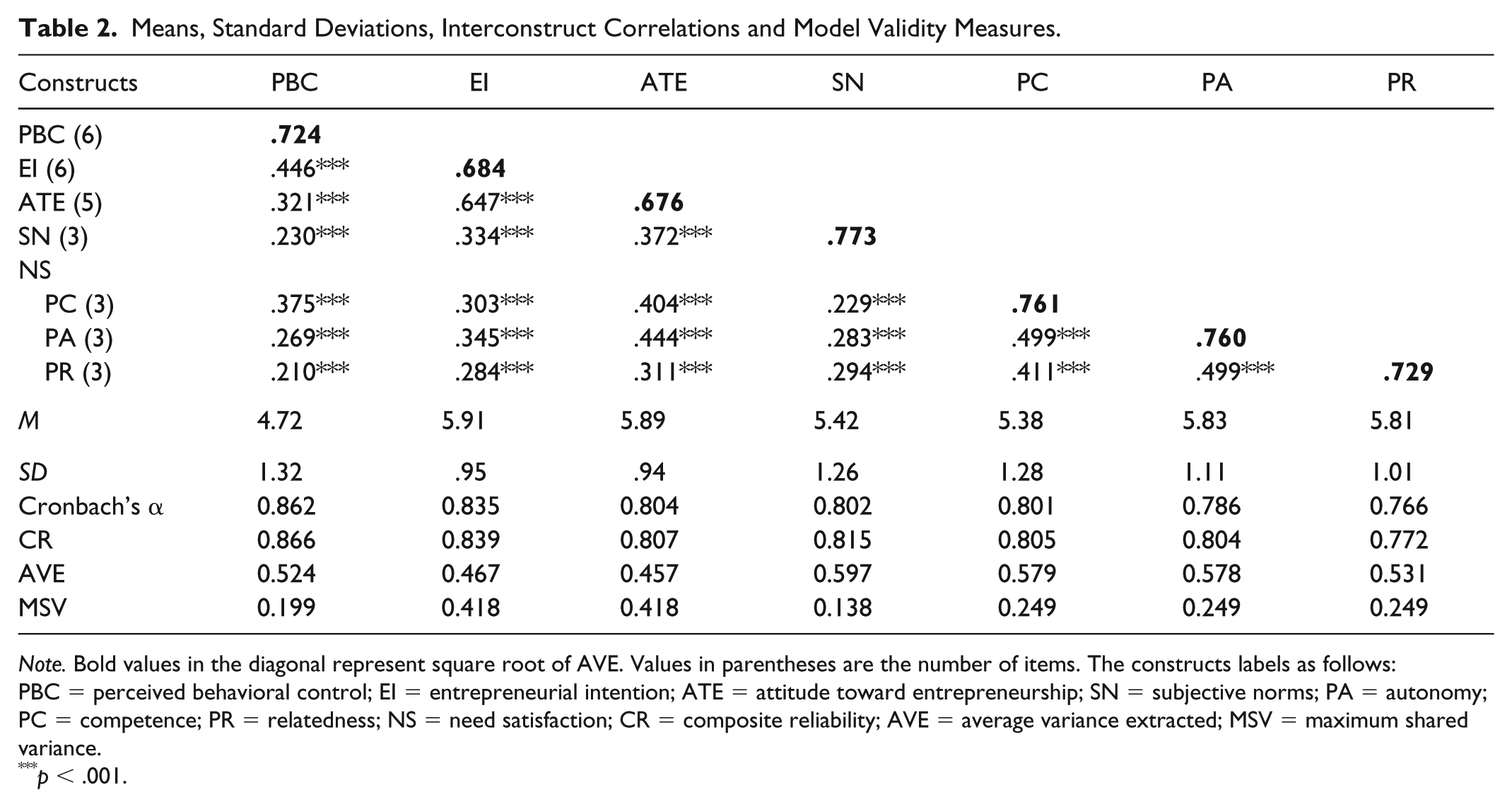
Note. Bold values in the diagonal represent square root of AVE. Values in parentheses are the number of items. The constructs labels as follows: PBC = perceived behavioral control; EI = entrepreneurial intention; ATE = attitude toward entrepreneurship; SN = subjective norms; PA = autonomy; PC = competence; PR = relatedness; NS = need satisfaction; CR = composite reliability; AVE = average variance extracted; MSV = maximum shared variance.
p < .001.
Hypotheses Testing
As the result of CFA suggested proceeding with further analysis and hypotheses testing, the structural model was examined. It modeled NS as a predictor; ATE, SN, and PBC as mediators; and EI as an outcome construct. As depicted in Figure 2, an acceptable fit of the model was achieved (χ² = 843.047, df = 367, CFI = .933, TLI = 926, RMSEA = .046).
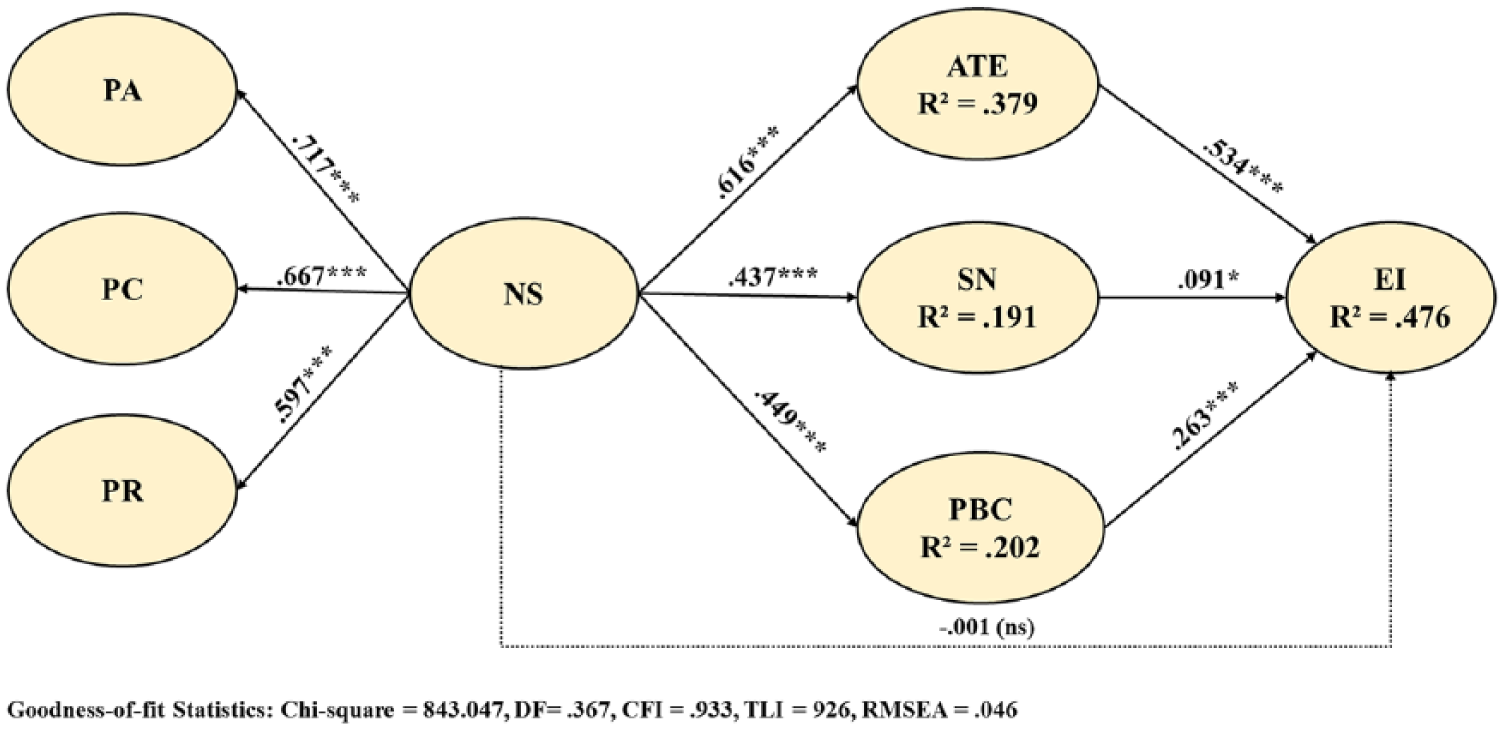
The full research integrated model.
Full support was found for all hypothesized relationships expect one. Results in Table 3 show that H1a to H1c of the three TPB predictors of intention were significant but vary in strength. ATE had the highest impact on EI followed by PBC and SN. The path coefficients of ATE → EI significant (β = .53, z = 9.462, p = .000), BPC → EI (β = .26, z = 6.105, p = .000), and SN → EI (β = .09, z = 227, p = .026). Similarity, NS was hypothesized to have direct positive effect on EI and its proximal predictors; ATE, SN, and PBC, H2a to H2d. Results show that the all hypotheses, but H2a, were very significant and positive as hypothesized. That is, strong effect was found from NS to ATE, SN and PBC; coefficients: (β = .62, z = 7.526, p = .000), (β = .44, z = 6.501, p = .000), and (β = .45, z = 6.735, p = .000) respectively, hence supporting H2b, H2c, and H2d. However, no direct effect was observed from NS into EI (β = –.001, z = –.012, p = .991), thus rejecting H2a.
Summary of Direct Hypotheses Testing.

Note. ATE = attitude toward entrepreneurship; EI = entrepreneurial intention; = subjective norms; PBC = perceived behavioral control; NS = need satisfaction.
Mediation Analysis
The bootstrap procedure for mediation analysis was used (Shrout & Bolger, 2002). We used Mplus software for specific indirect effect estimation because this is not available in Amos, where only bootstrap confidence intervals for total effects can be estimated. To determine the significance of mediation effect, critical ratio of z-scores should be greater than 1.96 on 0.05 significance level (Byrne, 2012). Bias-corrected interval approach was used to examine the significance of indirect effects (Preacher & Hayes, 2008).
ATE, SN, and PBC were hypothesized to play a mediation role between NS and EI (H3a, H3b, and H3c). As shown in Table 4, which contains estimates, z-scores, p values, and 95% bias-corrected confidence intervals (95% BCCIs) from 5,000 bootstrap iterations, and two mediation hypotheses supported H3a and H3c, but not H3b. The standardized total effect was significant (β = 0.514, z = 8.161, p = .000, [95% BCCI= .391, 0.638]). The standardized specific indirect effects of paths from NS to EI through ATE and PBC were (β = .350, z = 7.104, p = .000, [95% BCCI = .253, 0.446]) and (β = .124, z = 4.978, p = .000, [95% BCCI= .075, 0.172]). However, the NS → SN → EI was just above the significance level; (β = 0.041, z = 1.926, p = .054, [95% BCCI= −0.001, 0.082]), thus this hypothesis is not supported.
Mediation Effects of ATE, SN, and PBC on NS to EI Relationship.

Note. ATE = attitude toward entrepreneurship; SN = subjective norms; PBC = perceived behavioral control; NS = need satisfaction; EI = entrepreneurial intention; BCCI = bias-corrected confidence intervals.
Discussion
Understanding motivation and promoting entrepreneurial behaviors among young generation like university graduating students is very crucial to academicians, policy makers, and the nations as a whole. Therefore, in this study, we seek to test a comprehensive unified model using dual theoretical views based on well-established motivational and cognitive intentional theories: SDT and TPB. Specifically, it aims at examining the role of the SDT motivational factors on facilitating and explaining EI among final-year undergraduate students in Yemen. Furthermore, it aims at testing the role of TPB factors (ATE, SN, and PBC) as being proximal and mediators of SDT factors (PA, PC, and PR) to EI. Our argument is that motivation plays a significant role on determining EI. Knowing the relevance and significance of PA, PC, and PR in entrepreneurship research, it remains largely unnoticed. Accordingly, this makes the SDT and TPB unified model distinct in some sense as such integration has shown high relevance on other domains including school, health, and work.
Overall, the results support the study argument that the satisfaction of SDT motivational factors play a significant role in enhancing students’ EI, where 48% of variance in EI has been explained by the study constructs. The SEM results showed that all TPB constructs were significant predictors of EI, albeit weak effect of SN. Furthermore, NS of SDT showed relatively strong effect on the proximal TPB factors: ATE, SN, and PBC. However, NS does not have any significant direct effect on EI. Rather, it has indirectly predicted EI via ATE, SN, and PBC, as they operate as transmitters of effects, though SN showed insignificance on mediating NS and EI relationship. Our findings support earlier research on positive outcomes result from NSs (Croson & Minniti, 2012; Hagger & Chatzisarantis, 2009; Niemiec & Ryan, 2009; Roca & Gagne, 2008; Stenius et al., 2017). Theoretically, the finding lends support to SDT and TPB integration, where the autonomous motivation is very much related to students’ attitude, norms, and control perceptions. Students whose psychosocial needs are supported by the social environment would have favorable perceptions and inclination toward starting their own businesses, as choosing this career path reflects a sense of choice that emanates from their inner self (Al-Jubari et al., 2018). It is also revealed that they believe they are motivated by challenging task of entrepreneurship and they can effectively act upon it. Furthermore, being related to others is very important where students feel very significant in the social groups they identify with and they believe they are contributing to such groups like family, friends, and colleagues, and in turn, they are being cared for by them. The direct effect of and mediation roles of ATE, SN, and PBC were supported by this study confirming the applicability of TPB in entrepreneurship research. ATE was the strongest predictor of EI followed by PBC, and finally SN. Full mediation was found by ATE and PBC on NS and EI relationship. The results concur with previous research (e.g., Almobaireek, Alshumaimeri, & Manolova, 2016; Krueger et al., 2000; Liñán & Chen, 2009; Siu & Lo, 2013).
The previous discussion generates an interesting argument that relates to the autonomous motivation, a natural outcome of NSs, as a driver of EI. According to previous studies, those who display autonomous motivation generally come up with more creative ideas (Sheldon, 1995), satisfaction of autonomy, and competence that leads to emotional creativity (Moltafet, Sadati Firoozabadi, & Pour-Raisi, 2018) and autonomy support and autonomy orientation contributing to individual creativity (Liu, Chen, & Yao, 2011). Creativity is one of the essentials that characterizes successful entrepreneurial display (Moneta, 2012). Entrepreneurs may experience difficulties and tough times during the start-up stage that could lead to abandoning the business and simply give up, as they lack the motives to continue. SDT suggests that autonomously motivated individuals show high persistence in performing the task regardless of the hassles and adversities that they may face (Ryan & Deci, 2000; Vansteenkiste, Simons, Lens, Sheldon, & Deci, 2004). Hence, this study confirms that NSs could potentially keep aspiring entrepreneurs fuelled and energized toward achieving their entrepreneurial objectives and have tenacity despite such constraints.
Participants in this study are final-year students, who are to make choice of which career path to follow. Based on the results, they are inclined toward starting their business, as they view entrepreneurship as favorable and advantageous to them. The implication here is that the more they view it positively, the more likely business are started, and positive outcomes can be reaped such as more income, avoid unemployment, and so on. Not only they are benefiting themselves alone but rather contributing to their communities as well. The NS of autonomy, competence, and relatedness will contribute by generating creative business ideas and perhaps becoming more resilient in the face of challenges. The social environment including universities plays a significant role in enhancing students’ motivation and intention to be entrepreneurs. The more support provided to them, the high probability the start and sustainability of a business. Lecturers’ support is very crucial on enhancing students’ needs of autonomy competence and relatedness. Autonomy support from schools, lecturers, friends, and relatives contributes to the students’ basic psychological NSs and in turn to outer positive outcomes (Hassan & Al-Jubari, 2016; Klassen, Perry, & Frenzel, 2012).
Conclusion
In conclusion, this study has provided an empirical support to the integration of both theories used in the study, SDT and TPB. SDT operates as a distal contract that facilitates attitudinal factors, which in turn operates as proximal predictors of EI. The findings are consistent with previous evidence that SDT as a theory of motivation complements the cognitive theory of TPB in predicting intentional and voluntarily behavior such as entrepreneurship. SDT as a macro of human motivation, with much relevancy and applicability in many domains, has not received due attention in entrepreneurship research. Therefore, we maintain that this study demonstrates several important contributions. They include: psychological insights which are linked to behavioral EI; empirical support to the unified model and application of this study in the Yemeni context, where no research has been undertaken. This study corresponds to a research call that there is a lack of research in developing countries in the field of entrepreneurship, and research is needed to better understand EI (Nabi & Liñán, 2011). The findings of this study shed light on the entrepreneurship motivation and intention which provide very relevant insights to policy makers for the development of entrepreneurship policies. In addition, it provides new research avenues for researchers and academicians. It may also indicate that entrepreneurship educational programs could contribute greatly to the students’ autonomous motivation and intention to be entrepreneurs (Alharbi, Almahdi, & Mosbah, 2018).
Despite the theoretical and methodological support this study lends to the integrated model, few limitations must be noted. First, the target sample was final-year undergraduate students from two universities in Yemen. Cultural aspects should be considered in the future research because NSs and autonomous motivation are largely driven by the support received from social environment. A future research could include more countries in the Arab context, particularly neighboring Gulf Cooperation Council (GCC) countries. Furthermore, replication of this study should be done, but other segments of the population to see whether the model will hold as is the case here. Second, since this study is cross sectional in nature, no causality of any relationships tested can be claimed. Future studies applying longitudinal approach to track students whether they have actually enacted upon their EI, as SDT is much relevant to actions as well. Finally, although autonomous motivation results from NSs, this has not been examined in this study. This should be looked into in future studies examining EI.
Footnotes
Appendix
Measurement Instruments Factor Loadings.

| Construct | Items | Loadings |
|---|---|---|
| Entrepreneurial intention | I’m ready to make anything to be an entrepreneur | .583 |
| I will make every effort to start and run my own business | .622 | |
| My professional goal is becoming an entrepreneur | .672 | |
| I’m determined to create a business in the future | .751 | |
| I have very seriously thought in starting a business | .677 | |
| I’ve got the firm intention to start a business someday | .758 | |
| Attitude toward entrepreneurship | Being an entrepreneur implies more advantages than disadvantages to me | .635 |
| A career as entrepreneur is attractive for me | .634 | |
| If I had the opportunity and resources, I’d like to start a business | .647 | |
| Being an entrepreneur would entail great satisfactions for me | .702 | |
| Among various options, I’d rather be an entrepreneur | .743 | |
| Subjective norms | My immediate family would approve my decision to start a business | .716 |
| My close friends would approve my decision to start a business | .890 | |
| My classmates would approve my decision to start a business | .697 | |
| Perceived behavioral control | Starting a business and keeping it working would be easy for me | .530 |
| I’m prepared to start a viable business | .704 | |
| I can control the creation process of a new business | .680 | |
| I know the necessary practical details to start a business | .866 | |
| I know how to develop an entrepreneurial project | .840 | |
| If I tried to start a business, I would have a high probability of succeeding | .663 | |
| Autonomy | I feel free to do things my own way | .764 |
| I generally feel free to express my ideas and opinions | .741 | |
| I really do what interests me | .721 | |
| Competence | Most days I feel a sense of accomplishment from what I do | .818 |
| In my life I get much of a chance to show how capabilities | .731 | |
| I have been able to learn interesting new skills recently | .723 | |
| Relatedness | I feel close and connected with other people who are important to me | .768 |
| People in my life care about me and support me | .753 | |
| People are generally pretty friendly toward me | .652 | |
| Second-order CFA | ||
| Need satisfaction | Autonomy (PA) | .717 |
| Competence (PC) | .667 | |
| Relatedness (PR) | .597 | |
Declaration of Conflicting Interests
The author(s) declared no potential conflicts of interest with respect to the research, authorship, and/or publication of this article.
Funding
The author(s) received no financial support for the research, authorship, and/or publication of this article.
