




Abstract
This article is aimed at examining the effect, direct and indirect, of knowledge-based human resource management on innovative offerings of service small and medium-sized enterprises (SMEs). Knowledge-based human resource management essentially reflects the central role played by the embedded knowledge-centric human resource management practices, which may lead to new or improved services. A cross-sectional survey was implemented involving a sample of 278 business service SMEs from Malaysia and indicated two key findings from the study. First, knowledge-based human resource management was found to positively influence innovative service offerings. Second, dynamic capability in the aspects of entrepreneurial orientation, marketing capability, and technological capability were found to mediate the knowledge-based human resource management–innovative service offerings relationship. This study espouses the potentials of creating innovative service offerings among business service SMEs through embedding knowledge perspective in human resource management practices as well as investment in dynamic capabilities.
Introduction
Service small and medium-sized enterprises (SMEs) from developing countries have been increasingly internationalized in their quest for growth and survival (Martin et al., 2017). Although service SMEs from developing economies have been traditionally associated with providing low-cost services, these SMEs are now fast emerging as important global players capable of offering high value-added and innovative services to international customers (Radulovich et al., 2018). In fact, providing innovative services is key for these SMEs to remain competitive in both, domestic and international markets (Klaas et al., 2012). Key to this notion is the importance of innovation, which has been recognized as vital for entrepreneurial firms for creating competitive advantage (Hagedoorn, 1996).
In the context of business service SMEs which are knowledge intensive (Rodríguez & Nieto, 2012) and depend highly on knowledge workers in producing and delivering innovative services (Radulovich et al., 2018), it is necessary to take a human resource management (HRM) approach that focuses on knowledge (Kianto et al., 2017). Key to this is the purposefully designed HRM practices involving recruitment, training and development, appraisal, and compensation systems, which support employees’ knowledge-based behaviors (Hussinki et al., 2017; Kianto et al., 2017). In this regard, knowledge-based human resource management (KBHRM) offers a plausible explanation for the creation of an environment that is conducive for sharing and creating knowledge in an organization, which may result in enhanced innovative capability as innovation processes are considered as knowledge-based processes (Kianto et al., 2017; Minbaeva, 2013).
Although the literature suggests that human capital that is managed based on a knowledge-based framework may attract and retain knowledge workers (Kianto et al., 2017), the link between KBHRM and innovative service offerings is still not well understood as the subject is still at its infancy stage (Hussinki et al., 2018; Kianto et al., 2017). The mechanism in which KBHRM translate into innovative service offerings is also an area that is underexplored (Kianto et al., 2017; Rad & Hajikhani, 2018). Furthermore, current understanding on innovation in the literature which was built based on the experience of firms in the manufacturing industry, particularly from the developed economies (Radulovich et al., 2018), may not be appropriate for examining the innovative behavior of knowledge workers in service firms (Li & Hsu, 2016). This is due to the fact that service SMEs are highly dependent on human capital and knowledge (Holmlund et al., 2016) as compared with firms in the goods sector which rely highly on tangible resources such as manufacturing plants and machinery (Matsui, 2002).
In this regard, our study is directed at addressing the highlighted gaps and provide empirical evidence that will contribute to greater understanding on KBHRM and its link with innovation as well as the mechanism in which KBHRM may translate into innovative service offerings among business service SMEs. In meeting the objective of our study, we draw on the Resource-Based Theory (Barney, 1991; Barney et al., 2011), which suggest that KBHRM as a resource directly enhances innovative service offerings. Considering the importance of reskilling for dynamic capability sustenance as proposed by the Dynamic Capability View (Teece et al., 1997), this study acknowledges the importance of dynamic capabilities in the aspect of entrepreneurial orientation, marketing capability, and technological capability as factors that mediate the relationship between KBHRM and innovative service offerings. That is, we propose that KBHRM enhances innovative service offerings directly and indirectly. In this regard, we tested the hypothesized relationships by using purposive sampling method involving internationalizing business service SMEs from Malaysia.
This article proceeds by providing a review of KBHRM and its link with innovative service offerings, followed by discussions about the methodology employed for the study, as well as results and analysis. Subsequently, discussions on the findings as well as their implications to theory and managerial as well as limitation and future research direction will also be covered.
Review of the Literature
Previous literature has suggested that human capital is a key resource for service SMEs in producing and delivering services (Quader, 2007). It is therefore crucial that human capital is managed well to nurture and retain them (Kloutsiniotis & Mihail, 2017). In this regard, KBHRM, which is a high-performance HRM practice that is anchored on knowledge, provides an opportunity for service SMEs to better manage their human capital (Hussinki et al., 2017; Kianto et al., 2017). Nonetheless, in light of the dynamic nature of business environment (Zahra & Garvis, 2000), KBHRM alone would not be sufficient for creating competitive advantage in the long term. That is, for innovation to happen, KBHRM should be directed toward building dynamic capabilities, namely, entrepreneurial orientation, marketing capability, and technological capability (Al-Aali & Teece, 2014). In relation to this, we provide a review of the literature concerning the key constructs of the study, namely, innovative service offerings, KBHRM, entrepreneurial orientation, marketing capability, and technological capability in the sections that follow, with the view of linking these constructs and proposing hypotheses for the study.
Innovative Service Offerings
Innovation in services is viewed as multifaceted and involves aspects such as processes, delivery of services, managerial, and marketing (Amara et al., 2016). While innovation in services has been found to share some features of innovation in goods sector, the characteristics of service innovation have also been found to be explicitly different from the goods sector (Camacho & Rodríguez, 2005). In this regard, the available research on innovation in services has provided the taxonomy (den Hertog & Bilderbeek, 1999), characteristics (Camacho & Rodríguez, 2005), and the link between innovation and performance (Nasir et al., 2017). Existing literature has also indicated that innovation in services can be sourced from technological and non-technological resources (Camacho & Rodríguez, 2005). Technological innovation reflects the role of service firms as users of technology, while non-technological innovation reflects innovation in areas such as strategic and organizational changes, that is, new organizational strategies and cultures, advanced management and marketing techniques, changes in appearance and designs, or other subjective changes in services (Camacho & Rodríguez, 2005). In other words, innovative services entail the offering of an array of totally new services, or services that have been enhanced, which will provide improved benefits to customers (Dotzel et al., 2013).
In this regard, providing innovative offerings is key to ensure growth and survival among firms (Castaño et al., 2016). In fact, it is considered paramount for meeting the demands of the global markets (Snyder et al., 2016), create loyalty among customers (Cavusgil & Knight, 2009), as well as enhance revenue and profits (de Brentani, 2001). Furthermore, the capability to offer innovative services will enable firms to employ a differentiation strategy and create a sustainable competitive advantage (Bello et al., 2016) and thus, making it difficult for customers to switch to other service providers (Manjón et al., 2016). As business service SMEs depend highly on knowledge workers, the innovative behavior of employees in service SMEs are pertinent for the generation of innovative ideas (Li & Hsu, 2016). In a sense, competent personnel are important for innovation, as competent personnel tend to innovate more (Castaño et al., 2016). However, it is worth noting that previous studies have shown that employees’ turnover is a concern for firms regardless of their size, locations, and nature of business (Choi et al., 2012). This is particularly crucial for service-based SMEs due to the unstable labor market conditions involving employees’ turnover (Belfield, 1999). In this regard, the use of KBHRM offers plausible explanation as to how human capital can be retained and nurtured to generate innovative outcomes (Hussinki et al., 2017; Kianto et al., 2017).
KBHRM and Innovative Service Offerings
KBHRM refers to HRM practices with knowledge perspective embedded in the process (Hussinki et al., 2017). Key to this is effective HRM practices involving recruitment, training and development, performance assessment, and compensation arrangements that are supportive of knowledge-based behaviors among employees (Inkinen, 2015). Although references about the importance of knowledge-based perspective in managing human resource were covered by authors such as Lengnick-Hall et al. (2009) and Minbaeva (2013), the specific term of KBHRM was first used by Hussinki et al. (2017) and subsequently used by other studies such as Hussinki et al. (2018) and Rad and Hajikhani (2018). Nonetheless, the domain of KBHRM studies is still nascent, particularly pertaining to the influence that KBHRM has on innovation outcomes, hence the call for more studies to be conducted to examine the link between KBHRM and innovation (Hussinki et al., 2017; Kianto et al., 2017). This identified gap is being addressed by our study, whereby the hypothesis linking KBHRM and innovative service offerings is being deliberated.
In this regard, KBHRM reflects a shift from merely about managing people as subscribed by the traditional HRM (Lengnick-Hall et al., 2009) to a greater emphasis on strategic contributions of HRM, which include building innovative capability through HRM practices (Hussinki et al., 2017). This is in light of the focus of traditional HRM on managing organizational needs for talents based on current needs as well as existing best practices (Minbaeva, 2013). Emphasis on knowledge is also an area that is still inadequately captured in the traditional approach of HRM as existing discussions in the literature about knowledge management within the realm of HRM has thus far centered on the use of databases and information systems (Teo et al., 2007) and not comprehensive KBHRM practices. In a way, other than the use of systems and databases, knowledge perspective is inadequately embedded in the whole spectrum of HRM activities (Hussinki et al., 2017; Kianto et al., 2017). The traditional HRM also does not explicitly address the link between human capital and knowledge-based performance (Minbaeva, 2013) and tend to be inadequately aligned for the purpose of nurturing and enhancing knowledge process in firms, hence the need to use KBHRM in managing knowledge workers (Kianto et al., 2017). This is particularly key as knowledge workers have been touted as a catalyst for service SMEs’ internationalization (Stoian et al., 2018).
With regard to recruitment activity in KBHRM, it is anchored toward bringing the right talents with knowledge, learning, and networking capabilities that are germane to the firm (Kianto et al., 2017). This process is crucial as it determines the knowledge tapped by the firm (de Winne & Sels, 2010), which will become its knowledge foundation (Subramaniam & Youndt, 2005). In terms of training and development, the KBHRM process focuses on catering to the current and future needs of talents within the organization through the implementation of personalized training and development programs (Hussinki et al., 2017). The training and development activities need to be regularly updated to reflect the changing requirements as well as the complexity of knowledge and expertise (Hussinki et al., 2017; Kianto et al., 2017). With regard to performance assessment in KBHRM, greater weightage is given to employees’ contributions in the aspects of sharing, creating, and applying knowledge (Alavi & Leidner, 2001). This is then reflected in the compensation system of the organization, which rewards employees based on their contributions in sharing, creating, and applying knowledge (Hussinki et al., 2017; Kianto et al., 2017).
In line with the view of Barney and Wright (1998) and Wright et al. (1994), KBHRM can be regarded as a resource. In essence, KBHRM is vital in bringing the right talents with the desired knowledge and experience (Lopez-Cabrales et al., 2009). As innovation processes are considered as knowledge-based processes (Minbaeva, 2013), KBHRM practices through the sharing and creation of knowledge within an organization will likely result in enhanced innovative capability (Kianto et al., 2017). However, Laursen and Foss (2003) pointed out that the implementation of knowledge-based practices in HRM needs to be implemented in an integrated manner to exert more considerable influence on innovation.
In this regard, the creation and diffusion of knowledge are crucial in developing innovative capability as well as in executing innovative ideas (Bontis, 1998), which will essentially have an impact on innovation outcomes (Kwan & Chiu, 2015). The innovation capabilities will enable firms to obtain innovation-based competitive advantage (Donate et al., 2016). Essentially, the link between KBHRM and innovation is vital for creating new, or enhancing existing, services, which will influence a firm’s performance (Bello et al., 2016). This is in accordance with the literature which suggests that KBHRM promotes the building of human capital, as it is an important resource management tool to keep rare resources (knowledge, expertise, talent) within the firm. Although the area is still nascent, it can be anticipated that KBHRM, which is a form of a high-performance work system, will contribute to increased productivity, organizational performance, reduced turnover (Huselid, 1995), and innovative service offerings (Hussinki et al., 2017). Therefore, it can be hypothesized that
Mediating Effect of Dynamic Capabilities on the Relationship Between KBHRM and Innovative Service Offerings
Although KBHRM as a resource is critical for service SMEs in creating innovative services (Bello et al., 2016; Hussinki et al., 2017), this may not be sustainable unless SMEs continuously renew their existing resources and capabilities (Teece, 2016). In a sense, KBHRM only reflects the potential values that a firm has and capturing these values will require the firm to utilize its dynamic capabilities (O’Cass & Sok, 2014). In fact, Vargo and Lusch (2004) viewed that a firm’s resources and capabilities are part and parcel of service offerings, and serves as pertinent links with its customers, which will have an influence on the firm’s performance (Prajogo & Oke, 2016). In line with the Dynamic Capability View (Teece et al., 1997), dynamic capabilities allow firms to learn and adapt to fast-changing environments, use technologies, enhance competitiveness, and deliver innovative services (Radicic & Djalilov, 2019). Nonetheless, the effect of dynamic capabilities as intervening factors that mediate the relationship between KBHRM and innovation are still not well understood (Rad & Hajikhani, 2018; Shujahat et al., 2019), which is being addressed by our study.
Essentially, dynamic capabilities will enable firms to sense and seize any openings, as well as make the necessary transformation to ensure that opportunities are optimized (Teece, 2018). While the actual factors capturing the activities of sensing, seizing, and transforming have not been clearly identified (Teece, 2018), the use of entrepreneurial orientation, marketing capability, and technological capability are appropriate and reflect the dynamic capabilities concept (Al-Aali & Teece, 2014; Teece, 2018). In this regard, the present study seeks to evaluate the link between the identified dynamic capabilities (entrepreneurial orientation, marketing capability, technological capability) in the relationship between KBHRM and innovative service offerings. The central tenet of our argument is that resources (KBHRM) alone would lead to limited innovative service offerings. Only when KBHRM is implemented together with dynamic capabilities like entrepreneurial orientation, marketing capability, and technological capability, innovative service offering will increase in totality. The following discussion focuses on establishing the expected mediating role of the identified dynamic capabilities in the KBHRM–innovative service offerings relationship.
Entrepreneurial Orientation
Entrepreneurial orientation reflects the intention and action of individuals, collectively as a firm, which guides the firm’s decision-making activities and processes required for creating competitive advantage (Lumpkin & Dess, 1996). Essentially, entrepreneurially oriented firms tend to be more open toward taking risks, encourage innovation, and be proactive in sensing and seizing opportunities (Acosta et al., 2018). As entrepreneurial orientation is embedded in human capital (BarNir, 2012), and that human capital in the business service industry is known to be highly specialized and knowledge-based (Radulovich et al., 2018), instituting KBHRM is key to ensure the sharing and creation of knowledge within an organization will result in enhanced innovative service offerings (Kianto et al., 2017) and firm performance (Nasir et al., 2017). That is, KBHRM enhances firms’ capability to maintain entrepreneurial culture, which supports their ability to offer innovative services (Pinho & Prange, 2016). This points toward the potential mediating role of entrepreneurial orientation in the relationship between resources (KBHRM) and innovation (innovative service offerings; Han & Li, 2015).
In light of business service SMEs’ high dependency on human capital, the resources, skills, and entrepreneurial qualities are deemed essential predictors of success (Reuber & Fischer, 1997) and are vital for recognizing and exploiting entrepreneurial opportunities (Javalgi & Todd, 2011). In this regard, KBHRM promotes knowledge-based organizational learning and is linked with increased dynamic capability (entrepreneurial orientation; Li & Deng, 2017). In fact, the knowledge, skills, capabilities, and experience owned by a firm, which are embedded in human capital and better managed by using KBHRM (Hussinki et al., 2017; Kianto et al., 2017), will enhance the entrepreneurial culture in the organization by making them more proactive, innovative and willing to take risks in sensing and seizing market opportunities (Javalgi et al., 2011).
As committing resources into developing new services or upgrading existing ones involve a great deal of uncertainty and risks, firms with entrepreneurial knowledge workers have been found to be better at responding to market dynamics by being forward-looking, active in finding opportunities, as well as continuously reviewing existing operations that yield diminishing returns (Javalgi & Todd, 2011). These firms are also more receptive toward fresh and creative ideas in creating new services (Javalgi & Todd, 2011) and are willing to commit resources and debt to seize opportunities that yield high returns (Javalgi & Todd, 2011). This is in line with the view of Schumpeter, who posited that entrepreneurship is closely linked with innovation and disruption (Sweezy, 1943). Essential to this is the ability of firms to spot new openings, assess the associated threats, and make the necessary decisions to realign internal resources promptly to offer innovative services that will give them superior performance relative to their competitors (Jogaratnam, 2017).
Guided by the literature that (a) entrepreneurial orientation influences innovative service offerings and (b) human capital, which is better managed by instituting KBHRM, prognoses entrepreneurial orientation, it is likely that entrepreneurial orientation plays a mediating role in the KBHRM and innovative service offerings relationship. Therefore, the following hypotheses are framed:
Marketing Capability
Marketing capability is key for a firm as it links the firm with its customers, generates potential rents, and enable the firm to acquire knowledge and understanding about customers (Krasnikov & Jayachandran, 2008). It is closely linked with a firm’s orientation toward customers and competitors, which influence innovation outcomes (Atuahene-Gima, 2005), enable the firm to aptly respond to customers’ preferences (Day, 2011), facilitate the orchestration of resources to best deliver the service offerings (Martin et al., 2017), and create global positioning (Weerawardena et al., 2007). In this regard, the knowledge and understanding about customers and markets, which are embedded in the human capital of the firm (Dutta et al., 1999), are essential for forecasting the changing needs and wants of customers (Krasnikov & Jayachandran, 2008). Essentially, the nature of the business service industry which relies heavily on knowledge workers (Radulovich et al., 2018) necessitates the implementation of KBHRM to ensure that marketing capability and firm performance are enhanced (Nasir et al., 2017). That is, KBHRM enhances firms’ capability to conduct marketing efforts effectively and efficiently, which will enable the firms to continuously innovate their service offerings to meet customers’ needs ahead of competitors (Miozzo et al., 2016). This points toward the potential mediating role of marketing capability in the relationship between resources (KBHRM) and innovation (innovative service offerings; Weerawardena et al., 2014).
Essential to marketing capability is its reliance on human capital in dealing with customers (Dutta et al., 1999). In line with the knowledge-based nature of business service industry, implementing KBHRM in the organization is key to develop the capability of the human capital in the aspect of marketing (Hussinki et al., 2017). This will result in human capital that is knowledgeable about the target market and is able to effectively communicate to customers about the value of the services provided by firms (Krasnikov & Jayachandran, 2008). This becomes an essential point for collecting information and feedback from customers (Ahmed et al., 2014), which will provide insight to the firm as to how it can best capture the changing needs of customers while addressing any potential issues that may arise (Ahmed et al., 2014). That is, KBHRM supports knowledge-based learning process and is linked with increased dynamic capability (marketing capability; Li & Deng, 2017) and the optimization of market opportunities (O’Cass & Sok, 2014).
In this regard, the propensity to innovate among service firms has been found to increase in parallel with the increase in marketing capability (Amara et al., 2016). Salient to marketing capability is the ability of firms to make the necessary alignment concerning resources, capabilities, and offerings in line with the changing circumstances involving customers, competitors, technology, and environment (Weerawardena, 2014). Beyond enabling product fit and market position (Madsen & Servais, 1997), marketing capability enables firms to gain information, knowledge, and experience pertaining to market trends (Weerawardena et al., 2014). In this regard, Ngo and O’Cass (2012) postulated a positive association between marketing capability and innovation-related performance. In fact, Adams (1982) and Möller and Anttila (1987) asserted the lack of marketing capability will hinder product innovation and will result in declining returns for small firms. In a sense, marketing capability will facilitate innovation, whereby the higher the marketing capability, the more likely the firm will innovate (Weerawardena et al., 2014) and respond to customers’ needs (Ngo & O’Cass, 2012).
Guided by the literature that (a) marketing capability influences innovation outcomes and (b) human capital, which is better managed by instituting KBHRM, is key in handling customers effectively, it is likely that marketing capability mediates the relationship between KBHRM and innovative service offerings. Therefore, we articulate the following hypotheses:
Technological Capability
Technological capability refers to the capability of a firm to use various technologies in its business operations, which include scientific knowledge and technological devices (Gao et al., 2015). In relation to this, Castaño et al. (2016) viewed that technologically competent firms tend to explore new technologies in creating and delivering innovative products and services as well as in using technology to connect with their customers. Technological capability also contributes to increasing the propensity to innovate among knowledge-intensive service firms (Amara et al., 2016) as well as improves quality and reduces the cost of services (Camacho & Rodríguez, 2005). In this regard, the role of human capital in supporting the development of technological capability is key in creating and delivering values to customers (Ali et al., 2017). In line with the literature which suggests that business service industry is highly dependent on knowledge workers (Radulovich et al., 2018) and that technological capability is embodied in human capital (Chatterjee, 2017), it is crucial that the human capital of the firm is managed well. In this regard, implementing KBHRM can encourage firms to optimally use its technological capability and ensure the creation and delivery of innovative services and thus, enhance firm performance (Jin & Cho, 2018). That is, KBHRM enhances firms’ capability to acquire technological capability that will enable them to continuously explore new technologies in creating and delivering innovative products and services (Castaño et al., 2016). This points toward the potential mediating role of technological capability in the relationship between resources (KBHRM) and innovation (innovative service offerings; Castaño et al., 2016).
Essential to the discussion above is the need for firms to use knowledge and technologies in creating and delivering value to customers (Li et al., 2008). This denotes the key role played by human capital in improving technological capability (Ali et al., 2017). Furthermore, human capital has also been found to be directly linked with the absorptive capacity of firms to utilize knowledge (Subramaniam & Youndt, 2005), hence the applicability of KBHRM in managing the knowledge-based employees (Hussinki et al., 2017; Kianto et al., 2017). KBHRM will enable human capital to gain knowledge and experience on how to combine, integrate, and realign resources, as well as sequencing tasks in relation to the use of technologies (McFarlan, 1981). KBHRM, together with technological capability, represents the management of know-how and knowledge that are necessary for competitive advantage creation (Chatterjee, 2017).
As technological capability has been found to increase operational efficiency and effectiveness, reduce potential errors, and the need to reworking on innovation (Abdul-Halim et al., 2014), it is likely that technological capability will lead to the creation of innovative service offerings and enhance performance (Chatterjee, 2017). It can thus be anticipated that technologically able firms will be able to come up with innovative services as desired by customers (Teece, 2018). In addition, having technological capability will also facilitate internationalizing firms to optimally sense and seize market opportunities (Christensen et al., 2015). Furthermore, technological capability will also facilitate the interactions with customers, as well as gain crucial information and market knowledge (Kraemer & Gibbs, 2005) that will enable firms to better respond to market needs (Teece, 2018).
Guided by the literature that (a) technological capability is essential to innovativeness and (b) human capital determines a firm’s technological capability, it is likely that technological capability plays a mediating role in the KBHRM and innovative service offerings relationship. Hence, the following hypotheses are developed:
In summary, we hypothesized that KBHRM is directly and indirectly related to innovative service offerings. In this regard, the incorporation of KBHRM in the conceptual model of our study represents the importance of managing human capital for service SMEs. This is in light of the prevalent roles of knowledge workers in producing and delivering services for service firms (Quader, 2007). In fact, the production and delivery of services may take place simultaneously with the involvement of customers (Abdelzaher, 2012). Therefore, hiring and managing knowledge workers are crucial for service SMEs, not only for producing and delivering services but also for connecting with potential customers. Nonetheless, instituting KBHRM alone will not fully explain a firm’s innovative service offerings, hence the need for service SMEs to invest in building dynamic capabilities, namely, entrepreneurial orientation, marketing capability, and technological capability to fully realize the intended innovative outcomes. The anticipated relationships between the factors discussed above are reflected in the research framework of our study in Figure 1.

Research framework.
Research Method
Population and Sample
To empirically test the hypotheses which have been developed, a quantitative research method was utilized in the current study. The population of this study was Malaysian business service SMEs which have ventured overseas. The focus on business service SMEs from Malaysia is based on their contribution to Malaysia’s economy in terms of employment, value-added, and trade (Economic Planning Unit, 2015). Based on the latest available economic census, there were about 34,000 business service SMEs in Malaysia (DOSM, 2017). However, not all of the business service SMEs covered in the census are involved in internationalizing (Matrade, 2019). While there is no institution that has a complete list of service exporters in Malaysia (Rusiah Mohamad, personal conversation, September 18, 2018), the data in Matrade’s (2019) Service Exporters’ Directory indicated that there are 1,734 business service SMEs involved in internationalizing. In this regard, the internationalizing business service SMEs captured in Matrade’s Service Exporters’ Directory was treated as the population of the study. The determination of sample size for this study was based on power analysis as suggested by Henseler and Chin (2010). The result of the power analysis generated from the use of G*Power 3 software by Faul et al. (2007) indicated the minimum sample size for the study was 172.
For the current study, non-probability sampling technique was employed based on two grounds. First, a complete sampling frame of business service SME exporters is not currently available as not all service exporters are listed in Matrade’s Service Exporters’ Directory. Furthermore, there were instances whereby the information about the companies in the directory were out of date and inaccurate. Hence the use of non-probability is appropriate in line with the view of Rowley (2014) that in the absence of a complete sampling frame, studies should use non-probability sampling. Second, non-probability sampling is viewed as appropriate in studies which tend to suffer from low response rate that may lead to potential bias (Rowley, 2014). This is particularly true for studies on SMEs as previous studies have suffered from low response rate of 93 (Subramaniam & Youndt, 2005), 102 (Rodríguez-Serrano & Martín-Armario, 2017), and 120 (Prange & Pinho, 2017). In this regard, purposive sampling method was used involving internationalizing business service SMEs.
The respondent firms for the current study were chosen based on three criteria, namely, (a) internationalizing business service SMEs which recorded yearly revenue of less than RM20 million and a headcount of less than 75 people as prescribed by SME Corporation (2013), a government agency for SME development in Malaysia; (b) registered with Matrade; and (c) participated in exporting events organized by Matrade. In this relation, a self-administered survey was distributed involving key individuals who have in-depth knowledge about the firm such as owner, founder, chief executive officer, and manager.
The data for the study were collected by conducting survey with business service SMEs as respondents using questionnaire. The survey instrument was pre-tested with a total of 10 experts consisting of academic, government agencies, and industry. Subsequently, the authors further tested the survey instrument by conducting a pilot study involving 60 SMEs from various industries which participated in the productivity nexus initiative spearheaded by Malaysia Productivity Corporation, a government agency for productivity development. This process helped us refine the survey instrument. Realizing that conducting surveys with SMEs as respondents tend to suffer from a low response rate (Dennis, 2003), the researcher collaborated with Matrade in the data collection process to ensure that an optimal number of responses was obtained. In this regard, Matrade provided a support letter encouraging the industry to take part in the survey as well as facilitated the participation of the researcher in 13 exporting events. The participants of these events were those which were registered in Matrade’s Service Exporters’ Directory. During the events, potential respondents were asked about their type of industry to ensure that they were the appropriate respondents for the study. Hard-copy questionnaires were then distributed using face-to-face technique, and respondents who participated in the survey were given a token of appreciation in the form of a mobile phone cable for their effort. Overall, the authors participated in 13 events, whereby 800 questionnaires were distributed which yielded 337 responses.
Data Processing
The processing of the data was conducted by using Statistical Package for Social Sciences (SPSS) to ensure that the collected data were ready to be used for further analysis. The data cleaning process was then conducted whereby, only 278 of the responses were usable after excluding responses with high missing values, inconsistent responses, and responses from non-SMEs. Frequency analysis was then performed to ensure that the entered data were correct and corresponded with the defined range. The cleaned data were then transferred to SmartPLS software for measurement and structural models’ analysis.
In terms of measurement instrument, the constructs of this study, namely, KBHRM, entrepreneurial orientation, marketing capability, technological capability, and innovative service offerings were measured using the measurements of prior studies. In this regard, the scale of innovative service offerings was adapted from Atuahene-Gima (1995) and Bello et al. (2016). The composite reliability (CR) for innovative service offerings was .88 (Bello et al., 2016). For KBHRM, the measures were adapted from Kianto et al. (2017) with a CR of .806. Entrepreneurial orientation was measured by adapting the measures from Jantunen et al. (2005), whereby the Cronbach’s alpha (α) was .74. In terms of marketing capability, the study adapted the measures used by Knight and Cavusgil (2004) and Jin and Cho (2018) which recorded a Cronbach’s alpha of .94 (Jin & Cho, 2018). Concerning technological capability, the study adapted the measures from Knight and Cavusgil (2004), Jin and Cho (2018), and Zou et al. (2010). The Cronbach’s alpha for technological capability was .74 (Jin & Cho, 2018). The list of the variables and their indicators is attached in Appendix A. For all of the constructs, a 7-point Likert-type scale was used indicating 1 = strongly disagree and 7 = strongly agree.
Data Analysis
The study was analyzed using SPSS and Partial Least Squares Structural Equation Modeling (PLS-SEM). SPSS was used to conduct the descriptive analysis of the study for an understanding on the characteristics of the sample. Meanwhile, SmartPLS software was used to test the validity of the measurement model as well as analyze the structural model involving the hypotheses of the study (Ringle et al., 2015). It is important to note that within SEM, there are two estimation approaches, namely, covariance-based SEM (CB-SEM) and PLS-SEM (Hair et al., 2014). The current study employed PLS-SEM due to its capability to predict and estimate the influence of exogenous variables on endogenous variables (Ramayah et al., 2018), which is in line with the objective of our study. PLS-SEM is also capable of estimating both formative and reflective constructs (Henseler et al., 2016) and has been widely used in management-related contexts such as management (Rigdon, 2016), marketing (Hair et al., 2012), and HRM (Ringle et al., 2020).
Measurement model assessment
The assessment of measurement model in PLS-SEM can be broken into confirmatory factor analysis (CFA) and confirmatory composite analysis (CCA; Hair et al., 2019). For the current study, marketing capability, technological capability, and innovative service offerings were reflectively measured, while KBHRM and entrepreneurial orientation were formatively measured. We conducted CFA for reflective constructs while CCA was implemented for assessing formative constructs (Hair et al., 2019). In assessing the reflective constructs, we analyzed the internal consistency (reliability), convergent validity (loading and average variance extracted), and discriminant validity of the constructs (Hair et al., 2019). The outcomes of the analysis suggested that all of the reflective constructs met the requirements. The results of the reflective measurement model appear in Appendices B and C.
Whereas for formative constructs, we assessed the convergent validity (redundancy analysis), indicator collinearity, and the significance of indicators’ weight of the constructs (Hair, Hollingsworth, et al., 2017). In this regard, entrepreneurial orientation, which was unidimensionally measured, met the requirements concerning convergent validity, collinearity, as well as significance and relevance of outer weights. However, the variance inflated factor (VIF) for items EO4 and EO5 were found to have VIF scores of 3.614 and 3.631, respectively. While these scores were higher than the cut-off point of 3.3 set by Diamantopoulos and Siguaw (2006), they are still considered as acceptable (Hair, Hult, et al., 2017). The result of the measurement model for entrepreneurial orientation (unidimensional construct) is attached in Appendix D. Concerning the multidimensional formative construct of KBHRM, the results indicated that the analysis met the VIF requirement of below 3.3 (Diamantopoulos & Siguaw, 2006) but one dimension, namely, KBHRMPerf was found to be insignificant. Nonetheless, the dimension was retained based on theoretical basis whereby Hussinki et al. (2017) and Kianto et al. (2017) suggested that KBHRM is embedded in the HRM processes of recruitment, talent development, assessment of employees’ achievement, as well as remuneration. The result of the measurement model for KBHRM (multidimensional construct) is attached in Appendix E.
Common method variance (CMV)
As the current study used single-source respondent, addressing the potential issue surrounding CMV is key to avoid measurement errors which threaten the inferences made of the relationships between constructs (Podsakoff et al., 2003). In this regard, we used single method factor test to determine that CMV was not an issue by including three items in the questionnaire to represent a marker variable, namely, “(1) once I have come to a conclusion, I am not likely to change my mind; (2) I don’t change my mind easily; (3) My views are very consistent over time” (Oreg, 2003). This marker variable was not included in the model of the study (baseline model). Rather, the marker variable was used as an exogenous construct which predicts every endogenous construct in the single method factor model. Essentially, the comparison of the results of coefficient of determination (R2) between the baseline model and single method factor model indicated that CMV was not an issue (Tehseen et al., 2017).
Results and Analysis
The SMEs in our study represent business service SMEs from the different sub-industries. About 50% of these SMEs were found to have been in operation for less than 10 years and 85% were involved in exporting to less than five countries. The majority of the SMEs (57%) recorded an export revenue of greater than 20%. The demographic profile of the sample SMEs appears in Table 1.
Demographic Profile of Sample SMEs.
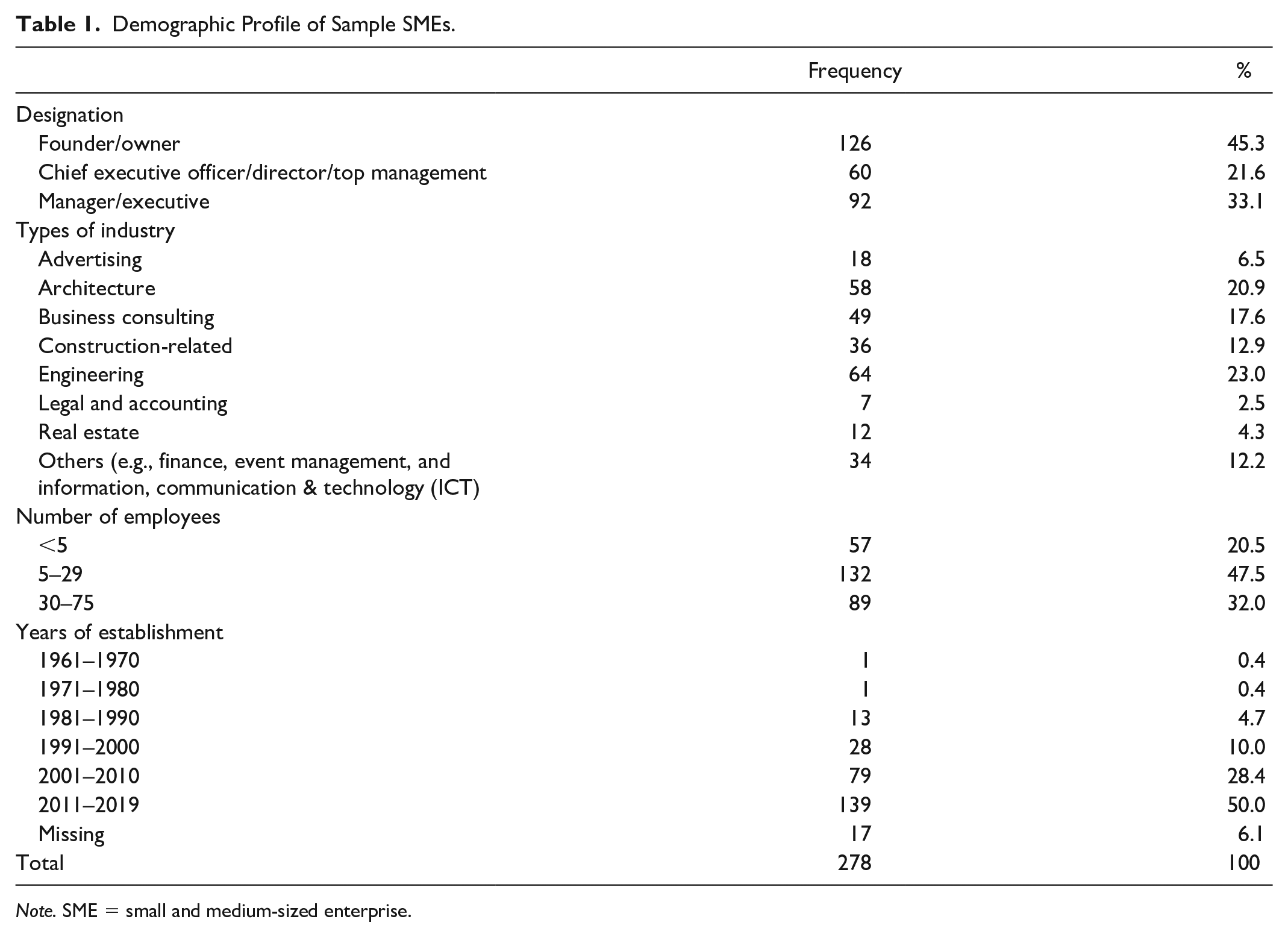
Note. SME = small and medium-sized enterprise.
Subsequently, we conducted structural assessments for the model, which indicated that lateral collinearity was not an issue as all of the constructs recorded VIF scores of less than 3.3 (Diamantopoulos & Siguaw, 2006). The coefficient of determination (R2) for all of the constructs were also found to exert moderate and substantial explanatory power (Cohen, 1988), whereby entrepreneurial orientation registered an R2 of .392, innovative service offerings (R2 = .546), marketing capability (R2 = .237), and technological capability (R2 = .138). The effect size (f2) of all of the constructs indicated an effect size of either small, medium, or substantial (Cohen, 1988). The model of the study also showed predictive relevance (Q2), whereby entrepreneurial orientation showed a Q2 of 0.216, innovative service offerings (Q2 = 0.384), marketing capability (Q2 = 0.133), and technological capability (Q2 = 0.088).
The results of the path coefficient analysis indicated that the link between KBHRM and innovative service offerings was positive and significant (β = .188, t = 3.189, p < .01), thereby providing support for H1. The results also indicated that KBHRM positively and significantly influences entrepreneurial orientation (β = .628, t = 17.020, p < .01), marketing capability (β = .487, t = 9.914, p < .01), and technological capability (β = .371, t = 6.707, p < .01), hence supporting H2a, H3a, and H4a. The dynamic capabilities also showed positive and significant relationships with innovative service offerings, whereby the result for entrepreneurial orientation was β = .139, t = 1.845, p < .05; marketing capability, β = .192, t = 2.832, p < .01; and technological capability, β = .394, t = 6.379, p < .01, which support H2b, H3b, and H4b. The results of the path coefficient assessment of the hypotheses appear as in Table 2.
Path Coefficient Assessment.

Note. CI = confidence interval; KBHRM = knowledge-based human resource management; ISO = innovative service offerings; EO = entrepreneurial orientation; MC = marketing capability; TC = technological capability.
p < .05. **p < .01.
Concerning the mediation effect assessment, the outcomes of the analysis showed that dynamic capabilities, namely, entrepreneurial orientation, marketing capability, and technological capability exerted mediating effect on KBHRM–innovative service offerings relationships, whereby the result for entrepreneurial orientation was β = .088, t = 2.006, p < .05; marketing capability, β = .094, t = 2.802, p < .01; and technological capability, β = .146, t = 5.101, p < .01, thereby providing support for H2, H3, and H4. The respective outcomes of the mediation effect assessment appear as Table 3.
Mediation Assessment.

Note. CI = confidence interval; VAF = variance accounted for; KBHRM = knowledge-based human resource management; EO = entrepreneurial orientation; ISO = innovative service offerings; MC = marketing capability; TC = technological capability.
p < .05. **p < .01.
Discussion
The research framework of our study was validated by the data collected from internationalizing business service SMEs from Malaysia. This study has shown that the framework is applicable within the context of service SMEs despite the association of SMEs with unstable labor market conditions as compared with the larger firms (Belfield, 1999). In this regard, our framework is cognizance of the challenges that the SMEs may face with regard to employees’ turnover and posited that these challenges could be addressed by creating a conducive knowledge-based work environment involving aspects such as training and development, compensation and benefit, as well as employee relations to nurture and retain the human capital (Choi et al., 2014), which reflect the key features of KBHRM. When KBHRM practices are being directed toward developing dynamic capabilities such as entrepreneurial orientation, marketing capability, and technological capability, competitive advantage (innovative service offerings) may follow.
Underpinned by the Resource-Based Theory, our study adds to the literature by positing that KBHRM as a resource contributes to competitive advantage creation (innovative service offerings). This study suggests that service SMEs need to invest in building human capital by utilizing KBHRM, which is over and above the normal HRM practices. This will enable the SMEs to tap on the relevant expertise, capability, and experience of their human capital from the point of recruiting talents to providing specialized training, charting a clear career path, as well as implementing compensation schemes that commensurate the knowledge-based nature of the jobs. The result of our study is consistent with Kianto et al. (2017) who viewed KBHRM as key in enhancing organizational knowledge that will lead to innovation performance, or in the context of the current study, innovative service offerings. Considering the area is still nascent (Kianto et al., 2017), the empirical evidence from this study has narrowed the chasm concerning the effect of KBHRM on innovation outcomes.
Essentially, service SMEs need to invest in building human capital by utilizing KBHRM. One of the ways to implement KBHRM is by developing a clear KBHRM guide that cuts across all HRM activities with the involvement of all stakeholders to ensure buy-in and smooth implementation. This is key in light of the investments that need to be made in coming up with programs for career development, training, and compensation schemes. For instance, in the recruitment and selection process, emphasis need to be given to the relevant expertise, learning development ability, and the ability of potential candidates to collaborate in various networks. Meanwhile for training and development activities, opportunities must be given to employees to deepen and expand their expertise through tailored training programs according to their specific needs. Likewise, the creation and application of knowledge need to be given higher weightage in performance assessment and compensation.
Our study also contributes to literature by enriching research on the interplay of KBHRM with dynamic capabilities, namely, entrepreneurial orientation, marketing capability, and technological capability. In this regard, we find empirical support on the positive association between KBHRM and entrepreneurial orientation. Essentially, KBHRM supports the creation of entrepreneurially orientated human capital by linking the skills, knowledge, experience, creativity, and ideas of the human capital with the exploration of market opportunities which necessitate the human capital to be proactive, innovative, and risk-taker. This finding is concordant with the view of BarNir (2012) that human capital prognoses entrepreneurship. In terms of the link between entrepreneurial orientation and innovative service offerings, we find that service SMEs that are proactive, innovative, and willing to take risk are able to generate more innovative services relative to their competitors, which is in line with the view of Bello et al. (2016).
Our study also advocates the importance of KBHRM in creating marketing capability. Essentially, the building of marketing capability among business service SMEs requires the implementation of KBHRM. This is in line with the key role played by human capital in dealing with customers, which becomes an essential point of collecting information and feedback as suggested by Ahmed et al. (2014). In a way, our study indicates that marketing capability is crucial for gaining market insight, capturing the changing needs of customers, as well as addressing any issues that may arise. This is in consonance with Ahmed et al. (2014) and Li and Deng (2017). We also find support concerning the positive link between marketing capability and innovative service offerings. In this regard, ownership of marketing capability is crucial to enable the service SMEs to utilize knowledge about customers, competitors, and markets in coming up with innovative service offerings. This finding is concordant with Weerawardena et al. (2014) that the propensity to innovate among service firms is expected to increase in parallel with the increase in marketing capability.
Empirical support from our study also points toward the importance of KBHRM in creating technological capability. Our study indicates that human capital enhances technological capability by enabling the service SMEs to gain knowledge and experience in acquiring, utilizing, and managing technology. This finding is in consonance with the view of Ali et al. (2017) that human capital improves technological capability. In relation to technological capability and innovative service offerings, this study suggests that technological capability is positively associated with innovative service offerings. In this regard, our study found that the sample SMEs encouraged the generation and implementation of innovative ideas as well as the capability and capacity to acquire, use, and manage technologies in their efforts to bring innovative solutions to the markets. This finding supports the view of Chatterjee (2017) and Teece (2018) that technological capability increases operational efficiency and facilitates the creation of innovative services.
This study also extends knowledge on KBHRM by establishing a mechanism of translating KBHRM into innovative service offerings. Essentially, the mechanism requires dynamic capabilities, namely, entrepreneurial orientation, marketing capability, and technological capability. In other words, the implementation of KBHRM will need to be complemented by equipping human capital with dynamic capabilities. This finding is in consonance with Ray et al. (2004) who were sanguine that a resource in itself will not contribute to competitive advantage, and will need to be complemented by dynamic capabilities to create sustainable competitive advantage (Teece, 2018). The findings on the mediating effect of dynamic capabilities on KBHRM–innovative service offerings relationship also contribute to the literature concerning the use of specific capabilities considered as dynamic, namely, entrepreneurial orientation, marketing capability, and technological capability. The use of these constructs to operationalize dynamic capabilities is in accordance with Al-Aali and Teece (2014) and Teece (2016).
In this regard, our study suggests a mediating role of entrepreneurial orientation in the relationship between KBHRM and innovative service offerings. This reflects the importance of managing human capital by encouraging them to be innovative, proactive, and risk-taker to generate more innovative ideas. Among the possible steps that could be taken by the SMEs include offering attractive incentives for every new innovative service introduced by their employees, as well as recognizing employees who have successfully challenged the status quo in seeking out new opportunities for the firm. The mediating effect of entrepreneurial orientation on the relationship between the exogenous and endogenous variables is consistent with prior studies, for example, Bello et al. (2016) and Pinho and Prange (2016).
With regard to marketing capability, our study suggests that the human capital of the firm needs to be managed and equipped with the knowledge and understanding of the overall business ecosystem including in subjects pertaining to customers, competitors, and institutional settings to facilitate the generation of innovative ideas. The significant mediating effect of marketing capability in our study provides support to the study conducted by Krasnikov and Jayachandran (2008) who found that marketing capability enhanced innovative service offerings. Essentially, our study found that marketing capability provided platforms for the service SMEs to actively engage their customers, competitors, and supply chain networks, which enabled them to gain insight on how best to come up with services that were innovative. In this regard, investment in KBHRM that is directed toward building marketing capability may include setting aside some budget for employees’ participation in exporting events, encouraging employees to form networks with employees from larger firms, as well as rewarding employees who have successfully met the sales targets with attractive incentives.
We also find empirical support on the mediating role of technological capability in the relationship between KBHRM and innovative service offerings. That is, innovative ideas are facilitated by the use of technologies that are either internally built or externally sourced. This reflects the necessity for firms to institute KBHRM in their organization to improve their capacity to acquire and utilize knowledge and technologies to create and deliver innovative services. This is particularly crucial in light of the nature of technology which changes rapidly, hence the need for firms to keep pace with the changing technology and continuously update their technological capability. On this front, our study’s finding resonates with Chatterjee (2017) who posited that technological capability is embodied in human capital and is key for influencing innovation outcomes. In fact, substantial investment in technological capability is crucial in light of the current study’s finding. In this regard, any plans made by the SMEs to acquire new technologies must be accompanied by investment in KBHRM that is directed toward building capability and capacity to use the newly acquired technology. For example, when procuring a new technology such as building information modeling (BIM) system, service SMEs in the construction industry could incorporate a clause in their procurement contract about sponsored training, attachment program, or on the job training from the supplier firm.
Theoretical and Managerial Implications
The study is aimed at testing theories, namely, Resource-Based Theory and Dynamic Capability View. Essentially, our study suggests that ownership of resources, as suggested by the Resource-Based Theory, will not be sufficient to create competitive advantage for internationalizing service SMEs. KBHRM as a resource will need to be carefully designed toward establishing dynamic capabilities to create innovative service offerings, in line with the Dynamic Capability View. In an area that is regarded as still at its infancy stage (Kianto et al., 2017), this article has narrowed the literature gap in the Resource-Based Theory by establishing that KBHRM is a key resource for creating innovative service offerings in light of business service SMEs’ high dependency on people and knowledge (Holmlund et al., 2016; Quader, 2007). Essentially, human capital needs to be managed well (Camacho & Rodríguez, 2005) to ensure growth and performance of firms (Radulovich et al., 2018). In this regard, our study has lent a voice to business service SMEs from a developing country concerning the factors that drive innovative service offerings in light of the scant evidence in the literature focusing on service SMEs (Radulovich et al., 2018). The emphasis on service SMEs in the current study also brought interesting insight to the literature due to their usual association with limitation of resources (Martin et al., 2017), knowledge management (Durst & Edvardsson, 2012), and innovative capability (Boratyńska, 2016).
In addition, our study extends the KBHRM concept by providing empirical evidence from the perspective of service SMEs of a developing country. While the KBHRM concept is not a new concept, its relationship with the development of capability and innovative service offerings have yet to be investigated. As a key takeaway from our study, service SMEs need to invest in instituting KBHRM that is directed toward building the dynamic capabilities of their employees to ensure innovative service offerings can be created. This is pertinent for service SMEs which require competitive strategies to obtain competitive advantage and ensure greater firm performance.
Our study also extends the KBHRM concept by providing a mechanism in which KBHRM can be translated into innovative service offerings through the mediating effect of dynamic capabilities, namely, entrepreneurial orientation, marketing capability, and technological capability, conforming to the Dynamic Capability View (Al-Aali & Teece, 2014). This study reaffirmed the view of Deng et al. (2020) and Ray et al. (2004) who were sanguine that a resource in itself will not contribute to competitive advantage, and that it needs to be complemented with dynamic capabilities to create competitive advantage (Teece, 2018). Our research also extends Dynamic Capability View by operationalizing it with the use of entrepreneurial orientation, marketing capability, and technological capability (Al-Aali & Teece, 2014), which otherwise have thus far been approached at the latent construct level (Prange & Pinho, 2017).
Concerning managerial lessons, our study highlights the importance for service SMEs to institute KBHRM in their organization to ensure that they get the right human capital who are capable of contributing to competitive advantage creation. In this relation, the knowledge-centric process of KBHRM will enable the SMEs to tap on the right talents and create a conducive knowledge-based work environment through training and development, performance assessment, and compensation. However, this is just the first step as what is more critical for these SMEs is to continue to invest in building firm-specific dynamic capabilities to enhance their competitive edge in any market, which includes those that transcend their national boundaries. In this regard, SMEs need to institute KBHRM as well as build their human capital by investing in building dynamic capabilities, particularly entrepreneurial orientation, marketing capability, and technological capability. This will enable the SMEs to inculcate the knowledge culture in their organization which encourages the generation of ideas that will lead to the creation of innovative service offerings.
Among others, SMEs could develop their entrepreneurial orientation by creating an internal environment that is supportive of new ideas and creativity among employees. For instance, SMEs could introduce incentive schemes to acknowledge the contribution of employees for every new idea which has been successfully implemented. Windows for network building with parties external to the SMEs should also be opened widely to make the human capital of the firm to be aware of the realities, opportunities, as well as threats in their business environment. This will enable the firm’s human capital to be more vigilant and receptive to new ideas as well as inspire them to challenge the status quo in finding new and better ways of providing innovative services. In terms of marketing capability, the SMEs may need to send their employees to participate in various export development programs, which include international exhibitions and trade fairs, to build networking and connections with potential customers. This will enable the employees to improve visibility and build rapport with potential customers that will facilitate the bidding of future projects. In light of SMEs’ limited resources, network with employees from larger firms should also be encouraged. With regard to technological capability, SMEs must be open to new technologies available in the market that facilitate the creation and delivery of innovative services. In this regard, service SMEs need to invest not only in acquiring new technology but also in building the capability and capacity to use the newly acquired technology. In a way, training provision to build the capability and capacity to use as well as manage the acquired technology in the long term must be made a standard clause in technology procurement contracts.
From the policy perspective, the current study is at an opportune juncture to inform policymakers as to the specific areas that they could do to facilitate the growth and performance of SMEs. These include the formulation of new policies, or tweaking the existing ones to create conducive business environment for business service SMEs that will enable them to create innovative service offerings. For instance, policy tools such as regulatory framework and taxation need to be supportive of the industry efforts to institute KBHRM in their organization, investment in building dynamic capabilities, as well as the generation and commercialization of ideas that will lead to more innovative outcomes.
Limitations and Further Research Directions
First, our study has limited ability in establishing causal and effect relationships between the predictor variables and innovative service offerings owing to the use of cross-sectional data. Nevertheless, the utilization of cross-sectional data is sufficient in establishing the relationship of the identified variables in the model. In this regard, future researches may use a longitudinal approach to establish the causal effect of the understudied variables. Second, caution must be exercised in applying the results of this study to other contexts and jurisdictions as the data of this study are based solely on a Malaysian context. Third, the model of the study explained about 55% of innovative service offerings, whereby 45% of innovative service offerings was explained by factors that are unknown. While the predictive accuracy of the model was found to be substantial (Cohen, 1988), it is pertinent to take into account other variables to improve understanding on innovative service offerings. In this relation, future studies on service SMEs’ innovation will need to take into account other factors such as foreign market knowledge (Bianchi et al., 2017), network (Jin & Cho, 2018), collaborative economies (Fehrer et al., 2018), industry 4.0 (Čaić et al., 2018), and green services (Guyader et al., 2019) to provide more empirical evidence that will contribute to greater comprehension of innovation outcomes among service SMEs.
Conclusion
To conclude, our study which is intended at investigating the influence of KBHRM in enhancing business service SMEs’ innovative service offerings revealed that KBHRM indeed directly and indirectly creates innovative service offerings. Our study also established the importance of dynamic capabilities namely, entrepreneurial orientation, marketing capability, and technological capability in translating KBHRM into innovative service offerings. In this regard, our study has narrowed the gaps in the literature and contributed to greater understanding on the roles and relationships between the identified variables which were underpinned by the Resource-Based and Dynamic Capability View theories. First, the study scrutinized the role and effect of KBHRM in a field which is still regarded as nascent. In this regard, the study revealed that business service SMEs could use KBHRM in attracting and building their human capital that will lead to the creation of innovative service offerings. Second, the study found that KBHRM alone would not be sufficient to create innovative service offerings, which necessitate the investment in building dynamic capabilities, namely, entrepreneurial orientation, marketing capability, and technological capability to translate KBHRM into innovative service offerings.
Footnotes
Appendix
Results of Formative Measurement Model: Multidimensional Construct.

| Higher order construct | Sub-dimensions | Convergent validity | VIF | Outer weight | t value | p value |
|---|---|---|---|---|---|---|
| KBHRM | KBHRMCom | 0.720 | 1.930 | 0.341 | 4.175 | .000 |
| KBHRMPerf | 2.102 | 0.089 | 0.984 | .326 | ||
| KBHRMRec | 1.882 | 0.432 | 5.627 | .000 | ||
| KBHRMTrain | 1.901 | 0.334 | 3.794 | .000 |
Note. VIF = variance inflated factor; KBHRM = knowledge-based human resource management.
Declaration of Conflicting Interests
The author(s) declared no potential conflicts of interest with respect to the research, authorship, and/or publication of this article.
Funding
The author(s) received no financial support for the research, authorship, and/or publication of this article.
