




Abstract
A more effective math education has never been more pressing than in today’s world. However, it is no mystery that students continue to struggle with basic mathematics concepts, let alone more advanced math such as Pre-Calculus. Thus, in the present study, two Pre-Calculus math classrooms were randomly assigned to either a flipped classroom model of instruction or one that employed traditional lecture. Data on two aspects of Pre-Calculus—matrices and vectors (operations and application)—were collected at pretest and again at posttest. Results revealed that students who were exposed to the flipped classroom model outperformed students in the control classroom but only on matrices items. We discuss implications and recommendations for math education.
Introduction
The flipped classroom is a relatively new trend in education where the traditional lecture-based model in Pre-K–12 education is inverted. Under the flipped model of instruction, acquisition of knowledge occurs outside the classroom while application of knowledge occurs inside the classroom. Introducing students to new content outside the classroom allows the teacher to spend class time assisting students in applying the newly learned information in active and engaging ways. The flipped classroom has been found in some circumstances to improve academic performance, increase engagement, promote critical thinking, and enhance attitudes, leading to the model becoming more prevalent in modern American classrooms (Guy & Marquis, 2016), albeit in other circumstances it has not been effective (Chen, 2016).
Although more educators are using the flipped model of instruction in their practices, there is a lack of research on the method’s impact in certain contexts. Specifically, there are few published studies on the effects of the flipped model in American high school math classes, and even fewer that analyze actual student performance (e.g., Clark, 2015; Hodgson et al., 2017). Yang et al. (in press), in their systematic review of the flipped classroom, point to several studies on the model, but a large majority of these studies were either qualitative, international, at the university level, or not in a strictly mathematics setting. Indeed, only one study reviewed by Yang et al. (in press) was in an American high school math class.
Despite the few available studies on the topic, more research is needed to help determine the effectiveness of the flipped model on student performance in American high school math classes. Therefore, the purpose of this study is to examine the effects of the flipped model of instruction in a high school Pre-Calculus class in a suburban school in Georgia focused on matrices and vectors (age ranges from 16–18 years). We compared data collected in both flipped and traditional settings in Spring 2019 from two Pre-Calculus sections. One section received instruction using the flipped model (experimental group) while the other received instruction using the traditional lecture model (control group). We collected student performance measures regarding matrices (operations and application) and vectors (operations and applications) at pretest and then again at posttest. Thus, we employed a quasi-experimental pretest–posttest design in which the two selected pre-existing classes were randomly selected to either experimental or control conditions.
Flipped Classroom Model of Instruction
Allison King’s (1993) work is often cited as seminal in the flipped movement (Kuppili & Venkatachelam, 2017). King (1993) accurately predicted that 21st-century learners would be expected to think for themselves and solve complex problems rather than rely on physical strength in factory jobs common in the former half of the 20th century. Consequently, students would need a model of learning where they could construct knowledge in the classroom under teacher guidance after initially learning content on their own. Although technology was not yet at a point where the flipped model would be practical, King laid the groundwork for future educators to flip their classrooms.
Several years later, Bergmann and Sams (2012a), themselves high school teachers, observed that students most needed educators to be physically present for personalized help with homework problems rather than provide content knowledge, as the traditional instructional model implies. For example, teachers employing the flipped model would pre-record lectures for students to view at home, thereby releasing actual class time to help students with concepts they did not understand and to more effectively model problem-solving skills, and thus, teacher support for these activities is more valuable than the simple provision of content knowledge. Bergmann and Sams (2012b) found that flipping their classrooms: (a) “spoke” the language of the modern student who is well-versed in technology use; (b) assisted busy students, especially those who were already struggling; and (c) allowed students of all math skill levels to excel. Their subsequent published works helped reveal their flipped classroom successes to a wider audience, leading more teachers, schools, and districts to attempt this method (Bergmann & Sams, 2013a, 2013b, 2014). Virtually nonexistent before Bergmann and Sams, as of 2016, it is estimated that 16% of American teachers currently employ flipped classrooms, with 35% of teachers desiring training on the model (Flipped Learning Global Initiative, 2016).
Self-regulated learning (SRL) theory posits that learning outcomes are a product of cognitive, metacognitive, and motivational components. Thus, SRL provides the necessary skills and strategies for successful learning and performance (Barak, 2010). Several models of SRL have been proposed in the literature. For instance, Zimmerman (2000) described SRL as a cyclical process involving three parts: (a) forethought (e.g., goal setting, strategic planning, self-efficacy beliefs, and intrinsic motivation), (b) performance and volitional control (e.g., attention focusing, self-instruction, and self-monitoring), and (c) self-reflection (e.g., self-evaluation, attributions, and self-reactions). Boekaerts (1999) proposed a three-layer model of SRL, including (a) regulation of the self-choice of goals and resources, (b) monitoring of processing methods (i.e., the use of metacognitive knowledge and skills to direct one’s learning), and (3) regulation of processing modes (i.e., the choice of cognitive strategies).
All these models agree that learning is regulated by a variety of dynamic interacting and cyclical cognitive, metacognitive, and motivational factors (Butler & Winne, 1995). With respect to the present study, we argue that the flipped classroom model of instruction enhances students’ SRL skills, which subsequently improves their performance. This enhancing effect of SRL skills on performance during learning is well documented among children (Gutierrez de Blume, 2017), adolescents (Dent & Koenka, 2016), and young adults (Gutierrez & Schraw, 2015).
Content Introduction and Application Methods
There are many ways that teachers can employ flipped classrooms. Common methods for transmission of knowledge outside of the classroom include lecture videos, PowerPoints, and screencasts that the teacher provides. These methods can be considered viable options to access instructional materials because they support a self-directed, student-centered approach to learning (Burke & Cody, 2014). Lim and Wilson (2018) assert that lecture videos created by the teacher can be a particularly effective way to introduce content in a flipped setting. Teacher-created videos ensure consistency between videos and allow the teacher to customize the video’s content while teaching at a level that is best suited for the teacher’s specific students (Lim & Wilson, 2018).
In-class activities in a flipped classroom focus on application of the newly learned content and ideally promote active learning. Roehl et al. (2013) note that incorporation of active learning strategies is critical in reaching today’s students. Audience response (e.g., clicker questions), pair-and-share activities, student presentations, group projects, problem-solving questions, and discussions have all been found to be effective flipped classroom activities that promote active learning and meet the needs of various learning styles (DeLozier & Rhodes, 2017; Rotellar & Cain, 2016).
Student Performance and Engagement
Several studies link the flipped model of instruction to increased student performance in various settings. Van Sickle (2016), for instance, compared the final exam scores of college algebra students taught using the flipped model with students taught using the lecture model to examine the flipped classroom’s influence on student learning. She found that the flipped method had a positive effect, with flipped students scoring nearly seven percentage points higher than traditional students on their final exams. Wilson (2013) also found an improvement in student performance when she flipped her introductory college statistics course after years of implementing the traditional lecture model. She looked at overall course averages and exam grades and compared the scores of students she taught using the flipped model with students she taught via lecture the previous year. She observed that flipped classroom students scored nearly 10 percentage points higher on their overall course grades and nearly seven percentage points higher on their exam grades than students in the lecture model.
In another study on the flipped classroom in a college statistics course, Nielsen et al. (2018) found that the flipped model resulted in improved student performance both overall and across various subgroups. Indeed, regardless of gender, teacher, American College Testing (ACT) score, high school grade point average (GPA), and level of learner autonomy, student performance improved in both course average and final exam average when instructed under the flipped model compared with the lecture model. Along a similar vein, Balaban et al. (2016) uncovered positive results when investigating student performance in a flipped college economics class; however, they explored more deeply than simply course or exam grades and examined performance on four types of questions: knowledge, comprehension, application, and ability to analyze. When comparing final exam grades, flipped students scored nearly seven percentage points higher than lecture students. When comparing question types, students in the flipped setting scored over four percentage points higher on knowledge and comprehension questions and over 10 percentage points higher on analysis and application questions, revealing that the flipped model had a significant impact on higher order thinking questions (Balaban et al., 2016).
Nevertheless, not all studies on the flipped classroom reveal a positive impact on student performance or engagement. Clark (2015), for example, observed high school algebra students in a flipped classroom to examine the effects of the flipped model on student engagement and performance. He compared the flipped students’ results on a teacher-created assessment with traditional students’ results and found that differences in the average scores were negligible. Likewise, DeSantis et al. (2015) found no significant difference in student understanding when comparing pre- and posttest scores between students in flipped and traditional settings. In addition, while examining student engagement in a flipped setting, Hodgson et al. (2017) examined three high school algebra classes taught under the lecture model for one unit and under the flipped model for a subsequent unit. They placed multiple observers in the classrooms to look for pre-determined on-task behaviors and found that only one of the three flipped classes showed a noticeable improvement in student engagement whereas the other two did not (Hodgson et al., 2017).
Advantages of the Flipped Classroom
One advantage of the flipped model is the convenience with which students can learn new content. Palacios and Evans (2013) argued that the flipped model allows students to study at the place, time, and pace that suits their individual schedules and needs, enabling them to be active, autonomous, and self-regulated learners when it is convenient for them. In their study on the effectiveness of the flipped model in an undergraduate audiology course, Berg et al. (2015) stated that a majority of students reported that they liked being able to access materials at their convenience as well as the unlimited availability of accessing the materials. This can be particularly helpful for slower learners, as it offers them the opportunity to pause, rewind, and review materials at their leisure (Lim & Wilson, 2018).
Disadvantages
When implementing a flipped classroom, one common disadvantage mentioned by teachers was dealing with students who did not view instructional materials outside of class (Bergmann & Sams, 2012a; Chen, 2016; Gough et al., 2017; Jaster, 2017; Kelly & Denson, 2017). This not only put the unprepared students at a disadvantage, but the prepared students also lost personalized instructional time while the teacher spent class time updating the unprepared students. Bergmann and Sams (2012b) suggest remedying this by having a computer in the classroom so unprepared students can view the materials in class.
Another disadvantage presented by the flipped model is that it devalues face-to-face Socratic teaching (Guy & Marquis, 2016). Altemueller and Lindquist (2017) even call attention to the concern that the model devalues the role of the teacher. When introduction to a new concept is done in the classroom, there is the potential for interactive engagement with the teacher that is not possible under the flipped model. While questions can be answered in class the next day, students do not have immediate access to the teacher during the exposure stage and can have many unanswered questions while trying to learn, limiting initial understanding.
Accessibility is another issue that arises with the flipped model. If the right technology is not in place, is unaffordable, or supported, the flipped classroom can be useless (Elkins & Pinder, 2015). Students who come from families that cannot afford sufficient technology or data plans would come to school without having seen any videos, thereby placing them at an enormous disadvantage. Altemueller and Lindquist (2017) point out that schools with larger lower-income populations have tried to remedy this by delivering content before or after school in the library or a classroom.
Defining the Problem
Research on the flipped classroom shows the approach to have various levels of effectiveness on both student performance and student perceptions. Several studies find the flipped model improves student performance (Balaban et al., 2016; Nielsen et al., 2018; Van Sickle, 2016; Wilson, 2013) and perceptions (Buch & Warren, 2017; Wilson, 2013). Yet others find that flipping the classroom has no effect on student performance or engagement (Clark, 2015; Hodgson et al., 2017), and it results in less favorable perceptions (Jaster, 2017; Van Sickle, 2016). However, there is a dearth of research on the impact of the flipped model in an American high school math setting. Hence, the primary goal of this research is to provide more empirical data on the flipped classroom’s impact in this setting to help policy makers, district and school administration, and teachers make more informed decisions.
The Present Study
Research question and hypothesis
This research will be guided by the following question:
Method
Participants, Sampling, and Research Design
This study employed a quasi-experimental pretest–posttest design. The participants for this study were students in two sections of the primary researcher’s Spring 2019 Pre-Calculus course at Flipped High School (a pseudonym) in suburban Georgia. Students were assigned to these sections by Flipped High School’s registrar. Assignment to a section was based upon a student’s specific schedule needs. If there were multiple sections offered at the same time, the registrar randomly assigned students to a section but made sure the number of students in each section was balanced.
The primary researcher had three sections of Pre-Calculus in the 2018–2019 school year. A convenience sample was used in the selection of two of these three sections for this study. One of the primary researcher’s sections had a noticeably smaller number of students (17) than the other two (28 and 32). In addition, the sections that were selected were in session during the same time on alternate days; Flipped High School employs an even–odd block scheduling system where students have an even schedule and an odd schedule that meet every other day. A convenience sample was deemed the most appropriate selection strategy due to the similarities in the sections’ class sizes and meeting times. A random number generator was used to assign one section to be taught under the flipped model of instruction and the other under the lecture model. The section with 28 students was assigned to be the experimental group and the section with 32 students was assigned to be the control group.
This study used the data from the 22 students in the experimental group and 22 students in the control group who turned in all consent forms and were present for both the pretest and the posttest. Table 1 illustrates the breakdown of demographics for participants in the experimental and control groups.
Demographic Information by Group.

Note. GPA = grade point average; ED = economically disadvantaged; IEP = individualized education program.
Contextualizing Math Performance
Students at Flipped High School have performed below the State level in their Coordinate Algebra and Analytic Geometry End of Course (EOC) exams. These are the only state-wide standardized math assessments administered at the school. According to the Georgia Department of Education (GADOE, 2019) in the 2017–2018 school year, the most recent year data are available, only 11.6% of students in Coordinate Algebra and 16.7% of students in Analytic Geometry scored at the proficient level or higher on the EOC. These percentages are lower than the state level, where 32.5% of Coordinate Algebra students and 32.2% of Analytic Geometry students scored at the proficient level or higher (GADOE, 2019).
It is important to note that the primary researcher was also the instructor for both sections. Consequently, to avoid potential bias, a colleague of the researcher gave each student a unique random number that was not known to the researcher. Students completed both assessments using this number, ensuring that the researcher did not know specific student results during the research period. Furthermore, participants were informed that participation in the study as well as pretest–posttest performance would not affect their course grade.
Attrition and Retention
Because Pre-Calculus students at Flipped High School were assigned to teachers for the entire year, attrition was not a major issue with this research. Students remained on the researcher’s roster throughout the research period. No student moved from the school district, was expelled, or was removed from a section roster for any reason.
Materials
Assessments
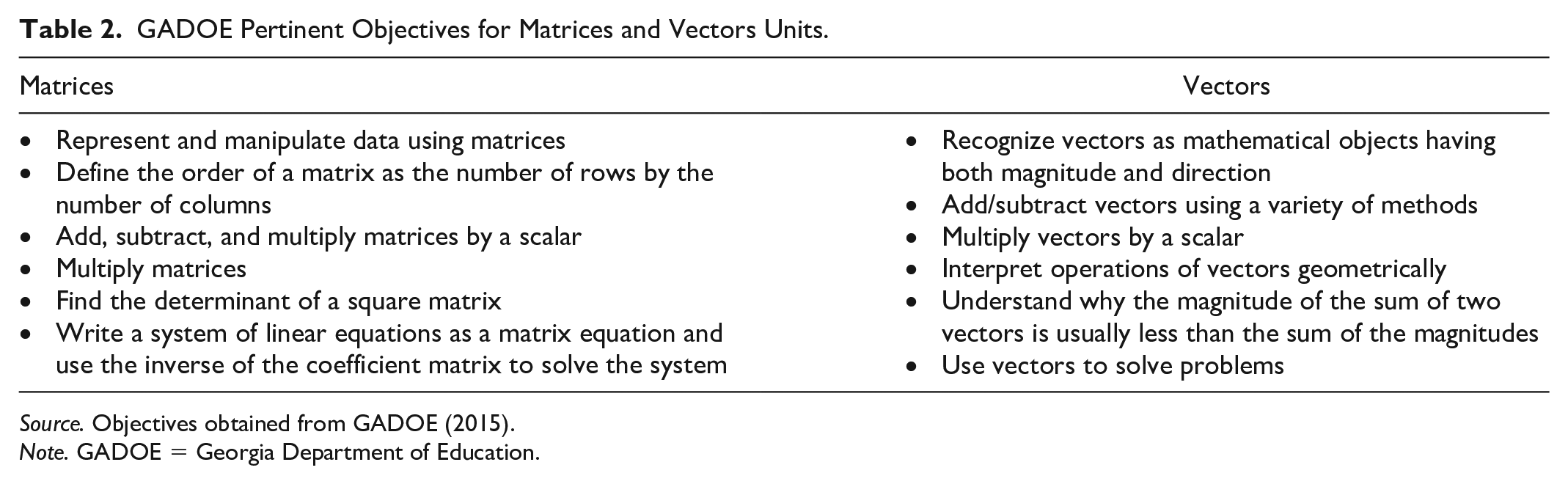
The pretest and posttest questions were created by the researcher to assess the objectives listed by the GADOE in the matrices and vectors units. We chose these two aspects because students are expected to learn this content in high school in the United States. These pertinent objectives are listed in Table 2. The pretest and posttest were identical, and both groups were given the same test. The tests contained both computation and application types of questions. Computation questions had students perform straightforward operations, such as adding two vectors or multiplying a matrix by a scalar. Application questions required students to apply their knowledge of the content in real-world situations. Students were asked, for example, to calculate a hiker’s total displacement using vectors. Modified versions of sample real-world application problems from the GADOE frameworks were included in the tests.
GADOE Pertinent Objectives for Matrices and Vectors Units.
Source. Objectives obtained from GADOE (2015).
Note. GADOE = Georgia Department of Education.
The assessment contained eight matrix operation problems, three matrix application problems, five vector operation problems, and four vector application problems for a total of 20 problems. Each assessment was graded by the researcher. Answers were marked as either correct or incorrect, and one point was awarded for a correct answer. Thus, we combined the matrices and vectors items (operations and application for both) into two composite outcomes, which we labeled matrices and vectors. Subsequently, the raw scores for the outcomes were converted to percentiles to facilitate interpretation. The assessment is included as supplementary material.
Reliability and validity
The instructor-made test contained questions that addressed the GADOE objectives listed in Table 2. Some of the test questions were based on questions found in the GADOE frameworks, which were created to satisfy the written unit objectives. Thus, the tests effectively measured what the GADOE considers appropriate Pre-Calculus content. Internal consistency reliability coefficients, Kuder–Richardson (KR) 20 formula, for items with dichotomous responses were matrix operations = .71 and vector operations = .69 at pretest; and matrix operations = .74 and vector operations = .72 at posttest.
Instructional materials
Students in both groups were given a packet of notes for the unit that was created by the primary researcher. The packet included vocabulary terms, explanations, and sample problems covering the matrices and vectors content. The videos used for the experimental group were a combination of researcher-created videos and videos from the educational website Khan Academy (used with permission). The videos created by the primary researcher featured him working through various problems from the packet. Each video was between 5 and 10 min long. They were subsequently uploaded to YouTube and posted to ItsLearning, a platform used by Flipped High School where students can access course materials. Access to the instructional videos was the only difference in materials between groups; only students in the experimental group were able to access the videos.
Procedures
University institutional review board (IRB) approval was secured prior to any data collection activities (IRB Approval No. H18161). All students in both sections took the assessments and received instruction according to their group’s treatment, but participation was optional and contingent upon receiving a signed permission form from both the participant and his or her parent/guardian. Participants were given a minor’s assent form and parent permission form requesting their permission to include the participant’s assessment scores in this study. Participants were given the option of turning in their consent forms to the researcher or to a colleague of the researcher so there would be no undue pressure to participate. Participants and their parents/guardians were informed that involvement in this study would not affect the participant’s grade in the class.
Prior to the instructional period, students in both groups were given the pretest to create a baseline score. Over the following 2-week period, students received instruction over matrices and vectors according to their group’s treatment. Students in each group started each class period with the same activating activity that featured problems involving the previous day’s lesson. This was often three to four simple problems. Likewise, each class was given the same summarizing strategy at the end of class, such as a ticket out the door where students briefly summarized what they learned. In addition, identical practice problems were given to each group to reinforce the content. Students in the experimental group, however, were able to work on and complete these problems in class with the teacher present while students in the control group did not have much class time to work on the problems, and thus, completed them at home.
Upon completion and review of the activating strategy, students in the control group were introduced to new content via lecture in class. Although the lecture covered the same material as the experimental group’s videos, it often took longer to cover the material due to common day-to-day classroom interruptions, such as the primary researcher having to answer any clarifying questions or address off-task behavior. It would typically take 20 to 25 min to cover the content of an 8-min video. After completion of the lecture, the remaining class time was devoted to working through practice problems, both individually and in groups. When working individually, students would look through their notes to help them work through the practice problems. When working in groups, the instructor would place students in heterogeneous groups based on formative assessment scores. In both individual and group work, the primary researcher would circulate the room and check for understanding. There would typically not be much class time for students in the control group to complete the practice problems, and therefore, they had to complete them after school for homework. The practice problems were graded twice a week.
By contrast, students in the experimental group were instructed to view the instructional videos prior to coming to class. The researcher reserved the first 5 to 10 min after the activating strategy to answer any clarifying questions students may have had after viewing the videos before having students work through practice problems either individually or in groups. The structure of the individual and group work was identical to the control group, but students in the experimental group had much more class time to do the work and would typically be able to complete the work before the end of the period. The time released by having students learn the material outside of class allowed the primary researcher to work through more in-depth, application style problems with the class. After the instructional period, the posttest was administered to both groups.
Data Analysis
Preliminary analyses
Prior to data analysis, data were tested for requisite statistical assumptions and screened for outliers. The data met the normality assumption—all skewness and kurtosis values were less than the absolute value of 2. Data also met the homogeneity of error variance assumption (Levene’s Test p-values were all greater than .05). Furthermore, because one student was classified as gifted and one classified as a student with special educational needs (see Table 1), we analyzed the data with and without these two individuals to ensure they did not unduly influence results, and thus, potentially bias findings. However, the results of the analyses with and without these two students were not significantly different (p = .56), and hence, we included them in all subsequent analyses to maximize statistical power. Finally, no extreme outliers were detected that would otherwise undermine the trustworthiness of the data. Therefore, all main analyses proceeded with all 44 cases with complete data.
We conducted a 2 (experimental condition: flipped instruction model, control) × 2 (type of test: pretest, posttest) factorial mixed-model (between-subjects and within-subjects) multivariate analysis of variance (MANOVA). The various question types—matrices and vectors—served as the dependent variables. The Bonferroni adjustment to statistical significance was used to control for the familywise Type I error rate inflation for the univariate omnibus results and all post hoc comparisons. All effect sizes for the factorial mixed-model MANOVA results were reported as partial η2 (
Results
Establishing Group Equivalence at Baseline
Prior to proceeding with data analysis, group equivalence was evaluated for all math performance outcomes at baseline. Significant differences among groups on pretest math performance would point to the need to statistically control for that variable. However, a series of independent-samples t test revealed no statistically significant differences between the experimental and control groups on pretest matrices and pretest vectors performance (all p values ≥ .11). Therefore, all analyses proceeded as planned.
Main Analyses
There was a statistically significant Experimental Condition × Type of Test interaction, multivariate F(2, 41) = 6.21, p = .004,
Univariate results revealed statistically and practically significant findings for the Matrices Experimental Condition × Type of Test interaction, F(1, 42) = 12.68, p = .001,
Simple contrasts with the Bonferroni adjustment to the p value revealed that within type of test, the experimental group exhibited significantly greater matrices performance at posttest when compared with the control group,
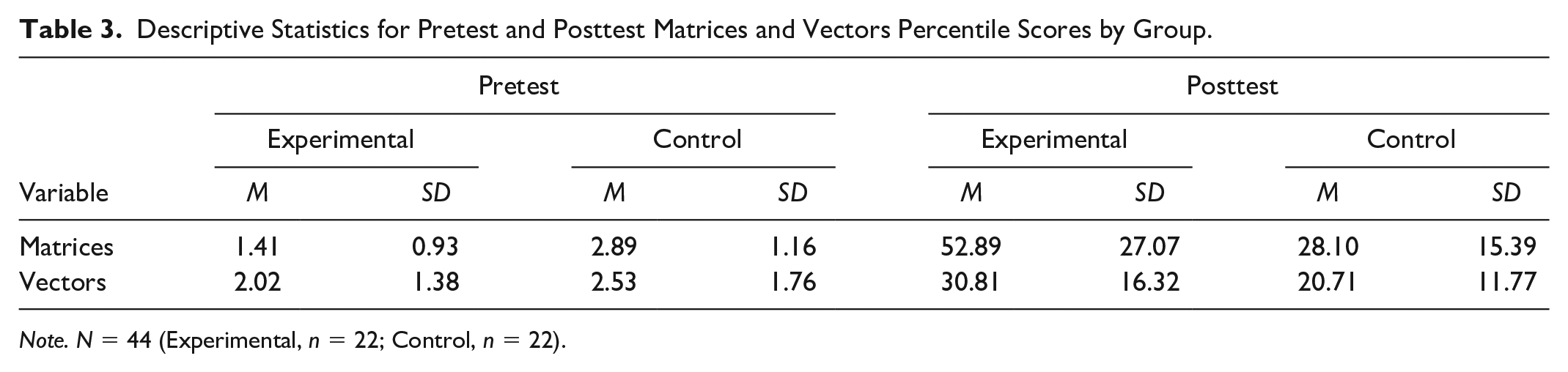
The main effect of experimental condition showed that the experimental group exhibited more proficient matrices performance when compared with the control group. The main effect for type of test indicated that both groups demonstrated math performance growth for matrices and vectors, albeit the growth was larger for the experimental group across both outcomes (see Table 3 for descriptive statistics).
Descriptive Statistics for Pretest and Posttest Matrices and Vectors Percentile Scores by Group.
Note. N = 44 (Experimental, n = 22; Control, n = 22).
Discussion
Findings from the study indicate that the flipped model of instruction shows promise regarding Pre-Calculus math performance in matrices and vectors. However, our hypothesis received only partial support from our findings, as group differences favoring the flipped classroom model existed only for matrices performance but not for vectors performance—for both the Experimental Condition × Type of Test interaction and the group main effect. Moreover, both groups exhibited growth from pretest to posttest regarding matrices and vectors performance, complicating substantive interpretation of the findings. Nevertheless, the growth experienced by the students in the flipped classroom was much larger from a practical standpoint (i.e., effect size) on both outcomes than that experienced by the students in the control group, which has a significant bearing on the meaningful implication of our study.
Overall, our study tentatively demonstrates that the flipped classroom model of instruction has the potential to positively affect student math performance in matrices (operations and application) in a high school math setting. Presumably, introducing new content outside of the classroom while going more in depth with the content inside the classroom can be an effective instructional method for high school math classes, at least as it pertains to matrices. The results of our study are consistent with the findings of previous research (e.g., Balaban et al., 2016; Nielsen et al., 2018; Van Sickle, 2016; Wilson, 2013). This series of studies, like ours, provided empirical evidence suggesting that students taught under the flipped model show more growth in math performance than students taught under the traditional lecture model, albeit ours only showed this conclusively for matrices, not vectors. It is important to note, however, that other research that has not found positive effects on performance of the flipped classroom model of instruction (e.g., Altemueller & Lindquist, 2017; Elkins & Pinder, 2015; Kelly & Denson, 2017) was incongruent to our own.
The discrepancies between student performance on matrices and vectors could be explained by the pre-requisite knowledge required to solve some of the vector questions. Students in both settings seemed to struggle in vector questions involving trigonometry. Right triangle trigonometry is content that students are introduced to prior to Pre-Calculus. Even though students in the experimental group (i.e., flipped classroom) performed better on average in both types of vector questions, their deficiencies in trigonometry could have prevented them from scoring at a statistically significant level. Conversely, the results may be due to differences in the conceptual nature of the two topics—that is, matrices at this level can be learned procedurally whereas vectors require much more conceptual understanding before students gain a basic grasp. The primary researcher could have provided a brief video remediating right triangle trigonometry along with the instructional materials to refresh students on this pre-requisite knowledge. This confounding effect of prior knowledge in math-related topics has been documented in previous studies (e.g., Fyfe et al., 2019; Mack, 1995).
Implications for Math Education
The depth and accessibility of technology in the 21st century allows today’s students to quickly and easily access information. This study tentatively showed that the flipped classroom model can be a viable option that can be effectively and efficiently implemented in a high school math classroom. Learning new math content can be a struggle for many students, but the flipped classroom allows students to be introduced to new content on their own time and pick it up at a pace with which they are comfortable. This is congruent with findings from previous work (Berg et al., 2015; Buch & Warren, 2017; Palacios & Evans, 2013; Wilson, 2013).
The flipped classroom model of instruction can also aid teachers in providing differentiation for students of different learning levels. Some students, for instance, might need basic learning materials or a refresher on pre-requisite content to do well with the new content. Conversely, other students might find the instructional materials very simple and could benefit from more in-depth and real-world applications of the content. The flipped model provides a method for teachers to be able to meet the needs of a diverse group of learners (Altemueller & Lindquist, 2017; Bauer & Haynie, 2017).
However, we would like to caution practitioners who fully rather than partially adopt the flipped classroom model of instruction. Although the flipped method was shown to be effective for matrices (but not vectors), students who do not view the materials before coming to class are at an enormous risk of falling behind. Simply because students should be viewing materials outside of class does not always mean that they will. Hence, the flipped model of instruction should be supplemented with training on digital citizenship to better prepare students to utilize their digital devices for productive, educational advancement rather than purely for social networking purposes and also to avoid the potential pitfalls of cyberbullying (e.g., Ribble, 2012; Ribble & Gerald, 2004). When introduction of new content is almost exclusively conducted outside of the classroom under the flipped model, it would be very difficult for students who are not prepared to learn much.
Even though the present study spanned only 2 weeks of treatment (i.e., the flipped classroom model of instruction), findings tentatively demonstrate that this model of instruction can be effectively implemented even in shorter periods of time than in previous studies on this topic. This tentative conclusion is especially utilitarian for in-practice classroom teachers who have limited time in their daily curricula to implement additional activities.
Recommendations for Future Research
Future research on the flipped model should consider implementing similar methods in various settings and with different math content. This study showed that the flipped model could be effective in a high school math class to improve matrices performance, but it was limited to one high school, one teacher, one classroom, and a small content area of one course. Future research could include schools in different demographic areas, such as more urban or rural areas. Teachers of different age and education levels could also be examined. In addition, content areas outside of matrices and vectors should also be explored under the flipped model. Qualitative studies using student think aloud protocols or interview data would also be informative to supplement any quantitative data, as would be mixed-method studies. The latter in particular would provide a more complete snapshot of the phenomenon under investigation.
Finally, future research should investigate the effects of the flipped model in courses of different levels, such as an accelerated, advanced placement; a special education inclusion; or repeater class. Math students can be a very diverse group of learners; math comes easy to some students while some students struggle with math throughout their educational careers. Quantitative data on the effectiveness of the flipped classroom in this area could help determine if the flipped classroom can be beneficial to students of different learning levels.
Limitations
Sample size
One limitation to the study was the sample size of 44, 22 per group. Even though the sections used for the experimental and control groups were equal in size, the dynamics of a high school class can vary from class to class. One section, for instance, can be assigned more students who have historically been prone to off-task behavior than another section, which not only hinders the understanding and performance of the off-task students, but also impairs their classmates’ ability to focus and learn.
Time
The small instructional period of only 2 weeks also limited our ability to reach more conclusive findings. Some students may have needed more time to adjust to the flipped model of instruction. Conversely, some students may have become complacent and lackadaisical after an extended period under the model. The primary researcher, however, had a limited window in which to conduct the study and collect data.
Math proficiency
Flipped High School’s low levels of math proficiency also limited the generalizability of this study. Although students taught under the flipped model showed more growth than students in the control group in matrices performance, their group’s mean score on the posttest was still under 50%, showing that on average, students could not demonstrate proficiency in over half of the assessed topics. However, the school in which the research occurred approximated the State’s math performance scores.
Despite the various limitations of our study, we wish to underscore two strengths. First, the research occurred in an ecologically valid setting (i.e., in actual high school math classrooms) rather than the contrived setting of a laboratory, and hence, our conclusions are more contextually valid. Second, we employed a robust research design—quasi-experimental pretest/posttest—and thus, the internal validity of our study, particularly as it pertains to the validity of our conclusions, is much stronger than non-experimental, cross-sectional descriptive designs.
Conclusion
This study shows that the flipped classroom can effectively be implemented in a high school math class. Although the age group, content levels, and implementation periods were all limited, there is promise that educators and students can both benefit from a flipped classroom. Educators have a model that can allow them to go more in depth with their content while students have opportunities to learn at the level and pace with which they are comfortable. Thus, the flipped model of instruction can successfully be implemented in ecologically valid settings to improve math instruction and student performance in some aspects of math, as our study tentatively shows.
Supplemental Material
sj-pdf-1-sgo-10.1177_2158244020982604 – Supplemental material for A Pilot Study on the Effect of the Flipped Classroom Model on Pre-Calculus Performance
Supplemental material, sj-pdf-1-sgo-10.1177_2158244020982604 for A Pilot Study on the Effect of the Flipped Classroom Model on Pre-Calculus Performance by Jeffrey D. Spotts and Antonio P. Gutierrez de Blume in SAGE Open
Footnotes
Declaration of Conflicting Interests
The author(s) declared no potential conflicts of interest with respect to the research, authorship, and/or publication of this article.
Funding
The author(s) received no financial support for the research, authorship, and/or publication of this article.
Ethical Statement
This research was reviewed and approved by the Georgia Southern University Institutional Review Board (Approval No. H16182).

Supplemental Material
Supplemental material for this article is available online.
References
Supplementary Material
Please find the following supplemental material available below.
For Open Access articles published under a Creative Commons License, all supplemental material carries the same license as the article it is associated with.
For non-Open Access articles published, all supplemental material carries a non-exclusive license, and permission requests for re-use of supplemental material or any part of supplemental material shall be sent directly to the copyright owner as specified in the copyright notice associated with the article.
