




Abstract
There are previous studies in the literature conducted on the effect of play-based math activities on the mathematical skills, language, and cognitive development of preschool children. However, the number of studies conducted to determine the effect of play-based math activities on different areas of development in preschool children was too few. The purpose of this study is to investigate the effect of play-based math activities on different developmental areas (personal-social, fine motor, language, and gross motor development) of children 48 to 60 months of age. The pretest/posttest quasi-experimental research design with control and experimental groups was employed in this study. The research group of this study is composed of 45 children 22 of whom (10 girls and 12 boys) were in the experimental group and 23 (10 girls and 13 boys) in the control group. Denver II Developmental Screening Test was used as the data collection tool. As a result, it was determined that there was a significant difference between the subscales and pretest-posttest total scores concerning personal-social, fine motor, and language areas in the experimental group, while there was no statistically significant difference in the gross motor subscale. In addition, it was observed that there was statistically no significant difference between pretest–posttest scores concerning personal-social, fine motor, language, gross motor subscales and total scores of the control group. The result revealed that play-based math activities have a positive effect on personal-social, fine motor, language, and gross motor developments of children. Further studies can be planned to investigate the effects of play-based mathematics education integrated with different activities where children can have fun and be physically active on children’s developmental areas.
Introduction
Play is the leading figure among the activities that the children enjoyably perform and the basis of physical, social, mental, and emotional development of the child and has the function of a bridge among their cognitive, affective, and kinetic developments. Within the preschool period, play presents an active learning environment. According to Uğurel and Moralı (2008), play is an indispensable part of life for children. According to Xu (2010), play is not a structure that waste time, but rather contributes to the development of the individual’s mental, affective, social, and psychomotor skills.
Through the play, children can acquire affective features such as self-confidence (Susüzer, 2006) and they can better express themselves, realize their talents, and develop social-cognitive skills (Gmitrova et al., 2009). It is accepted that a child, whose needs for play is met, is healthy in terms of physical and mental aspects (Hirose et al., 2011). It is known that the characters of children who can cooperate with their friends and comply with the rules of the games develop positively during the play (Saracho, 2001).
The period in which the fastest development is observed in children is between 0 and 6 ages. It is also vital in terms of gaining motor, social, emotional, cognitive, language, and personal care skills with features that will guide children in the future (Akman, 2002). In preschool period, the skills that children have affect their mental development. Educational activities offered with different techniques accelerate children’s learning skills. The interaction of parents with the child at home, the teacher’s interaction with the child at school, and the learning methods offered to children with different techniques positively affect their learning skills.
From past to present day, play is indispensable in human life, and it starts with life, develops, and transforms according to the needs and interests of the age; moreover, it is one of the most important communication tools that supports to control and express emotions (Tuğrul, 2010). In other words, play is the most important language, in which the children can express themselves both verbally and physically. While playing, children live within the play through their feelings and thoughts, and the play creates a world for them. By the help of the play they develop communication with their peers (Yıldız, 1999).
This study was planned according to the play-based learning model. According to the play-based learning model, the plays/activities are thought to contribute to the development as a whole. It is also stated that these plays and activities are an integral part of the child’s life. For example, some children play games by making-living, some by listening, and others by seeing. Therefore, teachers should include plays at every stage of the educational process, starting with preschool education, and they should support and create a pedagogical environment for the child (Aksoy, 2014; Koçyiğit et al., 2007). Play is a serious task for children. Therefore, children learn and discover the world through plays (Güneş, 2015). Recently, plays have been utilized for effective and permanent learning and the approach of “learning with plays” is spreading gradually within the field of education (Cohrssen et al., 2013; Cutter-Mackenzie & Edwards, 2013; Nolan & Paatsch, 2018; Pyle & Danniels, 2017; Robertson et al., 2018; Sumsion et al., 2014). Within the approach of learning through plays, it is aimed to enable children to actively participate in the educational activities and learn by enjoying. It is useful for developing children’s skills such as problem solving, cognitive exercises, focusing on, and being interested in the activities (Güneş, 2015). In addition, it teaches to find the way to reach the right from mistakes by trial and error method. Also plays are an effective way of making mathematics entertaining.
Mathematics is used almost in every part of the daily life and it is very important because it takes place in a major part of human life. In daily life, mathematical concepts are always encountered. For example, mathematical concepts are used during the expression of time, cooking, and watching football matches (Karakuş & Akman, 2017). In the daily life, in order for the harmony within the child, it is necessary to have the skills such as concepts of problem solving, one-on-one correspondence, classification, ordering, counting and scales, as well as mathematical thinking (Tural, 2005). Accordingly, it is necessary to introduce math activities to the children at an early age. The education of math provided for the children in preschool period will be the first step for developing positive attitude toward mathematics in their future life. The mathematical concepts are not congenital knowledge for the children; as a result of the informal experiences, they become aware of several mathematical skills. The children must acquire mathematical concepts starting from the preschool period because basis of the sophisticated mathematical concepts they will learn in the following years are constituted by the fundamental concepts they acquire within this period. In addition, the education of mathematics is very important for the mental, creativity, logic, and problem-solving skills development and for learning to think (Karakuş & Akman, 2017). “Math talk” and other math activities provided via parents/caregivers are performed prior to the preschool and is important for math development (Susperreguy & Davis-Kean, 2016).
Teaching through play method, which is one of the active learning approaches (Şahin, 2005), has recently been used in the education of mathematics as it is in many other fields (Özgenç, 2010). This method is effective especially in terms of acquiring and consolidating mathematical concepts (Altunay, 2004) and eliminating the biases (Pesen, 2003). Methods like the use of creative material and play-based activities, making small or cooperative group studies, showing the relations of mathematics with the daily life, and emphasizing the operations and concepts are recommended for avoiding the anxiety for mathematics in children or decreasing the existing anxiety (Alkan & Altun, 1998; Bekdemir et al., 2004; Dodd, 1992; Ramani & Scalise, 2018; Scalise et al., 2017).
The children learn through plays by recognizing themselves and the environment. Another activity included within the preschool period is math activities. Mathematics is a discipline which has a wide field of study functioning over arithmetic, geometry, equation, size and volume, mass, graphic, and numbers. Math skills can be defined as recognizing and thinking mathematical symbols, perceiving mathematical operations, understanding the relation between them, generalizing the operation in itself, and showing features like flexibility in mathematical operations and reaching out solutions in different ways (Güven & Balat, 2006). In preschool period, while children are studying on math activities, they also study for supporting the improvement of other developmental areas in addition to cognitive development such as having an opinion about math, developing problem-solving skills, recognizing operations, measuring, interpreting, and making guesses (Wortham, 2006).
In a study conducted by Koç (2017), it was stated that preschool teachers thought that mathematics education in preschool period was important and that this education was effective in gaining mental development and basic skills.
Preschool teachers can ignore doing mathematics education when they think that they are not able to carry out math activities in harmony with applications that can support children’s development (Karakuş et al., 2019). National Association for the Education of Young Children (NAEYC, 2008) and National Council of Teachers of Mathematics (2000) state that to promote early mathematics education, mathematics education should be a priority in the preschool education program and should be conducted in accordance with the practices that support children’s development (NAEYC, 2008).
Preschool activities include math activities. However, these studies are generally carried out in the form of preparation studies of reading-writing from the books in a stereotyped manner. In this study, it was ensured that children were included in the activity by leaving these patterns; considering the characteristics of this age group and the fact that they like to play a lot, it is emphasized that more playful math activities are taken into consideration. Presenting both plays and math activities in a concentric and entertaining way, which will draw the children’s attention through concrete materials, and including the children in the activities more actively accelerate learning and ensure the stimulus to be more active.
In the literature, there are studies on the effect of play-based math activities on the mathematical skills, language, and cognitive development of preschool children (Akkuş Sevigen, 2013; Çelik & Kandır, 2013; DeGroot, 2012; Hanline et al., 2008; Karaman, 2012; Şirin, 2011; Taşkın, 2013; Tuğrul & Çatlı, 2005; Türkmenoğlu, 2005; Vogt et al., 2018; Yıldız, 1999; Yılmaz Bolat and Dikici Sığırtmaç, 2006; Young & Loveridge, 2004). However, the number of studies conducted to determine the effect of play-based math activities on different areas of development in preschool children was too few. It is thought that this study will fill this gap. Therefore, the purpose of this study is to investigate the effect of play-based math activities on different developmental areas (personal-social, fine motor, language, and gross motor development) of children 48 to 60 months of age. Accordingly, this study is to answer the following research question: Is there a significant effect of play-based math activities on personal-social, fine motor, language, and gross motor developments of children 48 to 60 months of age?
Method
Research Design
In the study, a quasi-experimental quantitative design, including a pretest–posttest and experimental–control group, was used to assess the effect of play-based math activities on different developmental areas (personal-social, fine motor, language, and gross motor development) of children 48 to 60 months of age. Experimental design in a study, cause and effect under the control of the researcher to reveal their relationship, to be observed is the research model in which the requested data are produced (Büyüköztürk et al., 2017; McMillan & Schumacher, 2010). The purpose of quasi-experimental is same as the experimental design. One of the main differences between quasi-experimental and true experimental models is that the participants in the control and experimental groups are not taken into an artificial environment and are included in the study in their natural environment (Ekiz, 2003; Karasar, 2006). Therefore, children in the experimental and control groups are included in the study in their own classroom settings. However, it was determined randomly which group was the experimental group and which group would be the control group. In addition, the pretest averages of the two groups in different development areas obtained from the Denver Developmental Test are considered to be equivalent.
The Study Group
The research group consisted of 48- to 60-month-old children (X = 54.02, SD = 3.43), who attended a nursery school in Nilüfer district of Bursa province, in 2017. Considering that the children within the control group would be affected even indirectly from the math activities to be performed, the children for the control and experimental groups were chosen from the same school but from different classrooms. The research group of this study comprised 45 children 22 of whom (10 girls and 12 boys) were in the experimental group and 23 (10 girls and 13 boys) in the control group. The motive behind the unequal number of children in the experimental and control groups is that all children in the classroom were included in the study. The mean age of the children in the experimental and control groups was examined. Mean age of the girls in the experimental group was 53.8 months and in the control group was 53.5 months. Mean age of the boys in the experimental group was 53.3 months and in the control group, it was 51.4 months. The mean age values were similar.
The school where the experimental and control groups were attending was a kindergarten comprising children of families with similar sociocultural characteristics.
Data Collection Tools
Denver II Developmental Screening Test was developed for 0- to 6-year-old children by Frankenburg et al., in Denver, USA, and was first introduced in 1967 (Frankenburg & Dodds, 1967). Denver II Developmental Screening Test, which can be applied through a certificate based on a certain education and which was developed for following the developments of the healthy children between 0 and 6 years of age, was used as the data collection tool in the research.
The adaptation and standardization of the test for healthy Turkish children aged 0 to 6 years were performed by Anlar et al., in reliability tests in Turkey; it was evaluated simultaneously by more than one evaluator as 10 children from different age groups. When the test results of the same children were compared with a maximum of 5-day intervals, the inter-rater compatibility did not fall below 90% and the test–test compatibility did not fall below 86% (Anlar & Yalaz, 1995). This test has been used since 1967 and continued to be used after being standardized in 2007 by Hacettepe University Medicine Faculty Child Neurology Department. Thus, Denver II Developmental Screening Test was enabled to be used with its revised version in the whole country (Yalaz et al., 2009). The test is used to support and evaluate education in preschool education institutions; to determine the level of skill appropriate to the age of the child, the appropriate development for the age of the child; and to reveal the developmental problems if any (Madan & Tekin, 2015; Tunçeli & Zembat, 2017; Yalaz et al., 2009).
Denver II Developmental Screening Test is a development test that compares the children with their peers. The test consists of 134 items collected in four sections on the test form to scan the areas of development. These are Personal-Social (21 items; for example, communicating with others, meeting individual requirements), Fine motor (33 items; for example, hand-eye coordination, using objects, problem solving), Language (42 items; for example, hearing, comprehension, language), and Gross motor (38 items; for example, sitting, walking, jumping, and general mobility).
At the end of the test, five items concerning the “Test Behavior” were filled by the individual, who administered the test. This test behavior is important in terms of evaluating how children use their behaviors and talents. While applying the test, the adult, who recognizes the child well (mother-father-teacher, etc.), is supposed to accompany the child in the room. The exact age of the child is determined and it is approved by the adult. By this way, the age line is determined and drawn. In each section, proceeding toward right side of the items, it is continued to give items until “fail” area. The scoring of the item is expressed as Pass (P)–Fail (F)–No opportunity (NO)–Refusal (R). To obtain fine results, the test must be repeated after a while. The responses for the questions concerning each sub-item are interpreted and then the interpretation of the whole test is made (Yalaz et al., 2009).
The Denver II Developmental Screening Test was preferred for this study owing to the factors such as it is directed to various areas of development, the appliers of the test had adequacy and certificate for using the test, the variety of the materials, the number of questions asked for the age line was not high, the test duration is short (15–20 min), and there is an adult with the children with whom they feel safe and secure. Considering the items of the test, it is thought that the items-based materials and activities prepared by the educationalists would support the development areas of the children.
Planning and Application of Play-Based Math Activities
Math activities are very much included in the Turkish preschool education system. However, these studies are generally carried out in the form of stereotypes, worksheets, and readiness to read and write. In this study, the children were included in the activity by coming out of these patterns. In addition, taking into consideration the characteristics of this age group and considering that they like to play games, math activities are emphasized. Mathematics has a very important place in human life and there is a lifelong learning in this sense. Considering this age range in children, it is the period when the foundations of mathematics are started to be laid. However, supporting with concrete learning will affect active learning. At this stage, concrete learning comes into play. For this, children need to be actively involved in learning. For this reason, math activities were combined with play and drama and children were drawn into learning.
While preparing play-based math activities, the Ministry of National Education-Preschool Education Curriculum was utilized. The acquisitions and indicators regarding supporting all areas of development of the children were determined. While preparing play-based activities, ages, developmental needs, and interests of children were taken into consideration. Prepared activities were elected in line with the gains in Turkey Preschool Education Program. On the basis of the acquisitions and indicators, 14 play-based math activities were prepared. To understand that the prepared activities were chosen correctly, first of all, expert opinion was taken from two academicians working in the fields of preschool education and child development and education. After the approval of the experts, implementation of the activities was started.
Play-based math activities
The names of the 14 play-based math activities prepared are as follows: We Know The Blue Color (play and math integrated large group activity), Which Fruit Let’s Know (play and math integrated large group activity), We Know The Figures (Turkish, play and math integrated large group activity), Which One Is Not Here (play and math integrated large group activity), I Know The Figures (play and math integrated large group activity), What Can I Get With My Money? (art, play, and math integrated large group activity), We Learn Weighing (play and math integrated large group activity), Where Are I Order (art, play, and math integrated large group activity), My right-my left (play and math integrated large group activity), Tiny Detectives At Work (play and math integrated large group activity), Single-Double (play and math integrated large group activity), I Play Bingo (play and math integrated large group activity), Colors And Tones (play and math integrated large group activity), and Pizza Seller (play and math integrated large group activity).
These activities, in which the children will express themselves confidently, develop their problem-solving skills, ability to work in groups, and their creativity, and they take place during the activity process with physical movements. As an example of the plans prepared, a play called pizza seller was used to provide children with gains for concepts such as piece-whole and number. While this study was carried out, the families also joined the play.
Another example is the acquisition of the single-double concept. Montessori materials were used in this activity. This activity was performed by using the scales, and through the play, it was ensured for the children to gain the concept. During the play, hats with numbers were worn by the children. The teacher then asked the children to draw a number (1-2-3-5-7-9-11-13 . . . in the bag). The child who drew the double number passed it to the teacher. When the music started, the children started to dance, and when the music stopped, they aligned the children in the class as single-pairs, looking at the hats on the heads of their fellow children, who drew the double number.
Instead of routinely making use of the book during the addition and subtraction, a mechanism was created in the classroom in which the water pipes were used. The pipes were placed on two sides, allowing the children to throw objects from the pipe, grasping the addition and subtraction and learning through play.
During the studies on money, the visuals of money were first examined and it was ensured that the children had an idea about the subject. Then, “iron-paper money,” “what-how many pounds” games were played with children’s money awareness was infused.
In another activity, the concept of figure was tried to be introduced through play. Primarily, it was focused on the shapes they knew. Then a table, a button, and a chair were put in place. Chairs were placed on the opposite side to ensure that the children watch as spectators. Each child was drawn a number from 1 to 22, and the children were taken to the table with the button. Children were told the rule of the game and each child was asked three questions. The boy who knew the answer pressed the button. For example, answers were received in the form of clues such as “there are three sharp tips, slightly different from other shapes?”. During the play, it was observed that the children both reinforced their knowledge on shapes and had great fun.
In addition, riddles, puzzles, sentence completion, and bingo cards were used in other activities. All of the materials that were used within the activities were prepared by the researchers. Through these materials, it was aimed to teach the factors that support all areas of development of the children such as drawing the attention of the children, feeling themselves within the activity, expressing their feelings and thoughts confidently, participating in the individual and group activities, participating in the physical activities, and perceiving mathematical concepts.
Procedure of Quasi-Experimental Research
The test consists of 134 items and four sub-dimensions, Personal Social (21/6), Fine motor (33/9), Language (42/10), and Gross Motor (38/9). However, when the ages of the children were calculated as months and the age line was drawn, a total of 34 items from four sub-dimensions were administered on children. To evaluate the developments of the children, Denver II Developmental Screening Test was applied as the pretest to the children within the experimental and control groups. Permission was obtained from both the institutions and the families before the children were tested. After obtaining the necessary permits, each child was taken to the room separately with an adult. The questions determined by age range were directed to children and families. After the pretests were performed, 14 play-based math activities were performed to the experimental group for 1 hr on 2 days of a week for 8 weeks, between April 10, 2017, and June 2, 2017. The children within the experimental group continued their educations within the context of the Ministry of National Education-Preschool Education Curriculum during the period without play-based math activities. On the other hand, the children in the control group continued their education within the framework of the Ministry of National Education-Preschool Education Curriculum. After completing the application of play-based math activities, “Denver II Developmental Screening Test” was applied to the experimental and control groups as the posttest.
The study was carried out with the children who had a normal development and who were attending preschool education institutions. The children were observed throughout the study. The test interval between the pretest and posttest was determined as 2 months since the children normal development were chosen for the research.
The Analysis of the Data
Within the analysis of the data collected with Denver II Developmental Screening Test, the responses for the subtests of personal-social, fine motor, language, and gross motor skills were put on SPSS table, and they were scored between 1 and 2, scoring as passed (P) 2 or failed (F) 1. After scoring every subtest in itself, the total score of the test was evaluated. Subsequently, the results organized in tables were interpreted. In the analysis of the data, Mann–Whitney U test was used to see the differences between the experiment and the control group and the pretest and posttest.
Ethical Considerations
Permission was obtained from the university responsible for the management of the kindergarten to conduct research. In addition, consent form was obtained from the families of the children included in the study group. Children, who did not want to participate in the study, as required by the principle of volunteering, were not forced to participate. Especially during applications done one-to-one with children, the convenience and comfort of children were considered.
After completing the posttest, the applications administered to the experimental group were applied to the control group as well. Hence, the positive effects of these activities were enabled to be utilized by the children within the control group.
Results
The findings obtained from the research were presented in tables and discussed using the literature data.
Within the analysis of the data collected through “Denver II Developmental Screening Test,” first it was examined whether the scores of the experimental and control groups indicated normal distribution (Table 1). As a result of the analysis, it was seen that the pretest and post test score averages of the experimental group indicated aberration/deviation (*p < .05). Therefore, the scores obtained from Denver II Developmental Screening Test subscales and total were evaluated with nonparametric statistics (Büyüköztürk, 2013; Ural & Kılıç, 2013). Under the light of this result, the significance of the difference between pretest and post test regarding the development between experimental and control groups was analyzed through the Mann–Whitney U test.
The Pretest Posttest Normality Test Results of the Children Within the Experimental and Control Groups Concerning the Denver II Developmental Screening Test.

p < .05.
Mann–Whitney U test was used to determine the differences concerning the developmental characteristics between the experimental and control groups (Table 2).
Mann–Whitney U Test and Standard Deviations of the Pretest Score Averages Concerning the “Denver II Developmental Screening Test Subscales” of the Children in the Experimental and the Control Groups.

p < .05.
When Table 2 is examined, it is seen that the experimental group pretest score average concerning the “Denver II Developmental Screening Test” was X = 28.12, and control group pretest score average was X = 28.93. It is concluded that there was not a significant difference between the score averages of the experimental and the control groups (U = 0.625, p > .05). Similarly, no statistically significant differences were found in other subscales (Personal Social Subscale [U = 0.513, p > .05]; Fine Motor Subscale [U = 0.532, p > .05]; Language Subscale [U = 0.142, p > .05]; Gross Motor Subscale [U = 0.201, p > .05]). As a result of the analysis, it was determined that experimental and control groups were similar in terms of developmental characteristics.
When Table 3 is examined, the subscale score averages of the children within the experimental group, to whom the play-based math activities were administered, concerning the Denver II Developmental Screening Test were as follows: personal social pretest score was X = 3.01, post test score was X = 4.29 (U = 3.97, p < .05); fine motor pretest score was X = 6.21, post test score was X = 8.71(U = 7.93, p < .05); language pretest score was X = 6.80, posttest was X = 9.46 (U = 8.11, p < .05); gross motor pretest score was X = 7.18, and post test score was X = 8.93 (U = 8.12, p > .05). While a significant difference was seen among experimental pretest and posttest personal social, fine motor, and language subscale score averages, a significant difference was not encountered in the gross motor subscale. Although the subscale score averages of the children within the experimental group were low before the education, it was seen that posttest subscale score averages of the experimental group were higher. This situation can be interpreted in a way that play-based math activities affect the development of the children in a positive way. Before applying play-based math activities, the traditional education models were applied to the children; however, with play-based math activities, the activities were supported with concrete and interesting materials and involved the children in the activity both in an active and enjoying way.
The Standard Deviation and Mann–Whitney U Test of the Pretest and Posttest Score Averages of the Children in the Experimental Group Concerning the Denver II Developmental Screening Test Subscales.

p < .05.
When Table 4 is examined, it is seen that the subscale score averages of the children within the control group, to whom the play-based math activities were administered, concerning the Denver II Developmental Screening Test were as follows: personal social pretest score was X = 3.18, posttest was X = 4.1 (U = 3.83, p > .05); fine motor pretest score was X = 7.11, post test score was X = 9.01 (U = 6.97, p > .05); language pretest score was X = 7.02, X = 8.91 (U = 8.01, p > .05); gross motor pretest score was X = 7.67, and posttest score was X = 8.71 (U = 7.82, p > .05). Although there was an increase in experimental pretest and posttest personal social, fine motor, language, and gross motor subscale scores, a significant difference was not detected.
The Standard Deviation and Mann–Whitney U Test Results of the Pretest and Posttest Score Averages of the Children Within the Control Group Concerning the Denver II Developmental Screening Test Subscales.

p < .05.
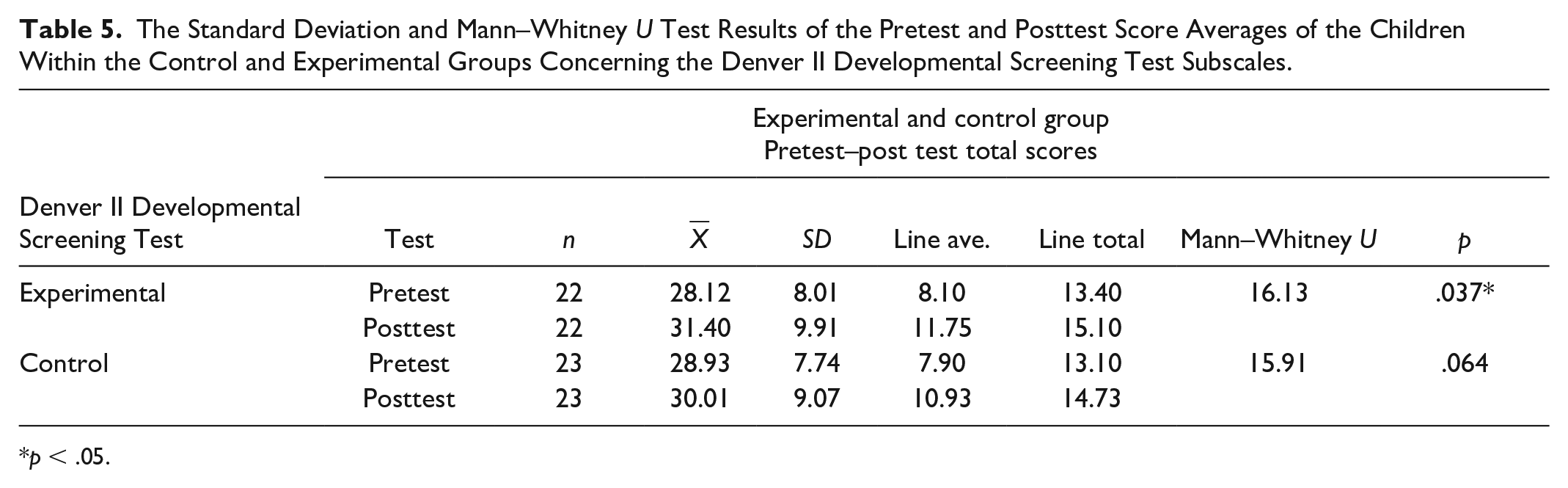
When Table 5 is examined, it is seen that the children within the experimental group, to whom the play-based math activities were applied, considering their Denver II Developmental Screening Test total scores, their pretest total score averages were X = 28.12, post test score averages were X = 31.40. There is a significant difference between experimental group pretest and post test score averages (U = 16.13, p < .05). Control group pretest total score average was X = 29.93, and posttest total score average was X = 30.01. There was not a significant difference between the pretest and posttest total score averages in the control group (U = 15.91, p > .05).
The Standard Deviation and Mann–Whitney U Test Results of the Pretest and Posttest Score Averages of the Children Within the Control and Experimental Groups Concerning the Denver II Developmental Screening Test Subscales.
p < .05.
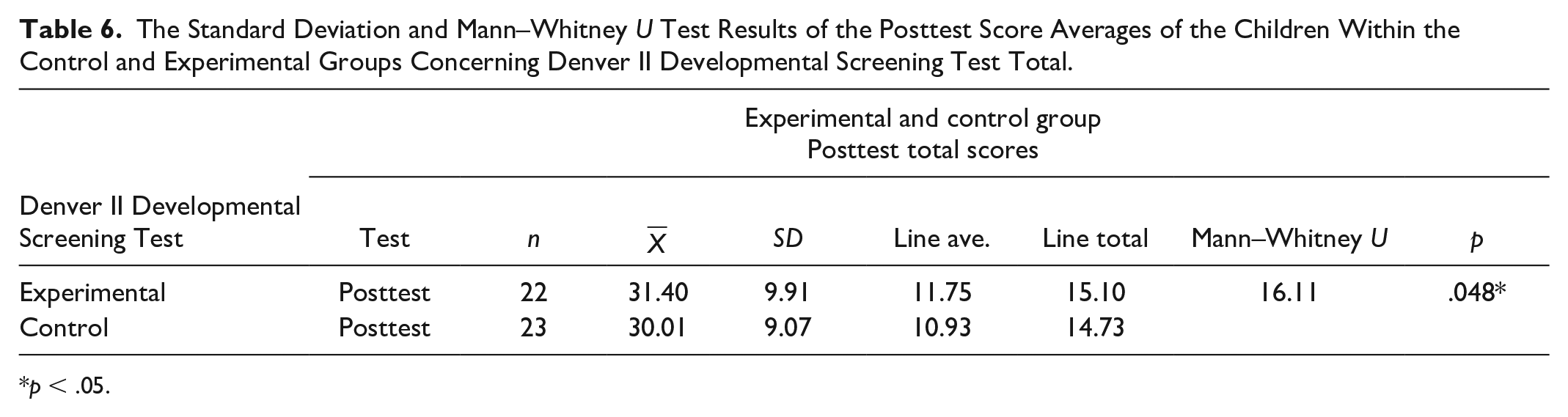
When Table 6 is examined, it is seen that the children within the experimental group, to whom the play-based math activities were administered, considering their Denver II Developmental Screening Test total scores, their post test total score average was X = 31.40, and control group post test score average was X = 30.01. There was a significant difference between the posttest total score averages of the experimental and control groups (U = 16.11, p < .05).
The Standard Deviation and Mann–Whitney U Test Results of the Posttest Score Averages of the Children Within the Control and Experimental Groups Concerning Denver II Developmental Screening Test Total.
p < .05.
Discussion and Conclusion
The main objective of this study was to investigate the effect of play-based math activities on different developmental areas (personal-social, fine motor, language, and gross motor development) of children 48 to 60 months of age. The result revealed that play-based math activities have a positive effect on personal-social, fine motor, language, and gross motor developments of children 48 to 60 months of age.
The reason of a significant difference in personal-social, fine motor, and language subareas concerning the experimental group can be explained by and the frequency of using materials like cubes, blocks, and so on and the acquisition of motor skills that require high fine motor skills such as drawing lines, holding a pencil, recognizing new words, realizing the features of the words like synonym-antonym, naming the words, using the language actively, and providing body control and coordination. In conclusion, it is seen that play-based math activities affect the development of personal social, fine motor, and language subareas of the children in a positive way.
It is thought that play-based math activities not only provide opportunities for children to learn several fundamental math concepts in a natural and entertaining way but also enable them to improve their language development through teaching new concepts. Similar studies have been found in the literature. In a research carried out by Taşkın (2013), it is stated that there is a positive relation between preschool teachers and language development through mathematics. Yıldız (1999) conducted a study on the effects of cooperative and traditional learning on the development of the fundamental math skills on preschool children. As a result of the study, it was concluded that the presentation of math activities supported with plays and other activities affect the fundamental mathematic skills in a positive way and support the areas of development. Ciancio et al. (1999) educated children at the age of 3.5 for 6 months with different play methods to teach Simple Classification and Sequencing Techniques. As a result of the study, they concluded that playing different and numerous plays affect the development of the children in a positive way and it created a significant difference on the sequencing-classification skills of the children. Dere (2000) employed a study with the children at the age of 6 attending preschool education institutions. Within the study, activities such as group plays, table activities, preparation to reading and writing with structured and traditional education for the acquisition of geometric shapes, and number concept were applied. As a result of the study, a significant difference was observed between the experimental group, in which structured activities were applied, and the control group, in which traditional activities were applied, in terms of developmental aspects. In another study conducted by Lambert (2001) to examine the skills of the preschool children and to measure how children use their thinking and problem-solving skills, five different activities were applied, particularly the play activities; throughout the study it was observed whether the children display attitudes such as recognizing the problem, restructuring, being insistent, individual interference, and planned study. As a result of the study, it was concluded that the math activities presented to children with plays and supportive activities affect the development of the children in a positive way. In another study (Yılmaz Bolat and Dikici Sığırtmaç, 2006) examining the effect of musical play activities in the acquisition of number and operation concepts of the children at the age of 6, who attend nursery school at low socio-economic level, it was concluded that there was a significant difference between the post test scores of the children within the experimental group and the post test scores of the children in the control group, and considering the development of the children, musical play activities affect the acquisition of number and operation concepts in a positive way in terms of cognitive development. As a result of this study, it was aimed to examine the effect of play-based math activities in children with 48 to 60 month of age, and whether presenting these activities through plays accelerates the learning of the children and affect their development in a positive way. Bates et al. (2013) investigated the reasons of early childhood pre-service teachers’ fear in teaching mathematics. As a result of the study, it was determined that they lacked confidence in their teaching skills, lack of knowledge in teaching methods, fear of not attracting the interest of students in activities, and lack of mathematical content knowledge. This result supports that they should be able to use different techniques in mathematics education when they become teachers.
Instead of doing math studies with activity books and copy papers to understand mathematical concepts, concrete experiences and play-based math activities and conversations about math during these activities increase children’s math skills (Ginsburg, 2009). Similarly, it is thought that play-based mathematics activities also contribute to children’s language and social development. Preschool teacher’s role here is to create educational environments that will allow children to talk about math and receive education through play-based math activities.
This study was carried out to examine the effect of play-based math activities on 48- to 60-month-old children. As a result of the study, while a significant difference was observed between the subscales and total scores of pretest-posttests concerning the personal-social, fine motor, and language of the experimental group, a significant difference was not seen in the gross motor subscale.
Dobbs et al. (2006) have determined that there is a relationship between math skills and social-emotional behavior. According to this research, there is a relationship between high math skills and self-control and commitment, and between poor math skills and comprehensive behavioral problems, internal symptoms, withdrawal, social problems, and attention problems. Karabon (2019) stated that the use of mathematics in early childhood classes provides opportunities for dynamic learning experiences, develops translation skills, and helps high-level mental functions with the potential to develop interpersonal skills and transform behaviors.
In Durualp and Aral’s (2018) research, it has been determined that play activities increase children’s fine motor and total motor development. In this study, it is thought that it provides the development of fine motor skills of children because it contains plays in play-based math activities.
In their study, Goyen and Lui (2002) determined that the plays suitable for the development of the child had a positive effect on the gross and fine motor skills of the children between the ages of 18 months and 3 to 5 years old.
According to Sawyers and Rogers (1994), educational math plays help children to improve their knowledge, social, and motor skills, while giving them the opportunity to express their feelings.
In addition, a significant difference was not seen between pretest–posttest personal-social, fine motor, language, gross motor subscales and total scores of the control group. Considering the fact that there is not a big difference between the score averages of the children in the control group, who were not involved in the education, and there is not a significant difference between the scores, it can be said that there was not much difference in the development of the children who have not experienced the play-based math activities. It is seen that there is not a significant difference in the total scores and control group pretest–posttest averages concerning the personal-social, fine motor, language, and gross motor subscales in terms of play-based math activities. The motive behind this reason can be the fact that math activities are presented to children with traditional education model, concrete materials are not included much, and the children are involved in the activities actively and in an entertaining way.
On the basis of the findings obtained from the study, various recommendations can be made to the researchers. Preschool education teachers should use plays at a higher rate when planning their math activities. In-service training seminars can be given to preschool teachers about the introduction and importance of the play-based learning approach. Teachers are required to choose plays with high-level educational features aimed at improving children’s developmental characteristics. Preschool teachers need more professional development and support in this regard. Therefore, it would be useful for teachers to attend training seminars for such plays. This study was conducted to examine the effect of play-based math activities on development of 48- to 60-month-old children. For further studies can be planned to investigate the effects of play-based mathematics education integrated with different activities where children can have fun and be physically active on children’s developmental areas. Planning play-based activities, a further study can be conducted on language activities. Early childhood educators should select purposeful and meaningful learning activities, such as play-based math activities for children. In addition, planning activities regarding social emotional area studies can be carried out to examine the effect of math activities regarding the social development of the children with younger ages.
Footnotes
Declaration of Conflicting Interests
The author(s) declared no potential conflicts of interest with respect to the research, authorship, and/or publication of this article.
Funding
The author(s) received no financial support for the research, authorship, and/or publication of this article.
