




Abstract
Mathematics is an important subject that plays a crucial role in constructing mental discipline among students. There has been a great focus on investigating students’ attitudes toward mathematics in higher education settings. The current study is aiming to explore the factors that affect attitudes toward math among higher education students in the United Arab Emirates (UAE). The Math Attitude Questionnaire MAQ was adapted from Prokop et al. to fulfill the study objectives. Gender and math course levels were the proposed variables that could influence students’ attitudes toward learning mathematics in six different dimensions. Data analysis demonstrated that higher education students in the UAE show a positive attitude toward math in most MAQ dimensions. The T-test for Independent Sample revealed that gender does not affect students’ attitudes toward learning mathematics. Moreover, the ANOVA test revealed that mathematics course levels have a significant impact on students’ attitudes toward math in the six dimensions of MAQ. The math instructor and equipment dimensions were found to have a significant effect on students’ attitudes among the students taking advanced math courses. The findings of this study could benefit the higher education system in the context of enhancing mathematics teaching and assessment.
Introduction
Learning is the process of gaining new knowledge in which individuals are engaged in various activities which results in relative behavior change. Learning mathematics is a dynamic procedure that requires preparation and readiness. Many students perceive mathematics as an exhausted and effortful subject that triggers fear and anxiety states (Arenillo & Cruzado, 2014). Measuring attitudes toward math is an interesting topic for many researchers (e.g., Asante, 2012; Escalera Chávez et al., 2019; Mata et al., 2012; Núñez-Peña et al., 2015). Students’ attitude toward mathematics is an essential component that contributes to students’ academic achievement. Many research studies (e.g., Bramlett & Herron, 2009; Mazana et al., 2019; Mensah & Okyere, 2019; Michelli, 2013; Mohamed & Waheed, 2011; Mohd et al., 2011; Yara, 2009; Zan & Martino, 2007) focused on examining the relationship between students’ attitudes toward math and their academic achievement. The findings of these research studies suggest a positive relationship between attitudes toward math and students’ academic achievement. Attitudes toward math could be influenced by many other factors such as math courses level and students’ gender. Kaiser-Messmer (1993) revealed gender-based differences between students’ attitudes toward math. Byun et al. (2015) conducted a research study to examine the impact of students’ achievement in the advanced math course and college enrollment and retention. Byun et al. (2015) revealed that students who are taking advanced math courses had immense attainment in math and supported their retention rate, which could explain a positive relationship between achievement in high-level math courses and the students’ intention to retain in the college or their major. As the relationship between students’ attitudes toward mathematics and academic performance has been studied broadly and based on Byun et al. (2015), this study hypothesizes that math course level could be correlated to students’ attitudes toward math, in addition to the assumption of gender-based differences in attitudes toward math. Thus, this study is designed to explore whether math course levels and gender are associated with students’ attitudes toward math in higher education institutions in the UAE. For this study, students’ math course levels are measured by the current math course the students are enrolled in, which is categorized into three different groups explained as follows; beginner refers to 100 level courses for the first year, intermediate indicates 200 and 300 levels for the second and third year, and advanced indicates 400 level for the fourth year. Attitude toward math is measured by the Math Attitude Questionnaire MAQ, which has been adapted from Biology Attitude Questionnaire BAQ created by (Prokop et al., 2007). As the research on this area in the UAE lacks, there is a need to investigate the factors that impact students’ attitudes toward math. The findings of this research paper will benefit the higher education sector in the UAE and help in designing strategic development plans to enhance students’ attitudes toward math to ensure achieving high performance in math. On the global consideration, the findings will be generalized over the higher education settings that are like the UAE as a country that includes a multicultural education environment.
Literature Review
Attitude Toward Math
Attitude as a term refers to “a psychological tendency that is expressed by evaluating a particular entity with some degree of favor or disfavor” (Eagly & Chaiken, 1993, p. 1). As explained by Maio and Haddock (2010), this definition describes attitude as deciding “liking vs. disliking, approving vs. disapproving, or favoring versus disfavoring a particular issue, object or person” (p. 114). Investigating the literature review of Attitude Towards Math (ATM) demonstrates the existence of many definitions to explain the concept of ATM. Kulm (1980, p. 358) stated that it is hard to find a clear definition of ATM that would be appropriate for all situations. According to Jovanovic and King (1998), attitude towards mathematics refers to the student’s readiness to perceive, think, sense, and act towards mathematics in an organized manner. As explained by Fonseca (2012, p. 3215) there is a set of essential dimension-based definitions:
Multidimensional definition: it considers three components; emotional response, beliefs regarding the subject, and behavior related to the subject. Thus, ATM is perceived as the emotions that an individual links with mathematics, which results in developing a positive or negative value and forms a human attitude and behavior (Hart, 1989).
Bi-dimensional definition, where behaviors can be found implicitly: As suggested by Daskalogianni and Simpson (2000), ATM is perceived as a set of exhibited thoughts, beliefs, and emotions toward mathematics.
Unidimensional definition: describes ATM as a positive or negative influence conditioned with a particular field of study, it is all about developing certain perception about mathematics.
Attitude towards mathematics is a crucial factor that was examined by many researchers (e.g., Brezavšček et al., 2020; Elçi, 2017; Mazana et al., 2019). Mata et al. (2012) found that high school students are identified with a generally positive attitude towards math. In addition, students’ achievement in math is influenced greatly by their attitudes. It was found that students’ attitudes towards mathematics affect students’ learning process and their academic performance (Brandell & Staberg, 2008; Heilbronner, 2013). When metacognitive awareness was linked to attitude towards mathematics, it was found to impact students’ achievement (Ajisuksmo & Saputri, 2017). The related literature revealed the scarcity of studying students’ attitudes towards math. Tapia and Marsh (2000a) indicated that there is not enough focus on the students’ attitudes towards mathematics, even though remarkable attention was given to students’ performance, mistakes, and test scores. The continuous efforts of researchers brought attitude towards math into researchers’ attention. The endless work of the researchers promoted measuring math attitudes. For instance, Tapia and Marsh (2002) developed the Attitudes Towards Mathematics Inventory (ATMI) to measure students’ attitudes towards mathematics. ATMI was initially administered to a sample of high school students. Exploratory factor analysis was performed to reveal the reliability of the items of the scale (ATMI), then the researchers conducted the study on college students and the scale showed validity for implementation within higher education students. Lim and Chapman (2015) conducted a quasi-experiment to examine the impact of employing history as a supportive tool on students’ mathematics achievement within grade 11 students. The impact of history was measured through three domains: attitudes, anxiety, and motivation. Findings indicated that employing history in teaching mathematics affected students’ achievement positively, in addition to the significant multivariate design influences students’ attitudes and motivation towards mathematics. Karjanto (2017) researched attitude towards mathematics within college students enrolled in a Foundation Year Program at Nazarbayev University. Results revealed that students showed a positive attitude towards mathematics. Yee (2010) measured the attitudes towards mathematics and achievement in relation to students’ motivations. Results showed a positive attitude towards mathematics with extrinsic motivations to do mathematics although the extrinsic motivation showed a low association degree with achievement in addition to the fact that achievement was strongly related to the intrinsic motivations.
Gender Differences Toward Math
Studying gender differences in attitudes toward math has been an attractive topic for researchers and educators and has been investigated on a larger scale during the last few decades (e.g., Asante, 2012; Frenzel et al., 2007; Kaiser-Messmer, 1993). Kaiser-Messmer (1993) found significant differences based on gender in many domains related to attitude toward math, including interest in mathematics, the importance of achievements in mathematics, considering mathematics for a future career, and engaging in effective mathematical activities. A research study conducted by Frenzel et al. (2007) aimed to explore the gender differences in students’ emotions toward mathematics. The results indicated that females are significantly less delighted than males and they are more anxious, showing hopelessness and dishonor. The researchers suggested that the emotional patterns of females are caused by a combination of their attitude, characteristics, beliefs, and their high subjective values of achievement in mathematics. In 2008, Ursini and Sánchez conducted a comparative longitudinal research study to examine the difference in changes in self-confidence and attitudes toward mathematics. The results showed little gender differences in students’ attitudes toward mathematics and their self-confidence. Boys were found to exhibit a positive attitude toward mathematics more than girls do (Ursini & Sánchez, 2008). Lee and Anderson (2015) explored the gender-based difference in attitudes toward math among students enrolled in a single-sex girls’ school, a single-sex boys’ school, and a coeducational school. The findings of that study showed significant differences in attitude toward mathematics. Findings showed that the girls in the single-sex school showed high positive attitudes, in contrast, the girls in the coeducation setting showed the least positive attitudes. The study of (Asante, 2012) revealed that male students were identified with higher positive attitudes toward mathematics than females. The study of (Elçi, 2017) demonstrated an existing difference in students’ attitudes toward mathematics based on their gender and performance in mathematics. Additionally, the study of Orhun (2007) confirmed the existence of gender-based differences in college students’ attitudes toward mathematics. Based on the study of Odell and Schumacher (1998), gender was found to cause a difference in attitude toward mathematics and help in predicting math achievement. Tapia and Marsh (2000b) examined the impact of gender on attitudes toward math. The results showed that gender affects the attitudes toward math significantly; female students scored less than male students on two categories of the measurement scale which are self-confidence and value. Moreover, high achiever students; those who scored letter grade “A” showed higher attitudes toward math than others.
On the other hand, the study of Sarouphim and Chartouny (2017) investigated the effect of gender on students’ attitudes toward mathematics and their achievement in mathematics, the results demonstrated that gender has no significant effects on either academic achievement or attitudes toward mathematics. Besides, the study of Guner (2012) revealed that gender does not affect students’ attitudes toward mathematics, however, the students’ attitude toward mathematics differs based on students’ preparation for university, which refers to the courses that prepare them for university life or enrolling in vocational schools. Lim and Chapman (2013) conducted a research study to examine the impact of students’ attitudes toward math and their metacognitive awareness of math achievement within high school students. Furthermore, Lim and Chapman examined gender differences in math achievement. The outcomes showed that students’ math achievement was significantly associated with both students’ attitudes toward math and metacognitive skills, in addition to the absence of gender differences’ impact on math achievement. As there is not enough research on gender impact on attitude toward math in the UAE, this emphasizes the great demand to focus on this area.
Math Course Levels
Literature review pertaining to mathematics education revealed that there is a lack of research studies that consider math course levels as a factor that could impact attitudes toward math. Thus, there is a need to focus on this area. One of the few studies that focus on math course levels is Byun et al. (2015), which examined the impact of students’ achievement in the advanced math course and college enrollment. The findings of Byun et al. (2015) revealed that students taking advanced math courses had immense attainment in math and supported their retention rate, which could explain the existence of a positive relationship between achievement in high-level math courses and the students’ intention to retain in the college or their major. Boaler et al. (2018) conducted a research study to measure the impact of math course levels and perception of mathematics on students’ attitudes and attainment in mathematics. Results showed that the course level has a positive effect on students’ achievement and attitudes toward math, which emphasizes the role of the math course nature/level. Correll (2004) suggested that students’ preference for mathematics courses increases their desire to learn and promotes attitudes toward math. Furthermore, it was revealed that students’ attitude toward math courses affects their motivation to learn math (Bayturan, 2004). Benken et al. (2015) designed a research study on first year (freshmen) students taking required and developmental mathematics courses in a large university. The outcome of the study proved that math courses do not necessarily indicate students’ readiness for university courses. Based on these results, the current research study is proposing that math course levels could influence students’ attitudes toward mathematics in different domains. For the current research study, the math course level refers to whether the course is introductory (freshmen level) level 100, intermediate (sophomore) level 200, or advanced level 300 and 400 (junior and senior level). The researchers hypothesizing that students’ attitudes toward math may be influenced by the course level, the higher the course level, the students’ attitude may increase as the student will be more committed to the course requirements as they construct their knowledge based on their previous knowledge in math.
Research Questions
This research paper was driven by the following research questions:
What is the students’ attitude toward math as measured by MAQ among higher education students in the UAE?
Is there a difference in attitudes toward math between male and female higher education students in the UAE?
Is there a difference in attitudes toward math based on the math course level within higher education students in the UAE?
Methods
Sample
This research study was conducted during the Spring of 2021, with a sample of 361 higher education students (n = 216 (59.8%) females; 145 (40.2%) males) enrolled in various higher education institutions in the UAE. The participants’ ages ranged from 18 to 45 with an average of 35, a median of 22, a mode of 21, and a standard deviation of 0.481. Participants’ ages were divided into categories and most of the sample’s age were categorized from 18 to 24 (See Table 1). Participants’ level of education varied from undergraduate freshman (first year) to graduate student (See Table 2). Participants come from a different level of mathematics, colleges, and disciplines such as College of Business Administration, College of Media and Mass Communication, College of Design, College of Security and Global Studies, College of Computer Information Technology, College of Education, and College of Law (See Tables 3 and 4). Participants are a representative sample from different countries including Iran, Egypt, Jordan, Kingdom of Saudi Arabia (KSA), Syria, Pakistan, UAE, Lebanon, USA, Syria, India, and multiple other countries as shown in (Table 5).
Sample Distribution by Age Categories.

N = 361.
Sample Distribution by Educational Level.

N = 361.
Sample Distribution by Math Level.

N = 361.
Distribution and Percentages of Participants by College/Major.

Distribution and Percentages of Participants by Nationality.

N = 361.
Instrumentation
Achieving the objective of the current study depended on using and adapting the 30—item Biology Attitude Questionnaire (BAQ) developed by (Prokop et al., 2007) to measure students’ attitudes toward biology education. The questionnaire BAQ has been adapted to measure students’ attitudes toward math and achieve the purpose of this study. The adapted questionnaire Math Attitude Questionnaire MAQ contains six dimensions/domains, explained as follow:
Interest: Students’ interest in math lessons
Career: Students’ attitude on the importance of math for their future career
Importance: Students’ attitude on the importance of math lessons
Instructor: Students’ attitude toward math instructor in the context of teaching and interaction in class.
Difficulty: Students’ attitude toward the difficulty of math lessons
Equipment: Students’ attitude on the use of math equipment in math lessons (software; Sage math, math lab, SPSS, scientific calculator, compass, protractor)
The 30-item questionnaire is a five-point Likert scale; ranging from 1 = “strongly disagree” to 5 = “strongly Agree” with “neither disagree nor agree” as the pivotal/neutral point of the scale. All positive items were scored normally from 1 to 5, on the other hand, the negative items were scored reversely. Math course level was determined by the students’ response to a multiple-choice question indicating the course level they have completed.
In a comparison between MAQ (Prokop et al., 2007) with the Attitudes Towards Math Inventory (ATMI) (Tapia, 1996), it was found that both questionnaires were originally designed to measure attitudes towards a school subject among high school students. MAQ contains six variables that could impact students’ attitudes, which are interest, future career, importance of math, instructor, difficulty, and equipment. ATMI also contains six variables that are proposed to affect students’ attitudes towards math. The variables are value, anxiety, motivation, confidence, enjoyment, and adults’ perspectives. MAQ has a total of 24 items, though, ATMI includes 49 items, so MAQ requires less time and effort to be completed than ATMI, however, ATMI could provide more agree. Both MAQ and ATMI are appropriate inventories to measure attitudes towards math from different perspectives/variables, however, for this study MAQ was chosen because its items are more relevant to the variables that the study examines. data. Both MAQ and ATMI are using a 5—point Likert scale for the obtained responses, ranges between strongly disagree to strongly
Instrument Reliability and Validity
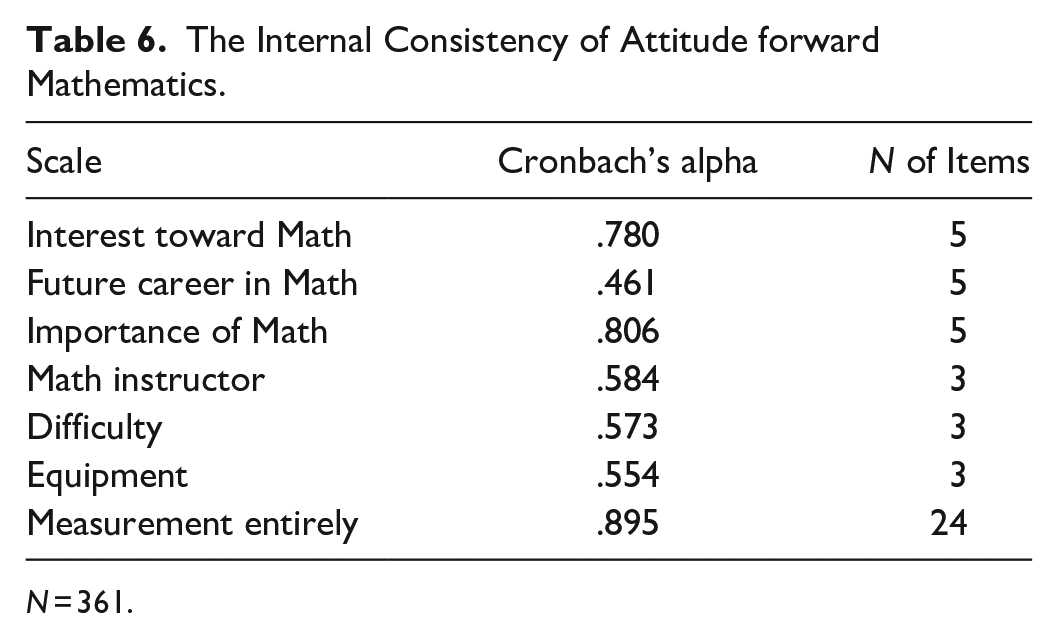
According to Prokop et al. (2007), for the BAQ questionnaire’s reliability, the authors conducted a factorial analysis which resulted in excluding items that showed low correlation. Excluded items were the ones from the three domains known as “Teacher/Instructor,” “Equipment” and “Difficulty.” Reliability was computed for the remaining items (total of 24) by two different statistical techniques: split-half reliability and internal consistency reliability. Results showed that the BAQ is a reliable questionnaire, Guttman split-half coefficient (α = .84), Cronbach’s alpha for the first half (α = .82) and for the second half of items (α = .74) and Cronbach’s alpha for BAQ entirely (α = .87), achieving α values that exceed 0.7, indicates convenient reliability(Nunnally, 1978). Data analysis revealed that the scale items of the Math Attitude Questionnaire MAQ were found to be reliable, represented by a Cronbach’s alpha of 24 (after excluding six items from the original BAQ). The Cronbach’s alpha for the whole test (α = .895) showed values that exceed 0.7, which indicates appropriate reliability (Nunnally, 1978). For the MAQ, Cronbach’s alpha values were calculated for each dimension, they were valued between 0.806and 0.46. these values of alpha demonstrate appropriate outcomes (Dhindsa & Chung, 2003; Francis & Greer, 1999; Fraser, 1989; Jegede et al., 1994), dimensions/domains with relatively low reliabilities such as “Future career in Math” (0.461), “Equipment” (0.554), need to be further examined to avoid misinterpretation of the results. The results of Cronbach’s alpha are displayed in (Table 6). For the instrument validity the Math Attitude Questionnaire MAQ was sent to a panel of expertise in the field of mathematics and measurement, it was confirmed that MAQ has adequate construct validity.
The Internal Consistency of Attitude forward Mathematics.
N = 361.
Data Collection
The data collection process started at the beginning of Spring 2021 and continued for 4 weeks. The Math Attitude Questionnaire MAQ was designed on Google forms with a full description of the purpose of the study, and the procedure for answering the questions, and the consent form was included. Researchers emailed numerous instructors and professors from multiple universities in the UAE asking for permission to visit their online classes and invite the students to participate in the study. After receiving permission, the researchers visited many virtual classes and explained to the students the purpose of the study and the procedure to answer the questionnaire. The researchers posted the link of the MAQ with guidelines and were available during administering the questionnaire to answer any concerns or questions. Many students from different colleges and universities responded to the questionnaire. All collected data was transferred to SPSS version 22 for analysis and conclusion.
Data Analysis and Findings
Before data analysis, the researchers addressed all issues of missing values, outliers, homogeneity of variance, normality, and independence. To answer research question 1, the mean score was calculated for all six domains of the MAQ. Data analysis revealed that higher education students in the UAE have a positive attitude toward math in five different domains and neutral in the sixth one of the MAQ. For the dimension Interest toward Math, (M = 3.127, SD = 0.8014), which represents moderate interest in learning math. For the domain Equipment (M = 3.553, SD = 0.6793) moderate to high integrating of equipment in teaching math. The domain Difficulty (M = 3.040, SD = 0.7722), which means medium difficulty when learning math, for Math instructor domain (M = 3.612, SD = 0.7432) high perception, which refers to the critical role of the instructor in learning math, Importance of Math (M = 3.664, SD = 0.7423), high perception of the importance of math and less preference for the Future career in Math (M = 2.913, SD = 0.6144). So students prefer studying mathematics as a subject, however they do not prefer careers related to mathematics.
To answer research question 2, a t-test for independent samples was conducted to explore whether there is any gender—based difference in the six domains of the MAQ: Interest toward Math, Future career in Math, Importance of Math, Math instructor, Difficulty, Equipment.
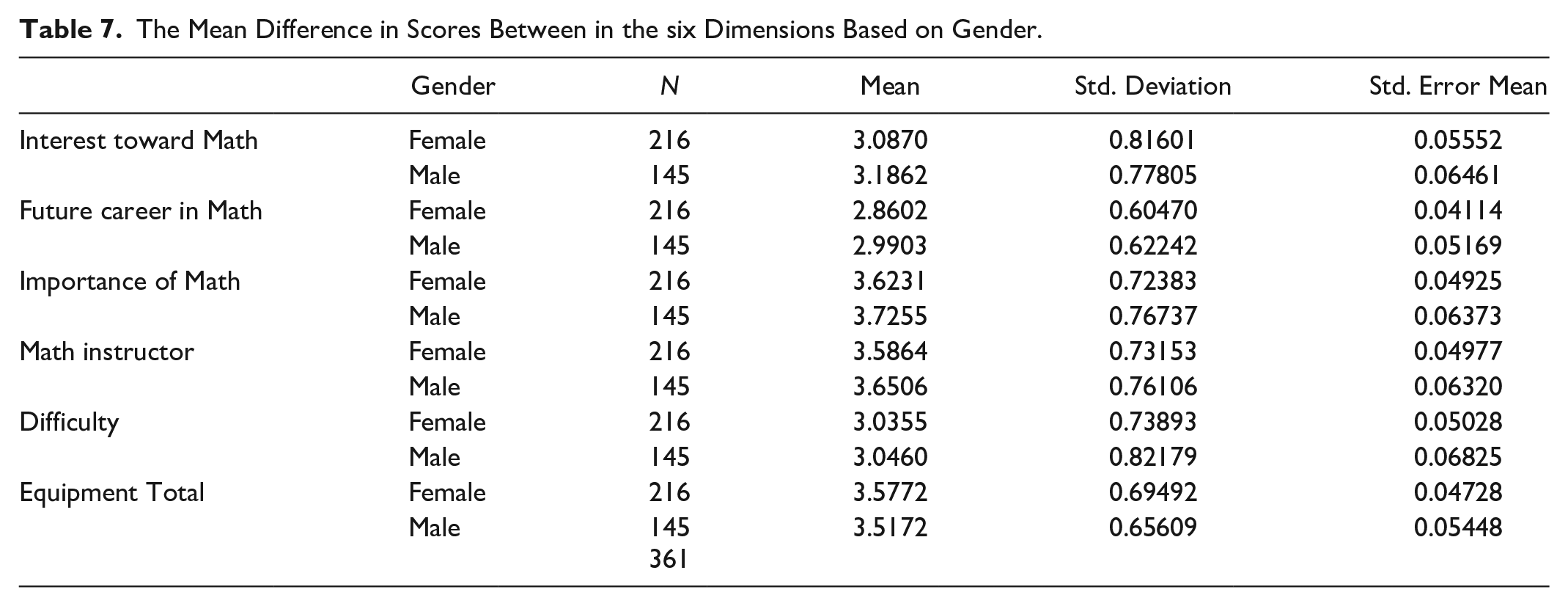
According to the findings of the Independent Samples t-test, there is no significant gender–based difference in five domains of MAQ; however, the domain of a “Future career in Math” was found to be statistically significant, Levene’s Test for equality of variances for “Future career in Math” F (359) = 1.006, p = .316, not statistically significant, which indicates that sample variances are equal, so we consider Equal variances assumed when explaining the results, t (359) = −1.981, p = .048 is statistically significant. Cohen’s d was calculated, it revealed that d = 0.2120 which represents a tiny effect size (can be ignored), which explains the findings of Levene’s test. The group statistics demonstrated the mean differences in scores between males and females in the six dimensions (Tables 7 and 8).
The Mean Difference in Scores Between in the six Dimensions Based on Gender.
t-Test for Independent Samples/Difference Based on Gender in Mean Score of MAQ.

To answer research question 3, a one-way analysis of variance (ANOVA) was conducted to examine the effect of math course levels on the student’s attitude toward math in the six dimensions. Data analysis demonstrated that there is a significant effect of math course levels on students’ attitudes toward math in the 6 dimensions of MAQ. The ANOVA findings for Interest toward Math, F (2, 358) = 40.62, p = .000, Future career in Math F(2, 358) = 13.10, p = .000, for Importance of Math F(2, 358) = 36.04, p = .000, Math instructor F(2, 358) = 7.35, p = .001, for Difficulty F(2, 358) = 26.88, p = .000, and for Equipment F(2, 358) = 10.31, p = .000, (See Table 9).
ANOVA Test Based on Students’ Math Level.

As the ANOVA results demonstrated that there is a significant difference between groups, a Post hoc test was conducted for the six dimensions to examine the differences between groups, testing each possible pair of groups. For Tukey’s test, a total level of significance = .05 was used for the set of tests. Tukey’s findings indicated the following:
For the dimension Interest toward math, the Beginner versus Intermediate is significant p < .001, Beginner vs. Advanced is statistically significant p < .001, and Intermediate versus Advanced, is statistically significant p = .001. The mean score of attitudes toward math based on the math level is described here, for Beginner (M = 2.5316, SD = 0.76049) is lower than the Intermediate level (M = 3.2010, SD = 0.69545) and the Advanced level of math (M = 3.5589, SD = 0.77025), p = .001 is statistically significant for all math levels. The more the students’ progress in maths course levels, the higher their attitude toward math. Putting together these results suggest that high levels of math courses do influence students’ attitude toward math. Specifically, our results suggest that when students’ levels’ progress in math courses, they develop a positive attitude toward math and feel more interested in studying math (See Tables 10 and 11).
Mean Score of the six Domains of MAQ Based on the Math Level.

N = 361.
ANOVA Test Based on Students’ Math Level.

N = 361.
For the dimension Future career in Math, the Beginner versus Intermediate is significant p = .001, Beginner vs. Advanced is statistically significant p = .000, and Intermediate versus Advanced is statistically significant p = .029. The mean score of attitudes toward math based on the math level is described here, for the Beginner (M = 2.6506, SD = 0.61140) is lower than the Intermediate level (M = 2.9321, SD = 0.56277) and the Advanced level of math (M = 3.1397, SD = 0.66222), p = .001 is statistically significant for all math levels. The more the students’ math level increases, the higher their attitudes toward math. Jointly, these results suggest that math course level affects students’ attitude toward math, so, when students’ levels’ progress in math courses, they develop a positive attitude toward thinking about future careers in the mathematical field (See Tables 10 and 11).
For the dimension Importance of Math, the Beginner vs. Intermediate is significant p < .001, Beginner versus Advanced is statistically significant p < .001, and Intermediate versus Advanced, is statistically significant p = .000. The mean score of attitudes toward math based on the math level is described here, for the Beginner (M = 3.2203, SD = 0.68508) is lower than the Intermediate level (M = 3.6603, SD = 0.66362) and the Advanced level of math (M = 4.1562, SD = 0.71589), p < .001 is statistically significant for all math levels. These results suggest that when students’ level progresses in math courses, they develop a positive perception toward the importance of math for them as a field of study (See Tables 10 and 11).
For the dimension Difficulty of Math, the Beginner versusIntermediate is significant p < .001, Beginner versus Advanced is statistically significant p < .001, and Intermediate versus Advanced, is statistically significant p < .001. The mean score of attitudes toward math based on the math level is described here, for the Beginner (M = 2.612, SD = 0.7229) is lower than the Intermediate level (M = 3.0510, SD = 0.68450) and the Advanced level of math (M = 3.470, SD = 0.81996), p < .001 is statistically significant for all math levels. Our findings suggest that when students enroll in an advanced math course, their perception of the difficulty of mathematics increases (See Tables 10 and 11).
For the dimension Math Instructor, the Beginner versus Intermediate is not significant p = .959, Beginner versus Advanced is statistically significant p = .004, and Intermediate versus Advanced is statistically significant p = .001. The mean score of attitudes toward math based on the math level is described here, for the Beginner (M = 3.5190, SD = 0.74869) is almost equals to Intermediate level (M = 3.5455, SD = 0.73539) and the Advanced level of math (M = 3.9041, SD = 0.69495). Altogether, these results suggest that in math introductory courses and the intermediate level, the students’ perception of the math instructor does not actually influence their attitudes toward math. Nonetheless, for the advanced course level, the math instructor influences the students’ attitudes toward math (See Tables 10 and 11).
For the dimension Equipment, the Beginner versus Intermediate is not significant p = .727, Beginner versus Advanced is statistically significant p = .000, and Intermediate versus Advanced is statistically significant p = .000. The mean score of attitudes toward math based on the math level is described here, for the Beginner (M = 3.4262, SD = 0.59661) is almost equal to Intermediate level (M = 3.4928, SD = 0.71393) and the Advanced level of math (M = 3.8630, SD = 0.56883). It can be interpreted from these findings that in math introductory courses and the intermediate level, the equipment that the instructor uses to facilitate teaching mathematics does not influence students’ attitudes toward math, yet for the advanced course level, the equipment that the instructor uses influences the students’ attitudes toward math (See Tables 10 and 11).
Discussion
This research study was conducted to investigate the factors influencing attitudes toward math between higher education students in the UAE. Gender and math course levels were the proposed factors that could impact attitudes toward math. The findings revealed that higher education students in the UAE show a positive attitude toward math in the six dimensions of MAQ, which suggests that students have moderate to high preference and acceptance of learning math. These results indicate that higher education students in the UAE have moderate to high interest in math which explains their concern about dealing with numbers, developing enhanced problem solving-skills and prefer logical and critical thinking skills. The positive perception of the importance of math marks the students’ ability to link their interest in math to their future occupation, reflecting their positive perception and the value of the real-life application of math. The outcome of the future career showed the least preferences among students, which could be interpreted in the perspectives of the difficulty and high demands of the math positions. The outcome of two dimensions; instructor and equipment dimensions, explain the great role that instructors play to facilitate teaching mathematics through combining appropriate equipment and adopting active learning techniques that enhance the learning outcomes. Students’ positive perception of the dimension difficulty of math courses highlights the nature of math as a discipline and emphasizes the demand of students’ readiness and competence to take the responsibility toward achievement in math. Instructor characteristics as a dimension were found to significantly contribute to students’ attitudes toward math. Higher education students in the UAE view their math instructors as a suitable model that supports and guides students to help them choose their careers. This factor differs according to math course level. Students in advanced math courses have a higher positive perception of the instructors’ role. One of the most powerful results of the study is math courses level. Data analysis reflected that it is the main factor that has a significant effect on students’ attitudes toward math for all dimensions of MAQ. These findings express that the more students progress in math courses, the more they develop an interest in math, consider a future career in math and acknowledge the importance of math for life applications. Moreover, progress in math courses increases students’ perception of math as a difficult subject, which are acceptable findings. Introductory courses are easier with fewer requirements than advanced courses which require more effort and sustainability. When instructors integrate appropriate equipment into teaching math in the higher education setting, students are expected to develop a positive attitude toward math.
Gender was detected to show no effect on attitudes toward math in all the six dimensions of MAQ within higher education students. These findings indicate that both genders share the same interest in math courses, the perception of the importance of math as a helpful tool for a future career, and an alike perception of the difficulty of math and the role of math instructors in forming their attitude toward math. Thus, the results suggest that both genders in the UAE have a scientific and mathematical awareness of the importance of mathematics and its applications in future life in many practical fields. These findings can be explained in the context of education equity and the equal learning opportunities that the UAE provides for all learners. The findings of this research study are consistent with Ursini and Sánchez (2008) who found little gender–based difference in students’ attitudes toward mathematics and their self-confidence. Also, these findings were supported by Sarouphim and Chartouny (2017) who demonstrated that there are no significant gender differences in attitudes toward mathematics. In contrast, the findings are not consistent with (Elçi, 2017; Lee & Anderson, 2015; Odell & Schumacher, 1998) who found a difference between girls’ and boys’ attitudes’ toward math, which can be explained as these studies were conducted among school students in younger ages; whereas, the current study explores the attitudes between higher education students, as students get older and matured, some of their characteristics change, and the gender may not have a prominent effect. Limitations for this study are found in the study design; the correlation between variables is not a causation, which makes it difficult to establish a cause-and-effect relationship when interpreting the findings.
Conclusion
This quantitative research study explores the factors that impact the attitude toward math in higher education institutions in the UAE. Higher education students in the UAE were identified with a positive attitude toward math with no gender-based differences. Math course levels were found as an effective factor that showed a significant effect on students’ attitude toward math in six different dimensions including interest in math, a future career in math, importance of math, math instructor, difficulty, and equipment. The math course level is genuinely associated with students’ attitudes toward math. The more students’ progress in math courses, the more their attitudes increase in the six dimensions of MAQ.
Recommendations for Implementation
This research study provides many educational implications, which can be summarized as follows. Adopting an appropriate motivation theory to keep students’ attitude toward math up, which will make students more actively receptive. Since students showed the highest attitude toward the Math Instructor, it suggested that the instructor’s impact should take a new level of importance to increase the attitudes toward Math and a career in Mathematics. It is recommended to focus on enhancing the instructor competencies through engaging math instructors in a professional development series to keep them updated on the most advanced teaching techniques. Frequent integration of convenient equipment during teaching and assessment may increase students’ attitudes toward math, particularly for advanced math courses. As the Future career in Math received the least positive attitude from students, there is a necessity to create a link between students and Mathematics through the application of mathematics in the entire surrounded environment to build a bridge between the interest and application in the real world. Colleges and universities could invite guest speakers to visit math classes, designing career fair events focusing on math careers, and encouraging students to participate in math career forums to enhance students’ attitudes toward math and consider a future career in mathematical fields. By improving this area, the students will recognize the usefulness of Mathematics, therefore, they will admire the input of instructors in their life and look forward to considering a mathematical career or including it efficiently in their existing careers. Moreover, a constant evaluation file should be established for students from early ages to track and balance their improvement in Mathematics, especially students who experience low confidence toward mathematics since this will bring a significant impact on their attitudes and interest toward the subject.
Future research: Our future goal in research is to develop a simulation model to enhance satisfaction toward learning mathematics and to develop assessment techniques to measure students’ progress and their overall attitude toward mathematics.
Footnotes
Acknowledgements
This paper is an authentic research project that was conducted in Dubai, UAE under the support of the authors’ higher education institution American University in the Emirates in the UAE. The authors would like to thank the American University in the Emirates for the continuous support and encouragement and providing a dynamic environment for teaching and research.
Declaration of Conflicting Interests
The author(s) declared no potential conflicts of interest with respect to the research, authorship, and/or publication of this article.
Funding
The author(s) received no financial support for the research, authorship, and/or publication of this article.
