




Abstract
This correlational study addressed two issues pertinent to developing mathematical competences for the 21st Century. Firstly, in a post-digital society, technology is recognized in teachers’ pedagogic and subject-specific knowledge domains. Secondly, cross-curricular teaching must be introduced to respond to societal requirements for maths knowledge application in diverse areas of life and work. Croatian educational reform recognized the importance of informatics and the integration of ICT across curricula supporting cross-curricular teaching. When reforming teaching, teaching efficacy beliefs inform change, and the study examined how technology pedagogy content knowledge (TPACK) contributes to teaching efficacy beliefs. Six hundred and six Croatian elementary school classroom teachers were surveyed for maths teaching efficacy beliefs (MTEBI) and self-assessment of their technology pedagogy content knowledge (TPACK). The study confirmed that the integration of technology knowledge in teachers’ pedagogical knowledge is, in addition to content knowledge, essential and predicts, with a large effect size (f2 = 0.64), the MTEBI subscale math teaching efficacy (MTE), while isolated technology knowledge does not. In addition, there is a positive correlation between years of service and pedagogy content knowledge and a negative correlation between years of service and technology pedagogy knowledge and technology knowledge, however, with a small effect size.
Keywords
Introduction
The changes in society and the educational landscape require innovative mathematics instruction, manifested in the maths curriculum and shaping teachers’ pedagogical practice. The elementary school mathematics classroom is essential for the development of maths thinking and competences and maths literacy and its application in youth and adult life in diverse disciplinary areas and areas of life and work. In 2019, the Council of Europe listed competence in maths and basic science and technology as key competences for lifelong learning (European Commission, 2019). In this paper, we focus on two issues pertinent to the development of mathematical competencies for the 21st Century.
Firstly, since the integration of digital technology in all areas of life and work is occurring in the 21st Century, Maths teaching should apply the affordances of digital technology for high-level maths competency. Digital technology has saturated all areas of society and socio-cultural practices. Knox (2019) examines the post-digital condition, which he defines as a thought about the relationship with technology, recognizing how technology is embedded in social practices and economic and political systems. He interprets post-digital not simply in terms of periodization but as indicating a different stage in the understanding and use of technology, also acknowledging a critical appraisal of the technology. He claims there is a critical engagement with technology that has reached a new stage reflecting technology saturation and omnipresence. Since the introduction of computers in education, technology integration in teaching and learning has aimed at students achieving higher-order learning outcomes (Jonassen & Reeves, 1996). Information communicational technology affordance has profoundly impacted literacy, similarly to how the technology of writing added to and replaced aspects of oral cultures (Havelock, 1986). In Vygotskian terminology, it is considered a cultural tool for learning and thinking (Vygotsky, 1978). Computer tools enable problem-solving and mathematical thinking and have a prominent role when integrated into teaching and learning methods. Chai (2019) reviewed teacher professional development from the perspectives of technological and pedagogical content knowledge—TPACK—and identified three important roles of technology: technology as a subject-specific tool, that is, technology content knowledge; technology as a tool for learning; and technology as a source for advancing maths and other STEM disciplines. Digital technology and skills related to its use and the transferability of digital skills within different disciplinary domains have been on the agenda since the spread of computer technology (Means & Olson, 1995). Elementary education addresses information and computer science in the curriculum with significant variability, with some countries having informatics as an elective and some as a compulsory curriculum subject. In Croatia, the curricular reform introduced informatics in the 2021/2022 academic year (Ministartsvo znanosti i obrazovanja, 2022).
Secondly, mathematical skills are required in all areas of life and work and are supportive of basic skills in various curricular subjects (Volk et al., 2017). Cross-curricular approaches and methods enable the application and transfer of mathematical skills in diverse areas (Chai, 2019; Volk et al., 2017). A cross-curricular philosophy challenges the division of disciplines established by the curriculum, holding that the cross-curricular approach is more aligned with the developmental characteristics of children and therefore designs instruction integrating distinct disciplines by setting learning objectives, themes, and topics and assessments across school subjects (Pring, 1976). Maths teaching guidance is set by national standards and international assessments, which identify maths concepts and procedures representing transferable skills and, importantly, form knowledge and learning across disciplines. An example is problem-solving in diverse life and work areas requiring mathematical skills (Haylock & Thangata, 2007). Pisa 2012 (OECD, 2014) identifies a lack of maths problem-solving skills as an issue. In the elementary classroom, maths makes an important contribution to the child’s development of mathematical thinking and emerging mathematical literacy with the application of maths in various situations in and out of school (Volk et al., 2017). Among the factors influencing students’ mathematical learning and outcomes and technology integration for high-level learning outcomes are teachers’ pedagogical beliefs, which affect instruction (Ertmer & Ottenbreit-Leftwich, 2010; McCulloch et al., 2018; Russell et al., 2003; Wachira & Keengwe, 2011). Pedagogical beliefs involve culturally imposed values and attitudes (Silverman, 2010), which develop gradually through years of schooling about instruction and learning and people’s attitudes about themselves. Beliefs are a better predictor of human action than consequences of action (Bandura, 1986) and play a significant role in teachers’ professional values, which drive teachers’ actions (Silverman, 2010). Beliefs refer to “…estimates of likelihood that the knowledge one has acquired about a referent is correct, or alternatively, that an event or state of affairs has or will occur (Eagly & Chaiken, 1998; Fishbain & Ajzen, 1975 in Wyer & Albarracin, 2005, p. 273).” Beliefs relate to a person’s experiences and knowledge and interplay with other cognitions such as attitudes, opinions, or other judgments (Wyer & Albarracin, 2005).
Teachers’ approaches to teaching are based on their experiences as learners, how they were taught and on the values and demands of cultural contexts (family, school, peers, and other cultural groups) interacting with their own knowledge and experiences as learners in schooling years, and how those beliefs form their professional identity later as teachers. The frequency of experience increases the probability and relatedness of beliefs in a person’s knowledge structure and the relevancy in a given situation (Wyer & Albarracin, 2005), which accordingly enhances the use of technology. The strength of beliefs varies, and stronger teachers’ estimates of certainty or subjective probability of the technology role and value in instruction represented as relevant to teachers’ knowledge and experiences may result in implementation. Pedagogical beliefs reflect instruction and technology integration from different perspectives. Teaching efficacy belief is examined from the perspective of the teachers’ beliefs about themselves and their capability. Self-efficacy is a belief in one’s own capability to execute an action to achieve planned performance (Bandura, 1986) in terms of the extent to which a person realizes performance demands (Bandura, 2015). Self-efficacy influences human behavior (Bandura, 1977), and higher self-efficacy enhances personal goal-setting (Bandura, 2015), which is observable in pedagogical practice. Especially when reforming teaching, teacher pedagogical beliefs are critical. Significant among them is what teachers believe about coping with change, which is reflected in their teaching efficacy (Enochs et al., 2000). In this paper, we examine how elementary teachers’ mathematical teaching efficacy beliefs bring about the two indicated societal requirements in light of the latest Croatian curricular reform for changes in teaching practice. We examine Croatian teachers (grade 1–4) maths teaching efficacy and whether this reflects (1) the characteristics of a post-digital society in which teachers’ subject-specific and pedagogical knowledge reflects technology and (2) society’s requirements for the application of maths knowledge by cross-curricular teaching.
The Literature Review
In a Post-Digital Society, Teachers’ Competencies Are Intertwined With Technology
Digital competency is essential for learning, life, and work (European Commission, 2016), and the teacher’s digital competency encompasses three areas: professional development, pedagogical practice, and the development of students’ digital skills (Redecker, 2017). The current society, in which technology is seamlessly integrated into all areas, is examined using post-digital thought (Jandrić et al., 2018; Knox, 2019). Post-digital thought questions discussions from the departure point of technology, calling for discussions of societal practices and pedagogical theory in which technology does not take the lead nor provide conditions for examining society. The post-digital condition requires a shift in thinking and examining societal practices, among them education from its roots, requiring that it not be focused on and seeking a predominant role and condition for technology. Educational technologists have expressed similar criticisms. Research should move beyond examining specific media and media comparisons (Reiser, 2001) and advanced tools and technologies that support learning in new and transformative ways to examine pedagogical problems. Technology intervention must be examined as it is integrated into the curriculum and not be studied in isolation (Roschelle et al., 2010). According to Knox (2019, p. 361), the post-digital is “… a (re)turn to core educational concerns, albeit in a context of a wider society already entangled with, and constituted by, pervasive digital technologies.”
This situation poses an epistemic condition of digital competency to perform in diverse areas: math, language, and communication, and STEM. With their pedagogical practice, teachers shape the digital skills of younger generations. However, research findings on the effects of technology-integrated maths teaching on students’ outcomes are inconclusive (Cheung & Slavin, 2013; Reed et al., 2010). An OECD (2019) report from 2019 highlights literacy, numeracy, and problem-solving skills in technology-rich environments with technology-assisted learning to bring the potential of innovative teaching approaches for schools with teachers’ digital competences as instrumental in mitigating failure in developing digital skills. Croatian national curricula address digital technology and skills either within curricular subjects or as generic skills, which could be addressed within different curricular subjects or with a cross-curricular approach. In 2018, Croatia introduced informatics into the elementary school curriculum, to be implemented in classroom teaching in the 2020/21 academic year (Ministartsvo znanosti i obrazovanja, 2022). From the 2021/2022 school year, all primary school students from grades 1 to 4 in the Republic of Croatia can enrol in informatics as an elective subject with funding for 70 hours per year (Ministarstvo znanosti i obrazovanja Republike Hrvatske, 2018). Although it is an elective subject, in the 2020/2021 school year, at least two-thirds of primary school students in grades 1 to 4 chose informatics as an elective subject (Sindikat Preporod, 2020), and this number is growing from year to year.
The Croatian curricular reform in 2019 enacted cross-curricular teaching between various subjects and mathematics. Among the cross-curricular topics was ICT use (European Commision, 2022). The mathematics curriculum suggests ICT as a topic for cross-curricular activity in mathematics at all levels of education (Eurydice, 2022; Ministarstvo znanosti i obrazovanja Republike Hrvatske, 2019). It is important to point out that the curriculum states the application of technology as a mathematical process that is represented at all levels of education and emphasizes that the use of ICT in mathematics teaching contributes to the quality of the educational process. The 2016 National Standard of Qualifications Framework for Teachers in Primary and Secondary Schools says that a licensed teacher should purposefully use ICT in teaching (Nacionalno vijeće za odgoj i obrazovanje Republike Hrvatske, 2016; Vizek Vidović et al., 2015). Regarding Croatian initial teacher education, the study programs contain courses in which student teachers acquire the general and methodological mathematical competencies necessary for teaching mathematics in the classroom. Furthermore, each study program also contains courses in which students acquire generic competencies for the use of ICT in everyday life and work. However, there are insufficient appropriate learning outcomes, either at the study program or course level, to ensure that future teachers will acquire competencies for the continuous application of ICT in mathematics teaching as well as for the design and implementation of cross-curricular topics and activities linking mathematics and all other subjects. The recommendations designed in 2015 and 2016 explicitly state the following outcomes: to connect other curricular contents and interdisciplinary topics in teaching with the subject taught; to use ICT purposefully in teaching (Nacionalno vijeće za odgoj i obrazovanje Republike Hrvatske, 2016; Vizek Vidović et al., 2015). Norway implemented a reformed curriculum in 2006, with digital competence as the fifth basic skill in all subjects of the elementary school curricula, which is also reflected in Norwegian initial teacher education (Krumsvik, 2011). In the Dutch curriculum, digital competence was recognized in 2020 as one of nine curricular areas, with technology among four learning themes to be covered (Fisser et al., 2020) and nine cross-curricular skills defined in the cognitive, personal, and social areas (OECD, 2022).
Chai (2019) argues that the use of technology as a learning tool for efficient teaching and learning should reflect the role of information technology in maths from the perspective of technology as a subject-matter-specific tool in maths and technology in the application of maths in diverse areas of life. Niess et al. (2009) examine digital technology as a learning tool in maths which was initially used for demonstration, verification and drill and practice of maths procedures and gradually encompassed more in-depth integration for students’ engagement in learning and developing concepts. The authors argue for the interplay and integrated view of teachers’ technology knowledge with maths subject-specific knowledge and pedagogical knowledge with the curriculum. Technology should not be considered in isolation from the curriculum. Instead, the curriculum should be built on technology’s pedagogical use, and the two must be examined as a fundamentally integrated system (Cheung & Slavin, 2013; Niess et al., 2009; Roschelle et al., 2010). Research reports that technology integration is more intense in a generation of digital natives and therefore correlates negatively with years of service (Baek et al., 2008; Cheng & Xie, 2018, citing Inan & Lowther, 2010; Koh et al., 2014; Yaghi, 2001; Gu et al., 2013; Russell et al., 2003). To enact changes in teaching practice, the teachers’ mathematical teaching efficacy beliefs toward the pedagogical shift are important (Enochs et al., 2000; Thomson et al., 2021). This paper examines teachers’ technological, pedagogical, and content knowledge (D. A. Schmidt et al., 2009; M. Schmidt et al., 2020) in maths, including cross-curricular teaching in connection with their maths teaching efficacy beliefs (Enochs et al., 2000).
Cross-Curricular Teaching for Mathematical Competences for the 21st Century
Historically, the curriculum was designed with a tendency to differentiate knowledge and design learning around disciplinary areas. As a result, learners’ development was conducted within disciplines (Pring, 1976) and, as such, decontextualized and less applicable in real-life and work contexts. However, Volk et al. (2017) argue that authentic learning should take place instead of disciplinary-based curricula. In addition, national standards and international assessments indicate that maths concepts and procedures are transferable skills that constitute knowledge and learning across disciplines. Problem-solving in diverse areas of life and work also requires mathematical skills (Haylock & Thangata, 2007). Pisa 2012 (OECD, 2014) identifies a lack of maths problem-solving skills as an issue. The school must develop literate individuals who can function in various life situations and have the competence to solve various problems and tasks. This requires the development of knowledge and competences that enable integrity and connection in authentic life situations. The competence-based curriculum aims at learning connected to authentic real-life problems and contexts and focuses on developing competencies across curricular areas (Volk et al., 2017). Computer-supported collaborative maths problem-solving in cross-curricular contextualized activities has been demonstrated to facilitate high-level learning objectives (Lazakidou & Retalis, 2010) and to provide a meaningful context for students within real-life problems and curriculum subjects (Mullis et al., 2012; OECD, 2003).
To teach maths efficiently and support students’ conceptual change, teachers need to identify threshold concepts and design instruction to deliver those concepts in authentic learning. Kuisma and Ratinen (2021) explain how learning concepts within disciplinary boundaries is limiting and makes it more difficult for students to transfer and apply them in different areas of life and other disciplines. As they learn, students build associative trees, and if these trees are limited to one discipline, their understanding faces obstacles (Chi, 1997; Kuisma & Ratinen, 2021). To construct and build knowledge, students need building blocks that allow them to progress ontologically and conceptually integrate maths with other disciplines. Threshold concepts could motivate the cross-curricular integration of content from other disciplines when supporting the understanding of critical content and concepts (Kuisma & Ratinen, 2021). Therefore, threshold concepts must be aligned to authentic tasks and contexts, which cross-curricular instruction provides. Meyer and Land (2003) define a threshold concept as a concept that allows students to see things in a new, transformed way. Among the characteristics of a threshold concept that Meyer and Land (2003) list are: transformative, irreversible, integrative, bounded, and troublesome. The examples for elementary K-5 mathematics provided by Mayakis and Williams (2022) illustrate the characteristics of threshold concepts well. Threshold concepts are transformative, and once students understand them, they transform their maths thinking irreversibly—students do not forget them. They provide the example of “borrowing” in traditional algorithm subtraction, which could be supported by decomposing and composing utilizing the base ten systems (Mayakis & Williams, 2022). A further characteristic is that they are integrative, which is illustrated by subitizing allowing later connection to more advanced numbers (skip counting, accessing numbers in groups, and breaking apart multidigit numbers). The concepts could be troublesome when students learn procedures and do not understand the concept behind the procedure. Finally, threshold concepts are bounded and could be defined within a discipline, for which they provide the example of the base ten system (Mayakis & Williams, 2022). Threshold-concept-informed instruction allows teachers to engage students in transformative learning, applying the concepts in a set of topics from diverse curricular subjects (Breen & O’Shea, 2016). Breen and O’Shea (2016) highlight the role of reification and the particular use of digital technologies in understanding actions and objects in maths processes.
Technology Knowledge in Teacher’s Knowledge Domains and Teaching Efficacy Beliefs
Technology knowledge in teachers’ knowledge domains was intensively studied with the TPACK model introduced (Mishra & Koehler, 2006). TPACK upgrades Shulman’s (1986) PCK with technology knowledge. In order to examine teachers’ pedagogical practices, we focused on subject content and pedagogical knowledge, which in the past were integrated and indistinguishable (Shulman, 1986) but have been separately categorized in order to examine teachers’ learning processes in the research of learning and teaching (Shulman, 1987). Shulman (1986) identified three categories: subject matter knowledge, pedagogical content knowledge (PCK), and curricular knowledge. According to Shulman (1986, 1987), subject matter knowledge has to be transferred to pedagogical content knowledge through an understanding of students’ minds and thinking and conducting teaching practice. The PCK is essential for competent teaching and integration of all knowledge domains (pedagogy, subject matter, and curriculum; Shulman, 1986). The review of PCK in maths by Depaepe et al. (2013) indicates reconceptualization of the most widely spread mathematical knowledge for teaching (MKT) or content knowledge for teaching mathematics (CKTM) (Ball et al., 2008; Hill et al., 2004, 2008; Hill et al., 2005 in Depaepe et al., 2013).
In a post-digital society, it is assumed that the curriculum and pedagogy integrate technology in subject-specific content, pedagogy, and curriculum on all levels. This reflects the TPACK (technological, pedagogical, and content knowledge) model of teachers’ competency, which was designed by Mishra and Koehler (2006). In PCK, the TPACK predecessor, Park and Oliver’s (2008) review of PCK models from 1987 to 2006 identifies only one model, Grossman’s model (Grossman, 1990 in Park & Oliver, 2008), which includes educational media. Depaepe et al. (2013) identify several PCK models which integrate curriculum and media, highlighting a model by Marks (1990 in Depaepe et al., 2013), which specifically indicates media for instruction in the subject matter. Niess et al. (2009) examined TPACK in maths teaching and summarized the technology role concerning PCK elaborating Grossman’s (1990) PCK model involving educational media.
In the TPACK model of knowledge domains, the particular focus is on the role of technology integration at the intersection of technology knowledge, pedagogy knowledge and content knowledge. In a post-digital society, we cannot think of pedagogy without technology, and technology influences curriculum-specific content, but technology is no longer an autonomous object of investigation. Therefore, TPACK offers a good model for studying integrated knowledge domains. Furthermore, TPACK is examined in maths teaching in relation to teachers’ preparation as integrative, providing a framework for teachers’ initial and continuing professional development (Chai, 2019; Niess et al., 2009) and has been recognized in maths teaching as adding technology-supported learning to many maths concept areas (Niess et al., 2009). TPACK knowledge domains are examined as correlated to teachers’ pedagogical beliefs (Wu et al., 2022), values beliefs that can predict technology integration (Cheng & Xie, 2018), self-efficacy beliefs (Voogt et al., 2013) and self-efficacy beliefs about technology integration (Abbitt, 2011). According to Abbitt (2011), TPACK knowledge domains affect teachers’ self-efficacy beliefs about technology integration. The same was examined for PCK. Park and Oliver (2008) identified that, along with knowledge, an essential component of PCK is an attitudinal aspect of teacher efficacy that they relate to “teacher beliefs about their ability to enact effective teaching methods for specific teaching goals [which] was specific to classroom situations/activities” (Park & Oliver, 2008, p. 270). Thomson et al. (2017) examined the PCK derivative MKT in relation to efficacy beliefs (Thomson et al., 2017). In the review of TPACK, Voogt et al. (2013) examine whether, within TPACK, the teacher’s knowledge and beliefs are intertwined. Beliefs associated with TPACK refer to self-efficacy beliefs, pedagogical beliefs, and technological beliefs. However, their results are inconclusive. They note that while Abbit (2011 in Voogt et al., 2013) found that technology functionality guided teachers’ technology integration in pedagogical practice, Hammond and Manfra (2009, in Voogt et al., 2013) found that it was beliefs, not functionality, that provided guidance.
Research findings argue that beliefs guiding teaching practice are as important as teachers’ knowledge (Abbitt, 2011). The pedagogical practice and especially its technology application inform teachers’ knowledge and pedagogical beliefs. Abbitt (2011) indicates beliefs and knowledge as an outcome measure of teachers’ technology preparation programs. Beliefs are relatively stable entities, and belief shifts require much time and influence. The relationship between beliefs and behavior is examined: how beliefs influence action and how experiences shape beliefs. In technology integration in teaching, the relationship between beliefs and actions is very complex. Wyer and Albarracin (2005) argue that the frequency of experience increases the probability and relatedness of beliefs in a person’s knowledge structure and the relevancy in a given situation which enhances the use of technology. According to Bandura (1997), factors influencing self-efficacy beliefs (enactive experiences, vicarious experiences, psychological state, and social influence) influence technology integration at several levels. The factors influencing self-efficacy beliefs are enactive experiences, vicarious experiences, social influence, and psychological state. Therefore a person’s self-efficacy builds by herself mastery of knowledge in technology use (enaction), by substitution when learning from another person or group (vicariously), and by psychological readiness and social influence.
The process of teachers’ professional development and learning during key moments or critical periods in initial teacher education and training is important when they acknowledge the technological practices in the field (vicarious learning) and integrate them into their teaching (enactive learning). Teachers at different stages of professional development require different directions in instruction. Teachers with more experience have been found to perceive lower self-efficacy in integrating technology in classrooms (Cheng & Xie, 2018, citing Inan & Lowther, 2010; Yaghi, 2001; Koh et al., 2014). In their experiences as learners and teachers, older teachers have been exposed to technology much less from the side of enactive, vicarious, and social influence and therefore require different instruction in this area than their less experienced colleagues. When reformed curricula are implemented, teaching efficacy is among the important pedagogical beliefs of teachers for enacting pedagogical innovation and shift (Enochs et al., 2000). Therefore, it is essential to examine teachers’ maths teaching efficacy beliefs when educational reforms are in place, and many studies report that teachers’ professional development fails to prepare them for reforming teaching (Thomson et al., 2021). Related studies report the importance of examining teaching efficacy in concrete subject-specific areas (Boulden et al., 2021). Teachers’ pedagogical beliefs about the nature of maths instruction shape their integration of technology and instructional performance (Wachira & Keengwe, 2011).
Research Problem and Methodology
In this study, we address two issues pertinent to developing mathematical competences for the 21st century: the technology recognized in teachers’ pedagogic and subject-specific competency and the cross-curricular teaching for the maths knowledge application in diverse areas of life and work. The Croatian curricular reform of national elementary school curricula indicated the need for technology integration in teaching and supporting cross-curricular teaching (Ministartsvo znanosti i obrazovanja, 2022). For the mathematics curriculum, ICT is suggested as a cross-curricular activity topic at all education levels (Eurydice, 2022; Ministarstvo znanosti i obrazovanja Republike Hrvatske, 2019). However, the successful implementation of technology in teaching depends on teachers’ maths teaching efficacy (MTEBI) and to what extent they are connected with technological, pedagogical, and maths content knowledge, including cross-curricular teaching (TPACK).
The study addresses three research questions with the three corresponding hypotheses:
RQ1: How do elementary Croatian classroom teachers self-assess their TPACK for maths and cross-curricular maths, what are their maths teaching efficacy beliefs (MTEBI), does the MTEBI significantly correlate to TPACK and which TPACK constructs are more important predictors of MTEBI?
H1: In the post-digital condition, teachers’ maths teaching efficacy beliefs are correlated to TPACK constructs and, in addition to PCKmath and PCKcross-cu, especially to the construct integrating technology with pedagogy, the TPK.
H2: In the post-digital condition, as well as pedagogical content knowledge in maths (PCKmath) and cross-curricular maths (PCKcross-cu), the integration of technology knowledge in teachers’ pedagogical knowledge (TPK) is essential and is important for predicting teachers’ maths teaching efficacy beliefs subscale MTE while technology knowledge (TK) is not.
RQ2: Do years of service affect teachers’ assessment of TPACK constructs?
H3: There is a positive correlation between years of service and TPACK constructs of content pedagogical knowledge and a negative correlation between years of service and TPACK constructs of technology knowledge.
RQ3: In which cross-curricular connections do Croatian teachers apply maths; in their opinion, which topics do students find difficult to comprehend, and where do teachers feel weak in their teaching competences?
Research Design and Instruments
We conducted a correlational study using a survey utilizing an online instrument consisting of four parts. The first part contained descriptive questions (gender, age, state of residence, years of teaching experiences, and grade of teaching); the second part, MTEBI Likert-type scale (Enochs et al., 2000), the third part an adapted TPACK Likert-type scale (D. A. Schmidt et al., 2009; M. Schmidt et al., 2020). A 5-point Likert scale (from 5-strongly agree to 1-strongly disagree) was applied for the MTEBI and TPACK scales, which is consistent with the TPACK (D. A. Schmidt et al., 2009; M. Schmidt et al., 2020) and MTEBI scales (Enochs et al., 2000). The fourth part asked teachers to answer three open-ended questions. The open-ended questions were added to obtain data about maths cross-curricular connections (Please list curricular subjects with which you most frequently connect maths teaching?), the most demanding topics for students as identified by participating teachers (Please list topics which, in your opinion, your students find hard to comprehend?), and the topics for which teachers feel insufficiently prepared (Please list mathematics topics that you believe that you are insufficiently prepared for?). The MTEBI identifies teachers’ maths teaching efficacy beliefs which are essential for coping with pedagogical change (Enochs et al., 2000). We applied the original scale with the subscale mathematics teaching efficacy—MTE and mathematics teaching outcome expectancy—MTOE.
TPACK was applied to examine teachers’ self-assessment of (1) their technology knowledge both alone and in relation to pedagogy knowledge and (2) their pedagogy content knowledge of maths and maths in cross-curricular connections. We aimed to examine whether technology is intertwined with pedagogy knowledge and whether, as Shulman (1986) contends, content, and pedagogy knowledge are in interplay in maths and cross-curricular teaching. Scales applied were: pedagogy content knowledge of maths and maths in cross-curricular connections—PCK (D. A. Schmidt et al., 2009); technology knowledge—TK (D. A. Schmidt et al., 2009); technology pedagogy knowledge—TPK (M. Schmidt et al., 2020); and technology, pedagogy, content knowledge—TPCK (M. Schmidt et al., 2020). We did not include all scales of the original TPACK questionnaire by D. A. Schmidt et al. (2009, M. Schmidt et al., 2020). With regard to teachers’ knowledge requiring integration, we did not focus specifically on any of content knowledge—CK or pedagogy knowledge—PK, or technology content knowledge—TCK. We were not interested in knowledge of technology in researching, developing, and participating in the scientific discourse of the mathematical discipline which reflected in technology content knowledge—TCK (M. Schmidt et al., 2020). Therefore, we omitted these three scales.
Compliance With Ethical Standards
The conduct of the study followed the University of Rijeka Code of Ethics. We obtained participants’ informed consent regarding voluntary participation and the purpose of data collection and use. The study and the reporting of a study followed the American Psychological Association’s ethical guidelines regarding consent, confidentiality, and anonymity of responses. The questionnaire was conducted anonymously with an online survey instrument 1ka (https://www.1ka.si/d/en).
Data Collection
The Agency for Education of the Republic of Croatia distributed the invitation to participate in the survey. The Agency’s main activity is to perform professional and advisory work in education, that is, participation in monitoring, improving, and developing education in preschool, primary, and secondary education, adult education, and education of children of Croatian citizens abroad and children of foreign nationals. The Agency sent the information about the research and the request to complete the online questionnaire to Croatian elementary school classroom teachers between May and July 2021. In addition, the Municipality of Rijeka, the founder of primary schools in Rijeka and the administrator of some primary schools, invited some teachers to fill out the questionnaire.
The Sample
A non-randomized sample comprised 606 elementary school teachers in the school year 2020/21. The sample comprised 590 females (97%) and 16 males (2.6%). The shares of teachers according to the grade they teach was between 21% and 22.4%. The sample structure was the following, 136 fourth-grade teachers formed 22.4% of the sample, 127 third-grade teachers formed 21% of the sample, 129 second-grade teachers formed 21.3% sample, and 134 first-grade teachers formed 22.1% of the sample. Teachers who teach classes including more than one grade are listed under the category of multigrade. There were 81 (13.2%) multigrade teachers.
Data Analysis
The data were analyzed using SPSS. Exploratory factor analysis was performed to assess the construct validity of MTEBI and TPACK Likert-type scales. It indicated sufficient construct validity in both cases, with the first factor explaining more than 20% of the total variance. The reliability of Likert-type scales was tested and indicated sufficient Cronbach alpha coefficients for all factors of MTEBI and TPACK (α ≤ .85). Descriptive statistics and the Pearson correlation coefficient—r—was computed for all factors. The effect size for the correlation between factors was calculated using R-squared—r2 (coefficient of determination). Multiple linear regression was conducted using the enter method to predict MTE based on TPACK constructs. The effect size was computed based on Cohen’s f2. A one-way between-subjects ANOVA was used to compare the effect of years of service on the outcome variables. We used the effect size measure Eta squared—η2 to assess its practical significance (Kline, 2004). We performed data analysis of open questions using Atlas.ti.
Findings
Factor Analysis and Reliability Analysis of the Instruments
Exploratory factor analysis was conducted to analyze the construct validity of TPACK instrument scales, the PCK, TK, TPK, and TPCK. The extraction method was the Unweighted Least Squares Method (ULS), and the rotation method was the Direct Oblimin Method with Kaiser normalization. The Kaiser–Meyer–Olkin measure verified the sampling adequacy for the analysis, KMO = 0.949 (“marvellous” according to Kaiser & Rice, 1974). Results showed that the teachers’ responses to the items were grouped into four factors, and it explained a total variance of 70.76%. All items in the questionnaire except one (TPCK 4—I can provide leadership in helping others to coordinate the use of the content, technologies, and teaching approaches at my school and/or district) were retained. The reliability (alpha) coefficients for four factors were .92, .85, .89, and .90, and the overall alpha was .94 (see Table 1).
EFA and Reliability Analysis Results for the Adapted TPACK Questionnaire (N = 606).

Note. KMO = 0.949, Bartlett test p < .001, total variance explained = 70.76, overall α = 0.94.
The subscale PCK– pedagogy content knowledge in cross-curricular maths was analyzed as one item (Table 2). A principal axis factor analysis (PFA) was conducted on the five items with no rotation. The Kaiser–Meyer–Olkin measure verified the sampling adequacy for the analysis, KMO = 0.88 (“meritorious” according to Kaiser & Rice, 1974). An initial analysis was run to obtain eigenvalues for each factor in the data. The scree plot showed that the inflexion would justify retaining one factor, which is consistent with the original structure of the PCK domain (D. A. Schmidt et al., 2009).
EFA and Reliability Analysis Results for the PCK—Cross-Curricular Pedagogy Content Knowledge (N = 606).

Note. KMO = 0.879, Bartlett test p < .001, total variance explained = 70.04.
A principal axis factor analysis (PFA) was conducted to check the construct validity of the MTEBI Likert-type scales (Enochs et al., 2000) with no rotation (Table 3). One item (MTEBI18—Given a choice, I will not invite the principal to evaluate my mathematics teaching.) was dropped due to insufficient factor loading (0.140). The Kaiser–Meyer–Olkin measure verified the sampling adequacy for the analysis, KMO = 0.88 (“meritorious” according to Kaiser & Rice, 1974). An initial analysis was run to obtain eigenvalues for each factor in the data. The scree plot showed that the inflexion would justify retaining two factors, which is consistent with the original structure of the MTEBI questionnaire. The items that cluster on the same factor suggest that factor 1 represents an MTEBI “Teaching efficacy” subscale and factor 2 “Outcome expectancy” subscale. The reliability (alpha) coefficients for the two factors were 0.85 and 0.81.
EFA and Reliability Analyses for the MTEBI (N = 606).

Note. KMO = 0.879, Bartlett test p < .001, total variance explained = 43.52.
Teachers’ Assessment of Their Technological, Pedagogical, and Cross-Curricular Maths Content Knowledge—TPACK and Maths Teaching Efficacy Beliefs—MTEBI, the Correlation Between the MTEBI and TPACK and Predicting Power of TPACK (Research Question 1)
Descriptive statistics in Table 4 show that participants assessed themselves highest in the TPACK instrument for PCKmath and PCKcross-cu and TPK. Conversely, they assessed themselves as lowest for TK. In the MTEBI questionnaire, they assessed themselves higher for MTE.
Descriptive Statistics of Factor Scores (N = 606).

Table 5 shows correlations for all study variables. The the Pearson correlation coefficient—r between TPACK and MTEBI variables shows moderate correlation between MTE and TPACK variables, while MTOE had very weak correlations with TPACK variables. The rule of thumb r < .10 negligible correlation; r = .10 to .39 weak correlation; r = .40 to .69 moderate correlation; r = .70 to .89 strong correlation; r ≥ .90 very strong correlation (Schober et al., 2018) was used. According to the first hypothesis, in a post-digital condition, in addition to PCKmath and PCKcross-cu, teachers’ maths teaching efficacy beliefs are correlated with teachers’ pedagogical knowledge integrating technology (TPK), which is confirmed for the MTE subscale. The PCKmath, PCKcross-cu, and TPK are moderately correlated with MTE. The correlation between TK—technology knowledge and MTE is weak. Effect size is calculated by R-squared—r2 to indicate the proportion of variance in the dependent variable explained by the variance of the independent variable. According to Cohen (1992), the basic rules of thumb are that r2 = .1 is considered a weak or low effect size, r2 = .3 is considered a moderate effect size, and r2 = .5 is considered a strong effect size. Table 6 shows r2 of TPACK variables on MTE. The effect size for PCKmath is moderate and accounts for 35.64% of the teaching efficacy beliefs. The effect sizes of all the other variables we measured are relatively weak. PCKcross-cu accounts for only 19.71%, TPK accounts for 19.98%, TPCK accounts for 18.40%, and TK accounts for 13.10% of the remaining effects.
The Pearson Correlation Coefficient for Study Variables.

R-Squared of the Pearson Correlation Coefficient for Correlation Between Teacher’s Maths Teaching Efficacy Beliefs MTEB-TE and TPACK Variables.

Multiple linear regression was conducted to predict MTE based on TPACK constructs. The hypothesis was: In post-digital conditions, as well as pedagogical content knowledge in maths (PCKmath) and cross-curricular maths and (PCKcross-cu), the integration of technology knowledge in teachers’ pedagogical knowledge (TPK) is essential and predicts teachers’ maths teaching efficacy beliefs subscale MTE, while technology knowledge (TK) does not looking more closely, multiple linear regression was conducted to predict MTE based on PCKmath, PCKcross-cu, TK, TPK, and TPACK (Table 7). No data were removed as outliers or influential cases because no case had a Cook’s distance value higher than 1.00. The assumption of normality of residuals was met. A significant regression equation was found (F(5, 600) = 78.322, p < .001, R2 = .395, R2adjusted = .390) using the enter method with a large effect size (Cohen’s f2 = 0.64). The effect size was calculated using Cohen’s f2. The basic rules of thumb, according to Cohen (1988), are that ≥0.02 is considered small, ≥0.15 medium, and large ≥0.35 effect size. The analysis shows that PCKmath (B = 1.007, t = 10.476, p < 0.001) and TPK (B = 0.271, t = 2.193, p = .029) significantly predicted the value of MTE, while other variables did not.
A Multiple Linear Regression to Predict MTE Teaching Efficacy Subscale Based on TPACK Constructs.

The Difference Between the Three Groups by the Years of Service ANOVA (Research Question 2)
A one-way between-subjects ANOVA was conducted to compare the effect of years of service on PCKmath, PCKcross-cu, TK, TPK, TPCK, and MTEBI. As indicated in Table 8, there was a significant effect of years of service on PCKmaths at the p < .001 level [F(2,603) = 9.44, p = .000], on PCKcross-cu at the p < .001 level [F(2, 603) = 15.63, p = .000], on TK at the p < .001 level [F(2, 603) = 9.06, p = .000], and on TPK at the p < .05 level [F(2, 603) = 3.19, p = .042]. Hypothesis three was confirmed: There is a positive correlation between years of service and TPACK constructs of content pedagogical knowledge and a negative correlation between years of service and TPACK constructs of technology knowledge. There was no statistical significance for TPCK as this construct integrates technology and pedagogy that, when separate, are in contrast, one positively and one negatively correlated. The average score increases with the years of service in the PCKmath and PCKcross-cu, while it decreases for TK and TPK.
ANOVA Results Regarding the Difference in Teachers’ Adapted TPACK and MTEBI by the Three Age Groups—Means, Standard Deviations, and One-Way Analyses of Variance.

p < .05 level. **p < .001 level.
For the MTEBI, marginal statistical characteristics identified an effect of years of service on MTE and MTOE. Eta squared is calculated as η2 = SSeffect/(SSeffect + SSerror). According to Cohen (1992), the basic rule of thumb is that η2 = .01 indicates a small effect; η2 = .06 indicates a medium effect; η2 = .14 indicates a large effect. In this study, η2 identified a small effect size for all independent variables with statistically significant differences. The effect size indicates that the independent variable age group explains only 3% of the variance on the dependent variable PCKmath. The effect size for the between-group difference effect on the dependent variable PCKcross-cu is 4.9%, and the effect size of the between-group difference on TK is 2.9%.
Findings of Open Questions: Cross-Curricular Connections, Demanding Topics for Students and Teachers as Assessed by Teachers (Research Question 3)
Teachers were asked to report which curricular subjects they most frequently use with maths in cross-curricular instruction. They listed two or three subjects that they use most frequently. The content analysis shows that teachers use the subject Nature and Society most frequently, with a very high percentage of teachers reporting this (82.8%; see Table 9). These are followed by the Croatian language (45.7%) and Sport (31%). The cross-curricular connections analysis indicated that teachers rarely connect maths to informatics (2%), and one can conclude that the effects on cross-curricular instruction are not yet visible. One part of the reason is that informatics is taught by informatics teachers, not by “generalist classroom teachers.” Note that the Informatics curriculum (Ministarstvo znanosti i obrazovanja Republike Hrvatske, 2018) suggests maths as a cross-curricular topic in the subject of informatics.
Most Frequent Maths Cross-Curricular Connections in Instruction.

Note. n = 606.
The subject with the highest use of maths cross-curricular connections is Nature and Society (82.8%). All students take this subject, and the subject syllabus only suggests cross-curricular connections with maths in principle, without providing concrete examples (Ministarstvo znanosti i obrazovanja Republike Hrvatske, 2019). The Croatian language is the second highest subject for forming maths cross-curricular connections (45.7%). The Croatian Language curriculum includes cross-curricular connections with maths only in connection to reading literacy (of mathematical problems; Ministarstvo znanosti i obrazovanja Republike Hrvatske, 2019). Note that English as a foreign language is not mentioned in the results, although it is a compulsory subject from the 1st grade of primary school. However, just as with informatics, it is taught by subject teachers, not “generalist classroom teachers.”
Teachers reported which maths content they considered most difficult for students to comprehend (Table 10). They viewed measurement as the most difficult for students, followed by geometry and arithmetic. Demanding maths content for students as assessed by participating teachers indicates issues in measurement (37.79%), geometry (31.68%), and arithmetic (29.37%). The Croatian 8-year elementary school maths curriculum requires students to comprehend topics in a shorter time and a year earlier than in a 9-year elementary school curriculum. The topics and threshold concepts that teachers identified as problematic in measurement are: developing a sense of units of measure for measuring length, mass, volume, time, money, and area, and converting and calculating units of measure. In geometry, problematic topics and threshold concepts are geometric bodies and figures, lines (the design of different lines—line, straight line, half-strip, parallels, and rectangles), points, and design of figures (rectangle, square, and circles). In arithmetic, problematic topics and threshold concepts include numbers and mathematical operations (addition, subtraction, multiplication, division; written addition, subtraction, multiplication, and division). Not so highly problematic were topics of problem tasks (word problems that contain too little or too much data to solve, logic problems, and word problems with unit conversion), statistics (collecting, displaying and interpreting data from various displays, and estimating probabilities), and algebra (pictorial and numerical patterns, equations, and inequalities).
Teachers’ Views of Curricular Topics Students Find Hard to Comprehend.

Note. n = 606.
We would like to point out that the Mathematics curriculum states that measurements, shape, and space are among the basic mathematical concepts on which further mathematical education is based (Ministarstvo znanosti i obrazovanja Republike Hrvatske, 2019) . These are also concepts that students should encounter in the lower grades of primary school, and which take up about 40% of the total maths hours in the first four grades. Furthermore, the curriculum notes a connection between the concepts of measurement, shape, and space and the process of technology application. We believe that more cross-curricular topics connecting mathematics and informatics contributed to a better comprehension of the above basic concepts and, consequently, a better understanding of mathematical content in higher grades.
Teachers were asked to report for which maths content they felt they had insufficient teaching competency (Table 11). Almost 63% of teachers reported they felt sufficiently educated, with strong competences. Most teachers feel sufficiently educated about maths topics. However, teachers reported that about 10% of them felt weak in geometry, 8% in logic, and 7% in problem tasks. A few reported feeling weak in measurement and arithmetic.
Teachers’ Views of Teaching Competency.
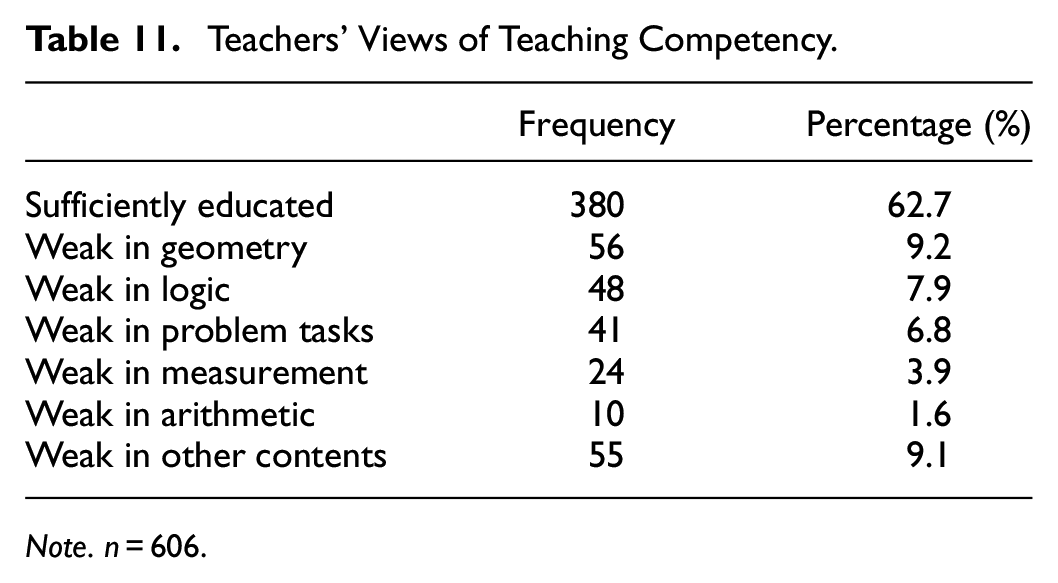
Note. n = 606.
Discussion
Teaching efficacy is an integral part of teachers’ pedagogical beliefs, and related studies report the importance of teaching efficacy in concrete subject-specific areas (Boulden et al., 2021) and that pedagogical beliefs correlate with TPACK (Wu et al., 2022).
We examined teaching efficacy in maths with a particular focus on cross-curricular teaching, which addresses requirements for 21st-century maths competency to support all areas of work and life (Chai, 2019; European Commission, 2016). In the current post-digital society facing the epistemic challenge of seamless digitalization, teaching, and learning combine technology, and the TPACK model has gained much attention. We therefore analyzed whether Croatian teachers’ maths teaching efficacy beliefs are connected with TPACK in maths and maths in cross-curricular connections. As related studies report a correlation between years of service and technological competence (Baek et al., 2008; Cheng & Xie, 2018, citing Inan & Lowther, 2010; Koh et al., 2014; Yaghi, 2001; Gu et al., 2013; Russell et al., 2003), we also examined this. First, we performed an exploratory factorial analysis on the Croatian sample of elementary teachers to assess the instrument’s construct validity on the particular sample. The findings confirm that the instrument had construct validity and could be applied in this study.
As already indicated by Shulman (1986), pedagogical content knowledge, PCK, is essential for competent teaching. In our study, hypothesis one, in the post-digital condition, in addition to PCKmath and PCK cross-cu, TPK also correlated to maths teaching efficacy, was confirmed regarding the MTE subscale. Hypothesis two, PCKmath, PCKcross-cu, and TPK are important in predicting MTE was confirmed regarding PCKmath and TPK. PCKmath has a moderate correlation (a moderate effect size r2 = .3564) with MTE (H1) and is the important predictor for MTE (H2). For PCKcross-cu, the correlation with MTE was also moderate but lower (a small effect size r2 = 0.1971) (H1) and was not identified as an important predictor for MTE (H2). TPK has a moderate correlation (a small effect size r2 = .1998) with MTE and is an important predictor for MTE. There was only a weak correlation between TK (a small effect size r2 = .1310) and MTE (H1), and as we hypothesized, the TK was found to be a predictor for MTE (H2). The TPACK construct integrating all knowledge domains showed moderate correlation (small effect size r2 = .1840) (H1) but was not identified as a predictor as it was not included in our hypothesis two regarding the importance of technology integration.
Niess et al. (2009) argue that teacher technology preparation should be integrated into Schulman’s pedagogical content knowledge. They report that PCK frequently lacks solid integration of technology (Niess et al., 2009), and reviews show that only rare studies of PCK integrate media (see Grossman, 1990 in Park & Oliver, 2008; Grossman, 1990 in Niess et al., 2009) and Marks (1990 in Depaepe et al., 2013). Teachers’ weak subject matter knowledge, such as concept knowledge or fragmented knowledge, reduces the transfer of competency from one domain to another (Mayakis & Williams, 2022; Mewborn, 2001). Our findings show that TPK is strongly correlated with MTE and has a mean higher than TK. TK is weakly correlated with MTE and has the lowest mean score, which is consistent with the findings of Wu et al. (2022). We identified a significant effect of the years of service between the three groups, however with a small effect size. Teachers with more years of service assessed PCKmath, PCKcross-cu, and TPK higher, while TK was lower. The negative correlation is also reported in the literature (Baek et al., 2008; Cheng & Xie, 2018, citing Gu et al., 2013; Inan & Lowther, 2010; Koh et al., 2014; Russell et al., 2003; Yaghi, 2001) which all report a lower level of technology knowledge with increased years of service, while young digital natives have a higher level of technology knowledge.
The analysis of cross-curricular connections indicated that teachers rarely connect maths to informatics (2%). Despite Croatian curricular reform and the introduction of Informatics as a curriculum subject (Ministartsvo znanosti i obrazovanja, 2022) and that ICT is suggested as a cross-curricular topic (Eurydice, 2022), the effects on cross-curricular instruction are not yet visible. Part of the reason for this is that informatics is taught by specialist teachers of informatics, not by primary school teachers (Ministarstvo znanosti i obrazovanja Republike Hrvatske, 2018). This has to be reconsidered as the curriculum also suggests Informatics as a cross-curricular topic. The organization of instruction in grades one to four currently taught by one classroom teacher should also consider, as well as collaboration between the classroom teacher and a specialist subject teacher for informatics, that classroom teachers teach topics of informatics, too. This would provide the necessary conditions for integrative teaching in various subjects.
Teachers most frequently apply cross-curricular connections for maths with subjects the Nature and Society (82.8%) and the Croatian language (45.7%). Participating teachers indicate that students find measurement, geometry, and arithmetic demanding. The Croatian 8-year elementary school maths curriculum requires that students comprehend topics in a shorter time than in a 9-year elementary school curriculum. Teachers also reported topics in which they felt weak. About 10% reported feeling weak in geometry, 8% in logic, and 7% in problem tasks.
On the other hand, almost all felt confident about measurement and arithmetic. The findings of this study give insights into teachers’ beliefs about teaching efficacy in maths and cross-curricular maths and how much they correlate with technology pedagogy content knowledge. Based on our findings, implications could be suggested for practice and for teachers’ initial education and training to increase the role of teachers’ reflection on their beliefs and knowledge domains. In particular, reflections focused on instruction design consisting of maths in cross-curricular connections which examine learners’ and teachers’ experience and practices within integrated domains such as the pedagogy content knowledge and technology pedagogy content knowledge are necessary. The isolated focus on technology is decontextualized and has little impact on teaching efficacy.
The limitations of our study are related to a small non-randomized sample. The findings could differ if a sample were randomized and included participants equally distributed by school areas. This self-reported study, conducted on a small sample of 606 teachers, could inform future studies utilizing mixed-methods research to get a deeper insight into teachers’ pedagogical beliefs and their effect on technology integration and cross-curricular maths teaching. In future research, an examination of teachers’ beliefs and instructional approaches with teaching scenarios should be placed alongside students’ perceptions of instruction and learning outcomes. As already indicated in the related studies, the self-reported study could be supported with peer-observation and assessment based on observation. The observation could utilize the same TPACK instrument (Archambault & Barnett, 2010). Having learning outcomes in mind, the integration of technology should be explored from three angles (1) a subject-matter-specific tool, (2) as a learning technology, and (3) as a tool for the authentic application of maths in diverse areas of life.
Conclusions
Research and development of teaching and learning emphasize teachers’ competences and beliefs. These reflect the post-digital context including cross-curricular maths, enabling the development of mathematical competences for the diversity of life and work. Maths teaching efficacy beliefs which enact pedagogical innovation and shift should reflect pedagogical practices which seamlessly integrate digital technology in cross-curricular connections. This paper aims to elucidate maths teaching efficacy beliefs in connection to technology pedagogy content knowledge for maths and cross-curricular maths of 606 Croatian elementary school teachers.
According to Shulman (1986), pedagogical content knowledge in the PCK is essential for competent teaching. In our study, the maths teaching efficacy beliefs subscale MTE is strongly correlated with PCKmath—pedagogical content knowledge in maths with a moderate effect size. We build these premises adding technology knowledge to teachers’ essential pedagogical knowledge domain. Findings confirmed hypotheses. H1:In the post-digital condition, for the MTE subscale, teachers’ maths teaching efficacy beliefs are correlated to TPACK constructs and in addition to PCKmath, especially to the construct integrating technology and pedagogy, TPK. H2: In post-digital conditions, in addition to pedagogical content knowledge in maths (PCKmath), the integration of technology knowledge in teachers’ pedagogical knowledge (TPK) is essential and is, with a large effect size, predicting teachers’ maths teaching efficacy beliefs subscale MTE, while technology knowledge (TK) is not. H3 was also confirmed with a small effect size, there is a significant negative correlation between years of service and TPK and TK—technology knowledge and a significant positive correlation with PCKmath and PCKcross-cu. As already established in related studies (Baek et al., 2008; Cheng & Xie, 2018, citing Inan & Lowther, 2010; Koh et al., 2014; Yaghi, 2001; Gu et al., 2013; Russell et al., 2003), years of service correlate negatively with technology knowledge and technology pedagogy knowledge and positively with maths and cross-curricular pedagogy content knowledge.
This paper focuses on two pertinent issues in developing mathematical competences for the 21st Century following the Croatian curricular reform in 2019 on the relationship between digital competency and all curricular subjects, emphasizing cross-curricular connections. The cross-curricular teaching between mathematics and ICT has, according to the findings of our study, not yet fully evolved. The introduction of informatics as an elementary school subject taught by specialist informatics teachers was an important part of the reform. An analysis of cross-curricular connections indicated that classroom teachers rarely connect maths to informatics (2%). Based on our findings, we, therefore, recommend that teaching collaboration should take place between classroom and specialist teachers to integrate informatics in various curricular areas and consideration be given to preparing classroom teachers to teach topics of Informatics, too. This study addressed how the requirements of the contemporary workplace for digital competency integration in diverse disciplines are addressed in classrooms. The level of teachers’ digital technology practices, which are reflected in teaching efficacy beliefs, is an important topic which deserves attention in future research.
Footnotes
Acknowledgements
The authors would like to express their thanks to the teachers and schools who participated in this study, to The Agency for Education of the Republic of Croatia and to the Municipality of Rijeka.
Declaration of Conflicting Interests
The author(s) declared no potential conflicts of interest with respect to the research, authorship, and/or publication of this article.
Funding
The author(s) disclosed receipt of the following financial support for the research, authorship, and/or publication of this article: The authors of this manuscript were supported and funded by the European Union ERASMUS + (2020-1-HR01-KA201-077816). The project titled An interdisciplinary approach to mathematical education—InMath is co-founded by the Erasmus+ Program of the European Union, Key Action: Cooperation for innovation and the exchange of good practices—Strategic Partnerships for school education.
Ethical Approval
The study was conducted following the University of Rijeka Code of ethics. The study and the reporting of a study followed guidelines of American Psychological Association’s ethical guidelines regarding consent, confidentiality, and anonymity of responses. All participants were fully informed that their anonymity was assured, why the research was being conducted, how their data would be used, and that there were no risks associated. They gave consent to participate and they could freely withdraw during the participation.
