




Abstract
While much attention is paid to 4G wireless Internet service based on long term evolution (LTE) technology, the previous studies investigating both subscription intention and of 4G wireless Internet service time are lacking. This study attempts to fill this void by analyzing the subscription intention and time of 4G wireless Internet service users using a bivariate two-equation model. Further, as previous studies on self-efficacy and innovativeness are lacking in mobile service adoption despite the importance of user capability for adopting Internet service, this study intends to fill the void by including user technical competency representing possession of comprehensive knowledge for 4G wireless Internet service, extensive use of wireless Internet, and the use of advanced smart phone.
The analysis results of bivariate two-equation model using the sample of 810 Korean users show that if users have the comprehensive knowledge for 4G wireless service, or use advanced mobile smart phone, or greatly use wireless Internet through advanced mobile smart phone, or who are male they are more likely to adopt 4G wireless service. The subscription time is shorter for the users who extensively use wireless Internet and use advanced mobile smart phone or, are male, and have high before tax monthly income. This study contributes to literature in mobile services by suggesting user technical competency as affecting subscription intention and time for 4G wireless Internet service. Managers may better concentrate their marketing efforts to the group of people using wireless Internet extensively and advanced mobile smart phone, and who are male.
Keywords
Introduction
The 4G mobile industry is showing the steepest rate of growing as a part of telecommunications industry (FreedomPop, 2019; KT Service Internet Provider, 2015; UbiFi, 2020). 4G wireless internet service was developed from the efforts to search the niche market after communication service market is saturated, to advance the wireless communication technology, and to utilize the frequency bandwidth (SPARK Services, 2020). 4G wireless internet service is complementary to other high-speed, mobile communication services. Given the advantages of high speed and mobility, 4G wireless internet service will provide lots of opportunity to occupy most of the market for telecommunication service where wired and wireless internet service is converged, and to improve the service scope of telecommunication business. Thus, both the wired and wireless communication service providers are eager to obtain the rights to do the 4G wireless internet service business. LTE (long-term evolution–advanced) technology which is a 4G mobile communication service is prevailing the offers for 4G wireless service. Although 5G is a currently state-of-the-art technology, our study focuses on 4G wireless internet service because 4G is the next cutting-edge technology besides 5G and users have sufficient usage experience to provide knowledgeable and reliable answers to the factors affecting its usage than 5G which has a shorter period of its diffusion.
This study has several motivations to fill the void in the previous studies on 4G mobile service. First, this study attempts to analyze the subscription intention and time (i.e., time taken before actual subscription to new 4G wireless internet service occurs after the service is initiated in the market) of 4G wireless internet service based on LTE technology using a bivariate two-equation model as the previous studies investigating the subscription intention and time simultaneously are lacking. Previous studies on mobile service (Fang & Fang, 2016; Li & He, 2015; J. Lin et al., 2011; Sanakulov & Karjaluoto, 2015) have rarely considered these both aspects at the same time.
Although it is necessary to analyze two critical uncertainties involved with new-technology adoptions whether and when the target market will begin to use them, previous studies examining both subscription and time are almost nonexistent. This study utilizes a bivariate two-equation model where the subscription intention and the subscription time are specified as two-step processes by the maximum likelihood estimation method. Using the survey data from the residents in metropolitan areas, this study attempts to analyze the subscription intention and time for 4G wireless service.
Second, our study intends to fill the void in the factors affecting the subscription intention and time of 4G wireless internet service by including user factors such as user technical competency, which is defined as a group of factors for self-efficacy and innovativeness of users, and indicates the extent that users have knowledge and usage experience of wireless internet required for adopting 4G wireless internet service, and tend to pursue new technology. While many empirical studies exist on the adoption of mobile internet service in other countries, the studies on the user factors for the adoption of 4G wireless internet service based on LTE technology are relatively rare (Jung et al., 2015). The exact links of 4G wireless internet service to economic growth remain unclear until we look at the details of which kinds of people use broadband (Ericsson, 2009).
Previous studies on self-efficacy and innovativeness are lacking in mobile service adoption, despite the importance of user capability for adopting new internet service (Kuo & Yen, 2009; Lee & Kim, 2009; Lee & Quan, 2013; Scott & Walczak, 2009). The 4G wireless internet service is an innovative technology, and its usage is related to innovativeness of users. People with greater extent of innovativeness likely establish more positive perceptions in terms of ease of use for Wireless Mobile Data Services (WMDS) in China (Lu et al., 2008). Personal innovativeness is much related to the perceived ease of use of 3G mobile services (Kuo & Yen, 2009). Innovativeness affect perceived ease of use for mobile game service (Lee & Quan, 2013). The users with the greater extent of self-efficacy and innovativeness tend to perceive less difficulty while using mobile game service. Thus, innovative users are likely to have intention to subscribe to 4G wireless internet service within a short time. This study intends to suggest user technical competency, that is, the possession of comprehensive knowledge for 4G wireless service, extensive use of wireless internet (more than 1 GB per month), and use of advanced mobile smart phone (model not older than 3 years).
Third, given the great usage and expectations of wireless internet, this study intends to provide an empirical study investigating other user factors such as user demographics (gender, age, education, income). The target sample is composed of Korean users for 4G wireless internet service. Evidence posits that the telecommunications services are greater in economic impact in developing countries such as Latin America and Asia than others (Thompson & Garbacz, 2011). China provides mobile communication quality which varies from one place to other because of the difference in economic advancement, and perceived communication quality has an influence on users’ continued usage intention (Li & He, 2015). Although there are many empirical studies on adoption of mobile internet service in other countries, the studies are lacking on the adoption of 4G wireless internet service based on LTE technology, which is a convergence of internet and broadband service. This study intends to fill this void.
Wireless and Broadband Internet Service
The current trend toward wireless internet has created great change in the world of mobile wireless networks (FreedomPop, 2019; UbiFi, 2020). 4G wireless internet service allows customers who are distributed geographically to be provided with information and contents in a collaborative, computer-based environment. 4G wireless internet service is a telecommunication service utilizing portable mobile devices to access information and content on the internet. 4G wireless internet service can be provided in moving vehicles at high speeds, which make it differ from wireless LAN (local area network) and low-speed wireless internet based on telecommunication devices. 4G wireless internet service enables high-speed access to wireless internet when users are driving long distances. This technology improves the mobility of WiMax developed by IEEE 802.16 Group and was accepted by IEEE in December 2005 as mobile WiMax standardization. Recently, LTE technology is the technology that prevails the offers for 4G wireless service.
The 4G wireless technology attracts more users by circumventing drawbacks of limited bandwidth, limited mobility, and instability of 3G service (S.-C. Lin et al., 2015). The implementation of 4G wireless internet service facilitates the convergence of service and technologies and development of Korean IT industries. In Korea, after 2.3-GHz frequency bandwidth had been allocated to 4G wireless service, several studies investigated the technology standardization and the possibility of 4G wireless internet service adoption in the industry.
4G wireless internet service provides four advantages compared with other telecommunication service; 4G wireless internet service enables (a) high-speed (more than 1 Mbps) (b) mobile telecommunication when users gain access (c) using various mobile devices (e.g., PDA, notebook computer, smart phone) (d) through wireless internet while they are moving. 4G wireless internet service can be provided much more cheaply than fixed-line services and offer cheap broadband infrastructure.
The diffusion of the convergence of internet and mobile phones in Korea has been phenomenal. The market for 4G wireless internet service based on LTE technology is likely to grow significantly for two reasons. First, the evolutionary advancement of networks is realized in preparation for an enormous increase in network traffics. The great market opportunity for 4G wireless internet service is possible by the rapid diffusion of smart phones, netbook computers, and mobile devices and application stores of large scale which contribute to a large demand for mobile data traffic. AT&T Wireless initiated 3G in July 2004 to provide the United States’ first 3G voice and data network. The current 3G network cannot realize the large-scale increase of the network traffic, and this makes the evolutionary advancement to the next generation of network necessary (Jeon & Lim, 2010). Second, it is possible to create new markets for services through 4G wireless internet service such as games, music, payment services, logistics, and disaster prevention and recovery. The generation of new services and applications will be a great opportunity for further profits. The increasing saturation of mobile technology such as phones and note pads offers the endless range of commercial activities including shopping, real-time news, buying tickets, banking, and booking through the internet in the “pockets” of consumers.
As data and voice technologies are combined, wireless broadband networks can decrease the strategic revenue position of traditional DSL/Cable and ISPs businesses, and can acquire the lead on cellular networks. The 4G wireless internet service is based on fast-developing networks that combine localized WLANs to build up a nationwide infrastructure for wireless service, which provides seamless wireless access to users through roaming from one spot of a city to another and among cities.
The wireless LAN does not provide support for continuous mobile communication when users are moving in the area wider than 100 m2. The communication speed is fast in the following descending order: wired internet, wireless LAN, digital multimedia broadcasting (DMB) (satellite/earth), wideband code division multiple access (W-CDMA), and mobile internet. 4G wireless internet service provides communication service for the users who are moving in the speed at most of 60 km/hr. DMB (satellite/earth), W-CDMA, and mobile internet also support the communication service for the users who are moving. The price of wireless LAN, satellite DMB, and 4G wireless internet service is lower than that of mobile internet and W-CDMA.
Factors Affecting Subscription Intention and Time
The studies on the factors wireless broadband internet service can be reviewed in the groups of broadband and mobile service. The studies of former group investigated factors influencing broadband usage. For example, Park and Yoon (2005) suggested that the key factor for the spread of broadband in Korea is the government’s policy for competition through deregulation. Tanguturi and Harmantzis (2006) investigated the behavioral, economical, and technological factors which affect the choosing of wireless technologies. The other studies used technology acceptance model (TAM) to investigate the adoption of mobile services (Chong et al., 2011; Shin, 2011). TAM is the widely used theory on studying adoption of mobile technology and services (Sanakulov & Karjaluoto, 2015). Mobile broadband exerts an important direct influence on gross domestic product (GDP), and low-income countries obtain much greater benefit from mobile broadband (Thompson & Garbacz, 2011). Perceived ease of use, perceived enjoyment and usefulness, and continuance usage intention of mobile service are affected by perceived communication quality (Li & He, 2015). For the studies of mobile service, various applications have been considered such as brokerage service (J. Lin et al., 2011), health care (S.-P. Lin, 2011), and mobile apps (Fang & Fang, 2016).
To focus on user capability which is suggested as crucial for adopting new internet service in previous studies (Kuo & Yen, 2009; Lee & Quan, 2013), this study develops user technical competency as a group of factors for self-efficacy and innovativeness of users, which indicates the extent that users possess knowledge and usage experience of wireless Internet required for adopting 4G wireless Internet service, and are likely to pursue new technology. This study describes user technical competency factors as composed of concepts for self-efficacy and innovativeness and intends to suggest three factors of user technical competency, that is, the possession of comprehensive knowledge for 4G wireless service, extensive use of wireless Internet, use of advanced mobile smart phone. Each of factors for user technical competency is chosen as it positively influences self-efficacy and innovativeness. Self-efficacy is assessed by the possession of comprehensive knowledge for 4G wireless internet service and extensive use of wireless. For instance, Lee and Kim (2009) suggested that the usage of intranet is affected by web experience which represents self-efficacy of this study. Scott and Walczak (2009) suggested that computer self-efficacy had an influence on perceived ease of use and adoption of ERP (enterprise resource planning) system’s training tool. Users with self-efficacy have a little difficulty in using ubiquitous mobile game service, showing that marketing efforts better center on the users with experience with related technology (Lee & Quan, 2013). Thus, people with high self-efficacy are likely to require less efforts to realize their goals and reduce barriers than users with low-self-efficacy.
Besides factors of user technical competency, this study adopts Korean users’ demographics which consist of gender, age, education, and income based on the previous studies in mobile service which used users’ demographics. For example, Hwang et al. (2016) suggested demographics factors affecting mobile application usage such as gender, age, and application types. Based on actual user experience and behavior log data, Hwang et al. suggested the moderating effects of gender and age on the usage of mobile apps. Thus, three factors of user technical competency along with users’ demographics such as gender, age, education, and income can be posited to influence subscription intention within a shorter time. Figure 1 suggested the effect of user technical competency and demographics on subscription intention and time for 4G wireless service.

User technical competency and demographics for 4G wireless internet service.
The Analysis Model
It is necessary to develop and validate a response scale that provides more accurate predictions not only of whether a future adoption will occur but also of when this adoption behavior is most likely to occur (Ittersum & Feinberg, 2010). This study proposes to estimate timed intent measure by presenting respondents with multiple time intervals for a specified time horizon. The study applies bivariate equation model which predicts the subscription to 4G wireless internet service based on LTE technology and the subscription time. The model describes the probability to subscribe to 4G wireless internet service and the “conditional” subscription time using the sample which decided to subscribe to 4G wireless internet service and two separate probability equations. Furthermore, the model predicts the impact of the increase of subscription rate on the subscription time.
The respondents are depicted as


Some of

1(•) is the indicator function which takes 1(0) if the condition in the parenthesis is true (false).
For
If respondent indicates that he (or she) will subscribe to 4G wireless internet service within from 6 to 9 months, he (or she) will choose third example and
The bivariate normal distribution is represented as joint distribution, that is,

If

The probability that ith respondent subscribe to 4G wireless internet service within 1 month is presented as follows:
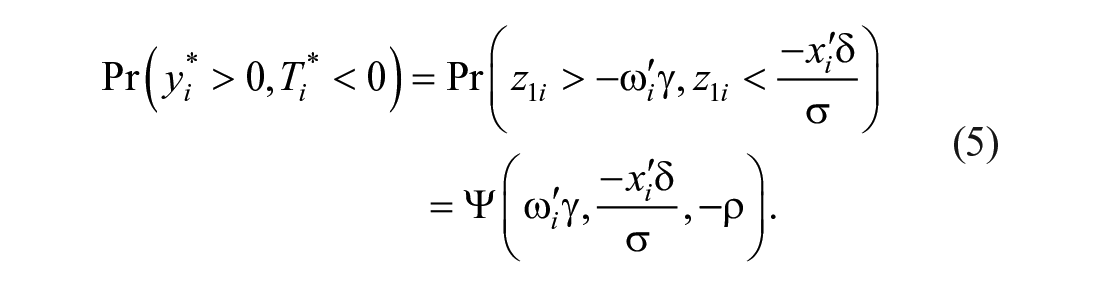
The probability that ith respondent subscribe to 4G wireless internet service within from 1 to 3 months is given as follows:

The probability that ith respondent subscribes to 4G wireless internet service after 24 months is provided as follows:
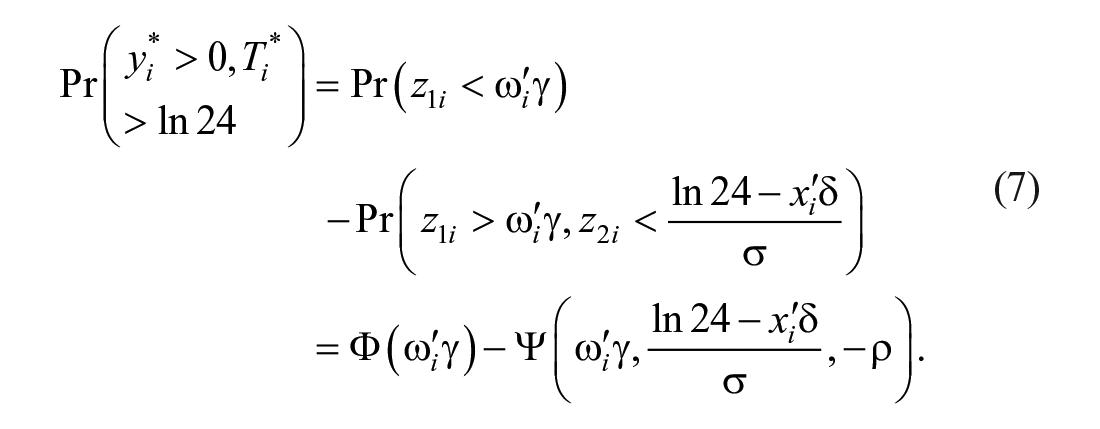
Thus, the final form of log of maximum likelihood function to estimate parameters of bivariate two-equation suggested in the study is presented as follows:

The parameters,
Research Variables
Table 1 indicates the operational definitions for the factors of user technical competency and demographics and the descriptive statistics of variables. The possession of the comprehensive knowledge is measured as a dichotomous item according to whether users are confident in knowing how to use recent models of 4G wireless internet service without difficulty (0 = No, 1 = Yes). Extensive use of wireless internet is measured as a dichotomous item (0 = No, 1 = Yes) according to whether the amount of wireless internet data communication is more than 1 GB per month (0 = No, 1 = Yes). Use of advanced mobile smart phone is a dichotomous item according to whether users are currently using advanced mobile smart phone having the model which is not older than 3 years (0 = No, 1 = Yes).
The Definitions and Descriptive Statistics of Variables.

SD = standard deviation.
Data Collection
The data collection method employed online survey site which our researcher composed using a google service based on the structured questionnaire. The concepts of 4G wireless internet service are explained to respondents and the questions regarding the markets of 4G wireless internet service and their intentions to subscribe to 4G wireless internet service are asked. The questions which have ambiguous meanings are corrected until they have clear and straightforward meanings. The questions are asked to examine whether respondents are able to buy mobile devices and are “really” ready to subscribe to 4G wireless service. The major advantages of 4G wireless internet service over other internet services are described in terms of mobility, maximum communication speed, communication quality, and usable mobile devices. For instance, 4G wireless internet service is possible on the fast moving vehicles and the maximum communication speed is 7 Mbps which is 23 times greater than the speed of current wireless internet service (384 Kbps). In the pilot test, the explanations of 4G wireless internet service are reviewed to examine whether they deliver appropriate meaning of the 4G wireless service.
The survey is requested to potential users in Seoul, that is, the capital of Korea, and its suburb area. The specialized survey company conducted the data collection for the scientific sample collection. The survey area is subdivided into the 43 (nine small cities and 34 district areas of two large cities), and the sample is selected in proportion to the size of the population of the subdivided area. The objective of the survey is to collect data for the estimation of subscription intention and time for 4G wireless service. The age of respondents is restricted to be from 20 to 65 years for the reliable response from their knowledge of 4G wireless service. The final sample includes 810 responses where the return rate is 45%.
The statistics are presented for three groups: the entire sample, the sample which is composed of the respondents who suggest (or do not suggest) the intentions of subscription. The questions are composed to ask for the intention to subscribe and for the time of subscription. For the simplicity of question, the respondents are allowed to choose one answer among the candidate examples. Most (86.5%) of respondents have already subscribed to 4G wireless internet service and currently possess no intention to subscribe to 4G wireless service. One hundred and nine respondents have the intentions to newly subscribe to 4G wireless service, which is 13.5% of the 810 randomly sampled respondents. Table 2 presents the distribution of the intentions to subscribe to 4G wireless internet service and the time of subscription.
The Distribution of the Intentions to Subscribe to 4G Wireless internet Service and the Time of Subscription.

Results and Discussion
Table 3 suggests the results of estimation of the bivariate two-equation model. To estimate the nonlinear effect of age as this variable is known to be the very feature characterizing the adoption of state-of-the technology like 4G, our study additionally uses the square of Age, Age2, as an explanatory variable. The equation model is relying on the assumption that the disturbance terms for the two equations are correlated. The bivariate two-equation model is expected to have better estimation results than that for the separate single equation model.
The Estimation Results of Bivariate Two-Equation Model.

Note. Value in the parenthesis is t-value.
p < .1. **p < .05. ***p < .01.
The bivariate two-equation model with
In the bivariate two-equation model, the effects of the possession of comprehensive knowledge for 4G wireless service, use of advanced mobile smart phone, extensive use of wireless internet, and gender on the intention to subscription are significant (p < .01, respectively). This indicates that if users possess the comprehensive knowledge for 4G wireless service, or currently use advanced mobile smart phone, or extensively use wireless internet through advanced mobile smart phone, they are more likely to adopt 4G wireless service. This shows that factors of user technical competency which indicates self-efficacy and innovativeness positively influence the intention to subscribe to 4G wireless service. Furthermore, male users are inclined to have stronger intention of subscription than female users. The estimated coefficients of explanatory variables in Table 3 indicate that the subscription intention and the subscription time depend on the social and economic characteristics of respondents. The respondents who have known comprehensively the 4G wireless internet service before are more likely to subscribe to 4G wireless internet service than the ones who have not known the 4G wireless internet service before. Furthermore, the respondents who currently use advanced mobile smart phone have greater probability to subscribe to 4G wireless internet service than the ones who do not currently use advanced mobile smart phone. In addition, male respondents are more likely to use 4G wireless internet service than female respondents. Managers should concentrate their marketing efforts toward these groups of customers.
Although not significant, the age of respondents is positively related to the probability of subscription to 4G wireless service. The negative coefficient of Age2 indicates that the age of respondents begins to negatively affect the probability of subscription after some age. Furthermore, the coefficient of the square term of age is negative indicating that the time to the subscription to 4G wireless internet service begins to decrease after the age of users exceed “some” age. Until then, the subscription time to 4G wireless internet service increases as the age of users increases. The positive constant term for the estimated bivariate model indicates that the predicted subscription time will be positive even if the values of the explanatory variables are small. This indicates that although 4G wireless internet service is initiated in the market, users will subscribe to 4G wireless internet service after some time.
Previous studies on mobile service (Fang & Fang, 2016; Li & He, 2015; Sanakulov & Karjaluoto, 2015) have rarely considered both subscription intention and time aspect at the same time. Thus, our study also suggests the user factors negatively affecting subscription time. The respondents who have known the 4G wireless internet service before are more likely to subscribe earlier to 4G wireless internet service than the ones who have not known the 4G wireless internet service before. The subscription time is shorter for the users who extensively use wireless internet and use advanced mobile smart phone or, are male, and have high before tax monthly income (p < .01, respectively). This shows that the respondents who currently use advanced mobile smart phone or wireless internet extensively will subscribe to 4G wireless internet service earlier than the ones who do not currently use advanced mobile smart phone or wireless internet extensively. This generally shows that the factors affecting subscription intention influences the subscription time negatively. In addition, male respondents will use 4G wireless internet service earlier than female respondents. The level of income is also negatively related to the subscription time. Thus, the marketing efforts of 4G wireless internet service should be concentrated to the extensive users of advanced mobile smart phone and wireless internet, male users, and the users with high income level. The promotion of the advantages of 4G wireless internet service to the users of advanced mobile smart phone and the extensive users of wireless internet and male users turned out to be effective strategy to increase the probability of subscription to 4G wireless service.
Conclusion
While there are many empirical studies on adoption of mobile internet service, the studies are lacking on the acceptance of 4G wireless internet service based on LTE technology. This study attempts to fill this void by analyzing the subscription intention and time of 4G wireless internet service users using a bivariate two-equation model using the data collected from a survey of the residents in metropolitan areas. The analysis results of bivariate two-equation model using the sample of 810 Korean users show that user factors of user competency which represents self-efficacy and innovativeness, and gender positively influence subscription intention. That is, if users have the comprehensive knowledge for 4G wireless service, or greatly use wireless internet through advanced mobile smart phone, use advanced mobile smart phone, or who are male they are more likely to adopt 4G wireless service. The subscription time is shorter for the users who extensively use wireless internet and use advanced mobile smart phone or, are male, and have high before tax monthly income. Our study offers insights regarding diffusion of 4G wireless internet service overcoming two critical uncertainties involved with new-technology adoptions whether and when the target market will begin to use them and specific user factors such as user competency (especially extensive use of wireless internet or use of advanced mobile smart phone) and demographics are suggested as affecting subscription intention and time.
Implications for Researchers
Using a bivariate two-equation model, this study estimated both the subscription intention and time (i.e., time taken before actual subscription to new 4G wireless internet service occurs after the service is initiated in the market) of 4G wireless internet service based on LTE technology. As previous studies on mobile service (Chong et al., 2011; Fang & Fang, 2016; Li & He, 2015; S.-P. Lin, 2011; J. Lin et al., 2011; Sanakulov & Karjaluoto, 2015; Shin, 2011; Thompson & Garbacz, 2011) have rarely considered both subscription intention and time aspects at the same time, this study utilizes a bivariate two-equation model where the subscription intention and the subscription time are estimated as two-step processes by the maximum likelihood estimation method.
While there are many empirical studies on diffusion of mobile internet service in other countries, the studies on user factors such as user competency for the adoption of 4G wireless internet service based on LTE technology are lacking. It is posited that the rapidly advancing telecommunications services is more economically impactful in developing countries in Asia (Thompson & Garbacz, 2011). The exact links of 4G wireless internet service to economic growth can be clear when the details of which kinds of people use broadband are examined (Ericsson, 2009). Thus, given the great usage and potential of wireless internet, this study provides an empirical study investigating user capability and demographics (gender, age, education, income) for 4G wireless internet service. As previous studies on self-efficacy and innovativeness are lacking in mobile service adoption, despite the importance of user capability for adopting internet service (Kuo & Yen, 2009; Lee & Kim, 2009; Lee & Quan, 2013; Scott & Walczak, 2009), this study contributes to literature in mobile services regarding self-efficacy and innovativeness by suggesting user technical competency as affecting subscription intention and time for 4G wireless internet service. While user capability should be important for adopting 4G wireless internet service and previous studies posited that people with greater extent of innovativeness likely establish more positive perceptions such as more perceiving ease of use for wireless mobile service (Lu et al., 2008), previous studies on self-efficacy and innovativeness are comparatively rare in 4G wireless internet service. Utilizing user technical competency and demographics, this study analyzes the subscription intention and time for 4G wireless internet service based on LTE technology through a bivariate two-equation model where the subscription intention and the subscription time are specified as two-step processes.
There are several future research issues. First, in the future study, more diverse set of sample needs to be exampled. Second, other analysis method can be used in the future study. For instance, the dichotomous choice contingent valuation methods can be useful to predict the demand for the market such as 4G wireless internet service market which is currently not widespread. Third, the intention to substitute 4G wireless internet service for various internet services can be useful in explaining the future structure of competitive telecommunication markets. The users of wired broadband service are less likely to change it with 4G wireless internet service if these services are complementary rather than substitutive. Managers can determine whether these services are substituting each other based on comparison study of these services. Fourth, the use of binary variables in our study precludes reliability and validity test of our measures. Future study can employ multi-items for measures and suggest reliability and validity of measures. Fifth, future studies can provide comparison among subsamples according to variables. For instance, it is possible to separate the entire sample into male cases and female cases, and show how the usage of wireless internet service is different among these samples. Finally, the interaction effects can exist between user contingency variables and users’ demographics, and future study can show how these interaction can affect the usage of cutting-edge wireless internet service.
Implications for Practitioners
The results provide implications to practitioners by improving understanding of the kinds of users who finally use it; corporate managers can understand the nature of potential customers. The studies in the context of Korean mobile services using user technical competency and demographics provide insights regarding diffusion of 4G wireless internet service, that is, whether and when the target market will begin to use them, and regarding the type of potential customers for 4G mobile services. For instance, the respondents who possess the comprehensive knowledge such that they can easily start using new wireless internet service are more likely to subscribe to 4G wireless internet service. The extensive users of wireless internet or advanced mobile smart phone are more likely to subscribe to 4G wireless internet service and the subscription time is shorter than the nonusers of these devices.
The results can support manager of 4G wireless internet service prepare market segmentation strategies based on user technical competency and demographics. To create value from the launch of 4G wireless internet service into market within a shorter time, managers may better concentrate their marketing efforts to the group of people who are likely to subscribe to 4G wireless internet service within a shorter than longer time: people who are male with high income level using wireless internet extensively and advanced mobile smart phone. For specific type of customers, the estimated model enables the estimation of future expected subscription and time for 4G wireless services. Managers may better concentrate their marketing efforts to the group of people using wireless internet extensively and advanced mobile smart phone, and who are male with high income level, and be better prepared for moving into 4G wireless internet service within an estimated time. The providers of 4G wireless internet service should develop competencies in their capability to have market research insight to target the specific segment of customers, and understanding of the rapidly changing mobile market space. Information service providers should target the specific group of customers through engaging a competitive services differentiation strategy.
Footnotes
Declaration of Conflicting Interests
The author(s) declared no potential conflicts of interest with respect to the research, authorship, and/or publication of this article.
Funding
The author(s) disclosed receipt of the following financial support for the research, authorship, and/or publication of this article: Funding for this paper was provided by Namseoul University.
