




Abstract
The aim of this research is to find out connections of identifications with the work group (group identification), informal subgroups (micro-group identification), and other members in the work group (interpersonal identification), considering cognitive, affective, and behavioral components, with an employee’s contribution to cooperative activities. The sample includes 302 fellows of 35 workgroups in Russian commercial companies and public organizations. Empirical data were collected with the Questionnaire of Interpersonal Identification, the Questionnaire of Micro-group and Group Identification, and the Collaborative Group Activity Scale from the Leadership, Contribution, and Interpersonal Style Questionnaire. All the tools were assembled into the computer-based assessment program “Group Profile” (GP) to conduct the survey individually on PC. It was found that all three dimensions of group identification and affective measures of interpersonal and micro-group identification predict individual contribution to collaborative activities in groups. Employee involvement in the informal subgroup within the work group mediates relations between identification dimensions at different levels and contribution to collaborative activities. The ties of additional characteristics (gender, age, tenure with the organization) with cooperative activities have been described. The multivariate model of identification makes it possible to extend the research scope and enhance the understanding of causes and effects of employee identification in the group.
Keywords
Introduction
In recent years, employee’s identification with the organization and work group has drawn particular attention of both theorists and managers because it sets grounds for a variety of organizational attitudes and behaviors in employees. There are statistically relevant positive correlations between the organizational identification and organizational commitment, job involvement, occupational and work group attachments, in-role and extra-role behaviors, and negative relationships between the organizational identification and intention to quit a job (Lee et al., 2015; Riketta, 2005). By turn, some attitudes and extra-role behaviors of employees are beneficial to the organization, as well as in-role behavior is considered a prerequisite to organizational functioning and effectiveness. In this way, extra-role and other kinds of prosocial behaviors—such as organizational citizenship behavior (OCB), contextual performance, and organizational spontaneity—have significant individual- and organizational-level outcomes (N. P. Podsakoff et al., 2009).
Most researchers examine the ties of organizational identification with the employees’ behavior unrelated to their professional and job responsibilities. However, the very concept of organizational identification—been understood as an indivisible entity—may lead to crucial oversights in organizational behavior studies (van Knippenberg & van Schie, 2000). It takes to consider different dimensions of identification stemmed from perceived work group membership in the organization. That is why the experts explore—as well, but quite seldom—the consequences of employees’ identification with work in-group (Christ et al., 2003; Hakonen & Lipponen, 2007; van Dick et al., 2004; van Knippenberg & van Schie, 2000). Saying about a small work group, we refer to the small-size enterprises, the structural unit of medium-size company or large corporation—such as administrative department, local crew, working shift, and narrow-in-scope taskforces at a workplace. The size of such groups may vary from three to 25 members and a few more. In the workgroups, one can find some other dimensions of identification in addition to general levels: there are, as well, identification with colleagues and leaders (interpersonal identification) and identification with informal subgroups (micro-group identification) which emerge within the structure of any work group. They, too, have outcomes in workers behaviors and attitudes within the organization. The above-mentioned identifications are called “level of identification,” so far as each of them matches a certain tier in the group structure: other workers, informal subgroup, and group. In other words, these structural layers constitute the foci of identification.
In common, organizational and group identifications are treated and evaluated as solid factors. However, they have different components such as cognitive, affective, and behavioral. The same constitution one may find in both micro-group and interpersonal identifications. Each aspect may have either the same or distinct outcomes in the employee’s behavior at different levels—work group, structural unit, or organizational.
Several aspects of prosocial behavior may be found in the literature: altruism, civic virtue, conscientiousness, functional participation, helping, taking charge, voice behavior, and so on: And, the list is permanently updated. Particularly, in this article, a contribution to group activity is considered as an OCB dimension. In the context of a whole organization, or its units, or a workgroup, those aspects can manifest themselves differently. And with it, the dimensions (levels or components) of identification may relate differently to various kinds of organizational behavior.
Thus, the aim of this research is to find out connections of identifications with the workgroup (group identification), informal subgroup (micro-group identification) and other members in the work group (interpersonal identification), considering cognitive, affective, and behavioral components, with an employee’s contribution to cooperative activities.
Dimensions of Identification
The primary focus of this research is to distinguish three levels of employee’s identification: with small in-group, with informal micro-group, and interpersonal identification with in-group colleagues. Within a small group context, there may be find additional forms of identification, for example, relational one (e.g., Li et al., 2018; Sluss & Ashforth, 2007; C. Zhao et al., 2016), but they diverge in both the content and outcomes from above mentioned identification dimensions.
According to some researchers, identification with the work group is stronger than identification with the organization (Riketta & van Dick, 2005; van Knippenberg & van Schie, 2000). Summarizing various findings, Riketta and van Dick (2005) offer a number of explanations for the divergence of organizational and group identifications: (a) professional activity is substantially carried out in workgroups, thereby mutuality and close relations are stronger with in-group members than with fellow workers in other organizational units; (b) the in-group have a stronger social-psychological impact upon their members than an organization in tote; (c) for its members, the in-group is more salient than organizational out-groups and entire organization—therefore, in-group membership has to be perceptually more salient in comparison with organizational memberships; and (d) very often groups are given comparatively higher autonomy and empowerment within the organization—thus workgroups become more important than entire organization, and the like.
Group identification is considered as multidimensional phenomenon. There are varieties of its dimensions: (a) by sources: cognitive, affective, and behavioral (mutuality; Henry et al., 1999); and (b) by components: consciousness of group affiliation, evaluative, and affect (Brown et al., 1986), cognition, affection, and balance between group and individual interests (Hinkle et al., 1989); cognitive, affective, and behavioral (Bouas & Arrow, 1996; Sidorenkov, 2010); cognition, affection, evaluative, and behavior (Jackson, 2002; van Dick et al., 2004); individual self-stereotyping, in-group homogeneity, solidarity, satisfaction, and centrality (Leach et al., 2008). More often, researchers assert a ternary structure of group identification that embraces cognitive, affective, and behavioral elements. Cognitive dimension refers to the feeling of both one’s own belonging (to) and integrative relationship with the relevant actor (individual or collective), perception of the other in line with his or her actual characteristics; affective dimension relates to the experience of relations with the other group members and evaluation of satisfaction of such relations, as well as to experience someone’s conformity with the other group members and related developments; behavioral dimension is linked with relatively sustainable reproduction of the other group members’ relevant characteristics in someone’s own deeds and actions as well as a conduct in response to expectations (Sidorenkov, 2010).
Experts rarely take heed to the occurrence of informal subgroups within a small work group and, therefore, related social-psychological phenomena, including identification with an informal subgroup (micro-group identification). It has to be noted that our concept of informal micro-group identification distinguishes with the conception of subgroup identification, which has also been considered in the literature in the particular meanings of identification with a service partner, or subcontractor (Lipponen et al., 2003), or with a small work group in the organization (Jetten et al., 2002). We use the term “informal subgroup” referring to the workers who establish closer relationships with each other, based on some significant—for them—attributes which separate them psychologically from other colleagues in the work group. It was found that micro-group identification is significantly stronger than both group identification and interpersonal one (Sidorenkov et al., 2014). Some of the ideas proposed by Riketta and van Dick (2005) for explaining preponderance of group identification over identification with the organization are suitable to explain the bias in favor of informal micro-group identification against identification with small work group in general. In addition, cooperation and cohesion, attraction and confidence are registered in a higher intensity within informal subgroups if compared with the whole group. In comparison with in-group, some functions toward its members (e.g., awareness-raising, encouraging an attainment of individual goals and the satisfaction of social needs, enhancing a sense of security) are carried out more successfully within informal subgroups.
Employees may at the same time identify with a work group, informal subgroup, and any of the individual members in the group, feeling closeness to an individual who expresses valued features (such as a way of dressing, patterns of interaction with unit managers, or a way of acting when important matters are at stake) that are lacking or not sufficiently expressed in them. They can also replicate some qualities of this colleague and behave in accordance with his or her expectations. Interpersonal identification differs from two other identification dimensions, and this difference stems from its orientation at a distinct object; it has approximately the same level of expression as group identification but is weaker than micro-group identification.
Micro-group and interpersonal identifications, as well as group identification, have three components—cognitive, affective, and behavioral (Sidorenkov et al., 2014). Thereby, it is possible to propose a two-facet model of employee’s identification in the group, which includes both levels (foci) of identification and its components (Figure 1).

Dimensions (levels and components) of employees’ identification in small group.
The dimensions of identification (both levels and components) may be conditional on some individual characteristics, among which are demographic and organizational tenure. The meta-analysis made by Riketta (2005) shows that organizational identification positively correlates with age and tenure of employment but does not significantly relate to gender. The data of more recent empirical research are contradictory. Some studies find that neither organizational (Klimov, 2014) nor group identification (Blader & Tyler, 2009) have a significant relationship with gender, age, and tenure, whereas others demonstrate correlations of organizational identification with gender and age (Blader & Tyler, 2009; Naumtseva & Klimov, 2017). However, the correlations of these individual characteristics with cognitive, affective, and behavioral components of interpersonal, micro-group, and group identifications are largely unaccounted.
The individual’s status in a group social-psychological structure stemmed from his or her involvement or noninvolvement into any informal subgroup, and it is an additional factor possibly having an impact on some dimensions of the employees’ identification in the group. There exist evidences that, among the members of a particular subgroup, each of three interpersonal identification components are stronger than at the whole group level and stronger than interpersonal identification among members of different subgroups or with autonomous members of the group who are not involved in any informal subgroup (Sidorenkov et al., 2014). At the same time, in contrast to interpersonal identifications, the intensity of both micro-group and group identifications registered in members of the particular informal subgroups and autonomous members who are not involved in informal subgroups is roughly the same. That appears to suggest the following hypothesis:
Contribution to Collaborative Group Activities
Both researchers and practitioners focus on such kinds of organizational behaviors as OCB (Organ, 1988, 1990) extra-role behavior (Van Dyne et al., 1995), contextual (citizenship) performance (Borman & Motowidlo, 1993; Motowidlo & Van Scotter, 1994), and organizational spontaneity (George & Brief, 1992). The attention to these forms of organizational behaviors ensues from their effects on workers, organizational units, and the very organization entity. They influence the employees’ performance ratings, intentions to change employments, management decisions on recognitions and rewards at the individual level, as well as productivity, quality of work, efficiency, cost reduction, and customer satisfaction at the organizational level (N. P. Podsakoff et al., 2009). The concepts of these kinds of behaviors overlap, so their distinctive characteristics are still to be defined (P. M. Podsakoff et al., 2000). What is common to all of them is that these behaviors are outside of any prescribed job duties and not considered for paying wages and incentive bonuses, but they are beneficial to other workers and the organization. In this research, the term “organizational citizenship behavior” is used as an overarching “umbrella” concept that encompasses all the above-mentioned kinds of prosocial behavior in organizations. By the early 2000s, a wide range of more than 30 specific forms of OCB have been singled out (P. M. Podsakoff et al., 2000), among them are altruism, courtesy, conscientiousness, civic virtue, and sportsmanship (Organ, 1988), personal support, organizational support, and conscientious initiative (Borman et al., 2001). Williams and Anderson (1991) proposed a two-dimensional conceptualization of OCB comprising OCB-I (behaviors directed toward individuals—colleagues and managers—such as helping, personal support) and OCB-O (behaviors directed toward organization, such as voice behavior, civic participation, and loyal boosterism).
In addition, we address one more OCB dimension as “contribution to collaborative activities in the group.” Contribution implies the amount and quality of individual efforts been carried out to achieve more efficient group or individual actions in both instrumental and social domains. At that, these efforts are not assumed by the employee’s duties. Employee’s contribution acts out in competent proposals concerning work or social issues as well as in constructive activism for the collective benefit. The concept of “contribution to collaborative activities in group,” at first glance, seems to be similar to other OCB forms, such as civic virtue (Organ, 1988), organizational participation (Graham, 1991), and voice behavior (LePine & Van Dyne, 1998; Maynes & Podsakoff, 2014). Nevertheless, contribution comprises not only voicing opinions but also grounded and competent ones. Sometimes associates may much and openly pronounce on changes or keeping from alterations in the working or social environment without giving reasonable ideas and renewed visions of the current situation. In this case, none could expect from the employee a high contribution to collaborative actions. As well, the contribution may be made not only to instrumental matters but also to social ones.
OCB and its dimensions are commonly examined within organizational context and much less frequently at group level (e.g., Hassan & Noor, 2008; Olkkonen & Lipponen, 2006). Ex facte, many of the organizational behaviors—helping behavior, voice behavior, and so on—manifest themselves variously in the workgroups, the organizational department, and the entire organization. Presumably, some of them—in a descending line—are more evinced in a small work group, and then less expressed in an organizational department, and—at the lightest point—they are exercised within the organization in general. Contribution to collaborative actions within the group is a target of this research.
OCB may depend on certain demographic variables, tenure of employment, and status in a workgroup (involvement/noninvolvement in informal subgroups). Nevertheless, there are findings that gender and age are correlated with neither helping behavior (Farmer et al., 2015; Klimov, 2014) nor enhancing implementation and working overtime (Klimov, 2014). Other data indicate that gender and age may make an impact on helping (Van Dyne & LePine, 1998). Particularly, female workers are more likely than males to help other fellows (Bridges, 1989) and show altruism (Lovell et al., 1999). Elder fellows show a greater altruistic behavior than younger fellows (Wagner & Rush, 2000). The comparable findings relate to tenure of employment: neither shorter (less than 9 years) nor longer (more than 9 years) duration of tenure does not considerably impact OCB in school faculty (Vigoda-Gadot, 2007). And with it, there are findings indicating positive correlations between the tenure of employment and teachers’ enhancing implementation at the level of the entire organization (Klimov, 2014). Clearly, due consideration of the question should take account of both distinguished antecedents of different OCB dimensions and varied social context of behavior at different structural levels—in small group, organizational unit, or entire organization. We have failed to find any evidence-based references on the correlations of fellow’s involvement/noninvolvement in the informal subgroup with OCB. However, it is conceivable that group members who are involved in any informal micro-group make a more significant contribution to entire group activities and collaborative actions in comparison with the fellows not involved in any informal subgroup.
Relations of Identification Dimensions With Contribution to Group Activities
Most of the researchers explore the relationship between organizational identification and behavior at the organizational level. A meta-analysis reveals this relationship is significantly positive as well as stronger in comparison with the ties between identification and in-role behavior (Lee et al., 2015; P. M. Podsakoff et al., 2000). Recent empirical evidence shows the impact of organizational identification on extra-role (Wilkins et al., 2018) and organizational citizenship (Matherne et al., 2018; Nguyen et al., 2016; Uzun, 2018) behaviors. Some experts examine the ties of discrete organizational identification dimensions with OCB. This approach provides us with a detailed description of correlations between distinctive attitudes and related behaviors. For instance, the cognitive and affective dimensions of organizational identification function as predictors of sportsmanship (van Dick et al., 2004), interpersonal helping, and loyal boosterism (Johnson et al., 2012). The authors, too, point that affective identification better predicts OCB in comparison with cognitive identification.
Substantially less research is carried out concerning the relations between identification with group and employee’s behavior. It has been revealed that identification with a group is positively correlated with sportsmanship and courtesy (van Dick et al., 2004), helping (Christ et al., 2003), aid-giving behavior and working overtime (Klimov, 2015). Nevertheless, these and other research lack differentiation between citizenship behavior in workgroup and organization, concealing the fact of splitting a behavior up to two kinds under the influence of workgroup identification. A meta-analysis of studies of the attachment correlates (identification and commitment) finds out that attachment to the work group has stronger relations with extra-role behavior in comparison with attachment to the organization (Riketta & van Dick, 2005). From the other hand, attachment to the in-group demonstrates weaker ties with extra-role behavior within the organization. In this regard, Christ et al. (2003) should be respected for paying their attention to the importance of distinguishing group and organizational identifications as well as different levels of OCBs—either in the group or in the organization—if the research concerns the analysis of correlations among these variables.
Empirical data on the correlations between micro-group identifications and behaviors are scarce. As well, there are not so many researches in the relations of interpersonal identification with OCB, for instance, finding positive correlations between helping behavior and identifications with colleagues in the team (Farmer et al., 2015).
Because identification in the work group has three levels (group, micro-group, and interpersonal) and each level includes three components (cognitive, affective, and behavioral), as well as the research is focused at employee’s contribution to collaborative actions within the workgroup, and not to the informal subgroup, it is possible to advance the following hypothesis:
Group, micro-group, and interpersonal identifications relate to employee’s behavior both directly and mediately, for some personal characteristics have an impact upon this relationship. And one of those is the employee’s status in the group structure (involvement/noninvolvement in informal subgroup). Such an involvement (affiliation) in an informal subgroup allows feeling oneself safer, interacting more intensely, generating more trust and interpersonal identification among themselves. Informal subgroups have fewer managerial and motivational losses. Their members have stronger micro-group identification. Consequently, the informal subgroup member’s contribution to collaborative actions and workgroup activities depends much more on the micro-group identification, whereas the contribution of a fellow not involved in any informal subgroup relies more heavily on group and interpersonal identification. And, the relation of different layers of identification with the contribution to collaborative group activities is more likely in affective and cognitive than behavioral components.
Therefore, the conceptual framework for this research is relevant to the multidimensional model of identification and the view of group social-psychological structure explored within the micro-group theory (Sidorenkov, 2010). The identification model comprised two dimensions (Figure 1). The first dimension is an identification focus toward either another in-group member (interpersonal identification), or toward an informal subgroup in the group (micro-group identification), or the whole group (group identification). Micro-group and group identifications fall into the broad category of social identity (collective self). This idea corresponds to the M. A. Hogg et al.’s (2004) view that an individual can have as many social identities as there are groups one feels been affiliated with. Another dimension concerns the components of identification: cognitive, affective, and behavioral. All the identifications—interpersonal, micro-group, and group—comprise cognitive, affective, and behavioral components. An earlier study of working groups shows that (a) micro-group identification is significantly stronger in all components in comparison with interpersonal and group ones (Sidorenkov et al., 2014); (b) there is a significant linear correlation between interpersonal identification and micro-group identification in all components, non-linear correlation is registered between micro-group and group identifications, whereas there is not any correlations between interpersonal and group identifications (Sidorenkov & Dorofeev, 2016); (c) micro-group identification in all components is significantly positively related with some indicators of group performance, whereas interpersonal and group identifications are not significantly related with them (Sidorenkov et al., 2014). These findings implicitly indicate that different identifications and their components can relate with behaviors (including OCB) and group characteristics in different ways.
Social-psychological structure of the group comprises both informal subgroups and those group members who are not included into such subgroups; and all these elements have a variety of ties and interactions in relation to each other and the whole group. A group member’s attitudes and behaviors possibly relate to the fact of his or her affiliation with an informal subgroup. In other words, having been included into an informal subgroup, someone gets such attitudes and activities that are often determined by the very affiliation with the subgroup and its key characteristics, but not by the personal intentions (goals, interests, needs). Otherwise, that group member who is not included into any informal subgroup more often involves in some group activities depending on the personal intentions and features, or the sense of belonging to a group, or the orientation to any referent subgroup. As opposed to group members who are not included into any informal subgroup, most members of informal subgroups demonstrate salient micro-group identification influencing their behavior in any contexts relevant to the subgroup. In situations when the subgroups are interested in benefiting the whole work group, the micro-group identification will have positively contributed to all collaborative group activities, not only to the subgroups.
Method
Participants
The research comprises 22 small-size enterprises and medium-size companies and four local authority social service agencies in Russia. It was conducted from February to June 2019. The selection of organizations and workgroups was carried out in two phases. In Phase 1, to get a heterogeneous sample, we selected organizations from different spheres (trade, social services, projects and design, production, etc.) and whose management had consented to conduct the survey. In Phase 2, we were given access to 35 appointed workgroups (departments, working shifts, local crews, etc.), and 302 employees from these groups were recruited to the survey. The size of the groups varied from five to 17 members (М = 9.5). The sample consisted of 55% females and 45% males; the age of the respondents varied from 18 to 67 years (M = 35.9 years, Med = 32.0 years). The tenure with the organization varied from 6 to 248 months (M = 71.1 months, Med = 48.0 months).
Measures
Informal subgroups
To discern the involved and noninvolved members and measure the composition of informal subgroups within the workgroups, we used formalizing algorithm (Gorbatenko & Gorbatenko, 1984). This algorithm consists of the following steps: (а) completing the “description” matrix to sum up the specific configuration of the grouped variables; (b) determination of the numerical value of the links (similarity) among the grouped members, and construction of the similarity factor matrix; (c) arrangement of individuals into subgroups and definition of the values, which characterize the quality of these micro-groups (the grouping procedure consists in that each member of a small group is regarded as the “center” of a possible subgroup formation, and a subgroup composition is determined such as to make the micro-group the most “dense”); and (d) selection of the “densest” subgroups (the grouping procedure is repeated until such groups are found), the density of which is higher than the unity; the remaining members of the small group are regarded as not included in any informal micro-groups (Sidorenkov & Pavlenko, 2015).
Identification dimensions
The research employed Russian versions of two questionnaires for assessing identification dimensions, as follows. The Questionnaire of Interpersonal Identification includes three subscales for cognitive, affective, and behavioral components of interpersonal identification (Sidorenkov & Pavlenko, 2015). It consists of 12 items with the reversed wording (four per each subscale): for example, “I don’t have a lot of common (interests, worldviews) with the others in my group” (cognitive), “I do not care if I am in dissent from any others in my group” (affective), “My behavior is diverged markedly from the others in my group” (behavioral). The 7-point Likert-type scale was used to rate the interpersonal identifications: from 1 = completely agree to 7 = completely disagree. The coefficient alphas for the subscales were .72 (cognitive), .74 (affective), and .70 (behavioral). The correlation coefficients were .33 between cognitive and affective, .43 between cognitive and behavioral, and .43 between affective and behavioral.
The Questionnaire of Micro-group and Group Identification has three subscales and allows the study of the following three components of the micro-group identification and group identification: cognitive, affective, and behavioral. There are four items per scale: for example, “I don’t always feel like I’m part of the group” (cognitive), “Shared successes or failures in this group are the least of my concerns” (affective), “Often I do things at my own will and do not make a point of listening to the shared opinion in the group” (behavioral). The same 7-point Likert-type scale was used to rate the responses. The questionnaire consists of two parts: “Among those with whom I maintain close relations” and “In the group on the whole.” The first part is intended for the study of micro-group identification, and the second for group identification. The internal consistency (Cronbach’s α) scores for the group identification layers were as follows: .72 (cognitive), .78 (affective), and .66 (behavioral). The correlation coefficients were .56 between the cognitive and affective, .34 between the cognitive and behavioral, and .41 between the affective and behavioral.
Contribution to collaborative group activities
Contribution to Group Activities Scale was taken from the Leadership, Contribution, and Interpersonal Style Questionnaire (Sidorenkov & Pavlenko, 2015). It consists of 12 items for personal traits, some of which have positive attributes from the standpoint of group (e.g., “One seems to know a lot and to be skillful, intentionally benefiting the group”), and some have negative ones (e.g., “One is not going to sacrifice his or her own interests for benefiting the group”). This questionnaire relies on expert judgments of group members assessing each other. The items proposed have proved content validity and mean diagnostic power. Test–retest reliability of the scale is .72, correlations with other scales of the entire questionnaire are .34 (leadership) and .04 (interpersonal style; Sidorenkov, 2012). All the questionnaires are assembled in the computer-based assessment program “Group Profile” (GP; Sidorenkov & Pavlenko, 2015) by which the research was conducted.
Ethical Consideration
This research, in its part of dealing with human participants, followed the guidelines and ethical standards of the Russian Psychological Association. The study implementation plan was reviewed, discussed, and approved by the expert committee on research ethics “Psychology and Pedagogy” of the Southern Federal University (Rostov-on-Don, Russia). Before entering the study, all participants were informed of its research purposes and then signed a standard consent form to confirm their willingness to take part in the study on the condition of anonymity and confidentiality.
Procedure
Each selected group was surveyed during its working hours in agreement with the head and with an employee’s consent. The participants were surveyed individually on personal computers (equipped with GP program). GP tracked and held up the survey in case of either omitting items or clearly distorted answering. It implements primary data processing, scoring, and so on. All that ensured the high reliability of the results. In addition, the participants were required to provide the following information: gender, age (integer number of years), and the duration of their stay in the organization (number of years). The participants were assured that their personal and private information would only be used for research purposes and will be kept safely to provide anonymity. Out of 302 respondents, only 214 reported their age and tenure, 292 indicated their gender.
Control (Mediator) Variables
Age (in terms of years), gender (0 = male, 1 = female), tenure (in terms of months), and status in group structure (0 = group member noninvolved in an informal subgroup, 1 = group member involved in an informal subgroup) are supposed mediating identification levels and dimensions, contribution to collaborative group activities as well as relation between identification variables and employee contribution.
Data Analysis
The statistical package for social sciences (SPSS) Version 17.0 was used for Pearson’s correlation and linear regression. In addition, we conducted a mediation analysis employing the psych package (Revelle, 2018) in R (R Core Team, 2019).
Results
Informal Subgroups in Group
A total number of informal subgroups in the survey was 60, their number within the workgroups ranged from one to three—mainly two (48.6%) and one (40.0%). As for the respondents’ status in the group structure, 163 employees (54.0% of the sample) proved to be part of any informal subgroup (have an “involved” status). In different groups under the survey, the proportion of fellows establishing relations within an informal subgroup varied from 16.7% to 100% (in two workgroups all their members were associated with subgroups). Many subgroups were made up of dyads (55.0%) and triads (26.7%). Much less frequently, the subgroups consisted of four (10.0%) and five (8.3%) fellows. These data seem to suggest the thing that associated fellows have identification with the subgroup they are involved in, as well as some other group members who are not involved in any informal subgroup, too, have identification with a particular subgroup within the group.
Relations of Identification Dimensions and Contribution to Group Activities With Employees’ Characteristics
We supposed that age and organizational tenure—in contrast with gender—are stronger predictors of various identification variables (H1). It was found that five identification variables of the nine—namely, interpersonal affective, micro-group cognitive, micro-group affective, micro-group behavioral, and group affective—have much more significant correlations with age and tenure in comparison with gender (Table 1). Thus, H1 was confirmed only for these variables. Four other identification variables—interpersonal cognitive, interpersonal behavioral, group cognitive, group affective and group behavioral—correlate roughly the same way with age, tenure, and gender. As well, age and organizational tenure are positively related to all the three dimensions of micro-group identification and negatively correlate with all the dimensions of both interpersonal and group identifications. Concerning gender, the same significant relations have been found except for interpersonal affective and micro-group behavioral identifications.
Pearson’s Correlation of Employees Characteristics With Identifications and Contribution to Collaborative Activities in Group.
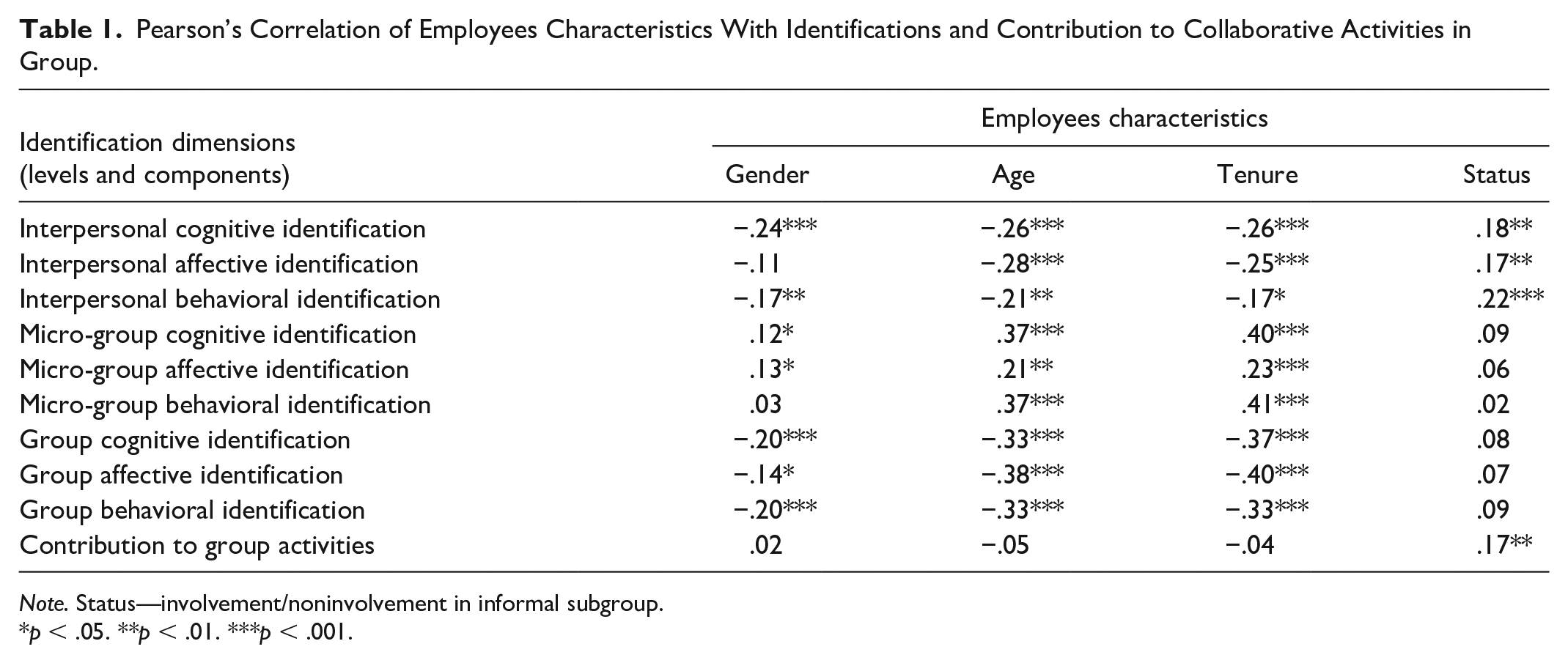
Note. Status—involvement/noninvolvement in informal subgroup.
p < .05. **p < .01. ***p < .001.
Next, we supposed that employee’s social-psychological status in workgroup—involvement/noninvolvement in informal subgroup—relates to interpersonal identification alone (H2). The significant positive correlations were found between involvement/noninvolvement status and all three components of interpersonal identification. As well, no significant ties were observed for micro-group and group identifications generally (Table 1). Thus, the H2 was confirmed too. Next, we suggested that employee’s status in the group may predict his or her contribution into collaborative activities within the group (H3), but not demographic characteristics (H4). The numbers in Table 1 confirm these suggestions.
Direct Links Between Identification Variables and Employees Contribution to Collaborative Group Activities
As we supposed in H5, group identification is a stronger predictor for an individual’s contribution to collaborative actions within a workgroup in comparison with interpersonal and micro-group identification. Regression analysis made for the entire survey sample showed (Table 2) that all the three group identification dimensions in aggregate with interpersonal and micro-group identifications have significantly positive relations to employees’ contribution to collaborative group activities. Accordingly, H5 has not been confirmed in full. Multiple regression analysis did not reveal any interaction effects between identification variables and employee’s contribution to collaborative group activities.
Results of Regression Analysis of Associations Between Identification Dimensions (Independent Variables) and Contribution to Collaborative Activities in Group (Dependant Variable).

Note. IP-C, IP-А, and IP-B—interpersonal cognitive, affective, and behavioral identifications, respectively; MgI-C, MgI-A, and MgI-B—micro-group cognitive, affective, and behavioral identifications, respectively; GI-C, GI-A, and GI-B—group cognitive, affective, and behavioral identifications, respectively.
p < .05. **p < .01.
Mediation Effects of Involvement in Subgroup Status on Identification Dimensions and Contribution to Collaborative Group Activity
It was also suggested employee involvement/noninvolvement status in the informal subgroup mediates identification dimensions and contribution to collaborative group activity (H6). To analyze mediation effects, we used the approach based on mainly considering the significance of indirect effects during mediation (X. Zhao et al., 2010). We take an involved/noninvolved status in the informal micro-group as a mediator (M). One of identification dimensions was an independent variable (X). We include step-by-step subscales of group identification, subscales of micro-group identification, and subscales of interpersonal identification. Contribution to collaborative group activities was the outcome variable (Y). The first computations show us a very small mediation effect on those predictors (Table 3). Further exploratory analysis shows that the measure of contribution to collaborative group activity was biased in terms of variation. The contribution to group activities distribution has the same value for many of employees, so it may bring an error term to the regression modeling step. According to Barron and Kenny, we use standard notation as follows: c—total effect, c′—direct effect, a × b indirect effect.
Mediating Effect of the Status (Involved/Noninvolved in Informal Subgroup) on Identification Variables and Contribution to Collaborative Activities in Group.

We use Model 2 for illustrating the effect of involved/noninvolved status in the informal subgroup on contribution to collaborative activities (Figure 2). In Step 1 of the mediation model, we found the significant regression of interpersonal affective identification (IP-А) on the contribution, ignoring the mediator: b = 0.01, t(299) = 2.23, p < .001. Step 2 also showed the significant regression of the IP-А on the mediator involved/noninvolved in the informal subgroup: b = 0.02, t(300) = 3.08, p < .001. Step 3 showed the mediation of involvement/noninvolvement in informal subgroup status on interpersonal affective identification was significant, too: b = 0.4, t(299) = 7.3, p < .001. Step 4 revealed that, controlling for the mediator (involved/noninvolved status in the informal subgroup), the interpersonal affective identification score was a significant predictor of contribution to collaborative group activities: y, b = 0.01, t(299) = 2.8, p < .001. It was found that involvement/noninvolvement in informal subgroup partly mediated interpersonal affective identification and contribution. Thus, the group members who are involved in informal subgroups, alongside with a stronger identification, increase their contribution to collaborative group activities (1 SD score more as compared with baseline).

Mediation effect of subgroup involvement status on the link between interpersonal affective identification and contribution to collaborative group activities.
It can be seen discrepancy for exposed relationships among the group members who are involved or noninvolved in informal subgroups (Table 2). Among involved members, you may see a low but significant positive relation between, on the one side, micro-group affective and group behavioral identification, and, on the other side, contribution to the group activities. By turn, interpersonal affective, group cognitive, and group affective identifications in noninvolved members have little effect on their contribution. Thus, the H6 may be considered proved. However, the mediation effect is weak and relates to affective dimension of interpersonal and micro-group identification as well as to all three components of group identification. This effect does not touch on cognitive and behavioral components of interpersonal and micro-group identification.
Discussion
We have known that female respondents in our Russian sample, as contrasted to males, have somewhat stronger cognitive and affective micro-group identification in organizational settings, but considerably weaker cognitive and behavioral dimensions of both interpersonal and group identification. Supposedly, females are likely more willing to associate with subgroups for conferring day-to-day, domestic, work, and other routine matters—that may be a ground for their disposition for stronger identification with the micro-group. Whereas males stronger align with their reference colleagues and the whole group, and it makes them to have stronger interpersonal and group identifications. Nevertheless, we admit the contradiction of this finding with other research where no effects had been observed between gender and group identification (e.g., Blader & Tyler, 2009). As well, there is very little mention of relations between gender and either interpersonal or micro-group identifications in an organizational context.
In our sample, employees, who are of younger age and shorter tenure, manifest stronger interpersonal and group identifications. We could explain this fact by saying that both young and new employees take time for adaptation of their conduct in the organizational settings. Such employees are more guided by the opinions and behavioral patterns of more experienced fellows in the organization, resulting in stronger interpersonal identification; as well, they tend to strictly follow the group norms and perspectives, resulting in stronger group identification. They have stronger feelings of association with some colleagues and the entire group. These levels of identification continue to abate with age and organizational tenure due to employees coping and assimilating with the social and professional experience within the organizational settings. Micro-group identification, quite the reverse, becomes stronger with age and tenure. Employees’ life experience acquired with age combined with the experience of including new fellows, being part of the group, has led to informal subgroups to become more referential and valued in comparison with individual group members and the entire workgroup. Informal subgroups constitute the special space within small groups and organizations. They can better support and secure their associates if we compare with the workgroup in whole.
Group members associated with any informal subgroup, as opposed to noninvolved members, manifest stronger interpersonal identification of all the three measures—cognitive, affective, and behavioral. They demonstrate more intensive cooperation, confidence, and attraction within the informal subgroups in comparison with the entire group (Sidorenkov et al., 2014). Group members that are involved in the subgroups show more significant contribution to collaborative group actions than members with noninvolved social-psychological status. This can be explained by stronger support and smaller coordination and motivational losses within subgroups in achieving the group objectives if compared with the performance of the entire group or its individual members noninvolved in the subgroups.
The significant positive relationship of group identification (for all components) with the contribution to in-group activities—that has been found in this research—is consistent with some studies presented in the relevant literature and contradicts others. However, this conclusion is relative because those researches explored either differing OCB dimensions or integral OCB in the group. For instance, there are the findings of significant positive ties between group identification and helping co-workers behavior (Van der Borgh et al., 2019), OCB-I (Kellison et al., 2013), extra-role (Hakonen & Lipponen, 2007), as well as lack of significant correlations with change-oriented (Seppälä et al., 2012), and helping behavior (Du et al., 2012). The positive relationship that we found can be explained by certain concepts of the self-categorization theory. When group identification as a social category becomes salient, individual self-perception gets depersonalized (Turner et al., 1987). It means the individual comes to see himself and others mainly as the exemplars of a social category that makes them part of a group, not unique personalities. That is why he or she apprehends, feels, and behaves in compliance with group interests, norms, and values. Intensification of identification with in-group leads to more intense collaborative actions (Ellemers et al., 2004) and increases their efforts to achieve group objectives (Wegge & Haslam, 2003).
Contribution to collaborative group activities, as well, is positively tied with micro-group identification. Informal subgroups are integral parts of the entire group, so feeling connected with the referent subgroup and related events have an impact on member’s contribution to the entire group activities. It is difficult to compare the correlations between micro-group identification and contribution to collaborative group activities founded in our research with the results of other studies, as we did not find any similar ones by the design and conceptual framework.
We found the positive ties between interpersonal cognitive identification of the group members that are not included into any subgroup, and their contribution into the group activities. This finding is consonant with other researchers that draw positive correlations between identification with colleagues and helping behavior (Farmer et al., 2015), and between identification with the supervisor and helping behavior (Carnevale et al., 2019), OCB-I (C. Zhao et al., 2016), and OCB-O and OCB-I (Wang & Jiang, 2015). Despite the fact that in our research the relationship was found only in a certain kind of group members who are not included into a subgroup, and using another OCB dimension, the consistency of the findings demonstrates a strong tendency for the relationship between the interpersonal identification and behavior.
In addition, if the three levels of identification are tied with an employee’s contribution to collaborative actions, it implies a compensatory effect. The weakening of one or two identification levels may not result in a significant decrease of contribution to collaborative group actions because one identification level weakening would be offset by strengthening in another one. Note that above-mentioned relations between identification dimensions and contribution to group activities always depend on involvement/noninvolvement in the informal subgroup of an employee.
Theoretical and Practical Implications
The finding presented in this article extends our understanding of the identifications of employees within the group and their relationships to OCB. Other researchers separately considered identifications with work group and with colleagues or supervisors and did not pay attention to the identification with an informal subgroup. They, too, typically discount the cognitive, affective, and behavioral components of identification. Our research demonstrates the importance of the comprehensive deliberation on all three levels (foci) and three components of identification treating them as OCB predictors. We propose an additional OCB dimension as the contribution to collaborative group activities, and we outlined the mediated effect of social-psychological status—involvement or noninvolvement of a group member in an informal subgroup—in the relationships between identification and contribution to group activities.
We see some practical implications of this research. Thus, managers are enabled in a differentiated way—by operating with different demographic characteristics: gender, age, tenure, and so on—to predict a possible impact of variable dimensions, levels, or components of identification on employee’s behavior. They can also forecast the contribution of each worker to collaborative group activities counting on the intensity of their group identification (all three components) as well as interpersonal and micro-group affective identifications. Human resources managers can devise some reasonable instruments to enhance intensity of different components of identification and, consequently, employee’s contribution to the group activities. For example, they could (a) increase perceived status of a work group in the organization, (b) highlight similarities of the group members and positive distinctions between their in-group and variety of out-groups, (c) set interdependent tasks for the group, (d) facilitate the group success in task performance, (e) involve employees in the decision-making process in the group, and (f) initiate competition groups with other groups. Managers should pay special attention to informal subgroups and, particularly, to involvement/noninvolvement of the worker in a subgroup. If there is an informal subgroup, whose goals and interests are very different from the goals and interests of the entire work group, then the members of this subgroup will probably very weakly identify themselves with the group, but strongly with their subgroup. Then, it is indeed that such workers have a weak contribution to collaborative group activities, and they may also hinder the successful work. Therefore, it is necessary to disintegrate such a subgroup partially or completely. When the goals and interests of the subgroup coincide with the goals and interests of the whole work group, then a strong micro-group identification of the subgroup members can increase their contribution to the group activities.
Limitations and Future Research
A narrow set of predictors (gender, age, and tenure) for identification dimensions in a group context was observed in this survey. Other independent variables would likely impact on dimensions of identification as well as on contribution to collaborative activities in groups, among which we might mention the following: individual personal traits, face-to-face interactions, emotional atmosphere within the group, and climate. Therefore, the ensuing studies need to be extended with the predicting variables. Another limitation is measuring the construct of contribution to the collaborative group activity. The literature suggests quite a number of particular measures of OCB. These may be aggregated into more comprehensive patterns: orientation to personal performance (sportsmanship, taking initiative, etc.), orientation to the others in the group (altruism, helping behavior, etc.), orientation to communication and relationships in group (courtesy, interpersonal facilitation, etc.), and orientation to group activity (taking charge, voice behavior, etc.). Exploration of relationships between identification dimensions and particular kinds of OCB would generate a more detailed picture of workgroup functioning in organizational settings, bearing in mind the existence of informal subgroups. Thereby, it makes possible to extend the range of assumptions concerning, first, that many kinds of OCB are salient in subgroup level, not in group. Second, interpersonal and micro-group identifications stronger mediate OCB in an informal subgroup than in the entire group.
Conclusion
Workgroup members have three levels of identification (interpersonal, micro-group, group) and each comprises three components—cognitive, affective, and behavioral. This identification model allows extending the scope of research and enhancing the understanding of the causes and effects of the employee’s identification in a group. There are common and specific features of identification predictors (demographic, tenure) and results (contribution to the collaborative group activity) at different dimensions. The identification dimensions and contribution to group activity have both direct and indirect relations mediated by the employee’s status of involvement/noninvolvement in the informal subgroup within group. The status has not been well examined in the previous organizational/group identification studies and OCB research. It is preferable to explore the impact of employees’ identification on their OCB in organizational settings at subgroup and group level, not the entire organization.
Footnotes
Declaration of Conflicting Interests
The author(s) declared the following potential conflicts of interest with respect to the research, authorship, and/or publication of this article: All procedures performed in studies involving human participants were in accordance with the ethical standards of the institutional and/or national research committee and with the 1964 Helsinki declaration and its later amendments or comparable ethical standards.
Funding
The author(s) disclosed receipt of the following financial support for the research, authorship, and/or publication of this article: This study was supported by the Russian Foundation for Basic Research (project no. 19-013-00393, “Identities and organizational behaviours of employees: A multilevel analysis”).
