




Abstract
It is essential to effectively integrate supply chain management and quality management, but a quality chain of suppliers and customers is a complex system relationship that remains poorly understood. An improved DEMATEL (Decision making trial and evaluation laboratory) and ISM (Interpretive structural modeling) integration approach was proposed to establish a systematic causal and hierarchical relationship of the quality enablers of supplier chain quality management (SCQM). The MICMAC method (cross-impact matrix multiplication applied to classification) was also used to classify the quality enablers of SCQM based on driving force and dependence force. The results suggest that organizations that develop SCQM implementation strategies should focus on quality enablers with high driving force, particularly on the quality enablers of strategy and leadership, information system usage and analysis, and cooperation and synergy of suppliers.
Introduction
Supply chain management (SCM) extends the concept of integrated management to all organizations involved in the supply chain, from suppliers of raw materials to the final customers. Commercial competition occurs at the firm level, and effective integration of the whole supply chain management can provide a competitive advantage (Lambert et al., 1998). Quality management refers to a quality-centered approach that involves all employees in various quality practices to satisfy customers and achieve long-term success. The incorporation of quality management principles into supply chain quality management (SCQM) will lead to maximum competitive advantage (Robinson & Malhotra, 2005). The goal of SCQM is to stably maintain the quality of a supply chain that can quickly respond to the needs of customers and the market to provide high-quality products and services. Since the initial description of SCQM by Ross (1998), there has been significant attention to models and measurement tools of SCQM. Kim (2009) also declared SCQM as a win-win model of organizations among supply chains to provide customers with the best product or service quality.
SCQM can be considered the expansion of quality management principles from a single company to a supply chain. Several studies reported that SCQM can positively influence a company’s performance (Hussain et al., 2020; Kahnali & Taghavi, 2010; Sidhu et al., 2019; Soares et al., 2017; Zeng et al., 2013). Other studies have focused on the verification of external variables. For example, Hong et al. (2019) showed that SCQM can positively influence operational performance and innovation. Choi et al. (2020) analyzed the relationships of improvement activities, business performance, and SCQM. Zaid et al. (2021) validated the relationship between SCQM practice and business performance and found that knowledge transfer mediated this relationship. V. H. Lee et al. (2021) validated positive relationships between SCQM and organizational learning capabilities and product innovation performance for small and medium-sized manufacturing enterprises. Abdallah et al. (2021) characterized the effects of SCQM, supply chain agility, and innovation on supply chain performance. Lim et al. (2021) found that SCQM improves sustainability performance. Overall, these studies demonstrated the importance of SCQM and suggest further practical applications.
The motivation of this study was to develop strategies to better study the SCQM as a complex system. The relationships between different factors may not be linear, and it is essential to study the causal and systematic hierarchical relationship of factors in SCQM from the perspective of a complex system. The concept of quality chain (Troczynski, 1996) integrated many major quality management concepts with the supply chain as a closed loop to comprehensively express the complex interactions among multiple units. The factors affecting different units may be expressed as functions and can also influence the relationships of other factors (Y. K. Lee & Yeom, 2007). Oakland (2000) proposed that quality chains of customers and suppliers could be disrupted if mechanisms were not fully understood. Hence, it is imperative to effectively identify the causal and hierarchical relationships of all factors in SCQM. However, few studies have analyzed SCQM from the perspective of a complex system.
The main purpose of this study was to identify the causal relationships of quality enablers of SCQM and partition the hierarchical structure of these quality enablers from the perspective of complex system analysis. To do this, data from previous related studies were collected and organized, and then an improved DEMATEL-ISM integration approach was developed for analysis. This proposed integrated approach requires only simple calculation, but simultaneously analyzes the causal relationships and hierarchical structure of quality enablers. This approach overcomes the limitations of the traditional DEMATEL-ISM integration method for improved accuracy. The MICMAC method (cross-impact matrix multiplication applied to classification) was also used to classify the quality enablers of SCQM based on driving force and dependence force. The results of this work can able help organizations determine the causal and systematic hierarchical relationships of quality enablers and better understand driving forces of these factors to develop effective SCQM implementation strategies.
Literature Review
Quality Enablers in SCQM
Previous studies identified many quality enablers of SCQM used in quality management (QM) and total quality management (TQM). For example, Sila and Ebrahimpour (2003) conducted a literature review of the studies from 1989 to 2000 and extracted 11 factors for TQM practice. Kutlu and Kadaifci (2014) extracted the significant factors of TQM implementation from studies from 1989 to 2000 using fuzzy cognitive mapping. Hu and Zhao (2018) identified six critical factors of SCQM: quality of strategic supply chain design, the effect of supply chain leadership on quality, internal quality integration, upstream and downstream quality management systems, and product recall system. Tayyab et al. (2022) found seven critical factors of SCQM practice: customer focus, leadership, process management, supplier relations, quality practice, human resources, and safety. There is significant variation in the factors identified in different studies as necessary for different research industries or purposes. The critical quality enablers of SCQM used in previous studies are listed in Table 1.
Critical Quality Enablers in SCQM Studies.
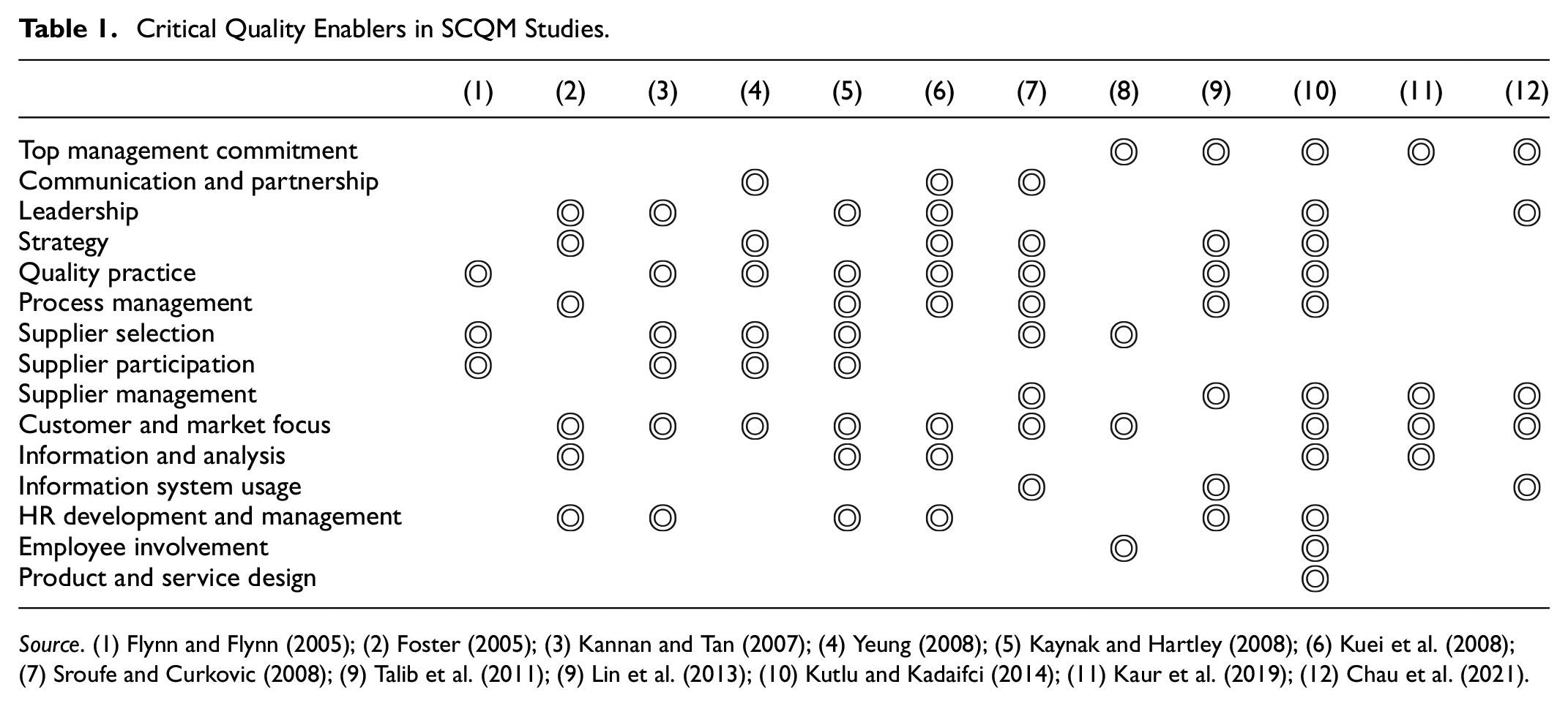
Source. (1) Flynn and Flynn (2005); (2) Foster (2005); (3) Kannan and Tan (2007); (4) Yeung (2008); (5) Kaynak and Hartley (2008); (6) Kuei et al. (2008);(7) Sroufe and Curkovic (2008); (9) Talib et al. (2011); (9) Lin et al. (2013); (10) Kutlu and Kadaifci (2014); (11) Kaur et al. (2019); (12) Chau et al. (2021).
After collecting the enablers identified previously, we re-defined and organized the enablers. Management strategy and leadership were integrated into a single enabler. Similarly, supplier management combined supplier selection and participation, information system usage combined information and analysis, and HR development and management comprise employee training. Kirezieva et al. (2013) and Chen et al. (2014) found cooperation and collaboration among elements of a food quality chain. This organization resulted in a total of 10 enablers that were used for analysis (Table 2).
Identification of Quality Enablers.

Traditional DEMATEL-ISM Integration Method
DEMATEL was developed by the Battelle Memorial Institute in Geneva (Gabus & Fontela, 1973). The ISM was proposed by Duperrin and Godet (1973). Both DEMATEL and ISM represent the relationship between influence factors through expert evaluation, expressed as a matrix. The influence relationship of influence factors is calculated through different principles. Both tools have been widely used (Bohtan et al., 2017; Seleem et al., 2016). However, Zhao et al. (2006) proposed a an integration method of the DEMATEL and ISM. The authors believed that the reachability matrix of ISM is computed with heavy and complex. In addition, the total-relation matrix of DEMATEL contains more detailed information. Hence authors proposed a set of algorithms to transform from the total-relation matrix to the reachability matrix to obtain the hierarchy of the influencing factors. This integration method has been subsequently adopted in many studies. For instance, it was used to identify CSFs (critical success factors) among government and non-profits for geo-disaster emergency decisions (Hou & Xiao, 2015); it was used to analyze influencing factors of runway incursion risk (Zhang & Luo, 2017); it was used to analyze factors affecting project communications (Wang et al., 2018); it was used to identify influencing factors in coal mine production safety (Shakeria & Khalilzadeh, 2020); it was used to identify the influencing factors of cross-border e-commerce supply chain resilience (Liu et al., 2021). However, some disadvantages lead to the inability to obtain accurate results in this DEMATEL–ISM integration method (traditional integration method is called in a subsequent part of this study). The detailed calculations and problems are described in the following.
The traditional integration method, first, invites the experts to evaluate the level of the direct influence relationship between the two factors in the DEMATEL analysis, and then puts the value of average evaluation of the experts to compose a direct-relation matrix (X):

Taking the maximum of the sum of the rows of the direct-relation matrix (X) as the normalized standard value, after normalizing direct-relation matrix (X) becomes the normalized direct-relation matrix (N) according to the following formula:

The total-relation matrix (T) is able to be obtained from the normalized direct-relation matrix (N) according to the following formula, where I represent identity matrix, (I − N)−1 represent the inverse matrix of (I − N):

The authors claimed that because the total-relation matrix (T) does not contain the influence effect of the factors on itself, thus the identity matrix I is added to construct the full-relation matrix (H). However, since the range of values of elements in the reachability matrix of ISM is {0,1}, the full-relation matrix (H) does not conform to this characteristic. The decision-makers can set the threshold (λ) by their knowledge and/or experience to compare and transform the elements to solve this problem. The full-relation matrix (H) can be transformed directly into the reachability matrix (K) based on the following conditions:

Based on reachability matrix K, determining the reachability set and the antecedent set, follow the following steps that the hierarchy structure of influence factors is able to be established:
(1) Identification of reachability set and antecedent set
The reachability set is the set where each factor affects all factors, that is, all other factors in the reachability matrix (K) where rows are displayed as 1, it is represented at R (i). The antecedent set is the set where all factors are affected by the factor, that is, all other factors in the reachability matrix (K) where columns are displayed as 1, it is represented at A (i).
(2) The level partition based on the intersection set C (i) of R (i) and A (i)
Firstly, to identify the intersection C (i) of the reachability set R (i) and the antecedent set A (i) for each factor. While elements of C (i) are the same as elements of R (i), the corresponding factors are the first tier factors and then removed from a column I and row I of the final reachability matrix (k). Repeat this step to gradually establish the hierarchical structure of the factors until all the factors are removed. The multilevel hierarchical structure of the factors is able to be established.
Problematic and Discussions
Although the full-relation matrix (H) contains the influence of factors, adding the identity matrix I directly may lead to contradictions because the diagonal value of the total-relation matrix (T) may not all be equal to 0. Besides, it comes through the calculation of
The reachability matrix ISM is obtained via the Boolean algebra operating rule
Furthermore, there are absent scientific computational methods for the threshold, only set by decision-makers based on their knowledge or/and experience, which may have reduced the accuracy of the analysis by being too subjective. This study proposes a threshold calculation method called the margin of error method (MEM), described in more detail below Section 3.1.
Improved DEMATEL-ISM Integration Approach
The Threshold Calculation Method: Margin of Error Method (MEM)
Lenth (1989) proposed an effect-sparsity assumption where the main effect and some low-order interactions have specific effects on the response variables while many high-order interactions can be ignored. This proposed assumption is consistent with the DEMATEL threshold. The effect-sparse hypothesis concept was used in this study to calculate the threshold. Its stepwise implementation is as follows:
(1) Bottom value (S0) calculation:

where
(2) Pseudo-standard error (PSE) calculation:

where
(3) The margin of error (ME) calculation:

where
The Law of Transitivity and Transitivity Check and Conversion
Assuming an example of a reachability matrix, the left half in Figure 1, the right half in Figure 1 represent the direct influence relationship between the factors.

Assumed initial reachability matrix and direct influence relationship.
But the reachability matrix of ISM should contain the direct and indirect influence relationship between factors, hence for factor a, it does not only directly affect factor b but also affect factor c. Factors d and e are indirectly affected by factor a. Factor b also indirectly affects factors d and e, while factor c indirectly affects factor e. Check all factors on this principle; ensure that all indirect effects can be drawn on the right side of factor influence drawing. Then modify the initial reachability matrix from 0 to 1 if it indirectly affects existence, as the right half of Figure 2 (in bold and plus *). Only after passing the transitivity check and conversion, the matrix can accord with the principle of ISM to be a real final reachability matrix. Based on this matrix, the causal relationship and hierarchical structure of quality enablers can be obtained really.

Full influence relation and final reachability matrix.
The Description of Proposed Improved Integration Approach Step
The proposed improved integration approach is described as follows:
Identify critical quality enablers in SCQM;
Using the DEMATEL method until the total-relation matrix (T) is obtained;
The threshold is calculated by using the MEM method; then change the element to be 0 if it is less than the threshold; change the element to be 1 if it is equal to or greater than the threshold;
All elements in the diagonal of the matrix, which after compared to a threshold and transformed are modified and/or hold be 1, to be the initial reachability matrix;
Performing the transitivity check and conversion to transform the initial reachability matrix into the final reachability matrix;
Perform the level partition of the ISM process based on the final reachability matrix;
Using MICMAC analyze the final reachability matrix. Define tij as elements of the ith row and jth column in the final reachability matrix, then calculate the total affect and total affected. The total affect (Ai) is equal to:

Flow of improved integrated DEAMTEL-ISM approach and MICMAC analysis.
Case-Based Analysis
Survey and Analysis
With high-tech enterprises in China’s Guangdong-Hong Kong-Macao Greater Bay Area, 36 industry experts who manage and implement SCQM activities in the enterprise and 21 experts who teach SCM, SCQM, or QM from colleges were invited in order to evaluate the mutual influence of the quality enablers. Forty-six valid responses were obtained, with 29 respondents coming from industry and 17 respondents coming from colleges. These valid responses were averaged to establish a direct-relation matrix, as shown in Table 3.
The Result of Direct-Relation Matrix.

The total-relation matrix was calculated according to the computational steps of DEMATEL, and the result is shown in Table 4.
The Result of Total-Relation Matrix.

Threshold calculated by MEM method
Using total-relation matrix, the threshold was then calculated by the MEM method. After applying the calculation steps described in Section 3.1, the median
The Result of Initial Reachability Matrix.

Transitivity check and conversion
According to the law of transitivity, there is an indirect relationship between many enablers, and after transitivity check and conversion, certain elements are modified to 1, it becomes the final reachability matrix (as shown in the 1 marked in bold with an asterisk in Table 6).
The Result of Final Reachability Matrix.

Level partition and MICMAC analysis
According to the level partition process of ISM, partition the final reachability matrix into a multi-hierarchical structure. The process and results are shown in Table 7.
The Process and Result of Level Partition.

All the quality enablers of SCQM were divided into five layers based on the proposed improved integration approach. “Customer and market focus” (E5), “Product and service design” (E9), and “Cooperation and synergy” (E10) are assigned at the Level I and placed at the top, followed by “Supplier management” (E4) at Level II. The complete multi-hierarchical structure diagram is shown in Figure 4.
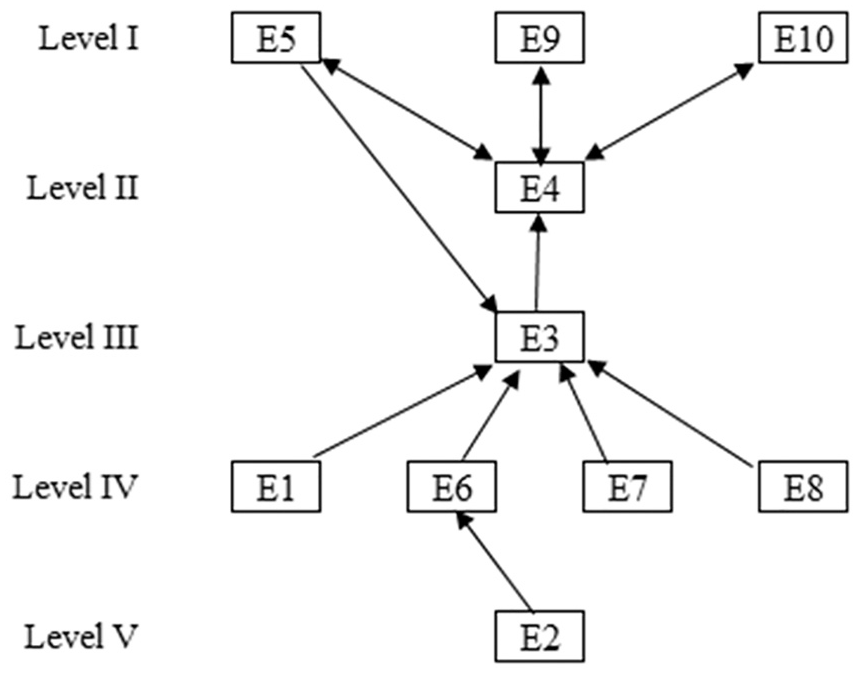
Level partitioning of quality enablers of SCQM.
The driver-dependence matrix diagram through MICMAC analysis is obtained according to the final reachability matrix. It helps to classify and collate enablers in driving and dependence powers. The result is shown in Figure 5.
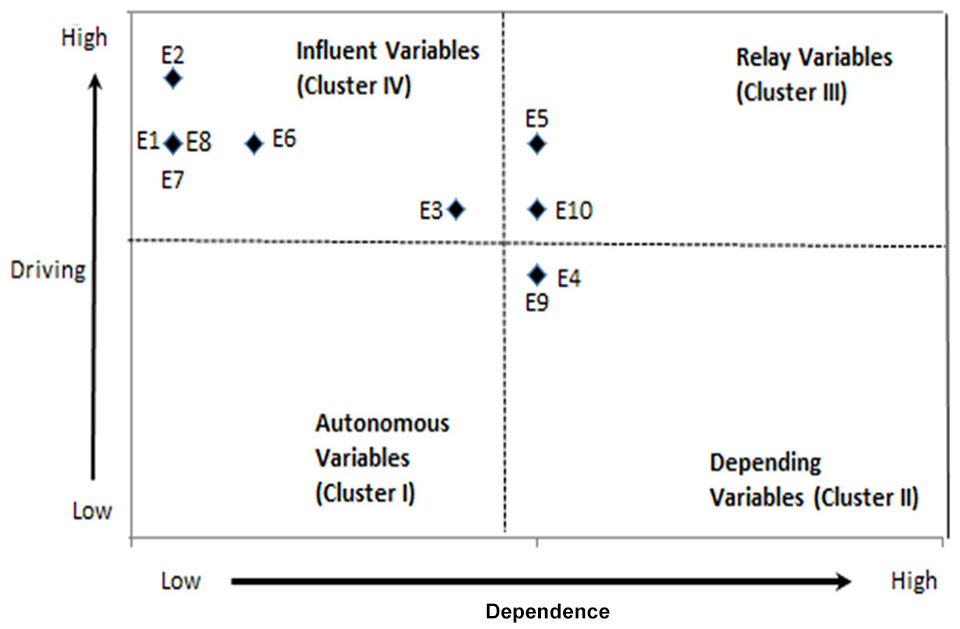
Driver-dependence matrix diagram of quality enablers of SCQM.
Together with level partition of ISM analysis, both diagrams provide valuable managerial implications and insight about the hierarchical, interdependence, and attribute among the quality enablers of SCQM.
Results and Discussion
According to Figure 4, the hierarchy from applying the improved integrated DEMATEL-ISM model, “Strategy & Leadership” (E2), occupies the bottom level. “Top management commitment” (E1), “Information system usage & analysis” (E6), “HR development and management” (E7), “Employee involvement” (E8) occupy Level IV. “QM practice” (E3) occupy Level III, and “Supplier management” (E4) occupy Level II while “Customer and market focus” (E5), “Product and service design” (E9), and “Cooperation and synergy” (E10) occupy Level I. Based on the causal relationships, “Strategy & Leadership” (E2) leads to the flow of “Information system usage & analysis” (E6), and “Information system usage & analysis” (E6), leads to the flow of “QM” (E3). Enablers “Top management commitment” (E1), “Information system usage & analysis” (E6), “HR development and management” (E7), “Employee involvement” (E8) and “Customer and market focus” (E5) lead to the flow of QM (E3), and “QM (E3) leads to the flow of “Supplier management” (E4). “Supplier management” (E4), “Customer and market focus” (E5), “Product and service design” (E9), and “Cooperation and synergy” (E10) are interrelated. The driver-dependence matrix diagram shows that “Strategy & Leadership” (E2) lies at the bottom level of the hierarchy and has the strongest driving force, indicating this is the most important enabler for the SCQM implementation. Organizational managements must first have a reasonable strategy and sufficient leadership to promote the effective development of related activities of SCQM.
Enablers such as “Top management commitment” (E1), “Strategy & Leadership” (E2), “QM” (E3), “Information system usage & analysis” (E6), “HR development and management” (E7), and “Employee involvement” (E8) are combined in the cluster IV of the driver-dependence matrix diagram. These enablers have a strong driving force and weak dependence force, called influent variables. In addition, these enablers lie in the lower portion of the hierarchy, and top management must emphasize and manage these enablers in order to SCQM implement successfully. As in many previous studies, effective top management plays an essential role in the success of QM implementation in organizations (Dewangan et al., 2015; Dubey & Singh, 2015). An effective strategy, good leadership, and the commitment and support of top management are essential to organizational performance. SCQM program implementation involves hiring consultants if required, talent recruitment and training, employee motivation and participation, upgrades to equipment, layout modifications, and supply chain management. All these activities require funds and time for implementation, requiring prioritization by the top management. Once the subject and implementation are identified, top management needs to deploy trained personnel and teams with sufficient resources. The team should be authorized to master the decision-making ability. In addition, effective organizational HR and employee involvement can enable organizations to apply better quality practices and improve the supplier chain via appropriate supplier management. SCQM implementation will succeed only if the top management is fully dedicated and devoted effort (Bhatia & Awasthi, 2018). Information technology (IT) is essential in SCQM because it transmits information to integrate all vendors in the supply chain, making SCQM more effective.
Enablers “Supplier management” (E4) and “Product and service design” (E9) lie near the center part of the driver-dependence matrix diagram, indicating these enablers have a medium driving force and medium dependence force. They are relatively unstable and require the consistent attention of top management since changes in these enablers will affect others and themselves. Enablers “Customers and market focus” (E5) and “Cooperation and synergy” (E10) are classified as relay variables. These factors belong to a higher portion of the hierarchy and depend on the lower portion of the hierarchy. In other words, if an organization understands what the market and customer want and provides services or products to satisfy their requirements, there will be a competitive advantage. In particular, an organization must focus on the “cooperation and synergy” of suppliers, as found previously in the studies from Jung and Kim (2014) and Jung and Son (2016). Good cooperation of suppliers can facilitate smooth SCQM implementation. Suppose organizations want SCQM to achieve maximum effect. In that case, it requires more than implementing QM in the organization and then extending it to suppliers. Organizations must understand the interactions among enablers and their systematic hierarchy and identify the factors with driving force and dependence force.
Conclusion
The main purpose of this study was to identify and model the quality enablers of SCQM and analyze the interactions of these enablers for the successful implementation of SCQM. To achieve these objectives, we developed an improved DEMATEL and ISM integration approach to establish a systematic structural hierarchy model. The MICMAC method was used to analyze the driving force and dependence force of enablers, and then the enablers were classified into four clusters. This classification can reveal interactions among quality enablers, allowing the management of an organization to focus on enablers with high driving force and develop effective SCQM implementation strategies. The results showed that enablers Strategy & Leadership occupies the bottom level; Top management commitment, Information system usage & analysis, HR development and management, and Employee involvement occupy Level IV; QM practice occupies Level III; Supplier management occupies Level II; and Customer and market focus, Product and service design, and Cooperation and synergy occupy Level I. Analysis revealed that enablers Top management commitment, Strategy & Leadership, QM practice, Information system usage & analysis, HR development and management, and Employee involvement are classified as influent variables; enablers Customers and market focus and Cooperation and synergy are classified as relay variables; enablers Supplier management and Product and service design are classified as dependent variables. Overall, the results show that Customers and market focus and Cooperation and synergy are critical enablers for SCQM implementation.
This study demonstrates how to determine the hierarchical structure and causal relationships of quality enablers of SCQM and to classify the quality enablers based on driving force and dependence force. The results can help organizations develop effective SCQM implementation strategies. This study presents an improved DEMATEL-ISM integration approach for increased accuracy of the analysis.
There are limitations to this work. In particular, this integrated DEMATEL-ISM approach has not been statistically validated. Future work should use structural equation modeling (SEM) to test overall model validity and to assess specific aspects of SCQM such as environmental, sustainability, operational, and tactical components. The analysis scope of this study was limited to high-tech companies in the Guangdong-Hong Kong-Macao Greater Bay region of China, and future work should investigate other regions/countries and specific industries.
Footnotes
Declaration of Conflicting Interests
The author(s) declared no potential conflicts of interest with respect to the research, authorship, and/or publication of this article.
Funding
The author(s) received no financial support for the research, authorship, and/or publication of this article.
